• About

Sacred Cow Chips

Sacred Cow Chips

Tag Archives: Climate Change

Promises and Policies: Grading the Candidates

29 Tuesday Oct 2024

Posted by Nuetzel in Election

≈ Leave a comment

Tags

2024 Election, Abortion, Abraham Accords, Barack Obama, Capitalism, Climate Change, Corporatism, DEI, Dobbs, Donald Trump, Elon Musk, fascism, Federal Reserve, First Amendment, Fossil fuels, Housing, Hysteria, Immigration, Inflation, Israel, Joe Biden, Kamala Harris, Medicaid, Medicare, Obamacare, Renewable energy, Second Amendment, Social Security, Supreme Court, Tariffs, Tax Policy, Ukraine, Vladimir Putin

Wow! We’re less than a week from Election Day! I’d hoped to write a few more detailed posts about the platforms and policies of Kamala Harris and Donald Trump, but I was waylaid by Hurricane Milton. It sent us scrambling into prep mode, then we evacuated to the Florida Panhandle. The drive there and back took much longer than expected due to the mass exodus. On our return we found the house was fine, but there was significant damage to an exterior structure and a mess in the yard. We also had to “de-prep” the house, and we’ve been dealing with contractors ever since. It was an exhausting episode, but we feel like we were very lucky.

Now, with less than a week left till the election, I’ll limit myself to a summary of the positions of the candidates in a number of areas, mostly but not all directly related to policy. I assign “grades” in each area and calculate an equally-weighted “GPA” for each candidate. My summaries (and “grades”) are pretty off-the-cuff and not adequate treatments on their own. Some of these areas are more general than others, and I readily admit that a GPA taken from my grade assignments is subject to a bit of double counting. Oh well!

Role of Government: Kamala Harris is a statist through and through. No mystery there. Trump is more selective in his statist tendencies. He’ll often favor government action if it’s politically advantageous. However, in general I think he is amenable to a smaller role for the public than the private sector. Harris: F; Trump: C

Regulation: There is no question that Trump stands for badly needed federal regulatory reform. This spans a wide range of areas, and it extends to a light approach to crypto and AI regulation. Trump plans to appoint Elon Musk as his “Secretary of Cost Cutting”. Harris, on the other hand, seems to favor a continuation of the Biden Administration’s heavy regulatory oversight. This encourages a bloated federal bureaucracy, inflicts high compliance costs on the private sector, stifles innovation, and tends to concentrate industrial power. Harris: F; Trump: A

Border Policy: Trump wants to close the borders (complete the wall) and deport illegal immigrants. Both are easier said than done. Except for criminal elements, the latter will be especially controversial. I’d feel better about Trump’s position if it were accompanied by a commitment to expanded legal immigration. We need more legal immigrants, especially the highly skilled. For her part, Harris would offer mass amnesty to illegals. She’d continue an open border policy, though she claims to want certain limits on illegal border crossings going forward. She also claims to favor more funds for border control. However, it is not clear how well this would translate into thorough vetting of illegal entrants, drug interdiction at the border, or sex trafficking. Harris: D; Trump: B-

Antitrust: Accusations of price gouging by American businesses? Harris! Forty three corporations in the S&P 500 under investigation by the DOJ? The Biden-Harris Administration. This reflects an aggressively hostile and manipulative attitude toward the business community. Trump, meanwhile, might wheedle corporations to act on behalf of certain of his agendas, but he is unlikely to take such a broadly punitive approach. Harris: F; Trump: B-

Foreign Policy: Harris is likely to continue the Biden Administration’s conciliatory approach to dealing with America’s adversaries. The other side of that coin is an often tepid commitment to longtime allies like Israel. Trump believes that dealing from a position of strength is imperative, and he’s willing to challenge enemies with an array of economic and political sticks and carrots. He had success during his first term in office promoting peace in the Middle East. A renewed version of the Abraham Accords that strengthened economic ties across the region would do just that. Ideally, he would like to restore the strength of America’s military, about which Harris has less interest. Trump has also shown a willingness to challenge our NATO partners in order to get them to “pay their fair share” toward the alliance’s shared defense. My major qualification here has to do with the candidates’ positions with respect to supporting Ukraine in its war against Putin’s mad aggression. Harris seems more likely than Trump to continue America’s support for Ukraine. Harris: D+; Trump: B-

Trade: Nations who trade with one another tend to be more prosperous and at peace. Unfortunately, neither candidate has much recognition of these facts. Harris is willing to extend the tariffs enforced during the Biden Administration. Trump, however, is under the delusion that tariffs can solve almost anything that ails the country. Of course, tariffs are a destructive tax on American consumers and businesses. Part of this owes to the direct effects of the tax. Part owes to the pricing power tariffs grant to domestic producers. Tariffs harm incentives for efficiency and the competitiveness of American industry. Retaliatory action by foreign governments is a likely response, which magnifies the harm.

To be fair, Trump believes he can use tariffs as a negotiating tool in nearly all international matters, whether economic, political, or military. This might work to achieve some objectives, but at the cost of damaging relations more broadly and undermining the U.S. economy. Trump is an advocate for not just selective, punitive tariffs, but for broad application of tariffs. Someone needs to disabuse him of the notion that tariffs have great revenue-raising potential. They don’t. And Trump is seemingly unaware of another basic fact: the trade deficit is mirrored by foreign investment in the U.S. economy, which spurs domestic economic growth. Quashing imports via tariffs will also quash that source of growth. I’ll add one other qualification below in the section on taxes, but I’m not sure it has a meaningful chance.

Harris: C-; Trump: F

Inflation: This is a tough one to grade. The President has no direct control over inflation. Harris wants to challenge “price gougers”, which has little to do with actual inflation. I expect both candidates to tolerate large deficits in order to fulfill campaign promises and other objectives. That will put pressure on credit markets and is likely to be inflationary if bond investors are surprised by the higher trajectory of permanent government indebtedness, or if the Federal Reserve monetizes increasing amounts of federal debt. Deficits are likely to be larger under Trump than Harris due in large part to differences in their tax plans, but I’m skeptical that Harris will hold spending in check. Trump’s policies are more growth oriented, and these along with his energy policies and deregulatory actions could limit the inflationary consequences of his spending and tax policies. Higher tariffs will not be of much help in funding larger deficits, and in fact they will be inflationary. Harris: C; Trump: C

Federal Reserve Independence: Harris would undoubtedly like to have the Fed partner closely with the Treasury in funding federal spending. Her appointments to the Board would almost certainly lead to a more activist Fed with a willingness to tolerate rapid monetary expansion and inflation. Trump might be even worse. He has signaled disdain for the Fed’s independence, and he would be happy to lean on the Fed to ease his efforts to fulfill promises to special interests. Harris: D; Trump: F

Entitlement Reform: Social Security and Medicare are both insolvent and benefits will be cut in 2035 without reforms. Harris would certainly be willing to tax the benefits of higher-income retirees more heavily, and she would likely be willing to impose FICA and Medicare taxes on incomes above current earning limits. These are not my favorite reform proposals. Trump has been silent on the issue except to promise no cuts in benefits. Harris: C-; Trump: F

Health Care: Harris is an Obamacare supporter and an advocate of expanded Medicaid. She favors policies that would short-circuit consumer discipline for health care spending and hasten the depletion of the already insolvent Medicare and Medicaid trust funds. These include a $2,000 cap on health care spending for Americans on Medicare, having Medicare cover in-home care, and extending tax credits for health insurance premia. She supports funding to address presumed health care disparities faced by black men. She also promises efforts to discipline or supplant pharmacy benefit managers. Trump, for his part, has said little about his plans for health care policy. He is not a fan of Obamacare and he has promised to take on Big Pharma, whatever that might mean. I fear that both candidates would happily place additional controls of the pricing of pharmaceuticals, a sure prescription for curtailed research and development and higher mortality. Harris: F; Trump: D+

Abortion: The Supreme Court’s 2022 decision in Dobbs v. Jackson essentially relegated abortion law to individual states. That’s consistent with federalist principles, leaving the controversial balancing of abortion vs. the unborn child’s rights up to state voters. Geographic differences of opinion on this question are dramatic, and Dobbs respects those differences. Trump is content with it. Meanwhile, Harris advocates for the establishment of expanded abortion rights at the federal level, including authorization of third trimester abortions by “care providers”. And Harris does not believe there should be religious exemptions for providers who do not wish to offer abortion services. No doubt she also approves of federally funded abortions. Harris: F; Trump: A

Housing: The nation faces an acute housing shortage owing to excessive regulation that limits construction of new or revitalized housing. These excessive rules are primarily imposed at the state and local level. While the federal government has little direct control over many of these decisions, it has abetted this regulatory onslaught in a variety of ways, especially in the environmental arena. Harris is offering stimulus to the demand side through a $25,000 housing tax credit for first-time home buyers. This will succeed in raising the cost of housing. She has also called for heavier subsidies for developers of low-income housing. If past is prologue, this might do more to line the pockets of developers than add meaningfully to the stock of affordable housing. Harris also favors rent controls, a sure prescription for deterioration in the housing stock, and she would prohibit software allowing landlords to determine competitive neighborhood rents. Trump has called for deregulation generally and would not favor rent controls. Harris: F; Trump B

Taxes: Harris has broached several wildly destructive tax proposals. Perhaps the worst of these is to tax unrealized capital gains, and while she promises it would apply only to extremely wealthy taxpayers, it would constitute a wealth tax. Once that line is crossed, the threat of widening the base becomes a very slippery slope. It would also be a strong detriment to domestic capital investment and economic growth. Harris would increase the top marginal personal tax rate and the corporate tax rate, which would discourage investment and undermine real wage growth. She’d also increase estate tax rates. As discussed above, she unwisely calls for a $25,000 tax credit for first-time homebuyers. She also wants to expand the child care tax credit to $6,000 for families with newborns. A proposed $50,000 small business tax credit would allow the federal government to subsidize and encourage risky entrepreneurial activity at taxpayers’ expense. I’m all for small business, but this style of industrial planning is bonkers. She would sunset the Trump (TCJA) tax cuts in 2026.

Finally, Harris has mimicked Trump in calling for no taxes on tips. Treating certain forms of income more favorably than others is a recipe for distortions in economic activity. Employers of tip-earning workers will find ways to shift employees’ income to tips that are mandatory for patrons. It will also skew labor supply decisions toward occupations that would otherwise have less economic value. But Trump managed to find an idea so politically seductive that Harris couldn’t resist.

Trump’s tax plans are a mixed bag of good and bad ideas. They include extending his earlier tax cuts (TCJA) and restoring the SALT deduction. The latter is an alluring campaign tidbit for voters in high-tax states. He would reduce the corporate tax rate, which I strongly favor. Corporate income is double-taxed, which is a detriment to growth as well as a weight on real wages. He would eliminate taxes on overtime income, another example of favoring a particular form of income over others. Wage earners would gain at the expense of salaried employees, so one could expect a transition in the form employees are paid over time. Otherwise, the classification of hours as “overtime” would have to be standardized. One could expect existing employees to work longer hours, but at the expense of new jobs. Finally, Trump says Social Security benefits should not be taxed, another kind of special treatment by form of income. This might encourage early retirement and become an additional drain on the Social Security Trust Fund.

The higher tariffs promised by Trump would collect some revenue. I’d be more supportive of this plank if the tariffs were part of a larger transition from income taxes to consumption taxes. However, Trump would still like to see large differentials between tariffs and taxes imposed on the consumption of domestically-produced goods and services.

Harris: F; Trump C+

Climate Policy: This topic has undergone a steep decline in relative importance to voters. Harris favors more drastic climate interventions than Trump, including steep renewable subsidies, EV mandates, and a panoply of other initiatives, many of which would carry over from the Biden Administration. Harris: F; Trump: B

Energy: Low-cost energy encourages economic growth. Just ask the Germans! Consistent with the climate change narrative, Harris wishes to discourage the use of fossil fuels, their domestic production, and even their export. She has been very dodgy with respect to restrictions on fracking. Her apparent stance on energy policy would be an obvious detriment to growth and price stability (or I should say a continuing detriment). Trump wishes to encourage fossil fuel production. Harris: F; Trump: A

Constitutional Integrity: Harris has supported the idea of packing the Supreme Court, which would lead to an escalating competition to appoint more and more justices with every shift in political power. She’s also disparaged the Electoral College, without which many states would never have agreed to join the Union. Under the questionable pretense of “protecting voting rights”, she has opposed steps to improve election integrity, such voter ID laws. And operatives within her party have done everything possible to register non-citizens as voters. Harris: F; Trump: A

First Amendment Rights: Harris has called for regulation and oversight of social media content and moderation. A more descriptive word for this is censorship. Trump is generally a free speech advocate. Harris: F; Trump A-

Second Amendment Rights: Harris would like to ban so-called “assault weapons” and high-capacity magazines, and she backs universal background checks for gun purchases. Trump has not called for any new restrictions on gun rights. Harris: F; Trump: A

DEI: Harris is strongly supportive of diversity and equity initiatives, which have undermined social cohesion and the economy. That necessarily makes her an enemy of merit-based rewards. Trump has no such confusion. Harris: F; Trump: A

Hysteria: The Harris campaign has embraced a strategy of demonizing Donald Trump. Of course, that’s not a new approach among Democrats, who have fabricated bizarre stories about Trump escapades in Russia, Trump as a pawn of Vladimir Putin, and Russian manipulation of the 2016 Trump campaign. Congressional democrats spent nearly all of Trump’s first term in office trying to find grounds for impeachment. Concurrently, there were a number of other crazy and false stories about Trump. The current variation on “Orange Man Bad” is that Trump is a fascist and a Nazi, and that all of his supporters are Nazis. And that Trump will use the military against his domestic political opponents, the so-called “enemy within”. And that Trump will send half the country’s populace to labor camps. The nonsense never ends, but could anything more powerfully ignite the passions of violent extremists than this sort of hateful rhetoric? Would it not be surprising if at least a few leftists weren’t interested in assassinating “Hitler” himself. This is hysteria, and one has to wonder if that is not, in fact, the intent.

Can any of these people actually define the term fascist? Most fundamentally, a fascist desires the use of government coercion for private gain (of wealth or power) for oneself and/or one’s circle of allies. By that definition, we could probably categorize a great many American politicians as fascists, including Barack Obama, Joe Biden, Donald Trump, and a majority of both houses of Congress. That only demonstrates that corporatism is fundamental to fascist politics. Less-informed definitions of fascism conflate it with everything from racism (certainly can play a part) and homophobia (certainly can play a part) to mere capitalism. But take a look at the demographics of Trump’s supporters and you can see that most of these definitions are inapt.

Is the Trump campaign suffering from any form of hysteria? It’s shown great talent at poking fun at the left. Of course, Trump’s reactions to illegal immigration, crime, and third-trimester abortions are construed by leftists to be hysterical. I mean, why would anyone get upset about those kinds of things?

Harris: F; Trump: A

“Grade Point Average”

I’m sure I forgot an area or two I should have covered. Anyway, the following are four-point “GPAs” calculated over 20 categories. I’m deducting a quarter point for a “minus” grade and adding a quarter point for a “plus” grade. Here’s what I get:

Harris: 0.44; Trump: 2.68

Hmmm

Wind, Solar, and the Five Circles of Dormant Capital

22 Monday Apr 2024

Posted by Nuetzel in Energy, Global Warming, Industrial Policy

≈ 1 Comment

Tags

Backup Power, Battery Technology, Capacity Factors, Center of the American Experiment, Climate Change, Dante’s Inferno, Dispatchable Power, Dormant Capital, Fossil Furls, Green Energy, Imposed Costs, Industrial Planning, Isaac Orr, Mackinac Center for Public Policy, Malinvestment, Mitch Rolling, Power Outages, Power Tramsmission, Solar Energy, Space Based Solar Power, Subsidies, Wind Energy

This is a first for me…. The following is partly excerpted from a post of two weeks ago, but I’ve made a number of edits and additions. The original post was way too long. This is a bit shorter, and I hope it distills a key message.

~~~~~~~~~~~~~~~~~~~~~~~~~~~~~~~~~~~~~

Failures of industrial policies are nothing new, but the current manipulation of electric power generation by government in favor of renewable energy technologies is egregious. These interventions are a reaction to an overwrought climate crisis narrative, but they have many shortcomings and risks of their own. Chief among them is whether the power grid will be capable of meeting current and future demand for power while relying heavily on variable resources, namely wind and sunshine. The variability implies idle and drastically underutilized hours every day without any ability to call upon the assets to produce when needed.

The variability is vividly illustrated by the chart above showing a representative daily profile of power demand versus wind and solar output. Below, with apologies to Dante, I describe the energy hellscape into which we’re being driven on the horns of irrational capital outlays. These projects would be flatly rejected by any rational investor but for the massive subsidies afforded by government.

The First Circle of Dormancy: Low Utilization

Wind and solar power assets have relatively low rates of utilization due to the intermittency of wind and sunshine. Capacity factors for wind turbines averaged almost 36% in the U.S. in 2022, while solar facilities averaged only about 24%. This compared with nuclear power at almost 93%, natural gas (66%), and coal (48%).

Despite their low rates of utilization, new wind and solar facilities are always touted at their full nameplate capacity. We hear a great deal about “additions to capacity”, which overstate the actual power-generating potential by factors of three to four times. More importantly, this also means wind and solar power costs per unit of output are often vastly understated. These assets contribute less economic value to the electric grid than more heavily utilized generating assets.

Sometimes wind and solar facilities are completely idle or dormant. Sometimes they operate at just a fraction of capacity. I will use the terms “idle” and dormant” euphemistically in what follows to mean assets operating not just at low levels of utilization, but for those prone to low utilization and also falling within the Second Circle of Dormancy.

The Second Circle of Dormancy: Non-Dispatchability

The First Circle of Dormancy might be more like a Purgatory than a Hell. That’s because relatively low average utilization of an asset could be justifiable if demand is subject to large fluctuations. This is the often case, as with assets like roads, bridges, restaurants, amusement parks, and many others. However, capital invested in wind and solar facilities is idle on an uncontrollable basis, which is more truly condemnable. Wind and solar do not provide “dispatchable” power, meaning they are not “on call” in any sense during idle or less productive periods. Not only is their power output uncontrollable, it is not entirely predictable.

Again, variable but controllable utilization allows flexibility and risk mitigation in many applications. But when utilization levels are uncontrollable, the capital in question has greatly diminished value to the power grid and to power customers relative to dispatchable sources having equivalent capacity and utilization. It’s no wonder that low utilization, variability, and non-dispatchability are underemphasized or omitted by promoters of wind and solar energy. This sort of uncontrollable down-time is a drain on real economic returns to capital.

The Third Circle of Dormancy: Transmission Infrastructure

The idleness that besets the real economic returns to wind and solar power generation extends to the transmission facilities necessary for getting power to the grid. Transmission facilities are costly, but that cost is magnified by the broad spatial distribution of wind and solar generating units. Transmission from offshore facilities is particularly complex. When wind turbines and solar panels are dormant, so are the transmission facilities needed to reach them. Thus, low utilization and the non-dispatchability of those units diminishes the value of the capital that must be committed for both power generation and its transmission.

The Fourth Circle of Dormancy: Backup Power Assets

The reliability of the grid requires that any commitment to variable wind and solar power must also include a commitment to back-up capacity. As another example, consider shipping concerns that are now experimenting with sails on cargo ships. What is the economic value of such a ship without back-up power? Can you imagine these vessels drifting in the equatorial calms for days on end? Even light winds would slow the transport of goods significantly. Idle, non–dispatchable capital, is unproductive capital.

Likewise, solar-powered signage can underperform or fail over the course of several dark, wintry days, even with battery backup. The signage is more reliable and valuable when it is backed-up by another power source. But again, idle, non-dispatchable capital is unproductive capital.

The needed provision of backup power sources represents an imposed cost of wind and solar, which is built into the cost estimates shown in a section below. But here’s another case of dormancy: some part of the capital commitment, either primary energy sources or the needed backups, will be idle regardless of wind and solar conditions… all the time. Of course, back-up power facilities should be dispatchable because they must serve an insurance function. Backup power therefore has value in preserving the stability of the grid even while completely idle. However, at best that value offsets a small part of the social loss inherent in primary reliance on variable and non-dispatchable power sources.

We can’t wholly “replace” dispatchable generating capacity with renewables without serious negative consequences. At the same time, maintaining existing dispatchable power sources as backup carries a considerable cost at the margin for wind and solar. At a minimum, it requires normal maintenance on dispatchable generators, periodic replacement of components, and an inventory of fuel. If renewables are intended to meet growth in power demand, the imposed cost is far greater because backup sources for growth would require investment in new dispatchable capacity.

The Fifth Circle of Dormancy: Outages

The pursuit of net-zero carbon emissions via wind and solar power creates uncontrollably dormant capital, which increasingly lacks adequate backup power. Providing that backup should be a priority, but it’s not.

Perhaps much worse than the cost of providing backup power sources is the risk and imposed cost of grid instability in their absence. That cost would be borne by users in the form of outages. Users are placed at increasing risk of losing power at home, at the office and factories, at stores, in transit, and at hospitals. This can occur at peak hours or under potentially dangerous circumstances like frigid or hot weather.

Outage risks include another kind of idle capital: the potential for economy-wide shutdowns across a particular region of all electrified physical capital. Not only can grid failure lead to economy-wide idle capital, but this risk transforms all capital powered by electricity into non-dispatchable productive capacity.

Reliance on wind and solar power makes backup capacity an imperative. Better still, just scuttle the wind and solar binge and provide for growth with reliable sources of power!

Quantifying Infernal Costs

A “grid report card“ from the Mackinac Center for Public Policy gets right to the crux of the imposed-cost problem:

“… the more renewable generation facilities you build, the more it costs the system to make up for their variability, and the less value they provide to electricity markets.”

The report card uses cost estimates for Michigan from the Center of the American Experiment. Here are the report’s average costs per MWh through 2050, including the imposed costs of backup power:

—Existing coal plant: $33/MWh

—Existing gas-powered: $22

— New wind: $180

—New solar: $278

—New nuclear reactor (light water): $74

—Small modular reactor: $185

—New coal plant: $106 with carbon capture and storage (CCS)

—New natural gas: $64 with CCS

It’s should be no surprise that existing coal and gas facilities are the most cost effective. Preserve them! Of the new installations, natural gas is the least costly, followed by the light water reactor and coal. New wind and solar capacity are particularly costly.

Proponents of net zero are loath to recognize the imposed cost of backup power for two reasons. First, it is a real cost that can be avoided by society only at the risk of grid instability, something they’d like to ignore. To them, it represents something of an avoidable external cost. Second, at present, backup dispatchable power would almost certainly entail CO2 emissions, violating the net zero dictum. But in attempting to address a presumed externality (climate warming) by granting generous subsidies to wind and solar investors, the government and NGOs induce an imposed cost on society with far more serious and immediate consequences.

Deadly Sin: Subsidizing Dormant Capital

Wind and solar capital outlays are funded via combinations of private investment and public subsidies, and the former is very much contingent on the latter. That’s because the flood of subsidies is what allows private investors a chance to profit from uncontrollably dormant capital. Wind and solar power are far more heavily subsidized than fossil fuels, as noted by Mitch Rolling and Isaac Orr:

“In 2022, wind and solar generators received three and eighteen times more subsidies per MWh, respectively, than natural gas, coal, and nuclear generators combined. Solar is the clear leader, receiving anywhere from $50 to $80 per MWh over the last five years, whereas wind is a distant second at $8 to $10 per MWh …. Renewable energy sources like wind and solar are largely dependent on these subsidies, which have been ongoing for 30 years with no end in sight.”

But even generous subsidies often aren’t enough to ensure financial viability. Rent-enabled malinvestments like these crowd out genuinely productive capital formation. Those lost opportunities span the economy and are not limited to power plants that might otherwise have used fossil fuels.

Despite billions of dollars in “green energy” subsidies, bankruptcy has been all too common among wind and solar firms. That financial instability demonstrates the uneconomic nature of many wind and solar investments. Bankruptcy pleadings represent yet another way investors are insulated against wind and solar losses.

Subsidized Off-Hour (Wasted) Output

This almost deserves a sixth circle, except that it’s not about dormancy. Wind and solar power are sometimes available when they’re not needed, in which case the power goes unused because we lack effective power storage technology. Battery technology has a long way to go before it can overcome this problem.

When wind and solar facilities generate unused and wasted power during off-hours, their operators are nevertheless paid for that power by selling it into the grid where it goes unused. It’s another subsidy to wind and solar power producers, and one that undermines incentives for investment in batteries.

A Path To Redemption

Space-based solar power beamed to earth may become a viable alternative to terrestrial wind and solar production within a decade or so. The key advantages would be constancy and the lack of an atmospheric filter on available solar energy, producing power 13 times as efficiently as earth-bound solar panels. From the last link:

“The intermittent nature of terrestrial renewable power generation is a major concern, as other types of energy generation are needed to ensure that lights stay on during unfavorable weather. Currently, electrical grids rely either on nuclear plants or gas and coal fired power stations as a backup…. “

Construction of collection platforms in geostationary orbit will take time, of course, but development of space-based solar should be a higher priority than blanketing vast tracts of land with inefficient solar panels while putting power users at risk of outages.

No Sympathy for Malinvestment

This post identified five ways in which investments in wind and solar power create frequent and often extended periods of damnably dormant physical capital:

  • Low Utilization
  • Nondispatchable Utilization
  • Idle Transmission Infrastructure
  • Idle Backup Generators
  • Outages of All Electrified Capital

Power demand is expected to soar given the coming explosion in AI applications, and especially if the heavily-subsidized and mandated transition to EVs comes to pass. But that growth in demand will not and cannot be met by relying solely on renewable energy sources. Their variability implies substantial idle capacity, higher costs, and service interruptions. Such a massive deployment of dormant capital represents an enormous waste of resources, and the sad fact is it’s been underway for some time.

In the years ahead, the net-zero objective will motivate more bungled industrial planning as a substitute for market-driven forces. Costs will be driven higher by the imposed costs of backup capacity and/or outages. Ratepayers, taxpayers, and innocents will all share these burdens.

Creating idle, non-dispatchable physical capital is malinvestment which diminishes future economic growth. The boom in wind and solar activity began in earnest during the era of negative real interest rates. Today’s higher rates might slow the malinvestment, but they won’t bring it to an end without a substantial shift in the political landscape. Instead, taxpayers will shoulder an even greater burden, as will ratepayers whose power providers are guaranteed returns on their regulated rate bases.

Tis the Season of Peak Climate Propaganda

09 Wednesday Aug 2023

Posted by Nuetzel in Climate

≈ 1 Comment

Tags

Björn Lomberg, Climate Change, Cooling the Past, Dust Bowl, El Nino, EPA, global warming, Heat Wave Index, Heat Waves, Hunga Tonga, Lancet, NASA, PBS News Hour, Satellite Temperatures, Thermometer Sitings, Urban Heat Island Effect, Water Temperatures, Water Vapor, Wildfires

It happens every summer! It’s been hot, and the news media and professional grifters in the anti-carbon climate-change establishment want us to panic about it. Granted, the weather really was quite hot for several weeks in July across parts of the U.S., Europe, and elsewhere, but it’s cooled off considerably since then, especially in my neck of the woods.

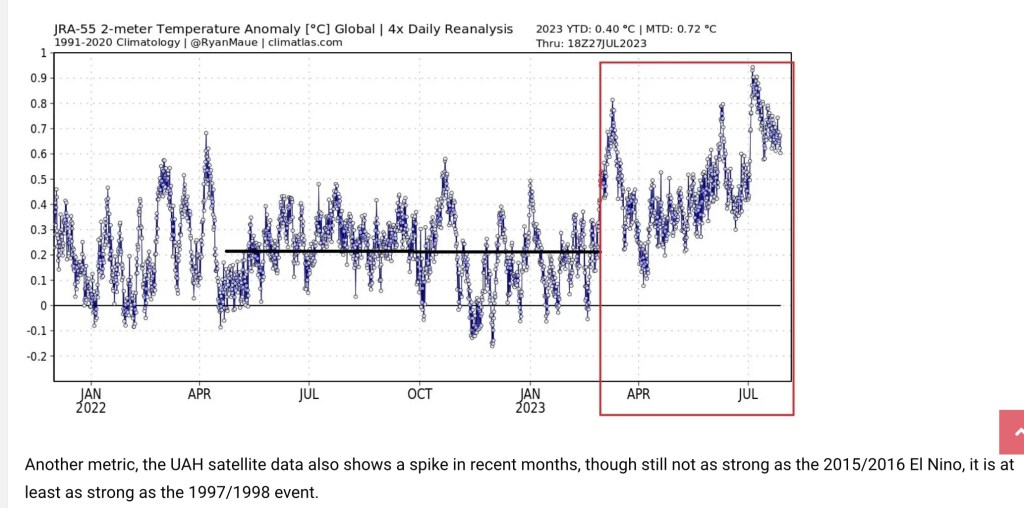
July is typically the warmest month of the year, and July 2023 was the warmest July for the troposphere on the satellite record. (The troposphere is the lowest 13 km of the atmosphere, but that’s an average — it’s thicker toward equatorial latitudes, thinner toward the poles.) However, attribution of this summer’s heat waves to carbon-induced climate change is misplaced. What follows are a few considerations in evaluating this claim, and the lengths to which climate activists go to distort weather data and reporting.

The Biggest Greenhouse Gas

One speculative explanation for the recent heat wave has gained some traction: the eruption of the Hunga Tonga-Hunga Ha’apai volcano in the South Pacific on Jan. 15, 2022 (and see here). This underwater eruption spewed massive quantities of water vapor into the stratosphere, which encircled the globe in fairly short order. Water vapor acts as a greenhouse gas, and it is by far the most important greenhouse gas. This plume of vapor may have affected the climate with a delay, and it is not expected to dissipate for at least a couple of years. However, there are theories that the eruption might have led to some offsetting effects due to the reflective properties of water and ice in the stratosphere. See here for an interesting debate on the estimated effects of this “shock” to the atmosphere.

NASA has estimated that the Hunga Tonga eruption resulted in a 10% increase in atmospheric water vapor, while the European Space Agency puts the increase at 13%. Now, in addition to this added water vapor, we have the early effects of an El Niño event in the Pacific, which may elevate temperatures over the next couple of years.

However, the temperatures in July simply don’t justify the claim that we’re experiencing “unprecedented” warmth. The satellite records go back only to 1979, which is an especially narrow window on climatological scales. The longer record of temperatures shows earlier periods of higher temperatures, For example, U.S. surface temperature records indicate that the 1930s had periods warmer than this July. Moreover, while estimates of paleo-climate data are a matter of great dispute, there is no question that the globe has experienced warmer temperatures in the past, with an ice-free Arctic.

So, was July 3 really the hottest day in history? No way, and the worst part of this warm spell wasn’t even the warmth. Rather, it was the attempts to make weather a political matter, as if public policymakers possess some kind of control knob over weather phenomena, or as if we should bestow upon them dictatorial powers to act on their fantasy.

Longer Trends

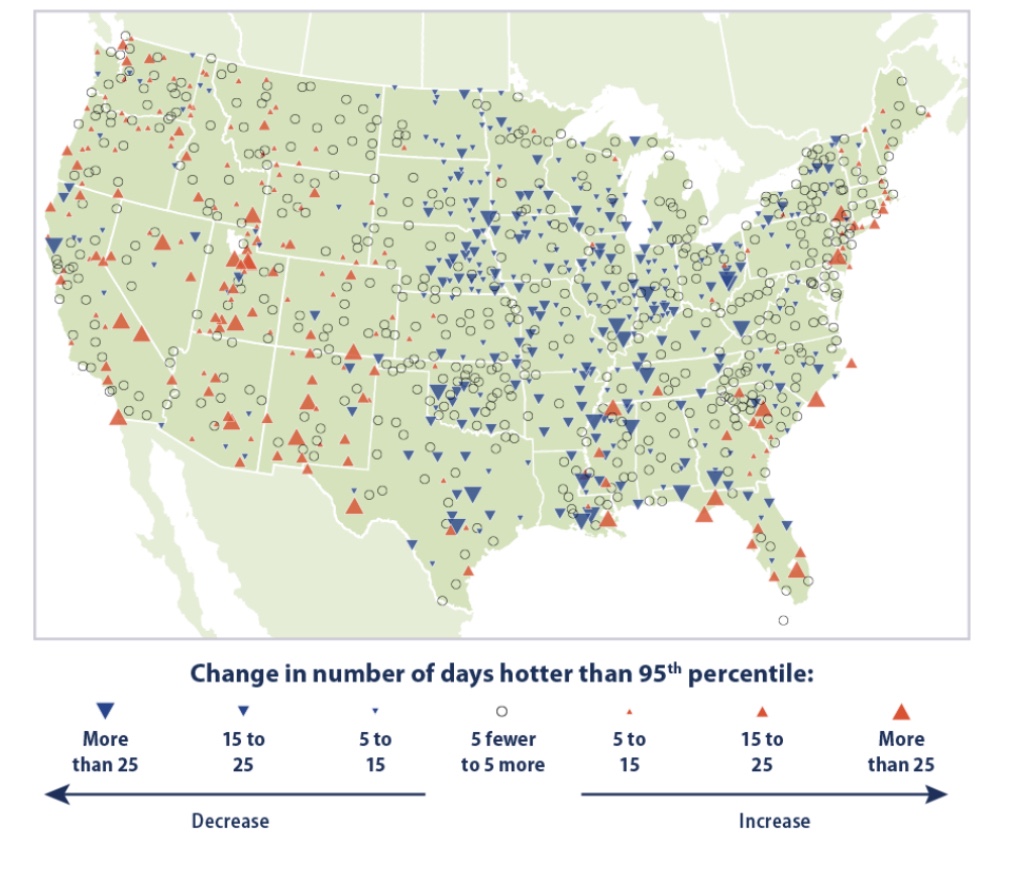
There’s plenty of other evidence running contrary to the “hotter-than-any-time in-history” foolishness. Take a look at trends in hot and cool weather from individual U.S. weather stations over a somewhat longer time span than the satellite record. The red symbols shown on the map below mark stations reporting increases in the number of unusually hot days (heat in the 95th percentile) between 1948 – 2020, with larger symbols corresponding to greater increases in extremely hot days. The blue symbols mark stations reporting increases in the number of unusually cool days (in the 5th percentile) over the same period. The data in this chart is published by the EPA, and it is definitely not alarming.

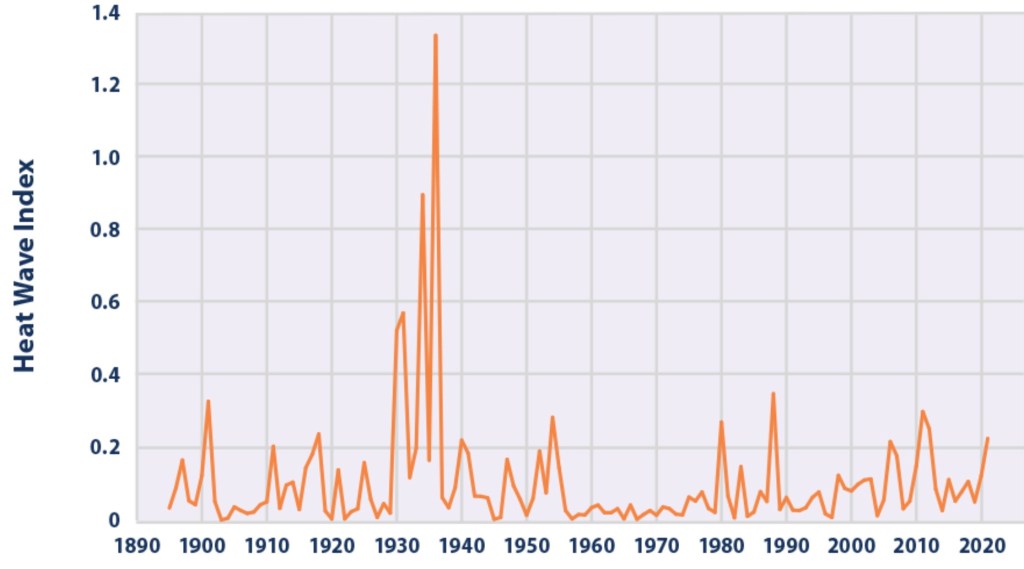
The next chart shows the so-called Heat Wave Index produced by the EPA. Recent spikes in the index are muted relative to the Dust Bowl days of the 1930s.

Journalism or Exaggeration?

Reports of hot weather in Europe have been distorted as well, often placing more emphasis on forecasts of high temperatures than on the temperatures themselves. It’s almost as if authorities, with the aid of the news media and naive weather reporters, are determined to raise an exaggerated sense of alarm among the citizenry. Almost?

Cold 10x Deadlier Than Heat

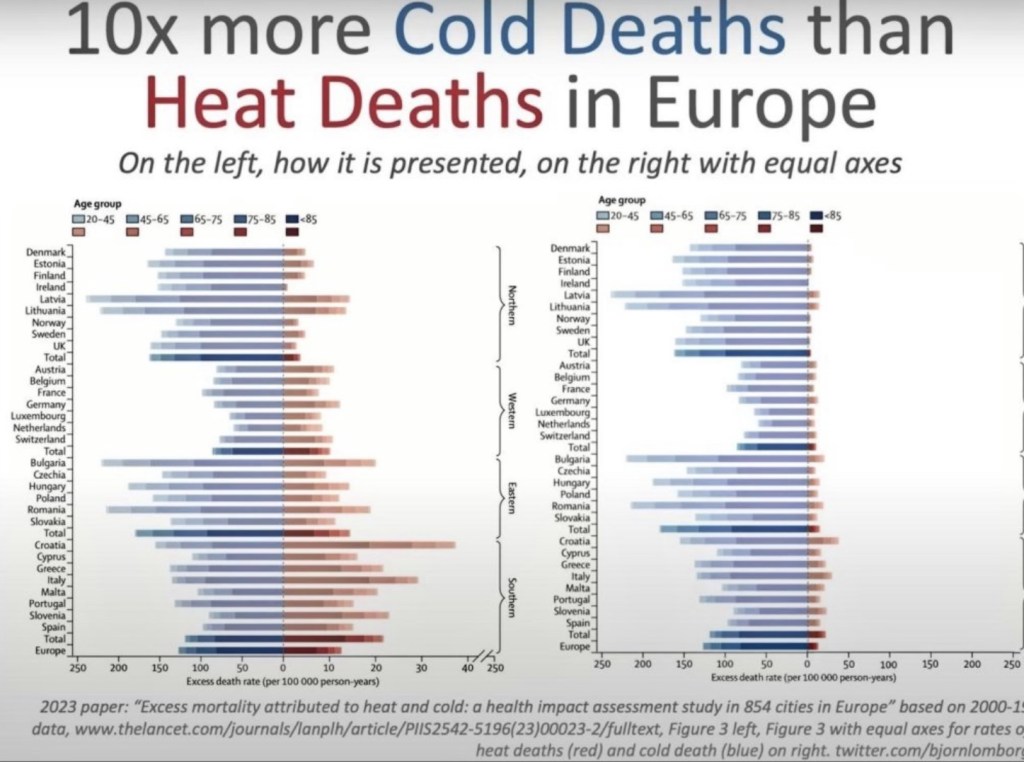
The next chart vividly illustrates an attempt to propagandize climate misinformation. Take a look at the left side of this illustration, which appeared in the medical journal Lancet. Note the difference in the horizontal scale for heat deaths vs. cold deaths. The chart on the right side uses equivalent scales for heat vs. cold deaths. This should qualify the journal for some kind of award for mendacity, or perhaps sheer stupidity. It’s the cold that really kills, not the heat! I’m moving south!

Finding Hot Water

And here’s a take-down of some incredible water temperature propaganda. A PBS News Hour reporter has pushed claims that South Florida water temperatures reached 101 degrees this summer. The emphasis on a single reading was taken from a buoy not subject to the cooling effects of deep water circulation, and it is located where fresh water often overlays salt water, which traps heat. Data from other buoys not far away showed much lower temperatures.

Spreads Like Wildfire

Another fallacious claim we hear too often is that global warming is literally causing the world to go up in flames. The facts run contrary to these scare stories. Björn Lomborg notes the following:

“For more than two decades, satellites have recorded fires across the planet’s surface. The data are unequivocal: Since the early 2000s, when 3% of the world’s land caught fire, the area burned annually has trended downward.

“In 2022, the last year for which there are complete data, the world hit a new record-low of 2.2% burned area. Yet you’ll struggle to find that reported anywhere.”

The heavy focus by the media on this year’s wild fires in North America offers a perfect example of the media’s tendency to “cherry pick for clicks”. Africa and Europe have had little burning this year, and in North America, arson has played a conspicuous role (and see here) in the wildfires.

Distorted Measurements

Personally, I have trouble accepting claims that temperatures are any warmer now than they were in my youth, at least where I grew up. My subjective and local assessment aside, there are strong reasons to doubt the reliability and significance of trends in official temperature records. The urban heat-island effect has distorted temperatures by ever greater magnitudes, as growing metropolitan areas absorb heat readily compared to rural green space.

Furthermore, poor siting of weather stations and temperature gauges has become all too common. This includes equipment located at airports and other areas in close proximity to asphalt or concrete. This contributes to an upward bias in more recent temperature data. It’s also worth noting in this context that satellite temperature readings must be calibrated periodically to surface temperatures. If the latter are corrupted in any way, the satellite readings may be corrupted as well.

“Adjusting” the Past

Official historical records also include a variety of “adjustments” to temperature data that raise concerns. Ostensibly, these adjustments are justified by an interest in maintaining a consistent historical record. Changes in equipment or it’s exact location can create discontinuities, for example. Unfortunately, the adjustments appear to have had a systematic tendency to “cool the past” relative to more recent data. This reinforcement of the warming trend over the past few decades is suspicious, to say the least. It does very little to build confidence in the agencies responsible for these records.

Conclusion

The hot temperatures in July brought the usual deluge of propaganda, including distortions in the reporting of weather phenomena. And we hear increasing calls to force transition to EVs (which are powered mostly by fossil-fuel electric plants), subsidize intermittent renewable power sources, and to end the use of air conditioning and gas stoves. Yet these coercive measures would do nothing to prevent summer heat or climate change generally. Water vapor represents 95% of greenhouse gases, and the huge vapor shock from the Hunga Tonga eruption might well make us prone to warmer temperatures for at least some months to come, mixed with signals from the Pacific El Niño pattern. But these are not evidence of a man-made crisis, despite perverse cheers from those rooting for more draconian state intrusions and an end to growth, or indeed, a reversal in gains to human well being.

Canadian Wildfires, Smoky Days Are Recurring Events

11 Sunday Jun 2023

Posted by Nuetzel in Forest Fires, Global Warming, Wildfires

≈ Leave a comment

Tags

Anthropomorphic Global Warming, Boreal Forests, Canadian Fires, Climate Change, Dark Days, David Marcus, Edward Struzik, Fire Suppression, Forest Management, Prescribed Burns, Québec Fires, rent seeking, Wildfires

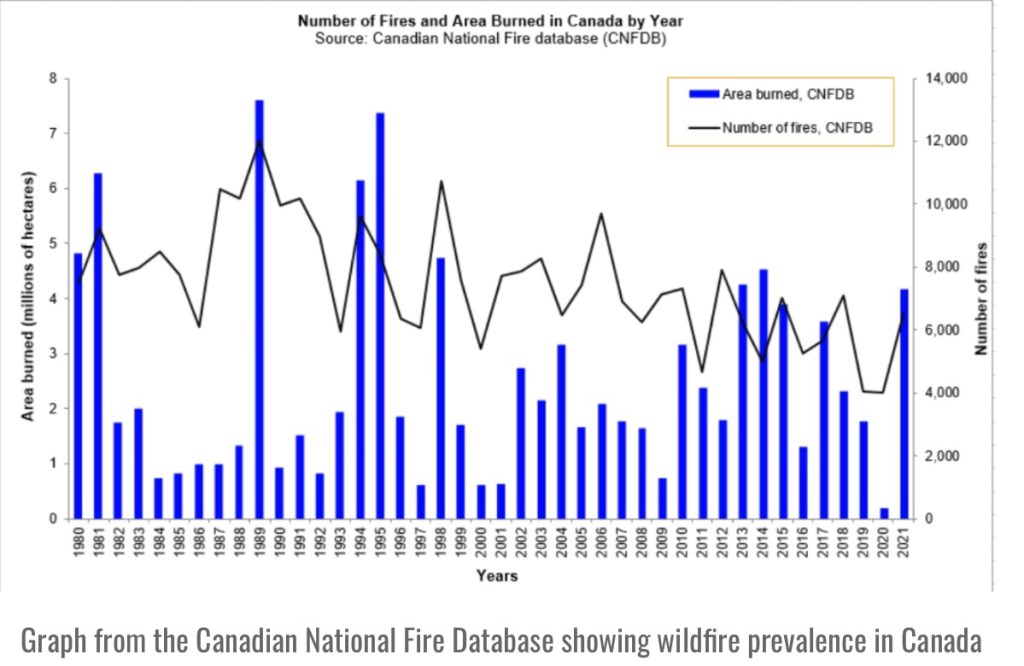
Smoke from this spring’s terrible forest fires in Canada has fouled the air in much of the country and blown into the northeastern U.S. and mid-Atlantic coastal states. The severity of the fires, if they continued at this pace over the rest of the fire season, would break Canadian records for number of fires and burned area.

Large wildfires with smoky conditions occur in these in regions from time-to-time, and it’s not unusual for fires to ignite in the late spring. The article shown above appeared in the New York Tribune on June 5, 1903. Other “dark day” episodes were recorded in New England in 1706, 1732, 1780, 1814, 1819, 1836, 1881, 1894, and 1903, and several times in the 20th century. I list early years specifically because they preceded by decades (even centuries) the era of supposed anthropomorphic global warming, now euphemistically known as “climate change”.

More recently, however, in the past 10 years, Quebec experienced relatively few wildfires. That left plenty of tinder in the boreal forests with highly flammable, sappy trees. In May, a spell of sunshine helped dry the brush in the Canadian forests. Then lightning and human carelessness sparked the fires, along with multiple instances of arson, some perpetrated by climate change activists.

On top of all that, poor forest management contributed to the conflagrations. So-called fire suppression techniques have done more harm than good over the years, as I’ve discussed on this blog in the past. David Marcus emphasizes the point:

“For years, Canadian parks officials have been warning that their country does not do enough to cull its forests and now we’re witnessing the catastrophic results.

It’s simple really. Edward Struzik, author of ‘Dark Days at Noon, The Future of Fire’ lays it out well.

‘We have been suppressing fires for so many decades in North America that we have forests that are older than they should be,’ he said. …

‘Prescribed burns are one of the best ways to mitigate the wildfire threat,’ he added.”

Nevertheless, the media are eager to blame climate change for any calamity. That’s one part simple naïveté on the part of young journalists, fresh off the turnip truck as it were, with little knowledge or inclination to understand the history and causes of underlying forest conditions. But many seasoned reporters are all too ready to support the climate change narrative as well. There’s also an element of calculated political misinformation in these claims, abetted by those seeking rents from government climate policies.

Wildfires are as old as time; without good forest management practices they are necessary for forest renewal. Agitation to sow climate panic based on wildfires is highly unscrupulous. There is no emergency except for the need to reform forest management, reduce the fuel load, and more generally, put an end to the waste of resources inherent in government climate change initiatives.

See this tweet! Hmmm.

Grow Or Collapse: Stasis Is Not a Long-Term Option

18 Wednesday Jan 2023

Posted by Nuetzel in Climate, Environment, Growth

≈ 1 Comment

Tags

Asymptotic Burnout, Benjamin Friedman, Climate Change, Dead Weight Loss, Degrowth, Fermi Paradox, Lewis M. Andrews, Limits to Growth, NIMBYism, Paul Ehrlich, Population Bomb, Poverty, regulation, Robert Colvile, Stakeholder Capitalism, State Capacity, Stubborn Attachments, Subsidies, Tax Distortions, Thomas Malthus, Tyler Cowan, Veronique de Rugy, Zero Growth

Growth is a human imperative and a good thing in every sense. We’ve long heard from naysayers, however, that growth will exhaust our finite resources, ending in starvation and the collapse of human civilization. They say, furthermore, that the end is nigh! It’s an old refrain. Thomas Malthus lent it credibility over 200 years ago (perhaps unintentionally), and we can pick on poor Paul Ehrlich’s “Population Bomb” thesis as a more modern starting point for this kind of hysteria. Lewis M. Andrews puts Ehrlich’s predictions in context:

“A year after the book’s publication, Ehrlich went on to say that this ‘utter breakdown’ in Earth’s capacity to support its bulging population was just fifteen years away. … For those of us still alive today, it is clear that nothing even approaching what Ehrlich predicted ever happened. Indeed, in the fifty-four years since his dire prophesy, those suffering from starvation have gone from one in four people on the planet to just one in ten, even as the world’s population has doubled.”

False Limits

The “limits” argument comes from the environmental Left, but it creates for them an uncomfortable tradeoff between limiting growth and the redistribution of a fixed (they hope) or shrinking (more likely) pie. That’s treacherous ground on which to build popular support. It’s also foolish to stake a long-term political agenda on baldly exaggerated claims (and see here) about the climate and resource constraints. Ultimately, people will recognize those ominous forecasts as manipulative propaganda.

Last year, an academic paper argued that growing civilizations must eventually reach a point of “asymptotic burnout” due to resource constraints, and must undergo a “homeostatic awakening”: no growth. The authors rely on a “superlinear scaling” argument based on cross-sectional data on cities, and they offer their “burnout” hypothesis as an explanation for the Fermi Paradox: the puzzling quiet we observe in the universe while we otherwise expect it to be teeming with life… civilizations reach their “awakenings” before finding ways to communicate with, or even detect, their distant neighbors. I addressed this point and it’s weaknesses last year, but here I mention it only to demonstrate that the “limits to growth” argument lives on in new incarnations.

Growth-limiting arguments are tenuous on at least three fundamental grounds: 1) failure to consider the ability of markets to respond to scarcity; 2) underestimating the potential of human ingenuity not only to adapt to challenges, but to invent new solutions, exploit new resources, and use existing resources more efficiently; and 3) homeostasis is impossible because zero growth cannot be achieved without destructive coercion, suspension of cooperative market mechanisms, and losses from non-market (i.e., political and non-political) competition for the fixed levels of societal wealth and production.

The zero-growth world is one that lacks opportunities and rewards for honest creation of value, whether through invention or simple, hard work. That value is determined through the interaction of buyers and sellers in markets, the most effective form of voluntary cooperation and social organization ever devised by mankind. Those preferring to take spoils through the political sphere, or who otherwise compete on the basis of force, either have little value to offer or simply lack the mindset to create value to exchange with others at arms length.

Zero-Growth Mentality

As Robert Colvile writes in a post called “The Morality of Growth”:

“A society without growth is not just politically far more fragile. It is hugely damaging to people’s lives – and in particular to the young, who will never get to benefit from the kind of compounding, increasing prosperity their parents enjoyed.”

Expanding on this theme is commenter Slocum at the Marginal Revolution site, where Colvile’s essay was linked:

“Humans behave poorly when they perceive that the pie is fixed or shrinking, and one of the main drivers for behaving poorly is feelings of envy coming to the forefront. The way we encourage people not to feel envy (and to act badly) is not to try to change human nature, or ‘nudge’ them, but rather to maintain a state of steady improvement so that they (naturally) don’t feel envious, jealous, tribal, xenophobic etc. Don’t create zero-sum economies and you won’t bring out the zero-sum thinking and all the ills that go with it.”

And again, this dynamic leads not to zero growth (if that’s desired), but to decay. Given the political instability to which negative growth can lead, collapse is a realistic possibility.

I liked Colville’s essay, but it probably should have been titled “The Immorality of Non-Growth”. It covers several contemporary obstacles to growth, including the rise of “stakeholder capitalism”, the growth of government at the expense of the private sector, strangling regulation, tax disincentives, NIMBYism, and the ease with which politicians engage in populist demagoguery in establishing policy. All those points have merit. But if his ultimate purpose was to shed light on the virtues of growth, it seems almost as if he lost his focus in examining only the flip side of the coin. I came away feeling like he didn’t expend much effort on the moral virtues of growth as he intended, though I found this nugget well said:

“It is striking that the fastest-growing societies also tend to be by far the most optimistic about their futures – because they can visibly see their lives getting better.”

Compound Growth

A far better discourse on growth’s virtues is offered by Veronique de Rugy in “The Greatness of Growth”. It should be obvious that growth is a potent tonic, but its range as a curative receives strangely little emphasis in popular discussion. First, de Rugy provides a simple illustration of the power of long-term growth, compound growth, in raising average living standards:

This is just a mechanical exercise, but it conveys the power of growth. At 2% real growth, real GDP per capital would double in 35 years and quadruple in 70 years. At 4% growth, real GDP would double in 18 years… less than a generation! It would quadruple in 35 years. If you’re just now starting a career, imagine nearing retirement at a standard of living four times as lavish as today’s senior employees (who make a lot more than you do now). We’ll talk a little more about how such growth rates might be achieved, but first, a little more on what growth can achieve.

The Rewards of Growth

Want to relieve poverty? There is no better and more permanent solution than economic growth. Here are some illustrations of this phenomenon:

Want to rein-in the federal budget deficit? Growth reduces the burden of the existing debt and shrinks fiscal deficits, though it might interfere with what little discipline spendthrift politicians currently face. We’ll have to find other fixes for that problem, but at least growth can insulate us from their profligacy.

And who can argue with the following?

“All the stuff an advocate anywhere on the political spectrum claims to value—good health, clean environment, safety, families and quality of life—depends on higher growth. …

There are other well-documented material consequences of modern economic growth, such as lower homicide rates, better health outcomes (babies born in the U.S. today are expected to live into their upper 70s, not their upper 30s as in 1860), increased leisure, more and better clothing and shelter, less food insecurity and so on.”

De Rugy argues convincingly that growth might well entail a greater boost in living standards for lower ranges of the socioeconomic spectrum than for the well-to-do. That would benefit not just those impoverished due to a lack of skills, but also those early in their careers as well as seniors attempting to earn extra income. For those with a legitimate need of a permanent safety net, growth allows society to be much more generous.

What de Rugy doesn’t mention is how growth can facilitate greater saving. In a truly virtuous cycle, saving is transformed into productivity-enhancing additions to the stock of capital. And not just physical capital, but human capital through investment in education as well. In addition, growth makes possible additional research and development, facilitating the kind of technical innovation that can sustain growth.

Getting Out of the Way of Growth

Later in de Rugy’s piece, she evaluates various ways to stimulate growth, including deregulation, wage and price flexibility, eliminating subsidies, less emphasis on redistribution, and simplifying the tax code. All these features of public policy are stultifying and involve dead-weight losses to society. That’s not to deny the benefits of adequate state capacity for providing true public goods and a legal and judicial system to protect individual rights. The issue of state capacity is a major impediment to growth in the less developed world, whereas countries in the developed world tend to have an excess of state “capacity”, which often runs amok!

In the U.S., our regulatory state imposes huge compliance costs on the private sector and effectively prohibits or destroys incentives for a great deal of productive (and harmless) activity. Interference with market pricing stunts growth by diverting resources from their most valued uses. Instead, it directs them toward uses that are favored by political elites and cronies. Subsidies do the same by distorting tradeoffs at a direct cost to taxpayers. Our system of income taxes is rife with behavioral distortions and compliance costs, bleeding otherwise productive gains into the coffers of accountants, tax attorneys, and bureaucrats. Finally, redistribution often entails the creation of disincentives, fostering a waste of human potential and a pathology of dependence.

Growth and Morality

Given the unequivocally positive consequences of growth to humanity, could the moral case for growth be any clearer? De Rugy quotes Benjamin Friedman’s “The Moral Consequences of Economic Growth”:

“Growth is valuable not only for our material improvement but for how it affects our social attitudes and our political institutions—in other words, our society’s moral character, in the term favored by the Enlightenment thinkers from whom so many of our views on openness, tolerance and democracy have sprung.”

De Rugy also paraphrases Tyler Cowen’s position on growth from his book “Stubborn Attachments”:

“… economic growth, properly understood, should be an essential element of any ethical system that purports to care about universal human well-being. In other words, the benefits are so varied and important that nearly everyone should have a pro-growth program at or near the top of their agenda.”

Conclusion

Agitation for “degrowth” is often made in good faith by truly frightened people. Better education would help them, but our educational establishment has been corrupted by the same ignorant narrative. When it comes to rulers, the fearful are no less tyrannical than power-hungry authoritarians. In fact, fear can be instrumental in enabling that kind of transformation in the personalities of activists. A basic failing is their inability to recognize the many ways in which growth improves well-being, including the societal wealth to enable adaptation to changing conditions and the investment necessary to enhance our range of technological solutions for mitigating existential risks. Not least, however, is the failure of the zero-growth movement to understand the cruelty their position condones in exchange for their highly speculative assurances that we’ll all be better off if we just do as they say. A terrible downside will be unavoidable if and when growth is outlawed.

The Futility and Falsehoods of Climate Heroics

01 Tuesday Jun 2021

Posted by Nuetzel in Climate science, Environmental Fascism, Global Warming, Uncategorized

≈ Leave a comment

Tags

Atmospheric Carbon, Biden Administration, Carbon forcing, Carbon Mitigation, Climate Change, Climate Sensitivity, ExxonMobil, Fossil fuels, global warming, Green Energy, Greenhouse Gas, IPPC, John Kerry, Judith Curry, Natural Gas, Netherlands Climate Act, Nic Lewis, Nuclear power, Putty-Clay Technology, Renewables, Ross McKitrick, Royal Dutch Shell, Social Cost of Carbon, William Nordhaus

The world’s gone far astray in attempts to battle climate change through forced reductions in carbon emissions. Last Wednesday, in an outrageously stupid ruling,a Dutch court ordered Royal Dutch Shell to reduce its emissions by 45% by 2030 relative to 2019 levels. It has nothing to do with Shell’s historical record on the environment. Rather, the Court said Shell’s existing climate action plans did not meet “the company’s own responsibility for achieving a CO2 reduction.” The decision will be appealed, but it appears that “industry agreements” under the Netherlands’ Climate Act of 2019 are in dispute.

Later that same day, a shareholder dissident group supporting corporate action on climate change won at least two ExxonMobil board seats. And then we have the story of John Kerry’s effort to stop major banks from lending to the fossil fuel industry. Together with the Biden Administration’s other actions on energy policy, we are witnessing the greatest attack on conventional power sources in history, and we’ll all pay dearly for it. 

The Central Planner’s Conceit

Technological advance is a great thing, and we’ve seen it in the development of safe nuclear power generation, but the environmental left has successfully placed roadblocks in the way of its deployment. Instead, they favor the mandated adoption of what amount to beta versions of technologies that might never be economic and create extreme environmental hazards of their own (see here, here, here, and here). To private adopters, green energy installations are often subsidized by the government, disguising their underlying inefficiencies. These premature beta versions are then embedded in our base of productive capital and often remain even as they are made obsolete by subsequent advances. The “putty-clay” nature of technology decisions should caution us against premature adoptions of this kind. This is just one of the many curses of central planning.

Not only have our leftist planners forced the deployment of inferior technologies: they are actively seeking to bring more viable alternatives to ruination. I mentioned nuclear power and even natural gas offer a path for reducing carbon emissions, yet climate alarmists wage war against it as much as other fossil fuels. We have Kerry’s plot to deny funding for the fossil fuel industry and even activist “woke” investors, attempting to override management expertise and divert internal resources to green energy. It’s not as if renewable energy sources are not already part of these energy firms’ development portfolios. Allocations of capital and staff to these projects are usually dependent upon a company’s professional and technical expertise, market forces, and (less propitiously) incentives decreed by the government. Yet, the activist investors are there to impose their will.

Placing Faith and Fate In Models

All these attempts to remake our energy complex and the economy are based on the presumed external costs associated with carbon emissions. Those costs, and the potential savings achievable through the mitigation efforts of government and private greenies around the globe, have been wildly exaggerated.

The first thing to understand about the climate “science” relied upon by the environmental left is that it is almost exclusively model-dependent. In other words, it is based on mathematical relationships specified by the researchers. Their projections depend on those specs, the selection of parameter values, and the scenarios to which they are subjected. The models are usually calibrated to be roughly consistent with outcomes over some historical time period, but as modelers in almost any field can attest, that is not hard to do. It’s still possible to produce extreme results out-of-sample. The point is that these models are generally not estimated statistically from a lengthy sample of historical data. Even when sound statistical methodologies are employed, the samples are blinkingly short on climatological timescales. That means they are highly sample-specific and likely to propagate large errors out-of-sample. But most of these are what might be called “toy models” specified by the researcher. And what are often billed as “findings” are merely projections based on scenarios that are themselves manufactured by imaginative climate “researchers” cum grant-seeking partisans. In fact, it’s much worse than that because even historical climate data is subject to manipulation, but that’s a topic for another day.

Key Assumptions

What follows are basic components of the climate apocalypse narrative as supported by “the science” of man-made or anthropomorphic global warming (AGW):

(A) The first kind of model output to consider is the increase in atmospheric carbon concentration over time, measured in parts per million (PPM). This is a function of many natural processes, including volcanism and other kinds of outgassing from oceans and decomposing biomass, as well absorption by carbon sinks like vegetation and various geological materials. But the primary focus is human carbon generating activity, which depends on the carbon-intensity of production technology. As Ross McKitrick shows (see chart below), projections from these kinds of models have demonstrated significant upside bias over the years. Whether that is because of slower than expected economic growth, unexpected technological efficiencies, an increase in the service-orientation of economic activity worldwide, or feedback from carbon-induced greening or other processes, most of the models have over-predicted atmospheric carbon PPM. Those errors tend to increase with the passage of time, of course.

(B) Most of the models promoted by climate alarmists are carbon forcing models, meaning that carbon emissions are the primary driver of global temperatures and other phenomena like storm strength and increases in sea level. With increases in carbon concentration predicted by the models in (A) above, the next stage of models predicts that temperatures must rise. But the models tend to run “hot.” This chart shows the mean of several prominent global temperature series contrasted with 1990 projections from the Intergovernmental Panel on Climate Change (IPCC).

The following is even more revealing, as it shows the dispersion of various model runs relative to three different global temperature series:

And here’s another, which is a more “stylized” view, showing ranges of predictions. The gaps show errors of fairly large magnitude relative to the mean trend of actual temperatures of 0.11 degrees Celsius per decade.

(C) Climate sensitivity to “radiative forcing” is a key assumption underlying all of the forecasts of AGW. A simple explanation is that a stronger greenhouse effect, and increases in the atmosphere’s carbon concentration, cause more solar energy to be “trapped” within our “greenhouse,” and less is radiated back into space. Climate sensitivity is usually measured in degrees Celsius relative to a doubling of atmospheric carbon. 

And how large is the climate’s sensitivity to a doubling of carbon PPM? The IPCC says it’s in a range of 1.5C to 4.5C. However, findings published by Nic Lewis and Judith Curry are close to the low end of that range, and are those found by the author of the paper described here. 

In separate efforts, Finnish and Japanese researchers have asserted that the primary cause of recent warming is an increase in low cloud cover, which the Japanese team attributes to increases in the Earth’s bombardment by cosmic rays due to a weakening magnetic field. The Finnish authors note that most of the models used by the climate establishment ignore cloud formation, an omission they believe leads to a massive overstatement (10x) of sensitivity to carbon forcings. Furthermore, they assert that carbon forcings are mainly attributable to ocean discharge as opposed to human activity.

(D) Estimates of the Social Cost of Carbon (SCC) per ton of emissions are used as a rationale for carbon abatement efforts. The SCC was pioneered by economist William Nordhaus in the 1990s, and today there are a number of prominent models that produce distributions of possible SCC values, which tend to have high dispersion and extremely long upper tails. Of course, the highest estimates are driven by the same assumptions about extreme climate sensitivities discussed above. The Biden Administration is using an SCC of $51 per ton. Some recommend the adoption of even higher values for regulatory purposes in order to achieve net-zero emissions at an early date, revealing the manipulative purposes to which the SCC concept is put. This is a raw attempt to usurp economic power, not any sort of exercise in optimization, as this admission from a “climate expert” shows. In the midst of a barrage of false climate propaganda (hurricanes! wildfires!), he tells 60 Minutes that an acceptable limit on warming of 1.5C is just a number they “chose” as a “tipping point.”

As a measurement exercise, more realistic climate sensitivities yield much lower SCCs. McKitrick presents a chart from Lewis-Curry comparing their estimates of the SCC at lower climate sensitivities to an average of earlier estimates used by IPCC:

High levels of the SCC are used as a rationale for high-cost carbon abatement efforts. If the SCC is overstated, however, then costly abatements represent waste. And there is no guarantee that spending an amount on abatements equal to the SCC will eliminate the presumed cost of a ton’s worth of anthropomorphic warming. Again, there are strong reasons to believe that the warming experienced over the past several decades has had multiple causes, and human carbon emissions might have played a relatively minor role. 

Crisis Is King

Some people just aren’t happy unless they have a crisis over which to harangue the rest of us. But try as they might, the vast resources dedicated to carbon reduction are largely wasted. I hesitate to say their effort is quixotic because they want more windmills and are completely lacking in gallantry. As McKitrick notes, it takes many years for abatement to have a meaningful impact on carbon concentrations, and since emissions mix globally, unilateral efforts are practically worthless. Worse yet, the resource costs of abatement and lost economic growth are unacceptable, especially when some of the most promising alternative sources of “clean” energy are dismissed by activists. So we forego economic growth, rush to adopt immature energy alternatives, and make very little progress toward the stated goals of the climate alarmists.

Myth Makers in Lab Coats

02 Friday Apr 2021

Posted by Nuetzel in Climate science, Research Bias, Science

≈ Leave a comment

Tags

Cambridge, Canonization Effect, Citation Bias, Climate Change, Climatology, Lee Jussim, Medical Science, Model Calibration, National Oceanic and Atmospheric Administration, Pandemic, Political Bias, Psychology Today, Publication Bias, Repication Crisis, Reporting Bias, Spin

The prestige of some elements of the science community has taken a beating during the pandemic due to hugely erroneous predictions, contradictory pronouncements, and misplaced confidence in interventions that have proven futile. We know that medical science has suffered from a replication crisis, and other areas of inquiry like climate science have been compromised by politicization. So it seemed timely when a friend sent me this brief exposition of how “scientific myths” are sometimes created, authored by Lee Jussim in Psychology Today. It’s a real indictment of the publication process in scientific journals, and one can well imagine the impact these biases have on journalists, who themselves are prone to exaggeration in their efforts to produce “hot” stories.

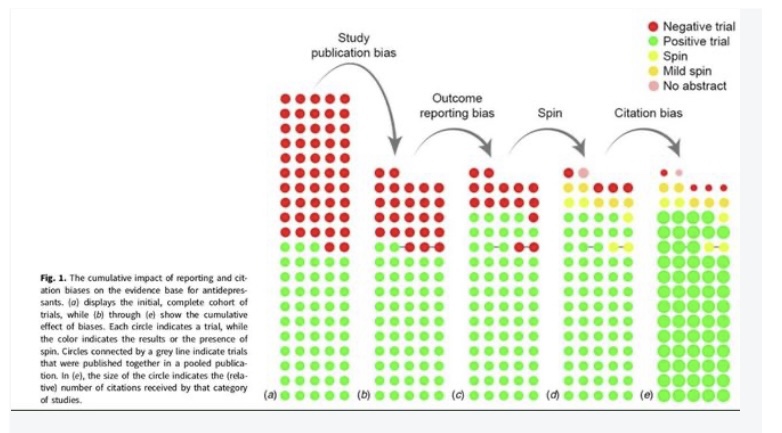
The graphic above appears in Jussim’s article, taken from a Cambridge study of reporting and citation biases in research on treatments for depression. But as Jussim asserts, the biases at play here are not “remotely restricted to antidepressant research”.

The first column of dots represent trial results submitted to journals for publication. A green dot signifies a positive result: that the treatment or intervention was associated with significantly improved patient outcomes. The red dots are trials in which the results were either inconclusive or the treatment was associated with detrimental outcomes. The trials were split about equally between positive and non-positive findings, but far fewer of the trials with non-positive findings were published. From the study:

“While all but one of the positive trials (98%) were published, only 25 (48%) of the negative trials were published. Hence, 77 trials were published, of which 25 (32%) were negative.“

The third column shows that even within the set of published trials, certain negative results were NOT reported or secondary outcomes were elevated to primary emphasis:

“Ten negative trials, however, became ‘positive’ in the published literature, by omitting unfavorable outcomes or switching the status of the primary and secondary outcomes.“

The authors went further by classifying whether the published narrative put a “positive spin” on inconclusive or negative results (yellow dots):

“… only four (5%) of 77 published trials unambiguously reported that the treatment was not more effective than placebo in that particular trial.“

Finally, the last column represents citations of the published trials in subsequent research, where the size of the dots corresponds to different levels of citation:

“Compounding the problem, positive trials were cited three times as frequently as negative trials (92 v. 32 citations. … Altogether, these results show that the effects of different biases accumulate to hide non- significant results from view.“

As Jussim concludes, it’s safe to say these biases are not confined to antidepressant research. He also writes of the “canonization effect”, which occurs when certain conclusions become widely accepted by scientists:

“It is not that [the] underlying research is ‘invalid.’ It is that [the] full scope of findings is mixed, but that the mixed nature of those findings does not make it into what gets canonized.“

I would say canonization applies more broadly across areas of research. For example, in climate research, empirics often take a back seat to theoretical models “calibrated” over short historical records. The theoretical models often incorporate “canonized” climate change doctrine which, on climatological timescales, can only be classified as speculative. Of course, the media and public has difficulty distinguishing this practice from real empirics.

All this is compounded by the institutional biases introduced by the grant-making process, the politicization of certain areas of science (another source of publication bias), and mission creep within government bureaucracies. In fact, some of these agencies control the very data upon which much research is based (the National Oceanic and Atmospheric Administration, for example), and there is credible evidence that this information has been systematically distorted over time.

The authors of the Cambridge study discuss efforts to mitigate the biases in published research. Unfortunately, reforms have met with mixed success at best. The anti-depressant research reflects tendencies that are all too human and perhaps financially motivated. Add to that the political motivation underlying the conduct of broad areas of research and the dimensions of the problem seem almost insurmountable without a fundamental revolution of ethics within the scientific community. For now, the biases have made “follow the science” into something of a joke.

Everything’s Big In Texas Except Surge Capacity

01 Monday Mar 2021

Posted by Nuetzel in Electric Power, Price Mechanism, Shortage

≈ 3 Comments

Tags

Austin Vernon, Blackouts, Climate Change, Coal Power, Dolar Power, Electric Reliability Council of Texas, ERCOT, Gas Power, Green Energy, H. Sterling Burnett, Heartland Institute, Judith Curry, Lynn Kiesling, Nuclear power, Renewables, Surge Capacity, Texas, Tyler Cowen, Variable-Rate Pricing, Vernon L. Smith, Wind Power

The February cold snap left millions of Texas utility customers without power. I provide a bit of a timeline at the bottom of this post. What happened? Well, first, don’t waste your time arguing with alarmists about whether “climate change” caused the plunge in temperatures. Whether it was climate change (it wasn’t) or anything else, the power shortage had very nuts-and-bolts causes and was avoidable.

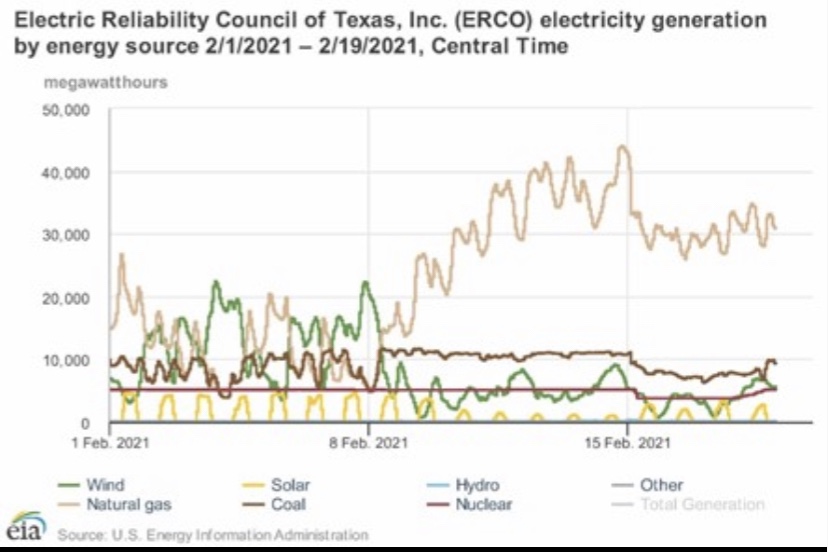
Texas has transitioned to producing a significant share of its power with renewables: primarily wind and solar, which is fine across a range of weather conditions, though almost certainly uneconomic in a strict sense. The problem in February was that the state lacks adequate capacity to meet surges under extreme weather conditions. But it wasn’t just that the demand for power surged during the cold snap: renewables were not able to maintain output due to frozen wind turbines and snow-covered solar panels, and even some of the gas- and coal-fired generators had mechanical issues. The reliability problem is typical of many renewables, however, which is why counting on it to provide base loads is extremely risky.

Judith Curry’s web site featured an informative article by a planning engineer this week: “Assigning Blame for the Blackouts in Texas”. The Electric Reliability Council of Texas (ERCOT) is the independent, non-profit operator of the state’s electric grid, with membership that includes utilities, electric cooperatives, other sellers, and consumers. Apparently ERCOT failed to prepare for such an extreme weather event and the power demand it engendered:

“… unlike utilities under traditional models, they don’t ensure that the resources can deliver power under adverse conditions, they don’t require that generators have secured firm fuel supplies, and they don’t make sure the resources will be ready and available to operate.”

ERCOT’s emphasis on renewables was costly, draining resources that otherwise might have been used to provide an adequate level of peak capacity and winterization of existing capacity. Moreover, it was paired with a desire to keep the price of power low. ERCOT has essentially “devalued capacity”:

“Texas has stacked the deck to make wind and solar more competitive than they could be in a system that better recognizes the value of dependable resources which can supply capacity benefits. … capacity value is a real value. Ignoring that, as Texas did, comes with real perils. … In Texas now we are seeing the extreme shortages and market price spikes that can result from devaluing capacity. “

Lest there be any doubt about the reliance on renewables in Texas, the Heartland Institutes’s H. Sterling Burnett notes that ERCOT data:

“… shows that five days before the first snowflake fell, wind and solar provided 58% of the electric power in Texas. But clouds formed, temperatures dropped and winds temporarily stalled, resulting in more than half the wind and solar power going offline in three days never to return during the storm, when the problems got worse and turbines froze and snow and ice covered solar panels.”

Power prices must cover the cost of meeting “normal” energy needs as well as the cost of providing for peak loads. That means investment in contracts that guarantee fuel supplies as well as peak generating units. It also means inter-connectivity to other power grids. Instead, ERCOT sought to subsidize costly renewable power in part by skimping on risk-mitigating assets.

Retail pricing can also help avert crises of this kind. Texas customers on fixed-rate plans had no incentive to conserve as temperatures fell. Consumers can be induced to lower their thermostats with variable-rate plans, and turning it down by even a degree can have a significant impact on usage under extreme conditions. The huge spike in bills for variable-rate customers during the crisis has much to do with the fact that too few customers are on these plans to begin with. Among other things, Lynne Kiesling and Vernon L. Smith discuss the use of digital devices to exchange information on scarcity with customers or their heating systems in real time, allowing quick adjustment to changing incentives. And if a customer demands a fixed-rate plan, the rate must be high enough to pay the customer’s share of the cost of peak capacity.

Price incentives make a big difference, but there are other technological advances that might one day allow renewables to provide more reliable power, as discussed in Tyler Cowen’s post on the “energy optimism” of Austin Vernon”. I find Vernon far too optimistic about the near-term prospects for battery technology. I am also skeptical of wind and solar due to drawbacks like land use and other (often ignored) environmental costs, especially given the advantages of nuclear power to provide “green energy” (if only our governments would catch on). The main thing is that sufficient capacity must be maintained to meet surges in demand under adverse conditions, and economic efficiency dictates that that it is a risk against which ratepayers cannot be shielded.

Note: For context on the chart at the top of this post, temperatures in much of Texas fell on the 9th of February, and then really took a dive on the 14th before recovering on the 19th. Wind generation fell immediately, and solar power diminished a day or two later. Gas and coal helped to offset the early reductions, but it took several days for gas to ramp up. Even then there were shortages. Then, on the 16th, there were problems maintaining gas and coal generation. Gas was still carrying a higher than normal load, but not enough to meet demand.

End of Snowfalls Is Greatly Exaggerated

03 Monday Feb 2020

Posted by Nuetzel in Uncategorized

≈ Leave a comment

Tags

Baby Boomers, Climate Change, Climate models, Gen X, global warming, Millenials, NOAA, Snowfalls, The Independent, Thomas Jefferson

Snowcover Anomoly

Everyone seems to think it snowed more in their youth than in recent years, but that’s generally incorrect, at least for for late-stage baby boomers, Gen Xers, and Millenials. Gregory Wrightstone thought the same thing as he reflected on his youth in Pittsburgh, but after checking snowfall records he was surprised to find an upward trend. In “Warming and the Snows of Yesteryear“, Wrightstone says his look at the records from other areas showed similar upward trends. The chart above from NOAA shows the Northern Hemisphere has experienced mostly positive snowfall anomalies over the past 20 years. So, the truth is that snowfalls have not decreased over the last 50+ years, contrary to our fond memories of big snows in childhood. Interestingly, Thomas Jefferson thought the same thing in 1801, but I’m not sure whether he was right.

We’ve been told by climate alarmists that “snowfalls are a thing of the past” due to global warming (The Independent in March, 2000). If anything, however, snowfalls have increased, and big snowfalls still happen. As with so many climate predictions over the years, this too is a bust. Most of those predictions have relied on predictive models fitted with an inadequate historical record of data, and the models are inadequately specified to capture the complexities of global climate trends. Don’t bet the house on them, and don’t presume to bet my house on them either, please!

Scorning the Language of the Left

12 Sunday Jan 2020

Posted by Nuetzel in Censorship, Leftism, Political Correctness

≈ Leave a comment

Tags

Abortion, Boy George, Brett Kavanaugh, Brexit, Check Your Privilege, Cisgender, Climate Change, Donald Trump, Gender, Harper's, Hate Speech, Identitarian, Israel, Lefty Lingo, LGBTQ, Lionel Shriver, Microaggession, Patriarchy, Phobic, Privilege, Progressive Speech, Pronouns, Queer, Safe Space, STFU, Sustainability

It’s hard not to ridicule some the language adopted by our lefty friends, and it can be fun! But it’s not just them. We hear it now from employers, schools, and otherwise sensible people too eager to signal their modernity and virtue. Lionel Shriver dissects some of this “Lefty Lingo” in an entertaining piece in Harper’s. It’s funny, but it aroused my contempt for the smugness of the “wokescenti” (a term Shriver attributes too Meghan Daum) and my pity for those “normals” simply desperate to project progressive sophistication.

Here are a few of Shriver’s observations:

“Privilege”: makes you incapable of understanding that which you criticize.

“Whereas a privilege can be acquired through merit—e.g., students with good grades got to go bowling with our teacher in sixth grade—privilege, sans the article, is implicitly unearned and undeserved. The designation neatly dispossesses those so stigmatized of any credit for their achievements while discounting as immaterial those hurdles an individual with a perceived leg up might still have had to overcome (an alcoholic parent, a stutter, even poverty). For privilege is a static state into which you are born, stained by original sin. Just as you can’t earn yourself into privilege, you can’t earn yourself out of it, either. … . it’s intriguing that the P-bomb is most frequently dropped by folks of European heritage, either to convey a posturing humility (“I acknowledge my privilege”) or to demonize the Bad White People, the better to distinguish themselves as the Good White People.

Meanwhile, it isn’t clear what an admission of privilege calls you to do, aside from cower. That tired injunction ‘Check your privilege’ translates simply to ‘S.T.F.U.’—and it’s telling that ‘Shut the fuck up’ is now a sufficiently commonplace imperative to have lodged in text-speak.”

“Cisgender”: “Cis-” is a linguistic shell game whereby the typical case is labelled cis-typical.

“Denoting, say, a woman born a woman who thinks she’s a woman, this freighted neologism deliberately peculiarizes being born a sex and placidly accepting your fate, and even suggests that there’s something a bit passive and conformist about complying with the arbitrary caprices of your mother’s doctor. Moreover, unless a discussion specifically regards transgenderism, in which case we might need to distinguish the rest of the population (‘non-trans’ would do nicely), we don’t really need this word, except as a banner for how gendercool we are. It’s no more necessary than words for ‘a dog that is not a cat,’ a ‘lamppost that is not a fire hydrant,’ or ‘a table that is actually a table.’ Presumably, in order to mark entities that are what they appear to be, we could append ‘cis’ to anything and everything. ‘Cisblue’ would mean blue and not yellow. ‘Cisboring’ would mean genuinely dull, and not secretly entertaining after all.”

“Microaggression“: Anything you say that bothers them, even a little.

“… a perverse concoction, implying that the offense in question is so minuscule as to be invisible to the naked eye, yet also that it’s terribly important. The word cultivates hypersensitivity.”

“_____-phobic”: the typical use of this suffix in identity politics stands “phobia” on its head. To be fair, however, it started with a presumption that people hate that which they fear. Maybe also that they fear and hate that which they don’t care for, but we’ll just focus on fear and hate. For example, there is the notion that men have deep fears about their own sexuality. Thus, the prototypical gay-basher in film is often compensating for his own repressed homosexual longings, you see. And now, the idea is that we always fear “otherness” and probably hate it too. Both assertions are tenuous. At least those narratives are rooted in “fear”, but it’s not quite the same phenomenon as hate, and yet “phobic” seems to have been redefined as odium:

“The ubiquitous ‘transphobic,’ ‘Islamophobic,’ and ‘homophobic’ are also eccentric, in that the reprobates so branded are not really being accused of fearfulness but hatred.”

“LGBTQ“: Lumping all these “types” together can be misleading, as they do not always speak in unison on public policy. But if we must, how about “Let’s Go Back To ‘Queer'”, as Shriver suggests. The LGBs I know don’t seem to mind it as a descriptor, but maybe that’s only when they say it. Not sure about the trannies. There is a great Libertarian economist who is transsexual ( Dierdre McCloskey), and somehow “queer” doesn’t seem quite right for her. Perhaps she’s just a great woman.

“The alphabet soup of ‘LGBTQ’ continues to add letters: LGBTQIAGNC, LGBTQQIP2SAA, or even LGBTIQCAPGNGFNBA. A three-year-old bashing the keyboard would produce a more functional shorthand, and we already have a simpler locution: queer.”

“Problematic”, “Troubling” and “Inappropriate”: I’m sure some of what I’ve said above is all three. I must confess I’ve used these terms myself, and they are perfectly good words. It’s just funny when the Left uses them in the following ways.

“Rare instances of left-wing understatement, ‘problematic’ and ‘troubling’ are coyly nonspecific red flags for political transgression that obviate spelling out exactly what sin has been committed (thereby eliding the argument). Similarly, the all-purpose adjectival workhorse ‘inappropriate’ presumes a shared set of social norms that in the throes of the culture wars we conspicuously lack. This euphemistic tsk-tsk projects the prim censure of a mother alarmed that her daughter’s low-cut blouse is too revealing for church. ‘Inappropriate’ is laced with disgust, while once again skipping the argument. By conceit, the appalling nature of the misbehavior at issue is glaringly obvious to everyone, so what’s wrong with it goes without saying.”

Here are a few others among my favorites:

“Patriarchy“: This serves the same function as “privilege” but is directed more specifically at the privilege enjoyed by males. Usually white, heterosexual males. It seeks to preemptively discredit any argument a male might make, and often it is used to discredit Western political and economic thought generally. That’s because so much of it was the product of the patriarchy, don’t you know! And remember, it means that males are simply incapable of understanding the plight of females … and children, let alone queers! Apparently fathers are bad, especially if they’re still straight. Mothers are good, unless they stand with the patriarchy.

“Hate Speech“: This expression contributes nothing to our understanding of speech that is not protected by the Constitution. If anything its use is intended to deny certain kinds of protected speech. Sure, originally it was targeted at such aberrations as racist or anti-gay rhetoric, assuming that always meant “hate”, but even those are protected as long as they stop short of “fighting words”. There are many kinds of opinions that now seem to qualify as “hate speech” in the eyes of the Identitarian Left, even when not truly “hateful”, such as church teachings in disapproval of homosexuality. There is also a tendency to characterize certain policy positions as “hate speech”, such as limits on immigration and opposition to “living wage” laws. Hypersensitivity, once more.

“Sustainability“: What a virtue signal! It’s now a big game to characterize whatever you do as promoting “sustainability”. But let’s get one thing straight: an activity is sustainable only if its benefits exceed its resource costs. That is the outcome sought by voluntary participants in markets, or they do not trade. Benefits and costs “estimated” by government bureaucrats without the benefit of market prices are not reliable guides to sustainability. Nor is Lefty politics a reliable guide to sustainability. Subsidies for favored activities actually undermine that goal.

There are many other Lefty catch phrases and preferred ways of speaking. We didn’t even get to “safe space”, “social justice”, and the pronoun controversy. Shriver closes with some general thoughts on the lefty lingo. I’ll close by quoting one of those points:

“The whole lexicon is of a piece. Its usage advertises that one has bought into a set menu of opinions—about race, gender, climate change, abortion, tax policy, #MeToo, Trump, Brexit, Brett Kavanaugh, probably Israel, and a great deal else. Reflexive resort to this argot therefore implies not that you think the same way as others of your political disposition but that you don’t think. You have ordered the prix fixe; you’re not in the kitchen cooking dinner for yourself.”


← Older posts
Follow Sacred Cow Chips on WordPress.com

Recent Posts

  • Immigration and Merit As Fiscal Propositions
  • Tariff “Dividend” From An Indigent State
  • Almost Looks Like the Fed Has a 3% Inflation Target
  • Government Malpractice Breeds Health Care Havoc
  • A Tax On Imports Takes a Toll on Exports

Archives

  • December 2025
  • November 2025
  • October 2025
  • September 2025
  • August 2025
  • July 2025
  • June 2025
  • May 2025
  • April 2025
  • March 2025
  • February 2025
  • January 2025
  • December 2024
  • November 2024
  • October 2024
  • September 2024
  • August 2024
  • July 2024
  • June 2024
  • May 2024
  • April 2024
  • March 2024
  • February 2024
  • January 2024
  • December 2023
  • November 2023
  • August 2023
  • July 2023
  • June 2023
  • May 2023
  • April 2023
  • March 2023
  • February 2023
  • January 2023
  • December 2022
  • November 2022
  • October 2022
  • September 2022
  • August 2022
  • July 2022
  • June 2022
  • May 2022
  • April 2022
  • March 2022
  • February 2022
  • January 2022
  • December 2021
  • November 2021
  • October 2021
  • September 2021
  • August 2021
  • July 2021
  • June 2021
  • May 2021
  • April 2021
  • March 2021
  • February 2021
  • January 2021
  • December 2020
  • November 2020
  • October 2020
  • September 2020
  • August 2020
  • July 2020
  • June 2020
  • May 2020
  • April 2020
  • March 2020
  • February 2020
  • January 2020
  • December 2019
  • November 2019
  • October 2019
  • September 2019
  • August 2019
  • July 2019
  • June 2019
  • May 2019
  • April 2019
  • March 2019
  • February 2019
  • January 2019
  • December 2018
  • November 2018
  • October 2018
  • September 2018
  • August 2018
  • July 2018
  • June 2018
  • May 2018
  • April 2018
  • March 2018
  • February 2018
  • January 2018
  • December 2017
  • November 2017
  • October 2017
  • September 2017
  • August 2017
  • July 2017
  • June 2017
  • May 2017
  • April 2017
  • March 2017
  • February 2017
  • January 2017
  • December 2016
  • November 2016
  • October 2016
  • September 2016
  • August 2016
  • July 2016
  • June 2016
  • May 2016
  • April 2016
  • March 2016
  • February 2016
  • January 2016
  • December 2015
  • November 2015
  • October 2015
  • September 2015
  • August 2015
  • July 2015
  • June 2015
  • May 2015
  • April 2015
  • March 2015
  • February 2015
  • January 2015
  • December 2014
  • November 2014
  • October 2014
  • September 2014
  • August 2014
  • July 2014
  • June 2014
  • May 2014
  • April 2014
  • March 2014

Blogs I Follow

  • Passive Income Kickstart
  • OnlyFinance.net
  • TLC Cholesterol
  • Nintil
  • kendunning.net
  • DCWhispers.com
  • Hoong-Wai in the UK
  • Marginal REVOLUTION
  • Stlouis
  • Watts Up With That?
  • Aussie Nationalist Blog
  • American Elephants
  • The View from Alexandria
  • The Gymnasium
  • A Force for Good
  • Notes On Liberty
  • troymo
  • SUNDAY BLOG Stephanie Sievers
  • Miss Lou Acquiring Lore
  • Your Well Wisher Program
  • Objectivism In Depth
  • RobotEnomics
  • Orderstatistic
  • Paradigm Library
  • Scattered Showers and Quicksand

Blog at WordPress.com.

Passive Income Kickstart

OnlyFinance.net

TLC Cholesterol

Nintil

To estimate, compare, distinguish, discuss, and trace to its principal sources everything

kendunning.net

The Future is Ours to Create

DCWhispers.com

Hoong-Wai in the UK

A Commonwealth immigrant's perspective on the UK's public arena.

Marginal REVOLUTION

Small Steps Toward A Much Better World

Stlouis

Watts Up With That?

The world's most viewed site on global warming and climate change

Aussie Nationalist Blog

Commentary from a Paleoconservative and Nationalist perspective

American Elephants

Defending Life, Liberty and the Pursuit of Happiness

The View from Alexandria

In advanced civilizations the period loosely called Alexandrian is usually associated with flexible morals, perfunctory religion, populist standards and cosmopolitan tastes, feminism, exotic cults, and the rapid turnover of high and low fads---in short, a falling away (which is all that decadence means) from the strictness of traditional rules, embodied in character and inforced from within. -- Jacques Barzun

The Gymnasium

A place for reason, politics, economics, and faith steeped in the classical liberal tradition

A Force for Good

How economics, morality, and markets combine

Notes On Liberty

Spontaneous thoughts on a humble creed

troymo

SUNDAY BLOG Stephanie Sievers

Escaping the everyday life with photographs from my travels

Miss Lou Acquiring Lore

Gallery of Life...

Your Well Wisher Program

Attempt to solve commonly known problems…

Objectivism In Depth

Exploring Ayn Rand's revolutionary philosophy.

RobotEnomics

(A)n (I)ntelligent Future

Orderstatistic

Economics, chess and anything else on my mind.

Paradigm Library

OODA Looping

Scattered Showers and Quicksand

Musings on science, investing, finance, economics, politics, and probably fly fishing.

  • Subscribe Subscribed
    • Sacred Cow Chips
    • Join 128 other subscribers
    • Already have a WordPress.com account? Log in now.
    • Sacred Cow Chips
    • Subscribe Subscribed
    • Sign up
    • Log in
    • Report this content
    • View site in Reader
    • Manage subscriptions
    • Collapse this bar
 

Loading Comments...