• About

Sacred Cow Chips

Sacred Cow Chips

Tag Archives: Cronyism

Good Profits and Bad Profits

18 Thursday May 2017

Posted by Nuetzel in Health Care, Profit Motive

≈ Leave a comment

Tags

ACA, Affordable Care Act, Big government, Corporatism, Cronyism, Economic Rents, Health Insurance, Opportunity cost, Profit Motive, Regulatory Capture, Reinsurance, rent seeking, Risk corridors, Supra-Normal Profit
Toles-on-Regulatory-Capture

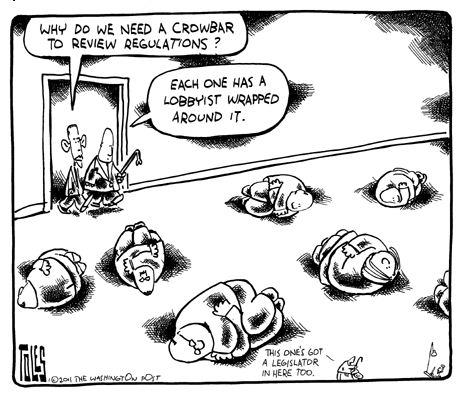
There are two faces of profit. It’s always the fashion on the left to denigrate profits and the profit motive generally, as if it serves no positive social function. This stems partly from a failure to examine the circumstances under which profits are earned: is it through competitive performance, innovation, hard-won customer loyalty, and the skill or even luck to spot an underpriced asset? Such a “good” profit might even exceed what economists call a “normal profit”, or one that just covers the opportunity cost of the owners’ capital. On the other hand, profit can be derived from what economists call “rent seeking”. That’s the dark side, but the unrecognized spirit of rent seeking seems to lurk within many discussions, as if the word profit was exclusively descriptive of evil. The “rent” in rent seeking derives from “economic rent”, which traditionally meant profit in excess of opportunity cost, or a “supra-normal” profit. But it’s impossible to know exactly how much of any given profit is extracted by rent seeking; a high profit in and of itself is not prima facie evidence of rent seeking, even though we might argue the social merits of a firm’s dominant market position.

Rent seeking takes many forms. Collusion between ostensible competitors is one, as is any predatory attempt to monopolize a market, but the term is most often associated with cronyism in government. For example, lobbying efforts might involve favors to individuals in hopes of swaying votes on regulatory matters or lucrative government contracts. Sometimes, a rent seeker wants lighter regulation. At others, a rent seeker might work the political system for more regulation in the knowledge that smaller competitors will be incapable of surviving the heavy compliance costs. Government administrators also have the authority to change fortunes with their rulings, and they are subject to the same temptations as elected officials. In fact, in the aggregate, administrative rule-making and even enforcement might outweigh prospective legislation as attractors of intense rent-seeking.

Rent seeking is big-time and it is small-time. It takes place at all levels of government, from attempts to influence zoning decisions, traffic patterns, contract awards, and even protection from law enforcement. When it’s big time, rent seeking is the very essence of what some call corporatism and more generally fascism: the enlistment of coercive government power for private gain. A pretty reliable rule is that where there’s government, there is rent-seeking behavior.

Otherwise, the profit motive serves a valuable and massive social function: resources are attracted to profitable uses because they signal the desires of potential buyers. In this way, profits assure that resources are drawn into the most-valued uses. The market interactions between new competitors, drawn by the prospect of profits, and willing buyers leads to a self-correction: supra-normal profits get competed away over time. In this way, the spontaneous actions of voluntary market participants lead to a great achievement: all mutually beneficial trades are exhausted. Profit makes this possible in the short-run and it assures that trades evolve optimally with changes in tastes, technology and resource availability. By comparison, government fares poorly when it attempts to plan outcomes in the short- or the long-run. Rent seeking is an attempt to influence and even encourage such planning, and the profits it enables impose costs on society.

Good and Bad Profits In Health Insurance

I’ve written a few posts about health insurance reform recently (see the left margin). Health care is scarce. If relying on government is the preferred alternative to private insurance, don’t count on better access to care: you won’t get it unless you’re connected. Profits earned by health insurance carriers are roundly condemned by the left. It is as if private capital utilized in arranging coverage and carrying the risk on pools of customers deserves zero compensation, that only public capital raised by coercive taxation is morally acceptable for this purpose. But aside from this obvious hogwash, is there a reason to question the insurers’ route to profitability based upon rent seeking?

The health insurers played a role in shaping the Affordable Care Act (ACA, i.e., Obamacare) and certainly had hoped to benefit from several of its provisions, even while sacrificing autonomy over product, price, coverage decisions, and payout ratios. The individual and employer mandates would force low-risk individuals to purchase extensive coverage, and essential benefits requirements would earn incremental margins. Sounds like a nice deal, but those policies were regarded by the ACA’s proponents as necessary for universal coverage, stabilizing risk, and promoting adequate coverage levels. There were other provisions, however, designed to safeguard the profitability of insurers. These included an industry risk adjustment mechanism, temporary reinsurance to help defray the cost of  covering high-risk patients, and so-called risk corridors (also temporary).

As it turned out, the ACA was not a great bet for insurers, as their risk pools deteriorated more than many expected. With the expiration of the temporary protections in Obamacare, it became evident that offering policies on the exchanges would not be profitable without large premium hikes. A number of carriers have stopped offering policies on the exchanges.

It should be no surprise that health insurance profitability has been anything but impressive over the past three years. The average industry return on equity was just 5.6% during that time frame, and it was a slightly better 6.2% in 2016, about 60% of the market-wide average. It’s difficult to conclude that insurers benefitted greatly from rent seeking activity with regard to the ACA’s passage, but perhaps that activity had a sufficient influence on policy to stabilize what otherwise might have been disastrous performance.

The critics of insurance profits are primarily interested in scapegoating as a means to promote a single-payer health care system. While some are aware of the favors granted to the industry in the design of the ACA, most are oblivious to the actual results. Even worse, they wish to throw-out the good with the bad.

The left is almost universally ignorant of the social function served by the profit motive. Profits stimulate supply, competition and innovation in virtually every area of economic life. To complain about profits in general is to wish for a primitive existence. Unfortunately, the potential for government to change the rules of the market makes it a ripe target for rent-seeking, and it creates a fog through which few discern the good from the bad.

Clinton Corruption Remedy: Keep Her Out

07 Monday Nov 2016

Posted by Nuetzel in Corruption, statism

≈ Leave a comment

Tags

Broomstick One, Clinton Foundation, Constitutional Remedy, Cronyism, Department of Justice, Department of State, Deroy Murdock, DOJ, Donald Trump, FBI, Gary Johnson, Government Corruption, Hillary Clinton, Impeachent, Independent Women's Forum, Influence Buying, Jason Chaffetz, Jeffrey Epstein, Lisa Schiffren, Loretta Lynch, Money Laudering, Pay to Play, statism, Trey Gowdy, Wikileaks

clinton-family-corruption

Would I ever vote for Donald Trump? I’ve been critical of Trump’s positions on foreign trade, immigration policy and eminent domain. I think he’s an extremely risky candidate for any supporter of small government. But I’ve been much more critical of Hillary Clinton: she is a statist through and through, and she so often finds herself in close proximity to corruption and some other highly suspicious circumstances. I consider myself a libertarian, and I like Gary Johnson. Unfortunately, Johnson has disappointed me with his selection of Bill Weld as a running mate, his goofs on foreign policy and his often poor presentation of libertarian principles.

FBI Director James Comey has again concluded that there was no intent on Clinton’s part to violate national security with her private email server, but he also concluded that she was reckless in conducting sensitive government business, including the transmission of classified information, on that server. Unfortunately, Comey limited his investigation to the period during which she was Secretary of State. The server, however, was put in place before she was confirmed by Congress. The question of intent makes that time period relevant, but Comey ignored it. She broke the law concerning the handling of classified documents, there is no question about that. No less than five of Clinton’s aides took the Fifth Amendment to avoid prosecution. Evidently, Mr. Comey has been under pressure from a highly-politicized Justice Department. There are other investigations underway at the FBI and by Congress involving the Clintons, however.

The deluge of information via Wikileaks over the past month reflects horribly on the Clintons. I don’t care whether the leaks came from government sources, the Russians, or from other foreign actors. No one has challenged the authenticity of these leaks. Again, Hillary Clinton compromised national security by conducting her duties as Secretary of State on a private computer server. That’s what got her into the email mess. Now, we’ve learned that she gave her housekeeper access to her computer to print documents! At least five foreign intelligence services hacked into that server. Clinton also obstructed justice on the matter by destroying evidence and perjuring herself before Congress.

Wikileaks has shed additional light on the Clinton Foundation as well. The foundation functions as a money laundering scheme intended to disguise influence-buying as charitable giving, with the Clinton’s and their cronies as the real beneficiaries. Foreign governments, including several middle eastern powers, funneled money to the foundation while Hillary served as Secretary of State. Here’s Deroy Murdock on the Foundation:

“… its 2014 IRS filings show that it spent a whopping 5.76 percent of its funds on actual charitable activities — far below the 65 percent that the Better Business Bureau calls kosher. That paltry figure also mocks Hillary’s Las Vegas lie, uttered at the final presidential debate on October 19: ‘We at the Clinton Foundation spend 90 percent — 90 percent of all the money that is donated on behalf of programs of people around the world and in our own country.’ The Clinton Slush Fund . . . uh . . . Foundation seems to be mainly a travel and full-employment program for Hillary’s government in waiting. It’s also a bribe pump that sucks in money and spews out favors.“

The Clintons also have had strong ties to individuals with criminal histories, such as the notorious child predator Jeffrey Epstein. And Hillary Clinton’s reputation for contemptuous behavior toward others was so strong that State Department security personnel requested reassignment. It’s been reported that members of her Secret Service detail called her plane “Broomstick One“.

A Hillary Clinton victory in the president election will not end the investigations. Congressional leaders such as Jason Chaffetz and Trey Gowdy have vowed to press on aggressively, given that Clinton lied before their committees and to the American people about the existence of classified emails on her server. Impeachment by the House might occur, though Clinton’s offenses have occurred prior to her term in office, and the Senate would never attain the two-thirds majority necessary to convict.

It is possible that the FBI investigation into the Clinton Foundation will be damaging, but it is unlikely to bring an indictment. The DOJ under Clinton would be headed by Loretta Lynch or some other Hillary/Obama sycophant. There will be no DOJ indictment or special prosecutor as long as the Attorney General reports to the criminal herself. (The FBI cannot indict; it can only recommend indictment.) There would hardly be a real opportunity to render justice to Hillary at the federal level.

A local jurisdiction could bring an indictment for criminal activity. The Anthony Weiner laptop investigation by the NYPD could be troublesome for Clinton, depending on the extent to which any Clinton dealings with Jeffrey Epstein were recorded there.

There remains only one sure constitutional remedy for Hillary Clinton’s corruption: Tuesday’s election. Preventing her from taking office must be priority one. Hillary Clinton’s days of insider dealing would then be over, as would the politicized government created by Barack Obama, who was just recorded encouraging illegal aliens to vote! But Gary Johnson obviously won’t beat Clinton… the only real option is Donald Trump.

Yes, Trump is risky, and I’ll have plenty to criticize on my blog if he takes office. He is plainspoken but sometimes crude and offensive. Naturally, that “style” is especially offensive to the tender snowflakes who cling to identity politics, but I do not believe Trump is a racist. It’s true, I don’t know exactly what we’d get with Trump. I suspect he has some statist tendencies of his own, but I prefer that risk to the corruption and certain statism of Hillary Clinton.

So I must vote for Donald Trump. Putting Hillary Clinton in the White House would compromise our system of government. She is an accomplished grafter and cronyist, expert at leveraging her position of power for personal enrichment, and she is prone to taking retribution against enemies. The IRS, the DOJ and other agencies have already become partisan organizations under Obama. And as I mentioned earlier, Clinton is a statist who desires centralized power. That is always dangerous.

Read this excellent essay: “The Case Against Hillary Clinton“, by Lisa Schiffren of the Independent Women’s Forum.

Here is a page with a number of past posts about Hillary Clinton on Sacred Cow Chips.

Parks, Prisons and Profits

30 Friday Sep 2016

Posted by Nuetzel in Government, Profit Motive

≈ Leave a comment

Tags

Ann Althouse, Bernie Sanders, Coyote Blog, Cronyism, Hillary Clinton, incentives, Morality of Profit, Netflix, Occupancy Guarantees, Orange Is the New Black, Private Operators, Private Park Operations, Private Prisons, Profit Motive, Reason Foundation, Sasha Volokh, The Volokh Conspiracy, Warren Meyer

img_3117

One of my favorite pastimes is tallying the economic and social death wishes espoused by leftists, populists and other statists. A frequent theme of their entreaties is the presumed ugliness of profits sought by private businesses. Their expressed distaste is usually couched in terms suggesting that profits are a certainty, which of course they are not. Profits are always at risk unless protected by government. The critics are sometimes focused on lines of business that involve public assets or a supposed public purpose, such as education. Two other examples of that nature recently came up in my news feed: privately-operated prisons and private management of public parks.

The complaints heard about these kinds of business operations are based on ill-founded notions about the function of profit: that it is appropriate for resources to earn rewards only in some endeavors and not others, regardless of the property invested and the risks assumed by the enterprise. Another fallacy is that somehow, as if by magic, the motives and competence of public employees are beyond question. In fact, the ineffective and sometimes perverse incentives faced by public institutions and employees tend to undermine effective performance. That’s the underlying reason why privatization of services is often in the public interest. The detractors of profit usually rely on anecdotal evidence of poor performance by private managers without any objective basis of comparison.

Warren Meyer at Coyote Blog discusses the common misconception held by many regarding the relative morality of profits and wages. His comments are in the context of the company he owns and manages, which operates public parks under contract with the US Forest Service (USFS) and other public agencies, collecting revenue via entry and camping fees. Meyer (and I) find it astonishing that the aversion to private park operations is so common:

“The most typical statement I hear from USFS employees that summarizes this opposition — and it is quite common to hear it — is that ‘It is wrong to make a profit on public lands.’ …. This general distaste for profit, which is seen as “dirty” in contrast to wages which are relatively ‘clean’ (at least up to some number beyond which they are dirty again), is not limited to the USFS or even to government agencies in general, but permeates much of the public.“

Meyer goes on to describe a conversation he had with a USFS District Ranger. I provide a few excerpts below:

“Me: If you think it’s wrong to make money on public lands, I assume you must volunteer, else you too would be making money on public lands.
Ranger: No, of course I get paid.
Me: Well, I know what I make for profit in your District, and I have a good guess what your salary probably is, and I can assure you that you make at least twice as much as me on these public lands.
Ranger: But that is totally different.
Me: How? … My profit is similar to your wage in that it is the way I get paid for my effort on this land — efforts that are generally entirely in harmony with yours as we are both trying to serve visitors and protect the natural resources here. But unlike your wage, my profit is also a return on the investment I have made. Every truck, uniform, and tool we use comes out of my profit, whereas you get all the tools you need paid for by your employer above and beyond your salary. Further, your salary is virtually guaranteed to you, short of some staggering malfeasance. Even if you do a bad job you likely would just get shunted to a less interesting staff position at the same salary, rather than fired. On the other hand if I do a bad job, or if one of my employees slips up, or even if some absolutely random occurrence entirely outside my control occurs (like, say, a flood that closes our operations) my profit can completely evaporate, or even turn into a loss. So like you, I get paid for my efforts here on public lands, but I have to take risk and make investments that aren’t required of you. So what about that makes my profit less honorable than your wage?
Ranger: Working on public lands should be a public service, not for profit
Me: Well, I think you are starting to make the argument again that you should be volunteering and not taking a salary. But leaving that aside, why is profit inconsistent with service to the public?”

Privatization is not inconsistent with service to the public except under one circumstance highlighted by Meyer in a postscript. The ranger might have asked:

“How do we know your profits are not just the rents from a corrupt, cronyist government contracting process?“

Of course, if that were true, it would not necessarily be worse than a park operated exclusively by a public agency with no incentive to operate efficiently. The key here is to have effective review of the contracting process and good performance incentives in place. Meyer notes that his company serves millions of visitors each year at high service levels for a cost that is low relative to government-operated parks, and the company receives excellent reviews. More power to him! Profits are not synonymous with graft. Unfortunately, the purely emotional “feeling” that profits are immoral or dishonorable is amplified by the public nature of park assets, and that idea won’t ever be purged from the populist mind.

Ann Althouse brought similar thoughts to mind in describing Hillary Clinton’s weakly-reasoned condemnation of privately-operated prisons. Here’s Hillary at the first presidential debate early this week, after expressing approval of the Obama Administration’s decision to phase out most privately-operated federal prisons:

“You shouldn’t have a profit motivation to fill prison cells with young Americans.“

You can almost hear Althouse, a law professor at the University of Wisconsin, laughing at the idea that operators of private correctional facilities have any ability “to fill prison cells”. That’s not how our justice system works, Hillary! Some argue that “occupancy guarantees” in private prison contracts give prosecutors an incentive to seek harsh sentences, but that is a tenuous argument, especially with prisons generally over-crowded as they are. And it isn’t as if private prisons are free of oversight. Althouse contends that Hillary Clinton’s position is a concession to the left made necessary by earlier outrage that the Clinton campaign had accepted contributions from the private prison industry, itself prompted by a Bernie Sanders’ attack on that point.

Reason Magazine commented on Sanders’ condemnation of private prisons last year, which then housed only about 12 percent of the federal prison population. Reason noted that closing private federal prisons would contribute to over-crowding at publicly-operated facilities. Sanders also proposed forcing state and local governments to close private prisons under their jurisdictions within two years. Not only would that action ignore objective measures of performance and cost, it would violate established contracts and constitute an outrageous overreach of federal authority.

The Administration’s decision to phase out private prisons was subjected to an even-handed critique by Sasha Volokh (younger brother of Eugene) in August. Volokh covers the evidence on costs and quality of private versus publicly-operated prisons. He finds that the DOJ memo announcing the decision to phase out private operators exaggerates cost and quality differences that favor government operations, and discounts evidence that favors private prisons. Reminiscent of Warren Meyer’s notes on privately-operated parks, Volokh stresses the importance of creating appropriate incentives for operators. Current quality incentives are weak, and he believes there is vast room for improvement:

“It might seem surprising, but private prisons have almost never been evaluated on their performance and compensated on that basis. …. In light of that, maybe it’s even surprising that private prisons have done as well as they have in the comparative studies. Be that as it may, the advent of performance-based contracting could open up possibilities for substantial quality improvements. This could work in the public sector too (bonus payments for public prison wardens?), but the private sector is probably better situated to take advantage of monetary incentives.“

The Reason Foundation published a report earlier this year entitled “Private Prisons: Quality Corrections at a Lower Cost“. The study reveals the leftist critique of private prisons to be a sham. Here are the two major takeaways:

“Private prisons save money-10 to 15 percent average savings on operations costs, based on fourteen independent cost comparison studies.

Private prisons provide at least the same quality services that government prisons do-based on six independent quality comparison studies, rates of American Correctional Association accreditation, recidivism comparison studies, contract terminations, and prisoner and correctional officer lawsuits.“

People often get their “facts” from questionable sources. As to privately-operated correctional facilities, I’ve heard critics state that people should watch the fictional Netflix serial “Orange Is the New Black” to gain a proper understanding of the horrors of private prisons. And many seem eager to accept that narrative without any knowledge of the facts. That’s probably because they have been taught that profits are “dirty”, that public purposes like the operations of parks and prisons are so pure of public purpose that private operators can have no legitimate role, and that government operation can be counted upon for quality and efficiency. Now doesn’t that sound oxymoronic?


Big-Time Regulatory Rewards

26 Tuesday Jul 2016

Posted by Nuetzel in Big Government, Central Planning, Regulation

≈ Leave a comment

Tags

Cronyism, Daniel Mitchell, Glenn Reynolds, Guy Rolnik, Harvard Business Review, Industrial Policy, James Bessen, Matt Ridley, Mercatus Center, Regdata, regressivity

Government Control

Why does regulation of private industry so often inure to the benefit of the regulated at the expense of consumers? In the popular mind, at least, regulating powerful market players restrains “excessive” profits or ensures that their practices meet certain standards. More often than not, however, regulation empowers the strongest market players at the expense of the very competition that would otherwise restrain prices and provide innovative alternatives. The more complex the regulation, the more likely that will be the result. Smaller firms seldom have the wherewithal to deal with complicated regulatory compliance. Moreover, regulatory standards are promulgated by politicians, bureaucrats, and often the most powerful market players themselves. If ever a system was “rigged”, to quote a couple of well-known presidential candidates, it is the regulatory apparatus. Pro-regulation candidates might well have the voters’ best interests at heart, or maybe not, but the losers are usually consumers and the winners are usually the dominant firms in any regulated industry.

The extent to which our wanderings into the regulatory maze have rewarded crony capitalists — rent seekers — is bemoaned by Daniel Mitchell in “A Very Depressing Chart on Creeping Cronyism in the American Economy“. The chart shows that about 40% of the increase in U.S. corporate profits since 1970 was generated by rent-seeking efforts — not by activities that enhance productivity and output. The chart is taken from an article in the Harvard Business Review by James Bessen of Boston University called “Lobbyists Are Behind the Rise in Corporate Profits“. Here are a couple of choice quotes from the article:

“Lobbying and political campaign spending can result in favorable regulatory changes, and several studies find the returns to these investments can be quite large. For example, one study finds that for each dollar spent lobbying for a tax break, firms received returns in excess of $220. …regulations that impose costs might raise profits indirectly, since costs to incumbents are also entry barriers for prospective entrants. For example, one study found that pollution regulations served to reduce entry of new firms into some manufacturing industries.”

“This research supports the view that political rent seeking is responsible for a significant portion of the rise in profits [since 1970]. Firms influence the legislative and regulatory process and they engage in a wide range of activity to profit from regulatory changes, with significant success. …while political rent seeking is nothing new, the outsize effect of political rent seeking on profits and firm values is a recent development, largely occurring since 2000. Over the last 15 years, political campaign spending by firm PACs has increased more than thirtyfold and the Regdata index of regulation has increased by nearly 50% for public firms.“

A good explanation of Bessen’s findings is provided by Guy Rolnik, including an interview with Bessen. Law Professor Glenn Reynolds of the University of Tennessee put his finger on the same issue in an earlier article entitled “Why we still don’t have flying cars“. One can bicker about the relative merits of various regulations, but as Reynolds points out, the expansion of the administrative and regulatory state has led to a massive diversion of resources that is very much a detriment to the intended beneficiaries of regulation:

“… 1970 marks what scholars of administrative law (like me) call the ‘regulatory explosion.’ Although government expanded a lot during the New Deal under FDR, it wasn’t until 1970, under Richard Nixon, that we saw an explosion of new-type regulations that directly burdened people and progress: The Clean Air Act, the Clean Water Act, National Environmental Policy Act, the founding of Occupation Safety and Health Administration, the creation of the Environmental Protection Agency, etc. — all things that would have made the most hard-boiled New Dealer blanch.

Within a decade or so, Washington was transformed from a sleepy backwater (mocked by John F. Kennedy for its ‘Southern efficiency and Northern charm’) to a city full of fancy restaurants and expensive houses, a trend that has only continued in the decades since. The explosion of regulations led to an explosion of people to lobby the regulators, and lobbyists need nice restaurants and fancy houses.“

Matt Ridley hits on a related point in “Industrial Strategy Can Be Regressive“, meaning that government planning and industrial regulation have perverse effects on prices and economic growth that hit the poor the hardest. Ridley, who is British, discusses regressivity in the context of his country’s policy environment, but the lessons are general:

“The history of industrial strategies is littered with attempts to pick winners that ended up picking losers. Worse, it is government intervention, not laissez faire, that has done most to increase inequality and to entrench wealth and privilege. For example, the planning system restricts the supply of land for housebuilding, raising property prices to the enormous benefit of the haves (yes, that includes me) at the expense of the have-nots. … 

Why are salaries so high in financial services? Because there are huge barriers to entry erected by government, which hands incumbent firms enormous quasi-monopoly advantages and thereby shelters them from upstart competition. Why are cancer treatments so expensive? Because governments give monopolies called patents to the big firms that invent them. Why are lawyers so rich? Because there is a government-licensed cartel restricting the supply of them.“

Ridley’s spirited article gives emphasis to the fact that the government cannot plan the economy any more than it can plan the way our tastes and preferences will evolve and respond to price incentives; it cannot plan production any more than it can anticipate changes in resource availability; it cannot dictate technologies wisely any more than it can predict the innumerable innovations brought forth by private initiative and market needs; it almost never can regulate any better than the market can regulate itself! But government is quite capable of distorting prices, imposing artificial rules, picking suboptimal technologies, consuming resources, and rewarding cronies. One should never underestimate the potential for regulation, and government generally, to screw things up!

The Wind, The Sun, and a Load of Subsidies

17 Thursday Mar 2016

Posted by Nuetzel in Environment, Renewable Energy, Subsidies

≈ Leave a comment

Tags

Abandoned Wind Turbines, Baseline Capacity, Cronyism, Decarbonization, Energiewende, Federal Energy Regulatory Commission, Intermittency, Investor Intel, John Peterson, Peaking Capacity, Power Storage, Renewable energy, Rooftop Solar, Seeker Blog, Solar Reimbursement Rates

image


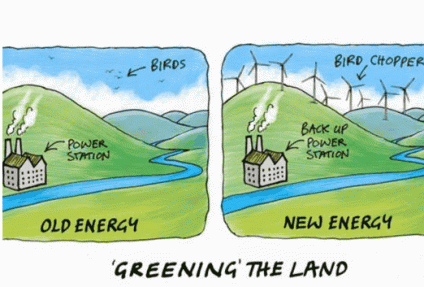
Renewable energy sources are not economically viable without subsidies, and they can impose some ugly external costs. Taxpayer subsidies for renewables like solar and wind projects are rationalized on the grounds that adoption will reduce carbon emissions and bring declining costs, ultimately saving resources by virtue of “free inputs”: the sun and the wind. But the cost of carbon emissions is highly uncertain, even speculative, and subsidies usually manage to get wasteful projects off the ground that are all too often run by political cronies. Despite the free variable inputs, these projects entail substantial resource costs that are conveniently overlooked by supporters. No wonder so many renewable outputs cannot be sustained without a continuing flow of aid.

What happens when the subsidies reach their sunset? There are thousands of abandoned wind turbines littering the U.S. (and a number of abandoned solar farms, too). There are several thousand turbines at one abandoned wind farm north of Los Angeles and another east of the Bay Area. There are many more in Hawaii, Iowa, Maine, Texas and other states. Attorneys often warn landowners that lease agreements with wind developers are risky. There are a number of ways that crony wind developers impose “external costs” on landowners. Eventual disposal is a risk, as the developers might just be inclined to take the subsidies and run.

Again, wind’s big advantages, aside from the subsidies, are that wind itself is free and produces no carbon, but other resources needed to make use of wind energy are not renewable, and producing those inputs produces CO2. To build and install the windmills requires materials (including steel and scarce rare-earth materials used in the electronic components), machinery, and of course labor and land costs. There is also a substantial investment in connecting windmills to the power grid. Ultimate disposal is a certainty, and it is not cheap. Then there is a controversial cost in terms of slaughtered avian life. Increasingly, wind turbines are thought to create health issues for people living nearby.

Solar power has the same advantages as wind in terms of a free input and no direct carbon output. In addition, the cost of solar panels has declined precipitously. Rooftop solar installations have allowed consumers to sell power back to electric utilities at certain times. In fact, without those “reimbursements” on top of the subsidies, installed on-site solar power would not be economically viable for many households and businesses. Reimbursement rates are therefore a huge controversy. Solar advocates have insisted that consumers should be reimbursed at the retail price of electricity. That is difficult to square with the fact that utilities could produce that power themselves for much less. It is especially difficult to square with the fact that the excess solar generation is often mismatched with the timing of power demand.

This brings us to the achilles heel of wind and solar power: wind and sunshine are intermittent, and not just on a daily basis, but over weeks, whole seasons and even years. This risk can be diversified geographically, but only to an extent, and effective power storage options do not presently exist and will not exist for some time, even with massive subsidies. Intermittent energy production requires the availability of other reliable power sources that are costly to turn on and off as needs dictate. It requires other “peaking” capacity to fill the “valleys” in wind and solar output, and baseline capacity is needed to provide for the less variable components of demand. Baseline capacity relies on nuclear power (which many solar advocates abhor) and carbon-emitting fossil fuels. Peaking capacity is typically provided by oil and natural gas generators. Hydro-electric power can be used as baseline or dialed back as needed, but hydro capacity is generally limited.

Renewable energy activists speak of replacing traditional power sources with wind and solar power. It is difficult enough, however, for wind and solar to replace peaking capacity, let alone baseline capacity. Peak wind and solar power production is not well-aligned with peak power demand in many areas (see the second chart at this link). The extra resources required to provide redundant facilities are significant, with ratepayers picking up the tab.

Given the current state of technology, pushing renewable energy goals even further, to the replacement of baseline capacity, is misguided at best. Yet it has been tried, with unintended but easily foreseeable consequences. Germany’s Energiewende program seeks to “decarbonize” power production without nuclear power. The costs have been very high:

“The report gives enough detail that you can see why Germany’s nuclear ban leads to a shocking cost of avoidance of $300 [/mt CO2]. … J.P. Morgan modeled a balanced deep decarbonization strategy, which using 35% nuclear, costs only $84/mt CO2. Note that the $300 is a bare-bones estimate – none of the cost of the additional transmission infrastructure required by high-renewables is included in the analysis. Even so the baseline Energiewende plan will double already second-highest in Europe current costs from $108 to $203/MWhr.“

California officials apparently want to go in the same direction. John Peterson reinforces the difficulties of integrating renewable energy capacity into the power grid in a recent post at InvestorIntel:

“The disadvantages [of intermittent power sources] include:

  • Intermittent power sources must have conventional backup for frequent periods when the wind and sun aren’t feeling particularly cooperative;
  • Cannibalization of peaking plant revenue streams results in higher electric costs for all because interest, depreciation, overhead and other fixed operating expenses must be recovered from fewer units of production;
  • When utilities pay premium prices for renewables, that indirectly increases electricity prices for all; and
  • When Federal, State and local treasuries subsidize the construction and operation of intermittent power sources, they indirectly increase everyone’s tax burden.“

The U.S. Federal Energy Regulatory Commission (FERC) is currently investigating the risk of intermittent energy sources to the reliability of the power grid.

“Power demand is relatively predictable and conventional power plants, like nuclear plants and natural gas, can adjust output accordingly. Solar and wind power, however, cannot easily adjust output. Peak power demand also occurs in the evenings, when solar power is going offline. Adding green power which only provide power at intermittent and unpredictable times [and stopping or even retiring other capacity], makes the power grid more fragile.“

Given decreasing costs, solar energy is likely to play an increasing role in power production in the future; wind production to a lesser extent. Both will depend on advances in the technology of power storage. However, there are still tremendous diseconomies that make current, widespread adoption of both wind and solar power a “Renewable Irony“. Like other attempts to centrally plan economic activity, the intentions are well and good, but execution requires mandated behavior and artificial inducements that impose heavy costs on society. Renewables should not be forced on us prematurely. They will happen voluntarily and naturally if we let them, guided by market signals as technology matures and resource scarcities evolve.


Omnibusted: Make Congress Stick To Single-Subject Bills

04 Thursday Feb 2016

Posted by Nuetzel in Big Government, Legislative Branch

≈ 3 Comments

Tags

Committee Review, Cronyism, Federal Profligacy, Glenn Reynolds, Mia Love, Omnibus Legislation, Public debt, Single-Subject Legislation

Omnibus-Bill

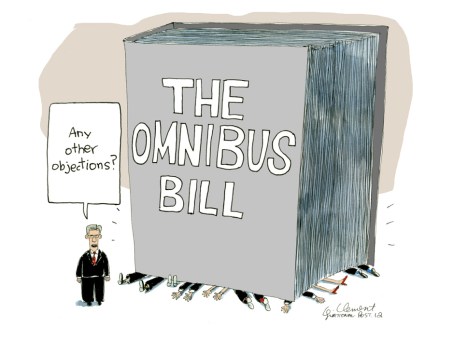
Here’s a great idea for making the federal government more transparent and accountable: force Congress to stick to single-subject legislation. Every bill should focus on a single issue with a clear statement of that issue. There would be no last-minute, unrelated amendments to legislation, and no omnibus bills as thick as several phone directories. This is the purpose of a three-page bill to be introduced by Representative Mia Love (R-UT). Glenn Reynolds explains the bill in more detail in “Want To Know Why Voters Are So Mad? Mia Love Has The Answer“. I’ll quote Reynolds at length, but do read the whole thing:

“A bill that’s so long that nobody can read it is, naturally, pretty likely to escape scrutiny. With thousands of pages and hundreds or thousands of provisions in the bill, what’s the chance that any particular provision will be noticed or criticized?

And even if a few provisions are criticized, when they’re tied to a bill that rewards literally hundreds of constituencies, there’s not much chance they’ll be shot down. Legislators, and special interests, have a vested interest in sticking together and being sure that the whole bill passes. Individually, most of these lousy provisions wouldn’t pass, but when banded together for mutual protection they can.   .…

Often, most of the provisions are written by lobbyists and inserted by tame members of Congress. The public isn’t really represented at all. That’s not an accident — it’s by design.“

No wonder the federal government and the public debt have grown to outrageous proportions. Reynolds would prefer a constitutional amendment on this issue similar to some state constitutions, but he supports Love’s bill as a second-best solution. The bill would also enable judicial review of potentially unrelated provisions of legislation, should they be challenged as such. Reynolds notes that cronyism often relies on the ability to sneak provisions into legislation to avoid scrutiny. Love’s bill might even encourage a return to the older congressional practice of subjecting appropriations to more thorough review in committee before going to the floor.

The tendency for legislation to grow seemingly misplaced appendages is also one of the reasons for the confusing accusations heard in the debates for the presidential nominations. Apparently, it’s possible for sponsors of legislation to be unaware of certain provisions attached to their bills. At the very least, it facilitates a less transparent form of political “horse trading”: I’ll vote for your bill if you allow me to attach an unrelated  provision that won’t be noticed.

The Love single-issue bill is a great idea, but there is likely to be strong resistance given the extenuatory pressures faced by many members of Congress, and their predictable reluctance to change the status quo. Hmm, perhaps Love can get her bill attached to another piece of legislation. Wouldn’t that be sweet irony!

White House Spins Weak Obamacare Enrollments

24 Monday Aug 2015

Posted by Nuetzel in Markets, Obamacare

≈ Leave a comment

Tags

ACA, ACA Exchange enrollment, ACA premium increases, Cronyism, Death Spiral, Heartland Institute, HHS Inspector General report, Insurer subsidies, Marco Rubio, Medicaid enrollment, Obamacare, Open enrollment, Rand Corporation, Reason Magazine, Robert Laszewski, Scott Walker, Slate, Somewhat Reasonable blog, Special enrollment period, Verification of eligibility

obamacare-humor-Screw

The Obama Administration is trying desperately to burnish the record of the President’s signature “achievement”, the Affordable Care Act (ACA), a.k.a. Obamacare.  That’s a tall order, unless the subject is the ACA’s remarkable triumph for excellence in high cronyism. Otherwise, little wonder that they tell only part of the Obamacare story. Robert Laszewski recently examined ACA’s enrollment in more detail and found the record rather dismal. He notes the following:

“… the Obama administration is just reporting the good news and a good share of the press appears to be happy to pass these numbers along–albeit in a technically correct but hardly complete way.“

Here are two examples provided by Laszewski:

  • The Rand Corporation reported that a net total of 16.9 million people were newly enrolled through February 2015. This was picked up by the press, which attributed the increase to Obamacare. But only 4.1 million of those newly insured came from the individual marketplaces (as noted by Rand). Most of those eligible for coverage through the marketplaces have not enrolled. Most of those who have enrolled were qualified for subsidies. Another 6.5 million came from Medicaid, which is free to those who qualify for that program. 9.6 million came from employer-provided plans, which has much to do with improved hiring over the past two years, as opposed to the ACA.
  • There were almost 950,000 new enrollees during the “special enrollment period” (after open enrollments ended) this year. This was heralded by the media, but little was said about the 1.3 million who dropped off the Obamacare rolls by the end of March. That number will grow once the administration comes clean on the number who have dropped coverage since then.

From Laszewski:

“The Obamacare insurance exchanges aren’t enrolling anywhere near the number of people they were supposed to. And, there is no proof Obamacare has grown since the close of open enrollment. In fact the anecdotal and historical evidence would suggest it is now shrinking.“

Going forward, the prospects for ACA enrollment are not good. As Slate belatedly reported last month, substantial premium increases are expected for 2016. The Heartland Institute‘s “Somewhat Reasonable” blog reports that “Millions of Americans Refuse to Buy Obamacare, Prefer to Pay Penalty“. The total who have refused is 7.5 million, much more than expected, while another 12 million people have claimed that they are exempt from the ACA’s requirements. Obamacare pricing and subsidies contain perverse incentives. It remains to be seen whether the insurers dominating the exchanges will have a sufficient number of young, healthy individuals enrolled and paying inflated premiums to offset the claims of more heavily-subsidized, high-risk enrollees.

There are many other problems plaguing Obamacare, including limited access to health care providers for many enrollees. Reason.com recently asked whether Obamacare is simply too complex to work, a question based largely on the findings of an HHS Inspector General’s report. There are massive issues related to verification of eligibility for subsidies and back-end payment systems for compensating insurers:

“Think of it this way: Before Obamacare, the U.S. health system was like a giant tangled knot. If you’ve ever tried to untangle a big knot, you know that it can take a while, and that the trick is to patiently loosen one bit at a time.

Obamacare’s designers, in contrast, saw that they couldn’t undo the knot, so they added more string, and tied it into the knot that was already there. Now it’s an even bigger mess.“

The so-called Obamacare success story is wishful thinking and shameless propaganda. It has failed to accomplish its goals in terms of coverage and especially cost, it has resulted in lost coverage to millions in the individual market who “liked their plans”, and it has caused millions of others who “liked their doctors” to lose their doctors. Things are not looking any rosier as we approach the implementation of the employer mandate (which was delayed twice) in 2016.

There are many ideas in play for improving health care coverage and access post-Obamacare. Here are summaries of the plans floated so far by Republican Presidential candidates Scott Walker and Marco Rubio. Though neither plan is a detailed as I’d like, some of the proposed high-level features are promising, at least relative to the ACA. There will be more proposals from other candidates before long. I’m hopeful that they will all remember to let markets work.

The Government Inequality Machine

17 Wednesday Jun 2015

Posted by Nuetzel in Big Government

≈ Leave a comment

Tags

Beautiful Anarchy, Cronyism, Export-Import Bank, Housing Policy, Inequality, Intellectual Property Rights, Jeffrey Tucker, Kevin Erdmann, National Review, Redistribution, regulation, rent seeking, Robert P. Murphy, Scott Sumner, The Freeman, Thomas Piketty, Welfare for the Rich

Cronyism cartoon

Some perceive the government as an ideal agent of redistribution, but they fail to apprehend the many ways in which government policy undermines equality. Scott Sumner and Kevin Erdmann have written an excellent essay on this point entitled “Here’s What’s Driving Inequality” at National Review. They focus on three areas of government action with the unavoidable side-effect of upward redistribution: housing policy (at all levels of government), regulation, and excessive protections for intellectual property.

Sumner and Erdmann briefly cover Thomas Piketty’s controversial view that wealth becomes increasingly concentrated under conditions of secular stagnation. However, they note that over the past few decades:

“... almost the entire change in the share of domestic income going to capital in major developed economies was explained by rising rents on residential real estate. Non-rental capital income (including the corporate sector) still has a fairly stable share of domestic income.“

Housing policy has driven rents upward in myriad ways. For example, restrictive zoning laws, environmental regulation of new building and regulation of bank lending have all made homeownership less feasible and renting more expensive. If you’re already in your own home, you’re safe! If not, welcome to the have-nots! Here’s a story on government insurance programs that offer massive subsidies to wealthy homeowners. All these redistributional effects are compounded by a tax code that has inflated housing prices through the home mortgage interest deduction, and at the same time inflated rents via the incidence of higher taxes on rental income and real estate capital gains.

Regulation of private business activity is often viewed naively as a necessary, protective function of government, but regulation acts in perverse ways:

“Unfortunately, many government regulations tend to favor larger firms. In recent years we have seen the passage of some extremely complex regulations involving thousands of pages of rules, such as Sarbanes-Oxley, Dodd-Frank, and the Affordable Care Act. The Food and Drug Administration, the Department of Defense, and the public health-care complex tend to create opportunities for uber-firms within industries, which act as clearinghouses for public contracts and regulatory demands.”

Large firms tend to pay higher wages and salaries than small firms. By favoring large firms, regulation in turn favors their relatively high-income workers. In addition, regulation such as occupational licensing, labor regulations and local wage controls damage the health and growth potential of small firms and the mobility of individuals at the bottom of the economic ladder.

Finally, Sumner and Erdmann discuss the often bizarre extension of intellectual-property (IP) rights and the way it favors large firms:

“Copyright protections once lasted for 14 years, applied only to maps and books, and could be renewed once if the author was still alive. Now they’ve been extended to many other products, extend for 50 years after the death of the author, and last for at least 95 years for corporations. These extensions are widely seen as reflecting the lobbying power of companies such as Disney. In the high-tech sector, patents are often granted for seemingly minor and obvious innovations.“

Sacred Cow Chips featured a piece on IP several months ago called “Is The Patent a Perversion?” The Libertarian view of IP is skeptical, to say the least, and favors limited protection at most. In that post, I quoted Jeffrey Tucker of the Beautiful Anarchy blog:

“Through intellectual property laws, the state literally assigned ownership to ideas that are the source of innovation, thereby restricting them and entangling entrepreneurs in endless litigation and confusion. Products are kept off the market. Firms that would come into existence do not. Profits that would be earned never appear. Intellectual property has institutionalized slow growth and landed the economy in a thicket of absurdity.“

There is little doubt that economic mobility is not well served by excessive grants of IP rights that extend monopolies indefinitely.

Government fosters inequality in many other ways. The mere existence of a confiscatory mechanism for legal revenue collection, and a complex bureaucracy in charge of distributing the spoils and making rules, will always attract high-powered rent-seeking resources and encourage cronyism. It is a graft machine. The very complexity of the tax code creates fertile ground for transfers via obscure breaks and carve-outs, while higher tax rates on others are required to fund the exceptions. Here’s another: the Export-Import Bank, which subsidizes exports for large corporations. A nice run-down of some of the many areas of “Welfare for the Rich” was provided a few years ago by Robert P. Murphy in The Freeman.

Unfortunately, direct efforts by the government to help the poor are often mere palliatives. At the same time, many of these programs are notorious for destroying work incentives, which undermines equality and economic mobility.

Government is simply not as well-suited to promoting equality as well-functioning markets, free of government meddling and government grants of monopoly. Profits in such markets attract new resources that compete away excess returns and bid prices downward, actions that tend to promote equality. The opportunity to compete without restraint not only vitiates artificial or permanent claims to profits; along with strong property rights, it encourages invention, economic mobility and growth.

Big Daddy Wants To Neutralize Your Net

09 Friday Jan 2015

Posted by Nuetzel in Uncategorized

≈ 4 Comments

Tags

AEI, Bureaucracy, central planning, Common Carrier, Cronyism, Don Boudreaux, FCC, Google, Internet REgulation, ISPs, Jeffrey Eisenach, Market Solutions, Net Neutrality, Netflix, Peter Suderman, Reason, Ronald Coase, Tom Wheeler, Wired

Net-Neutrality

Once again, President Obama is trying his hand as populist candyman, now pressing the FCC to adopt “net neutrality” rules for regulating internet service providers (ISPs) as common carriers. Net neutrality refers to regulations on ISPs that would prohibit different treatment of different types of internet content, matters that are better left to market participants. Obama has no idea what he’s doing or who he’ll be hurting (hint: internet users of all stripes). The candy is an illusion. Peter Suderman’ has an aptly titled article on this topic at Reason: “Will 2015 Be the Year the FCC Regulates the Internet Back to 1934?” He offers some background on the history of U.S. telecommunications regulation and explains the context within which FCC Chairman Tom Wheeler and the Commission will deal with the issue. Suderman closes with this thought:

“If Wheeler does take this route (reclassification of ISPs as common carriers], as he now seems to determined (sic), we’ll end up with an Internet that is more regulated, more subject to regulatory uncertainty in the near-term, and more like a public utility from another era than an information delivery service for the modern age. It’ll be 2015—but for the Internet, it’ll be 1934 all over again.”

Wired also gives its perspective but implies that Wheeler is seeking ways to reclassify the ISPs, impose neutrality rules, while also creating sufficient exceptions to mollify the ISPs, avoiding litigation as well as market disruption. That would be nice as far as it goes.

Net neutrality is a misnomer, as Sacred Cow Chips has discussed on two previous occasions in “The Non-Neutrality of Network Hogs“, and “Net Neutrality: A Tangled Web“. A lowlight is the corporate cronyism inherent in calls for net neutrality. The biggest beneficiaries are not consumers, but large content providers such as Netflix and Google, though the latter has altered its position on neutrality now that it is entering the market as an ISP. Another lowlight is the disincentive for network expansion created by forced subsidies to the large content providers, who are extremely heavy users of internet capacity.

Jeffrey Eisenach at AEI picks apart the arguments in favor of internet regulation. He also counters assertions that consumers are likely to benefit from internet regulation. Here are two choice quotes:

“And while much is made of consumers’ limited choices, the broadband market is actually less concentrated than the markets for search engines, social networks, and over-the-top video services: discriminatory regulation of ISPs cannot be justified on the basis of market power.”

“Finally, there’s the argument about fast lanes and slow lanes, or, in regulatory jargon, “paid prioritization.” The simple reality is that edge providers like Netflix require prioritization for their services to work. It’s just the “paid” part they don’t like.”

Finally, Don Boudreaux provides two relevant quotes on regulation, one from the great Ronald Coase, along with some of his own thoughts. I close with Boudreaux’s summation:

“Government imposition of “net neutrality” will substitute bureaucrats’ politically poisoned judgments on what are and what are not appropriate business practices for the market-tested judgments of legions of suppliers competing for the patronage of hundreds of millions – indeed, often billions – of consumers.“

Negative Net Taxes For Most Is Not A Good Sign

18 Tuesday Nov 2014

Posted by Nuetzel in Uncategorized

≈ Leave a comment

Tags

Carpe Diem, CBO, Corporate tax, Cronyism, Inequality, Mark Perry, OECD, Progressive Taxes, rent seeking, Senate Budget Committee

IRS Spider

Carpe Diem (Mark Perry) reports on a new CBO study showing that nearly all net federal taxes (taxes net of transfer payments received) are paid by households in the highest income quintile. The fourth quintile pays a small, positive amount of net taxes, but the lowest 60% of  households pay negative net taxes, with average tax rates on market income plus transfers ranging from -13.7% for the middle income quintile to -35% for the lowest quintile. From Perry:

“The second-highest income quintile basically just barely covers its transfer payments, so it’s really the top 20% of “net payer” households that are financing transfer payments to the entire bottom 60% AND financing the non-financed operations of the entire federal government.”

A heavy concentration of taxes at one end of the income distribution is not a healthy development for a democracy when it comes to fiscal responsibility.

In a second post, Perry uses the same study to show that adjusting market income for net taxes reduces income inequality by almost 50%. Advocates for greater income equality always focus on market income alone because it tends to show a more dramatic gap between rich and poor. This distortion understates the extent to which policies already in place reduce income inequality and amplifies the unabating contention that more must be done. In addition, standard measures of income inequality tend to distort trends, as SCC has noted in the past.

At the same time, OECD data reveal that the U.S. has the most progressive tax system in the industrialized world. The author of the OECD post cited the data in testifying before the Senate Budget Committee:

“This prompted one Senator to point out that if the richest 10% of taxpayers earn the most of any OECD country, shouldn’t it make sense that they bear the largest tax burden of any country?”

The Senator’s premise was false, as there are countries with higher or similar income shares earned by the top decile, but the tax burden on that decile in the U.S. is the highest. In addition, the U.S. has the highest corporate tax rate in the industrialized world, a point on which SCC has posted before.

The ongoing debate over inequality is counterproductive. Calls for higher taxes will certainly do nothing to encourage economic growth and job creation. Quite the opposite. And inequality, in principle, is not in any way synonymous with decreasing standards of living. However, I certainly agree that inequality can be harmful when it is induced by rent-seeking activity and cronyism, which become a way of life with growth in the public sector.

← Older posts
Newer posts →
Follow Sacred Cow Chips on WordPress.com

Recent Posts

  • A Warsh Policy Scenario At the Federal Reserve
  • The Coexistence of Labor and AI-Augmented Capital
  • The Case Against Interest On Reserves
  • Immigration and Merit As Fiscal Propositions
  • Tariff “Dividend” From An Indigent State

Archives

  • February 2026
  • January 2026
  • December 2025
  • November 2025
  • October 2025
  • September 2025
  • August 2025
  • July 2025
  • June 2025
  • May 2025
  • April 2025
  • March 2025
  • February 2025
  • January 2025
  • December 2024
  • November 2024
  • October 2024
  • September 2024
  • August 2024
  • July 2024
  • June 2024
  • May 2024
  • April 2024
  • March 2024
  • February 2024
  • January 2024
  • December 2023
  • November 2023
  • August 2023
  • July 2023
  • June 2023
  • May 2023
  • April 2023
  • March 2023
  • February 2023
  • January 2023
  • December 2022
  • November 2022
  • October 2022
  • September 2022
  • August 2022
  • July 2022
  • June 2022
  • May 2022
  • April 2022
  • March 2022
  • February 2022
  • January 2022
  • December 2021
  • November 2021
  • October 2021
  • September 2021
  • August 2021
  • July 2021
  • June 2021
  • May 2021
  • April 2021
  • March 2021
  • February 2021
  • January 2021
  • December 2020
  • November 2020
  • October 2020
  • September 2020
  • August 2020
  • July 2020
  • June 2020
  • May 2020
  • April 2020
  • March 2020
  • February 2020
  • January 2020
  • December 2019
  • November 2019
  • October 2019
  • September 2019
  • August 2019
  • July 2019
  • June 2019
  • May 2019
  • April 2019
  • March 2019
  • February 2019
  • January 2019
  • December 2018
  • November 2018
  • October 2018
  • September 2018
  • August 2018
  • July 2018
  • June 2018
  • May 2018
  • April 2018
  • March 2018
  • February 2018
  • January 2018
  • December 2017
  • November 2017
  • October 2017
  • September 2017
  • August 2017
  • July 2017
  • June 2017
  • May 2017
  • April 2017
  • March 2017
  • February 2017
  • January 2017
  • December 2016
  • November 2016
  • October 2016
  • September 2016
  • August 2016
  • July 2016
  • June 2016
  • May 2016
  • April 2016
  • March 2016
  • February 2016
  • January 2016
  • December 2015
  • November 2015
  • October 2015
  • September 2015
  • August 2015
  • July 2015
  • June 2015
  • May 2015
  • April 2015
  • March 2015
  • February 2015
  • January 2015
  • December 2014
  • November 2014
  • October 2014
  • September 2014
  • August 2014
  • July 2014
  • June 2014
  • May 2014
  • April 2014
  • March 2014

Blogs I Follow

  • Passive Income Kickstart
  • OnlyFinance.net
  • TLC Cholesterol
  • Nintil
  • kendunning.net
  • DCWhispers.com
  • Hoong-Wai in the UK
  • Marginal REVOLUTION
  • Stlouis
  • Watts Up With That?
  • Aussie Nationalist Blog
  • American Elephants
  • The View from Alexandria
  • The Gymnasium
  • A Force for Good
  • Notes On Liberty
  • troymo
  • SUNDAY BLOG Stephanie Sievers
  • Miss Lou Acquiring Lore
  • Your Well Wisher Program
  • Objectivism In Depth
  • RobotEnomics
  • Orderstatistic
  • Paradigm Library
  • Scattered Showers and Quicksand

Blog at WordPress.com.

Passive Income Kickstart

OnlyFinance.net

TLC Cholesterol

Nintil

To estimate, compare, distinguish, discuss, and trace to its principal sources everything

kendunning.net

The Future is Ours to Create

DCWhispers.com

Hoong-Wai in the UK

A Commonwealth immigrant's perspective on the UK's public arena.

Marginal REVOLUTION

Small Steps Toward A Much Better World

Stlouis

Watts Up With That?

The world's most viewed site on global warming and climate change

Aussie Nationalist Blog

Commentary from a Paleoconservative and Nationalist perspective

American Elephants

Defending Life, Liberty and the Pursuit of Happiness

The View from Alexandria

In advanced civilizations the period loosely called Alexandrian is usually associated with flexible morals, perfunctory religion, populist standards and cosmopolitan tastes, feminism, exotic cults, and the rapid turnover of high and low fads---in short, a falling away (which is all that decadence means) from the strictness of traditional rules, embodied in character and inforced from within. -- Jacques Barzun

The Gymnasium

A place for reason, politics, economics, and faith steeped in the classical liberal tradition

A Force for Good

How economics, morality, and markets combine

Notes On Liberty

Spontaneous thoughts on a humble creed

troymo

SUNDAY BLOG Stephanie Sievers

Escaping the everyday life with photographs from my travels

Miss Lou Acquiring Lore

Gallery of Life...

Your Well Wisher Program

Attempt to solve commonly known problems…

Objectivism In Depth

Exploring Ayn Rand's revolutionary philosophy.

RobotEnomics

(A)n (I)ntelligent Future

Orderstatistic

Economics, chess and anything else on my mind.

Paradigm Library

OODA Looping

Scattered Showers and Quicksand

Musings on science, investing, finance, economics, politics, and probably fly fishing.

  • Subscribe Subscribed
    • Sacred Cow Chips
    • Join 128 other subscribers
    • Already have a WordPress.com account? Log in now.
    • Sacred Cow Chips
    • Subscribe Subscribed
    • Sign up
    • Log in
    • Report this content
    • View site in Reader
    • Manage subscriptions
    • Collapse this bar
 

Loading Comments...