• About

Sacred Cow Chips

Sacred Cow Chips

Tag Archives: Don Boudreaux

Trump’s New Corporatist Plunder Will Cost U.S.

05 Friday Sep 2025

Posted by Nuetzel in Central Planning, Protectionism, Socialism

≈ Leave a comment

Tags

AMD, central planning, CHIPS Act, Corporatism, Don Boudreaux, Donald Trump, Extortion, fascism, Golden Share, Howard Lutnick, Intel, MP Materials, National Security, Nippon Steel, NVIDIA, Protectionism, Public debt, Scott Bessent, Socialism, Tad DeHaven, TikTok, U.S. Steel, Unfunded Obligations, Veronique de Rugy

Since his inauguration, Donald Trump has been busy finding ways for the government to extort payments and ownership shares from private companies. This has taken a variety of forms. Tad DeHaven summarizes the major pieces of booty extracted thus far in the following bullet points (skipping the quote marks here):

  • June 13: Trump issues an executive order allowing the Nippon Steel-US Steel deal contingent on giving the government a “golden share” that enables the president to exert extensive control over US Steel’s operations.
  • July 10: The Department of Defense (DoD) unveils a multi-part package with convertible preferred stock, warrants, and loan guarantees, making it the top shareholder of rare earth metals producer MP Materials.
  • July 23: The White House claims an agreement with Japan to reduce the president’s so-called reciprocal tariff rate on Japanese imports comes with a $550 billion Japanese “investment fund” that Trump will control.
  • July 31: Trump claims an agreement with South Korea to reduce the so-called reciprocal tariff on South Korean imports comes with a $350 billion South Korean-financed investment in projects “owned and controlled by the United States” that he will select.
  • August 11: The White House confirms an “unprecedented” deal with Nvidia and AMD that allows them to sell particular chips to China in exchange for 15 percent of the sales.
  • August 12: In a Fox Business interview, Bessent points to the alleged investments from Japan, South Korea, and the EU “to some extent” and says, “Other countries, in essence, are providing us with a sovereign wealth fund.”
  • August 22: Fifteen days after calling for Intel CEO Lip-Bu Tan to resign, Trump announces that the US will take a 10 percent equity stake in Intel using the CHIPS Act and DoD funds, becoming Intel’s largest single shareholder.

Each of these “deals” has a slightly different back story, but national security is a common theme. And Trump says they’ll all make America great again. They are touted as a way for American taxpayers to benefit from the investment he claims his policies are attracting to the U.S. However, all of these are ill-advised for several reasons, some of which are common to all. That includes the extortionary nature of each and every one of them.

Short Background On “Deals”

The June 13 deal (Nippon/US Steel), the July 10 deal (MP Materials), and the August 22 deal (Intel) all involve U.S. government equity stakes in private companies. The August 11 deal (NVIDIA/AMD) diverts a stream of private revenue to the government. The July 23 and July 31 deals (Japan and South Korea) both involve “investment funds” that Trump will control to one extent or another.

The August 12 entry adds “expected” EU investments with some qualification, but that bullet quotes Treasury Secretary Bessent referring to these investments as part of a sovereign wealth fund (SWF). Secretary of Commerce Lutnick now denies that an SWF will exist. My objections might be tempered slightly (but only slightly) by an SWF because it would probably need to place constraints on an Administation’s control. That might give you a hint as to why Lutnick is now downplaying the creation of an SWF.

I object to the Nippon/US Steel “deal” in part (and only in part) because it was extortion on its face. There is no valid anti-trust argument against the deal (US Steel is the nation’s third largest steelmaker and is broke), and the national security concerns that were voiced (Japan! for one thing) were completely bogus. Even worse, the “Golden Share” would give the federal government authority, if it chose to exercise it, over a variety of the company’s decisions.

The Intel “deal” is another highly questionable transaction. Intel was to receive $11 billion under the CHIPS Act, a fine example of corporate welfare, as Veronique de Rugy once described the law. However, Intel was to receive its grants only if it stood up four fabrication facilities. But it did not. Now, instead of demanding reimbursement of amounts already paid, the government offered to pay the remainder in exchange for a 9.9% stake in the company. And there is no apparent requirement that Intel meet the original committment! This could turn out a bust!

The MP Materials transaction with the Department of Defense has also been rationalized on national security grounds. This excuse comes a little closer to passing the smell test, but the equity stake is objectionable for other reasons (to follow).

The Nvidia/AMD deal has been justified as compensation for allowing the companies to sell chips to China, which is competing with the U.S. to lead the world in AI development. This is another form of selective treatment, here applied to an export license. The chips in question do not have the same advanced specifications as those sold by the companies in the U.S., but let’s not let that get in the way of a revenue opportunity.

While nothing about TikTok appears on the list above, I fear that a resolution of its operational status in the U.S. presents another opportunity for extortion by the Trump Administration. I’m sure there will be many other cases.

Root Cause: Protectionism

The so-called investment funds described in the timeline above are nearly all the result of trade terms negotiated by a dominant and belligerent trading partner: the U.S. My objections to tariffs are one thing, but here we are extorting investment pledges for reductions in the taxes we’ll impose on our own citizens! Additionally, the belief that these investments will somehow prevent a general withdrawal of foreign investment in the U.S. is misguided. In fact, a smaller trade deficit dictates less foreign investment. The difference here is that the government will wrest ownership control over a greater share of less foreign investment.

Trump the Socialist?

Needless to say, I don’t favor government ownership of the means of production. That’s socialism, but do matters of national security offer a rationale for public ownership? For example, rare earth minerals are important to national defense. Therefore, it’s said that we must ensure a domestic supply of those minerals. I’m not convinced that’s true, but in any case, fat defense contracts should create fat profit opportunities in mining rare earths (enter MP Materials). None of that means public ownership is necessary or a good idea.

All of these federal investments are construed, to one extent or another, as matters of national security, but that argument for market intervention is much too malleable. Must we ensure a domestic supply of semiconductors for national security reasons? And public ownership? Is the same true of steel? Is the same true of our “manufacturing security”? It can go on and on. The next thing you know, someone will argue that grocery stores should be owned by the government in the name of “food security”! Oh, wait…

Trump the Central Planner

Government ownership takes the notion of industrial planning a huge step beyond the usual conception of that term. Ordinarily, when government takes the role of encouraging or discouraging activity in particular industries or technologies, it attempts to select winners and losers. The very idea presumes that the market is not allocating resources in an optimal way, as if the government is in any position to gainsay the decisions of private market participants who have skin in the game. This is a foolhardy position with predictably negative consequences. (For some examples, see the first, second, and fourth articles linked here by Don Boudreaux.) The fundamental flaw in central planning always comes down to the inability of planners to collect, process, and act on the information that the market handles with marvelous efficiency.

When government invests taxpayer funds in exchange for ownership positions in private concerns, the potential levers of control are multiplied. One danger is that political guidance will replace normal market incentives. And as de Rugy points out, the government’s potential role as a regulator creates a clear conflict of interest. In a strong sense, a government ownership stake is worse for private owners than a mere dilution of their interests. It looms as a possible taking, as private owners and managers surrender to creeping government extortion.

Financial Malfeasance

In addition to the objections above, I maintain that these investments represent poor stewardship of public funds. The U.S. public debt currently stands at $37 trillion with an entitlement disaster still to come. In fact, according to one estimate, the federal government’s total unfunded obligations amount to additional $121 trillion! Putting aside the extortion we’re witnessing, any spare dollar should be put toward retiring debt, rather than allowing its upward progression.

As I’ve noted before, paying off a dollar of debt entails a risk-free “return” in the form of interest cost avoidance, let’s say 3.5% for the sake of argument. If instead the dollar is “invested” in risk assets by the government, the interest cost is still incurred. To earn a net return as high as the that foregone from interest avoidance, the government must consistently earn at least 7% on its invested dollar. But of course that return is not risk-free!

A continuing failure to pay down the public debt will ultimately poison the debt market’s assessment of the government’s will to stay within its long-run budget constraint. That would ultimately manifest in an inflation, shrinking the real value of the public debt even as it undermines the living standards of many Americans.

One final thought: Though few MAGA enthusiasts would admit it even if they understood, we’re witnessing a bridging of two ends of the idealogical “horseshoe”. Right-wing populism and protectionism meet the left-wing ideal of central planning and public ownership. There is a name for this particular form of corporatist state, and it is fascism.
A Cooked-Up “Crisis” In U.S. Manufacturing

05 Monday May 2025

Posted by Nuetzel in Liberty

≈ 1 Comment

Tags

Brian Albrecht, Data Security, Don Boudreaux, Donald Trump, Economic Security, Health Security, Jeff Jacoby, Job Security, National Security, Protectionism, Ross Douthat, Strategic Goods, Tariffs, Trade Barriers, Tyler Cowen, Veronique de Rugy

Supporters of President Trump’s hard line on trade make so many false assertions that it’s hard to keep up. I’ve addressed several of these in earlier posts and I’ll address two more fallacies here: 1) that the U.S. manufacturing sector is in a state of crisis; and 2) that tariffs played a key role in promoting economic growth in the U.S. during the so-called gilded age of the late 19th and early 20th centuries.

Security

First, let’s revisit one tenet of protectionism: national security demands self-sufficiency. This undergirds the story that we must produce physical “things”, in addition to often higher-valued services, to be a great nation, or even to survive!

Of course, protecting industries critical to national security might seems like a natural concession to make, even for those supportive of liberalized trade. Ross Douthat says this:

“I think trying to reshore some manufacturing and decouple more from China makes sense from a national security standpoint, even if it costs something to G.D.P. and the stock market.“

Unfortunately, this kind of rationale is far too malleable. There is never a clearly defined limiting principle. Someone decides which goods are “critical” to national security, and this deliberation becomes the subject of much political jockeying and favor-seeking. But wait! Economic security is also cited as an adequate excuse for trade protections! And how about data security? Health security? Job security? Always there is insistence that “security” of one sort or another demands that we provide for our own needs. For definitive proof, take a look at this nonsense! Give them an inch and they’ll take a mile.

Pretty soon you “protect” such a wide swath of industries in a quest for self-sufficiency that the entire economy is unmoored from opportunity costs, comparative advantages, and the information about scarcities provided by market prices. Absolute “security” comes at the cost of transforming the economy’s productive machinery into a complacent hulk rivaling the inefficiency of Soviet industrial planning. Competition is the solution, but not limited to firms under the same set of protective trade barriers.

Manufacturing Is Mostly Fine

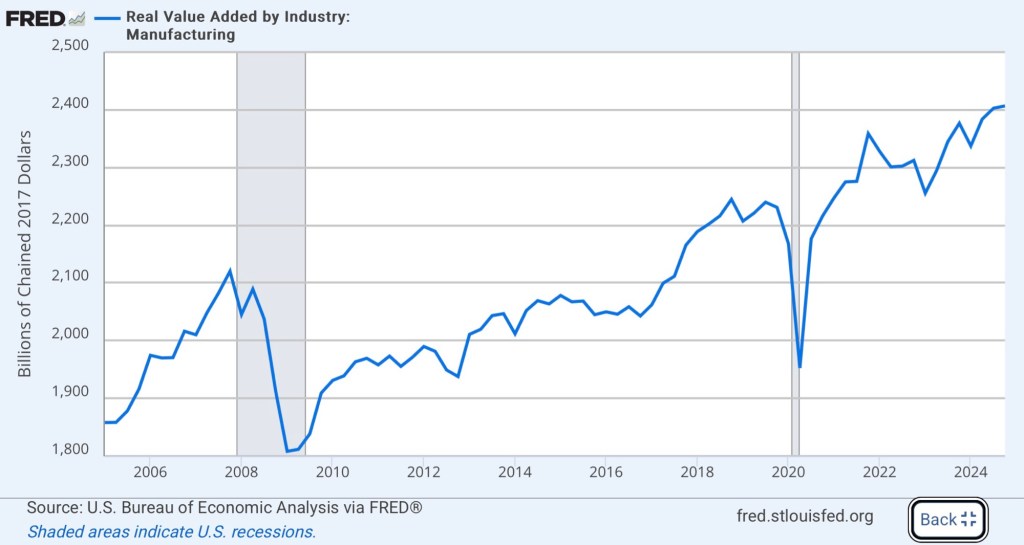
Trade warriors, including members of Trump’s team, insist that our decline as a nation is being hastened by a crisis in manufacturing. However, value added in U.S. manufacturing is at an all-time high.

There has been a long-term decline in manufacturing employment, but not manufacturing output. In fact, manufacturing output has doubled since 1980. As Jeff Jacoby notes, “the purpose of manufacturing is to make things, not jobs.” If our overarching social goal was job security, we’d have revolted long ago against the tremendous reduction in agricultural employment experienced over the past century. We’d rely on switchboard operators to load web pages, and we’d dig trenches and tunnels with spoons (to paraphrase Milton Friedman).

The secular decline in manufacturing employment is a consequence of growth in manufacturing productivity. Economy-wide, this phenomenon allows real income and our standard of living to grow.

Take That Job and …

It’s also significant that few Americans have much interest in factory work. It’s typically less dangerous than in times past, but many of today’s factory jobs are still physically challenging and relatively risky. Perhaps that helps explain why nearly half-a-million jobs in manufacturing are unfilled.

Jacoby describes the transition that has changed the face of American manufacturing:

“… US plants have largely turned away from making many of the low-tech, labor-intensive consumer items they once specialized in — sneakers, T-shirts, small appliances, toys. Those jobs have mostly gone overseas, and trying to bring them back by means of a trade war would be ruinous. Yet America remains a global manufacturing powerhouse — highly skilled, highly innovative, and highly efficient.“

And yet, even as wages in manufacturing have grown, many factory jobs do not pay as well as positions requiring far less strenuous toil in the services sector. It’s also true that the best manufacturing jobs in the U.S. today require high-level skills, which are in short supply. These factors help explain why manufacturers believe finding qualified workers is one of their biggest challenges.

Isolating Weak Sectors

There are specific sectors within manufacturing that have fared poorly, including textiles, furniture, metals, and low-end electronics. The loss of competitiveness that drove those sectoral declines is not a new development. It has, however, devastated communities in the U.S. that were heavily dependent on these industries. These misfortunes are regrettable, but trade barriers are not an effective prescription for revitalizing depressed areas.

Meanwhile, other manufacturing sectors have enjoyed growth, such as computers, aerospace, and EVs. While we’ve seen a decline in the number of manufacturing firms, the performance of U.S. manufacturing in the 21st century can be described as mixed at the very worst.

The author of this piece seems to accept the false notion that U.S. manufacturing is moribund, but he knows tariffs aren’t an effective way to strengthen domestic goods production. He has a number of better suggestions, including a commitment to infrastructure investment, reforms to education and health, and reconfiguring certain corporate income tax policies. Unfortunately, his ideas on tariffs are sometimes as mistaken as Trump’s,

The Gilded Age

Finally, the other false assertion noted in the opening paragraph is that tariffs somehow spurred economic growth in the late 19th and early 20th centuries. Brian Albrecht corrects this protectionist fallacy, which lies at the root of many defenses of Trump’s tariffs. Albrecht cites favorable conditions for growth that were sufficient to overwhelm the negative effects of tariffs, including:

“… explosive population growth, mass European immigration, rapid technological innovation, westward expansion, abundant natural resources, high literacy rates, and stable property rights.”

While cross-country comparisons indicate a positive correlation between tariffs and growth during the 1870 – 1920 period, those differences were caused by other forces that dominated tariffs. Cross-industry research discussed by Albrecht indicates that tariffs on manufactured goods during the gilded era reduced labor productivity and stimulated the entry of smaller, less productive firms. Likewise, natural experiments find that tariffs allowed inefficient firms to survive and discouraged innovation.

Conclusion

The U.S. manufacturing sector is not in any sort of crisis, and its future growth won’t be powered by attempts to restore the sort of low-value production offshored over the past several decades. What protectionists interpret as failure is the natural progression of a technically advanced market-based civilization, where high-value services account for greater shares of growing total output. Of course, low-value production is sometimes “crowded out” in this process, depending on its trade-ability and comparative advantages. The logic of the process is encapsulated by Veronique de Rugy’s recent discussion of iPhone production (HT: Don Boudreaux):

“Then there’s [Commerce Secretary Howard] Lutnick, pining for a world where Americans flood back into massive factories to assemble iPhones. This is nostalgic industrial cosplay masquerading as economic strategy. Yes, iPhones aren’t assembled by Americans. But this isn’t a failure; it’s a feature of smart economic specialization. We design the iPhone here. That’s the high-value, high-margin part. The sophisticated chips, software, architecture, and intellectual property are all created in the U.S. The marketing is done here, too. That’s most of the value of the iPhone. The lower-value labor-intensive assembly work is done abroad because those tasks are more efficiently performed abroad.“

There is certainly no crisis in U.S. manufacturing. That narrative is driven by a combination of politics, rent seeking, and misplaced nostalgia.

Government Failure as a Root Cause of Market Failure

10 Monday Jul 2023

Posted by Nuetzel in Government Failure, Market Failure

≈ Leave a comment

Tags

Capital Formation, central planning, Chevron Doctrine, Competitive Equilibrium, Corruption, crowding out, Declaration of Independence, Don Boudreaux, External Benefits, External Costs, Government Failure, Inflation, John Cochrane, Labor Supply, Market Failure, Michael Munger, monopoly power, Pareto Superiority, Peter Boettke, Price Controls, Protectionism, Redistribution, Regulatory Capture, rent seeking, Risk-Free Asset, Side Payments, Social Security, State Capacity, Tax Distortions, Thomas Jefferson, Treasury Debt, William R. Keech

We’re told again and again that government must take action to correct “market failures”. Economists are largely responsible for this widespread view. Our standard textbook treatments of external costs and benefits are constructed to demonstrate departures from the ideal of perfectly competitive market equilibria. This posits an absurdly unrealistic standard and diminishes the power and dramatic success of real-world markets in processing highly dispersed information, allocating resources based on voluntary behavior, and raising human living standards. It also takes for granted the underlying institutional foundations that lead to well-functioning markets and presumes that government possesses the knowledge and ability to rectify various departures from an ideal. Finally, “corrective” interventions are usually exposited in economics classes as if they are costless!

Failed Disgnoses

This brings into focus the worst presumption of all: that government solutions to social and economic problems never fail to achieve their intended aims. Of course that’s nonsense. If defined on an equivalent basis, government failure is vastly more endemic and destructive than market failure.

Related to this point, Don Boudreaux quotes from Peter Boettke’s Living Economics:

“According to ancient legend, a Roman emperor was asked to judge a singing contest between two participants. After hearing the first contestant, the emperor gave the prize to the second on the assumption that the second could be no worse than the first. Of course, this assumption could have been wrong; the second singer might have been worse. The theory of market failure committed the same mistake as the emperor. Demonstrating that the market economy failed to live up to the ideals of general competitive equilibrium was one thing, but to gleefully assert that public action could costlessly correct the failure was quite another matter. Unfortunately, much analytical work proceeded in such a manner. Many scholars burst the bubble of this romantic vision of the political sector during the 1960s. But it was [James] Buchanan and Gordon Tullock who deserve the credit for shifting scholarly focus.”

John Cochrane sums up the whole case succinctly in the “punchline” of a recent post:

“The case for free markets never was their perfection. The case for free markets always was centuries of experience with the failures of the only alternative, state control. Free markets are, as the saying goes, the worst system; except for all the others.”

Tracing Failures

We can view the relation between market failure and government failure in two ways. First, we can try to identify market failures and root causes. For example, external costs like pollution cause harm to innocent third parties. This failure might be solely attributable to transactions between private parties, but there are cases in which government engages as one of those parties, such as defense contracting. In other cases government effectively subsidizes toxic waste, like the eventual disposal of solar panels. Another kind of market failure occurs when firms wield monopoly power, but that is often abetted by costly regulations that deliver fatal blows to small competitors.

The second way to analyze the nexus between government and market failures is to first examine the taxonomy of government failure and identify the various damages inflicted upon the operation of private markets. That’s the course I’ll follow below, though by no means is the discussion here exhaustive.

Failures In and Out of Scope

An extensive treatment of government failure was offered eight years ago by William R. Keech and Michael Munger. To start, they point out what everyone knows: governments occasionally perpetrate monstrous acts like genocide and the instigation of war. That helps illustrate a basic dichotomy in government failures:

“… government may fail to do things it should do, or government may do things it should not do.’

Both parts of that statement have numerous dimensions. Failures at what government should do run the gamut from poor service at the DMV, to failure to enforce rights, to corrupt bureaucrats and politicians skimming off the public purse in the execution of their duties. These failures of government are all too common.

What government should and should not do, however, is usually a matter of political opinion. Thomas Jefferson’s axioms appear in a single sentence at the beginning of the Declaration of Independence; they are a tremendous guide to the first principles of a benevolent state. However, those axioms don’t go far in determining the range of specific legal protections and services that should and shouldn’t be provided by government.

Pareto Superiority

Keech and Munger engage in an analytical exercise in which the “should and shouldn’t” question is determined under the standard of Pareto superiority. A state of the world is Pareto superior if at least one person prefers it to the current state (and no one else is averse to it). Coincidentally, voluntary trades in private markets always exploit Pareto superior opportunities, absent legitimate external costs and benefits.

The set of Pareto superior states available to government can be expanded by allowing for side payments or compensation to those who would have preferred the current state. Still, those side payments are limited by the magnitude of the gains flowing to those who prefer the alternative (and if those gains can be redistributed monetarily).

Keech and Munger define government failure as the unexploited existence of Pareto superior states. Of course, by this definition, only a benevolent, omniscient, and omnipotent dictator could hope to avoid government failure. But this is no more unrealistic than the assumptions underlying perfectly competitive market equilibrium from which departure are deemed “market failures” that government should correct. Thus, Keech and Munger say:

“The concept of government failure has been trapped in the cocoon of the theory of perfect markets. … Government failure in the contemporary context means failing to resolve a classic market failure.”

But markets must operate within a setting defined by culture and institutions. The establishment of a social order under which individuals have enforceable rights must come prior to well-functioning markets, and that requires a certain level of state capacity. Keech and Munger are correct that market failure is often a manifestation of government failure in setting and/or enforcing these “rules of the game”.

“The real question is … how the rules of the game should be structured in terms of incentives, property rights, and constraints.”

The Regulatory State and Market Failures

Government can do too little in defining and enforcing rights, and that’s undoubtedly a cause of failure in markets in even the most advanced economies. At the same time there is an undeniable tendency for mission creep: governments often try to do too much. Overregulation in the U.S. and other developed nations creates a variety of market failures. This includes the waste inherent in compliance costs that far exceed benefits; welfare losses from price controls, licensing, and quotas; diversion of otherwise productive resources into rent seeking activity, anti-competitive effects from “regulatory capture”; Chevron-like distortions endemic to the administrative judicial process; unnecessary interference in almost any aspect of private business; and outright corruption and bribe-taking.

Central Planning and Market Failures

Another category of government attempting to “do too much” is the misallocation of resources that inevitably accompanies efforts to pick “winners and losers”. The massive subsidies flowing to investors in various technologies are often misdirected. Many of these expenditures end up as losses for taxpayers, and this is not the only form in which failed industrial planning takes place. A related evil occurs when steps are taken to penalize and destroy industries in political disfavor with thin economic justification.

Other clear examples of government “planning” failure are protectionist laws. These are a net drain on our wealth as a society, denying consumers of free choice and saddling the country with the necessity to produce restricted products at high cost relative to erstwhile trading partners.

There are, of course, failures lurking within many other large government spending programs in areas such as national defense, transportation, education, and agriculture. Many of these programs can be characterized as centrally planning. Not only are some of these expenditures ineffectual, but massive procurement spending seems to invite waste and graft. After all, it’s somebody else’s money.

Redistribution and Market Failures

One might regard redistribution programs as vehicles for the kinds of side payments described by Keech and Munger. Some might even say these are the side payments necessary to overcome resistance from those unable to thrive in a market economy. That reverses the historical sequence of events, however, since the dominant economic role of markets preceded the advent of massive redistribution schemes. Unfortunately, redistribution programs have been plagued by poor design, such as the actuarial nightmare inherent in Social Security and the destructive work incentives embedded in other parts of the social safety net. These are rightly viewed as government failures, and their distortionary effects spill variously into capital markets, labor markets and ultimately product markets.

Taxation and Market Failures

All these public initiatives under which government failures precipitate assorted market failures must be paid for by taxpayers. Therefore, we must also consider the additional effects of taxation on markets and market failures. The income tax system is rife with economic distortions. Not only does it inflict huge compliance costs, but it alters incentives in ways that inhibit capital formation and labor supply. That hampers the ability of input markets to efficiently meet the needs of producers, inhibiting the economy’s productive capacity. In turn, these effects spill into output market failures, with consequent losses in .social welfare. Distortionary taxes are a form of government failure that leads to broad market failures.

Deficits and Market Failure

More often than not, of course, tax revenue is inadequate to fund the entire government budget. Deficit spending and borrowing can make sense when public outlays truly produce long-term benefits. In fact, the mere existence of “risk-free” assets (Treasury debt) across the maturity spectrum might enhance social welfare if it enables improvements in portfolio diversification that outweigh the cost of the government’s interest obligations. (Treasury securities do bear interest-rate risk and, if unindexed, they bear inflation risk.)

Nevertheless, borrowing can reflect and magnify deleterious government efforts to “do too much”, ultimately leading to market failures. Government borrowing may “crowd out” private capital formation, harming economy-wide productivity. It might also inhibit the ability of households to borrow at affordable rates. Interest costs of the public debt may become explosive as they rise relative to GDP, limiting the ability of the public sector to perform tasks that it should *actually* do, with negative implications for market performance.

Inflation and Market Failure

Deficit spending promotes inflation as well. This is more readily enabled when government debt is monetized, but absent fiscal discipline, the escalation of goods prices is the only remaining force capable of controlling the real value of the debt. This is essentially the inflation tax.

Inflation is a destructive force. It distorts the meaning of prices, causes the market to misallocate resources due to uncertainty, and inflicts costs on those with fixed incomes or whose incomes cannot keep up with inflation. Sadly, the latter are usually in lower socioeconomic strata. These are symptoms of market failure prompted by government failure to control spending and maintain a stable medium of exchange.

Conclusion

Markets may fail, but when they do it’s very often rooted in one form of government failure or another. Sometimes it’s an inadequacy in the establishment or enforcement of property rights. It could be a case of overzealous regulation. Or government may encroach on, impede, or distort decisions regarding the provision of goods or services best left to the market. More broadly, redistribution and taxation, including the inflation tax, distort labor and capital markets. The variety of distortions created when government fails at what it should do, or does what it shouldn’t do, is truly daunting. Yet it’s difficult to find leaders willing to face up to all this. Statism has a powerful allure, and too many elites are in thrall to the technocratic scientism of government solutions to social problems and central planning in the allocation of resources.

The Impotence of AI for the Socialist Calculation Debate

05 Monday Jun 2023

Posted by Nuetzel in Artificial Intelligence, Central Planning, Markets

≈ Leave a comment

Tags

Allocative efficiency, CATO Institute, central planning, Don Boudreaux, F.A. Hayek, incentives, Industrial Policy, Invisible Hand, Jason Kuznicki, Jesús Fernández-Villaverde, Knowledge Problem, Libertarianism.org, Machine Learning, Michael Munger, Opportunity cost, Protectionism, Robert Lucas, Socialist Calculation Debate

Recent advances in artificial intelligence (AI) are giving hope to advocates of central economic planning. Perhaps, they think, the so-called “knowledge problem” (KP) can be overcome, making society’s reliance on decentralized market forces “unnecessary”. The KP is the barrier faced by planners in collecting and using information to direct resources to their most valued uses. KP is at the heart of the so-called “socialist calculation debate”, but it applies also to the failures of right-wing industrial policies and protectionism.

Apart from raw political motives, run-of-the-mill government incompetence, and poor incentives, the KP is an insurmountable obstacle to successful state planning, as emphasized by Friedrich Hayek and many others. In contrast, market forces are capable of spontaneously harnessing all sources of information on preferences, incentives, resources, as well as existing and emergent technologies in allocating resources efficiently. In addition, the positive sum nature of mutually beneficial exchange makes the market by far the greatest force for voluntary social cooperation known to mankind.

Nevertheless, the hope kindled by AI is that planners would be on an equal footing with markets and allow them to intervene in ways that would be “optimal” for society. This technocratic dream has been astir for years along with advances in computer technology and machine learning. I guess it’s nice that at least a few students of central planning understood the dilemma all along, but as explained below, their hopes for AI are terribly misplaced. AI will never allow planners to allocate resources in ways that exceed or even approximate the efficiency of the market mechanism’s “invisible hand”.

Michael Munger recently described the basic misunderstanding about the information or “data” that markets use to solve the KP. Markets do not rely on a given set of prices, quantities, and production relationships. They do not take any of those as givens with respect to the evolution of transactions, consumption, production, investment, or search activity. Instead, markets generate this data based on unobservable and co-evolving factors such as the shape of preferences across goods, services, and time; perceptions of risk and its cost; the full breadth of technologies; shifting resource availabilities; expectations; locations; perceived transaction costs; and entrepreneurial energy. Most of these factors are “tacit knowledge” that no central database will ever contain.

At each moment, dispersed forces are applied by individual actions in the marketplace. The market essentially solves for the optimal set of transactions subject to all of those factors. These continuously derived solutions are embodied in data on prices, quantities, and production relationships. Opportunity costs and incentives are both an outcome of market processes as well as driving forces, so that they shape the transactional footprint. And then those trades are complete. Attempts to impose the same set of data upon new transactions in some repeated fashion, freezing the observable components of incentives and other requirements, would prevent the market from responding to changing conditions.

Thus, the KP facing planners isn’t really about “calculating” anything. Rather, it’s the impossibility of matching or replicating the market’s capacity to generate these data and solutions. There will never be an AI with sufficient power to match the efficiency of the market mechanism because it’s not a matter of mere “calculation”. The necessary inputs are never fully unobservable and, in any case, are unknown until transactions actually take place such that prices and quantities can be recorded.

In my 2020 post “Central Planning With AI Will Still Suck”, I reviewed a paper by Jesús Fernández-Villaverde (JFV), who was skeptical of AI’s powers to achieve better outcomes via planning than under market forces. His critique of the “planner position” anticipated the distinction highlighted by Munger between “market data” and the market’s continuous generation of transactions and their observable footprints.

JFV emphasized three reasons for the ultimate failure of AI-enabled planning: impossible data requirements; the endogeneity of expectations and behavior; and the knowledge problem. Again, the discovery and collection of “data” is a major obstacle to effective planning. If that were the only difficulty, then planners would have a mere “calculation” problem. This shouldn’t be conflated with the broader KP. That is, observable “data” is a narrow category relative the arrays of unobservables and the simultaneous generation of inputs and outcomes that takes place in markets. And these solutions are found by market processes subject to an array of largely unobservable constraints.

An interesting obstacle to AI planning cited by JFV is the endogeneity of expectations. It too can be considered part of the KP. From my 2020 post:

“Policy Change Often Makes the Past Irrelevant: Planning algorithms are subject to the so-called Lucas Critique, a well known principle in macroeconomics named after Nobel Prize winner Robert Lucas. The idea is that policy decisions based on observed behavior will change expectations, prompting responses that differ from the earlier observations under the former policy regime. … If [machine learning] is used to “plan” certain outcomes desired by some authority, based on past relationships and transactions, the Lucas Critique implies that things are unlikely to go as planned.”

Again, note that central planning and attempts at “calculation” are not solely in the province of socialist governance. They are also required by protectionist or industrial policies supported at times by either end of the political spectrum. Don Boudreaux offers this wisdom on the point:

“People on the political right typically assume that support for socialist interventions comes uniquely from people on the political left, but this assumption is mistaken. While conservative interventionists don’t call themselves “socialists,” many of their proposed interventions – for example, industrial policy – are indeed socialist interventions. These interventions are socialist because, in their attempts to improve the overall performance of the economy, proponents of these interventions advocate that market-directed allocations of resources be replaced with allocations carried out by government diktat.”

The hope that non-market planning can be made highly efficient via AI is a fantasy. In addition to substituting the arbitrary preferences of planners and politicians for those of private agents, the multiplicity of forces bearing on individual decisions will always be inaccessible to AIs. Many of these factors are deeply embedded within individual minds, and often in varying ways. That is why the knowledge problem emphasized by Hayek is much deeper than any sort of “calculation problem” fit for exploitation via computer power.

~~~~~~~~~~~~~~~~~~~~~~~~~~~~~~~~~~~~~

Note: The image at the top of this post is attributed by Bing to the CATO Institute-sponsored website Libertarianism.org and an article that appeared there in 2013, though that piece, by Jason Kuznicki, no longer seems to feature that image.

Economic Growth and the Real Accretion of Resources

10 Friday Feb 2023

Posted by Nuetzel in Growth, Scarcity

≈ Leave a comment

Tags

Angus Maddison, Carbon Concentrations, Carbon Dial, Common Resources, Don Boudreaux, External Costs, Fusion Energy, Geothermal Energy, global warming, Grabby Civilization, Greening, Growth, Human capital, Human Ingenuity, Julian Simon, Known Reserves, Markets, Modular Reactors, Paleoclimate Data, Price Signals, Public Finance, Renewables, Resource Accretion, Risk Mitigation, S-Curve, Scarcity, Sea Levels, Space Mining, Urban Heat Islands

A few weeks ago I argued that raising living standards and eliminating poverty are human imperatives, and therefore growth is an imperative. Growth is a natural process for a free and creative people, and the alternative to growth is not zero growth. The coercion necessary to “achieve” a static economic environment would invariably lead to decline. It would be impossible to maintain average living standards while attempting a coerced leveling of those standards.

People have a notion, however, that it’s impossible to sustain growth due to the planet’s finite base of resources. If that is the case, we have available a mechanism to warn us as the time of hard limits approaches, which I’ll discuss below. So far, that signal hasn’t been activated. Moreover, the claim that growth is unsustainable can be challenged on several levels, which I’ll also address.

Effective Resources

First, a word about what I mean by the “accretion of resources”. The phrase refers to growth in the total effectiveness or productive potential of known resources given the rate of discovery and improvements in extraction and production technologies. Of course, if these discoveries and efficiencies are exceeded by current use, then there is no accretion, but depletion.

So let’s say we have a particular known stock of a resource we can readily draw on, so many pounds of resource X. In addition, we might know of the existence of another equally large quantity that can’t be readily drawn upon. Those are additional known (or proved) but undeveloped reserves. They might be difficult to exploit except at high cost, but we know they exist. We’d want to get on with the business of developing those reserves for extraction if they were needed any time soon, and we might want to begin prospecting for new reserves as well. As we’ve learned over the years. discoveries of previously unknown reserves of resources can be quite large. Prospectors are willing to bet that more resources exist, and they’ll undertake the risks of exploration if the potential rewards are adequate.

All of those concepts are straightforward. However, suppose we discover ways in which resource X can be used more efficiently, making things stronger or run longer or harder with less X. If we double the efficiency with which X is used, we have doubled the effective known reserves of X and, at least theoretically, unknown reserves as well. We’d have witnessed a doubling in the years that resource X can last. This is a form of resource accretion. Improvements in extraction or purification methods are also examples. Technological leaps like this, not to mention untold small increments in the efficiency of practices, have made economic growth possible in the past and will continue to do so in the future. Our effective resources seem to keep expanding. Accretion has occurred even with respect to resources like land as the world urbanized and the efficiency of farming advanced many-fold.

Growth In Real Time

Perceptions of growth are sometimes shaped by graphic depictions that some parties find alarming, so it might be helpful to take a quick look at some growth curves. First is an oldie-but-goodie chart showing GDP per capita taken from “Statistics on World Population, GDP, and Per Capital GDP, 1- 2008 AD” by Angus Maddison of the IMF:

This shows the explosion in the value of production that occurred during and after the industrial revolution, in contrast to very slow progress before that. The point I want to make here is how dramatic growth can look on a broad but visually compressed time scale. OMG! Look what we’ve done! How can we go on like this??? Often, the crux of the limits to growth argument is that such growth seems impossible assuming that we face fixed resource limits.

In fact, we experience growth in a very “local” way with respect to the passage of time. The two charts below illustrate a difference in perspectives using a hypothetically constant annual growth rate of 2.5%. The first chart shows 200 periods of growth, while the second expands only the last 20 periods of that time frame.

There is a great difference in the way the two vertical axes are scaled, which is important, but the second chart conveys that a respectable growth rate doesn’t really feel extreme when you’re in the middle of it, or, that is, in real time. It can look very extreme at the end of a long interval, depending on how severely the time axis is compressed. That’s not to discount the reality of much larger levels of activity (the vertical axes) and demands for resources as time goes on. However, those levels, and growth from those levels, is not at all alarming if our ability to achieve them has kept pace. So how can we know when we’re approaching a point at which resource limits will make it impossible to achieve those levels of activity? Market prices are the key signals, and they are the key to resource accretion.

Market Signals Light the Way

The market price is the best gauge of the scarcity of a resource. When resources become especially scarce, higher prices tell us so. That leads to conservation, which obviously extends the availability of those resources. Prices also function as an incentive for sellers to exploit new or harder-to-reach stores of a resource. That kind of resource accretion is one of the lessens the oil market has taught us again and again: oil exploration and known reserves tend to expand as the price rises, such that the prospect of oil depletion moves out to ever more distant horizons. There are certain minerals, elements, or isotopes (tritium?) that seem to be quite rare on Earth, but our ability to find them or extract them often improves with time. Space mining, which would vastly reduce the scarcity of resources like platinum, iron, nickel, cobalt, and many others, may become a reality in the near future. Interestingly, much of that activity could be in private hands. Space mining would lead to resource accretion on a whole new scale, and if we aspire to be a “grabby” civilization, it is a logical next step. So let’s go grab an asteroid!

When a price spikes due to greater scarcity, opportunities for substitution, exploration, and new efficiencies arise because the higher price justifies the cost of exploiting them. In addition to more difficult or costly extraction, a higher price encourages the use of close and even novel substitutes that may involve new technologies. In turn, that substitution reduces the relative scarcity of the original resource in question. And finally, back to conservation, users respond to price increases by finding their own innovative efficiencies in how a resource is utilized. The price response to scarcity is a channel through which much technological progress is encouraged.

While our earth-bound resources or even our star-system’s resources are finite, their effective quantity is highly flexible. Their potential at any time depends on our stage of discovery and the state of technology. Human ingenuity is a marvel at stretching the effective quantity of resources, and the greatest gains always occur when market forces are unleashed.

Thus, we see that prices, markets, and capitalism itself enable rational and sustainable responses to scarcity. Yet too often we hear claims that capitalism must be destroyed in order to save humanity. In fact, capitalism itself is the one system of social organization capable of achieving resource accretion, sustained growth, and lifting mankind from poverty. In fact, growth might well be an insurmountable problem without the dynamic energies of capitalism. Government planners are incapable of gathering and processing the vast information that markets process each and every day. Planners must substitute their own weak judgements, which prove flawed again and again.

Scarcity of the Commons

The environmental Left is quick to marshal a different kind of limits-to-growth argument. This one has to do with the scarcity of non-priced common resources and their overuse in production. For example, if a certain activity degrades the environment and those costs are not internalized by producers, they will tend to produce “too much”, leading to some degree of deterioration in human living conditions or the natural quality of the environment. In that case, we might not notice the limits to growth bearing down on us before corrective action is taken. Or so goes the theory that accumulating externalities lead to catastrophe. This is another front along which the limits to growth are asserted, particularly by climate alarmists and the environmental Left. Most prominently today, they contend that increases in atmospheric carbon concentration will lead to an unlivable warming of Earth’s climate.

Sense and Nonsense

The most glaring shortcoming of climate change advocacy is that the trends it decries are exaggerated. I’ve discussed the absurdly brief climate record cited by alarmists in several past posts (many of which appear here). We can start with the contention that carbon emissions are “poison”. In fact, carbon is life nourishing, as we’ve witnessed with the “greening” of the planet at current carbon concentrations of 4 parts per 10,000 of atmospheric gas. Furthermore, a longer historical temperature record using paleoclimate data shows that we are well within the range of past variation, even with the huge distortions to the record caused by urban heat islands and questionable downward adjustments to records of five to 15 decades ago.

The alarmist perspective is also inflamed by simplistic models of carbon forcing that ignore the impact of solar radiation, volcanic activity, and the behavior of aerosols in the atmosphere. Those models have consistently over-predicted temperature trends for decades. Equally troubling is that these models promote the fiction that mankind can control global temperatures by a little fiddling with a “carbon dial”, as if such fiddling could be accomplished without a massive centralization of political and economic power. The panicked narratives related to sea level increases and alleged increases in violent weather are equally flawed.

Growth Can Cure It

Another compelling response to climate arguments against growth is that technological advances have already enabled us to produce power without carbon emissions. Unfortunately, as a matter of public policy (regulation and bad choices by government industrial planners), we have increasingly failed to avail ourselves of these opportunities, instead choosing extremely wasteful methods of generating power. These are the windmill and solar “renewables”, which are resource-intensive, intermittent, low utilization, non-dispatchable, lacking storage for excess generation, intensive in land use (reversing prior accretions), and environmentally disastrous in fabrication, operation, and at disposal. Nuclear power is a far superior technology, especially with the advent of small, modular reactors and potential breakthroughs in fusion energy. These might help to rescue us from the spectacle of bone-headed industrial planning and greedy, renewable-energy rent seekers, but regulators have done seemingly all they can to prevent nuclear facilities from being built.

Just as human ingenuity is capable of expanding the exploitable stock of tradable, priced resources, it is also capable of inventing non-carbon power technologies that are more efficient and less environmentally destructive than ground-based solar and wind. Collection of non-intermittent solar energy in space arrays with wireless transmission to Earth is another promising alternative, as is geothermal energy. And carbon capture technologies show promise for neutralizing emissions or perhaps even reversing carbon concentrations one day, if that is deemed necessary. Much of this development work is in private hands, but barring drastic reductions in scale, the bulk of these efforts are (or will be) dependent on government funding.

It’s worth acknowledging here that resource accretion has a safety component in an expected value sense. Sometimes those risks can be internalized if risk reduction is of value to buyers. But the costs of “reasonable” risk mitigation cannot always be internalized without government action. For example, deflecting asteroid threats to the planet might be done best by private actors, but paying for that activity is a worthy application of public finance. The ability to deflect incoming asteroids is a noteworthy example of resource accretion via risk reduction.

Somehow, governments must be convinced to begin dedicating a larger share of the vast sums they spend on misguided climate interventions (including renewable technologies) to more sensible innovations. We might then benefit from accelerated breakthroughs that would settle not only our energy future, but a great deal of political strife as well. Like the market response to changes in scarcity, creative entrepreneurs will always step forward to compete for government funding. But if you pay them for crap, you’ll get a lot of crap!

Growth Once More

One day we might learn we are reaching the top of an s-curve. We aren’t there yet, if our ongoing accretion of resources is any guide, and there are new frontiers of space and technology to explore. The primary obstacles we face are not natural, but political and regulatory.

One area neglected above is the accretion of human capital. Certainly education is another way to expand our boundaries. However, population growth (and therefore labor force growth) tends to slow as living standards rise, and many argue that demographics have already become a drag on growth. A shrinking and aging population places a tremendous burden on young workers, making other sources of growth and productivity all the more critical. But new physical capital, resource development (including education), and new technologies can all continue to drive productivity and growth.

Growth depends on resource accretion, and there are many ways in which our effective stock of resources can be expanded. That includes enhancements in quantities, efficiencies, and safety. Private investment should be the primary avenue through which these are accomplished, which in turn requires flows of saving. Those flows are much more difficult to conjure without growth, so we have a chicken and egg cross-dependency. But chickens will lay eggs, just as saving and all kinds of investment will take place given the right incentives. Those would promote expansion in our effective stock of resources, improved adaptation to change, and enhanced well being. In the end, the rationale is simple: ending poverty requires growth.

Addendum: I just noticed that Don Boudreaux posted (and beautifully elaborated upon) this great Julian Simon quote:

“The quantity of a natural resource that might be available to us – and even more important the quantity of the services that can eventually be rendered to us by that natural resource – can never be known even in principle, just as the number of points in a one-inch line can never be counted even in principle.”

Interventionists Love You and Demand You Change, or Else

19 Friday Aug 2022

Posted by Nuetzel in Central Planning, Industrial Policy, Uncategorized

≈ Leave a comment

Tags

CHIPS Act, David McGrogan, Dierdre McCloskey, Don Boudreaux, Industrial Planning, Inflation Reduction Act, Jason Brennan, Joseph Stiglitz, Lionel Trilling, Lockdowns, Pandemic, Paul Krugman, Scientism, Solyndra

Statistics and measurement might not be critical to the exercise of the authoritarian impulse, but they have served to enable the technocratic tyranny idealized by contemporary statists. Certain influential thinkers have claimed our ability to compile statistics helps give rise to the bureaucratized state. I ran across a great post that led with that topic: “The Brutalization of Compassion” by David McGrogan. The mere ability to compile relevant statistics on a population and its well being (income, jobs, wages, inequality, mortality, suicide, etc… ) can motivate action by authorities to “improve” matters. The purpose might be to get ahead of rival states, or the action might be rationalized as compassion. But watch out! McGrogan quotes a bit of cautionary wisdom from Lionel Trilling:

“‘When once we have made our fellow men the objects of our enlightened interest,’ he put it, something within us causes us to then ‘go on and make them the objects of our pity, then of our wisdom, ultimately of our coercion.’”

Ultimately, to pursue their vision, interventionists must impose controls on behaviors. In practice, that means any variance or attempted variance must be penalized. Here’s McGrogan’s description of the steps in this process:

“The conceptualisation of the population as a field of action, and the measurement of statistical phenomenon within it – the taking of an ‘enlightened interest’ in it – gives rise to both ‘pity,’ or compassion, and the application of ‘wisdom’ to resolve its problems. What is left, of course, is coercion, and we do not need to look far to identify it in the many means by which the modern state subjects the population to a kind of Tocquevillian ‘soft despotism,’ constantly manipulating, cajoling and maneuvering it this way and that for its own good, whether through compulsory state education or ‘sin taxes’ or anything in between.”

Follow the Scientism

I can’t neglect to mention another important condition: the hubris among apparatchiks who imagine the state can improve upon private institutions to achieve social betterment. They will always fail in attempts to replace the action of the private markets and the price mechanism to process information relating to scarcities and preferences. Absent that facility, human planners cannot guide flows of resources to their most valued uses. In fact, they nearly always botch it!

Government provision of public goods is one concession worth making, but the state capacity needed to fulfill this legitimate function is subject to severe mission creep: we frequently see efforts to characterize goods and service as “public” despite benefits that are almost wholly private (e.g. education). Likewise, we often hear exaggerated claims of “harms” requiring state intervention (e.g. carbon emissions). These situations often hinge purely on politics. Even when legitimate external benefits or costs can be identified, there is a pretension that they can be accurately measured and corrected via subsidies or taxes. This is far-fetched. At best, it’s possible to vouch for the directional appropriateness of some interventions, but the magnitude of corrective measures is variable and essentially unknowable. Too often we see government failure via over-subsidization of politically favored activities and over-penalization of politically disfavored activities.

One of the most egregious errors of intervention is the over-application of the precautionary principle: if risks are associated with an activity, then it must be curtailed. This often relies on measurements of highly uncertain causes and effects, and it involves aggregation subject to its own biases.

Just as questionable is the ability of “experts” to model natural or behavioral processes such that outcomes can be “predicted” over horizons extending many decades forward. That interventionists tend to ignore the uncertainties of these predictions is the most blatant and damaging conceit of all, not least because the public and the media usually have limited knowledge with which to assess the phenomenon in question.

Public Health Tyranny

The Covid pandemic presented a compelling excuse for precautionists in government and even private institutions to impose radical controls under a set of claims they called “the science”. These claims were often false and really antithetical to the principles of scientific inquiry, which calls for continually questioning hypotheses, even when they represent “consensus”. Yet a series of questionable scientific claims were used to justify abridgment of basic freedoms for the general population, most of whom faced little risk from the virus. This included lockdowns of schools and churches, business closures, cancellation of public events (except of course for protests and riots by Leftists), deferred medical care, vaccine mandates, and mask mandates. The damage these measures inflicted was fierce, and in the end we know that it was almost entirely unnecessary. Still, the public health establishment seems all too willing to ignore the facts in its readiness to repeat the whole range of mistakes at the slightest uptick in what’s now an endemic infection.

Standard Issue Cronyism

In the wake of the pandemic, we’ve witnessed a surge in calls for government to enhance the security of our nation’s supply chains. Too large a share of the critical goods required by domestic industries are produced overseas, which has made supply disruptions, and the threat of future disruptions, especially acute. Right on cue, advocates of industrial policy and planning have arranged for the federal government to provide $85 billion to domestic producers of semiconductors under the so-called CHIPS Act. But semiconductor producers are in no need of government incentives to “re-shore” production:

“… there has been even more chipmaking investment dedicated to the U.S. market, even as federal subsidies have languished. Construction is now underway at four major U.S. facilities and will continue with or without subsidies—something even Intel reluctantly acknowledged when it delayed the groundbreaking ceremony on its much‐ballyhooed Ohio facility to protest congressional inaction. This is because, as numerous experts have explained over the last year, there are real economic and geopolitical reasons to invest in additional U.S. semiconductor production—no federal subsidies needed.”

Moreover, the global shortage of computer chips appears to be ending. The subsidies will unnecessarily enrich industrialists and their shareholders, provide a source of graft to bureaucrats and various middle men, and likely over-allocate resources to domestic production of chips. Industrial planning of this kind has a long history of failure, and this time won’t be different.

Climate Fascists

We also see repeated over-application of the precautionary principle and rising dominance of industrial policy in climate and energy policy. Enormous sacrifices are imposed on consumers for the sake of minuscule changes in global carbon emissions and the “expected” long-term path of future “global” temperatures. The interventions taken in pursuit of these objectives are draconian, limiting choices and raising the cost of virtually everything produced and consumed. They distort the direction of physical investment, disfavoring reliable sources of base load capacity needed for growth, and also disfavoring the safest and most reliable zero-carbon alternative: nuclear power. The renewable energy sources foolishly pushed by the state and the ESG establishment are environmentally costly in their own right, and they don’t work when natural conditions are unfavorable. As one wag says about the climate provisions of the ironically named Inflation Reduction Act, “Gonna be a lot more Solyndras coming”.

And talk about sloppy! Our “trusted representatives” in Congress could hardly be bothered to pretend they’d done their homework. They neglected to provide any quantitative carbon and temperature impacts of the legislation. This must be a case of true honesty, because they really have no idea!

Delusions of Central Planning

One great weakness (among many) of arguments for state industrial planning is the assumption that government agents are somehow more competent, efficient, and “pure of heart” than agents in the private sector. Nothing could be more laughable. On this point, some of the most incisive commentary I’ve seen is provided by the masterful Don Boudreaux, first quoting Georgetown philosopher Jason Brennan before adding his own entertaining thoughts:

The typical way the left argues for the state is to describe what economists in the 1850s thought markets would be like under monopoly or monopsony, and then compare that to a state run by angels. Both halves of the argument are bad, and yet philosophy treats this as if it were rigorous and sophisticated.

“Far too many policy proposals are nothing more than prayers to the state-god. ‘We entreat you, Oh Powerful and Sacred One, to relieve our people of this or that misery, blemish, and market imperfection! We beseech you to bestow upon us – your faithful servants – cosmic justice, safety from new pathogens, unkind thoughts, and microaggressions, and protection from each and every burden of reality that we can imagine being cured by an omniscient, benevolent, and omnipotent deity! If we obey – and sacrifice to you without complaint our treasure and our freedoms – you will provide!’

I do not exaggerate. Pick at random any proposed government intervention offered by the likes of Progressives or national conservatives, and you’ll discover that the workability of this proposed intervention, when evaluated honestly, rests on nothing more solid than the above absurd faith that the state is – or, when in the right hands, will be – a secular god.”

On the idealization of government’s ability to “plan the economy” rationally, here is more from Boudreaux, first quoting the great Deirdre McCloskey:

Deep in left-wing thought about the economy, and in a good deal of right-wing thought, too, is the premise, as Isaiah Berlin once put it with a sneer, that government can accomplish whatever it rationally proposes to do. As has been often observed about leftists even as sweet as John Rawls, the left has no theory of the behavior of the government. It assumes that the government is a perfect expression of the will of The People.

“And nothing is more unscientific – indeed, more mystical – than is this still-commonplace practice of most Progressives, and also of very many conservatives, to analyze the economy and society, and to offer policy recommendations, using such a juvenile ‘understanding’ of the state. Yet such an ‘understanding’ of the state permeates the work even of some Nobel laureates in economics – laureates such as Paul Krugman and Joseph Stiglitz. This ‘understanding’ of the state is inseparable also from the work of pundits too many to count…

That these professors and pundits think of themselves as scientific – and are widely regarded as being especially intelligent, thoughtful, and scientific – testifies to the strength of the cult of democratically rubber-stamped coercion.”

Conclusion

Humans have proven to be incredible documentarians. The advent of measurement techniques and increasingly sophisticated methods of accounting for various phenomena has enabled better ways of understanding our world and our well being. Unfortunately, a by-product was the birth of scientism, the belief that men in authority are capable not only of measuring, but of fine-tuning, the present and future details of society and social interaction. Those pretensions are terribly mistaken. However, the actions of Congress and the Biden Administration prove that it’s adherents will never be persuaded, despite repeated demonstrations of the futility of central planning. Their words of compassion are no comfort — they must coerce the ones they “love”.

The Vampiric Nature of “Stakeholder” Capitalism

21 Thursday Jul 2022

Posted by Nuetzel in Capitalism, Human Welfare

≈ 1 Comment

Tags

Bank of America, Blackrock, Capital Markets, Consumer Surplus, David Henderson, Don Boudreaux, ESG Scores, Fiduciary Laws, George Will, Mark Joffe, Michael C. Jenner, Producer Surplus, Reservation Wage, Semantic Infiltration, Shareholder Value, Stakeholder Capitalism, Theory of the Firm, Virginia Postrel

When so-called “stakeholders” are in charge of a company, or when non-owner “stakeholders” receive deference to their various goals from management, the actual owners have been displaced and no longer have control. That represents a kind of taking in which managers are complicit, failing to keep proper vigilance in their duty to maximize value for shareholders.

Ceding control to stakeholders represents a severe dislocation in the principle-agent relationship between owners and corporate management. Virginia Postrel is on-point in her discussion of the failures of “stakeholder capitalism”, but she might as well just say that it isn’t capitalism at all! And she’d be right!

Stakeholder capitalism represents a “theory” of the firm that accepts an array of different goals that often stand in conflict. This is the key point raised by Postrel. She cites Michael C. Jenner’s 2010 paper on stakeholder theory in which he notes the impossibility of maximizing any single-valued objective in the presence of a multi-dimensional corporate objective function. Thus, stakeholder objectives nearly always subvert management’s most important responsibility: maximizing value for owners.

And just who are these “stakeholders”? The designation potentially includes just about anyone and everyone: managers, customers and potential customers, suppliers and potential suppliers, employees, the pool of potential job applicants, union organizers, regulators, community members and organizations, local governing bodies, “underserved” populations, anyone with a grievance, environmental activists, and the children of tomorrow. Sure, owners are part of the broad set of stakeholders as well, but as Jenner more or less noted, who’s got time to maximize profits in the face of the myriad “claims” on company resources by the larger, blood-sucking hoard?

George Will aptly refers to stakeholder capitalism as “parasitic progressivism”. In fact, in his opening sentence, he notes that the very term “stakeholder” is a form of semantic infiltration, whereby the innocent (and ignorant) adoption of the term is a gateway to accepting the agenda. Will also notes that management deference to stakeholders violates fiduciary laws intended to protect owners, which include worker pensions and 401(k)s, as well as small investor IRAs, charitable organizations, and insurance companies funding life insurance policies and annuities.

This behavior is not merely parasitic — it is truly vampiric. Once bitten by the woke zombie corpses of stakeholder capitalism, either from within the organization or without, the curse of this deadly economic philosophy spreads. Human resource organizations impose diversity, equity, and inclusion training, rules, and hiring practices on operations. Suppliers might be imposed upon to not only deliver valued inputs, but to do so in a way that pleases multiple stakeholders. Woke fund managers, upon whom the firm might rely for capital, will insist on actions that promote social and environmental “justice”. It can go on and on, and no amount of appeasement is ever sufficient.

Unfortunately, there really are activist investors — actual stockholders — who encourage this misguided philosophy. If the majority of a firm’s owners wish to be accountable to the whims of particular non-owner stakeholders, that’s their right. Other investors would be wise to sell their shares… fast! Wastrels and incompetents have blown many a great and small fortune over the years, but capital markets are well-equipped to punish them, and eventually they will. Get woke, go broke!

The best way for a firm to maximize its contribution to society is to do its job well. That task involves producing a good or service that is valued by customers. By doing it well and efficiently, shareholders, customers, employees and society all win. This is the magic of mutually beneficial trade! Produce something that customers value highly while being mindful of tradeoffs that allow resource costs to be minimized. In general, the customers extract surplus value; shareholders extract surplus value; suppliers extract surplus value; and employees extract a surplus value because they receive wages at least as high as the lowest “reservation” wages they’d find acceptable. Here are some comments from Don Boudreaux on this general point:

“… regardless of how well or poorly managers are at running their companies in ways that maximize share values, there’s every reason to believe that managers will be much less competent at running their companies in ways that adequately satisfy ‘stakeholder’ interests. Not only is the definition of ‘stakeholder’ inherently open-ended and ambiguous, even the most skilled managers have no way to know how to trade-off the well-being of one set of ‘stakeholders’ for that of another set.”

This is very nearly a restatement of Jenner’s conclusion, but Jenner’s applies even when managers know specifics about the tradeoffs. Generally they don’t! Remember too that the firm, its shareholders, suppliers, and its employees are all subject to taxes on their surplus values, so their contribution to society exceeds their own gain. Moreover, many firms are already regulated precisely because lawmakers believe government has an interest in protecting larger classes of “stakeholders”. But beyond meeting regulatory requirements, to further insist that firms devote less than their remaining energies and resources to doing their jobs well, and to ask them to focus instead on the varied interests of external parties, whomever they might be, is ultimately a prescription for social harm.

A monster child of stakeholder theory is so-called ESG scoring. ESG stands for Environmental, Social, and Governance, and the scores are intended as “grades” for how well a firm is addressing these concerns. Proponents claim that high ESG’s are predictive of future returns, but that’s true only if lawmakers and regulators look upon these firms with favor and upon others with disfavor. ESG is basically a political tool. Otherwise, it is an economically illiterate notion foisted upon investors by political activists embedded in “woke” financial institutions like Blackrock and Bank of America. There be some real vampires! As David Henderson and Marc Joffe write, ESG fuels higher prices and obstructs economic growth. That’s because it formalizes the effort to serve “stakeholders”, thus raising the cost of actually producing and delivering the good or service one naturally presumes to be the firm’s primary mission. The shareholders pay the cost, as do customers and employees.

When I hear business people talk reverently about serving their “stakeholders” (and when I hear naive investment advisors wax glowingly about ESG scores), it sends up huge red flags. These individuals have lost sight of their valid objectives. They should be trying to run a business, not serving as a grab-bag for other interests. Serve your customers well and efficiently so as to maximize value for shareholders. Do so within the bounds of the law and ethics, but stick to your business mission and the parties to whom you are ultimately accountable!

Rejecting Fossil Fuels at Our Great Peril

18 Wednesday May 2022

Posted by Nuetzel in Central Planning, Energy, Risk, Technology

≈ 2 Comments

Tags

Bartley J. Madden, Biden Administration, Dan Ervin, Don Boudreaux, Electric Vehicles, Energy Mandates, Energy subsidies, EV Adoption, External Benefits, External Costs, Fossil fuels, Grid Stability, Intermittancy, Kevin Williamson, Markets, Power Outages, Price Controls, regressivity, Renewable energy, Russia Sanctions, SEC Carbon Mandate, Sustainability

The frantic rush to force transition to a zero-carbon future is unnecessary and destructive to both economic well-being and the global environment. I do not subscribe to the view that a zero-carbon goal is an eventual necessity, but even if we stipulate that it is, a rational transition would eschew the immediate abandonment of fossil fuels and adopt a gradual approach relying heavily on market signals rather than a mad dash via coercion.

I’ve written about exaggerated predictions of temperature trends and catastrophes on a number of occasions (and see here for a similar view from a surprising source). What might be less obvious is the waste inherent in forcing the abandonment of mature and economic technologies in favor of, as yet, under-developed and uneconomic technologies. These failures should be obvious when the grid fails, as it does increasingly. It is often better to leave the development and dispersion of new technologies to voluntary decision-making. In time, advances will make alternative, low- or zero-carbon energy sources cost effective and competitive to users. That will include efficient energy storage at scale, new nuclear technologies, geothermal techniques, and further improvements in the carbon efficiency of fossil fuels themselves. These should be chosen by private industry, not government planners.

Boneheads At the Helm

Production of fossil fuels has been severely hampered by the Biden Administration’s policies. The sanctions on Russian oil that only began to take hold in March have caused an additional surge in the price of oil. Primarily, however, we’ve witnessed an artificial market disruption instigated by Biden’s advisors on environmental policy. After all, neither Russian oil imports nor the more recent entreaties to rogue states as Iraq and Venezuela for oil would have been necessary if not for the Administration’s war on fossil fuels. Take a gander at this White House Executive Order issued in January 2021. It reads like a guidebook on how to kill an industry. In a column this weekend, Kevin Williamson quipped about “the Biden administration’s uncanny ability to get everything everywhere wrong all at once.” That was about policy responses to inflation, but it applies to energy in particular.

Scorning the Miracle

Fossil fuels are the source of cheap and reliable energy that have lifted humanity to an unprecedented level of prosperity. Fossil fuels have given a comfortable existence to billions of people, allowing them to rise out of poverty. This prosperity gives us the luxury of time to develop substitutes, not to mention much greater safety against the kind of weather extremes that have always been a fact of life. The world still gets 80% of its energy from fossil fuels. These fuels are truly a miracle, and we should not discard such valuable technologies prematurely. That forces huge long-term investments in inferior technologies that are likely to be superseded in the future by more economic refinements or even energy sources and methods now wholly unimagined. There are investors who will still wish to pursue those new technologies, perhaps with non pecuniary motives, and there are a few consumers who really want alternatives to fossil fuels.

Biden’s apparent hope that his aggressive climate agenda will be a great legacy of his presidency is at the root of his intransigence toward fossil fuels. His actions in this regard have had a profoundly negative psychological effect on the oil and gas industry. Steps such as cancellations of pipeline projects are immediately impactful in that regard, to say nothing of the supplies that would have ultimately flowed through those pipelines. These cancellations reinforce the message Biden’s been sending to the industry and its investors since his campaign: we mean to shut you down! Who wants to invest in new wells under those circumstances? Other actions have followed: no new federal oil and gas leases, methane restrictions, higher drilling fees on federal land, and a variety of climate change initiatives that bode ill for the industry, such as the SEC’s mandate on carbon disclosures and the Federal Reserve’s proposed role in policing climate impacts.

And now, Democrats are contemplating a move that would make gasoline even more scarce: price controls. As Don Boudreaux says in a recent letter to The Hill:

“Progressives incessantly threaten to tax and regulate carbon fuels into oblivion. These threats cannot but reduce investors’ willingness to fund each of the many steps – from exploration through refining to transporting gasoline to market – that are necessary to keep energy prices low. One reality reflected by today’s high prices at the pump is this hostility to carbon fuels generally and to petroleum especially. And gasoline price controls would only make matters worse by further reducing the attractiveness of investing in the petroleum industry: Why invest in bringing products to market if the prices at which you’re allowed to sell are dictated by grandstanding politicians?”

The kicker is that all these policies are futile in terms of their actual impact on global carbon concentrations, let alone their highly tenuous link to global temperatures. The policies are also severely regressive, inflicting disproportionate harm on the poor, who can least afford such an extravagant transition. Biden wants the country to sacrifice its standard of living in pursuit of these questionable goals, while major carbon-emitting nations like China and India essentially ignore the issue.

Half-Baked Substitution

Market intervention always has downsides to balance against the potential gains of “internalizing externalities”. In this case, the presumed negative externalities are imagined harms of catastrophic climate change from the use of fossil fuels; the presumed external benefits are the avoidance of carbon emissions and climate change via renewables and other “zero-carbon” technologies. With those harms and gains in question, it’s especially important to ask who loses. Taxpayers are certainly on that list. Users of energy produced with fossil fuels end up paying higher prices and are forced to conserve or submit to coerced conversion away from fossil fuels. Then there are the wider impediments to economic growth and, as noted above, the distributional consequences.

Users of immature or inferior energy alternatives might also end up as losers, and there are likely to be external costs associated with those technologies as well. It’s not widely appreciated that today’s so-called clean energy alternatives are plagued by their need to obtain certain minerals that are costly to extract in economic and environmental terms, not to mention highly carbon intensive. And when solar and wind facilities fail or reach the end of their useful lives, disposal creates another set of environmental hazards. In short, the loses imposed through forced internalization of highly uncertain externalities are all too real.

Unfortunately, the energy sources favored by the Administration fail to meet base-load power needs on windless and/or cloudy days. The intermittency of these key renewables means that other power sources, primarily fossil-fuel and nuclear capacity, must remain available to meet demand on an ongoing basis. That means the wind and solar cannot strictly replace fossil fuels and nuclear capacity unless we’re willing to tolerate severe outages. Growth in energy demand met by renewables must be matched by growth in backup capacity.

A call for “energy pragmatism” by Dan Ervin hinges on the use of coal to provide the “bridge to the energy future”, both because there remains a large amount of coal generating capacity and it can stabilize the grid given the intermittency of wind and solar. Ervin also bases his argument for coal on recent increases in the price of natural gas, though a reversal of the Biden EPA’s attacks on gas and coal, which Ervin acknowledges, would argue strongly in favor of natural gas as a pragmatic way forward.

Vehicle Mandates

The Administration has pushed mandates for electric vehicle (EV) production and sales, including subsidized charging stations. Of course, the power used by EVs is primarily generated by fossil fuels. Furthermore, rapid growth in EVs will put a tremendous additional strain on the electric grid, which renewables will not be able to relieve without additional backup capacity from fossil fuels and nuclear. This severely undermines the supposed environmental benefits of EVs.

Once again, mandates and subsidies are necessary because EV technology is not yet economic for most consumers. Those buyers don’t want to spend what’s necessary to purchase an EV, nor do they wish to suffer the inconveniences that re-charging often brings. This is a case in which policy is outrunning the ability of the underlying infrastructure required to support it. And while adoption of EVs is growing, it is still quite low (and see here).

Wising Up

Substitution into new inputs or technologies happens more rationally when prices accurately reflect true benefits and scarcities. The case for public subsidies and mandates in the push for a zero-carbon economy rests on model predictions of catastrophic global warming and a theoretical link between U.S. emissions and temperatures. Both links are weak and highly uncertain. What is certain is the efficiency of fossil fuels to power gains in human welfare.

This Bartley J. Madden quote sums up a philosophy of progress that is commendable for firms, and probably no less for public policymakers:

“Keep in mind that innovation is the key to sustainable progress that jointly delivers on financial performance and taking care of future generations through environmental improvements.”

Madden genuflects to the “sustainability” crowd, who otherwise don’t understand the importance of trusting markets to guide innovation. If we empower those who wish to crush private earnings from existing technologies, we concede the future to central planners, who are likely to choose poorly with respect to technology and timing. Let’s forego the coercive approach in favor of time, development, and voluntary adoption!

A “Right to Health Care” Is Code for “Freebie“

07 Tuesday May 2019

Posted by Nuetzel in Health Care, Rights

≈ 1 Comment

Tags

Don Boudreaux, Free Health Care, Medicaid, Medicare, Negative Rights, Positive Rights, Right To Health Care, Subsidies, Trevor Burrus


The existence of a right to health care is often taken for granted without a moment’s reflection on its absurd implications. Does your right to health care exist regardless of how you comport yourself? Do you smoke or drink heavily? How much treatment for diseased lungs and livers will be owed to you? Do you take physical risks? By how much are the world’s ERs and orthopedists in thrall to you? There are always people who can benefit from additional care, so providers must then come face-to-face with truly daunting obligations. Are caregivers to be in bondage? Can they take vacations? After all, delivery of care is their duty to all health-care rights-holders. If you are entitled to health care as a basic right, does that relieve you of any responsibility to purchase insurance coverage? Or does that become everyone else’s responsibility? 

These are just a few of the decisions that have to made to determine the boundaries of a “right” to health care. The answers are dependent on politics and, surrounding many details, bureaucratic rule-making. It is an odd thing for a so-called “right” to be subject to the shifting vagaries of politics and the day-to-day decisions of bureaucrats.

There is an important distinction between two different kinds of rights, however. The least controversial rights place obligations on others only insofar as they must tolerate free exercise by the rights-holder. So it is with free speech, religion, and private property, which only compel others to inaction. For that reason, they are sometimes called “negative rights”, a rather unfortunate appellation. Trevor Burrus draws contrasts between negative rights and those which obligate others to take action. The latter are called “positive rights”, which is equally unfortunate and dubious.

The problem is that no one has an indisputable right obligating others to take action on their behalf. One may feel it is their moral imperative to aid others under some circumstances, as under a physician’s oath, but ultimately, in a free society, such acts are voluntary. Neither should these actions be matters of state compulsion. Instead, they are ordinarily self-imposed as professional duty or Samaritanship. The point is that a positive right to health care cannot exist without the consent of someone else: those second parties (providers) or third parties (payers) upon whom the exercise of the right depends.

Don Boudreaux states things simply: asserting a right to healthcare is really a demand that health care be “free” at the point of service, despite its resource costs. Inspired by this misguided notion, vote-seeking politicians have given us a history of efforts to subsidize health care via Medicaid, Medicare and tax deductibility. But as Boudreaux explains, this has driven up health care costs, often undermining the ability to access the very care meant to have been available in greater abundance. Boudreaux’s key insight is the application of real-world scarcity to the problem of inventing “rights” that require the positive action and resources of others.

A hot topic in the current health care debate involves coverage of individuals with pre-existing conditions and the subsidies necessary to ensure that they get care. Do they have a right to that care? Perhaps a “positive right”, but maybe not: as a society, we might choose to ensure their care, but if that is a political decision lacking the full consent of all potential payers, the delivery of care is really just an act of majoritarian compassion, not an absolute right.

The most fundamental of human rights, so-called negative rights, require only tolerance from others. In a free society, so-called positive rights do not exist without the voluntary consent of those who must shoulder the burdens necessary to allow the exercise of those rights. The burdens might involve tasks or payments on the rights-holders behalf. Human rights should never be conceived as creating enforceable, involuntary debts for second or third parties to be repaid with action. Without full consent, government creates such obligations only by force and the taking of resources. Health care should be viewed as a real right only to the extent that caregivers and payers agree to provide the needed resources voluntarily. That doesn’t mean we lack an ethical obligation to care for the sick, only that sick individuals may not demand free, unrestricted care.

April 22: Happy Human Achievement Day!

21 Sunday Apr 2019

Posted by Nuetzel in Free markets, Free Trade, Human Welfare, Uncategorized

≈ Leave a comment

Tags

Disease, Don Boudreaux, Earth Day, Fossil fuels, Free Markets, Human Ingenuity, Human Progress, Literacy, Marion Tupy, Paul Driessen, Poverty

By way of celebrating human ingenuity, I’ll be driving 600 miles on Monday in a beautiful sedan powered by high-octane fuel. I’ll be clothed in incredibly comfortable fibers and have access to a great variety of listening amusements via satellite. The celebration will continue when I arrive home. I’ll enjoy the comfort of climate-control, electric power, modern plumbing, a refrigerator and pantry full of agricultural bounty, delicious wine, and even more incredible access to entertainment and intellectual pursuits. But it’s not just the goods and technology I’ll celebrate. I’ll also raise a glass to the fabulous, free-market institutions that have made all this possible, effectively allowing us to trade with specialized producers all around the world at low cost, and at prices that signal the true scarcities of resources… ill-considered tariffs aside.

In honor of mankind’s great achievements, I bring you additional testimony from Don Boudreaux, who provides some juicy tidbits to mark our progress. Here is more from Marion Tupy at humanprogess.org. And one more link is from Paul Driessen, who last Thanksgiving wrote of the the many developments since 1800 that have drastically improved human well being, including the ability to exploit fossil fuels that are extremely clean-burning and efficient relative to primitive energy sources.

What riches we enjoy today! Contrary to the claims of doomsayers, busybodies, and self-appointed enforcers of an austere existence, our prospects for continued improvement in human standards of living are excellent. The long arc of technological progress has made the effective abundance of resources greater and more sustainable than ever. As the many charts in Tupy’s article demonstrate, long-term trends in real incomes, poverty, literacy, longevity and the incidence of disease are quite favorable. We owe all that to the spread of human ingenuity, freedom, and voluntary exchange. That’s truly progressive!

← Older posts
Follow Sacred Cow Chips on WordPress.com

Recent Posts

  • Immigration and Merit As Fiscal Propositions
  • Tariff “Dividend” From An Indigent State
  • Almost Looks Like the Fed Has a 3% Inflation Target
  • Government Malpractice Breeds Health Care Havoc
  • A Tax On Imports Takes a Toll on Exports

Archives

  • December 2025
  • November 2025
  • October 2025
  • September 2025
  • August 2025
  • July 2025
  • June 2025
  • May 2025
  • April 2025
  • March 2025
  • February 2025
  • January 2025
  • December 2024
  • November 2024
  • October 2024
  • September 2024
  • August 2024
  • July 2024
  • June 2024
  • May 2024
  • April 2024
  • March 2024
  • February 2024
  • January 2024
  • December 2023
  • November 2023
  • August 2023
  • July 2023
  • June 2023
  • May 2023
  • April 2023
  • March 2023
  • February 2023
  • January 2023
  • December 2022
  • November 2022
  • October 2022
  • September 2022
  • August 2022
  • July 2022
  • June 2022
  • May 2022
  • April 2022
  • March 2022
  • February 2022
  • January 2022
  • December 2021
  • November 2021
  • October 2021
  • September 2021
  • August 2021
  • July 2021
  • June 2021
  • May 2021
  • April 2021
  • March 2021
  • February 2021
  • January 2021
  • December 2020
  • November 2020
  • October 2020
  • September 2020
  • August 2020
  • July 2020
  • June 2020
  • May 2020
  • April 2020
  • March 2020
  • February 2020
  • January 2020
  • December 2019
  • November 2019
  • October 2019
  • September 2019
  • August 2019
  • July 2019
  • June 2019
  • May 2019
  • April 2019
  • March 2019
  • February 2019
  • January 2019
  • December 2018
  • November 2018
  • October 2018
  • September 2018
  • August 2018
  • July 2018
  • June 2018
  • May 2018
  • April 2018
  • March 2018
  • February 2018
  • January 2018
  • December 2017
  • November 2017
  • October 2017
  • September 2017
  • August 2017
  • July 2017
  • June 2017
  • May 2017
  • April 2017
  • March 2017
  • February 2017
  • January 2017
  • December 2016
  • November 2016
  • October 2016
  • September 2016
  • August 2016
  • July 2016
  • June 2016
  • May 2016
  • April 2016
  • March 2016
  • February 2016
  • January 2016
  • December 2015
  • November 2015
  • October 2015
  • September 2015
  • August 2015
  • July 2015
  • June 2015
  • May 2015
  • April 2015
  • March 2015
  • February 2015
  • January 2015
  • December 2014
  • November 2014
  • October 2014
  • September 2014
  • August 2014
  • July 2014
  • June 2014
  • May 2014
  • April 2014
  • March 2014

Blogs I Follow

  • Passive Income Kickstart
  • OnlyFinance.net
  • TLC Cholesterol
  • Nintil
  • kendunning.net
  • DCWhispers.com
  • Hoong-Wai in the UK
  • Marginal REVOLUTION
  • Stlouis
  • Watts Up With That?
  • Aussie Nationalist Blog
  • American Elephants
  • The View from Alexandria
  • The Gymnasium
  • A Force for Good
  • Notes On Liberty
  • troymo
  • SUNDAY BLOG Stephanie Sievers
  • Miss Lou Acquiring Lore
  • Your Well Wisher Program
  • Objectivism In Depth
  • RobotEnomics
  • Orderstatistic
  • Paradigm Library
  • Scattered Showers and Quicksand

Blog at WordPress.com.

Passive Income Kickstart

OnlyFinance.net

TLC Cholesterol

Nintil

To estimate, compare, distinguish, discuss, and trace to its principal sources everything

kendunning.net

The Future is Ours to Create

DCWhispers.com

Hoong-Wai in the UK

A Commonwealth immigrant's perspective on the UK's public arena.

Marginal REVOLUTION

Small Steps Toward A Much Better World

Stlouis

Watts Up With That?

The world's most viewed site on global warming and climate change

Aussie Nationalist Blog

Commentary from a Paleoconservative and Nationalist perspective

American Elephants

Defending Life, Liberty and the Pursuit of Happiness

The View from Alexandria

In advanced civilizations the period loosely called Alexandrian is usually associated with flexible morals, perfunctory religion, populist standards and cosmopolitan tastes, feminism, exotic cults, and the rapid turnover of high and low fads---in short, a falling away (which is all that decadence means) from the strictness of traditional rules, embodied in character and inforced from within. -- Jacques Barzun

The Gymnasium

A place for reason, politics, economics, and faith steeped in the classical liberal tradition

A Force for Good

How economics, morality, and markets combine

Notes On Liberty

Spontaneous thoughts on a humble creed

troymo

SUNDAY BLOG Stephanie Sievers

Escaping the everyday life with photographs from my travels

Miss Lou Acquiring Lore

Gallery of Life...

Your Well Wisher Program

Attempt to solve commonly known problems…

Objectivism In Depth

Exploring Ayn Rand's revolutionary philosophy.

RobotEnomics

(A)n (I)ntelligent Future

Orderstatistic

Economics, chess and anything else on my mind.

Paradigm Library

OODA Looping

Scattered Showers and Quicksand

Musings on science, investing, finance, economics, politics, and probably fly fishing.

  • Subscribe Subscribed
    • Sacred Cow Chips
    • Join 128 other subscribers
    • Already have a WordPress.com account? Log in now.
    • Sacred Cow Chips
    • Subscribe Subscribed
    • Sign up
    • Log in
    • Report this content
    • View site in Reader
    • Manage subscriptions
    • Collapse this bar
 

Loading Comments...