• About

Sacred Cow Chips

Sacred Cow Chips

Author Archives: Nuetzel

Economic Growth and the Real Accretion of Resources**

18 Saturday Feb 2023

Posted by Nuetzel in Growth, Scarcity

≈ Leave a comment

A copy of a post from last week appears below. This was necessary because two of the sites to which I cross-post required a revised link. I don’t know why, but they did.

A few weeks ago I argued that raising living standards and eliminating poverty are human imperatives, and therefore growth is an imperative. Growth is a natural process for a free and creative people, and the alternative to growth is not zero growth. The coercion necessary to “achieve” a static economic environment would invariably lead to decline. It would be impossible to maintain average living standards while attempting a coerced leveling of those standards.

People have a notion, however, that it’s impossible to sustain growth due to the planet’s finite base of resources. If that is the case, we have available a mechanism to warn us as the time of hard limits approaches, which I’ll discuss below. So far, that signal hasn’t been activated. Moreover, the claim that growth is unsustainable can be challenged on several levels, which I’ll also address.

Effective Resources

First, a word about what I mean by the “accretion of resources”. The phrase refers to growth in the total effectiveness or productive potential of known resources given the rate of discovery and improvements in extraction and production technologies. Of course, if these discoveries and efficiencies are exceeded by current use, then there is no accretion, but depletion.

So let’s say we have a particular known stock of a resource we can readily draw on, so many pounds of resource X. In addition, we might know of the existence of another equally large quantity that can’t be readily drawn upon. Those are additional known (or proved) but undeveloped reserves. They might be difficult to exploit except at high cost, but we know they exist. We’d want to get on with the business of developing those reserves for extraction if they were needed any time soon, and we might want to begin prospecting for new reserves as well. As we’ve learned over the years. discoveries of previously unknown reserves of resources can be quite large. Prospectors are willing to bet that more resources exist, and they’ll undertake the risks of exploration if the potential rewards are adequate.

All of those concepts are straightforward. However, suppose we discover ways in which resource X can be used more efficiently, making things stronger or run longer or harder with less X. If we double the efficiency with which X is used, we have doubled the effective known reserves of X and, at least theoretically, unknown reserves as well. We’d have witnessed a doubling in the years that resource X can last. This is a form of resource accretion. Improvements in extraction or purification methods are also examples. Technological leaps like this, not to mention untold small increments in the efficiency of practices, have made economic growth possible in the past and will continue to do so in the future. Our effective resources seem to keep expanding. Accretion has occurred even with respect to resources like land as the world urbanized and the efficiency of farming advanced many-fold.

Growth In Real Time

Perceptions of growth are sometimes shaped by graphic depictions that some parties find alarming, so it might be helpful to take a quick look at some growth curves. First is an oldie-but-goodie chart showing GDP per capita taken from “Statistics on World Population, GDP, and Per Capital GDP, 1- 2008 AD” by Angus Maddison of the IMF:

This shows the explosion in the value of production that occurred during and after the industrial revolution, in contrast to very slow progress before that. The point I want to make here is how dramatic growth can look on a broad but visually compressed time scale. OMG! Look what we’ve done! How can we go on like this??? Often, the crux of the limits to growth argument is that such growth seems impossible assuming that we face fixed resource limits.

In fact, we experience growth in a very “local” way with respect to the passage of time. The two charts below illustrate a difference in perspectives using a hypothetically constant annual growth rate of 2.5%. The first chart shows 200 periods of growth, while the second expands only the last 20 periods of that time frame.

There is a great difference in the way the two vertical axes are scaled, which is important, but the second chart conveys that a respectable growth rate doesn’t really feel extreme when you’re in the middle of it, or, that is, in real time. It can look very extreme at the end of a long interval, depending on how severely the time axis is compressed. That’s not to discount the reality of much larger levels of activity (the vertical axes) and demands for resources as time goes on. However, those levels, and growth from those levels, is not at all alarming if our ability to achieve them has kept pace. So how can we know when we’re approaching a point at which resource limits will make it impossible to achieve those levels of activity? Market prices are the key signals, and they are the key to resource accretion.

Market Signals Light the Way

The market price is the best gauge of the scarcity of a resource. When resources become especially scarce, higher prices tell us so. That leads to conservation, which obviously extends the availability of those resources. Prices also function as an incentive for sellers to exploit new or harder-to-reach stores of a resource. That kind of resource accretion is one of the lessens the oil market has taught us again and again: oil exploration and known reserves tend to expand as the price rises, such that the prospect of oil depletion moves out to ever more distant horizons. There are certain minerals, elements, or isotopes (tritium?) that seem to be quite rare on Earth, but our ability to find them or extract them often improves with time. Space mining, which would vastly reduce the scarcity of resources like platinum, iron, nickel, cobalt, and many others, may become a reality in the near future. Interestingly, much of that activity could be in private hands. Space mining would lead to resource accretion on a whole new scale, and if we aspire to be a “grabby” civilization, it is a logical next step. So let’s go grab an asteroid!

When a price spikes due to greater scarcity, opportunities for substitution, exploration, and new efficiencies arise because the higher price justifies the cost of exploiting them. In addition to more difficult or costly extraction, a higher price encourages the use of close and even novel substitutes that may involve new technologies. In turn, that substitution reduces the relative scarcity of the original resource in question. And finally, back to conservation, users respond to price increases by finding their own innovative efficiencies in how a resource is utilized. The price response to scarcity is a channel through which much technological progress is encouraged.

While our earth-bound resources or even our star-system’s resources are finite, their effective quantity is highly flexible. Their potential at any time depends on our stage of discovery and the state of technology. Human ingenuity is a marvel at stretching the effective quantity of resources, and the greatest gains always occur when market forces are unleashed.

Thus, we see that prices, markets, and capitalism itself enable rational and sustainable responses to scarcity. Yet too often we hear claims that capitalism must be destroyed in order to save humanity. In fact, capitalism itself is the one system of social organization capable of achieving resource accretion, sustained growth, and lifting mankind from poverty. In fact, growth might well be an insurmountable problem without the dynamic energies of capitalism. Government planners are incapable of gathering and processing the vast information that markets process each and every day. Planners must substitute their own weak judgements, which prove flawed again and again.

Scarcity of the Commons

The environmental Left is quick to marshal a different kind of limits-to-growth argument. This one has to do with the scarcity of non-priced common resources and their overuse in production. For example, if a certain activity degrades the environment and those costs are not internalized by producers, they will tend to produce “too much”, leading to some degree of deterioration in human living conditions or the natural quality of the environment. In that case, we might not notice the limits to growth bearing down on us before corrective action is taken. Or so goes the theory that accumulating externalities lead to catastrophe. This is another front along which the limits to growth are asserted, particularly by climate alarmists and the environmental Left. Most prominently today, they contend that increases in atmospheric carbon concentration will lead to an unlivable warming of Earth’s climate.

Sense and Nonsense

The most glaring shortcoming of climate change advocacy is that the trends it decries are exaggerated. I’ve discussed the absurdly brief climate record cited by alarmists in several past posts (many of which appear here). We can start with the contention that carbon emissions are “poison”. In fact, carbon is life nourishing, as we’ve witnessed with the “greening” of the planet at current carbon concentrations of 4 parts per 10,000 of atmospheric gas. Furthermore, a longer historical temperature record using paleoclimate data shows that we are well within the range of past variation, even with the huge distortions to the record caused by urban heat islands and questionable downward adjustments to records of five to 15 decades ago.

The alarmist perspective is also inflamed by simplistic models of carbon forcing that ignore the impact of solar radiation, volcanic activity, and the behavior of aerosols in the atmosphere. Those models have consistently over-predicted temperature trends for decades. Equally troubling is that these models promote the fiction that mankind can control global temperatures by a little fiddling with a “carbon dial”, as if such fiddling could be accomplished without a massive centralization of political and economic power. The panicked narratives related to sea level increases and alleged increases in violent weather are equally flawed.

Growth Can Cure It

Another compelling response to climate arguments against growth is that technological advances have already enabled us to produce power without carbon emissions. Unfortunately, as a matter of public policy (regulation and bad choices by government industrial planners), we have increasingly failed to avail ourselves of these opportunities, instead choosing extremely wasteful methods of generating power. These are the windmill and solar “renewables”, which are resource-intensive, intermittent, low utilization, non-dispatchable, lacking storage for excess generation, intensive in land use (reversing prior accretions), and environmentally disastrous in fabrication, operation, and at disposal. Nuclear power is a far superior technology, especially with the advent of small, modular reactors and potential breakthroughs in fusion energy. These might help to rescue us from the spectacle of bone-headed industrial planning and greedy, renewable-energy rent seekers, but regulators have done seemingly all they can to prevent nuclear facilities from being built.

Just as human ingenuity is capable of expanding the exploitable stock of tradable, priced resources, it is also capable of inventing non-carbon power technologies that are more efficient and less environmentally destructive than ground-based solar and wind. Collection of non-intermittent solar energy in space arrays with wireless transmission to Earth is another promising alternative, as is geothermal energy. And carbon capture technologies show promise for neutralizing emissions or perhaps even reversing carbon concentrations one day, if that is deemed necessary. Much of this development work is in private hands, but barring drastic reductions in scale, the bulk of these efforts are (or will be) dependent on government funding.

It’s worth acknowledging here that resource accretion has a safety component in an expected value sense. Sometimes those risks can be internalized if risk reduction is of value to buyers. But the costs of “reasonable” risk mitigation cannot always be internalized without government action. For example, deflecting asteroid threats to the planet might be done best by private actors, but paying for that activity is a worthy application of public finance. The ability to deflect incoming asteroids is a noteworthy example of resource accretion via risk reduction.

Somehow, governments must be convinced to begin dedicating a larger share of the vast sums they spend on misguided climate interventions (including renewable technologies) to more sensible innovations. We might then benefit from accelerated breakthroughs that would settle not only our energy future, but a great deal of political strife as well. Like the market response to changes in scarcity, creative entrepreneurs will always step forward to compete for government funding. But if you pay them for crap, you’ll get a lot of crap!

Growth Once More

One day we might learn we are reaching the top of an s-curve. We aren’t there yet, if our ongoing accretion of resources is any guide, and there are new frontiers of space and technology to explore. The primary obstacles we face are not natural, but political and regulatory.

One area neglected above is the accretion of human capital. Certainly education is another way to expand our boundaries. However, population growth (and therefore labor force growth) tends to slow as living standards rise, and many argue that demographics have already become a drag on growth. A shrinking and aging population places a tremendous burden on young workers, making other sources of growth and productivity all the more critical. But new physical capital, resource development (including education), and new technologies can all continue to drive productivity and growth.

Growth depends on resource accretion, and there are many ways in which our effective stock of resources can be expanded. That includes enhancements in quantities, efficiencies, and safety. Private investment should be the primary avenue through which these are accomplished, which in turn requires flows of saving. Those flows are much more difficult to conjure without growth, so we have a chicken and egg cross-dependency. But chickens will lay eggs, just as saving and all kinds of investment will take place given the right incentives. Those would promote expansion in our effective stock of resources, improved adaptation to change, and enhanced well being. In the end, the rationale is simple: ending poverty requires growth.

Addendum: I just noticed that Don Boudreaux posted (and beautifully elaborated upon) this great Julian Simon quote:

“The quantity of a natural resource that might be available to us – and even more important the quantity of the services that can eventually be rendered to us by that natural resource – can never be known even in principle, just as the number of points in a one-inch line can never be counted even in principle.”

Economic Growth and the Real Accretion of Resources

10 Friday Feb 2023

Posted by Nuetzel in Growth, Scarcity

≈ Leave a comment

Tags

Angus Maddison, Carbon Concentrations, Carbon Dial, Common Resources, Don Boudreaux, External Costs, Fusion Energy, Geothermal Energy, global warming, Grabby Civilization, Greening, Growth, Human capital, Human Ingenuity, Julian Simon, Known Reserves, Markets, Modular Reactors, Paleoclimate Data, Price Signals, Public Finance, Renewables, Resource Accretion, Risk Mitigation, S-Curve, Scarcity, Sea Levels, Space Mining, Urban Heat Islands

A few weeks ago I argued that raising living standards and eliminating poverty are human imperatives, and therefore growth is an imperative. Growth is a natural process for a free and creative people, and the alternative to growth is not zero growth. The coercion necessary to “achieve” a static economic environment would invariably lead to decline. It would be impossible to maintain average living standards while attempting a coerced leveling of those standards.

People have a notion, however, that it’s impossible to sustain growth due to the planet’s finite base of resources. If that is the case, we have available a mechanism to warn us as the time of hard limits approaches, which I’ll discuss below. So far, that signal hasn’t been activated. Moreover, the claim that growth is unsustainable can be challenged on several levels, which I’ll also address.

Effective Resources

First, a word about what I mean by the “accretion of resources”. The phrase refers to growth in the total effectiveness or productive potential of known resources given the rate of discovery and improvements in extraction and production technologies. Of course, if these discoveries and efficiencies are exceeded by current use, then there is no accretion, but depletion.

So let’s say we have a particular known stock of a resource we can readily draw on, so many pounds of resource X. In addition, we might know of the existence of another equally large quantity that can’t be readily drawn upon. Those are additional known (or proved) but undeveloped reserves. They might be difficult to exploit except at high cost, but we know they exist. We’d want to get on with the business of developing those reserves for extraction if they were needed any time soon, and we might want to begin prospecting for new reserves as well. As we’ve learned over the years. discoveries of previously unknown reserves of resources can be quite large. Prospectors are willing to bet that more resources exist, and they’ll undertake the risks of exploration if the potential rewards are adequate.

All of those concepts are straightforward. However, suppose we discover ways in which resource X can be used more efficiently, making things stronger or run longer or harder with less X. If we double the efficiency with which X is used, we have doubled the effective known reserves of X and, at least theoretically, unknown reserves as well. We’d have witnessed a doubling in the years that resource X can last. This is a form of resource accretion. Improvements in extraction or purification methods are also examples. Technological leaps like this, not to mention untold small increments in the efficiency of practices, have made economic growth possible in the past and will continue to do so in the future. Our effective resources seem to keep expanding. Accretion has occurred even with respect to resources like land as the world urbanized and the efficiency of farming advanced many-fold.

Growth In Real Time

Perceptions of growth are sometimes shaped by graphic depictions that some parties find alarming, so it might be helpful to take a quick look at some growth curves. First is an oldie-but-goodie chart showing GDP per capita taken from “Statistics on World Population, GDP, and Per Capital GDP, 1- 2008 AD” by Angus Maddison of the IMF:

This shows the explosion in the value of production that occurred during and after the industrial revolution, in contrast to very slow progress before that. The point I want to make here is how dramatic growth can look on a broad but visually compressed time scale. OMG! Look what we’ve done! How can we go on like this??? Often, the crux of the limits to growth argument is that such growth seems impossible assuming that we face fixed resource limits.

In fact, we experience growth in a very “local” way with respect to the passage of time. The two charts below illustrate a difference in perspectives using a hypothetically constant annual growth rate of 2.5%. The first chart shows 200 periods of growth, while the second expands only the last 20 periods of that time frame.

There is a great difference in the way the two vertical axes are scaled, which is important, but the second chart conveys that a respectable growth rate doesn’t really feel extreme when you’re in the middle of it, or, that is, in real time. It can look very extreme at the end of a long interval, depending on how severely the time axis is compressed. That’s not to discount the reality of much larger levels of activity (the vertical axes) and demands for resources as time goes on. However, those levels, and growth from those levels, is not at all alarming if our ability to achieve them has kept pace. So how can we know when we’re approaching a point at which resource limits will make it impossible to achieve those levels of activity? Market prices are the key signals, and they are the key to resource accretion.

Market Signals Light the Way

The market price is the best gauge of the scarcity of a resource. When resources become especially scarce, higher prices tell us so. That leads to conservation, which obviously extends the availability of those resources. Prices also function as an incentive for sellers to exploit new or harder-to-reach stores of a resource. That kind of resource accretion is one of the lessens the oil market has taught us again and again: oil exploration and known reserves tend to expand as the price rises, such that the prospect of oil depletion moves out to ever more distant horizons. There are certain minerals, elements, or isotopes (tritium?) that seem to be quite rare on Earth, but our ability to find them or extract them often improves with time. Space mining, which would vastly reduce the scarcity of resources like platinum, iron, nickel, cobalt, and many others, may become a reality in the near future. Interestingly, much of that activity could be in private hands. Space mining would lead to resource accretion on a whole new scale, and if we aspire to be a “grabby” civilization, it is a logical next step. So let’s go grab an asteroid!

When a price spikes due to greater scarcity, opportunities for substitution, exploration, and new efficiencies arise because the higher price justifies the cost of exploiting them. In addition to more difficult or costly extraction, a higher price encourages the use of close and even novel substitutes that may involve new technologies. In turn, that substitution reduces the relative scarcity of the original resource in question. And finally, back to conservation, users respond to price increases by finding their own innovative efficiencies in how a resource is utilized. The price response to scarcity is a channel through which much technological progress is encouraged.

While our earth-bound resources or even our star-system’s resources are finite, their effective quantity is highly flexible. Their potential at any time depends on our stage of discovery and the state of technology. Human ingenuity is a marvel at stretching the effective quantity of resources, and the greatest gains always occur when market forces are unleashed.

Thus, we see that prices, markets, and capitalism itself enable rational and sustainable responses to scarcity. Yet too often we hear claims that capitalism must be destroyed in order to save humanity. In fact, capitalism itself is the one system of social organization capable of achieving resource accretion, sustained growth, and lifting mankind from poverty. In fact, growth might well be an insurmountable problem without the dynamic energies of capitalism. Government planners are incapable of gathering and processing the vast information that markets process each and every day. Planners must substitute their own weak judgements, which prove flawed again and again.

Scarcity of the Commons

The environmental Left is quick to marshal a different kind of limits-to-growth argument. This one has to do with the scarcity of non-priced common resources and their overuse in production. For example, if a certain activity degrades the environment and those costs are not internalized by producers, they will tend to produce “too much”, leading to some degree of deterioration in human living conditions or the natural quality of the environment. In that case, we might not notice the limits to growth bearing down on us before corrective action is taken. Or so goes the theory that accumulating externalities lead to catastrophe. This is another front along which the limits to growth are asserted, particularly by climate alarmists and the environmental Left. Most prominently today, they contend that increases in atmospheric carbon concentration will lead to an unlivable warming of Earth’s climate.

Sense and Nonsense

The most glaring shortcoming of climate change advocacy is that the trends it decries are exaggerated. I’ve discussed the absurdly brief climate record cited by alarmists in several past posts (many of which appear here). We can start with the contention that carbon emissions are “poison”. In fact, carbon is life nourishing, as we’ve witnessed with the “greening” of the planet at current carbon concentrations of 4 parts per 10,000 of atmospheric gas. Furthermore, a longer historical temperature record using paleoclimate data shows that we are well within the range of past variation, even with the huge distortions to the record caused by urban heat islands and questionable downward adjustments to records of five to 15 decades ago.

The alarmist perspective is also inflamed by simplistic models of carbon forcing that ignore the impact of solar radiation, volcanic activity, and the behavior of aerosols in the atmosphere. Those models have consistently over-predicted temperature trends for decades. Equally troubling is that these models promote the fiction that mankind can control global temperatures by a little fiddling with a “carbon dial”, as if such fiddling could be accomplished without a massive centralization of political and economic power. The panicked narratives related to sea level increases and alleged increases in violent weather are equally flawed.

Growth Can Cure It

Another compelling response to climate arguments against growth is that technological advances have already enabled us to produce power without carbon emissions. Unfortunately, as a matter of public policy (regulation and bad choices by government industrial planners), we have increasingly failed to avail ourselves of these opportunities, instead choosing extremely wasteful methods of generating power. These are the windmill and solar “renewables”, which are resource-intensive, intermittent, low utilization, non-dispatchable, lacking storage for excess generation, intensive in land use (reversing prior accretions), and environmentally disastrous in fabrication, operation, and at disposal. Nuclear power is a far superior technology, especially with the advent of small, modular reactors and potential breakthroughs in fusion energy. These might help to rescue us from the spectacle of bone-headed industrial planning and greedy, renewable-energy rent seekers, but regulators have done seemingly all they can to prevent nuclear facilities from being built.

Just as human ingenuity is capable of expanding the exploitable stock of tradable, priced resources, it is also capable of inventing non-carbon power technologies that are more efficient and less environmentally destructive than ground-based solar and wind. Collection of non-intermittent solar energy in space arrays with wireless transmission to Earth is another promising alternative, as is geothermal energy. And carbon capture technologies show promise for neutralizing emissions or perhaps even reversing carbon concentrations one day, if that is deemed necessary. Much of this development work is in private hands, but barring drastic reductions in scale, the bulk of these efforts are (or will be) dependent on government funding.

It’s worth acknowledging here that resource accretion has a safety component in an expected value sense. Sometimes those risks can be internalized if risk reduction is of value to buyers. But the costs of “reasonable” risk mitigation cannot always be internalized without government action. For example, deflecting asteroid threats to the planet might be done best by private actors, but paying for that activity is a worthy application of public finance. The ability to deflect incoming asteroids is a noteworthy example of resource accretion via risk reduction.

Somehow, governments must be convinced to begin dedicating a larger share of the vast sums they spend on misguided climate interventions (including renewable technologies) to more sensible innovations. We might then benefit from accelerated breakthroughs that would settle not only our energy future, but a great deal of political strife as well. Like the market response to changes in scarcity, creative entrepreneurs will always step forward to compete for government funding. But if you pay them for crap, you’ll get a lot of crap!

Growth Once More

One day we might learn we are reaching the top of an s-curve. We aren’t there yet, if our ongoing accretion of resources is any guide, and there are new frontiers of space and technology to explore. The primary obstacles we face are not natural, but political and regulatory.

One area neglected above is the accretion of human capital. Certainly education is another way to expand our boundaries. However, population growth (and therefore labor force growth) tends to slow as living standards rise, and many argue that demographics have already become a drag on growth. A shrinking and aging population places a tremendous burden on young workers, making other sources of growth and productivity all the more critical. But new physical capital, resource development (including education), and new technologies can all continue to drive productivity and growth.

Growth depends on resource accretion, and there are many ways in which our effective stock of resources can be expanded. That includes enhancements in quantities, efficiencies, and safety. Private investment should be the primary avenue through which these are accomplished, which in turn requires flows of saving. Those flows are much more difficult to conjure without growth, so we have a chicken and egg cross-dependency. But chickens will lay eggs, just as saving and all kinds of investment will take place given the right incentives. Those would promote expansion in our effective stock of resources, improved adaptation to change, and enhanced well being. In the end, the rationale is simple: ending poverty requires growth.

Addendum: I just noticed that Don Boudreaux posted (and beautifully elaborated upon) this great Julian Simon quote:

“The quantity of a natural resource that might be available to us – and even more important the quantity of the services that can eventually be rendered to us by that natural resource – can never be known even in principle, just as the number of points in a one-inch line can never be counted even in principle.”

Oh To Squeeze Fiscal Discipline From a Debt Limit Turnip

01 Wednesday Feb 2023

Posted by Nuetzel in Fiscal policy, Monetary Policy

≈ 1 Comment

Tags

Brinksmanship, British Consols, Congressional Budget Office, consumption tax, David Andolfatto, Debt Limit, Debt to GDP, Entitlement Trust Funds, Extraordinary Measures, Fed Independence, Federal Debt, Federal Default, Federal Reserve, Fiscal Restraint, Income Tax, Inflation tax, IRS, Janet Yellen, Joe Biden, John Cochrane, Josh Barro, Kevin McCarthy, Matt Levine, Modern Monetary Theory, Monetarist Arithmetic, Neil Wallace, Pandemic Benefits, Payment Prioritization, Perpetuities, Platinum Coin, Premium Bonds, Privatization, Rashida Tlaib, Rohan Grey, Saving Incentives, Thomas Sargent, Treasury Debt, Trillion Dollar Coin, Value Added Tax

It’s as if people view the debt limit controversy as a political nuisance rather than the stopgap enforcement mechanism for fiscal sanity that it’s intended to be. That’s a lesson in how far we’ve gone toward an unhealthy acceptance of permanent federal deficits. Oh, most people seem to realize the the government’s spending is prodigious and beyond our capacity to collect taxes, but many don’t grasp the recklessness of the ongoing blowout. Federal deficits are expected to average $1.6 trillion per year over the next decade, versus less than $0.9 trillion and $1.25 trillion over the two previous decades, respectively. That $1.25 trillion includes the massive (and excessive) transfers that took place during the pandemic, which is why we’ve bumped up against the debt limit earlier than had been expected. The trend isn’t abating, despite the fact that the pandemic is behind us. And keep in mind that the Congressional Budget Office has been too optimistic for the past 20 years or so. Take a look at federal debt relative to GDP:

Unpleasant Arithmetic

With federal debt growing faster than GDP, the burden of servicing the debt mounts. This creates a strain in the coordination of fiscal and monetary policy, as described by David Andolfatto, who last year reviewed the implications of “Some Unpleasant Monetarist Arithmetic” for current policy. His title was taken from a seminal paper written by Thomas Sargent and Neil Wallace in 1981. Andolfatto says that:

“… attempting to monetize a smaller fraction of outstanding Treasury securities has the effect of increasing the rate of inflation. A tighter monetary policy ends up increasing the interest expense of debt issuance. And if the fiscal authority is unwilling to curtail the rate of debt issuance, the added interest expense must be monetized—at least if outright default is to be avoided.

Andolfatto wrote that last spring, before the Federal Reserve began its ongoing campaign to tighten monetary policy by raising short-term interest rates. But he went on to say:

“Deficit and debt levels are elevated relative to their historical norms, and the current administration seems poised to embark on an ambitious public spending program. … In the event that inflation rises and then remains intolerably above target, the Federal Reserve is expected to raise its policy rate. … if the fiscal authority is determined to pursue its deficit policy into the indefinite future, raising the policy rate may only keep a lid on inflation temporarily and possibly only at the expense of a recession. In the longer run, an aggressive interest rate policy may contribute to inflationary pressure—at least until the fiscal regime changes.”

So it is with a spendthrift government: escalating debt and interest expense must ultimately be dealt with via higher taxes or inflation, despite the best intentions of a monetary authority.

Fiscal Wrasslin’

Some people think the debt limit debate is all a big fake. Maybe … there are spendthrifts on both sides of the aisle. Still, the current debt limit impasse could serve a useful purpose if fiscal conservatives succeed in efforts to restrain spending. There is, however, an exaggerated uproar over the possibility of default, meaning a failure to make scheduled payments on Treasury securities. The capital markets aren’t especially worried because an outright default is very unlikely. Establishment Republicans may well resort to their usual cowardice and accept compromise without holding out for better controls on spending. Already, in a politically defensive gesture, House Speaker Kevin McCarthy has said the GOP wishes to strengthen certain entitlement programs. Let’s hope he really means restoring solvency to the Social Security and Medicare Trust Funds via fundamental reforms. And if the GOP rules out cuts to any program, let’s hope they don’t rule out cuts in the growth of these programs, or privatization. For their part, of course, Democrats would like to eliminate the debt ceiling entirely.

One of the demands made by Republicans is a transformation of the federal tax system. They would like to eliminate the income tax and substitute a tax on consumption. Economists have long favored the latter because it would eliminate incentives that penalize saving, which undermine economic growth. Unfortunately, this is almost dead in the water as a political matter, but the GOP further sabotaged their own proposal in their zeal to abolish the IRS. Their consumption tax would be implemented as a national sales tax applied at the point of sale, complete with a new Treasury agency to administer the tax. They’d have done better to propose a value added tax (VAT) or a tax on a simple base of income less saving (and other allowances).

Gimmicks and Measures

We’ve seen proposals for various accounting tricks to allow the government to avoid a technical default and buy time for an agreement to be reached on the debt limit. Treasury Secretary Janet Yellen already has implemented “extraordinary measures” to stay under the debt limit until June, she estimates. The Treasury is drawing down cash, skipping additional investments in government retirement accounts (which can be made up later without any postponement of benefits), plus a few other creative accounting maneuvers.

Payment prioritization, whereby the Treasury makes payments on debt and critical programs such as Social Security and Medicare, but defers a variety of other payments, has also been considered. Those deferrals could include amounts owed to contractors or even government salaries. However, a deferral of payments owed to anyone represents a de facto default. Thus, payment prioritization is not a popular idea, but if push comes to shove, it might be viewed as the lesser of two evils. Missing payments on government bonds could precipitate a financial crisis, but no one believes it will come to that.

Two other ideas for avoiding a breach of the debt ceiling are rather audacious. One involves raising new cash via the sale of premium bonds by the Treasury, as described here by Josh Barro (and here by Matt Levine). The other idea is to mint a large denomination ($1 trillion) platinum, “commemorative” coin, which the Treasury would deposit at the Federal Reserve, enabling it to conduct business as usual until the debt limit impasse is resolved. I’ll briefly describe each of these ideas in more detail below.

Premium Bonds

Premium bonds would offer a solution to the debt limit controversy because the debt ceiling is defined in terms of the par value of Treasury debt outstanding, as opposed to the amount actually raised from selling bonds at auction. For example, a note that promises to pay $100 in one year has a par value of $100. If it also promises to pay $100 in interest, it will sell at a steep premium. Thus, the Treasury collects, say, $185 at auction, and it could use the proceeds to pay off $100 of maturing debt and fund $85 of federal spending. That would almost certainly require a “market test” by the Treasury on a limited scale, and the very idea might reveal any distaste the market might have for obviating the debt limit in this fashion. But distaste is probably too mild a word.

An extreme example of this idea is for the Treasury to sell perpetuities, which have a zero par value but pay interest forever, or at least until redeemed beyond some minimum (but lengthy) term. John Cochrane has made this suggestion, though mainly just “for fun”. The British government sold perpetuities called consols for many years. Such bonds would completely circumvent the debt limit, at least without legislation to redefine the limit, which really is long overdue.

The $1 Trillion Coin

Minting a trillion dollar coin is another thing entirely. Barro has a separate discussion of this option, as does Cochrane. The idea was originally proposed and rejected during an earlier debt-limit controversy in 2011. Keep in mind, in what follows, that the Fed does not follow Generally Accepted Accounting Principles (GAAP).

Skeptics might be tempted to conclude that the “coin trick” is a ploy to engineer a huge increase the money supply to fund government expansion, but that’s not really the gist of this proposal. Instead, the Treasury would deposit the coin in its account at the Fed. The Fed would hold the coin and give the Treasury access to a like amount of cash. To raise that cash, the Fed would sell to the public $1 trillion out of its massive holdings of government securities. The Treasury would use that cash to meet its obligations without exceeding the debt ceiling. As Barro says, the Fed would essentially substitute sales of government bonds from its portfolio for bonds the Treasury is prohibited from selling under the debt limit. The effect on the supply of money is basically zero, and it is non-inflationary unless the approach has an unsettling impact on markets and inflation expectations (which of course is a distinct possibility).

When the debt ceiling is finally increased by Congress, the process is reversed. The Treasury can borrow again and redeem its coin from the Fed for $1 trillion, then “melt it down”, as Barro says. The Fed would repurchase from the public the government securities it had sold, adding them back to its portfolio (if that is consistent with its objectives at that time). Everything is a wash with respect to the “coin trick”, as long as the Treasury ultimately gets a higher debt limit.

Lust For the Coin

In fairness to skeptics, it’s easy to understand why the “coin trick” described above might be confused with another coin minting idea that arose from the collectivist vanguard during the pandemic. Representative Rashida Tlaib (D-MI) proposed minting coins to fund monthly relief payments of $1,000 – $2,000 for every American via electronic benefit cards. She was assisted in crafting this proposal by Rohan Grey, a prominent advocate of Modern Monetary Theory (MMT), the misguided idea that government can simply print money to pay for the resources it demands without inflationary consequences.

Tlaib’s plan would have required the Federal Reserve to accept the minted coins as deposits into the Treasury’s checking account. But then, rather than neutralizing the impact on the money supply by selling government bonds, the coin itself would be treated as base money. Cash balances would simply be made available in the Treasury’s checking account with the Fed. That’s money printing, pure and simple, but it’s not at all the mechanism under discussion with respect to short-term circumvention of the debt limit.

Fed Independence

The “coin trick” as a debt limit work-around is probably an impossibility, as Barro and others point out. First, the Fed would have to accept the coin as a deposit, and it is under no legal obligation to do so. Second, it obligates the Fed to closely coordinate monetary policy with the Treasury, effectively undermining its independence and its ability to pursue its legal mandates of high employment and low inflation. Depending on how badly markets react, it might even present the Fed with conflicting objectives.

Believe me, you might not like the Fed, but we certainly don’t want a Fed that is subservient to the Treasury… maintaining financial and economic stability in the presence of an irresponsible fiscal authority is bad enough without seating that authority at the table. As Barro says of the “coin trick”:

“These actions would politicize the Fed and undermine its independence. In order to stabilize expectations about inflation, the Fed would have to communicate very clearly about its intentions to coordinate its fiscal actions with Treasury — that is, it would have to tell the world that it’s going to act as Treasury’s surrogate in selling bonds when Treasury can’t. …

These actions would interfere with the Fed’s normal monetary operations. … the Fed is currently already reducing its holdings of bonds as part of its strategy to fight inflation. If economic conditions change (fairly likely, in the event of a near-default situation) that might change the Fed’s desired balance sheet strategy.”

On With The Show

Discussions about the debt limit continue between the White House and both parties in Congress. Kevin McCarthy met with President Biden today (2/1), but apparently nothing significant came it. Fiscal conservatives wonder whether McCarthy and other members of the GOP lack seriousness when it comes to fiscal restraint. But spending growth must slow to achieve deficit reduction, non-inflationary growth, and financial stability.

Meanwhile, even conservative media pundits seem to focus only on the negative politics of deficit reduction, ceding the advantage to Democrats and other fiscal expansionists. For those pundits, the economic reality pales in significance. That is a mistake. Market participants are increasingly skeptical that the federal government will ever pay down its debts out of future surpluses. This will undermine the real value of government debt, other nominal assets, incomes and buying power. That’s the inflation tax in action.

Unbridled growth of the government’s claims on resources at the expense of the private sector destroys the economy’s productive potential, to say nothing of growth. The same goes for government’s insatiable urge to regulate private activities and to direct patterns of private resource use. Unfortunately, so many policy areas are in need of reform that imposition of top-down controls on spending seems attractive as a stopgap. Concessions on the debt limit should only be granted in exchange for meaningful change: limits on spending growth, regulatory reforms, and tax simplification (perhaps replacing the income tax with a consumption tax) should all be priorities.

In the meantime, let’s avoid trillion dollar coins. As a debt limit work-around, premium bonds are more practical without requiring any compromise to the Fed’s independence. Other accounting gimmicks will be used to avoid missing payments, of course, but the fact that premium bonds and platinum coins are under discussion highlights the need to redefine the debt limit. When the eventual time of default draws near, fiscal conservatives must be prepared to stand up to their opponents’ convenient accusations of “brinksmanship”. The allegation is insincere and merely a cover for government expansionism.

Conformity and Suppression: How Science Is Not “Done”

26 Thursday Jan 2023

Posted by Nuetzel in Political Bias, Science

≈ Leave a comment

Tags

Breakthrough Findings, Citation Politics, Citation Practices, Climate science, Conformist Science, Covid Lockdowns, Disruptive Science, Mary Worley Montagu, Matt Ridley, NASA, Nature Magazine, Politicized Science, President Dwight Eisenhower, Public Health, Scientism, Scott Sumner, Steven F. Hayward, Wokeness

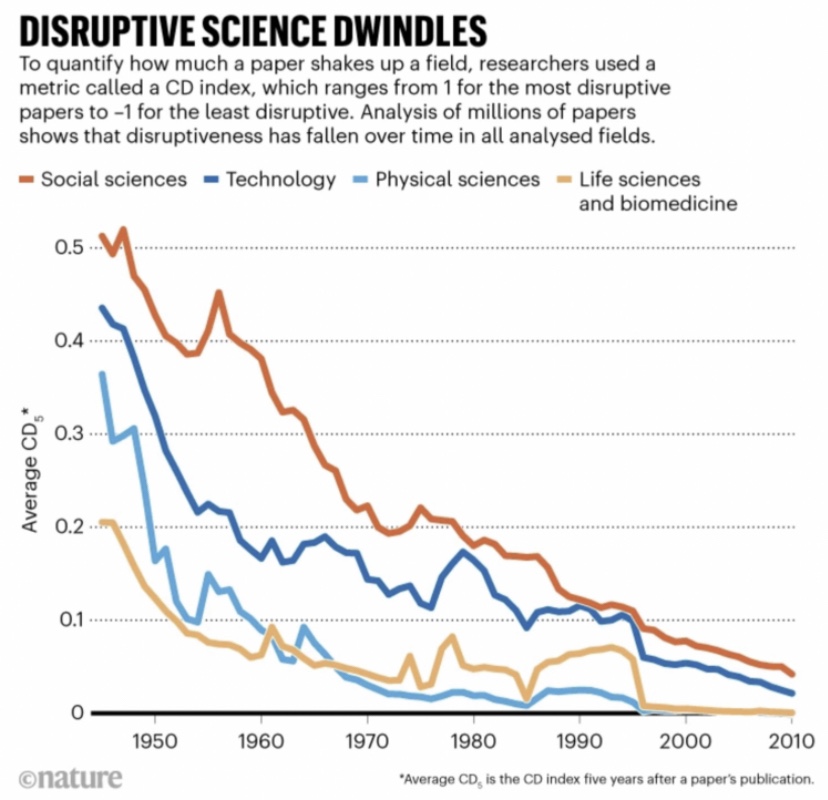
I’m not terribly surprised to learn that scientific advancement has slowed over my lifetime. A recent study published in the journal Nature documented a secular decline in the frequency of “disruptive” or “breakthrough” scientific research across a range of fields. Research has become increasingly dominated by “incremental” findings, according to the authors. The graphic below tells a pretty dramatic story:

The index values used in the chart range “from 1 for the most disruptive to -1 for the least disruptive.” The methodology used to assign these values, which summarize academic papers as well as patents, produces a few oddities. Why, for example, does the tech revolution of the last 40 years create barely a blip in the technology index in the chart above? And why have tech research and social science research always been more “disruptive” than other fields of study?

Putting those questions aside, the Nature paper finds trends that are basically consistent across all fields. Apparently, systematic forces have led to declines in these measures of breakthrough scientific findings. The authors try to provide a few explanations as to the forces at play: fewer researchers, incrementalism, and a growing role of large-team research that induces conformity. But if research has become more incremental, that’s more accurately described as a manifestation of the disease, rather than a cause.

Conformity

Steven F. Hayward skewers the authors a little, and perhaps unfairly, stating a concern held by many skeptics of current scientific practices. Hayward says the paper:

“… avoids the most significant and obvious explanation with the myopia of Inspector Clouseau, which is the deadly confluence of ideology and the increasingly narrow conformism of academic specialties.”

Conformism in science is nothing new, and it has often interfered with the advancement of knowledge. The earliest cases of suppression of controversial science were motivated by religious doctrine, but challenges to almost any scientific “consensus” seem to be looked upon as heresy. Several early cases of suppression are discussed here. Matt Ridley has described the case of Mary Worley Montagu, who visited Ottoman Turkey in the early 1700s and witnessed the application of puss from smallpox blisters to small scratches on the skin of healthy subjects. The mild illness this induced led to immunity, but the British medical establishment ridiculed her. A similar fate was suffered by a Boston physician in 1721. Ridley says:

“Conformity is the enemy of scientific progress, which depends on disagreement and challenge. Science is the belief in the ignorance of experts, as [the physicist Richard] Feynman put it.”

When was the Scientific Boom?

I couldn’t agree more with Hayward and Ridley on the damaging effects of conformity. But what gave rise to our recent slide into scientific conformity, and when did it begin? The Nature study on disruptive science used data on papers and patents starting in 1945. The peak year for disruptive science within the data set was … 1945, but the index values were relatively high over the first two decades of the data set. Maybe those decades were very special for science, with a variety of applications and high-profile accomplishments that have gone unmatched since. As Scott Sumner says in an otherwise unrelated post, in many ways we’ve failed to live up to our own expectations:

“In retrospect, the 1950s seem like a pivotal decade. The Boeing 707, nuclear power plants, satellites orbiting Earth, glass walled skyscrapers, etc., all seemed radically different from the world of the 1890s. In contrast, airliners of the 2020s look roughly like the 707, we seem even less able to build nuclear power plants than in the 1960s, we seem to have a harder time getting back to the moon than going the first time, and we still build boring glass walled skyscrapers.”

It’s difficult to put the initial levels of the “disruptiveness” indices into historical context. We don’t know whether science was even more disruptive prior to 1945, or how the indices used by the authors of the Nature article would have captured it. And it’s impossible to say whether there is some “normal” level of disruptive research. Is a “normal” index value equal to zero, which we now approach as an asymptote?

Some incredible scientific breakthroughs occurred decades before 1945, to take Einstein’s theory of relativity as an obvious example. Perhaps the index value for physical sciences would have been much higher at that time, were it measured. Whether the immediate post-World War II era represented an all-time high in scientific disruption is anyone’s guess. Presumably, the world is always coming from a more primitive base of knowledge. Discoveries, however, usually lead to new and deeper questions. The authors of the Nature article acknowledge and attempt to test for the “burden” of a growing knowledge base on the productivity of subsequent research and find no effect. Nevertheless, it’s possible that the declining pattern after 1945 represents a natural decay following major “paradigm shifts” in the early twentieth century.

The Psychosis Now Known As “Wokeness”

The Nature study used papers and patents only through 2010. Therefore, the decline in disruptive science predates the revolution in “wokeness” we’ve seen over the past decade. But “wokeness” amounts to a radicalization of various doctrines that have been knocking around for years. The rise of social justice activism, critical theory, and anthropomorphic global warming theology all began long before the turn of the century and had far reaching effects that extended to the sciences. The recency of “wokeness” certainly doesn’t invalidate Hayward and Ridley when they note that ideology has a negative impact on research productivity. It’s likely, however, that some fields of study are relatively immune to the effects of politicization, such as the physical sciences. Surely other fields are more vulnerable, like the social sciences.

Citations: Not What They Used To Be?

There are other possible causes of the decline in disruptive science as measured by the Nature study, though the authors believe they’ve tested and found these explanations lacking. It’s possible that an increase in collaborative work led to a change in citation practices. For example, this study found that while self-citation has remained stable, citation of those within an author’s “collaboration network” has declined over time. Another paper identified a trend toward citing review articles in Ecology Journals rather than the research upon which those reviews were based, resulting in incorrect attribution of ideas and findings. That would directly reduce the measured “disruptiveness” of a given paper, but it’s not clear whether that trend extends to other fields.

Believe it or not, “citation politics” is a thing! It reflects the extent to which a researcher should suck-up to prominent authors in a field of study, or to anyone else who might be deemed potentially helpful or harmful. In a development that speaks volumes about trends in research productivity, authors are now urged to append a “Citation Diversity Statement” to their papers. Here’s an academic piece addressing the subject of “gendered citation practices” in contemporary physics. The 11 authors of this paper would do well to spend more time thinking about problems in physics than in obsessing about whether their world is “unfair”.

Science and the State

None of those other explanations are to disavow my strong feeling that science has been politicized and that it is harming our progress toward a better world. In fact, it usually leads us astray. Perhaps the most egregious example of politicized conformism today is climate science, though the health sciences went headlong toward a distinctly unhealthy conformism during the pandemic (and see this for a dark laugh).

Politicized science leads to both conformism and suppression. Here are several channels through which politicization might create these perverse tendencies and reduce research productivity or disruptiveness:

  • Political or agenda-driven research is driven by subjective criteria, rather than objective inquiry and even-handed empiricism
  • Research funding via private or public grants is often contingent upon whether the research can be expected to support the objectives of the funding NGOs, agencies, or regulators. The gravy train is reserved for those who support the “correct” scientific narrative
  • Promotion or tenure decisions may be sensitive to the political implications of research
  • Government agencies have been known to block access to databases funded by taxpayers when a scientist wishes to investigate the “wrong questions”
  • Journals and referees have political biases that may influence the acceptance of research submissions, which in turn influences the research itself
  • The favorability of coverage by a politicized media influences researchers, who are sensitive to the damage the media can do to one’s reputation
  • The influence of government agencies on media treatment of scientific discussion has proven to be a potent force
  • The chance that one’s research might have a public policy impact is heavily influenced by politics
  • The talent sought and/or attracted to various fields may be diminished by the primacy of political considerations. Indoctrinated young activists generally aren’t the material from which objective scientists are made

Conclusion

In fairness, there is a great deal of wonderful science being conducted these days, despite the claims appearing in the Nature piece and the politicized corruption undermining good science in certain fields. Tremendous breakthroughs are taking place in areas of medical research such as cancer immunotherapy and diabetes treatment. Fusion energy is inching closer to a reality. Space research is moving forward at a tremendous pace in both the public and private spheres, despite NASA’s clumsiness.

I’m sure there are several causes for the 70-year decline in scientific “disruptiveness” measured in the article in Nature. Part of that decline might have been a natural consequence of coming off an early twentieth-century burst of scientific breakthroughs. There might be other clues related to changes in citation practices. However, politicization has become a huge burden on scientific progress over the past decade. The most awful consequences of this trend include a huge misallocation of resources from industrial planning predicated on politicized science, and a meaningful loss of lives owing to the blind acceptance of draconian health policies during the Covid pandemic. When guided by the state or politics, what passes for science is often no better than scientism. There are, however, even in climate science and public health disciplines, many great scientists who continue to test and challenge the orthodoxy. We need more of them!

I leave you with a few words from President Dwight Eisenhower’s Farewell Address in 1961, in which he foresaw issues related to the federal funding of scientific research:

“Akin to, and largely responsible for the sweeping changes in our industrial-military posture, has been the technological revolution during recent decades.

In this revolution, research has become central; it also becomes more formalized, complex, and costly. A steadily increasing share is conducted for, by, or at the direction of, the Federal government.

Today, the solitary inventor, tinkering in his shop, has been over shadowed by task forces of scientists in laboratories and testing fields. In the same fashion, the free university, historically the fountainhead of free ideas and scientific discovery, has experienced a revolution in the conduct of research. Partly because of the huge costs involved, a government contract becomes virtually a substitute for intellectual curiosity. For every old blackboard there are now hundreds of new electronic computers.

The prospect of domination of the nation’s scholars by Federal employment, project allocations, and the power of money is ever present and is gravely to be regarded.

Yet, in holding scientific research and discovery in respect, as we should, we must also be alert to the equal and opposite danger that public policy could itself become the captive of a scientific-technological elite.”

Grow Or Collapse: Stasis Is Not a Long-Term Option

18 Wednesday Jan 2023

Posted by Nuetzel in Climate, Environment, Growth

≈ 1 Comment

Tags

Asymptotic Burnout, Benjamin Friedman, Climate Change, Dead Weight Loss, Degrowth, Fermi Paradox, Lewis M. Andrews, Limits to Growth, NIMBYism, Paul Ehrlich, Population Bomb, Poverty, regulation, Robert Colvile, Stakeholder Capitalism, State Capacity, Stubborn Attachments, Subsidies, Tax Distortions, Thomas Malthus, Tyler Cowan, Veronique de Rugy, Zero Growth

Growth is a human imperative and a good thing in every sense. We’ve long heard from naysayers, however, that growth will exhaust our finite resources, ending in starvation and the collapse of human civilization. They say, furthermore, that the end is nigh! It’s an old refrain. Thomas Malthus lent it credibility over 200 years ago (perhaps unintentionally), and we can pick on poor Paul Ehrlich’s “Population Bomb” thesis as a more modern starting point for this kind of hysteria. Lewis M. Andrews puts Ehrlich’s predictions in context:

“A year after the book’s publication, Ehrlich went on to say that this ‘utter breakdown’ in Earth’s capacity to support its bulging population was just fifteen years away. … For those of us still alive today, it is clear that nothing even approaching what Ehrlich predicted ever happened. Indeed, in the fifty-four years since his dire prophesy, those suffering from starvation have gone from one in four people on the planet to just one in ten, even as the world’s population has doubled.”

False Limits

The “limits” argument comes from the environmental Left, but it creates for them an uncomfortable tradeoff between limiting growth and the redistribution of a fixed (they hope) or shrinking (more likely) pie. That’s treacherous ground on which to build popular support. It’s also foolish to stake a long-term political agenda on baldly exaggerated claims (and see here) about the climate and resource constraints. Ultimately, people will recognize those ominous forecasts as manipulative propaganda.

Last year, an academic paper argued that growing civilizations must eventually reach a point of “asymptotic burnout” due to resource constraints, and must undergo a “homeostatic awakening”: no growth. The authors rely on a “superlinear scaling” argument based on cross-sectional data on cities, and they offer their “burnout” hypothesis as an explanation for the Fermi Paradox: the puzzling quiet we observe in the universe while we otherwise expect it to be teeming with life… civilizations reach their “awakenings” before finding ways to communicate with, or even detect, their distant neighbors. I addressed this point and it’s weaknesses last year, but here I mention it only to demonstrate that the “limits to growth” argument lives on in new incarnations.

Growth-limiting arguments are tenuous on at least three fundamental grounds: 1) failure to consider the ability of markets to respond to scarcity; 2) underestimating the potential of human ingenuity not only to adapt to challenges, but to invent new solutions, exploit new resources, and use existing resources more efficiently; and 3) homeostasis is impossible because zero growth cannot be achieved without destructive coercion, suspension of cooperative market mechanisms, and losses from non-market (i.e., political and non-political) competition for the fixed levels of societal wealth and production.

The zero-growth world is one that lacks opportunities and rewards for honest creation of value, whether through invention or simple, hard work. That value is determined through the interaction of buyers and sellers in markets, the most effective form of voluntary cooperation and social organization ever devised by mankind. Those preferring to take spoils through the political sphere, or who otherwise compete on the basis of force, either have little value to offer or simply lack the mindset to create value to exchange with others at arms length.

Zero-Growth Mentality

As Robert Colvile writes in a post called “The Morality of Growth”:

“A society without growth is not just politically far more fragile. It is hugely damaging to people’s lives – and in particular to the young, who will never get to benefit from the kind of compounding, increasing prosperity their parents enjoyed.”

Expanding on this theme is commenter Slocum at the Marginal Revolution site, where Colvile’s essay was linked:

“Humans behave poorly when they perceive that the pie is fixed or shrinking, and one of the main drivers for behaving poorly is feelings of envy coming to the forefront. The way we encourage people not to feel envy (and to act badly) is not to try to change human nature, or ‘nudge’ them, but rather to maintain a state of steady improvement so that they (naturally) don’t feel envious, jealous, tribal, xenophobic etc. Don’t create zero-sum economies and you won’t bring out the zero-sum thinking and all the ills that go with it.”

And again, this dynamic leads not to zero growth (if that’s desired), but to decay. Given the political instability to which negative growth can lead, collapse is a realistic possibility.

I liked Colville’s essay, but it probably should have been titled “The Immorality of Non-Growth”. It covers several contemporary obstacles to growth, including the rise of “stakeholder capitalism”, the growth of government at the expense of the private sector, strangling regulation, tax disincentives, NIMBYism, and the ease with which politicians engage in populist demagoguery in establishing policy. All those points have merit. But if his ultimate purpose was to shed light on the virtues of growth, it seems almost as if he lost his focus in examining only the flip side of the coin. I came away feeling like he didn’t expend much effort on the moral virtues of growth as he intended, though I found this nugget well said:

“It is striking that the fastest-growing societies also tend to be by far the most optimistic about their futures – because they can visibly see their lives getting better.”

Compound Growth

A far better discourse on growth’s virtues is offered by Veronique de Rugy in “The Greatness of Growth”. It should be obvious that growth is a potent tonic, but its range as a curative receives strangely little emphasis in popular discussion. First, de Rugy provides a simple illustration of the power of long-term growth, compound growth, in raising average living standards:

This is just a mechanical exercise, but it conveys the power of growth. At 2% real growth, real GDP per capital would double in 35 years and quadruple in 70 years. At 4% growth, real GDP would double in 18 years… less than a generation! It would quadruple in 35 years. If you’re just now starting a career, imagine nearing retirement at a standard of living four times as lavish as today’s senior employees (who make a lot more than you do now). We’ll talk a little more about how such growth rates might be achieved, but first, a little more on what growth can achieve.

The Rewards of Growth

Want to relieve poverty? There is no better and more permanent solution than economic growth. Here are some illustrations of this phenomenon:

Want to rein-in the federal budget deficit? Growth reduces the burden of the existing debt and shrinks fiscal deficits, though it might interfere with what little discipline spendthrift politicians currently face. We’ll have to find other fixes for that problem, but at least growth can insulate us from their profligacy.

And who can argue with the following?

“All the stuff an advocate anywhere on the political spectrum claims to value—good health, clean environment, safety, families and quality of life—depends on higher growth. …

There are other well-documented material consequences of modern economic growth, such as lower homicide rates, better health outcomes (babies born in the U.S. today are expected to live into their upper 70s, not their upper 30s as in 1860), increased leisure, more and better clothing and shelter, less food insecurity and so on.”

De Rugy argues convincingly that growth might well entail a greater boost in living standards for lower ranges of the socioeconomic spectrum than for the well-to-do. That would benefit not just those impoverished due to a lack of skills, but also those early in their careers as well as seniors attempting to earn extra income. For those with a legitimate need of a permanent safety net, growth allows society to be much more generous.

What de Rugy doesn’t mention is how growth can facilitate greater saving. In a truly virtuous cycle, saving is transformed into productivity-enhancing additions to the stock of capital. And not just physical capital, but human capital through investment in education as well. In addition, growth makes possible additional research and development, facilitating the kind of technical innovation that can sustain growth.

Getting Out of the Way of Growth

Later in de Rugy’s piece, she evaluates various ways to stimulate growth, including deregulation, wage and price flexibility, eliminating subsidies, less emphasis on redistribution, and simplifying the tax code. All these features of public policy are stultifying and involve dead-weight losses to society. That’s not to deny the benefits of adequate state capacity for providing true public goods and a legal and judicial system to protect individual rights. The issue of state capacity is a major impediment to growth in the less developed world, whereas countries in the developed world tend to have an excess of state “capacity”, which often runs amok!

In the U.S., our regulatory state imposes huge compliance costs on the private sector and effectively prohibits or destroys incentives for a great deal of productive (and harmless) activity. Interference with market pricing stunts growth by diverting resources from their most valued uses. Instead, it directs them toward uses that are favored by political elites and cronies. Subsidies do the same by distorting tradeoffs at a direct cost to taxpayers. Our system of income taxes is rife with behavioral distortions and compliance costs, bleeding otherwise productive gains into the coffers of accountants, tax attorneys, and bureaucrats. Finally, redistribution often entails the creation of disincentives, fostering a waste of human potential and a pathology of dependence.

Growth and Morality

Given the unequivocally positive consequences of growth to humanity, could the moral case for growth be any clearer? De Rugy quotes Benjamin Friedman’s “The Moral Consequences of Economic Growth”:

“Growth is valuable not only for our material improvement but for how it affects our social attitudes and our political institutions—in other words, our society’s moral character, in the term favored by the Enlightenment thinkers from whom so many of our views on openness, tolerance and democracy have sprung.”

De Rugy also paraphrases Tyler Cowen’s position on growth from his book “Stubborn Attachments”:

“… economic growth, properly understood, should be an essential element of any ethical system that purports to care about universal human well-being. In other words, the benefits are so varied and important that nearly everyone should have a pro-growth program at or near the top of their agenda.”

Conclusion

Agitation for “degrowth” is often made in good faith by truly frightened people. Better education would help them, but our educational establishment has been corrupted by the same ignorant narrative. When it comes to rulers, the fearful are no less tyrannical than power-hungry authoritarians. In fact, fear can be instrumental in enabling that kind of transformation in the personalities of activists. A basic failing is their inability to recognize the many ways in which growth improves well-being, including the societal wealth to enable adaptation to changing conditions and the investment necessary to enhance our range of technological solutions for mitigating existential risks. Not least, however, is the failure of the zero-growth movement to understand the cruelty their position condones in exchange for their highly speculative assurances that we’ll all be better off if we just do as they say. A terrible downside will be unavoidable if and when growth is outlawed.

Cassandras Feel An Urgent Need To Crush Your Lifestyle

12 Thursday Jan 2023

Posted by Nuetzel in Climate science, Environmental Fascism

≈ 1 Comment

Tags

Atmospheric Aerosols, Capacity Factors, Carbon Emissions, Carbon-Free Buildings, Chicken Little, Climate Alarmism, Coercion, Electric Vehicles, Elon Musk, Extreme Weather Events, Fossil fuels, Gas Stoves, Judith Curry, Land Use, Model Bias, Nuclear power, Paul Ehrlich, Renewable energy, rent seeking, Sea Levels, Settled Science, Solar Irradience, Solar Panels, Subsidies, Temperature Manipulation, Toyota Motors, Urban Heat Islands, Volcanic activity, Wind Turbines

Appeals to reason and logic are worthless in dealing with fanatics, so it’s too bad that matters of public policy are so often subject to fanaticism. Nothing is more vulnerable on this scale than climate policy. Why else would anyone continue to listen to prognosticators of such distinguished failure as Paul Ehrlich? Perhaps most infamously, his 1970s forecasts of catastrophe due to population growth were spectacularly off-base. He’s a man without any real understanding of human behavior and how markets deal efficiently and sustainably with scarcity. Here’s a little more detail on his many misfires. And yet people believe him! That’s blind faith.

The foolish acceptance of chicken-little assertions leads to coercive and dangerous policy prescriptions. These are both unnecessary and very costly in direct and hidden ways. But we hear a frantic chorus that we’d better hurry or… we’re all gonna die! Ironically, the fate of the human race hardly matters to the most radical of the alarmists, who are concerned only that the Earth itself be in exactly the same natural state that prevailed circa 1800. People? They don’t belong here! One just can’t take this special group of fools too seriously, except that they seem to have some influence on an even more dangerous group of idiots called policymakers.

Judith Curry, an esteemed but contrarian climate expert, writes of the “faux urgency” of climate action, and how the rush to implement supposed climate mitigations is a threat to our future:

“Rapid deployment of wind and solar power has invariably increased electricity costs and reduced reliability, particularly with increasing penetration into the grid. Allegations of human rights abuses in China’s Xinjiang region, where global solar voltaic supplies are concentrated, are generating political conflicts that threaten the solar power industry. Global supply chains of materials needed to produce solar and wind energy plus battery storage are spawning new regional conflicts, logistical problems, supply shortages and rising costs. The large amount of land use required for wind and solar farms plus transmission lines is causing local land use conflicts in many regions.”

Curry also addresses the fact that international climate authorities have “moved the goalposts” in response to the realization that the so-called “crisis” is not nearly as severe as we were told not too long ago. And she has little patience for delusions that authorities can reliably force adjustments in human behavior so as to to reduce weather disasters:

“Looking back into the past, including paleoclimatic data, there has been more extreme weather [than today] everywhere on the planet. Thinking that we can minimize severe weather through using atmospheric carbon dioxide as a control knob is a fairy tale.”

The lengths to which interventionists are willing to go should make consumer/taxpayers break out their pitchforks. It’s absurd to entertain mandates forcing vehicles powered by internal combustion engines (ICEs) off the road, and automakers know it. Recently, the head of Toyota Motors acknowledged his doubts that electric vehicles (EVs) can meet our transportation demands any time soon:

“People involved in the auto industry are largely a silent majority. That silent majority is wondering whether EVs are really OK to have as a single option. But they think it’s the trend so they can’t speak out loudly. Because the right answer is still unclear, we shouldn’t limit ourselves to just one option.”

In the same article, another Toyota executive says that neither the market nor the infrastructure is ready for a massive transition to EVs, a conclusion only a dimwit could doubt. Someone should call the Big 3 American car companies!

No one is a bigger cheerleader for EVs than Elon Musk. In the article about Toyota, he is quoted thusly:

“At this time, we actually need more oil and gas, not less. Realistically I think we need to use oil and gas in the short term, because otherwise civilization will crumble. One of the biggest challenges the world has ever faced is the transition to sustainable energy and to a sustainable economy. That will take some decades to complete.”

Of course, for the foreseeable future, EVs will be powered primarily by electricity generated from burning fossil fuels. So why the fuss? But as one wag said, that’s only until the government decides to shut down those power plants. After that, good luck with your EV!

Gas stoves are a new target of our energy overlords, but this can’t be about fuel efficiency, and it’s certainly not about the quality of food preparation. The claim by an environmental think tank called “Carbon-Free Buildings” is that gas stoves are responsible for dangerous indoor pollutants. Of course, the Left was quick to rally around this made-up problem, despite the fact that they all seem to use gas stoves and didn’t know anything about the issue until yesterday! And, they insist, racial minorities are hardest hit! Well, they might consider using exhaust fans, but the racialist rejoinder is that minorities aren’t adequately informed about the dangers and mitigants. Okay, start a safe-use info campaign, but keep government away from an embedded home technology that is arguably superior to the electric alternative in several respects.

Renewable energy mandates are a major area of assault. If we were to fully rely on today’s green energy technologies, we’d not just threaten our future, but our immediate health and welfare. Few people, including politicians, have any awareness of the low rates at which green technologies are actually utilized under real-world conditions.

“Worldwide average solar natural capacity factor (CF) reaches about ~11-13%. Best locations in California, Australia, South Africa, Sahara may have above 25%, but are rare. (see www.globalsolaratlas.info, setting direct normal solar irradiance)

Worldwide average wind natural capacity factors (CF) reach about ~21-24%. Best off-shore locations in Northern Europe may reach above 40%. Most of Asia and Africa have hardly any usable wind and the average CF would be below 15%, except for small areas on parts of the coasts of South Africa and Vietnam. (see www.globalwindatlas.info, setting mean power density)”

Those CFs are natural capacity factors (i.e., the wind doesn’t always blow or blow at “optimal” speeds, and the sun doesn’t always shine or shine at the best angle), The CFs don’t even account for “non-natural” shortfalls in actual utilization and other efficiency losses. It would be impossible for investors to make these technologies profitable without considerable assistance from taxpayers, but they couldn’t care less about whether their profits are driven by markets or government fiat. You see, they really aren’t capitalists. They are rent seekers playing a negative-sum game at the expense of the broader society.

There are severe environmental costs associated with current wind and solar technologies. Awful aesthetics and the huge inefficiencies of land use are bad enough. Then there are deadly consequences for wildlife. Producing inputs to these technologies requires resource-intensive and environmentally degrading mining activities. Finally, the costs of disposing of spent, toxic components of wind turbines and solar panels are conveniently ignored in most public discussions of renewables.

There is still more hypocritical frosting on the cake. Climate alarmists are largely opposed to nuclear power, a zero-carbon and very safe energy source. They also fight to prevent development of fossil fuel energy plant for impoverished peoples around the world, which would greatly aid in economic development efforts and in fostering better and safer living conditions. Apparently, they don’t care. Climate activists can only be counted upon to insist on wasteful and unreliable renewable energy facilities.

Before concluding, it’s good to review just a few facts about the “global climate”:

1) the warming we’ve seen in forecasts and in historical surface temperature data has been distorted by urban heat island effects, and weather instruments are too often situated in local environments rich in concrete and pavement.

2) Satellite temperatures are only available for the past 43 years, and they have to be calibrated to surface measurements, so they are not independent measures. But the trend in satellite temperatures over the past seven years has been flat or negative at a time when global carbon emissions are at all-time highs.

3) There have been a series of dramatic adjustments to historical data that have “cooled the past” relative to more recent temperatures.

4) The climate models producing catastrophic long-term forecasts of temperatures have proven to be biased to the high side, having drastically over-predicted temperature trends over the past two- to three decades.

5) Sea levels have been rising for thousands of years, and we’ve seen an additional mini-rebound since the mini-ice age of a few hundred years ago. Furthermore, the rate of increase in sea levels has not accelerated in recent decades, contrary to the claims of climate alarmists.

6) Storms and violent weather have shown no increase in frequency or severity, yet models assure us that they must!

Despite these facts, climate change fanatics will only hear of climate disaster. We should be unwilling to accept the climatological nonsense now passing for “settled science”, itself a notion at odds with the philosophy of science. I’m sad to say that climate researchers are often blinded by the incentives created by publication bias and grant money from power-hungry government bureaucracies and partisan NGOs. They are so blinded, in fact, that research within the climate establishment now almost completely ignores the role of other climatological drivers such as the solar irradiance, volcanic activity, and the role and behavior of atmospheric aerosols. Yes, only the global carbon dial seems to matter!

No one is more sympathetic to “the kids” than me, and I’m sad that so much of the “fan base” for climate action is dominated by frightened members of our most youthful generations. It’s hard to blame them, however. Their fanaticism has been inculcated by a distinctly non-scientific community of educators and journalists who are willing to accept outrageous assertions based on “toy models” concocted on weak empirical grounds. That’s not settled science. It’s settled propaganda.

Containing An Online Viper Pit of Antisemites

05 Thursday Jan 2023

Posted by Nuetzel in Free Speech, Social Media

≈ Leave a comment

Tags

Andrew Torba, Antisemitism, Christian Nationalism, Corporatism, Dan Frankel, fascism, Fighting Words, Free Speech, Gab, GabPro, Israel, Judeo-Bolshevism, Kanye West, Kristallnach, Pittsburgh Jewish Chronicle, racism, Religious Liberty, Rothschild Family, Theocracy, Zionism

This post is about a particular social media platform and a terrible oversight on my part. I signed up for Gab at least two years ago as I tried to find social media platforms that respected free speech rights and on which I could promote my blog. I haven’t paid for a subscription to “GabPro”, but I’m embarrassed to have completely missed some of the stink emanating from within the platform until recently. It’s not as if it hadn’t been reported, but somehow, I was oblivious.

I knew pretty quickly that Gab was an odd fit for me because so many posters there are on the very religious right. That’s fine, as I’m a strong believer in religious liberty and free speech. My views sometimes conflict with the religious right, but we’re in alignment on some key issues.

I never really scrolled Gab for more than a few moments at any time, having maintained my account there primarily for cross-posting my blog. I joined a particular Gab “fan” group of a band I love, and I have an old friend who happens to be on Gab. I also joined the “Libertarians of Gab” group. Occasionally, something raised my antennae right at the top of my feed, prompting me to look more closely, but I knew this much: like many other social media platforms, Gab is a meme-fest with lots of repetition, so I seldom wasted time scrolling there.

A year or so ago, a Jewish acquaintance on Gab mentioned a few antisemitic posts he’d seen there, but he’s a staunch free-speech advocate and had other reasons to stick with it. At the time, I might have begun to notice a few posters on Gab who were clearly anti-Zionist, but there’s a real distinction between anti-Zionism and antisemitism. Antisemites are bound to be anti-Zionist; the reverse doesn’t always follow. But again, I hadn’t yet found any real fault with Gab itself at that time.

(Note: I’m not hyphenating “antisemitism”, nor am I capitalizing “semitism”, because there is no such thing as a “semite” or “semitism”. The word was concocted by political factions in 19th century Germany in an attempt to “other” German Jews as “Orientals”.)

Over the next several months, however, at the top of my feed, I began to see a few antisemitic posts. Sometimes these amounted to silly assertions, such as the Rothschild family’s supposed world domination, a claim that would be harmless enough if not for indignation that the Rothschilds happen to be Jewish. A few posts were much worse. My knee-jerk reaction to offensive content is to block the poster, as I did a few times.

More recently, in the wake of Kanye West’s crazy tweets about Jews, I was a recipient of a group email from Andrew Torba, the founder and CEO of Gab. Torba, as it happens, is a self-styled “Christian Nationalist”. His email essentially portrayed West as a messenger from God. Here are some excerpts:

“God is using Ye, formerly known as Kanye West, for a big purpose…. He talks about the need for our leaders to uphold Christian values, not Zionist ones. … Ye is using the influence and talents that God has given him to speak the Truth and glorify Jesus Christ.”

It’s interesting that Torba referred to “Zionist” values. Though he is almost certainly anti-Zionist, that’s not really what he meant here. This bit of nut-jobbery, as I learned, had been preceded by many other wild statements from Torba over the years. For instance, over a year ago he tweeted the following and then disabled his Twitter account, a stunt he’s repeated several times:

“We’re building a parallel Christian society because we are fed up and done with the Judeo-Bolshevik one.”

The author at the link above, who reviewed some of Torba’s antics, noted that Judeo-Bolshevism was a term thrown around by the Nazis in the 1930s. But even putting that aside, Torba has an unfortunate tendency to paint with an extremely broad brush in promoting his very own brand of identity politics. That point is established clearly in this “Open Letter” to Torba from a “Hebraic-oriented evangelical Christian attorney”. If anything, the letter is far too gentle with Torba. The writer concludes:

“… I do hope you will reconsider your gratuitous exclusionary rhetoric regarding our spiritual cousins in the House of Judah, treating at least the many who share our cultural values and all-important Creationist paradigm with the same basic respect and camaraderie you show to atheists in the MAGA and conservative movements.”

Torba’s perspective seems to be that all Jews are unworthy, or worse. Here’s one of his posts:

From my perspective, Torba’s recent email regarding “Ye” served as a permission slip to antisemites on Gab to engage in blatant hatred of Jews. Since then, I’ve seen truly antisemitic content appear in my feed with increasing frequency, as if it’s being promoted by the platform. I’m not sure it always sinks to the level of brown-shirts on Kristallnach, but it has that nauseating flavor. Much to my dismay, a few of these posts were from users with whom I’d established earlier connections, or it was content they reposted. Others might have appeared on my feed courtesy of an effort to “introduce” users to one another and to promote certain content.

I didn’t save screenshots of the offensive posts I’ve seen on Gab. I probably should have, but here’s a sampling of a few of the wholesome users I’ve blocked:

One recent post expressed anger with so-called “elites”, an understandable sentiment shared by many in an age of corporatist fascism with the imposition of “woke” ideology in many institutions. However, the poster’s real point was to admonish others for not identifying the target of their anger as “the Jews”.

I became aware of another piece of disturbing information about the perpetrator of a mass killing in Pittsburgh a few years ago, and I can’t believe I missed it:

“The man accused of killing 11 Jews in the Tree of Life building posted antisemitic messages on Gab before the Oct. 27, 2018, massacre. In his Gab bio, he described Jews as the ‘children of satan.’”

Related to these murders, Torba reposted this article on Gab not long ago, from the Pittsburgh Jewish Chronicle. It stated that Pennsylvania Representative Dan Frankel was the target of hateful and threatening posts on the platform. Some of the posts quoted at the link are awful.

But why did Torba repost that article? Well, it motivated a large number of Torba’s followers on Gab to subject the Chronicle to a series of antisemitic replies. This would appear to have been Torba’s intent, but he subsequently removed the repost of the article (along with the hateful replies). That’s a familiar pattern.

Torba’s original comments on the Chronicle article included the following:

“People are done caring about your eternal victimhood complex … Free speech means the right to offend…Stop conflating offensive memes with ‘threats’…Gab is what free speech looks like, the good, the bad, and the ugly are all included.”

Well, you’re right about free speech, Mr. Torba, but subject to an important qualification: “fighting words” are not protected speech under the Constitution. Maybe that’s why you took down your repost, and most importantly the replies. Did you come to your senses relative to the limits of free speech?

It’s not surprising, but the hatred on Gab is not reserved solely for Jews. Since I’ve been on the lookout, I’ve witnessed overt racism of several other varieties on Gab, and I’ve duly blocked those posters. There is also a complement of hatred for individuals falling under the LGBTQ+ banner.

Gab is not the only province of this sort of behavior on social media, but it might be a hotbed. Is it that easy to learn to hate others? Is the distinction between arguing policy versus revilement and ad hominem too subtle for them?

I have Jewish friends across the political spectrum and Jews in my extended family. Few of them are deeply religious. Likewise, many of my friends raised as Christians are not deeply religious. These individuals are entitled to the liberty to practice any or no religion at all. Their choices are no cause for hostility unless they make some effort to impose their views or will upon others. But that kind of theocratic, coercive power seems to be precisely what Andrew Torba and his Christian Nationalist followers on Gab wish to have for themselves.

I’m happy to report that I’ve seen far fewer offensive posts since blocking a number of antisemitic and racist posters. Maybe the platform is “learning” about me. However, there are many well-intentioned people on Gab, and even a few who actively call-out the bigots. I might have to join in that effort. I support Torba’s right to express his views, short of threats or incitement of violence. I have no desire to be affiliated with Torba, however, and I’ll never pay him for GabPro. I’ll remain on Gab for the time being, and we’ll see how the content evolves.

My Christmas With Stagger Lee and Billy DeLyon

27 Tuesday Dec 2022

Posted by Nuetzel in Music

≈ Leave a comment

Tags

Baio, Big Stick, Billy DeLyon, Billy Lyons, Bob Dylan, Cab Calloway, Christmas Murder, Deep Morgan, Delia’s Gone, Doc Watson, Elvis Presley, Eric McHenry, Frankie and Albert, Frankie and Johnny, Grateful Dead, Harvey Hull, James Brown, Jeff Terich, Jerry Garcia, Leadbelly, Lee Shelton, Lloyd Price, Matt Marshall, Mississippi John Hurt, Nearer My God To Thee, Nick Cave, Patrick Blackman, Paul Slade, Robert Hunter, St. Louis Missouri, Stack Lee, Stacker Lee, Stagalee, Stagger Lee, Taj Mahal, The Bucket of Blood, The Clash

I made an small addition to this post in early 2026. It appears in a paragraph about the name of the lawman to whom Delia DeLyon appealed after the killing of Billy DeLyon.

________________________________________

The true story of Stagger Lee is something I’ve known in a vague way for years. Maybe I heard about it once because the “incident” took place in my hometown of St. Louis, Missouri. I’ve always been fond of Robert Hunter’s colorful version of the story, put to song by Jerry Garcia and performed by the Grateful Dead (some great live versions here). There are many other Stagger Lee songs, however, going back to the end of the 19th century, though no recordings seem to exist from before the 1920s.

I was working out the Dead’s version of the song on the guitar when I got curious about a couple of things and went down a proverbial rabbit hole. I’ll get into a few details about Hunter’s version of the story below, but all the entries in this long tradition in song are about how the title character killed a man at a bar (or in a cave, an alley, and maybe elsewhere).

The Facts of the Case

The true story is this: Lee Shelton had a dispute with one Billy Lyons at a bar named Clark’s in the “Deep Morgan” neighborhood of St. Louis, Missouri. It happened on Christmas night of 1895 (not 1932, 1940, or 1948). It’s said to have started with a political argument, not a new phenomenon by any means! Shelton “grabbed Lyons’ derby and broke the form”. Lyons then snatched Shelton’s Stetson hat. Shelton demanded it back, and when Lyons refused, he hit Lyons over the head with the butt of his gun. Lyons pulled a knife and Shelton backed away, shooting Lyons in the abdomen. Shelton “cooly” picked up his hat, according to witnesses, left the bar, and strolled a few blocks to the home of a girlfriend, where he crashed for the night. He was arrested a few hours later, at around 3 a.m. on the 26th.

Lee Shelton was a carriage driver and rumored to be a pimp. He also worked as a political organizer for local democrats, whose “club” met at Clark’s saloon. Shelton had a record as a violent criminal, but he was nevertheless well-connected to powerful players on the local scene. He was also said to be quite a dandy, and went by the alias of Stack Lee. One theory is that Shelton, a mulatto, intimated that he was the illegitimate son of the steamboat captain Stacker Lee, whose dad owned a line of riverboats. Lyons, an African American levee hand, also participated in politics, but at a republican “club” centered at another saloon a few blocks away from Clark’s, so the two men were rivals in some respects.

Shelton’s first trial ended in a hung jury. Later he was convicted to serve 25 years at the state penitentiary in Jefferson City, Mo. He was paroled in 1909 but sent back to prison in 1911 for another crime. He died of tuberculosis in the prison hospital in 1912, at the age of 47.

The Legend and Tradition

At least one song was written about Shelton while he was in jail awaiting his first trial for murder, Many others followed, including levee work songs and field calls. His legend caught on and became part of African American folklore, sometimes with Stagger Lee cast as the hero of the story, but more often as the bad guy. He was, however, mythologized as a powerful black man who did what he pleased, which was understandably appealing to a people who, by then, had been nominally free for 30 years but still suffered various forms of subjugation.

Robert Hunter’s version of Stagger Lee is consistent with several aspects of the sung tradition of the legend. But like all other versions of which I’m aware, Hunter’s story differs from the facts of the case in several ways. His is a unique imagining of a set of events in the immediate aftermath the shooting. Hunter performed his original version of the song himself, called “Delia DeLyon and Stagger Lee”. I hadn’t known until last week that Jerry Garcia “re-ordered” Hunter’s lyrics in composing the Dead’s music for the song. Garcia cut a few of Hunter’s lines and made some other small changes. Of course, when you actually start singing a tune, the words can fall out in new ways!

Hunter must have had a good understanding of the song’s tradition, or maybe he did some deep research. I’m impressed either way, but researching a topic like this is a lot easier now than it was in the 1970s. Some of Hunter’s lyrics contain strong echoes of earlier versions as well as other legendary songs, and they share a cadence in phrasing and even pieces of specific lines from earlier variations of Stagger Lee.

The Songs, and Hunter’s Song

Here are a few points about the legend of Stagger Lee in song, and particularly Hunter’s (and Garcia’s) version. These are listed in more or less random order. They are interesting to me in part because I think they reflect the knowledge and study Hunter brought to bear on his song-writing effort.


The Biggest Hit: Versions have been recorded by a number of great artists over the years, including Cab Calloway, James Brown, Fats Domino, Elvis Presley, Taj Mahal, Doc Watson, Bob Dylan, The Clash, Nick Cave, and many others. However, in 1958 Lloyd Price released a version of the song, and maybe the only version, that garnered broad popularity. His R&B tune is nothing like the Hunter/Garcia effort, but Price speaks of the moon, a dice game, the Stetson hat, and he refers to the victim Billy as “that poor boy”. Other versions reference Billy as a “poor boy” as well, including Hunter’s. But many traditional songs have used “poor boy” to describe victimized or sympathetic male characters, so this isn’t a big coincidence.


Mississippi John Hurt: Recorded in 1928, Hurt’s version is said to be the “standard”. His lyrics refer to the victim as Billy de Lyon, rather than Lyons. DeLyon is the name used by Hunter. I’m not sure Hurt was the first to use “de Lyon”, but his version was influential. Here is another part of Hurt’s lyrics:

“Gentleman’s of the jury, what do you think of that?
Stack O’ Lee killed Billy de Lyon about a five-dollar Stetson hat.”

And here’s Hunter:

“Do you know what he shot him for? What do you make of that?
‘Cause Billy de Lyon threw the lucky dice. Won Stagger Lee’s Stetson hat
.”


He’s a Bad Man! The refrain, “He’s a bad man, oh cruel Stagolee”, is repeated many times in Hurt’s early version. However, the refrain Hunter used at the end of each verse was simply “He’s a mad man”. Garcia must have removed Hunter’s “mad man” refrain from the Dead’s version, and it’s easy to see why it wouldn’t have worked as well there. But there’s still the line: “Stagger Lee is a mad man and he shot my Billy dead”.

Interestingly, Hunter’s original “Delia DeLyon and Stagger Lee” is sung to Hurt’s country blues melody (with a few differences – compare here and here). That means, in turn, that the same lyrical cadence is used in both Hurt’s and the Dead’s versions, despite completely different melodies.


Did He Pack a .45… Or a .44? Shelton apparently used a .44 Smith & Wessen revolver to kill Lyons, and almost all versions of the song refer to a .44. Perhaps Hunter simply liked the rhyme of “I won’t come back alive” with “He packs a .45.”

Cowardly Cops? Or Just Corrupt?: The corruption theme was common to many versions of the song. That might have been a product of black resentment in that era against a lackadaisical (and probably racist) attitude toward prosecuting crimes against blacks. Here are a few lines from the 1927 song by Little Harvey Hull and The Down Home Boys, casting Billy as a cop:

“How can it be,
You arrest a man that’s as bad as me,
But you won’t arrest Stack O’Lee?
”

Here’s a verse from one of the traditional versions reprinted at this site:

“The woman asked the sheriff, said ‘How can this be?
You got all them bad men, but you can’t get Stagolee’
Deputies took their badges and they laid them on the shelf
‘If you want to get that bad man, you get him by yourself’
”

Those deputies sound scared! Either way, Hurt followed Hull in describing a cop who wouldn’t do his job:

“Police officer, how can it be?
You can ‘rest everybody but cruel Stack O’ Lee”

These words will ring familiar to anyone who’s heard Hunter’s version. Hunter’s cop was definitely frightened. The lines from “The Annotated Grateful Dead Lyrics” are:

“Baio, Baio, tell me how can this be?
You arrest the girls for turning tricks
but you’re scared of Staggerlee
Staggerlee is a madman and he shot my Billy dead
Baio you go get him or give the job to me
”

I should note that there are a few slight differences between the “Annotated” lyrics and those on dead.net.


Nearer My God To Thee: This reference appeared in a tale about a different St. Louis murder taking place in either 1890 or 1899, depending on the source. Like the Lyons shooting, it was remembered in song. Quite a few songs, as a matter of fact. Many were called Frankie and Albert, though many others were called Frankie and Johnny. Same story. Basically, Frankie killed her man Albert (Johnny) for cheating on her.

The following is from Leadbelly’s long 1939 version of Frankie and Albert, followed by a corresponding Hunter reference in Stagger Lee:

“Little Frankie went down Broadway
As far as she could see
And all she could hear was a two-string bow
Playing, ‘Nearer, My God To Thee’…
”

And here’s Hunter:

“Delia went a walkin’
Down on Singapore Street
Where a three-piece band on a corner played
‘Nearer, My God To Thee’…
”


Singapore Street? I thought perhaps Hunter placed the location of the story in San Francisco, but there is no evidence of a street by that name historically. Maybe elsewhere, but there is no Singapore Street in the U.S. at present.


Christmas Day or Eve? Hunter placed the murder on “X-mas Eve” (Garcia sang “Christmas Eve” at least once), but the shooting actually occurred on Christmas night at about 10 p.m.

I only found one other reference to Christmas Eve in the versions I checked out (not even close to half of the total), and I’m not sure it would have influenced Hunter. These lines are from a traditional version with lyrics at this site:

“Stagalee, Stagalee — you must-a been a sinner
Ev’ry- Christmas eve they give Stagalee a dinner”


The Dice Game: Many versions of the song have the dispute between Stagger Lee and Billy arising from a dice game. That seems to have been an embellishment prompted by a newspaper article that ran more than six months after the killing (and one day before Shelton’s first trial). It stated that Shelton and Lyons had been shooting craps, but there’s no evidence that dice were involved that night. Here is Paul Slade on that point:

“In fact, there’s no mention of gambling in either the earlier newspaper reports or the inquest statements. Either the reporter responsible was genuinely confused, or he could not resist embellishing the story with one extra little colourful detail. Whatever its beginnings, the gambling is now an immovable part of the song”.

The Bucket of Blood: In 1967, a black inmate at the New York State Pen named “Big Stick” recited a “toast” that contained the following:


“He walked through rain and he walked through mud, Till he came to a place called the Bucket of Blood.”

Apparently Nick Cave’s lyrics were taken in large part from the Big Stick toast, and that, in turn, was based on “traditional” versions going back to at least 1911.

The “Bucket of Blood” was another St.Louis bar in the 1890s where some versions of the song have incorrectly placed the shooting. Perhaps it’s a stretch, but the name of that bar has such a gratuitous ring that it seems reminiscent of Hunter’s lines:

“She waded to De Lyon’s club through Billy De Lyon’s blood”

Minor point, but Lyons‘ “club” actually met at a bar called Bridgewater’s, which was just a few blocks down the street from Clark’s. It would have been odd for Delia to look for Stagger Lee at Bridgewater’s in order to exact her revenge, but I’m getting picky!


The Gallows: Shelton was not sent to the gallows, but many versions have it that way, including Hunter’s (if we’re to presume that Delia’s wishes were honored).


Delia DeLyon: Billy Lyons was likely married, but not to anyone named Delia. However, there is another murder song called “Delia’s Gone” about a shooting that took place in Savannah, Georgia on Christmas Eve in 1900! I somehow doubt that Hunter’s choice of “Delia” was coincidental.


The Cop’s Name: The name of the lawman in Hunter’s version seemed like a curiosity to me. It’s written as “Baio” in The Annotated Grateful Dead Lyrics. “Bayou” is probably what most people imagine they hear, and I’ve seen it that way on guitar charts. I poked around to see if I could learn of any historical basis for that name. There are a few people here and there who’ve gone by the name of Bayou… it might be confined to the lower Mississippi Valley. Nowhere could I find any reference to that name in the true story of Stagger Lee or in any other versions of the song. Woodie Guthrie’s rendition has the line “The bayou calls”, which doesn’t seem pertinent. The Rulers recorded a song about Stagger Lee called “Wrong ‘Em Boyo”, later covered by The Clash, but that’s apparently coincidental because “Boyo” is a reference to Stagger Lee himself. So I couldn’t find a source for the name of the cop in Hunter’s story.

I came across the Spanish surname Bayeu while reading a book about the great artist Francisco Goya in early 2026. Francisco Bayeu was Goya‘s brother-in-law, and he was also a great artist. The Bayeu surname was prominent in Spain around the time of the Inquisition. Who knows whether this name popped into Hunter‘s mind while composing the lyrics, or if it had some connection to the actual facts of the story, as St. Louis had a modest Spanish population in its early days.


Wrap Up

The music of many Stagger Lee songs could be described as old country blues, but there have been ragtime, swing, R&B, folk, reggae, and punk versions as well, not to mention spoken “toasts”. I like Garcia’s Stagger Lee melody for several reasons. It’s catchy, and it also has an “old-timey” or even “rag-timey” feel, despite its electricity.

It’s a fascinating Christmas tale, but probably not one you’ll want to tell your children as you tuck them in next Christmas Eve! Of course, Hunter’s lyrics describe something well beyond the actual facts of the Stagger Lee case. Nevertheless, he respects much of the tradition common to so many versions of the story. Meanwhile, his focus on Delia’s passion, revenge, and righteousness in avenging Stagger Lee’s brutality gives a whole different flavor to the story.


In case I failed to provide links to some of the source articles I drew on, here’s a list:

Several articles by Patrick Blackman on Singout.org

“The Baddest Man In Town”, by Eric McHenry

“A Brief History of Stagger Lee and Billy Lyons”, by Matt Marshall

“A Christmas Killing: Stagger Lee”, by Paul Slade

“The murder ballad of ‘Stagger Lee’ created a gruesome legend”, by Jeff Terich

Price Stability: Are We There Yet?

22 Thursday Dec 2022

Posted by Nuetzel in Inflation, Liberty, Monetary Policy

≈ Leave a comment

Tags

Adam Shapiro, Bloomberg, Cleveland Fed, Demand-Driven Inflation, Federal Reserve, Great Recession, Inflation Targets, Joe Wiesenthal, Median CPI, Modern Monetary Theory, Money Printing, Noah Smith, Omnibus Spending Bill, Optimal Rate of Inflation, Pay-As-You-Go Law, PCE Deflator, Price Stability, Quantitative Easing, Rate Targets, Strategic Petroleum Reserve, Supply-Driven Inflation, Team Transitory, Trading Economics, Trimmed CPI

The answer to that question, kids, is a resounding no! The Federal Reserve created far too much liquidity during and after the pandemic and waited too long to reverse that policy. That’s a common view among the “monetarazzi”, but far too many analysts, in the next breath, assert that the Fed is going too far in tightening policy. Sorry, but you can’t have it both ways! Thus far, the reductions we’ve seen in the monetary aggregates (M1, M2, M3) represent barely a trickle out of the ocean of liquidity released during the previous two years. The recent slight moderation in the rate of inflation is unlikely to gain momentum without persistence by the Fed.

This Could Be Easier

I humbly concede, however, that a different approach by the Fed might have been less disruptive. A better alternative would have involved more aggressive reductions in the gigantic portfolio of securities it acquired via “quantitative easing” (QE) during the pandemic while avoiding direct intervention to raise short-term interest rates. In fact, allowing interest rates to be determined by the market, rather than via central bank intervention, is more sensible in terms of pricing debt of any duration. It also suggests a more direct and sensible approach to managing the growth of the money supply. Of course, had the Fed unwound QE more aggressively, short-term rates would surely have risen anyway, but to levels appropriate to rationing liquidity more efficiently. Furthermore, those rates could have served as a useful indicator of the market’s ability to digest a particular volume of sales from the Fed’s portfolio.

Getting Tight

The chart below shows the level of the monetary base (bank reserves plus currency) over the past five years from the Trading Economics site. The monetary base is the narrow monetary aggregate supporting growth of the money stock and is under fairly direct control of the Fed.

The base has declined substantially during 2022 largely as a consequence of the Fed’s restrictive policies. However, it has retraced only about a third of the massive expansion engineered by the Fed over the two prior years. Here is the corresponding plot of the M1 money stock (currency plus checking deposits):

So the reductions in the base have yet to translate into much of a reduction in the money stock, though growth in all of the aggregates has certainly declined. No one thinks this will be a walk in the park. Withdrawing liquid capital from markets accustomed to swilling in excesses will have consequences, particularly for investors who’ve grown undisciplined in their approach to evaluating prospective assets. Investors and society at large inevitably pay the price for the malinvestment encouraged by unbridled money growth (not to mention misdirected industrial policies … that’s a different can of worms).

But the squeamish resist! I got a kick out of this tweet by Noah Smith in which he pokes fun at those who insist that the surge in inflation was a mere transitory phenomenon:

“Team Transitory: OMG inflation is just going to go away, you don’t need to raise interest rates.

Fed: *raises interest rates*

Inflation: *goes down a bit*

Team Transitory: SEE, I told you inflation was going away and that you didn’t need to raise interest rates!!”

Well, in fairness, “Team Transitory” has been fixated on supply disruptions that very well should resolve with private efforts over time. Some have resolved already. And again, we’ve yet to feel much impact from the Fed’s tighter policy, but I’m amused by the tweet nevertheless.

In fact, the surge in inflation has been driven by both supply and demand factors, and it’s true the Fed can do very little about the former. But stalling the effort to purge excess liquidity and demand-side inflation risks allowing expectations of inflation to edge higher, creating an environment in which price pressures are more resistant to policy actions.

Inflation And Its Proximate Sources

It is indeed good news that inflation has tapered slightly over the past few months, or at least the “headline” inflation numbers have tapered. Weaker energy prices helped a great deal, though releases from the Strategic Petroleum Reserve aren’t sustainable. Measures of “core” inflation that exclude food and energy prices, and more central measures of inflation within the spectrum of goods and services, have moved sideways or perhaps shown signs of a slight moderation.

Here’s a plot of several measures of CPI inflation taken from the Cleveland Fed’s web site. Note that the median component of the CPI has finally hit a plateau, and a “trimmed” measure that excludes CPI components with extreme changes has dipped slightly. The Core CPI has fluctuated in a range just above 6% for most of the year.

The deflator for personal consumption expenditures (PCE) gets more emphasis from the Fed in its policy deliberations. The latest release at the start of December showed patterns similar to the CPI:

With respect to the PCE deflator, the slight dampening of price pressure we’ve seen recently came primarily from the supply side, with some progress on the demand side as well. Energy was one factor on the supply side, but even the core PCE deflator shows less supply pressure. Adam Shapiro has a decomposition of the PCE deflator into supply-driven and demand-driven components (but the chart only goes through October):

First, without endorsing Shapiro’s construction of this dichotomy, I note that the impact of monetary policy is primarily through the demand side of the economy. Of course, monetary instability isn’t good for producers, and excessive money growth and inflation create uncertainty that inhibits supply. But what we’ve seen recently has more to do with the curing of supply chain bottlenecks that cropped up during the pandemic (or in its wake), and Shapiro attempts to capture that kind of phenomenon here.

Still, many would argue that the November CPI showed sufficient progress for the Fed to pause its tightening campaign. The reductions in the monthly price increases were fairly widespread, as shown by this table from the CPI report:

The next chart from Joe Wiesenthal (via Bloomberg) displays trends in broad CPI categories, but it shows vividly that the reductions were concentrated in energy components and goods prices, while services and food inflation did not really abate. (The legend is so hard to read that I took the liberty of blowing it up a bit below the chart itself):

Playing Catch-Up

While the Fed’s effort to restrain inflation began in earnest in the spring of this year, it lifted the federal funds rate target rapidly. Here’s another chart from Adam Shapiro, via the Wall Street Journal: the Fed’s current tightening cycle is the fastest in 40 years in terms of those rate hikes:

Fast, yes, but they got a late start in the face of a rapid acceleration of inflation, and for what it’s worth, the Fed’s rate target remains below the rate of inflation. Yes, I’m forced to acknowledge here that the Fed’s preference for rate intervention and targeting is just what they do, for now. In any case, top-line inflation and strictly demand-side inflation are still above the Fed’s 2% target.

Fabian Fiscal Expansionists

One “fix” recommended in some circles suggests that the Fed’s inflation target is too low, as if price stability had nothing to do with its mandate! The idea that low-grade inflation is a healthy thing has never been convincingly demonstrated. In fact, the monetary literature leans strongly in the direction of price stability and an optimal rate of inflation of zero! That the Fed should aim for higher inflation seems like a cop-out intended to appease those who still subscribe to the discredited notion that there exists a reliable long-run tradeoff between inflation and unemployment.

In fact, proposals to increase the central bank’s inflation target would enable more deficit spending financed with the “printing press”, which is at the root of the demand-side inflation problem we now face. A major justifications for ballooning levels of federal spending has been so-called Modern Monetary Theory (MMM), which has gained adherents among statists in the years since the Great Recession. MMM holds that “important” initiatives can simply be paid for with new money creation, rather than interest bearing debt, or God forbid, taxes! “Partisan” is probably a better description than “theorist” for any fan of MMM, and they have convinced themselves that money financed deficits are without inflationary consequences. Of course, this represents a complete suspension of the law of resource scarcity, not to mention years of monetary history. Raising the Fed’s inflation target plays well with the same free-lunch advocates who rally behind MMM.

The Fed’s Unfaithful Fiscal Partner

Federal budget control is likely to take another hit this week with passage of the $1.7 omnibus spending bill. It includes spending increases with no immediate offsets as required under the pay-as-you-go budget law. It delays those offsets to 2025 and increases deficits in the interim by hundreds of billions of dollars. It also sets a new, higher baseline for discretionary appropriations in future years. The federal deficit has already risen dramatically compared to a year ago under the fiscal profligacy of Congress and the Administration. Another contributing factor, however, is that the interest cost of servicing the national debt has spiked as interest rates have risen. Needless to say, none this makes the Fed’s job any easier, especially as it seeks to reverse QE.

Say Uncle!?

When will the Fed begin to take its foot off the brake? It “only” raised the Fed funds target by 50 basis points at its meeting last week (after four 75 bps moves in a row. It is expected to raise the target another 50 bps in early February and perhaps another 25 in March. Strong signals of imminent recession would be needed for the Fed to call it off any sooner, and we’re definitely seeing more hints of a weakening economy in the data (and see here, here, here, and here). More definitive declines in inflation would obviously help settle things. Otherwise, the Fed may pause after March in order to gauge progress toward its goal of 2% inflation.

The Employment Situation: Where’s the Recession?

14 Wednesday Dec 2022

Posted by Nuetzel in Economic Outlook

≈ 1 Comment

Tags

ADP Employment Report, Average Weekly Hours, BLS, Business Confidence, Consumer Confidence, Elise Gould, Employment Situation, Establishment Survey, Federal Reserve, Great Depression, Household Survey, Index of Leading Indicators, Inverted Yield Curve, Jerome Powell, Job Losers, Labor Force Participation, Labor Market, Lagging Indicator, Layoffs, Long and Variable Lags, Nonfarm Payrolls, Real Wages, Soft Landing, Underemployment

It’s always hard to foresee dramatic turns in the economy and their timing. One day, way back in grad school, a professor of mine went on about how the Great Depression seemed to surprise people at the time. He felt they should have known it was coming, and he emphasized that housing had been in a downturn starting around 1926. Well, hindsight’s 20/20, and I’m not sure how timely and accurate economic reporting was at the time, but today it’s not any easier to call recessions in advance.

An Array of Weak Signals

We’ve seen a downturn in housing this year, and for that and several other reasons many forecasters are predicting a recession in 2023. Consumers are depleting their savings and running up debt, and in November consumer confidence dropped for a fourth month in a row. In October, the Index of Leading Economic Indicators declined for an eighth straight month. A slump in business confidence has been underway for 12 months. Businesses are accumulating debt at much higher interest rates, and the earnings outlook (excluding energy) is bleak.

Buttressing that negative outlook is the inverted yield curve, which has been reliable (though not infallible) as a recession signal in the past. We now have a gap between the one-year Treasury yield and the 10-year Treasury yield of well over 100 basis points, which is as high as it’s been since 1981. That looks rather ominous.

The Fed’s Mission

Perhaps most importantly, the Federal Reserve has succeeded in reducing the money supply. That shift to tightening policy really only began in the late spring, however, and as Milton Friedman emphasized, the impact of money supply growth on the real economy is subject to “long and variable lags”. That could mean an economic slowdown or recession any time from now into 2024, but many analysts believe it will begin in the first half of 2023.

Denialists

Yet a few observers claim things are rosy, not least of all those within the Biden Administration. They insist the economy is in fine shape, pointing to the continuing strength in some of the employment numbers. Those gains have also been a preoccupation of the media, but employment statistics aren’t especially good predictors of changes in economic growth. Job growth and unemployment are lagging indicators, so we shouldn’t expect to see obvious signals of recession from employment data, at least until a downturn is underway. Even the Fed’s official economic forecast still calls for something of a “soft landing”, but Chairman Jerome Powell is wary of placing much confidence in particular outcomes, and with good reason.

The Employment Situation

There are unusual patterns in recent employment data that might portend a weaker economy, but first, the statistics most widely followed are changes in non-farm employment (from the Bureau of Labor Statistics’ Survey of Business Establishments) and the unemployment rate (from the BLS Household Survey). The chart below shows monthly changes in nonfarm payrolls over the past year. There was a still-healthy gain in payrolls in November, but the pace of job growth slowed over the last twelve months as we came off the post-pandemic rebound.

One factor partly offsetting recent gains in non-farm employment is a decrease in the average workweek. Average weekly hours declined slightly in November and it was down 0.4 hours from a year earlier.

There are sectors of the economy that have shown recent weakness in payroll jobs. There was a decline in goods-producing employment in November, and layoffs are underway in the tech sector, a first for some of the big tech firms. Job reductions have also been announced at a few prominent financial firms.

The next chart shows that the unemployment rate has remained near post-pandemic lows since early this year. An ongoing factor helping to keep it low, however, is that labor force participation is still running below pre-pandemic levels (despite rebounding well off pandemic lows during 2021). You aren’t counted as unemployed if you don’t participate in the labor force by seeking work.

One negative sign here is an uptick over the past two months in the share of job losers among the unemployed (as opposed to quitters or new entrants). That’s a pattern that would become more pronounced when and if a recession takes hold.

Keep in mind that these statistics are derived from surveys and extrapolated to the universe of households or non-farm employees. The Household Survey samples 60,000 households, whereas the Establishment Survey samples 131,000 employers, accounting for 670,000 employees. So the Household Survey is much smaller. Nevertheless, sample sizes of these magnitudes should be highly reliable, even for most subcategories.

Contradictory BLS Surveys

There are a few other possible signs of a weakening labor market in recent employment data. One such development is a gap between new job numbers from the Establishment Survey (non-farm payrolls) and the Household Survey (total employment). The following table (taken from the December 2nd BLS Report for households) is from a series of tweets by Elise Gould:

Total employment from the Household Survey has actually declined by almost 470,000 the past two months, while non-farm payrolls have increased by a total of over 500,000. Turning points in employment from the Household Survey tend to lead non-farm payrolls, so this could foretell a softening. While the Household Survey is smaller than the Establishment Survey, it is broader in some respects, covering several categories of workers who aren’t counted on non-farm payrolls, including agricultural workers and the self-employed. The latter are a more significant part of the employed population given the rise in the so-called gig economy. Self-employed workers (unincorporated) have declined by more than 170,000 over the past two months. However, it’s not clear that these workers would be affected earlier than others around turning points.

A separate employment report by ADP Research noted a sharp slowdown in private sector hiring in November, with the most weakness in construction and interest rate sensitive industries. The report also noted that fewer workers are leaving jobs voluntarily.

Is the Labor Market Tight Or Loose?

Nominal wages are rising at an accelerating pace, which might make it more difficult for the Fed to rein-in inflation. However, wages are still rising less than prices — as of October, real hourly earnings had declined 1.9% over the past year. November will mark 20 straight months of declines in the real wage. The drop in real weekly earnings is even steeper, given a slight decline in the average workweek. If we’re looking for a silver lining, inflation and declines in real earnings mean that employers have gained additional incentive to hire. Perhaps that can be offered as one reason for persistent strength in the payroll numbers.

There are still more than 10 million job openings across the country, but only 6 million workers are unemployed. Again, many would-be job candidates are sitting things out. (Perhaps they are mostly terrible candidates, given their apparent disinterest in work.) Some observers assume this means that the labor market is extremely tight, yet real wages are declining, as if there were an excess supply of workers! The answer to this “puzzle” is that many vacancies are ultimately filled by candidates who were already employed. Also, there is a large number of underemployed workers. Thus, the available pool of candidates is much larger than the number available due to unemployment. It’s not outlandish to think that there is actually an excess supply of labor at the moment, rather than excess demand, but that doesn’t bode well for real wage gains going forward.

Conclusion

Despite an ostensibly strong labor market, there are reasons to think that strength is waning, even without appeal to other economic and financial indicators. The BLS household survey showed recent declines in employment, as did the ADP survey, and we’ve seen an increase in the share of job losers among the unemployed. High-profile layoff announcements should also give pause. The recessionary outlook is reinforced by a number of other indicators, but most of all, the Federal Reserve’s tightening of the money supply is bound to have a stronger impact on the economy in 2023, and the Fed is not finished tightening yet.

← Older posts
Newer posts →
Follow Sacred Cow Chips on WordPress.com

Recent Posts

  • Grading Trump II, So Far
  • A Warsh Policy Scenario At the Federal Reserve
  • The Coexistence of Labor and AI-Augmented Capital
  • The Case Against Interest On Reserves
  • Immigration and Merit As Fiscal Propositions

Archives

  • March 2026
  • February 2026
  • January 2026
  • December 2025
  • November 2025
  • October 2025
  • September 2025
  • August 2025
  • July 2025
  • June 2025
  • May 2025
  • April 2025
  • March 2025
  • February 2025
  • January 2025
  • December 2024
  • November 2024
  • October 2024
  • September 2024
  • August 2024
  • July 2024
  • June 2024
  • May 2024
  • April 2024
  • March 2024
  • February 2024
  • January 2024
  • December 2023
  • November 2023
  • August 2023
  • July 2023
  • June 2023
  • May 2023
  • April 2023
  • March 2023
  • February 2023
  • January 2023
  • December 2022
  • November 2022
  • October 2022
  • September 2022
  • August 2022
  • July 2022
  • June 2022
  • May 2022
  • April 2022
  • March 2022
  • February 2022
  • January 2022
  • December 2021
  • November 2021
  • October 2021
  • September 2021
  • August 2021
  • July 2021
  • June 2021
  • May 2021
  • April 2021
  • March 2021
  • February 2021
  • January 2021
  • December 2020
  • November 2020
  • October 2020
  • September 2020
  • August 2020
  • July 2020
  • June 2020
  • May 2020
  • April 2020
  • March 2020
  • February 2020
  • January 2020
  • December 2019
  • November 2019
  • October 2019
  • September 2019
  • August 2019
  • July 2019
  • June 2019
  • May 2019
  • April 2019
  • March 2019
  • February 2019
  • January 2019
  • December 2018
  • November 2018
  • October 2018
  • September 2018
  • August 2018
  • July 2018
  • June 2018
  • May 2018
  • April 2018
  • March 2018
  • February 2018
  • January 2018
  • December 2017
  • November 2017
  • October 2017
  • September 2017
  • August 2017
  • July 2017
  • June 2017
  • May 2017
  • April 2017
  • March 2017
  • February 2017
  • January 2017
  • December 2016
  • November 2016
  • October 2016
  • September 2016
  • August 2016
  • July 2016
  • June 2016
  • May 2016
  • April 2016
  • March 2016
  • February 2016
  • January 2016
  • December 2015
  • November 2015
  • October 2015
  • September 2015
  • August 2015
  • July 2015
  • June 2015
  • May 2015
  • April 2015
  • March 2015
  • February 2015
  • January 2015
  • December 2014
  • November 2014
  • October 2014
  • September 2014
  • August 2014
  • July 2014
  • June 2014
  • May 2014
  • April 2014
  • March 2014

Blogs I Follow

  • Passive Income Kickstart
  • OnlyFinance.net
  • TLC Cholesterol
  • Nintil
  • kendunning.net
  • DCWhispers.com
  • Hoong-Wai in the UK
  • Marginal REVOLUTION
  • Stlouis
  • Watts Up With That?
  • American Elephants
  • The View from Alexandria
  • The Gymnasium
  • A Force for Good
  • Notes On Liberty
  • troymo
  • SUNDAY BLOG Stephanie Sievers
  • Miss Lou Acquiring Lore
  • Your Well Wisher Program
  • Objectivism In Depth
  • RobotEnomics
  • Orderstatistic
  • Paradigm Library
  • Scattered Showers and Quicksand
  • Jam Review

Blog at WordPress.com.

Passive Income Kickstart

OnlyFinance.net

TLC Cholesterol

Nintil

To estimate, compare, distinguish, discuss, and trace to its principal sources everything

kendunning.net

The Future is Ours to Create

DCWhispers.com

Hoong-Wai in the UK

A Commonwealth immigrant's perspective on the UK's public arena.

Marginal REVOLUTION

Small Steps Toward A Much Better World

Stlouis

Watts Up With That?

The world's most viewed site on global warming and climate change

American Elephants

Defending Life, Liberty and the Pursuit of Happiness

The View from Alexandria

In advanced civilizations the period loosely called Alexandrian is usually associated with flexible morals, perfunctory religion, populist standards and cosmopolitan tastes, feminism, exotic cults, and the rapid turnover of high and low fads---in short, a falling away (which is all that decadence means) from the strictness of traditional rules, embodied in character and inforced from within. -- Jacques Barzun

The Gymnasium

A place for reason, politics, economics, and faith steeped in the classical liberal tradition

A Force for Good

How economics, morality, and markets combine

Notes On Liberty

Spontaneous thoughts on a humble creed

troymo

SUNDAY BLOG Stephanie Sievers

Escaping the everyday life with photographs from my travels

Miss Lou Acquiring Lore

Gallery of Life...

Your Well Wisher Program

Attempt to solve commonly known problems…

Objectivism In Depth

Exploring Ayn Rand's revolutionary philosophy.

RobotEnomics

(A)n (I)ntelligent Future

Orderstatistic

Economics, chess and anything else on my mind.

Paradigm Library

OODA Looping

Scattered Showers and Quicksand

Musings on science, investing, finance, economics, politics, and probably fly fishing.

Jam Review

"If you get confused, listen to the music play."

  • Subscribe Subscribed
    • Sacred Cow Chips
    • Join 128 other subscribers
    • Already have a WordPress.com account? Log in now.
    • Sacred Cow Chips
    • Subscribe Subscribed
    • Sign up
    • Log in
    • Report this content
    • View site in Reader
    • Manage subscriptions
    • Collapse this bar
 

Loading Comments...