• About

Sacred Cow Chips

Sacred Cow Chips

Tag Archives: central planning

Trump’s New Corporatist Plunder Will Cost U.S.

05 Friday Sep 2025

Posted by Nuetzel in Central Planning, Protectionism, Socialism

≈ Leave a comment

Tags

AMD, central planning, CHIPS Act, Corporatism, Don Boudreaux, Donald Trump, Extortion, fascism, Golden Share, Howard Lutnick, Intel, MP Materials, National Security, Nippon Steel, NVIDIA, Protectionism, Public debt, Scott Bessent, Socialism, Tad DeHaven, TikTok, U.S. Steel, Unfunded Obligations, Veronique de Rugy

Since his inauguration, Donald Trump has been busy finding ways for the government to extort payments and ownership shares from private companies. This has taken a variety of forms. Tad DeHaven summarizes the major pieces of booty extracted thus far in the following bullet points (skipping the quote marks here):

  • June 13: Trump issues an executive order allowing the Nippon Steel-US Steel deal contingent on giving the government a “golden share” that enables the president to exert extensive control over US Steel’s operations.
  • July 10: The Department of Defense (DoD) unveils a multi-part package with convertible preferred stock, warrants, and loan guarantees, making it the top shareholder of rare earth metals producer MP Materials.
  • July 23: The White House claims an agreement with Japan to reduce the president’s so-called reciprocal tariff rate on Japanese imports comes with a $550 billion Japanese “investment fund” that Trump will control.
  • July 31: Trump claims an agreement with South Korea to reduce the so-called reciprocal tariff on South Korean imports comes with a $350 billion South Korean-financed investment in projects “owned and controlled by the United States” that he will select.
  • August 11: The White House confirms an “unprecedented” deal with Nvidia and AMD that allows them to sell particular chips to China in exchange for 15 percent of the sales.
  • August 12: In a Fox Business interview, Bessent points to the alleged investments from Japan, South Korea, and the EU “to some extent” and says, “Other countries, in essence, are providing us with a sovereign wealth fund.”
  • August 22: Fifteen days after calling for Intel CEO Lip-Bu Tan to resign, Trump announces that the US will take a 10 percent equity stake in Intel using the CHIPS Act and DoD funds, becoming Intel’s largest single shareholder.

Each of these “deals” has a slightly different back story, but national security is a common theme. And Trump says they’ll all make America great again. They are touted as a way for American taxpayers to benefit from the investment he claims his policies are attracting to the U.S. However, all of these are ill-advised for several reasons, some of which are common to all. That includes the extortionary nature of each and every one of them.

Short Background On “Deals”

The June 13 deal (Nippon/US Steel), the July 10 deal (MP Materials), and the August 22 deal (Intel) all involve U.S. government equity stakes in private companies. The August 11 deal (NVIDIA/AMD) diverts a stream of private revenue to the government. The July 23 and July 31 deals (Japan and South Korea) both involve “investment funds” that Trump will control to one extent or another.

The August 12 entry adds “expected” EU investments with some qualification, but that bullet quotes Treasury Secretary Bessent referring to these investments as part of a sovereign wealth fund (SWF). Secretary of Commerce Lutnick now denies that an SWF will exist. My objections might be tempered slightly (but only slightly) by an SWF because it would probably need to place constraints on an Administation’s control. That might give you a hint as to why Lutnick is now downplaying the creation of an SWF.

I object to the Nippon/US Steel “deal” in part (and only in part) because it was extortion on its face. There is no valid anti-trust argument against the deal (US Steel is the nation’s third largest steelmaker and is broke), and the national security concerns that were voiced (Japan! for one thing) were completely bogus. Even worse, the “Golden Share” would give the federal government authority, if it chose to exercise it, over a variety of the company’s decisions.

The Intel “deal” is another highly questionable transaction. Intel was to receive $11 billion under the CHIPS Act, a fine example of corporate welfare, as Veronique de Rugy once described the law. However, Intel was to receive its grants only if it stood up four fabrication facilities. But it did not. Now, instead of demanding reimbursement of amounts already paid, the government offered to pay the remainder in exchange for a 9.9% stake in the company. And there is no apparent requirement that Intel meet the original committment! This could turn out a bust!

The MP Materials transaction with the Department of Defense has also been rationalized on national security grounds. This excuse comes a little closer to passing the smell test, but the equity stake is objectionable for other reasons (to follow).

The Nvidia/AMD deal has been justified as compensation for allowing the companies to sell chips to China, which is competing with the U.S. to lead the world in AI development. This is another form of selective treatment, here applied to an export license. The chips in question do not have the same advanced specifications as those sold by the companies in the U.S., but let’s not let that get in the way of a revenue opportunity.

While nothing about TikTok appears on the list above, I fear that a resolution of its operational status in the U.S. presents another opportunity for extortion by the Trump Administration. I’m sure there will be many other cases.

Root Cause: Protectionism

The so-called investment funds described in the timeline above are nearly all the result of trade terms negotiated by a dominant and belligerent trading partner: the U.S. My objections to tariffs are one thing, but here we are extorting investment pledges for reductions in the taxes we’ll impose on our own citizens! Additionally, the belief that these investments will somehow prevent a general withdrawal of foreign investment in the U.S. is misguided. In fact, a smaller trade deficit dictates less foreign investment. The difference here is that the government will wrest ownership control over a greater share of less foreign investment.

Trump the Socialist?

Needless to say, I don’t favor government ownership of the means of production. That’s socialism, but do matters of national security offer a rationale for public ownership? For example, rare earth minerals are important to national defense. Therefore, it’s said that we must ensure a domestic supply of those minerals. I’m not convinced that’s true, but in any case, fat defense contracts should create fat profit opportunities in mining rare earths (enter MP Materials). None of that means public ownership is necessary or a good idea.

All of these federal investments are construed, to one extent or another, as matters of national security, but that argument for market intervention is much too malleable. Must we ensure a domestic supply of semiconductors for national security reasons? And public ownership? Is the same true of steel? Is the same true of our “manufacturing security”? It can go on and on. The next thing you know, someone will argue that grocery stores should be owned by the government in the name of “food security”! Oh, wait…

Trump the Central Planner

Government ownership takes the notion of industrial planning a huge step beyond the usual conception of that term. Ordinarily, when government takes the role of encouraging or discouraging activity in particular industries or technologies, it attempts to select winners and losers. The very idea presumes that the market is not allocating resources in an optimal way, as if the government is in any position to gainsay the decisions of private market participants who have skin in the game. This is a foolhardy position with predictably negative consequences. (For some examples, see the first, second, and fourth articles linked here by Don Boudreaux.) The fundamental flaw in central planning always comes down to the inability of planners to collect, process, and act on the information that the market handles with marvelous efficiency.

When government invests taxpayer funds in exchange for ownership positions in private concerns, the potential levers of control are multiplied. One danger is that political guidance will replace normal market incentives. And as de Rugy points out, the government’s potential role as a regulator creates a clear conflict of interest. In a strong sense, a government ownership stake is worse for private owners than a mere dilution of their interests. It looms as a possible taking, as private owners and managers surrender to creeping government extortion.

Financial Malfeasance

In addition to the objections above, I maintain that these investments represent poor stewardship of public funds. The U.S. public debt currently stands at $37 trillion with an entitlement disaster still to come. In fact, according to one estimate, the federal government’s total unfunded obligations amount to additional $121 trillion! Putting aside the extortion we’re witnessing, any spare dollar should be put toward retiring debt, rather than allowing its upward progression.

As I’ve noted before, paying off a dollar of debt entails a risk-free “return” in the form of interest cost avoidance, let’s say 3.5% for the sake of argument. If instead the dollar is “invested” in risk assets by the government, the interest cost is still incurred. To earn a net return as high as the that foregone from interest avoidance, the government must consistently earn at least 7% on its invested dollar. But of course that return is not risk-free!

A continuing failure to pay down the public debt will ultimately poison the debt market’s assessment of the government’s will to stay within its long-run budget constraint. That would ultimately manifest in an inflation, shrinking the real value of the public debt even as it undermines the living standards of many Americans.

One final thought: Though few MAGA enthusiasts would admit it even if they understood, we’re witnessing a bridging of two ends of the idealogical “horseshoe”. Right-wing populism and protectionism meet the left-wing ideal of central planning and public ownership. There is a name for this particular form of corporatist state, and it is fascism.

Public Debt and AI: Ain’t But One Way Crowding Out

17 Sunday Aug 2025

Posted by Nuetzel in Artificial Intelligence, Deficits

≈ Leave a comment

Tags

AI Capital Expenditures, Artificially Intelligence, Bradford S. Cohen, Carlyle, central planning, Cronyism, crowding out, Daren Acemoglu, Digital Assets, Federal Deficits, Goldman Sachs, Jason Thomas, Megan Jones, Productivity Growth, Public debt, Scarcity, Seth Benzell, Sovereign Wealth Fund, Stanford Digital Economy Lab, Tyler Cowen

There’s a hopeful narrative making the rounds that artificial intelligence will prove to be such a boon to the economy that we need not worry about high levels of government debt. AI investment is already having a substantial economic impact. Jason Thomas of Carlyle says that AI capital expenditures on such things as data centers, hardware, and supporting infrastructure account for about a third of second quarter GDP growth (preliminarily a 3% annual rate). Furthermore, he says relevant orders are growing at an annual rate of about 40%. The capex boom may continue for a number of years before leveling off. In the meantime, we’ll begin to see whether AI is capable of boosting productivity more broadly.

Unfortunately, even with this kind of investment stimulus, there’s no assurance that AI will create adequate economic growth and tax revenue to end federal deficits, let alone pay down the $37 trillion public debt. That thinking puts too much faith in a technology that is unproven as a long-term economic engine. It would also be a naive attitude toward managing debt that now carries an annual interest cost of almost $1 trillion, accounting for about half of the federal budget deficit.

Boom Times?

Predictions of AI’s long-term macro impact are all over the map. Goldman Sachs estimates a boost in global GDP of 7% over 10 years, which is not exactly aggressive. Daren Acemoglu has been even more conservative, estimating a gain of 0.7% in total factor productivity over 10 years. Tyler Cowen has been skeptical about the impact of AI on economic growth. For an even more pessimistic take see these comments.

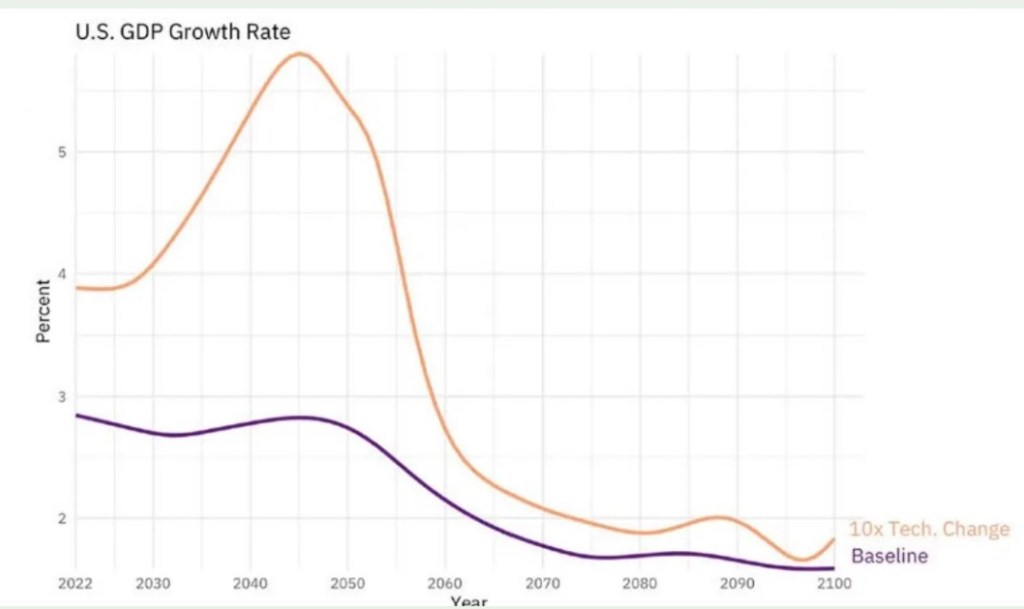
In July, however, Seth Benzell of the Stanford Digital Economy Lab discussed some simulations showing impressive AI-induced growth (see chart at top). The simulations project additional U.S. GDP growth of between 1% – 3% annually over the next 75 years! The largest boost in growth occurs now through the 2050s. This would produce a major advance in living standards. It would also eliminate the federal deficit and cure our massive entitlement insolvency, but the result comes with heavy qualifications. In fact, Benzell ultimately throws cold water on the notion that AI growth will be strong enough to reduce or even stabilize the public debt to GDP ratio.

The Scarcity Spoiler

The big hitch has to do with the scarcity of capital, which I’ve described as an impediment to widespread AI application. Competition for capital will drive interest rates up (3% – 4%, according to Benzell’s model). Ongoing needs for federal financing intensify that effect. But it might not be so bad, according to Benzell, if climbing rates are accompanied by heightened productivity powered by AI. Then, tax receipts just might keep-up with or exceed the explosion in the government’s interest obligations.

A further complication cited by Benzell lurks in insatiable demands for public spending, and politicians who simply can’t resist the temptation to buy votes via public largesse. Indeed, as we’ve already seen, government will try to get in on the AI action, channeling taxpayer funds into projects deemed to be in the public interest. And if there are segments of the work force whose jobs are eliminated by AI, there will be pressure for public support. So even if AI succeeds in generating large gains in productivity and tax revenue, there’s very little chance we’ll see a contagion of fiscal discipline in Washington DC. This will put more upward pressure on interest rates, giving rise to the typical crowding out phenomenon, curtailing private investment in AI.

Playing Catch-Up

The capex boom must precede much of the hoped-for growth in productivity from AI. Financing comes first, which means that rates are likely to rise sooner than productivity gains can be expected. And again, competition from government borrowing will crowd out some private AI investment, slowing potential AI-induced increases in tax revenue.

There’s no chance of the converse: that AI investment will crowd out government borrowing! That kind of responsiveness is not what we typically see from politicians. It’s more likely that ballooning interest costs and deficits generally will provoke even more undesirable policy moves, such as money printing or rate ceilings.

The upshot is that higher interest rates will cause deficits to balloon before tax receipts can catch up. And as for tax receipts, the intangibility of AI will create opportunities for tax flight to more favorable jurisdictions, a point well understood by Benzell. As attorneys Bradford S. Cohen and Megan Jones put it:

“Digital assets can be harder to find and more easily shifted offshore, limiting the tax reach of the U.S. government.”

AI Growth Realism

Benzell’s trepidation about our future fiscal imbalances is well founded. However, I also think Benzell’s modeled results, which represent a starting point in his analysis of AI and the public debt, are too optimistic an assessment of AI’s potential to boost growth. As he says himself,

“… many of the benefits from AI may come in the form of intangible improvements in digital consumption goods. … This might be real growth, that really raises welfare, but will be hard to tax or even measure.”

This is unlikely to register as an enhancement to productivity. Yet Benzell somehow buys into the argument that AI will lead to high levels of unemployment. That’s one of his reasons for expecting higher deficits.

My view is that AI will displace workers in some occupations, but it is unlikely to put large numbers of humans permanently out of work and into state support. That’s because the opportunity cost of many AI applications is and will remain quite high. It will have to compete for financing not only with government and more traditional capex projects, but with various forms of itself. This will limit both the growth we are likely to reap from AI and losses of human jobs.

Sovereign Wealth Fund

I have one other bone to pick with Benzell’s post. That’s in regard to his eagerness to see the government create a sovereign wealth fund. Here is his concluding paragraph:

“Instead of contemplating a larger debt, we should instead be talking about a national sovereign wealth fund, that could ‘own the robots on behalf of the people’. This would both boost output and welfare, and put the welfare system on an indefinitely sustainable path.”

Whether the government sells federal assets or collects booty from other kinds of “deals”, the very idea of accumulating risk assets in a sovereign wealth fund undermines the objective to reduce debt. It will be a struggle for a sovereign wealth fund to consistently earn cash returns to compensate for interest costs and pay down the debt. This is especially unwise given the risk of rising rates. Furthermore, government interests in otherwise private concerns will bring cronyism, displacement of market forces by central planning, and a politicization of economic affairs. Just pay off the debt with whatever receipts become available. This will free up savings for investment in AI capital and hasten the hoped-for boom in productivity.

Summary

AI’s contribution to economic growth probably will be inadequate and come too late to end government budget deficits and reduce our burgeoning public debt. To think otherwise seems far fetched in light of our historical inability to restrain the growth of federal spending. Interest on the federal debt already accounts for about half of the annual budget deficit. Refinancing the existing public debt will entail much higher costs if AI capex continues to grow aggressively, pushing interest rates higher. These dynamics make it pretty clear that AI won’t provide an easy fix for federal deficits and debt. In fact, ongoing federal borrowing needs will sop up savings needed for AI development and diffusion, even as the capital needed for AI drives up the cost of funds to the government. It’s a shame that AI won’t be able to crowd out government.

My Foolish Hopes For Free Trade Bargaining

24 Saturday May 2025

Posted by Nuetzel in Central Planning, Free Trade

≈ 2 Comments

Tags

Balance of Payments, Big Beautiful Bill, central planning, Coercion, Cronyism, Donald Trump, Eric Boehm, Fiscal Restraint, Foreign Investment, Free trade, Liberation Day, National Security, Non-Tariff Barriers, Price Pressures, Punitive Tariffs, Reciprocal Tariffs, Retaliatory Tariffs, Selective Tariffs, Tariff Exceptions, Tariff Incidence, Trade Deals, Trade Deficit

Just a few weeks back I engaged in wishful speculation that Trump’s drastic imposition of “reciprocal” and punitive tariffs could actually prove to be a free-trade play, but only if the U.S. used its universally dominant position in trade wisely at the bargaining table. I worried, however, that any notion Trump might have along those lines was eclipsed by his antipathy for otherwise harmless trade deficits. Another bad indicator was his conviction that manipulating tariffs could restore “fairness” in trade relations while raising revenue to pay for the selective tax cuts he promised for tips, overtime wages, and social security benefits.

Aside from that, I won’t repeat all of Trump’s fallacies about trade (and see here and here) except where they’ve impinged on recent developments.

One Raw Deal

My hopes for reduced trade barriers were dashed when the first “deal” (or really a “Memorandum of Understanding”) was announced with the United Kingdom. The U.S. runs a trade surplus with the UK, so one might think Trump would find it unnecessary to levy tariffs on U.S. imports from the UK. No dice! Clearly this was not motivated by the trade deficit bogeyman of Trump’s fever dreams. The White House stated that buyers of goods from the UK will pay the minimum 10% tariff (up from 3.3% before Trump took office).

Trump simply likes tariffs. Apparently he’s never given much thought to their incidence, which falls largely on domestic consumers and businesses. The MAGA faithful are in blissful denial that such a burden exists, despite ample evidence of its reality.

As Eric Boehm notes, the U.S. received a few concessions on British tariffs under the deal, but the reductions only amount to about a 2% equivalent. There are sharp reductions in special tariffs on U.S. agricultural products, especially meat. There are also exceptions to tariffs on certain British goods, like autos (up to 100,000 units). The selective nature of the concessions on both sides underscores the cronyist underpinnings of this style of economic governance, which amounts to ad hoc central planning.

Also troubling is the misleading spin the Administration attempted to put on news coverage of the deal. They claimed to have reduced tariffs of goods imported from the UK, which is true only in comparison to post-“Liberation Day” tariff levels established in early April. In fact, the baseline tariff now applied to most UK goods sold in the U.S. has more than tripled since last year! As Boehm states, American consumers and businesses are paying a lot more for this “deal” than their British counterparts.

Raw Deals To Be?

The “deal” with China is worse, partly because it’s only a 90-day pause in implementation (pending negotiation), and partly because the “reciprocal” tariff rate of 30% applied to Chinese goods is much higher than before Trump imposed the punitive rates. Still worse, the 10% tariff on U.S. exports to China applied during the pause is also much higher. What a deal! And it could get worse. These tariff hikes have little to do with “national security” and they are regressive, having disproportionately large burdens on lower-income consumers and small businesses.

The only other agreement announced thus far is with India. It is not a “trade deal” at all, but a so-called “Terms of Reference On Bilateral Trade Agreement”. It is a “roadmap” for future negotiations. Perhaps it will come together quickly, but it’s hard to expect much after the UK agreement.

Uniting Western Civilization

Just this week we had another hardball move by Trump: a 50% tariff on goods from the European Union starting in June, up from an average of about 3.8% on a trade-weighted basis. The new tariff rate is also higher than the 10% baseline tariff in place since the 90-day pause was announced in April. Trump claims the EU has been levying tariffs of 39% on U.S. goods, which might include what the Administration would call effective tariffs from non-tariff barriers to trade. Or it might refer to retaliatory tariffs announced by the EU in response to Trump’s Liberation Day announcement, but all of those have been paused. In any case, the World Trade Organization says EU tariffs on US goods average 4.8%. Quite a difference!

The move against the EU is much like Trump’s earlier ploy with China, but he says he’s “not looking for a deal”. He also says talks with the EU are “going nowhere”, though the Polish Trade Minister reassures that talks are “ongoing”. The outcome is likely to be a disappointment for anyone (like me) hoping for freer trade. The EU will probably make commitments to buy something from the U.S., maybe beef or liquified natural gas. But U.S. tariffs on EU goods will be higher than in the past.

So, thus far we have only one “deal” (such as it is), one roadmap for negotiations to follow, and a bunch of pauses pending negotiation (China included). The Trump team says about 100 countries hope to negotiate trade deals, but that is a practical impossibility. Even Trump says “… it’s not possible to meet the number of people that want to see us.” But it could be easy: just drop all U.S. trade barriers and allow protectionist countries to tax their own citizens, denying them access to free choice.

Bullying Enemies, Allies and Producers

Higher U.S. tariffs will put some upward pressure on the prices of imports and import-competing goods. We haven’t seen this play out just yet, but it’s early. In a defensive move, Trump is attempting to bully and shame domestic companies such as WalMart for attempting to protect their bottom lines in the face of tariffs. He also warned automakers about their pricing before carving out an exception for them. And now Apple has been singled-out by Trump for a special 25% tariff after it had announced plans to move assembly of iPhones to India, rather than in the U.S.

You better stay on Trump’s good side. This is a loathsome kind of interference. It encourages firms to seek favors in the form of tariff exemptions or to accept what amounts to state expropriation of profits. Cronyism and coercion reign.

Swamped By Spendthrifts?

The market seems to believe the negative impact of tariffs on economic growth will be more than offset by other stimulative forces. This includes the extension of Trump’s 2017 tax cuts. The so-called “big beautiful bill” passed by the House of Representatives also includes new tax breaks on tip and overtime pay, and an increase in the deduction for state and local taxes. While the bill reduces the growth of federal spending, there is disappointment that spending wasn’t reduced. The Senate might pass a version with more cuts, but the market sees nothing but deficits going forward. This is not the sort of “fiscal restraint” the market hoped for, particularly with escalating interest costs on the burgeoning federal debt.

Conflicting Goals

Trump has bargained successfully for some major investments in the U.S. by wealthy nations like Saudi Arabia and Dubai, as well as a few major manufacturing and technology firms. That’s wonderful. He doesn’t understand, however, that strong foreign investment in the U.S. will encourage larger trade deficits. That’s because foreign capital inflows raise incomes, which increase demand for imports. In addition, the capital inflows cause the value of the dollar to appreciate, making imports cheaper but exports more expensive for foreigners. It would be a shame if Trump reacted to these eventualities by doubling down on tariffs.

Conclusion

Alas, my hopes that Trump’s bellicose trade rhetoric was mere posturing were in vain. He could have used our dominant trading position to twist arms for lower trade barriers all around. While I worried that he massively misunderstood the meaning of trade deficits, and that he viewed higher tariffs as a magic cure, I should have worried much more!

Trade Charades and a Capital Crusade

15 Tuesday Apr 2025

Posted by Nuetzel in Balance of Payments, Federal Budget, Protectionism

≈ 4 Comments

Tags

Balance of Payments, Capital Account, Capital Deepening, Capital Surplus, central planning, Cronyism, Current Account, Donald Trump, Federal Budget Deficit, John Cochrane, Reciprocal Tariffs, Scott Lincicome, Trade Barriers, Trade Deficit

I’m nowhere near eating crow over the skepticism I’ve directed at Donald Trump’s trade offensive. The uncertainty created by his erratic policy changes is very likely to drag the U.S. into recession. However, there were signs last week of movement in a more promising direction, as he placed a 90-day pause on the targeted “reciprocal” tariffs announced in early April. However, a “baseline” universal tariff of 10% still applies to all imported goods. So do tariffs targeted at China, which have ratcheted up through a few rounds of retaliation. Now, he’s announced exemptions for some key electronics products, many of which come from China, and there are signs that he’s ready to exempt imports of auto parts. Needless to say, the tariffs and their exemptions represent an ill-advised escapade in central planning, replete with ample opportunities for politically-motivated favoritism and prejudice.

Why the Pause?

The pause in reciprocal tariffs was ostensibly intended to allow time to negotiate lower trade barriers with “more than 75 countries” that came forward to engage with Trump rather than retaliate. Now, there are said to be as many as 90 countries that wish to negotiate. This more or less aligns with an evolution of the strategy I described in my last post: game theory suggests that a dominant trading partner may be able to threaten or impose higher tariffs and ultimately achieve agreement on a regime with lower trade barriers on both sides. In Trump’s case, that would involve reaching many different bilateral agreements within a very short time, an imposing challenge given the history of trade negotiations. So far we have no deals, though Trump claims some are close. If only we didn’t have to reach formal agreements not to interfere with mutually beneficial trade!

A debate ensued almost immediately over whether Trump’s pause showed that he “caved” to the negative market reaction to his tariffs, but perhaps he acted primarily because a number of nations approached with hats in hand. Trump knew he had the leverage to force other nations to make concessions on trade barriers. They obviously responded.

The timing of the pause was surely a combination of those overtures, market reaction, advisor opinion, and Trump’s own instincts. This view is buttressed by the unaltered universal 10% tariffs, the remaining special tariffs on specific nations and product categories, and the punative tariffs on China. Furthermore, Trump knows he can reimpose a targeted tariff on any country that refuses a deal satisfactory to him. Let’s hope he’s reasonable and doesn’t allow his love affair with tariffs to color his position in these talks.

My hope is that the Trump Administration can negotiate a large number of new agreements with trading partners to reduce or eliminate tariffs and other barriers to trade. Obviously the pause is no guarantee of success, and severe challenges remain with more belligerent trading partners, especially China.

Disclaimer!

None of the foregoing is intended as a dispensation for the many apparent misconceptions Trump has about trade. In the MAGA cult clamor to defend all-things Trump, there have been a number of absurd claims about tariffs and trade, such as: tariffs are not a tax; tariffs don’t raise the price of imports; trade deficits are a deduction from GDP; tariffs can replace the income tax; trade deficits will bankrupt the country; high tariffs produced rapid growth in the late 19th century; “reciprocal” tariffs will eliminate our bilateral trade deficits; U.S. manufacturing is in crisis; value added taxes are trade barriers; it’s better to export goods than services; and trade deficits reduce investment. Every one a laugher, but I’ll leave most of them aside for now.

In the remainder of this post, I’ll focus on Trump’s aims for coaxing firms, via tariff avoidance, to make capital investment in the U.S., and the implications of that effort for the trade balance. An influx of capital might be construed as a strength of Trump’s policy agenda, though his effort to “cut deals” in this manner is a form of economic meddling as well as a vehicle for cronyism. Moreover, he doesn’t understand the nexus between foreign investment, the federal deficit, and the balance of payments. He’ll be disappointed to learn that his notion that trade deficits are ruinous conflicts with his vision of encouraging foreign accumulations of productive U.S. assets.

Oh No! A Capital Surplus!

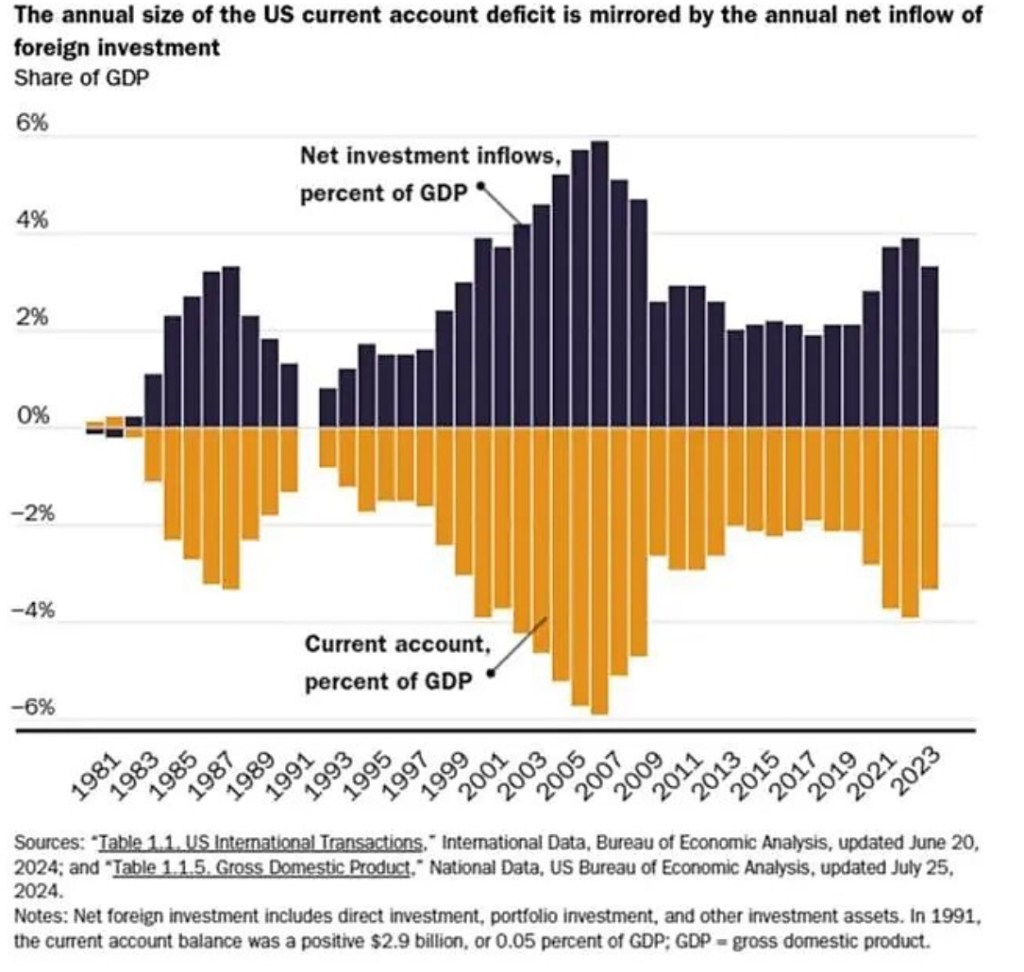
It isn’t a widely understood equivalence, but each year we have a surplus in foreign purchases of U.S. assets (the capital account surplus) that is roughly matched by a deficit in trade for foreign goods and services (the current account deficit). This is why the balance of payments (BoP) balances! Here is the near mirror image of these two sides of the BoP, from Scott Lincicome’s “Things Everyone Should Know about Trade Deficits”:

The two sides of the BoP are very much codetermined. One does not exclusively drive the other.

It’s wonderful to be in a position to avail ourselves of foreign savings to invest in our economy. Unfortunately, a large portion of this foreign investment finances our huge government budget deficit, and that is a real problem. Otherwise, the investment would make a greater contribution to U.S. growth.

Funding the Federal Deficit

As John Cochrane explains, transfer payments account for a large share of government spending and borrowing. In turn, these transfers are spent by recipients on consumer goods, some of which come from overseas. Cochrane emphasizes that we are borrowing from abroad, as shown by our capital surplus, to finance this consumption, rather than investing foreign capital in productive assets. While one might conclude that our capital surplus and our trade deficit are creating a long-term vulnerability, the root of the problem is the federal government’s largess.

There is a sense in which different prongs of Trump’s policy agenda could act to address this problem. These are his efforts to reduce government waste, deregulate, and encourage direct investment in new plant and equipment. Reducing the federal budget deficit is paramount, but huge doubts remain over his determination to control spending or undertake real entitlement reforms. Tariffs will generate some revenue, but part of that will be required to offset other tax breaks Trump is contemplating.

Deepening the Capital Base

Trump harps on the need for firms, both foreign and domestic, to produce goods here in the U.S. Currently he’s taking credit for $5 trillion of new investment in the U.S., though we really don’t know whether all of these are “new deals” or had already been planned. Deregulation can improve incentives to invest in physical capital and increase the speed with which it comes online. To the extent that investment in productive capital replaces government borrowing, the debt we accumulate (held by foreign and domestic lenders) will be more sustainable.

However, Trump seems oblivious to a fact made inescapable by the balance of payments relationship. This new investment, should it come to fruition, will bring with it future excesses of imports over exports. Foreign demand for U.S. capital assets lifts domestic income and leads to a stronger dollar, both of which boost imports and the trade deficit. The trade deficit will persist even if foreign investment in new factories fully replaces the bloated federal deficit as a use of foreign capital.

Of course, the intent of Trump’s reshoring campaign is for new domestic output to substitute for imports and increase exports. That would bring positive returns for domestic and foreign capital, but rising income and a stronger dollar will stimulate demand for other imports, while exports would flag with the strength of the dollar. In any case, the new investments and a larger capital surplus will increase the trade deficit.

Tangled Up In Green Industrial Policy: Joe Biden’s Electrification

28 Thursday Mar 2024

Posted by Nuetzel in Government Failure, Industrial Policy, Liberty

≈ 1 Comment

Tags

Adam Smith, Administrative State, Arnold Kling, Battery Fires, Battery Replacement, Biden EPA Mandates, BYD, Carbon Credits, central planning, Charging Stations, Chevron Deference, Electric Stoves, Electric Vehicles, Electrification, Energiewende, EV Range, EV Rich-Man Subsidy, EV Tire Wear, Fossil fuels, Friedrich Hayek, Grid Capacity, Industrial Policy, Infrastructure Investment and Jobs Act, Joel Kotkin, John Mozena, Legislative Deference, Long Tailpipe, Ludwig von Mises, National Security, Net Zero, Offshore Wind, Rare Earth Minerals, Trade Intervention

Industrial policy allows government planners to select favored and disfavored industries or sectors. It thereby bypasses and distorts impersonal market signals that would otherwise direct scarce resources to the uses most valued by market participants. Instead, various forms of aid and penalties are imposed on different sectors in order to accomplish the planners’ objectives, This includes interventions in foreign trade and attempts to steer technological development. Industrial policy often comes under the guise of enhanced national security. Of course, it can also be used to reward cronies. And it has a poor record of accomplishing its objectives and avoiding unintended consequences.

The Sausage Factory

The executive and legislative branches of the U.S. government are loaded with economic interventionists, regardless of party affiliation. In an age of (Chevron) judicial deference to “experts” within the administrative state, it is not uncommon for legislative language to give abundant leeway to those who implement policy within the executive branch (though a couple of upcoming Supreme Court decisions might change that balance). Increasingly, bills are stuffed so full of provisions that lawmakers find it all but impossible to read them in full, let alone make an accurate assessment of their virtues, drawbacks, and internal contradictions.

Even worse is the fact that bills are, in great part, written by relatively youthful legislative staffers with little real world experience in industry, and who harbor the naive belief that whatever is wished, government can make it so. But their work also proceeds under guidance from lawmakers, administration officials, consultants, and lobbyists who have their own agendas and axes to grind. This is how industrial policy is promulgated in the U.S., and it is through this ugly prism that we must view environmental policy.

The Left dictates environmental and energy policy in several states, especially California, where energy costs have soared under renewable energy initiatives. California households now pay almost triple the rate per kilowatt-hour paid in Washington, and more than double what’s paid in Oregon. Something similar may happen in New York, which has highly ambitious goals for renewable energy even as the costs of the state’s offshore wind projects are out of control. These and other state-level “laboratories” are demonstrating that a renewable energy agenda can carry very high costs to the populace. The same is true of the painful experience in Germany with its much-heralded Energiewende.

Net Zero

The Left is also pulling the strings within the federal bureaucracy and the Biden Administration. The objective is an industrial policy to achieve “net zero” CO2 emissions, a practical impossibility for at least several decades (unless it’s faked, of course). Nevertheless, that policy calls for phasing out the use of fossil fuels. Under this agenda, mandates and subsidies are bestowed upon the use of renewable electric power sources, while restrictions and penalties are imposed on the production and use of fossil fuels. A subsequent post on the subject of power generation will address this prototypical failure of central planning.

Electrification

Here, I discuss another key objective of our industrial planners: electrify whatever is not electrified in order to advance the net zero agenda. Of course, for some time to come, more than half of electric power will be generated using fossil fuels (currently about 60%, with another 18% nuclear), so the policy is largely a sham on its face, but we’ll return to that point below. The EV tailpipe is very long, as they say.

Electrification means, among other things, the forced adoption of electronic vehicles (EVs). President Biden’s EPA has issued rules on auto emissions that are expected to require, by 2032, that 60% or more of cars and light trucks sold will be EVs. The USA Today article at the link offers this rich aside:

“…the original proposal — which was always technology-neutral in theory, meaning automakers could sell any cars and light-duty trucks they wanted as long as they hit the fleetwide reductions….”

Technology neutral? Hahaha! We aren’t forcing you to choose technologies as long as you meet our technological requirements!

EV Doldrums

Anyway, the EPA’s targets are completely impractical, partly because the value for drivers is lacking. Not coincidentally, the market for EVs seems to have chilled of late. Hertz has soured on heavy use of EVs in its fleet, and Ford has announced reductions in EV production. The new UAW agreements will make it difficult for some domestic producers to turn a profit on EVs. Fisker is just about broke. Apple has cancelled development of its EV, and several other automakers have reduced their production plans. Toyota was the first producer to raise the red flag on the breakneck transition to EVs in favor of a measured reliance on hybrids. Of course, there are other prominent voices cautioning against rapid attempts at electrification in general.

To be fair, some EVs are marvelous machines, but they and their supporting infrastructure are not yet well-suited to the mass market.

A Tangled Web

Here are some drawbacks of EVs that have yet to be adequately addressed:

  • They are expensive, even with the rich-man’s subsidy to buyers paid by the government and carbon credit subsidies granted to producers.
  • Costly battery replacement is an eventuality that looms over the wallets of EV owners.
  • EVs have limited range given the state of battery technology, especially when the weather is cold.
  • There presently exist far too few charging stations to make EVs workable for many people. In any case, charging away from home can be extremely time consuming and the charges vary widely.
  • The purchase and installation of EV chargers at home is a separate matter, and can cost $4,000 or more if an upgrade to the service panel is necessary. Installed costs commonly range from $1,175 to $3,300, depending on the type of charger and the region.
  • EVs are much heavier than vehicles powered by internal combustion engines. As a result, EV tire wear can be a surprising cost causer and pollutant.
  • Used EVs are not in demand, given all of the above, so resale value is questionable.
  • Battery fires in EVs are extremely difficult to extinguish, creating a new challenge for emergency responders.
  • Reliance on EVs for local emergency services would be dangerous without duplicative investment by local jurisdictions to offset the down-time required for charging.
  • For decades to come, the power grid will be unable to handle the load required for widespread adoption of EVs. A rapid conversion would be impossible without a great expansion in generating and transmission capacity, including transformer availability.
  • Domestically we lack the natural resources to produce the batteries required by EVs in a quantity that would satisfy the Administration’s goals. This forces dependence on China, our chief foreign adversary.
  • The mining of those resources is destructive to the environment. Much of it is done in China due to the country’s abundance of rare earth minerals, but wherever the mining occurs, it relies heavily on diesel power.
  • Joel Kotkin points out that China now hosts the world’s largest EV producer, BYD. Biden’s mandates might very well allow China to dominate the U.S. auto market, even as its own CO2 emissions are soaring,,
  • Producers of EVs earn carbon credits for each vehicle sold, which they can sell to other auto producers who fall short of their required mix of EVs in total production. Tesla, for example, earned revenue of $1.8 billion from carbon credit sales in 2022. But note again that these so-called zero-emission vehicles use electricity generated with an average of 60% fossil fuels. Thus, the scheme is largely a sham.

The push for EVs has been hampered by the botched rollout of (non-Tesla) charging stations under a huge Biden initiative in the Infrastructure Investment and Jobs Act. Progress has been bogged down by sheer complexity and expense, including the cost of bringing adequate power supplies to the chargers as well as the difficulty of meeting contracting requirements and operating standards. This is exemplary of the failures that usually await government efforts to engineer outcomes contrary to market forces.

Electric Everything?

Like EVs, electric stoves have drawbacks that limit their popularity, including price and the nature of the heat needed for quality food preparation. In addition to autos and stoves, wholesale electrification would require the replacement or costly reconfiguration of a huge stock of business and household capital that is now powered by fossil fuels, like gas furnaces, tractors, chain saws, and many other tools and appliances. This set of legacy investment choices was guided by market prices that reflect the scarcity and efficiency of the resources, yet government industrial planners propose to lay much of it to waste.

Central Planning: a False Conceit

John Mozena quotes Adam Smith on the social and economic hazards of rejecting the market mechanism and instead accepting governmental authority over the allocation of resources:

“All governments which thwart this natural course, which force things into another channel, or which endeavour to arrest the progress of society at a particular point, are unnatural, and to support themselves are obliged to be oppressive and tyrannical.”

And Arnold Kling gives emphasis to the disadvantages faced by even the most benevolent central planner:

“As Ludwig von Mises and Friedrich Hayek pointed out during the socialist calculation debate, central planners lack the information that is produced by markets. By over-riding market prices and substituting their own judgment, regulators incur the same loss of information.”

Advocates of EV industrial policy have failed to appreciate the large gaps between the technology they are determined to dictate and basic consumer requirements. These gaps are along such margins as range, charging time, tire and battery wear, and perhaps most importantly, affordability. The planners have failed to foresee the massive demands on the power grid of a forced replacement of the internal combustion auto stock with EVs. The planners elide the true nature of EV-driven emissions, which are never zero carbon but instead depend on the mix of power sources used to charge EV batteries. Finally, EV mandates show that the industrial planners are oblivious to other environmental burdens inherent in EVs, whatever their true carbon footprint might be.

Continue reading →

Government Failure as a Root Cause of Market Failure

10 Monday Jul 2023

Posted by Nuetzel in Government Failure, Market Failure

≈ Leave a comment

Tags

Capital Formation, central planning, Chevron Doctrine, Competitive Equilibrium, Corruption, crowding out, Declaration of Independence, Don Boudreaux, External Benefits, External Costs, Government Failure, Inflation, John Cochrane, Labor Supply, Market Failure, Michael Munger, monopoly power, Pareto Superiority, Peter Boettke, Price Controls, Protectionism, Redistribution, Regulatory Capture, rent seeking, Risk-Free Asset, Side Payments, Social Security, State Capacity, Tax Distortions, Thomas Jefferson, Treasury Debt, William R. Keech

We’re told again and again that government must take action to correct “market failures”. Economists are largely responsible for this widespread view. Our standard textbook treatments of external costs and benefits are constructed to demonstrate departures from the ideal of perfectly competitive market equilibria. This posits an absurdly unrealistic standard and diminishes the power and dramatic success of real-world markets in processing highly dispersed information, allocating resources based on voluntary behavior, and raising human living standards. It also takes for granted the underlying institutional foundations that lead to well-functioning markets and presumes that government possesses the knowledge and ability to rectify various departures from an ideal. Finally, “corrective” interventions are usually exposited in economics classes as if they are costless!

Failed Disgnoses

This brings into focus the worst presumption of all: that government solutions to social and economic problems never fail to achieve their intended aims. Of course that’s nonsense. If defined on an equivalent basis, government failure is vastly more endemic and destructive than market failure.

Related to this point, Don Boudreaux quotes from Peter Boettke’s Living Economics:

“According to ancient legend, a Roman emperor was asked to judge a singing contest between two participants. After hearing the first contestant, the emperor gave the prize to the second on the assumption that the second could be no worse than the first. Of course, this assumption could have been wrong; the second singer might have been worse. The theory of market failure committed the same mistake as the emperor. Demonstrating that the market economy failed to live up to the ideals of general competitive equilibrium was one thing, but to gleefully assert that public action could costlessly correct the failure was quite another matter. Unfortunately, much analytical work proceeded in such a manner. Many scholars burst the bubble of this romantic vision of the political sector during the 1960s. But it was [James] Buchanan and Gordon Tullock who deserve the credit for shifting scholarly focus.”

John Cochrane sums up the whole case succinctly in the “punchline” of a recent post:

“The case for free markets never was their perfection. The case for free markets always was centuries of experience with the failures of the only alternative, state control. Free markets are, as the saying goes, the worst system; except for all the others.”

Tracing Failures

We can view the relation between market failure and government failure in two ways. First, we can try to identify market failures and root causes. For example, external costs like pollution cause harm to innocent third parties. This failure might be solely attributable to transactions between private parties, but there are cases in which government engages as one of those parties, such as defense contracting. In other cases government effectively subsidizes toxic waste, like the eventual disposal of solar panels. Another kind of market failure occurs when firms wield monopoly power, but that is often abetted by costly regulations that deliver fatal blows to small competitors.

The second way to analyze the nexus between government and market failures is to first examine the taxonomy of government failure and identify the various damages inflicted upon the operation of private markets. That’s the course I’ll follow below, though by no means is the discussion here exhaustive.

Failures In and Out of Scope

An extensive treatment of government failure was offered eight years ago by William R. Keech and Michael Munger. To start, they point out what everyone knows: governments occasionally perpetrate monstrous acts like genocide and the instigation of war. That helps illustrate a basic dichotomy in government failures:

“… government may fail to do things it should do, or government may do things it should not do.’

Both parts of that statement have numerous dimensions. Failures at what government should do run the gamut from poor service at the DMV, to failure to enforce rights, to corrupt bureaucrats and politicians skimming off the public purse in the execution of their duties. These failures of government are all too common.

What government should and should not do, however, is usually a matter of political opinion. Thomas Jefferson’s axioms appear in a single sentence at the beginning of the Declaration of Independence; they are a tremendous guide to the first principles of a benevolent state. However, those axioms don’t go far in determining the range of specific legal protections and services that should and shouldn’t be provided by government.

Pareto Superiority

Keech and Munger engage in an analytical exercise in which the “should and shouldn’t” question is determined under the standard of Pareto superiority. A state of the world is Pareto superior if at least one person prefers it to the current state (and no one else is averse to it). Coincidentally, voluntary trades in private markets always exploit Pareto superior opportunities, absent legitimate external costs and benefits.

The set of Pareto superior states available to government can be expanded by allowing for side payments or compensation to those who would have preferred the current state. Still, those side payments are limited by the magnitude of the gains flowing to those who prefer the alternative (and if those gains can be redistributed monetarily).

Keech and Munger define government failure as the unexploited existence of Pareto superior states. Of course, by this definition, only a benevolent, omniscient, and omnipotent dictator could hope to avoid government failure. But this is no more unrealistic than the assumptions underlying perfectly competitive market equilibrium from which departure are deemed “market failures” that government should correct. Thus, Keech and Munger say:

“The concept of government failure has been trapped in the cocoon of the theory of perfect markets. … Government failure in the contemporary context means failing to resolve a classic market failure.”

But markets must operate within a setting defined by culture and institutions. The establishment of a social order under which individuals have enforceable rights must come prior to well-functioning markets, and that requires a certain level of state capacity. Keech and Munger are correct that market failure is often a manifestation of government failure in setting and/or enforcing these “rules of the game”.

“The real question is … how the rules of the game should be structured in terms of incentives, property rights, and constraints.”

The Regulatory State and Market Failures

Government can do too little in defining and enforcing rights, and that’s undoubtedly a cause of failure in markets in even the most advanced economies. At the same time there is an undeniable tendency for mission creep: governments often try to do too much. Overregulation in the U.S. and other developed nations creates a variety of market failures. This includes the waste inherent in compliance costs that far exceed benefits; welfare losses from price controls, licensing, and quotas; diversion of otherwise productive resources into rent seeking activity, anti-competitive effects from “regulatory capture”; Chevron-like distortions endemic to the administrative judicial process; unnecessary interference in almost any aspect of private business; and outright corruption and bribe-taking.

Central Planning and Market Failures

Another category of government attempting to “do too much” is the misallocation of resources that inevitably accompanies efforts to pick “winners and losers”. The massive subsidies flowing to investors in various technologies are often misdirected. Many of these expenditures end up as losses for taxpayers, and this is not the only form in which failed industrial planning takes place. A related evil occurs when steps are taken to penalize and destroy industries in political disfavor with thin economic justification.

Other clear examples of government “planning” failure are protectionist laws. These are a net drain on our wealth as a society, denying consumers of free choice and saddling the country with the necessity to produce restricted products at high cost relative to erstwhile trading partners.

There are, of course, failures lurking within many other large government spending programs in areas such as national defense, transportation, education, and agriculture. Many of these programs can be characterized as centrally planning. Not only are some of these expenditures ineffectual, but massive procurement spending seems to invite waste and graft. After all, it’s somebody else’s money.

Redistribution and Market Failures

One might regard redistribution programs as vehicles for the kinds of side payments described by Keech and Munger. Some might even say these are the side payments necessary to overcome resistance from those unable to thrive in a market economy. That reverses the historical sequence of events, however, since the dominant economic role of markets preceded the advent of massive redistribution schemes. Unfortunately, redistribution programs have been plagued by poor design, such as the actuarial nightmare inherent in Social Security and the destructive work incentives embedded in other parts of the social safety net. These are rightly viewed as government failures, and their distortionary effects spill variously into capital markets, labor markets and ultimately product markets.

Taxation and Market Failures

All these public initiatives under which government failures precipitate assorted market failures must be paid for by taxpayers. Therefore, we must also consider the additional effects of taxation on markets and market failures. The income tax system is rife with economic distortions. Not only does it inflict huge compliance costs, but it alters incentives in ways that inhibit capital formation and labor supply. That hampers the ability of input markets to efficiently meet the needs of producers, inhibiting the economy’s productive capacity. In turn, these effects spill into output market failures, with consequent losses in .social welfare. Distortionary taxes are a form of government failure that leads to broad market failures.

Deficits and Market Failure

More often than not, of course, tax revenue is inadequate to fund the entire government budget. Deficit spending and borrowing can make sense when public outlays truly produce long-term benefits. In fact, the mere existence of “risk-free” assets (Treasury debt) across the maturity spectrum might enhance social welfare if it enables improvements in portfolio diversification that outweigh the cost of the government’s interest obligations. (Treasury securities do bear interest-rate risk and, if unindexed, they bear inflation risk.)

Nevertheless, borrowing can reflect and magnify deleterious government efforts to “do too much”, ultimately leading to market failures. Government borrowing may “crowd out” private capital formation, harming economy-wide productivity. It might also inhibit the ability of households to borrow at affordable rates. Interest costs of the public debt may become explosive as they rise relative to GDP, limiting the ability of the public sector to perform tasks that it should *actually* do, with negative implications for market performance.

Inflation and Market Failure

Deficit spending promotes inflation as well. This is more readily enabled when government debt is monetized, but absent fiscal discipline, the escalation of goods prices is the only remaining force capable of controlling the real value of the debt. This is essentially the inflation tax.

Inflation is a destructive force. It distorts the meaning of prices, causes the market to misallocate resources due to uncertainty, and inflicts costs on those with fixed incomes or whose incomes cannot keep up with inflation. Sadly, the latter are usually in lower socioeconomic strata. These are symptoms of market failure prompted by government failure to control spending and maintain a stable medium of exchange.

Conclusion

Markets may fail, but when they do it’s very often rooted in one form of government failure or another. Sometimes it’s an inadequacy in the establishment or enforcement of property rights. It could be a case of overzealous regulation. Or government may encroach on, impede, or distort decisions regarding the provision of goods or services best left to the market. More broadly, redistribution and taxation, including the inflation tax, distort labor and capital markets. The variety of distortions created when government fails at what it should do, or does what it shouldn’t do, is truly daunting. Yet it’s difficult to find leaders willing to face up to all this. Statism has a powerful allure, and too many elites are in thrall to the technocratic scientism of government solutions to social problems and central planning in the allocation of resources.

The Impotence of AI for the Socialist Calculation Debate

05 Monday Jun 2023

Posted by Nuetzel in Artificial Intelligence, Central Planning, Markets

≈ Leave a comment

Tags

Allocative efficiency, CATO Institute, central planning, Don Boudreaux, F.A. Hayek, incentives, Industrial Policy, Invisible Hand, Jason Kuznicki, Jesús Fernández-Villaverde, Knowledge Problem, Libertarianism.org, Machine Learning, Michael Munger, Opportunity cost, Protectionism, Robert Lucas, Socialist Calculation Debate

Recent advances in artificial intelligence (AI) are giving hope to advocates of central economic planning. Perhaps, they think, the so-called “knowledge problem” (KP) can be overcome, making society’s reliance on decentralized market forces “unnecessary”. The KP is the barrier faced by planners in collecting and using information to direct resources to their most valued uses. KP is at the heart of the so-called “socialist calculation debate”, but it applies also to the failures of right-wing industrial policies and protectionism.

Apart from raw political motives, run-of-the-mill government incompetence, and poor incentives, the KP is an insurmountable obstacle to successful state planning, as emphasized by Friedrich Hayek and many others. In contrast, market forces are capable of spontaneously harnessing all sources of information on preferences, incentives, resources, as well as existing and emergent technologies in allocating resources efficiently. In addition, the positive sum nature of mutually beneficial exchange makes the market by far the greatest force for voluntary social cooperation known to mankind.

Nevertheless, the hope kindled by AI is that planners would be on an equal footing with markets and allow them to intervene in ways that would be “optimal” for society. This technocratic dream has been astir for years along with advances in computer technology and machine learning. I guess it’s nice that at least a few students of central planning understood the dilemma all along, but as explained below, their hopes for AI are terribly misplaced. AI will never allow planners to allocate resources in ways that exceed or even approximate the efficiency of the market mechanism’s “invisible hand”.

Michael Munger recently described the basic misunderstanding about the information or “data” that markets use to solve the KP. Markets do not rely on a given set of prices, quantities, and production relationships. They do not take any of those as givens with respect to the evolution of transactions, consumption, production, investment, or search activity. Instead, markets generate this data based on unobservable and co-evolving factors such as the shape of preferences across goods, services, and time; perceptions of risk and its cost; the full breadth of technologies; shifting resource availabilities; expectations; locations; perceived transaction costs; and entrepreneurial energy. Most of these factors are “tacit knowledge” that no central database will ever contain.

At each moment, dispersed forces are applied by individual actions in the marketplace. The market essentially solves for the optimal set of transactions subject to all of those factors. These continuously derived solutions are embodied in data on prices, quantities, and production relationships. Opportunity costs and incentives are both an outcome of market processes as well as driving forces, so that they shape the transactional footprint. And then those trades are complete. Attempts to impose the same set of data upon new transactions in some repeated fashion, freezing the observable components of incentives and other requirements, would prevent the market from responding to changing conditions.

Thus, the KP facing planners isn’t really about “calculating” anything. Rather, it’s the impossibility of matching or replicating the market’s capacity to generate these data and solutions. There will never be an AI with sufficient power to match the efficiency of the market mechanism because it’s not a matter of mere “calculation”. The necessary inputs are never fully unobservable and, in any case, are unknown until transactions actually take place such that prices and quantities can be recorded.

In my 2020 post “Central Planning With AI Will Still Suck”, I reviewed a paper by Jesús Fernández-Villaverde (JFV), who was skeptical of AI’s powers to achieve better outcomes via planning than under market forces. His critique of the “planner position” anticipated the distinction highlighted by Munger between “market data” and the market’s continuous generation of transactions and their observable footprints.

JFV emphasized three reasons for the ultimate failure of AI-enabled planning: impossible data requirements; the endogeneity of expectations and behavior; and the knowledge problem. Again, the discovery and collection of “data” is a major obstacle to effective planning. If that were the only difficulty, then planners would have a mere “calculation” problem. This shouldn’t be conflated with the broader KP. That is, observable “data” is a narrow category relative the arrays of unobservables and the simultaneous generation of inputs and outcomes that takes place in markets. And these solutions are found by market processes subject to an array of largely unobservable constraints.

An interesting obstacle to AI planning cited by JFV is the endogeneity of expectations. It too can be considered part of the KP. From my 2020 post:

“Policy Change Often Makes the Past Irrelevant: Planning algorithms are subject to the so-called Lucas Critique, a well known principle in macroeconomics named after Nobel Prize winner Robert Lucas. The idea is that policy decisions based on observed behavior will change expectations, prompting responses that differ from the earlier observations under the former policy regime. … If [machine learning] is used to “plan” certain outcomes desired by some authority, based on past relationships and transactions, the Lucas Critique implies that things are unlikely to go as planned.”

Again, note that central planning and attempts at “calculation” are not solely in the province of socialist governance. They are also required by protectionist or industrial policies supported at times by either end of the political spectrum. Don Boudreaux offers this wisdom on the point:

“People on the political right typically assume that support for socialist interventions comes uniquely from people on the political left, but this assumption is mistaken. While conservative interventionists don’t call themselves “socialists,” many of their proposed interventions – for example, industrial policy – are indeed socialist interventions. These interventions are socialist because, in their attempts to improve the overall performance of the economy, proponents of these interventions advocate that market-directed allocations of resources be replaced with allocations carried out by government diktat.”

The hope that non-market planning can be made highly efficient via AI is a fantasy. In addition to substituting the arbitrary preferences of planners and politicians for those of private agents, the multiplicity of forces bearing on individual decisions will always be inaccessible to AIs. Many of these factors are deeply embedded within individual minds, and often in varying ways. That is why the knowledge problem emphasized by Hayek is much deeper than any sort of “calculation problem” fit for exploitation via computer power.

~~~~~~~~~~~~~~~~~~~~~~~~~~~~~~~~~~~~~

Note: The image at the top of this post is attributed by Bing to the CATO Institute-sponsored website Libertarianism.org and an article that appeared there in 2013, though that piece, by Jason Kuznicki, no longer seems to feature that image.

It’s a Big Government Mess

22 Tuesday Nov 2022

Posted by Nuetzel in Big Government, Uncategorized

≈ 1 Comment

Tags

Campaign Spending, Carbon Footprint, central planning, Climate Risk, Compliance Costs, Cronyism, Debt Monetization, dependency, Diversity, Do-Somethingism, External Costs, Fiscal Illusion, Limited government, Malinvestment, monopoly, Price Controls, Public goods, Redistribution, Regulatory Capture, rent seeking, Wetlands, Willingness To Pay

I’m really grateful to have the midterm elections behind us. Well, except for the runoff Senate race in Georgia, the cockeyed ranked-choice Senate race in Alaska, and a few stray House races that remain unsettled after almost two weeks. I’m tired of campaign ads, including the junk mail and pestering “unknown” callers — undoubtedly campaign reps or polling organizations.

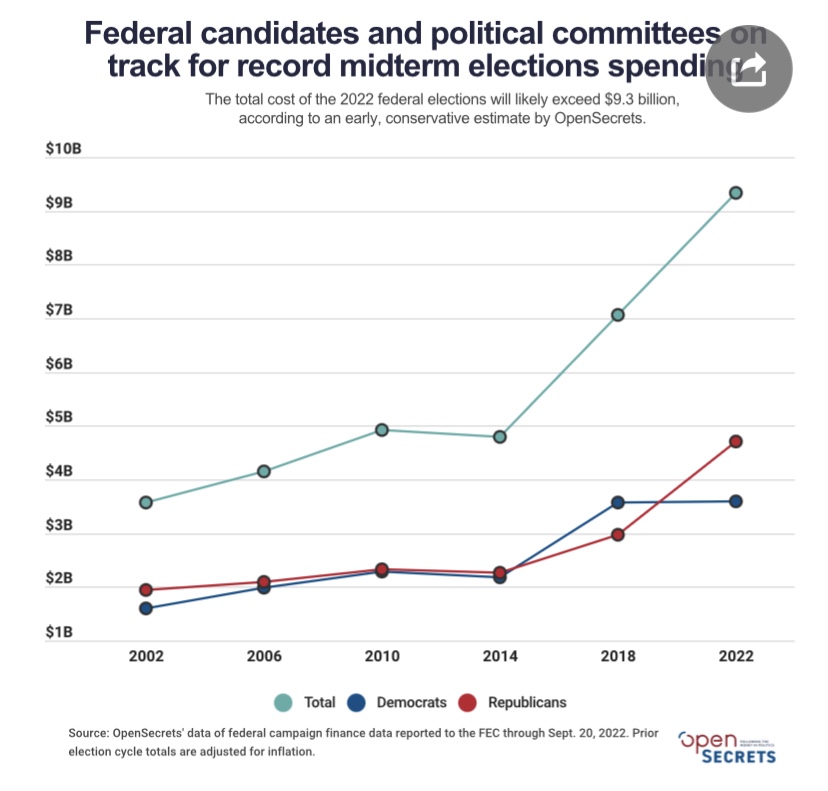
It’s astonishing how much money is donated and spent by political campaigns. This year’s elections saw total campaign spending (all levels) hit $16.7 billion, a record for a mid-term. The recent growth in campaign spending for federal offices has been dramatic, as the chart below shows:

Do you think spending of a few hundred million dollars on a Senate campaign is crazy? Me too, though I don’t advocate for legal limits on campaign spending because, for better or worse, that issue is entangled with free speech rights. Campaigns are zero-sum events, but presumably a big donor thinks a success carries some asymmetric reward…. A success rate of better than 50% across several campaigns probably buys much more…. And donors can throw money at sure political bets that are probably worth a great deal…. Many donors spread their largess across both parties, perhaps as a form of “protection”. But it all seems so distasteful, and it’s surely a source of waste in the aggregate.

My reservations about profligate campaign spending include the fact that it is a symptom of big government. Donors obviously believe they are buying something that government, in one way or another, makes possible for them. The greater the scope of government activity, the more numerous are opportunities for rent seeking — private gains through manipulation of public actors. This is the playground of fascists!

There are people who believe that placing things in the hands of government is an obvious solution to the excesses of “greed”. However, politicians and government employees are every bit as self-interested and “greedy” as actors in the private sector. And they can do much more damage: government actors legally exercise coercive power, they are not subject in any way to external market discipline, and they often lack any form of accountability. They are not compelled to respect consumer sovereignty, and they make correspondingly little contribution to the nation’s productivity and welfare.

Actors in the private sector, on the other hand, face strong incentives to engage in optimizing behavior: they must please customers and strive to improve performance to stay ahead of their competition. That is, unless they are seduced by what power they might have to seek rents through public sector activism.

A people who grant a wide scope of government will always suffer consequences they should expect, but they often proceed in abject ignorance. So here is my rant, a brief rundown on some of the things naive statists should expect to get for their votes. Of course, this is a short list — it could be much longer:

  • Opportunities for graft as bureaucrats administer the spending of others’ money and manipulate economic activity via central planning.
  • A ballooning and increasingly complex tax code seemingly designed to benefit attorneys, the accounting profession, and certainly some taxpayers, but at the expense of most taxpayers.
  • Subsidies granted to producers and technologies that are often either unnecessary or uneconomic (and see here), leading to malinvestment of capital. This is often a consequence of the rent seeking and cronyism that goes hand-in-hand with government dominance and ham-handed central planning.
  • Redistribution of existing wealth, a zero- or even negative-sum activity from an economic perspective, is prioritized over growth.
  • Redistribution beyond a reasonable safety net for those unable to work and without resources is a prescription for unnecessary dependency, and it very often constitutes a surreptitious political buy-off.
  • Budgetary language under which “budget cuts” mean reductions in the growth of spending.
  • Large categories of spending, known in the U.S. as non-discretionary entitlements, that are essentially off limits to lawmakers within the normal budget appropriations process.
  • “Fiscal illusion” is exploited by politicians and statists to hide the cost of government expansion.
  • The strained refrain that too many private activities impose external costs is stretched to the point at which government authorities externalize internalities via coercive taxes, regulation, or legal actions.
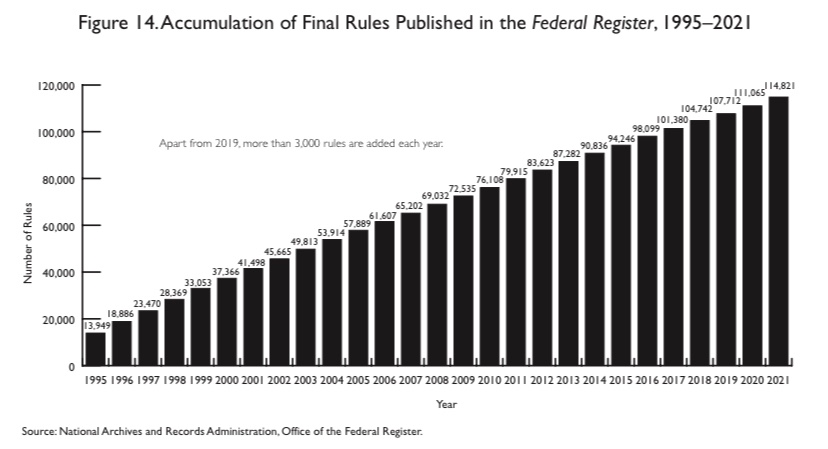
  • Massive growth in regulation (see chart at top) extending to puddles classified as wetlands (EPA), the ”disparate impacts” of private hiring practices (EEOC), carbon footprints of your company and its suppliers (EPA, Fed, SEC), outrageous energy efficiency standards (DOE), and a multiplicity of other intrusions.
  • Growth in the costs of regulatory compliance.
  • A nearly complete lack of responsiveness to market prices, leading to misallocation of resources — waste.
  • Lack of value metrics for government activities to gauge the public’s “willingness to pay”.
  • Monopoly encouraged by regulatory capture and legal / compliance cost barriers to competition. Again, cronyism.
  • Monopoly granted by other mechanisms such as import restrictions and licensure requirements. Again, cronyism.
  • Ruination of key industries as government control takes it’s grip.
  • Shortages induced by price controls.
  • Inflation and diminished buying power stoked by monetized deficits, which is a long tradition in financing excessive government.
  • Malinvestment of private capital created by monetary excess and surplus liquidity.
  • That malinvestment of private capital creates macroeconomic instability. The poorly deployed capital must be written off and/or reallocated to productive uses at great cost.
  • Funding for bizarre activities folded into larger budget appropriations, like holograms of dead comedians, hamster fighting experiments, and an IHOP for a DC neighborhood.
  • A gigantic public sector workforce in whose interest is a large and growing government sector, and who believe that government shutdowns are the end of the world.
  • Attempts to achieve central control of information available to the public, and the quashing of dissent, even in a world with advanced private information technology. See the story of Hunter Biden’s laptop. This extends to control of scientific narratives to ensure support for certain government programs.
  • Central funding brings central pursestrings and control. This phenomenon is evident today in local governance, education, and science. This is another way in which big government fosters dependency.
  • Mission creep as increasing areas of economic activity are redefined as “public” in nature.
  • Law and tax enforcement, security, and investigative agencies pressed into service to defend established government interests and to compromise opposition.

I’ve barely scratched the surface! Many of the items above occur under big government precisely because various factions of the public demand responses to perceived problems or “injustices”, despite the broader harms interventions may bring. The press is partly responsible for this tendency, being largely ignorant and lacking the patience for private solutions and market processes. And obviously, those kinds of demands are a reason government gets big to begin with. In the past, I’ve referred to these knee-jerk demands as “do somethingism”, and politicians are usually too eager to play along. The squeaky wheel gets the oil.

I mentioned cronyism several times in the list. The very existence of broad public administration and spending invites the clamoring of obsequious cronies. They come forward to offer their services, do large and small “favors”, make policy suggestions, contribute to lawmakers, and to offer handsomely remunerative post-government employment opportunities. Of course, certaIn private parties also recognize the potential opportunities for market dominance when regulators come calling. We have here a perversion of the healthy economic incentives normally faced by private actors, and these are dynamics that gives rise to a fascist state.

It’s true, of course, that there are areas in which government action is justified, if not necessary. These include pure public goods such as national defense, as well as public safety, law enforcement, and a legal system for prosecuting crimes and adjudicating disputes. So a certain level of state capacity is a good thing. Nevertheless, as the list suggests, even these traditional roles for government are ripe for unhealthy mission creep and ultimately abuse by cronies.

The overriding issue motivating my voting patterns is the belief in limited government. Both major political parties in the U.S. violate this criterion, or at least carve out exceptions when it suits them. I usually identify the Democrat Party with statism, and there is no question that democrats rely far too heavily on government solutions and intervention in private markets. The GOP, on the other hand, often fails to recognize the statism inherent in it’s own public boondoggles, cronyism, and legislated morality. In the end, the best guide for voting would be a political candidate’s adherence to the constitutional principles of limited government and individual liberty, and whether they seem to understand those principles. Unfortunately, that is often too difficult to discern.

Markets Deal With Scarcity, Left Screams “Price Gouging”

11 Monday Apr 2022

Posted by Nuetzel in Antitrust, Environmental Fascism, Oil Prices

≈ Leave a comment

Tags

Antitrust, Barack Obama, central planning, ESG Scores, FDR, Fossil fuels, Gas Prices, Green New Deal, Intermittancy, Joe Biden, Keystone Pipeline, Lawrence Summers, Oil Prices, Oil Profits, OPEC, Power Grid, Price Gouging, Profit Margins, Profiteering, Renewable energy, Strategic Petroleum Reserve, Ukraine Invasion, Vladimir Putin, West Texas Intermediate

Democrats claim profiteering by oil companies is responsible for the sustained rise in oil prices since Joe Biden’s inauguration (really, his election). That’s among the more laughable attempts at gaslighting in recent memory, right up there with blaming market concentration for the sustained increase in inflation since Biden’s inauguration. At a hearing this week, congressional Democrats, frightened by the prospect of a beat-down just ahead in the mid-term elections, couldn’t resist making “price-gouging” accusations against oil producers. These pols stumble over their own contradictory talking points, insisting on more oil production only when they aren’t hastily sabotaging oil and gas output. Their dishonestly is galling, but so is the foolishness of voters who blindly accept the economic illiteracy issuing from that side of the aisle.

Break It Then Blame It

Those who level “price gouging” charges at oil companies are often the same people seeking to eliminate fossil fuel consumption by making those energy choices unaffordable. The latter is a bad look this close to mid-term elections, so they follow the playbook I described recently in “Break the Market, Blame It, Then Break It Some More“. And this post is instructive: “House Dem: Big Oil is profiteering by, er … doing what we demanded”.

Not only have the Democrats’ policies caused oil prices to soar; for many years they’ve been undermining the stability of the power grid via forced conversion into intermittent renewable energy sources like wind and solar, all while preventing the expansion of safe and carbon-free nuclear power generation. It’s ironic that these would-be industrial planners seem so eager to botch the job, though failure is all too typical of central planning. Just ask the Germans about their own hapless efforts at energy planning.

As economist Lawrence Summers, former Treasury Secretary under Barack Obama, said recently:

“Look, the net effect of the things the administration talks about in terms of micro policies to reduce inflation, this gouging talk is frivolous, nonserious, and utterly ineffectual. A gas price holiday would, ultimately, push up prices by raising demand. … The student loan relief … is injecting resources into the economy at a hundred billion dollar a year annual rate when the economy needs to be cooled off, not heated up. … The administration could be much more constructive than it has been with respect to energy supply.”

The market functions to allocate scarce resources. When conditions of scarcity become more acute, the market mechanism responds by pricing available supplies to both curtail use and incentivize delivery of additional quantities. That involves the processing of vast amounts of information, and it is a balancing at which the market performs extremely well relative to bumbling politicians and central planners, whose actions are too often at the root of acute scarcities.

Antitrust Nonsense

Of course, the Democrats have seized upon the inescapable fact that soaring oil prices cause profits to soar for anyone producing oil or holding stocks of oil. But oil company profits are notoriously volatile. Margins were negative for most of 2020, when demand weakened in the initial stages of the pandemic. And now, some companies are bracing for massive write-downs on abandoned drilling projects in Russia. The oil and gas business is certainly not known for high profit margins. Short-term profits, while they last, must be used to meet the physical or financial needs of the business.

The threats of antitrust action by the Biden Administration are an extension of the price-gouging narrative, even if the threat reflects an injudicious grasp of what it takes to prove collusion. It takes a fertile imagination to think western oil companies could successfully collude on pricing in a market dominated by the following players:

Fat chance. In any case, it’s a global market, and it’s impossible for western oil producers to dictate pricing. Even the OPEC cartel has been unable to dictate prices, not to mention keeping it’s members from violating production quotas. But if a successful conspiracy among oil companies to raise prices was possible, one would guess they’d have done it a lot sooner!

Nor is it possible for the oil majors to dictate prices at the pump, because retail prices are set independently. While the cost of crude oil is only about 54% of the cost of refined gas at retail, fluctuations in prices at the pump correlate strongly with crude oil prices. Here is a ten-year chart of daily price data, where the blue line is the price of West Texas Intermediate crude oil and the orange line is the average price of regular gas in the U.S.:

Here are the same two series for 2022 year-to-date:

Coerced Scarcity

Again, oil prices have been under upward pressure for over a year until a break in early March, following the steep run-up in the immediate wake of the Ukraine invasion. First there was Biden’s stultifying rhetoric, before and after the 2020 election, assisted by radical members of Congress. Then there were executive orders halting drilling on federal lands, killing the Keystone pipeline, efforts to shut down several other existing pipelines, and the imposition of regulatory penalties on drillers. In addition, unrest in certain parts of the Middle East curtailed production, compounded this year by the boycott on Russian oil (which, as a foreign policy matter, was far too late in coming).

However, existing facilities have been capable of squeezing out more oil and gas. Lo and behold, supply curves slope upward, even in the short-run! Despite all of Biden’s efforts to cripple domestic oil production, higher crude prices have brought forth some additional supplies. Biden’s raid on the Strategic Petroleum Reserve has also boosted supply for now, but its magnitude won’t help much, and it must be replaced for use during real U.S. national emergencies, which the war in Ukraine is not, as awful as it is.

That said, investing in new drilling capacity is not wise given the political climate created by Biden and the Democrats: they have been quite clear that they mean to crush the fossil fuel industry. For some time, the oil companies have been busy investing cash flows in “green” initiatives in an effort to bolster their ESG scores, a dubious exercise to say the least. Arguably, in this policy environment, the most responsible thing to do is to return some of the capital over which these firms are stewards to its rightful owners, many of whom are middle-class savers who hold oil stocks in their 401(k) funds. That approach is manifest in the recent stock buybacks and dividend payments oil companies have announced and defended before Congress.

Conclusion

A forced shutdown of fossil fuel energy was much ballyhooed by the Left as a part of Joe Biden’s agenda. Biden himself bought into the “Green New Deal”, imagining it might win him a vaunted place alongside FDR’s legacy in American history. The effort was unwise, but Biden is trying to hang onto the narrative and maintain his punitive measures against American oil companies. All the while, he begs OPEC producers to step up production, bending a knee to despots in countries such as Iran and Venezuela. Why, it’s as if their fossil fuels are somehow cleaner than those extracted in the U.S! The feeble Biden and congressional Democrats are proving just how mendacious they are. They can rightfully blame Vladimir Putin for the recent escalation in oil prices, but they bear much responsibility themselves for the burden of high gas prices, energy bills, and the unnecessary, ongoing scarcity victimizing the American public.

The SEC’s Absurd Climate Overreach

04 Monday Apr 2022

Posted by Nuetzel in Central Planning, Global Warming

≈ 2 Comments

Tags

capital costs, Carbon Emissions, Carbon Forcing Models, carbon Sensitivity, central planning, Corporatism, Disclosure Requirements, ESG Risk, ESG Scores, Green Energy, Greenhouse Gas, Hester Peirce, John Cochrane, Litigation Risk, Paris Agreement, Regulatory Risk, Renewable energy, Scope 1, Scope 2, Scope 3, SEC Climate Mandate, Securities and Exchange Commission

The Securities and Exchange Commission recently issued a proposed rule for reporting on climate change risk, and it is fairly outrageous. It asks that corporations report on their own direct greenhouse gas emissions (GHG – Scope 1), the emissions caused by their purchases of energy inputs (Scope 2), and the emissions caused by their “downstream” customers and “upstream” suppliers (Scope 3). This is another front in the Biden Administration’s efforts to bankrupt producers of fossil fuels and to force the private sector to radically alter its mix of energy inputs. The SEC’s proposed “disclosures” are sheer lunacy on several levels.

The SEC Mandate

If implemented, the rule would allow the SEC to stray well outside the bounds of its regulatory authority. The SEC’s role is not to regulate emissions or the environment. Rather, as its web site makes clear, the agency is charged with:

“… protecting investors, maintaining fair, orderly, and efficient markets, and facilitating capital formation.”

Given this mission, the SEC requires management to disclose material financial risks. Are a firm’s GHG emissions really material risks? The first problem here is quite practical: John Cochrane notes the outrageous costs that would be associated with compliance:

“‘Disclosure’ usually means revealing something you know. A perfectly honest answer to ‘disclose what you know about your carbon emissions’ is, ‘we have no idea what our carbon emissions are.’ Back that up with every document the company has ever produced, and you have perfectly ‘disclosed.’ There is no asymmetric information, fraud, etc.

The SEC has already required the production of new information, and as Hester Peirce makes perfectly clear, the climate rules again make a huge dinner out of that appetizer: essentially telling companies to hire a huge number of climate consultants to generate new information, and also how to run businesses.”

In a separate post, Cochrane quotes SEC Commissioner Hester Peirce’s response to the proposed rule. She emphasizes that companies are already required to disclose all material risks. Perhaps they have properly declined to disclose climate risks because those risks are not material.

“Current SEC disclosure mandates are intended to provide investors with an accurate picture of the company’s present and prospective performance through managers’ own eyes. How are they thinking about the company? What opportunities and risks do the board and managers see? What are the material determinants of the company’s financial value?”

Identifying the Risk Causers

Regardless of the actual risks to a firm caused by climate change, the SEC’s proposed GHG disclosures put a more subtle issue into play. Peirce describes what amounts to a fundamental shift in the SEC’s philosophy regarding the motivation and purpose of disclosure:

The proposal, by contrast, tells corporate managers how regulators, doing the bidding of an array of non-investor stakeholders, expect them to run their companies. It identifies a set of risks and opportunities—some perhaps real, others clearly theoretical—that managers should be considering and even suggests specific ways to mitigate those risks. It forces investors to view companies through the eyes of a vocal set of stakeholders, for whom a company’s climate reputation is of equal or greater importance than a company’s financial performance.”

In other words, a major risk faced by these firms has nothing to do with climate change itself, but with perceptions of “climate-related” risks by other parties. That transforms the question of climate risk into something that is, in fact, regulatory and political. Is this the true nature of the SEC’s concern, all dressed up in the scientism typically relied upon by climate change activists?

The reaction of government bureaucrats to the risks they perceive is a palpable threat to investor well-being. For example, GHG emissions might lead to future regulatory sanctions from various government agencies, including fines, taxes, various sanctions, and mitigation mandates. In addition, with the growth of investment management based on what are essentially shambolic and ad hoc ESG scores, GHG or carbon emissions might lead to constraints on a firm’s access to capital. Just ask the oil and gas industry! That penalty is imposed by activist investors and fund managers who wish to force an unwise and premature end to the use of fossil fuels. There is also a threat that GHG disclosures themselves, based (as they will be) on flimsy estimates, could create litigation risk for many companies.

Much Ado About Nothing

While there are major regulatory and political risks to investors, let’s ask, for the sake of argument: how would one degree celcius of warming by the end of this century affect corporate results? Generally not at all. (The bounds described in the Paris Agreement are 1.5 to 2 degrees, but these are based on unrealistic scenarios — see links below.) It would happen gradually in any case, with ample opportunity to adapt to the operating environment. To think otherwise requires great leaps of imagination. For example, climate alarmists probably fancy that violent weather or wildfires will wipe out facilities, yet there is no reliable evidence that the mild warming experienced to-date has been associated with more violent weather or an increased incidence of wildfires (and see here). There are a great many “sacred cows” worshiped by climate-change neurotics, and the SEC undoubtedly harbors many of those shibboleths.

What probabilities can be attached to each incremental degree of warming that might occur over several decades. The evidence we’ve seen comes from so-called carbon-forcing models parameterized for unrealistically high carbon sensitivities and subjected to unrealistic carbon-concentration scenarios. Estimates of these probabilities are not reliable.

Furthermore, climate change risks, even if they could be measured reliably in the aggregate, cannot reasonably be allocated to individual firms. The magnitude of the firm’s own contribution to that risk is equivalent to the marginal reduction in risk if the firm implemented a realistic zero-carbon operating rule. For virtually any firm, we’re talking about something infinitesimal. It involves tremendous guesswork given that various parties around the globe take a flexible approach to emissions, and will continue to do so. The very suggestion of such an exercise is an act of hubris.

Back To The SEC’s Mandated Role

Let’s return to the practical problems associated with these kinds of disclosure requirements. Cochrane also points out that the onerous nature of the SEC proposal, and the regulatory and political threats it embodies, will hasten the transition away from public ownership in many industries.

“The fixed costs alone are huge. The trend to going private and abandoning public markets, at least in the U.S. will continue. The trend to large oligopolized politically compliant static businesses in the U.S. will continue.

I would bet these rules wind up in court, and that these are important issues. They should be.”

Unfortunately, private companies will still have to to deal with certain investors who would shackle their use of energy inputs and demand forms of diligence (… not to say “due”) of their own.

The SEC’s proposed climate risk disclosures are stunningly authoritarian, and they are designed to coalesce with other demands by the regulatory state to kill carbon-based energy and promote renewables. These alternative energy sources are, as yet, unable to offer an economical and stable supply of power. The fraudulent nature of the alleged risks make this all the more appalling. The SEC has effectively undertaken an effort to engage in corporatist industrial policy benefitting a certain class of “green” energy investors, exposing the proposal as yet another step on the road to fascism. Let’s hope Cochrane is right: already, 16 state attorneys general are preparing a legal challenge. May the courts ultimately see through the SEC’s sham!

← Older posts
Follow Sacred Cow Chips on WordPress.com

Recent Posts

  • Immigration and Merit As Fiscal Propositions
  • Tariff “Dividend” From An Indigent State
  • Almost Looks Like the Fed Has a 3% Inflation Target
  • Government Malpractice Breeds Health Care Havoc
  • A Tax On Imports Takes a Toll on Exports

Archives

  • December 2025
  • November 2025
  • October 2025
  • September 2025
  • August 2025
  • July 2025
  • June 2025
  • May 2025
  • April 2025
  • March 2025
  • February 2025
  • January 2025
  • December 2024
  • November 2024
  • October 2024
  • September 2024
  • August 2024
  • July 2024
  • June 2024
  • May 2024
  • April 2024
  • March 2024
  • February 2024
  • January 2024
  • December 2023
  • November 2023
  • August 2023
  • July 2023
  • June 2023
  • May 2023
  • April 2023
  • March 2023
  • February 2023
  • January 2023
  • December 2022
  • November 2022
  • October 2022
  • September 2022
  • August 2022
  • July 2022
  • June 2022
  • May 2022
  • April 2022
  • March 2022
  • February 2022
  • January 2022
  • December 2021
  • November 2021
  • October 2021
  • September 2021
  • August 2021
  • July 2021
  • June 2021
  • May 2021
  • April 2021
  • March 2021
  • February 2021
  • January 2021
  • December 2020
  • November 2020
  • October 2020
  • September 2020
  • August 2020
  • July 2020
  • June 2020
  • May 2020
  • April 2020
  • March 2020
  • February 2020
  • January 2020
  • December 2019
  • November 2019
  • October 2019
  • September 2019
  • August 2019
  • July 2019
  • June 2019
  • May 2019
  • April 2019
  • March 2019
  • February 2019
  • January 2019
  • December 2018
  • November 2018
  • October 2018
  • September 2018
  • August 2018
  • July 2018
  • June 2018
  • May 2018
  • April 2018
  • March 2018
  • February 2018
  • January 2018
  • December 2017
  • November 2017
  • October 2017
  • September 2017
  • August 2017
  • July 2017
  • June 2017
  • May 2017
  • April 2017
  • March 2017
  • February 2017
  • January 2017
  • December 2016
  • November 2016
  • October 2016
  • September 2016
  • August 2016
  • July 2016
  • June 2016
  • May 2016
  • April 2016
  • March 2016
  • February 2016
  • January 2016
  • December 2015
  • November 2015
  • October 2015
  • September 2015
  • August 2015
  • July 2015
  • June 2015
  • May 2015
  • April 2015
  • March 2015
  • February 2015
  • January 2015
  • December 2014
  • November 2014
  • October 2014
  • September 2014
  • August 2014
  • July 2014
  • June 2014
  • May 2014
  • April 2014
  • March 2014

Blogs I Follow

  • Passive Income Kickstart
  • OnlyFinance.net
  • TLC Cholesterol
  • Nintil
  • kendunning.net
  • DCWhispers.com
  • Hoong-Wai in the UK
  • Marginal REVOLUTION
  • Stlouis
  • Watts Up With That?
  • Aussie Nationalist Blog
  • American Elephants
  • The View from Alexandria
  • The Gymnasium
  • A Force for Good
  • Notes On Liberty
  • troymo
  • SUNDAY BLOG Stephanie Sievers
  • Miss Lou Acquiring Lore
  • Your Well Wisher Program
  • Objectivism In Depth
  • RobotEnomics
  • Orderstatistic
  • Paradigm Library
  • Scattered Showers and Quicksand

Blog at WordPress.com.

Passive Income Kickstart

OnlyFinance.net

TLC Cholesterol

Nintil

To estimate, compare, distinguish, discuss, and trace to its principal sources everything

kendunning.net

The Future is Ours to Create

DCWhispers.com

Hoong-Wai in the UK

A Commonwealth immigrant's perspective on the UK's public arena.

Marginal REVOLUTION

Small Steps Toward A Much Better World

Stlouis

Watts Up With That?

The world's most viewed site on global warming and climate change

Aussie Nationalist Blog

Commentary from a Paleoconservative and Nationalist perspective

American Elephants

Defending Life, Liberty and the Pursuit of Happiness

The View from Alexandria

In advanced civilizations the period loosely called Alexandrian is usually associated with flexible morals, perfunctory religion, populist standards and cosmopolitan tastes, feminism, exotic cults, and the rapid turnover of high and low fads---in short, a falling away (which is all that decadence means) from the strictness of traditional rules, embodied in character and inforced from within. -- Jacques Barzun

The Gymnasium

A place for reason, politics, economics, and faith steeped in the classical liberal tradition

A Force for Good

How economics, morality, and markets combine

Notes On Liberty

Spontaneous thoughts on a humble creed

troymo

SUNDAY BLOG Stephanie Sievers

Escaping the everyday life with photographs from my travels

Miss Lou Acquiring Lore

Gallery of Life...

Your Well Wisher Program

Attempt to solve commonly known problems…

Objectivism In Depth

Exploring Ayn Rand's revolutionary philosophy.

RobotEnomics

(A)n (I)ntelligent Future

Orderstatistic

Economics, chess and anything else on my mind.

Paradigm Library

OODA Looping

Scattered Showers and Quicksand

Musings on science, investing, finance, economics, politics, and probably fly fishing.

  • Subscribe Subscribed
    • Sacred Cow Chips
    • Join 128 other subscribers
    • Already have a WordPress.com account? Log in now.
    • Sacred Cow Chips
    • Subscribe Subscribed
    • Sign up
    • Log in
    • Report this content
    • View site in Reader
    • Manage subscriptions
    • Collapse this bar
 

Loading Comments...