• About

Sacred Cow Chips

Sacred Cow Chips

Tag Archives: Donald Trump

Trump Hates/Loves Lockdowns, Dumps on Swedes

07 Sunday Jun 2020

Posted by Nuetzel in Health Care, Pandemic

≈ Leave a comment

Tags

Cholesterol, Coronavirus, Donald Trump, Herd Immunity, Institute for Health Metrics and Evaluation, Lockdowns, Nordic, Rose Garden Briefing, Somali Immigration, Sweden, Vitamin D

President Trump was in a festive mood last Friday, pleased with the May employment report, as he should be. But in his Rose Garden word jam, he made some questionable and unnecessary claims about coronavirus policies in the U.S. and the Swedish experience. I credit Trump for pushing to end the lockdowns as it became clear that they were both unhealthy and unsustainable. However, he’s now way too eager to cover his earlier tracks. That is, he is now defensive about the precautions he advocated on the advice of his medical experts in March and early April.

In the Rose Garden, Trump said that lockdowns were necessary to stop the spread of the virus. But to assert that lockdowns “stopped” or even slowed the spread of the virus is speculation at best, and they had deadly effects of their own. Most of the social distancing was achieved through voluntary action, as I have argued previously. Lockdown advocacy lacked any semblance of geographic nuance, as if uniform application makes sense regardless of population density.

Trump went on to say that Sweden was in “bad shape” because it did not impose a lockdown during the pandemic. This is not a new position for the president, but the facts are anything but clear-cut. Again, there is mixed evidence on whether mandatory lockdowns have a real impact on the spread or mortality of the coronavirus (also see here). That’s not to say that social distancing doesn’t work, but much of the benefit comes from private decisions to mitigate risk via distancing. Of course, that also depends on whether people have good information to act on. And to be fair, Sweden did take certain measures such as banning gatherings of more than 50 people, closing schools, and limiting incoming travel.

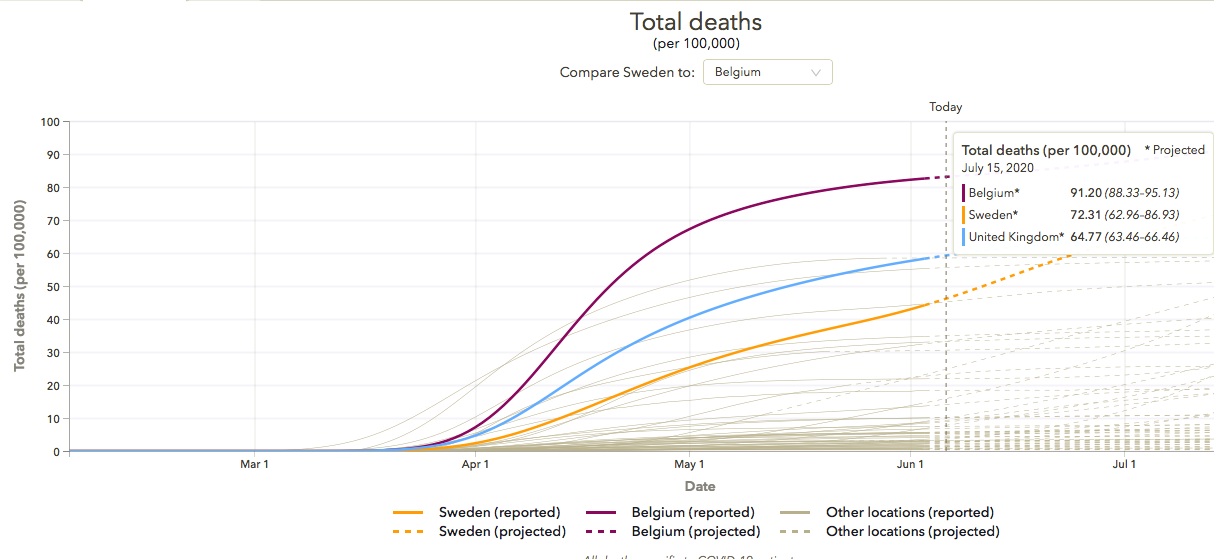
While the full tale has not been told, and Sweden’s death rate is high on a per capita basis, several other Western European countries that imposed lockdowns have had even higher death rates. The following chart is from the Institute for Health Metrics and Evaluation (IMHE). It is expressed in terms of coronavirus deaths per 100,000 of population. The orange line is Sweden, the purple line is Belgium, and the light blue line is the UK. Actuals are reported through June 4th. While Sweden’s death toll has a somewhat steeper gradient, the level remains well below both Belgium and the UK. It is also lower than the death rates for Italy and Spain, and it is about the same as France’s death rate. Yes, a number of other countries have lower death rates, including the U.S., but the evidence is hardly consistent with Trump’s characterization.

Sweden’s big mistake was not it’s decision to rely on voluntary social distancing, but in failing to adequately protect highly vulnerable populations. The country’s elderly skew older than most countries by several years. Residents of nursing homes have accounted for about half of Sweden’s coronavirus deaths, an international outlier. Inadequate preparedness in elder care has been a particular problem, including a lack of personal protective equipment for workers. There was also a poorly implemented volunteer program, intended to fill-out staffing needs, that appears to have aggravated transmission of the virus.

Sweden has also experienced a concentration of cases and deaths among its large immigrant population. It has the largest immigrant population among the Nordic countries, with large numbers of low income migrants from Syria, Iraq, Iran, Somalia and parts of Eastern Europe. Earlier in the pandemic, according to one estimate, 40% of coronavirus fatalities in Stockholm were in the Somali population. These immigrants tend to live in dense conditions, often in multigenerational households. Many residents with health problems tend to go untreated. Conditions like Vitamin D deficiency and high cholesterol, apparent risk factors for coronavirus severity, likely go untreated in these communities. In addition, language barriers and traditional trust relationships may diminish the effectiveness of communications from public health authorities. In fact, some say the style of Swedish public health messaging was too culturally idiosyncratic to be of much use to immigrants. And one more thing: immigrants are a disproportionately high 28% of nursing home staff in Sweden, implying an intimacy between two vulnerable populations that almost surely acts as a risk multiplier in both.

It might be too harsh to suggest that that Sweden could have prevented the outsized impact of the virus on immigrants. However, Sweden’s coronavirus testing has not been as intensive as other Nordic countries. More testing might have helped alleviate the spread of the virus in nursing homes and in immigrant communities. But the vulnerabilities of the immigrant population might be more a matter of inadequate health care than anything else, both on the demand and supply sides.

Contrary to Trump’s characterization, Sweden’s herd immunity strategy is not the reason for it’s relatively high death rate from the virus. Several countries that imposed lockdowns have had higher death rates. And Sweden’s death rate has been heavily concentrated among the aged in nursing homes and its large immigrant population. It’s possible that Sweden’s approach led to a cavalier attitude with respect identifying vulnerable groups and taking measures that could have protected them, including more intensive testing. Nevertheless, it’s inaccurate and unfair to scapegoat Sweden for not imposing a mandatory lockdown. The choice is not merely whether to impose lockdowns, but how to protect vulnerable populations at least cost. In that sense, general lockdowns are a poor choice.


Rioters Inflict Racial Injustice

02 Tuesday Jun 2020

Posted by Nuetzel in Free Speech, racism, Terrorism

≈ Leave a comment

Tags

Antifa, Black Lives Matter, Coronavirus, Covid-19, Criminal Justice Reform, Derrick Chauvin, Donald Trump, Equity Markets, George Floyd, Glenn Reynolds, Jane Coaston, National Guard, Police Unions, Qualified Immunity, racism, War on Drugs, Will Collier, Willie Delwiche

My fervent hope is that the reaction of horror to George Floyd’s murder is universal. However, my perspective on the violence that’s erupted over the week since is also one of disgust. The perpetrators are using Floyd’s death as an opportunity to unleash attacks that undermine civil society and often hurt people of color more than anyone.

The peaceful protests against police brutality and racism in cities across the country are earnest calls for reform, and they also represent fine tributes to all victims of racism. But a different dynamic takes hold when peaceful protesters are infiltrated by violent elements. Agitators use the cover of the protests and typically begin to dominate the scene as darkness falls, though sometimes it happens in broad daylight. The violence, arson, looting, and shooting are perpetrated by a combination of those whose political motivations go well beyond needed reforms to the justice system and other opportunists who are primarily interested in loot, or just a riotous a good time. There are also some otherwise non-violent protesters emboldened by the agitators to cheer on these acts of violence.

As others have said, the rioting does not serve to honor George Floyd in any way, and it does nothing to end racism or racial victimization. By cheering on these malefactors you lose any legitimate claim as an enemy of racism. The rioting, if anything, brings harm to the black community. Black lives are lost in the strife, such as the retired police captain in St. Louis who was shot Monday night defending his friend’s pawn shop. Blacks are also losing their livelihoods as a consequence of the destruction.

The left-wing, anarchist agitators are modern blackshirts masquerading as anti-fascists. Their interest, and delusion, is the violent overthrow of our government. They are largely white millennials, mostly male, and largely unemployed as a result of the ill-advised coronavirus lockdowns imposed in many states. Antifa has been prominent in these attacks, often running under Black Lives Matter flags, and the radical wing of BLM participates as well.

These pigs have been coddled by leftist state and local government officials in many cities, who send outmanned police forces to try to keep the damage in check while releasing those arrested the next day. President Trump was absolutely right on Monday to call out the national guard and raise the possibility of deploying military forces where state and local officials are incapable or unwilling to bring these situations under control.

And here’s the thing: all it takes is a few agitators, along with their enthusiastic but less ideological recruits, to destroy communities. There have been larger numbers in big cities, perhaps a few thousand hard-core shit disturbers. Slowly but surely, perhaps due to Trump’s prodding, state and local politicians are awakening and enabling law enforcement to effectively quell the unrest. The agitators, who are fairly well organized, are being infiltrated by moles who will undermine their operations and perhaps aid in prosecuting higher-level organizers and funders at the federal level. In the end, the force of anarchists is fairly small and the local support they manage to stir is fleeting.

While we recoil at the harm inflicted by the riots, another perspective is offered by the equity markets, which have been relatively unfazed through the turmoil. The values of firms in the security business have risen, but otherwise, as one investment strategist says:

“‘Right now it’s limited enough that it’s not perceived as having a meaningful economic impact,’ said Willie Delwiche, investment strategist at Baird. ‘The risk to the market right now is excessive optimism,’ and headlines from protests could simply be dampening that optimism a bit, he added.”

The riots are destructive of lives and economic value, and while we mourn those caught up in these tragedies, the situation does not portend a total social collapse. The overall impact on the U.S. economy expected by markets is not of a magnitude suggesting great instability. This too shall pass, though not easily for the small businesses and employees being ruined by the double jolt of lockdowns and riots.

Besides the outright harm to the black community by the riots, there are other disturbing elements that must be confronted. I keep hearing “White silence = violence”. No, “white silence” is neither responsible for the actions of George Floyd’s killer nor the riots in the streets. What must one say to avoid personal responsibility for the aberrant behavior of Derrick Chauvin and the rioters? What I hear are ignorant excuses and accusations: the violence is inexcusable and it is no one’s fault but the participants, whatever their circumstances.

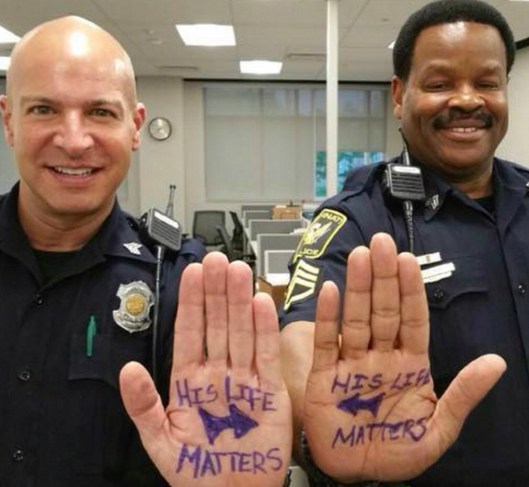
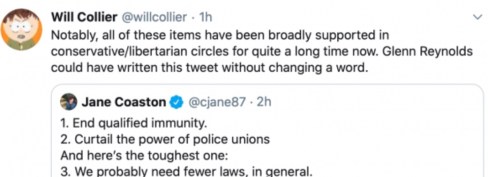
People of good faith oppose the brutality inflicted by bad cops and a system that tolerates them. It is surely time for some reforms, as the following suggests:

And there are still other promising criminal justice reforms to consider. We need to end the drug war, which is particularly harmful to minority communities.

I bemoan the poor circumstances and education that have burdened many of the disaffected protesters, and even the rioters. I advocate for policies that I believe promote improved education and family stability. I have advocated for a safety net. I have shared my distaste for the unnecessary COVID-19 lockdowns that forced so many of these individuals out of their jobs for several months. But from some quarters, the demands have no end. Not until I bow down on my hands and knees to apologize for the sins of generations past. Who cares if they weren’t my ancestors? I’m white! The next demand is reparation payments to today’s generations of blacks. Don’t complain that impoverished whites won’t share in the gains, though there are more than twice as many of them. They simply failed to capitalize on the opportunity afforded by their privilege. I’m sorry for the sarcasm….

Please mourn George Floyd’s horrible death and support the protests against the brutality that killed him, but do not pretend for a moment that the violence is in any way justified, or that it will create a healthier society. Don’t root for that shit. And don’t cast aspirations at your fellow men and women as if the color of their skin is responsible for the social ills you’ve taken up as a cause. It does nothing to further solutions.

Trump and Coronavirus

26 Tuesday May 2020

Posted by Nuetzel in Pandemic, Public Health, Risk Management, Stimulus, Trump Administration

≈ 1 Comment

Tags

Andrew Cuomo, Anthony Fauci, Bill De Blasio, CARES Act, CDC, Coronavirus, Deborah Birx, DHS, Disinfectant, Donald Trump, Elective Surgeries, FDA, Federalism, FEMA, Fiscal policy, Hydroxychloraquine, International Travel, Javits Center, John Bolton, John Cochrane, Laboratory Federalism, Lancet, Liability Waivers, Lockdowns, Michael Pence, Mike Pompeo, N95 Mask, NSC, Paycheck Protection Program, PPE, Robert Redfield, State Department, Testing, Unfunded Pensions, UV Light, Vaccines, Ventilators, WHO, Wuhan, Zinc

It’s a bit early to fully evaluate President Trump’s performance in dealing with the coronavirus pandemic, but there are a number of criteria on which I might assign marks. I’ll address some of those below, but in so doing I’m reminded of Jerry Garcia’s quip that he was “shopping around for something no one will like.” That might be how this goes. Of course, many of the sub-topics are worthy of lengthier treatment. The focus here is on the pandemic and not more general aspects of his performance in office, though there is some unavoidable overlap.

General “Readiness”

Many have criticized the Trump Administration for not being “ready” for a pandemic. I assign no grade on that basis because absolutely no one was ready, at least not in the West, so there is no sound premise for judgement. I also view the very general charge that Trump did not provide “leadership” as code for either “I don’t like him”, or “he refused to impose more authoritarian measures”, like a full-scale nationwide lockdown. Such is the over-prescriptive instinct of the Left.

Equally misleading is the allegation that Trump had “disbanded” the White House pandemic response team, and I have addressed that here. First, while the NSC would play a coordinating role, pandemic response is supposed to be the CDC’s job, when it isn’t too busy with diseases of social injustice to get it done. Second, it was John Bolton who executed a reorganization at the NSC. There were two high profile departures from the team in question at the time, and one one was a resignation. Most of the team’s staff remained with the NSC with the same duties as before the reirganization.

Finally, there was the matter of a distracting impeachment on false charges. This effort lasted through the first three years of Trump’s administration, finally culminating in January 2020. Perhaps the Administration would have had more time to focus on what was happening in China without the histrionics from the opposition party. So whatever else I might say below, these factors weigh toward leniency in my appraisal of Trump’s handing of the virus.

Messaging: C

As usual, Trump’s messaging during the pandemic was often boorish and inarticulate. His appearances at coronavirus briefings were no exception, often cringeworthy and sometimes featuring misinterpretations of what his team of experts was saying. He was inconsistent in signaling optimism and pessimism, as were many others such as New York Governor Andrew Cuomo and New York City Mayor Bill De Blasio. It shifted from “the virus is about like the flu” in February to a more sober assessment by mid-March. This was, however, quite consistent with the messaging from Dr. Anthony Fauci over the same time frame, as well as the World Health Organization (WHO). Again, no one really knew what to expect, so it’s understandable. A great deal of that can be ascribed to “the fog of war”.

Delegation and Deference: B

Trump cannot be accused of ignoring expert advice through the episode. He was obviously on-board with Fauci, Dr. Deborah Birx, Dr. Robert Redfield, and other health care advisors on the “15 Days to Slow the Spread” guidelines issued on March 16. His messaging wavered during those 15 days, expressing a desire to fully reopen the nation by Easter, which Vice President Michael Pence later described as “aspirational”. Before the end of March, however, Trump went along with a 30-day extension of the guidelines. Finally, by mid-April, the White House released guidelines for “Opening Up America Again“, which was a collaboration between Trump’s health care experts and the economic team. Trump agreed that the timeline for reopening should be governed by “the data”. There is no question, however, that Trump was chomping at the bit for reopening at several stages of this process. I see value in that positioning, as it conveys an intent to reopen asap and that people should have confidence in progress toward that goal.  

International Travel Bans: A

If anyone wonders why the world was so thoroughly blindsided by the coronavirus, look no further than China’s failure to deliver a proper warning as 2019 drew to a close. Wuhan, China was ground zero; the virus spread to the rest of the world with travelers out of Wuhan and other Chinese cities. The White House announced severe restrictions on flights from China on January 31, including a two-week quarantine for returning U.S. citizens. In retrospect, it wasn’t a minute too soon, yet for that precaution, Trump was attacked as a racist by the Left. In early February, WHO actually said travel bans were unnecessary, among other missteps. Other bans were instituted on entry from Iran and Brazil, as well as entry from Europe in early March, as countries around the globe closed their borders. Trump’s actions on incoming travelers were prescient, so I’ll score this one for Trump. Some of these travel restrictions can and should be eased now, and certainly that is expected in coming months, so we’ll see how well that process is managed.

Deference to States: A-

As a federalist, I was pleased that Trump and his team left most of the specifics on closures and bans on public gatherings up to state and local governments. That allowed more targeted mitigation efforts as dictated by local conditions and, to some extent, public opinion. This is a classic case of “laboratory federalism” whereby the most effective policies can be identified, though as we’ve seen, there’s no guarantee less successful states will emulate them. I grade Trump well on this one.

On reopening, too, Trump has been a consistent advocate of allowing flexility where local conditions permit, though he wrongly claimed he had “total authority” over ending social distancing rules. It’s hard to square that remark with his general stand on the issue of autonomy except as a tactic to strong-arm certain governors on other points.   

CDC/FDA Snafus: D

I applaud the Administration for its emphasis on the salutary effects of deregulation, but Trump went along with some major pieces of “expert advice” that were not only poor from regulatory perspective, but an affront to federalism. One was a directive issued by the CDC to delay “all elective surgeries, non-essential medical, surgical, and dental procedures during the 2019 Novel Coronavirus (COVID-19) outbreak“. (See my post “Suspending Medical Care in the Name of Public Health“.)

This is exactly the kind of “one size fits all” regulatory policy that has proven so costly, sacrificing not just economic activity but lives and care for the sick, creating avoidable illnesses and complications. The idea was to assure that adequate health care resources were available to treat an onslaught of coronavirus patients, but that was unneeded in most jurisdictions. And while the contagion was in it’s early “exponential” phase at the time, a more nuanced approach could have been adopted to allow different geographic areas and facilities more discretion, especially for different kinds of patients, or perhaps something less than a complete suspension of care. In any case, the extensions into May were excessive. I must grade Trump poorly for allowing this to happen, despite what must have been extreme pressure to follow “expert advice” on the point and the others discussed earlier.

That’s not the only point on which I blame Trump for caving to the CDC. In a case of massive regulatory failure, the CDC and FDA put the U.S. well over a month behind on testing when the first signs of the virus appeared here. Not only did they prohibit private labs and universities from getting testing underway, insisting on exclusive use of the CDC’s own tests, they also distributed faulty tests in early February that took over a month to replace. The FDA also enforced barriers to imported N95-type masks during the pandemic. Trump tends to have a visceral understanding of the calcifying dangers of regulation, but he let the so-called “experts” call the shots here. Big mistake, and Trump shares the blame with these agencies.  

Health Resources: B-

Managing the emergency distribution of PPE and ventilators to states did not go as smoothly as might have been hoped. The shortage itself left FEMA with the unenviable task of allocating quantities that could never satisfy all demands. A few states were thought to have especially acute needs, but there was also an obligation to hold stockpiles against potential requests from other states. In fact, a situation of this kind creates an incentive for states to overstate their real needs, and there are indications that such was the case. Trump sparred with a few governors over these allocations. There is certainly blame to be shared, but I won’t grade Trump down for this.

Vaccines and Treatments: C+


The push to develop vaccines might not achieve success soon, if ever, but a huge effort is underway. Trump gets some of the credit for that, as well as the investment in capacity now to produce future vaccine candidates in large quantities. As for treatments, he was very excited about the promise of hydroxychloraquine, going so far as to take it himself with zinc, a combination for which no fully randomized trial results have been reported (the recent study appearing in the Lancet on HCQ taken by itself has been called into question). Trump also committed an unfortunate gaffe when the DHS announced the results of a study showing that sunlight kills coronavirus in a matter of minutes, as do bleach and other disinfectants. Trump mused that perhaps sunlight or some form of disinfectant could be used as a treatment for coronavirus patients. He might have been thinking about an old and controversial practice whereby blood is exposed to UV light and then returned to the body. Later, he said he used the term “disinfectant” sarcastically, but he probably meant to say “euphemistically” …. I’m not sure he knows the difference. In any case, his habit of speculating on such matters is often unhelpful, and he loses points for that.

Fiscal Policy: B

The several phases of the economic stimulus program were a collaboration between the Trump Administration and Congress. A reasonably good summary appears here. The major parts were the $2.3 trillion CARES Act in late March and a nearly $500 billion supplemental package in late April. These packages were unprecedented in size. Major provisions were direct cash payments and the Paycheck Protection Program (PPP), which provides loans and grants to small businesses. The execution of both was a bit clunky, especially PPP, which placed a burden on private banks to extend the loans but was sketchy in terms of qualifications. The extension of unemployment compensation left some workers with more benefits than they earned in their former jobs, which could be an impediment to reopening. There were a number of other reasonable measures in these packages and the two smaller bills that preceded them in March. A number of these measures were well-targeted and inventive, such as waiving early withdrawal penalties from IRA and 401(k) balances. The Trump Administration deserves credit for helping to shape these efforts as well as others taken independently by the executive branch. 

Trump’s proposal to suspend payroll taxes did not fly, at least not yet. The idea is to reduce the cost of hiring and increase the return to work, if only temporarily. This is not a particularly appealing idea because so much of the benefits would flow to those who haven’t lost their jobs. It could be improved if targeted at new hires and rehires, however.

Trump’s proposal to grant liability waivers to reopened private businesses is extremely contentious, but one I support. Lockdowns are being eased under the weight of often heavy public and private regulation of conduct. As John Cochrane says in “Get Ready for the Careful Economy“: 

“One worry on regulation is that it will provide a recipe for a wave of lawsuits. That may have been a reason the Administration tried to hold back CDC guidance. A long, expensive, and impractical list of things you must do to reopen is catnip when someone gets sick and wants to blame a business. Show us the records that you wiped down the bathrooms every half hour. A legal system that can sue over talcum powder is not above this.”

Indeed, potential liability might represent a staggering cost to many businesses, one that might not be insurable. Accusations of negligence, true or false, can carry significant legal costs. Customers and employees, not just businesses, must accept some of the burden of risks of doing business. I give Trump good marks for this one, but we’ll see if it goes anywhere.

Some of the proposals for new stimulus legislation from democrats are much worse, including diversity initiatives, massive subsidies for “green” technologies, and bailouts for state and local government for unfunded pension liabilities. None of these has anything to do with the virus. The burden of pension shortfalls in some states should not fall on taxpayers nationwide, but on the states that incurred them. The Trump Administration and congressional Republicans should continue resisting these opportunistic proposals.

The Grade

Without assigning weights to the sub-topics covered above, I’d put the overall grade for Trump and his Administration’s handling of matters during the pandemic at about a B-, thus far. When it comes to politics, it’s often unfair to credit or blame one side for the promulgation of an overall set of policies. Nevertheless, I think it’s fair to say that Trump, could have done much better and could have done much worse. We will learn more with the passage of time, the continued evolution of the virus, the development of treatments or vaccines, and the course of the economy.



Private Social Distancing, Private Reversal

04 Monday May 2020

Posted by Nuetzel in Liberty, Pandemic, Uncategorized

≈ 1 Comment

Tags

Andrew Cuomo, Anthony Fauci, Apple Mobility, Bill De Blasio, Centre for Economic Policy Research, Donald Trump, Externalities, Forbes, Foursquare, Heterogeneity, John Koetsier, Laissez Faire, Lockdowns, Nancy Pelosi, Points of Interest, Private Governance, Safegraph, Social Distancing, Social Welfare, Stay-at-Home Orders, Vitamin D, Wal Mart, WHO

My original post on the dominance of voluntary social distancing over the mandated variety appears below. That dominance is qualified by the greater difficulty of engaging in certain activities when they are outlawed by government, or when the natural locations of activities are declared off-limits. Nevertheless, as with almost all regulation, people make certain “adjustments” to suit themselves (sometimes involving kickbacks to authorities, because regulation does nothing so well as creating opportunities for graft). Those “adjustments” often lead to much less desirable outcomes than the original, unregulated state. In the case of a pandemic, however, it’s tempting to view such unavoidable actions as a matter of compromise.

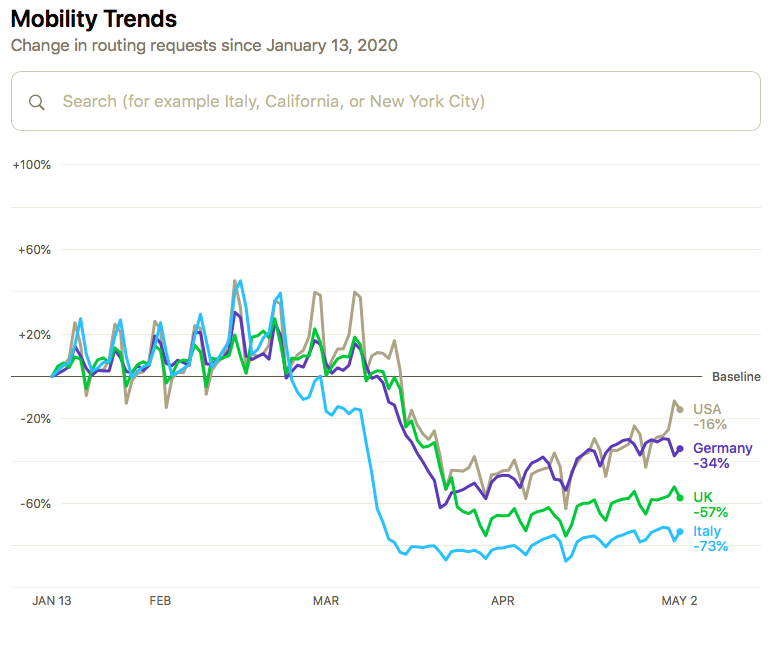
I say this now because the voluntary social distancing preceding most government lockdown orders in March (discussed in the post below) is subject to a degree of self-reversal. Apple Mobility Data suggests that something like that was happening throughout much of April, as shown in the chart at the top of this post. Now, in early May, the trend is likely to continue as some of the government lockdown mandates are being lifted, or at least loosened.

An earlier version of the chart above appeared in a Forbes article entitled, “Apple Data Shows Shelter-In-Place Is Ending, Whether Governments Want It To Or Not“. The author, John Koetsier, noted the Apple data are taken from map searches, so they may not be reliable indicators of actual movement. But he also featured some charts from Foursquare, which showed actual visits to various kinds of destinations, and some of theoe demonstrate the upward trend in activity.

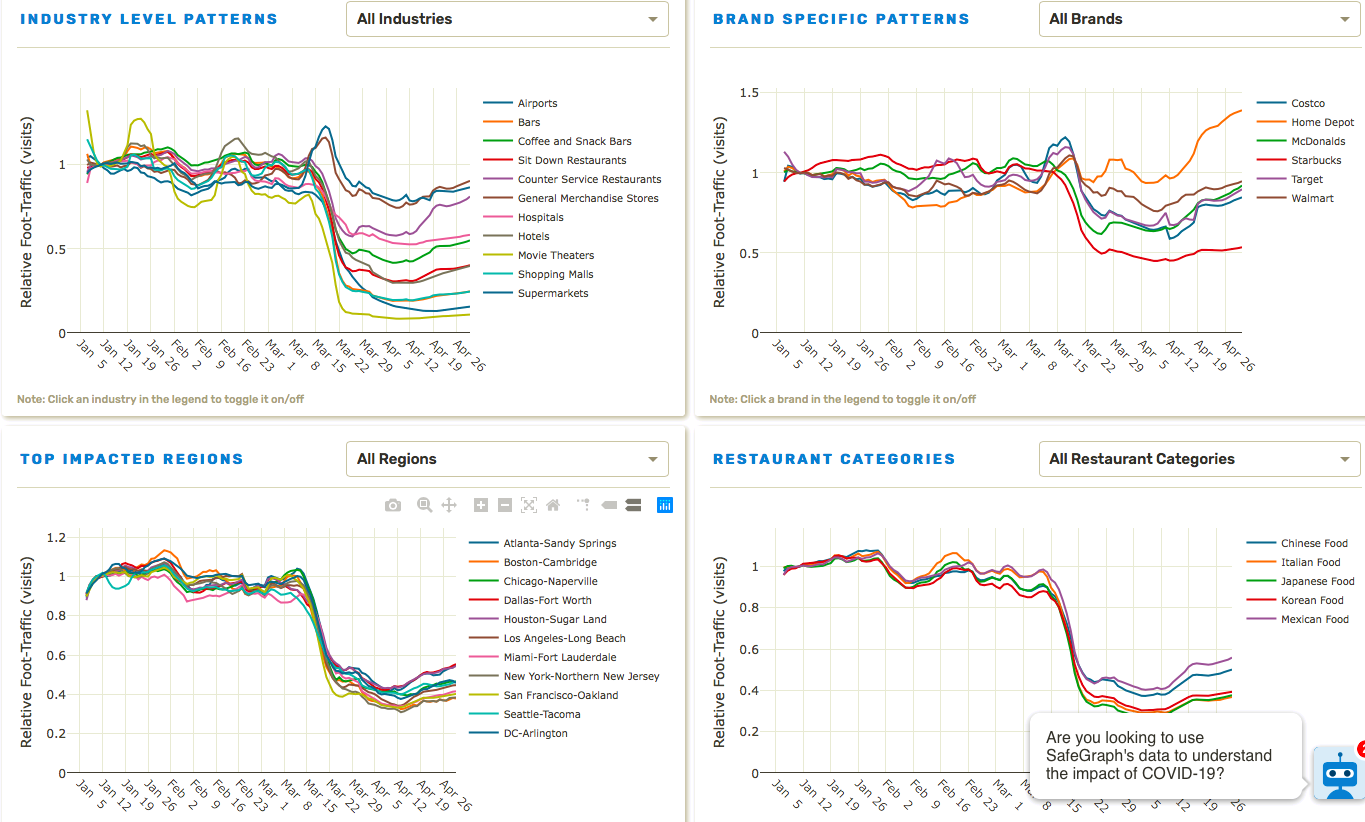
In the original post below, I used SafeGraph charts lifted from a paper I described there. The four charts below are available on the SafeGraph website, which offered the services of the friendly little robot in the lower right-hand corner, but I demurred. You’ll probably need to click on the image to read the detail. They show more granular information by industry, brand, region, and restaurant categories. The upward trends are evident in quite a few of the series.

I should qualify my interpretation of the charts above and those in my original post: First, nine states did not have stay-at-home orders, though a few of those had varying restrictions on individuals and on the operation of “non-essential” businesses. The five having no orders of any kind (that I can tell) are lightly-populated, very low-density states, so the vast majority of the U.S. population was subject to some sort of lockdown measure. Second, eight states began to ease or lift orders in the last few days of April, Georgia and Colorado being the largest. Therefore, at the tail end, a small part of the increase in activity could be related to those liberalizations. Then again, it might have happened anyway.

The authoritarian impulse to shut everything down was largely unnecessary, and it did not accomplish much that voluntary distancing hadn’t accomplished already (again, see below). Healthy people need to stop cowering and take action. That includes the non-elderly and those free of underlying health conditions. Sure, take precautions, keep your distance, but get out of your home if you can. Get some sunny Vitamin D.

Committing yourself to the existence of a shut-in is not healthy, not wise, and it might destroy whatever wealth you possess if you are a working person. The data above show that people are recognizing that fact. As much as the Left wishes it were so, government seldom “knows better”. It is least effective when it uses force to suppress voluntary behavior; it is most effective when it follows consensus, and especially when it protects the rights of individuals to make their own choices where no consensus exists.

Last week’s post follows:

~~~~~~~~~~~~~~~~~~~~~~~~~~~~~~~

How much did state and local governments accomplish when they decided to issue stay-at-home orders? Perhaps not much. That’s the implication of data presented by the authors of “Internal and external effects of social distancing in a pandemic” (starts on page 22 in the linked PDF). Social distancing began in the U.S. in a series of voluntary, private actions. Government orders merely followed and, at best, reinforced those actions, but often in ham-handed ways.

The paper has a broader purpose than the finding that social distancing is often a matter of private initiative. I’ll say a bit more about it, but you can probably skip the rest of this paragraph without loss of continuity. The paper explores theoretical relationships between key parameters (including a social distancing construct) and the dynamics of a pandemic over time in a social welfare context. The authors study several alternatives: a baseline in which behavior doesn’t change in any way; a “laissez faire” path in which actions are all voluntary; and a “socially optimal” path imposed by a benevolent and all-knowing central authority (say what???). I’d offer more details, but I’ll await the coming extension promised by the authors to a world in which susceptible populations are heterogenous (e.g., like Covid-19, where children are virtually unaffected, healthy working age adults are roughly as at-risk as they are to the flu, and a population of the elderly and health-compromised individuals for which the virus is much more dangerous than the flu). In general, the paper seems to support a more liberalized approach to dealing with the pandemic, but that’s a matter of interpretation. Tyler Cowen, who deserves a hat-tip, believes that reading is correct “at the margin”.

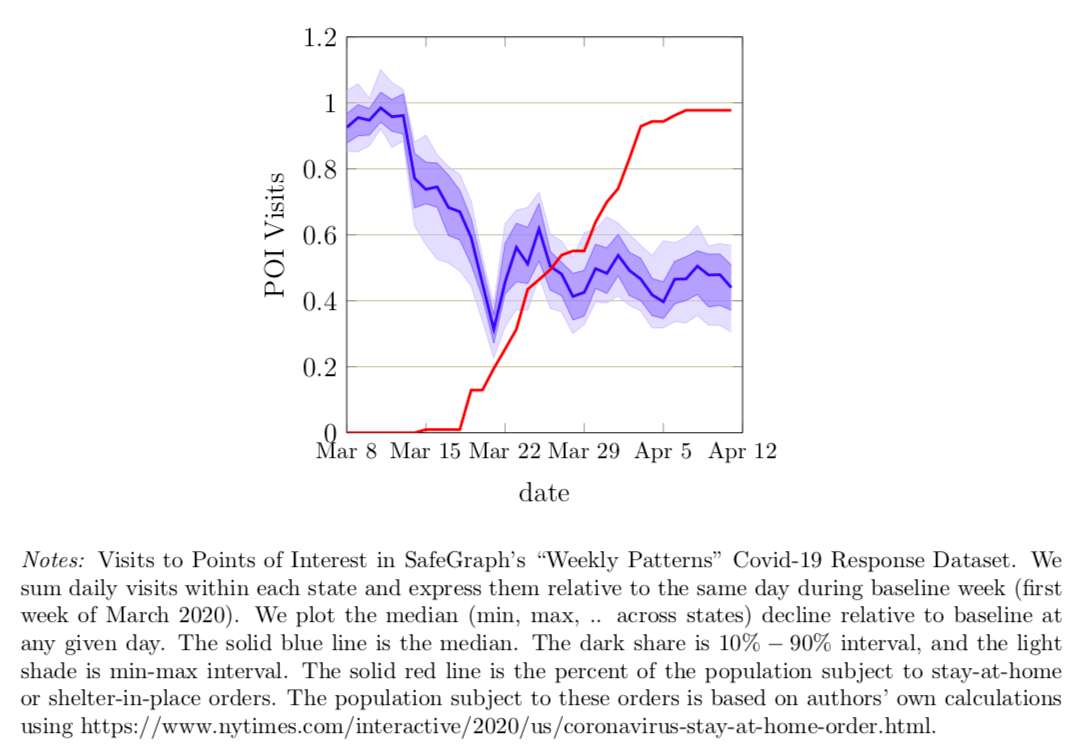
Let’s look at some of the charts the authors present early in the paper. The data on social distancing behavior comes from Safegraph, a vendor of mobility data taken from cell phone location information. This data can be used to construct various proxies for aggregate social activity. The first chart below shows traffic at “points of interest” (POI) in the U.S. from March 8 to April 12, 2020. That’s the blue line. The red line is the percentage of the U.S. population subject to lockdown orders on each date. The authors explain the details in the notes below the chart:

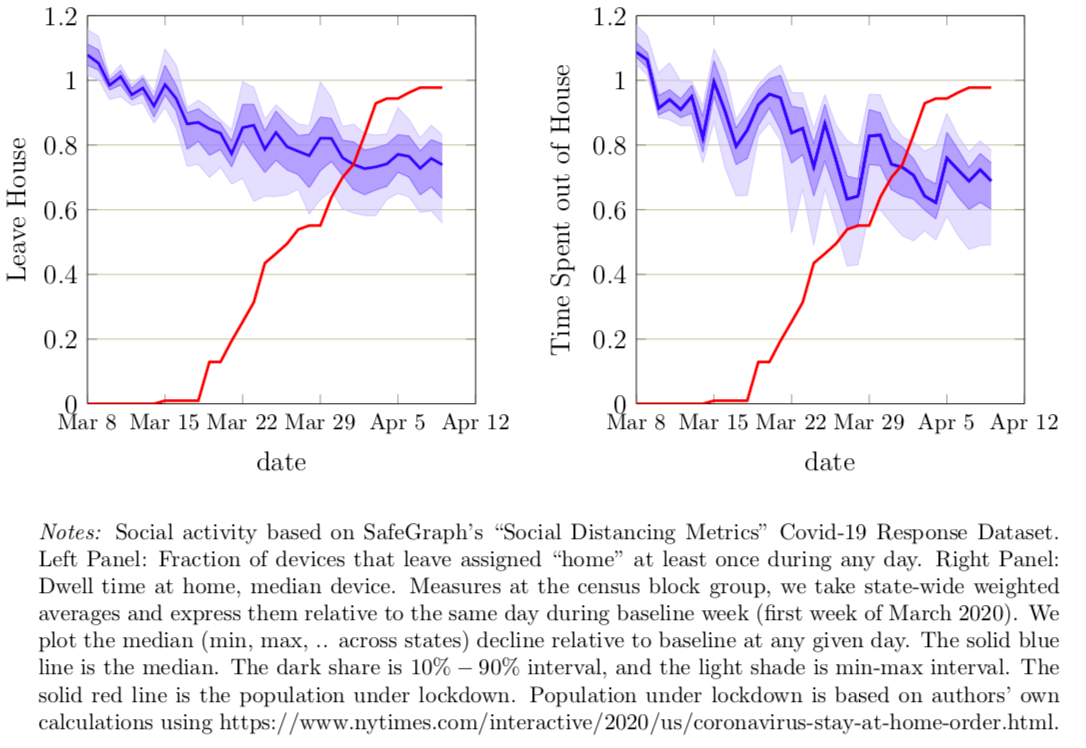
Clearly POI visits were declining sharply before any governments imposed their own orders. The next two charts show similar declines in the percent of mobile devices that leave “home” each day (“home” being the device’s dominant location during nighttime hours) and the duration over which devices were away from “home”, on average.

So all of these measures of social activity began declining well ahead of the government orders. The authors say private social distancing preceded government action in all 50 states. POI traffic was down almost 40% by the time 10% of the U.S. population was subject to government orders, and those early declines accounted for the bulk of the total decline through April 12. The early drops in the two away-from-home measures were 15-20%, again accounting for well over half of the total decline.

The additional declines beyond that time, to the extent they can be discerned, could be either trends that would have continued even in the absence of government orders or reinforcing effects the orders themselves. This does not imply that lockdown orders have no effects on specific activities. Rather, it means that those orders have minor incremental effects on measures of aggregate social activity than the voluntary actions already taken. In other words, the government lockdowns are largely a matter of rearranging the deck chairs, or, that is to say, their distribution.

Many private individuals and institutions acted early in response to information about the virus, motivated by concerns about their own safety and the safety of family and friends. The public sector in the U.S. was not especially effective in providing information, with such politicos as President Donald Trump, Nancy Pelosi, Andrew Cuomo, Bill De Blasio, and the mayor of New Orleans minimizing the dangers into the month of March, and some among them encouraging people to get out and celebrate at public events. Even Anthony Fauci minimized the danger in late February (not to mention the World Health Organization). In fact, “the scientists” were as negligent in their guidance as anyone in the early stages of the pandemic.

When lockdown orders were issued, they were often arbitrary and nonsensical. Grocery stores, liquor stores, and Wal Mart were allowed to remain open, but department stores and gun shops were not. Beaches and parks were ordered closed, though there is little if any chance of infection outdoors. Lawn care services, another outdoor activity, were classified as non-essential in some jurisdictions and therefore prohibited. And certain personal services seem to be available to public officials, but not to private citizens. The lists of things one can and can’t buy truly defies logic.

In March, John W. Whitehead wrote:

“We’re talking about lockdown powers (at both the federal and state level): the ability to suspend the Constitution, indefinitely detain American citizens, bypass the courts, quarantine whole communities or segments of the population, override the First Amendment by outlawing religious gatherings and assemblies of more than a few people, shut down entire industries and manipulate the economy, muzzle dissidents, ‘stop and seize any plane, train or automobile to stymie the spread of contagious disease,’…”

That is fearsome indeed, and individuals can accomplish distancing without it. If you are extremely risk averse, you can distance yourself or take other precautions to remain protected. You can either take action to isolate yourself or you can decide to be in proximity to others. The more risk averse among us will internalize most of the cost of voluntary social distancing. The less risk averse will avoid that cost but face greater exposure to the virus. Of course, this raises questions of public support for vulnerable segments of the population for whom risk aversion will be quite rational. That would certainly be a more enlightened form of intervention than lockdowns, though support should be offered only to those highly at-risk individuals who can’t support themselves.

Christopher Phelan writes of three rationales for the lockdowns: buying time for development of a vaccine or treatments; reducing the number of infected individuals; and to avoid overwhelming the health care system. Phelan thinks all three are of questionable validity at this point. A vaccine might never arrive, and Phelan is pessimistic about treatments (I have more hope in that regard). Ultimately a large share of the population will be infected, lockdowns or not. And of course the health care system is not overwhelmed at this point. Yes, those caring for Covid patients are under a great stress, but the health care system as a whole, and patients with other maladies, are currently suffering from massive under-utilization.

If you wish to be socially distant, you are free to do so on your very own. Individuals are quite capable of voluntary risk mitigation without authoritarian fiat, as the charts above show. While private actors might not internalize all of the external costs of their activities, government is seldom capable of making the appropriate corrections. Coercion to enforce the kinds of crazy rules that have been imposed during this pandemic is the kind of abuse of power the nation’s founders intended to prevent. Reversing those orders can be difficult, and the precedent itself becomes a threat to future liberty. Nevertheless, we see mounting efforts to resist by those who are harmed by these orders, and by those who recognize the short-sighted nature of the orders. Private incentives for risk reduction, and private evaluation of the benefits of social and economic activity, offer superior governance to the draconian realities of lockdowns.

Social Distancing Largely a Private Matter

26 Sunday Apr 2020

Posted by Nuetzel in Liberty, Pandemic, Uncategorized

≈ 1 Comment

Tags

Andrew Cuomo, Anthony Fauci, Bill De Blasio, Centre for Economic Policy Research, Donald Trump, Externalities, Heterogeneity, Laissez Faire, Lockdowns, Nancy Pelosi, Points of Interest, Private Governance, Safegraph, Social Distancing, Social Welfare, Stay-at-Home Orders, Wal Mart, WHO

How much did state and local governments accomplish when they decided to issue stay-at-home orders? Perhaps not much. That’s the implication of data presented by the authors of “Internal and external effects of social distancing in a pandemic” (starts on page 22 in the linked PDF). Social distancing began in the U.S. in a series of voluntary, private actions. Government orders merely followed and, at best, reinforced those actions, but often in ham-handed ways.

The paper has a broader purpose than the finding that social distancing is often a matter of private initiative. I’ll say a bit more about it, but you can probably skip the rest of this paragraph without loss of continuity. The paper explores theoretical relationships between key parameters (including a social distancing construct) and the dynamics of a pandemic over time in a social welfare context. The authors study several alternatives: a baseline in which behavior doesn’t change in any way; a “laissez faire” path in which actions are all voluntary; and a “socially optimal” path imposed by a benevolent and all-knowing central authority (say what???). I’d offer more details, but I’ll await the coming extension promised by the authors to a world in which susceptible populations are heterogenous (e.g., like Covid-19, where children are virtually unaffected, healthy working age adults are roughly as at-risk as they are to the flu, and a population of the elderly and health-compromised individuals for which the virus is much more dangerous than the flu). In general, the paper seems to support a more liberalized approach to dealing with the pandemic, but that’s a matter of interpretation. Tyler Cowen, who deserves a hat-tip, believes that reading is correct “at the margin”.

Let’s look at some of the charts the authors present early in the paper. The data on social distancing behavior comes from Safegraph, a vendor of mobility data taken from cell phone location information. This data can be used to construct various proxies for aggregate social activity. The first chart below shows traffic at “points of interest” (POI) in the U.S. from March 8 to April 12, 2020. That’s the blue line. The red line is the percentage of the U.S. population subject to lockdown orders on each date. The authors explain the details in the notes below the chart:

Clearly POI visits were declining sharply before any governments imposed their own orders. The next two charts show similar declines in the percent of mobile devices that leave “home” each day (“home” being the device’s dominant location during nighttime hours) and the duration over which devices were away from “home”, on average.

So all of these measures of social activity began declining well ahead of the government orders. The authors say private social distancing preceded government action in all 50 states. POI traffic was down almost 40% by the time 10% of the U.S. population was subject to government orders, and those early declines accounted for the bulk of the total decline through April 12. The early drops in the two away-from-home measures were 15-20%, again accounting for well over half of the total decline.

The additional declines beyond that time, to the extent they can be discerned, could be either trends that would have continued even in the absence of government orders or reinforcing effects the orders themselves. This does not imply that lockdown orders have no effects on specific activities. Rather, it means that those orders have minor incremental effects on measures of aggregate social activity than the voluntary actions already taken. In other words, the government lockdowns are largely a matter of rearranging the deck chairs, or, that is to say, their distribution.

Many private individuals and institutions acted early in response to information about the virus, motivated by concerns about their own safety and the safety of family and friends. The public sector in the U.S. was not especially effective in providing information, with such politicos as President Donald Trump, Nancy Pelosi, Andrew Cuomo, Bill De Blasio, and the mayor of New Orleans minimizing the dangers into the month of March, and some among them encouraging people to get out and celebrate at public events. Even Anthony Fauci minimized the danger in late February (not to mention the World Health Organization). In fact, “the scientists” were as negligent in their guidance as anyone in the early stages of the pandemic.

When lockdown orders were issued, they were often arbitrary and nonsensical. Grocery stores, liquor stores, and Wal Mart were allowed to remain open, but department stores and gun shops were not. Beaches and parks were ordered closed, though there is little if any chance of infection outdoors. Lawn care services, another outdoor activity, were classified as non-essential in some jurisdictions and therefore prohibited. And certain personal services seem to be available to public officials, but not to private citizens. The lists of things one can and can’t buy truly defies logic.

In March, John W. Whitehead wrote:

“We’re talking about lockdown powers (at both the federal and state level): the ability to suspend the Constitution, indefinitely detain American citizens, bypass the courts, quarantine whole communities or segments of the population, override the First Amendment by outlawing religious gatherings and assemblies of more than a few people, shut down entire industries and manipulate the economy, muzzle dissidents, ‘stop and seize any plane, train or automobile to stymie the spread of contagious disease,’…”

That is fearsome indeed, and individuals can accomplish distancing without it. If you are extremely risk averse, you can distance yourself or take other precautions to remain protected. You can either take action to isolate yourself or you can decide to be in proximity to others. The more risk averse among us will internalize most of the cost of voluntary social distancing. The less risk averse will avoid that cost but face greater exposure to the virus. Of course, this raises questions of public support for vulnerable segments of the population for whom risk aversion will be quite rational. That would certainly be a more enlightened form of intervention than lockdowns, though support should be offered only to those highly at-risk individuals who can’t support themselves.

Christopher Phelan writes of three rationales for the lockdowns: buying time for development of a vaccine or treatments; reducing the number of infected individuals; and to avoid overwhelming the health care system. Phelan thinks all three are of questionable validity at this point. A vaccine might never arrive, and Phelan is pessimistic about treatments (I have more hope in that regard). Ultimately a large share of the population will be infected, lockdowns or not. And of course the health care system is not overwhelmed at this point. Yes, those caring for Covid patients are under a great stress, but the health care system as a whole, and patients with other maladies, are currently suffering from massive under-utilization.

If you wish to be socially distant, you are free to do so on your very own. Individuals are quite capable of voluntary risk mitigation without authoritarian fiat, as the charts above show. While private actors might not internalize all of the external costs of their activities, government is seldom capable of making the appropriate corrections. Coercion to enforce the kinds of crazy rules that have been imposed during this pandemic is the kind of abuse of power the nation’s founders intended to prevent. Reversing those orders can be difficult, and the precedent itself becomes a threat to future liberty. Nevertheless, we see mounting efforts to resist by those who are harmed by these orders, and by those who recognize the short-sighted nature of the orders. Private incentives for risk reduction, and private evaluation of the benefits of social and economic activity, offer superior governance to the draconian realities of lockdowns.

Coronavirus Controversies

11 Saturday Apr 2020

Posted by Nuetzel in Health Care, Leftism, Pandemic

≈ 1 Comment

Tags

American Society of  Thoracic Surgeons, Anecdotal Evidence, Co-Morbidities, Coronavirus, Covid-19, Donald Trump, Dr. Anthony Fauci, Dr. Jeffrey Singer, Excess Deaths, FDA, Hydroxychloraquin, Plasma Therapy, Randomized Control Trial, Reason Magazine, Remdeivir, Replication Problem, Right-To-Try Laws, Trump Derangement Syndrome, Victoria Taft, Z-Pac, Zinc

The coronavirus and the tragedy it has wrought has prompted so many provocative discussions that it’s hard to pick just one of those topics for scarce blogging time. So I’ll try to cover two here: first, the question of whether coronavirus deaths are being miscounted; second, the politically-motivated controversy over the use of hydroxychloraquin to treat severe cases of Covid-19.

Counting Deaths

I’ve been suspicious that Covid deaths are being over-counted, but I’m no longer as sure of that. Of course, there are reasons to doubt the accuracy of the death counts. For example, there is a strong possibility that some Covid deaths are simply not being counted due to lack of diagnoses. But there are widespread suspicions that too many deaths with positive diagnoses are being counted as Covid deaths when decedents have severe co-morbidities. Members of that cohort die on an ongoing basis, but now many or all of those deaths are being attributed to Covid-19. A more perverse counting problem might occur when public health authorities instruct physicians to attribute various respiratory deaths to Covid even without a positive diagnosis! That is happening in some parts of the country.

To avoid any bias in the count, I’ve advocated tracking mortality from all co-morbidities and comparing the total to historical or “normal” levels to calculate “excess deaths”. One could also look at all-cause mortality and do the same, though I don’t think that would be quite on point. For example, traffic deaths are certainly way down, which would distort the excess deaths calculation.

Despite the vagaries in counting, there is no question that the coronavirus has been especially deadly in its brief assault on humans. New York has experienced a sharp increase in deaths, as the chart below illustrates (the chart is a corrected version of what appeared in the Reason article at the prior link). The spike is way out of line with normal seasonal patterns, and it obviously corresponds closely with deaths attributable to Covid-19. It is expected to be short-lived, but it might taper over the course of several weeks or months, Once it does, I suspect that the cumulative deaths under all those other curves in the chart will exceed Covid deaths substantially. Also note that the yellow line for the flu just stops when Covid deaths begin, suggesting that the red line probably incorporates at least some “normal” flu deaths.

Once the virus abates, we’ll be able to tell with a bit more certainty just how deadly the pandemic has been. It will be revealed through analyses of excess deaths. For now, we have the statistics we have, and they should be interpreted cautiously.

Hydrochloraquin

A more boneheaded debate centers on the use of the anti-malarial drug hydroxychloraquin (HCQ) to treat coronavirus patients. There have been many successes, particularly in combination with a Z-Pak, or zinc. Guidelines issued by the American Society of  Thoracic Surgeons last week call for HCQ’s use in advanced cases of coronavirus infection. These and other therapies are being tested formally, but many are prescribed outside any formal testing framework. Remdesivir has been prominent among these. Plasma therapy has been as well, and several other possible treatments are under study.

With respect to HCQ, it’s almost as if the Left, much of the media, and a subset of overly “prescriptive” medical experts were goaded into an irrational position via pure Trump Derangement. Just Google or Bing “Hydroxychloraquine Coronavirus” for a bizarre list of alarmist articles about Trump’s mention of HCQ. To take just two of the claims, the idea that Trump stands to earn substantial personal profits from HCQ because he holds a few equity shares in a manufacturer of generic drugs is patently absurd. And claims that shortages for arthritis, lupus, and malaria patients are imminent are unconvincing, given the massive stockpiles now accumulated and the efforts to ramp-up production.

So much lefty hair is on fire over a potential therapy that is both promising and safe that the media message lacks credulity. But more ominously, the Democrat governors of Michigan and Nevada were so petulant that they banned HCQ’s use in their states, though at least Nevada’a governor rescinded his order. It’s almost as if they don’t want it to work, and don’t want to give it a chance to work. Or do I go too far? No, I don’t think so.

Victoria Taft has a good summary of the media backlash against President Trump’s hopeful statements about HCQ. Not only was the FDA’s authority over the use of HCQ misrepresented, there was also a good bit of smearing of various researchers who’d found preliminary evidence of HCQ’s effectiveness. Let’s be honest: the quality of medical research is often inflated by the research establishment. And the media eat up any study with findings that are noteworthy in any way. Over the years, a great deal of medical research has been based on small samples from which statistical hypothesis tests are shaky at best. That’s one reason for the legendary replication problem in medical research. In the case of HCQ, there has been widespread misuse of the term “anecdotal” in the media, prompted by experts like Dr. Anthony Fauci, who should know better. The term was used to describe clinical tests on moderately large groups of patients, at least one of which was a randomized control trial.

Every day we hear stories from individual patients that they were saved by HCQ. These are properly called anecdotal accounts. But we also hear from various physicians around the country and world who claim to be astonished at HCQ’s therapeutic efficacy on groups of patients. This link gives another strong indication of how physicians feel about HCQ at this point. These are not from RCTs, but they constitute clinical evidence, not mere “anecdotes”.

By virtue of state and federal right-to-try laws, terminally ill patients can choose to take medications that are unapproved by regulators. Beyond that, FDA approval of HCQ specifically for treating coronavirus was unnecessary because the drug was already legal to prescribe to cover patients as an “off-label” use. That’s true of all drugs approved by the FDA: they can be prescribed legally for off-label uses. When regulators like Dr. Fauci, and even practicing physicians like Dr. Jeffrey Singer (linked below) claim that the FDA hasn’t approved HCQ specifically for treating Covid, it is a technicality: the FDA can certainly “approve” it for that specific use, but it’s already legal to prescribe!

While it won’t end the silly argument, which is obviously grounded in other motives, Dr. Singer brings us to the only reasonable position: treatment of Covid with HCQ is between the patient and their doctor.


The Federal Reserve and Coronatative Easing

09 Monday Mar 2020

Posted by Nuetzel in Monetary Policy, Pandemic

≈ Leave a comment

Tags

Caronavirus, Covid-19, Donald Trump, Externality, Federal Reserve, Fiscal Actions, Flight to Safety, Glenn Reynolds, Influenza, Liquidity, Michael Fumento, Monetary policy, Network Effects, Nonpharmaceutical Intervention, Paid Leave, Pandemic, Payroll Tax, Quarantines, Scott Sumner, Solvency, Wage Assistance

Laughs erupted all around when the Federal Reserve reduced its overnight lending rate by 50 basis points last week: LIKE THAT’LL CURE THE CORANAVIRUS! HAHAHA! It’s easy to see why it seemed funny to people, even those who think the threat posed by Covid-19 is overblown. But it should seem less silly with each passing day. That’s not to say I think we’re headed for disaster. My own views are aligned with this piece by Michael Fumento: it will run its course before too long, and “viruses hate warm weather“. Nevertheless, the virus is already having a variety of economic effects that made the Fed’s action prudent.

Of course, the Fed did not cut its rate to cure the virus. The rate move was intended to deal with some of the economic effects of a pandemic. The spread of the virus has been concentrated in a few countries thus far: China, Iran, Italy, and South Korea. Fairly rapid growth is expected in the number of cases in the U.S. and the rest of the world over the next few weeks, especially now with the long-awaited distribution of test kits. But already in the U.S., we see shortages of supplies hitting certain industries, as shipments from overseas have petered. And now efforts to control the spread of the virus will involve more telecommuting, cancellation of public events, less travel, less dining out, fewer shopping trips, missed work, hospitalizations, and possibly widespread quarantines.

The upshot is at least a temporary slowdown in economic activity and concomitant difficulties for many private businesses. We’ve been in the midst of a “flight to safety”, as investors incorporate these expectations into stock prices and interest rates. Firms in certain industries will need cash to pay bills during a period of moribund demand, and consumers will need cash during possible layoffs. All of this suggests a need for liquidity, but even worse, it raises the specter of a solvency crisis.

The Fed’s power can attempt to fill the shortfall in liquidity, but insolvency is a different story. That, unfortunately, might mean either business failures or bailouts. Large firms and some small ones might have solid business continuation plans to help get them through a crisis, at least one of short to moderate duration, but many businesses are at risk. President Trump is proposing certain fiscal and regulatory actions, such as a reduction in the payroll tax, wage payment assistance, and some form of mandatory paid leave for certain workers. Measures might be crafted so as to target particular industries hit hard by the virus.

I do not object to these pre-emptive measures, even as an ardent proponent of small government, because the virus is an externality abetted by multiplicative network effects, something that government has a legitimate role in addressing. There are probably other economic policy actions worth considering. Some have suggested a review of laws restricting access to retirement funds to supplement inadequate amounts of precautionary savings.

Last week’s Fed’s rate move can be viewed as pre-emptive in the sense that it was intended to assure adequate liquidity to the financial sector and payment system to facilitate adjustment to drastic changes in risk appetites. It might also provide some relief to goods suppliers who find themselves short of cash, but their ability to benefit depends on their relationships to lenders, and lenders will be extremely cautious about extending additional credit as long as conditions appear to be deteriorating.

In an even stronger sense, the Fed’s action last week was purely reactive. Scott Sumner first raised an important point about ten days before the rate cut: if the Fed fails to reduce its overnight lending target, it represents a de facto tightening of U.S. monetary policy, which would be a colossal mistake in a high-risk economic and social environment:

“When there’s a disruption to manufacturing supply chains, that tends to reduce business investment, puts downward pressure on demand for credit. That will tend to reduce equilibrium interest rates. In addition, with the coronavirus, there’s also a lot of uncertainty in the global economy. And when there’s uncertainty, there’s sort of a rush for safe assets, people buy treasury bonds, that puts downward pressure on interest rates. So you have this downward pressure on global interest rates. Now while this is occurring, if the Fed holds constant its policy rate, it targets the, say fed funds rate at a little over 1.5 percent. While the equilibrium rates are falling, then essentially the Fed will be making monetary policy tighter.

… what I’m saying is, if the Fed actually wants to maintain a stable monetary policy, they may have to move their policy interest rate up and down with market conditions to keep the effective stance of monetary policy stable. So again, it’s not trying to solve the supply side problem, it’s trying to prevent it from spilling over and also impacting aggregate demand.”

The Fed must react appropriately to market rates to maintain the tenor of its policy, as it does not have the ability to control market rates. Its powers are limited, but it does have a responsibility to provide liquidity and to avoid instability in conducting monetary policy. Fiscal actions, on the other hand, might prove crucial to restoring economic confidence, but ultimately controlling the spread of the virus must be addressed at local levels and within individual institutions. While I am strongly averse to intrusions on individual liberty and I desperately hope it won’t be necessary, extraordinary measures like whole-city quarantines might ultimately be required. In that context, this post on the effectiveness of “non-pharmaceutical interventions” such as school closures, bans on public gatherings, and quarantines during the flu pandemic of 1918-19 is fascinating.


Not Obama’s Economy

01 Sunday Mar 2020

Posted by Nuetzel in economic growth, Macroeconomics

≈ Leave a comment

Tags

Barack Obama, Caronavirus, Chuck Jones, Donald Trump, Federal Reserve, Forbes, Great Recession, Joe Biden, Minority Unemployment, Minority Wage Growth, Monetary policy, NPR.org, Shovel-Ready Projects, Trump Economy

The “Trump economy” hasn’t been half bad, though one can’t attribute all of the results to the economic policies of his administration. In fact, the economy was growing when he took office, though it took several years after the Great Recession to recover under Barack Obama, and various sectors were showing strains before Trump took office. And yes, Obama inherited a very bad economy, but he went off the rails a few weeks ago in a pathetic attempt to take credit for ten-plus years of economic growth. Here is one of his tweets:

“Eleven years ago today, near the bottom of the worst recession in generations, I signed the Recovery Act, paving the way for more than a decade of economic growth and the longest streak of job creation in American history,”

The tweet was immediately ridiculed by Trump, as is his habit, but at best Obama received lukewarm support from his usually adoring media outlets. How interesting, however, that just a few days before Obama’s tweet, Chuck Jones, a regular Forbes contributor who really needn’t prove he’s an Obama hack, submitted a scorecard of economic performance covering President Trump’s first three years in office. It was an exercise in throwing shade at a series of good numbers. Then, a week later, Jones had the chutzpah to claim the Obama’s “shovel-ready” stimulus program of a decade ago, which proved anemic in its effects, was the proximate cause of healthy growth under Trump’s watch. Who gave him that idea?

Jones’ effort to diminish Trump’s economic accomplishments is music to the ears of leftists wistful for the days of Obama. They fancy Jones’ appearance in what they assume to be a right-leaning outlet as an enhancement to the credibility of his claims. Forbes, however, is certainly not the bastion of conservatism the Left would have you believe. Their model pays contributors who drive circulation, which has little to do with political alignment. To the extent that Jones is able to stroke the predilections of the Left, he probably can play well at that game.

The truth is it’s difficult to attribute variations in economic growth to different presidential administrations. This fairly well-balanced piece at NPR.org gives one very simple reason:

“Let’s stipulate that presidents of both parties often get more credit and blame for economic conditions than they deserve, given that much of what happens is outside their control.”

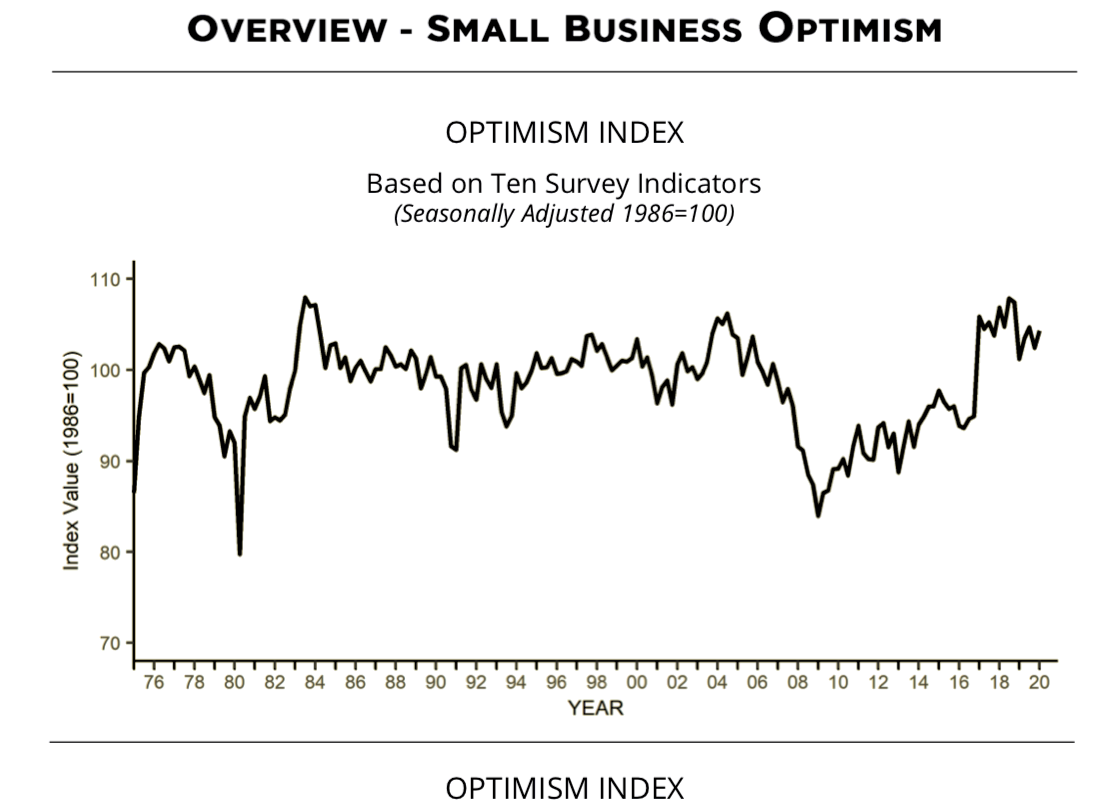
It is true that a new administration inherits economic conditions and policies from its predecessor. Trump inherited an economy that was growing, but there were plenty of strains, including sluggish wage growth, low labor force participation, weak business startups, and a languid housing sector, as this link makes clear. Moreover, economic expansions have lasted an average of only about five years in the post-WW2 era. The current expansion was about 90 months running at the time of Trump’s inauguration, a stage at which vulnerabilities might develop. But new policies often lead to new economic realities. In Trump’s case, that included tax cuts, and especially corporate tax cuts that spurred hiring and wage growth, and more liberalized regulation. Accommodative monetary policy by the Federal Reserve also provided an assist. As the chart at the top shows, Trump’s platform lifted small business enthusiasm considerably, which is a broad indicator of economic vibrancy. Of course, his trade initiatives have probably had negative effects thus far, but his way of negotiating new trade agreements might well end up making a positive contribution, on balance.

Now, the danger of a caronavirus pandemic is presenting major economic challenges. It’s unlikely to produce as many deaths as a bad flu season in the U.S., in part because the Trump Administration took quick action to limit domestic exposure. Nevertheless, the economic consequences of the virus and attempts to control its spread will be significant. At least the economy was strong when the shock occurred, so it is reasonable to expect a rebound if the outbreak runs its course over the next month or two.

The economic record since Trump took office has been impressive given the stage of the business cycle at which he took office. Not only that, but minority wage growth has surged, and minority unemployment has fallen substantially. Let’s face it: Obama and Joe Biden are eager to neutralize any plaudits a strong economy might earn Trump in an election year, but they shouldn’t embarrass themselves by trying to take credit for it, and Chuck Jones could do better than carrying their water.


Scorning the Language of the Left

12 Sunday Jan 2020

Posted by Nuetzel in Censorship, Leftism, Political Correctness

≈ Leave a comment

Tags

Abortion, Boy George, Brett Kavanaugh, Brexit, Check Your Privilege, Cisgender, Climate Change, Donald Trump, Gender, Harper's, Hate Speech, Identitarian, Israel, Lefty Lingo, LGBTQ, Lionel Shriver, Microaggession, Patriarchy, Phobic, Privilege, Progressive Speech, Pronouns, Queer, Safe Space, STFU, Sustainability

It’s hard not to ridicule some the language adopted by our lefty friends, and it can be fun! But it’s not just them. We hear it now from employers, schools, and otherwise sensible people too eager to signal their modernity and virtue. Lionel Shriver dissects some of this “Lefty Lingo” in an entertaining piece in Harper’s. It’s funny, but it aroused my contempt for the smugness of the “wokescenti” (a term Shriver attributes too Meghan Daum) and my pity for those “normals” simply desperate to project progressive sophistication.

Here are a few of Shriver’s observations:

“Privilege”: makes you incapable of understanding that which you criticize.

“Whereas a privilege can be acquired through merit—e.g., students with good grades got to go bowling with our teacher in sixth grade—privilege, sans the article, is implicitly unearned and undeserved. The designation neatly dispossesses those so stigmatized of any credit for their achievements while discounting as immaterial those hurdles an individual with a perceived leg up might still have had to overcome (an alcoholic parent, a stutter, even poverty). For privilege is a static state into which you are born, stained by original sin. Just as you can’t earn yourself into privilege, you can’t earn yourself out of it, either. … . it’s intriguing that the P-bomb is most frequently dropped by folks of European heritage, either to convey a posturing humility (“I acknowledge my privilege”) or to demonize the Bad White People, the better to distinguish themselves as the Good White People.

Meanwhile, it isn’t clear what an admission of privilege calls you to do, aside from cower. That tired injunction ‘Check your privilege’ translates simply to ‘S.T.F.U.’—and it’s telling that ‘Shut the fuck up’ is now a sufficiently commonplace imperative to have lodged in text-speak.”

“Cisgender”: “Cis-” is a linguistic shell game whereby the typical case is labelled cis-typical.

“Denoting, say, a woman born a woman who thinks she’s a woman, this freighted neologism deliberately peculiarizes being born a sex and placidly accepting your fate, and even suggests that there’s something a bit passive and conformist about complying with the arbitrary caprices of your mother’s doctor. Moreover, unless a discussion specifically regards transgenderism, in which case we might need to distinguish the rest of the population (‘non-trans’ would do nicely), we don’t really need this word, except as a banner for how gendercool we are. It’s no more necessary than words for ‘a dog that is not a cat,’ a ‘lamppost that is not a fire hydrant,’ or ‘a table that is actually a table.’ Presumably, in order to mark entities that are what they appear to be, we could append ‘cis’ to anything and everything. ‘Cisblue’ would mean blue and not yellow. ‘Cisboring’ would mean genuinely dull, and not secretly entertaining after all.”

“Microaggression“: Anything you say that bothers them, even a little.

“… a perverse concoction, implying that the offense in question is so minuscule as to be invisible to the naked eye, yet also that it’s terribly important. The word cultivates hypersensitivity.”

“_____-phobic”: the typical use of this suffix in identity politics stands “phobia” on its head. To be fair, however, it started with a presumption that people hate that which they fear. Maybe also that they fear and hate that which they don’t care for, but we’ll just focus on fear and hate. For example, there is the notion that men have deep fears about their own sexuality. Thus, the prototypical gay-basher in film is often compensating for his own repressed homosexual longings, you see. And now, the idea is that we always fear “otherness” and probably hate it too. Both assertions are tenuous. At least those narratives are rooted in “fear”, but it’s not quite the same phenomenon as hate, and yet “phobic” seems to have been redefined as odium:

“The ubiquitous ‘transphobic,’ ‘Islamophobic,’ and ‘homophobic’ are also eccentric, in that the reprobates so branded are not really being accused of fearfulness but hatred.”

“LGBTQ“: Lumping all these “types” together can be misleading, as they do not always speak in unison on public policy. But if we must, how about “Let’s Go Back To ‘Queer'”, as Shriver suggests. The LGBs I know don’t seem to mind it as a descriptor, but maybe that’s only when they say it. Not sure about the trannies. There is a great Libertarian economist who is transsexual ( Dierdre McCloskey), and somehow “queer” doesn’t seem quite right for her. Perhaps she’s just a great woman.

“The alphabet soup of ‘LGBTQ’ continues to add letters: LGBTQIAGNC, LGBTQQIP2SAA, or even LGBTIQCAPGNGFNBA. A three-year-old bashing the keyboard would produce a more functional shorthand, and we already have a simpler locution: queer.”

“Problematic”, “Troubling” and “Inappropriate”: I’m sure some of what I’ve said above is all three. I must confess I’ve used these terms myself, and they are perfectly good words. It’s just funny when the Left uses them in the following ways.

“Rare instances of left-wing understatement, ‘problematic’ and ‘troubling’ are coyly nonspecific red flags for political transgression that obviate spelling out exactly what sin has been committed (thereby eliding the argument). Similarly, the all-purpose adjectival workhorse ‘inappropriate’ presumes a shared set of social norms that in the throes of the culture wars we conspicuously lack. This euphemistic tsk-tsk projects the prim censure of a mother alarmed that her daughter’s low-cut blouse is too revealing for church. ‘Inappropriate’ is laced with disgust, while once again skipping the argument. By conceit, the appalling nature of the misbehavior at issue is glaringly obvious to everyone, so what’s wrong with it goes without saying.”

Here are a few others among my favorites:

“Patriarchy“: This serves the same function as “privilege” but is directed more specifically at the privilege enjoyed by males. Usually white, heterosexual males. It seeks to preemptively discredit any argument a male might make, and often it is used to discredit Western political and economic thought generally. That’s because so much of it was the product of the patriarchy, don’t you know! And remember, it means that males are simply incapable of understanding the plight of females … and children, let alone queers! Apparently fathers are bad, especially if they’re still straight. Mothers are good, unless they stand with the patriarchy.

“Hate Speech“: This expression contributes nothing to our understanding of speech that is not protected by the Constitution. If anything its use is intended to deny certain kinds of protected speech. Sure, originally it was targeted at such aberrations as racist or anti-gay rhetoric, assuming that always meant “hate”, but even those are protected as long as they stop short of “fighting words”. There are many kinds of opinions that now seem to qualify as “hate speech” in the eyes of the Identitarian Left, even when not truly “hateful”, such as church teachings in disapproval of homosexuality. There is also a tendency to characterize certain policy positions as “hate speech”, such as limits on immigration and opposition to “living wage” laws. Hypersensitivity, once more.

“Sustainability“: What a virtue signal! It’s now a big game to characterize whatever you do as promoting “sustainability”. But let’s get one thing straight: an activity is sustainable only if its benefits exceed its resource costs. That is the outcome sought by voluntary participants in markets, or they do not trade. Benefits and costs “estimated” by government bureaucrats without the benefit of market prices are not reliable guides to sustainability. Nor is Lefty politics a reliable guide to sustainability. Subsidies for favored activities actually undermine that goal.

There are many other Lefty catch phrases and preferred ways of speaking. We didn’t even get to “safe space”, “social justice”, and the pronoun controversy. Shriver closes with some general thoughts on the lefty lingo. I’ll close by quoting one of those points:

“The whole lexicon is of a piece. Its usage advertises that one has bought into a set menu of opinions—about race, gender, climate change, abortion, tax policy, #MeToo, Trump, Brexit, Brett Kavanaugh, probably Israel, and a great deal else. Reflexive resort to this argot therefore implies not that you think the same way as others of your political disposition but that you don’t think. You have ordered the prix fixe; you’re not in the kitchen cooking dinner for yourself.”


3 Cheers, No Tears for Strike on Master of Iranian Terror

08 Wednesday Jan 2020

Posted by Nuetzel in Middle East, War

≈ Leave a comment

Tags

AL Monitor, Al-Quds, Anderson Cooper, Avi Melamed, Bloomberg, Charles De Gaulle, Decapitation, Deterrence, Donald Trump, Iran, Iranian Mullah Regime, Iraq, Kataeb Hezbollah, Politico, Qassim Soleimani, Regime Change, Retaliation, Reuters, Saudi Arabia, Self-Defense, Syria, Terrorism, Tyler Cowen, Victor Davis Hanson, World War III

Note: As I finish this post, Iran has fired missiles at U.S. bases in Iraq, so we know a bit more about their response to the killing of Qassim Soleimani. Tonight’s response by Iran looks to have been impotent. There are risks of other kinds of action, of course. We shall see.

Last week’s killing of Iranian General Qassim Soleimani was not prompted solely by the attack on the U.S. embassy in Iraq by Kataeb Hezbollah, the Iranian-backed militia. Iran, perhaps the largest state-sponsor of terrorism in the world, has been guilty of provocation and aggression in Iraq, Syria, Saudi Arabia and elsewhere under Soleimani’s direction for many years. And he was reviled for his ruthless treatment of protestors within Iran’s borders. In recent weeks there had been a series of rocket attacks on U.S. bases, and there was “chatter” that much more was planned. It’s been noted that the presence of so-many high-level officials in one place at the time of the attack on Soleimani indicated that something big was in the works. This Reuters article gives some insight into Soleimani’s suspicious activities in the weeks prior to his death, of which the U.S. was surely aware. While the attack on the U.S. embassy provided additional pretext (as if it was needed), all of this indicates that Soleimani’s assassination was not an impulsive decision, but deliberated, contrary to assertions by critics of President Trump’s decision to act. It was both retaliatory and preemptive. Soleimani’s travels and whereabouts were well known, and it’s highly likely that a “decapitation” had been planned as a contingency for some time. This report in Politico provides details of the decision making leading up to the strike. The attack was executed brilliantly by all accounts.

The U.S. had retaliated to earlier rocket attacks with strikes against Kataeb Hezbollah positions. That the strike on Soleimani was more than retaliation and an act of self-defense against additional threats is, I believe, the flaw in arguments against the strike like the one Tyler Cowen seemed to make in Bloomerg (though his main point was different). The value of the strike goes far beyond retaliation. This was not intended to be another volley in an ongoing series of “tits-for-tats”.

In addition to Soleimani, several other high-level Iranian military personnel were killed. This undoubtedly disrupted plans that would have threatened U.S. soldiers and assets, yet some describe the strike as an “impulsive” act on Trump’s part, and an “act of war”, as if unprovoked. And as if Iran had not been warring on the U.S. for the past 40 years. What to make of those who take this position?  Of course, most are reflexively anti-Trump, refusing to evaluate the decision on it’s own merits. They pretend that Soleimani and the Iranian overseers of the stooge government in Iraq have legitimacy. Anderson Cooper actually compared Soleimani to Charles De Gaulle. It would be more accurate to compare him to the murderous Che Guevara, but then again, many on the Left worship Che’s memory as well! These fools will tell you that Soleimani was “worshipped” in Iran. In fact, there are a great many Iranians who are quietly celebrating his death.

Middle East analyst Avi Melamed does not mince words in describing the impact Soleimani has had on the Middle East (emphasis his):

“Some argue that the assassination of Soleimani will increase tensions in the Middle East. This outlook confuses cause and effect: Tensions in the Middle East have intensified over the past decade because of the violent Iranian aggression which Soleimani spearheaded. Aggression which has led to Syria’s destruction and the disintegration of Lebanon and Iraq. Aggression that threatens maritime routes and safe passage in the Arab (Persian) Gulf and the Red Sea, a direct attack on Saudi Arabia’s oil facilities that spiked oil prices and compromised the world’s oil supply. Aggression that has fueled and intensified tensions – including direct military confrontations – between Iran and its proxies and Israel.

General Soleimani and the Al-Quds force led the escalation in the region in the service of the hegemonic vision of the Iranian Mullah regime. Their actions have so far claimed the lives of hundreds of thousands of people, led to the destruction of states, the disintegration of cities, and caused a wave of millions of refugees. Killing Soleimani is not the cause of the escalation – but the result.”

Malamed expected Iran to take retaliatory actions in Iraq, where it already has a strong military presence and good reconnaissance. Missiles have now been fired at U.S. bases from Iran (as of tonight), but with few or no casualties. It remains to be seen how effective a response the Iranians can mount. Any short-term U.S. casualties should probably not be viewed as incremental, given the high likelihood of casualties had Soleimani lived. Perhaps Iran will fire missiles at Israel from western Iraq or Syria, or at Saudi Arabian oil assets, as it did last September. Or it might make a bold military intervention in Iraq to strengthen its control there, which Iran considers crucial to its own security.

Al Monitor believes the assassination “leaves Iran with very few options to retaliate” with any strength, at least in the short-run:

“… the economic hardship in Iran — in addition to the challenges the government is facing internally — would not allow Tehran to increase the tension. Iran’s past conduct against Israel strikes on Iranian bases in Syria also shows it will not seek revenge if its national security and interests are in danger. … This all indicates that Iran and its proxies in the region most likely would not seek revenge in the near future and — in regard to Iraq, in particular — would not lead Iraq to fall into a civil war or mass destruction, because it would lose even more in Iraq if it takes such a risk.”

So despite the brash talk, Iran is weak and spread thin across commitments outside its borders, and the regime has real fear of retaliation by its enemies that can only have been reinforced by the strike against Soleimani. Of what other retaliatory actions is Iran capable, assuming the regime can survive in the longer run? And assuming the Mullah regime itself is willing to take existential risks? It has threatened actions against civilians in the West. Can it bring down planes? Can it bomb targets in the U.S.? Can it develop or buy a small nuclear device? It can try any of those things, of course, but with uncertain odds and with risks it might not want to take. Survival is of the utmost importance to the regime, and it is already on shaky ground.

Trump’s critics claim that he authorized the “decapitation” without a plan for its aftermath. Trump has made clear his intent to “punch back twice as hard”, as it were, in response to any additional force from Iran. This is, first and foremost, a game of deterrence. Beyond that, however, and despite talk of “changing the Iranian regime’s behavior”, it appears that the larger plan pursued by Trump is to continue undermining the regime with sanctions and targeted strikes, if necessary. “Maximum pressure”. But there will be no World War III. The markets seem pretty comfortable about that as well, including the oil market.

I do take issue with Trump’s mention of the possibility of striking “cultural sites” in Iran, though he seems to have retracted it. On that point, however, I fully agree with Tyler Cowan (linked above). The only plausible rationale for such a statement is to frighten Iran’s leadership, especially if it has located military and intelligence functions within cultural sites.

Trump still maintains that our ultimate goal should be withdrawal from Iraq. That assumes stabilization in the region and fair elections, which would be well-served by a weaker Iran or a regime change there. As Victor Davis Hanson explains, the Middle East is of declining importance in world energy markets and trade generally. That’s one reason we’re unlikely to ever again send a huge ground force to the region, and it’s a good reason to scale back our presence in the Middle East generally.

← Older posts
Newer posts →
Follow Sacred Cow Chips on WordPress.com

Recent Posts

  • A Warsh Policy Scenario At the Federal Reserve
  • The Coexistence of Labor and AI-Augmented Capital
  • The Case Against Interest On Reserves
  • Immigration and Merit As Fiscal Propositions
  • Tariff “Dividend” From An Indigent State

Archives

  • February 2026
  • January 2026
  • December 2025
  • November 2025
  • October 2025
  • September 2025
  • August 2025
  • July 2025
  • June 2025
  • May 2025
  • April 2025
  • March 2025
  • February 2025
  • January 2025
  • December 2024
  • November 2024
  • October 2024
  • September 2024
  • August 2024
  • July 2024
  • June 2024
  • May 2024
  • April 2024
  • March 2024
  • February 2024
  • January 2024
  • December 2023
  • November 2023
  • August 2023
  • July 2023
  • June 2023
  • May 2023
  • April 2023
  • March 2023
  • February 2023
  • January 2023
  • December 2022
  • November 2022
  • October 2022
  • September 2022
  • August 2022
  • July 2022
  • June 2022
  • May 2022
  • April 2022
  • March 2022
  • February 2022
  • January 2022
  • December 2021
  • November 2021
  • October 2021
  • September 2021
  • August 2021
  • July 2021
  • June 2021
  • May 2021
  • April 2021
  • March 2021
  • February 2021
  • January 2021
  • December 2020
  • November 2020
  • October 2020
  • September 2020
  • August 2020
  • July 2020
  • June 2020
  • May 2020
  • April 2020
  • March 2020
  • February 2020
  • January 2020
  • December 2019
  • November 2019
  • October 2019
  • September 2019
  • August 2019
  • July 2019
  • June 2019
  • May 2019
  • April 2019
  • March 2019
  • February 2019
  • January 2019
  • December 2018
  • November 2018
  • October 2018
  • September 2018
  • August 2018
  • July 2018
  • June 2018
  • May 2018
  • April 2018
  • March 2018
  • February 2018
  • January 2018
  • December 2017
  • November 2017
  • October 2017
  • September 2017
  • August 2017
  • July 2017
  • June 2017
  • May 2017
  • April 2017
  • March 2017
  • February 2017
  • January 2017
  • December 2016
  • November 2016
  • October 2016
  • September 2016
  • August 2016
  • July 2016
  • June 2016
  • May 2016
  • April 2016
  • March 2016
  • February 2016
  • January 2016
  • December 2015
  • November 2015
  • October 2015
  • September 2015
  • August 2015
  • July 2015
  • June 2015
  • May 2015
  • April 2015
  • March 2015
  • February 2015
  • January 2015
  • December 2014
  • November 2014
  • October 2014
  • September 2014
  • August 2014
  • July 2014
  • June 2014
  • May 2014
  • April 2014
  • March 2014

Blogs I Follow

  • Passive Income Kickstart
  • OnlyFinance.net
  • TLC Cholesterol
  • Nintil
  • kendunning.net
  • DCWhispers.com
  • Hoong-Wai in the UK
  • Marginal REVOLUTION
  • Stlouis
  • Watts Up With That?
  • Aussie Nationalist Blog
  • American Elephants
  • The View from Alexandria
  • The Gymnasium
  • A Force for Good
  • Notes On Liberty
  • troymo
  • SUNDAY BLOG Stephanie Sievers
  • Miss Lou Acquiring Lore
  • Your Well Wisher Program
  • Objectivism In Depth
  • RobotEnomics
  • Orderstatistic
  • Paradigm Library
  • Scattered Showers and Quicksand

Blog at WordPress.com.

Passive Income Kickstart

OnlyFinance.net

TLC Cholesterol

Nintil

To estimate, compare, distinguish, discuss, and trace to its principal sources everything

kendunning.net

The Future is Ours to Create

DCWhispers.com

Hoong-Wai in the UK

A Commonwealth immigrant's perspective on the UK's public arena.

Marginal REVOLUTION

Small Steps Toward A Much Better World

Stlouis

Watts Up With That?

The world's most viewed site on global warming and climate change

Aussie Nationalist Blog

Commentary from a Paleoconservative and Nationalist perspective

American Elephants

Defending Life, Liberty and the Pursuit of Happiness

The View from Alexandria

In advanced civilizations the period loosely called Alexandrian is usually associated with flexible morals, perfunctory religion, populist standards and cosmopolitan tastes, feminism, exotic cults, and the rapid turnover of high and low fads---in short, a falling away (which is all that decadence means) from the strictness of traditional rules, embodied in character and inforced from within. -- Jacques Barzun

The Gymnasium

A place for reason, politics, economics, and faith steeped in the classical liberal tradition

A Force for Good

How economics, morality, and markets combine

Notes On Liberty

Spontaneous thoughts on a humble creed

troymo

SUNDAY BLOG Stephanie Sievers

Escaping the everyday life with photographs from my travels

Miss Lou Acquiring Lore

Gallery of Life...

Your Well Wisher Program

Attempt to solve commonly known problems…

Objectivism In Depth

Exploring Ayn Rand's revolutionary philosophy.

RobotEnomics

(A)n (I)ntelligent Future

Orderstatistic

Economics, chess and anything else on my mind.

Paradigm Library

OODA Looping

Scattered Showers and Quicksand

Musings on science, investing, finance, economics, politics, and probably fly fishing.

  • Subscribe Subscribed
    • Sacred Cow Chips
    • Join 128 other subscribers
    • Already have a WordPress.com account? Log in now.
    • Sacred Cow Chips
    • Subscribe Subscribed
    • Sign up
    • Log in
    • Report this content
    • View site in Reader
    • Manage subscriptions
    • Collapse this bar
 

Loading Comments...