• About

Sacred Cow Chips

Sacred Cow Chips

Tag Archives: Inequality

A, But Not-So-I: Altman’s Plan To Tax Wealth and Redistribute Capital

09 Tuesday Jul 2024

Posted by Nuetzel in Artificial Intelligence, Wealth Distribution, Wealth Taxes

≈ 2 Comments

Tags

Absolute Advantage, AGI, Alignment, American Equity Fund, Antitrust, ChatGPT, Chris Edwards, Comparative advantage, consumption tax, David Schizer, Defense Production Act, Direct Taxes, Inequality, Maxwell Tabarrok, Michael Munger, Michael Strain, Moore v. United States, Moore’s Law, Open AI, Patrick Hedger, Sam Altman, Scarcity, Scott Sumner, Sixteenth Amendment, Steven Calabresi, Tax Incidence, ULTRA Tax, Wealth Tax

In this case, the “A” stands for Altman. Now Sam Altman is no slouch, but he’s taken a few ill-considered positions on public policy. Altman, the CEO of Open AI, wrote a blog post back in 2021 entitled “Moore’s Law For Everything” in which he predicted that AI will feed an explosion of economic growth. He also said AI will put a great many people out of work and drive down the price of certain kinds of labor. Furthermore, he fears that the accessibility of AI will be heavily skewed against the lowest socioeconomic classes. In later interviews (see here and here), Altman is somewhat demure about those predictions, but the general outline is the same: despite exceptional growth of GDP and wealth, he envisions job losses, an underclass of AI-illiterates, and a greater degree of income and wealth inequality.

Not Quite Like That

We’ve yet to see an explosion of growth, but it’s still very early in the AI revolution. The next several years will be telling. AI holds the potential to vastly increase our production possibilities over the course of the next few decades. For that and other reasons, I don’t buy the more dismal aspects of Altman’s scenario, as my last two posts make clear (here and here).

There will be plenty of jobs for people because humans will have comparative advantages in various areas of production. AI agents might have absolute advantages across most or even all jobs, but a rational deployment would have AI agents specialize only where they have a comparative advantage.

Scarcity will not be the sort of anachronism envisioned by some AI futurists, Altman included, and scarcity of AI agents (and their inputs) will necessitate their specialization in certain tasks. The demand for AI agents will be quite high, and their energy and “compute” requirements will be massive. AI agents will face extremely high opportunity costs in other tasks, leaving many occupations open for human labor, to say nothing of abundant opportunities for human-AI collaboration.

However, I don’t dismiss the likelihood of disruptions in markets for certain kinds of labor if the AI revolution proceeds as rapidly as Altman thinks it will. Many workers would be displaced, and it would take time, training, and a willingness to adapt for them to find new opportunities. But new kinds of jobs for people will emerge with time as AI is embedded throughout the economy.

Altman’s Rx

Altman’s somewhat pessimistic outlook for human employment and inequality leads him to make a couple of recommendations:

1) Ownership of capital must be more broadly distributed.

2) Capital and land must be taxed, potentially replacing income taxes, but primarily to fund equity investments for all Americans.

Here I agree with the spirit of #1. Broad ownership of capital is desirable. It allows greater participation in the capitalist system, which fosters political and economic stability. And wider access to capital, whether owned or not, allows a greater release of entrepreneurial energy. It also diversifies incomes and reduces economic dependency.

Altman proposes the creation of an American Equity Fund (AEF) to hold the proceeds of taxes on land and corporate assets for the benefit of all Americans. I’ll get to the taxes in a moment, but in discussing the importance of educating the public on the benefits of compounding, Altman seems to imply that assets in AEF would be held in individual accounts, as opposed to a single “public” account controlled by the federal government. Individual accounts would be far preferable, but it’s not clear how much control Altman would grant individuals in managing their accounts.

To Kill a Golden Goose

Taxes on capital are problematic. Capital can only be accumulated over time by saving out of income. Thus, as Michael Munger points out, as a general proposition under an income tax, all capital has already been taxed once. And we tax the income from capital at both the corporate and individual level. So corporate income is already double taxed: corporate profits are taxed along with dividend payments to shareholders.

Altman proposed in his 2021 blog post to levy a tax of 2.5% on the market value of publicly-traded corporations each year. The tax would be payable in cash or in corporate shares to be placed into the AEF. The latter would establish a kind of UnLiquidated Tax Reserve Accounts (ULTRA), which Munger discusses in the article linked above (my bracketed x% in the quote here):

“Instead of taking [x%] of the liquidated value of the wealth, the state would simply take ownership of the wealth, in place. An ULTRA is a ‘notional equity interest.’ The government literally takes a portion of the value of the asset; that value will be paid to the state when the asset is sold. Now, it is only a ‘notional’ stake, in the sense that no shared right of control or voting rights exists. But for those who advocate for ULTRAs, in any situation where tax agencies are authorized to tax an asset today, but cannot because there is no evaluation event, the taxpayer could be made to pay with an ULTRA rather than with cash.”

This solves all sorts of administrative problems associated with wealth taxes, but it is draconian nevertheless. Munger quotes an example of a successful, privately-held business subject to a 2% wealth tax every year in the form of an ULTRA. After 20 years, the government owns more than a third of the company’s value. That represents a substantial penalty for success! However, the incidence of such a tax might fall more on workers and customers and less on business owners. And Altman would tax corporations more heavily than in Munger’s example.

A tax on wealth essentially penalizes thrift, reduces capital accumulation, and diminishes productivity and real wages. But another fundamental reason that taxes on capital should be low is that the supply of capital is elastic. A tax on capital discourages saving and encourages capital flight. The use of avoidance schemes will proliferate, and there will be intense pressure to carve out special exemptions.

A Regressive Dimension

Another drawback of a wealth tax is its regressivity with respect to returns on capital. To see this, we can convert a tax on wealth to an equivalent income tax on returns. Here is Chris Edwards on that point:

“Suppose a person received a pretax return of 6 percent on corporate equities. An annual wealth tax of 2 percent would effectively reduce that return to 4 percent, which would be like a 33 percent income tax—and that would be on top of the current federal individual income tax, which has a top rate of 37 percent.”

… The effect is to impose lower effective tax rates on higher‐yielding assets, and vice versa. If equities produced returns of 8 percent, a 2 percent wealth tax would be like a 25 percent income tax. But if equities produced returns of 4 percent, the wealth tax would be like a 50 percent income tax. People with the lowest returns would get hit with the highest tax rates, and even people losing money would have to pay the wealth tax.“

Edwards notes the extreme inefficiency of wealth taxes demonstrated by the experience of a number of OECD countries. There are better ways to increase revenue and the progressivity of taxes. The best alternative is a tax on consumption, which rewards saving and capital accumulation, promoting higher wages and economic growth. Edwards dedicates a lengthy section of his paper to the superiority of a consumption tax.

Is a Wealth Tax Constitutional?

The constitutionality of a wealth tax is questionable as well. Steven Calabresi and David Schizer (C&S) contend that a federal wealth tax would qualify as a direct tax subject to the rule of apportionment, which would also apply to a federal tax on land. That is, under the U.S. Constitution, these kinds of taxes would have to be the same amount per capita in every state. Thus, higher tax rates would be necessary in less wealthy states.

C&S also note a major distinction between taxes on the value of wealth relative to income, excise, import, and consumption taxes. The latter are all triggered by transactions entered into voluntarily. They are avoidable in that sense, but not wealth taxes. Moreover, C&S believe the founders’ intent was to rely on direct taxes only as a backstop during wartime.

The recent Supreme Court decision in Moore v. United States created doubt as to whether the Court had set a precedent in favor of a potential wealth tax. According to earlier precedent, the Constitution forbade the “laying of taxes” on “unrealized” income or changes in wealth. However, in Moore, the Court ruled that undistributed profits from an ownership interest in a foreign business are taxable under the mandatory repatriation tax, signed into law by President Trump in 2017 as part of his tax overhaul package. But Justice Kavanaugh, who wrote the majority opinion, stated that the ruling was based on the foreign company’s status as a pass-through entity. The Wall Street Journal says of the decision:

“Five Justices open the door to taxing unrealized gains in assets. Democrats will walk through it.”

In a brief post, Calabrisi laments Justice Ketanji Brown Jackson’s expansive view of the federal government’s taxing authority under the Sixteenth Amendment, which might well be shared by the Biden Administration. But the Wall Street Journal piece also describes Kavanaugh’s admonition regarding any expectation of a broader application of the Moore opinion:

“Justice Kavanaugh does issue a warning that ‘the Due Process Clause proscribes arbitrary attribution’ of undistributed income to shareholders. And he writes that his opinion should not ‘be read to authorize any hypothetical congressional effort to tax both an entity and its shareholders or partners on the same undistributed income realized by the entity.’”

Growth Is the Way, Not Taxes

AI growth will lead to rapid improvements in labor productivity and real wages in many occupations, despite a painful transition for some workers requiring occupational realignment and periods of unemployment and training. However, people will retain comparative advantages over AI agents in a number of existing occupations. Other workers will find that AI allows them to shift their efforts toward higher-value or even new aspects of their jobs. Along the same lines, there will be a huge variety of new occupations made possible by AI of which we’re only now catching the slightest glimpse. Michael Strain has emphasized this aspect of technological diffusion, noting that 60% of the jobs performed in 2018 did not exist in 1940. In fact, few of those “new” jobs could have been imagined in 1940.

AI entrepreneurs and AI investors will certainly capture a disproportionate share of gains from an AI revolution. Of course, they’ll have created a disproportionate share of that wealth. It might well skew the distribution of wealth in their favor, but that does not reflect negatively on the market process driving the outcome, especially because it will also give rise to widespread gains in living standards.

Altman goes wrong in proposing tax-funded redistribution of equity shares. Those taxes would slow AI development and deployment, reduce economic growth, and produce fewer new opportunities for workers. The surest way to effect a broader distribution of equity capital, and of equity in AI assets, is to encourage innovation, economic growth, and saving. Taxing capital more heavily is a very bad way to do that, whether from heavier taxes on income from capital, new taxes on unrealized gains, or (worst of all) from taxes on the value of capital, including ULTRA taxes.

Altman is right, however, to bemoan the narrow ownership of capital. As I mentioned above, he’s also on-target in saying that most people do not fully appreciate the benefits of thrift and the miracle of compounding. That represents both a failure of education and our calamitously high rate of time preference as a society. Perhaps the former can be fixed! However, thrift is a decision best left in private hands, especially to the extent that AI stimulates rapid income growth.

Killer Regulation

Altman also supports AI regulation, and I’ll cut him some slack by noting that his motives might not be of the usual rent-seeking variety. Maybe. Anyway, he’ll get some form of his wish, as legislators are scrambling to draft a “roadmap” for regulating AI. Some are calling for billions of federal outlays to “support” AI development, with a likely and ill-advised effort to “direct” that development as well. That is hardly necessary given the level of private investment AI is already attracting. Other “roadmap” proposals call for export controls on AI and protections for the film and recording industries.

These proposals are fueled by fears about AI, which run the gamut from widespread unemployment to existential risks to humanity. Considerable attention has been devoted to the alignment of AI agents with human interests and well being, but this has emerged largely within the AI development community itself. There are many alignment optimists, however, and still others who decry any race between tech giants to bring superhuman generative AI to market.

The Biden Administration stepped in last fall with an executive order on AI under emergency powers established by the Defense Production Act. The order ranges more broadly than national defense might necessitate, and it could have damaging consequences. Much of the order is redundant with respect to practices already followed by AI developers. It requires federal oversight over all so-called “foundation models” (e.g., ChatGPT), including safety tests and other “critical information”. These requirements are to be followed by the establishment of additional federal safety standards. This will almost certainly hamstring investment and development of AI, especially by smaller competitors.

Patrick Hedger discusses the destructive consequences of attempts to level the competitive AI playing field via regulation and antitrust actions. Traditionally, regulation tends to entrench large players who can best afford heavy compliance costs and influence regulatory decisions. Antitrust actions also impose huge costs on firms and can result in diminished value for investors in AI start-ups that might otherwise thrive as takeover targets.

Conclusion

Sam Altman’s vision of funding a redistribution of equity capital via taxes on wealth suffers from serious flaws. For one thing, it seems to view AI as a sort of exogenous boon to productivity, wholly independent of investment incentives. Taxing capital would inhibit investment in new capital (and in AI), diminish growth, and thwart the very goal of broad ownership Altman wishes to promote. Any effort to tax capital at a global level (which Altman supports) is probably doomed to failure, and that’s a good thing. The burden of taxes on capital at the corporate level would largely be shifted to workers and consumers, pushing real wages down and prices up relative to market outcomes.

Low taxes on income and especially on capital, together with light regulation, promote saving, capital investment, economic growth, higher real wages, and lower prices. For AI, like all capital investment, public policy should focus on encouraging “aligned” development and deployment of AI assets. A consumption tax would be far more efficient than wealth or capital taxes in that respect, and more effective in generating revenue. Policies that promote growth are the best prescription for broadening the distribution of capital ownership.


On Noah Smith’s Take Re: Human/AI Comparative Advantage

13 Thursday Jun 2024

Posted by Nuetzel in Artificial Intelligence, Comparative advantage, Labor Markets

≈ 3 Comments

Tags

Absolute Advantage, Agentic AI, Alignment, Andrew Mayne, Artificial Intelligence, Comparative advantage, Compute, Decreasing Costs, Dylan Matthews, Fertility, Floating Point Operations Per Second, Generative AI, Harvey Specter, Inequality, National Security, Noah Smith, Opportunity cost, Producer Constraints, Substitutability, Superabundance, Tyler Cowen

I was happy to see Noah Smith’s recent post on the graces of comparative advantage and the way it should mediate the long-run impact of AI on job prospects for humans. However, I’m embarrassed to have missed his post when it was published in March (and I also missed a New York Times piece about Smith’s position).

I said much the same thing as Smith in my post two weeks ago about the persistence of a human comparative advantage, but I wondered why the argument hadn’t been made prominently by economists. I discussed it myself about seven years ago. But alas, I didn’t see Smith’s post until last week!

I highly recommend it, though I quibble on one or two issues. Primarily, I think Smith qualifies his position based on a faulty historical comparison. Later, he doubles back to offer a kind of guarantee after all. Relatedly, I think Smith mischaracterizes the impact of energy costs on comparative advantages, and more generally the impact of the resources necessary to support a human population.

We Specialize Because…

Smith encapsulates the underlying phenomenon that will provide jobs for humans in a world of high automation and generative AI: “… everyone — every single person, every single AI, everyone — always has a comparative advantage at something!” He tells technologists “… it’s very possible that regular humans will have plentiful, high-paying jobs in the age of AI dominance — often doing much the same kind of work that they’re doing right now …”

… often, but probably transformed in fundamental ways by AI, and also doing many other new kinds of work that can’t be foreseen at present. Tyler Cowen believes the most important macro effects of AI will be from “new” outputs, not improvements in existing outputs. That emphasis doesn’t necessarily conflict with Smith’s narrative, but again, Smith thinks people will do many of the same jobs as today in a world with advanced AI.

Smith’s Non-Guarantee

Smith hedges, however, in a section of his post entitled “‘Possible’ doesn’t mean guaranteed”. This despite his later assertion that superabundance would not eliminate jobs for humans. That might seem like a separate issue, but it’s strongly intertwined with the declining AI cost argument at the basis of his hedge. More on that below.

On his reluctance to “guarantee” that humans will have jobs in an AI world, Smith links to a 2013 Tyler Cowen post on “Why the theory of comparative advantage is overrated”. For example, Cowen says, why do we ever observe long-term unemployment if comparative advantage rules the day? Of course there are many reasons why we observe departures from the predicted results of comparative advantage. Incentives are often manipulated by governments and people differ drastically in their capacities and motivation.

But Cowen cites a theoretical weakness of comparative advantage: that inputs are substitutable (or complementary) by degrees, and the degree might change under different market conditions. An implication is that “comparative advantages are endogenous to trade”, specialization, and prices. Fair enough, but one could say the same thing about any supply curve. And if equilibria exist in input markets it means these endogenous forces tend toward comparative advantages and specializations balancing the costs and benefits of production and trade. These processes might be constrained by various frictions and interventions, and their dynamics might be complex and lengthy, but that doesn’t invalidate their role in establishing specializations and trade.

The Glue Factory

Smith concerns himself mainly with another one of Cowen’s “failings of comparative advantage”: “They do indeed send horses to the glue factory, so to speak.” The gist here is that when a new technology, motorized transportation, displaced draft horses, there was no “wage” low enough to save the jobs performed by horses. Smith says horses were too costly to support (feed, stables, etc…), so their comparative advantage at “pulling things” was essentially worthless.

True, but comparing outmoded draft horses to humans in a world of AI is not quite appropriate. First, feedstock to a “glue factory” better not be an alternative use for humans whose comparative advantages become worthless. We’ll have to leave that question as an imperative for the alignment community.

Second, horses do not have versatile skill sets, so the comparison here is inapt due to their lack of alternative uses as capital assets. Yes, horses can offer other services (racing, riding, nostalgic carriage rides), but sadly, the vast bulk of work horses were “one-trick ponies”. Most draft horses probably had an opportunity cost of less than zero, given the aforementioned costs of supporting them. And it should be obvious that a single-use input has a comparative advantage only in its single use, and only when that use happens to be the state-of-the-art, or at least opportunity-cost competitive.

The drivers, on the other hand, had alternatives, and saw their comparative advantage in horse-driving occupations plunge with the advent of motorized transport. With time it’s certain many of them found new jobs, perhaps some went on to drive motorized vehicles. The point is that humans have alternatives, the number depending only on their ability to learn a crafts and perhaps move to a new location. Thus, as Smith says, “… everyone — every single person, every single AI, everyone — always has a comparative advantage at something!” But not draft horses in a motorized world, and not square pegs in a world of round holes.

AI Producer Constraints

That brings us to the topic of what Smith calls producer-specific constraints, which place limits on the amount and scope of an input’s productivity. For example, in my last post, there was only one super-talented Harvey Specter, so he’s unlikely to replace you and keep doing his own job. Thus, time is a major constraint. For Harvey or anyone else, the time constraint affects the slope of the tradeoff (and opportunity costs) between one type of specialization versus another.

Draft horses operated under the constraints of land, stable, and feed requirements, which can all be viewed as long-run variable costs. The alternative use for horses at the glue factory did not have those costs.

Humans reliant on wages must feed and house themselves, so those costs also represent constraints, but they probably don’t change the shape of the tradeoff between one occupation and another. That is, they probably do not alter human comparative advantages. Granted, some occupations come with strong expectations among associates or clients regarding an individual’s lifestyle, but this usually represents much more than basic life support. In the other end of the spectrum, displaced workers will take actions along various margins: minimize living costs; rely on savings; avail themselves of charity or any social safety net as might exist; and ultimately they must find new positions at which they maintain comparative advantages.

The Compute Constraint

In the case of AI agents, the key constraint cited by Smith is “compute”, or computer resources like CPUs or GPUs. Advancements in compute have driven the AI revolution, allowing AI models to train on increasingly large data sets and levels of compute. In fact, by one measure of compute, floating point operations per second (FLOPs), compute has become drastically cheaper, with FLOPs per dollar almost doubling every two years. Perhaps I misunderstand him, but Smith seems to assert the opposite: that compute costs are increasing. Regardless, compute is scarce, and will always be scarce because advancements in AI will require vast increases in training. This author explains that while lower compute costs will be more than offset by exponential increases in training requirements, there nevertheless will be an increasing trend in capabilities per compute.

Every AI agent will require compute, and while advancements are enabling explosive growth in AI capabilities, scarce compute places constraints on the kinds of AI development and deployment that some see as a threat to human jobs. In other words, compute scarcity can change the shape of the tradeoffs between various AI applications and thus, comparative advantages.

The Energy Constraint

Another producer constraint on AI is energy. Certainly highly complex applications, perhaps requiring greater training, physical dexterity, manipulation of materials, and judgement, will require a greater compute and energy tradeoff against simpler applications. Smith, however, at one point dismisses energy as a differential producer constraint because “… humans also take energy to run.” That is a reference to absolute energy requirements across inputs (AI vs. human), not differential requirements for an input across different outputs. Only the latter impinge on tradeoffs or opportunity costs facing an inputs. Then, the input having the lowest opportunity cost for a particular output has a comparative advantage for that output. However, it’s not always clear whether an energy tradeoff across outputs for humans will be more or less skewed than for AI, so this might or might not influence a human comparative advantage.

Later, however, Smith speculates that AI might bid up the cost of energy so high that “humans would indeed be immiserated en masse.” That position seems inconsistent. In fact, if AI energy demands are so intensive, it’s more likely to dampen the growth in demand for AI agents as well as increase the human comparative advantage because the most energy-intensive AI applications will be disadvantaged.

And again, there is Smith’s caution regarding the energy required for human life support. Is that a valid long-run variable cost associated with comparative advantages possessed by humans? It’s not wrong to include fertility decisions in the long-run aggregate human labor supply function in some fashion, but it doesn’t imply that energy requirements will eliminate comparative advantages. Those will still exist.

Hype, Or Hyper-Growth?

AI has come a long way over the past two years, and while its prospective impact strikes some as hyped thus far, it has the potential to bring vast gains across a number of fields within just a few years. According to this study, explosive economic growth on the order of 30% annually is a real possibility within decades, as generative AI is embedded throughout the economy. “Unprecedented” is an understatement for that kind of expansive growth. Dylan Matthews in Vox surveys the arguments as to how AI will lead to super-exponential economic growth. This is the kind of scenario that would give rise to superabundance.

I noted above that Smith, despite his unwillingness to guarantee that human jobs will exist in a world of generative AI, asserts (in an update) at the bottom of his post that a superabundance of AI (and abundance generally) would not threaten human comparative advantages. This superabundance is a case of decreasing costs of compute and AI deployment. Here Smith says:

“The reason is that the more abundant AI gets, the more value society produces. The more value society produces, the more demand for AI goes up. The more demand goes up, the greater the opportunity cost of using AI for anything other than its most productive use. 

“As long as you have to make a choice of where to allocate the AI, it doesn’t matter how much AI there is. A world where AI can do anything, and where there’s massively huge amounts of AI in the world, is a world that’s rich and prosperous to a degree that we can barely imagine. And all that fabulous prosperity has to get spent on something. That spending will drive up the price of AI’s most productive uses. That increased price, in turn, makes it uneconomical to use AI for its least productive uses, even if it’s far better than humans at its least productive uses. 

“Simply put, AI’s opportunity cost does not go to zero when AI’s resource costs get astronomically cheap. AI’s opportunity cost continues to scale up and up and up, without limit, as AI produces more and more value.”

This seems as if Smith is backing off his earlier hedge. Some of that spending will be in the form of fabulous investment projects of the kinds I mentioned in my post, and smaller ones as well, all enabled by AI. But the key point is that comparative advantages will not go away, and that means human inputs will continue to be economically useful.

I referenced Andrew Mayne in my last post. He contends that the income growth made possible by AI will ensure that plenty of jobs are available for humans. He mentions comparative advantage in passing, but he centers his argument around applications in which human workers and AI will be strong complements in production, as will sometimes be the case.

A New Age of Worry

The economic success of AI is subject to a number of contingencies. Most important is that AI alignment issues are adequately addressed. That is, the “self-interest” of any agentic AI must align with the interests of human welfare. Do no harm!

The difficulty of universal alignment is illustrated by the inevitability of competition among national governments for AI supremacy, especially in the area of AI-enabled weaponry and espionage. The national security implications are staggering.

A couple of Smith‘s biggest concerns are the social costs of adjusting to the economic disruptions AI is sure to bring, as well as its implications for inequality. Humans will still have comparative advantages, but there will be massive changes in the labor market and transitions that are likely to involve spells of unemployment and interruptions to incomes for some. The speed and strength of the AI revolution may well create social upheaval. That will create incentives for politicians to restrain the development and adoption of AI, and indeed, we already see the stirrings of that today.

Finally, Smith worries that the transition to AI will bring massive gains in wealth to the owners of AI assets, while workers with few skills are likely to languish. I’m not sure that’s consistent with his optimism regarding income growth under AI, and inequality matters much less when incomes are rising generally. Still, the concern is worthy of a more detailed discussion, which I’ll defer to a later post.

What’s To Like About Income Inequality?

22 Saturday May 2021

Posted by Nuetzel in Uncategorized

≈ 2 Comments

Tags

Capital Gains, David Splinter, Emmanuel Saez, Fiscal Income, Founders, Gerald Auten, Hoover Institution, Income Redistribution, Inequality, Inheritance, Joel Kotkin, John Cochrane, Joint Committee on Taxation, Omitted Income, Paul Graham, Progressive Taxes, Thomas Piketty, Transfer Oayments

What’s to like about inequality?

That depends on how it happened and on the conditions governing its future evolution. Inequality is a fact of life, and no social or economic system known to man can avoid or eliminate it. It’s “bad” in the sense that “not everybody gets a prize,” but inequality in a free market economic system arises out of the same positive dynamic that fosters achievement in any kind of competition. Even the logic underlying the view that inequality is “bad” is not consistent: we can be more equal if the rich all lose $1,000,000 and the poor all lose $1,000, but that won’t make anyone happy.

Unequal Rewards Are Natural

Many activities contribute to general prosperity and create unequal rewards as a by-product. A capitalist system rewards knowledge, effort, creativity, and risk-taking. Those who are very good at creating value earn commensurate rewards, and in turn, they often create rewarding opportunities for others who might participate in their enterprises. A system of just incentives and rewards also requires that property rights be secure, and that implies that wealth can be accumulated more readily by those earning the greatest rewards.

Equality can be decreed only by severely restricting the rewards to productive effort, and that requires a massive imbalance of power. The state, and those who direct its actions, always have a monopoly on legal coercion. In practice, the power to commandeer value created by others means that economic benefits will waft under the noses of apparatchiks. The raw power and economic benefits usurped under such an authoritarian regime cannot be competed away, and efficiency and value are seldom prioritized by state monopolists. The egalitarian pretense thus masks its own form of extreme inequality and decline. Inequality is unavoidable in a very real sense.

Measuring Trends in Inequality

Beyond those basic truths, the facts do not support the conventional wisdom that inequality has grown more extreme. A research paper by Gerald Auten and David Splinter corrects many of the shortcomings of commonly-cited sources on income inequality. Auten works for the U.S. Treasury, and Splinter is employed by the congressional Joint Committee on Taxation. They find that higher transfer payments and growing tax progressivity since the early 1960s kept the top after-tax income share stable.

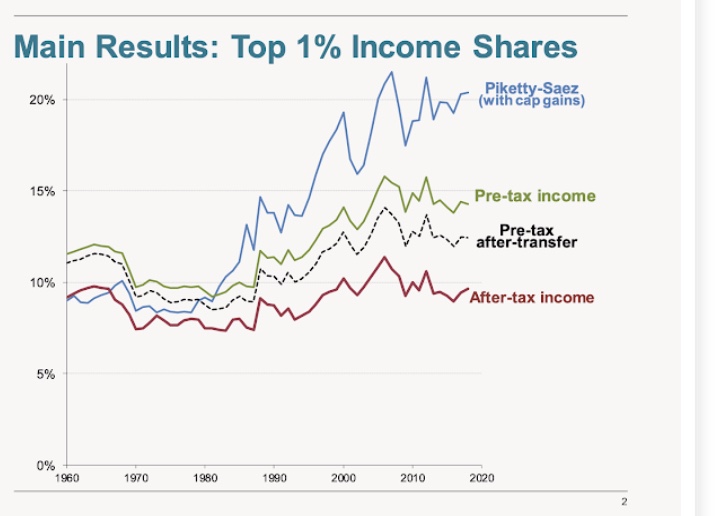
John Cochrane shares the details of a recent presentation made by Auten and Splinter (AS) at the Hoover Institution. A few interesting charts follow:

The blue “Piketty-Saez” (PS) line at the top uses an income measure from well-known research by Thomas Piketty and Emanuel Saez that contributed to the narrative of growing income inequality. The PS line is based on tax return information (fiscal income), but it embeds several distortions.

Realized capital gains are counted there, which misrepresents income shares because the realization of gains does not mark the point at which the true gains occur. Typically, the wealth exists before and after the gains are realized. Realized gains are often a function of changes in tax law and investor reaction to those changes. Moreover, neither realized nor unrealized gains represent income earned in production; instead, they capture changes in asset prices.

Income earned in production is about a third more than the income measure used by PS, even with the capital gains distortion. This omitted income and its allocation across earners is the subject of detailed analysis by AS. Their analysis is consistent in its focus on individual taxpayers, rather than households, which eliminates another upward bias in the PS line created by a secular decline in marriage rates. Then, AS consider the reallocation of income shares due to taxes and transfer payments. After all that, the income share of the top 1% shifts all the way down to the red line in the chart. The most recent observations put the share about where it was in the 1960s. 

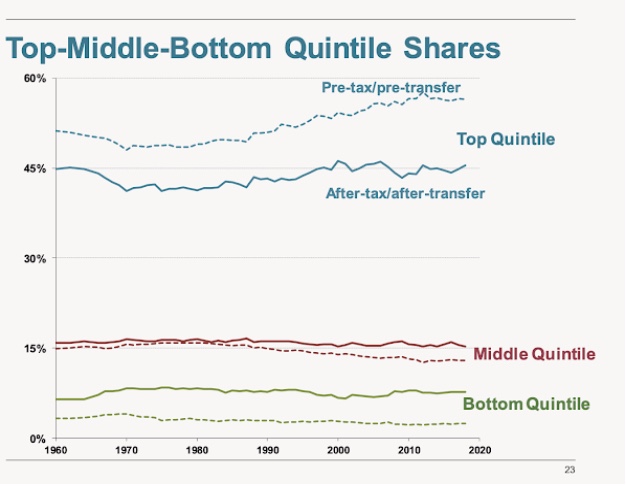
The next chart shows income shares for broader segments: the top, middle, and lowest 20% of the income distribution. Taxes and transfers cause massive changes in the calculated shares and their trends over time. Again, these shares remain about where they were in the 1960s, contradicting the popular narrative that high earners are gobbling up ever larger pieces of the pie.

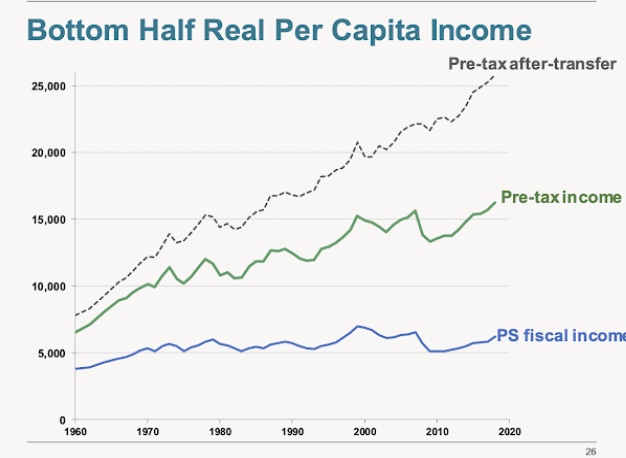
If income shares have remained about the same since the 1960s, that means high and low earners have made roughly equivalent income gains over that time. The next chart demonstrates that the bottom half of the income distribution has indeed seen significant growth in real incomes, despite the false impression created by PS and the common misperception of stagnant income growth among the working class. 

More Distributional Tidbits 

In a sense, all this is misleading because there is so much migration across the income distribution over time. Traditional calculations of income shares are “cross-sectional”, meaning they compare the same slices of the distribution at different points in time. But people near the low end in 1990 are not the same people near the bottom today. The same is true of those near the top and those in the middle. Income grows over time, and those lower in the distribution typically migrate upward as they age and acquire skills and work experience. Upward migration in income share is the general tendency, but there is some downward migration as well. Abandoning the cross-sectional view causes the typical story-line of rising income inequality to unravel.

There are many other interesting facts (and some great charts) in the AS paper and in Cochran’s post. One in particular shows that the average federal tax rate paid by the top 1% trended upward from the 1960s through the mid-1990s before flattening and trending slightly downward. This contradicts the assertion that high earners paid much higher taxes before the 1960s than today. In fact, the tax base broadened over that time, more than compensating for declines in marginal tax rates. 

Given the fact that more exacting measures of inequality haven’t changed much over the years, does that imply that redistributional policies have worked to keep the income distribution from worsening? That seems plausible on its face. If anything, taxes on high earners have increased, as have transfers to low earners and non-earners. Those changes appear to have offset other factors that would have led to greater inequality. However, the framing of the question is inappropriate. Maintaining a given income distribution is not a good thing if it inhibits economic growth. In fact, faster growth in production and greater well-being might well have led to a more unequal distribution of income. In other words, the whole question of offsetting inequality via redistribution is something of a chimera in the absence of a reliable counter-factual.

Wealth

Cochrane has a related post on the sources of wealth in America. Increasingly over the past few decades, wealth has been accumulated by self-made entrepreneurs, rather than through inheritance. That might come as a surprise to many on the left, to the extent that they care. Cochrane quotes Paul Graham on this point:

“In 1982 the most common source of wealth was inheritance. Of the 100 richest people, 60 inherited from an ancestor. There were 10 du Pont heirs alone. By 2020 the number of heirs had been cut in half, accounting for only 27 of the biggest 100 fortunes.

Why would the percentage of heirs decrease? Not because inheritance taxes increased. In fact, they decreased significantly during this period. The reason the percentage of heirs has decreased is not that fewer people are inheriting great fortunes, but that more people are making them.

How are people making these new fortunes? Roughly 3/4 by starting companies and 1/4 by investing. Of the 73 new fortunes in 2020, 56 derive from founders’ or early employees’ equity (52 founders, 2 early employees, and 2 wives of founders), and 17 from managing investment funds.”

The picture that emerges is one of great opportunity and dynamism. While the accumulation of massive fortunes might enrage the Left, these are the kinds of outcomes we should hope for, especially because the success of these new titans of industry is inextricably linked to tremendous value captured by their customers and lucrative opportunities for their employees. 

Here’s the best part of Cochrane’s post:

“We should not think about more or less inequality, we should think about the right amount of inequality, or productive vs. rent-seeking sources of inequality. Or, better, whether inequality is a symptom of health or sickness in the economy. Take Paul’s picture of the US economy at face value. What’s a better economy and society? One in which a few oligopolies … , deeply involved with government, run everything — think GM, Ford, IBM, AT&T, defense contractors — and it’s hard to start new innovative fast growing companies? Or the world in which the Bill Gates and Steve Jobs of the world can start new companies, deliver fabulous products and get insanely rich in the process? “

No doubt about it! However, today’s tremendously successful tech entrepreneurs also give us something to worry about. They have become oligarchs capable of suppressing competitive forces through sheer market power, influence, and even control over politicians and regulators. As I said at the top, whether inequality is benign depends upon the conditions governing its evolution. And today, we see the ominous development of a corporate-state tyranny, as decried by Joel Kotkin in this excellent post. Many of the daring tech entrepreneurs who benefitted from advantages endowed by our capitalist system have become autocrats who seek to plan our future with their own ideologies and self-interest in mind.

Conclusion

For too long we’ve heard the Left bemoan an increasingly “unfair” distribution of income. This includes propaganda intended to distort poverty levels in the U.S. The fine points of measuring shifts in the income distribution show that narrative to be false. Moreover, attempting to equalize the distribution of income, or even preventing changes that might occur as a natural consequence of innovation and growth, is not a valid policy objective if our goal is to maximize economic well-being.

The worst thing about inequality is that the poorest individuals are likely to be destitute and with no ability or means of supporting themselves. There is certainly such an underclass in the U.S., and our social safety net helps keep the poorest and least capable individuals above the poverty line after transfer payments. But too often our efforts to provide support interfere with incentives for those who are capable of productive work, which is both demeaning for them and a drain on everyone else. The best prescription for improving the well-being of all is economic growth, regardless of its impact on the distribution of income or wealth.

Diversity of Thought Matters

14 Sunday Jun 2020

Posted by Nuetzel in Censorship, Identity Politics, Tyranny

≈ Leave a comment

Tags

ActBlue Charities, Black Lives Matter, Censorship, George Floyd, Identity Politics, Inequality, Joe Biden, Poverty, racism, STEM, Thomas Sowell, UC-Berkeley, Viewpoint Diversity, ZeroHedge

Here’s an extraordinary letter written last week by a UC-Berkeley history professor to his colleagues. I link to a reprint on ZeroHedge because it was easier to read on my phone than the original source. The letter is anonymous, but it’s authenticity has been verified by well-known colleagues of the author outside the UC system, including Thomas Sowell of Stanford. In the first instance, it is a reaction to recent departmental and university communications, but the issues are much broader. The author, a self-described person of color, is embittered by the tyranny of groupthink that has characterized the reaction to George Floyd’s murder, the “soft bigotry of low expectations’ for blacks, and the virtual beatification of a man with a long and brutal rap sheet. The letter is an ominous warning that basic freedoms are at risk, not to mention intellectual integrity. Here are some salient points from the letter:

  • “I could not find a single instance of substantial counter-argument or alternative narrative to explain the under-representation of black individuals in academia or their over-representation in the criminal justice system. The explanation provided in your documentation, to the near exclusion of all others, is univariate: the problems of the black community are caused by whites, or, when whites are not physically present, by the infiltration of white supremacy and white systemic racism into American brains, souls, and institutions.“
  • “The claim that the difficulties that the black community faces are entirely causally explained by exogenous factors in the form of white systemic racism, white supremacy, and other forms of white discrimination remains a problematic hypothesis that should be vigorously challenged by historians. Instead, it is being treated as an axiomatic and actionable truth without serious consideration of its profound flaws, or its worrying implication of total black impotence.“
  • “… consider the proportion of black incarcerated Americans. This proportion is often used to characterize the criminal justice system as anti-black. However, if we use the precise same methodology, we would have to conclude that the criminal justice system is even more anti-male than it is anti-black. … Would we characterize criminal justice as a systemically misandrist conspiracy against innocent American men? I hope you see that this type of reasoning is flawed, and requires a significant suspension of our rational faculties. Black people are not incarcerated at higher rates than their involvement in violent crime would predict. This fact has been demonstrated multiple times across multiple jurisdictions in multiple countries.
  • “I personally don’t dare speak out against the BLM narrative, and with this barrage of alleged unity being mass-produced by the administration, tenured professoriat, the UC administration, corporate America, and the media, the punishment for dissent is a clear danger at a time of widespread economic vulnerability. I am certain that if my name were attached to this email, I would lose my job and all future jobs, even though I believe in and can justify every word I type.“
  • “The vast majority of violence visited on the black community is committed by black people. There are virtually no marches for these invisible victims, no public silences, no heartfelt letters from the UC regents, deans, and departmental heads. The message is clear: Black lives only matter when whites take them. Black violence is expected and insoluble, while white violence requires explanation and demands solution. Please look into your hearts and see how monstrously bigoted this formulation truly is. … No discussion is permitted for nonblack victims of black violence, who proportionally outnumber black victims of nonblack violence.“
  • “… our department appears to have been entirely captured by the interests of the Democratic National Convention, and the Democratic Party more broadly. To explain what I mean, consider what happens if you choose to donate to Black Lives Matter, an organization UCB History has explicitly promoted in its recent mailers. All donations to the official BLM website are immediately redirected to ActBlue Charities, an organization primarily concerned with bankrolling election campaigns for Democrat candidates. Donating to BLM today is to indirectly donate to Joe Biden’s 2020 campaign.“
  • … our university and department has made multiple statements celebrating and eulogizing George Floyd. Floyd was a multiple felon who once held a pregnant black woman at gunpoint. He broke into her home with a gang of men and pointed a gun at her pregnant stomach. He terrorized the women in his community. He sired and abandoned multiple children, playing no part in their support or upbringing, failing one of the most basic tests of decency for a human being. He was a drug-addict and sometime drug-dealer, a swindler who preyed upon his honest and hard-working neighbors. … And yet, the regents of UC and the historians of the UCB History department are celebrating this violent criminal, elevating his name to virtual sainthood. A man who hurt women. A man who hurt black women. With the full collaboration of the UCB history department, corporate America, most mainstream media outlets, and some of the wealthiest and most privileged opinion-shaping elites of the USA, he has become a culture hero, buried in a golden casket, his (recognized) family showered with gifts and praise. Americans are being socially pressured into kneeling for this violent, abusive misogynist. A generation of black men are being coerced into identifying with George Floyd, the absolute worst specimen of our race and species.”
  • “My family have been personally victimized by men like Floyd. We are aware of the condescending depredations of the Democrat party against our race. The humiliating assumption that we are too stupid to do STEM, that we need special help and lower requirements to get ahead in life, is richly familiar to us. … The ever-present soft bigotry of low expectations and the permanent claim that the solutions to the plight of my people rest exclusively on the goodwill of whites rather than on our own hard work is psychologically devastating. No other group in America is systematically demoralized in this way by its alleged allies. A whole generation of black children are being taught that only by begging and weeping and screaming will they get handouts from guilt-ridden whites.“

There is much more in the letter. Some will dismiss the letter based on the author’s decision to remain anonymous, but one can hardly find fault with that in today’s suffocating intellectual environment. There are many others who remain silent because they either fear the consequences, distain the questions, or wish to be polite. My only other reservation about the letter is the author’s failure to acknowledge George Floyd’s efforts to reform, which were obviously in vain. Those efforts and his murder should not elevate Floyd to an heroic status. Nevertheless, his victimhood qualifies him as a legitimate symbol of police brutality, if not racism.

While much of academia has been swallowed whole by vapid identitarianism and scientism over science and rational thought, the history professor has managed to survive in what might be the hottest bed of leftist extremism in the country at UC-Berkeley. I hope the professor has a long and influential career.

Inequality and Inequality Propaganda

21 Saturday Dec 2019

Posted by Nuetzel in Income Distribution, Inequality, Uncategorized

≈ Leave a comment

Tags

Alexandria Ocasio-Cortez, Bernie Sanders, Capitalism, Consumer Surplus, David Splinter, Declaration of Independence, Declination blog, Diffusion of Technology, Economic Mobility, Edward F. Leamer, Elizabeth Warren, Gerald Auten, Income Distribution, Inequality, J. Rodrigo Fuentes, Jeff Jacoby, Luddite, Marginal cost, Mark Perry, Marriage Rates, Pass-Through Income, Redistribution, Robert Samuelson, Scalability, Thales, Uber, Workaholics

I’m an “inequality skeptic”, first, with respect to its measurement and trends; and second, with respect to its consequences. Economic inequality in the U.S. has not increased over the past 60 years as often claimed. And some degree of ex post inequality, in and of itself, has no implication for real economic well-being at any point on the socioeconomic spectrum, the growls of class-warmongers aside. So I’m not just a skeptic. I’m telling you the inequality narrative is BS! The media has been far too eager to promote distorted metrics that suggest widening disparities and presumed injustice. Left-wing politicians such as Bernie Sanders, Elizabeth Warren, and Alexandra Ocasio-Cortez pounce on these reports with opportunistic zeal, fueling the flames of class warfare among their sycophants.

Measurement

Comparisons of income groups and their gains over time have been plagued by a number of shortcomings. Jeff Jacoby reviews issues underlying the myth of a widening income gap. Today, the top 1% earns about the same share of income as in the early 1960s, according to a recent study by two government economists, Gerald Auten and David Splinter.

Jacoby recounts distortions in the standard measures of income inequality:

  • The comparisons do not account for tax burdens and redistributive government transfer payments, which level incomes considerably. As for tax burdens, the top 1% paid more taxes in 2018 than the bottom 90% combined.
  • The focus of inequality metrics is typically on households, the number of which has expanded drastically with declines in marriage rates, especially at lower income levels. Incomes, however, are more equal on a per capital basis.
  • The use of pension and retirement funds like IRAs and 401(k) plans has increased substantially over the years. The share of stock market value owned by retirement funds increased from just 4% in 1960 to more than 50% now. As Jacoby says, this has “democratized” gains in asset prices.
  • A change in the tax law in 1986 led to reporting of more small business income on individual returns, which exaggerated the growth of incomes at the high-end. That income had already been there.
  • People earn less when they are young and more as they reach later stages of their careers. That means they move up through the income distribution over time, yet the usual statistics seem to suggest that the income groups are static. Jacoby says:

“Contrary to progressive belief, America is not divided into rigid economic strata. The incomes of the wealthy often decline, while many taxpayers go from being poor at one point to not-poor at another. Research shows that more than one-tenth of Americans will make it all the way to the top 1 percent for at least one year during their working lives.”

Mark Perry recently discussed America’s record middle-class earnings, emphasizing some of the same subtletles listed above. A middle income class ($35k-$100k in constant dollars) has indeed shrunk over the past 50 years, but most of that decrease was replaced by growth in the high income strata (>$100k), and the lower income class (<$35k) shrank almost as much as the middle group in percentage terms.

Causes

What drives the inequality we actually observe, after eliminating the distortions mentioned above? The reflexive answer from the Left is capitalism, but capitalism fosters great social and economic mobility relative to authoritarian or socialist regimes. That a few get fabulously rich under capitalism is often a positive attribute. A friend of mine contends that most of the great fortunes made in recent history involve jobs for which the product or service produced is highly scalable. So, for example, on-line software and networks “scale” and have produced tremendous fortunes. Another way of saying this is that the marginal cost of serving additional customers is near zero. However, those fortunes are earned because consumers extract great value from these products or services: they benefit to an extent exceeding price. So while the modern software tycoon is enriched in a way that produces inequality in measured income, his customers are enriched in ways that aren’t reflected in inequality statistics.

Mutually beneficial trade creates income for parties on only one side of a given transaction, but a surplus is harvested on both sides. For example, an estimate of the consumer surplus earned in transactions with the Uber ride-sharing service in 2015 was $1.60 for every dollar of revenue earned by Uber! That came to a total of $18 billion of consumer surplus in 2015 from Uber alone. These benefits of free exchange are difficult to measure, and are understandably ignored by official statistics. They are real nevertheless, another reason to take those statistics, and inequality metrics, with a grain of salt.

Certain less lucrative jobs can also scale. For example, the work of a systems security manager at a bank produces benefits for all customers of the bank, and at very low marginal cost for new customers. Conversely, jobs that don’t scale can produce great wealth, such as the work of a highly-skilled surgeon. While technology might make him even more productive over time, the scalability of his efforts are clearly subject to limits. Yet the demand for his services and the limited supply of surgical skills leads to high income. Here again, both parties at the operating table make gains (if all goes well), but only one party earns income from the transaction. These examples demonstrate that standard metrics of economic inequality have severe shortcomings if the real objective is to measure differences in well-being. 

Economist Robert Samuelson asserts that “workaholics drive inequality“, citing a recent study by Edward E. Leamer and J. Rodrigo Fuentes that appeals to statistics on incomes and hours worked. They find the largest income gains have accrued to earners with high educational attainment. It stands to reason that higher degrees, and the longer hours worked by those who possess them, have generated relatively large income gains. Samuelson also cites the ability of these workers to harness technology. So far, so good: smart, hard-working students turn into smart, hard workers, and they produce a disproportionate share of value in the marketplace. That seems right and just. And consumers are enriched by those efforts. But Samuelson dwells on the negative. He subscribes to the Ludditical view that the gains from technology will accrue to the few:

“The Leamer-Fuentes study adds to our understanding by illuminating how these trends are already changing the way labor markets function. … The present trends, if continued, do not bode well for the future. If the labor force splits between well-paid workaholics and everyone else, there is bound to be a backlash — there already is — among people who feel they’re working hard but can’t find the results in their paychecks.“

That conclusion is insane in view of the income trends reviewed above, and as a matter of economic logic: large income gains might accrue to the technological avant guarde, but those individuals buy things, generating additional demand and income gains for other workers. And new technology diffuses over time, allowing broader swaths of the populace to capture value both in consumption and production. Does technology displace some workers? Of course, but it also creates new, previously unimagined opportunities. The history of technological progress gives lie to Samuelson’s perspective, but there will always be pundits to say “this time it’s different”, and it probably sounds heroic to their ears.

Consequences

The usual discussions of economic inequality in media and politics revolve around an egalitarian ideal, that somehow we should all be equal in an absolute and ex post sense. That view is ignorant and dangerous. People are not equal in terms of talent and their willingness to expend effort. In a free society, the most talented and motivated individuals will produce and capture more value. Attempts to make it otherwise can only interfere with freedoms and undermine social welfare across the spectrum. This post on the Declination blog, “The Myth of Equality“, is broader in its scope but makes the point definitively. It quotes the Declaration of Independence:

“We hold these truths to be self-evident, that all men are created equal, that they are endowed by their Creator with certain unalienable Rights, that among these are Life, Liberty and the Pursuit of Happiness.”

The poster, “Thales”, goes on to say:

“The context of this was within an implied legal framework of basic rights. All men have equal rights granted by God, and a government is unjust if it seeks to deprive a man of these God-given rights. … This level of equality is both the basis for a legal framework limiting the power of government, and a reference to the fact that we all have souls; that God may judge them. God, being omniscient, can be an absolute neutral arbiter of justice, having all the facts, and thus may treat us with absolute equality. No man could ever do this, though justice is often better served by man at least making a passing attempt at neutrality….”

Attempts to go beyond this concept of ex ante equality are doomed to failure. To accept that inequalities must always exist is to acknowledge reality, and it serves to protect rights and opportunities broadly. To do otherwise requires coercion, which is violent by definition. In any case, inequality is not as extreme as standard metrics would have us believe, and it has not grown more extreme.

Climbing Up: Economic Mobility In the U.S.

29 Monday Oct 2018

Posted by Nuetzel in Inequality, Markets, Redistribution

≈ Leave a comment

Tags

Economic Mobility, Income Distribution, Inequality, Living Standards, Middle Class Stagnation, Non-Wage Income, Panel Data, Russ Roberts, Unreported Income

One of the great sacred cows of current economic discourse is that U.S. living standards have been stagnant for decades, coincident with a severe lack of economic mobility (I know, those are goats!). These assertions have been made by people with the training to know better, and by members of the commentariat who certainly would not know better. But Russ Roberts has a great article on the proper measurement of these trends and how poorly that case stacks up. I have made some of the same points in the past (and here), but Roberts’ synthesis is excellent.

Those who insist that income growth has languished or even declined in real terms over the past 40 years have erred in several ways. They usually ignore non-wage benefits (for which workers often receive favorable tax treatment) and other forms of income. Roberts notes that income tax returns leave about 40% of income unreported, and a lot of it goes to individuals in lower income strata. In addition, the studies often use flawed inflation gauges, fail to adjust correctly for various demographic trends in the identification of “households”, and most importantly, fail to follow the same individuals over time. The practice of taking “snapshots” of the income distribution at two different points in time, and then comparing the same percentiles from those snapshots, is inappropriate for addressing the question of income mobility. Instead, the question is how specific individuals or cohorts have migrated across time. Generally incomes grow as people age through their working lives.

Roberts discusses some studies that follow individuals over time, rather than percentiles, to see how they have fared:

From a study comparing the 1960s and the early 2000s:

“… 84% earned more than their parents, corrected for inflation. But 93% of the children in the poorest households, the bottom 20% surpassed their parents. Only 70% of those raised in the top quintile exceeded their parent’s income.”

 In another study compared children born in 1980:

“… 70% of children born in 1980 into the bottom decile exceed their parents’ income in 2014. For those born in the top 10%, only 33% exceed their parents’ income.”

Another study finds:

“The children from the poorest families ended up twice as well-off as their parents when they became adults. The children from the poorest families had the largest absolute gains as well. Children raised in the top quintile did no better or worse than their parents once those children became adults.”

The next study cited by Roberts compares adults at two stages of life:

“The study looks at people who were 35–40 in 1987 and then looks at how they were doing 20 years later, when they are 55–60. The median income of the people in the top 20% in 1987 ended up 5% lower twenty years later. The people in the middle 20% ended up with median income that was 27% higher. And if you started in the bottom 20%, your income doubled. If you were in the top 1% in 1987, 20 years later, median income was 29% lower.”

And here’s one more:

“… when you follow the same people, the biggest gains go to the poorest people. The richest people in 1980 actually ended up poorer, on average, in 2014. Like the top 20%, the top 1% in 1980 were also poorer on average 34 years later in 2014.”

These studies show impressive mobility across the income distribution, but is it still true that overall incomes have been flat? No, for reasons mentioned earlier: growth in benefits and unreported income have been dramatic, and inflation measures used to “deflate” nominal income income gains are notoriously poor. When the prices of many goods are expressed in terms of labor hours, there is no doubt that living standards have advanced tremendously. It is all the more impressive in view of the quality improvements that have occurred over the years.

The purported income stagnation and lack of mobility are also said to be associated with an increasingly unequal distribution of income. The OECD reports that the distribution of income in the U.S. is relatively unequal compared to other large, developed countries, but the definitions and accuracy of these comparisons are not without controversy. A more accurate accounting for incomes after redistribution via taxes and transfer payments would place the U.S. in the middle of the pack. And while measures of income inequality have trended upward, consumption inequality has not, which suggests that the income comparisons may be distorted.

Contrary to the oft-repeated narrative, U.S. living standards have not stagnated since the 1970s, nor have U.S. households been plagued by a lack of economic mobility. It’s easy to understand the confusion suffered by journalists on these points, but it’s horrifying to realize that such mistaken interpretations of data are actually issued by economists. Even more disappointing is that these misguided narratives are favorite talking points of class warriors and redistributionists, whose policy recommendations would bring-on real stagnation and immobility. That’s the subject of a future post, or posts. For now, I’ll let it suffice to say that it is the best guarantee of mobility is the preservation of economic freedom and opportunity by limiting the size and scope of government, creating a more neutral tax code, and encouraging markets to flourish.

Egalitarian Aggression

15 Thursday Oct 2015

Posted by Nuetzel in Big Government, Equality, Liberty

≈ Leave a comment

Tags

Comparative advantage, Dylan Matthews, Egalitarianism, Equality of Opportunity, Inequality, Integrity of the Family, John Rawls, Llewellyn Rockwell Jr., Mises Institute, Redistribution, Robert Nisbet, The Mises Daily, Vox, Wilt Chamberlain Problem

communism Lady liberty in rear view mirror

In what sense is “equality” a rational objective? Can it ever be achieved without aggression? It’s certainly admirable for individuals to treat all others fairly and without bias against personal traits. A society composed of individuals possessing that kind of integrity is one in which “equal opportunity” exists in an intuitive sense. Such a society would yield market outcomes that are free from personal discrimination.

There are many social pitfalls when central authorities attempt to enforce this sort of equality. There will always be minor and even random cases of treatment that someone considers unfair. Any effort to adjudicate such incidents comes at a great resource cost. The potential for moral hazard in pursuing grievances is also strong, and the enforcement authority may well have biases of its own.

Stronger forms of equality are even more difficult to achieve in a free society. There are many barriers to “equality” that most people would regard as natural, like genetics and the integrity of the family. And like family, many other barriers to equality are cultural virtues, such as educational and occupational rewards based on merit. The institution of strong private property rights provides an effective system of incentives that fosters efficient resource allocation, promoting economic growth and human well-being, but it’s rewards will not be distributed equally.

Institutionalized tampering with any of these features for the sake of equality tends to legitimize envy as a cause of social action. And the intrusions require design and enforcement of a system of social “overrides” by a central authority possessing police power. Needless to say, this must involve elements of aggression and tyranny. These overrides introduce significant risks to individual freedom and the functioning of markets, and are likely to cause widespread destruction of welfare. In that sense, forced equality cannot be a rational objective.

These points are developed more fully in “The Menace of Egalitarianism“, a piece by Llewellyn Rockwell Jr. at the Mises Daily blog.

“A libertarian is perfectly at peace with the universal phenomenon of human difference. He does not wish it away, he does not shake his fist at it, he does not pretend not to notice it. It affords him another opportunity to marvel at a miracle of the market: its ability to incorporate just about anyone into the division of labor. … Indeed the division of labor is based on human difference.“

Rockwell goes on to explain the law of comparative advantage, which allows more productive and less productive individuals to profit by specializing in areas for which each has the lowest opportunity cost. And when producers compete for rewards, as Rockwell notes, average consumers (and rich ones and poor ones) are the ultimate beneficiaries.

Outcomes such as the inequality of wealth and income are not only impossible to avoid, they are natural consequences of economic freedom. Several earlier posts on Sacred Cow Chips have dealt with this topic, and can be viewed from the Home page by typing “inequality” into the search box near the top. For his part, Rockwell discusses the “Wilt Chamberlain” problem, whereby private demand to witness great athletic prowess results in a shift towards an unequal distribution of income:

“… the pattern of wealth distribution is disturbed as soon as anyone engages in any exchange at all. Are we to cancel the results of all these exchanges and return everyone’s money to the original owners? Is Chamberlain to be deprived of the money people freely chose to gave [sic] him in exchange for the entertainment he provided?“

The fact that “equality” is seldom well-defined as an actual objective should be met with skepticism. Here’s more Rockwell:

“It is precisely this lack of clarity that makes the idea of equality so advantageous for the state. No one is entirely sure what the principle of equality commits him to. And keeping up with its ever-changing demands is more difficult still. … Equality is a concept that cannot and will not be kept restrained or nailed down.”  

He takes a dismal view of “cultural inequality” and “equality of opportunity” as worthwhile causes for invoking the power of the state. For example, two families in different economic circumstances will generally confer different opportunities to their children. Dylan Matthews at Vox makes the same point in “Equality of Opportunity“, though Matthews’ analysis is weak in several respects. The point here is that there is only so much that can be done to correct for unequal family-related endowments without undermining the integrity of the family (not to mention property rights). This has long been a bone of contention with respect to the design of U.S. welfare programs. But the problem is much deeper:

“In the course of working toward equality, the state expands its power at the expense of other forms of human association, including the family itself. The family has always been the primary obstacle to the egalitarian program. The very fact that parents differ in their knowledge, skill levels, and devotion to their offspring means that children in no two households can ever be raised ‘equally.’

Robert Nisbet, the Columbia University sociologist, openly wondered if [John] Rawls would be honest enough to admit that his system, if followed to its logical conclusion, had to lead to the abolition of the family. ‘I have always found treatment of the family to be an excellent indicator of the degree of zeal and authoritarianism, overt or latent, in a moral philosopher or political theorist,’ Nisbet said.“

And here is Rawls himself expressing doubts, as quoted by Rockwell:

“It seems that when fair opportunity (as it has been defined) is satisfied, the family will lead to unequal chances between individuals. Is the family to be abolished then? Taken by itself and given a certain primacy, the idea of equal opportunity inclines in this direction.“

The quest for “equality” is a creeping force. It infects economic life in a way that makes widespread gains in welfare difficult to achieve, diminishes expectations and fosters social devolution. It also leads to demands for eliminating useful distinctions, which can only be erased though aggression by the state. This forces a convergence toward the least common denominator throughout the culture. I believe the following statement by Rockwell rings true:

“The obsession with equality… undermines every indicator of health we might look for in a civilization. It involves a madness so complete that although it flirts with the destruction of the family…. It leads to the destruction of standards — scholarly, cultural, and behavioral. It is based on assertion rather than evidence, and it attempts to gain ground not through rational argument but by intimidating opponents into silence. There is nothing honorable or admirable about any aspect of the egalitarian program.“

The Government Inequality Machine

17 Wednesday Jun 2015

Posted by Nuetzel in Big Government

≈ Leave a comment

Tags

Beautiful Anarchy, Cronyism, Export-Import Bank, Housing Policy, Inequality, Intellectual Property Rights, Jeffrey Tucker, Kevin Erdmann, National Review, Redistribution, regulation, rent seeking, Robert P. Murphy, Scott Sumner, The Freeman, Thomas Piketty, Welfare for the Rich

Cronyism cartoon

Some perceive the government as an ideal agent of redistribution, but they fail to apprehend the many ways in which government policy undermines equality. Scott Sumner and Kevin Erdmann have written an excellent essay on this point entitled “Here’s What’s Driving Inequality” at National Review. They focus on three areas of government action with the unavoidable side-effect of upward redistribution: housing policy (at all levels of government), regulation, and excessive protections for intellectual property.

Sumner and Erdmann briefly cover Thomas Piketty’s controversial view that wealth becomes increasingly concentrated under conditions of secular stagnation. However, they note that over the past few decades:

“... almost the entire change in the share of domestic income going to capital in major developed economies was explained by rising rents on residential real estate. Non-rental capital income (including the corporate sector) still has a fairly stable share of domestic income.“

Housing policy has driven rents upward in myriad ways. For example, restrictive zoning laws, environmental regulation of new building and regulation of bank lending have all made homeownership less feasible and renting more expensive. If you’re already in your own home, you’re safe! If not, welcome to the have-nots! Here’s a story on government insurance programs that offer massive subsidies to wealthy homeowners. All these redistributional effects are compounded by a tax code that has inflated housing prices through the home mortgage interest deduction, and at the same time inflated rents via the incidence of higher taxes on rental income and real estate capital gains.

Regulation of private business activity is often viewed naively as a necessary, protective function of government, but regulation acts in perverse ways:

“Unfortunately, many government regulations tend to favor larger firms. In recent years we have seen the passage of some extremely complex regulations involving thousands of pages of rules, such as Sarbanes-Oxley, Dodd-Frank, and the Affordable Care Act. The Food and Drug Administration, the Department of Defense, and the public health-care complex tend to create opportunities for uber-firms within industries, which act as clearinghouses for public contracts and regulatory demands.”

Large firms tend to pay higher wages and salaries than small firms. By favoring large firms, regulation in turn favors their relatively high-income workers. In addition, regulation such as occupational licensing, labor regulations and local wage controls damage the health and growth potential of small firms and the mobility of individuals at the bottom of the economic ladder.

Finally, Sumner and Erdmann discuss the often bizarre extension of intellectual-property (IP) rights and the way it favors large firms:

“Copyright protections once lasted for 14 years, applied only to maps and books, and could be renewed once if the author was still alive. Now they’ve been extended to many other products, extend for 50 years after the death of the author, and last for at least 95 years for corporations. These extensions are widely seen as reflecting the lobbying power of companies such as Disney. In the high-tech sector, patents are often granted for seemingly minor and obvious innovations.“

Sacred Cow Chips featured a piece on IP several months ago called “Is The Patent a Perversion?” The Libertarian view of IP is skeptical, to say the least, and favors limited protection at most. In that post, I quoted Jeffrey Tucker of the Beautiful Anarchy blog:

“Through intellectual property laws, the state literally assigned ownership to ideas that are the source of innovation, thereby restricting them and entangling entrepreneurs in endless litigation and confusion. Products are kept off the market. Firms that would come into existence do not. Profits that would be earned never appear. Intellectual property has institutionalized slow growth and landed the economy in a thicket of absurdity.“

There is little doubt that economic mobility is not well served by excessive grants of IP rights that extend monopolies indefinitely.

Government fosters inequality in many other ways. The mere existence of a confiscatory mechanism for legal revenue collection, and a complex bureaucracy in charge of distributing the spoils and making rules, will always attract high-powered rent-seeking resources and encourage cronyism. It is a graft machine. The very complexity of the tax code creates fertile ground for transfers via obscure breaks and carve-outs, while higher tax rates on others are required to fund the exceptions. Here’s another: the Export-Import Bank, which subsidizes exports for large corporations. A nice run-down of some of the many areas of “Welfare for the Rich” was provided a few years ago by Robert P. Murphy in The Freeman.

Unfortunately, direct efforts by the government to help the poor are often mere palliatives. At the same time, many of these programs are notorious for destroying work incentives, which undermines equality and economic mobility.

Government is simply not as well-suited to promoting equality as well-functioning markets, free of government meddling and government grants of monopoly. Profits in such markets attract new resources that compete away excess returns and bid prices downward, actions that tend to promote equality. The opportunity to compete without restraint not only vitiates artificial or permanent claims to profits; along with strong property rights, it encourages invention, economic mobility and growth.

The Dire Wolf’s Collectivist Dues

24 Saturday Jan 2015

Posted by Nuetzel in Taxes

≈ Leave a comment

Tags

529 Plans, Capital Gains Tax, Collectivism, Dire Wolf, Glenn Reynolds, Inequality, Market Inequality, Megan McArdle, Obama Tax Plan, Redistribution, Robert Higgs, Sheldon Richman, State of the Union, Statist Inequality

wolf mask

Inequality does not imply poverty for anyone, and inequality is a reasonable outcome of voluntary economic interactions between individuals who vary in their ability to create value. But inequality arising from artificial advantages conferred by the force of government and cronyism is indefensible. Sheldon Richman draws this useful distinction between the market’s distribution of rewards, which is a consequence of an unequal distribution of value-creating energy, ingenuity and talent, as opposed to the unequal rewards of a system of centralized control in which subsidies flow to cronies, monopolists are protected, barriers to activity are erected and political elites enjoy the fruits of value-destroying privilege. Here’s a sample from Richman’s post:

“Unlike market inequality, political-economic inequality is unjust and should be eliminated. … How? By abolishing all direct and indirect subsidies; artificial scarcities, such as those created by so-called intellectual property; regulations, which inevitably burden smaller and yet-to-be-launched firms more than lawyered-up big businesses; eminent domain; and permit requirements, zoning, and occupational licensing, which all exclude competition. …

Instead of symbolically tweaking the tax code to appear to be addressing inequality—the politicians’ charade—political-economic inequality should be ended by repealing all privileges right now.”

And yet we get fatuous rants from Obama about the ravages of market inequality and more tweaking of the tax code. Tweaking is too kind a word. The State of the Union address last week was a collectivist’s wet dream, replete with visions of central planning and a long list of non-neutral incentives and favors for the president’s base. He did his best to stoke the flames of class division and envy. One must ask: how long can the surviving market economy and a shrinking share of actual taxpayers support the growing dependent class and the nonproductive state apparatus?

In “Uncle Sam Is Coming After Your Savings?“, Megan McArdle warns of the dire wolf waiting at the door of every hopeful saver and middle class taxpayer. She cites Obama’s proposed tax on college savings plans (529s) as one piece of evidence, and asks “How would you feel if they did this to Roth IRAs”?

“… the very fact that we are discussing taxation of educational savings — redistributing educational subsidies downward — indicates that the administration has started scraping the bottom of the barrel when seeking out money to fund new programs. Why target a tax benefit that goes to a lot of your supporters (and donors), that tickles one of the sweetest spots in American politics (subsidizing higher education), and that will hit a lot of people who make less than the $250,000 a year that has become the administration’s de facto definition of ‘rich’?”

Then there’s the proposed elimination of the stepped-up tax basis at death, covered a few days ago at this blog, and the increase in the tax rate on capital gains and already double-taxed dividends from 24% to 28%. Of this, and the more general issue of investment incentives and efficient revenue generation, McArdle says:

“… we don’t try to tax the bejesus out of capital income, much as many would like to; old capital flees, and new capital doesn’t get formed, as savers decide it’s not worth it.”

No we don’t, for now, but that lack of capital formation is a dire implication of heavier taxes for the economy. It is an achilles heal of the redistributionist policy agenda, as a lack of new capital undermines productivity, income growth and opportunity across the board. Middle-class economics? Please, no. Glenn Reynolds has some additional thoughts on McArdle’s column:

“The truth is, in our redistributionist system politicians make their careers mostly by taking money from one group of citizens that won’t vote for them and giving it to another that will. If they run short of money from traditional sources, they’ll look for new revenue wherever they can find it. And if that’s the homes and savings of the middle class, then that’s what they’ll target.

For the moment, Americans are safe. With both houses of Congress controlled by the GOP, Obama’s proposals are DOA. But over the long term, the appetite for government spending is effectively endless, while the sources of revenue are limited. Keep that in mind as you think about where to invest your money … and your votes.”

Statistics on inequality are brandished by progressives as if to prove the existence of a great market malfunction, but as Richman points out at the link given above, an extreme form of inequality is an inevitable outcome of privilege conferred by the state. On the other hand, market inequality is no tragedy for humankind. It is an artifact of the most peaceful, productive system of social coordination ever devised. Market inequality is not related in any way to the absolute welfare of the median earning family or the least fortunate, as Robert Higgs explains in this interesting essay:

“Probably no subject in the social sciences has created so much unnecessary heat. Yet, at the same time, economists actually know a great deal about it and can dispel the public’s confusion about it if they try.” [Emphasis added]

Well-Intentioned Souls For Sale

04 Thursday Dec 2014

Posted by Nuetzel in Uncategorized

≈ Leave a comment

Tags

Ayn Rand Institute, Big government, incentives, Inequality, John Cochrane, Police Power, Political contributions, Redistribution, rent seeking, statism, Steve Simpson, Thomas Piketty, Wall Street Journal

Paint_the_town_red_1885

Most would agree that power corrupts. Some believe that greater wealth begets power, yet they cling to a naive hope that larger government can protect against “evil” private accretion. These well-intentioned souls forget that those holding power in government will not always have preferences that match their own. More importantly, they fail to account for the real-world implications of concentrating power in the public sector, conveniently forgetting that “control” itself is a problematic solution to the perceived “problem” of private power. They would grant ever more controlling authority to an entity possessing the police power, managed by politicians, employees and technocrats with their own incentives for accretion. Public administrative power is often exercised by rule-making, asserting more control over private affairs. It usually results in the granting of favors and favorable treatment, compensable in various ways, to certain private parties. Big government begets big rent seeking and the subjugation of market discipline in favor of privilege. It’s a devil’s playground.

The confusion of the statists, if I can be so charitable, now extends to the desire for control over the related issues of wealth inequality and political contributions. John Cochrane, an economist from the University of Chicago, has an interesting piece on these topics on wsj.com entitled “What the Inequality Warriors Really Want” (if this is gated, try googling the author and title). He points out some of the obvious hypocrisies of those calling for more government control, including limits on political spending:

“… the inequality warriors want the government to confiscate wealth and control incomes so that wealthy individuals cannot influence politics in directions they don’t like. Koch brothers, no. Public-employee unions, yes. This goal, at least, makes perfect logical sense. And it is truly scary.”

The presumption that redistribution of income and wealth can be achieved at low cost ignores the terrible incentives that such policies create for both the nominal losers and winners. In the real world, redistribution is not zero-sum; it is negative sum with compounding. Steve Simpson of the Ayn Rand Institute has some further thoughts on Cochrane’s piece as well as the work of Thomas Piketty, the new intellectual light of the redistributive statists.

← Older posts
Follow Sacred Cow Chips on WordPress.com

Recent Posts

  • The Case Against Interest On Reserves
  • Immigration and Merit As Fiscal Propositions
  • Tariff “Dividend” From An Indigent State
  • Almost Looks Like the Fed Has a 3% Inflation Target
  • Government Malpractice Breeds Health Care Havoc

Archives

  • January 2026
  • December 2025
  • November 2025
  • October 2025
  • September 2025
  • August 2025
  • July 2025
  • June 2025
  • May 2025
  • April 2025
  • March 2025
  • February 2025
  • January 2025
  • December 2024
  • November 2024
  • October 2024
  • September 2024
  • August 2024
  • July 2024
  • June 2024
  • May 2024
  • April 2024
  • March 2024
  • February 2024
  • January 2024
  • December 2023
  • November 2023
  • August 2023
  • July 2023
  • June 2023
  • May 2023
  • April 2023
  • March 2023
  • February 2023
  • January 2023
  • December 2022
  • November 2022
  • October 2022
  • September 2022
  • August 2022
  • July 2022
  • June 2022
  • May 2022
  • April 2022
  • March 2022
  • February 2022
  • January 2022
  • December 2021
  • November 2021
  • October 2021
  • September 2021
  • August 2021
  • July 2021
  • June 2021
  • May 2021
  • April 2021
  • March 2021
  • February 2021
  • January 2021
  • December 2020
  • November 2020
  • October 2020
  • September 2020
  • August 2020
  • July 2020
  • June 2020
  • May 2020
  • April 2020
  • March 2020
  • February 2020
  • January 2020
  • December 2019
  • November 2019
  • October 2019
  • September 2019
  • August 2019
  • July 2019
  • June 2019
  • May 2019
  • April 2019
  • March 2019
  • February 2019
  • January 2019
  • December 2018
  • November 2018
  • October 2018
  • September 2018
  • August 2018
  • July 2018
  • June 2018
  • May 2018
  • April 2018
  • March 2018
  • February 2018
  • January 2018
  • December 2017
  • November 2017
  • October 2017
  • September 2017
  • August 2017
  • July 2017
  • June 2017
  • May 2017
  • April 2017
  • March 2017
  • February 2017
  • January 2017
  • December 2016
  • November 2016
  • October 2016
  • September 2016
  • August 2016
  • July 2016
  • June 2016
  • May 2016
  • April 2016
  • March 2016
  • February 2016
  • January 2016
  • December 2015
  • November 2015
  • October 2015
  • September 2015
  • August 2015
  • July 2015
  • June 2015
  • May 2015
  • April 2015
  • March 2015
  • February 2015
  • January 2015
  • December 2014
  • November 2014
  • October 2014
  • September 2014
  • August 2014
  • July 2014
  • June 2014
  • May 2014
  • April 2014
  • March 2014

Blogs I Follow

  • Passive Income Kickstart
  • OnlyFinance.net
  • TLC Cholesterol
  • Nintil
  • kendunning.net
  • DCWhispers.com
  • Hoong-Wai in the UK
  • Marginal REVOLUTION
  • Stlouis
  • Watts Up With That?
  • Aussie Nationalist Blog
  • American Elephants
  • The View from Alexandria
  • The Gymnasium
  • A Force for Good
  • Notes On Liberty
  • troymo
  • SUNDAY BLOG Stephanie Sievers
  • Miss Lou Acquiring Lore
  • Your Well Wisher Program
  • Objectivism In Depth
  • RobotEnomics
  • Orderstatistic
  • Paradigm Library
  • Scattered Showers and Quicksand

Blog at WordPress.com.

Passive Income Kickstart

OnlyFinance.net

TLC Cholesterol

Nintil

To estimate, compare, distinguish, discuss, and trace to its principal sources everything

kendunning.net

The Future is Ours to Create

DCWhispers.com

Hoong-Wai in the UK

A Commonwealth immigrant's perspective on the UK's public arena.

Marginal REVOLUTION

Small Steps Toward A Much Better World

Stlouis

Watts Up With That?

The world's most viewed site on global warming and climate change

Aussie Nationalist Blog

Commentary from a Paleoconservative and Nationalist perspective

American Elephants

Defending Life, Liberty and the Pursuit of Happiness

The View from Alexandria

In advanced civilizations the period loosely called Alexandrian is usually associated with flexible morals, perfunctory religion, populist standards and cosmopolitan tastes, feminism, exotic cults, and the rapid turnover of high and low fads---in short, a falling away (which is all that decadence means) from the strictness of traditional rules, embodied in character and inforced from within. -- Jacques Barzun

The Gymnasium

A place for reason, politics, economics, and faith steeped in the classical liberal tradition

A Force for Good

How economics, morality, and markets combine

Notes On Liberty

Spontaneous thoughts on a humble creed

troymo

SUNDAY BLOG Stephanie Sievers

Escaping the everyday life with photographs from my travels

Miss Lou Acquiring Lore

Gallery of Life...

Your Well Wisher Program

Attempt to solve commonly known problems…

Objectivism In Depth

Exploring Ayn Rand's revolutionary philosophy.

RobotEnomics

(A)n (I)ntelligent Future

Orderstatistic

Economics, chess and anything else on my mind.

Paradigm Library

OODA Looping

Scattered Showers and Quicksand

Musings on science, investing, finance, economics, politics, and probably fly fishing.

  • Subscribe Subscribed
    • Sacred Cow Chips
    • Join 128 other subscribers
    • Already have a WordPress.com account? Log in now.
    • Sacred Cow Chips
    • Subscribe Subscribed
    • Sign up
    • Log in
    • Report this content
    • View site in Reader
    • Manage subscriptions
    • Collapse this bar
 

Loading Comments...