• About

Sacred Cow Chips

Sacred Cow Chips

Tag Archives: John Cochrane

Government Malpractice Breeds Health Care Havoc

02 Sunday Nov 2025

Posted by Nuetzel in Health Care, Subsidies

≈ Leave a comment

Tags

000 Mules, 340B Program, Affordable Care Act, Community Pricing, Continuing Resolution, Cross Subsidies, Federal Medical Assistance Percentages, Gender-Affirming Care, Government Shutdown, Guaranteed Renewability, Health Status Insurance, Jane Menton, John Cochrane, Medicaid, Medicare, Michael Cannon, Nationalized Health Care, Obamacare, Obamacare Expanded Subsidies, Obamacare Tax Credits, One Big Beautiful Bill Act, Peter G. Peterson Foundation, Portability, Pre-Existing Conditions, Right To Health Care, Tax Cuts and Jobs Act, Third-Party Payers

The impasse at the heart of the seemingly unending government shutdown revolves around health care subsidies.

First, there is disagreement about whether to extend the expanded Obamacare subsidies promulgated during the COVID pandemic. That expansion allowed individuals earning more than four times the federal poverty level (the original limit under the Affordable Care Act (ACA)) to receive tax credits for the purchase of health coverage on the exchange “marketplace”. Republicans find this highly objectionable. Many of them also object that the subsidies help pay for “essential health benefits” under the ACA that include so-called gender-affirming care.

Democrats and the insurance lobby would very much like to reinstate or retain the tax credits. The ten-year cost of extending them is more than $400 billion. Incredibly, it turns out that roughly 40% of individuals taking those tax credits did not file a medical claim in 2024. It was pure cash for insurers at the expense of taxpayers.

Second, the One Big Beautiful Bill Act (OBBB), among other things, restricts access to Medicaid by imposing work or job search requirements for overall eligibility. It also formally denies coverage to illegal aliens. This, of course, is opposed by Democrats, who insist that those requirements be rescinded.

Health Care Central Planning

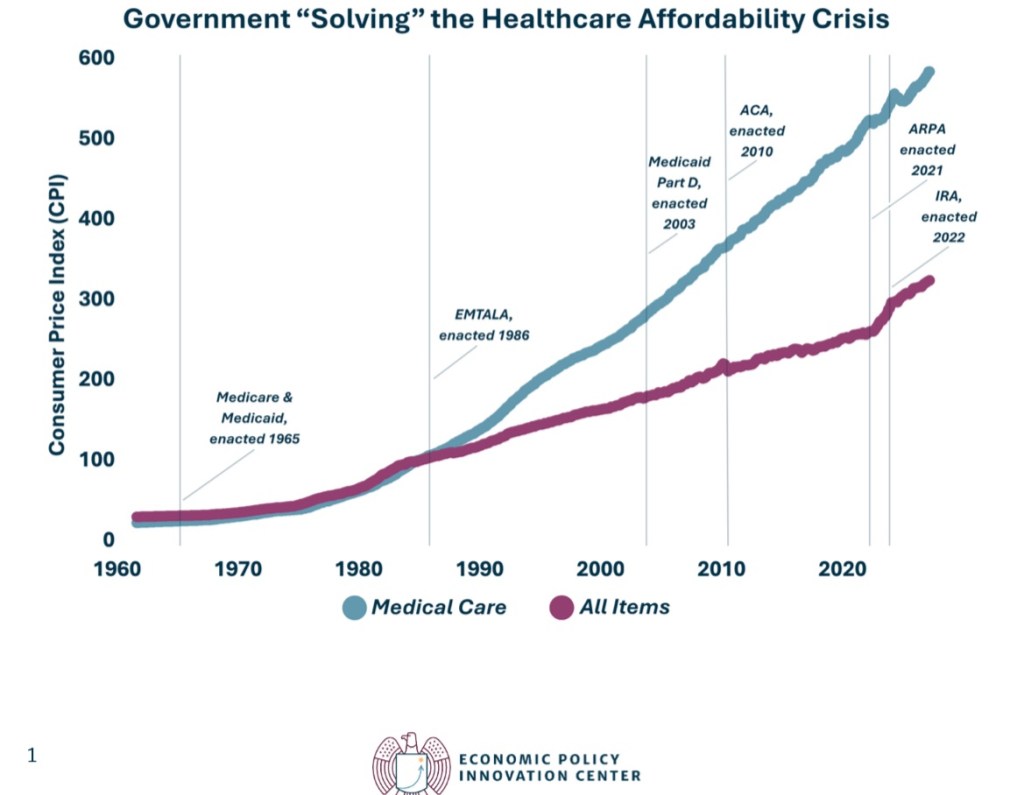
These issues are part of a much larger debate over government dominance of the health care system. Almost every institutional arrangement in health care coverage and delivery is dictated by rules and practices imposed by government, and it would seem they are intentionally designed to escalate costs and compromise the delivery of care. The chart at the top of this post illustrates, in a high-level way, the futility of these efforts.

Medicare and Medicaid dominate government health care spending, as this report from the Peter G. Peterson Foundation shows. However, that strict budgetary view greatly understates the control government now exerts on the health care sector.

Medical Free Market Myth

Michael Cannon recently emphasized the irony of the persistent myth of a U.S. free market in health care:

“… government controls a larger share of health spending in the United States than in 27 out of 38 OECD-member nations, including the United Kingdom (83%) and Canada (73%), each of which has an explicitly socialized health-care system. When it comes to government control of health spending, the United States is closer to communist Cuba (89%) than the average OECD nation (75%).

“Nor does the United States have market prices for health care. Direct government price-setting, price floors, and price ceilings determine prices for more than half of U.S. health spending, including virtually all health-insurance premiums.“

ObamaSnare

Government “control” takes a variety of forms, including regulatory intrusions under the aegis of Obamacare. The Affordable Care Act (ACA), as its name implies, was sold as a way to keep health care and health insurance costs affordable. And it was billed as a way to extend individual health care coverage to the previously uninsured population. It failed badly on the first count and met with only limited success on the second.

One leg upon which the ACA stood was kicked away in 2017: the penalty for violating the Act’s individual mandate for health coverage was eliminated by the Tax Cuts and Jobs Act (TCJA). The penalty was arguably unconstitutional as a tax on non-commerce, or the non-purchase of insurance on the exchange. However, the Supreme Court had ruled narrowly in favor of the penalty in 2012, claiming that it was within the scope of Congress’ taxing power. Following passage of the TCJA, however, the toothlessness of the mandate caused the risk pool to deteriorate. This was aggravated by the ACA’s insistence on comprehensive coverage, which applies not just to policies sold on the Obamacare exchange, but to almost all private health insurance sold in the U.S.

A well-functioning marketplace would instead have promoted the availability of more moderately-priced coverage options. Ultimately, subsidies were all that prevented a broad exit from the marketplace. But they did nothing to slow the escalation in coverage costs and deteriorating quality of coverage and care:

“The result has been a race to the bottom in terms of the quality of insurance coverage for the sick. …individual-market provider networks [have] narrow[ed] significantly… They have eroded coverage through ‘poor coverage for the medications demanded by [the sick]’ … higher deductibles and copayments; mandatory drug substitutions and coverage exclusions for certain drugs; more frequent and tighter preauthorization requirements; highly variable coinsurance requirements; inaccurate provider directories; and exclusions of top specialists, high-quality hospitals, and leading cancer centers from their networks. ….

“The healthy suffer, too. … ‘currently healthy consumers cannot be adequately insured against the negative shock of transitioning to one of the poorly covered chronic disease states.’ A coalition of dozens of patient groups has complained that this dynamic ‘completely undermines the goal of the [Affordable Care Act].’”

Price Distortions

Cannon emphasizes another persistent myth: that government sets prices at levels that would prevail in a free market. Here is one baffling aspect of the many prices set by government for individual services under the Medicare and Medicaid programs.

“One of the more striking indications of widespread mispricing is that Medicare routinely sets different prices for identical items depending solely on who owns the facility.“

For example, ambulatory surgical centers are compensated much less for the same services as hospitals. The same is true of compensation for skilled nursing facilities vs. long-term care hospitals, and there appears to be no economic rationale for the differences. Furthermore, it’s an open secret that Medicare sets higher prices for lower-cost providers (and treatment of lower-cost patients). As Cannon notes, this explains the rapid growth of specialty hospitals owned by physicians.

Cannon provides much more detail on Medicare and Medicaid mis-pricing, including the blunting of patients’ price-sensitivity and the shifting of costs to private payers.

Divorcing Risk and Insurance

The price of insurance and insurer reimbursements are also prescribed by government. Cannon’s discussion includes the ACA’s abolition of risk-based insurance pricing, which is an astonishing case of economic malpractice. Depending on one’s health status, “community pricing” acts as either a price ceiling or a price floor. This creates perverse incentives for both the healthy and the unhealthy. Premiums fall short of the cost of caring for the sick.

The federal government attempts to compensate by subsidizing insurers based on the health status of individuals in their risk pool, but that falls short in terms of the quality of coverage for unhealthy individuals. Thus, both the healthy and taxpayers must shoulder an ever-increasing cost burden of insuring the unhealthy.

Circular Scam

As for Medicaid, certain arrangements drive up the cost of the program to taxpayers. For example, last March I wrote about this apparent scam allowing state governments to inflate their Medicaid costs, qualifying for hundreds of billions of federal matching funds:

“Here’s the gist of it: increases in state Medicaid reimbursements qualify for a federal match at a rate known as the Federal Medical Assistance Percentage (FMAPs). First, increases in Medicaid reimbursements must be funded at the state level. To do this, states tax Medicaid providers, but then the revenue is kicked back to providers in higher reimbursements. The deluge of matching federal dollars follows, and states are free to use those dollars in their general budgets.“

Unfortunately, FMAP reform is not directly addressed in the “clean” Continuing Resolution before Congress, though reduced funding levels might lead to reductions in FMAP percentages.

And Another Circular Scam

John Cochrane is largely in agreement with Cannon’s piece, but he focuses first on cross subsidies flowing to “eligible” hospitals dispensing prescription drugs to low-income patients. These hospitals get the drugs from pharmaceutical companies at a steep discount mandated by the so-called 340B program, but the hospitals then bill insurers (or Medicare and Medicaid), a significant markup over their acquisition cost. The Medicaid expansion under the ACA led to an increase in the number of hospitals eligible for the drug discounts.

But that’s not the end of the story. This arrangement creates an obvious incentive for the drug companies to raise their pre-discounted prices. Another unintended outcome cited by Cochrane is that eligible hospitals do not use the proceeds of their mark-ups to offer better care (or care at a lower cost) to low-income consumers. Instead, the funds tend to be directed to investment accounts. The program also creates another incentive for hospital consolidation.

Someone Else’s Money

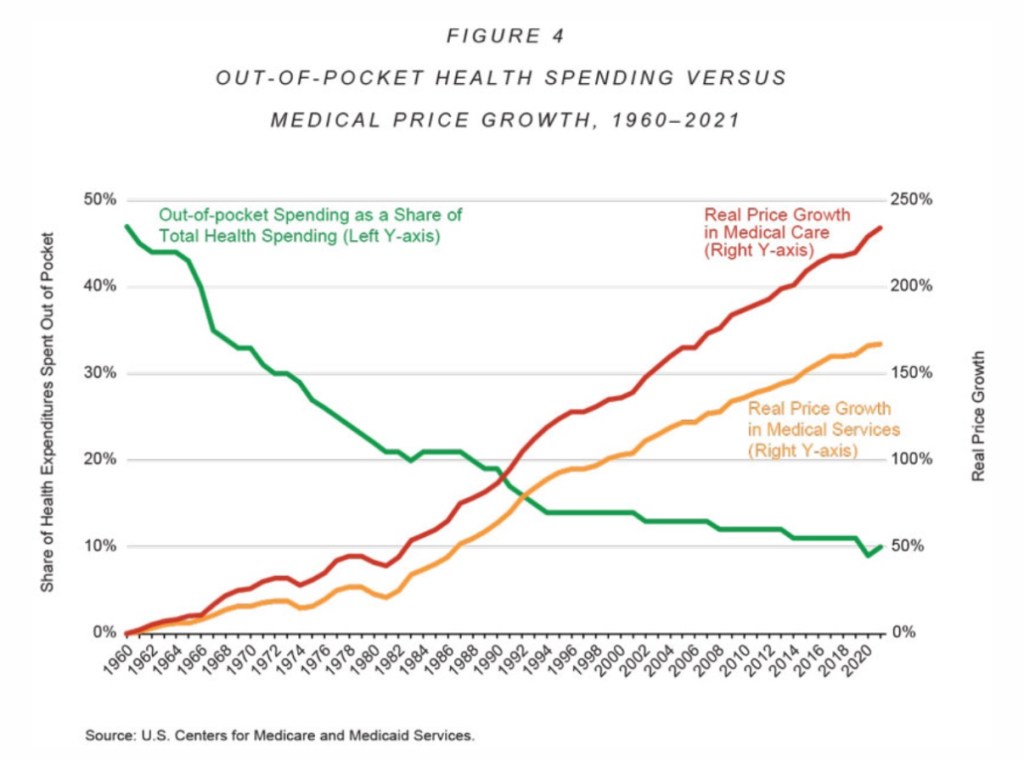
Unfortunately, the dysfunction in health care goes deeper than Obamacare, Medicare, and Medicaid. The third-party payment system itself has been at the root of cost escalation. It largely relieves consumers of their sovereignty over purchasing decisions, rendering them much less sensitive to variations in price. This can be seen clearly in one of Cannon’s charts, reproduced below:

In addition, the disparate income tax treatment of employer-provided health coverage exacerbates cost escalation. Obviously, employees receiving this deduction can afford higher-quality and more comprehensive coverage. This exemption has acted to drive up the cost of all health care and insurance coverage over the almost nine decades of its existence..

What To Do?

The claim that the U.S. health care system operates within a free market ecosystem is obviously absurd. Together, the Cochrane and Cannon pieces represent something of a gripe session, but it is well deserved. Both authors devote sections to reforms, however. They don’t break new ground in the debate, but the overarching theme of the suggested reforms is to give consumers authority over their health care spending. That means keeping government out of health care in all the myriad ways it now intrudes. It also means that insurers should not have authority to dictate how health care is priced. The key is to allow competition to flourish among health care providers and insurers.

Ending FMAPs and the tax exemption for employer-provided coverage is one thing, but it’s another to contemplate dismantling Medicare, Medicaid, and the many rules and pricing arrangements enforced under Obamacare.

Cochrane takes an accommodating approach to the health care needs of seniors and those in need of a safety net. He calls for Medicare and Medicaid to be replaced with the issuance of vouchers (rather than cash) toward the purchase of affordable private health care plans. Then, health coverage can be provided in a lightly regulated, competitive market without all the distortions and sneaky opportunities for graft embedded in our current entitlements.

Conflicting Rights and Reality

And what of the argument that health care is a human right? That notion is, of course, very popular on the left. The idea subtly shifts a meaningful portion of the responsibility for one’s health onto others, including providers and taxpayers. But smokers, heavy drinkers, reckless drivers, hard drug users, and the avoidably obese should not be led to expect a free ride for risky behaviors.

Of course, it’s not a basic human right to demand, by force of government, involuntary service of health care workers, or that taxpayers give alms, but Cochrane answers with this:

“Yes! It is a basic human right that I should be free to offer my money to a willing physician or hospital, in a brutally competitive and innovative market.”

“Willing” is a key word, and to that we should add “able”, but those are qualifying conditions that markets help facilitate.

Jane Menton has discussed the notion of a human right to health care, wisely explaining that conditions are not always compatible with fulfilling such a right. Her primary concern is the future supply of medical personnel, and an acute shortage of nurses.

“In our current political environment, young people seem to think that claiming something as an entitlement means someone will inevitably show up to do the work.“

To codify a right to health care would be an ill-fared call for a nationalized solution. It would be a prescription for still higher costs and lower quality care. As in any other sector, centralized decision-making leads to misallocated resources, higher costs, and inferior outcomes for patients. Our current mess gives a strong hint of the kind of over-regulated dysfunction that nationalization would bring.

Insurance On Insurability

Pre-existing conditions motivate much of the discussion surrounding a presumed right to health care. Individual portability of group health coverage goes partway in addressing coverage for pre-existing conditions. Portability is mandated by the Health Insurance Portability and Accountability Act of 1996, but like community rating, it shifts costs to others. That is, the cost of covering pre-existing conditions becomes the responsibility of employers in general, group insurers, and ultimately healthy (and younger) workers.

Given time, the debate over a right to health care can be rendered moot via market processes. Cochrane has long supported the concept of health status insurance. Such policies would allow healthy consumers to guarantee their insurability against the risk of future health contingencies. Guaranteed renewability is a limited form of this type of coverage. General availability of health status insurance contracts, offered regardless of current coverage, could allow for a range of future insurability options at affordable prices. Then, pre-existing conditions would cease to be such a huge driver of cross subsidies.

Trade Charades and a Capital Crusade

15 Tuesday Apr 2025

Posted by Nuetzel in Balance of Payments, Federal Budget, Protectionism

≈ 4 Comments

Tags

Balance of Payments, Capital Account, Capital Deepening, Capital Surplus, central planning, Cronyism, Current Account, Donald Trump, Federal Budget Deficit, John Cochrane, Reciprocal Tariffs, Scott Lincicome, Trade Barriers, Trade Deficit

I’m nowhere near eating crow over the skepticism I’ve directed at Donald Trump’s trade offensive. The uncertainty created by his erratic policy changes is very likely to drag the U.S. into recession. However, there were signs last week of movement in a more promising direction, as he placed a 90-day pause on the targeted “reciprocal” tariffs announced in early April. However, a “baseline” universal tariff of 10% still applies to all imported goods. So do tariffs targeted at China, which have ratcheted up through a few rounds of retaliation. Now, he’s announced exemptions for some key electronics products, many of which come from China, and there are signs that he’s ready to exempt imports of auto parts. Needless to say, the tariffs and their exemptions represent an ill-advised escapade in central planning, replete with ample opportunities for politically-motivated favoritism and prejudice.

Why the Pause?

The pause in reciprocal tariffs was ostensibly intended to allow time to negotiate lower trade barriers with “more than 75 countries” that came forward to engage with Trump rather than retaliate. Now, there are said to be as many as 90 countries that wish to negotiate. This more or less aligns with an evolution of the strategy I described in my last post: game theory suggests that a dominant trading partner may be able to threaten or impose higher tariffs and ultimately achieve agreement on a regime with lower trade barriers on both sides. In Trump’s case, that would involve reaching many different bilateral agreements within a very short time, an imposing challenge given the history of trade negotiations. So far we have no deals, though Trump claims some are close. If only we didn’t have to reach formal agreements not to interfere with mutually beneficial trade!

A debate ensued almost immediately over whether Trump’s pause showed that he “caved” to the negative market reaction to his tariffs, but perhaps he acted primarily because a number of nations approached with hats in hand. Trump knew he had the leverage to force other nations to make concessions on trade barriers. They obviously responded.

The timing of the pause was surely a combination of those overtures, market reaction, advisor opinion, and Trump’s own instincts. This view is buttressed by the unaltered universal 10% tariffs, the remaining special tariffs on specific nations and product categories, and the punative tariffs on China. Furthermore, Trump knows he can reimpose a targeted tariff on any country that refuses a deal satisfactory to him. Let’s hope he’s reasonable and doesn’t allow his love affair with tariffs to color his position in these talks.

My hope is that the Trump Administration can negotiate a large number of new agreements with trading partners to reduce or eliminate tariffs and other barriers to trade. Obviously the pause is no guarantee of success, and severe challenges remain with more belligerent trading partners, especially China.

Disclaimer!

None of the foregoing is intended as a dispensation for the many apparent misconceptions Trump has about trade. In the MAGA cult clamor to defend all-things Trump, there have been a number of absurd claims about tariffs and trade, such as: tariffs are not a tax; tariffs don’t raise the price of imports; trade deficits are a deduction from GDP; tariffs can replace the income tax; trade deficits will bankrupt the country; high tariffs produced rapid growth in the late 19th century; “reciprocal” tariffs will eliminate our bilateral trade deficits; U.S. manufacturing is in crisis; value added taxes are trade barriers; it’s better to export goods than services; and trade deficits reduce investment. Every one a laugher, but I’ll leave most of them aside for now.

In the remainder of this post, I’ll focus on Trump’s aims for coaxing firms, via tariff avoidance, to make capital investment in the U.S., and the implications of that effort for the trade balance. An influx of capital might be construed as a strength of Trump’s policy agenda, though his effort to “cut deals” in this manner is a form of economic meddling as well as a vehicle for cronyism. Moreover, he doesn’t understand the nexus between foreign investment, the federal deficit, and the balance of payments. He’ll be disappointed to learn that his notion that trade deficits are ruinous conflicts with his vision of encouraging foreign accumulations of productive U.S. assets.

Oh No! A Capital Surplus!

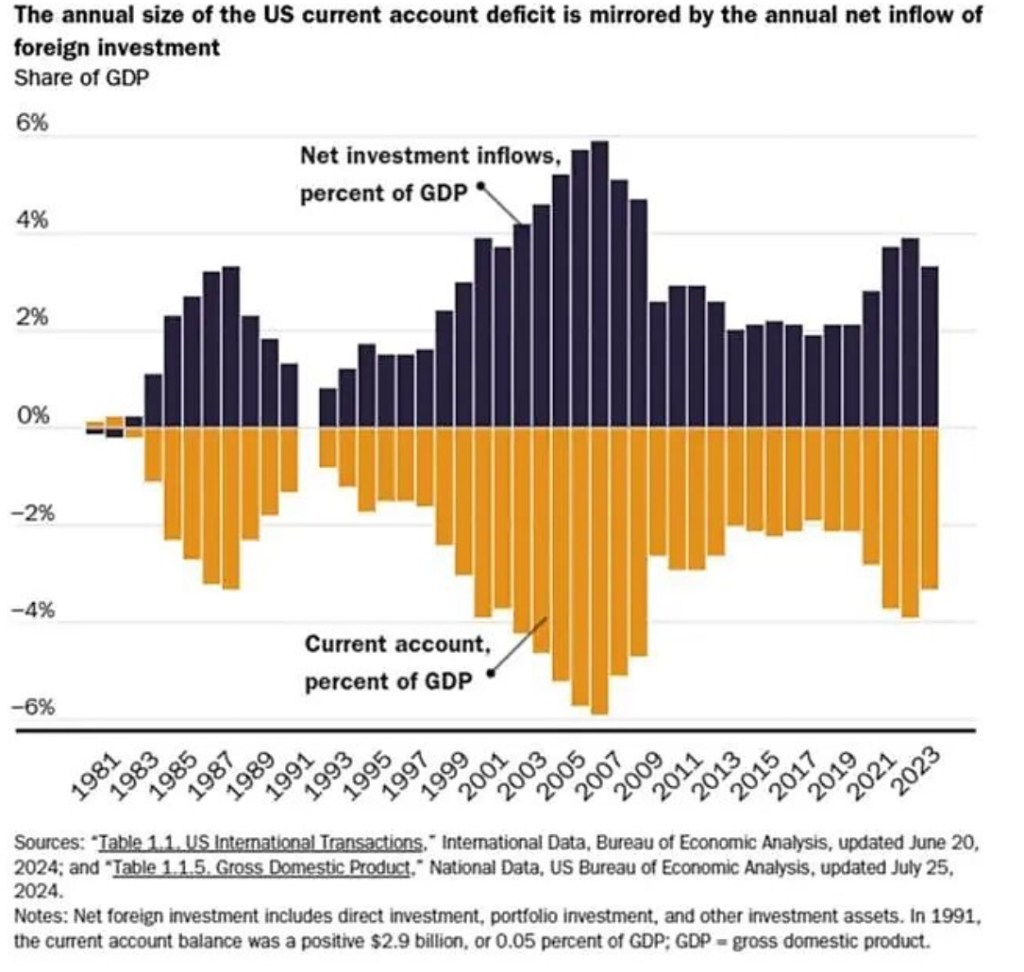
It isn’t a widely understood equivalence, but each year we have a surplus in foreign purchases of U.S. assets (the capital account surplus) that is roughly matched by a deficit in trade for foreign goods and services (the current account deficit). This is why the balance of payments (BoP) balances! Here is the near mirror image of these two sides of the BoP, from Scott Lincicome’s “Things Everyone Should Know about Trade Deficits”:

The two sides of the BoP are very much codetermined. One does not exclusively drive the other.

It’s wonderful to be in a position to avail ourselves of foreign savings to invest in our economy. Unfortunately, a large portion of this foreign investment finances our huge government budget deficit, and that is a real problem. Otherwise, the investment would make a greater contribution to U.S. growth.

Funding the Federal Deficit

As John Cochrane explains, transfer payments account for a large share of government spending and borrowing. In turn, these transfers are spent by recipients on consumer goods, some of which come from overseas. Cochrane emphasizes that we are borrowing from abroad, as shown by our capital surplus, to finance this consumption, rather than investing foreign capital in productive assets. While one might conclude that our capital surplus and our trade deficit are creating a long-term vulnerability, the root of the problem is the federal government’s largess.

There is a sense in which different prongs of Trump’s policy agenda could act to address this problem. These are his efforts to reduce government waste, deregulate, and encourage direct investment in new plant and equipment. Reducing the federal budget deficit is paramount, but huge doubts remain over his determination to control spending or undertake real entitlement reforms. Tariffs will generate some revenue, but part of that will be required to offset other tax breaks Trump is contemplating.

Deepening the Capital Base

Trump harps on the need for firms, both foreign and domestic, to produce goods here in the U.S. Currently he’s taking credit for $5 trillion of new investment in the U.S., though we really don’t know whether all of these are “new deals” or had already been planned. Deregulation can improve incentives to invest in physical capital and increase the speed with which it comes online. To the extent that investment in productive capital replaces government borrowing, the debt we accumulate (held by foreign and domestic lenders) will be more sustainable.

However, Trump seems oblivious to a fact made inescapable by the balance of payments relationship. This new investment, should it come to fruition, will bring with it future excesses of imports over exports. Foreign demand for U.S. capital assets lifts domestic income and leads to a stronger dollar, both of which boost imports and the trade deficit. The trade deficit will persist even if foreign investment in new factories fully replaces the bloated federal deficit as a use of foreign capital.

Of course, the intent of Trump’s reshoring campaign is for new domestic output to substitute for imports and increase exports. That would bring positive returns for domestic and foreign capital, but rising income and a stronger dollar will stimulate demand for other imports, while exports would flag with the strength of the dollar. In any case, the new investments and a larger capital surplus will increase the trade deficit.

A Social Security “Private Option” and Federal Debt

03 Tuesday Dec 2024

Posted by Nuetzel in Privatization, Social Security

≈ Leave a comment

Tags

Donald Trump, FDIC, Federal Debt, FICA, Fiscal Theory of Price Level, Government Budget Constraint, Insolvency, John Cochrane, Medicare, Penn-Wharton Budget Model, Ponzi Scheme, Primary Surplus, Private Option, Privatization, Social Security, Trust Funds, Unbanked Households

Social Security wasn’t designed as a true saving vehicle for workers. Instead, SS has always been a pay-as-you-go system under which current benefits are funded by the payroll taxes levied on the current employed population. In fact, many Americans earn lousy effective returns on their tax “contributions” (also see here), though low-income individuals do much better than those near or above the median income. Worst of all, under pay-as-you-go, the system can collapse like a Ponzi scheme when the number of workers shrinks drastically relative to the retired population, leading to the kind of situation we face today.

Unfunded Obligations

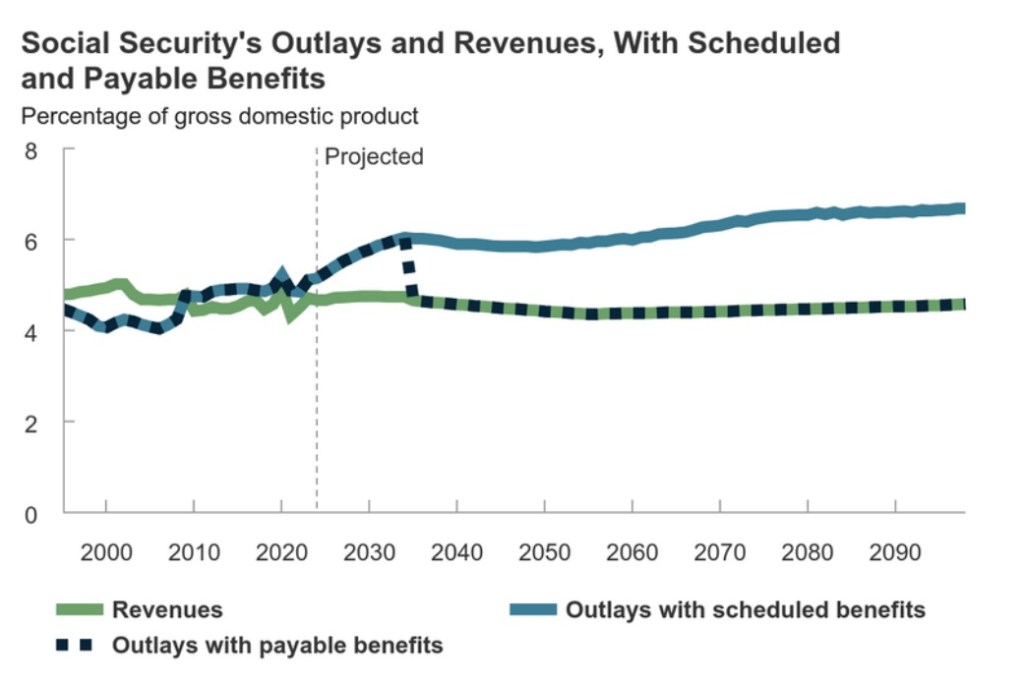
Payroll tax revenue is no longer adequate to pay for current Social Security and Medicare benefits, and the problem is huge: according to the Penn-Wharton Budget Model, the unfunded obligations of Social Security (including old age, survivorship and disability) through 2095 have a present value of $18.1 trillion in constant 2024 dollars (using a discount rate of 4.4%). The comparable figure for Medicare Part A is $18.6 trillion. Together these amount to more than the current national debt.

Barring earlier reform, the Social Security Trust Fund is expected to be exhausted in 2033 (excluding the disability fund). At that point, a 20% reduction in benefits will be required by law. (More on the trust fund below.)

What To Do?

The most prominent reform proposals involve reduced benefits for wealthy beneficiaries, increased payroll taxes on high earners, and an increase in the retirement age. However, President-Elect Donald Trump shows no inclination to make any changes on his watch. This is unfortunate because the sooner the system’s insolvency is addressed, the less draconian the necessary reforms will be.

A neglected reform idea is for SS to be privatized. Many observers agree in principle that current workers could earn better returns over the long-term by investing funds in a conservative mix of equities and bonds. The transition to private accounts could be made voluntary, so that no one is forced to give up the benefits to which they’re “entitled”.

Takers would receive an initial deposit from the government in a tax-deferred account. For participating pre-retirees, ongoing FICA contributions (in whole or in part) would be deposited into their private accounts. They could purchase a private annuity with the balance at retirement if they choose. The income tax treatment of annuity payments or distributions could mimic the current tax treatment of SS benefits.

Given that the balance remaining at death would be heritable, some individuals might be willing to accept an initial deposit less than the actuarial PV of the future SS benefits they’ve accumulated to-date (discounted at an internal rate of return equating future benefits “earned” to-date and contributions to-date). I also believe many individuals would willingly accept a lower initial deposit because they would gain some control over investment direction. Such voluntarily-accepted reductions in initial deposits to personal accounts would mean the government’s issue of new debt would be smaller than the decrease in future benefit obligations.

Nevertheless, funding the accounts at the time of transition would necessitate a huge and immediate increase in federal debt. Market participants and political interests are likely to fear an impossible strain on the credit market. Perhaps the transition could be staged over time to make it less “shocking”, but that would complicate matters. In any case, heavy debt issuance is the rub that dissuades most observers from supporting privatization.

Fiscal Theory of Price Level

The fiscal theory of the price level (FTPL) implies that such a privatization might not be an insurmountable challenge after all, at least in terms of comparative dynamics. Much background on FTPL can be found at John Cochrane’s Grumpy Economist Substack.

FTPL asserts that fiscal policy can influence the price level due to a constraint on the market value of government debt. This market value must be in balance with the expected stream of future government primary surpluses. This is known as the government budget constraint.

The primary surplus excludes the government’s interest expense, a budget component that must be paid out of the primary surplus or else borrowed. Of course, the market value of government debt incorporates the discounted value of future interest payments.

This budget constraint must be true in an expectational sense. That is, the market must be convinced that future surpluses will be adequate to pay all future obligations associated with the debt. Otherwise, the value of the debt must change.

Should a spending initiative require the government to issue new debt with no credible offset in terms of future surpluses, the market value of the debt must decline. That means interest rates and/or the price level must rise. If interest rates are fixed by the monetary authority (the Fed) then only prices will rise.

A SS Private Option Under FTPL

But what about FTPL in the context of entitlement reform, specifically a privatization of Social Security? Suppose the government issues debt and then deposits the proceeds into personal accounts to fund future benefits. Future government surpluses (deficits) would increase (decrease) by the reduction in future SS benefit payments.

This improved budgetary position should be highly credible to financial markets, despite the fact that benefits are not and never have been guaranteed. If it is credible to markets, the new debt would not raise prices, nor would it be valued differently than existing debt. There need not be any change in interest rates.

But Thin Ice

There are risks, of course. It might be too much to hope that other federal spending can be restrained. That kind of failure would subvert the rationale for any budgetary reform. A variety of other crises and economic shocks are also possible. Those could disrupt markets and jeopardize budget discipline as well. Given a severe shock, interest expense could more readily explode given the massive debt issuance required by the reform discussed here. So there are big risks, but one might ask whether they could turn out to be more disastrous in the absence of reform.

Other Details

The private account “offers” extended to workers or beneficiaries relative to the actuarial PVs of their future benefits would be controversial. Different offer percentages (discounts) could be tested to guage uptake.

Another issue: provisions would have to be made for individuals in “unbanked” households, estimated by the FDIC to be about 4.2% of all U.S. households in 2023. Voluntary uptake of the “offer” is likely to be lower among the unbanked and among those having less confidence in their ability to make financial decisions. However, even a simplified set of choices might be superior to the returns under today’s SS, even for low-income workers, not to mention the very real threat of future reductions in benefits. Furthermore, financial institutions might compete for new accounts in part by offering some level of financial education for new clients.

A similar reform could be applied to Medicare, which like SS is also technically insolvent. Participating beneficiaries could receive some proportion of expected future benefits in a private account, which they could use to pay for private or public health insurance coverage or medical expenses. From a budget perspective, the increase in federal debt would be balanced against the reduction in future Medicare benefits, which would constitute a credible increase (decrease) in future surpluses (deficits).

Credibility

But again, how credible would markets find the decrease in benefit obligations? Direct reductions in future entitlements should be convincing, though politicians are likely to find plenty of other ways to use the savings.

On the other hand, markets already give some weight to the possibility of future benefit cuts (or other policies that would reduce SS shortfalls). So it’s likely that markets will give the reform’s favorable budget implications significant but only “incremental credit”.

Another possible complication is that the market, prior to execution of the reform, might discount the uptake by workers and current retirees. This would necessitate better offers to improve uptake and more debt issuance for a given reduction in future obligations. Skepticism along these lines might worsen implications for the price level and interest rates.

The Trust Fund

Finally, what about the SS Trust Fund? Can it play in role in the reform discussed above? The answer depends on how the trust fund fits into the federal government’s budgetary position.

The trust fund holds as assets only non-marketable Treasury securities acquired in the past when SS contributions exceeded benefit payments. The excess payroll tax revenue was placed in the trust fund, which in turn lent the funds to the federal government to help meet other budgetary needs. Hence the bond holdings.

In terms of the government’s fiscal position, the money has already been pissed away, as it were. The bonds in the trust fund do not represent a pot of money. As noted above, with our age demographics now reversed, payroll taxes no longer meet benefits. Thus, bonds in the trust fund must be redeemed to pay all SS obligations. The Treasury must pay off the bonds via general revenue or by borrowing additional amounts from the public.

Post-reform, if continuing deficits are the order of the day, redeeming bonds in the trust fund would do nothing to improve the government’s fiscal position. If the trust fund “cashes them in” to help meet benefit payments, the federal government must borrow to raise that cash. In other words, the bonds in the trust fund would be more or less superfluous.

But what if the federal budget swings into a surplus position post-reform? In that case, federal tax revenue would cover the redemption of at least some of the bonds held by the trust fund. SS beneficiaries would then have a meaningful claim on federal taxpayers through the trust fund and the government’s surplus position, which would reduce the new federal debt required by the reform.

Conclusion

The Social Security and Medicare systems are in desperate need reform, but there is little momentum for any such undertaking. Meanwhile, exhaustion of the SS and Medicare trust funds creeps ever closer, along with required benefit cuts. All of the reform options would be painful in one way or another. A voluntary privatization would require a huge makeover, but it might be the least painful option of all. Current workers and beneficiaries would not be compelled to make choices they found inferior. Moreover, the new debt necessary to pay for the reforms would be matched by a reduction in future government obligations. The fiscal theory of the price level implies that the reform would not be inflationary and need not depress the value of Treasury bonds, provided the reform is accompanied by long-term budget discipline.

~~~~~~~~~~~~~~~~~~~~~~~~~~~~~~~~~~~

Note: the chart at the top of this post was produced by the Congressional Budget Office and appears in this publication.

Big Spending, Explosive Debt, and the Inflation Tax

07 Tuesday May 2024

Posted by Nuetzel in Deficits, Fiscal policy, Inflation

≈ Leave a comment

Tags

American Rescue Plan, CBO, Child Tax Credit, CHIPS Act, Debt to GDP, Discretionary Spending, Donald Trump, Emergency Spending, entitlements, Eric Boehm, Inflation Premium, Inflation tax, Infrastructure Investment and Jobs Act, Joe Biden, John Cochrane, Medicare, OMB, Promise to Address Comprehensive Toxics Act, Social Security, Soft Default, Student Loan Forgiveness, Supreme Court, Treasury Debt

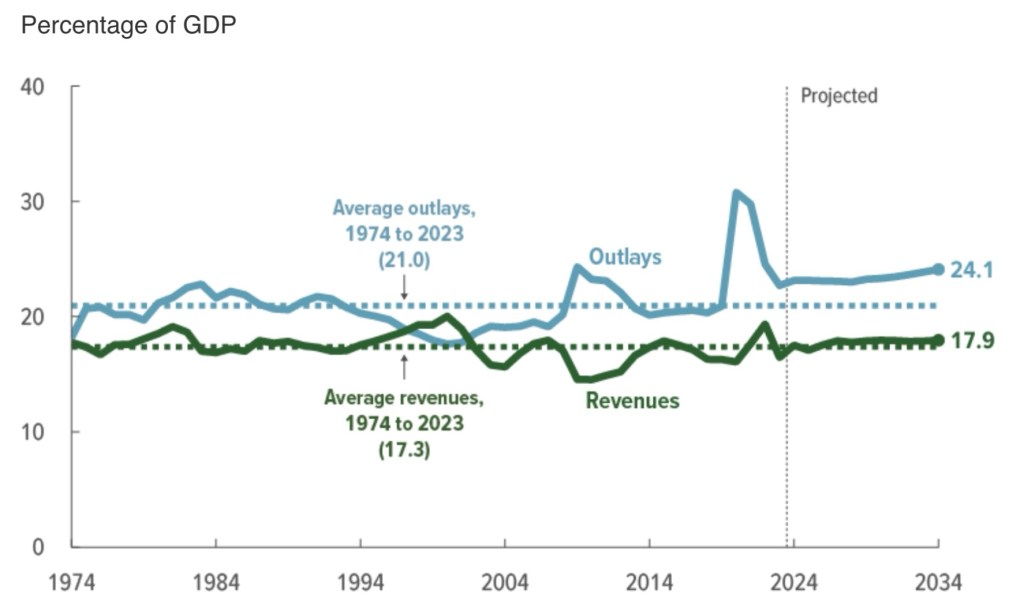
The chart above makes a convincing case that we have a spending problem at the federal level. Really, we’ve had a spending problem for a long time. But at least tax revenue today remains reasonably well-aligned with its 50-year historical average as a share of GDP. Not spending. Even larger deficits opened up during the pandemic and they haven’t returned to pre-pandemic levels.

We’ve seen Joe Biden break spending records. His initiatives, often with questionable merit, have included the $1.8 trillion American Rescue Plan and the nearly $0.8 trillion Infrastructure Investment and Jobs Act, along with several other significant spending initiatives such as the Promise to Address Comprehensive Toxics Act and the subsidy-laden CHIPS Act. Meanwhile, emergency spending has become a regular occurrence on Biden’s watch. More recently, he’s made repeated efforts to forgive massive amounts of student loans despite the Supreme Court’s clear ruling that such gifts are unconstitutional.

Indeed, while Biden keeps pretty busy spinning tales of his days driving an 18-wheeler, cannibals devouring his Uncle Bosie Finnegan, his upbringing in black churches, synagogues, or in the Puerto Rican community, he still finds time to dream up ways for the government to spend money it doesn’t have. Or his kindly puppeteers do.

Biden’s New Budget

Eric Boehm expressed wonderment at Biden’s fiscal 2025 budget not long after its release in March. He was also mystified by the gall it took to produce a “fact sheet” in which the White House congratulated itself on fiscal responsibility. That’s how this Administration characterizes deficits projected at $16 trillion over the next ten years. No joke!

Furthermore, the Administration says the record spending will be “paid for”. Well, yes, with tax increases and lots of borrowing! There are a great many fabulist claims made by the White House about the budget. This link from the Office of Management and Budget includes a handy list of propaganda sheets they’ve managed to produce on the virtues of their proposal.

The Congressional Budget Office (CBO) projects ten-year deficits under current law that are $3 trillion higher than Biden’s proposed budget. That’s the basis of the White House’s boast of fiscal restraint. But the difference is basically paid for with a couple of accounting tricks (see below). More charitably, one could say it’s paid for with higher taxes, aided by the assumption of slightly faster economic growth. The latter will be a good trick while undercutting incentives and wages with a big boost to the corporate tax rate.

The revenue projected by the While House from those taxes does not come anywhere close to eliminating the gap shown in the CBO’s chart above. Federal spending under Biden’s budget grows at about 4% annually, just a bit slower than nominal GDP. Thus, the federal share of GDP remains roughly constant and only slightly higher than the CBO’s current projection for 2034. Nevertheless, spending relative to GDP would continue at an historically high rate. Over the next decade, it would average more than 3% higher than its 50-year average. That would be about $1.3 trillion in 2034!

Meanwhile, the ratio of tax revenue to GDP under Biden’s proposal, as they project it, would average slightly higher than its 50-year average, reaching a full percentage point above by 2034 (and higher than the CBO baseline). That’s probably optimistic.

There is little real effort in this budget to reduce federal deficits, with Treasury borrowing rates now near 15-year highs. Interest expense has grown to an alarming share of spending. In fact, it’s expected to exceed spending on defense in 2024! Perhaps not coincidentally, the White House assumes a greater decline in interest rates than CBO over the next 10 years.

Treats or Tricks?

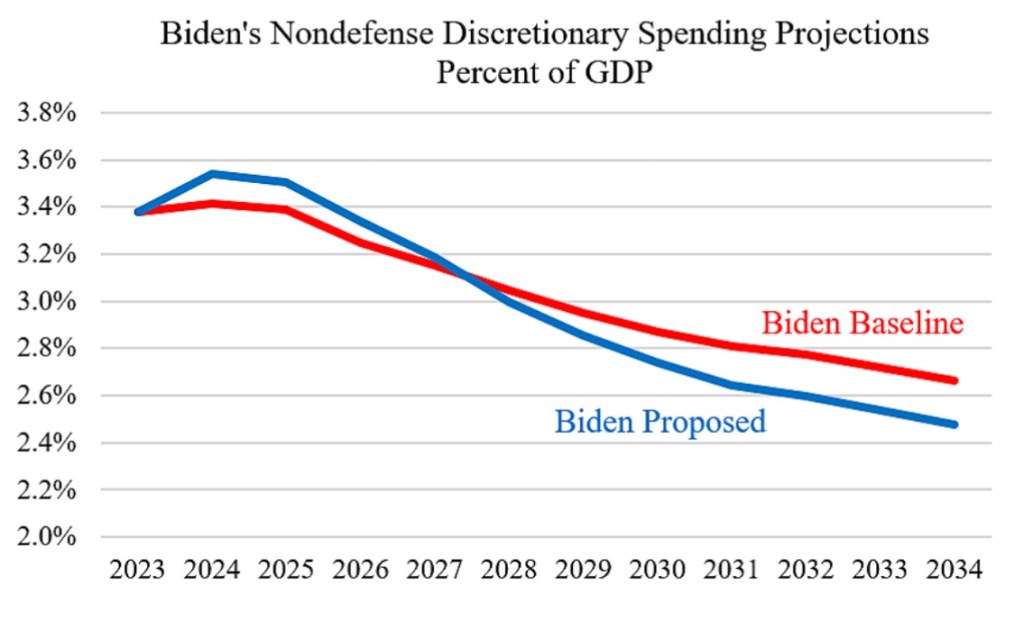
The situation is likely worse than the White House depicts, given that its budget incorporates assumptions that look generous to their claim of fiscal restraint. First, they frontload nondefense discretionary spending, allowing Biden to make extravagant promises for the near-term while pushing off steep declines in budget commitments to the out-years. The sharp reductions in this category of spending pares more than $2 trillion from the 10-year deficit. From the link above:

Biden also proposes to restore the expanded the child tax credit — for one year! How handy from a budget perspective: heroically call for an expanded credit (for a year) while avoiding, for the time being, the addition of a couple of trillion to the 10-year deficit.

Code Red

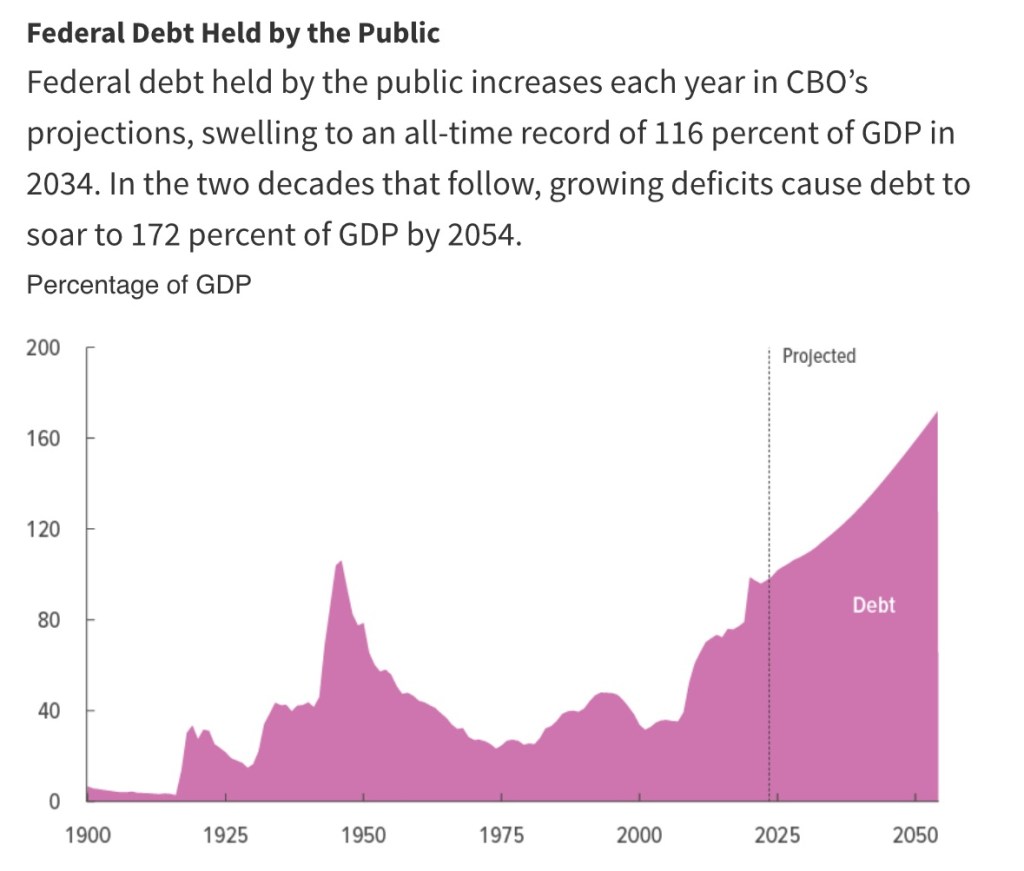
So where does this end? The ratio of federal debt to GDP will resume its ascent after a slight decline from the pandemic high. Here is the CBO’s projection:

The Biden budget shows a relatively stable debt to GDP ratio through 2034 due to the assumptions of slightly faster GDP growth, lower Treasury borrowing rates, and the aforementioned “fiscal restraint”. But don’t count on it!

The government’s growing dominance over real resources will have negative consequences for growth in the long-term. Purely as a fiscal matter, however, it must be paid for in one of three ways: revenue from explicit taxes, federal borrowing, or an implicit tax on the public more commonly known as the inflation tax. The last two are intimately related.

Bond investors always face at least a small measure of default risk even when lending to the U.S. Treasury. There is almost no chance the government would ever default outright by failing to pay interest or principal when due. However, investors hold an expectation that the value of their bonds will erode in real terms due to inflation. To compensate, they demand an “inflation premium” in the interest rate they earn on Treasury bonds. But an upside surprise to inflation would constitute a “soft default” on the real value of their bonds. This occurred during and after the pandemic, and it was triggered by a burgeoning federal deficit.

Brief Mechanics

John Cochrane has explained the mechanism by which acts of fiscal profligacy can be transmitted to the price of goods. The real value of outstanding federal debt cannot exceed the expected real value of future surpluses (a present value summed across positive and negative surpluses). If expected surpluses are reduced via some emergency or shock such that repayment in real terms is less likely, then the real value of government debt must fall. That means either interest rates or the price level must rise, or some combination of the two.

The Federal Reserve can prevent interest rates from rising (by purchasing bonds and increasing the money supply), but that leaves a higher price level as the only way the real value of debt can come into line. In other words, an unexpected increase in the path of federal deficits would be financed by money printing and an inflation tax. The incidence of this unexpected “implicit” tax falls not only to bondholders, but also on the public at large, who suffer an unexpected decline in the purchasing power of their nominal assets and incomes. This in turn tends to free-up real resources for government absorption.

Government Debt Is Risky

It appears that investors expect the future deficits now projected by the CBO (and the White House) to be paid down someday, to some extent, by future surpluses. That might seem preposterous, but markets apparently aren’t surprised by the projected deficits. After all, fiscal policy decisions can change tremendously over the course of a few years. But it still feels like excessive optimism. Whatever the case, Cochrane cautions that the next fiscal emergency, be it a new pandemic, a war, a recession, or some other crisis, is likely to create another huge expansion in debt and a substantial increase price level. Joe Biden doesn’t seem inclined to put us in a position to deal with that risk very effectively. Unfortunately, it’s not clear that Donald Trump will either. And neither seems inclined to seriously address the insolvencies of Social Security and Medicare. If unaddressed, those mandatory obligations will become real crises over the next decade.

Government Failure as a Root Cause of Market Failure

10 Monday Jul 2023

Posted by Nuetzel in Government Failure, Market Failure

≈ Leave a comment

Tags

Capital Formation, central planning, Chevron Doctrine, Competitive Equilibrium, Corruption, crowding out, Declaration of Independence, Don Boudreaux, External Benefits, External Costs, Government Failure, Inflation, John Cochrane, Labor Supply, Market Failure, Michael Munger, monopoly power, Pareto Superiority, Peter Boettke, Price Controls, Protectionism, Redistribution, Regulatory Capture, rent seeking, Risk-Free Asset, Side Payments, Social Security, State Capacity, Tax Distortions, Thomas Jefferson, Treasury Debt, William R. Keech

We’re told again and again that government must take action to correct “market failures”. Economists are largely responsible for this widespread view. Our standard textbook treatments of external costs and benefits are constructed to demonstrate departures from the ideal of perfectly competitive market equilibria. This posits an absurdly unrealistic standard and diminishes the power and dramatic success of real-world markets in processing highly dispersed information, allocating resources based on voluntary behavior, and raising human living standards. It also takes for granted the underlying institutional foundations that lead to well-functioning markets and presumes that government possesses the knowledge and ability to rectify various departures from an ideal. Finally, “corrective” interventions are usually exposited in economics classes as if they are costless!

Failed Disgnoses

This brings into focus the worst presumption of all: that government solutions to social and economic problems never fail to achieve their intended aims. Of course that’s nonsense. If defined on an equivalent basis, government failure is vastly more endemic and destructive than market failure.

Related to this point, Don Boudreaux quotes from Peter Boettke’s Living Economics:

“According to ancient legend, a Roman emperor was asked to judge a singing contest between two participants. After hearing the first contestant, the emperor gave the prize to the second on the assumption that the second could be no worse than the first. Of course, this assumption could have been wrong; the second singer might have been worse. The theory of market failure committed the same mistake as the emperor. Demonstrating that the market economy failed to live up to the ideals of general competitive equilibrium was one thing, but to gleefully assert that public action could costlessly correct the failure was quite another matter. Unfortunately, much analytical work proceeded in such a manner. Many scholars burst the bubble of this romantic vision of the political sector during the 1960s. But it was [James] Buchanan and Gordon Tullock who deserve the credit for shifting scholarly focus.”

John Cochrane sums up the whole case succinctly in the “punchline” of a recent post:

“The case for free markets never was their perfection. The case for free markets always was centuries of experience with the failures of the only alternative, state control. Free markets are, as the saying goes, the worst system; except for all the others.”

Tracing Failures

We can view the relation between market failure and government failure in two ways. First, we can try to identify market failures and root causes. For example, external costs like pollution cause harm to innocent third parties. This failure might be solely attributable to transactions between private parties, but there are cases in which government engages as one of those parties, such as defense contracting. In other cases government effectively subsidizes toxic waste, like the eventual disposal of solar panels. Another kind of market failure occurs when firms wield monopoly power, but that is often abetted by costly regulations that deliver fatal blows to small competitors.

The second way to analyze the nexus between government and market failures is to first examine the taxonomy of government failure and identify the various damages inflicted upon the operation of private markets. That’s the course I’ll follow below, though by no means is the discussion here exhaustive.

Failures In and Out of Scope

An extensive treatment of government failure was offered eight years ago by William R. Keech and Michael Munger. To start, they point out what everyone knows: governments occasionally perpetrate monstrous acts like genocide and the instigation of war. That helps illustrate a basic dichotomy in government failures:

“… government may fail to do things it should do, or government may do things it should not do.’

Both parts of that statement have numerous dimensions. Failures at what government should do run the gamut from poor service at the DMV, to failure to enforce rights, to corrupt bureaucrats and politicians skimming off the public purse in the execution of their duties. These failures of government are all too common.

What government should and should not do, however, is usually a matter of political opinion. Thomas Jefferson’s axioms appear in a single sentence at the beginning of the Declaration of Independence; they are a tremendous guide to the first principles of a benevolent state. However, those axioms don’t go far in determining the range of specific legal protections and services that should and shouldn’t be provided by government.

Pareto Superiority

Keech and Munger engage in an analytical exercise in which the “should and shouldn’t” question is determined under the standard of Pareto superiority. A state of the world is Pareto superior if at least one person prefers it to the current state (and no one else is averse to it). Coincidentally, voluntary trades in private markets always exploit Pareto superior opportunities, absent legitimate external costs and benefits.

The set of Pareto superior states available to government can be expanded by allowing for side payments or compensation to those who would have preferred the current state. Still, those side payments are limited by the magnitude of the gains flowing to those who prefer the alternative (and if those gains can be redistributed monetarily).

Keech and Munger define government failure as the unexploited existence of Pareto superior states. Of course, by this definition, only a benevolent, omniscient, and omnipotent dictator could hope to avoid government failure. But this is no more unrealistic than the assumptions underlying perfectly competitive market equilibrium from which departure are deemed “market failures” that government should correct. Thus, Keech and Munger say:

“The concept of government failure has been trapped in the cocoon of the theory of perfect markets. … Government failure in the contemporary context means failing to resolve a classic market failure.”

But markets must operate within a setting defined by culture and institutions. The establishment of a social order under which individuals have enforceable rights must come prior to well-functioning markets, and that requires a certain level of state capacity. Keech and Munger are correct that market failure is often a manifestation of government failure in setting and/or enforcing these “rules of the game”.

“The real question is … how the rules of the game should be structured in terms of incentives, property rights, and constraints.”

The Regulatory State and Market Failures

Government can do too little in defining and enforcing rights, and that’s undoubtedly a cause of failure in markets in even the most advanced economies. At the same time there is an undeniable tendency for mission creep: governments often try to do too much. Overregulation in the U.S. and other developed nations creates a variety of market failures. This includes the waste inherent in compliance costs that far exceed benefits; welfare losses from price controls, licensing, and quotas; diversion of otherwise productive resources into rent seeking activity, anti-competitive effects from “regulatory capture”; Chevron-like distortions endemic to the administrative judicial process; unnecessary interference in almost any aspect of private business; and outright corruption and bribe-taking.

Central Planning and Market Failures

Another category of government attempting to “do too much” is the misallocation of resources that inevitably accompanies efforts to pick “winners and losers”. The massive subsidies flowing to investors in various technologies are often misdirected. Many of these expenditures end up as losses for taxpayers, and this is not the only form in which failed industrial planning takes place. A related evil occurs when steps are taken to penalize and destroy industries in political disfavor with thin economic justification.

Other clear examples of government “planning” failure are protectionist laws. These are a net drain on our wealth as a society, denying consumers of free choice and saddling the country with the necessity to produce restricted products at high cost relative to erstwhile trading partners.

There are, of course, failures lurking within many other large government spending programs in areas such as national defense, transportation, education, and agriculture. Many of these programs can be characterized as centrally planning. Not only are some of these expenditures ineffectual, but massive procurement spending seems to invite waste and graft. After all, it’s somebody else’s money.

Redistribution and Market Failures

One might regard redistribution programs as vehicles for the kinds of side payments described by Keech and Munger. Some might even say these are the side payments necessary to overcome resistance from those unable to thrive in a market economy. That reverses the historical sequence of events, however, since the dominant economic role of markets preceded the advent of massive redistribution schemes. Unfortunately, redistribution programs have been plagued by poor design, such as the actuarial nightmare inherent in Social Security and the destructive work incentives embedded in other parts of the social safety net. These are rightly viewed as government failures, and their distortionary effects spill variously into capital markets, labor markets and ultimately product markets.

Taxation and Market Failures

All these public initiatives under which government failures precipitate assorted market failures must be paid for by taxpayers. Therefore, we must also consider the additional effects of taxation on markets and market failures. The income tax system is rife with economic distortions. Not only does it inflict huge compliance costs, but it alters incentives in ways that inhibit capital formation and labor supply. That hampers the ability of input markets to efficiently meet the needs of producers, inhibiting the economy’s productive capacity. In turn, these effects spill into output market failures, with consequent losses in .social welfare. Distortionary taxes are a form of government failure that leads to broad market failures.

Deficits and Market Failure

More often than not, of course, tax revenue is inadequate to fund the entire government budget. Deficit spending and borrowing can make sense when public outlays truly produce long-term benefits. In fact, the mere existence of “risk-free” assets (Treasury debt) across the maturity spectrum might enhance social welfare if it enables improvements in portfolio diversification that outweigh the cost of the government’s interest obligations. (Treasury securities do bear interest-rate risk and, if unindexed, they bear inflation risk.)

Nevertheless, borrowing can reflect and magnify deleterious government efforts to “do too much”, ultimately leading to market failures. Government borrowing may “crowd out” private capital formation, harming economy-wide productivity. It might also inhibit the ability of households to borrow at affordable rates. Interest costs of the public debt may become explosive as they rise relative to GDP, limiting the ability of the public sector to perform tasks that it should *actually* do, with negative implications for market performance.

Inflation and Market Failure

Deficit spending promotes inflation as well. This is more readily enabled when government debt is monetized, but absent fiscal discipline, the escalation of goods prices is the only remaining force capable of controlling the real value of the debt. This is essentially the inflation tax.

Inflation is a destructive force. It distorts the meaning of prices, causes the market to misallocate resources due to uncertainty, and inflicts costs on those with fixed incomes or whose incomes cannot keep up with inflation. Sadly, the latter are usually in lower socioeconomic strata. These are symptoms of market failure prompted by government failure to control spending and maintain a stable medium of exchange.

Conclusion

Markets may fail, but when they do it’s very often rooted in one form of government failure or another. Sometimes it’s an inadequacy in the establishment or enforcement of property rights. It could be a case of overzealous regulation. Or government may encroach on, impede, or distort decisions regarding the provision of goods or services best left to the market. More broadly, redistribution and taxation, including the inflation tax, distort labor and capital markets. The variety of distortions created when government fails at what it should do, or does what it shouldn’t do, is truly daunting. Yet it’s difficult to find leaders willing to face up to all this. Statism has a powerful allure, and too many elites are in thrall to the technocratic scientism of government solutions to social problems and central planning in the allocation of resources.

Biden OMB Suggests Minimal Discounts of Future Benefits

28 Wednesday Jun 2023

Posted by Nuetzel in Big Government, Risk, Tradeoffs

≈ Leave a comment

Tags

Administrative State, Certainty Equivalent, Consumer Price Index, Discount Rate, John Cochrane, Joshua Rauh, MIT, Modernizing Regulatory Review, Office of Management and Budget, Present Value, Real Interest Rate, Regulatory Impact Analysis, Risk-Free Rate, TIPS, Tradeoffs, Treasury Bonds, Unintended Consequences

Tweaks to the projected costs and benefits of prospective regulations or programs can be a great way to encourage domination of resources and society by the state. Of course, public policy ideas will never receive serious consideration unless their “expected” benefits exceed costs. It’s therefore critical that the validity of cost and benefit estimates — to say nothing of their objectivity — are always subject to careful review. By no means does that ensure that the projections are reasonable, however.

Traditionally less scrutinized is the rate at which the future costs and benefits of a program or regulation are discounted into present value terms. The discount rate can have a tremendous impact on the comparison of costs and benefits when their timing differs significantly, which is usually the case.

Intertemporal Tradeoffs

People generally aren’t willing to forsake present pleasure without at least a decent prospect of future gain. Thus, we observe that the deferral of $1 of consumption today generally brings a reward of more than $1 of future consumption. That’s made possible by the existence of productive opportunities for the use of resources. These opportunities, and the freedom to exploit them, allow a favorable tradeoff at which we transform resources across time for the benefit of both our older selves and our progeny. The interaction of savers and investors in such opportunities results in an equilibrium interest rate balancing the supply and demand for saving.

We can restate the tradeoff to demonstrate the logic of discounting. That is, the promise of $1 in the future induces the voluntary deferral of less than $1 of consumption today. To arrive at the amount of the deferral, the promised $1 in the future is discounted at the consumer’s rate of time preference. The promised $1 must cover the initial deferral of consumption plus the consumer’s perceived opportunity cost of lost consumption in the present, or else the “trade” won’t happen.

Discounting practices are broadly embedded in the economy. They provide a rational basis of evaluating inter-temporal tradeoffs. The calculation of net present values (NPVs) and internal rates of return (the discount rate at which NPV = 0) are standard practices for capital budgeting decisions in the private sector. Public-sector cost-benefit analysis often makes use of discounting methodology as well, which is unequivocally good as long as the process is not rigged.

Government Discounting

The Office of Management and Budget (OMB) provides guidance to federal agencies on matters like cost-benefit analysis. As part of a recent proposal that was prompted by executive orders on “Modernizing Regulatory Review” from the Biden Administration, the OMB has recommended revisions to a 2003 Circular entitled “Regulatory Analysis”. A major aspect of the proposal is a downward adjustment to recommended discount rates, largely dressed up as an update for “changes in market conditions”.

Since 2003, the OMB’s guidance on discount rates called for use of a historical average rate on 10-year government bonds. Before averaging, the rate was converted to a “real rate” in each period by subtracting the rate of increase in the Consumer Price Index (CPI). The baseline discount rate of 3% was taken from the average of that real rate over the 30 years ending in 2002. There has been an alternative discount rate of 7% under the existing guidance intended as a nod to the private costs of capital, but it’s not clear how seriously agencies took this higher value.

The new proposal seeks to update the calculation of recommended discount rates by using more recent data on Treasury rates and inflation. One aspect of the proposal is to utilize the rate on 10-year inflation-indexed Treasury bonds (TIPS) for the years in which it is available (2003-2022). The first ten years of the “new” 30-year average would use the previous methodology. However, the proposal gives examples of how other methods would change the resulting discount rate and requests comments on the most appropriate method of updating the calculation of the 30-year average.

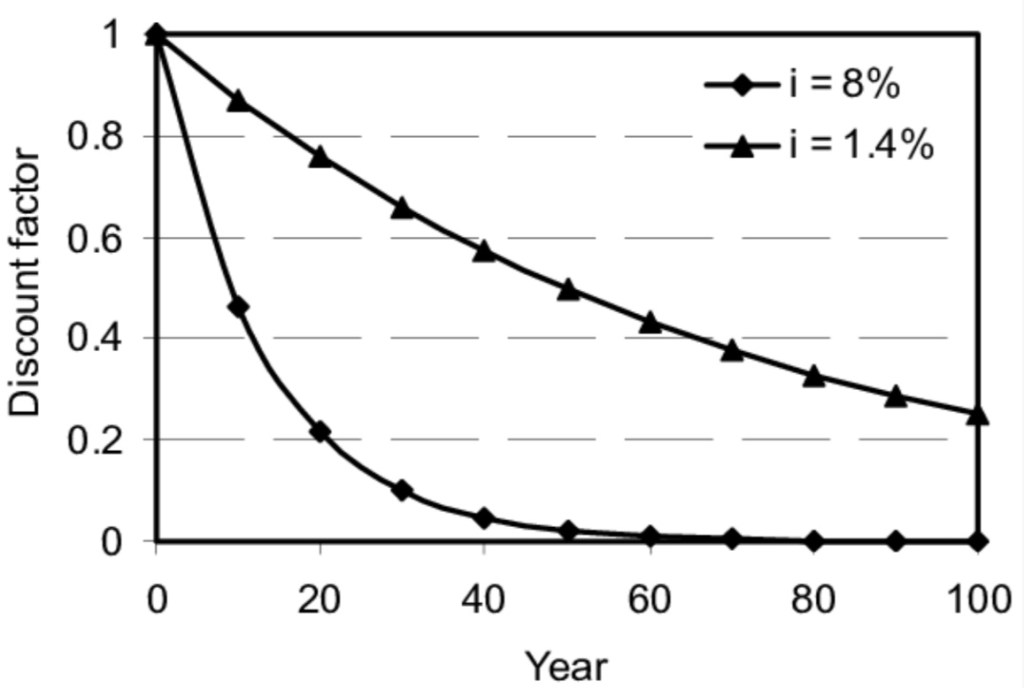
The new baseline discount rate proposed by OMB is 1.7%, and it is lower still for very distant flows of benefits. This is intended as a real, after-tax discount rate on Treasury bonds. It represents an average (and ex post) risk-free rate on bonds held to maturity over the historical period in question, calculated as described by OMB. However, like the earlier guidance, it is not prospective in any sense. And of course it is quite low!

Our Poor Little Rich Ancestors

The projected benefits of regulations or other public initiatives can be highly dubious in the first place. Unintended consequences are the rule rather than the exception. Furthermore, even modest economic growth over several generations will leave our ancestors with far more income and wealth than we have at our disposal today. That means their ability to adapt to changes will be far superior, and they will have access to technologies making our current efforts seem quaint.

Now here’s the thing: discounting the presumed benefits of government intervention at a low rate would drastically inflate their present value. John Cochrane uses an extreme case to illustrate the point. Suppose a climate policy is projected to avoid costs equivalent to 5% of GDP 100 years from now. Those avoided costs would represent a gigantic sum! By then, at just 2% growth, real GDP will be over seven times larger than this year’s output. Cochrane calculates that 5% of real GDP in 2123 is equivalent to 37% of 2023 real GDP. And the presumed cost saving goes on forever.

We can calculate the present value of the climate policy’s benefits to determine whether it’s greater than the proposed cost of the policy. Let’s choose a fairly low discount rate like … oh, say zero. In that case, the present value is infinite, and it is infinite at any discount rate below 2% (such as 1.7%). That’s because the benefits grow at 2% (like real GDP) and go on forever! That’s faster than the diminishing effect of discounting on present value. In mathematical terms, the series does not converge. Of course, this is not discounting. It is non-discounting. Cochrane’s point, however, is that if you take these calculations seriously, you’d be crazy not to implement the policy at any finite cost! You shouldn’t mind the new taxes at all! Or the inflation tax induced by more deficit spending! Or higher regulatory costs passed along to you as a consumer! So just stop your bitching!

Formal Comments to OMB

If Cochrane’s example isn’t enough to convince you of the boneheadedness of the OMB proposal, there are several theoretical reasons to balk. Cochrane provides links to a couple of formal comments submitted to OMB. Joshua Rauh of the Stanford Business School details a few fundamental objections. His first point is that a regulatory impact analysis (RIA), or the evaluation of any other initiative, “should be based on market conditions that prevail at the time of the RIA”. In other words, the choice of a discount rate should not rely on an average over a lengthy historical period. Second, it is unrealistic to assume that the benefits and costs of proposed regulations are risk-free. In fact, unlike Treasury securities, these future streams are quite risky, and they are not tradable, and they are not liquid.

Rauh also notes that the OMB’s proposed decline in discount rates to be applied to benefits or cash flows in more distant periods has no reliable empirical basis. He believes that results based on a constant discount rate should at least be reported. Moreover, agencies should be required to offer justification for their choice of a discount rate relative to the risks inherent in the streams of costs and benefits on any new project or rule.

Rauh is skeptical of recommendations that agencies should add a theoretical risk premium to a risk-free rate, however, despite the analytical superiority of that approach. Instead, he endorses the simplicity of the OMB’s previous guidance for discount rates of 3% and 7%. But he also proposes that RIAs should always include “the complete undiscounted streams of both benefits and costs…”. If there are distributions of possible cost and benefit streams, then multiple streams should be included.

Furthermore, Rauh says that agencies should not recast streams of benefits in the form of certainty equivalents, which interpose various forms of objective functions in order to calculate a “fair guarantee”, rather than a range of actual outcomes. Instead, Rauh insists that straightforward expected values should be used, This is for the sake of transparency and to enable independent assessment of RIAs.

Another comment on the OMB proposal comes from a group of economists at MIT. They have fewer qualms than Rauh regarding the use of risk-adjusted discount rates by government agencies. In addition, they note that risk in the private sector can often be ameliorated by diversification, whereas risks inherent in public policy must be absorbed by changes in taxes, government spending, or unintended costs inflicted on the private sector. Taxpayers, those having stakes in other programs, and the general public bear these risks. Using Treasury rates for discounting presumes that bad outcomes have no cost to society!

Conclusion

Discounting the costs and benefits of proposed regulations and other government programs should be performed with discount rates that reflect risks. Treasury rates are wholly inappropriate as they are essentially risk-free over time horizons often much shorter than the streams of benefits and costs to be discounted. The OMB proposal might be a case of simple thoughtlessness, but I doubt it. To my mind, it aligns a little too neatly with the often expansive agenda of the administrative state. It would add to what is already a strong bias in favor of regulatory action and government absorption of resources. Champions of government intervention are prone to exaggerate the flow of benefits from their pet projects, and low discount rates exaggerate the political advantages they seek. That bias comes at the expense of the private sector and economic growth, where inter-temporal tradeoffs and risks are exploited only at more rational discounts and then tested by markets.

Oh To Squeeze Fiscal Discipline From a Debt Limit Turnip

01 Wednesday Feb 2023

Posted by Nuetzel in Fiscal policy, Monetary Policy

≈ 1 Comment

Tags

Brinksmanship, British Consols, Congressional Budget Office, consumption tax, David Andolfatto, Debt Limit, Debt to GDP, Entitlement Trust Funds, Extraordinary Measures, Fed Independence, Federal Debt, Federal Default, Federal Reserve, Fiscal Restraint, Income Tax, Inflation tax, IRS, Janet Yellen, Joe Biden, John Cochrane, Josh Barro, Kevin McCarthy, Matt Levine, Modern Monetary Theory, Monetarist Arithmetic, Neil Wallace, Pandemic Benefits, Payment Prioritization, Perpetuities, Platinum Coin, Premium Bonds, Privatization, Rashida Tlaib, Rohan Grey, Saving Incentives, Thomas Sargent, Treasury Debt, Trillion Dollar Coin, Value Added Tax

It’s as if people view the debt limit controversy as a political nuisance rather than the stopgap enforcement mechanism for fiscal sanity that it’s intended to be. That’s a lesson in how far we’ve gone toward an unhealthy acceptance of permanent federal deficits. Oh, most people seem to realize the the government’s spending is prodigious and beyond our capacity to collect taxes, but many don’t grasp the recklessness of the ongoing blowout. Federal deficits are expected to average $1.6 trillion per year over the next decade, versus less than $0.9 trillion and $1.25 trillion over the two previous decades, respectively. That $1.25 trillion includes the massive (and excessive) transfers that took place during the pandemic, which is why we’ve bumped up against the debt limit earlier than had been expected. The trend isn’t abating, despite the fact that the pandemic is behind us. And keep in mind that the Congressional Budget Office has been too optimistic for the past 20 years or so. Take a look at federal debt relative to GDP:

Unpleasant Arithmetic

With federal debt growing faster than GDP, the burden of servicing the debt mounts. This creates a strain in the coordination of fiscal and monetary policy, as described by David Andolfatto, who last year reviewed the implications of “Some Unpleasant Monetarist Arithmetic” for current policy. His title was taken from a seminal paper written by Thomas Sargent and Neil Wallace in 1981. Andolfatto says that:

“… attempting to monetize a smaller fraction of outstanding Treasury securities has the effect of increasing the rate of inflation. A tighter monetary policy ends up increasing the interest expense of debt issuance. And if the fiscal authority is unwilling to curtail the rate of debt issuance, the added interest expense must be monetized—at least if outright default is to be avoided.

Andolfatto wrote that last spring, before the Federal Reserve began its ongoing campaign to tighten monetary policy by raising short-term interest rates. But he went on to say:

“Deficit and debt levels are elevated relative to their historical norms, and the current administration seems poised to embark on an ambitious public spending program. … In the event that inflation rises and then remains intolerably above target, the Federal Reserve is expected to raise its policy rate. … if the fiscal authority is determined to pursue its deficit policy into the indefinite future, raising the policy rate may only keep a lid on inflation temporarily and possibly only at the expense of a recession. In the longer run, an aggressive interest rate policy may contribute to inflationary pressure—at least until the fiscal regime changes.”

So it is with a spendthrift government: escalating debt and interest expense must ultimately be dealt with via higher taxes or inflation, despite the best intentions of a monetary authority.

Fiscal Wrasslin’

Some people think the debt limit debate is all a big fake. Maybe … there are spendthrifts on both sides of the aisle. Still, the current debt limit impasse could serve a useful purpose if fiscal conservatives succeed in efforts to restrain spending. There is, however, an exaggerated uproar over the possibility of default, meaning a failure to make scheduled payments on Treasury securities. The capital markets aren’t especially worried because an outright default is very unlikely. Establishment Republicans may well resort to their usual cowardice and accept compromise without holding out for better controls on spending. Already, in a politically defensive gesture, House Speaker Kevin McCarthy has said the GOP wishes to strengthen certain entitlement programs. Let’s hope he really means restoring solvency to the Social Security and Medicare Trust Funds via fundamental reforms. And if the GOP rules out cuts to any program, let’s hope they don’t rule out cuts in the growth of these programs, or privatization. For their part, of course, Democrats would like to eliminate the debt ceiling entirely.

One of the demands made by Republicans is a transformation of the federal tax system. They would like to eliminate the income tax and substitute a tax on consumption. Economists have long favored the latter because it would eliminate incentives that penalize saving, which undermine economic growth. Unfortunately, this is almost dead in the water as a political matter, but the GOP further sabotaged their own proposal in their zeal to abolish the IRS. Their consumption tax would be implemented as a national sales tax applied at the point of sale, complete with a new Treasury agency to administer the tax. They’d have done better to propose a value added tax (VAT) or a tax on a simple base of income less saving (and other allowances).

Gimmicks and Measures

We’ve seen proposals for various accounting tricks to allow the government to avoid a technical default and buy time for an agreement to be reached on the debt limit. Treasury Secretary Janet Yellen already has implemented “extraordinary measures” to stay under the debt limit until June, she estimates. The Treasury is drawing down cash, skipping additional investments in government retirement accounts (which can be made up later without any postponement of benefits), plus a few other creative accounting maneuvers.

Payment prioritization, whereby the Treasury makes payments on debt and critical programs such as Social Security and Medicare, but defers a variety of other payments, has also been considered. Those deferrals could include amounts owed to contractors or even government salaries. However, a deferral of payments owed to anyone represents a de facto default. Thus, payment prioritization is not a popular idea, but if push comes to shove, it might be viewed as the lesser of two evils. Missing payments on government bonds could precipitate a financial crisis, but no one believes it will come to that.

Two other ideas for avoiding a breach of the debt ceiling are rather audacious. One involves raising new cash via the sale of premium bonds by the Treasury, as described here by Josh Barro (and here by Matt Levine). The other idea is to mint a large denomination ($1 trillion) platinum, “commemorative” coin, which the Treasury would deposit at the Federal Reserve, enabling it to conduct business as usual until the debt limit impasse is resolved. I’ll briefly describe each of these ideas in more detail below.

Premium Bonds

Premium bonds would offer a solution to the debt limit controversy because the debt ceiling is defined in terms of the par value of Treasury debt outstanding, as opposed to the amount actually raised from selling bonds at auction. For example, a note that promises to pay $100 in one year has a par value of $100. If it also promises to pay $100 in interest, it will sell at a steep premium. Thus, the Treasury collects, say, $185 at auction, and it could use the proceeds to pay off $100 of maturing debt and fund $85 of federal spending. That would almost certainly require a “market test” by the Treasury on a limited scale, and the very idea might reveal any distaste the market might have for obviating the debt limit in this fashion. But distaste is probably too mild a word.

An extreme example of this idea is for the Treasury to sell perpetuities, which have a zero par value but pay interest forever, or at least until redeemed beyond some minimum (but lengthy) term. John Cochrane has made this suggestion, though mainly just “for fun”. The British government sold perpetuities called consols for many years. Such bonds would completely circumvent the debt limit, at least without legislation to redefine the limit, which really is long overdue.

The $1 Trillion Coin

Minting a trillion dollar coin is another thing entirely. Barro has a separate discussion of this option, as does Cochrane. The idea was originally proposed and rejected during an earlier debt-limit controversy in 2011. Keep in mind, in what follows, that the Fed does not follow Generally Accepted Accounting Principles (GAAP).

Skeptics might be tempted to conclude that the “coin trick” is a ploy to engineer a huge increase the money supply to fund government expansion, but that’s not really the gist of this proposal. Instead, the Treasury would deposit the coin in its account at the Fed. The Fed would hold the coin and give the Treasury access to a like amount of cash. To raise that cash, the Fed would sell to the public $1 trillion out of its massive holdings of government securities. The Treasury would use that cash to meet its obligations without exceeding the debt ceiling. As Barro says, the Fed would essentially substitute sales of government bonds from its portfolio for bonds the Treasury is prohibited from selling under the debt limit. The effect on the supply of money is basically zero, and it is non-inflationary unless the approach has an unsettling impact on markets and inflation expectations (which of course is a distinct possibility).

When the debt ceiling is finally increased by Congress, the process is reversed. The Treasury can borrow again and redeem its coin from the Fed for $1 trillion, then “melt it down”, as Barro says. The Fed would repurchase from the public the government securities it had sold, adding them back to its portfolio (if that is consistent with its objectives at that time). Everything is a wash with respect to the “coin trick”, as long as the Treasury ultimately gets a higher debt limit.

Lust For the Coin

In fairness to skeptics, it’s easy to understand why the “coin trick” described above might be confused with another coin minting idea that arose from the collectivist vanguard during the pandemic. Representative Rashida Tlaib (D-MI) proposed minting coins to fund monthly relief payments of $1,000 – $2,000 for every American via electronic benefit cards. She was assisted in crafting this proposal by Rohan Grey, a prominent advocate of Modern Monetary Theory (MMT), the misguided idea that government can simply print money to pay for the resources it demands without inflationary consequences.

Tlaib’s plan would have required the Federal Reserve to accept the minted coins as deposits into the Treasury’s checking account. But then, rather than neutralizing the impact on the money supply by selling government bonds, the coin itself would be treated as base money. Cash balances would simply be made available in the Treasury’s checking account with the Fed. That’s money printing, pure and simple, but it’s not at all the mechanism under discussion with respect to short-term circumvention of the debt limit.

Fed Independence

The “coin trick” as a debt limit work-around is probably an impossibility, as Barro and others point out. First, the Fed would have to accept the coin as a deposit, and it is under no legal obligation to do so. Second, it obligates the Fed to closely coordinate monetary policy with the Treasury, effectively undermining its independence and its ability to pursue its legal mandates of high employment and low inflation. Depending on how badly markets react, it might even present the Fed with conflicting objectives.

Believe me, you might not like the Fed, but we certainly don’t want a Fed that is subservient to the Treasury… maintaining financial and economic stability in the presence of an irresponsible fiscal authority is bad enough without seating that authority at the table. As Barro says of the “coin trick”:

“These actions would politicize the Fed and undermine its independence. In order to stabilize expectations about inflation, the Fed would have to communicate very clearly about its intentions to coordinate its fiscal actions with Treasury — that is, it would have to tell the world that it’s going to act as Treasury’s surrogate in selling bonds when Treasury can’t. …

These actions would interfere with the Fed’s normal monetary operations. … the Fed is currently already reducing its holdings of bonds as part of its strategy to fight inflation. If economic conditions change (fairly likely, in the event of a near-default situation) that might change the Fed’s desired balance sheet strategy.”

On With The Show

Discussions about the debt limit continue between the White House and both parties in Congress. Kevin McCarthy met with President Biden today (2/1), but apparently nothing significant came it. Fiscal conservatives wonder whether McCarthy and other members of the GOP lack seriousness when it comes to fiscal restraint. But spending growth must slow to achieve deficit reduction, non-inflationary growth, and financial stability.

Meanwhile, even conservative media pundits seem to focus only on the negative politics of deficit reduction, ceding the advantage to Democrats and other fiscal expansionists. For those pundits, the economic reality pales in significance. That is a mistake. Market participants are increasingly skeptical that the federal government will ever pay down its debts out of future surpluses. This will undermine the real value of government debt, other nominal assets, incomes and buying power. That’s the inflation tax in action.

Unbridled growth of the government’s claims on resources at the expense of the private sector destroys the economy’s productive potential, to say nothing of growth. The same goes for government’s insatiable urge to regulate private activities and to direct patterns of private resource use. Unfortunately, so many policy areas are in need of reform that imposition of top-down controls on spending seems attractive as a stopgap. Concessions on the debt limit should only be granted in exchange for meaningful change: limits on spending growth, regulatory reforms, and tax simplification (perhaps replacing the income tax with a consumption tax) should all be priorities.

In the meantime, let’s avoid trillion dollar coins. As a debt limit work-around, premium bonds are more practical without requiring any compromise to the Fed’s independence. Other accounting gimmicks will be used to avoid missing payments, of course, but the fact that premium bonds and platinum coins are under discussion highlights the need to redefine the debt limit. When the eventual time of default draws near, fiscal conservatives must be prepared to stand up to their opponents’ convenient accusations of “brinksmanship”. The allegation is insincere and merely a cover for government expansionism.

“Hard Landing” Is Often Cost of Fixing Inflationary Policy Mistakes

05 Wednesday Oct 2022

Posted by Nuetzel in Inflation, Monetary Policy

≈ Leave a comment

Tags

Ample Reserves, Budget Deficit, Core CPI, Demand-Side Inflation, Energy Policy, Expected Inflation, Hard Landing, Inflation, Inflation Targeting, Inverted Yield Curve, Jeremy Siegel, John Cochrane, M2, Median CPI, Median PCE, Monetary Base, Monetary policy, PCE Deflator, Price Signals, Recession, Scott Sumner, Soft Landing, Supply-Side Inflation, Trimmed CPI

The debate over the Federal Reserve’s policy stance has undergone an interesting but understandable shift, though I disagree with the “new” sentiment. For the better part of this year, the consensus was that the Fed waited too long and was too dovish about tightening monetary policy, and I agree. Inflation ran at rates far in excess of the Fed’s target, but the necessary correction was delayed and weak at the start. This violated the necessary symmetry of a legitimate inflation-targeting regime under which the Fed claims to operate, and it fostered demand-side pressure on prices while risking embedded expectations of higher prices. The Fed was said to be “behind the curve”.

Punch Bowl Resentment

The past few weeks have seen equity markets tank amid rising interest rates and growing fears of recession. This brought forth a chorus of panicked analysts. Bloomberg has a pretty good take on the shift. Hopes from some economists for a “soft landing” notwithstanding, no one should have imagined that tighter monetary policy would be without risk of an economic downturn. At least the Fed has committed to a more aggressive policy with respect to price stability, which is one of its key mandates. To be clear, however, it would be better if we could always avoid “hard landings”, but the best way to do that is to minimize over-stimulation by following stable policy rules.

Price Trends

Some of the new criticism of the Fed’s tightening is related to a perceived change in inflation signals, and there is obvious logic to that point of view. But have prices really peaked or started to reverse? Economist Jeremy Siegel thinks signs point to lower inflation and believes the Fed is being too aggressive. He cites a series of recent inflation indicators that have been lower in the past month. Certainly a number of commodity prices are generally lower than in the spring, but commodity indices remain well above their year-ago levels and there are new worries about the direction of oil prices, given OPEC’s decision this week to cut production.

Central trends in consumer prices show that there is a threat of inflation that may be fairly resistant to economic weakness and Fed actions, as the following chart demonstrates:

Overall CPI growth stopped accelerating after June, and it wasn’t just moderation in oil prices that held it back (and that moderation might soon reverse). Growth of the Core CPI, which excludes food and energy prices, stopped accelerating a bit earlier, but growth in the CPI and the Core CPI are still running above 8% and 6%, respectively. More worrisome is the continued upward trend in more central measures of CPI growth. Growth in the median component of the CPI continues to accelerate, as has the so-called “Trimmed CPI”, which excludes the most extreme sets of high and low growth components. The response of those central measures lagged behind the overall CPI, but it means there is still inflationary momentum in the economy. There is a substantial risk that expectations of a more permanent inflation are becoming embedded in expectations, and therefore in price and wage setting, including long-term contracts.

The Fed pays more attention to a measure of prices called the Personal Consumption Expenditures (PCE) deflator. Unlike the CPI, the PCE deflator accounts for changes in the composition of a typical “basket” of goods and services. In particular, the Fed focuses most closely on the Core PCE deflator, which excludes food and energy prices. Inflation in the PCE deflator is lower than the CPI, in large part because consumers actively substitute away from products with larger price increases. However, the recent story is similar for these two indices:

Both overall PCE inflation and Core PCE inflation stopped accelerating a few months ago, but growth in the median PCE component has continued to increase. This central measure of inflation still has upward momentum. Again, this raises the prospect that inflationary forces remain strong, and that higher and more widespread expected inflation might make the trend more difficult for the Fed to rein in.

That leaves the Fed little choice if it hopes to bring inflation back down to its target level. It’s really a only a choice of whether to do it faster or slower. One big qualification is that the Fed can’t do much about supply shortfalls, which have been a source of price pressure since the start of the rebound from the pandemic. However, demand pressures have been present since the acceleration in price growth began in earnest in early 2021. At this point, it appears that they are driving the larger part of inflation.

The following chart shows share decompositions for growth in both the “headline” PCE deflator and the Core PCE deflator. Actual inflation rates are NOT shown in these charts. Focus only on the bolder colored bars. (The lighter bars represent estimates having less precision.) Red represents “supply-side” factors contributing to changes in the PCE deflator, while blue summarizes “demand-side” factors. This division is based on a number of assumptions (methodological source at the link), but there is no question that demand has contributed strongly to price pressures. At least that gives a sense about how much of the inflation can be addressed by actions the Fed might take.

I mentioned the role of expectations in laying the groundwork for more permanent inflation. Expected inflation not only becomes embedded in pricing decisions: it also leads to accelerated buying. So expectations of inflation become a self-fulfilling prophesy that manifests on both the supply side and the demand-side. Firms are planning to raise prices in 2023 because input prices are expected to continue rising. In terms of the charts above, however, I suspect this phenomenon is likely to appear in the “ambiguous” category, as it’s not clear that the counting method can discern the impacts of expectations.

What’s a Central Bank To Do?

Has the Fed become too hawkish as inflation accelerated this year while proving to be more persistent than expected? One way to look at that question is to ask whether real interest rates are still conducive to excessive rate-sensitive demand. With PCE inflation running at 6 – 7% and Treasury yields below 4%, real returns are still negative. That’s hardly seems like a prescription for taming inflation, or “hawkish”. Rate increases, however, are not the most reliable guide to the tenor of monetary policy. As both John Cochrane and Scott Sumner point out, interest rate increases are NOT always accompanied by slower money growth or slowing inflation!

However, Cochrane has demonstrated elsewhere that it’s possible the Fed was on the right track with its earlier dovish response, and that price pressures might abate without aggressive action. I’m skeptical to say the least, and continuing fiscal profligacy won’t help in that regard.

The Policy Instrument That Matters

Ultimately, the best indicator that policy has tightened is the dramatic slowdown (and declines) in the growth of the monetary aggregates. The three charts below show five years of year-over-year growth in two monetary measures: the monetary base (bank reserves plus currency in circulation), and M2 (checking, saving, money market accounts plus currency).

Growth of these aggregates slowed sharply in 2021 after the Fed’s aggressive moves to ease liquidity during the first year of the pandemic. The monetary base and M2 growth have slowed much more in 2022 as the realization took hold that inflation was not transitory, as had been hoped. Changes in the growth of the money stock takes time to influence economic activity and inflation, but perhaps the effects have already begun, or probably will in earnest during the first half of 2023.

The Protuberant Balance Sheet

Since June, the Fed has also taken steps to reduce the size of its bloated balance sheet. In other words, it is allowing its large holdings of U.S. Treasuries and Agency Mortgage-Backed Securities to shrink. These securities were acquired during rounds of so-called quantitative easing (QE), which were a major contributor to the money growth in 2020 that left us where we are today. The securities holdings were about $8.5 trillion in May and now stand at roughly $8.2 trillion. Allowing the portfolio to run-off reduces bank reserves and liquidity. The process was accelerated in September, but there is increasing tension among analysts that this quantitative tightening will cause disruptions in financial markets and ultimately the real economy, There is no question that reducing the size of the balance sheet is contractionary, but that is another necessary step toward reducing the rate of inflation.

The Federal Spigot

The federal government is not making the Fed’s job any easier. The energy shortages now afflicting markets are largely the fault of misguided federal policy restricting supplies, with an assist from Russian aggression. Importantly, however, heavy borrowing by the U.S. Treasury continues with no end in sight. This puts even more pressure on financial markets, especially when such ongoing profligacy leaves little question that the debt won’t ever be repaid out of future budget surpluses. The only way the government’s long-term budget constraint can be preserved is if the real value of that debt is bid downward. That’s where the so-called inflation tax comes in, and however implicit, it is indeed a tax on the public.

Don’t Dismiss the Real Costs of Inflation

Inflation is a costly process, especially when it erodes real wages. It takes its greatest toll on the poor. It penalizes holders of nominal assets, like cash, savings accounts, and non-indexed debt. It creates a high degree of uncertainty in interpreting price signals, which ordinarily carry information to which resource flows respond. That means it confounds the efficient allocation of resources, costing all of us in our roles as consumers and producers. The longer it continues, the more it erodes our economy’s ability to enhance well being, not to mention the instability it creates in the political environment.

Imminent Recession?

So far there are only limited signs of a recession. Granted, real GDP declined in both the first and second quarters of this year, but many reject that standard as overly broad for calling a recession. Moreover, consumer spending held up fairly well. Employment statistics have remained solid, though we’ll get an update on those this Friday. Nevertheless, payroll gains have held up and the unemployment rate edged up to a still-low 3.7% in August.

Those are backward-looking signs, however. The financial markets have been signaling recession via the inverted yield curve, which is a pretty reliable guide. The weak stock market has taken a bite out of wealth, which is likely to mean weaker demand for goods. In addition to energy-supply shocks, the strong dollar makes many internationally-traded commodities very costly overseas, which places the global economy at risk. Moreover, consumers have run-down their savings to some extent, corporate earnings estimates have been trimmed, and the housing market has weakened considerably with higher mortgage rates. Another recent sign of weakness was a soft report on manufacturing growth in September.

Deliver the Medicine

The Fed must remain on course. At least it has pretensions of regaining credibility for its inflation targeting regime, and ultimately it must act in a symmetric way when inflation overshoots its target, and it has. It’s not clear how far the Fed will have to go to squeeze demand-side inflation down to a modest level. It should also be noted that as long as supply-side pressures remain, it might be impossible for the Fed to engineer a reduction of inflation to as low as its 2% target. Therefore, it must always bear supply factors in mind to avoid over-contraction.

As to raising the short-term interest rates the Fed controls, we can hope we’re well beyond the halfway point. Reductions in the Fed’s balance sheet will continue in an effort to tighten liquidity and to provide more long-term flexibility in conducting operations, and until bank reserves threaten to fall below the Fed’s so-called “ample reserves” criterion, which is intended to give banks the wherewithal to absorb small shocks. Signs that inflationary pressures are abating is a minimum requirement for laying off the brakes. Clear signs of recession would also lead to more gradual moves or possibly a reversal. But again, demand-side inflation is not likely to ease very much without at least a mild recession.

The SEC’s Absurd Climate Overreach

04 Monday Apr 2022

Posted by Nuetzel in Central Planning, Global Warming

≈ 2 Comments

Tags

capital costs, Carbon Emissions, Carbon Forcing Models, carbon Sensitivity, central planning, Corporatism, Disclosure Requirements, ESG Risk, ESG Scores, Green Energy, Greenhouse Gas, Hester Peirce, John Cochrane, Litigation Risk, Paris Agreement, Regulatory Risk, Renewable energy, Scope 1, Scope 2, Scope 3, SEC Climate Mandate, Securities and Exchange Commission

The Securities and Exchange Commission recently issued a proposed rule for reporting on climate change risk, and it is fairly outrageous. It asks that corporations report on their own direct greenhouse gas emissions (GHG – Scope 1), the emissions caused by their purchases of energy inputs (Scope 2), and the emissions caused by their “downstream” customers and “upstream” suppliers (Scope 3). This is another front in the Biden Administration’s efforts to bankrupt producers of fossil fuels and to force the private sector to radically alter its mix of energy inputs. The SEC’s proposed “disclosures” are sheer lunacy on several levels.

The SEC Mandate

If implemented, the rule would allow the SEC to stray well outside the bounds of its regulatory authority. The SEC’s role is not to regulate emissions or the environment. Rather, as its web site makes clear, the agency is charged with:

“… protecting investors, maintaining fair, orderly, and efficient markets, and facilitating capital formation.”

Given this mission, the SEC requires management to disclose material financial risks. Are a firm’s GHG emissions really material risks? The first problem here is quite practical: John Cochrane notes the outrageous costs that would be associated with compliance:

“‘Disclosure’ usually means revealing something you know. A perfectly honest answer to ‘disclose what you know about your carbon emissions’ is, ‘we have no idea what our carbon emissions are.’ Back that up with every document the company has ever produced, and you have perfectly ‘disclosed.’ There is no asymmetric information, fraud, etc.

The SEC has already required the production of new information, and as Hester Peirce makes perfectly clear, the climate rules again make a huge dinner out of that appetizer: essentially telling companies to hire a huge number of climate consultants to generate new information, and also how to run businesses.”

In a separate post, Cochrane quotes SEC Commissioner Hester Peirce’s response to the proposed rule. She emphasizes that companies are already required to disclose all material risks. Perhaps they have properly declined to disclose climate risks because those risks are not material.

“Current SEC disclosure mandates are intended to provide investors with an accurate picture of the company’s present and prospective performance through managers’ own eyes. How are they thinking about the company? What opportunities and risks do the board and managers see? What are the material determinants of the company’s financial value?”

Identifying the Risk Causers

Regardless of the actual risks to a firm caused by climate change, the SEC’s proposed GHG disclosures put a more subtle issue into play. Peirce describes what amounts to a fundamental shift in the SEC’s philosophy regarding the motivation and purpose of disclosure:

The proposal, by contrast, tells corporate managers how regulators, doing the bidding of an array of non-investor stakeholders, expect them to run their companies. It identifies a set of risks and opportunities—some perhaps real, others clearly theoretical—that managers should be considering and even suggests specific ways to mitigate those risks. It forces investors to view companies through the eyes of a vocal set of stakeholders, for whom a company’s climate reputation is of equal or greater importance than a company’s financial performance.”

In other words, a major risk faced by these firms has nothing to do with climate change itself, but with perceptions of “climate-related” risks by other parties. That transforms the question of climate risk into something that is, in fact, regulatory and political. Is this the true nature of the SEC’s concern, all dressed up in the scientism typically relied upon by climate change activists?

The reaction of government bureaucrats to the risks they perceive is a palpable threat to investor well-being. For example, GHG emissions might lead to future regulatory sanctions from various government agencies, including fines, taxes, various sanctions, and mitigation mandates. In addition, with the growth of investment management based on what are essentially shambolic and ad hoc ESG scores, GHG or carbon emissions might lead to constraints on a firm’s access to capital. Just ask the oil and gas industry! That penalty is imposed by activist investors and fund managers who wish to force an unwise and premature end to the use of fossil fuels. There is also a threat that GHG disclosures themselves, based (as they will be) on flimsy estimates, could create litigation risk for many companies.

Much Ado About Nothing

While there are major regulatory and political risks to investors, let’s ask, for the sake of argument: how would one degree celcius of warming by the end of this century affect corporate results? Generally not at all. (The bounds described in the Paris Agreement are 1.5 to 2 degrees, but these are based on unrealistic scenarios — see links below.) It would happen gradually in any case, with ample opportunity to adapt to the operating environment. To think otherwise requires great leaps of imagination. For example, climate alarmists probably fancy that violent weather or wildfires will wipe out facilities, yet there is no reliable evidence that the mild warming experienced to-date has been associated with more violent weather or an increased incidence of wildfires (and see here). There are a great many “sacred cows” worshiped by climate-change neurotics, and the SEC undoubtedly harbors many of those shibboleths.

What probabilities can be attached to each incremental degree of warming that might occur over several decades. The evidence we’ve seen comes from so-called carbon-forcing models parameterized for unrealistically high carbon sensitivities and subjected to unrealistic carbon-concentration scenarios. Estimates of these probabilities are not reliable.

Furthermore, climate change risks, even if they could be measured reliably in the aggregate, cannot reasonably be allocated to individual firms. The magnitude of the firm’s own contribution to that risk is equivalent to the marginal reduction in risk if the firm implemented a realistic zero-carbon operating rule. For virtually any firm, we’re talking about something infinitesimal. It involves tremendous guesswork given that various parties around the globe take a flexible approach to emissions, and will continue to do so. The very suggestion of such an exercise is an act of hubris.

Back To The SEC’s Mandated Role

Let’s return to the practical problems associated with these kinds of disclosure requirements. Cochrane also points out that the onerous nature of the SEC proposal, and the regulatory and political threats it embodies, will hasten the transition away from public ownership in many industries.

“The fixed costs alone are huge. The trend to going private and abandoning public markets, at least in the U.S. will continue. The trend to large oligopolized politically compliant static businesses in the U.S. will continue.

I would bet these rules wind up in court, and that these are important issues. They should be.”

Unfortunately, private companies will still have to to deal with certain investors who would shackle their use of energy inputs and demand forms of diligence (… not to say “due”) of their own.

The SEC’s proposed climate risk disclosures are stunningly authoritarian, and they are designed to coalesce with other demands by the regulatory state to kill carbon-based energy and promote renewables. These alternative energy sources are, as yet, unable to offer an economical and stable supply of power. The fraudulent nature of the alleged risks make this all the more appalling. The SEC has effectively undertaken an effort to engage in corporatist industrial policy benefitting a certain class of “green” energy investors, exposing the proposal as yet another step on the road to fascism. Let’s hope Cochrane is right: already, 16 state attorneys general are preparing a legal challenge. May the courts ultimately see through the SEC’s sham!

ESG Scoring: Political Tool Disguised as Investment Guide

30 Wednesday Mar 2022

Posted by Nuetzel in Capital Markets, Corporatism, Environmental Fascism, Social Justice

≈ 3 Comments

Tags

Access to Capital, Antitrust, Blackrock, Climate Action 100+, Corporatism, Diversity, Equity, ESG Fees, ESG Scores, Great Reset, Green Energy, Inclusion, John Cochrane, Mark Brnovich, Principal-Agent Problem, Renewable energy, Renewables, rent seeking, Shareholder Value, Social Justice, Stakeholder Capitalism, Sustainability, Too big to fail, Ukraine Invasion, Vladimir Putin, Woke Investors, Zero-Carbon

ESG scores are used to rate companies on “Environmental, Social, and Governance” criteria. The truth, however, is that ESGs are wholly subjective measures of company performance. There are many different ESG scores available, with no uniform standards for methodology, specific inputs, or weighting schemes. If you think quarterly earnings reports are manipulated, ESGs are an even more pliable tool for misleading investors. It is a market fad, and fund managers are using it as an excuse to charge higher fees to investors. But like any trending phenomenon, for a time, the focus on ESGs might feed-back positively to returns on favored companies. That won’t be sustainable, however, without legislative and regulatory cover, plus a little manipulative help from the ESG engineers and “Great Reset” propagandists.

It’s 100% Political, 0% Economic

ESGs are founded on prioritizing objectives that have little to do with shareholder value or any well-understood yardsticks of financial or operating performance. The demands on company resources for scoring highly on ESG are often nakedly political. This includes adoption of environmental goals such as fraudulent “zero carbon” impacts, the nebulous “sustainability” objective promoted by “green” activists, diversity, inclusion and equity initiatives, and support for activist groups such as Black Lives Matter and Antifa.

Concepts like “stakeholder value” are critical to the rationale for ESGs. “Stakeholders” can include employees, suppliers, and customers, as well as potential employees. suppliers, and customers. In other words, they can be just about anyone in the broader community, or more likely activists for “social change” whose interests have but the thinnest connection to the business’s productive activities. In essence, so-called stakeholder capitalism amounts to a ceding of control over corporate resources, and ultimately confiscation of wealth from equity owners.

Corporations have long engaged in various kinds of defensive actions, amounting to a modern-day trade in indulgences. No one will be upset about your gas-powered fleet if you buy enough carbon offsets, which just might neutralize the impact of the fleet on your ESG! On a more sinister level, ESG’s provide opportunities for cover against information that might be damaging to firms, such as the use of slave labor overseas. Flatter the right people, give to their causes, “partner” with them on pet initiatives, and your sins will be ignored and your ESG will climb! And ESGs are used in attempts to pacify leftist investors who see the corporation as a vessel for their own social objectives, quite apart from any mission it might have had as a productive enterprise.

Your ESG will shine if you do business that’s politically-favored, like renewable energy, despite its inefficiencies and significant environmental blemishes. But ESGs are not merely used to reward those anointed as virtuous by the Left. They are more forcefully used to punish firms in industries that are out of favor, or firms refusing to participate in buying off authoritarian crusaders. For example, you might be so berserk as to think fossil fuels and climate change represent imminent threats of catastrophe. Naturally, you’ll want to punish oil and gas producers. In fact, if you are in charge of ESG modeling, you might want to penalize almost any extraction industry, with certain exceptions: the massive extraction and disposal costs of renewables will pass without notice.

All these machinations occur despite the huge uncertainty surrounding flimsy, model-based predictions of warming and global catastrophe. Never mind that fossil fuels are still relied upon to provide for most of our energy needs and will be for some time to come, including base-load power generation when intermittency prevents renewables from meeting demand. The stability of the power grid depends upon the availability of carbon-based energy, which in fact is marvelously efficient. Yet the ESG crowd (not to mention the Biden Administration) seeks to drive up its cost, including the cost of capital, and these added costs fall most heavily on the poor.

ESG-guided efforts by activists to deny capital to certain segments of the energy sector may constitute antitrust violations. Some big players in the financial industry, who together manage trillions of dollars in investment funds, belong to an advocacy organization called Climate Action 100+. They coordinate on a mission to completely transform the energy industry via “green” investments and divestments of presumptively “dirty” concerns. These players and their clients have huge investments in green energy, and it is in their interest to provide cheap capital to those firms while denying capital to fossil fuel industries. As Arizona Attorney General Mark Brnovich writes at the link above, this is restraint of trade “hiding in plain sight”.

Manipulation

ESGs could be the mother of all principal-agent problems. Corporate CEOs, hired by ownership as stewards and managers of productive assets, are promoting these metrics and activities, which may not align with the interests of ownership. ESG’s are not standardized, and most users will have little insight into exactly how these “stakeholder” sausages are stuffed. In fact, much of the information used for ESGs is extremely ad hoc, not universally disclosed, and is often qualitative. The applicability of these scores to the universe of stocks, and their reliability in guiding investment decisions, is extremely questionable no matter what the investor’s objectives. And of course the models can be manipulated to produce scores that suit the preferences of money managers who have a stake in certain firms or industry segments, and who inflate their fees in exchange for ESG investment advice. And firms can certainly engage in deceptions that boost ESGs, as already discussed.

Like many cultural or consumer trends, investment trends can feed off themselves for a time. If there are enough “woke” investors, ESGs might well feed an unvirtuous cycle of stock purchases in which returns become positively correlated with wokeness. Such a divorce from business fundamentals will eventually take its toll on returns, especially when economic or other conditions present challenges, but that’s not the answer you’ll get from many stock pickers and investment pundits.

At the same time, there are ways in which the preoccupation with ESGs dovetails with the rents often sought in the political arena. Subsidies, for example, will be awarded to firms producing renewables. Politically favored firms are also likely to receive better regulatory treatment.

There are other ways in which firms engaging in wasteful activities can survive profitably, at least for a time. Monopoly power is one, and companies often develop a symbiosis with regulators that hampers smaller competitors. This is traditional rent-seeking corporatism in action, along with the “too-big-to-fail” regime. Sometimes sheer growth in demand for new technologies or networking potential helps to conceal waste. Hot opportunities can leave growing companies awash in cash, some of which will be burned in wasteful endeavors. ESG scoring offers them additional cover.

Cracks In the Edifice

John Cochrane notes a fundamental, long-term contradiction for those who invest based on ESGs: an influx of capital will tend to drive down returns in those firms and industries, while the returns on firms having low ESGs will be driven upward. Yet advocates claim you can invest for virtue and superior returns. That can’t outlast real market forces, especially as ESG efforts dilute any mission a firm might have as a productive enterprise.

Vladimir Putin’s brutal invasion of Ukraine has revealed other cracks in the ESG edifice. We now have parties arguing that defense stocks should be awarded ESG points! Also, that oil production by specific nations should be scored highly. There is also an awakening to the viability of nuclear power as an energy source. Then we have the problem of delivering on Biden’s promise to Europe of more liquified natural gas exports. That will be difficult given the way Biden has bludgeoned the industry, as well as the ESG conspiracy to deny it access to capital. Just watch the ESG hacks backpedal. Now, even the evangelists at Blackrock are wavering. To see the thread of supposed ESG consistency unravel would be enough to make you laugh if the entire conspiracy weren’t so grotesque.

Closing

The pretensions underlying “green” initiatives undertaken by large corporations are good mainly for virtue signaling, to collect public subsidies, and to earn better ESG scores. They are usually wasteful in a pure economic sense. The same is true of social justice and diversity initiatives, which can be perversely racist in their effects and undermine the rule of law.

Ultimately, we must recognize that the best contribution any producer can make to society is to create value for shareholders and customers by doing what it does well. The business world, however, has gone far astray in the direction of rank corporatism, and keep this in mind: any company supporting a sprawling HR department, pervasive diversity efforts, “sustainability” initiatives, and preoccupations with “stakeholder” outreach is distracted from its raison d’etre, its purpose as a business enterprise to produce something of value. It is probably captive to outside interests who have essentially commandeered management’s attention and shareholders’ resources.

When it comes to investing, I prefer absolute neutrality with respect to out-of-mission social goals. Sure, do no harm, but the focus should remain squarely on goals inherent in the creation of value for customers and shareholders.

← Older posts
Follow Sacred Cow Chips on WordPress.com

Recent Posts

  • Immigration and Merit As Fiscal Propositions
  • Tariff “Dividend” From An Indigent State
  • Almost Looks Like the Fed Has a 3% Inflation Target
  • Government Malpractice Breeds Health Care Havoc
  • A Tax On Imports Takes a Toll on Exports

Archives

  • December 2025
  • November 2025
  • October 2025
  • September 2025
  • August 2025
  • July 2025
  • June 2025
  • May 2025
  • April 2025
  • March 2025
  • February 2025
  • January 2025
  • December 2024
  • November 2024
  • October 2024
  • September 2024
  • August 2024
  • July 2024
  • June 2024
  • May 2024
  • April 2024
  • March 2024
  • February 2024
  • January 2024
  • December 2023
  • November 2023
  • August 2023
  • July 2023
  • June 2023
  • May 2023
  • April 2023
  • March 2023
  • February 2023
  • January 2023
  • December 2022
  • November 2022
  • October 2022
  • September 2022
  • August 2022
  • July 2022
  • June 2022
  • May 2022
  • April 2022
  • March 2022
  • February 2022
  • January 2022
  • December 2021
  • November 2021
  • October 2021
  • September 2021
  • August 2021
  • July 2021
  • June 2021
  • May 2021
  • April 2021
  • March 2021
  • February 2021
  • January 2021
  • December 2020
  • November 2020
  • October 2020
  • September 2020
  • August 2020
  • July 2020
  • June 2020
  • May 2020
  • April 2020
  • March 2020
  • February 2020
  • January 2020
  • December 2019
  • November 2019
  • October 2019
  • September 2019
  • August 2019
  • July 2019
  • June 2019
  • May 2019
  • April 2019
  • March 2019
  • February 2019
  • January 2019
  • December 2018
  • November 2018
  • October 2018
  • September 2018
  • August 2018
  • July 2018
  • June 2018
  • May 2018
  • April 2018
  • March 2018
  • February 2018
  • January 2018
  • December 2017
  • November 2017
  • October 2017
  • September 2017
  • August 2017
  • July 2017
  • June 2017
  • May 2017
  • April 2017
  • March 2017
  • February 2017
  • January 2017
  • December 2016
  • November 2016
  • October 2016
  • September 2016
  • August 2016
  • July 2016
  • June 2016
  • May 2016
  • April 2016
  • March 2016
  • February 2016
  • January 2016
  • December 2015
  • November 2015
  • October 2015
  • September 2015
  • August 2015
  • July 2015
  • June 2015
  • May 2015
  • April 2015
  • March 2015
  • February 2015
  • January 2015
  • December 2014
  • November 2014
  • October 2014
  • September 2014
  • August 2014
  • July 2014
  • June 2014
  • May 2014
  • April 2014
  • March 2014

Blogs I Follow

  • Passive Income Kickstart
  • OnlyFinance.net
  • TLC Cholesterol
  • Nintil
  • kendunning.net
  • DCWhispers.com
  • Hoong-Wai in the UK
  • Marginal REVOLUTION
  • Stlouis
  • Watts Up With That?
  • Aussie Nationalist Blog
  • American Elephants
  • The View from Alexandria
  • The Gymnasium
  • A Force for Good
  • Notes On Liberty
  • troymo
  • SUNDAY BLOG Stephanie Sievers
  • Miss Lou Acquiring Lore
  • Your Well Wisher Program
  • Objectivism In Depth
  • RobotEnomics
  • Orderstatistic
  • Paradigm Library
  • Scattered Showers and Quicksand

Blog at WordPress.com.

Passive Income Kickstart

OnlyFinance.net

TLC Cholesterol

Nintil

To estimate, compare, distinguish, discuss, and trace to its principal sources everything

kendunning.net

The Future is Ours to Create

DCWhispers.com

Hoong-Wai in the UK

A Commonwealth immigrant's perspective on the UK's public arena.

Marginal REVOLUTION

Small Steps Toward A Much Better World

Stlouis

Watts Up With That?

The world's most viewed site on global warming and climate change

Aussie Nationalist Blog

Commentary from a Paleoconservative and Nationalist perspective

American Elephants

Defending Life, Liberty and the Pursuit of Happiness

The View from Alexandria

In advanced civilizations the period loosely called Alexandrian is usually associated with flexible morals, perfunctory religion, populist standards and cosmopolitan tastes, feminism, exotic cults, and the rapid turnover of high and low fads---in short, a falling away (which is all that decadence means) from the strictness of traditional rules, embodied in character and inforced from within. -- Jacques Barzun

The Gymnasium

A place for reason, politics, economics, and faith steeped in the classical liberal tradition

A Force for Good

How economics, morality, and markets combine

Notes On Liberty

Spontaneous thoughts on a humble creed

troymo

SUNDAY BLOG Stephanie Sievers

Escaping the everyday life with photographs from my travels

Miss Lou Acquiring Lore

Gallery of Life...

Your Well Wisher Program

Attempt to solve commonly known problems…

Objectivism In Depth

Exploring Ayn Rand's revolutionary philosophy.

RobotEnomics

(A)n (I)ntelligent Future

Orderstatistic

Economics, chess and anything else on my mind.

Paradigm Library

OODA Looping

Scattered Showers and Quicksand

Musings on science, investing, finance, economics, politics, and probably fly fishing.

  • Subscribe Subscribed
    • Sacred Cow Chips
    • Join 128 other subscribers
    • Already have a WordPress.com account? Log in now.
    • Sacred Cow Chips
    • Subscribe Subscribed
    • Sign up
    • Log in
    • Report this content
    • View site in Reader
    • Manage subscriptions
    • Collapse this bar
 

Loading Comments...