• About

Sacred Cow Chips

Sacred Cow Chips

Tag Archives: Malinvestment

Wind, Solar, and the Five Circles of Dormant Capital

22 Monday Apr 2024

Posted by Nuetzel in Energy, Global Warming, Industrial Policy

≈ 1 Comment

Tags

Backup Power, Battery Technology, Capacity Factors, Center of the American Experiment, Climate Change, Dante’s Inferno, Dispatchable Power, Dormant Capital, Fossil Furls, Green Energy, Imposed Costs, Industrial Planning, Isaac Orr, Mackinac Center for Public Policy, Malinvestment, Mitch Rolling, Power Outages, Power Tramsmission, Solar Energy, Space Based Solar Power, Subsidies, Wind Energy

This is a first for me…. The following is partly excerpted from a post of two weeks ago, but I’ve made a number of edits and additions. The original post was way too long. This is a bit shorter, and I hope it distills a key message.

~~~~~~~~~~~~~~~~~~~~~~~~~~~~~~~~~~~~~

Failures of industrial policies are nothing new, but the current manipulation of electric power generation by government in favor of renewable energy technologies is egregious. These interventions are a reaction to an overwrought climate crisis narrative, but they have many shortcomings and risks of their own. Chief among them is whether the power grid will be capable of meeting current and future demand for power while relying heavily on variable resources, namely wind and sunshine. The variability implies idle and drastically underutilized hours every day without any ability to call upon the assets to produce when needed.

The variability is vividly illustrated by the chart above showing a representative daily profile of power demand versus wind and solar output. Below, with apologies to Dante, I describe the energy hellscape into which we’re being driven on the horns of irrational capital outlays. These projects would be flatly rejected by any rational investor but for the massive subsidies afforded by government.

The First Circle of Dormancy: Low Utilization

Wind and solar power assets have relatively low rates of utilization due to the intermittency of wind and sunshine. Capacity factors for wind turbines averaged almost 36% in the U.S. in 2022, while solar facilities averaged only about 24%. This compared with nuclear power at almost 93%, natural gas (66%), and coal (48%).

Despite their low rates of utilization, new wind and solar facilities are always touted at their full nameplate capacity. We hear a great deal about “additions to capacity”, which overstate the actual power-generating potential by factors of three to four times. More importantly, this also means wind and solar power costs per unit of output are often vastly understated. These assets contribute less economic value to the electric grid than more heavily utilized generating assets.

Sometimes wind and solar facilities are completely idle or dormant. Sometimes they operate at just a fraction of capacity. I will use the terms “idle” and dormant” euphemistically in what follows to mean assets operating not just at low levels of utilization, but for those prone to low utilization and also falling within the Second Circle of Dormancy.

The Second Circle of Dormancy: Non-Dispatchability

The First Circle of Dormancy might be more like a Purgatory than a Hell. That’s because relatively low average utilization of an asset could be justifiable if demand is subject to large fluctuations. This is the often case, as with assets like roads, bridges, restaurants, amusement parks, and many others. However, capital invested in wind and solar facilities is idle on an uncontrollable basis, which is more truly condemnable. Wind and solar do not provide “dispatchable” power, meaning they are not “on call” in any sense during idle or less productive periods. Not only is their power output uncontrollable, it is not entirely predictable.

Again, variable but controllable utilization allows flexibility and risk mitigation in many applications. But when utilization levels are uncontrollable, the capital in question has greatly diminished value to the power grid and to power customers relative to dispatchable sources having equivalent capacity and utilization. It’s no wonder that low utilization, variability, and non-dispatchability are underemphasized or omitted by promoters of wind and solar energy. This sort of uncontrollable down-time is a drain on real economic returns to capital.

The Third Circle of Dormancy: Transmission Infrastructure

The idleness that besets the real economic returns to wind and solar power generation extends to the transmission facilities necessary for getting power to the grid. Transmission facilities are costly, but that cost is magnified by the broad spatial distribution of wind and solar generating units. Transmission from offshore facilities is particularly complex. When wind turbines and solar panels are dormant, so are the transmission facilities needed to reach them. Thus, low utilization and the non-dispatchability of those units diminishes the value of the capital that must be committed for both power generation and its transmission.

The Fourth Circle of Dormancy: Backup Power Assets

The reliability of the grid requires that any commitment to variable wind and solar power must also include a commitment to back-up capacity. As another example, consider shipping concerns that are now experimenting with sails on cargo ships. What is the economic value of such a ship without back-up power? Can you imagine these vessels drifting in the equatorial calms for days on end? Even light winds would slow the transport of goods significantly. Idle, non–dispatchable capital, is unproductive capital.

Likewise, solar-powered signage can underperform or fail over the course of several dark, wintry days, even with battery backup. The signage is more reliable and valuable when it is backed-up by another power source. But again, idle, non-dispatchable capital is unproductive capital.

The needed provision of backup power sources represents an imposed cost of wind and solar, which is built into the cost estimates shown in a section below. But here’s another case of dormancy: some part of the capital commitment, either primary energy sources or the needed backups, will be idle regardless of wind and solar conditions… all the time. Of course, back-up power facilities should be dispatchable because they must serve an insurance function. Backup power therefore has value in preserving the stability of the grid even while completely idle. However, at best that value offsets a small part of the social loss inherent in primary reliance on variable and non-dispatchable power sources.

We can’t wholly “replace” dispatchable generating capacity with renewables without serious negative consequences. At the same time, maintaining existing dispatchable power sources as backup carries a considerable cost at the margin for wind and solar. At a minimum, it requires normal maintenance on dispatchable generators, periodic replacement of components, and an inventory of fuel. If renewables are intended to meet growth in power demand, the imposed cost is far greater because backup sources for growth would require investment in new dispatchable capacity.

The Fifth Circle of Dormancy: Outages

The pursuit of net-zero carbon emissions via wind and solar power creates uncontrollably dormant capital, which increasingly lacks adequate backup power. Providing that backup should be a priority, but it’s not.

Perhaps much worse than the cost of providing backup power sources is the risk and imposed cost of grid instability in their absence. That cost would be borne by users in the form of outages. Users are placed at increasing risk of losing power at home, at the office and factories, at stores, in transit, and at hospitals. This can occur at peak hours or under potentially dangerous circumstances like frigid or hot weather.

Outage risks include another kind of idle capital: the potential for economy-wide shutdowns across a particular region of all electrified physical capital. Not only can grid failure lead to economy-wide idle capital, but this risk transforms all capital powered by electricity into non-dispatchable productive capacity.

Reliance on wind and solar power makes backup capacity an imperative. Better still, just scuttle the wind and solar binge and provide for growth with reliable sources of power!

Quantifying Infernal Costs

A “grid report card“ from the Mackinac Center for Public Policy gets right to the crux of the imposed-cost problem:

“… the more renewable generation facilities you build, the more it costs the system to make up for their variability, and the less value they provide to electricity markets.”

The report card uses cost estimates for Michigan from the Center of the American Experiment. Here are the report’s average costs per MWh through 2050, including the imposed costs of backup power:

—Existing coal plant: $33/MWh

—Existing gas-powered: $22

— New wind: $180

—New solar: $278

—New nuclear reactor (light water): $74

—Small modular reactor: $185

—New coal plant: $106 with carbon capture and storage (CCS)

—New natural gas: $64 with CCS

It’s should be no surprise that existing coal and gas facilities are the most cost effective. Preserve them! Of the new installations, natural gas is the least costly, followed by the light water reactor and coal. New wind and solar capacity are particularly costly.

Proponents of net zero are loath to recognize the imposed cost of backup power for two reasons. First, it is a real cost that can be avoided by society only at the risk of grid instability, something they’d like to ignore. To them, it represents something of an avoidable external cost. Second, at present, backup dispatchable power would almost certainly entail CO2 emissions, violating the net zero dictum. But in attempting to address a presumed externality (climate warming) by granting generous subsidies to wind and solar investors, the government and NGOs induce an imposed cost on society with far more serious and immediate consequences.

Deadly Sin: Subsidizing Dormant Capital

Wind and solar capital outlays are funded via combinations of private investment and public subsidies, and the former is very much contingent on the latter. That’s because the flood of subsidies is what allows private investors a chance to profit from uncontrollably dormant capital. Wind and solar power are far more heavily subsidized than fossil fuels, as noted by Mitch Rolling and Isaac Orr:

“In 2022, wind and solar generators received three and eighteen times more subsidies per MWh, respectively, than natural gas, coal, and nuclear generators combined. Solar is the clear leader, receiving anywhere from $50 to $80 per MWh over the last five years, whereas wind is a distant second at $8 to $10 per MWh …. Renewable energy sources like wind and solar are largely dependent on these subsidies, which have been ongoing for 30 years with no end in sight.”

But even generous subsidies often aren’t enough to ensure financial viability. Rent-enabled malinvestments like these crowd out genuinely productive capital formation. Those lost opportunities span the economy and are not limited to power plants that might otherwise have used fossil fuels.

Despite billions of dollars in “green energy” subsidies, bankruptcy has been all too common among wind and solar firms. That financial instability demonstrates the uneconomic nature of many wind and solar investments. Bankruptcy pleadings represent yet another way investors are insulated against wind and solar losses.

Subsidized Off-Hour (Wasted) Output

This almost deserves a sixth circle, except that it’s not about dormancy. Wind and solar power are sometimes available when they’re not needed, in which case the power goes unused because we lack effective power storage technology. Battery technology has a long way to go before it can overcome this problem.

When wind and solar facilities generate unused and wasted power during off-hours, their operators are nevertheless paid for that power by selling it into the grid where it goes unused. It’s another subsidy to wind and solar power producers, and one that undermines incentives for investment in batteries.

A Path To Redemption

Space-based solar power beamed to earth may become a viable alternative to terrestrial wind and solar production within a decade or so. The key advantages would be constancy and the lack of an atmospheric filter on available solar energy, producing power 13 times as efficiently as earth-bound solar panels. From the last link:

“The intermittent nature of terrestrial renewable power generation is a major concern, as other types of energy generation are needed to ensure that lights stay on during unfavorable weather. Currently, electrical grids rely either on nuclear plants or gas and coal fired power stations as a backup…. “

Construction of collection platforms in geostationary orbit will take time, of course, but development of space-based solar should be a higher priority than blanketing vast tracts of land with inefficient solar panels while putting power users at risk of outages.

No Sympathy for Malinvestment

This post identified five ways in which investments in wind and solar power create frequent and often extended periods of damnably dormant physical capital:

  • Low Utilization
  • Nondispatchable Utilization
  • Idle Transmission Infrastructure
  • Idle Backup Generators
  • Outages of All Electrified Capital

Power demand is expected to soar given the coming explosion in AI applications, and especially if the heavily-subsidized and mandated transition to EVs comes to pass. But that growth in demand will not and cannot be met by relying solely on renewable energy sources. Their variability implies substantial idle capacity, higher costs, and service interruptions. Such a massive deployment of dormant capital represents an enormous waste of resources, and the sad fact is it’s been underway for some time.

In the years ahead, the net-zero objective will motivate more bungled industrial planning as a substitute for market-driven forces. Costs will be driven higher by the imposed costs of backup capacity and/or outages. Ratepayers, taxpayers, and innocents will all share these burdens.

Creating idle, non-dispatchable physical capital is malinvestment which diminishes future economic growth. The boom in wind and solar activity began in earnest during the era of negative real interest rates. Today’s higher rates might slow the malinvestment, but they won’t bring it to an end without a substantial shift in the political landscape. Instead, taxpayers will shoulder an even greater burden, as will ratepayers whose power providers are guaranteed returns on their regulated rate bases.

Tangled Up In Green Industrial Policy II: Rewarding Idle Capital

06 Saturday Apr 2024

Posted by Nuetzel in Energy, Global Warming, Industrial Policy

≈ 1 Comment

Tags

AI, Capacity Factors, Carbon Capture, Casey Handmer, Center of the American Experiment, Charles Glasser, crowding out, Dispatchable Power, EV Mandates, Externalities, Heat Island Effect, Hydrocarbons, Idle Capital, IMF, Imposed Cost, Industrial Policy, Institute for Energy Research, Lazard Levelized Costs, Lionel Shriver, Long Tailpipe, Mackinac Center for Public Policy, Malinvestment, Modular Reactors, Natural Gas, Net Zero, Nuclear Fusion, Power Transmission, Production Possibilities, Renewable energy, Simon P. Michaux, Subsidies, Toxicity, Travis Fisher, Wildlife Hazards

A week ago I posted about electrification and particularly EV mandates, one strand of government industrial policy under which non-favored sectors of the economy must labor. This post examines a related industrial policy: manipulation of power generation by government policymakers in favor of renewable energy technologies, while fossil fuels are targeted for oblivion. These interventions are a reaction to an overwrought climate crisis narrative, but they present many obstacles, oversights and risks of their own. Chief among them is whether the power grid will be capable of meeting current and future demand for power while relying heavily on variable resources: wind and sunshine.

Like almost everything I write, this post is too long! Here is a guide to what follows. Scroll down to whatever sections might be of interest:

  • Malinvestment: Idle capital
  • Key Considerations to chew on
  • False Premises: zero CO2? Low cost?
  • Imposed Cost: what and how much?
  • Supporting Growth: with renewables?
  • Resource Constraints: they’re tight!
  • Technological Advance: patience!
  • The Presumed Elephant: CO2 costs
  • Conclusion

Malinvestment

The intermittency of wind and solar power creates a fundamental problem of physically idle capital, which leaves the economy short of its production possibilities. To clarify, capital invested in wind and solar facilities is often idle in two critical ways. First, wind and solar assets have relatively low rates of utilization because of their variability, or intermittency. Second, neither provides “dispatchable” power: it is not “on call” in any sense during those idle periods, which are not entirely predictable. Wind and solar assets therefore contribute less value to the electric grid than dispatchable sources of power having equivalent capacity and utilization.

Is “idle capital” a reasonable characterization? Consider the shipping concerns that are now experimenting with sails on cargo ships. What is the economic value of such a ship without back-up power? Can you imagine them drifting in the equatorial calms for days on end? Even light winds would slow the transport of goods significantly. Idle capital might be bad enough, but a degree of idleness allows flexibility and risk mitigation in many applications. Idle, non–dispatchable capital, however, is unproductive capital.

Likewise, solar-powered signage can underperform or fail over the course of several dark, wintry days, even with battery backup. The signage is more reliable and valuable when it is backed-up by another power source. Again, idle, non-dispatchable capital is unproductive capital.

The pursuit of net-zero carbon emissions via wind and solar power creates idle capital, which increasingly lacks adequate backup power. That should be a priority, but it’s not. This misguided effort is funded from both private investment and public subsidies, but the former is very much contingent on the latter. That’s because the flood of subsidies is what allows private investors to profit from idle capital. Rent-enabled investments like these crowd out genuinely productive capital formation, which is not limited to power plants that might otherwise use fossil fuels.

Creating idle or unemployed physical capital is malinvestment, and it diminishes future economic growth. The surge in this activity began in earnest during the era of negative real interest rates. Today, in an era of higher rates, taxpayers can expect an even greater burden, as can ratepayers whose power providers are guaranteed returns on their regulated rate bases.

Key Consideration

The forced transition to net zero will be futile, but especially if wind and solar energy are the primary focus. Keep the following in mind:

  • The demand for electricity is expected to soar, and soon! Policymakers have high hopes for EVs, and while adoption rates might fall well short of their goals, they’re doing their clumsy best to force EVs down our throats with mandates. But facilitating EV charging presents difficulties. Lionel Shriver states the obvious: “Going Electric Requires Electricity”. Reliable electricity!
  • Perhaps more impressive than prospects for EVs is the expected growth in power demand from data centers required by the explosion of artificial intelligence applications across many industries. It’s happening now! This will be magnified with the advent of artificial general intelligence (AGI).
  • Dispatchable power sources are needed to back-up unreliable wind and solar power to ensure service continuity. Maintaining backup power carries a huge “imposed cost” at the margin for wind and solar. At present, that would entail CO2 emissions, violating the net zero dictum.
  • Perhaps worse than the cost of backup power would be the cost borne by users under the complete elimination of certain dispatchable power sources. An imposed cost then takes the form of outages. Users are placed at risk of losing power at home, at the office and factories, at stores, in transit, and at hospitals at peak hours or under potentially dangerous circumstances like frigid or hot weather.
  • Historically, dispatchable power has allowed utilities to provide reliable electricity on-demand. Just flip the switch! This may become a thing of the past.
  • Wind and solar power are sometimes available when they’re not needed, in which case the power goes unused because we lack effective power storage technology.
  • Wind and solar power facilities operate at low rates of utilization, yet new facilities are always touted at their full nameplate capacity. Capacity factors for wind turbines averaged almost 36% in the U.S. in 2022, while solar facilities averaged only about 24%. This compared with nuclear power at almost 93%, natural gas (66%), and coal (48%). Obviously, the low capacity factors for wind and solar reflect their variable nature, rather than dispatchable responses to fluctuations in power demand.
  • Low utilization and variability are underemphasized or omitted by those promoting wind and solar plant in the media and often in discussions of public policy, and no wonder! We hear a great deal about “additions to capacity”, which overstate the actual power-generating potential by factors of three to four times. Here is a typical example.
  • Wind and solar power are far more heavily subsidized than fossil fuels. This is true in absolute terms and especially on the basis of actual power output, which reveals their overwhelmingly uneconomic nature. From the link above, here are Mitch Rolling and Isaac Orr on this point:
    • “In 2022, wind and solar generators received three and eighteen times more subsidies per MWh, respectively, than natural gas, coal, and nuclear generators combined. Solar is the clear leader, receiving anywhere from $50 to $80 per MWh over the last five years, whereas wind is a distant second at $8 to $10 per MWh …. Renewable energy sources like wind and solar are largely dependent on these subsidies, which have been ongoing for 30 years with no end in sight.”
  • The first-order burden of subsidies falls on taxpayers. The second-order burdens manifest in an unstable grid and higher power costs. But just to be clear, subsidies are paid by governments to producers or consumers to reduce the cost of activity favored by policymakers. However, the International Monetary Fund frequently cites “subsidy” figures that include staff estimates of unaddressed externalities. These are based on highly-simplified models and subject to great uncertainty, of course, especially when dollar values are assigned to categories like “climate change”. Despite what alarmists would have us believe, the extent and consequences of climate change are not settled scientific issues, let alone the dollar cost.
  • Wind and solar power are extremely land- and/or sea-intensive. For example, Casey Handmer estimates that a one-Gigawatt data center, if powered by solar panels, would need a footprint of 20,000 acres. 
  • Solar installations are associated with a significant heat island effect: “We found temperatures over a PV plant were regularly 3–4 °C warmer than wildlands at night….”
  • Wind and solar power both represent major hazards to wildlife both during and after construction.
    • In addition to the destruction of habitat both on- and offshore, turbine blades create noise, electromagnetism, and migration barriers. Wind farms have been associated with significant bird and bat fatalities. Collisions with moving blades are one thing, but changes to the winds and air pressure around turbines are also a danger to avian species.
    • There is a strong likelihood that offshore wind development is endangering whales and dolphins.
    • Solar farms present dangers to waterfowl. These creatures are tricked into diving toward what they believe to be bodies of water, only to crash into the panels.
  • The production of wind and solar equipment requires the intensive use of scarce resources, including environmentally-sensitive materials. Extracting these materials often requires the excavation of massive amounts of rock subject to extensive processing. Mining and processing rely heavily on diesel fuel. Net zero? No.
  • Wind and solar facilities often present major threats of toxicity at disposal, or even sooner. A recent hail storm in Texas literally destroyed a solar farm, and the smashed panels have prompted concerns not only about solar “sustainability”, but also that harsh chemicals may be leaking into the local environment.
  • The transmission of power is costly, but that cost is magnified by the broad spatial distribution of wind and solar generating units. Transmission from offshore facilities is particularly complex. And high voltage lines run into tremendous local opposition and regulatory scrutiny.
  • When wind turbines and solar panels are idle, so are the transmission facilities needed to reach them. Thus, low utilization and the variability of those units drives up the capital needed for power and power transmission.
  • There is also an acute shortage of transformers, which presents a major bottleneck to grid development and stability.
  • While zero carbon is the ostensible goal, zero carbon nuclear power has been neglected by our industrial planners. That neglect plays off exaggerated fears about safety. Fortunately, there is a growing realization that nuclear power may be surest way to carbon reductions while meeting growth in power demand. In fact, new data centers will go off-grid with their own modular reactors.
  • At the Shriver link, he notes the smothering nature of power regulation, which obstructs the objective of providing reliable power and any hope of achieving net zero.
  • The Biden administration has resisted the substitution of low CO2 emitting power sources for high CO2 emitting sources. For example, natural gas is more energy efficient in a variety of applications than other fuel sources. Yet policymakers seem determined to discourage the production and use of natural gas.

False Premises

Wind and solar energy are touted by the federal government as zero carbon and low-cost technologies, but both claims are false. Extracting the needed resources, fabricating, installing, connecting, and ultimately disposing of these facilities is high in carbon emissions.

The claim that wind and solar have a cost advantage over traditional power sources is based on misleading comparisons. First, putting claims about the cost of carbon aside, it goes without saying that the cost of replacing already operational coal or natural gas generating capacity with new wind and solar facilities is greater than doing nothing.

The hope among net zero advocates is that existing fossil fuel generating plant can be decommissioned as more renewables come on-line. Again, this thinking ignores the variable nature of renewable power. Dispatchable backup power is required to reliably meet power demand. Otherwise, fluctuating power supplies undermine the economy’s productive capacity, leading to declines in output, income, health, and well being. That is costly, but so is maintaining and adding back-up capacity. Costs of wind and solar should account for this necessity. It implies that wind and solar generating units carry a high cost at the margin.

Imposed Costs

A “grid report card” from the Mackinac Center for Public Policy notes the conceptual flaw in comparing the levelized cost (à la Lazard) of a variable resource with one capable of steady and dispatchable performance. From the report, here is the crux of the imposed-cost problem:

“… the more renewable generation facilities you build, the more it costs the system to make up for their variability, and the less value they provide to electricity markets.”

A committment to variable wind and solar power along with back-up capacity also implies that some capital will be idle regardless of wind and solar conditions. This is part of the imposed cost of wind and solar built into the accounting below. But while back-up power facilities will have idle periods, it is dispatchable and serves an insurance function, so it has value even when idle in preserving the stability of the grid. For that matter, sole reliance on dispatchable power sources requires excess capacity to serve an insurance function of a similar kind.

The Mackinac report card uses estimates of imposed cost from an Institute for Energy Research to construct the following comparison (expand the view or try clicking the image for a better view):

The figures shown in this table are somewhat dated, but the Mackinac authors use updated costs for Michigan from the Center of the American Experiment. These are shown below in terms of average costs per MWh through 2050, but the labels require some additional explanation.

The two bars on the left show costs for existing coal ($33/MWh) and gas-powered ($22) plants. The third and fourth bars are for new wind ($180) and solar ($278) installations. The fifth and sixth bars are for new nuclear reactors (a light water reactor ($74) and a small modular reactor($185)). Finally, the last two bars are for a new coal plant ($106) and a natural gas plant ($64), both with carbon capture and storage (CCS). It’s no surprise that existing coal and gas facilities are the most cost effective. Natural gas is by far the least costly of the new installations, followed by the light water reactor and coal.

The Mackinac “report card” is instructive in several ways. It provides a detailed analysis of different types of power generation across five dimensions, including reliability, cost, cleanliness, and market feasibility (the latter because some types of power (hydro, geothermal) have geographic limits. Natural gas comes out the clear winner on the report card because it is plentiful, energy dense, dispatchable, clean burning, and low-cost.

Supporting Growth

Growth in the demand for power cannot be met with variable resources without dispatchable backup or intolerable service interruptions. Unreliable power would seriously undermine the case for EVs, which is already tenuous at best. Data centers and other large users will go off-grid before they stand for it. This would represent a flat-out market rejection of renewable investments, ESGs be damned!

Casey Handmer makes some interesting projections of the power requirements of data centers supporting not just AI, but AGI, which he discusses in “How To Feed the AIs”. Here is his darkly humorous closing paragraph, predicated on meeting power demands from AGI via solar:

“It seems that AGI will create an irresistibly strong economic forcing function to pave the entire world with solar panels – including the oceans. We should probably think about how we want this to play out. At current rates of progress, we have about 20 years before paving is complete.”

Resource Constraints

Efforts to force a transition to wind and solar power will lead to more dramatic cost disadvantages than shown in the Mackinac report. By “forcing” a transition, I mean aggressive policies of mandates and subsidies favoring these renewables. These policies would effectuate a gross misallocation of resources. Many of the commodities needed to fabricate the components of wind and solar installations are already quite scarce, particularly on the domestic U.S. front. Inflating the demand for these commodities will result in shortages and escalating costs, magnifying the disadvantages of wind and solar power in real economic terms.

To put a finer point on the infeasibility of the net zero effort, Simon P. Michaux produced a comparative analysis in 2022 of the existing power mix versus a hypothetical power mix of renewable energy sources performing an equal amount of work, but at net-zero carbon emissions (the link is a PowerPoint summary). In the renewable energy scenario, he calculated the total quantities of various resources needed to achieve the objective over one generation of the “new” grid (to last 20 -30 years). He then calculated the numbers of years of mining or extraction needed to produce those quantities based on 2019 rates of production. Take a look at the results in the right-most column:

Those are sobering numbers. Granted, they are based on 2019 wind and solar technology. However, it’s clear that phasing out fossil fuels using today’s wind and solar technology would be out of the question within the lifetime of anyone currently living on the planet. Michaux seems to have a talent for understatement:

“Current thinking has seriously underestimated the scale of the task ahead.”

He also emphasizes the upward price pressure we’re likely to witness in the years ahead across a range of commodities.

Technological Breakthroughs

Michaux’s analysis assumes static technology, but there may come a time in the not-too-distant future when advances in wind and solar power and battery storage allow them to compete with hydrocarbons and nuclear power on a true economic basis. The best way to enable real energy breakthroughs is through market-driven economic growth. Energy production and growth is hampered, however, when governments strong-arm taxpayers, electricity buyers, and traditional energy producers while rewarding renewable developers with subsidies.

We know that improvements will come across a range of technologies. We’ve already seen reductions in the costs of solar panels themselves. Battery technology has a long way to go, but it has improved and might some day be capable of substantial smoothing in the delivery of renewable power. Collection of solar power in space is another possibility, as the feasibility of beaming power to earth has been demonstrated. This solution might also have advantages in terms of transmission depending on the locations and dispersion of collection points on earth, and it would certainly be less land intensive than solar power is today. Carbon capture and carbon conversion are advancing technologies, making net zero a more feasible possibility for traditional sources of power. Nuclear power is zero carbon, but like almost everything else, constructing plants is not. Nevertheless, fission reactors have made great strides in terms of safety and efficiency. Nuclear fusion development is still in its infancy, but there have been notable advances of late.

Some or all of these technologies will experience breakthroughs that could lead to a true, zero-carbon energy future. The timeline is highly uncertain, but it’s likely to be faster than anything like the estimates in Michaux’s analysis. Who knows? Perhaps AI will help lead us to the answers.

A Presumed Elephant

This post and my previous post have emphasized two glaring instances of government failure on their own terms: a headlong plunge into unreliable renewable energy, and forced electrification done prematurely and wrong. Some would protest that I left the veritable “elephant in the room”: the presumed external or spillover costs associated with CO2 emissions from burning fossil fuels. Renewables and electrification are both intended to prevent those costs.

External costs were not ignored, of course. Externalities were discussed explicitly in several different contexts such as the mining of new materials, EV tire wear, the substitution of “cleaner” fuels for others, toxicity at disposal, and the exaggerated reductions in CO2 from EVs when the “long tailpipe” problem is ignored. However, I noted explicitly that estimates of unaddressed externalities are often highly speculative and uncertain, and especially the costs of CO2 emissions. They should not be included in comparisons of subsidies.

Therefore, the costs of various power generating technologies shown above do not account for estimates of externalities. If you’re inclined, other SCC posts on the CO2 “elephant” can be found here.

Conclusion

Power demand is expected to soar given the coming explosion in AI applications, and especially if the heavily-subsidized and mandated transition to EVs comes to pass. But that growth in demand will not and cannot be met by relying on renewable energy sources. Their variability implies substantial idle capacity, higher costs, and service interruptions. Such a massive deployment of idle capital would represents an enormous waste of resources, but the sad fact is it’s been underway for some time.

In the years ahead, the net-zero objective will prove representative of a bumbling effort at industrial planning. Costs will be driven higher, including the cost inflicted by outages and environmental damage. Ratepayers, taxpayers, and innocents will share these burdens. Travis Fisher is spot on when he says the grid is becoming a “dangerous liability” thanks to wounds inflicted by subsidies, regulations, and mandates.

As Charles Glasser put it on Instapundit:

“The National Electrical Grid is teetering on collapse. The shift away from full-time available power (like fossil fuels, LNG, etc.) to so-called ‘green’ sources has deeply impacted reliability.”

“Also, as more whale-killing off-shore wind farms are planned, the Biden administration forgot to plan for the thousands of miles of transmission lines that will be needed. And in a perfect example of leftist autophagy, there is considerable opposition from enviro-groups who will tie up the construction of wind farms and transmission lines in court for decades.”

Meanwhile, better alternatives to wind and solar have been routinely discouraged. The substantial reductions in carbon emissions achieved in the U.S. over the past 15 years were caused primarily by the substitution of natural gas for coal in power generation. Much more of that is possible. The Biden Administration, however, wishes to prevent that substitution in favor of greater reliance on high-cost, unreliable renewables. And the Administration wishes to do so without adequately backing up those variable power sources with dispatchable capacity. Likewise, nuclear power has been shunted aside, despite its safety, low risk, and dispatchability. However, there are signs of progress in attitudes toward bringing more nuclear power on-line.

Industrial policy usually meets with failure, and net zero via wind and solar power will be no exception. Like forced electrification, unreliable power fails on its own terms. Net zero ain’t gonna happen any time soon, and not even by 2050. That is, it won’t happen unless net zero is faked through mechanisms like fraudulent carbon credits (and there might not be adequate faking capacity for that!). Full-scale net-zero investment in wind and solar power, battery capacity, and incremental transmission facilities will drive the cost of power upward, undermining economic growth. Finally, wind and solar are not the environmental panacea so often promised. Quite the contrary: mining of the necessary minerals, component fabrication, installation, and even operation all have negative environmental impacts. Disposal at the end of their useful lives might be even worse. And the presumed environmental gains … reduced atmospheric carbon concentrations and lower temperatures, are more scare story than science.

Postscript: here’s where climate alarmism has left us, and this is from a candidate for the U.S. Senate (she deleted the tweet after an avalanche of well-deserved ridicule):

It’s a Big Government Mess

22 Tuesday Nov 2022

Posted by Nuetzel in Big Government, Uncategorized

≈ 1 Comment

Tags

Campaign Spending, Carbon Footprint, central planning, Climate Risk, Compliance Costs, Cronyism, Debt Monetization, dependency, Diversity, Do-Somethingism, External Costs, Fiscal Illusion, Limited government, Malinvestment, monopoly, Price Controls, Public goods, Redistribution, Regulatory Capture, rent seeking, Wetlands, Willingness To Pay

I’m really grateful to have the midterm elections behind us. Well, except for the runoff Senate race in Georgia, the cockeyed ranked-choice Senate race in Alaska, and a few stray House races that remain unsettled after almost two weeks. I’m tired of campaign ads, including the junk mail and pestering “unknown” callers — undoubtedly campaign reps or polling organizations.

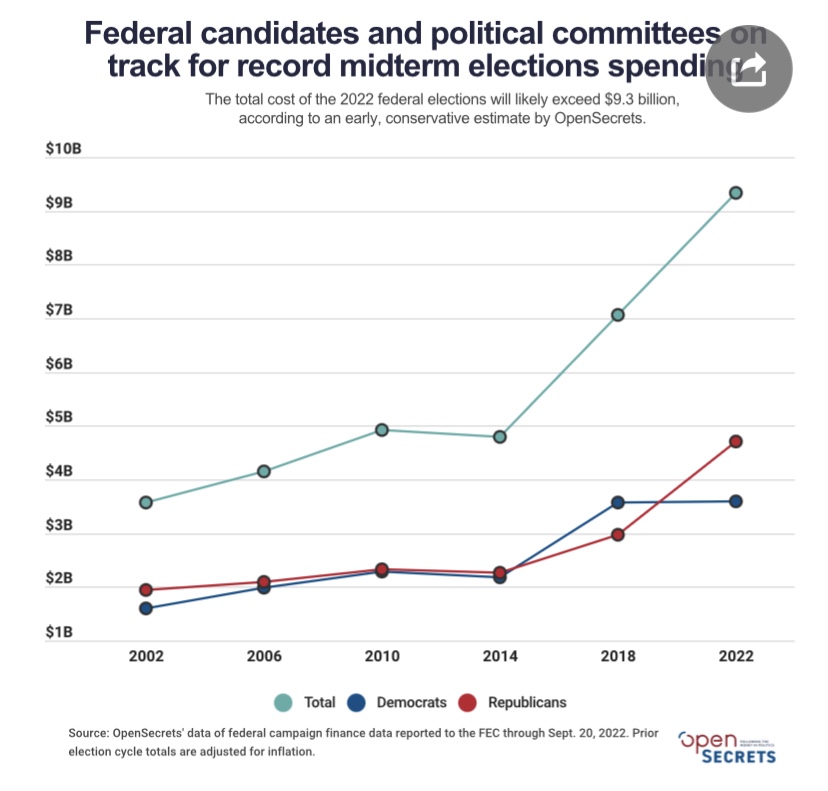
It’s astonishing how much money is donated and spent by political campaigns. This year’s elections saw total campaign spending (all levels) hit $16.7 billion, a record for a mid-term. The recent growth in campaign spending for federal offices has been dramatic, as the chart below shows:

Do you think spending of a few hundred million dollars on a Senate campaign is crazy? Me too, though I don’t advocate for legal limits on campaign spending because, for better or worse, that issue is entangled with free speech rights. Campaigns are zero-sum events, but presumably a big donor thinks a success carries some asymmetric reward…. A success rate of better than 50% across several campaigns probably buys much more…. And donors can throw money at sure political bets that are probably worth a great deal…. Many donors spread their largess across both parties, perhaps as a form of “protection”. But it all seems so distasteful, and it’s surely a source of waste in the aggregate.

My reservations about profligate campaign spending include the fact that it is a symptom of big government. Donors obviously believe they are buying something that government, in one way or another, makes possible for them. The greater the scope of government activity, the more numerous are opportunities for rent seeking — private gains through manipulation of public actors. This is the playground of fascists!

There are people who believe that placing things in the hands of government is an obvious solution to the excesses of “greed”. However, politicians and government employees are every bit as self-interested and “greedy” as actors in the private sector. And they can do much more damage: government actors legally exercise coercive power, they are not subject in any way to external market discipline, and they often lack any form of accountability. They are not compelled to respect consumer sovereignty, and they make correspondingly little contribution to the nation’s productivity and welfare.

Actors in the private sector, on the other hand, face strong incentives to engage in optimizing behavior: they must please customers and strive to improve performance to stay ahead of their competition. That is, unless they are seduced by what power they might have to seek rents through public sector activism.

A people who grant a wide scope of government will always suffer consequences they should expect, but they often proceed in abject ignorance. So here is my rant, a brief rundown on some of the things naive statists should expect to get for their votes. Of course, this is a short list — it could be much longer:

  • Opportunities for graft as bureaucrats administer the spending of others’ money and manipulate economic activity via central planning.
  • A ballooning and increasingly complex tax code seemingly designed to benefit attorneys, the accounting profession, and certainly some taxpayers, but at the expense of most taxpayers.
  • Subsidies granted to producers and technologies that are often either unnecessary or uneconomic (and see here), leading to malinvestment of capital. This is often a consequence of the rent seeking and cronyism that goes hand-in-hand with government dominance and ham-handed central planning.
  • Redistribution of existing wealth, a zero- or even negative-sum activity from an economic perspective, is prioritized over growth.
  • Redistribution beyond a reasonable safety net for those unable to work and without resources is a prescription for unnecessary dependency, and it very often constitutes a surreptitious political buy-off.
  • Budgetary language under which “budget cuts” mean reductions in the growth of spending.
  • Large categories of spending, known in the U.S. as non-discretionary entitlements, that are essentially off limits to lawmakers within the normal budget appropriations process.
  • “Fiscal illusion” is exploited by politicians and statists to hide the cost of government expansion.
  • The strained refrain that too many private activities impose external costs is stretched to the point at which government authorities externalize internalities via coercive taxes, regulation, or legal actions.
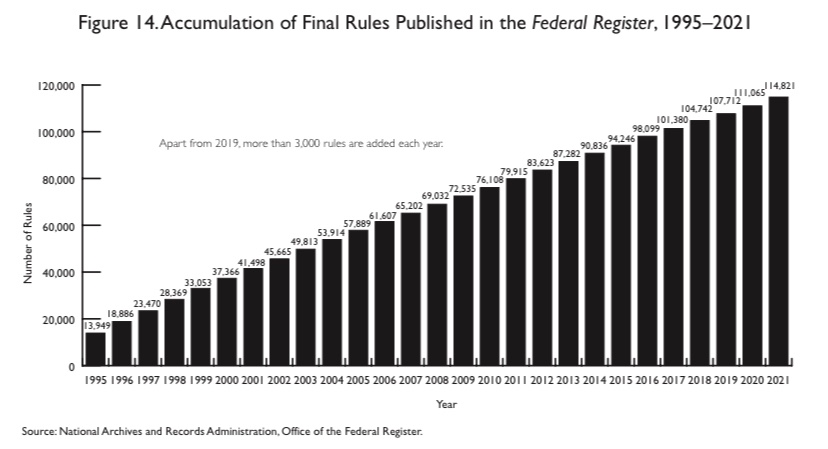
  • Massive growth in regulation (see chart at top) extending to puddles classified as wetlands (EPA), the ”disparate impacts” of private hiring practices (EEOC), carbon footprints of your company and its suppliers (EPA, Fed, SEC), outrageous energy efficiency standards (DOE), and a multiplicity of other intrusions.
  • Growth in the costs of regulatory compliance.
  • A nearly complete lack of responsiveness to market prices, leading to misallocation of resources — waste.
  • Lack of value metrics for government activities to gauge the public’s “willingness to pay”.
  • Monopoly encouraged by regulatory capture and legal / compliance cost barriers to competition. Again, cronyism.
  • Monopoly granted by other mechanisms such as import restrictions and licensure requirements. Again, cronyism.
  • Ruination of key industries as government control takes it’s grip.
  • Shortages induced by price controls.
  • Inflation and diminished buying power stoked by monetized deficits, which is a long tradition in financing excessive government.
  • Malinvestment of private capital created by monetary excess and surplus liquidity.
  • That malinvestment of private capital creates macroeconomic instability. The poorly deployed capital must be written off and/or reallocated to productive uses at great cost.
  • Funding for bizarre activities folded into larger budget appropriations, like holograms of dead comedians, hamster fighting experiments, and an IHOP for a DC neighborhood.
  • A gigantic public sector workforce in whose interest is a large and growing government sector, and who believe that government shutdowns are the end of the world.
  • Attempts to achieve central control of information available to the public, and the quashing of dissent, even in a world with advanced private information technology. See the story of Hunter Biden’s laptop. This extends to control of scientific narratives to ensure support for certain government programs.
  • Central funding brings central pursestrings and control. This phenomenon is evident today in local governance, education, and science. This is another way in which big government fosters dependency.
  • Mission creep as increasing areas of economic activity are redefined as “public” in nature.
  • Law and tax enforcement, security, and investigative agencies pressed into service to defend established government interests and to compromise opposition.

I’ve barely scratched the surface! Many of the items above occur under big government precisely because various factions of the public demand responses to perceived problems or “injustices”, despite the broader harms interventions may bring. The press is partly responsible for this tendency, being largely ignorant and lacking the patience for private solutions and market processes. And obviously, those kinds of demands are a reason government gets big to begin with. In the past, I’ve referred to these knee-jerk demands as “do somethingism”, and politicians are usually too eager to play along. The squeaky wheel gets the oil.

I mentioned cronyism several times in the list. The very existence of broad public administration and spending invites the clamoring of obsequious cronies. They come forward to offer their services, do large and small “favors”, make policy suggestions, contribute to lawmakers, and to offer handsomely remunerative post-government employment opportunities. Of course, certaIn private parties also recognize the potential opportunities for market dominance when regulators come calling. We have here a perversion of the healthy economic incentives normally faced by private actors, and these are dynamics that gives rise to a fascist state.

It’s true, of course, that there are areas in which government action is justified, if not necessary. These include pure public goods such as national defense, as well as public safety, law enforcement, and a legal system for prosecuting crimes and adjudicating disputes. So a certain level of state capacity is a good thing. Nevertheless, as the list suggests, even these traditional roles for government are ripe for unhealthy mission creep and ultimately abuse by cronies.

The overriding issue motivating my voting patterns is the belief in limited government. Both major political parties in the U.S. violate this criterion, or at least carve out exceptions when it suits them. I usually identify the Democrat Party with statism, and there is no question that democrats rely far too heavily on government solutions and intervention in private markets. The GOP, on the other hand, often fails to recognize the statism inherent in it’s own public boondoggles, cronyism, and legislated morality. In the end, the best guide for voting would be a political candidate’s adherence to the constitutional principles of limited government and individual liberty, and whether they seem to understand those principles. Unfortunately, that is often too difficult to discern.

Central Banks Stumble Into Negative Rates, Damn the Savers

01 Tuesday Mar 2016

Posted by Nuetzel in Central Planning, Monetary Policy

≈ 1 Comment

Tags

Bank of Japan, central planning, Federal Reserve, Helicopter Drop, Income Effect vs. Substitution Effect, Interest Rate Manipulation, Intertemporal Tradeoffs, Malinvestment, Mises Institute, Monetary policy, negative interest rates, NIRP, Printing Money, Privacy Rights, QE, Quantitative Easing, Reach For Yield, regulation, War on Cash, Zero Interest Rate Policy, ZIRP

Dollar Cartoon

Should government actively manipulate asset prices in an effort to “manage ” economic growth? The world’s central bankers, otherwise at their wit’s end, are attempting just that. Hopes have been pinned on so-called quantitative easing (QE), which simply means that central banks like the U.S. Federal Reserve (the Fed) buy assets (government and private bonds) from the public to inject newly “printed” money into the economy. The Fed purchased $4.5 trillion of assets between the last financial crisis and late 2014, when it ended its QE. Other central banks are actively engaged in QE, however, and there are still calls from some quarters for the Fed to resume QE, despite modest but positive economic growth. The goals of QE are to drive asset prices up and interest rates down, ultimately stimulating demand for goods and economic growth. Short-term rates have been near zero in many countries (and in the U.S. until December), and negative short-term interest rates are a reality in the European Union, Japan and Sweden.

Does anyone really have to pay money to lend money, as indicated by a negative interest rate? Yes, if a bank “lends” to the Bank of Japan, for example, by holding reserves there. The BOJ is currently charging banks for the privilege. But does anyone really “earn” negative returns on short-term government or private debt? Not unless you buy a short-term bill and hold it till maturity. Central banks are buying those bills at a premium, usually from member banks, in order to execute QE, and that offsets a negative rate. But the notion is that when these “captive” member banks are penalized for holding reserves, they will be more eager to lend to private borrowers. That may be, but only if there are willing, credit-worthy borrowers; unfortunately, those are scarce.

Thus far, QE and zero or negative rates do not seem to be working effectively, and there are several reasons. First, QE has taken place against a backdrop of increasingly binding regulatory constraints. A private economy simply cannot flourish under such strictures, with or without QE. Moreover, government makes a habit of manipulating investment decisions, partly through regulatory mandates, but also by subsidizing politically-favored activities such as ethanol, wind energy, post-secondary education, and owner-occupied housing. This necessarily comes at the sacrifice of opportunities for physical investment that are superior on economic merits.

The most self-defeating consequence of QE and rate manipulation, be that zero interest rate policy (ZIRP) or negative interest rate policy (NIRP), is the distortion of inter-temporal tradeoffs that guide decisions to save and invest in productive assets. How, and how much, should individuals save when returns on relatively safe assets are very low? Most analysts would conclude that very low rates prompt a strong substitution effect toward consuming more today and less in the future. However, the situation may well engender a strong “income effect”, meaning that more must be saved (and less consumed in the present) in order to provide sufficient resources in the future. The paradox shouldn’t be lost on central bankers, and it may undermine the stimulative effects of ZIRP or NIRP. It might also lead to confusion in the allocation of productive capital, as low rates could create a mirage of viability for unworthy projects. Central bank intervention of this sort is disruptive to the healthy transformation of resources across time.

Savers might hoard cash to avoid a negative return, which would further undermine the efficacy of QE in creating monetary stimulus. This is at the root of central bank efforts to discourage the holding of currency outside of the banking system: the “war on cash“. (Also see here.) This policy is extremely offensive to anyone with a concern for protecting the privacy of individuals from government prying.

Another possible response for savers is to “reach for yield”, allocating more of their funds to high-risk assets than they would ordinarily prefer (e.g., growth funds, junk bonds, various “alternative” investments). So the supply of saving available for adding to the productive base in various sectors is twisted by central bank manipulation of interest rates. The availability of capital may be constrained for relatively safe sectors but available at a relative discount to risky sectors. This leads to classic malinvestment and ultimately business failures, displaced workers, and harsh adjustment costs.

With any luck, the Fed will continue to move away from this misguided path. Zero or negative interest rates imposed by central banks penalize savers by making the saving decision excessively complex and fraught with risk. Business investment is distorted by confusing signals as to risk preference and inflated asset prices. Central economic planning via industrial policy, regulation, and price controls, such as the manipulation of interest rates, always ends badly. Unfortunately, most governments are well-practiced at bungling in all of those areas.


Enduring A Dead-Weight Dominion

13 Wednesday Jan 2016

Posted by Nuetzel in Big Government, Macroeconomics

≈ Leave a comment

Tags

Anthony de Jasay, Automatic Stabilizers, Big government, Boom and Bust Cycle, central planning, Code of Federal Regulations, Double Taxation, Federal Reserve, Final Output, Government intervention, infrastructure, Intermediate Transactions, John Maynard Keynes, Keynesian Economics, Malinvestment, Mark Skousen, Mercatus Center, Shovel-Ready Projects, Spontaneous Order, Stabilization policy, Too big to fail, Underconsumption

government-intervention

If you hope for government to solve economic problems, try to maintain some perspective: the state has unique abilities to botch it, and its power to distort and degrade the economy in the process of “helping” is vast. Government spending at all levels copped about 18% of the U.S.  economy’s final output in 2014, but the public sector’s impact is far more pervasive than that suggests. Private fixed investment in new structures and equipment accounted for only about 16% of Gross Domestic Product (GDP); the nonresidential portion of fixed investment was less than 13% of GDP. I highlight these two components of GDP because no one doubts the importance of capital investment as a determinant of the economy’s productive capacity. But government is a larger share of spending, it can divert saving away from investment, and it creates a host of other impediments to productivity and efficient resource allocation.

The private economy is remarkable in its capacity to satisfy human wants. The market is a manifestation of spontaneous order, lacking the conscious design of any supreme authority. It is able to adjust to dynamic shifts in desires and resource constraints; it provides reliable feedback in the form of changing prices to modulate and guide the responses of participants through all stages of production. Most forms of government activity, however, are not guided by these signals. Instead, the state imposes binding and sometimes immediate constraints on the decisions of market participants. The interference takes a number of forms, including price controls, but they all have the power to damage the performance and outcomes of markets.

The productive base at each stage of the market process is a consequence of the interplay of perceived business opportunities and acts of saving or deferred consumption. The available flow of saving depends on its rewards, which are heavily influenced by taxes and government intervention in financial markets. It’s worth noting here that the U.S. has the highest corporate tax rates in the developed world, as well as double taxation of corporate income paid out to owners. In addition, the tax system is used as a tool to manipulate the allocation of resources, drawing them into uses that are politically favored and punishing those in disfavor. The damaging impact is compounded by the fact that changes in taxes are often unknown ex ante. This adds a degree of political risk to any investment decision, thus discouraging capital spending and growth in the economy’s productive base.

The government is also a massive and growing regulator of economic activity. Over 100,000 new regulatory restrictions were added to the Code of Federal Regulations between 2008 and 2012. Regulation can have prohibitive compliance costs and may forbid certain efficiencies, often based on flimsy or nonexistent cost/benefit comparisons. It therefore damages the value and returns on embedded capital and discourages new investment. It is usually uneven in its effects across industries and it typically reduces the level of competition in markets because small firms are less capable of surviving the costs it imposes. Innovation is stifled and prices are higher as a result.

From a philosophical perspective, even the best cost/benefit comparisons are suspect as tools for evaluating government intervention. Don Boudreaux quotes Anthony de Jasay’s The State on this point:

“What could be more innocuous, more unexceptional than to refrain from intervening unless the cost-benefit comparison is favourable? Yet it treats the balancing of benefits and costs, good and bad consequences, as if the logical status of such balancing were a settled matter, as if it were technically perhaps demanding but philosophically straightforward. Costs and benefits, however, stretch into the future (problems of predictability) and benefits do not normally or exclusively accrue to the same persons who bear the costs (problems of externality). … Treating it as a pragmatic question of factual analysis, one of information and measurement, is tacitly taking the prior and much larger questions as having been somehow, somewhere resolved. Only they have not been.“

Poorly-executed and inappropriate stabilization policy is another way in which government distorts decisions at all stages of production. There are many reasons why these policies tend to be ineffective and potentially destructive, especially in the long run. Keynesian economics, based on ideas articulated by John Maynard Keynes, offers prescriptions for government action during times of instability. That means “expansionary” policy when the economy is weak and “contractionary” policy when it is strong.  At least that is the intent. This framework relies on the notion that components of aggregate demand determine the economy’s output, prices and employment.

The major components of GDP in the National Income and Product Accounts are consumer spending, private investment, government spending, and net foreign spending. In a Keynesian world, these are treated as four distinct parts of aggregate “demand”, and each is governed by particular kinds of assumed behavior. Supply effects are treated with little rigor, if at all, and earlier stages of production are considered only to the extent that their value added is included, and that the finished value of  investment (including new inventories) is one of the components of aggregate demand.

Final spending on goods and services (GDP) may be convenient because it corresponds to GDP, but that is simply an accounting identity. In fact, GDP represents less than 45% of all transactions. (See the end note below.) In other words, intermediate transactions for raw materials, business-to-business (B2B) exchange of services and goods in a partly fabricated state, and payments for distributional services are not counted, but they exceed GDP. They are also more variable than GDP over the course of the business cycle. Income is generated and value is added at each stage of production, not only in final transactions. To say that “value-added” is counted across all stages is a restatement of the accounting identity. It does not mean that those stages are treated behaviorally. Technology, capital, employees, and complex decision-making are required at each stage to meet demands in competitive markets. Aggregation at the final goods level glosses over all this detail.

The focus of the media and government policymakers in a weak economy is usually on “underconsumption”. The claim is often heard that consumer spending represents “over two-thirds of the economy”, but it is only about one-third of total transactions at all levels. It is therefore not as powerful an engine as many analysts assert. Government efforts to stimulate consumption are often thwarted by consumers themselves, who behave in ways that are difficult for models to capture accurately.

Government spending to combat weakness is another typical prescription, but such efforts are usually ill-timed and are difficult to reverse as the economy regains strength. The value of most government “output” is not tested in markets and it is not subject to competitive pressure, so as the government absorbs additional resources, the ability of the economy to grow is compromised. Programmatic ratcheting is always a risk when transfer payments are expanded. (Fixed programs that act as “automatic stabilizers”, and that are fiscally neutral over the business cycle, are less objectionable on these grounds, but only to the extent that they are not manipulated by politicians or subject to fraud.) Furthermore, any measure that adds to government deficits creates competition for the savings available for private capital investment. Thus, deficits can reduce the private economy’s productive capacity.

Government investment in infrastructure is a common refrain, but infrastructure spending should be tied to actual needs, not to the business cycle. Using public infrastructure spending for stabilization policy creates severe problems of timing. Few projects are ever “shovel-ready”, and rushing into them is a prescription for poor management, cost overruns and low quality.

Historically, economic instability has often been a consequence of poorly-timed monetary policy actions. Excessive money growth engineered by the Federal Reserve has stimulated excessive booms and inflation in the prices of goods and assets. These boom episodes were followed by market busts and recessions when the Fed attempted to course-correct by restraining money growth. Booms tend to foster misjudgments about risk that end in over-investment in certain assets. This is especially true when government encourages risk-taking via implicit “guarantees” (Fannie Mae and Freddie Mac) and “too-big-to-fail” promises, or among individuals who can least afford it, such as low-income homebuyers.

Given a boom-and-bust cycle inflicted by monetary mismanagement, attempts to stimulate demand are usually the wrong prescription for a weak economy. Unemployed resources during recessions are a direct consequence of the earlier malinvestment. It is better to let asset prices and wages adjust to bring them into line with reality, while assisting those who must transition to new employment. The best prescription for instability is a neutral stance toward market risks combined with stable policy, not more badly-timed countercyclical efforts. The best prescription for economic growth is to shrink government’s absorption of resources, restoring their availability to those with incentives to use them optimally.

The more that central authorities attempt to guide the economy, the worse it gets. The torpid recovery from the last recession, despite great efforts at stimulus, demonstrates the futility of demand-side stabilization policy. The sluggishness of the current expansion also bears witness to the counterproductive nature of government activism. It’s a great credit to the private market that it is so resilient in the face of long-standing government economic and regulatory mismanagement. A bureaucracy employing a large cadre of technocrats is a “luxury” that only a productive, dynamic economy can afford. Or can it?

~~~~~~~~~~~~~~~~~~~~~~~~~~~~~~~~~~~~~~~~~~~~~~~~~~~~~~~~~~~~~~~~~~~~

A Note On Output Measures

More complete aggregations of economic activity than GDP are gross output (GO) and gross domestic expenditures (GDE). These were developed in detail by economist Mark Skousen in his book “The Structure of Production“, published in 1990. GO includes all final transactions plus business-to-business (B2B) transactions, while GDE adds the costs of wholesale and retail distribution to GO. Or as Skousen says in this paper:

“GDE is defined as the value of all transactions (sales) in the production of new goods and services, both finished and unfinished, at all stages of production inside a country during a calendar year.“

GO and GDE show the dominance of business transactions in economic activity. GDE is more than twice as large as GDP, and B2B transactions plus business investment are twice the size of consumer spending. According to Skousen, GDE varies with the business cycle much more than GDP. Many economic indicators focus on statistics at earlier stages of production, yet real final spending is often assumed to be the only measure of transactions that matters.


High-Speed Third Rail For Taxpayers

15 Friday May 2015

Posted by Nuetzel in Big Government, infrastructure, Taxes

≈ 3 Comments

Tags

Amtrak, Bullet trains, California, capital costs, Carbon Emissions, fare revenue, Frederic Bastiat, High speed rail, infrastructure, Malinvestment, Megabus, operating costs, Privatization, profitability, Public benefits, Public boondoggles, Randall O'Toole, Sean Davis, The Federalist, Transit subsidies

bullet train

Public boondoggles come in many forms, including sports stadiums and entertainment venues, convention centers, local trolly lines, light rail, superhighways, “gold-plated” public offices, and even subsidies for politically-favored (as opposed to market-favored) industries. Anything involving “infrastructure” has an almost perverse  political appeal. The many varieties of boondoggles have much in common from a public finance perspective: ultimately, they are almost always funded by taxpayers; when they confer benefits to private parties (and they usually do), they are underpriced to those users. Taxpayers are often lucky if these projects cover their operating costs, let alone capital costs, via direct revenue generation. Taxpayers are usually on the hook for the bonds. Pure public benefits might offer some justication for this burden, but those cited by project proponents are often unconvincing on that basis. Let’s face it: projects are seldom evaluated against something approximating the true opportunity costs faced by the public or taxpayers.

A prominent example of such a project that seems to capture the political imagination is high-speed rail (HSR). My friend John Crawford emailed the following link: “Doing the math on California’s bullet train fares“. John provided this summary:

“Not surprisingly, today’s fare estimate has risen 72% over the estimate that was cited during planning. That’s telling but probably not surprising to anyone, even those that tried to change opinions by citing the $50 fare. What I think is most interesting follows.

CA-HSR price of 86 is about 20c/mile. Comparable prices are 22c for a Chinese train that everybody agrees to be subsidized, 54c for a French train that is profitable and 50c for the Amtrak corridor on the East coast, which is probably profitable; 46c in Germany. Somehow, they think they can do what nobody else in the world can do…profit at 20c/mile.“

The California authority is either spectacularly arrogant or stupid. Probably the former, because they are doing what self-interested bureaucrats and politicians always do. They want the project to get done, thus creating an empire, kicking a can-full of fare increases and taxpayer liabilities down the road, beyond the time when anyone will hold them accountable for the malinvestment. But the true extent of the malinvestment will never be obvious, because the counter-factual will remain in the unseen world of lost opportunity.

Something I find exasperating about articles like this are references to “profitability”, as in “… state officials say the system will quickly become profitable“, when the meaning is not actual profitability. My friend John did it too, but I forgive him because he knew the score, and because he’ll forgive me for being a pedant (I hope). But this is important! What the California officials mean by “profitability” (and it is a misuse of the term) is fare revenue in excess of operating costs. The latter do not include initial capital costs, so these officials are not making claims about actual profitability. Profitability means that revenue exceeds ALL costs, including capital costs. Many observers consider the California authority’s estimates of operating costs to be suspect, so it’s not even clear that revenue will cover the future costs of capital replacement, let alone the initial installation costs. Construction and planning costs are expected to be $68 billion for Phase 1 only, and you can safely bet on significant additional overruns by the projected completion of Phase 1 in 2029.

Fares calibrated to cover operating costs are not defensible in terms of long-run marginal cost pricing. While an incremental rider does not cause the capital cost of the system to increase in the short run, incremental riders absolutely do have an impact on long-run capital costs. In any case, there are many incremental riders at start-up. The long run is now. Yet, like many public projects, the burden of uncovered costs is justified in terms of other benefits of a supposedly public nature. Here is a vague description of such benefits from the CA HSR Authority:

“California high-speed rail will connect the mega-regions of the state, contribute to economic development and a cleaner environment, create jobs and preserve agricultural and protected lands.“

Let’s take these one at a time:

  • connecting “mega-regions”, if that is a real benefit of HSR relative to alternative modes of transportation, will largely accrue to riders, not the general public.
  • Economic development benefits are possible along the route or near stations, but that is hardly a pure public benefit, and it is likely to come at the expense of development elsewhere.
  • The trains will be powered, at least in part, by energy from fossil fuels. If HSR produces less carbon than equivalent airplanes, autos and other alternatives, that might represent a pure public benefit (according to the carbonphobic), but this is a costly way to achieve a minor reduction in carbon emissions. It is of value only to the extent that HSR brings real substitution away from other, higher carbon modes.
  • Construction jobs are part of the cost of the project, but this is a common ploy and very handy way to sell the project. Gains for the workers are certainly not a pure public benefit. To paraphrase Bastiat, calling construction jobs from malinvested capital a “public benefit” is like calling a broken window beneficial because it provides work for the glazier.
  • As for preserving agricultural and public lands, I do not believe that HSR will make much of a dent in future, land-gobbling highway construction (and if it did, it would offset those vaunted HSR job gains).

The public should always view large public projects like HSR with skepticism and insist that private benefits should be paid privately. There are always alternative uses of taxpayer funds, including the possibility that taxpayers should keep them. Too many public projects become funding disasters. In many cases, private parties would not be willing to buy the facilities for more than 10 cents on the dollar.of original cost.  Without access to tax revenue, only a low purchase price would allow them to operate at a profit.

At the national level, this week’s tragic Amtrak crash near Philadelphia was the context for misguided calls to provide additional funding to the rail service. Sean Davis in The Federalist has a more logical proposal, even if it is a bit radical: not only should Amtrak be privatized, its assets should be given away! And how could anyone reach such a conclusion?

“Amtrak lost nearly $1.3 billion in 2013. Since its creation, Amtrak has racked up over $31 billion in accumulated losses. And every penny of those losses has been covered by federal taxpayers.

… Hand over the entire enterprise to whichever rail company wants it. ‘But that’s crazy!’ you might say. ‘Giving it away for free makes no cents [sic]!’

Well, neither does keeping it on the taxpayers’ books. The status quo costs taxpayers at least a billion dollars each year.“

Davis makes a fair point, though a give-away might attract multiple takers. Ultimately, bidding just might be necessary! Or, perhaps it would be necessary to PAY a private rail operator to take Amtrak off the federal government’s hands. A fairly high payment would still be worthwhile to taxpayers.

Randall O’Toole provides this excellent discussion of privatizing transit in a video  of approximately 17 minutes. He discusses trends in ridership, the inefficiencies inherent in public transportation systems, and compares various market structures and types of private transportation systems, including private intercity buses (Megabus). He also addresses concerns that private transportation systems will not meet the needs of the poor by proposing the substitution of “transit stamps” for the huge subsidies currently paid into transportation bureaucracies.

Poverty Maintenance Is Not A Win

01 Wednesday Apr 2015

Posted by Nuetzel in Poverty, Uncategorized

≈ 2 Comments

Tags

AFDC, CATO Institute, Child Tax Credit, Christopher Jencks, Earned Income Tax Credit, Food Stamps, Lyndon Johnson, Malinvestment, Marginal tax rates, Martha Bailey, Poverty, Private charity, Sheldon Danziger, Supplemental Security Income, TANF, War on Poverty, Welfare reform, work incentives

obama-new-normal

Merely keeping a patient alive is inferior to curing the disease. Likewise, merely allowing the impoverished to live under tolerable conditions is inferior to eliminating the underlying causes of poverty. Evidence for the former is used by Harvard Professor Christopher Jencks to proclaim the war on poverty a success. That is the upshot of his recent article in The New York Review of Books. But does the maintenance of a permanent dependent class constitute success? I believe that our goals should be loftier, and President Johnson’s original goals for the War on Poverty went much farther than Jencks suggests.

Ostensibly a review of other work by Martha Bailey and Sheldon Danziger, Professor Jencks devotes most of his essay to arguing that the official poverty rate published by the Census Bureau is distorted, and that a “corrected” measure has declined since the “war” was initiated by Johnson in the 1960s. The official rate has fluctuated in a range of 11-15% since the mid-1960s. Jencks corrects the 2013 rate of 14.5% for 1) the value of non-cash benefits received by certain program recipients (-3%); 2) the omission of refundable tax credits from the official incomes of employed individuals below the poverty line (-3%); and 3) a change in the price index used to adjust the official poverty thresholds over time to one that does not overstate changes in the cost of living (-3.7%). These three adjustments would reduce the poverty rate in 2013 to just 4.8%.

Taken at face value, that reduction is impressive, but the third adjustment is not directly attributable to antipoverty programs. It could also be due to economic growth or other factors. Jencks notes the following:

“Both liberals and conservatives tend to resist the idea that poverty has fallen dramatically since 1964, although for different reasons. Conservatives’ resistance is easy to understand. They have argued since the 1960s that the federal government’s antipoverty programs were ineffective, counterproductive, or both. 

Liberals hear the claim that poverty has fallen quite differently, although they do not like it any better than conservatives do. Anyone, liberal or conservative, who wants the government to solve a problem soon discovers that it is easier to rally support for such an agenda by saying that the problem in question is getting worse than by saying that although the problem is diminishing, more still needs to be done.”

For my own part, I believe that many antipoverty programs succeed only as palliatives. They have not succeeded in breaking the cycle of poverty and dependence on the state. In other words, successful programs must foster self-sufficiency, which is a superior goal from a humanitarian and a Libertarian perspective. Jencks plans a follow-up on the “successes and failures specific anti-poverty programs”, but merely paying alms to the poor establishes a very low threshold for success.

In fairness to Jencks, anti-poverty programs serve a large number of individuals who are incapable of providing for themselves for a variety of reasons such as age, physical and mental disabilities. While it is beyond the scope of this post, some argue that private charities are more effective at providing for these individuals as well as the able poor. A greater role for charity could even be facilitated via public funding, but in any case, a larger role for private charity should always be on the menu of policy options.

A basic failing of many welfare programs is an incentive problem: able recipients perceive a penalty for work effort (additional hours or even kinds of employment) if rising earned income is associated with reduction or elimination of program benefits. This means that participants face a very high effective marginal tax rate on earned income.

This article from The CATO Institute contains a good overview of the federal welfare system, which consists of 126 separate programs. The article contains somewhat more detailed on the largest anti-poverty programs, such as Refundable Tax Credits (the Earned Income Tax Credit (EITC), and Child Tax Credit (CTC)), Supplemental Security Income (SSI – for aged, blind and disabled), SNAP (food stamps), housing subsidies, child nutrition (WIC), Temporary Assistance For Needy Families (TANF) and unemployment insurance. Social Security is also included since it pays benefits to many low income seniors.

The CATO analysis shows that by one measure, refundable tax credits are by far the most cost efficient at lifting people out of poverty at a point in time, at least among the large programs, followed by SSI and using subsidies. In-kind programs such as SNAP and WIC tend to be less targeted and less effective by this measure. There is fairly widespread agreement that the tax credits have better incentives for work effort, but there are still high marginal tax rates in the phase-out range, a marriage penalty, and the credits are paid only once a year as tax refunds. Some contend that the phase-out of the EITC discourages labor supply even more than the credit increases labor supply at lower incomes. Still others believe that adding certain work requirements would make the EITC a more effective measure:

“The [EITC] clearly does reduce poverty, but it raises work levels far less than some of the statistical studies of the past decade claim, and it appears to do so by encouraging working people to keep working, rather than driving the non-working poor toward jobs. If we wish the credit to promote work as well as raise incomes, we … must add other suasions to promote and enforce work, such as those found in the more successful work-incentive experiments…. These include mandating participation in work programs and setting some threshold of working hours that claimants have to achieve to get benefits.”

The incentive effects of other programs are more negative than the tax credits. This paper found that the food stamp program reduces employment and hours worked. The TANF program, which was the successor to Aid To Families With Dependent Children (AFDC), also exposes recipients to high marginal tax rates. While CATO has been criticized for analyzing the combined impact on marginal tax rates of up to eight different programs, there is little question that the incentive problem is compounded for participants in multiple programs.

There are many different approaches that can be explored for eliminating poverty, supporting those who can’t work and ending dependency for those who can. Certainly, the work incentives of existing anti-poverty programs can be improved in a number of ways. More inventive approaches can be tested at the state level. However, programs such as guaranteed incomes should be eschewed, as they tend to aggravate the incentive problem and encourage dependency.

There are many other approaches to attacking poverty and its causes that do not strictly qualify as “welfare reform.” These include measures that would improve education and employment prospects, including apprenticeship and other training programs. School choice is a fundamental reform with enormous potential to improve the quality of education among poor children. Transitioning to market-based health care reform, including competition among health insurers, would reduce medical costs across the board. Eliminating costly regulation of business can encourage economic growth, which is basic to lifting the incomes of the working poor. Minimum wage legislation should be avoided as it simply eliminates opportunities for the least productive members of society and it is not well-targeted at the poor. Tax reform that encourages saving and investment, including corporate tax reform, will increase the economy’s long-term growth potential, as would a general reduction in the size of the public sector. An end to wasteful subsidies to “privileged” industries can minimize malinvestment and release resources to uses that pass a true market test, leading to a more general prosperity.

Taking The Air Out Of The Deflation Scare

25 Wednesday Mar 2015

Posted by Nuetzel in Macroeconomics

≈ 1 Comment

Tags

Deflation, Demand-driven deflation, Federal Reserve, John Cochrane, Keynesians, Malinvestment, Mises Daily, negative interest rates, Public debt, rate of time preference, Science Times, Supply-driven deflation, Thorsten Polleit, Underconsumption, ZIRP

Baby-Pufferfish

Deflation is not the evil so many journalists have been taught to believe. The historical evidence does not support the contention that deflation is always a consequence of “underconsumption”, that it leads to a self-reinforcing spiral, or that it is destructive in and of itself. A new academic paper on the costs of deflation is reviewed here by John Cochrane, who reproduces some of the interesting evidence from the paper showing that deflation is not correlated with output growth historically. Cochrane quotes the paper’s authors:

“‘The almost reflexive association of deflation with economic weakness is easily explained. It is rooted in the view that deflation signals an aggregate demand shortfall, which simultaneously pushes down prices, incomes and output. But deflation may also result from increased supply. Examples include improvements in productivity, greater competition in the goods market, or cheaper and more abundant inputs, such as labour or intermediate goods like oil. Supply-driven deflations depress prices while raising incomes and output.’”

The Science Times has a succinct review of the same paper:

“After analyzing figures going back to 1870 from 38 countries, Borio [one of the co-authors] concludes that declines in consumer prices are not actually the problem. He argues that the negative effects associated with deflation are in reality caused by huge declines in real estate prices and equity values. All this time, he posits, economists have been deceived by the fact that prices for goods and services have at times decreased at the same time that asset prices have gone down, especially during the Great Depression.”

An earlier op-ed on deflation by Cochrane was the subject of this Sacred Cow Chips post a few months ago, which noted an unfortunate tendency among traditional Keynesian economists related to the statist agenda they often support:

“Quick to blame insufficient private demand for economic ills, they propose to ratchet government to higher levels to make up for the supposed shortfall. That diagnosis is often debatable; the prescription may be a palliative at best and destructive at worst.”

Deflation is usually a symptom of other, more primary economic phenomena. Whether it can be taken as a sign of economic malaise depends on the underlying cause. Certainly, as noted above, deflation is quite welcome when it results from supply-driven growth of output, especially if wages are supported by advances in labor productivity.

On the other hand, deflation may be a demand-side symptom of weakness engendered by restrictive monetary policy, fragile confidence among consumers or employers, trade restrictions, excessive taxation, over-regulation, or adjustments to a binge of malinvested capital. It does not follow, however, that a resulting deflation is unhealthy. Quite the opposite: Downward price adjustments help to clear the economy of excesses and pave the way for renewal, as excess goods, capital and other resources are repriced to levels at which purchases become gainful. This may involve more severe declines in some relative prices due to specific excesses, such as real estate. Some recent examples of deflation and reversals of economic weakness are discussed in this post at The Mises Daily.

One consequence of expected deflation is that market interest rates are driven below “real” interest rates, or the rates at which economic agents are indifferent between present and future consumption (abstracting from risk and liquidity premia). The latter is sometimes called the rate of time preference, the natural interest rate, or the originary interest rate. Recently, some short-term market interest rates in Europe have been negative, prompting some to offer arguments that the natural rate may have turned negative. This post by Thorsten Polliet reveals these arguments as nonsense:

“If the originary interest rate was near-zero [let alone negative], it means that you prefer two apples available in, say, 1,000 years over one apple available today. A truly zero originary interest rate implies that the actor’s planning horizon or “period of provision” is infinitely long, which is another way of saying that he would never act at all but would continually push the attainment of his goals into the future.”

Polleit discusses the fact that market real interest rates may be negative, but that is a consequence of central bank manipulation of nominal market rates, including the Federal Reserve’s so called ZIRP, or zero interest-rate policy. Polleit has this to say about the destructive consequences of this kind of behavior, albeit in extreme form:

“Should a central bank really succeed in making all market interest rates negative in real terms, savings and investment would come to a shrieking halt: as time preference and the originary interest rate are always positive, “capitalistic saving” — the accumulation of goods designed for improving the production process — would come to an end.”

While Keynesians imagine that expansive government policy can rescue the economy from the ravages of weak private demand, they also know that accumulation of public debt is an unavoidable by-product. That reveals an underlying motive for policies such as ZIRP, as Polite explains:

“It is an actually perfidious policy for debasing the real value of outstanding debt; and it is a recipe for wreaking havoc on the economy.”

An otherwise innocuous supply-side deflation, or a deflation corrective of demand-side forces, may well be accompanied by intervention by an activist central bank. The ostensible purpose would be to stimulate the demand for goods, but a more direct consequence is a reduction in the government’s interest costs. If the policy succeeds in pushing real market interest rates to zero or below, the intervention may well undermine capital formation and economic growth.

Follow Sacred Cow Chips on WordPress.com

Recent Posts

  • The Case Against Interest On Reserves
  • Immigration and Merit As Fiscal Propositions
  • Tariff “Dividend” From An Indigent State
  • Almost Looks Like the Fed Has a 3% Inflation Target
  • Government Malpractice Breeds Health Care Havoc

Archives

  • January 2026
  • December 2025
  • November 2025
  • October 2025
  • September 2025
  • August 2025
  • July 2025
  • June 2025
  • May 2025
  • April 2025
  • March 2025
  • February 2025
  • January 2025
  • December 2024
  • November 2024
  • October 2024
  • September 2024
  • August 2024
  • July 2024
  • June 2024
  • May 2024
  • April 2024
  • March 2024
  • February 2024
  • January 2024
  • December 2023
  • November 2023
  • August 2023
  • July 2023
  • June 2023
  • May 2023
  • April 2023
  • March 2023
  • February 2023
  • January 2023
  • December 2022
  • November 2022
  • October 2022
  • September 2022
  • August 2022
  • July 2022
  • June 2022
  • May 2022
  • April 2022
  • March 2022
  • February 2022
  • January 2022
  • December 2021
  • November 2021
  • October 2021
  • September 2021
  • August 2021
  • July 2021
  • June 2021
  • May 2021
  • April 2021
  • March 2021
  • February 2021
  • January 2021
  • December 2020
  • November 2020
  • October 2020
  • September 2020
  • August 2020
  • July 2020
  • June 2020
  • May 2020
  • April 2020
  • March 2020
  • February 2020
  • January 2020
  • December 2019
  • November 2019
  • October 2019
  • September 2019
  • August 2019
  • July 2019
  • June 2019
  • May 2019
  • April 2019
  • March 2019
  • February 2019
  • January 2019
  • December 2018
  • November 2018
  • October 2018
  • September 2018
  • August 2018
  • July 2018
  • June 2018
  • May 2018
  • April 2018
  • March 2018
  • February 2018
  • January 2018
  • December 2017
  • November 2017
  • October 2017
  • September 2017
  • August 2017
  • July 2017
  • June 2017
  • May 2017
  • April 2017
  • March 2017
  • February 2017
  • January 2017
  • December 2016
  • November 2016
  • October 2016
  • September 2016
  • August 2016
  • July 2016
  • June 2016
  • May 2016
  • April 2016
  • March 2016
  • February 2016
  • January 2016
  • December 2015
  • November 2015
  • October 2015
  • September 2015
  • August 2015
  • July 2015
  • June 2015
  • May 2015
  • April 2015
  • March 2015
  • February 2015
  • January 2015
  • December 2014
  • November 2014
  • October 2014
  • September 2014
  • August 2014
  • July 2014
  • June 2014
  • May 2014
  • April 2014
  • March 2014

Blogs I Follow

  • Passive Income Kickstart
  • OnlyFinance.net
  • TLC Cholesterol
  • Nintil
  • kendunning.net
  • DCWhispers.com
  • Hoong-Wai in the UK
  • Marginal REVOLUTION
  • Stlouis
  • Watts Up With That?
  • Aussie Nationalist Blog
  • American Elephants
  • The View from Alexandria
  • The Gymnasium
  • A Force for Good
  • Notes On Liberty
  • troymo
  • SUNDAY BLOG Stephanie Sievers
  • Miss Lou Acquiring Lore
  • Your Well Wisher Program
  • Objectivism In Depth
  • RobotEnomics
  • Orderstatistic
  • Paradigm Library
  • Scattered Showers and Quicksand

Blog at WordPress.com.

Passive Income Kickstart

OnlyFinance.net

TLC Cholesterol

Nintil

To estimate, compare, distinguish, discuss, and trace to its principal sources everything

kendunning.net

The Future is Ours to Create

DCWhispers.com

Hoong-Wai in the UK

A Commonwealth immigrant's perspective on the UK's public arena.

Marginal REVOLUTION

Small Steps Toward A Much Better World

Stlouis

Watts Up With That?

The world's most viewed site on global warming and climate change

Aussie Nationalist Blog

Commentary from a Paleoconservative and Nationalist perspective

American Elephants

Defending Life, Liberty and the Pursuit of Happiness

The View from Alexandria

In advanced civilizations the period loosely called Alexandrian is usually associated with flexible morals, perfunctory religion, populist standards and cosmopolitan tastes, feminism, exotic cults, and the rapid turnover of high and low fads---in short, a falling away (which is all that decadence means) from the strictness of traditional rules, embodied in character and inforced from within. -- Jacques Barzun

The Gymnasium

A place for reason, politics, economics, and faith steeped in the classical liberal tradition

A Force for Good

How economics, morality, and markets combine

Notes On Liberty

Spontaneous thoughts on a humble creed

troymo

SUNDAY BLOG Stephanie Sievers

Escaping the everyday life with photographs from my travels

Miss Lou Acquiring Lore

Gallery of Life...

Your Well Wisher Program

Attempt to solve commonly known problems…

Objectivism In Depth

Exploring Ayn Rand's revolutionary philosophy.

RobotEnomics

(A)n (I)ntelligent Future

Orderstatistic

Economics, chess and anything else on my mind.

Paradigm Library

OODA Looping

Scattered Showers and Quicksand

Musings on science, investing, finance, economics, politics, and probably fly fishing.

  • Subscribe Subscribed
    • Sacred Cow Chips
    • Join 128 other subscribers
    • Already have a WordPress.com account? Log in now.
    • Sacred Cow Chips
    • Subscribe Subscribed
    • Sign up
    • Log in
    • Report this content
    • View site in Reader
    • Manage subscriptions
    • Collapse this bar
 

Loading Comments...