• About

Sacred Cow Chips

Sacred Cow Chips

Tag Archives: Veronique de Rugy

Trump’s New Corporatist Plunder Will Cost U.S.

05 Friday Sep 2025

Posted by Nuetzel in Central Planning, Protectionism, Socialism

≈ Leave a comment

Tags

AMD, central planning, CHIPS Act, Corporatism, Don Boudreaux, Donald Trump, Extortion, fascism, Golden Share, Howard Lutnick, Intel, MP Materials, National Security, Nippon Steel, NVIDIA, Protectionism, Public debt, Scott Bessent, Socialism, Tad DeHaven, TikTok, U.S. Steel, Unfunded Obligations, Veronique de Rugy

Since his inauguration, Donald Trump has been busy finding ways for the government to extort payments and ownership shares from private companies. This has taken a variety of forms. Tad DeHaven summarizes the major pieces of booty extracted thus far in the following bullet points (skipping the quote marks here):

  • June 13: Trump issues an executive order allowing the Nippon Steel-US Steel deal contingent on giving the government a “golden share” that enables the president to exert extensive control over US Steel’s operations.
  • July 10: The Department of Defense (DoD) unveils a multi-part package with convertible preferred stock, warrants, and loan guarantees, making it the top shareholder of rare earth metals producer MP Materials.
  • July 23: The White House claims an agreement with Japan to reduce the president’s so-called reciprocal tariff rate on Japanese imports comes with a $550 billion Japanese “investment fund” that Trump will control.
  • July 31: Trump claims an agreement with South Korea to reduce the so-called reciprocal tariff on South Korean imports comes with a $350 billion South Korean-financed investment in projects “owned and controlled by the United States” that he will select.
  • August 11: The White House confirms an “unprecedented” deal with Nvidia and AMD that allows them to sell particular chips to China in exchange for 15 percent of the sales.
  • August 12: In a Fox Business interview, Bessent points to the alleged investments from Japan, South Korea, and the EU “to some extent” and says, “Other countries, in essence, are providing us with a sovereign wealth fund.”
  • August 22: Fifteen days after calling for Intel CEO Lip-Bu Tan to resign, Trump announces that the US will take a 10 percent equity stake in Intel using the CHIPS Act and DoD funds, becoming Intel’s largest single shareholder.

Each of these “deals” has a slightly different back story, but national security is a common theme. And Trump says they’ll all make America great again. They are touted as a way for American taxpayers to benefit from the investment he claims his policies are attracting to the U.S. However, all of these are ill-advised for several reasons, some of which are common to all. That includes the extortionary nature of each and every one of them.

Short Background On “Deals”

The June 13 deal (Nippon/US Steel), the July 10 deal (MP Materials), and the August 22 deal (Intel) all involve U.S. government equity stakes in private companies. The August 11 deal (NVIDIA/AMD) diverts a stream of private revenue to the government. The July 23 and July 31 deals (Japan and South Korea) both involve “investment funds” that Trump will control to one extent or another.

The August 12 entry adds “expected” EU investments with some qualification, but that bullet quotes Treasury Secretary Bessent referring to these investments as part of a sovereign wealth fund (SWF). Secretary of Commerce Lutnick now denies that an SWF will exist. My objections might be tempered slightly (but only slightly) by an SWF because it would probably need to place constraints on an Administation’s control. That might give you a hint as to why Lutnick is now downplaying the creation of an SWF.

I object to the Nippon/US Steel “deal” in part (and only in part) because it was extortion on its face. There is no valid anti-trust argument against the deal (US Steel is the nation’s third largest steelmaker and is broke), and the national security concerns that were voiced (Japan! for one thing) were completely bogus. Even worse, the “Golden Share” would give the federal government authority, if it chose to exercise it, over a variety of the company’s decisions.

The Intel “deal” is another highly questionable transaction. Intel was to receive $11 billion under the CHIPS Act, a fine example of corporate welfare, as Veronique de Rugy once described the law. However, Intel was to receive its grants only if it stood up four fabrication facilities. But it did not. Now, instead of demanding reimbursement of amounts already paid, the government offered to pay the remainder in exchange for a 9.9% stake in the company. And there is no apparent requirement that Intel meet the original committment! This could turn out a bust!

The MP Materials transaction with the Department of Defense has also been rationalized on national security grounds. This excuse comes a little closer to passing the smell test, but the equity stake is objectionable for other reasons (to follow).

The Nvidia/AMD deal has been justified as compensation for allowing the companies to sell chips to China, which is competing with the U.S. to lead the world in AI development. This is another form of selective treatment, here applied to an export license. The chips in question do not have the same advanced specifications as those sold by the companies in the U.S., but let’s not let that get in the way of a revenue opportunity.

While nothing about TikTok appears on the list above, I fear that a resolution of its operational status in the U.S. presents another opportunity for extortion by the Trump Administration. I’m sure there will be many other cases.

Root Cause: Protectionism

The so-called investment funds described in the timeline above are nearly all the result of trade terms negotiated by a dominant and belligerent trading partner: the U.S. My objections to tariffs are one thing, but here we are extorting investment pledges for reductions in the taxes we’ll impose on our own citizens! Additionally, the belief that these investments will somehow prevent a general withdrawal of foreign investment in the U.S. is misguided. In fact, a smaller trade deficit dictates less foreign investment. The difference here is that the government will wrest ownership control over a greater share of less foreign investment.

Trump the Socialist?

Needless to say, I don’t favor government ownership of the means of production. That’s socialism, but do matters of national security offer a rationale for public ownership? For example, rare earth minerals are important to national defense. Therefore, it’s said that we must ensure a domestic supply of those minerals. I’m not convinced that’s true, but in any case, fat defense contracts should create fat profit opportunities in mining rare earths (enter MP Materials). None of that means public ownership is necessary or a good idea.

All of these federal investments are construed, to one extent or another, as matters of national security, but that argument for market intervention is much too malleable. Must we ensure a domestic supply of semiconductors for national security reasons? And public ownership? Is the same true of steel? Is the same true of our “manufacturing security”? It can go on and on. The next thing you know, someone will argue that grocery stores should be owned by the government in the name of “food security”! Oh, wait…

Trump the Central Planner

Government ownership takes the notion of industrial planning a huge step beyond the usual conception of that term. Ordinarily, when government takes the role of encouraging or discouraging activity in particular industries or technologies, it attempts to select winners and losers. The very idea presumes that the market is not allocating resources in an optimal way, as if the government is in any position to gainsay the decisions of private market participants who have skin in the game. This is a foolhardy position with predictably negative consequences. (For some examples, see the first, second, and fourth articles linked here by Don Boudreaux.) The fundamental flaw in central planning always comes down to the inability of planners to collect, process, and act on the information that the market handles with marvelous efficiency.

When government invests taxpayer funds in exchange for ownership positions in private concerns, the potential levers of control are multiplied. One danger is that political guidance will replace normal market incentives. And as de Rugy points out, the government’s potential role as a regulator creates a clear conflict of interest. In a strong sense, a government ownership stake is worse for private owners than a mere dilution of their interests. It looms as a possible taking, as private owners and managers surrender to creeping government extortion.

Financial Malfeasance

In addition to the objections above, I maintain that these investments represent poor stewardship of public funds. The U.S. public debt currently stands at $37 trillion with an entitlement disaster still to come. In fact, according to one estimate, the federal government’s total unfunded obligations amount to additional $121 trillion! Putting aside the extortion we’re witnessing, any spare dollar should be put toward retiring debt, rather than allowing its upward progression.

As I’ve noted before, paying off a dollar of debt entails a risk-free “return” in the form of interest cost avoidance, let’s say 3.5% for the sake of argument. If instead the dollar is “invested” in risk assets by the government, the interest cost is still incurred. To earn a net return as high as the that foregone from interest avoidance, the government must consistently earn at least 7% on its invested dollar. But of course that return is not risk-free!

A continuing failure to pay down the public debt will ultimately poison the debt market’s assessment of the government’s will to stay within its long-run budget constraint. That would ultimately manifest in an inflation, shrinking the real value of the public debt even as it undermines the living standards of many Americans.

One final thought: Though few MAGA enthusiasts would admit it even if they understood, we’re witnessing a bridging of two ends of the idealogical “horseshoe”. Right-wing populism and protectionism meet the left-wing ideal of central planning and public ownership. There is a name for this particular form of corporatist state, and it is fascism.

DOGE Hunts On, Despite Obstacles

30 Saturday Aug 2025

Posted by Nuetzel in Administrative State, DOGE, Liberty

≈ Leave a comment

Tags

Administrative State, AI Deregulation Decision Tool, Big Beautiful Bill, Dan Mitchell, Deferred Resignation, Deficit Reduction, DOGE, Elon Musk, Embedded Employees, Entitlement Reform, HHS, Medicaid, Medicare, Michael Reitz, Rescission Bill, RIF Rules, Senate DOGE Caucus, Senator Joni Ernst, Social Security, USAID, Veronique de Rugy, Veterans Administration

I’ve noted a number of policy moves by Donald Trump that I find aggravating (scroll my home page), but I still applaud his administration’s agenda to downsize government, promote operational efficiency, and deregulate the private economy. It’s just too bad that Trump demonstrates a penchant for expanding government authority in significant ways, which makes it harder to celebrate successes of the former variety. Beyond that, there have been huge obstacles to rationalizing the administrative state. We’ve seen progress in some areas, but the budgetary impact has been disappointing.

Grinding On

The Department of Government Efficiency (DOGE) was to play a large role in the effort to reduce fraud and inefficiency at the federal level. On the surface, it’s easy to surmise that DOGE has failed in its mission to root out government waste. After seven months, DOGE touts that it has saved taxpayers $205 billion thus far. That is well short of the original $2 trillion objective (subsequently talked down by Elon Musk), but it was expected to take 18 months to reach that goal. Still, the momentum has slowed considerably.

Moreover, the $205 billion figure does not represent recurring budgetary savings. Some of it is one-time proceeds from property sales or grant cancellations. Some of it ($30 billion) seems to represent savings in regulatory compliance costs to Americans, but that’s not clear as the DOGE website is lightly documented, to put it charitably. A recent analysis reached the conclusion that DOGE had exaggerated the savings it has claimed for taxpayers, which seems plausible.

But DOGE is still plugging away, reviewing federal contracts, programs, regulations, payments, grants, workforce deployment, and accounting systems. The work is desperately needed given the fraud that’s been exposed among the agency workforce, which seemed to escalate following the advent of massive Covid benefit payments during the pandemic. Some details of an investigation by the Senate DOGE Caucus, discussed at this link, are truly astonishing. Employees at multiple state and federal agencies have been collecting food stamps, survivor benefits, and even unemployment benefits while employed by government. Apparently, this was made possible by the lack of list de-duplication by the federal agencies that dole out these benefits. This might be a pretty good explanation for the lawsuits filed by federal employee unions attempting to prevent DOGE from accessing agency records. Congratulations to Senator Joni Ernst, Chairman of the Caucus, for her leadership in exposing this graft.

False Aspersions

Shortly after DOGE was constituted, most of its employees were assigned to individual agencies to identify opportunities to reduce waste and promote efficiency. This has led to confusion about the extent to which DOGE should take credit for certain savings maneuvers. However, contrary to some allegations, no DOGE employees have been “embedded” as career civil servants.

Since almost the start of Trump’s second term, DOGE has been blamed for workforce reductions that some deemed reckless and arbitrary. There were indeed some early mistakes, most notably at HHS, but a number of those key workers were rehired. Many of the force reductions were instigated by individual agencies themselves, and many of those were voluntary separations with generous severance packages.

As to the “arbitrary” nature of the force reductions, one former DOGE staffer described the difficulty of making sensible cuts at the Veterans Administration under agency rules:

“Then came a reality check about RIF rules, which turned out to be brutally deterministic:

  • Tenure matters most—new hires were cut first
  • Veterans’ preference comes next; vets are protected over non-vets
  • Length of service trumps performance—seniority beats skill
  • Performance ratings break any remaining ties

“These reduction-in-force rules–which stem from the Veterans’ Preference Act of 1944–surprised me and many others. Unlike private industry layoffs that target middle management bloat and low performers, the government cuts its newest people first, regardless of performance. Anyone promoted within the last two years was also considered probationary—first in line to go.“

It would be hard to be less arbitrary than these rules. Other agencies are subject to similar strictures on reductions in force. No wonder the Administration relied heavily on a buyout offer (“deferred resignation”) with broad eligibility in its attempt to downsize government. Furthermore, the elimination of positions was largely targeted functions that were wasteful of taxpayer resources, such as promoting DEI objectives and administering grants to NGOs driven by ideological motives.

Of course, the buyouts come with a cost to taxpayers. In fact, one report asserted that DOGE’s efforts themselves cost taxpayers $135 billion or more. Of course, buyouts carry a one-time cost. However, that figure also includes a questionable estimate of lost productivity caused by turmoil at federal agencies. I’m just a little skeptical when it comes to claims about the productivity of the federal workforce.

Obstacles

DOGE has had to grapple with other severe limitations, as Dan Mitchell has commented. These are primarily rooted in the spending authority of Congress. Only one rescission bill reflecting DOGE cuts, totaling just $9 billion, has made it to Trump’s desk. Another “untouchable” for DOGE is interest on the federal debt, which has become a huge portion of the federal budget.

Furthermore, DOGE is guilty of one self-imposed obstacle: the main driver of ongoing deficits is entitlement spending, While the Big Beautiful Bill included Medicaid reforms, the Trump Administration and Congress have shown little interest in shoring up Social Security and Medicare, both of which are technically insolvent. While DOGE would seem to have limited authority over entitlements, as opposed to the discretionary budget, some charge that DOGE made a critical error in failing to address entitlement fraud. According to Veronique de Rugy:

“It is insane not to have started there. Given DOGE’s comparative advantage in data analytics and [information technology], this is where it can have the greatest impact… Cracking down on this waste isn’t just about saving money; it’s about restoring integrity to safety-net programs and protecting taxpayers. And if fixing this problem is not quintessential ‘efficiency,’ what is?“

On the Bright Side

Michael Reitz offered a different perspective. He cited the difficulty of reforming an entrenched bureaucracy. He also noted the following, however, as a kind of hidden success of DOGE and Elon Musk:

“But others I spoke with thought Musk’s four months in government were both substantive and symbolic. He changed the conversation about waste and grift. Musk made cuts cool again, especially for Republican politicians who have forgotten fiscal restraint. He highlighted the need to follow the data and oppose bureaucrats who impede reform by controlling the flow of information.“

Of course, DOGE has been instrumental in identifying absurdly wasteful federal contracts, even if they are “small change” relative to the size of the federal budget. This includes grants to NGOs that appear to have functioned primarily as partisan slush funds. DOGE has also helped identify deregulatory actions to eliminate duplicative or contradictory agency rules on industry, reducing costly economic burdens on the private sector. The DOGE website claims (preliminarily) that it has deleted 1.9 million words of regulation, but doesn’t provide a total number of rules eliminated.

An important part of DOGE’s mission was to modernize technology, software, and accounting systems at federal agencies. This included centralization of these systems with improved tracking of payments and a written justification for each payment. These efforts were met with hostility from some quarters, including lawsuits to limit or prevent DOGE personnel from accessing agency data. Nevertheless, DOGE has pushed ahead with the initiative. This is a laudable attempt to not only modernize systems, but to encourage transparency, accountability, and efficiency.

In a related development, this week DOGE was blamed by a whistleblower for uploading a file from Social Security containing sensitive information to an unsecured cloud environment. However, a spokesperson for the Social Security Administration stated that the data was secure and that the SSA had no indication that it had been breached. We shall see.

AI Scrutiny

Now, DOGE is recommending the use of an AI tool to cut federal regulations. According to Newsweek:

“The ‘DOGE AI Deregulation Decision Tool,’ developed by engineers brought into government under Elon Musk’s DOGE initiative, is programmed to scan about 200,000 existing federal rules and flag those that are either outdated or not legally required.“

Critics are concerned about accuracy and legal complexities, but the regulations flagged by the AI tool will be reviewed by attorneys and other agency personnel, and there will be an opportunity for public comment. The process could make deregulatory progress well beyond what would be possible under purely human review. DOGE believes that up to 100,000 rules could be eliminated, saving trillions of dollars in compliance costs. If successful, this might well turn out to be DOGE’s signal accomplishment.

Conclusion

I’m disappointed at the flagging momentum of DOGE’s quest to eliminate inefficiencies in the executive branch. I’m also frustrated by the limited progress in translating DOGE’s work into ongoing deficit reduction. In addition, it was a mistake to leave aside any scrutiny of improper entitlement payments. Nevertheless, DOGE has has some significant wins and the effort continues. Also, it must be acknowledged that DOGE has faced tremendous obstacles. For too long, government itself has metastasized along with bureaucratic inefficiencies and graft. That is the rotten fruit of the symbiosis between rent seeking behavior and a bloated public sector. We should applaud the spirit motivating DOGE and encourage greater progress.

Trump’s Dreadful Sacking of BLS Commish

10 Sunday Aug 2025

Posted by Nuetzel in Data Integrity, Economic Aggregates

≈ Leave a comment

Tags

Birth/Death Model of Business Formation, Bureau of Labor Statistics, Claudia Sahm, Donald Trump, Erika McEntarfer, Establishment Survey, Household Survey, John Podhoretz, Mish Shedlock, Nonfarm Payroll Employment, Quarterly Census of Employment and Wages, Seasonal Adjustments, Veronique de Rugy

The dismissal of the Bureau of Labor Statistics (BLS) commissioner Erika McEntarfer by President Trump was regrettable and a dumb move besides. It was undeserved, and its timing made Trump look like the authoritarian buffoon of his enemies’ worst nightmares.

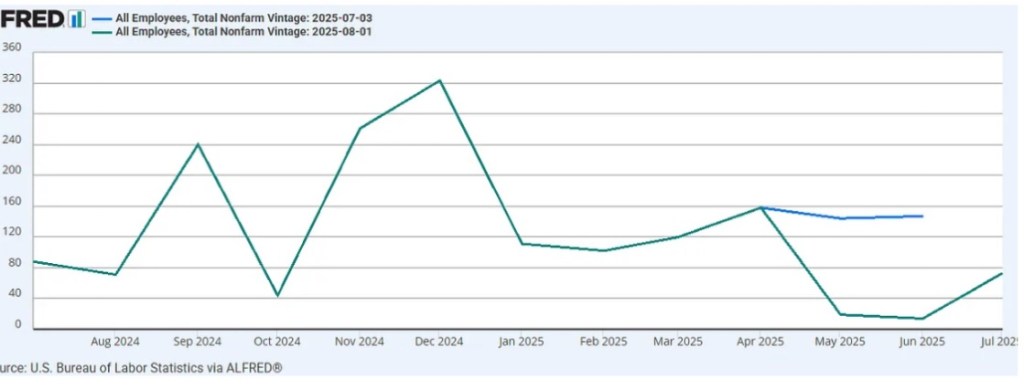
Trump believed the weak employment report for July made him “look bad”. He was particularly enraged by the downward revisions in nonfarm payrolls for the months of May and June (see chart above). Of course, he would not have liked the estimates to begin with, had they been in line the ultimate revisions — he just doesn’t like “bad” numbers on his watch. Trump stated his conviction that the weak report was “politically motivated”, and even “rigged” by McEntarfer, which is absurd. To anyone who knows anything about how these numbers are produced, this makes Trump look like a guy who is willing to manipulate economic data to his advantage. Only good numbers, please!

As I’ve said before, the mere availability of aggregate economic statistics seems to encourage activist policy. This is made worse by the unreliability and mis-measurement of these aggregates, which compounds policy failures. Like other parts of the federal statistical system, BLS reporting has shortcomings, some of them severe and getting worse. But that’s not McEntarfer’s doing. The numbers, for all their faults, are generated by a highly standardized process. Reforming that process will not be cheap.

One compelling take on the negative revisions is that they are really Trump’s very own fault. In an excellent post describing some of the technicalities that drive revisions, Claudia Sahm says:

“This is a policy problem, not a measurement problem. … Large, unpredictable shifts in economic policy are placing unusual strains on our measurement apparatus because they are causing large, unpredictable changes in the behavior of consumers and businesses. These changes are difficult to measure in real time. The GDP statistics this year have struggled to isolate massive swings in imported goods around the start of tariffs from its measure of domestic production. The initial estimates of payrolls didn’t capture the slowdown in employment, but that’s more a reflection of how sharp the jobs slowdown is, rather than a limitation of the surveys.“

The key lesson here is that shifts in the policy landscape can make economic activity more difficult to measure. And of course, policy uncertainty has contractionary effects on top of the stagflationary effects of higher taxes (i.e., tariffs). But I’m not holding out hope that Trump will engage in any introspection on the point.

As Sahm explains, the sharp slowing of job growth serves to highlight one of the difficulties inherent in survey-based measures of economic performance: not all responses are timely, and that is likely aggravated when underlying changes in activity are dramatic. In fact, she says, the June revision was driven largely by late reporting. Furthermore, the May and June revisions to payrolls were also partly driven by a change in seasonal adjustment factors based on new data (BLS uses a concurrent seasonal adjustment methodology).

In terms of industries, half of the June revision to payrolls came from state and local education, erasing an initial estimate showing that public education jobs had increased in June, which perplexed analysts at the time. The other half of the revision was spread broadly across the private sector.

In addition to the changeable nature of survey data and seasonal variability, BLS reports suffer because they often involve shaky assumptions made necessary by the limits of survey coverage. Perhaps the most controversial of these comes from the so-called birth/death (b/d) model of business formation/closure. This model is used by the BLS to estimate the net jobs created by new businesses that cannot be covered by the monthly Establishment Survey. Month-to-month, that can be a large gap to fill. Unfortunately, the b/d model can be extremely inaccurate, especially at turning points. In July 2025, the b/d model added about 257,000 jobs to total new jobs (prior to seasonal adjustment). Thus, the b/d assumption was 3.5 times the seasonally adjusted total gain of 73,000!

Critics of BLS methodology insist that its monthly payroll estimates should be benchmarked to quarterly data from a different survey as soon as it is available: the Quarterly Census of Employment and Wages, which has a 90% response rate. From Mish Shedlock:

“It is inexcusable for the BLS to not incorporate QCEW data as soon as possible.

“Instead, it relies on poor sampling of a small subset. On that poor sample, the response rate is pathetic.

“In addition, there is survival bias. In recognition of survival bias, the BLS concocted its absurd birth-death model.

“And on top that that, struggling businesses have no incentive to respond. In contrast, large corporations likely have someone dedicated to filling out government surveys.”

I’ve been critical of large BLS revisions in the past, as well as glaring inconsistencies between estimates of payroll jobs from the Establishment Survey and total civilian employment from the BLS Household Survey. Of course, they are different surveys designed to estimate different things with different samples, different coverage, geared toward counting jobs in one case and people employed and unemployed in the other. The two are benchmarked differently and at different frequencies. Still, it’s unsettling to see the two surveys diverge sharply in terms of monthly changes or trends, or to see consistently one-directional revisions. John Podhoretz states that the number of new nonfarm payroll jobs has been revised down in 25 of the past 30 months!

As Veronique de Rugy says, flaws are not the same as bad faith. Surely improvements can be made to both BLS surveys, their benchmarking, and to other adjustments and assumptions made for reporting. However, it’s pretty clear that BLS has not had the staffing and resources necessary to address these shortcomings. Over the ten years ending in 2024, inflation-adjusted BLS funding declined by more than 20%. At the same time, response rates on the Household survey have declined from 89% to less than 70%. The Establishment Survey of nonfarm businesses has also been plagued by deteriorating response rates, which fell from 61% to less than 43% over the past 10 years. And now, the Trump Administration has proposed an additional budget cut for the BLS of 8% in 2026.

Trump would have done better to ask the BLS commissioner what resources were needed to revamp its processes. Instead, his approach was to create a public spectacle by firing the head of the agency. One has to wonder how Trump might find a well-trained economist or statistician who will take the job if the numbers must always reflect well on the boss.

A Cooked-Up “Crisis” In U.S. Manufacturing

05 Monday May 2025

Posted by Nuetzel in Liberty

≈ 1 Comment

Tags

Brian Albrecht, Data Security, Don Boudreaux, Donald Trump, Economic Security, Health Security, Jeff Jacoby, Job Security, National Security, Protectionism, Ross Douthat, Strategic Goods, Tariffs, Trade Barriers, Tyler Cowen, Veronique de Rugy

Supporters of President Trump’s hard line on trade make so many false assertions that it’s hard to keep up. I’ve addressed several of these in earlier posts and I’ll address two more fallacies here: 1) that the U.S. manufacturing sector is in a state of crisis; and 2) that tariffs played a key role in promoting economic growth in the U.S. during the so-called gilded age of the late 19th and early 20th centuries.

Security

First, let’s revisit one tenet of protectionism: national security demands self-sufficiency. This undergirds the story that we must produce physical “things”, in addition to often higher-valued services, to be a great nation, or even to survive!

Of course, protecting industries critical to national security might seems like a natural concession to make, even for those supportive of liberalized trade. Ross Douthat says this:

“I think trying to reshore some manufacturing and decouple more from China makes sense from a national security standpoint, even if it costs something to G.D.P. and the stock market.“

Unfortunately, this kind of rationale is far too malleable. There is never a clearly defined limiting principle. Someone decides which goods are “critical” to national security, and this deliberation becomes the subject of much political jockeying and favor-seeking. But wait! Economic security is also cited as an adequate excuse for trade protections! And how about data security? Health security? Job security? Always there is insistence that “security” of one sort or another demands that we provide for our own needs. For definitive proof, take a look at this nonsense! Give them an inch and they’ll take a mile.

Pretty soon you “protect” such a wide swath of industries in a quest for self-sufficiency that the entire economy is unmoored from opportunity costs, comparative advantages, and the information about scarcities provided by market prices. Absolute “security” comes at the cost of transforming the economy’s productive machinery into a complacent hulk rivaling the inefficiency of Soviet industrial planning. Competition is the solution, but not limited to firms under the same set of protective trade barriers.

Manufacturing Is Mostly Fine

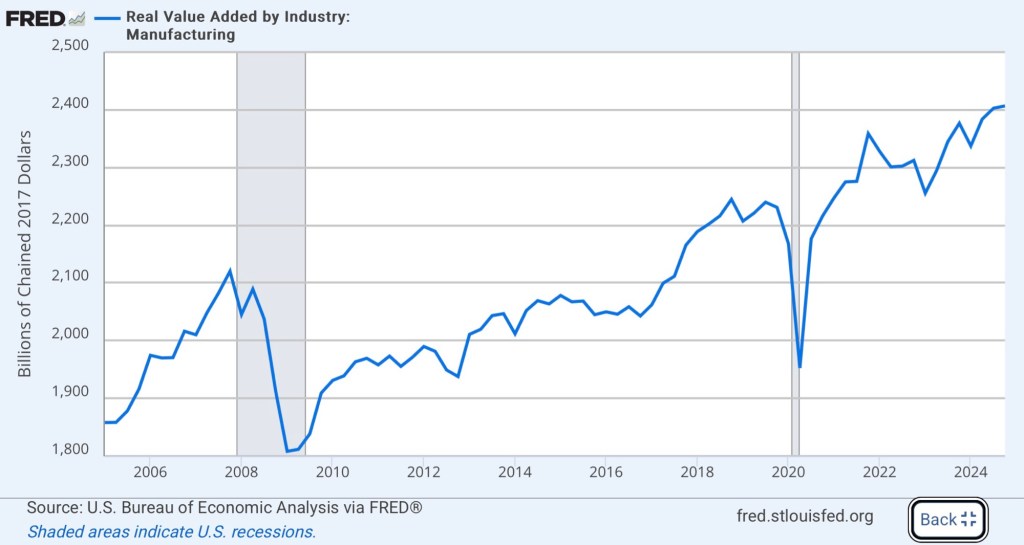
Trade warriors, including members of Trump’s team, insist that our decline as a nation is being hastened by a crisis in manufacturing. However, value added in U.S. manufacturing is at an all-time high.

There has been a long-term decline in manufacturing employment, but not manufacturing output. In fact, manufacturing output has doubled since 1980. As Jeff Jacoby notes, “the purpose of manufacturing is to make things, not jobs.” If our overarching social goal was job security, we’d have revolted long ago against the tremendous reduction in agricultural employment experienced over the past century. We’d rely on switchboard operators to load web pages, and we’d dig trenches and tunnels with spoons (to paraphrase Milton Friedman).

The secular decline in manufacturing employment is a consequence of growth in manufacturing productivity. Economy-wide, this phenomenon allows real income and our standard of living to grow.

Take That Job and …

It’s also significant that few Americans have much interest in factory work. It’s typically less dangerous than in times past, but many of today’s factory jobs are still physically challenging and relatively risky. Perhaps that helps explain why nearly half-a-million jobs in manufacturing are unfilled.

Jacoby describes the transition that has changed the face of American manufacturing:

“… US plants have largely turned away from making many of the low-tech, labor-intensive consumer items they once specialized in — sneakers, T-shirts, small appliances, toys. Those jobs have mostly gone overseas, and trying to bring them back by means of a trade war would be ruinous. Yet America remains a global manufacturing powerhouse — highly skilled, highly innovative, and highly efficient.“

And yet, even as wages in manufacturing have grown, many factory jobs do not pay as well as positions requiring far less strenuous toil in the services sector. It’s also true that the best manufacturing jobs in the U.S. today require high-level skills, which are in short supply. These factors help explain why manufacturers believe finding qualified workers is one of their biggest challenges.

Isolating Weak Sectors

There are specific sectors within manufacturing that have fared poorly, including textiles, furniture, metals, and low-end electronics. The loss of competitiveness that drove those sectoral declines is not a new development. It has, however, devastated communities in the U.S. that were heavily dependent on these industries. These misfortunes are regrettable, but trade barriers are not an effective prescription for revitalizing depressed areas.

Meanwhile, other manufacturing sectors have enjoyed growth, such as computers, aerospace, and EVs. While we’ve seen a decline in the number of manufacturing firms, the performance of U.S. manufacturing in the 21st century can be described as mixed at the very worst.

The author of this piece seems to accept the false notion that U.S. manufacturing is moribund, but he knows tariffs aren’t an effective way to strengthen domestic goods production. He has a number of better suggestions, including a commitment to infrastructure investment, reforms to education and health, and reconfiguring certain corporate income tax policies. Unfortunately, his ideas on tariffs are sometimes as mistaken as Trump’s,

The Gilded Age

Finally, the other false assertion noted in the opening paragraph is that tariffs somehow spurred economic growth in the late 19th and early 20th centuries. Brian Albrecht corrects this protectionist fallacy, which lies at the root of many defenses of Trump’s tariffs. Albrecht cites favorable conditions for growth that were sufficient to overwhelm the negative effects of tariffs, including:

“… explosive population growth, mass European immigration, rapid technological innovation, westward expansion, abundant natural resources, high literacy rates, and stable property rights.”

While cross-country comparisons indicate a positive correlation between tariffs and growth during the 1870 – 1920 period, those differences were caused by other forces that dominated tariffs. Cross-industry research discussed by Albrecht indicates that tariffs on manufactured goods during the gilded era reduced labor productivity and stimulated the entry of smaller, less productive firms. Likewise, natural experiments find that tariffs allowed inefficient firms to survive and discouraged innovation.

Conclusion

The U.S. manufacturing sector is not in any sort of crisis, and its future growth won’t be powered by attempts to restore the sort of low-value production offshored over the past several decades. What protectionists interpret as failure is the natural progression of a technically advanced market-based civilization, where high-value services account for greater shares of growing total output. Of course, low-value production is sometimes “crowded out” in this process, depending on its trade-ability and comparative advantages. The logic of the process is encapsulated by Veronique de Rugy’s recent discussion of iPhone production (HT: Don Boudreaux):

“Then there’s [Commerce Secretary Howard] Lutnick, pining for a world where Americans flood back into massive factories to assemble iPhones. This is nostalgic industrial cosplay masquerading as economic strategy. Yes, iPhones aren’t assembled by Americans. But this isn’t a failure; it’s a feature of smart economic specialization. We design the iPhone here. That’s the high-value, high-margin part. The sophisticated chips, software, architecture, and intellectual property are all created in the U.S. The marketing is done here, too. That’s most of the value of the iPhone. The lower-value labor-intensive assembly work is done abroad because those tasks are more efficiently performed abroad.“

There is certainly no crisis in U.S. manufacturing. That narrative is driven by a combination of politics, rent seeking, and misplaced nostalgia.

Scarce, Costly Housing as if a Regulatory Objective

19 Sunday May 2024

Posted by Nuetzel in Housing Policy, Regulation

≈ Leave a comment

Tags

Airbnb, Bryan Caplan, Build Baby Build, Fertility, Frederic Bastiat, Height Restrictions, Home Vacancies, Housing Developers, Housing Subsidies, Kevin Erdman, Labor Mobility, Lot Sizes, NIMBYism, Rent Control, Ryan Bourne, Seen and Unseen, The War on Prices, Urban Density, Veronique de Rugy, Zoning

Housing costs are taking a toll on many Americans. Home prices have risen about 47% cumulatively since 2020, while higher mortgage rates have compounded the difficulties faced by potential homebuyers. Meanwhile, rents are up about 23% over the same period. There just aren’t enough homes available, and the primary cause is an extensive set of regulatory obstacles to increasing the supply of homes.

High housing costs are often blamed on various manifestations of greed. Renters tend to resent their landlords, while those suffering from housing sticker-shock sometimes cast paranoid blame on people with second homes, investor properties, Airbnb rentals, and even residential developers, as if those seeking to build new housing are at the root of the problem.

Quite the contrary: we have an acute shortage of housing. The chart below shows how home vacancy rates have fallen to a level that can’t accommodate the normal frictions associated with housing turnover.

Doubts about this shortfall might owe to confusion over the meaning of one statistic: our high current level of housing units per capita. It does not indicate a plentiful stock of housing, as some assume. Alex Tabarrok, in commenting favorably on a lengthier post by Kevin Erdman, offers a simple example demonstrating that units per capita is not a reliable guide to the adequacy of housing supply:

“Suppose we have 100 homes and 100 families, each with 2 parents and 2 kids. Thus, there are 100 homes, 400 people and 0.25 homes per capita.  Now the kids grow up, get married, and want homes of their own but they have fewer kids of their own, none for simplicity. Imagine that supply increases substantially, say to 150 homes. The number of homes per capita goes up to 150/400 (.375), an all time high! Supply-side skeptics are right about the numbers, wrong about the meaning. The reality is that the demand for homes has increased to 200 but supply has increased to just 150 leading to soaring prices.”

Fewer kids have led to more homes per capita even as we suffer from a shortage of housing. In the long run, lower fertility might make it easier for housing supply to catch up with demand, but not if government continues to hamstring housing construction. Only new construction can rectify this shortfall.

That’s the message of Bryan Caplan’s “Build Baby, Build!”. Caplan has been a prominent advocate of eliminating obstacles to the construction of new housing. His book is rather unique in its contribution to economic literature because it tells the story of counterproductive housing policy in the form of a “graphic novel”, which is to say an elaborate comic book. Caplan appears in the book as protagonist, teacher and persistent gadfly.

Government obstructs additions to the supply of housing in a variety of ways: rent controls, zoning laws, density restrictions, height limits, environmental rules, and compliance paperwork. And very often these interventions are supported by existing occupants and even owners of existing homes as a matter of NIMBYism. Construction of new homes, the sure answer to the problem of an inadequate supply of housing, is actively resisted. These limitations have widespread implications for the health of the economy.

As Caplan points out, the scarcity and expense of housing limits mobility, so workers are often unable to exploit opportunities that require a move, particularly to areas of rapid growth. This makes it difficult for the labor market to adjust to negative shocks or long-term decline that might displace workers in specific locales. The mobility of resources is key to well-functioning economy, but our policies fail miserably on this count.

Rent control is an insidious policy option usually favored in dense urban areas by current renters as well as politicians seeking a visible and easy “fix” to rising rental rates. The problem is obvious: rent control destroys incentives to improve or even maintain properties. Depending on specific rules, it might even discourage development of new rental units. The result is a slow decay of the existing housing stock.

Zoning laws are an old tool of NIMBYism. The objective is to keep multifamily housing (or certain kinds of commercial development) safely away from single-family neighborhoods, or to prevent developments with relatively small lot sizes. There is also agricultural zoning, which can prevent new development along urban peripheries. It’s not difficult to understand how restrictive zoning causes rents and housing prices to escalate.

Similarly, density limits, height restrictions, burdensome filing requirements, and environmental rules all work to limit the supply of new homes.

As if crushing the supply side wasn’t enough, housing costs will come under pressure from the demand side as the Biden Administration pushes new home buying subsidies. They propose tax credits of $400 a month (at least while mortgage rates remain elevated) and an end to title insurance fees on government-backed mortgages. This would drive prices higher still. The Administration also threatens to prosecute landlords who “collude” in utilizing third-party algorithms for information in establishing rental rates. Finally, Biden proposes to dedicate billions to the construction of affordable housing, but the history of affordable housing initiatives and building subsidies is one of drastically inflated costs. This is unlikely to differ in that regard.

As wrongheaded as it is, the fact that the public is often favorably disposed to so much housing regulation is easy to understand. Rent controls prevent increases in rents to existing tenants, an easily “seen” benefit. The deleterious long-term consequences on the stock of housing are “unseen”, in the language of Frederic Bastiat.

As for zoning, homeowners are resistant to the construction of nearby “low-value” units for a variety of reasons, some aesthetic and some practical, like maintaining home values or preventing excessive traffic. “Keeping the riffraff out” is undoubtedly at play as well.

This resistance extends well beyond the limits of enforcing private property rights. It is pure rent seeking behavior in the public sphere for private benefit. Politicians and government officials tend to view the motives behind zoning as sensible, however, despite the long-term consequences of strict zoning for housing supply. Similarly, environmental restrictions sound well and good, but they too have their “unseen” negative consequences.

Most puzzling is the animus with which so many regard private residential developers, who generally build what people want: low-density suburban enclaves. Developers do it for profit, but this alienates voters who are ignorant of the economic role of profit. As in any other pursuit, profit creates a basic incentive for development activity, and to provide the kinds of homes and neighborhood amenities demanded by consumers, and to do so efficiently.

On the other hand, sprawling development inflicts external costs on incumbent residents due to added congestion, and developers and their home buyers benefit from the provision of roads that are free to users. The solution is to internalize the cost of building roads by pricing their use. Homebuyers would then weigh the value of buying in a particular area against the full marginal cost, including road use, while helping to defray the cost of maintenance and upgrades to roads and other infrastructure.

Our housing policies restrict the actions of landlords, developers, and ultimately consumers of housing. The misallocations of resources occur every time a tenant or homeowner feels they can’t afford to move in response to changing circumstances. Here is Veronique de Rugy, in an article inspired by Ryan Bourne’s “The War on Prices”, on the constraints imposed on individuals by one form of misguided intervention (my bracketed additions):

“Prices and wages [and housing rents] set on market dynamics reflect underlying economic realities and then send out a signal for help. Price [rent] controls only mask these realities, which inevitably worsens the economy’s ability to respond with what ordinary consumers and workers need.“

But our housing problem is not solely caused by interference with the price mechanism. Rather, excessive regulation of rents and a panoply of other details of the legal environment for housing have led to our current shortfall. The lesson is deregulate, and to let developers build (and rehabilitate) the housing that people need.

Grow Or Collapse: Stasis Is Not a Long-Term Option

18 Wednesday Jan 2023

Posted by Nuetzel in Climate, Environment, Growth

≈ 1 Comment

Tags

Asymptotic Burnout, Benjamin Friedman, Climate Change, Dead Weight Loss, Degrowth, Fermi Paradox, Lewis M. Andrews, Limits to Growth, NIMBYism, Paul Ehrlich, Population Bomb, Poverty, regulation, Robert Colvile, Stakeholder Capitalism, State Capacity, Stubborn Attachments, Subsidies, Tax Distortions, Thomas Malthus, Tyler Cowan, Veronique de Rugy, Zero Growth

Growth is a human imperative and a good thing in every sense. We’ve long heard from naysayers, however, that growth will exhaust our finite resources, ending in starvation and the collapse of human civilization. They say, furthermore, that the end is nigh! It’s an old refrain. Thomas Malthus lent it credibility over 200 years ago (perhaps unintentionally), and we can pick on poor Paul Ehrlich’s “Population Bomb” thesis as a more modern starting point for this kind of hysteria. Lewis M. Andrews puts Ehrlich’s predictions in context:

“A year after the book’s publication, Ehrlich went on to say that this ‘utter breakdown’ in Earth’s capacity to support its bulging population was just fifteen years away. … For those of us still alive today, it is clear that nothing even approaching what Ehrlich predicted ever happened. Indeed, in the fifty-four years since his dire prophesy, those suffering from starvation have gone from one in four people on the planet to just one in ten, even as the world’s population has doubled.”

False Limits

The “limits” argument comes from the environmental Left, but it creates for them an uncomfortable tradeoff between limiting growth and the redistribution of a fixed (they hope) or shrinking (more likely) pie. That’s treacherous ground on which to build popular support. It’s also foolish to stake a long-term political agenda on baldly exaggerated claims (and see here) about the climate and resource constraints. Ultimately, people will recognize those ominous forecasts as manipulative propaganda.

Last year, an academic paper argued that growing civilizations must eventually reach a point of “asymptotic burnout” due to resource constraints, and must undergo a “homeostatic awakening”: no growth. The authors rely on a “superlinear scaling” argument based on cross-sectional data on cities, and they offer their “burnout” hypothesis as an explanation for the Fermi Paradox: the puzzling quiet we observe in the universe while we otherwise expect it to be teeming with life… civilizations reach their “awakenings” before finding ways to communicate with, or even detect, their distant neighbors. I addressed this point and it’s weaknesses last year, but here I mention it only to demonstrate that the “limits to growth” argument lives on in new incarnations.

Growth-limiting arguments are tenuous on at least three fundamental grounds: 1) failure to consider the ability of markets to respond to scarcity; 2) underestimating the potential of human ingenuity not only to adapt to challenges, but to invent new solutions, exploit new resources, and use existing resources more efficiently; and 3) homeostasis is impossible because zero growth cannot be achieved without destructive coercion, suspension of cooperative market mechanisms, and losses from non-market (i.e., political and non-political) competition for the fixed levels of societal wealth and production.

The zero-growth world is one that lacks opportunities and rewards for honest creation of value, whether through invention or simple, hard work. That value is determined through the interaction of buyers and sellers in markets, the most effective form of voluntary cooperation and social organization ever devised by mankind. Those preferring to take spoils through the political sphere, or who otherwise compete on the basis of force, either have little value to offer or simply lack the mindset to create value to exchange with others at arms length.

Zero-Growth Mentality

As Robert Colvile writes in a post called “The Morality of Growth”:

“A society without growth is not just politically far more fragile. It is hugely damaging to people’s lives – and in particular to the young, who will never get to benefit from the kind of compounding, increasing prosperity their parents enjoyed.”

Expanding on this theme is commenter Slocum at the Marginal Revolution site, where Colvile’s essay was linked:

“Humans behave poorly when they perceive that the pie is fixed or shrinking, and one of the main drivers for behaving poorly is feelings of envy coming to the forefront. The way we encourage people not to feel envy (and to act badly) is not to try to change human nature, or ‘nudge’ them, but rather to maintain a state of steady improvement so that they (naturally) don’t feel envious, jealous, tribal, xenophobic etc. Don’t create zero-sum economies and you won’t bring out the zero-sum thinking and all the ills that go with it.”

And again, this dynamic leads not to zero growth (if that’s desired), but to decay. Given the political instability to which negative growth can lead, collapse is a realistic possibility.

I liked Colville’s essay, but it probably should have been titled “The Immorality of Non-Growth”. It covers several contemporary obstacles to growth, including the rise of “stakeholder capitalism”, the growth of government at the expense of the private sector, strangling regulation, tax disincentives, NIMBYism, and the ease with which politicians engage in populist demagoguery in establishing policy. All those points have merit. But if his ultimate purpose was to shed light on the virtues of growth, it seems almost as if he lost his focus in examining only the flip side of the coin. I came away feeling like he didn’t expend much effort on the moral virtues of growth as he intended, though I found this nugget well said:

“It is striking that the fastest-growing societies also tend to be by far the most optimistic about their futures – because they can visibly see their lives getting better.”

Compound Growth

A far better discourse on growth’s virtues is offered by Veronique de Rugy in “The Greatness of Growth”. It should be obvious that growth is a potent tonic, but its range as a curative receives strangely little emphasis in popular discussion. First, de Rugy provides a simple illustration of the power of long-term growth, compound growth, in raising average living standards:

This is just a mechanical exercise, but it conveys the power of growth. At 2% real growth, real GDP per capital would double in 35 years and quadruple in 70 years. At 4% growth, real GDP would double in 18 years… less than a generation! It would quadruple in 35 years. If you’re just now starting a career, imagine nearing retirement at a standard of living four times as lavish as today’s senior employees (who make a lot more than you do now). We’ll talk a little more about how such growth rates might be achieved, but first, a little more on what growth can achieve.

The Rewards of Growth

Want to relieve poverty? There is no better and more permanent solution than economic growth. Here are some illustrations of this phenomenon:

Want to rein-in the federal budget deficit? Growth reduces the burden of the existing debt and shrinks fiscal deficits, though it might interfere with what little discipline spendthrift politicians currently face. We’ll have to find other fixes for that problem, but at least growth can insulate us from their profligacy.

And who can argue with the following?

“All the stuff an advocate anywhere on the political spectrum claims to value—good health, clean environment, safety, families and quality of life—depends on higher growth. …

There are other well-documented material consequences of modern economic growth, such as lower homicide rates, better health outcomes (babies born in the U.S. today are expected to live into their upper 70s, not their upper 30s as in 1860), increased leisure, more and better clothing and shelter, less food insecurity and so on.”

De Rugy argues convincingly that growth might well entail a greater boost in living standards for lower ranges of the socioeconomic spectrum than for the well-to-do. That would benefit not just those impoverished due to a lack of skills, but also those early in their careers as well as seniors attempting to earn extra income. For those with a legitimate need of a permanent safety net, growth allows society to be much more generous.

What de Rugy doesn’t mention is how growth can facilitate greater saving. In a truly virtuous cycle, saving is transformed into productivity-enhancing additions to the stock of capital. And not just physical capital, but human capital through investment in education as well. In addition, growth makes possible additional research and development, facilitating the kind of technical innovation that can sustain growth.

Getting Out of the Way of Growth

Later in de Rugy’s piece, she evaluates various ways to stimulate growth, including deregulation, wage and price flexibility, eliminating subsidies, less emphasis on redistribution, and simplifying the tax code. All these features of public policy are stultifying and involve dead-weight losses to society. That’s not to deny the benefits of adequate state capacity for providing true public goods and a legal and judicial system to protect individual rights. The issue of state capacity is a major impediment to growth in the less developed world, whereas countries in the developed world tend to have an excess of state “capacity”, which often runs amok!

In the U.S., our regulatory state imposes huge compliance costs on the private sector and effectively prohibits or destroys incentives for a great deal of productive (and harmless) activity. Interference with market pricing stunts growth by diverting resources from their most valued uses. Instead, it directs them toward uses that are favored by political elites and cronies. Subsidies do the same by distorting tradeoffs at a direct cost to taxpayers. Our system of income taxes is rife with behavioral distortions and compliance costs, bleeding otherwise productive gains into the coffers of accountants, tax attorneys, and bureaucrats. Finally, redistribution often entails the creation of disincentives, fostering a waste of human potential and a pathology of dependence.

Growth and Morality

Given the unequivocally positive consequences of growth to humanity, could the moral case for growth be any clearer? De Rugy quotes Benjamin Friedman’s “The Moral Consequences of Economic Growth”:

“Growth is valuable not only for our material improvement but for how it affects our social attitudes and our political institutions—in other words, our society’s moral character, in the term favored by the Enlightenment thinkers from whom so many of our views on openness, tolerance and democracy have sprung.”

De Rugy also paraphrases Tyler Cowen’s position on growth from his book “Stubborn Attachments”:

“… economic growth, properly understood, should be an essential element of any ethical system that purports to care about universal human well-being. In other words, the benefits are so varied and important that nearly everyone should have a pro-growth program at or near the top of their agenda.”

Conclusion

Agitation for “degrowth” is often made in good faith by truly frightened people. Better education would help them, but our educational establishment has been corrupted by the same ignorant narrative. When it comes to rulers, the fearful are no less tyrannical than power-hungry authoritarians. In fact, fear can be instrumental in enabling that kind of transformation in the personalities of activists. A basic failing is their inability to recognize the many ways in which growth improves well-being, including the societal wealth to enable adaptation to changing conditions and the investment necessary to enhance our range of technological solutions for mitigating existential risks. Not least, however, is the failure of the zero-growth movement to understand the cruelty their position condones in exchange for their highly speculative assurances that we’ll all be better off if we just do as they say. A terrible downside will be unavoidable if and when growth is outlawed.

Liar-Left, Daft-Left Bellow: It’s the Unkindest Tax Cut of All

08 Friday Dec 2017

Posted by Nuetzel in Health Insurance, Taxes

≈ Leave a comment

Tags

Bernie Sanders, Bubble Tax, Cross Subsidies, David Harsanyi, Individual Mandate, Insurability, Jeffrey Tucker, Medical Expense Deduction, Medicare, Obamacare, Paygo, Penalty Tax, Progressive Left, Snopes, Standard Deduction, Tax Reform, Veronique de Rugy

A misapprehension of progressive leftists is that the tax reform bills under debate by the GOP will revoke something from the needy: the poor, cancer patients, the working class, the aged, you name it. Well, that is a misapprehension held by many earnest leftists, but it amounts to deceitful rhetoric from others. David Harsanyi, in an article about the Left’s penchant for corrupting the English language, attempts to set the record straight:

“Whenever the rare threat of a passable Republican bill emerges, we learn from Democrats that thousands, or perhaps millions, of lives are at stake. …

… the most obvious and ubiquitous of the Left’s contorted contentions about the tax bill deliberately muddles the concept of giving and the concept of not taking enough. This distortion is so embedded in contemporary rhetoric that I’m not sure most of the foot soldiers even think it’s odd to say anymore. …  Whatever you make of the separate tax bills the House and Senate have passed, though, the authors do not take one penny from anyone. In fact, no spending is being cut (unfortunately). Not one welfare program is being block-granted. Not one person is losing a subsidy. It’s just a wide-ranging tax cut without any concurrent spending cuts.“

The Left may have a basic math incompetency, or maybe they know better when they insist that the GOP plans will inflict a new burden on the middle class. The middle class actually receives larger reductions in taxes than higher strata. Veronique de Rugy highlighted this point recently:

“President Trump’s intention to give a real tax break to the middle class is counter-productive considering the middle class barely shoulders any of the income tax as it is. The top 10 percent of income earners—households making $133K [or more], not $1 million as most assume—currently pay more than 70 percent of all income tax revenue. The middle quintile pays, on average, 2.6 percent of the federal income tax.

And yet, in both the House and Senate plans the middle class receives the largest tax relief by reducing their marginal tax rates, increasing the child tax credit and doubling the standard deduction. The result is fewer taxpayers would be paying income tax at all, problematic from a small government perspective. It also means a more progressive income tax code than it already is.

The House plan also effectively jacks up the top marginal rate for some high earners by using a 39.6 percent bubble rate on the first $90K earned by single taxpayers making $1 million and married taxpayers making $1.2 million and a 12 percent rate like everyone else.“

I have listened to horror stories about school teachers who, in the past, were able to deduct supplies they purchased for their students. Now, the cruel GOP is trying to take that away! This argument neatly ignores the doubling of the standard deduction. Many teachers will find that it no longer makes sense to itemize deductions, and they will come out ahead. But for the sake of argument, suppose a teacher earning $50,000 itemizes and spends $2,500 on unreimbursed supplies for their students every year. At the Senate plan’s new rate in that bracket, the lost deduction will cost the teacher $550, but about $300 would be saved via rate reductions for every $10,000 of taxable income. The teacher is likely to come out ahead even if he unwisely passes on the improved standard deduction.

Liberal thought-whisperers have goaded their minions into believing that the GOP intends to cut Medicare funds by $25 billion a year going forward. The bills under discussion would do no such thing. However, in a rare gesture of fiscal responsibility, President Obama in 2010 signed the Statutory Pay-As-You-Go Act (Paygo), which may require automatic reductions in outlays when spending or tax changes lead to an increase in federal debt. The act has never been enforced, and Republican leadership in both houses insists that Paygo can and will be waived. Clearly, the GOP’s intent is not to allow the Paygo cuts to take place. Even the left-leaning Snopes.com is reasonably neutral on this point. But if Paygo takes hold, the lefties will have themselves to blame.

At the last link, Snopes also touches on one actual provision of the Senate tax plan, the repeal of the Obamacare individual mandate, or rather, the repeal of the “penalty tax” imposed by the IRS on uninsured individuals. The Supreme Court ruled that it is a tax in 2012, at the time giving rise to a mixture of delight and embarrassment on the Left. The ruling saved Obamacare, but the Left had been loath to call the penalty a tax. The supposed rub here is that repeal of the mandate will be greeted enthusiastically by many young and healthy individuals. Freed from coercion, many of them will elect to go without coverage, leading to a deterioration of the exchange risk pools and causing premiums paid by the remaining exchange buyers to rise. However, the critics conveniently ignore the fact that Obamacare individual subsidies will automatically ratchet upward with increases in the premium on the Silver Plan. So the panic related to this portion of the Senate tax bill is misplaced.

One other point about the mandate: because it coerces the payment of cross-subsidies by the young and healthy to higher-risk insurance buyers, the mandate distorts the pricing of risk, the incentives to insure, and the use of resources in the provision of health insurance and health care itself. This is how the proper function of a market is destroyed. And this is how resources are wasted. Good riddance to the mandate. The high-risk population should be subsidized directly, not through distorted pricing, at least until such time as a market for future insurability can be established. As Jeffrey Tucker has said, repeal of the mandate is a very good first step.

The loss of the medical expense deduction is not a done deal. While the House plan eliminates the deduction, the Senate plan reduces the minimum medical expense requirement from 10% to just 7.5% of qualified income, so it is more generous than under current law. I’ve seen bloggers commit basic misstatements of facts on this and other provisions, such as confusing this limit with a total limit on the amount of the medical deduction. This deduction tends to benefit higher-income individuals who itemize deductions, which will represent a higher threshold under the increased standard deduction. Of course, this deduction appeals to our sense of fairness, but like all the complexities in the tax code, it comes with costs: not only does it add to compliance costs and create a need for higher tax rates, but it subsidizes demand for medical care, much like the tax breaks available on employer-provided health care, and it therefore inflates health care costs for everyone. To the extent that these deductions and many others are still in play, the GOP plans fall short of real tax reform.

The GOP tax bills certainly have their shortcomings. I hope some of them are rectified in conference. The bills do not offer extensive simplification of the tax code, and they would not be truly historic: in real terms, an earlier version of the House bill would have been the fourth biggest cut in U.S. history relative to GDP, and I believe the version that passed the House is smaller. However, many of the arguments mounted by the Left against the bills are without merit and are often deceitful. The Left strongly identifies with the zero-sum philosophy inherent in collectivism, and the misleading arguments I’ve cited are plausible to the less-informed among that crowd. That brings me back to David Harsanyi’s point, discussed at the top of this post: “intellectuals” on the progressive Left find value in corrupting the meaning of words and phrases like “budget cuts”, “giving” and “taking”:

“Everyone tends to dramatize the consequences of policy for effect, of course, but a Democratic Party drifting towards Bernie-ism is far more likely to perceive cuts in taxation as limiting state control and thus an attack on all decency and morality.“

“There is a parallel explanation for the hysterics. With failure comes frustration, and frustration ratchets up the panic-stricken rhetoric. It’s no longer enough to hang nefarious personal motivations on your political opponents — although it certainly can’t hurt! — you have to corrupt language and ideas to imbue your ham-fisted arguments with some kind of basic plausibility.“

Weighing Tax Reform vs. Spending and Deficits

05 Tuesday Dec 2017

Posted by Nuetzel in Taxes

≈ Leave a comment

Tags

Bernie Sanders, Brian Reidl, Dan Mitchell, Deficit Spending, GOP Tax Reform, Jeffrey Tucker, Joint Committee on Taxation, Quantria/Inforum, Ricardian Equivalence, Tax Trigger, Veronique de Rugy

The tax reform legislation likely to come out of the House and Senate reconciliation process will be far from ideal, but it will be much better than current tax law in several respects (see my last several posts listed in the left-hand margin). One complaint raised by Democrats and others, however, is that the GOP tax compromise will lead to higher budget deficits. Of course they are right, but Democrats fail as legitimate critics given their hypocrisy on the issue of deficit spending. And chronic deficits are ultimately a symptom of government excess. Deficits exist when the polity is unwilling to support the explicit taxes necessary to pay for the spending that politicians are willing and able to authorize.

Nevertheless, there is near-universal consensus that the tax plans passed by the House and Senate would add to the deficit if either were to become law, the biggest exception to that consensus being Republican leadership. The Joint Committee on Taxation (JCT) has estimated that the Senate plan would add $1.4 trillion to the deficit without the benefit of economic feedback. That shrinks to about $1 trillion with the dynamic feedback effect of resultant economic growth. Others believe the gap would be smaller, however. The Tax Foundation, for example, estimates the net cost in tax revenue at $500 billion. Veronique de Rugy quotes a dynamic score by Quantria/Inforum that would put the revenue loss at about $300 billion, based on the starting JCT static estimate. The Tax Foundation, as noted by de Rugy, believes the JCT errs in treating the U.S. economy as a closed economy in which business funding is limited to a fixed pool of domestic saving, and in assuming that the Federal Reserve would attempt to offset the economic growth spurred by the tax cuts. These JCT assumptions mute the economic and revenue responses to tax changes.

But whether you believe the JCT’s estimates or the others, the impact is relatively minor compared to the existing fiscal shortfalls brought on by government excess. Brian Riedl puts the proposed tax cuts in perspective. The 10-year deficit was already projected at $10 trillion, with little apparent concern from Democrats. Riedl notes that the opposition has repeatedly shown itself unwilling to address fiscal problems such as Obama’s deficit legislation, Bernie Sander’s $30 trillion health care plan, and a shortfall in Social Security and Medicare funding of $82 trillion over the next three decades:

“Critics who are unwilling to confront these mammoth spending deficits are in no position to lecture others on the deficit implications of a (comparatively modest) $2 trillion tax cut.“

Jeffrey Tucker, whose posts I usually enjoy, seems to assert that deficits are not worthy of great concern. He offers a negative and somewhat muddled assessment of Ricardian equivalence, the idea that deficit spending is neutral because the expectation of future taxes discourages private spending. Tucker’s position is rooted in impatience with the rhetoric of revenue neutrality, but I think his real point might not be too far from Reidl’s. To his credit, Tucker condemns “fiscal profligacy”. He says:

“To be sure, this is not a defense of fiscal irresponsibility. Debts and deficits are terrible. Fiscal conservatism is a good thing. The budget should always be balanced. But there is one proviso: none of this should happen at the expense of the wealth creators in society: you, me, and the business sector. Government should bear responsibility for its own profligacy.“

I will interpret that last remark generously to mean that Tucker would cut spending to shrink deficits, but he also advocates for the sale of federal assets, which I generally support.

Concern by some Republicans over the deficit effects of tax reform prompted a debate during the Senate negotiations over a so-called “trigger” that would have increased taxes automatically if revenue fell short of certain benchmarks. At the last link, Ryan Bourne explains what a bad idea that would have been. A future revenue shortfall could be attributed to any number of future developments, not all of which would be compatible with a tax hike as a fix. The trigger would also create uncertainty, dampening the positive revenue effects that would otherwise be operative. It’s a relief that the trigger idea was abandoned by the GOP.

Despite the corrosive effects of big government and excessive spending, there is a relatively painless solution to closing the fiscal gap, with or without GOP tax reform. (I use the word “painless” guardedly, because big government inflicts distortions and costs well beyond mere spending levels.) Dan Mitchell has updated his calculations showing that the annual deficit would be eliminated by a decline in the budgeted annual growth of spending from 5.49% to 2.67% over ten years, starting in 2019. That hardly seems draconian, but watch: progressives and even relatively reflective Democrats would call such growth reductions “heartless cuts”. Such is the intellectual integrity of the left.

Mobility, Safety Nets & Sticky Webs

23 Thursday Jun 2016

Posted by Nuetzel in Big Government, Welfare State

≈ Leave a comment

Tags

Affordable Care Act, Andrei Schleifer, Basic Income Guarantee, Christopher Jencks, Curley Effect, David Henderson, Dependent Class, Don Boudreaux, Earned Income Tax Credit, Edward Glaeser, Employment Incentives, Extreme Poverty, Henry Hazlitt, Kathryn Edin, Labor Force Participation, Luke Shaefer, Marginal Revolution, Medicaid expansion, Michael Tanner, Milton Friedman, Mises Wire, Obamacare, Social Safety Net, Tyler Cowan, Universal Basic Income, Veronique de Rugy, War on Poverty, Welfare State, work incentives

image

We’re unlikely to reduce the share of the U.S. population living in economic dependency under the current policy regime. So many aspects of tax law, regulation and aid programs are designed as if to perpetuate or perhaps even worsen the situation. I’ve discussed this topic before on Sacred Cow Chips in “Degrees of Poverty and the Social Safety Trap“, and “Minority Politics and the Redistributionist Honey Trap“.

Many supporters of aggressive anti-poverty efforts take umbrage at any suggestion that government aid might discourage the poor from engaging in productive activities. They imagine an implication that the poor are “lazy”, perfidious or otherwise undeserving of assistance. Whether that is a misunderstanding or merely rhetorical bite-back, the fact is that it is rational to respond to incentives and there is no shame in doing so. Unfortunately, many assistance programs contain incentive traps or income “cliffs” that discourage work effort. This applies to food stamps, rent subsidies, Obamacare subsidies, and many more of the 120+ federal aid programs and other state and local programs.

Here’s a new example from a research abstract posted at Marginal Revolution: The Medicaid expansion had very negative effects on labor force participation. The funding for Medicaid expansion at the state level was authorized by the Affordable Care Act (ACA) — aka Obamacare, but only about half the states went along with it. From the abstract:

“I find a significant negative relationship between Medicaid expansion and labor force participation, in which expanding Medicaid is associated with 1.5 to 3 percentage point drop in labor force participation.“

The direction of impact is hardly unique, and as Tyler Cowen notes at the link:

“Work is good for most people, and it is even better for their future selves, and their future children too.“

The negative impact of Obamacare is more massive than the estimate above might suggest. Veronique de Rugy at Reason.com discusses how “Federal Programs Keep People Poor“. While most of her article is about the negative impact of high marginal tax rates on the employment prospects of the poor, she also recalls an ugly CBO estimate of the ACA’s impact:

“In 2014, the Congressional Budget Office—Congress’ official fiscal scorekeeper—revised its original estimate to report that because of the law, by 2024 the equivalent of 2.5 million Americans who were otherwise willing and able to work will have exited the labor force.“

There are several different channels through which the negative effects of the ACA operate: Small employers are incented to limit their hiring and the hours of employees, and federal subsidies (and sometimes state benefits) are available to individuals only so long as they remain below certain income thresholds. Again, this is typical of many government aid programs (the Earned Income Tax Credit (EITC) being an exception). More from de Rugy:

“When the government takes away a person’s benefits as his income goes up, it has the same effect as a direct tax. And remember, when you tax something, you usually get less of it. That means these programs can actually hinder income mobility: In order to continue receiving their government cash, individuals are forced to limit the amount they earn. Thus, they have an incentive not to try to climb the income ladder by putting in extra hours or signing up for job training and educational programs.“

Mises Wire recently carried a reprint of an essay by the great Henry Hazlitt, “How To Cure Poverty“. The gist of Hazlitt’s argument is that government largess simply cannot create wealth for society, but only diminish it. The mere process of redistributing the current “pie” consumes resources, but that is minor compared to the future reduction in the size of the pie brought on by the terrible incentives inherent in income taxation and many government benefit programs:

“The problem of curing poverty is difficult and two-sided. It is to mitigate the penalties of misfortune and failure without undermining the incentives to effort and success. … The way to cure poverty is … through … the adoption of a system of private property, freer trade, free markets, and free enterprise. It was largely because we adopted this system more fully than any other country that we became the most productive and hence the richest nation on the face of the globe. Through this system more has been done to wipe out poverty in the last two centuries than in all previous history.“

Harvard professors Edward Glaeser and Andrei Schleifer have written about “The Curley Effect: The Economics of Shaping the Electorate“, which posits that redistributive policies that are harmful to constituents can be rewarding to politicians. The paper deals with policies that encourage emigration of affluent voters away from cities, but which nevertheless reward politicians by increasing the proportion of their political base in the remaining constituency. It seems to apply very well to many major cities in the U.S. However, it certainly applies more broadly, across states and nations, when affluent people and their capital are mobile while the less affluent are not, especially when benefits are at stake. It’s no secret that promises of benefits are often attractive to voters in the short run, even if they are harmful and unsustainable in the long run.

The welfare state appears to have helped to sustain many of the poor at an improved standard of living after accounting for benefits, or it has prevented them from falling into “deep poverty”. However, it hasn’t succeeded in lifting the poor out of dependency on the state. Pre-benefit poverty rates are about the same as they were the late 1960s. In addition, Christopher Jencks observes that the “Very Poor” have in fact become poorer. That’s discussed in his review of “$2.00 a Day: Living on Almost Nothing in America” by Kathryn Edin and Luke Shaefer. Jencks presents statistics showing that those in the lowest two percentiles of the income distribution have suffered a fairly sharp decline in income since 1999. Many of these extremely poor individuals do not avail themselves of benefits for which they could qualify. In addition, the EITC requires earned income. A job loss is a wage loss and, if it goes on, a loss of EITC benefits. Unfortunately, work requirements are more difficult to meet in the presence of wage floors and other distortions imposed by heavy-handed regulation.

A guaranteed national income has become a hot topic recently. Michael Tanner weighs in on “The Pros and Cons…” of such a program. There are many things to like about the idea inasmuch as it could sweep away many of the wasteful programs piled upon each other over the years. It is possible to construct a sliding-scale guarantee that would retain positive incentives for all, as Milton Friedman demonstrated years ago with his negative income tax concept. However, as Tanner points out, there are many details to work out, and the benefits of the switch would depend upon the incentive structure built into the guarantee. As a political plaything, it could still be dangerous to the health of the economy and an impediment to income mobility. Don Boudreaux has registered objections to a guaranteed income, one of which is based on strengthening the wrongheaded argument that we derive all rights from government. Even more interesting is David Henderson’s take on a basic income guarantee. He finds that the budgetary impact of a $10,000 guarantee would equate to a 30% increase in government spending, and that assumes that it replaces all other assistance programs! Henderson also discusses the public choice aspects of income guarantees, as well as moral objections, and he concludes that there are strong reasons to reject the idea on libertarian grounds.

The economy is riddled with too many subsidies, penalties and bad incentives that distort the behavior of various groups. The well-to-do often benefit from subsidies that are every bit as distortionary as those inherent in many public assistance programs. They should all be swept away to restore a dynamic economy with the potential to lift even more out of poverty. There could be a role for a guaranteed income on the grounds that it is better than what we’ve got. But we should recall the words of Hazlitt, who reminded us that we’ve come so far on the strength of property rights, private initiative, and free trade. Left unfettered, those things can take us much farther than the ugly pairing of beneficence and coercion of the government behemoth.


Pay and Productivity

05 Sunday Jun 2016

Posted by Nuetzel in Living Wage, Markets, Minimum Wage

≈ 1 Comment

Tags

Automation, Carwasheros, central planning, Ecomomic Policy Institute, James Sherk, Labor Productivity, Labor Saving Technology, Living Wage, Low-Skilled Workers, Minimum Wage, Productivity and Wages, Resource Allocation, Veronique de Rugy

allaboutproductivity

Remember, the real minimum wage is zero, and state-imposed unemployment is not justice. In the private economy, wages rise with productivity, and that’s true across workers at any point in time, for workers over time, and for workers in different industries over time. Don’t think so? Contrary to the blithe pronouncements of Barack Obama and reports by the union-backed Economic Policy Institute (EPI), there has been no divergence in productivity and pay since the early 1970s. This is shown convincingly by James Sherk in “Workers’ Compensation: Growing Along With Productivity“. Sherk’s work shows that hourly productivity increased by 81% since 1973, while average employee compensation increased 78%. In contrast, the EPI has claimed that productivity grew 91% since 1973, but  employee compensation grew just 10%.

How did the EPI (and Obama) reach such a faulty conclusion? Sherk breaks the error into three major parts: 1) comparing the pay of a subset of workers to the productivity of all workers; 2) excluding the pay growth of the self-employed; and 3) inconsistent adjustments of pay and productivity for inflation.

The link between wages and productivity is immutable in a market economy. The state can attempt to short-circuit the relationship, but such intervention comes at the cost of dislocations in resource utilization and damage to well-being. Veronique de Rugy discusses Sherk’s findings and emphasizes the folly in thinking that the government can somehow divorce the pay of workers from their underlying contribution to the value of output:

“One of the assets of the American economic model is a relatively flexible labor market, especially when compared with labor markets in many European countries. It explains some of the consistently lower U.S. unemployment rates and higher economic growth. Unfortunately, this flexibility is increasingly threatened by government policies that would increase the cost of employing workers.“

Populists and statists share some destructive tendencies, such as a fixation on increasing the cost of labor to employers. The current debate over a “living wage” of $15 per hour involves more than doubling the minimum wage in many parts of the country. This is so far out of line with the productivity of low-skilled workers as to make absurd claims that it won’t have a serious impact on their employment. There are employers who won’t be able to survive under those circumstances. There are others who will have to scale back operations. Employers having access to capital in industries such as car washes and fast food know that automation is more than viable as a substitute for low-skilled labor. And new labor-saving innovations are inevitable when creative entrepreneurs are confronted with an obstacle like high-cost labor: necessity is the mother of invention. But premature automation is not an obvious consequence to living-wage advocates. And that’s to say nothing of the futures destroyed when low-skilled workers are denied opportunities for work experience.

The connection between wages and productivity is part of a well-functioning economy and it is just as alive and well in today’s economy as ever. The “right” wage cannot be determined by central planners, bureaucrats or legislators apart from productive reality, and the adverse consequences of their attempts to do so cannot be wished away. Only markets that price the real value of productive contributions can put resources such as low-skilled labor to their best use, avoiding the waste inherent in regulation that is always ignorant of dynamic preferences and resource availability.


Follow Sacred Cow Chips on WordPress.com

Recent Posts

  • Government Malpractice Breeds Health Care Havoc
  • A Tax On Imports Takes a Toll on Exports
  • Dubious Scorecards of Violence By Ideology
  • Employee Speech and Its Consequences
  • Tariff Challenges at the High Court

Archives

  • November 2025
  • October 2025
  • September 2025
  • August 2025
  • July 2025
  • June 2025
  • May 2025
  • April 2025
  • March 2025
  • February 2025
  • January 2025
  • December 2024
  • November 2024
  • October 2024
  • September 2024
  • August 2024
  • July 2024
  • June 2024
  • May 2024
  • April 2024
  • March 2024
  • February 2024
  • January 2024
  • December 2023
  • November 2023
  • August 2023
  • July 2023
  • June 2023
  • May 2023
  • April 2023
  • March 2023
  • February 2023
  • January 2023
  • December 2022
  • November 2022
  • October 2022
  • September 2022
  • August 2022
  • July 2022
  • June 2022
  • May 2022
  • April 2022
  • March 2022
  • February 2022
  • January 2022
  • December 2021
  • November 2021
  • October 2021
  • September 2021
  • August 2021
  • July 2021
  • June 2021
  • May 2021
  • April 2021
  • March 2021
  • February 2021
  • January 2021
  • December 2020
  • November 2020
  • October 2020
  • September 2020
  • August 2020
  • July 2020
  • June 2020
  • May 2020
  • April 2020
  • March 2020
  • February 2020
  • January 2020
  • December 2019
  • November 2019
  • October 2019
  • September 2019
  • August 2019
  • July 2019
  • June 2019
  • May 2019
  • April 2019
  • March 2019
  • February 2019
  • January 2019
  • December 2018
  • November 2018
  • October 2018
  • September 2018
  • August 2018
  • July 2018
  • June 2018
  • May 2018
  • April 2018
  • March 2018
  • February 2018
  • January 2018
  • December 2017
  • November 2017
  • October 2017
  • September 2017
  • August 2017
  • July 2017
  • June 2017
  • May 2017
  • April 2017
  • March 2017
  • February 2017
  • January 2017
  • December 2016
  • November 2016
  • October 2016
  • September 2016
  • August 2016
  • July 2016
  • June 2016
  • May 2016
  • April 2016
  • March 2016
  • February 2016
  • January 2016
  • December 2015
  • November 2015
  • October 2015
  • September 2015
  • August 2015
  • July 2015
  • June 2015
  • May 2015
  • April 2015
  • March 2015
  • February 2015
  • January 2015
  • December 2014
  • November 2014
  • October 2014
  • September 2014
  • August 2014
  • July 2014
  • June 2014
  • May 2014
  • April 2014
  • March 2014

Blogs I Follow

  • Passive Income Kickstart
  • OnlyFinance.net
  • TLC Cholesterol
  • Nintil
  • kendunning.net
  • DCWhispers.com
  • Hoong-Wai in the UK
  • Marginal REVOLUTION
  • Stlouis
  • Watts Up With That?
  • Aussie Nationalist Blog
  • American Elephants
  • The View from Alexandria
  • The Gymnasium
  • A Force for Good
  • Notes On Liberty
  • troymo
  • SUNDAY BLOG Stephanie Sievers
  • Miss Lou Acquiring Lore
  • Your Well Wisher Program
  • Objectivism In Depth
  • RobotEnomics
  • Orderstatistic
  • Paradigm Library
  • Scattered Showers and Quicksand

Blog at WordPress.com.

Passive Income Kickstart

OnlyFinance.net

TLC Cholesterol

Nintil

To estimate, compare, distinguish, discuss, and trace to its principal sources everything

kendunning.net

The Future is Ours to Create

DCWhispers.com

Hoong-Wai in the UK

A Commonwealth immigrant's perspective on the UK's public arena.

Marginal REVOLUTION

Small Steps Toward A Much Better World

Stlouis

Watts Up With That?

The world's most viewed site on global warming and climate change

Aussie Nationalist Blog

Commentary from a Paleoconservative and Nationalist perspective

American Elephants

Defending Life, Liberty and the Pursuit of Happiness

The View from Alexandria

In advanced civilizations the period loosely called Alexandrian is usually associated with flexible morals, perfunctory religion, populist standards and cosmopolitan tastes, feminism, exotic cults, and the rapid turnover of high and low fads---in short, a falling away (which is all that decadence means) from the strictness of traditional rules, embodied in character and inforced from within. -- Jacques Barzun

The Gymnasium

A place for reason, politics, economics, and faith steeped in the classical liberal tradition

A Force for Good

How economics, morality, and markets combine

Notes On Liberty

Spontaneous thoughts on a humble creed

troymo

SUNDAY BLOG Stephanie Sievers

Escaping the everyday life with photographs from my travels

Miss Lou Acquiring Lore

Gallery of Life...

Your Well Wisher Program

Attempt to solve commonly known problems…

Objectivism In Depth

Exploring Ayn Rand's revolutionary philosophy.

RobotEnomics

(A)n (I)ntelligent Future

Orderstatistic

Economics, chess and anything else on my mind.

Paradigm Library

OODA Looping

Scattered Showers and Quicksand

Musings on science, investing, finance, economics, politics, and probably fly fishing.

  • Subscribe Subscribed
    • Sacred Cow Chips
    • Join 128 other subscribers
    • Already have a WordPress.com account? Log in now.
    • Sacred Cow Chips
    • Subscribe Subscribed
    • Sign up
    • Log in
    • Report this content
    • View site in Reader
    • Manage subscriptions
    • Collapse this bar
 

Loading Comments...