• About

Sacred Cow Chips

Sacred Cow Chips

Category Archives: Uncategorized

Fall Coronavirus Season

16 Friday Oct 2020

Posted by Nuetzel in Coronavirus, Pandemic, Uncategorized

≈ Leave a comment

Tags

Antigenic Drift, CARES Act, Coronavirus, Covid-19, Death Laundering, Europe, False Positives, Hospital Reimbursement, IFR, Immunity, Infection Fatality Rate, Kyle Lamb, Medicare, Seasonality, Second Wave, Twitter, Vitamin D, WHO

We’ve known for some times that COVID-19 (C19) follows seasonal patterns typical of the flu, though without the flu’s frequent antigenic drift. Now that we’re moving well into autumn, we’ve seen a surge in new C19 case counts in Europe and in a number of U.S. states, especially along the northern tier of the country.

The new case surge began in early to mid-September, depending on the state, and it’s been coincident with another surge in tests. From late July through early October, we had a near doubling in the number of tests per positive in the U.S. An increase in tests also accompanied the previous surge during the summer, which claimed far fewer lives than the initial wave in the early spring. In the summer, infections were much more prevalent among younger people than in the spring. Vitamin D levels were almost certainly higher during the summer months, our ability to treat the virus had also improved, and immunities imparted by prior infections left fewer susceptible individuals in the population. We have many of those advantages now, but D levels will fade as the fall progresses.

As for the new surge in cases, another qualification is that false positives are still a major testing problem; they inflate both case counts and C19-attributed deaths. In the absence of any improvement in test specificity, of which there is no evidence, the exaggeration caused by false positives grows larger as testing increases and positivity rates fall. So take all the numbers with that as a caveat.

How deadly will the virus be this fall? So far in Europe, the trends look very promising. Kyle Lamb provided the following charts from WHO on Twitter yesterday. (We should all be grateful that Twitter hasn’t censored Kyle yet, because he’s been a force in exposing alarmism in the mainstream media and among the public health establishment.) Take a look at these charts, and note particularly the lag between the first wave of infections and deaths, as well as the low counts of deaths now:

If the lag between diagnosis and death is similar now to the spring, Europe should have seen a strong upward trend in deaths by now, yet it’s hardly discernible in most of those countries. The fatality rates are low as well:

As Lamb notes, the IFRs in the last column look about like the flu, though again, the reporting of deaths and their causes are often subject to lags.

What about the U.S.? Nationwide, C19 cases and attributed death reports declined after July. See the chart below. More recently, reported deaths have stabilized at under 700 per day. Note again the relatively short lags between turns in cases and deaths in both the spring and summer waves.

Clearly, there has been no acceleration in C19 deaths corresponding to the recent trend in new cases. Northeastern states that had elevated death rates in the spring saw no resurgence in the summer; southern states that experienced a surge in the summer have now enjoyed taperings of both cases and deaths. But with each season, the virus seems to roll to regions that have been relatively unscathed to that point. Now, cases are surging in the upper Midwest and upper mountain states, though some of these states are lightly populated and their data are thin.

A few state charts are shown below, but trends in deaths are very difficult to tease out in some cases. First, here are new cases and reported deaths in Michigan, Wisconsin, and Minnesota. There is a clear uptrend in cases in these states along with a very slight rise in deaths, but reported deaths are very low.

Next are Idaho, Montana, North Dakota, and South Dakota. A slight uptrend in cases began as early as August. Idaho and Montana have had few deaths, so they are not plotted in the second chart. The Dakotas have had days with higher reported deaths, and while the data are thin and volatile, the visual impression is definitely of an uptrend in deaths.

The following states are somewhat more central in latitude: Colorado, Illinois, and Ohio. There is a slight upward trend in new cases, but not deaths. Illinois is experiencing its own second wave in cases.

Out of curiosity, I also plotted Massachusetts, Pennsylvania, and New Jersey, all of which suffered in the first wave during the spring. They are now experiencing uptrends in cases, especially Massachusetts, but deaths have been restrained thus far.

The upshot is that states having little previous exposure to the virus are seeing an uptrend in deaths this fall. The same does not seem to be happening in states with significant prior exposure, at least not yet.

There are major questions about the reasons for the lingering death counts in the U.S.. But consider the following: first, the infection fatality rate (IFR) keeps falling, despite the stubborn level of daily reported deaths. Second, deaths reported have increasingly been pulled forward from deaths that actually occurred in the more distant past. This sort of “laundering” lends the appearance of greater persistence in deaths than is real. Third, again, false positives exaggerate not just cases, but also C19 deaths. Hospitals test everyone admitted, and patients who test positive for C19 are reimbursed at higher rates under the CARES Act; Medicare reimburses at a higher rates for C19 patients as well.

We’re definitely seeing a seasonal upswing in C19 infections in the US., now going on five weeks. In Europe, the surge in cases began slightly earlier. However, in both Europe and the U.S., these new cases have not yet been associated with a meaningful surge in deaths. The exceptions in the U.S. are the low-density upper mountain states, which have had little prior exposure to the virus. The lag between cases and deaths in the spring and summer was just two to three weeks, and while it’s too early to draw conclusions, the absence of a surge in deaths thus far bodes well for the IFR going forward. If we’re so fortunate, we can thank a combination of factors: a younger set of infecteds, earlier detection, better treatment and therapeutics, lower viral loads, and a subset of individuals who have already gained immunity.

Lockdowns Subvert Public Health and Life Itself

15 Thursday Oct 2020

Posted by Nuetzel in Coronavirus, Lockdowns, Public Health, Uncategorized

≈ 1 Comment

Tags

Bill of Rights, CDC, City Journal, Coronavirus, Covid-19, David Miles, Deaths of Despair, dependency, Dr. David Nabarro, Excess Deaths, Flatten the Curve, Great Barrington Declaration, John Tierney, Lockdown Deaths, Lockdowns, Ninth Amendment, Oxfam International, Pandemic, Quality Adjusted Life Years, School Closures, Suicide, The Ethical Skeptic, The Lancet, WHO, World Health Organization

Acceptance of risk is a necessary part of a good life, and extreme efforts to avoid it are your own business. Government has no power to guarantee absolute safety, nor should we presume to have such a right. Ongoing COVID lockdowns are an implicit assertion of exactly that kind of government power, despite the impotence of those efforts, and they constitute a rejection of more fundamental rights.

Lockdowns have had destructive effects on health and economic well being while conferring little if any benefit in mitigating harm from the virus. The lockdowns were originally sold as a way to “flatten the curve”, that is, to avoid a spike in cases and an overburdened health care system. However, this arguably well-qualified rationale later expanded in scope to encompass the mitigation of smaller and much less deadly outbreaks among younger cohorts, and then to the very idea of extinguishing the virus altogether. It’s become painfully obvious that such measures are not capable of achieving those goals.

In the U.S., the ongoing lockdowns have been a cause célèbre largely on the interventionist Left, and they have been prolonged mainly by Democrats at various levels of government. In a way, this is not unlike many other policies championed by the Left, often ostensibly designed to help members of the underclasses: instead, those policies often destroy or wrongly obviate incentives and promote dependency on the state. In this case, the plunge into dependency is a reality the Left would very much like to ignore, or to blame on someone else. You know who.

The lockdowns have been largely unsuccessful in mitigating the spread of the virus. At the same time, they have been used as a pretext to deny constitutional rights such as the free practice of religion, assembly, and a broad range of unenumerated rights under the “penumbra” of the Bill of Rights and the Ninth Amendment. What’s more, the severity of the economic blow caused by lockdowns has been borne disproportionately by the working poor and the small businesses who employ so many of them.

Lockdowns are deadly. It’s not clear that they’ve saved any lives, but they have massively disrupted the operation of the health care system with major consequences for those with chronic and undiagnosed conditions. The lockdowns have also led to spikes in mental health issues, alcoholism, drug abuse, and deaths of despair. A recent study found that over 26% of the excess deaths during the pandemic were non-COVID deaths. Those deaths were avoidable or accelerated, whereas the lockdowns have failed to meaningfully curtail COVID deaths. Don’t tell me about reduced traffic fatalities: that reduction is relatively small relative to the increase in non-COVID excess deaths (see below).

What proof do we have that lockdowns cause excess deaths? See this study in The Lancet on cancer deaths due to lockdown-induced delays in diagnoses. See this study on UK school closures. See this Oxfam International report on lockdown-induced starvation. Other reports from the UK suggests that lockdown deaths are widespread, having taken nearly 2,800 per week early in the pandemic, and many other deaths yet to occur have been made inevitable by lockdowns. Doctors in the U.S. have warned that lockdowns are a “mass casualty incident”, and a German government study warned of the same.

The Ethical Skeptic (TES) on Twitter has been tracking a measure of lockdown deaths for some time now. The following graphic provides a breakdown of excess non-COVID deaths since the start of the pandemic. The total “pie” shows almost 320,000 excess deaths through September 26th (avoiding less complete counts in recent weeks), as reported by the CDC. COVID accounted for 202,000 of those deaths, based on state-level reporting. Of the remaining 117,000 excess deaths, TES uses CDC data to allocate roughly 85,000 to various causes, the largest (more than half) being “Suicide, Addiction, Abandonment, and Abuse”. Other large categories include Cardio/Diabetes, Stroke, premature Alzheimers/Dementia death, and Cancer Access. Nearly 32,000 excess deaths remain as a “backlog”, not yet reported with a cause by states.

Also of interest in the graphic are estimates of life-years lost. The vast bulk of COVID victims are elderly, of course, which means that any estimate of lost years per victim must be relatively low. On the other hand, most non-COVID, lockdown-related deaths are among younger victims, with correspondingly greater life-years lost. TES’s aggregate estimate is that lockdown-related excess deaths involve double the life-years lost of COVID deaths. Of course, that is an estimate, but even granting some latitude for error, the reality is horrifying!

John Tierney in City Journal cites several recent studies concluding that lockdowns have been largely ineffective in Europe and in the U.S. While Tierney doesn’t rule out the possibility that lockdowns have produced some benefits, they have carried excessive costs and risks to public health going forward, such as lingering issues for those having deferred important health care decisions as well as disruption in future economic prospects. Ultimately, lockdowns don’t accomplish anything:

“While the economic and social costs have been enormous, it’s not clear that the lockdowns have brought significant health benefits beyond what was achieved by people’s voluntary social distancing and other actions.”

Tierney also discusses the costs and benefits of lockdowns in terms of life years: quality-adjusted life-years (QALY), which is a widely-used measure for evaluating of the use of health care resources:

“By the QALY measure, the lockdowns must be the most costly—and cost-ineffective—medical intervention in history because most of the beneficiaries are so near the end of life. Covid-19 disproportionately affects people over 65, who have accounted for nearly 80 percent of the deaths in the United States. The vast majority suffered from other ailments, and more than 40 percent of the victims were living in nursing homes, where the median life expectancy after admission is just five months. In Britain, a study led by the Imperial College economist David Miles concluded that even if you gave the lockdown full credit for averting the most unrealistic worst-case scenario (the projection of 500,000 British deaths, more than ten times the current toll), it would still flunk even the most lenient QALY cost-benefit test.”

We can now count the World Health Organization among the detractors of lockdowns. According to WHO’s Dr. David Nabarro:

“Lockdowns just have one consequence that you must never ever belittle, and that is making poor people an awful lot poorer…. Look what’s happened to smallholder farmers all over the world. … Look what’s happening to poverty levels. It seems that we may well have a doubling of world poverty by next year. We may well have at least a doubling of child malnutrition.”

In another condemnation of the public health consequences of lockdowns, number of distinguished epidemiologists have signed off on a statement known as The Great Barrington Declaration. The declaration advocates a focused approach of protecting the most vulnerable from the virus, while allowing those at low risk to proceed with their lives in whatever way they deem acceptable. Those at low risk of severe disease can acquire immunity, which ultimately inures to the benefit of the most vulnerable. With few, brief, and local exceptions, this is how we have always dealt with pandemics in the past. That’s real life!

Teachers Face Low-to-Moderate COVID Risk

29 Saturday Aug 2020

Posted by Nuetzel in Education, Pandemic, School Choice, Uncategorized

≈ Leave a comment

Tags

Coronavirus, Covid-19, Digital Divide, Gymnasium Teachers, Occupational Risk, Online Learning, School Choice, School Closures, School Reform, Sweden, Teachers Unions

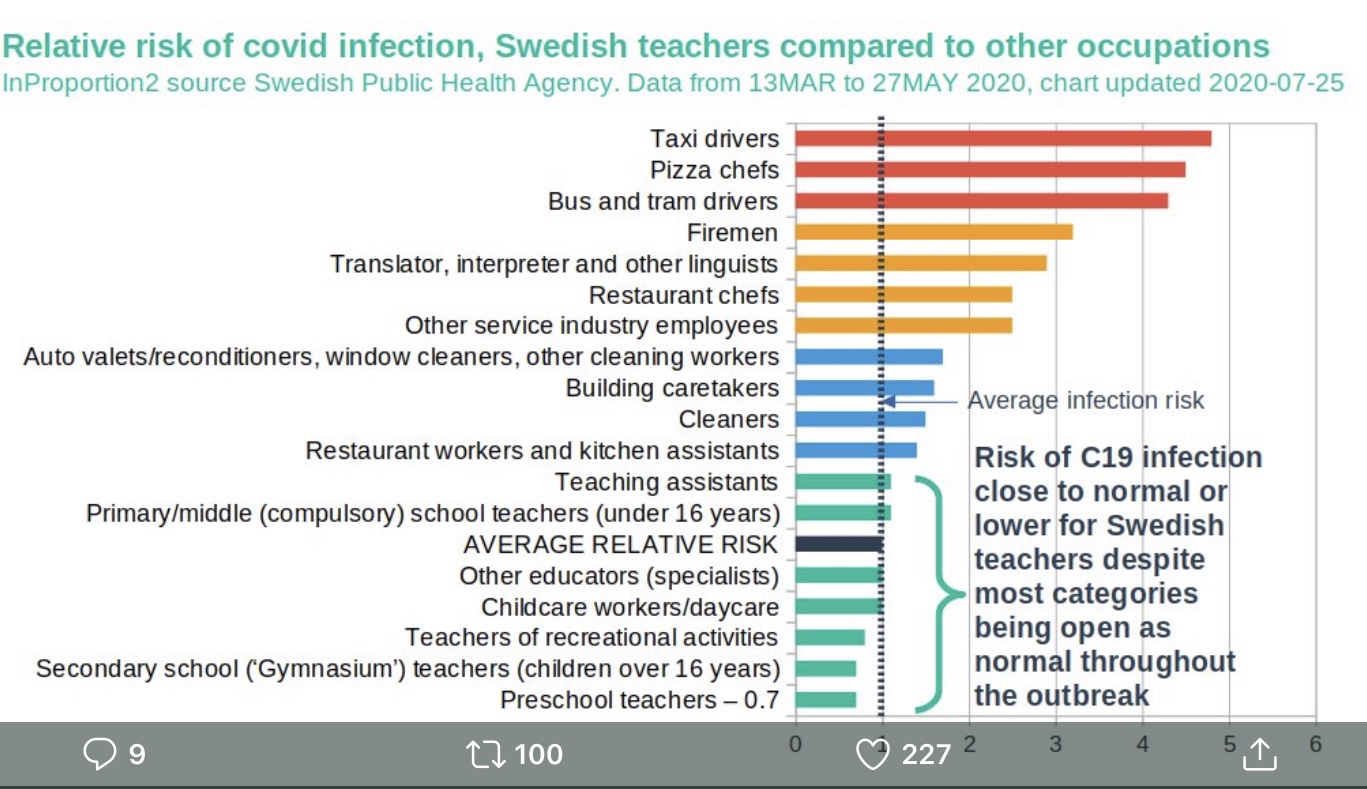
A quick follow-up to my recent post “COVID Hysteria and School Reform“: the graphic above is from an occupational risk study recently conducted by Swedish health authorities. The horizontal axis is obscured by the lower banner from Twitter (my fault), but the average risk of infection across all occupations was slightly less than 1%, and the highest-risk occupations were in the 4 – 5% range. Keep in mind, the data was collected while the virus was still raging in Sweden, while schools remained open. The virus hasn’t completely vanished in Sweden since then, but it has largely abated.

The study found that teachers had roughly average or below average risk, especially for pre-school and upper secondary (so-called “gymnasium”) teachers. The results demonstrate the lack of merit to claims by teachers unions that their members are somehow at greater risk of contracting coronavirus than other “essential” workers. We already know that children have extremely low susceptibility to COVID-19 and that they do not readily transmit the virus.

The health benefits of closing schools or taking them on-line do not compensate for the loss of educational effectiveness and detrimental health effects of preventing children from attending schools. The digital divide between children from disadvantaged households and their peers is likely to grow more severe if online learning is their only option. They should have choices, including functioning public schools.

To the last point, however, read this link for the sort of thing one teachers union supports. If the members are okay with that insanity then they shouldn’t be teaching your kids.

Dr. Fauci, RCTs, and Large Sample “Anecdotes”

01 Saturday Aug 2020

Posted by Nuetzel in Uncategorized

≈ 1 Comment

Anthony Fauci insists that the only valid test of efficacy for a pharmacological treatment is a randomized control trial (RCT). Other kinds of evidence, he claims, are merely “anecdotal”. Well-designed, large sample RCTs are highly desirable, of course, but both of Dr. Fauci’s statements are balderdash. Real world RCTs often have design flaws and drawbacks, and they often produce biased results. We certainly shouldn’t invest such confidence in their universal superiority over other clinical evidence, which for years has been relied upon in the FDA’s reviews of drugs and other interventions for safety and efficacy.

An RCT is a prospective study in which subjects are randomly assigned to one or more groups who receive different treatments, one of which is a control group receiving “standard care” or a placebo. The so-called “gold standard” of trials is the double blind RCT, which means that neither the subject nor the researchers know the treatment to which the subject is assigned.

On multiple occasions, Fauci has erroneously claimed that positive findings from anything short an RCT are “anecdotal”, which, if meaningful in any way, implies that only RCTs have samples of adequate size. That’s false: traditional clinical trials (TCTs) are not at any systematic disadvantage to RCTs in terms of sample size. The difference is that individuals are not randomly assigned to different treatment groups, but rather are assigned with the researcher’s intent, by dint of opportunity, or happenstance. These groups may include a pure control, and they may be balanced according to medical history, condition, or other potentially confounding influences. TCTs might be prospective (subjects are observed over time), or retrospective (which exploit previous case files).

The idea of double-blind, random assignment to treatment groups is appealing because it prevents researchers from exerting any bias in the selection of groups that might influence the results. That’s good, but random assignment can still lead to unbalanced comparisons, and RCTs can be flawed in many other ways. This paper discusses a number of fine points of RCTs that can lead to bias, but here are a few important ones, not all of which are covered at the link:

  • The most glaring difficulty is that random assignment can result in very unbalanced characteristics across groups. The findings can be so sample-specific as to lack external validity. This is especially problematic when group sub-samples are small, as is often the case in medical research, but it is often true in samples of moderate size or even large samples. This contrasts with selecting groups with deliberate balance across key characteristics.

“Contrary to frequent claims in the applied literature, randomization does not equalize everything other than the treatment in the treatment and control groups, it does not automatically deliver a precise estimate of the average treatment effect (ATE), and it does not relieve us of the need to think about (observed or unobserved) covariates. Finding out whether an estimate was generated by chance is more difficult than commonly believed.”

  • An implication of the heterogeneity across participants and random assignment of confounding attributes is that even with large treatment groups, the tests reveal differences in central tendencies, but they might not apply well to large subsets of patients. Some researchers go so far as to say all RCTs are biased in one way or another. TCT’s are also subject to bias, of course, but the point is that RCT’s are subject to significant risks of bias for reasons that TCTs often avoid.
  • Comparisons of small treatment group samples results in low-powered tests that are often statistically insignificant. This weakness is shared by all RCTs and TCTs having inadequate samples to divide between the desired number of treatment groups.
  • “Blindness” is often violated because treatment can involve a large number of  personnel and roles. This may influence outcomes, for example, if some caregivers alter standard treatment in an effort to compensate for its perceived deficiencies.
  • Recruiting for RCTs is often difficult. This leads to the small sample problems discussed above. Sometimes participation in RCTs is heavily qualified. Sometimes patients are reluctant to participate because they don’t want to be assigned to a treatment randomly. Sometimes delays are caused by the fact that RCTs require approval by an independent review board, whereas assignment in a TCT might require only treatment decisions by different physicians.
  • An RCT can be highly misleading if treatments are poorly targeted. This might take several forms: Failure to screen for conditions that might lead to treatment complications can be dangerous and counter-productive, since the general safety of the treatment might be falsely implicated. Likewise, a treatment might be effective only under certain conditions or at a certain stage of a disease, but the selection of participants might not meet those conditions. Or a treatment might be most effective in combination with other interventions, but failing to combine them will overlook the effect. Misapplications of this kind are likely to lead to erroneous conclusions.

The last bullet point has been a major bone of contention in the debate over the efficacy of hydroxychloroquine (HCQ) in the treatment of the novel coronavirus. Proponents of the drug contend it is most effective in early treatment, but a number of negative tests have studied only late treatment. Also, proponents contend that HCQ works best in combination with zinc and a Z-pak (antibiotic), but many studies have failed to use or control for those combinations.

Here are a few examples of the kinds of difficulties encountered by RCTs, as well as issues creating doubts about the results. All involve trials of HCQ .

  • NIH cancels three trials: the first trial involved only hospitalized patients, though that might not have qualified as early treatment in all subjects. The other two trials were cancelled because of recruitment problems!
  • A study of HCQ without zinc or Z-Pac antibiotic on hospitalized patients found that HCQ was associated with a greater likelihood of death and longer hospital stays, but in addition to the use of HCQ only, the study appears to have been mis-targeted at advanced cases of C19 infection.
  • This study also endeavored to investigate HCQ as a treatment, but not only did it fail to combine HCQ with zinc and a Z-pac; over 40% of the participants never tested positive for COVID-19! It’s also not clear that participants were adequately screened for complications. The following results were statistically insignificant, indicating a possible lack of statistical power, though they favored HCQ (which is not noted by the authors):

“At 14 days, 24% (49 of 201) of participants receiving hydroxychloroquine had ongoing symptoms compared with 30% (59 of 194) receiving placebo (P = 0.21).  … With placebo, 10 hospitalizations occurred (2 non–COVID-19–related), including 1 hospitalized death. With hydroxychloroquine, 4 hospitalizations occurred plus 1 nonhospitalized death (P = 0.29).”

  • This study was on a relatively small sample of non-hospitalized patients. It found only a small difference favoring HCQ in terms of viral load at day 7, as well as the following statistically insignificant results otherwise favoring HCQ:

“This treatment regimen did not reduce risk of hospitalization (7.1%, control vs. 5.9%, intervention; RR 0.75 [0.32;1.77]) nor shortened the time to complete resolution of symptoms (12 days, control vs. 10 days, intervention; p = 0.38).”

For a more comprehensive view of the evidence, this link contains a compendium of studies on HCQ 1) as a treatment at various stages of C19 infection, 2) as pre-exposure prophylaxis (PrEP) against infection; or 3) a post-exposure prophylaxis (PEP). It includes high-level details on many of the studies as well as links to most of the studies. A few of the studies are RCTs, but most are either prospective or retrospective TCTs; some are in vitro (lab) studies, and some are meta-analyses covering multiple prior studies; some address the safety of HCQ only.

The site includes a kind of “scorecard” at the top categorizing 66 of the studies as either positive (HCQ is effective) or negative within four categories: PrEP, PEP, early-stage infection, and late-stage infection. Studies were excluded from the scorecard for various reasons, including meta-analyses, in vitro studies, safety studies, those terminated due to inadequate recruitment, and studies that were deemed inconclusive due to data inadequacies and questions of interpretation awaiting feedback from authors.

The results for HCQ as a prophylactic were uniformly positive, as were the studies involving early-stage treatment. Results were mixed for late-stage treatment. Of special interest is the meta-analysis of 12 studies of high-risk outpatients by Harvey A. Risch, the seventh listed in the compendium referenced above. The 12 studies analyzed by Risch all showed that HCQ is highly effective. He calls out those who would insist that those studies be disregarded because they were not RCTs, including one critic who, like Dr. Fauci, abuses the term “anecdotal”:

“… to distinguish from the ‘magic’ of randomized controlled trials, when government medical and scientific regulatory agencies of western countries around the world routinely use epidemiologic evidence to establish facts of causation, benefit and harm. This disingenuous argument has been discussed at length elsewhere…. Finally, in pandemic times when months and years of delay cannot be tolerated before large randomized controlled trials are completed, it is possible to quibble with apparent imperfections in almost any study. That misses the forest for the trees.”

The “elsewhere” link in the quote above includes an excellent summary of the battle waged over the efficacy of HCQ. It became a media war, which relied in part on the false assertion that only RCTs are acceptable. That was abetted by certain public health experts and researchers who might have had financial or political interests in promoting new drugs, rather than the safe, cheap alternative that had been used safely for many decades. The article notes that few media sources carried the following, which was released only days after the FDA revoked its Emergency Use Authorization for HCQ (based on faulty evidence):

“TUCSON, Ariz., June 22, 2020 /PRNewswire/ — Today the Association of American Physicians & Surgeons files its motion for a preliminary injunction to compel release to the public of hydroxychloroquine by the Food & Drug Administration (FDA) and the Department of Health & Human Services (HHS), in AAPS v. HHS, No. 1:20-cv-00493-RJJ-SJB (W.D. Mich.). Nearly 100 million doses of hydroxychloroquine (HCQ) were donated to these agencies, and yet they have not released virtually any of it to the public…

‘Why does the government continue to withhold more than 60 million doses of HCQ from the public?’ asks Jane Orient, M.D., the Executive Director of AAPS. ‘This potentially life-saving medication is wasting away in government warehouses while Americans are dying from COVID-19.'”


Risk Realism, COVID Hysteria

29 Wednesday Jul 2020

Posted by Nuetzel in Uncategorized

≈ 1 Comment

Tags

All-Cause Mortality, American Academy of Pediatrics, American Association of Sciences, Asian Flu, Covid-19, David Zaruk, Engineering and Medicine, Hydroxychloraquine, Infection Fatality Rate, Mollie Hemingway, Precautionary Principle, Spanish Flu, The Risk Monger, Tyler Cowen, Wired

Perhaps life in a prosperous society has sapped our ability and willingness to face risks. This tendency undermines that very prosperity, however. If we ever needed an illustration, the hysteria surrounding COVID-19 surely provides it. Do we really know how to exist in a world with risk anymore? During this episode, the media, public officials, and much of the public have completely lost their bearings with respect to the evaluation of risk, acting as if they are entitled to a zero-risk existence. Of course, COVID-19 is highly transmissible and dangerous for certain segments of the population, but it is rather benign for most people.

Perspective On C19 Risks

Just for starters, the table at the top of this post (admittedly not particularly well organized) shows calculations of odds from the CDC. These odds might well overstate the risks of both C19 and the flu, as they probably don’t account well for the huge number of asymptomatic cases of both viruses.

Another glimpse of reality is offered by a recent Swiss study showing the C19 infection mortality rate (IFR) by age, shown below. You can find a number of other charts on-line that show the same pattern: If you’re less than 50 years old, your risk of death from C19 is quite slim. Even those 50-64 years of age don’t face a substantial mortality risk, though it’s obviously higher for individuals having co-morbidities. These IFRs are lower than all-cause mortality for younger cohorts, but higher for older cohorts.

And here are a few other facts to put the risks of C19 in perspective:

  • The current pandemic is relatively benign: thus far, the U.S. has suffered a total of about 145,000 deaths, or 440 per million of population;
  • the Asian Flu of 1957-58 took 116,000, according to the CDC, or 674 per million;
  • the Spanish Flu of 1917-18 took 675,000 U.S lives, or 6,553 per million.

It should be obvious that these risks, while new and elevated for some, are not of such outrageous magnitude that they can’t be managed without bringing life to a grinding halt. That’s especially true when so-called safety measures entail substantial health risks of their own, as I have emphasized elsewhere (and here).

The Schools

Nothing illustrates our inability to assess risks better than the debate over reopening schools. This article in Wired is well-balanced on the safety issue. It emphasizes that there is little risk to teachers, students, or their families from opening schools if reasonable safety measures are taken.

Children of pre-school and elementary school age do not contract the virus readily, do not transmit the virus readily, and do not readily succumb to its effects. This German study on elementary schools demonstrates the safety of reopening. It is similar to the experience of other EU countries that have reopened schools. This article reinforces that point, but it emphasizes measures to limit any flare-ups that might arise. And while it singles out Israel as an example of poor execution, it fails to offer any evidence on the severity of infections.

Furthermore, we should not overlook the destructive effects of denying in-classroom learning to children. They simply don’t learn as well on-line, especially students who struggle. There are also the devastating social-psychological effects of the isolation experienced by many elementary school children during extended school closures. This is of a piece with the significant risks of lockdowns to well being. Perhaps not well known is that schooling is positively correlated with life expectancy: this study found that a one-year reduction in years of schooling is associated with a reduction in life expectancy of 0.6 years!

It’s true that children older than 10 might pose somewhat greater risks for C19 contagion, but those risks are manageable via hygiene, distancing, and other mitigations including hydroxychloraquine or other prophylaxes against infection for teachers who desire it. Capacity limitations might well require a temporary mix of online and in-school learning, but at least part-time attendance at brick-and-mortar schools should remain the centerpiece.

As Tyler Cowen points out, teenagers are less likely to remain isolated from others during school closures, so their behavior might be more difficult to manage. It’s quite possible they could be more heavily exposed outside of school, hanging out with friends, than in the classroom. This illustrates how our readiness to demure from absolute risk often ignores the pertinent question of relative risk.

Judging by reactions on social media, people are so frightened out of their wits that they cannot put these manageable risks in perspective. But here is a statement from the American Academy of Pediatrics. And here is a statement from the American Association of Sciences, Engineering and Medicine. They speak for themselves.

Excessive Precautionary Putzery

Our reaction to C19 amounts to a misapplication of the precautionary principle (PP), which states, quite reasonably, that precautionary measures must be invoked when faced with a risk that is not well understood. Risk must be managed! But what are those precautions and on what basis should benefits we forego via mitigation be balanced against quantifiable risks. That was one theme of my post “Precaution Forbids Your Rewards” several years back. Ralph B. Alexander discusses the PP, noting that the construct is vulnerable to political manipulation. It is, unfortunately, a wonderful devise for opportunistic interest groups and interventionist politicians. See something you don’t like? Identify a risk you can use to frighten the public. Use any anecdotal evidence you can scrape together. Start a movement and put a stop to it!

That really doesn’t help us deal with risk in a productive way. Do we understand that well being generally is enhanced by our willingness to incur and manage risks? As David Zaruk, aka, the Risk Monger, says, “our reliance of the precautionary principle has ruined our ability to manage risk.”:

“Two decades of the precautionary principle as the key policy tool for managing uncertainties has neutered risk management capacities by offering, as the only approach, the systematic removal of any exposure to any hazard. As the risk-averse precautionary mindset cements itself, more and more of us have become passive docilians waiting to be nannied. We no longer trust and are no longer trusted with risk-benefit choices as we are channelled down over-engineered preventative paths. While it is important to reduce exposure to risks, our excessively-protective risk managers have, in their zeal, removed our capacity to manage risks ourselves. Precaution over information, safety over autonomy, dictation over accountability.”

To quote Mollie Hemingway, in the case of the coronavirus, Americans are “reacting like a bunch of hysterics“.


COVID Trends and the Scourge of False Positives

20 Monday Jul 2020

Posted by Nuetzel in Uncategorized

≈ Leave a comment

Positive COVID-19 tests continue to mount, which is scary, but the more I learn about the processes generating the data, the more skeptically I regard the numbers. And whether the data is junk or otherwise, it’s often misinterpreted or misused by the media. Here I’ll focus mainly on issues related to testing and cause-of-death. What’s striking is the likelihood of upward bias in the reported case counts based on one set of tests, even while the incidence of antibodies to the virus appear to be more widespread.

Testing

Almost all of the C19 test results included in the case counts we’ve seen are from polymerase chain reaction (PCR) tests, the kind involving samples collected with “brain scrambling” nasal swabs. These tests detect whether the subject is shedding any viral particles. The other kind of test is for antibodies, called a serological test, which focuses on whether a subject has HAD the virus, not on whether they have it currently. The latter test, however, might catch some active cases in addition to resolved infections.

The first problem is that some states have combined results from these two kinds of tests. That’s likely to inflate the case count because they would capture those who are infected, and those who were infected but aren’t any longer.

A second problem is the faulty reporting of test results we’ve seen in states like Florida, where some labs have been reporting an implausible 100% positivity rate over certain periods. That might or might not imply an exaggerated count of positives, but it certainly inflates the positivity rate. There are other practices that systematically inflate the positive test count, however, such as counting all members of a household as “probable positives”, and counting multiple positive tests on the same patient as multiple cases.

Test reliability

This is the third problem and it’s really a biggie. It’s also more complicated because there is more than one kind of accuracy on which tests are evaluated.

1) The PCR tests are said to have a sensitivity of anywhere from 66%-80%, depending on testing and lab conditions. That means about one of every three or four tests on infected people will miss the actual infection: that’s a false negative and a horrible mistake. An article in The New England Journal of Medicine puts sensitivity at 70%. These levels of sensitivity are poor, so there is good reason for repeat testing, or to develop and implement more sensitive tests!

2) The other kind of accuracy is called specificity. It indicates the percentage of uninfected subjects who actually test negative. If it’s 90%, then one out of every ten tests identifies an infection that really isn’t there. That’s a false positive. It’s extremely hard to find estimates of specificity for PCR tests outside of perfect lab conditions. We know there are false positives in the real world, however, and I’ll get to that evidence below. But we know, for example, that individuals will continue to shed virus for a short time even after the virus is dead, and that reduces specificity. False positives can also result from poor testing or lab conditions.

So here’s an example: let’s be generous and assume that test sensitivity is 80%, and we’ll give the benefit of the doubt to test specificity and say it’s 95%. Further suppose that 2% of the population is currently infected. Out of 1,000 tests, 20 involve infected subjects. The sensitivity implies that we’ll correctly identify 16 of them (80%) and we’ll miss four. The other 980 tests subjects are virus-free, but 95% specificity implies that about 49 of those tests will come back positive (49/980 = 5%). All together, that yields a whopping positivity rate of:

(49 + 16)/1000, or 6.5%, well above the true infection rate of 2%.

So it’s very easy for a test having inadequate specificity to inflate the number of positives. That’s less problematic when prevalence is high, since fewer virus-free subjects are available to misidentify. Unfortunately, it becomes a larger concern when testing is broad and less focused on symptoms, since that implies lower prevalence in the tested population. The U.S. has increased testing over the past two months, roughly quintupling the number of daily tests over a span of three months. The tested population has therefore broadened to include many more subjects who are either asymptomatic, freaked out about their allergy symptoms, or have been routinely tested on admittance to hospitals for other illnesses or procedures.

Discussion

It’s absolutely necessary for society to have testing capacity for those with symptoms and those likely to be exposed to the virus, such as first responders. But rolling out the test to the broader population means the case data are much less accurate unless positive diagnoses are based on repeated tests. Unfortunately, the bulk of the testing we’ve seen thus far has been so lacking in specificity as to inflate the number of cases as testing became more widespread.

Evidence for this claim is offered by a paper just published by a Connecticut epidemiologist. He used a more robust technique to re-examine ten positive and ten negative tests provided by the CT Department of Public Health. He found that nine of the 20 cases were true infections, but two of those came from the ten negative tests! So, in fact, there were three false positives and two false negatives among the 20 tests. Therefore, the tests overestimated the number of actual cases by around 11% in the sample, net of both kinds of errors. Granted, this was a small sample, and we don’t know the true prevalence of the virus in the full population of test subjects, but if we assume the positive tests and negative tests were representative, a prevalence of 5% would imply, after weighting, a rather drastic inflation of the positivity rate to 32.5%!

0.95(3/10) + 0.05(8/10)

That’s just outrageous!

The U.S. positivity rate by the end of April was about 12%, when testing was still limited; it’s been running at about 8% recently. The decline almost certainly reflects both a broadening of the test population and a decline in prevalence among the tested population. That, in turn, implies that a positive test has less predictive value, for even though the test captures the same percentage of true positives, a larger percentage of all positive tests will be false negatives. It might seem paradoxical, but it’s likely that the 12% positivity rate early in the pandemic had a smaller upward bias than the 8% we see currently, but that is due to the composition of the population tested. Under current testing, the specificity percentage is applied to a larger proportion of uninfected subjects, so the number of false positives overwhelms the test’s ability to identify true positives.

The first priority of testing is to reliably identify true cases. The current PCR tests fail in that objective due to low sensitivity. But inspecific test are costly too. First, they waste medical resources on uninflected subjects. Second, a major set of worries and inconveniences are imposed on false positives, which have a real cost. Third, inspecific tests can be costly because of the even higher likelihood of false positives over several rounds of tests. For example, it will be extremely difficult for sports teams to establish continuity, or even to maintain a full roster, because so many players are likely to become victims of false-positivity under repeated testing.

Death tolls

Anything that inflates the C19 case count tends to inflate C19-attributed deaths. For example, almost all hospital admissions are now tested. A high number of false positives leads to more deaths being wrongly attributed to C19. Other issues related to counting deaths go beyond the vagaries of test accuracy. Hospitals have a perverse incentive to boost their C19 cases and deaths via more generous Medicare reimbursements. Deaths are also attributed to C19 in a variety of other circumstances, some quite suspicious, but we are constantly told without evidence that C19 deaths are undercounted and so these additions must be reasonable.

The argument that deaths of C19 patients with comorbidities are rightfully attributed to C19 is likewise flawed for some of the reasons discussed above. False positives are all too common. Furthermore, patients might be admitted to a hospital with advanced or terminal conditions and die having caught C19 coincidentally at the hospital. And one can certainly quibble with the notion that the deaths of otherwise terminal patients should be attributed to C19. There is a significant grey area.

Finally, as I discussed in a previous post, the deaths reported each week are at odds with the actual timing of those deaths. There are occasionally large additions to the CDC’s provisional deaths counts many weeks in the past. It’s bad enough that those deaths are reported so late and treated by the media as if they just occurred. Possibly worse is the potential for manipulating death counts for political purposes, which is enabled by the large backlog of deaths lacking attributed causes over the course of weeks and months.

Serological tests and false positives

The first serological tests for C19 antibodies, back in April, yielded surprisingly high estimates of individuals with acquired immunity to the virus, often 10 or more times the number of infections based on case counts (also see here and here). The earliest antibody test results were criticized because their specificity and the prevalence of antibodies in the general population were thought to be low. That made it relatively easy for critics to rationalize the high estimates as a consequence of false positives. We now know, however, that serological tests have higher specificity than the PCR tests for active infections, and those tests have consistently shown a larger than expected share of individuals having acquired immunity. But how does that square with the argument that case counts based on PCR tests are inflated? How can so many have developed antibodies if the case counts are so exaggerated?

To rephrase: how can the population with antibodies, those who have HAD the virus, accumulate to a level several times the case count? Keep in mind that a high proportion of the serological tests have been conducted in relative hot spots, where there are likely to be many undetected cases. There is also some question about the real timing of the pandemic in the U.S. Some believe it was spreading prior to March, so the true number of cases, diagnosed and undiagnosed, might have mounted more quickly early in the pandemic than later case diagnoses suggested. Moreover, serological testing has not been conducted on a random sample of the population. In fact, those tests are more often administered when patients go to labs for other blood work, so there is reason to believe that prevalence in this group might exceed that of the general population. It’s also possible that the serological tests are picking up antibodies developed in response to other forms of the coronavirus, which might in fact be protective. Finally, the serological tests are still subject to a level of false positives. So the antibody findings from serological tests are not necessarily inconsistent with the notion that case counts and death counts are inflated now.

Summary

We truly need better, quicker tests, and many talented people are now working to improve them. My point is not to degrade the effort to conduct testing, but to note that our current testing regime has many flaws, one of which is to raise alarm about extremely high case and death counts. I do not doubt that the number of actual infections has grown in June and July. However, the positivity rate remains lower than early in the pandemic with a much larger, less focused selection of test subjects. Many of the cases identified by PCR tests are false positives. As disappointing as it is to someone who loves to work with data, C19 case counts and mortality look unreliable.


Some Cheery COVID Research Tidbits

16 Thursday Jul 2020

Posted by Nuetzel in Pandemic, Public Health, Uncategorized

≈ 1 Comment

Tags

ACE Inhibitors, Angiotensin Drugs, ARBs, bacillus Calmette-Guerin, BCG Vaccine, Blood Plasma, Cholesterol, Coronavirus, Covid-19, Derek Lowe, Gilead Sciences, Herd Immunity, Hydroxychloroquine, Immune Globulin, Instapundit, Lancet, Marginal Revolution, National Academies of Science Engineering and Medicine, Off-Label Drugs, Oxford, R0, Remdesivir, SARS-CoV-2, Severe Acute Respiratory Syndrome, Statins, T-Cell Immunity, Transmissability, Tricor, Tuberculosis, Viral Load

Here’s a short list of new or newish research developments, some related to the quest to find COVID treatments. Most of it is good news; some of it is very exciting!

Long-lasting T-cell immunity: this paper in Nature shows that prior exposure to coronaviruses like severe acute respiratory syndrome (SARS) and even the common cold prompt an immune reaction via so-called T-cells that have long memories and are reactive to certain proteins in COVID-19 (SARS-CoV-2). The T-cells were detected in both C19-infected and uninfected patients. This comes after discouraging reports that anti-body responses to C19 are short-lived, but T-cells are a different form of acquired immunity. Derek Lowe says the following:

“This makes one think, as many have been wondering, that T-cell driven immunity is perhaps the way to reconcile the apparent paradox between (1) antibody responses that seem to be dropping week by week in convalescent patients but (2) few (if any) reliable reports of actual re-infection. That would be good news indeed.”

The herd immunity threshold (HIT) is much lower than you think: I’ve written about the effect of heterogeneity on the HIT before, here and here. This new paper, by three Oxford zoologists, shows that the existence of a cohort having some form of prior immunity, innate or acquired, reduces the number of infections required to achieve the HIT. For example, if initial transmissibility (R0) is 2.5 and 40% of the population has prior immunity (both reasonable assumptions for many areas), the HIT is as low as 20%, according to the authors’ calculations. That’s when the contagion begins to recede, though the final infected share of the population would be higher. This might explain why new cases and deaths have already plunged in places like Italy, Sweden, and New York, and why protests in NYC did not lead to a new wave of infections, while those in the south appear to have done so.

Seasonal effects: viral loads might be decreasing. From the abstract:

“Severity of COVID-19 in Europe decreased significantly between March and May and the seasonality of COVID-19 is the most likely explanation. Mucosal barrier and mucociliary clearance can significantly decrease viral load and disease progression, and their inactivation by low relative humidity of indoor air might significantly contribute to severity of the disease.”

The BCG vaccine appears to be protective: this is the bacillus Calmette-Guérin tuberculosis vaccine administered in some countries, This finding is not based on clinical trials, so more work is needed.

Is there no margin in plasma? No subsidy? This is the only “bad news” item on my list. It’s widely agreed that blood plasma from recovered C19 patients can be incorporated into an immune globulin drug to inoculate people against the virus. It’s proven safe, but for various reasons no one seems interested. Not the government. Not private companies. Did Trump happen to mention it or something?

C19 doesn’t spread in schools: this German study demonstrates that there is little risk in reopening schools. One of the researchers says:

“Children act more as a brake on infection. Not every infection that reaches them is passed on…. This means that the degree of immunization in the group of study participants is well below 1 per cent and much lower then we expected. This suggests schools have not developed into hotspots.”

Also worth emphasis is that remote learning leaves much to be desired, as acknowledged by the National Academies of Science, Engineering and Medicine, which has recommended that schools reopen for younger children and those with special needs.

Can angiotensin drugs (ACE Inhibitors/ARBs) reduce mortality? This meta-analysis of nine studies finds that these drugs reduce C19 mortality among patients with hypertension. The drugs were also associated with a reduction in severity but not with statistical significance. These results run contrary to initial suspicions, because ACEI/ARB drugs actually “up-regulate” ACE-2 receptors, to which C19 binds. Researchers say the drugs might be working through some other protective channel. This is not a treatment per se, but this should be reassuring if you already take one of these medications.

Tricor appears to clear lung tissue of C19: this research focused on C19’s preference for an environment rich in cholesterol and other fatty acids:

“What they found is that the novel coronavirus prevents the routine burning of carbohydrates, which results in large amounts of fat accumulating inside lung cells – a condition the virus needs to reproduce.”

Tricor reduces those fats, and the researchers claim it is capable of clearing lung tissue of C19 in a matter of days. This was not a clinical trial, however, so more work is needed. Tricor is an FDA approved drug, so it is safe and could be administered “off label” immediately. Tricor is a fibrate; the news with respect to statins and C19 severity is pretty good too! These are not treatments per se, but this should be reassuring if you already take one of these medications.

Hydroxychloroquine works: despite months of carping from media and leftist know-it-all’s dismissing the mere possibility of HCQ as a potential C19 treatment, evidence is accumulating that it is effective in treating early-stage infections after all. The large study conducted by the Henry Ford Health System found that treatment with HCQ early after hospitalization, and with careful monitoring of heart function, cut the death rate in half relative to a control group. Here’s another: an Indian study found that four-plus maintenance doses of HCQ acted as a prophylactic against C19 infection among health care workers, reducing the odds of infection by more than half. An additional piece of evidence is provided by this analysis of a 14-day Swiss ban on the use of HCQ in late May and early June. The ban was associated with a huge leap in the C19 deaths after a lag of less than two weeks. Resumption of HCQ treatment brought C19 deaths down sharply after a similar lag.

Meanwhile, a study in Lancet purporting to show that HCQ was ineffective and posed significant risks to heart health was retracted based on the poor quality of the data.

Remdesivir also cuts death rate: by 62% in a smaller controlled study by the drug maker Gilead Sciences.

Pet ownership might confer some immunity: this one is a little off-beat, and perhaps the research is under-developed, but it is interesting nonetheless!

I owe Instapundit and Marginal Revolution hat tips for several of these items.

Equal *Mattering* Under Ethics, Law and Community

04 Saturday Jul 2020

Posted by Nuetzel in Identity Politics, racism, Uncategorized

≈ 1 Comment

Tags

Black Lives Matter, Civil Rights, Conflict Theory, Equal Protection, Family Unit, Great Society, Identity Politics, Jim Crow, Lyndon Johnson, Marxism, Moral Dilemma, Original Sin, racism, Self-Driving Cars, Slavery, Systemic Racism, Thomas Sowell, Tribalism, Walter Williams, Welfare State

How many white lives is a single black life worth? It seems so easy to pin that down, but if you think it’s okay to say “black lives matter”, but not to say “all lives matter”, the implication is that one black life is worth more than one white life. Anyone who insists on that should take the following litmus test. 

A classic dilemma discussed by ethicists involves situations of mortal danger in which a life or lives might be sacrificed in order to save other lives. Variants of it come up again and again in the effort to tune software for autonomous vehicles. It’s also a simple tool for challenging assertions about the values of different lives, or whether different lives “matter”.

Suppose that two pedestrians step into the path of your vehicle. You can save them only by swerving, killing a single pedestrian standing at the curb. Most would agree the car should swerve, but the answer might change under certain circumstances. Forget about the argument that the two in your path weren’t careful, so they “deserve” die. We just don’t know what caused them to proceed, or what might have distracted them.

What if the two in your path are elderly, using walkers and dragging oxygen tanks, while the pedestrian at the curb is a healthy child. Does that matter? Do we weigh the sacrifice of many potential life-years as well as a higher quality of life? People might feel less certain about that choice.

Now let’s suppose that all three pedestrians are healthy, young adults. Does it matter that any of the pedestrians are black? The one on the the curb, or the two in your path? Of course not! The truly “colorblind” answer is to swerve regardless of race. You are an obvious racist if you think otherwise. The sacrifice of one white life is certainly worth saving two black lives; the sacrifice of one black life is certainly worth saving two white lives. Black lives and white lives matter equally. 

Our Constitution and ethical standards dictate that lives are equal, that we are equal before the law, that we that we have equal rights to speak, worship, and enjoy the fruits of our labors, including the unchallenged right to property we might acquire. Under the law, and in all of our social interactions, we must be accorded equal consideration regardless of extraneous characteristics such as race. All of us have the same promise of life and opportunities to pursue happiness, and to make of our lives what we can or will. However, none of this entitles us to equal happiness, romance, and material well being.

Now, detractors will say all that misses the point. The value of black lives has been discounted for centuries, they say, as evidenced in disparate treatment by police, prosecutors, juries, employers, neighbors, social clubs, and places of business. Of course it’s true that racism has a long history throughout the world, and at one time or other it has been turned against virtually every race or religion in existence. If you think in this day and age that racism doesn’t exist elsewhere, think again.

Slavery was a tragic reality in the U.S. until 155 years ago, but it was certainly not unique to the U.S. Jim Crow laws that prevented blacks from participating equally in many aspects of life were finally ended more than 50 years ago through a series of legislative actions and Supreme Court decisions. Slavery and Jim Crowism were the acts of long-dead ancestors of almost anyone living today. The presumption that all whites should assume guilt for some kind original sin against blacks is sheer nonsense, and one many of us will simply never accept.

Nevertheless, the legacy of degraded personhood under those long-defunct laws created a heavy burden for blacks in terms of upward mobility, and certainly vestiges of racism survive even today. However, we have adopted many standards and programs intended to rectify this unfortunate legacy, including the civil rights legislation of the 1960s and beyond, the Great Society programs of Lyndon Johnson, and many other enlargements of the social safety net since then. These programs have represented a massive redistribution of resources to the impoverished via education, housing, and direct transfers. One estimate put cumulative federal spending on anti-poverty programs alone at $13 trillion between 1963 and 2010. In addition, a variety of programs have been a source of preferential treatment for various minorities in an effort to ensure equal opportunities across many aspects of life.

The success of these programs is subject to great doubt (more on that below), and in fact the motives of Johnson and other proponents of this expansion in the role of government were perhaps less than pure. Nevertheless, the entirety of the package of civil rights and welfare state programs over the years was supported by most of the black community. In fact, one could say that these measures were hardly the actions of a racist society, at least in ostensible intent.

And yet we are told today that we do not sufficiently appreciate that black lives matter! There is no question that racism lives in the hearts and minds of certain individuals, but those individuals aren’t all white. More importantly, the blanket condemnation of whites as racist lacks any basis in reality.

When Black Lives Matter activists talk of “systemic racism”, you can translate as follows: blacks have not met with the ex post economic and social success to which these activists believe blacks are entitled. As it pertains to law enforcement, they mean that blacks are met with more violent police actions than blacks should suffer.

As to law enforcement, it is an awful thing that crime perpetrated by blacks, and particularly crime by blacks against blacks, is disproportionally heavy. As I argued recently, it is difficult to accept the hypothesis of systemic racism in law enforcement in the presence of rampant “systemic crime” in the black community. But crime, in turn, is tied closely to economic success, or the lack thereof.

Median black income has grown relative to median white income since 1970 (also see here). Unfortunately, many blacks have not shared in that growth and remain mired in poverty and on public aid. Sadly, many aid programs have pernicious effects because they impose extremely high marginal tax rates on earned income. The solution lays the groundwork for continued dependency. That qualifies as systemic racism, or at least classism.

Two well-known black economists, Thomas Sowell and Walter Williams, have both decried the welfare state’s destructive impact on the black family unit. That’s one reason why Williams calls white liberals the “worst enemy of black people“. (Also see what Williams has to say about expectations for black students, and about black crime.)

Ultimately, the uproar over racism alleged to be so widespread and “systemic” is divisive. It is an application of Marxist “conflict theory” lying at the very heart of identity politics. Such tribal philosophies creat huge obstacles to peaceful and productive coexistence among diverse peoples. Meanwhile, there’s a simple truth: a widespread consensus exists that all lives are of equal value, that all lives deserve respect and equal treatment under the law, that the goodwill of one’s fellows is a birthright, and that racism is fundamentally evil. If society is to provide fertile ground for the equal cultivation of all lives, it must reject the strictures and resentment bred by identity politics in favor of individual liberty, personal responsibility, and compassion for those unable to care for themselves.

Zero Cost Stimulus: Risky Business

21 Sunday Jun 2020

Posted by Nuetzel in Uncategorized

≈ Leave a comment

Tags

Alex Tabarrok, Contingent Wage Subsidies, economic stimulus, Fiscal policy, Low Employment Equilibrium, Payroll Tax Holiday, Robertas Zubrickas

When the federal government intervenes to stimulate the economy, it generally means a big spending program or tax reduction and an increase in the federal deficit. This year we’ve witnessed the largest single-year fiscal policy effort in U.S. history, an effort to aid individuals whose jobs were lost and to stimulate the suddenly depressed economy. The coronavirus lockdowns in most states brought federal legislation enhancing unemployment compensation, one-time support payments to most adults, emergency business “loans” that are largely to be forgiven, and many other elements. The cost of these packages is expected to be about $2.4 trillion. And there will be more legislation this summer intended to stimulate hiring, including a probable infrastructure bill. President Trump still supports what the Administration calls a “hiring subsidy”, which is in fact a payroll tax holiday. As described, it would not explicitly target new hires, but would grant the holiday to all workers regardless of employment status. All these programs will ultimately be quite costly to taxpayers.

But what if there is a way to stimulate hiring without adding a dime to the federal deficit? (And I’m not talking about monetary policy, which inflicts costs of its own.) One inventive idea would create hiring incentives on a contingent basis, but with the beautiful feature that the program itself eliminates the contingency. Alex Tabarrok recently devoted a post to this idea, for which credit goes to Robertas Zubrickas. Here’s how it works, in Zubrickas’ words:

“… we propose a policy that offers firms wage subsidies for new hires payable only if the total number of new hires made in the economy does not exceed a prespecified threshold. An example would be a promise to cover all new labor costs contingent on that less than, say, 100,000 new jobs are created in total. From a firm’s perspective two outcomes can occur from this policy. One outcome is when the number of new jobs is less than the threshold, in which case the firm has its additional labor costs covered while keeping all the additional revenue. The second outcome is when the threshold is met and no subsidies are paid.”

If enough firms hire in order to reap the subsidies, then aggregate hiring exceeds the threshold and no wage subsidies are paid, but the additional employment boosts demand sufficiently to justify the hiring. Fiscal stimulus without any budget impact! Incredible, right?

There are problems, of course. The simple program described would carry big risks for many businesses. Just because aggregate hiring exceeds the threshold doesn’t mean demand for your firm’s offerings will increase. To take an obvious example, can a rural employer count on an increase in demand? The program could be designed to hinge on different regional hiring thresholds, or different industry hiring thresholds, but that quickly gets complicated.

Moreover, firms will have an incentive to free ride on other businesses who hire up-front. The timing of cash flows would also be critical. Are the subsidies to be paid upon proof of hiring, with repayment later if the aggregate hiring threshold is reached? If not, I suspect many employers would rather scramble to hire workers upon the realization of any increase in demand as might occur, but unwilling to risk hiring given the possibility that the subsidy will be lost and that their own sales will remain weak. That might be especially true for small firms. And if the subsidy is paid up front, good luck getting it back on behalf of taxpayers! So there are substantial fiscal risks, whether or not the aggregate hiring threshold is met. But perhaps those risks could be minimized with some limited tests of such a program.

Finally, this sort of plan would be much less likely to succeed with repetition. Then again, a one-time contingent hiring subsidy might be well suited to the so-called “low-employment equilibrium” that many believe we face today. The contingent subsidy is certainly a market distortion, but one hopes it would be a temporary distortion.

Zubrickas’ contingent wage subsidies are fascinating. The pandemic and the social distancing imperative have increased the cost of doing business, and the infection risk perceived by consumers is a potential drag on demand. Wage subsidies would reduce hiring costs, but if enough firms hire, those costs would be restored while demand would be stronger. But additional sales might not materialize for your firm! Designing a program of this type so as to minimize the risks faced by individual firms and taxpayers is tough, but it is an idea worth exploring in more detail. In concept, it’s certainly preferable to fiscal programs that carry huge costs and usually end in permanently larger government.        


Hypocrisy and the False Presumption of Expertise

11 Thursday Jun 2020

Posted by Nuetzel in Uncategorized

≈ Leave a comment

Between self-righteous insistence on lockdowns and wholeheartedly jumping into throngs of protestors in the streets, it’s as if the “woke” crowd is eager to flaunt its hypocrisy. However, a greater disgrace belongs to public health experts who have compromised and politicized their advice since the George Floyd murder in Minneapolis more than two weeks ago. Their apparent compulsion to virtue signal has overwhelmed their mindfulness as objective scientists.

Here is Tyler Cowen on the preposterous messaging from some of these experts. I’m fairly certain the quote in the first paragraph is from the esteemed Carl T. Bergstrom:

“I am not looking to attack or make trouble for any individual person here, so no link or name, but this is from a leading figure in biology and also a regular commenter on epidemiology: ‘As a citizen, I wholeheartedly support the protests nonetheless.’

My worries run deep. Should the original lockdown recommendations have been asterisked with a ‘this is my lesser, non-citizen self speaking’ disclaimer? Should those who broke the earlier lockdowns, to save their jobs or visit their relatives, or go to their churches, or they wanted to see their dying grandma but couldn’t…have been able to cite their role as ‘citizens’ as good reason for opposing the recommendations of the ‘scientists’? Does the author have much scientific expertise in how likely these protests are to prove successful? Does typing the word ‘c-i-t-i-z-e-n’ relieve one of the burden of estimating how much public health credibility will be lost if/when we are told that another lockdown is needed to forestall a really quite possible second wave? Does the author have a deep understanding of the actual literature on the ‘science/citizen’ distinction, value freedom in science, the normative role of the advisor, and so on? Does the implicit portrait painted by that tweet imply a radically desiccated, and indeed segregated role of the notions of ‘scientist’ and ‘citizen’? Would you trust a scientist like that for advice? Should you? And shouldn’t he endorse the protests ‘2/3 heartedly’ or so, rather than ‘wholeheartedly’? Isn’t that the mood affiliation talking?

On May 20th, the same source called a Trump plan for rapid reopening (churches too, and much more) ‘extraordinarily dangerous’ — was that the scientist or the citizen talking? And were we told which at the time? Andreas’s comments at that above link are exactly on the mark, especially the point that the fragile consensus for the acceptability of lockdown will be difficult to recreate ever again. ….

We really very drastically need to raise the quality and credibility of the advice given here.”

David Bernstein identifies the same charlatanism in the claims of health experts (e.g, the likes of Jennifer Nuzzo of Johns Hopkins), who insist that protests have value that outweighs the cost of any coronavirus infections they might cause:

“The public health folks who are comparing the negative Covid-related health effects of the rallies to the health effects of racism and police violence are committing a fundamental methodological error. On the one side, there is a real public health problem of coronavirus, and we know, based on what the experts have been telling us since March, that large public gatherings will likely kill a large but indeterminate number of people.

On the other side, racism harms people’s well-being, and state violence directly harms their health. However, and this is key, no one has any idea what overall effect the protests (and any attendant violence) will have on racism and state violence, even whether it will be positive or negative.

When public health experts express implicit or explicit belief that political rallies and protests will lead to desirable social and political outcomes, they are not engaging in science, they are not relying on public health research, they are relying on something akin to faith.”

These experts have not made any effort of “model” the effects of racism on public health, to say nothing of the presumed effectiveness of protests in mitigating those effects. They are engaged in political advocacy. In fact, however, I quite agree that certain reforms to the criminal justice system will have long-term benefits to society, but all prior advice from these experts suggests the protests will have severe health costs. Cowen links to virologist Trevor Bedford’s tweets offering a range of estimates for the ultimate number of coronavirus deaths that will result from the protests: 200-1,100.  While acknowledging the tragic consequences of racism, Bedford notes that most of these extra deaths will be “disproportionately among black individuals”.

Moreover, the crazier ideas holding sway with some protesters (e.g., ban police, reparation payments), and the crazy actions taken by radical elements (arson, looting, murder) might well result in racial backlash. Worse yet, dismantling police departments or even reduced police budgets could reverse declines in violent crime we’ve witnessed over the past 20 years, with most of the cost falling squarely on impoverished black communities.

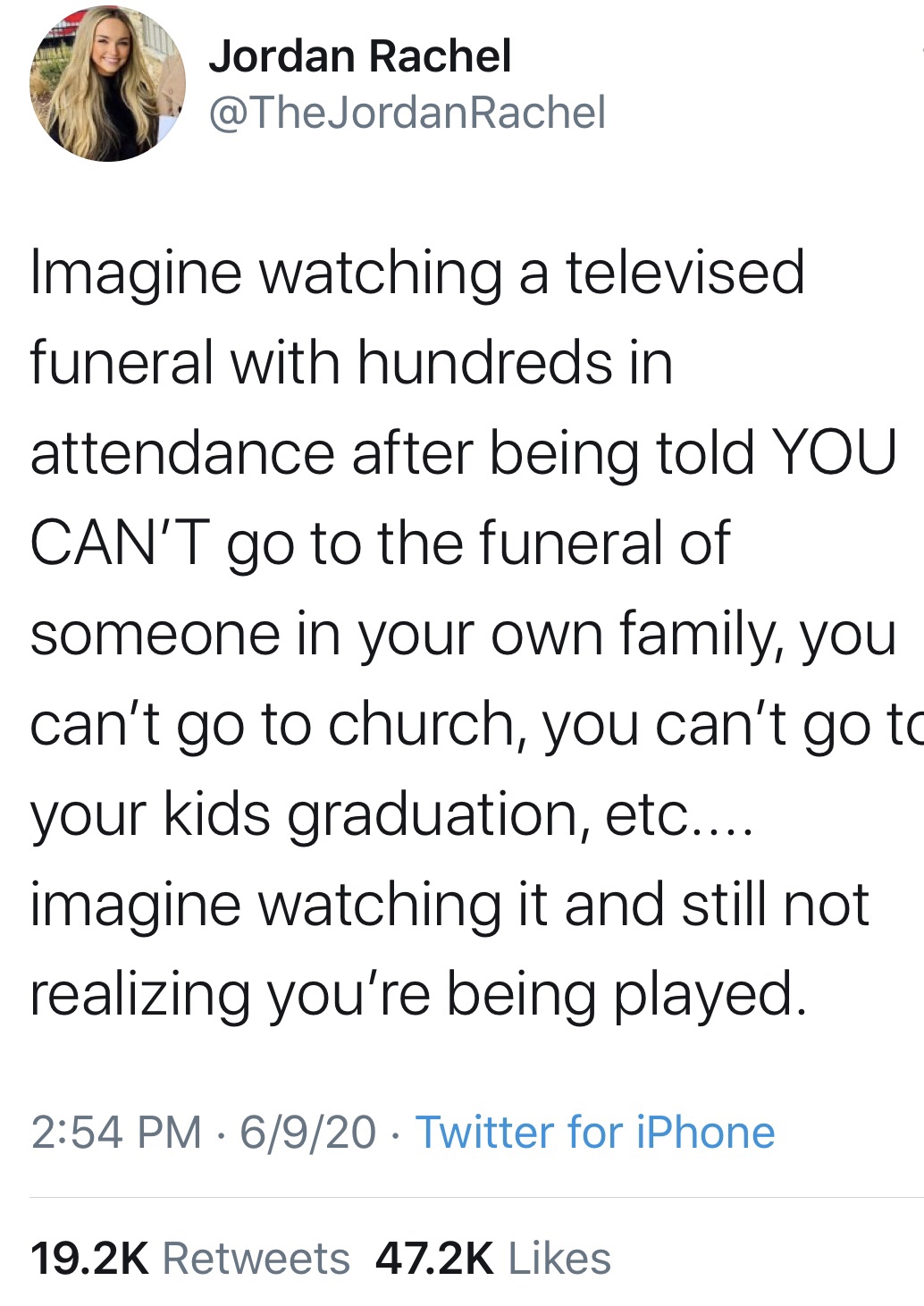
Some rightly ask why people have been denied their right to grieve and bury their own loved ones while throngs are permitted to attend George Floyd’s funeral, along with the protests on crowded streets:

Is it any surprise that democrats now claim Trump rallies would be coronavirus hazards, even after supporting the protesters who flocked to the streets? The Trump rallies might well lead to more infections. If the rallies take place, I’d be glad to see them kept outdoors with socially-distanced attendees wearing masks. But anyone defending the marches and protests of the past two weeks while condemning future Trump rallies on the grounds of coronavirus risk is engaging in rank hypocrisy. But that’s just one example: it’s just as outrageous to agitate for lockdowns that inflict the greatest harm on the poor, and cost lives in myriad ways, while carping about economic injustice.


← Older posts
Newer posts →
Follow Sacred Cow Chips on WordPress.com

Recent Posts

  • The Case Against Interest On Reserves
  • Immigration and Merit As Fiscal Propositions
  • Tariff “Dividend” From An Indigent State
  • Almost Looks Like the Fed Has a 3% Inflation Target
  • Government Malpractice Breeds Health Care Havoc

Archives

  • January 2026
  • December 2025
  • November 2025
  • October 2025
  • September 2025
  • August 2025
  • July 2025
  • June 2025
  • May 2025
  • April 2025
  • March 2025
  • February 2025
  • January 2025
  • December 2024
  • November 2024
  • October 2024
  • September 2024
  • August 2024
  • July 2024
  • June 2024
  • May 2024
  • April 2024
  • March 2024
  • February 2024
  • January 2024
  • December 2023
  • November 2023
  • August 2023
  • July 2023
  • June 2023
  • May 2023
  • April 2023
  • March 2023
  • February 2023
  • January 2023
  • December 2022
  • November 2022
  • October 2022
  • September 2022
  • August 2022
  • July 2022
  • June 2022
  • May 2022
  • April 2022
  • March 2022
  • February 2022
  • January 2022
  • December 2021
  • November 2021
  • October 2021
  • September 2021
  • August 2021
  • July 2021
  • June 2021
  • May 2021
  • April 2021
  • March 2021
  • February 2021
  • January 2021
  • December 2020
  • November 2020
  • October 2020
  • September 2020
  • August 2020
  • July 2020
  • June 2020
  • May 2020
  • April 2020
  • March 2020
  • February 2020
  • January 2020
  • December 2019
  • November 2019
  • October 2019
  • September 2019
  • August 2019
  • July 2019
  • June 2019
  • May 2019
  • April 2019
  • March 2019
  • February 2019
  • January 2019
  • December 2018
  • November 2018
  • October 2018
  • September 2018
  • August 2018
  • July 2018
  • June 2018
  • May 2018
  • April 2018
  • March 2018
  • February 2018
  • January 2018
  • December 2017
  • November 2017
  • October 2017
  • September 2017
  • August 2017
  • July 2017
  • June 2017
  • May 2017
  • April 2017
  • March 2017
  • February 2017
  • January 2017
  • December 2016
  • November 2016
  • October 2016
  • September 2016
  • August 2016
  • July 2016
  • June 2016
  • May 2016
  • April 2016
  • March 2016
  • February 2016
  • January 2016
  • December 2015
  • November 2015
  • October 2015
  • September 2015
  • August 2015
  • July 2015
  • June 2015
  • May 2015
  • April 2015
  • March 2015
  • February 2015
  • January 2015
  • December 2014
  • November 2014
  • October 2014
  • September 2014
  • August 2014
  • July 2014
  • June 2014
  • May 2014
  • April 2014
  • March 2014

Blogs I Follow

  • Passive Income Kickstart
  • OnlyFinance.net
  • TLC Cholesterol
  • Nintil
  • kendunning.net
  • DCWhispers.com
  • Hoong-Wai in the UK
  • Marginal REVOLUTION
  • Stlouis
  • Watts Up With That?
  • Aussie Nationalist Blog
  • American Elephants
  • The View from Alexandria
  • The Gymnasium
  • A Force for Good
  • Notes On Liberty
  • troymo
  • SUNDAY BLOG Stephanie Sievers
  • Miss Lou Acquiring Lore
  • Your Well Wisher Program
  • Objectivism In Depth
  • RobotEnomics
  • Orderstatistic
  • Paradigm Library
  • Scattered Showers and Quicksand

Blog at WordPress.com.

Passive Income Kickstart

OnlyFinance.net

TLC Cholesterol

Nintil

To estimate, compare, distinguish, discuss, and trace to its principal sources everything

kendunning.net

The Future is Ours to Create

DCWhispers.com

Hoong-Wai in the UK

A Commonwealth immigrant's perspective on the UK's public arena.

Marginal REVOLUTION

Small Steps Toward A Much Better World

Stlouis

Watts Up With That?

The world's most viewed site on global warming and climate change

Aussie Nationalist Blog

Commentary from a Paleoconservative and Nationalist perspective

American Elephants

Defending Life, Liberty and the Pursuit of Happiness

The View from Alexandria

In advanced civilizations the period loosely called Alexandrian is usually associated with flexible morals, perfunctory religion, populist standards and cosmopolitan tastes, feminism, exotic cults, and the rapid turnover of high and low fads---in short, a falling away (which is all that decadence means) from the strictness of traditional rules, embodied in character and inforced from within. -- Jacques Barzun

The Gymnasium

A place for reason, politics, economics, and faith steeped in the classical liberal tradition

A Force for Good

How economics, morality, and markets combine

Notes On Liberty

Spontaneous thoughts on a humble creed

troymo

SUNDAY BLOG Stephanie Sievers

Escaping the everyday life with photographs from my travels

Miss Lou Acquiring Lore

Gallery of Life...

Your Well Wisher Program

Attempt to solve commonly known problems…

Objectivism In Depth

Exploring Ayn Rand's revolutionary philosophy.

RobotEnomics

(A)n (I)ntelligent Future

Orderstatistic

Economics, chess and anything else on my mind.

Paradigm Library

OODA Looping

Scattered Showers and Quicksand

Musings on science, investing, finance, economics, politics, and probably fly fishing.

  • Subscribe Subscribed
    • Sacred Cow Chips
    • Join 128 other subscribers
    • Already have a WordPress.com account? Log in now.
    • Sacred Cow Chips
    • Subscribe Subscribed
    • Sign up
    • Log in
    • Report this content
    • View site in Reader
    • Manage subscriptions
    • Collapse this bar
 

Loading Comments...