• About

Sacred Cow Chips

Sacred Cow Chips

Tag Archives: Renewable energy

Promises and Policies: Grading the Candidates

29 Tuesday Oct 2024

Posted by Nuetzel in Election

≈ Leave a comment

Tags

2024 Election, Abortion, Abraham Accords, Barack Obama, Capitalism, Climate Change, Corporatism, DEI, Dobbs, Donald Trump, Elon Musk, fascism, Federal Reserve, First Amendment, Fossil fuels, Housing, Hysteria, Immigration, Inflation, Israel, Joe Biden, Kamala Harris, Medicaid, Medicare, Obamacare, Renewable energy, Second Amendment, Social Security, Supreme Court, Tariffs, Tax Policy, Ukraine, Vladimir Putin

Wow! We’re less than a week from Election Day! I’d hoped to write a few more detailed posts about the platforms and policies of Kamala Harris and Donald Trump, but I was waylaid by Hurricane Milton. It sent us scrambling into prep mode, then we evacuated to the Florida Panhandle. The drive there and back took much longer than expected due to the mass exodus. On our return we found the house was fine, but there was significant damage to an exterior structure and a mess in the yard. We also had to “de-prep” the house, and we’ve been dealing with contractors ever since. It was an exhausting episode, but we feel like we were very lucky.

Now, with less than a week left till the election, I’ll limit myself to a summary of the positions of the candidates in a number of areas, mostly but not all directly related to policy. I assign “grades” in each area and calculate an equally-weighted “GPA” for each candidate. My summaries (and “grades”) are pretty off-the-cuff and not adequate treatments on their own. Some of these areas are more general than others, and I readily admit that a GPA taken from my grade assignments is subject to a bit of double counting. Oh well!

Role of Government: Kamala Harris is a statist through and through. No mystery there. Trump is more selective in his statist tendencies. He’ll often favor government action if it’s politically advantageous. However, in general I think he is amenable to a smaller role for the public than the private sector. Harris: F; Trump: C

Regulation: There is no question that Trump stands for badly needed federal regulatory reform. This spans a wide range of areas, and it extends to a light approach to crypto and AI regulation. Trump plans to appoint Elon Musk as his “Secretary of Cost Cutting”. Harris, on the other hand, seems to favor a continuation of the Biden Administration’s heavy regulatory oversight. This encourages a bloated federal bureaucracy, inflicts high compliance costs on the private sector, stifles innovation, and tends to concentrate industrial power. Harris: F; Trump: A

Border Policy: Trump wants to close the borders (complete the wall) and deport illegal immigrants. Both are easier said than done. Except for criminal elements, the latter will be especially controversial. I’d feel better about Trump’s position if it were accompanied by a commitment to expanded legal immigration. We need more legal immigrants, especially the highly skilled. For her part, Harris would offer mass amnesty to illegals. She’d continue an open border policy, though she claims to want certain limits on illegal border crossings going forward. She also claims to favor more funds for border control. However, it is not clear how well this would translate into thorough vetting of illegal entrants, drug interdiction at the border, or sex trafficking. Harris: D; Trump: B-

Antitrust: Accusations of price gouging by American businesses? Harris! Forty three corporations in the S&P 500 under investigation by the DOJ? The Biden-Harris Administration. This reflects an aggressively hostile and manipulative attitude toward the business community. Trump, meanwhile, might wheedle corporations to act on behalf of certain of his agendas, but he is unlikely to take such a broadly punitive approach. Harris: F; Trump: B-

Foreign Policy: Harris is likely to continue the Biden Administration’s conciliatory approach to dealing with America’s adversaries. The other side of that coin is an often tepid commitment to longtime allies like Israel. Trump believes that dealing from a position of strength is imperative, and he’s willing to challenge enemies with an array of economic and political sticks and carrots. He had success during his first term in office promoting peace in the Middle East. A renewed version of the Abraham Accords that strengthened economic ties across the region would do just that. Ideally, he would like to restore the strength of America’s military, about which Harris has less interest. Trump has also shown a willingness to challenge our NATO partners in order to get them to “pay their fair share” toward the alliance’s shared defense. My major qualification here has to do with the candidates’ positions with respect to supporting Ukraine in its war against Putin’s mad aggression. Harris seems more likely than Trump to continue America’s support for Ukraine. Harris: D+; Trump: B-

Trade: Nations who trade with one another tend to be more prosperous and at peace. Unfortunately, neither candidate has much recognition of these facts. Harris is willing to extend the tariffs enforced during the Biden Administration. Trump, however, is under the delusion that tariffs can solve almost anything that ails the country. Of course, tariffs are a destructive tax on American consumers and businesses. Part of this owes to the direct effects of the tax. Part owes to the pricing power tariffs grant to domestic producers. Tariffs harm incentives for efficiency and the competitiveness of American industry. Retaliatory action by foreign governments is a likely response, which magnifies the harm.

To be fair, Trump believes he can use tariffs as a negotiating tool in nearly all international matters, whether economic, political, or military. This might work to achieve some objectives, but at the cost of damaging relations more broadly and undermining the U.S. economy. Trump is an advocate for not just selective, punitive tariffs, but for broad application of tariffs. Someone needs to disabuse him of the notion that tariffs have great revenue-raising potential. They don’t. And Trump is seemingly unaware of another basic fact: the trade deficit is mirrored by foreign investment in the U.S. economy, which spurs domestic economic growth. Quashing imports via tariffs will also quash that source of growth. I’ll add one other qualification below in the section on taxes, but I’m not sure it has a meaningful chance.

Harris: C-; Trump: F

Inflation: This is a tough one to grade. The President has no direct control over inflation. Harris wants to challenge “price gougers”, which has little to do with actual inflation. I expect both candidates to tolerate large deficits in order to fulfill campaign promises and other objectives. That will put pressure on credit markets and is likely to be inflationary if bond investors are surprised by the higher trajectory of permanent government indebtedness, or if the Federal Reserve monetizes increasing amounts of federal debt. Deficits are likely to be larger under Trump than Harris due in large part to differences in their tax plans, but I’m skeptical that Harris will hold spending in check. Trump’s policies are more growth oriented, and these along with his energy policies and deregulatory actions could limit the inflationary consequences of his spending and tax policies. Higher tariffs will not be of much help in funding larger deficits, and in fact they will be inflationary. Harris: C; Trump: C

Federal Reserve Independence: Harris would undoubtedly like to have the Fed partner closely with the Treasury in funding federal spending. Her appointments to the Board would almost certainly lead to a more activist Fed with a willingness to tolerate rapid monetary expansion and inflation. Trump might be even worse. He has signaled disdain for the Fed’s independence, and he would be happy to lean on the Fed to ease his efforts to fulfill promises to special interests. Harris: D; Trump: F

Entitlement Reform: Social Security and Medicare are both insolvent and benefits will be cut in 2035 without reforms. Harris would certainly be willing to tax the benefits of higher-income retirees more heavily, and she would likely be willing to impose FICA and Medicare taxes on incomes above current earning limits. These are not my favorite reform proposals. Trump has been silent on the issue except to promise no cuts in benefits. Harris: C-; Trump: F

Health Care: Harris is an Obamacare supporter and an advocate of expanded Medicaid. She favors policies that would short-circuit consumer discipline for health care spending and hasten the depletion of the already insolvent Medicare and Medicaid trust funds. These include a $2,000 cap on health care spending for Americans on Medicare, having Medicare cover in-home care, and extending tax credits for health insurance premia. She supports funding to address presumed health care disparities faced by black men. She also promises efforts to discipline or supplant pharmacy benefit managers. Trump, for his part, has said little about his plans for health care policy. He is not a fan of Obamacare and he has promised to take on Big Pharma, whatever that might mean. I fear that both candidates would happily place additional controls of the pricing of pharmaceuticals, a sure prescription for curtailed research and development and higher mortality. Harris: F; Trump: D+

Abortion: The Supreme Court’s 2022 decision in Dobbs v. Jackson essentially relegated abortion law to individual states. That’s consistent with federalist principles, leaving the controversial balancing of abortion vs. the unborn child’s rights up to state voters. Geographic differences of opinion on this question are dramatic, and Dobbs respects those differences. Trump is content with it. Meanwhile, Harris advocates for the establishment of expanded abortion rights at the federal level, including authorization of third trimester abortions by “care providers”. And Harris does not believe there should be religious exemptions for providers who do not wish to offer abortion services. No doubt she also approves of federally funded abortions. Harris: F; Trump: A

Housing: The nation faces an acute housing shortage owing to excessive regulation that limits construction of new or revitalized housing. These excessive rules are primarily imposed at the state and local level. While the federal government has little direct control over many of these decisions, it has abetted this regulatory onslaught in a variety of ways, especially in the environmental arena. Harris is offering stimulus to the demand side through a $25,000 housing tax credit for first-time home buyers. This will succeed in raising the cost of housing. She has also called for heavier subsidies for developers of low-income housing. If past is prologue, this might do more to line the pockets of developers than add meaningfully to the stock of affordable housing. Harris also favors rent controls, a sure prescription for deterioration in the housing stock, and she would prohibit software allowing landlords to determine competitive neighborhood rents. Trump has called for deregulation generally and would not favor rent controls. Harris: F; Trump B

Taxes: Harris has broached several wildly destructive tax proposals. Perhaps the worst of these is to tax unrealized capital gains, and while she promises it would apply only to extremely wealthy taxpayers, it would constitute a wealth tax. Once that line is crossed, the threat of widening the base becomes a very slippery slope. It would also be a strong detriment to domestic capital investment and economic growth. Harris would increase the top marginal personal tax rate and the corporate tax rate, which would discourage investment and undermine real wage growth. She’d also increase estate tax rates. As discussed above, she unwisely calls for a $25,000 tax credit for first-time homebuyers. She also wants to expand the child care tax credit to $6,000 for families with newborns. A proposed $50,000 small business tax credit would allow the federal government to subsidize and encourage risky entrepreneurial activity at taxpayers’ expense. I’m all for small business, but this style of industrial planning is bonkers. She would sunset the Trump (TCJA) tax cuts in 2026.

Finally, Harris has mimicked Trump in calling for no taxes on tips. Treating certain forms of income more favorably than others is a recipe for distortions in economic activity. Employers of tip-earning workers will find ways to shift employees’ income to tips that are mandatory for patrons. It will also skew labor supply decisions toward occupations that would otherwise have less economic value. But Trump managed to find an idea so politically seductive that Harris couldn’t resist.

Trump’s tax plans are a mixed bag of good and bad ideas. They include extending his earlier tax cuts (TCJA) and restoring the SALT deduction. The latter is an alluring campaign tidbit for voters in high-tax states. He would reduce the corporate tax rate, which I strongly favor. Corporate income is double-taxed, which is a detriment to growth as well as a weight on real wages. He would eliminate taxes on overtime income, another example of favoring a particular form of income over others. Wage earners would gain at the expense of salaried employees, so one could expect a transition in the form employees are paid over time. Otherwise, the classification of hours as “overtime” would have to be standardized. One could expect existing employees to work longer hours, but at the expense of new jobs. Finally, Trump says Social Security benefits should not be taxed, another kind of special treatment by form of income. This might encourage early retirement and become an additional drain on the Social Security Trust Fund.

The higher tariffs promised by Trump would collect some revenue. I’d be more supportive of this plank if the tariffs were part of a larger transition from income taxes to consumption taxes. However, Trump would still like to see large differentials between tariffs and taxes imposed on the consumption of domestically-produced goods and services.

Harris: F; Trump C+

Climate Policy: This topic has undergone a steep decline in relative importance to voters. Harris favors more drastic climate interventions than Trump, including steep renewable subsidies, EV mandates, and a panoply of other initiatives, many of which would carry over from the Biden Administration. Harris: F; Trump: B

Energy: Low-cost energy encourages economic growth. Just ask the Germans! Consistent with the climate change narrative, Harris wishes to discourage the use of fossil fuels, their domestic production, and even their export. She has been very dodgy with respect to restrictions on fracking. Her apparent stance on energy policy would be an obvious detriment to growth and price stability (or I should say a continuing detriment). Trump wishes to encourage fossil fuel production. Harris: F; Trump: A

Constitutional Integrity: Harris has supported the idea of packing the Supreme Court, which would lead to an escalating competition to appoint more and more justices with every shift in political power. She’s also disparaged the Electoral College, without which many states would never have agreed to join the Union. Under the questionable pretense of “protecting voting rights”, she has opposed steps to improve election integrity, such voter ID laws. And operatives within her party have done everything possible to register non-citizens as voters. Harris: F; Trump: A

First Amendment Rights: Harris has called for regulation and oversight of social media content and moderation. A more descriptive word for this is censorship. Trump is generally a free speech advocate. Harris: F; Trump A-

Second Amendment Rights: Harris would like to ban so-called “assault weapons” and high-capacity magazines, and she backs universal background checks for gun purchases. Trump has not called for any new restrictions on gun rights. Harris: F; Trump: A

DEI: Harris is strongly supportive of diversity and equity initiatives, which have undermined social cohesion and the economy. That necessarily makes her an enemy of merit-based rewards. Trump has no such confusion. Harris: F; Trump: A

Hysteria: The Harris campaign has embraced a strategy of demonizing Donald Trump. Of course, that’s not a new approach among Democrats, who have fabricated bizarre stories about Trump escapades in Russia, Trump as a pawn of Vladimir Putin, and Russian manipulation of the 2016 Trump campaign. Congressional democrats spent nearly all of Trump’s first term in office trying to find grounds for impeachment. Concurrently, there were a number of other crazy and false stories about Trump. The current variation on “Orange Man Bad” is that Trump is a fascist and a Nazi, and that all of his supporters are Nazis. And that Trump will use the military against his domestic political opponents, the so-called “enemy within”. And that Trump will send half the country’s populace to labor camps. The nonsense never ends, but could anything more powerfully ignite the passions of violent extremists than this sort of hateful rhetoric? Would it not be surprising if at least a few leftists weren’t interested in assassinating “Hitler” himself. This is hysteria, and one has to wonder if that is not, in fact, the intent.

Can any of these people actually define the term fascist? Most fundamentally, a fascist desires the use of government coercion for private gain (of wealth or power) for oneself and/or one’s circle of allies. By that definition, we could probably categorize a great many American politicians as fascists, including Barack Obama, Joe Biden, Donald Trump, and a majority of both houses of Congress. That only demonstrates that corporatism is fundamental to fascist politics. Less-informed definitions of fascism conflate it with everything from racism (certainly can play a part) and homophobia (certainly can play a part) to mere capitalism. But take a look at the demographics of Trump’s supporters and you can see that most of these definitions are inapt.

Is the Trump campaign suffering from any form of hysteria? It’s shown great talent at poking fun at the left. Of course, Trump’s reactions to illegal immigration, crime, and third-trimester abortions are construed by leftists to be hysterical. I mean, why would anyone get upset about those kinds of things?

Harris: F; Trump: A

“Grade Point Average”

I’m sure I forgot an area or two I should have covered. Anyway, the following are four-point “GPAs” calculated over 20 categories. I’m deducting a quarter point for a “minus” grade and adding a quarter point for a “plus” grade. Here’s what I get:

Harris: 0.44; Trump: 2.68

Hmmm

Tangled Up In Green Industrial Policy II: Rewarding Idle Capital

06 Saturday Apr 2024

Posted by Nuetzel in Energy, Global Warming, Industrial Policy

≈ 1 Comment

Tags

AI, Capacity Factors, Carbon Capture, Casey Handmer, Center of the American Experiment, Charles Glasser, crowding out, Dispatchable Power, EV Mandates, Externalities, Heat Island Effect, Hydrocarbons, Idle Capital, IMF, Imposed Cost, Industrial Policy, Institute for Energy Research, Lazard Levelized Costs, Lionel Shriver, Long Tailpipe, Mackinac Center for Public Policy, Malinvestment, Modular Reactors, Natural Gas, Net Zero, Nuclear Fusion, Power Transmission, Production Possibilities, Renewable energy, Simon P. Michaux, Subsidies, Toxicity, Travis Fisher, Wildlife Hazards

A week ago I posted about electrification and particularly EV mandates, one strand of government industrial policy under which non-favored sectors of the economy must labor. This post examines a related industrial policy: manipulation of power generation by government policymakers in favor of renewable energy technologies, while fossil fuels are targeted for oblivion. These interventions are a reaction to an overwrought climate crisis narrative, but they present many obstacles, oversights and risks of their own. Chief among them is whether the power grid will be capable of meeting current and future demand for power while relying heavily on variable resources: wind and sunshine.

Like almost everything I write, this post is too long! Here is a guide to what follows. Scroll down to whatever sections might be of interest:

  • Malinvestment: Idle capital
  • Key Considerations to chew on
  • False Premises: zero CO2? Low cost?
  • Imposed Cost: what and how much?
  • Supporting Growth: with renewables?
  • Resource Constraints: they’re tight!
  • Technological Advance: patience!
  • The Presumed Elephant: CO2 costs
  • Conclusion

Malinvestment

The intermittency of wind and solar power creates a fundamental problem of physically idle capital, which leaves the economy short of its production possibilities. To clarify, capital invested in wind and solar facilities is often idle in two critical ways. First, wind and solar assets have relatively low rates of utilization because of their variability, or intermittency. Second, neither provides “dispatchable” power: it is not “on call” in any sense during those idle periods, which are not entirely predictable. Wind and solar assets therefore contribute less value to the electric grid than dispatchable sources of power having equivalent capacity and utilization.

Is “idle capital” a reasonable characterization? Consider the shipping concerns that are now experimenting with sails on cargo ships. What is the economic value of such a ship without back-up power? Can you imagine them drifting in the equatorial calms for days on end? Even light winds would slow the transport of goods significantly. Idle capital might be bad enough, but a degree of idleness allows flexibility and risk mitigation in many applications. Idle, non–dispatchable capital, however, is unproductive capital.

Likewise, solar-powered signage can underperform or fail over the course of several dark, wintry days, even with battery backup. The signage is more reliable and valuable when it is backed-up by another power source. Again, idle, non-dispatchable capital is unproductive capital.

The pursuit of net-zero carbon emissions via wind and solar power creates idle capital, which increasingly lacks adequate backup power. That should be a priority, but it’s not. This misguided effort is funded from both private investment and public subsidies, but the former is very much contingent on the latter. That’s because the flood of subsidies is what allows private investors to profit from idle capital. Rent-enabled investments like these crowd out genuinely productive capital formation, which is not limited to power plants that might otherwise use fossil fuels.

Creating idle or unemployed physical capital is malinvestment, and it diminishes future economic growth. The surge in this activity began in earnest during the era of negative real interest rates. Today, in an era of higher rates, taxpayers can expect an even greater burden, as can ratepayers whose power providers are guaranteed returns on their regulated rate bases.

Key Consideration

The forced transition to net zero will be futile, but especially if wind and solar energy are the primary focus. Keep the following in mind:

  • The demand for electricity is expected to soar, and soon! Policymakers have high hopes for EVs, and while adoption rates might fall well short of their goals, they’re doing their clumsy best to force EVs down our throats with mandates. But facilitating EV charging presents difficulties. Lionel Shriver states the obvious: “Going Electric Requires Electricity”. Reliable electricity!
  • Perhaps more impressive than prospects for EVs is the expected growth in power demand from data centers required by the explosion of artificial intelligence applications across many industries. It’s happening now! This will be magnified with the advent of artificial general intelligence (AGI).
  • Dispatchable power sources are needed to back-up unreliable wind and solar power to ensure service continuity. Maintaining backup power carries a huge “imposed cost” at the margin for wind and solar. At present, that would entail CO2 emissions, violating the net zero dictum.
  • Perhaps worse than the cost of backup power would be the cost borne by users under the complete elimination of certain dispatchable power sources. An imposed cost then takes the form of outages. Users are placed at risk of losing power at home, at the office and factories, at stores, in transit, and at hospitals at peak hours or under potentially dangerous circumstances like frigid or hot weather.
  • Historically, dispatchable power has allowed utilities to provide reliable electricity on-demand. Just flip the switch! This may become a thing of the past.
  • Wind and solar power are sometimes available when they’re not needed, in which case the power goes unused because we lack effective power storage technology.
  • Wind and solar power facilities operate at low rates of utilization, yet new facilities are always touted at their full nameplate capacity. Capacity factors for wind turbines averaged almost 36% in the U.S. in 2022, while solar facilities averaged only about 24%. This compared with nuclear power at almost 93%, natural gas (66%), and coal (48%). Obviously, the low capacity factors for wind and solar reflect their variable nature, rather than dispatchable responses to fluctuations in power demand.
  • Low utilization and variability are underemphasized or omitted by those promoting wind and solar plant in the media and often in discussions of public policy, and no wonder! We hear a great deal about “additions to capacity”, which overstate the actual power-generating potential by factors of three to four times. Here is a typical example.
  • Wind and solar power are far more heavily subsidized than fossil fuels. This is true in absolute terms and especially on the basis of actual power output, which reveals their overwhelmingly uneconomic nature. From the link above, here are Mitch Rolling and Isaac Orr on this point:
    • “In 2022, wind and solar generators received three and eighteen times more subsidies per MWh, respectively, than natural gas, coal, and nuclear generators combined. Solar is the clear leader, receiving anywhere from $50 to $80 per MWh over the last five years, whereas wind is a distant second at $8 to $10 per MWh …. Renewable energy sources like wind and solar are largely dependent on these subsidies, which have been ongoing for 30 years with no end in sight.”
  • The first-order burden of subsidies falls on taxpayers. The second-order burdens manifest in an unstable grid and higher power costs. But just to be clear, subsidies are paid by governments to producers or consumers to reduce the cost of activity favored by policymakers. However, the International Monetary Fund frequently cites “subsidy” figures that include staff estimates of unaddressed externalities. These are based on highly-simplified models and subject to great uncertainty, of course, especially when dollar values are assigned to categories like “climate change”. Despite what alarmists would have us believe, the extent and consequences of climate change are not settled scientific issues, let alone the dollar cost.
  • Wind and solar power are extremely land- and/or sea-intensive. For example, Casey Handmer estimates that a one-Gigawatt data center, if powered by solar panels, would need a footprint of 20,000 acres. 
  • Solar installations are associated with a significant heat island effect: “We found temperatures over a PV plant were regularly 3–4 °C warmer than wildlands at night….”
  • Wind and solar power both represent major hazards to wildlife both during and after construction.
    • In addition to the destruction of habitat both on- and offshore, turbine blades create noise, electromagnetism, and migration barriers. Wind farms have been associated with significant bird and bat fatalities. Collisions with moving blades are one thing, but changes to the winds and air pressure around turbines are also a danger to avian species.
    • There is a strong likelihood that offshore wind development is endangering whales and dolphins.
    • Solar farms present dangers to waterfowl. These creatures are tricked into diving toward what they believe to be bodies of water, only to crash into the panels.
  • The production of wind and solar equipment requires the intensive use of scarce resources, including environmentally-sensitive materials. Extracting these materials often requires the excavation of massive amounts of rock subject to extensive processing. Mining and processing rely heavily on diesel fuel. Net zero? No.
  • Wind and solar facilities often present major threats of toxicity at disposal, or even sooner. A recent hail storm in Texas literally destroyed a solar farm, and the smashed panels have prompted concerns not only about solar “sustainability”, but also that harsh chemicals may be leaking into the local environment.
  • The transmission of power is costly, but that cost is magnified by the broad spatial distribution of wind and solar generating units. Transmission from offshore facilities is particularly complex. And high voltage lines run into tremendous local opposition and regulatory scrutiny.
  • When wind turbines and solar panels are idle, so are the transmission facilities needed to reach them. Thus, low utilization and the variability of those units drives up the capital needed for power and power transmission.
  • There is also an acute shortage of transformers, which presents a major bottleneck to grid development and stability.
  • While zero carbon is the ostensible goal, zero carbon nuclear power has been neglected by our industrial planners. That neglect plays off exaggerated fears about safety. Fortunately, there is a growing realization that nuclear power may be surest way to carbon reductions while meeting growth in power demand. In fact, new data centers will go off-grid with their own modular reactors.
  • At the Shriver link, he notes the smothering nature of power regulation, which obstructs the objective of providing reliable power and any hope of achieving net zero.
  • The Biden administration has resisted the substitution of low CO2 emitting power sources for high CO2 emitting sources. For example, natural gas is more energy efficient in a variety of applications than other fuel sources. Yet policymakers seem determined to discourage the production and use of natural gas.

False Premises

Wind and solar energy are touted by the federal government as zero carbon and low-cost technologies, but both claims are false. Extracting the needed resources, fabricating, installing, connecting, and ultimately disposing of these facilities is high in carbon emissions.

The claim that wind and solar have a cost advantage over traditional power sources is based on misleading comparisons. First, putting claims about the cost of carbon aside, it goes without saying that the cost of replacing already operational coal or natural gas generating capacity with new wind and solar facilities is greater than doing nothing.

The hope among net zero advocates is that existing fossil fuel generating plant can be decommissioned as more renewables come on-line. Again, this thinking ignores the variable nature of renewable power. Dispatchable backup power is required to reliably meet power demand. Otherwise, fluctuating power supplies undermine the economy’s productive capacity, leading to declines in output, income, health, and well being. That is costly, but so is maintaining and adding back-up capacity. Costs of wind and solar should account for this necessity. It implies that wind and solar generating units carry a high cost at the margin.

Imposed Costs

A “grid report card” from the Mackinac Center for Public Policy notes the conceptual flaw in comparing the levelized cost (à la Lazard) of a variable resource with one capable of steady and dispatchable performance. From the report, here is the crux of the imposed-cost problem:

“… the more renewable generation facilities you build, the more it costs the system to make up for their variability, and the less value they provide to electricity markets.”

A committment to variable wind and solar power along with back-up capacity also implies that some capital will be idle regardless of wind and solar conditions. This is part of the imposed cost of wind and solar built into the accounting below. But while back-up power facilities will have idle periods, it is dispatchable and serves an insurance function, so it has value even when idle in preserving the stability of the grid. For that matter, sole reliance on dispatchable power sources requires excess capacity to serve an insurance function of a similar kind.

The Mackinac report card uses estimates of imposed cost from an Institute for Energy Research to construct the following comparison (expand the view or try clicking the image for a better view):

The figures shown in this table are somewhat dated, but the Mackinac authors use updated costs for Michigan from the Center of the American Experiment. These are shown below in terms of average costs per MWh through 2050, but the labels require some additional explanation.

The two bars on the left show costs for existing coal ($33/MWh) and gas-powered ($22) plants. The third and fourth bars are for new wind ($180) and solar ($278) installations. The fifth and sixth bars are for new nuclear reactors (a light water reactor ($74) and a small modular reactor($185)). Finally, the last two bars are for a new coal plant ($106) and a natural gas plant ($64), both with carbon capture and storage (CCS). It’s no surprise that existing coal and gas facilities are the most cost effective. Natural gas is by far the least costly of the new installations, followed by the light water reactor and coal.

The Mackinac “report card” is instructive in several ways. It provides a detailed analysis of different types of power generation across five dimensions, including reliability, cost, cleanliness, and market feasibility (the latter because some types of power (hydro, geothermal) have geographic limits. Natural gas comes out the clear winner on the report card because it is plentiful, energy dense, dispatchable, clean burning, and low-cost.

Supporting Growth

Growth in the demand for power cannot be met with variable resources without dispatchable backup or intolerable service interruptions. Unreliable power would seriously undermine the case for EVs, which is already tenuous at best. Data centers and other large users will go off-grid before they stand for it. This would represent a flat-out market rejection of renewable investments, ESGs be damned!

Casey Handmer makes some interesting projections of the power requirements of data centers supporting not just AI, but AGI, which he discusses in “How To Feed the AIs”. Here is his darkly humorous closing paragraph, predicated on meeting power demands from AGI via solar:

“It seems that AGI will create an irresistibly strong economic forcing function to pave the entire world with solar panels – including the oceans. We should probably think about how we want this to play out. At current rates of progress, we have about 20 years before paving is complete.”

Resource Constraints

Efforts to force a transition to wind and solar power will lead to more dramatic cost disadvantages than shown in the Mackinac report. By “forcing” a transition, I mean aggressive policies of mandates and subsidies favoring these renewables. These policies would effectuate a gross misallocation of resources. Many of the commodities needed to fabricate the components of wind and solar installations are already quite scarce, particularly on the domestic U.S. front. Inflating the demand for these commodities will result in shortages and escalating costs, magnifying the disadvantages of wind and solar power in real economic terms.

To put a finer point on the infeasibility of the net zero effort, Simon P. Michaux produced a comparative analysis in 2022 of the existing power mix versus a hypothetical power mix of renewable energy sources performing an equal amount of work, but at net-zero carbon emissions (the link is a PowerPoint summary). In the renewable energy scenario, he calculated the total quantities of various resources needed to achieve the objective over one generation of the “new” grid (to last 20 -30 years). He then calculated the numbers of years of mining or extraction needed to produce those quantities based on 2019 rates of production. Take a look at the results in the right-most column:

Those are sobering numbers. Granted, they are based on 2019 wind and solar technology. However, it’s clear that phasing out fossil fuels using today’s wind and solar technology would be out of the question within the lifetime of anyone currently living on the planet. Michaux seems to have a talent for understatement:

“Current thinking has seriously underestimated the scale of the task ahead.”

He also emphasizes the upward price pressure we’re likely to witness in the years ahead across a range of commodities.

Technological Breakthroughs

Michaux’s analysis assumes static technology, but there may come a time in the not-too-distant future when advances in wind and solar power and battery storage allow them to compete with hydrocarbons and nuclear power on a true economic basis. The best way to enable real energy breakthroughs is through market-driven economic growth. Energy production and growth is hampered, however, when governments strong-arm taxpayers, electricity buyers, and traditional energy producers while rewarding renewable developers with subsidies.

We know that improvements will come across a range of technologies. We’ve already seen reductions in the costs of solar panels themselves. Battery technology has a long way to go, but it has improved and might some day be capable of substantial smoothing in the delivery of renewable power. Collection of solar power in space is another possibility, as the feasibility of beaming power to earth has been demonstrated. This solution might also have advantages in terms of transmission depending on the locations and dispersion of collection points on earth, and it would certainly be less land intensive than solar power is today. Carbon capture and carbon conversion are advancing technologies, making net zero a more feasible possibility for traditional sources of power. Nuclear power is zero carbon, but like almost everything else, constructing plants is not. Nevertheless, fission reactors have made great strides in terms of safety and efficiency. Nuclear fusion development is still in its infancy, but there have been notable advances of late.

Some or all of these technologies will experience breakthroughs that could lead to a true, zero-carbon energy future. The timeline is highly uncertain, but it’s likely to be faster than anything like the estimates in Michaux’s analysis. Who knows? Perhaps AI will help lead us to the answers.

A Presumed Elephant

This post and my previous post have emphasized two glaring instances of government failure on their own terms: a headlong plunge into unreliable renewable energy, and forced electrification done prematurely and wrong. Some would protest that I left the veritable “elephant in the room”: the presumed external or spillover costs associated with CO2 emissions from burning fossil fuels. Renewables and electrification are both intended to prevent those costs.

External costs were not ignored, of course. Externalities were discussed explicitly in several different contexts such as the mining of new materials, EV tire wear, the substitution of “cleaner” fuels for others, toxicity at disposal, and the exaggerated reductions in CO2 from EVs when the “long tailpipe” problem is ignored. However, I noted explicitly that estimates of unaddressed externalities are often highly speculative and uncertain, and especially the costs of CO2 emissions. They should not be included in comparisons of subsidies.

Therefore, the costs of various power generating technologies shown above do not account for estimates of externalities. If you’re inclined, other SCC posts on the CO2 “elephant” can be found here.

Conclusion

Power demand is expected to soar given the coming explosion in AI applications, and especially if the heavily-subsidized and mandated transition to EVs comes to pass. But that growth in demand will not and cannot be met by relying on renewable energy sources. Their variability implies substantial idle capacity, higher costs, and service interruptions. Such a massive deployment of idle capital would represents an enormous waste of resources, but the sad fact is it’s been underway for some time.

In the years ahead, the net-zero objective will prove representative of a bumbling effort at industrial planning. Costs will be driven higher, including the cost inflicted by outages and environmental damage. Ratepayers, taxpayers, and innocents will share these burdens. Travis Fisher is spot on when he says the grid is becoming a “dangerous liability” thanks to wounds inflicted by subsidies, regulations, and mandates.

As Charles Glasser put it on Instapundit:

“The National Electrical Grid is teetering on collapse. The shift away from full-time available power (like fossil fuels, LNG, etc.) to so-called ‘green’ sources has deeply impacted reliability.”

“Also, as more whale-killing off-shore wind farms are planned, the Biden administration forgot to plan for the thousands of miles of transmission lines that will be needed. And in a perfect example of leftist autophagy, there is considerable opposition from enviro-groups who will tie up the construction of wind farms and transmission lines in court for decades.”

Meanwhile, better alternatives to wind and solar have been routinely discouraged. The substantial reductions in carbon emissions achieved in the U.S. over the past 15 years were caused primarily by the substitution of natural gas for coal in power generation. Much more of that is possible. The Biden Administration, however, wishes to prevent that substitution in favor of greater reliance on high-cost, unreliable renewables. And the Administration wishes to do so without adequately backing up those variable power sources with dispatchable capacity. Likewise, nuclear power has been shunted aside, despite its safety, low risk, and dispatchability. However, there are signs of progress in attitudes toward bringing more nuclear power on-line.

Industrial policy usually meets with failure, and net zero via wind and solar power will be no exception. Like forced electrification, unreliable power fails on its own terms. Net zero ain’t gonna happen any time soon, and not even by 2050. That is, it won’t happen unless net zero is faked through mechanisms like fraudulent carbon credits (and there might not be adequate faking capacity for that!). Full-scale net-zero investment in wind and solar power, battery capacity, and incremental transmission facilities will drive the cost of power upward, undermining economic growth. Finally, wind and solar are not the environmental panacea so often promised. Quite the contrary: mining of the necessary minerals, component fabrication, installation, and even operation all have negative environmental impacts. Disposal at the end of their useful lives might be even worse. And the presumed environmental gains … reduced atmospheric carbon concentrations and lower temperatures, are more scare story than science.

Postscript: here’s where climate alarmism has left us, and this is from a candidate for the U.S. Senate (she deleted the tweet after an avalanche of well-deserved ridicule):

Carbon Credits Are Still Largely Fake

06 Wednesday Mar 2024

Posted by Nuetzel in Climate, Renewable Energy

≈ 4 Comments

Tags

Carbon Credits, Carbon Offsets, CO2, Credible CO2 Offsets, Deforestation, Double Counting of Offsets, ESG Variance, Excess Power, Global Greening, Greenhouse Gases, Inelastic Power Demand, Intermitancy, Net Zero, Paul Mueller, Renewable energy, Renewables Utilization, Taylor Swift, Water Vapor

About a year ago I wrote about the sketchy nature of carbon credits (or “offsets”), which are purchased by people or entities whose actions generate CO2 emissions they’d like to offset. Those actions would include Taylor Swift’s private air travel, electric power generation, and many other activities whose participants wish to have “greenwashed”.

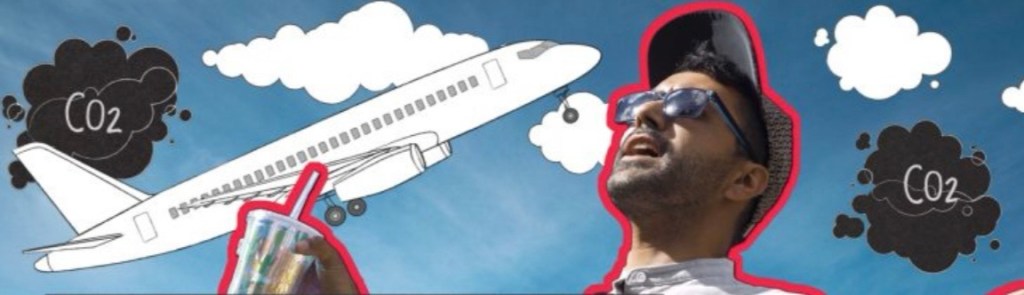
One short digression before I get started: see those black clouds of CO2 in the image above? Well, carbon dioxide doesn’t really look like that. In fact, CO2 is transparent. Trees breathe it! Visually, it’s less obvious than the greenhouse gas known as water vapor in those puffy white clouds, but virtually every image you’ll ever see on-line depicting CO2 emissions shows dark, roiling smoke. I just hate to spoil the scary effect, but there it is.

Back to carbon credits, which help fund projects that offset CO2 emissions (at least theoretically), such as planting new forest acreage (which would absorb CO2 … someday) or preventing deforestation. Other types of offset activities include investment in renewable energy projects and carbon capture technology. So, for example, if a utility’s power generation emits CO2, the creation or preservation of some amount of forested acreage can serve as a carbon sink adequate to offset the utility’s emissions. Net zero! Or so the utility might claim.

If only it were that simple! Paul Mueller explains that the incentive structure of these arrangements is perverse. What if credits are sold on the basis of supposed efforts to preserve forests that were never at risk to begin with? In fact, the promise of revenue from the sale of credits may be a powerful incentive to falsely present forested lands as targets for development. For that matter, cutting forestland for lumber makes more sense if it can be replanted immediately in exchange for revenue from the sale of carbon credits. And newly planted acreage won’t lead to absorption of much CO2 for many years, until the trees begin to mature. Then there are the risks of forest fires or disease that could compromise a forest’s ultimate value as a carbon sink.

Whether through fraud, calamity, or mismanagement, the sad truth is that projects serving as a basis for credits have done far less to reduce deforestation than promised. On top of that, another issue plaguing carbon markets for some time has been double counting of offsets, which can occur under several circumstances. Ultimately, CO2 emissions themselves may have done more to promote the growth of forests than purchases of carbon credits, because CO2 gives life to vegetation!

Obviously, the purchase of offsets raises the incremental cost of any project having CO2 emissions. The incidence of this added cost is borne to a large extent by consumers, especially because power demand is fairly inelastic. The craziness of offset logic may even dictate the purchase of offsets when a plant emitting more CO2 (e.g., coal) is replaced by a plant emitting less (natural gas), because the replacement would still emit carbon!

Some carbon offsets help pay for the construction of renewable power facilities like wind and solar farms. These renewable power facilities contribute to the power supply, of course, but wind turbines and solar farms typically operate at a small fraction of nameplate capacity due to the intermittency of wind and sunshine. Thus, these offsets are far less than complete. And from that low rate of renewable utilization we can deduct another fraction: periods of actual utilization often occur when no one wants the power, and while utilities can sell that excess power into the grid, it doesn’t replace other power at those times and it therefore doesn’t contribute to reductions in CO2 emissions.

Claims of achieving net zero are very much in vogue in the corporate world, and for a few related reasons. One is that they help keep activists and protesters away from the gates. There are, however, plenty of activists serving on corporate boards, in the executive suite, and among regulators.

The purchase of carbon offsets by “socially responsible corporations” might put stakeholder pressure on competitors who are “insufficiently green”. That would help to compensate for the higher costs imposed by offsets. After all, carbon credits are not cheap. In fact, smaller competitors might struggle to fund additional outlays for the credits.

Finally, claims of carbon neutrality also help with another constituency: “woke” investors. “Achieving” net zero boosts a firm’s so-called ESG score, presumed to reflect soundness in terms of environmental (E) and social (S) responsibility, as well as the quality of internal governance (G). With firms jockeying for ESG improvements, they help keep the offset charade going.

There is no common standard for calculating ESG, and there is considerable variance in ESG scores across rating firms. This should be cause for great skepticism, but too many investors are vulnerable to suggestions that screening on ESGs can enable both social responsibility and better returns. Sadly, they are sometimes paying higher fees for the privilege. The ESG fad among these investors might have helped fulfill hopes of greater returns for a while, but the imagined ESG advantage may have faded.

Carbon credits or offsets are plagued by bad incentives that often lead to wasteful outlays if not outright fraud. At present, they generally fail to reduce atmospheric CO2 as promised and they contribute to higher costs, which are passed on to consumers. They also serve as an unworthy basis for higher ESG scores, which are something of a sham in any case.

There have been efforts underway to improve the quality and legitimacy of carbon offsets. Some of this is voluntary due diligence on the part of purchasers. The effort also includes various NGOs and regulators. Ultimately, the push for quality is likely to push the price of offsets upward dramatically. Perhaps offsets will become more credible, but they won’t come cheap. The cost of achieving net zero targets will largely come out of consumers’ pockets, and those net zeros will still be nominal at best.

Cassandras Feel An Urgent Need To Crush Your Lifestyle

12 Thursday Jan 2023

Posted by Nuetzel in Climate science, Environmental Fascism

≈ 1 Comment

Tags

Atmospheric Aerosols, Capacity Factors, Carbon Emissions, Carbon-Free Buildings, Chicken Little, Climate Alarmism, Coercion, Electric Vehicles, Elon Musk, Extreme Weather Events, Fossil fuels, Gas Stoves, Judith Curry, Land Use, Model Bias, Nuclear power, Paul Ehrlich, Renewable energy, rent seeking, Sea Levels, Settled Science, Solar Irradience, Solar Panels, Subsidies, Temperature Manipulation, Toyota Motors, Urban Heat Islands, Volcanic activity, Wind Turbines

Appeals to reason and logic are worthless in dealing with fanatics, so it’s too bad that matters of public policy are so often subject to fanaticism. Nothing is more vulnerable on this scale than climate policy. Why else would anyone continue to listen to prognosticators of such distinguished failure as Paul Ehrlich? Perhaps most infamously, his 1970s forecasts of catastrophe due to population growth were spectacularly off-base. He’s a man without any real understanding of human behavior and how markets deal efficiently and sustainably with scarcity. Here’s a little more detail on his many misfires. And yet people believe him! That’s blind faith.

The foolish acceptance of chicken-little assertions leads to coercive and dangerous policy prescriptions. These are both unnecessary and very costly in direct and hidden ways. But we hear a frantic chorus that we’d better hurry or… we’re all gonna die! Ironically, the fate of the human race hardly matters to the most radical of the alarmists, who are concerned only that the Earth itself be in exactly the same natural state that prevailed circa 1800. People? They don’t belong here! One just can’t take this special group of fools too seriously, except that they seem to have some influence on an even more dangerous group of idiots called policymakers.

Judith Curry, an esteemed but contrarian climate expert, writes of the “faux urgency” of climate action, and how the rush to implement supposed climate mitigations is a threat to our future:

“Rapid deployment of wind and solar power has invariably increased electricity costs and reduced reliability, particularly with increasing penetration into the grid. Allegations of human rights abuses in China’s Xinjiang region, where global solar voltaic supplies are concentrated, are generating political conflicts that threaten the solar power industry. Global supply chains of materials needed to produce solar and wind energy plus battery storage are spawning new regional conflicts, logistical problems, supply shortages and rising costs. The large amount of land use required for wind and solar farms plus transmission lines is causing local land use conflicts in many regions.”

Curry also addresses the fact that international climate authorities have “moved the goalposts” in response to the realization that the so-called “crisis” is not nearly as severe as we were told not too long ago. And she has little patience for delusions that authorities can reliably force adjustments in human behavior so as to to reduce weather disasters:

“Looking back into the past, including paleoclimatic data, there has been more extreme weather [than today] everywhere on the planet. Thinking that we can minimize severe weather through using atmospheric carbon dioxide as a control knob is a fairy tale.”

The lengths to which interventionists are willing to go should make consumer/taxpayers break out their pitchforks. It’s absurd to entertain mandates forcing vehicles powered by internal combustion engines (ICEs) off the road, and automakers know it. Recently, the head of Toyota Motors acknowledged his doubts that electric vehicles (EVs) can meet our transportation demands any time soon:

“People involved in the auto industry are largely a silent majority. That silent majority is wondering whether EVs are really OK to have as a single option. But they think it’s the trend so they can’t speak out loudly. Because the right answer is still unclear, we shouldn’t limit ourselves to just one option.”

In the same article, another Toyota executive says that neither the market nor the infrastructure is ready for a massive transition to EVs, a conclusion only a dimwit could doubt. Someone should call the Big 3 American car companies!

No one is a bigger cheerleader for EVs than Elon Musk. In the article about Toyota, he is quoted thusly:

“At this time, we actually need more oil and gas, not less. Realistically I think we need to use oil and gas in the short term, because otherwise civilization will crumble. One of the biggest challenges the world has ever faced is the transition to sustainable energy and to a sustainable economy. That will take some decades to complete.”

Of course, for the foreseeable future, EVs will be powered primarily by electricity generated from burning fossil fuels. So why the fuss? But as one wag said, that’s only until the government decides to shut down those power plants. After that, good luck with your EV!

Gas stoves are a new target of our energy overlords, but this can’t be about fuel efficiency, and it’s certainly not about the quality of food preparation. The claim by an environmental think tank called “Carbon-Free Buildings” is that gas stoves are responsible for dangerous indoor pollutants. Of course, the Left was quick to rally around this made-up problem, despite the fact that they all seem to use gas stoves and didn’t know anything about the issue until yesterday! And, they insist, racial minorities are hardest hit! Well, they might consider using exhaust fans, but the racialist rejoinder is that minorities aren’t adequately informed about the dangers and mitigants. Okay, start a safe-use info campaign, but keep government away from an embedded home technology that is arguably superior to the electric alternative in several respects.

Renewable energy mandates are a major area of assault. If we were to fully rely on today’s green energy technologies, we’d not just threaten our future, but our immediate health and welfare. Few people, including politicians, have any awareness of the low rates at which green technologies are actually utilized under real-world conditions.

“Worldwide average solar natural capacity factor (CF) reaches about ~11-13%. Best locations in California, Australia, South Africa, Sahara may have above 25%, but are rare. (see www.globalsolaratlas.info, setting direct normal solar irradiance)

Worldwide average wind natural capacity factors (CF) reach about ~21-24%. Best off-shore locations in Northern Europe may reach above 40%. Most of Asia and Africa have hardly any usable wind and the average CF would be below 15%, except for small areas on parts of the coasts of South Africa and Vietnam. (see www.globalwindatlas.info, setting mean power density)”

Those CFs are natural capacity factors (i.e., the wind doesn’t always blow or blow at “optimal” speeds, and the sun doesn’t always shine or shine at the best angle), The CFs don’t even account for “non-natural” shortfalls in actual utilization and other efficiency losses. It would be impossible for investors to make these technologies profitable without considerable assistance from taxpayers, but they couldn’t care less about whether their profits are driven by markets or government fiat. You see, they really aren’t capitalists. They are rent seekers playing a negative-sum game at the expense of the broader society.

There are severe environmental costs associated with current wind and solar technologies. Awful aesthetics and the huge inefficiencies of land use are bad enough. Then there are deadly consequences for wildlife. Producing inputs to these technologies requires resource-intensive and environmentally degrading mining activities. Finally, the costs of disposing of spent, toxic components of wind turbines and solar panels are conveniently ignored in most public discussions of renewables.

There is still more hypocritical frosting on the cake. Climate alarmists are largely opposed to nuclear power, a zero-carbon and very safe energy source. They also fight to prevent development of fossil fuel energy plant for impoverished peoples around the world, which would greatly aid in economic development efforts and in fostering better and safer living conditions. Apparently, they don’t care. Climate activists can only be counted upon to insist on wasteful and unreliable renewable energy facilities.

Before concluding, it’s good to review just a few facts about the “global climate”:

1) the warming we’ve seen in forecasts and in historical surface temperature data has been distorted by urban heat island effects, and weather instruments are too often situated in local environments rich in concrete and pavement.

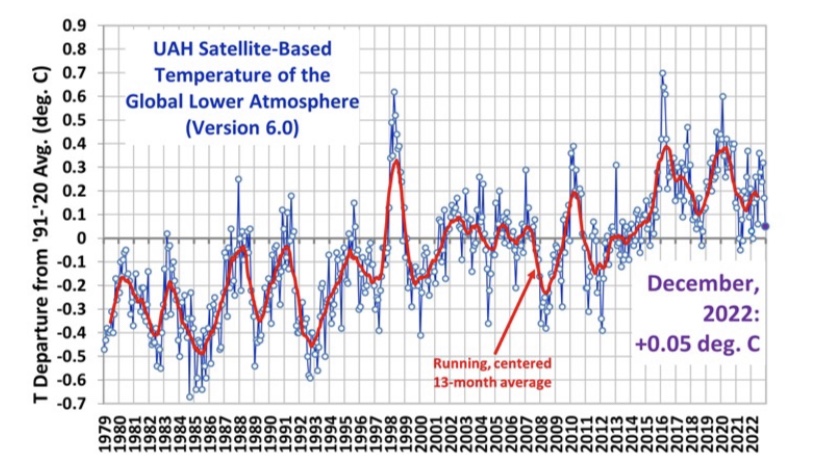
2) Satellite temperatures are only available for the past 43 years, and they have to be calibrated to surface measurements, so they are not independent measures. But the trend in satellite temperatures over the past seven years has been flat or negative at a time when global carbon emissions are at all-time highs.

3) There have been a series of dramatic adjustments to historical data that have “cooled the past” relative to more recent temperatures.

4) The climate models producing catastrophic long-term forecasts of temperatures have proven to be biased to the high side, having drastically over-predicted temperature trends over the past two- to three decades.

5) Sea levels have been rising for thousands of years, and we’ve seen an additional mini-rebound since the mini-ice age of a few hundred years ago. Furthermore, the rate of increase in sea levels has not accelerated in recent decades, contrary to the claims of climate alarmists.

6) Storms and violent weather have shown no increase in frequency or severity, yet models assure us that they must!

Despite these facts, climate change fanatics will only hear of climate disaster. We should be unwilling to accept the climatological nonsense now passing for “settled science”, itself a notion at odds with the philosophy of science. I’m sad to say that climate researchers are often blinded by the incentives created by publication bias and grant money from power-hungry government bureaucracies and partisan NGOs. They are so blinded, in fact, that research within the climate establishment now almost completely ignores the role of other climatological drivers such as the solar irradiance, volcanic activity, and the role and behavior of atmospheric aerosols. Yes, only the global carbon dial seems to matter!

No one is more sympathetic to “the kids” than me, and I’m sad that so much of the “fan base” for climate action is dominated by frightened members of our most youthful generations. It’s hard to blame them, however. Their fanaticism has been inculcated by a distinctly non-scientific community of educators and journalists who are willing to accept outrageous assertions based on “toy models” concocted on weak empirical grounds. That’s not settled science. It’s settled propaganda.

Wind and Solar Power: Brittle, Inefficient, and Destructive

03 Thursday Nov 2022

Posted by Nuetzel in Environment, Nuclear power, Renewable Energy, Uncategorized

≈ 1 Comment

Tags

@MartialData1, @Mining_Atoms, B. F. Randall, Baseload Power, Blake Lovewall, Carbon Credits, Carbon Sink, Dispatchable Power, Fossil fuels, Greenwashing, Grid Stability, Intermittency, Land Use, Martian Data, Nuclear power, Plant Life Cycle, Polysilicons, Renewable energy, Solar Power, Turbine Blades, Wind Power, Zero-Carbon

Just how renewable is “renewable” energy, or more specifically solar and wind power? Intermittent though they are, the wind will always blow and the sun will shine (well, half a day with no clouds). So the possibility of harvesting energy from these sources is truly inexhaustible. Obviously, it also takes man-made hardware to extract electric power from sunshine and wind — physical capital— and it is quite costly in several respects, though taxpayer subsidies might make it appear cheaper to investors and (ultimately) users. Man-made hardware is damaged, wears out, malfunctions, or simply fails for all sorts of reasons, and it must be replaced from time to time. Furthermore, man-made hardware such as solar panels, wind turbines, and the expansions to the electric grid needed to bring the power to users requires vast resources and not a little in the way of fossil fuels. The word “renewable” is therefore something of a misnomer when it comes to solar and wind facilities.

Solar Plant

B. F. Randall (@Mining_Atoms) has a Twitter thread on this topic, or actually several threads (see below). The first thing he notes is that solar panels require polysilicon, which not recyclable. Disposal presents severe hazards of its own, and to replace old solar panels, polysilicon must be produced. For that, Randall says you need high-purity silica from quartzite rock, high-purity coking coal, diesel fuel, and large flows of dispatchable (not intermittent) electric power. To get quartzite, you need carbide drilling tools, which are not renewable. You also need to blast rock using ammonium nitrate fuel oil derived from fossil fuels. Then the rock must be crushed and often milled into fine sand, which requires continuous power. The high temperatures required to create silicon are achieved with coking coal, which is also used in iron and steel making, but coking coal is non-renewable. The whole process requires massive amounts of electricity generated with fossil fuels. Randall calls polysilicon production “an electricity beast”.

Greenwashing

The resulting carbon emissions are, in reality, unlikely to be offset by any quantity of carbon credits these firms might purchase, which allow them to claim a “zero footprint”. Blake Lovewall describes the sham in play here:

“The biggest and most common Carbon offset schemes are simply forests. Most of the offerings in Carbon marketplaces are forests, particularly in East Asian, African and South American nations. …

The only value being packaged and sold on these marketplaces is not cutting down the trees. Therefore, by not cutting down a forest, the company is maintaining a ‘Carbon sink’ …. One is paying the landowner for doing nothing. This logic has an acronym, and it is slapped all over these heralded offset projects: REDD. That is a UN scheme called ‘Reduce Emissions from Deforestation and Forest Degradation’. I would re-name it to, ‘Sell off indigenous forests to global investors’.”

Lovewall goes on to explain that these carbon offset investments do not ensure that forests remain pristine by any stretch of the imagination. For one thing, the requirements for managing these “preserves” are often subject to manipulation by investors working with government; as such, the credits are often vehicle for graft. In Indonesia, for example, carbon credited forests have been converted to palm oil plantations without any loss of value to the credits! Lovewall also cites a story about carbon offset investments in Brazil, where the credits provided capital for a massive dam in the middle of the rainforest. This had severe environmental and social consequences for indigenous peoples. It’s also worth noting that planting trees, wherever that might occur under carbon credits, takes many years to become a real carbon sink.

While I can’t endorse all of Lovewall’s points of view, he makes a strong case that carbon credits are a huge fraud. They do little to offset carbon generated by entities that purchase them as offsets. Again, the credits are very popular with the manufacturers and miners who participate in the fabrication of physical capital for renewable energy installations who wish to “greenwash” their activities.

Wind Plant

Randall discusses the non-renewability of wind turbines in a separate thread. Turbine blades, he writes, are made from epoxy resins, balsa wood, and thermoplastics. They wear out, along with gears and other internal parts, and must be replaced. Land disposal is safe and cheap, but recycling is costly and requires even greater energy input than the use of virgin feedstocks. Randall’s thread on turbines raised some hackles among wind energy defenders and even a few detractors, and Randall might have overstated his case in one instance, but the main thrust of his argument is irrefutable: it’s very costly to recycle these components into other usable products. Entrepreneurs are still trying to work out processes for doing so. It’s not clear that recycling the blades into other products is more efficient than sending them to landfills, as the recycling processes are resource intensive.

But even then, the turbines must be replaced. Recycling the old blades into crates and flooring and what have you, and producing new wind turbines, requires lots of power. And as Randall says, replacement turbines require huge ongoing quantities of zinc, copper, cement, and fossil fuel feedstocks.

The Non-Renewability of Plant

It shouldn’t be too surprising that renewable power machinery is not “renewable” in any sense, despite the best efforts of advocates to convince us of their ecological neutrality. Furthermore, the idea that the production of this machinery will be “zero carbon” any time in the foreseeable future is absurd. In that respect, this is about like the ridiculous claim that electric vehicles (EVs) are “zero emission”, or the fallacy that we can achieve a zero carbon world based on renewable power.

It’s time the public came to grips with the reality that our heavy investments in renewables are not “renewable” in the ecological sense. Those investments, and reinvestments, merely buy us what Randall calls “garbage energy”, by which he means that it cannot be relied upon. Burning garbage to create steam is actually a more reliable power source.

Highly Variable With Low Utilization

Randall links to information provided by Martian Data (@MartianManiac1) on Europe’s wind energy generation as of September 22, 2022 (see the tweet for Martian Data’s sources):

“Hourly wind generation in Europe for past 6 months:
Max: 122GW
Min: 10.2GW
Mean: 41.0
Installed capacity: ~236GW
”

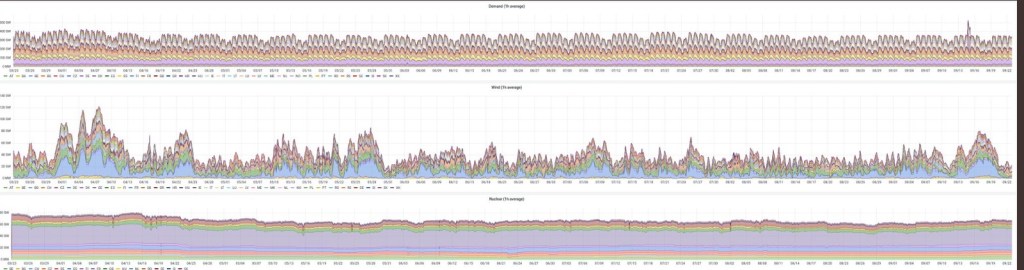
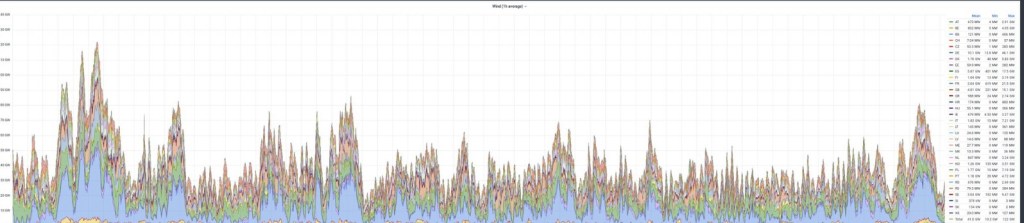
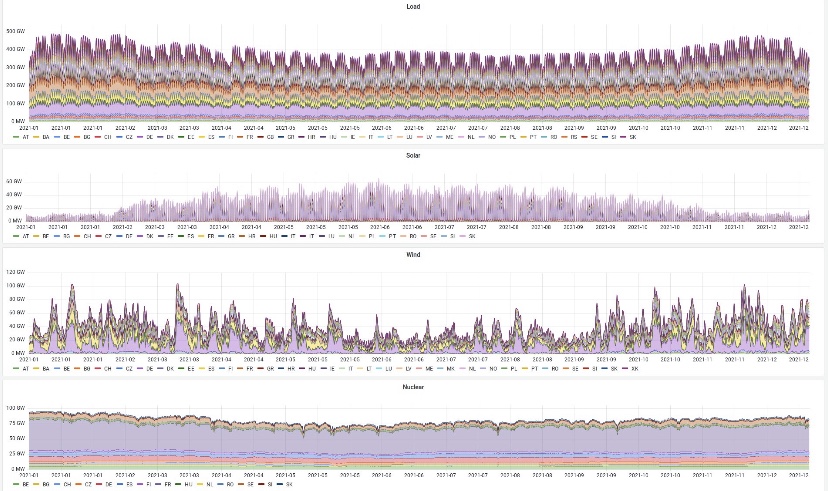
That’s a whopping 17.4% utilization factor! That’s pathetic, and it means the effective cost is quintuple the value at nameplate capacity. Take a look at this chart comparing the levels and variations in European power demand, nuclear generation, and wind generation over the six months ending September 22nd (if you have trouble zooming in here, try going to the thread):

The various colors represent different countries. Here’s a larger view of the wind component:

A stable power grid cannot be built upon this kind of intermittency. Here is another comparison that includes solar power. This chart is daily covering 2021 through about May 26, 2022.

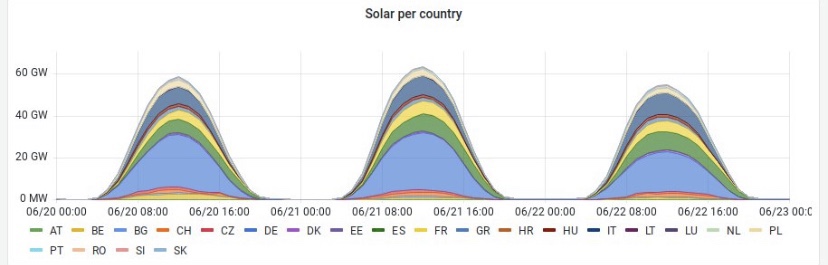
As for solar capacity utilization, it too is unimpressive. Here is Martian Data’s note on this point, followed by a chart of solar generation over the course of a few days in June:

“so ~15% solar capacity is whole year average. ~5% winter ~20% summer. And solar is brief in summer too…, it misses both both morning and evening peaks in demand.”

Like wind, the intermittency of solar power makes it an impractical substitute for traditional power sources. Check out Martian Data’s Twitter feed for updates and charts from other parts of the world.

Nuclear Efficiency

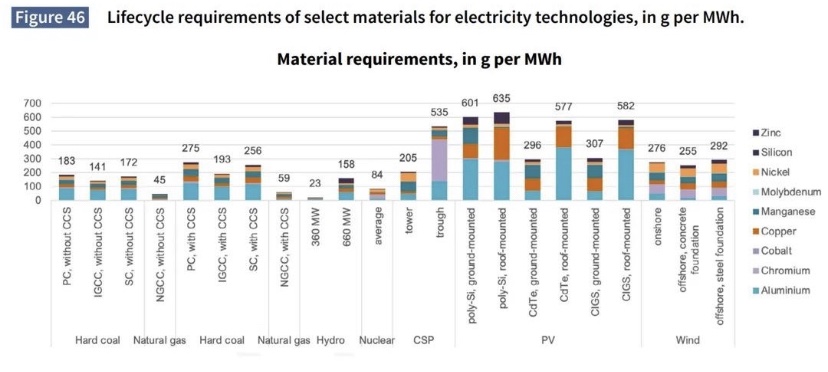
Nuclear power generation is an excellent source of baseload power. It is dispatchable and zero carbon except at plant construction. It also has an excellent safety record, and newer, modular reactor technologies are safer yet. It is cheaper in terms of generating capacity and it is more flexible than renewables. In fact, in terms of the resource costs of nuclear power vs. renewables over plant cycles, it’s not even close. Here’s a chart recently posted by Randall showing input quantities per megawatt hour produced over the expected life of each kind of power facility (different power sources are labeled at bottom, where PV = photovoltaic (solar)):

In fairness, I’m not completely satisfied with these comparisons. They should be stated in terms of current dollar costs, which would neutralize differences in input densities and reflect relative scarcities. Nevertheless, the differences in the chart are stark. Nuclear produces cheap, reliable power.

The Real Dirt

Solar and wind power are low utilization power sources and they are intermittent. Heavy reliance on these sources creates an extremely brittle power grid. Also, we should be mindful of the vast environmental degradation caused by the mining of minerals needed to produce solar panels and wind turbines, including their inevitable replacements, not to mention the massive land use requirements of wind and solar power. Also disturbing is the hazardous dumping of old solar panels from the “first world” now taking place in less developed countries. These so-called clean-energy sources are anything but clean or efficient.

Rejecting Fossil Fuels at Our Great Peril

18 Wednesday May 2022

Posted by Nuetzel in Central Planning, Energy, Risk, Technology

≈ 2 Comments

Tags

Bartley J. Madden, Biden Administration, Dan Ervin, Don Boudreaux, Electric Vehicles, Energy Mandates, Energy subsidies, EV Adoption, External Benefits, External Costs, Fossil fuels, Grid Stability, Intermittancy, Kevin Williamson, Markets, Power Outages, Price Controls, regressivity, Renewable energy, Russia Sanctions, SEC Carbon Mandate, Sustainability

The frantic rush to force transition to a zero-carbon future is unnecessary and destructive to both economic well-being and the global environment. I do not subscribe to the view that a zero-carbon goal is an eventual necessity, but even if we stipulate that it is, a rational transition would eschew the immediate abandonment of fossil fuels and adopt a gradual approach relying heavily on market signals rather than a mad dash via coercion.

I’ve written about exaggerated predictions of temperature trends and catastrophes on a number of occasions (and see here for a similar view from a surprising source). What might be less obvious is the waste inherent in forcing the abandonment of mature and economic technologies in favor of, as yet, under-developed and uneconomic technologies. These failures should be obvious when the grid fails, as it does increasingly. It is often better to leave the development and dispersion of new technologies to voluntary decision-making. In time, advances will make alternative, low- or zero-carbon energy sources cost effective and competitive to users. That will include efficient energy storage at scale, new nuclear technologies, geothermal techniques, and further improvements in the carbon efficiency of fossil fuels themselves. These should be chosen by private industry, not government planners.

Boneheads At the Helm

Production of fossil fuels has been severely hampered by the Biden Administration’s policies. The sanctions on Russian oil that only began to take hold in March have caused an additional surge in the price of oil. Primarily, however, we’ve witnessed an artificial market disruption instigated by Biden’s advisors on environmental policy. After all, neither Russian oil imports nor the more recent entreaties to rogue states as Iraq and Venezuela for oil would have been necessary if not for the Administration’s war on fossil fuels. Take a gander at this White House Executive Order issued in January 2021. It reads like a guidebook on how to kill an industry. In a column this weekend, Kevin Williamson quipped about “the Biden administration’s uncanny ability to get everything everywhere wrong all at once.” That was about policy responses to inflation, but it applies to energy in particular.

Scorning the Miracle

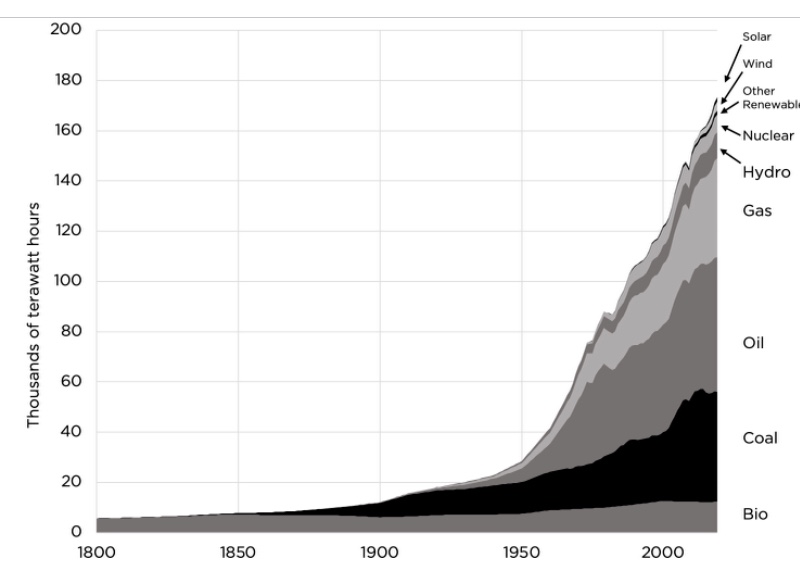
Fossil fuels are the source of cheap and reliable energy that have lifted humanity to an unprecedented level of prosperity. Fossil fuels have given a comfortable existence to billions of people, allowing them to rise out of poverty. This prosperity gives us the luxury of time to develop substitutes, not to mention much greater safety against the kind of weather extremes that have always been a fact of life. The world still gets 80% of its energy from fossil fuels. These fuels are truly a miracle, and we should not discard such valuable technologies prematurely. That forces huge long-term investments in inferior technologies that are likely to be superseded in the future by more economic refinements or even energy sources and methods now wholly unimagined. There are investors who will still wish to pursue those new technologies, perhaps with non pecuniary motives, and there are a few consumers who really want alternatives to fossil fuels.

Biden’s apparent hope that his aggressive climate agenda will be a great legacy of his presidency is at the root of his intransigence toward fossil fuels. His actions in this regard have had a profoundly negative psychological effect on the oil and gas industry. Steps such as cancellations of pipeline projects are immediately impactful in that regard, to say nothing of the supplies that would have ultimately flowed through those pipelines. These cancellations reinforce the message Biden’s been sending to the industry and its investors since his campaign: we mean to shut you down! Who wants to invest in new wells under those circumstances? Other actions have followed: no new federal oil and gas leases, methane restrictions, higher drilling fees on federal land, and a variety of climate change initiatives that bode ill for the industry, such as the SEC’s mandate on carbon disclosures and the Federal Reserve’s proposed role in policing climate impacts.

And now, Democrats are contemplating a move that would make gasoline even more scarce: price controls. As Don Boudreaux says in a recent letter to The Hill:

“Progressives incessantly threaten to tax and regulate carbon fuels into oblivion. These threats cannot but reduce investors’ willingness to fund each of the many steps – from exploration through refining to transporting gasoline to market – that are necessary to keep energy prices low. One reality reflected by today’s high prices at the pump is this hostility to carbon fuels generally and to petroleum especially. And gasoline price controls would only make matters worse by further reducing the attractiveness of investing in the petroleum industry: Why invest in bringing products to market if the prices at which you’re allowed to sell are dictated by grandstanding politicians?”

The kicker is that all these policies are futile in terms of their actual impact on global carbon concentrations, let alone their highly tenuous link to global temperatures. The policies are also severely regressive, inflicting disproportionate harm on the poor, who can least afford such an extravagant transition. Biden wants the country to sacrifice its standard of living in pursuit of these questionable goals, while major carbon-emitting nations like China and India essentially ignore the issue.

Half-Baked Substitution

Market intervention always has downsides to balance against the potential gains of “internalizing externalities”. In this case, the presumed negative externalities are imagined harms of catastrophic climate change from the use of fossil fuels; the presumed external benefits are the avoidance of carbon emissions and climate change via renewables and other “zero-carbon” technologies. With those harms and gains in question, it’s especially important to ask who loses. Taxpayers are certainly on that list. Users of energy produced with fossil fuels end up paying higher prices and are forced to conserve or submit to coerced conversion away from fossil fuels. Then there are the wider impediments to economic growth and, as noted above, the distributional consequences.

Users of immature or inferior energy alternatives might also end up as losers, and there are likely to be external costs associated with those technologies as well. It’s not widely appreciated that today’s so-called clean energy alternatives are plagued by their need to obtain certain minerals that are costly to extract in economic and environmental terms, not to mention highly carbon intensive. And when solar and wind facilities fail or reach the end of their useful lives, disposal creates another set of environmental hazards. In short, the loses imposed through forced internalization of highly uncertain externalities are all too real.

Unfortunately, the energy sources favored by the Administration fail to meet base-load power needs on windless and/or cloudy days. The intermittency of these key renewables means that other power sources, primarily fossil-fuel and nuclear capacity, must remain available to meet demand on an ongoing basis. That means the wind and solar cannot strictly replace fossil fuels and nuclear capacity unless we’re willing to tolerate severe outages. Growth in energy demand met by renewables must be matched by growth in backup capacity.

A call for “energy pragmatism” by Dan Ervin hinges on the use of coal to provide the “bridge to the energy future”, both because there remains a large amount of coal generating capacity and it can stabilize the grid given the intermittency of wind and solar. Ervin also bases his argument for coal on recent increases in the price of natural gas, though a reversal of the Biden EPA’s attacks on gas and coal, which Ervin acknowledges, would argue strongly in favor of natural gas as a pragmatic way forward.

Vehicle Mandates

The Administration has pushed mandates for electric vehicle (EV) production and sales, including subsidized charging stations. Of course, the power used by EVs is primarily generated by fossil fuels. Furthermore, rapid growth in EVs will put a tremendous additional strain on the electric grid, which renewables will not be able to relieve without additional backup capacity from fossil fuels and nuclear. This severely undermines the supposed environmental benefits of EVs.

Once again, mandates and subsidies are necessary because EV technology is not yet economic for most consumers. Those buyers don’t want to spend what’s necessary to purchase an EV, nor do they wish to suffer the inconveniences that re-charging often brings. This is a case in which policy is outrunning the ability of the underlying infrastructure required to support it. And while adoption of EVs is growing, it is still quite low (and see here).

Wising Up

Substitution into new inputs or technologies happens more rationally when prices accurately reflect true benefits and scarcities. The case for public subsidies and mandates in the push for a zero-carbon economy rests on model predictions of catastrophic global warming and a theoretical link between U.S. emissions and temperatures. Both links are weak and highly uncertain. What is certain is the efficiency of fossil fuels to power gains in human welfare.

This Bartley J. Madden quote sums up a philosophy of progress that is commendable for firms, and probably no less for public policymakers:

“Keep in mind that innovation is the key to sustainable progress that jointly delivers on financial performance and taking care of future generations through environmental improvements.”

Madden genuflects to the “sustainability” crowd, who otherwise don’t understand the importance of trusting markets to guide innovation. If we empower those who wish to crush private earnings from existing technologies, we concede the future to central planners, who are likely to choose poorly with respect to technology and timing. Let’s forego the coercive approach in favor of time, development, and voluntary adoption!

Markets Deal With Scarcity, Left Screams “Price Gouging”

11 Monday Apr 2022

Posted by Nuetzel in Antitrust, Environmental Fascism, Oil Prices

≈ Leave a comment

Tags

Antitrust, Barack Obama, central planning, ESG Scores, FDR, Fossil fuels, Gas Prices, Green New Deal, Intermittancy, Joe Biden, Keystone Pipeline, Lawrence Summers, Oil Prices, Oil Profits, OPEC, Power Grid, Price Gouging, Profit Margins, Profiteering, Renewable energy, Strategic Petroleum Reserve, Ukraine Invasion, Vladimir Putin, West Texas Intermediate

Democrats claim profiteering by oil companies is responsible for the sustained rise in oil prices since Joe Biden’s inauguration (really, his election). That’s among the more laughable attempts at gaslighting in recent memory, right up there with blaming market concentration for the sustained increase in inflation since Biden’s inauguration. At a hearing this week, congressional Democrats, frightened by the prospect of a beat-down just ahead in the mid-term elections, couldn’t resist making “price-gouging” accusations against oil producers. These pols stumble over their own contradictory talking points, insisting on more oil production only when they aren’t hastily sabotaging oil and gas output. Their dishonestly is galling, but so is the foolishness of voters who blindly accept the economic illiteracy issuing from that side of the aisle.

Break It Then Blame It

Those who level “price gouging” charges at oil companies are often the same people seeking to eliminate fossil fuel consumption by making those energy choices unaffordable. The latter is a bad look this close to mid-term elections, so they follow the playbook I described recently in “Break the Market, Blame It, Then Break It Some More“. And this post is instructive: “House Dem: Big Oil is profiteering by, er … doing what we demanded”.

Not only have the Democrats’ policies caused oil prices to soar; for many years they’ve been undermining the stability of the power grid via forced conversion into intermittent renewable energy sources like wind and solar, all while preventing the expansion of safe and carbon-free nuclear power generation. It’s ironic that these would-be industrial planners seem so eager to botch the job, though failure is all too typical of central planning. Just ask the Germans about their own hapless efforts at energy planning.

As economist Lawrence Summers, former Treasury Secretary under Barack Obama, said recently:

“Look, the net effect of the things the administration talks about in terms of micro policies to reduce inflation, this gouging talk is frivolous, nonserious, and utterly ineffectual. A gas price holiday would, ultimately, push up prices by raising demand. … The student loan relief … is injecting resources into the economy at a hundred billion dollar a year annual rate when the economy needs to be cooled off, not heated up. … The administration could be much more constructive than it has been with respect to energy supply.”

The market functions to allocate scarce resources. When conditions of scarcity become more acute, the market mechanism responds by pricing available supplies to both curtail use and incentivize delivery of additional quantities. That involves the processing of vast amounts of information, and it is a balancing at which the market performs extremely well relative to bumbling politicians and central planners, whose actions are too often at the root of acute scarcities.

Antitrust Nonsense

Of course, the Democrats have seized upon the inescapable fact that soaring oil prices cause profits to soar for anyone producing oil or holding stocks of oil. But oil company profits are notoriously volatile. Margins were negative for most of 2020, when demand weakened in the initial stages of the pandemic. And now, some companies are bracing for massive write-downs on abandoned drilling projects in Russia. The oil and gas business is certainly not known for high profit margins. Short-term profits, while they last, must be used to meet the physical or financial needs of the business.

The threats of antitrust action by the Biden Administration are an extension of the price-gouging narrative, even if the threat reflects an injudicious grasp of what it takes to prove collusion. It takes a fertile imagination to think western oil companies could successfully collude on pricing in a market dominated by the following players:

Fat chance. In any case, it’s a global market, and it’s impossible for western oil producers to dictate pricing. Even the OPEC cartel has been unable to dictate prices, not to mention keeping it’s members from violating production quotas. But if a successful conspiracy among oil companies to raise prices was possible, one would guess they’d have done it a lot sooner!

Nor is it possible for the oil majors to dictate prices at the pump, because retail prices are set independently. While the cost of crude oil is only about 54% of the cost of refined gas at retail, fluctuations in prices at the pump correlate strongly with crude oil prices. Here is a ten-year chart of daily price data, where the blue line is the price of West Texas Intermediate crude oil and the orange line is the average price of regular gas in the U.S.:

Here are the same two series for 2022 year-to-date:

Coerced Scarcity

Again, oil prices have been under upward pressure for over a year until a break in early March, following the steep run-up in the immediate wake of the Ukraine invasion. First there was Biden’s stultifying rhetoric, before and after the 2020 election, assisted by radical members of Congress. Then there were executive orders halting drilling on federal lands, killing the Keystone pipeline, efforts to shut down several other existing pipelines, and the imposition of regulatory penalties on drillers. In addition, unrest in certain parts of the Middle East curtailed production, compounded this year by the boycott on Russian oil (which, as a foreign policy matter, was far too late in coming).

However, existing facilities have been capable of squeezing out more oil and gas. Lo and behold, supply curves slope upward, even in the short-run! Despite all of Biden’s efforts to cripple domestic oil production, higher crude prices have brought forth some additional supplies. Biden’s raid on the Strategic Petroleum Reserve has also boosted supply for now, but its magnitude won’t help much, and it must be replaced for use during real U.S. national emergencies, which the war in Ukraine is not, as awful as it is.

That said, investing in new drilling capacity is not wise given the political climate created by Biden and the Democrats: they have been quite clear that they mean to crush the fossil fuel industry. For some time, the oil companies have been busy investing cash flows in “green” initiatives in an effort to bolster their ESG scores, a dubious exercise to say the least. Arguably, in this policy environment, the most responsible thing to do is to return some of the capital over which these firms are stewards to its rightful owners, many of whom are middle-class savers who hold oil stocks in their 401(k) funds. That approach is manifest in the recent stock buybacks and dividend payments oil companies have announced and defended before Congress.

Conclusion

A forced shutdown of fossil fuel energy was much ballyhooed by the Left as a part of Joe Biden’s agenda. Biden himself bought into the “Green New Deal”, imagining it might win him a vaunted place alongside FDR’s legacy in American history. The effort was unwise, but Biden is trying to hang onto the narrative and maintain his punitive measures against American oil companies. All the while, he begs OPEC producers to step up production, bending a knee to despots in countries such as Iran and Venezuela. Why, it’s as if their fossil fuels are somehow cleaner than those extracted in the U.S! The feeble Biden and congressional Democrats are proving just how mendacious they are. They can rightfully blame Vladimir Putin for the recent escalation in oil prices, but they bear much responsibility themselves for the burden of high gas prices, energy bills, and the unnecessary, ongoing scarcity victimizing the American public.

The SEC’s Absurd Climate Overreach

04 Monday Apr 2022

Posted by Nuetzel in Central Planning, Global Warming

≈ 2 Comments

Tags

capital costs, Carbon Emissions, Carbon Forcing Models, carbon Sensitivity, central planning, Corporatism, Disclosure Requirements, ESG Risk, ESG Scores, Green Energy, Greenhouse Gas, Hester Peirce, John Cochrane, Litigation Risk, Paris Agreement, Regulatory Risk, Renewable energy, Scope 1, Scope 2, Scope 3, SEC Climate Mandate, Securities and Exchange Commission

The Securities and Exchange Commission recently issued a proposed rule for reporting on climate change risk, and it is fairly outrageous. It asks that corporations report on their own direct greenhouse gas emissions (GHG – Scope 1), the emissions caused by their purchases of energy inputs (Scope 2), and the emissions caused by their “downstream” customers and “upstream” suppliers (Scope 3). This is another front in the Biden Administration’s efforts to bankrupt producers of fossil fuels and to force the private sector to radically alter its mix of energy inputs. The SEC’s proposed “disclosures” are sheer lunacy on several levels.

The SEC Mandate

If implemented, the rule would allow the SEC to stray well outside the bounds of its regulatory authority. The SEC’s role is not to regulate emissions or the environment. Rather, as its web site makes clear, the agency is charged with:

“… protecting investors, maintaining fair, orderly, and efficient markets, and facilitating capital formation.”

Given this mission, the SEC requires management to disclose material financial risks. Are a firm’s GHG emissions really material risks? The first problem here is quite practical: John Cochrane notes the outrageous costs that would be associated with compliance:

“‘Disclosure’ usually means revealing something you know. A perfectly honest answer to ‘disclose what you know about your carbon emissions’ is, ‘we have no idea what our carbon emissions are.’ Back that up with every document the company has ever produced, and you have perfectly ‘disclosed.’ There is no asymmetric information, fraud, etc.

The SEC has already required the production of new information, and as Hester Peirce makes perfectly clear, the climate rules again make a huge dinner out of that appetizer: essentially telling companies to hire a huge number of climate consultants to generate new information, and also how to run businesses.”

In a separate post, Cochrane quotes SEC Commissioner Hester Peirce’s response to the proposed rule. She emphasizes that companies are already required to disclose all material risks. Perhaps they have properly declined to disclose climate risks because those risks are not material.

“Current SEC disclosure mandates are intended to provide investors with an accurate picture of the company’s present and prospective performance through managers’ own eyes. How are they thinking about the company? What opportunities and risks do the board and managers see? What are the material determinants of the company’s financial value?”

Identifying the Risk Causers

Regardless of the actual risks to a firm caused by climate change, the SEC’s proposed GHG disclosures put a more subtle issue into play. Peirce describes what amounts to a fundamental shift in the SEC’s philosophy regarding the motivation and purpose of disclosure:

The proposal, by contrast, tells corporate managers how regulators, doing the bidding of an array of non-investor stakeholders, expect them to run their companies. It identifies a set of risks and opportunities—some perhaps real, others clearly theoretical—that managers should be considering and even suggests specific ways to mitigate those risks. It forces investors to view companies through the eyes of a vocal set of stakeholders, for whom a company’s climate reputation is of equal or greater importance than a company’s financial performance.”

In other words, a major risk faced by these firms has nothing to do with climate change itself, but with perceptions of “climate-related” risks by other parties. That transforms the question of climate risk into something that is, in fact, regulatory and political. Is this the true nature of the SEC’s concern, all dressed up in the scientism typically relied upon by climate change activists?

The reaction of government bureaucrats to the risks they perceive is a palpable threat to investor well-being. For example, GHG emissions might lead to future regulatory sanctions from various government agencies, including fines, taxes, various sanctions, and mitigation mandates. In addition, with the growth of investment management based on what are essentially shambolic and ad hoc ESG scores, GHG or carbon emissions might lead to constraints on a firm’s access to capital. Just ask the oil and gas industry! That penalty is imposed by activist investors and fund managers who wish to force an unwise and premature end to the use of fossil fuels. There is also a threat that GHG disclosures themselves, based (as they will be) on flimsy estimates, could create litigation risk for many companies.

Much Ado About Nothing

While there are major regulatory and political risks to investors, let’s ask, for the sake of argument: how would one degree celcius of warming by the end of this century affect corporate results? Generally not at all. (The bounds described in the Paris Agreement are 1.5 to 2 degrees, but these are based on unrealistic scenarios — see links below.) It would happen gradually in any case, with ample opportunity to adapt to the operating environment. To think otherwise requires great leaps of imagination. For example, climate alarmists probably fancy that violent weather or wildfires will wipe out facilities, yet there is no reliable evidence that the mild warming experienced to-date has been associated with more violent weather or an increased incidence of wildfires (and see here). There are a great many “sacred cows” worshiped by climate-change neurotics, and the SEC undoubtedly harbors many of those shibboleths.

What probabilities can be attached to each incremental degree of warming that might occur over several decades. The evidence we’ve seen comes from so-called carbon-forcing models parameterized for unrealistically high carbon sensitivities and subjected to unrealistic carbon-concentration scenarios. Estimates of these probabilities are not reliable.

Furthermore, climate change risks, even if they could be measured reliably in the aggregate, cannot reasonably be allocated to individual firms. The magnitude of the firm’s own contribution to that risk is equivalent to the marginal reduction in risk if the firm implemented a realistic zero-carbon operating rule. For virtually any firm, we’re talking about something infinitesimal. It involves tremendous guesswork given that various parties around the globe take a flexible approach to emissions, and will continue to do so. The very suggestion of such an exercise is an act of hubris.

Back To The SEC’s Mandated Role

Let’s return to the practical problems associated with these kinds of disclosure requirements. Cochrane also points out that the onerous nature of the SEC proposal, and the regulatory and political threats it embodies, will hasten the transition away from public ownership in many industries.

“The fixed costs alone are huge. The trend to going private and abandoning public markets, at least in the U.S. will continue. The trend to large oligopolized politically compliant static businesses in the U.S. will continue.

I would bet these rules wind up in court, and that these are important issues. They should be.”

Unfortunately, private companies will still have to to deal with certain investors who would shackle their use of energy inputs and demand forms of diligence (… not to say “due”) of their own.

The SEC’s proposed climate risk disclosures are stunningly authoritarian, and they are designed to coalesce with other demands by the regulatory state to kill carbon-based energy and promote renewables. These alternative energy sources are, as yet, unable to offer an economical and stable supply of power. The fraudulent nature of the alleged risks make this all the more appalling. The SEC has effectively undertaken an effort to engage in corporatist industrial policy benefitting a certain class of “green” energy investors, exposing the proposal as yet another step on the road to fascism. Let’s hope Cochrane is right: already, 16 state attorneys general are preparing a legal challenge. May the courts ultimately see through the SEC’s sham!

ESG Scoring: Political Tool Disguised as Investment Guide

30 Wednesday Mar 2022

Posted by Nuetzel in Capital Markets, Corporatism, Environmental Fascism, Social Justice

≈ 3 Comments

Tags

Access to Capital, Antitrust, Blackrock, Climate Action 100+, Corporatism, Diversity, Equity, ESG Fees, ESG Scores, Great Reset, Green Energy, Inclusion, John Cochrane, Mark Brnovich, Principal-Agent Problem, Renewable energy, Renewables, rent seeking, Shareholder Value, Social Justice, Stakeholder Capitalism, Sustainability, Too big to fail, Ukraine Invasion, Vladimir Putin, Woke Investors, Zero-Carbon

ESG scores are used to rate companies on “Environmental, Social, and Governance” criteria. The truth, however, is that ESGs are wholly subjective measures of company performance. There are many different ESG scores available, with no uniform standards for methodology, specific inputs, or weighting schemes. If you think quarterly earnings reports are manipulated, ESGs are an even more pliable tool for misleading investors. It is a market fad, and fund managers are using it as an excuse to charge higher fees to investors. But like any trending phenomenon, for a time, the focus on ESGs might feed-back positively to returns on favored companies. That won’t be sustainable, however, without legislative and regulatory cover, plus a little manipulative help from the ESG engineers and “Great Reset” propagandists.

It’s 100% Political, 0% Economic

ESGs are founded on prioritizing objectives that have little to do with shareholder value or any well-understood yardsticks of financial or operating performance. The demands on company resources for scoring highly on ESG are often nakedly political. This includes adoption of environmental goals such as fraudulent “zero carbon” impacts, the nebulous “sustainability” objective promoted by “green” activists, diversity, inclusion and equity initiatives, and support for activist groups such as Black Lives Matter and Antifa.

Concepts like “stakeholder value” are critical to the rationale for ESGs. “Stakeholders” can include employees, suppliers, and customers, as well as potential employees. suppliers, and customers. In other words, they can be just about anyone in the broader community, or more likely activists for “social change” whose interests have but the thinnest connection to the business’s productive activities. In essence, so-called stakeholder capitalism amounts to a ceding of control over corporate resources, and ultimately confiscation of wealth from equity owners.

Corporations have long engaged in various kinds of defensive actions, amounting to a modern-day trade in indulgences. No one will be upset about your gas-powered fleet if you buy enough carbon offsets, which just might neutralize the impact of the fleet on your ESG! On a more sinister level, ESG’s provide opportunities for cover against information that might be damaging to firms, such as the use of slave labor overseas. Flatter the right people, give to their causes, “partner” with them on pet initiatives, and your sins will be ignored and your ESG will climb! And ESGs are used in attempts to pacify leftist investors who see the corporation as a vessel for their own social objectives, quite apart from any mission it might have had as a productive enterprise.

Your ESG will shine if you do business that’s politically-favored, like renewable energy, despite its inefficiencies and significant environmental blemishes. But ESGs are not merely used to reward those anointed as virtuous by the Left. They are more forcefully used to punish firms in industries that are out of favor, or firms refusing to participate in buying off authoritarian crusaders. For example, you might be so berserk as to think fossil fuels and climate change represent imminent threats of catastrophe. Naturally, you’ll want to punish oil and gas producers. In fact, if you are in charge of ESG modeling, you might want to penalize almost any extraction industry, with certain exceptions: the massive extraction and disposal costs of renewables will pass without notice.

All these machinations occur despite the huge uncertainty surrounding flimsy, model-based predictions of warming and global catastrophe. Never mind that fossil fuels are still relied upon to provide for most of our energy needs and will be for some time to come, including base-load power generation when intermittency prevents renewables from meeting demand. The stability of the power grid depends upon the availability of carbon-based energy, which in fact is marvelously efficient. Yet the ESG crowd (not to mention the Biden Administration) seeks to drive up its cost, including the cost of capital, and these added costs fall most heavily on the poor.

ESG-guided efforts by activists to deny capital to certain segments of the energy sector may constitute antitrust violations. Some big players in the financial industry, who together manage trillions of dollars in investment funds, belong to an advocacy organization called Climate Action 100+. They coordinate on a mission to completely transform the energy industry via “green” investments and divestments of presumptively “dirty” concerns. These players and their clients have huge investments in green energy, and it is in their interest to provide cheap capital to those firms while denying capital to fossil fuel industries. As Arizona Attorney General Mark Brnovich writes at the link above, this is restraint of trade “hiding in plain sight”.

Manipulation

ESGs could be the mother of all principal-agent problems. Corporate CEOs, hired by ownership as stewards and managers of productive assets, are promoting these metrics and activities, which may not align with the interests of ownership. ESG’s are not standardized, and most users will have little insight into exactly how these “stakeholder” sausages are stuffed. In fact, much of the information used for ESGs is extremely ad hoc, not universally disclosed, and is often qualitative. The applicability of these scores to the universe of stocks, and their reliability in guiding investment decisions, is extremely questionable no matter what the investor’s objectives. And of course the models can be manipulated to produce scores that suit the preferences of money managers who have a stake in certain firms or industry segments, and who inflate their fees in exchange for ESG investment advice. And firms can certainly engage in deceptions that boost ESGs, as already discussed.

Like many cultural or consumer trends, investment trends can feed off themselves for a time. If there are enough “woke” investors, ESGs might well feed an unvirtuous cycle of stock purchases in which returns become positively correlated with wokeness. Such a divorce from business fundamentals will eventually take its toll on returns, especially when economic or other conditions present challenges, but that’s not the answer you’ll get from many stock pickers and investment pundits.

At the same time, there are ways in which the preoccupation with ESGs dovetails with the rents often sought in the political arena. Subsidies, for example, will be awarded to firms producing renewables. Politically favored firms are also likely to receive better regulatory treatment.

There are other ways in which firms engaging in wasteful activities can survive profitably, at least for a time. Monopoly power is one, and companies often develop a symbiosis with regulators that hampers smaller competitors. This is traditional rent-seeking corporatism in action, along with the “too-big-to-fail” regime. Sometimes sheer growth in demand for new technologies or networking potential helps to conceal waste. Hot opportunities can leave growing companies awash in cash, some of which will be burned in wasteful endeavors. ESG scoring offers them additional cover.

Cracks In the Edifice

John Cochrane notes a fundamental, long-term contradiction for those who invest based on ESGs: an influx of capital will tend to drive down returns in those firms and industries, while the returns on firms having low ESGs will be driven upward. Yet advocates claim you can invest for virtue and superior returns. That can’t outlast real market forces, especially as ESG efforts dilute any mission a firm might have as a productive enterprise.

Vladimir Putin’s brutal invasion of Ukraine has revealed other cracks in the ESG edifice. We now have parties arguing that defense stocks should be awarded ESG points! Also, that oil production by specific nations should be scored highly. There is also an awakening to the viability of nuclear power as an energy source. Then we have the problem of delivering on Biden’s promise to Europe of more liquified natural gas exports. That will be difficult given the way Biden has bludgeoned the industry, as well as the ESG conspiracy to deny it access to capital. Just watch the ESG hacks backpedal. Now, even the evangelists at Blackrock are wavering. To see the thread of supposed ESG consistency unravel would be enough to make you laugh if the entire conspiracy weren’t so grotesque.

Closing

The pretensions underlying “green” initiatives undertaken by large corporations are good mainly for virtue signaling, to collect public subsidies, and to earn better ESG scores. They are usually wasteful in a pure economic sense. The same is true of social justice and diversity initiatives, which can be perversely racist in their effects and undermine the rule of law.

Ultimately, we must recognize that the best contribution any producer can make to society is to create value for shareholders and customers by doing what it does well. The business world, however, has gone far astray in the direction of rank corporatism, and keep this in mind: any company supporting a sprawling HR department, pervasive diversity efforts, “sustainability” initiatives, and preoccupations with “stakeholder” outreach is distracted from its raison d’etre, its purpose as a business enterprise to produce something of value. It is probably captive to outside interests who have essentially commandeered management’s attention and shareholders’ resources.

When it comes to investing, I prefer absolute neutrality with respect to out-of-mission social goals. Sure, do no harm, but the focus should remain squarely on goals inherent in the creation of value for customers and shareholders.

Bill Gates, Wayward Climate Nerd

17 Wednesday Nov 2021

Posted by Nuetzel in Climate, Energy

≈ Leave a comment

Tags

Abortion, Anti-Vaxers, Battery Technology, Bill Gates, Carbon Capture, Carbon Concentration, Carbon Efficiency, Carbon Emissions, CO2, David Solway, Fossil fuels, Gates Foundation, Green Premium, Health and Fertility, Hydrogen Power, Industrial Policy, Kaya Identity, Lockdowns, Median Voter, Natural Gas, Net Zero Carbon, Non-Pharmaceutical interventions, Nuclear power, Power Storage, Renewable energy, Reproductive Health Services, Solar Power, TED Talks, Thomas Malthus, Vaccine Passports, Wind Power, World Health Organization

Bill Gates’ considerable philanthropic efforts through the Gates Foundation are well known. Much of the foundation’s activity has focused on disease control and nutrition around the globe. Education reform has also been a priority. Many of these projects are laudable, though I’m repulsed by a few (see here and here). During the coronavirus pandemic, Gates has spoken approvingly of Non-Pharmaceutical Interventions (lockdown measures), which are both coercive and ineffective (and see here). He has earned the enmity of anti-vaxers, of course, though I’m not anti-vax as long as the jabs are voluntary. The Gates Foundation funded the World Health Organization’s effort to provide guidance on digital vaccine passports, which is a de facto endorsement of discrimination based on vaccination status. His priorities for addressing climate change also raise some troubling issues, a few of which I address below.

Squeezing Policy from a Definition

Gates put a special Malthusian twist on a TED Talk he did back in 2010 using an equation for carbon dioxide emissions, which he’s reprised over the years. It gained a lot of notice in 2016 when a few sticklers noticed that his claim to have “discovered” the equation was false. The equation is:

CO2 = P x S x E x C,

where P = People, S = Services per person, E = Energy per service, and C = CO2 per energy unit.

This equation first appeared as the so-called Kaya Identity in a scientific review in 2002. Such an equation can be helpful in organizing one’s thoughts, but it has no operational implications in and of itself. At one level it is superficial: we could write a similar identity for almost anything, like the quantity of alcohol consumed in a year, which must equal the population times the ounces of alcohol per drink times the number of drinks per person. At a deeper level, it can be tempting to build theories around such equations, and there is no question that any theory about CO2 must at least preserve the identity.

There’s an obvious temptation to treat an equation like this as something that can be manipulated by policy, despite the possibility of behavioral links across components that might lead to unintended consequences. This is where Gates gets into trouble.

Reality Checks

As David Solway writes, Gates’ jumped to the conclusion that population drives carbon emissions, reinforcing a likely perspective that the human population is unsustainable. His benevolent solution? A healthier population won’t breed as fast, so he prescribes more vaccinations (voluntary?) and improved health care. For good measure, he added a third prong: better “reproductive health services”. Let’s see… what share of the 0.9 -1.4 billion reduction in world population Gates prescribed in 2016 would have come from terminated pregnancies?

In fact, healthier people might or might not want more children, but lower child mortality in the developing world would reduce certain economic incentives for high fertility. Another reliable association is between income and child bearing: an increase in “services per person” is likely to lead to smaller families, but that wasn’t given any emphasis by Gates. Income growth is simply not part of the narrative! Yet income growth does something else: it allows us to more easily afford the research and investments required for advanced technologies, including cleaner energy. These things take time, however.

Solway points to other weaknesses in Gates’ interpretation of the Kaya Identity. For example, efforts to slow population growth are not reliably associated with “services per person”, fuel efficiency, or carbon efficiency. In other words, carbon emissions may be powerfully influenced by factors other than population. China is a case in point.

Centralized industrial and social planning is generally ill-suited to advancing human well being. It’s especially suspect if the sole objective is to reduce carbon emissions. But Gates knows that lowering emissions without a corresponding drop in real income requires continuing technological advances and/or more efficient decisions about which technologies to deploy. He is a big advocate of developing cheap hydrogen power, which is far from a reality. He is also excited about carbon capture technologies, which are still in their infancy.

Renewables like wind and solar power play a large part in Gates’ vision. Those technologies cannot deliver a reliable flow of power, however, without either adequate backup capacity or a dramatic advance in battery technology. Gates over-promotes wind and solar, but I give him credit for acknowledging their intermittency. He attempts to come to grips with it by advocating nuclear backup, but it’s just not clear that he has integrated the incremental cost of the necessary backup capacity with other direct costs of these renewables… not to mention the considerable environmental costs imposed by wind and solar (see the “back-to-nature” photo at the top for a cogent illustration). Power storage at scale is still a long way off, and its cost will be significant as well.

We could deploy existing energy technologies to greater advantage with respect to carbon efficiency. We’ve already reduced CO2 emissions in the U.S. by substituting natural gas for less carbon-efficient fuels, but the Biden Administration would rather discourage its use. Gates deserves credit for recognizing the huge role that nuclear energy can play in providing zero-carbon power. Despite that, he still can’t quite bring himself to admit the boneheadedness of heavy reliance on intermittent renewables.

Bill’s “Green Premium”

Gates seems to have deemphasized the Kaya Identity more recently. Instead, his focus has shifted to the so-called “green premium”, or the incremental cost of using zero-carbon technology relative to a traditional source. Needless to say, the premium is large for truly zero-carbon sources, but Gates emphasizes the importance of using the green premium to guide development even in the here and now.

That’s fine, but it’s not clear that he gives adequate consideration to cases in which emissions, while not eliminated, can be reduced at a negative incremental cost via appropriate substitution. That describes the transition to natural gas from other fuels. This is something that markets can do without the assistance of ham-handed interventionists. Gates prefers nuclear power and says natural gas is “not a real bridge technology” to a zero carbon future. That’s short-sighted and reflects an absolutist mindset that ignores both the economic and political environment. The thinking is that if it’s not zero emissions, it’s not worth doing.

Gates emphasizes the need to sharply reduce the range of green premia on various technologies to achieve net-zero carbon emissions by 2050. But the goal of net-zero emissions 2050 is based on the highly unlikely proposition that global catastrophe awaits failing net-zero. In fact, the predicted consequences of doing nothing are based on drastic and outdated carbon growth scenarios and rudimentary carbon-forcing models that have proven to be severely biased to the upside in terms of predicting global temperature trends.

The idea that 2050 is some kind of “deadline” is a wholly arbitrary determination. Furthermore, the absolutism with which such goals are stated belies a failure to properly assess the true costs and benefits of carbon-based energy. If we so much as accept the notion that fossil fuels have external costs, we are then expected to accept that zero carbon emissions is optimal. This is not “science”; it is doctrine propped-up by bizarre and false scare stories. It involves massive efforts to manipulate opinion and coerce behavior based upon shoddy forecasts produced by committee. Even carbon capture technology is considered “problematic” because it implies that someone, somewhere, will use a process that emits CO2. That’s a ridiculous bogeyman, of course, and even Gates supports development of carbon capture.

Conclusion

I’ve never felt any real antipathy for Bill Gates as a person. He built a fortune, and I used his company’s software for most of my career. In some ways I still prefer it to macOS. I believe Gates is sincere in his efforts to help humanity even if his efforts are misdirected. He seems to reside on the less crazy end of the spectrum of climate alarmists. He’s putting a great deal of his private resources toward development of technologies that, if successful, might actually lead to less coercion by those attempting to transform private energy decisions. Nevertheless, there is menace in some of the solutions to which Gates clings. They require concerted action on the part of central authorities that would commandeer private resources and abrogate liberty. His assertion that the world is over-populated is both dubious and dangerous. You can offer free health care, but a conviction that the population must be thinned can lead to far more radical and monstrous initiatives.

The “green premium” promoted by Gates is an indirect measure of how far we must go to achieve parity in the pricing of carbon and non-carbon energy sources, as if parity should be an objective of public policy. That proposition is based on bad economics, fraudulent analyses of trends in carbon concentrations and climate trends, and a purposely incomplete menu of technological alternatives. Yes, the green premium highlights various technological challenges, but it is also a direct measure of how much intervention via taxes or subsidies are necessary to achieve parity. Is that a temptation to policymakers? Or does it represent a daunting political barrier? It’s pretty clear that the “median voter” does not view climate change as the only priority.

← Older posts
Follow Sacred Cow Chips on WordPress.com

Recent Posts

  • Immigration and Merit As Fiscal Propositions
  • Tariff “Dividend” From An Indigent State
  • Almost Looks Like the Fed Has a 3% Inflation Target
  • Government Malpractice Breeds Health Care Havoc
  • A Tax On Imports Takes a Toll on Exports

Archives

  • December 2025
  • November 2025
  • October 2025
  • September 2025
  • August 2025
  • July 2025
  • June 2025
  • May 2025
  • April 2025
  • March 2025
  • February 2025
  • January 2025
  • December 2024
  • November 2024
  • October 2024
  • September 2024
  • August 2024
  • July 2024
  • June 2024
  • May 2024
  • April 2024
  • March 2024
  • February 2024
  • January 2024
  • December 2023
  • November 2023
  • August 2023
  • July 2023
  • June 2023
  • May 2023
  • April 2023
  • March 2023
  • February 2023
  • January 2023
  • December 2022
  • November 2022
  • October 2022
  • September 2022
  • August 2022
  • July 2022
  • June 2022
  • May 2022
  • April 2022
  • March 2022
  • February 2022
  • January 2022
  • December 2021
  • November 2021
  • October 2021
  • September 2021
  • August 2021
  • July 2021
  • June 2021
  • May 2021
  • April 2021
  • March 2021
  • February 2021
  • January 2021
  • December 2020
  • November 2020
  • October 2020
  • September 2020
  • August 2020
  • July 2020
  • June 2020
  • May 2020
  • April 2020
  • March 2020
  • February 2020
  • January 2020
  • December 2019
  • November 2019
  • October 2019
  • September 2019
  • August 2019
  • July 2019
  • June 2019
  • May 2019
  • April 2019
  • March 2019
  • February 2019
  • January 2019
  • December 2018
  • November 2018
  • October 2018
  • September 2018
  • August 2018
  • July 2018
  • June 2018
  • May 2018
  • April 2018
  • March 2018
  • February 2018
  • January 2018
  • December 2017
  • November 2017
  • October 2017
  • September 2017
  • August 2017
  • July 2017
  • June 2017
  • May 2017
  • April 2017
  • March 2017
  • February 2017
  • January 2017
  • December 2016
  • November 2016
  • October 2016
  • September 2016
  • August 2016
  • July 2016
  • June 2016
  • May 2016
  • April 2016
  • March 2016
  • February 2016
  • January 2016
  • December 2015
  • November 2015
  • October 2015
  • September 2015
  • August 2015
  • July 2015
  • June 2015
  • May 2015
  • April 2015
  • March 2015
  • February 2015
  • January 2015
  • December 2014
  • November 2014
  • October 2014
  • September 2014
  • August 2014
  • July 2014
  • June 2014
  • May 2014
  • April 2014
  • March 2014

Blogs I Follow

  • Passive Income Kickstart
  • OnlyFinance.net
  • TLC Cholesterol
  • Nintil
  • kendunning.net
  • DCWhispers.com
  • Hoong-Wai in the UK
  • Marginal REVOLUTION
  • Stlouis
  • Watts Up With That?
  • Aussie Nationalist Blog
  • American Elephants
  • The View from Alexandria
  • The Gymnasium
  • A Force for Good
  • Notes On Liberty
  • troymo
  • SUNDAY BLOG Stephanie Sievers
  • Miss Lou Acquiring Lore
  • Your Well Wisher Program
  • Objectivism In Depth
  • RobotEnomics
  • Orderstatistic
  • Paradigm Library
  • Scattered Showers and Quicksand

Blog at WordPress.com.

Passive Income Kickstart

OnlyFinance.net

TLC Cholesterol

Nintil

To estimate, compare, distinguish, discuss, and trace to its principal sources everything

kendunning.net

The Future is Ours to Create

DCWhispers.com

Hoong-Wai in the UK

A Commonwealth immigrant's perspective on the UK's public arena.

Marginal REVOLUTION

Small Steps Toward A Much Better World

Stlouis

Watts Up With That?

The world's most viewed site on global warming and climate change

Aussie Nationalist Blog

Commentary from a Paleoconservative and Nationalist perspective

American Elephants

Defending Life, Liberty and the Pursuit of Happiness

The View from Alexandria

In advanced civilizations the period loosely called Alexandrian is usually associated with flexible morals, perfunctory religion, populist standards and cosmopolitan tastes, feminism, exotic cults, and the rapid turnover of high and low fads---in short, a falling away (which is all that decadence means) from the strictness of traditional rules, embodied in character and inforced from within. -- Jacques Barzun

The Gymnasium

A place for reason, politics, economics, and faith steeped in the classical liberal tradition

A Force for Good

How economics, morality, and markets combine

Notes On Liberty

Spontaneous thoughts on a humble creed

troymo

SUNDAY BLOG Stephanie Sievers

Escaping the everyday life with photographs from my travels

Miss Lou Acquiring Lore

Gallery of Life...

Your Well Wisher Program

Attempt to solve commonly known problems…

Objectivism In Depth

Exploring Ayn Rand's revolutionary philosophy.

RobotEnomics

(A)n (I)ntelligent Future

Orderstatistic

Economics, chess and anything else on my mind.

Paradigm Library

OODA Looping

Scattered Showers and Quicksand

Musings on science, investing, finance, economics, politics, and probably fly fishing.

  • Subscribe Subscribed
    • Sacred Cow Chips
    • Join 128 other subscribers
    • Already have a WordPress.com account? Log in now.
    • Sacred Cow Chips
    • Subscribe Subscribed
    • Sign up
    • Log in
    • Report this content
    • View site in Reader
    • Manage subscriptions
    • Collapse this bar
 

Loading Comments...