• About

Sacred Cow Chips

Sacred Cow Chips

Author Archives: Nuetzel

The Anti-CRT Revolt: Banning a Racist Curriculum

16 Wednesday Jun 2021

Posted by Nuetzel in Critical Race Theory, Education, racism, Uncategorized

≈ Leave a comment

Tags

1619 Project, Black Lives Matter, Critical Race Theory, Disparate impact, Food Deserts, Jim Crow, Living Wage, New York Times, racism, Systemic Racism, Unconscious Bias, Zinn Education Project

Suddenly it’s dawned on many people of good faith that our educational, business, and other institutions have been commandeered by adherents to critical race theory (CRT), which teaches that all social interactions and outcomes must be viewed through the lens of racial identity and exploitation. In fact, it teaches that racism is endemic, whether conscious or unconscious, among people deemed to have privilege. They are labeled as oppressors, especially anyone with white skin. Furthermore, CRT holds that racism is systemic, and therefore the “system”, meaning all of our institutions and social arrangements, must be radically transformed. Some or all of these tenets are taught to our children in public and private schools, and they are embedded in anti-bias and diversity training delivered to employees of government, non-profits, and private companies.

Standing Up To It

It’s easy to see why many have come to view CRT as a racist philosophy in its own right. Teaching children that they are either “oppressors” or “victims” based on the color of their skin, is a deeply flawed and dangerous practice. The revelation of CRT’s cultural inroads has prompted an angry counter-revolution by parents who hope to purge CRT from the curricula in their children’s schools… schools that they PAY FOR as taxpayers. Many other fair-minded people are offended by the sweeping racism and identity politics inherent in CRT. And yet its proponents continue in attempts to gaslight the public. More on that below.

The groundswell of opposition to CRT is evident in explosive meetings of school boards across the country, as well as recent school board elections in which slates of candidates opposed to the teaching of CRT have been victorious (see here, here, and here).

In addition, we’ve seen a number of recent legislative or administrative initiatives at the state level. There are now, or recently have been, efforts in 22 states to ban or restrict the instruction of CRT. In some cases, institutions found to be in violation of the new laws are subject to deadlines to remedy the situation. Otherwise, funding dispersed by their state’s Department of Education may be cut by ten percent, for example.

But It’s Speech

As happy as I am to witness the pushback, it’s fair to ask whether the most severe restrictions are reasonable from an educational point of view. For example, as a social philosophy, and as wrong-headed as I believe it to be, there is no reason CRT can’t be discussed alongside other social philosophies, failed and otherwise, without endorsement. For that matter, we should not insist that schools shield children from the fact that racism exists, and CRT certainly has its place along the spectrum of racism.

For my own part, I believe elective classes covering CRT as one philosophical position among others should be defended, as should instruction in the history of American slavery and Jim Crow laws, for example. However, mandatory training in CRT is unacceptable and, to the extent that students or employees are required to accept its tenets, it constitutes compelled speech. To the extent that certain groups of students are identified as inherently biased, it is a form of defamation and a personal attack. 

Legislation

Some states are attempting to ban CRT outright. Others have imposed strictures on certain messages arising from the CRT curriculum. The Florida Department of Education just passed an extremely brief rule stating: 

“Instruction on the required topics must be factual and objective, and may not suppress or distort significant historical events, such as the Holocaust, and may not define American history as something other than the creation of a new nation based largely on universal principles stated in the Declaration of Independence.”

The Florida rule prohibits teaching the 1619 Project as part of the history curriculum. This revised “history” of our nation’s founding was sponsored by the New York Times. It insists that the Revolutionary War was fought to preserve American slavery, an assertion that has been condemned as false by many historians (see here and here), though the Left still desperately clings to it. I have no problem with a prohibition on false histories, though again, it’s important for students to learn that slavery was the subject of much debate at the nation’s founding and that it persisted beyond that time. No one kept those facts from us when I was a child. And they didn’t brand white students as oppressors.

While a rulemaking by a state Department of Education is better than nothing, it’s a far cry from an actual piece of legislation. A bill signed into law in Idaho in late March contained substantially the same provisions as the rule promulgated in Florida, but it didn’t proscribe the 1619 Project. The same is true of the bill signed into law in Oklahoma in early May. 

In Texas, the state senate passed a bill in May that would ban instruction in any public school or state agency of any of the following:

“… one race or sex is inherently superior to another race or sex

an individual, by virtue of his or her race or sex, is inherently racist, sexist, or oppressive, whether consciously or unconsciously;

an individual, by virtue of his or her race or sex, bears responsibility for actions committed in the past by other members of the same race or sex;

meritocracy or traits such as a hard work ethic are racist or sexist, or were created by … members of a particular race to oppress members of another race.”

A new law in Iowa and abill signed by the governor of Tennessee in late May contained similar provisions, essentially banning instruction of some highly objectionable tenets of CRT. However, the Iowa and Tennessee laws are careful to spell out what the law should not be construed to do. For example, these laws do not:

“—Inhibit or violate the first amendment rights of students or faculty, or undermine a school district’s duty to protect to the fullest degree intellectual freedom and free expression.
—Prohibit discussing specific defined concepts as part of a larger course of academic instruction.
—Prohibit the use of curriculum that teaches the topics of sexism, slavery, racial oppression, racial segregation, or racial discrimination, including topics relating to the enactment and enforcement of laws resulting in sexism, racial oppression, segregation, and discrimination.
“

A bill in the Missouri House mentions a few such protections. However, the Missouri bill is general in the sense that it explicitly bans the instruction of CRT by name, rather than simply blocking a few unsavory messages of CRT, as detailed by Texas and a few other states. Utah’s legislation, which is awaiting the governor’s signature, is also quite brief and explicit in its prohibition of CRT. I greatly prefer the Texas approach, however, as it makes clear that discussions of CRT in the classroom are not precluded, as might be inferred from the language of the Missouri bill. 

But, But… You Just Don’t Get It!

PProtests against these legislative actions have shown a certain tone-deaf belligerence. According to an organization called Black Lives Matter at School and the Zinn Education Project, all the protesters want is a curriculum that illuminates:

“… full and accurate U.S. history and current events … rais[ing] awareness of the dangers of lying to students about systemic racism and other forms of oppression.”

One advocate says they must be free to teach the “truth” of our nation’s foundational and ongoing structural racism. The Missouri bill, they say, “fails to note ‘a single lesson’ which is ‘inaccurate’ or ‘misleads’ students.” It’s not as if it’s necessary for legislation to provide a series of examples, but be that as it may, these CRT advocates know exactly what many find objectionable. Essentially, their response is, “You don’t understand CRT! WE are the experts on systemic, institutional racism.” What they believe is somehow, every negative outcome is actuated by racism of one kind or another, past or present.

Divining the “Fault” Line

Are you below the poverty line? Earning less than a “living wage”? Are you unemployed? Is your credit score lousy? Do you live in a high crime area? In a “food desert”? Are you a single parent? Did you receive a failing grade? Is your rent going up? Did someone fail to defer to you? Did they “disrespect” you, whatever your definition? Were you scolded for being late? 

Of course, none of those “outcomes” is exclusive to people of color or minorities. But wait! Someone else is earning a decent income. They got good grades. They have a high credit score. They drive a nice car. They have skills. 

Does any of that make them guilty of oppression? Does this have something to do with YOU?

Well, you see, CRT teaches us that every unequal outcome must be the consequence of unjust, “disparate impacts” inherent to the social and economic order. To be clear, outcomes are a legitimate subject of policy debate, and we should aim for improved well-being across the board. The point that defenders of CRT miss is that unequal outcomes are seldom diabolic in and of themselves. Real indications of injustice, past or present, do not imply that any one class of individuals is inherently racist or behaves in a discriminatory manner.

Critical Theory Is a Fraud

Critical race “theory” is nothing but blame in fraudulent “search” of perpetrators. It is fraudulent because the perps are already identified in advance. It is “critical” because someone or something deserves blame. The real exercise is to spin a tale of misused privilege and biased conduct by the privileged perps against a set of oppressed victims.

CRT is not just one theory, but a whole slew of theories of blame. The very attitudes of the purveyors of CRT show they do not believe their “theories” are falsifiable. And indeed, allegations of unconscious bias are impossible to falsify. Thus, CRT is not a theory, as such. It amounts to a polemic, and it should only be discussed as such. It certainly shouldn’t be taught as “truth” to children, university students, or employees. More states should jump on-board to restrict the CRT putsch to propagandize.

An Internet for Users, Not Gatekeepers and Monopolists

09 Wednesday Jun 2021

Posted by Nuetzel in Censorship, Social Media, Uncategorized

≈ Leave a comment

Tags

Alphabet, Amazon, Anti-Trust, Biden v. Knight First Amendment Institute, Big Tech, Censor Track, Censorship, Clarence Thomas, Clubhousse, Common Carrier, Communications Decency Act, Daniel Oliver, Department of Justice, Exclusivity, Facebook, Fairness Doctrine, Gab, Google, Google Maps, Internet Accountability Project, Josh Hawley, Katherine Mangu-Ward, Media Research Center, MeWe, monopoly, Muhammadu Buhari, Murray Rothbard, My Space, Net Neutrality, Public Accommodation, Public Forum, Quillet, Right to Exclude, Ron DeSantis, Scholar, Section 230, Social Media, Statista, Street View, Telegram, TikTok, Twitter, Tying Arrangement

Factions comprising a majority of the public want to see SOMETHING done to curb the power of Big Tech, particularly Google/Alphabet, Facebook, Amazon, and Twitter. The apprehensions center around market power, censorship, and political influence, and many of us share all of those concerns. The solutions proposed thus far generally fall into the categories of antitrust action and legislative changes with the intent to protect free speech, but it is unlikely that anything meaningful will happen under the current administration. That would probably require an opposition super-majority in Congress. Meanwhile, some caution the problem is blown out of proportion and that we should not be too eager for government to intervene. 

Competition

There are problems with almost every possible avenue for reining in the tech oligopolies. From a libertarian perspective, the most ideal solution to all dimensions of this problem is organic market competition. Unfortunately, the task of getting competitive platforms off the ground seems almost insurmountable. In social media, the benefits to users of a large, incumbent network are nearly overwhelming. That’s well known to anyone who’s left Facebook and found how difficult it is to gain traction on other social media platforms. Hardly anyone you know is there!

Google is the dominant search engine by far, and the reasons are not quite as wholesome as the “don’t-be-evil” mantra goes. There are plenty of other search engines, but some are merely shells using Google’s engine in the background. Others have privacy advantages and perhaps more balanced search results than Google, but with relatively few users. Google’s array of complementary offerings, such as Google Maps, Street View, and Scholar, make it hard for users to get away from it entirely.

Amazon has been very successful in gaining retail market share over the years. It now accounts for an estimated 50% of retail e-commerce sales in the U.S., according to Statista. That’s hardly a monopoly, but Amazon’s scale and ubiquity in the online retail market creates massive advantages for buyers in terms of cost, convenience, and the scope of offerings. It creates advantages for online sellers as well, as long as Amazon itself doesn’t undercut them, which it is known to do. As a buyer, you almost have to be mad at them to bother with other online retail platforms or shopping direct. I’m mad, of course, but I STILL find myself buying through Amazon more often than I’d like. But yes, Amazon has competition.

Anti-Trust

Quillette favors antitrust action against Big Tech. Amazon and Alphabet are most often mentioned in the context of anti-competitive behavior, though the others are hardly free of complaints along those lines. Amazon routinely discriminates in favor of products in which it has a direct or indirect interest, and Google discriminates in favor of its own marketplace and has had several costly run-ins with EU antitrust enforcers. Small businesses are often cited as victims of Google’s cut-throat business tactics.

The Department of Justice filed suit against Google in October, 2020 for anti-competitive and exclusionary practices in the search and search advertising businesses. The main thrust of the charges are:

  • Exclusivity agreements prohibiting preinstallation of other search engines;
  • Tying arrangements forcing preinstallation of Google and no way to delete it;
  • Suppressing competition in advertising;

There are two other antitrust cases filed by state attorneys general against Google alleging monopolistic practices benefitting its own services at the expense of sellers in various lines of business. All of these cases, state and federal, are likely to drag on for years and the outcomes could take any number of forms: fines, structural separation of different parts of the business, and divestiture are all possibilities. Or perhaps nothing. But I suppose one can hope that the threat of anti-trust challenges, and of prolonged battles defending against such charges, will have a way of tempering anti-competitive tendencies, that is, apart from actual efficiency and good service.

These cases illustrate the fundamental tension between our desire for successful businesses to be rewarded and antitrust. As free market economists such as Murray Rothbard have said, there is something “arbitrary and capricious” about almost any anti-trust action. Legal thought on the matter has evolved to recognize that monopoly itself cannot be viewed as a crime, but the effort to monopolize might be. But as Rothbard asserted, claims along those lines tend to be rather arbitrary, and he was quite right to insist that the only true monopoly is one granted by government. In this case, many conservatives believe Section 230 of the Communications Decency Act of 1996 was the enabling legislation. But that is something anti-trust judgements cannot rectify.

Revoking Immunity

Section 230 gives internet service providers immunity against prosecution for any content posted by users on their platforms. While this provision is troublesome (see below), it is not at all clear why it might have encouraged monopolization, especially for web search services. At the time of the Act’s passage, Larry Page and Sergey Brin had barely begun work on Backrub, the forerunner to Google. Several other search engines had already existed and others have sprung up since then with varying degrees of success. Presumably, all of them have benefitted from Section 230 immunity, as have all social media platforms: not just Facebook, but Twitter, MeWe, Gab, Telegram, and others long forgotten, like MySpace.

Nevertheless, while private companies have free speech rights of their own, Section 230 confers undeserved protection against liability for the tech giants. That protection was predicated on the absence of editorial positioning and/or viewpoint curation of content posted by users. Instead, Section 230 often seems designed to put private companies in charge of censoring the kind of speech that government might like to censor. Outright repeal has been used as a threat against these companies, but what would it accomplish? The tech giants insist it would mean even more censorship, which is likely to be the result. 

Other Legislative Options

Other legislative solutions might hold the key to establishing true freedom of speech on the internet, a project that might have seemed pointless a decade ago. Justice Clarence Thomas’s concurring opinion in Biden v. Knight First Amendment Institute suggested the social media giants might be treated as common carriers or made accountable under laws on public accommodation. This seems reasonable in light of the strong network effects under which social media platforms operate as “public squares.” Common carrier law or a law designating a platform as a public accommodation would prohibit the platform from discriminating on the basis of speech.

I do not view such restrictions in the same light as so-called net neutrality, as some do. The latter requires carriers of data to treat all traffic equally in terms of priority and pricing of network resources, despite the out-sized demands created by some services. It is more of a resource allocation issue and not at all like managing traffic based on its political content.

The legislation contemplated by free speech activists with respect to big tech has to do with prohibiting viewpoint discrimination. That could be accomplished by laws asserting protections similar to those granted under the so-called Fairness Doctrine. As Daniel Oliver explains:

“A law prohibiting viewpoint discrimination (Missouri Senator Josh Hawley has introduced one such bill) would be just as constitutional as the Fairness Doctrine, an FCC policy which adjusted the overall balance of broadcast programming, or the Equal Time Rule, which first emerged in the Radio Act of 1927 and was established by the Communications Act of 1934. Under such a law, a plaintiff could sue for viewpoint discrimination. That plaintiff would be someone whose message had been suppressed by a tech company or whose account had been blocked or cancelled….”

Ron DeSantis just signed a new law giving the state of Florida or individuals the right to sue social media platforms for limiting, altering or deleting content posted by users, as well as daily fines for blocking candidates for political office. It will be interesting to see whether any other states pass similar legislation. However, the fines amount to a pittance for the tech giants, and the law will be challenged by those who say it compels speech by social media companies. That argument presupposes an implicit endorsement of all user content, which is absurd and flies in the face of the very immunity granted by Section 230. 

Justice Thomas went to pains to point out that when the government restricts a platform’s “right to exclude,” the accounts of public officials can more clearly be delineated as public forums. But in an act we wouldn’t wish to emulate, the government of Nigeria just shut down Twitter for blocking President Buhari’s tweet threatening force against rebels in one part of the country. Still, any law directly restricting a platform’s editorial discretion must be enforceable, whether that involves massive financial penalties for violations or some other form of discipline.

Private Action

There are private individuals who care enough about protecting speech online to do something about it. For example, these tech executives are fighting against internet censorship. You can also complain directly to the platforms when they censor content, and there are ways to react to censored posts by following prompts — tell them the information provided on their decision was NOT helpful and why. You can follow and support groups like the Media Research Center and its Censor Track service, or the Internet Accountability Project. Complain to your state and federal legislators about censorship and tell them what kind of changes you want to see. Finally, if you are serious about weakening the grip of the Big Tech, ditch them. Close your accounts on Facebook and Twitter. Stop using Google. Cancel your Prime membership. Join networks that are speech friendly and stick it out.

Individual action and a sense of perspective are what Katherine Mangu-Ward urges in this excellent piece:

“Ousted from Facebook and Twitter, Trump has set up his own site. This is a perfectly reasonable response to being banned—a solution that is available to virtually every American with access to the internet. In fact, for all the bellyaching over the difficulty of challenging Big Tech incumbents, the video-sharing app TikTok has gone from zero users to over a billion in the last five years. The live audio app Clubhouse is growing rapidly, with 10 million weekly active users, despite being invite-only and less than a year old. Meanwhile, Facebook’s daily active users declined in the last two quarters. And it’s worth keeping in mind that only 10 percent of adults are daily users of Twitter, hardly a chokehold on American public discourse.

Every single one of these sites is entirely or primarily free to use. Yes, they make money, sometimes lots of it. But the people who are absolutely furious about the service they are receiving are, by any definition, getting much more than they paid for. The results of a laissez-faire regime on the internet have been remarkable, a flowering of innovation and bountiful consumer surplus.”

Conclusion

The fight over censorship by Big Tech will continue, but legislation will almost certainly be confined to the state level in the short-term. It might be some time before federal law ever recognizes social media platforms as the public forums most users think they should be. Federal legislation might someday call for the wholesale elimination of Section 230 or an adjustment to its language. A more direct defense of First Amendment rights would be strict prohibitions of online censorship, but that won’t happen. Instead, the debate will become mired in controversy over appropriate versus inappropriate moderation, as Mangu-Ward alludes. Antitrust action should always be viewed with suspicion, though some argue that it is necessary to establish a more competitive environment, one in which free speech and fair search-engine treatment can flourish.

Organic competition is the best outcome of all, but users must be willing to vote with their digital feet, as it were, rejecting the large tech incumbents and trying new platforms. And when you do, try to bring your friends along with you!

Note: This post also appears at The American Reveille.

The Futility and Falsehoods of Climate Heroics

01 Tuesday Jun 2021

Posted by Nuetzel in Climate science, Environmental Fascism, Global Warming, Uncategorized

≈ Leave a comment

Tags

Atmospheric Carbon, Biden Administration, Carbon forcing, Carbon Mitigation, Climate Change, Climate Sensitivity, ExxonMobil, Fossil fuels, global warming, Green Energy, Greenhouse Gas, IPPC, John Kerry, Judith Curry, Natural Gas, Netherlands Climate Act, Nic Lewis, Nuclear power, Putty-Clay Technology, Renewables, Ross McKitrick, Royal Dutch Shell, Social Cost of Carbon, William Nordhaus

The world’s gone far astray in attempts to battle climate change through forced reductions in carbon emissions. Last Wednesday, in an outrageously stupid ruling,a Dutch court ordered Royal Dutch Shell to reduce its emissions by 45% by 2030 relative to 2019 levels. It has nothing to do with Shell’s historical record on the environment. Rather, the Court said Shell’s existing climate action plans did not meet “the company’s own responsibility for achieving a CO2 reduction.” The decision will be appealed, but it appears that “industry agreements” under the Netherlands’ Climate Act of 2019 are in dispute.

Later that same day, a shareholder dissident group supporting corporate action on climate change won at least two ExxonMobil board seats. And then we have the story of John Kerry’s effort to stop major banks from lending to the fossil fuel industry. Together with the Biden Administration’s other actions on energy policy, we are witnessing the greatest attack on conventional power sources in history, and we’ll all pay dearly for it. 

The Central Planner’s Conceit

Technological advance is a great thing, and we’ve seen it in the development of safe nuclear power generation, but the environmental left has successfully placed roadblocks in the way of its deployment. Instead, they favor the mandated adoption of what amount to beta versions of technologies that might never be economic and create extreme environmental hazards of their own (see here, here, here, and here). To private adopters, green energy installations are often subsidized by the government, disguising their underlying inefficiencies. These premature beta versions are then embedded in our base of productive capital and often remain even as they are made obsolete by subsequent advances. The “putty-clay” nature of technology decisions should caution us against premature adoptions of this kind. This is just one of the many curses of central planning.

Not only have our leftist planners forced the deployment of inferior technologies: they are actively seeking to bring more viable alternatives to ruination. I mentioned nuclear power and even natural gas offer a path for reducing carbon emissions, yet climate alarmists wage war against it as much as other fossil fuels. We have Kerry’s plot to deny funding for the fossil fuel industry and even activist “woke” investors, attempting to override management expertise and divert internal resources to green energy. It’s not as if renewable energy sources are not already part of these energy firms’ development portfolios. Allocations of capital and staff to these projects are usually dependent upon a company’s professional and technical expertise, market forces, and (less propitiously) incentives decreed by the government. Yet, the activist investors are there to impose their will.

Placing Faith and Fate In Models

All these attempts to remake our energy complex and the economy are based on the presumed external costs associated with carbon emissions. Those costs, and the potential savings achievable through the mitigation efforts of government and private greenies around the globe, have been wildly exaggerated.

The first thing to understand about the climate “science” relied upon by the environmental left is that it is almost exclusively model-dependent. In other words, it is based on mathematical relationships specified by the researchers. Their projections depend on those specs, the selection of parameter values, and the scenarios to which they are subjected. The models are usually calibrated to be roughly consistent with outcomes over some historical time period, but as modelers in almost any field can attest, that is not hard to do. It’s still possible to produce extreme results out-of-sample. The point is that these models are generally not estimated statistically from a lengthy sample of historical data. Even when sound statistical methodologies are employed, the samples are blinkingly short on climatological timescales. That means they are highly sample-specific and likely to propagate large errors out-of-sample. But most of these are what might be called “toy models” specified by the researcher. And what are often billed as “findings” are merely projections based on scenarios that are themselves manufactured by imaginative climate “researchers” cum grant-seeking partisans. In fact, it’s much worse than that because even historical climate data is subject to manipulation, but that’s a topic for another day.

Key Assumptions

What follows are basic components of the climate apocalypse narrative as supported by “the science” of man-made or anthropomorphic global warming (AGW):

(A) The first kind of model output to consider is the increase in atmospheric carbon concentration over time, measured in parts per million (PPM). This is a function of many natural processes, including volcanism and other kinds of outgassing from oceans and decomposing biomass, as well absorption by carbon sinks like vegetation and various geological materials. But the primary focus is human carbon generating activity, which depends on the carbon-intensity of production technology. As Ross McKitrick shows (see chart below), projections from these kinds of models have demonstrated significant upside bias over the years. Whether that is because of slower than expected economic growth, unexpected technological efficiencies, an increase in the service-orientation of economic activity worldwide, or feedback from carbon-induced greening or other processes, most of the models have over-predicted atmospheric carbon PPM. Those errors tend to increase with the passage of time, of course.

(B) Most of the models promoted by climate alarmists are carbon forcing models, meaning that carbon emissions are the primary driver of global temperatures and other phenomena like storm strength and increases in sea level. With increases in carbon concentration predicted by the models in (A) above, the next stage of models predicts that temperatures must rise. But the models tend to run “hot.” This chart shows the mean of several prominent global temperature series contrasted with 1990 projections from the Intergovernmental Panel on Climate Change (IPCC).

The following is even more revealing, as it shows the dispersion of various model runs relative to three different global temperature series:

And here’s another, which is a more “stylized” view, showing ranges of predictions. The gaps show errors of fairly large magnitude relative to the mean trend of actual temperatures of 0.11 degrees Celsius per decade.

(C) Climate sensitivity to “radiative forcing” is a key assumption underlying all of the forecasts of AGW. A simple explanation is that a stronger greenhouse effect, and increases in the atmosphere’s carbon concentration, cause more solar energy to be “trapped” within our “greenhouse,” and less is radiated back into space. Climate sensitivity is usually measured in degrees Celsius relative to a doubling of atmospheric carbon. 

And how large is the climate’s sensitivity to a doubling of carbon PPM? The IPCC says it’s in a range of 1.5C to 4.5C. However, findings published by Nic Lewis and Judith Curry are close to the low end of that range, and are those found by the author of the paper described here. 

In separate efforts, Finnish and Japanese researchers have asserted that the primary cause of recent warming is an increase in low cloud cover, which the Japanese team attributes to increases in the Earth’s bombardment by cosmic rays due to a weakening magnetic field. The Finnish authors note that most of the models used by the climate establishment ignore cloud formation, an omission they believe leads to a massive overstatement (10x) of sensitivity to carbon forcings. Furthermore, they assert that carbon forcings are mainly attributable to ocean discharge as opposed to human activity.

(D) Estimates of the Social Cost of Carbon (SCC) per ton of emissions are used as a rationale for carbon abatement efforts. The SCC was pioneered by economist William Nordhaus in the 1990s, and today there are a number of prominent models that produce distributions of possible SCC values, which tend to have high dispersion and extremely long upper tails. Of course, the highest estimates are driven by the same assumptions about extreme climate sensitivities discussed above. The Biden Administration is using an SCC of $51 per ton. Some recommend the adoption of even higher values for regulatory purposes in order to achieve net-zero emissions at an early date, revealing the manipulative purposes to which the SCC concept is put. This is a raw attempt to usurp economic power, not any sort of exercise in optimization, as this admission from a “climate expert” shows. In the midst of a barrage of false climate propaganda (hurricanes! wildfires!), he tells 60 Minutes that an acceptable limit on warming of 1.5C is just a number they “chose” as a “tipping point.”

As a measurement exercise, more realistic climate sensitivities yield much lower SCCs. McKitrick presents a chart from Lewis-Curry comparing their estimates of the SCC at lower climate sensitivities to an average of earlier estimates used by IPCC:

High levels of the SCC are used as a rationale for high-cost carbon abatement efforts. If the SCC is overstated, however, then costly abatements represent waste. And there is no guarantee that spending an amount on abatements equal to the SCC will eliminate the presumed cost of a ton’s worth of anthropomorphic warming. Again, there are strong reasons to believe that the warming experienced over the past several decades has had multiple causes, and human carbon emissions might have played a relatively minor role. 

Crisis Is King

Some people just aren’t happy unless they have a crisis over which to harangue the rest of us. But try as they might, the vast resources dedicated to carbon reduction are largely wasted. I hesitate to say their effort is quixotic because they want more windmills and are completely lacking in gallantry. As McKitrick notes, it takes many years for abatement to have a meaningful impact on carbon concentrations, and since emissions mix globally, unilateral efforts are practically worthless. Worse yet, the resource costs of abatement and lost economic growth are unacceptable, especially when some of the most promising alternative sources of “clean” energy are dismissed by activists. So we forego economic growth, rush to adopt immature energy alternatives, and make very little progress toward the stated goals of the climate alarmists.

Work vs. Alms: Sympathy For the Faustian Bargain-Takers

26 Wednesday May 2021

Posted by Nuetzel in Minimum Wage, Welfare State

≈ Leave a comment

Tags

#WeAreClosed, Brett Kavanaugh, Christine Blasey Ford, Coronavirus Relief, Faustian Bargain, Henry Ford, Mark Judge, Minimum Wage, Rental Assistance, Senate Judiciary Committee, Unemployment Compensation, Universal Basic Income

Mark Judge says he understands the real importance of #WeAreClosed, a hashtag that’s attained some popularity on Twitter in support of those having to choose between a return to low-paying jobs or continued unemployment benefits. Judge is a conservative author and an old high school friend of Supreme Court Justice Brett Kavanaugh. His notoriety soared in 2018 during Kavanaugh’s confirmation hearings. Christine Blasey Ford, who alleged that Kavanaugh sexually assaulted her more than 30 years before, said Judge had been in the room at the time. Judge offered to cooperate with investigators but denied any memory of the incident, and he was never compelled to testify before the Senate Judiciary Committee.

The Temptation of Joe Lunchpail

I often agree with Judge’s points of view, but not so much in the case of “We Are Closed”. I don’t think he’s identified the right problem or the right villain. He expresses sympathy for those who toil at jobs like dishwashing — and apparently he worked as a dishwasher in the not too distant past. I sympathize as well. It’s tough to make ends meet working a low-wage job. Judge views health insurance as indispensable, and that can take a big chunk out of a low earner’s paycheck. Child care can take another big chunk.

Of course, it’s easy to understand the dilemma faced by these potential re-entrants to the labor force. Under normal circumstances, a worker who is laid off or furloughed can expect to have 30% to 50% of their lost wages replaced by unemployment compensation, depending on the state. That’s somewhere between $500 to $850 a month for a worker earning $10 an hour. COVID assistance now adds another $300 a month, though a number of states will soon end those extended benefits. Still, for now, the extra $300 means the $10/hour worker can replace 50% to 70% of their income if they remain out of work. Rental assistance may also be available due to unemployment or a loss of income. Also, Obamacare premiums are subsidized at low income levels.

In addition to the incremental effect of a decision not to work, all those earning less than $75,000 a year are receiving checks for $1,400. It’s not dependent on being out of work, but it’s a cushion that might convince fence-sitters that marginal wages are not worthwhile for the time being. Any rational individual will weigh public aid against the prospect of a boring, physically demanding, low-wage position.

For the Intercession of Saintly Bosses

Judge cites Henry Ford as the kind of enlightened employer we need more of today. The story goes that Ford wanted his line workers to be able to afford the vehicles they produced, and he did pay his line workers more than the prevailing wage. After all, the technology he implemented made his workers highly productive. However, that he paid them enough to buy Model Ts is something of a myth. And paying employees on any basis other than their productivity is generally a bad business model.

Clearly Judge has large corporations in mind: “Companies that make millions in profit and have high-earning CEOs …” should pay their workers more, he says. It’s foolish to take the position that those “millions” represent some kind of fun money. While high profits surely reflect monopoly power or ill-gotten rents in some cases, my baseline assumption is that profits are necessary to attract the capital needed to maintain and grow a business. And CEO pay is a cheap target: high-level managerial talent is in very short supply. It’s an extremely competitive corner of the labor market, and one seldom gets there via shear nepotism, as Judge implies, or they won’t last long.

Large firms have traditionally paid premium wages. That might be a consequence of more rigorous screening of hires, and certainly large firms tend to have more productive capital per worker. There is some evidence that the large firm wage premium has diminished more recently. Still, if large firms made a regular practice of extracting excess profits by underpaying workers, that wage premium would be negative!

Recently we’ve seen several large corporations make waves by hiking wages in the relatively low-wage retail and food service industries. This includes Amazon, Costco (which has notoriously high labor productivity), Target, WalMart, and Chipotle. This is not so much a matter of enlightenment as it is a reaction to tight labor market conditions exacerbated by the #WeAreClosed” attitude.

Lucifer’s Leviathan

I’d like to cut Judge plenty of slack. He seems to understand work incentives, and he clearly believes work is more fulfilling and socially beneficial than life on the dole. He doesn’t advocate for a higher legal minimum or so-called “living wage”, at least not that I’m aware. Nevertheless, it’s important to note in this context that while a higher wage floor would help certain workers, it would harm the least productive and most needy, who are likely to lose hours or even their jobs if the pay rate threatens to exceed their contribution to output. Then there is the inevitable substitution of capital for labor, as automation becomes a more favorable alternative to higher wage payments. Those workers who keep their jobs may find deteriorated working conditions, as there are many margins along which employers are able to compensate for a higher wage. That includes the most obvious: higher customer prices. However, many small firms facing stiff competition might not be able to manage that. In the end, wage floors really don’t help the working poor, who pay higher prices and might well lose hours or their jobs.

Democrats have been unsuccessful in attaching a higher minimum wage to the Biden infrastructure bill, but they are using the post-pandemic labor shortage as a talking point in favor of putting it back in. It’s also being used in state-level negotiations over minimum wage legislation. Beefed-up COVID relief for workers, as well as the scare tactics regarding continuing COVID risks to workers, have helped to engineer tight labor market conditions and a higher reservation wage among potential workers. Firms are being forced to pay up or go without staff. The largest players with financial reserves may be only too willing to go along with it — we’ve already seen some evidence of that, which puts their smaller competitors in a real bind.

The conundrum faced by low-wage workers in the post-pandemic labor market just might offer a clue as to the impact of a universal basic income on labor force participation. That would bring us full circle to the point at which some will simply choose not to work. Unfortunately, politicians need only hear “Do Something!” to inspire incredibly crackpot policy initiatives. And that way lays the Beast!

The Final Judgement

I’m not sure Judge thought much about the market consequences of ongoing COVID relief or public aid in general. He’d like to see a higher equilibrium wage rate, but he’d surely have mixed feelings about the advantage it confers to large firms at the expense of small ones, given the strong sympathies and antipathies he expresses in his post.

Manual labor is hard! But in the end, low-wage earners who apply themselves and gain job experience can look forward to better things. It’s up to them to seek out the best employment relationship they can. Insisting that firms pay workers more than their productive value is not helpful. If anything, it may buttress political support for governments to impose wage mandates. Public efforts to “help” workers are at best uneven in their effects, helping some workers and harming others. That goes for minimum wages and many forms of public aid, especially the unconditional variety. Judge’s sympathies for those having to choose between returning to work and collecting aid are understandable, but they reflect the sad consequences of the knee-jerk temptation to offer public alms to those presently living and working below their aspirations.

What’s To Like About Income Inequality?

22 Saturday May 2021

Posted by Nuetzel in Uncategorized

≈ 2 Comments

Tags

Capital Gains, David Splinter, Emmanuel Saez, Fiscal Income, Founders, Gerald Auten, Hoover Institution, Income Redistribution, Inequality, Inheritance, Joel Kotkin, John Cochrane, Joint Committee on Taxation, Omitted Income, Paul Graham, Progressive Taxes, Thomas Piketty, Transfer Oayments

What’s to like about inequality?

That depends on how it happened and on the conditions governing its future evolution. Inequality is a fact of life, and no social or economic system known to man can avoid or eliminate it. It’s “bad” in the sense that “not everybody gets a prize,” but inequality in a free market economic system arises out of the same positive dynamic that fosters achievement in any kind of competition. Even the logic underlying the view that inequality is “bad” is not consistent: we can be more equal if the rich all lose $1,000,000 and the poor all lose $1,000, but that won’t make anyone happy.

Unequal Rewards Are Natural

Many activities contribute to general prosperity and create unequal rewards as a by-product. A capitalist system rewards knowledge, effort, creativity, and risk-taking. Those who are very good at creating value earn commensurate rewards, and in turn, they often create rewarding opportunities for others who might participate in their enterprises. A system of just incentives and rewards also requires that property rights be secure, and that implies that wealth can be accumulated more readily by those earning the greatest rewards.

Equality can be decreed only by severely restricting the rewards to productive effort, and that requires a massive imbalance of power. The state, and those who direct its actions, always have a monopoly on legal coercion. In practice, the power to commandeer value created by others means that economic benefits will waft under the noses of apparatchiks. The raw power and economic benefits usurped under such an authoritarian regime cannot be competed away, and efficiency and value are seldom prioritized by state monopolists. The egalitarian pretense thus masks its own form of extreme inequality and decline. Inequality is unavoidable in a very real sense.

Measuring Trends in Inequality

Beyond those basic truths, the facts do not support the conventional wisdom that inequality has grown more extreme. A research paper by Gerald Auten and David Splinter corrects many of the shortcomings of commonly-cited sources on income inequality. Auten works for the U.S. Treasury, and Splinter is employed by the congressional Joint Committee on Taxation. They find that higher transfer payments and growing tax progressivity since the early 1960s kept the top after-tax income share stable.

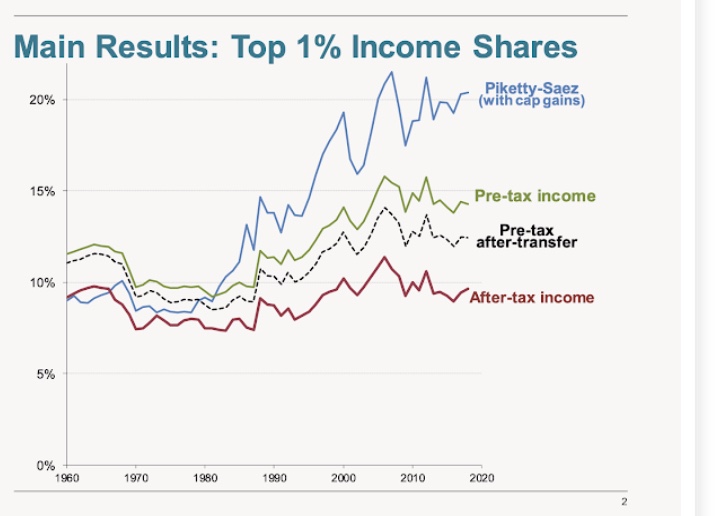
John Cochrane shares the details of a recent presentation made by Auten and Splinter (AS) at the Hoover Institution. A few interesting charts follow:

The blue “Piketty-Saez” (PS) line at the top uses an income measure from well-known research by Thomas Piketty and Emanuel Saez that contributed to the narrative of growing income inequality. The PS line is based on tax return information (fiscal income), but it embeds several distortions.

Realized capital gains are counted there, which misrepresents income shares because the realization of gains does not mark the point at which the true gains occur. Typically, the wealth exists before and after the gains are realized. Realized gains are often a function of changes in tax law and investor reaction to those changes. Moreover, neither realized nor unrealized gains represent income earned in production; instead, they capture changes in asset prices.

Income earned in production is about a third more than the income measure used by PS, even with the capital gains distortion. This omitted income and its allocation across earners is the subject of detailed analysis by AS. Their analysis is consistent in its focus on individual taxpayers, rather than households, which eliminates another upward bias in the PS line created by a secular decline in marriage rates. Then, AS consider the reallocation of income shares due to taxes and transfer payments. After all that, the income share of the top 1% shifts all the way down to the red line in the chart. The most recent observations put the share about where it was in the 1960s. 

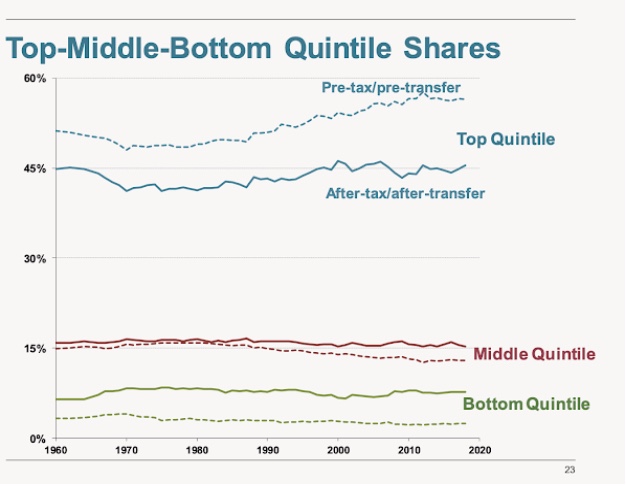
The next chart shows income shares for broader segments: the top, middle, and lowest 20% of the income distribution. Taxes and transfers cause massive changes in the calculated shares and their trends over time. Again, these shares remain about where they were in the 1960s, contradicting the popular narrative that high earners are gobbling up ever larger pieces of the pie.

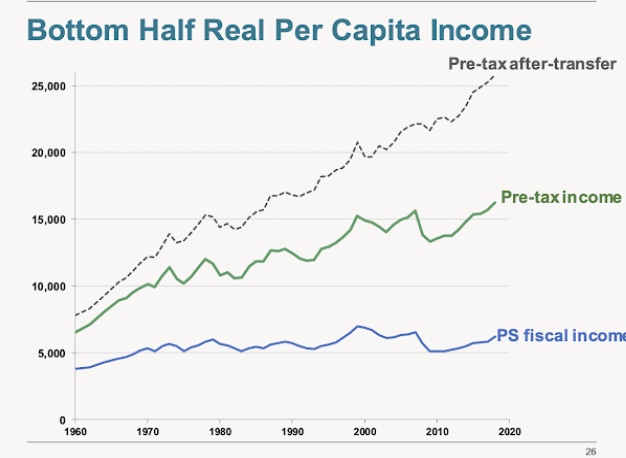
If income shares have remained about the same since the 1960s, that means high and low earners have made roughly equivalent income gains over that time. The next chart demonstrates that the bottom half of the income distribution has indeed seen significant growth in real incomes, despite the false impression created by PS and the common misperception of stagnant income growth among the working class. 

More Distributional Tidbits 

In a sense, all this is misleading because there is so much migration across the income distribution over time. Traditional calculations of income shares are “cross-sectional”, meaning they compare the same slices of the distribution at different points in time. But people near the low end in 1990 are not the same people near the bottom today. The same is true of those near the top and those in the middle. Income grows over time, and those lower in the distribution typically migrate upward as they age and acquire skills and work experience. Upward migration in income share is the general tendency, but there is some downward migration as well. Abandoning the cross-sectional view causes the typical story-line of rising income inequality to unravel.

There are many other interesting facts (and some great charts) in the AS paper and in Cochran’s post. One in particular shows that the average federal tax rate paid by the top 1% trended upward from the 1960s through the mid-1990s before flattening and trending slightly downward. This contradicts the assertion that high earners paid much higher taxes before the 1960s than today. In fact, the tax base broadened over that time, more than compensating for declines in marginal tax rates. 

Given the fact that more exacting measures of inequality haven’t changed much over the years, does that imply that redistributional policies have worked to keep the income distribution from worsening? That seems plausible on its face. If anything, taxes on high earners have increased, as have transfers to low earners and non-earners. Those changes appear to have offset other factors that would have led to greater inequality. However, the framing of the question is inappropriate. Maintaining a given income distribution is not a good thing if it inhibits economic growth. In fact, faster growth in production and greater well-being might well have led to a more unequal distribution of income. In other words, the whole question of offsetting inequality via redistribution is something of a chimera in the absence of a reliable counter-factual.

Wealth

Cochrane has a related post on the sources of wealth in America. Increasingly over the past few decades, wealth has been accumulated by self-made entrepreneurs, rather than through inheritance. That might come as a surprise to many on the left, to the extent that they care. Cochrane quotes Paul Graham on this point:

“In 1982 the most common source of wealth was inheritance. Of the 100 richest people, 60 inherited from an ancestor. There were 10 du Pont heirs alone. By 2020 the number of heirs had been cut in half, accounting for only 27 of the biggest 100 fortunes.

Why would the percentage of heirs decrease? Not because inheritance taxes increased. In fact, they decreased significantly during this period. The reason the percentage of heirs has decreased is not that fewer people are inheriting great fortunes, but that more people are making them.

How are people making these new fortunes? Roughly 3/4 by starting companies and 1/4 by investing. Of the 73 new fortunes in 2020, 56 derive from founders’ or early employees’ equity (52 founders, 2 early employees, and 2 wives of founders), and 17 from managing investment funds.”

The picture that emerges is one of great opportunity and dynamism. While the accumulation of massive fortunes might enrage the Left, these are the kinds of outcomes we should hope for, especially because the success of these new titans of industry is inextricably linked to tremendous value captured by their customers and lucrative opportunities for their employees. 

Here’s the best part of Cochrane’s post:

“We should not think about more or less inequality, we should think about the right amount of inequality, or productive vs. rent-seeking sources of inequality. Or, better, whether inequality is a symptom of health or sickness in the economy. Take Paul’s picture of the US economy at face value. What’s a better economy and society? One in which a few oligopolies … , deeply involved with government, run everything — think GM, Ford, IBM, AT&T, defense contractors — and it’s hard to start new innovative fast growing companies? Or the world in which the Bill Gates and Steve Jobs of the world can start new companies, deliver fabulous products and get insanely rich in the process? “

No doubt about it! However, today’s tremendously successful tech entrepreneurs also give us something to worry about. They have become oligarchs capable of suppressing competitive forces through sheer market power, influence, and even control over politicians and regulators. As I said at the top, whether inequality is benign depends upon the conditions governing its evolution. And today, we see the ominous development of a corporate-state tyranny, as decried by Joel Kotkin in this excellent post. Many of the daring tech entrepreneurs who benefitted from advantages endowed by our capitalist system have become autocrats who seek to plan our future with their own ideologies and self-interest in mind.

Conclusion

For too long we’ve heard the Left bemoan an increasingly “unfair” distribution of income. This includes propaganda intended to distort poverty levels in the U.S. The fine points of measuring shifts in the income distribution show that narrative to be false. Moreover, attempting to equalize the distribution of income, or even preventing changes that might occur as a natural consequence of innovation and growth, is not a valid policy objective if our goal is to maximize economic well-being.

The worst thing about inequality is that the poorest individuals are likely to be destitute and with no ability or means of supporting themselves. There is certainly such an underclass in the U.S., and our social safety net helps keep the poorest and least capable individuals above the poverty line after transfer payments. But too often our efforts to provide support interfere with incentives for those who are capable of productive work, which is both demeaning for them and a drain on everyone else. The best prescription for improving the well-being of all is economic growth, regardless of its impact on the distribution of income or wealth.

CDC Makes a Bum Lead Steer: Alternate Reality vs. The Herd

16 Sunday May 2021

Posted by Nuetzel in Herd Immunity, Pandemic

≈ 2 Comments

Tags

Adam Kucharski, Andy Slovitt, Anthony Fauci, CDC, Degrees of Separation, Herd Immunity, Herd Immunity Threshold, Joe Biden, Jordan Schachtel, Nathan D. Grawe, Obesity, Phil Kerpen, Pre-existing Immunity, Precautionary Principle, Reproduction Rate, Seroprevalence, Sub-Herds, Super-Spreader Events, Vaccinations, Vitamin D, Zero COVID

Jordan Schachtel enjoyed some schadenfreude last week when he tweeted:

“I am thoroughly enjoying the White House declaring COVID over and seeing the confused cultists having a nervous breakdown and demanding the continuation of COVID Mania.”

It’s quite an exaggeration to say the Biden Administration is “declaring COVID over”, however. They’re backpedaling, and while last week’s CDC announcement on masking is somewhat welcome, it reveals more idiotic thinking about almost everything COVID: the grotesquely excessive application of the precautionary principle (typical of the regulatory mindset) and the mentality of “zero COVID”. And just listen to Joe Biden’s tyrannical bluster following the CDC announcement:

“The rule is now simple: get vaccinated or wear a mask until you do.

The choice is yours.”

Is anyone really listening to this buffoon?Unfortunately, yes. But there’s no federal “rule”, unless your on federal property; it constitutes “guidance” everywhere else. I’m thankful our federalist system still receives a modicum of respect in the whole matter, and some states have chosen their own approaches (“Hooray for Florida”). Meanwhile, the state of the pandemic looks like this, courtesy of Andy Slavitt:

False Assertions

The CDC still operates under the misapprehension that kids need to wear masks, despite mountains of evidence showing children are at negligible risk and tend not to be spreaders. Here’s some evidence shared by Phil Kerpen on the risk to children:

The chart shows the fatality risk by age (deaths per 100,000), and then under the assumption of a 97% reduction in that risk due to vaccination, which is quite conservative. Given that kind of improvement, an unvaccinated 9 year-old child has about the same risk as a fully vaccinated 30 year-old!

The CDC still believes the unvaccinated must wear masks outdoors, but unless you’re packed in a tight crowd, catching the virus outdoors has about the same odds as a piano falling on your head. And the CDC insists that two shots of mRNA vaccine (Pfizer or Moderna) are necessary before going maskless, but only one shot of the Johnson and Johnson vaccine, even though J&J’s is less effective than a single mRNA jab!

Other details in the CDC announcement are worthy of ridicule, but for me the most aggravating are the agency’s implicit position that herd immunity can only be achieved through vaccination, and its “guidance” that the unvaccinated should be dealt with coercively, even if they have naturally-acquired immunity from an infection!

Tallying Immunity

Vaccination is only one of several routes to herd immunity, as I’ve noted in the past. For starters, consider that a significant share of the population has a degree of pre-existing immunity brought on by previous exposure to coronaviruses, including the common cold. That doesn’t mean they won’t catch the virus, but it does mean they’re unlikely to suffer severe symptoms or transmit a high viral load to anyone else. Others, while not strictly immune, are nevertheless unlikely to be sickened due to protections afforded by healthy vitamin D levels or because they are not obese. Children, of course, tend to be fairly impervious. Anyone who’s had a bout with the virus and survived is likely to have gained strong and long-lasting immunity, even if they were asymptomatic. And finally, there are those who’ve been vaccinated. All of these groups have little or no susceptibility to the virus for some time to come.

It’s not necessary to vaccinate everyone to achieve herd immunity, nor is it necessary to reach something like an 85% vax rate, as the fumbling Dr. Fauci has claimed. Today, almost 47% of the U.S. population has received at least one dose, or about 155 million adults. Here’s Kerpen’s vax update for May 14.

Another 33 million people have had positive diagnoses and survived, and estimates of seroprevalence would add perhaps another 30 million survivors. Some of those individuals have been vaccinated unnecessarily, however, and to avoid double counting, let’s say a total of 50 million people have survived the virus. Some 35 million children in the U.S. are under age 12. Therefore, even if we ignore pre-existing immunity, there are probably about 240 million effectively immune individuals without counting the remaining non-susceptibles. At the low end, based on a population of 330 million, U.S. immunity is now greater than 70%, and probably closer to 80%. That is more than sufficient for herd immunity, as traditionally understood.

The Herd Immunity Threshold

Here and in the following section I take a slightly deeper dive into herd immunity concepts.

Herd immunity was one of my favorite topics last year. I’m still drawn to it because it’s so misunderstood, even by public health officials with pretensions of expertise in the matter. My claim, about which I’m not alone, is that it’s unnecessary for a large majority of the population to be infected (or vaccinated) to limit the spread of a virus. That’s primarily because there is great variety in individuals’ degree of susceptibility, social connections, aerosol production, and viral load if exposed: call it heterogeneity or diversity if you like. Variation across individuals naturally limits a contagion relative to a homogeneous population.

Less than 1% of those who caught the virus died, while the others recovered and acquired immunity. The remaining subset of individuals most vulnerable to severe illness was thus reduced over time via acquired immunity or death. This is the natural dynamic that causes contagions to slow and ultimately peter out. In technical jargon, the virus reproduction rate “R” falls below a value of one. The point at which that happens is called the “herd immunity threshold” (HIT).

A population with lots of variation in susceptibility will have a lower HIT. Some have estimated a HIT in the U.S. as low as 15% -25%. Ultimately, total exposure will go much higher than the HIT, perhaps well more than doubling exposure, but the contagion recedes once the HIT is reached. So again, it’s unnecessary for anywhere near the full population to be immune to achieve herd immunity.

One wrinkle is that CIVID is now likely to have become endemic. Increased numbers of cases will re-emerge seasonally in still-susceptible individuals. That doesn’t contradict the discussion above regarding the HIT rate: subsequent waves will be quite mild by comparison with the past 14 months. But if the effectiveness of vaccines or acquired immunity wanes over time, or as healthy people age and become unhealthy, re-emergence becomes a greater risk.

Sub-Herd Immunity

A further qualification relates to so-called sub-herds. People are clustered by geographical, social, and cultural circles, so we should think of society not as a singular “herd”, but as a collection of sub-herds having limited cross-connectivity. The following charts are representations of different kinds of human networks, from Nathan D. Grawe’s review of “The Rules of Contagion, by Adam Kucharski:

Sub-herd members tend to have more degrees of separation from individuals in other sub-herds than within their own sub-herd. The most extreme example is the “broken network” (where contagions could not spread across sub-herds), but there are identifiable sub-herds in all of the examples shown above. Less average connectedness across sub-herds implies barriers to transmission and more isolated sub-herd contagions.

We’ve seen isolated spikes in cases in different geographies, and there have been spikes within geographies among sub-herds of individuals sharing commonalities such as race, religious affiliation, industry affiliation, school, or other cultural affiliation. Furthermore, transmission of COVID has been dominated by “super-spreader” events, which tend to occur within sub-herds. In fact, sub-herds are likely to be more homogeneous than the whole of society, and that means their HIT will be higher than we might naively calculate based on higher levels of aggregation.

We have seen local, state, or regional contagions peak and turn down when estimates of total incidence of infections reach the range of 15 – 25%. That appears to have been enough to reach the HIT in those geographically isolated cases. However, if those geographical contagions were also concentrated within social sub-herds, those sub-herds might have experienced much higher than 25% incidence by the time new infections peaked. Again, the HIT for sub-herds is likely to be greater than the aggregate population estimates implied, The upshot is that some sub-herds might have achieved herd immunity last year but others did not, which explains the spikes in new geographic areas and even the recurrence of spikes within geographic areas.

Conclusion

It’s unnecessary for 100% of the population to be vaccinated or to have pre-existing immunity. Likewise, herd immunity does not imply that no one catches the virus or that no one dies from the virus. There will be seasonal waves, though muted by the large immune share of the population. This is not something that government should try to stanch, as that would require the kind of coercion and scare tactics we’ve already seen overplayed during the pandemic. People face risks in almost everything they do, and they usually feel competent to evaluate those risks themselves. That is, until a large segment of the population allows themselves to be infantalized by public health authorities.

It’s Time to Make Woke Corporations Hurt!

12 Wednesday May 2021

Posted by Nuetzel in Corporatism, Social Justice, Virtue Signaling

≈ Leave a comment

Tags

Amazon, Apple, Bank of America, Black Lives Matter, Coca Cola, Delta Airlines, Disney, Disney Plus, Disparate impact, Diversity, EEOC, ESG Scores, Fuzzy Logic Blog, Joe Biden, Price Discrimination, Race-Based Discounts, Stakeholder Capitalism, Whole Foods, Wokeness

It’s a BLM discount! You need only shout the magic words! Ah, but if “woke” corporations are sincere in their avowals to help end racial injustice, there is so much more they can do! In fact, let me describe an idea so good and rich that we really must partner with Black Lives Matter and Antifa to bring it on!

Yes, we know how much the social justice warriors of corporate America care about diversity, inclusion, and eliminating unconscious bias. Also, in their business practices, they are eager to avoid “disparate impacts” on “protected classes” of individuals. However, if they want to get serious, they need to put real money where their mouths are. The Fuzzy Logic blog (FLB) suggests that we dare corporations celebrating “wokeness” to offer free products and services to people of color (POC)!

There is a strong rationale under current law for a slightly less drastic version of this proposal. For example, in 2019, the median household income of African Americans was about 60% that of whites, but Disney charges blacks and whites the same admission price to their theme parks. That means it costs a black family proportionately more of their income than a white family to spend a day at the park in Orlando. That, my friends, is a disparate impact!

I’m not aware of any legal challenges along these lines, but it’s not as if “one price” is a business necessity, which would otherwise offer Disney a defense against such a claim. Disney already offers discounts to seniors and other groups. But why wait for the EEOC to take action when Disney can demonstrate its high-mindedness and good faith by offering race-based discounts right now?

It would be fun to see how the company reacts to pressure for that kind of action. Based on income disparities, the company could discount tickets by 40% to African Americans and by about 26% for Hispanics. Discounting should be extended to Disney Plus subscriptions as well. Those discounts can be revisited each year with appropriate adjustments until such time as income parity is achieved.

In reality, differential pricing is practiced broadly by American businesses. It’s called price discrimination, and it is generally legal. Higher prices tend to be charged to market segments with less elastic (price-sensitive) demand, and lower prices are offered to segments with more elastic demand. It is a rational and often profit-maximizing approach to pricing, but its practice tends to be more subtle than discriminating on price with respect to race or ethnicity. It’s safe to say that pressure to do so would be disruptive and unwelcome to these firms. So I still like the idea!

But again, FLB’s post goes much farther: given past injustices, why limit the reparations to a correction for the disparate impact of pricing? Something more radical is needed as this is a matter of conscience, not merely a legal hurdle to neutralize income disparities:

“These companies (and the many thousands more engaged in this woke crap) must put their own profits where their big, fat lying mouths are. There will be no government bailouts for them; they must pay for their part in condoning and pushing white supremacy for the past bazillion years, and they must pay with their own wealth, wealth they say they accumulated on the backs of black and brown people.”

Therefore, FLB insists that Disney should offer free admission and streaming on Disney Plus to certain racial and ethnic minorities for a period of several years…and free accommodations at Disney Hotels! What a tremendous show of good faith in wokeness that would be!

We’re picking on Disney, and it’s not alone in its professed racial consciousness and pursuit of equal outcomes. There are so many others! Coca-Cola could issue coupons redeemable at full price through a program of outreach in minority communities. Delta Airlines could institute a program of “Black Life Passports” to bona fide African Americans (meaning one must identify as such!) for discounted or free fares. Bank of America will probably want to exceed the minimum requirements under community banking law by offering free banking services and heavily discounted account management fees to African Americans. Amazon will no doubt want to offer free Prime memberships to certain minorities and perhaps throw in some freebies at Whole Foods as well. And Apple has plenty of merchandise to give away. Why wait for Joe Biden to offer free phones in the run-up to the 2024 election like his old boss did?

You probably won’t be happy about this proposal if you’re a corporate shareholder, but then you should not be happy to have witnessed increasing management preoccupation with social justice, and you should not have been happy as your “agents” lost sight of their fundamental missions as business organizations: to produce something well and thereby do well for customers and shareholders. The sad consequence of “stakeholder capitalism” is that everything a business is supposed to do gets done worse.

I recently discussed the assignment of “scores” to public companies for their focus and performance on environmental, social, and governance (ESG) factors. These ESG scores are used by “woke” fund managers and advisors to select or rate stocks. I personally have no wish to invest in companies seeking to boost their ESGs, but you can read all about that at the link. For our purposes here, ESGs might serve well as a tool for identifying entities most in need of pressure to offer discounts and freebies to POC.

It would be great to see agitation against the woke-most corporations for race-based discounts and free products. Perhaps a broad discussion of the idea would prompt social justice warriors to get on board. It might provide some laughs, but the real hope is to shake the corporate wokesters from their virtue-signaling stupor. Most shareholders wouldn’t like race-based discounts, of course, and that’s part of the idea. A conceivable defensive maneuver for our “target” entities would be a lobbying effort for government action such as tax-financed reparations. That won’t necessarily be cheap for them or their shareholders, however. Get woke, go broke!

NFT Assets, Artists, and Con Games

08 Saturday May 2021

Posted by Nuetzel in Art, Corruption

≈ 2 Comments

Tags

000 Days, Aeriel, Asset Inflation, Beeple, Beeple Crap, Blockchain, Carbon Offsets, Christie’s, Copyright, Crypto-Currency, Digital Racehorses, Ergreifungen, Everdays: The First 5, Face, Federal Reserve, Jerry Garcia, Jerry Garcia Foundation, Katy Perry, Long Con, Metakoven, Metapurse, Mike Winkelmann, NFTs, Non-Fungible Tokens, Remodern Review, Richard Bledsoe, Roper, Royalties, Shill, The American Reveille, Tokenomics

The art world is buzzing about “non-fungible tokens” (NFTs), or digital files in which ownership is secured by blockchain technology. As the name suggests, such a crypto-asset can exist only as a whole piece. That’s unlike crypto currency, which is infinitely divisible and, well, fungible. NFTs are diverse in their features and functions, and various kinds of art are now being traded as NFTs: digital images, GIFs, and audio clips, for example.

Beeple Crap

A digital artist named Mike Winkelmann, otherwise known as Beeple, makes digital “Beeple-crap”, as he calls it, like the giant “Xi-bot” shown above. He has successfully monetized the digital images he’s posted on his web site over the last 13 years, and in a coup de grace, he recently aggregated all those images into a one-file mashup NFT for which a buyer paid $69.3 million in Ethereum (less a substantial fee to Christie’s auction house). And Beeple isn’t the only one making big bucks on NFTs!

Beeple’s “collage” is available for anyone to see or copy on the web. It’s called “Everdays: The First 5000 Days”. But precisely what are the rights now held by the buyer of “5000 Days”? Apparently, they are limited to the satisfaction of knowing digital proof of ownership is his, and whatever that smug feeling might be worth on potential resale! In fact, Beeple himself retains the copyright to 5000 Days, so it’s not as if the buyer is the only guy who can ever print a high-resolution copy. But here’s what Beeple says the buyer got:

“The biggest thing he actually bought is a relationship with me to promote his purchase. He and I are very aligned. I want to see this artwork go up in value. He wants to see the artwork go up in value, which benefits me. So the idea that he bought nothing is kind of misleading.”

The buyer, known as Metakovan, is the founder of Metapurse.fund, a highly influential player in crypto ventures and NFTs. But Metakovan’s purchase of 5000 Days is not his first collaboration with Beeple. They already had a significant “relationship”, and this transaction obviously won’t be their last.

If this smells a bit like a con game to you, you’re not alone. Don’t get me wrong: Beeple does produce art … very striking images, in fact. They might not be your cup of tea, and many are a bit cartoonish, but Beeple has computer skills and a real creative streak. He also has a knack for self-promotion unequalled, in relative terms, by perhaps any of the old masters or impressionists.

I’m perfectly happy to know there is a vibrant market in anything people call art. Whatever floats your boat, baby! However, I have trouble believing that long-term growth can occur on top of this kind of “valuation” without an escalating monetary inflation. Between the Federal Reserve’s open-spigot policy of near-zero interest rates and the advent of crypto-currencies with supply limits, dollars are getting cheap. Asset markets, still denominated in dollars, usually receive more than their fair share of bidding as excess dollars accumulate on balance sheets. So the outlook might be bright for NFTs as an asset class, such as it is.

Art In the Ersatz

The most regrettable thing about NFTs like 5000 Days might be what they reflect about the state of the art world itself. Richard Bledsoe of the Remodern Review has a lively take on 5000 Days and NFTs as a new stage in the long decline in the quality of what is called art. Bledsoe is no fan of contemporary art, which he argues has been enabled by elites who have successfully corrupted the art market.

I’m no expert, but I generally view contemporary art as less ambitious and requiring less skill than earlier forms. I think that’s easy to prove (see here and here), but it’s outside the scope of this post. I have wondered whether the emergence of contemporary art was impelled by the tremendous increase in prosperity during the late 19th and 20th centuries and the attendant expansion in the market for original art. Artists such as painters and sculptors, whose labor productivity did not greatly benefit from technology growth (we can argue about the last several decades), might have adjusted to this reality by focusing on simpler and more abstract forms. This is a digression, but it’s surely worthy of a much longer treatment. 

There’s no accounting for tastes, of course, and while I like some contemporary art, I’m definitely sympathetic to Bledsoe’s views. As for NFTs, he quotes from his book, “Remodern America: How the Renewal of Art Will Change the Course of Western Civilization”:

“Billions are being spent on unskilled and intangible contemporary art. Just like in the good old days, many of the suckers are the newly rich or globalists looking for social credibility and a fast buck. There’s a lot of money laundering and tax evasion in the equation as well.

How does the art world convince well-heeled fools to part with their money, when they are offering so little real value in return? Simple. The art market follows the tried and true methods honed by generations of confidence tricksters: the elaborate pantomime known as the long con…”

Don’t You Let That Deal Go Down

Bledsoe gives a brief sketch of the mechanics of the “long con” and how it’s practiced in the art market. He describes players such as the “Shill” (a promoter who avoids revealing a personal stake), the “Face” (a celebrity whose presence helps to “guarantee buzz will exceed rationality), and the lastly the “Roper”:

“… whose affluence leads to influence, a savvy and powerful individual whose participation gives credibility to the whole enterprise. What is ignored is how much moguls like this manipulate the market to serve personal interests, using insider trading, shady financing and backroom deals to inflate the value of their own collections.

In any other industry, common practices of the establishment art market could probably lead to criminal charges. But in the unregulated free-for-all of the art world, it’s very hard to bring these cases of potential white-collar crime to justice, and the victims here are less than sympathetic. After all, the buyers are people who have so much money it’s meaningless to them. Who cares if a bunch of billionaires are getting ripped off?”

All of these players seem well ensconced in the world of promoting NFT art: Beeple in particular, and the “art experts” at Christie’s, Beeple’s celebrity pals (OMG! Katy Perry!!), and finally Metakovan’s stature as an authority on NFTs and “tokenomics”. By the way, his considered opinion is that 5000 Days is “worth a billion dollars”. Well, okay then!

Carbon Indulgences

Another insane aspect of NFTs and the crypto-currencies used to buy them is the pushback over the carbon footprint of crypto-currency mining. This is discussed briefly by Bledsoe as well. While the electricity used in mining is significant, the amount attributable to any given transaction is minuscule. Yet now, sales of high-value NFTs are accompanied by the purchase of carbon credits. Read this description of an auction to be held for a piece of art created by Jerry Garcia on a Mac in 1990. It says “… carbon offsetting to be provided by a company called Aerial.” Now, Jerry Garcia was a talented visual artist on canvas and on his early Mac, not to mention his considerable magic as a guitarist and songwriter. God bless his family, and no offense to the Garcia Foundation, but they were perfect suckers for what has quickly become a standardized virtue signal or buy-off. The fact is that carbon offsets generally don’t have an impact for many years, and there are doubts as to their efficacy in permanently reducing carbon when the time comes.

Redeeming Potential

While the artistic value of NFTs like 5000 Days can be debated, my doubts about their value as assets center around the lack of real ownership rights conferred to buyers. Work is underway, however, on new NFT standards that would allow an NFT buyer to collect royalties, which would obviously carry real value. So, for example, a musician or band could immediately monetize a recording’s future royalties by selling it as an NFT. No one should have qualms about that, and good for the musicians.

I believe other kinds of NFTs have real value, in principle, such as the digital racehorses discussed in this article. Apparently, virtual horse races have already achieved a degree of popularity. These crypto-horses actually win prize money and collect stud fees, based on their digital bloodlines. Another example: NFTs can be concert tickets, electronic possession of which entitles the bearer to a particular seat at the venue; or, an NFT might remain in your “digital wallet” as a season ticket to sporting events. Among the claimed advantages over “normal” electronic ticketing is security, and NFT tickets live on as tradeable memorabilia as well.

Conclusion

It’s still early days for crypto-currencies and especially for NFTs. I can’t object to a free individual spending their hard-earned crypto-wealth on crypto-art like 5000 Days. Unfortunately, the market for NFT art does seem to embody aspects of a confidence game. And like Richard Bledsoe, I’m a skeptic when it comes to most contemporary art. However, there are circumstances under which the value of NFTs can be compelling, and the development of more “use-cases” will increase the value of digital currencies. New NFT standards and applications might well revolutionize certain industries. Continuing asset inflation instigated by central banks, and especially the Federal Reserve, will cause the dollar value of crypto-assets to rise. Big institutions like investment banks are starting to jump on the crypto bandwagon as well. So, while some NFTs might be short-term plays and might even be dangerous swindles, crypto and NFTs in general should not be dismissed as an asset class.

A Blogger’s Lament: It’s a Meme, Meme, Meme, Meme, Meme, Meme, Meme, Meme World

02 Sunday May 2021

Posted by Nuetzel in Blogging

≈ 3 Comments

Tags

Blogging, Covid-19, Critical Race Theory, Graphs, Meme Fatigue, Memes, Social Media, Wordpress

A few years ago a guy clicked through to this blog from a social media site. Apparently he made a quick retreat, and he left the following comment: “Ohh, too many words….” It’s not a revelation to me, but it’s amazing how few people are willing to READ!

My nephew, who is something of a political activist and has a news site of his own, put his finger on it last year. In a piece I’d written about pandemic issues, I used a cover photo of a graph illustrating one of my main points, as I do sometimes when empirics are involved. I’m paraphrasing, but he said I shouldn’t use graphs as covers because it scares off potential readers. It says, “if you click through you’ll have to think!” But I have no ambitions to be a mass sensation, and as a reader of blogs I tend to regard such devices positively. On the other hand, if a picture is worth a thousand words, there’s a chance that good thinkers gather in what they presume they need to know without clicking through. That’s almost as bad from my perspective, because I want to give them the thousand words anyway!

Here’s a similar phenomenon: occasionally I’ll use a meme as a cover photo for a blog post, but some people “like” the post solely because of the meme without bothering to click through! I’m glad we’re simpatico, but I’d prefer they read the post. I view that kind of reaction as lazy or the act of an easily distracted individual.

I have no interest in writing for people who don’t want to think, but the rub lies in finding those that do. I have a full time job, so producing more content is not an option. I’m not affiliated with a well-known publication or an institution with a significant presence on the web. My readers come from the WordPress community, search engines, and a few social media sites to which I cross-post. Occasionally, if the subject matter is pertinent, I post comments to articles on other blogs and link to one of my posts. That brings in a few views, and those visitors have a definite interest in the subject matter.

Social media sites would seem to be a natural channel for readers, but of course they are jam-packed with memes. Some of those are very good and some are very funny. Some are surely worth a thousand words, but I quickly develop “meme fatigue”. And both good memes and bad memes seem to be reposted ad infinitum.

Simplification and humor are major elements of “meme art”, and I would describe the best of it as such. The ability to simplify is likewise one of the greatest skills an economist can possess, so I respect it. In fact, I like to call economics formalized common sense, but that formalization must happen within an expository framework. Many of my posts are mere commentary, but I like a somewhat deeper dive than the meme form can accommodate. If I get excited about a topic and immerse myself, blogging gives me an opportunity to do some research and explain my point of view while doing my best to apply economic thinking. Moreover, I like to write. Unfortunately, I’m not all that funny, but sometimes I try.

I’m frequently disappointed to see memes I view as extremist, distorted, shallow or over-simplified. For example, I’m no fan of critical race theory, but it’s not fiction to say that racist memes sometimes appear on social media, which prompts me to block the poster immediately.

I scroll through a few memes each day, but I spend more time checking the other blogs I frequent, where I find gobs of interesting reading material. I join groups related to my musical interests, which offer great recordings. I occasionally watch video commentary, but prefer the written form. I have friends who send me lonnnng videos, but I wish they’d send transcripts instead. A two-hour video is not a commitment I’m usually willing to make!

There are many who say blogging is passé, and apparently many don’t have the patience to read lengthier treatments. It’s still the form I prefer, despite the difficulty of battling for eyeballs with memes. But that’s not quite right: there’s really no battle when it comes to those without interest in detailed treatments of issues. The real battles have to do with finding motivated and patient users with common interests and getting more favorable placement on biased search engines. Good content is also key, but that challenge is part of the joy of blogging.

Social Credit Scores, ESGs, and Portfolio Rot

29 Thursday Apr 2021

Posted by Nuetzel in Capital Markets, Corporatism, Environment, Social Justice

≈ 4 Comments

Tags

American Conservative Union, Asian Hate, Bank of America, Credit Bureaus, Credit Score, CSRHub, Diversity, Environmentalism, Equifax, ESG Scores, ESGs, FICO Score, Giorgio Election Law, Goldman Sachs, Green Energy, Major League Baseball, Merrill Lynch, public subsidies, Refinitiv, Selling Indulgences, Social Credit Score, Social Justice, Stakeholders vs. Shareholders, Stop Corporate Tyranny, Sustainability, Transunion, Unilever, Woke Capitalism.

As a small investor I resent very much the use of so-called “ESG scores” to guide investment decisions on my behalf. ESG stands for “Environmental, Social, and Governance” criteria for rating companies. These scores or grades are developed and assigned by various firms (Refinitiv, CSRHub, and many others) to public companies. The scores are then marketed to financial institutions. While ESGs from various sources are not yet standardized, a public company can attempt to improve its ESG scoring through adoption of environmental goals such as “zero” carbon, diversity and inclusion initiatives, and (less objectionably) by enhancing its systems and processes to ensure protection of shareholder and other interests.

Who Uses ESGs?

An investment fund, for example, might target firms with high ESG scores as a way of appealing to progressive investors. Or an institutional investor like a pension fund might wish to invest in high ESG stocks in order to avoid riling “woke” activist investors, thus keeping the hounds at bay. This is nothing new: many corporations engage in various kinds of defensive actions, which amount to modern day “selling of indulgences”.

An aggregate ESG score can be calculated for a fund or portfolio of stocks by weighting individual holdings by market value. And of course, an ESG score can be calculated for YOUR portfolio. As a “service” to clients, Merrill Lynch plans to do just that.

My first reaction was to give my ML financial advisor an earful. Of course, ML’s presumed objective is to guide you to make “better” investment decisions. However, I do not wish to reward firms with capital based on their “social” positioning, nor do I wish to encourage exercises in “wokeness”. I simply want to supply capital based on a firm’s business fundamentals.

My advisor was more than sympathetic, and I believe he’s sincere. The problem is that corporate wokeness is so ubiquitous that it becomes difficult to invest in equities at all without accepting some of it and just holding your nose. That goes for virtually all ETFs and index funds.

ESGs Are Not Consumer Scores

I’m obviously unhappy about this as a Merrill account holder, and also as a financial economist and a libertarian. But first, a few words about what is not happening, at least not yet. A number of conservative commentators (see here, and here) have described this as an assignment of “social credit scores” to consumers based on their individual or household behavior, much as the Chinese government now grades people on the quality of their citizenship. These conservative voices have reacted to ESG scores as if they incorporate information on your energy usage, for example, to grade you along the environmental dimension. That is not the case, though ESGs can be used to grade the stocks you own. And yes, that is rather Orwellian!

One day, if present trends continue, banks might have access to our energy usage through affiliations with utilities, smart car companies, and various data aggregators. And who knows? They might also use information on your political contributions and subscriptions to grade you on your social “wokeness”, but only if they have access to payment records. Traditional credit information will be used as it is now, to grade you on financial discipline, but your “consumer ESG” might be folded into credit approval decisions, for example, or any number of other decisions that affect your way of life. But except for credit scoring, none of this is happening today. All the consumer information outside of traditional credit scoring data is too scattered and incomplete. So far, ESGs are confined to evaluating companies, funds, and perhaps your portfolio.

ESGs and Returns

ESGs get plenty of favorable coverage from the financial press and even from academics. This post from The Motley Fool from 2019 demonstrates the kind of praise often heaped upon ESGs. Sure, firms who cater to various cultural trends will be rewarded if they convince interested buyers they do it well, whatever it is. That includes delivering goods and services that appeal in some way to environmental consciousness or social justice concerns. So I don’t doubt for a moment that money can be made in the effort. Still, there are several difficulties in quantitatively assessing the value of ESG scores for investment purposes.

First, ESG inputs, calculations, and weights are often proprietary, so you don’t get to see exactly how the sausage is stuffed. On that point, it’s worth noting that much of the information used for ESG’s is rather ad hoc, not universally disclosed, or qualitative. Thus, the applicability (and reliability) of these scores to the universe of stocks is questionable.

Second, inputs to ESGs represent a mix of elements with positive and negative firm-level effects. I already mentioned that ESGs reward good governance on behalf of shareholders. The environmental component is almost surely correlated with lines of business that qualify for government subsidies. More generally, it might reflect conservation of certain materials having a favorable impact on costs. And attempts to measure diversity might extract legitimately positive signals from the employment of highly productive individuals, many of whom have come from distant shores. So ESG scores almost certainly have a few solidly useful components for investors.

The proprietary nature of ESG calculations also raises the question of whether they can be engineered to produce a more positive association with returns. There’s no doubt that they can, but I’m not sure it can be confirmed one way or the other for a particular ESG variant.

Like cultural or consumer trends, investment trends can feed off themselves for a time. If there are enough “woke” investors, ESGs might well feed an unvirtuous cycle of stock purchases in which returns become positively correlated with wokeness. My thinking is that such a divorce from business fundamentals will eventually take its toll on returns, especially when economic or other conditions present challenges, but that’s not the answer you’ll get from many stock pickers and investment pundits.

Remember also that while a particular ESG might be positively correlated with returns, that does not make it the best or even a good tool for evaluating stocks. In fact, it might not even rank well relative to traditional metrics.

Finally, there is the question of causality. There are both innocent and pernicious reasons why certain profitable firms are able to spend exorbitantly on initiatives that coincidentally enhance their ESGs. More on that below.

Social and Economic Rot

Most of the “green” initiatives undertaken by large corporations are good mainly for virtue signaling or to collect public subsidies. They are often wasteful in a pure economic sense, meaning they create more waste and other costs than their environmental benefits. The same is true of social justice and diversity initiatives, which can be perversely racist in their effects and undermine the rule of law. And acts on behalf of “stakeholders” often sacrifice shareholders’ interests unnecessarily.

There are many ways in which firms engaging in wasteful activities can survive profitably, at least for a time. Monopoly power is one way, of course. Large companies often develop a symbiosis with regulators which hampers smaller competitors. This is traditional corporatism in action, along with the “too big to fail” regime. And again, sheer growth in demand for new technologies or networking potential can hide a lot of warts. Hot opportunities sometimes leave growing companies awash in cash, some of which will be burned in wasteful endeavors.

Ultimately, we must recognize that the best contribution any producer can make to society is to create value for shareholders and customers by doing what it does well. But to see how far the corporate world has gone in the other direction, keep this in mind: any company supporting a sprawling HR department, pervasive diversity efforts, “sustainability” initiatives, and preoccupations with “stakeholder” outreach is distracted from its raison d’etre, its purpose as a business enterprise to produce something of value. It is probably captive to certain outside interests who have essentially commandeered management’s attention and shareholders’ resources. And this is evidence of rot.

My reference to “portfolio rot” reflects my conviction is that it is a mistake to dilute investment objectives by rewarding virtue signals. They are usually economically wasteful, though sometimes they might be rewarded via government industrial policy, regulators, and the good graces of activists. But ultimately, this waste will degrade the economy, undermine social cohesion, and devalue assets generally.

What Can We Do?

Despite the grim implications of widespread ESG scoring, there are a few things you can do. First, simply avoid any funds that extol progressive activism, whether based on ESGs or along any dimension. If you invest in individual stocks, you can avoid the worst corporate offenders. Here is one guide that lists some of the “woke-most” companies by industry, and it provides links to more detailed reviews. I gave my advisor a list of firms from which I wanted to permanently divest, including Bank of America, which owns Merrill! I also listed various firms that are owned and operated by Chinese interests because I am repulsed by the Chinese regime’s human rights violations.

If you have the time, you can do a little more research before voting your proxies. That goes for shareholder, board, or management proposals as well as electing board members. You are very unlikely to swing the vote, but it might send a useful signal. I recently voted against a Unilever green initiative. I also researched each of the candidates for board seats, voting against a few based on their political, social and environmental positions and activities. Good information can be hard to get, however, so I abstained from a few others. This kind of thing is time consuming and I’m not sure I’m eager to do very much of it.

You can also support organizations like the American Conservative Union, which is “taking a stand against the increasingly divisive and partisan activism by public corporations and organizations that are caving to ‘woke’ pressure.” And there is Stop Corporate Tyranny, which is “a one-stop shop for educational resources exposing the Left’s nearly completed takeover of corporate America, along with resources and tools for everyday Americans to fight back against the Left’s woke and censoring mob in the corporate lane.”

People can make it harder for social credit scoring to enter the consumer realm by protecting their privacy. There will be obstacles, however, as sellers offer certain benefits and apply “nudges” to obtain their customers’ data, and it is often shared with other sellers. Sadly, one day those who guard their privacy most closely might find themselves punished in the normal course of trade due to their “thin” social credit files. There are many dark aspects to a world with social credit scoring!

Conservative Social Scoring?

There are at least two ETFs available that utilize conservative “social scoring systems” in picking stocks: EGIS and LYFE. Both are sponsored by 2ndVote Funds. EGIS has as its stated theme to invest in stocks which receive a favorable rating in support of the Second Amendment right to bear arms and/or in the interest of border security. LYFE seeks to meet its long-term return objectives in stocks with a favorable rating on the pro-life agenda. Both have reasonable expense ratios, as those things go. Unfortunately, my advisor says Merrill won’t allow those funds to be purchased until they have close to a full year of experience.

Are these two ETFs really so special? Are they really just marketing gimmicks? After all, I noticed that EGIS has Goldman Sachs in its top 10 holdings. While Goldman might not be the worst of its peers in terms of wokeness, it has stooped to some politically-motivated “cancel capers”. Moreover, do I really want to mix my investment objectives with my social preferences? Leftist investors are doing it, so countering might be well-advised if you can afford the risk of diluting your returns. My heart says yes, but my investor brain isn’t sure.

Closing

When it comes to investing, I’d prefer absolute neutrality with to respect social goals, other than the social goals inherent in the creation of value for customers and shareholders. Any emphasis on ESG scores is objectionable, but it’s a regrettable fact that we have to live with to some extent. If “social scoring” is unavoidable, then perhaps the themes adopted by 2ndVote Funds are worth trying as part of an investment approach. After all, given my personal blacklist of woke corporations, I’ve already succumbed to the temptation to invest based on social goals. And I feel pretty good about it. Unfortunately, it might mean I’ll sacrifice return and witness the continued descent of western society into a woke hellscape.

← Older posts
Newer posts →
Follow Sacred Cow Chips on WordPress.com

Recent Posts

  • Some Dimensions Of the AI/Data Center Freakout
  • Warsh and Fed Confront a Crossroads On Policies
  • Isotopes Point To Natural CO2 Origins
  • Is “Global Temperature” a Fiction?
  • ESG Contortions: Virtue, Returns, and Politics

Archives

  • June 2026
  • May 2026
  • April 2026
  • March 2026
  • February 2026
  • January 2026
  • December 2025
  • November 2025
  • October 2025
  • September 2025
  • August 2025
  • July 2025
  • June 2025
  • May 2025
  • April 2025
  • March 2025
  • February 2025
  • January 2025
  • December 2024
  • November 2024
  • October 2024
  • September 2024
  • August 2024
  • July 2024
  • June 2024
  • May 2024
  • April 2024
  • March 2024
  • February 2024
  • January 2024
  • December 2023
  • November 2023
  • August 2023
  • July 2023
  • June 2023
  • May 2023
  • April 2023
  • March 2023
  • February 2023
  • January 2023
  • December 2022
  • November 2022
  • October 2022
  • September 2022
  • August 2022
  • July 2022
  • June 2022
  • May 2022
  • April 2022
  • March 2022
  • February 2022
  • January 2022
  • December 2021
  • November 2021
  • October 2021
  • September 2021
  • August 2021
  • July 2021
  • June 2021
  • May 2021
  • April 2021
  • March 2021
  • February 2021
  • January 2021
  • December 2020
  • November 2020
  • October 2020
  • September 2020
  • August 2020
  • July 2020
  • June 2020
  • May 2020
  • April 2020
  • March 2020
  • February 2020
  • January 2020
  • December 2019
  • November 2019
  • October 2019
  • September 2019
  • August 2019
  • July 2019
  • June 2019
  • May 2019
  • April 2019
  • March 2019
  • February 2019
  • January 2019
  • December 2018
  • November 2018
  • October 2018
  • September 2018
  • August 2018
  • July 2018
  • June 2018
  • May 2018
  • April 2018
  • March 2018
  • February 2018
  • January 2018
  • December 2017
  • November 2017
  • October 2017
  • September 2017
  • August 2017
  • July 2017
  • June 2017
  • May 2017
  • April 2017
  • March 2017
  • February 2017
  • January 2017
  • December 2016
  • November 2016
  • October 2016
  • September 2016
  • August 2016
  • July 2016
  • June 2016
  • May 2016
  • April 2016
  • March 2016
  • February 2016
  • January 2016
  • December 2015
  • November 2015
  • October 2015
  • September 2015
  • August 2015
  • July 2015
  • June 2015
  • May 2015
  • April 2015
  • March 2015
  • February 2015
  • January 2015
  • December 2014
  • November 2014
  • October 2014
  • September 2014
  • August 2014
  • July 2014
  • June 2014
  • May 2014
  • April 2014
  • March 2014

Blogs I Follow

  • Passive Income Kickstart
  • OnlyFinance.net
  • TLC Cholesterol
  • Nintil
  • kendunning.net
  • DCWhispers.com
  • Hoong-Wai in the UK
  • Marginal REVOLUTION
  • Stlouis
  • Watts Up With That?
  • American Elephants
  • The View from Alexandria
  • The Gymnasium
  • A Force for Good
  • Notes On Liberty
  • troymo
  • SUNDAY BLOG Stephanie Sievers
  • Miss Lou Acquiring Lore
  • Your Well Wisher Program
  • Objectivism In Depth
  • RobotEnomics
  • Orderstatistic
  • Paradigm Library
  • Scattered Showers and Quicksand
  • Jam Review

Blog at WordPress.com.

Passive Income Kickstart

OnlyFinance.net

TLC Cholesterol

Nintil

To estimate, compare, distinguish, discuss, and trace to its principal sources everything

kendunning.net

The Future is Ours to Create

DCWhispers.com

Hoong-Wai in the UK

A Commonwealth immigrant's perspective on the UK's public arena.

Marginal REVOLUTION

Small Steps Toward A Much Better World

Stlouis

Watts Up With That?

The world's most viewed site on global warming and climate change

American Elephants

Defending Life, Liberty and the Pursuit of Happiness

The View from Alexandria

In advanced civilizations the period loosely called Alexandrian is usually associated with flexible morals, perfunctory religion, populist standards and cosmopolitan tastes, feminism, exotic cults, and the rapid turnover of high and low fads---in short, a falling away (which is all that decadence means) from the strictness of traditional rules, embodied in character and inforced from within. -- Jacques Barzun

The Gymnasium

A place for reason, politics, economics, and faith steeped in the classical liberal tradition

A Force for Good

How economics, morality, and markets combine

Notes On Liberty

Spontaneous thoughts on a humble creed

troymo

SUNDAY BLOG Stephanie Sievers

Escaping the everyday life with photographs from my travels

Miss Lou Acquiring Lore

Gallery of Life...

Your Well Wisher Program

Attempt to solve commonly known problems…

Objectivism In Depth

Exploring Ayn Rand's revolutionary philosophy.

RobotEnomics

(A)n (I)ntelligent Future

Orderstatistic

Economics, chess and anything else on my mind.

Paradigm Library

OODA Looping

Scattered Showers and Quicksand

Musings on science, investing, finance, economics, politics, and probably fly fishing.

Jam Review

"If you get confused, listen to the music play."

  • Subscribe Subscribed
    • Sacred Cow Chips
    • Join 128 other subscribers
    • Already have a WordPress.com account? Log in now.
    • Sacred Cow Chips
    • Subscribe Subscribed
    • Sign up
    • Log in
    • Report this content
    • View site in Reader
    • Manage subscriptions
    • Collapse this bar

Loading Comments...