• About

Sacred Cow Chips

Sacred Cow Chips

Tag Archives: Coronavirus

Rioters Inflict Racial Injustice

02 Tuesday Jun 2020

Posted by Nuetzel in Free Speech, racism, Terrorism

≈ Leave a comment

Tags

Antifa, Black Lives Matter, Coronavirus, Covid-19, Criminal Justice Reform, Derrick Chauvin, Donald Trump, Equity Markets, George Floyd, Glenn Reynolds, Jane Coaston, National Guard, Police Unions, Qualified Immunity, racism, War on Drugs, Will Collier, Willie Delwiche

My fervent hope is that the reaction of horror to George Floyd’s murder is universal. However, my perspective on the violence that’s erupted over the week since is also one of disgust. The perpetrators are using Floyd’s death as an opportunity to unleash attacks that undermine civil society and often hurt people of color more than anyone.

The peaceful protests against police brutality and racism in cities across the country are earnest calls for reform, and they also represent fine tributes to all victims of racism. But a different dynamic takes hold when peaceful protesters are infiltrated by violent elements. Agitators use the cover of the protests and typically begin to dominate the scene as darkness falls, though sometimes it happens in broad daylight. The violence, arson, looting, and shooting are perpetrated by a combination of those whose political motivations go well beyond needed reforms to the justice system and other opportunists who are primarily interested in loot, or just a riotous a good time. There are also some otherwise non-violent protesters emboldened by the agitators to cheer on these acts of violence.

As others have said, the rioting does not serve to honor George Floyd in any way, and it does nothing to end racism or racial victimization. By cheering on these malefactors you lose any legitimate claim as an enemy of racism. The rioting, if anything, brings harm to the black community. Black lives are lost in the strife, such as the retired police captain in St. Louis who was shot Monday night defending his friend’s pawn shop. Blacks are also losing their livelihoods as a consequence of the destruction.

The left-wing, anarchist agitators are modern blackshirts masquerading as anti-fascists. Their interest, and delusion, is the violent overthrow of our government. They are largely white millennials, mostly male, and largely unemployed as a result of the ill-advised coronavirus lockdowns imposed in many states. Antifa has been prominent in these attacks, often running under Black Lives Matter flags, and the radical wing of BLM participates as well.

These pigs have been coddled by leftist state and local government officials in many cities, who send outmanned police forces to try to keep the damage in check while releasing those arrested the next day. President Trump was absolutely right on Monday to call out the national guard and raise the possibility of deploying military forces where state and local officials are incapable or unwilling to bring these situations under control.

And here’s the thing: all it takes is a few agitators, along with their enthusiastic but less ideological recruits, to destroy communities. There have been larger numbers in big cities, perhaps a few thousand hard-core shit disturbers. Slowly but surely, perhaps due to Trump’s prodding, state and local politicians are awakening and enabling law enforcement to effectively quell the unrest. The agitators, who are fairly well organized, are being infiltrated by moles who will undermine their operations and perhaps aid in prosecuting higher-level organizers and funders at the federal level. In the end, the force of anarchists is fairly small and the local support they manage to stir is fleeting.

While we recoil at the harm inflicted by the riots, another perspective is offered by the equity markets, which have been relatively unfazed through the turmoil. The values of firms in the security business have risen, but otherwise, as one investment strategist says:

“‘Right now it’s limited enough that it’s not perceived as having a meaningful economic impact,’ said Willie Delwiche, investment strategist at Baird. ‘The risk to the market right now is excessive optimism,’ and headlines from protests could simply be dampening that optimism a bit, he added.”

The riots are destructive of lives and economic value, and while we mourn those caught up in these tragedies, the situation does not portend a total social collapse. The overall impact on the U.S. economy expected by markets is not of a magnitude suggesting great instability. This too shall pass, though not easily for the small businesses and employees being ruined by the double jolt of lockdowns and riots.

Besides the outright harm to the black community by the riots, there are other disturbing elements that must be confronted. I keep hearing “White silence = violence”. No, “white silence” is neither responsible for the actions of George Floyd’s killer nor the riots in the streets. What must one say to avoid personal responsibility for the aberrant behavior of Derrick Chauvin and the rioters? What I hear are ignorant excuses and accusations: the violence is inexcusable and it is no one’s fault but the participants, whatever their circumstances.

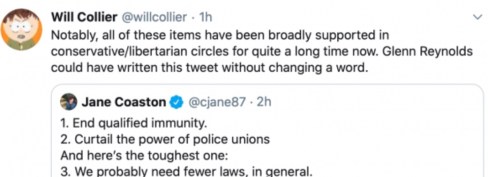
People of good faith oppose the brutality inflicted by bad cops and a system that tolerates them. It is surely time for some reforms, as the following suggests:

And there are still other promising criminal justice reforms to consider. We need to end the drug war, which is particularly harmful to minority communities.

I bemoan the poor circumstances and education that have burdened many of the disaffected protesters, and even the rioters. I advocate for policies that I believe promote improved education and family stability. I have advocated for a safety net. I have shared my distaste for the unnecessary COVID-19 lockdowns that forced so many of these individuals out of their jobs for several months. But from some quarters, the demands have no end. Not until I bow down on my hands and knees to apologize for the sins of generations past. Who cares if they weren’t my ancestors? I’m white! The next demand is reparation payments to today’s generations of blacks. Don’t complain that impoverished whites won’t share in the gains, though there are more than twice as many of them. They simply failed to capitalize on the opportunity afforded by their privilege. I’m sorry for the sarcasm….

Please mourn George Floyd’s horrible death and support the protests against the brutality that killed him, but do not pretend for a moment that the violence is in any way justified, or that it will create a healthier society. Don’t root for that shit. And don’t cast aspirations at your fellow men and women as if the color of their skin is responsible for the social ills you’ve taken up as a cause. It does nothing to further solutions.

Trump and Coronavirus

26 Tuesday May 2020

Posted by Nuetzel in Pandemic, Public Health, Risk Management, Stimulus, Trump Administration

≈ 1 Comment

Tags

Andrew Cuomo, Anthony Fauci, Bill De Blasio, CARES Act, CDC, Coronavirus, Deborah Birx, DHS, Disinfectant, Donald Trump, Elective Surgeries, FDA, Federalism, FEMA, Fiscal policy, Hydroxychloraquine, International Travel, Javits Center, John Bolton, John Cochrane, Laboratory Federalism, Lancet, Liability Waivers, Lockdowns, Michael Pence, Mike Pompeo, N95 Mask, NSC, Paycheck Protection Program, PPE, Robert Redfield, State Department, Testing, Unfunded Pensions, UV Light, Vaccines, Ventilators, WHO, Wuhan, Zinc

It’s a bit early to fully evaluate President Trump’s performance in dealing with the coronavirus pandemic, but there are a number of criteria on which I might assign marks. I’ll address some of those below, but in so doing I’m reminded of Jerry Garcia’s quip that he was “shopping around for something no one will like.” That might be how this goes. Of course, many of the sub-topics are worthy of lengthier treatment. The focus here is on the pandemic and not more general aspects of his performance in office, though there is some unavoidable overlap.

General “Readiness”

Many have criticized the Trump Administration for not being “ready” for a pandemic. I assign no grade on that basis because absolutely no one was ready, at least not in the West, so there is no sound premise for judgement. I also view the very general charge that Trump did not provide “leadership” as code for either “I don’t like him”, or “he refused to impose more authoritarian measures”, like a full-scale nationwide lockdown. Such is the over-prescriptive instinct of the Left.

Equally misleading is the allegation that Trump had “disbanded” the White House pandemic response team, and I have addressed that here. First, while the NSC would play a coordinating role, pandemic response is supposed to be the CDC’s job, when it isn’t too busy with diseases of social injustice to get it done. Second, it was John Bolton who executed a reorganization at the NSC. There were two high profile departures from the team in question at the time, and one one was a resignation. Most of the team’s staff remained with the NSC with the same duties as before the reirganization.

Finally, there was the matter of a distracting impeachment on false charges. This effort lasted through the first three years of Trump’s administration, finally culminating in January 2020. Perhaps the Administration would have had more time to focus on what was happening in China without the histrionics from the opposition party. So whatever else I might say below, these factors weigh toward leniency in my appraisal of Trump’s handing of the virus.

Messaging: C

As usual, Trump’s messaging during the pandemic was often boorish and inarticulate. His appearances at coronavirus briefings were no exception, often cringeworthy and sometimes featuring misinterpretations of what his team of experts was saying. He was inconsistent in signaling optimism and pessimism, as were many others such as New York Governor Andrew Cuomo and New York City Mayor Bill De Blasio. It shifted from “the virus is about like the flu” in February to a more sober assessment by mid-March. This was, however, quite consistent with the messaging from Dr. Anthony Fauci over the same time frame, as well as the World Health Organization (WHO). Again, no one really knew what to expect, so it’s understandable. A great deal of that can be ascribed to “the fog of war”.

Delegation and Deference: B

Trump cannot be accused of ignoring expert advice through the episode. He was obviously on-board with Fauci, Dr. Deborah Birx, Dr. Robert Redfield, and other health care advisors on the “15 Days to Slow the Spread” guidelines issued on March 16. His messaging wavered during those 15 days, expressing a desire to fully reopen the nation by Easter, which Vice President Michael Pence later described as “aspirational”. Before the end of March, however, Trump went along with a 30-day extension of the guidelines. Finally, by mid-April, the White House released guidelines for “Opening Up America Again“, which was a collaboration between Trump’s health care experts and the economic team. Trump agreed that the timeline for reopening should be governed by “the data”. There is no question, however, that Trump was chomping at the bit for reopening at several stages of this process. I see value in that positioning, as it conveys an intent to reopen asap and that people should have confidence in progress toward that goal.  

International Travel Bans: A

If anyone wonders why the world was so thoroughly blindsided by the coronavirus, look no further than China’s failure to deliver a proper warning as 2019 drew to a close. Wuhan, China was ground zero; the virus spread to the rest of the world with travelers out of Wuhan and other Chinese cities. The White House announced severe restrictions on flights from China on January 31, including a two-week quarantine for returning U.S. citizens. In retrospect, it wasn’t a minute too soon, yet for that precaution, Trump was attacked as a racist by the Left. In early February, WHO actually said travel bans were unnecessary, among other missteps. Other bans were instituted on entry from Iran and Brazil, as well as entry from Europe in early March, as countries around the globe closed their borders. Trump’s actions on incoming travelers were prescient, so I’ll score this one for Trump. Some of these travel restrictions can and should be eased now, and certainly that is expected in coming months, so we’ll see how well that process is managed.

Deference to States: A-

As a federalist, I was pleased that Trump and his team left most of the specifics on closures and bans on public gatherings up to state and local governments. That allowed more targeted mitigation efforts as dictated by local conditions and, to some extent, public opinion. This is a classic case of “laboratory federalism” whereby the most effective policies can be identified, though as we’ve seen, there’s no guarantee less successful states will emulate them. I grade Trump well on this one.

On reopening, too, Trump has been a consistent advocate of allowing flexility where local conditions permit, though he wrongly claimed he had “total authority” over ending social distancing rules. It’s hard to square that remark with his general stand on the issue of autonomy except as a tactic to strong-arm certain governors on other points.   

CDC/FDA Snafus: D

I applaud the Administration for its emphasis on the salutary effects of deregulation, but Trump went along with some major pieces of “expert advice” that were not only poor from regulatory perspective, but an affront to federalism. One was a directive issued by the CDC to delay “all elective surgeries, non-essential medical, surgical, and dental procedures during the 2019 Novel Coronavirus (COVID-19) outbreak“. (See my post “Suspending Medical Care in the Name of Public Health“.)

This is exactly the kind of “one size fits all” regulatory policy that has proven so costly, sacrificing not just economic activity but lives and care for the sick, creating avoidable illnesses and complications. The idea was to assure that adequate health care resources were available to treat an onslaught of coronavirus patients, but that was unneeded in most jurisdictions. And while the contagion was in it’s early “exponential” phase at the time, a more nuanced approach could have been adopted to allow different geographic areas and facilities more discretion, especially for different kinds of patients, or perhaps something less than a complete suspension of care. In any case, the extensions into May were excessive. I must grade Trump poorly for allowing this to happen, despite what must have been extreme pressure to follow “expert advice” on the point and the others discussed earlier.

That’s not the only point on which I blame Trump for caving to the CDC. In a case of massive regulatory failure, the CDC and FDA put the U.S. well over a month behind on testing when the first signs of the virus appeared here. Not only did they prohibit private labs and universities from getting testing underway, insisting on exclusive use of the CDC’s own tests, they also distributed faulty tests in early February that took over a month to replace. The FDA also enforced barriers to imported N95-type masks during the pandemic. Trump tends to have a visceral understanding of the calcifying dangers of regulation, but he let the so-called “experts” call the shots here. Big mistake, and Trump shares the blame with these agencies.  

Health Resources: B-

Managing the emergency distribution of PPE and ventilators to states did not go as smoothly as might have been hoped. The shortage itself left FEMA with the unenviable task of allocating quantities that could never satisfy all demands. A few states were thought to have especially acute needs, but there was also an obligation to hold stockpiles against potential requests from other states. In fact, a situation of this kind creates an incentive for states to overstate their real needs, and there are indications that such was the case. Trump sparred with a few governors over these allocations. There is certainly blame to be shared, but I won’t grade Trump down for this.

Vaccines and Treatments: C+


The push to develop vaccines might not achieve success soon, if ever, but a huge effort is underway. Trump gets some of the credit for that, as well as the investment in capacity now to produce future vaccine candidates in large quantities. As for treatments, he was very excited about the promise of hydroxychloraquine, going so far as to take it himself with zinc, a combination for which no fully randomized trial results have been reported (the recent study appearing in the Lancet on HCQ taken by itself has been called into question). Trump also committed an unfortunate gaffe when the DHS announced the results of a study showing that sunlight kills coronavirus in a matter of minutes, as do bleach and other disinfectants. Trump mused that perhaps sunlight or some form of disinfectant could be used as a treatment for coronavirus patients. He might have been thinking about an old and controversial practice whereby blood is exposed to UV light and then returned to the body. Later, he said he used the term “disinfectant” sarcastically, but he probably meant to say “euphemistically” …. I’m not sure he knows the difference. In any case, his habit of speculating on such matters is often unhelpful, and he loses points for that.

Fiscal Policy: B

The several phases of the economic stimulus program were a collaboration between the Trump Administration and Congress. A reasonably good summary appears here. The major parts were the $2.3 trillion CARES Act in late March and a nearly $500 billion supplemental package in late April. These packages were unprecedented in size. Major provisions were direct cash payments and the Paycheck Protection Program (PPP), which provides loans and grants to small businesses. The execution of both was a bit clunky, especially PPP, which placed a burden on private banks to extend the loans but was sketchy in terms of qualifications. The extension of unemployment compensation left some workers with more benefits than they earned in their former jobs, which could be an impediment to reopening. There were a number of other reasonable measures in these packages and the two smaller bills that preceded them in March. A number of these measures were well-targeted and inventive, such as waiving early withdrawal penalties from IRA and 401(k) balances. The Trump Administration deserves credit for helping to shape these efforts as well as others taken independently by the executive branch. 

Trump’s proposal to suspend payroll taxes did not fly, at least not yet. The idea is to reduce the cost of hiring and increase the return to work, if only temporarily. This is not a particularly appealing idea because so much of the benefits would flow to those who haven’t lost their jobs. It could be improved if targeted at new hires and rehires, however.

Trump’s proposal to grant liability waivers to reopened private businesses is extremely contentious, but one I support. Lockdowns are being eased under the weight of often heavy public and private regulation of conduct. As John Cochrane says in “Get Ready for the Careful Economy“: 

“One worry on regulation is that it will provide a recipe for a wave of lawsuits. That may have been a reason the Administration tried to hold back CDC guidance. A long, expensive, and impractical list of things you must do to reopen is catnip when someone gets sick and wants to blame a business. Show us the records that you wiped down the bathrooms every half hour. A legal system that can sue over talcum powder is not above this.”

Indeed, potential liability might represent a staggering cost to many businesses, one that might not be insurable. Accusations of negligence, true or false, can carry significant legal costs. Customers and employees, not just businesses, must accept some of the burden of risks of doing business. I give Trump good marks for this one, but we’ll see if it goes anywhere.

Some of the proposals for new stimulus legislation from democrats are much worse, including diversity initiatives, massive subsidies for “green” technologies, and bailouts for state and local government for unfunded pension liabilities. None of these has anything to do with the virus. The burden of pension shortfalls in some states should not fall on taxpayers nationwide, but on the states that incurred them. The Trump Administration and congressional Republicans should continue resisting these opportunistic proposals.

The Grade

Without assigning weights to the sub-topics covered above, I’d put the overall grade for Trump and his Administration’s handling of matters during the pandemic at about a B-, thus far. When it comes to politics, it’s often unfair to credit or blame one side for the promulgation of an overall set of policies. Nevertheless, I think it’s fair to say that Trump, could have done much better and could have done much worse. We will learn more with the passage of time, the continued evolution of the virus, the development of treatments or vaccines, and the course of the economy.




Suspending Medical Care In the Name of Public Health

23 Saturday May 2020

Posted by Nuetzel in Health Care, Pandemic

≈ 3 Comments

Tags

Asian Flu, Comorbidities, Coronavirus, Covid-19, Get Outside, Hong Kong Flu, Imperial College Model, Italy, Lockdowns, Mortality by Age, Mortality Rates, Neil Ferguson, New York, Organ Failure, Pandemic, Public Health, Slow the Spread, South Korea, Spanish Flu, Suicide Hotlines, Vitamin D Deficiency

Step back in time six months and ask any health care professional about the consequences of suspending delivery of most medical care for a period of months. Forget about the coronavirus for a moment and just think about that “hypothetical”. These experts would have answered, uniformly, that it would be cataclysmic: months of undiagnosed cardiac and stroke symptoms; no cancer screenings, putting patients months behind on the survival curve; deferred procedures of all kinds; run-of-the-mill infections gone untreated; palsy and other neurological symptoms anxiously discounted by victims at home; a hold on treatments for all sorts of other progressive diseases; and patients ordinarily requiring hospitalization sent home. And to start back up, new health problems must compete with all that deferred care. Do you dare tally the death and other worsened outcomes? Both are no doubt significant.

What you just read has been a reality for more than two months due to federal and state orders to halt non-emergency medical procedures in the U.S. The intent was to conserve hospital capacity for a potential rush of coronavirus patients and to prevent others from exposure to the virus. That might have made sense in hot spots like New York, but even there the provision of temporary capacity went almost completely unused. Otherwise, clearing hospitals of non-Covid patients, who could have been segregated, was largely unnecessary. The fears prompted by these orders impacted delivery of care in emergency facilities: people have assiduously avoided emergency room visits. Even most regular office visits were placed on hold. And as for the reboot, there are health care facilities that will not survive the financial blow, leaving communities without local sources of care.

A lack of access to health care is one source of human misery, but let’s ask our health care professional about another “hypothetical”: the public health consequences of an economic depression. She would no doubt predict that the stresses of joblessness and business ruin would be acute. It’s reasonable to think of mental health issues first. Indeed, in the past two months, suicide hotlines have seen calls spike by multiples of normal levels (also see here and here). But the stresses of economic disaster often manifest in failing physical health as well. Common associations include hypertension, heart disease, migraines, inflammatory responses, immune deficiency, and other kinds of organ failure.

The loss of economic output during a shutdown can never be recovered. Goods don’t magically reappear on the shelves by government mandate. Running the printing press in order to make government benefit payments cannot make us whole. The output loss will permanently reduce the standard of living, and it will reduce our future ability to deal with pandemics and other crises by eroding the resources available to invest in public health, safety, and disaster relief.

What would our representative health care professional say about the health effects of a mass quarantine, stretching over months? What are the odds that it might compound the effects of the suspension in care? Confinement and isolation add to stress. In an idle state of boredom and dejection, many are unmotivated and have difficulty getting enough exercise. There may be a tendency to eat and drink excessively. And misguided exhortations to “stay inside” certainly would never help anyone with a Vitamin D deficiency, which bears a striking association with the severity of coronavirus infections.

But to be fair, was all this worthwhile in the presence of the coronavirus pandemic? What did health care professionals and public health officials know at the outset, in early to mid-March? There was lots of alarming talk of exponential growth and virus doubling times. There were anecdotal stories of younger people felled by the virus. Health care professionals were no doubt influenced by the dire conditions under which colleagues who cared for virus victims were working.

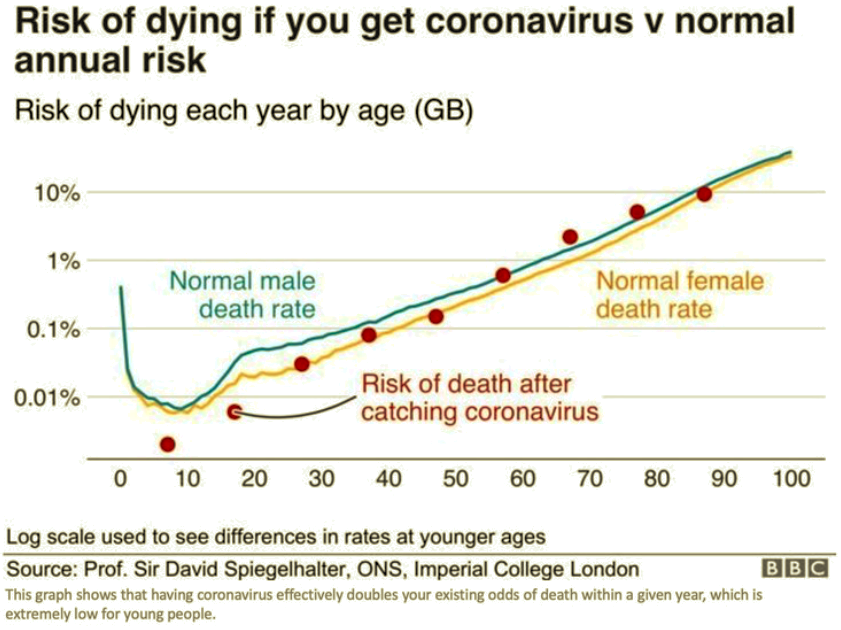
Nevertheless, a great deal was known in early March about the truly vulnerable segments of the population, even if you discount Chinese reporting. Mortality rates in South Korea and Italy were heavily skewed toward the aged and those with other risk factors. One can reasonably argue that health care professionals and policy experts should have known even then how best to mitigate the risks of the virus. That would have involved targeting high-risk segments of the population for quarantine, and treatment for the larger population in-line with the lower risks it actually faced. Vulnerable groups require protection, but death rates from coronavirus across the full age distribution closely mimic mortality from other causes, as the chart at the top of this chart shows.

The current global death toll is still quite small relative to major pandemics of the past (Spanish Flu, 1918-19: ~45 million; Asian Flu, 1957-58: 1.1 million; Hong Kong flu, 1969: 1 million; Covid-19 as of May 22: 333,000). But by mid-March, people were distressed by one particular epidemiological model (Neil Ferguson’s Imperial College Model, subsequently exposed as slipshod), predicting 2.2 million deaths in the U.S. (We are not yet at 100,000 deaths). Most people were willing to accept temporary non-prescription measures to “slow the spread“. But unreasonable fear and alarm, eagerly promoted by the media, drove the extension of lockdowns across the U.S. by up to two extra months in some states, and perhaps beyond.

The public health and policy establishment did not properly weigh the health care and economic costs of extended lockdowns against the real risks of the coronavirus. I believe many health care workers were goaded into supporting ongoing lockdowns in the same way as the public. They had to know that the suspension of medical care was a dire cost to pay, but they fell in line when the “experts” insisted that extensions of the lockdowns were worthwhile. Some knew better, and much of the public has learned better.

Covid Framing #6: The Great Over-Reaction

16 Saturday May 2020

Posted by Nuetzel in Pandemic

≈ 2 Comments

Tags

Asian Flu, California, Colorado, Confirmed Cases, Coronavirus, Covid-19, Death Toll, Florida, Georgia, Germany, Great Over-Reaction, Hong Kong Flu, Italy, Nate Silver, Neil Ferguson, New York, Pandemics, Spanish Flu, Sweden

I visited my doctor last Wednesday. He’s a specialist but also serves as my primary care physician, and we share the same condition. He’s affiliated with a prestigious medical school and practices on the campus of a large research hospital. First thing, I asked him, “So what do you think of all this?” Without hesitation, he said he believes we’re witnessing the single greatest over-reaction in all of medical history. He elaborated at length, which I very much appreciated, and I was gratified that much of what he said was familiar to me and my readers. The risks of the coronavirus are highly concentrated among the elderly and the already-sick, and the damage that the panic and lockdowns have done to the delivery of other medical care is probably a bigger tragedy, to say nothing of the economic damage. Furthermore, the Covid-19 pandemic is certainly not more threatening than others the world has experienced since WW II.

But did we know all that in March? No one with any sense believed the low numbers coming out of China; major flip-flops and mistakes by public health officials in the U.S. did much to confuse matters and delay evaluation of the outbreak. Nevertheless, there were reasons to proceed more deliberately. The explosion of cases in Italy and elsewhere consistently indicated that risk was concentrated among the elderly, so a targeted approach to protecting the vulnerable would have made sense. Still, individuals took voluntary action to social distance even before governments initiated broad lockdowns.

The lockdowns, of course, were sold as a short-term effort to “flatten the curve” so that medical resources would not be overwhelmed. There was, no doubt, great stress on front-line health care workers in March and April, and there were short-term shortages of personal protective equipment as well as ventilators for the most severe cases (but it’s possible ventilators actually harmed some patients). But whether you credit government action, private action, or the fact that so much of the population was not susceptible to begin with, mission accomplished! The strains were concentrated in certain geographic regions, especially the New York City metro area, but even there, the virus is on the wane. There is always the possibility of a major second wave, but perhaps it can be handled more intelligently by the public and especially public servants.

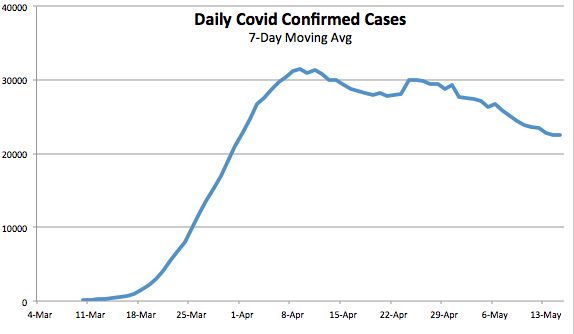
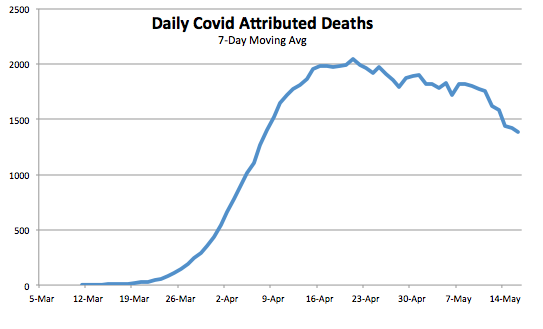
And now for some charts. Due to day-to-day volatility, and because the data on case numbers and deaths fluctuate on a weekly frequency, the charts below are on a 7-day moving average basis. It’s clear that the peak in U.S. daily confirmed cases was over five weeks ago, while the peak in Covid-attributed deaths was about three weeks ago.

Unfortunately, there is more doubt than ever about the legitimacy of the numbers. New York keeps “discovering” new deaths in nursing homes, a situation aggravated by a statewide order in March prohibiting homes from rejecting new or returning patients with active infections. There are reports from across the country of family deaths that were imminent, yet officially attributed to Covid. In one case, a death from severe alcohol poisoning was attributed to Covid. Colorado announced today that it was revising its death toll downward by about 24%.

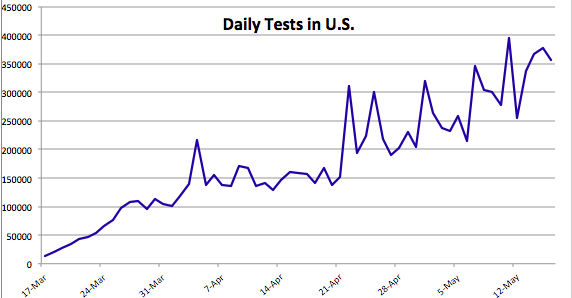
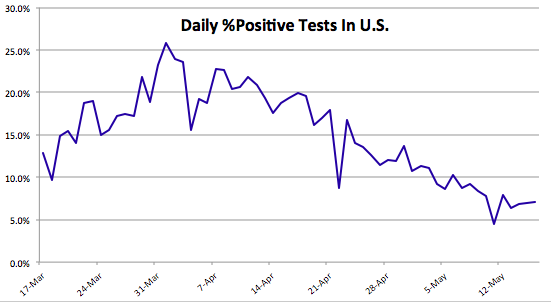
The data on confirmed cases are elevated because testing keeps expanding. The first chart below shows that the number of daily tests has more than doubled over the past 3½ weeks. At the same time, the second chart below shows that the rate of “positives” has declined steadily for over six weeks. That is likely due to a combination of expanded testing for screening purposes, as opposed to testing mainly individuals presenting symptoms, and fewer individuals presenting symptoms each day.

As Nate Silver said on Saturday:

“There are still *way* too many stories about big spikes in cases when the cause of those spikes was a big increase in tests. And remember, it’s a good thing when states start doing more tests!”

One commenter on Silver’s thread pointed out that more testing is likely to lead to more confirmed cases even if the true number of infections is declining.

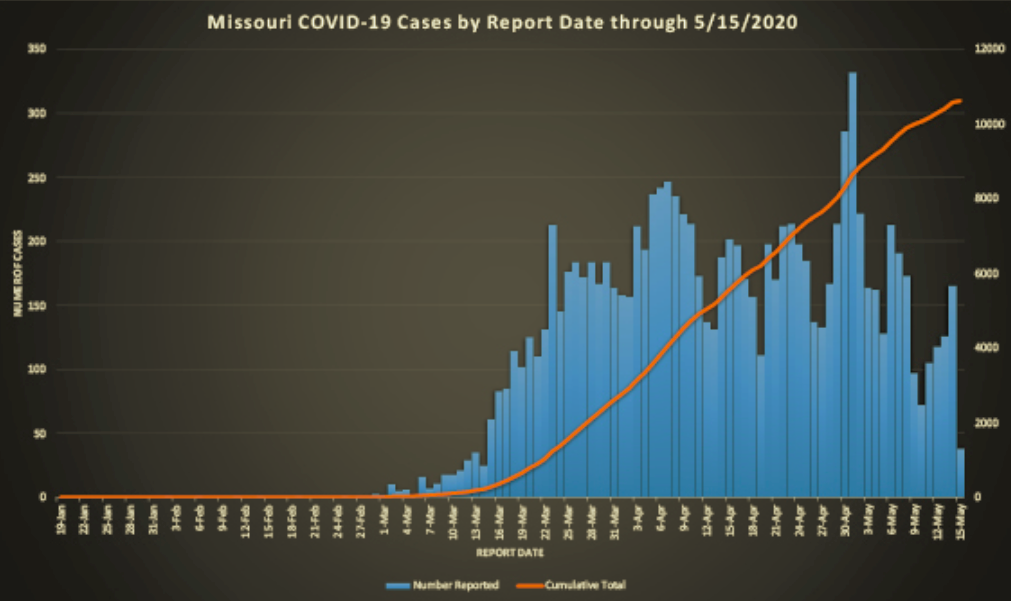
I’ll highlight just a few individual states. Missouri’s peak in cases appears to have occurred several weeks ago, though a spike at the end of April interrupted the trend. The spike was partly attributable to a flare-up at a single meat-packing plant (facilities that are particularly conducive to viral spread due to close conditions and aerosols).

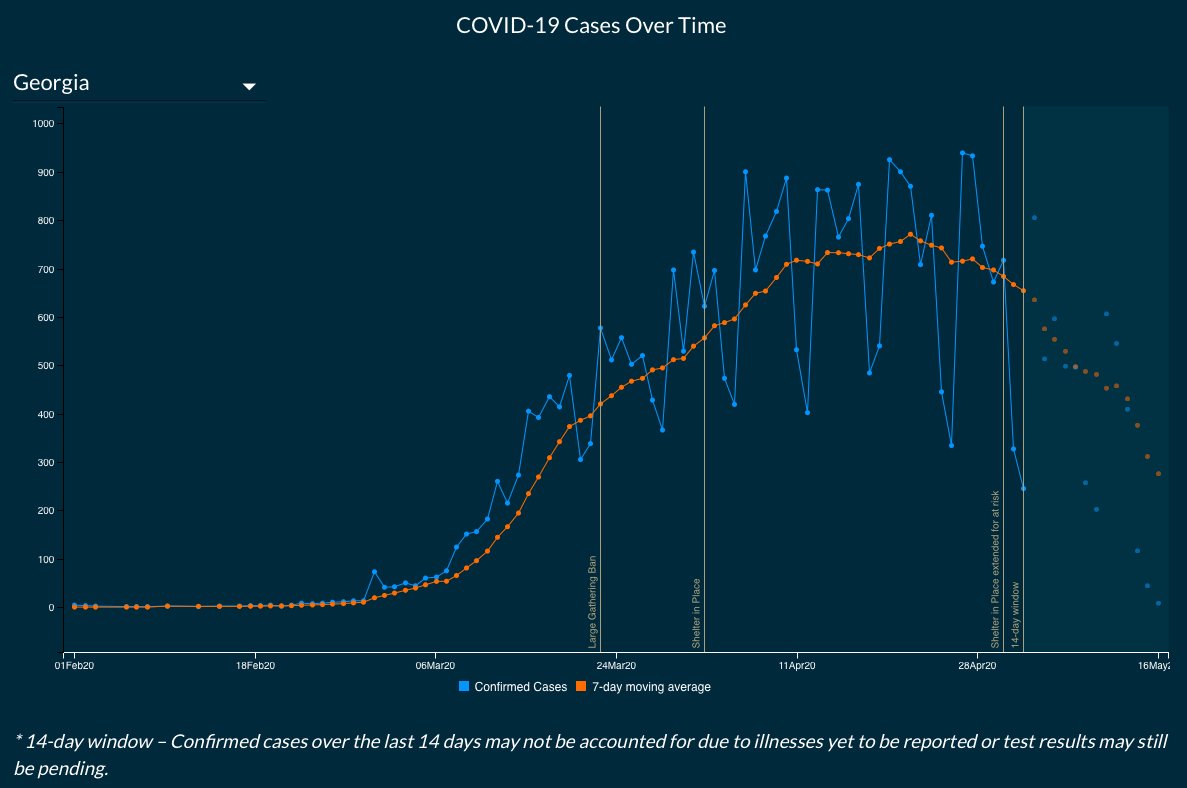
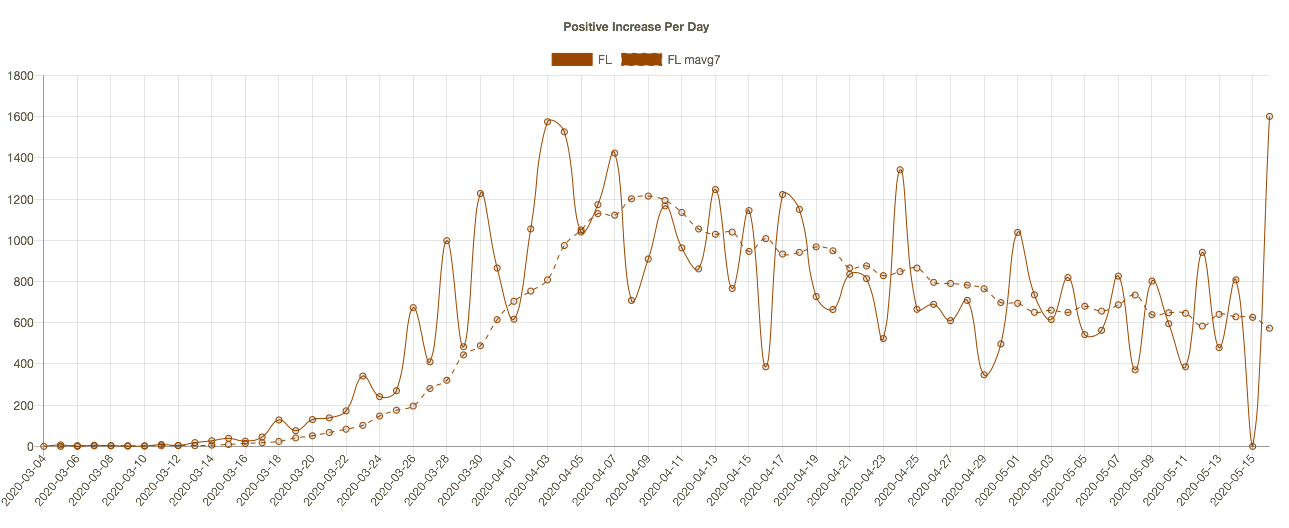
Here is Georgia, which began to reopen its economy on April 24. The pro-lockdown crowd confidently predicted the reopening would lead to a spike in cases within two weeks. Georgia is conservative in its reporting, so they don’t extend the lines in the chart beyond 14 days of the most recent reports due to potential revisions. Nevertheless, it’s clear that the trend in cases is downward.

The pro-lockdown contingent predicted the same for Florida, but that has not been the case:

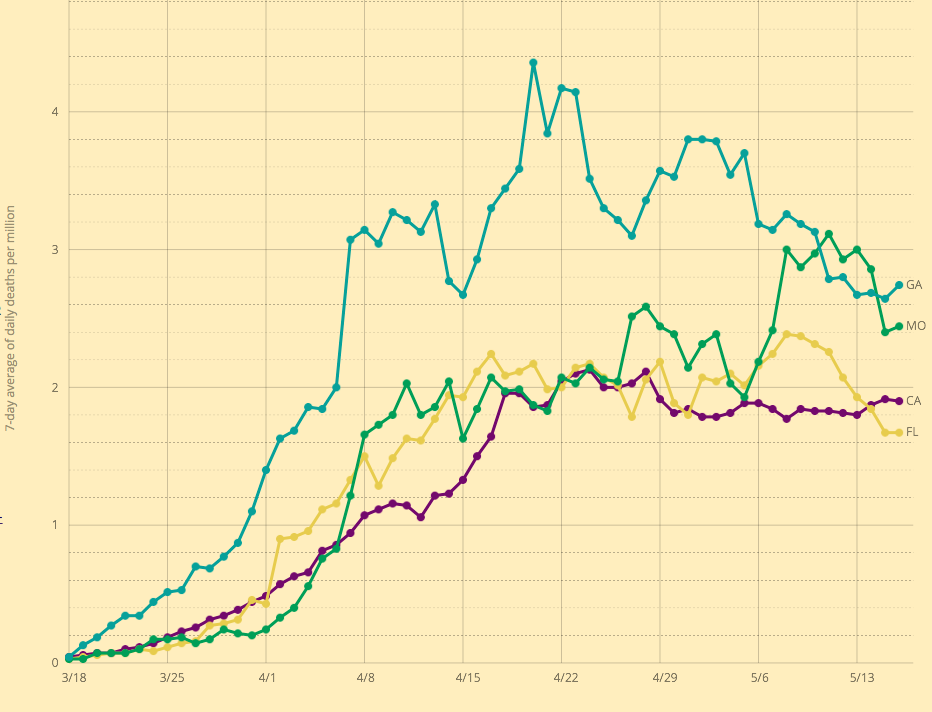
The next chart shows seven-day moving averages of deaths per million of population for four states: CA, FL, GA, and MO. The labels on the right might be hard to read, but MO is the green line. Deaths lag cases by a few weeks, and Missouri’s death rate was elevated more recently, again owing partly to the meat-packing plant. These death rates are all fairly low relative to the northeastern states around New York.

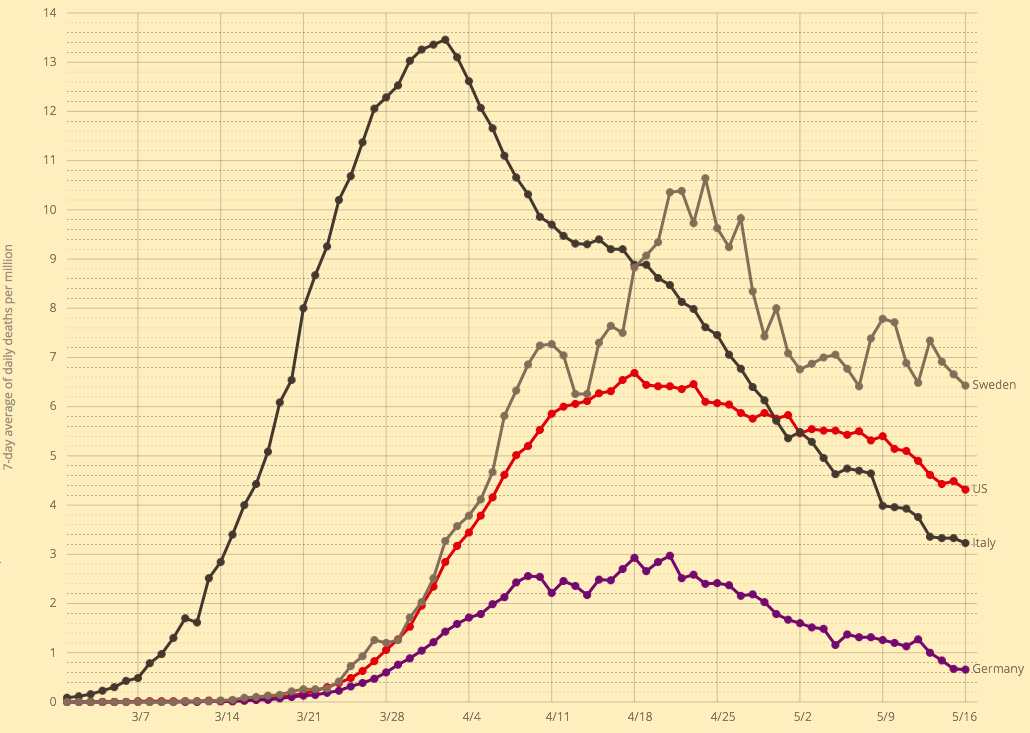
Finally, here are death rates per million of population for a few selected countries: Italy, Germany, Sweden, and the US. Italy had the large early spike, while Germany lagged and with a much lower fatality rate. The U.S. suffered more than twice the German death rate. Sweden, which has pursued a herd immunity strategy, has come in somewhat higher. The Italian and Swedish experiences both reflect high deaths in nursing homes, which might indicate a lack of preparedness at those institutions.

Here is a post from just a few days ago with a nice collection of charts for various countries.

Returning to the main gist of this “framing”, the Great Over-Reaction, the predictions setting off this panic were made by a forecaster, Neil Ferguson, who has had a rather poor track record of predicting the severity of earlier pandemics. The model he used is said to have been poorly coded and documented, and it is underdetermined such that many multiple forecast paths are possible. That means the choice of a “forecast” path is arbitrary.

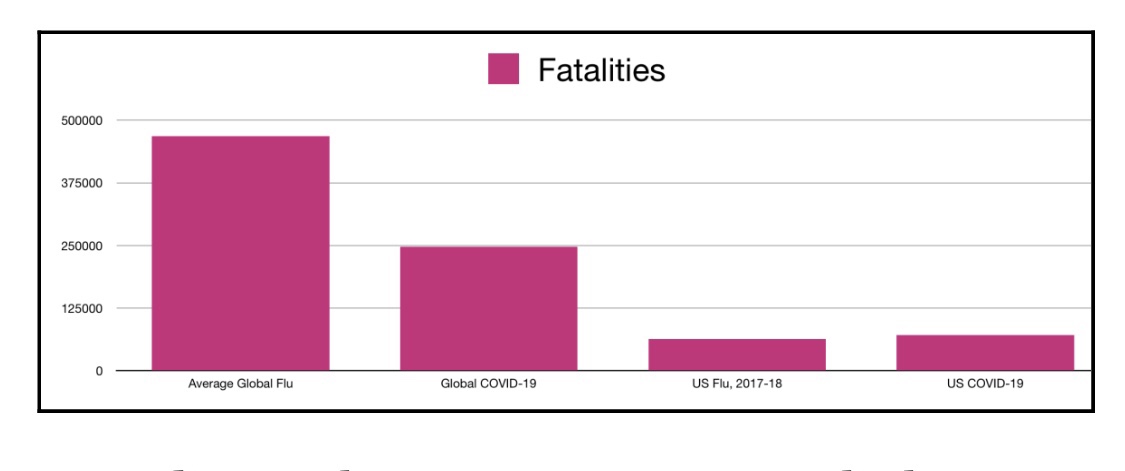
Make no mistake: Covid-19 is a serious virus. Ultimately, however, the Covid-19 pandemic might not reach the scale of a typical global flu: the current global death toll is only about two-thirds of the average flu season (global deaths from Covid-19 are now about 312,000—the chart below is a few days old). In the U.S., the death toll is modestly higher than the average flu season, but that is largely attributable to the New York City metro area. Worldwide, Covid19 deaths are now about 30% of the toll of the Hong Kong flu in 1969-70, 28% of the Asian flu in 1957-58, and far less than 1% of the Spanish flu at the end of WW I. Neither the Hong Kong flu nor the Asian flu were dealt with via widespread non-prescription health interventions like the draconian lockdowns instituted this time. The damage to the economy has been massive and unjustifiable, and the effective moratorium on medical care for other serious conditions is inflicting a large toll of its own.

Again, we can identify distinct groups that are highly vulnerable to Covid-19: the aged and individuals with co-morbidities most common among the aged. A large share of the population is not susceptible, including children and the vast bulk of the work force. The sensible approach is to target vulnerable groups for protection while minimizing interference with the liberties of those capable of taking care of themselves, especially their freedom to weigh risks. Nevertheless, those facing low risks should continue to practice extra-good manners…. er, social distancing, to avoid subjecting others to undue risk. Don’t be a close talker, don’t go out if you feel at all out of sorts, and cover your sneezes!

Cuomo Denies Tradeoffs, Cries Scarcity

12 Tuesday May 2020

Posted by Nuetzel in Pandemic, statism, Virtue Signaling

≈ 1 Comment

Tags

Andrew Cuomo, BMI, Coronavirus, Cost-Benefit Analysis, Covid-19, Economic Value of Life, European Virus, Javits Center, Lockdown, New York Virus, Shadow Price, statism, The Nation, Ventilators, Who Shall Live?, Wuhan Virus

Here’s an all-time dumbass bromide: “If it saves only one life, it’s worth it.” New York Governor Andrew Cuomo said it last week in a bit of sanctimonious posturing intended for consumption by the unthinking. A variant on this is, “You can’t put a value on a human life,” and Cuomo said that too. But of course we do that every day. Yes, we weigh lives against costs, and we must. Each and every decision involving any personal or public health risk entails an implicit and sometimes explicit valuation of human life. There are few costless decisions in a world of scarce resources, and lives are often one of those costs. These might be matters of probability in an ex ante sense, which might make it more palatable. Ex post, they add up to real lives.

Imagine a world in which we spared no expense to save lives. We’d shift massive resources into health care to the detriment of all production and consumption that does not save lives. No precaution would be too conservative. No driving or biking, because those prohibitions would save many lives. Many risky construction and maintenance jobs would be off limits. No smoking, of course, and no drinking! No chips! Every BMI greater than 25 and you’re off to mandatory fat camp. Sadly, the effort to save a life is sometimes fruitless, but as long as there’s a chance, we’d try and try, providing mechanical life support to every patient hanging on by a tattered thread. No, we don’t do these things because it’s too damn costly.

We face an infinite number of tradeoffs in medical care and in public health more generally. The question “Who Shall Live?” must be answered every day when deciding how health care resources are to be allocated. No matter how you answer that question, certain lives will be lost as the cost of meeting your preferred medical objectives. You can’t meet them all. Resources are scarce — or in more everyday language, budgets are tight.

So human life is often assigned an implicit or shadow value in decision making. But even explicit assignment of economic value to human life is not uncommon. Valuing lives is a standard practice in cost-benefit analysis. It’s also quite common for life values to be estimated as part of forensic analyses in support of legal proceedings.

Andrew Cuomo surely knows all this. That makes his statements all the more disingenuous. This article in The Nation from the end of March implies that Cuomo has valued life all too cheaply in light of his past budget proposals for health care programs. Along the same lines, see this eye-opening critique of the policies Cuomo has pursued that left NY poorly prepared for a pandemic. And now, he’d like to keep his costly lockdown order in place even if it saves “just one life”.

Beyond all that, Cuomo is a stupendous hypocrite, asserting that life is too precious to spare any expense after signing an order in March requiring nursing homes to accept individuals with active Covid infections. Nursing homes have been the very hottest of spots for Covid infections and deaths, so the order was glaringly dismissive in valuing the lives of vulnerable nursing home residents. The rationale for the order was to save hospital beds, but there was no shortage. 

In fairness, Cuomo was also clamoring for assistance to add hospital capacity. Millions were spent to convert the Javits Center to a temporary field hospital and to bring a U.S. Navy hospital ship up the Hudson, but they went almost completely unused. Why not send the elderly patients there, instead of back to the nursing homes?

Finally, he pouted for weeks about his state’s shortage of ventilators, only to quickly reverse course as it became apparent that the state had a surplus of ventilators.

Recently, Cuomo felt it necessary to demonstrate his anti-Western bona fides by labeling the coronavirus the “European Virus“. He must think that’s a clever poke in the eye to those who prefer “Wuhan Virus”, though it is quite correct (and not the least bit “racist”) to note that the virus originated in Wuhan, China. For what it’s worth, the genome of the European strain, like the others that hit New York, differs by less than 12 out of 30,000 base-pairs of DNA from the original Wuhan strain. And of course the New York metropolitan area has made a massive contribution to the U.S. case load and death toll from the virus. Travelers from New York did much to spread Covid-19 to the rest of the country. So, as some have suggested, perhaps a better name might be “New York Virus”.

Andrew Cuomo is nothing if not a politician, and I suppose he’s just behaving like one. I probably wouldn’t gripe were it not for the minions who fall for Cuomo’s sham virtue. But it’s worse than that: the claim that public intervention at any cost is worthwhile if it saves “just one life” is a deeply statist sentiment.

The Vagaries of Excess Deaths

02 Saturday May 2020

Posted by Nuetzel in Liberty, Pandemic, Tyranny

≈ 2 Comments

Tags

Cause of Death, CDC, Civid-Only Deaths, Co-Morbidities, Coronavirus, Covid-19, Denmark Covid, Eastern Europe Covid, Euromomo, Excess Mortality, Germany Covid, Jacob Sullum, John Burn-Murdoch, New York Covid, New York Times, Probable Covid Deaths

The New York Times ran a piece this week suggesting that excess mortality from Covid-19 in the U.S. is, or will be, quite high. The analysis was based on seven “hard hit” states, including three of the top four states in Covid death rate and five of the top ten. Two states in the analysis, New York and New Jersey, together account for over half of all U.S. active cases. This was thinly-veiled cherry picking by the Times, as Jacob Sullum notes in his discussion of what excess mortality does and doesn’t mean. Local and regional impacts of the virus have varied widely, depending on population density, international travel connections, cultural practices, the quality of medical care, and private and public reaction to news of the virus. To suggest that the experience in the rest of the country is likely to bear any similarity to these seven states is complete nonsense. Make no mistake: there have been excess deaths in the U.S. over the past few weeks of available data, but again, not of the magnitude the Times seems to intimate will be coming.

Beyond all that, the Times asserts that the CDC’s all-cause death count as of April 11 is a significant undercount, though the vast majority of deaths are counted within a three week time frame. In fact, CDC data at this link show that U.S. all-cause mortality was at a multi-year low during the first week of April. The author admits, however, that the most recent data is incomplete. The count will rise as reporting catches up, but even an allowance for the likely additions to come would leave the count for the U.S. well below the kinds of levels suggested by the Times‘s fear-mongering article, based as it was on the seven cherry-picked states.

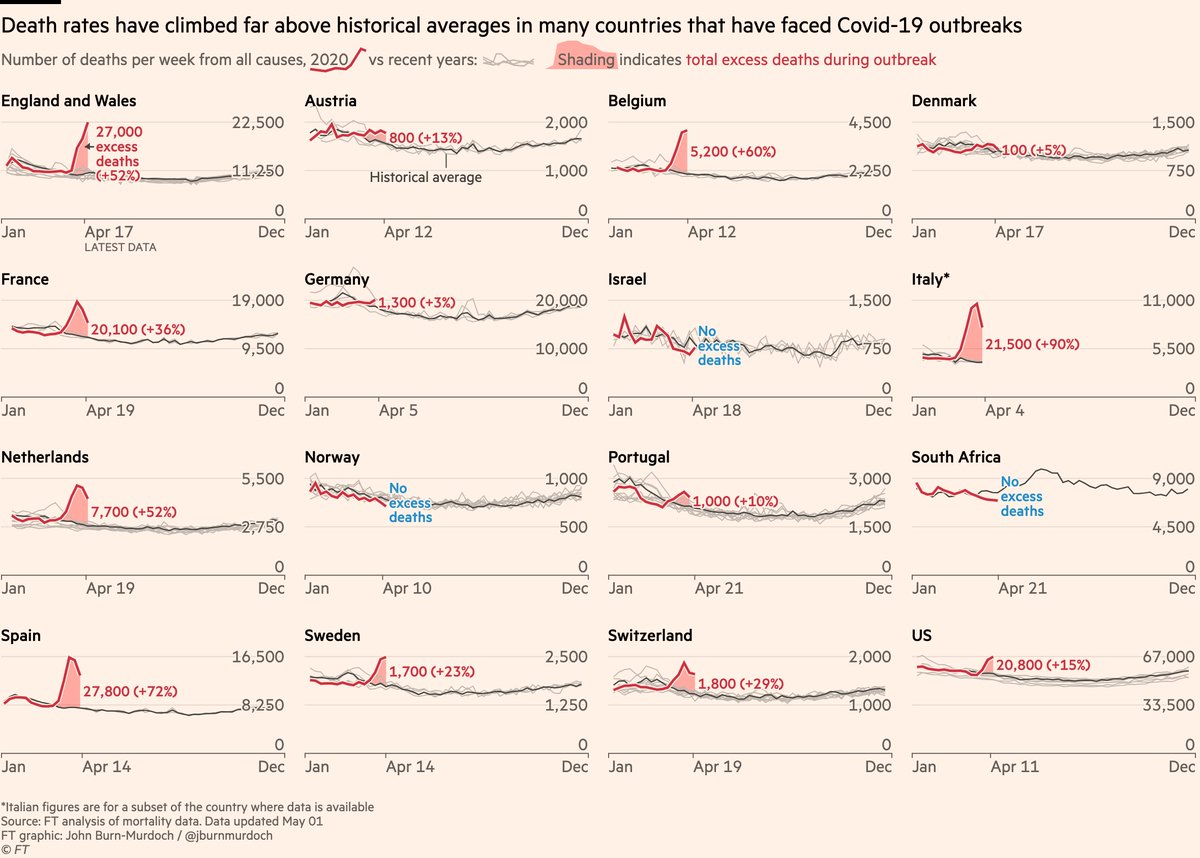
The author of this Twitter thread, John Burn-Murdoch, seems to engage in the same practice with respect to Europe. He shows charts with excess deaths in 12 countries, almost all of which show significant, recent bumps in excess deaths (the sole exception being Denmark). Inexplicably, he excludes Germany and a number of other countries with low excess deaths or even “valleys” of negative excess deaths. His most recent update is a bit more inclusive, however. (It was the source of the chart at the top of this post.) Euromomo is a site that tracks excess mortality in 24 European countries or major regions (non-overlapping), and by my count, 13 of have no or very little excess mortality. And by the way, even this fails to account for a number of other Eastern European nations having low Covid deaths.

Excess mortality is a tricky metric: it cannot be measured with certainty, and almost any measure has conceptual shortcomings. In the case of Covid-19, excess mortality seeks to measure the number of deaths attributable to the virus net of deaths that would have occurred anyway in the absence of the virus. For example, abstracting from some of the details, suppose there are 360 deaths per hundred-thousand of population during the average month of a pandemic. If the “normal” mortality rate is 60 per hundred-thousand, then excess mortality is 300 per month. It can also be expressed as a percentage of the population (0.3% in the example). But that’s just one way to measure it.

In the spirit of Sullum’s article, it’s important to ask what we’re trying to learn from statistics on excess mortality. It’s easy to draw general conclusions if the number of Covid-19 deaths is far in excess of the normal death rate, but that depends on the quality of the data, and any conclusion is subject to limits on its applicability. Covid deaths are not that high in many places. By the same token, if the number of Covid deaths (defined narrowly) is below the normal death rate (measured by an average of prior years), it really conveys little information about whether excess mortality is positive of negative: that depends on the nature of the question. For each of the following I offer admittedly preliminary answers:

  • Are people dying from Covid-19? Of course, virtually everywhere. There is no “normal” death rate here. And while this is the most direct question, it might not be the “best” question.
  • Is Covid-19 causing an increase in respiratory deaths? Yes, in many places, but perhaps not everywhere. Here and below, the answer might depend on the time frame as well.
  • Is Covid-19 increasing deaths from infectious diseases (biological and viral)? Yes, but perhaps not everywhere.
  • Is Covid-19 increasing total deaths from natural causes? Yes, but not everywhere.
  • Is all-cause mortality increasing due to Covid-19? In some places, not others. Accurate global and national numbers are still a long way off.

All-cause mortality is the most “rough and ready” comparison we have, but it includes deaths that have no direct relationship to the disease. For example, traffic fatalities might be down significantly due to social distancing or regulation during a pandemic. Thus, if our purpose is purely epidemiological, traffic fatalities might bias excess mortality downward. On the other hand, delayed medical treatments or personal malaise during a pandemic might lead to higher deaths, creating an upward bias in excess deaths via comparisons based on all-cause mortality.

Do narrow comparisons give a more accurate picture? If we focus only on respiratory deaths then we exclude deaths from other causes and co-morbidities that would have occurred in the absence of the virus. That may create a bias in excess mortality. So narrow comparisons have their drawbacks, depending on our purpose.

That also goes for the length of time over which excess mortality is measured. It can make a big difference. Again, much has been made of the fact that so many victims of Covid-19 have been elderly or already ailing severely before the pandemic. There is no question that some of these deaths would have occurred anyway, which goes to the very point of calculating excess mortality. If the pandemic accelerates death by a matter of weeks or months for a certain percentage of victims, it is reasonable to measure excess mortality over a lengthier period of time, despite the (perhaps) highly valuable time lost by those victims (that being dependent on the decedent’s likely quality of life during the interval).

Conversely, too narrow a window in time can lead to biases that might run in either direction. Yet a cottage industry is busy calculating excess mortality even as we speak with the pandemic still underway. There are many fatalities to come that are excluded by premature calculations of excess mortality. On the other hand, if the peak in deaths is behind us, a narrow window and premature calculation may sharply exaggerate excess mortality.

Narrow measures of excess mortality are affected by the accuracy of cause-of-death statistics. There are always inaccuracies in this data because so many deaths involve multiple co-morbidities, so there is often an arbitrary element in these decisions. For Covid-19, cause-of-death attribution has been extremely problematic. Some cases are easy: those testing positive for the virus, or even its presence immediately after death, and having no other respiratory infections, can fairly be counted as Covid-19 deaths. But apparently just over half of Covid-19 deaths counted by the CDC are “Covid-Only” deaths. A significant share of deaths involve both Covid and the flu, pneumonia, or all three. There are also “probable” Covid-19 deaths now counted without testing. In fact, hospitals and nursing homes are being encouraged to code deaths that way, and there are often strong financial incentives to do so. Many deaths at home, sans autopsy, are now routinely classified as Covid-19 deaths. While I have no doubt there are many Covid deaths of untested individuals both inside or outside of hospitals, there is no question this practice will overcount Covid deaths. Whether you believe that or not, doubts about cause-of-death accuracy is another reason why narrow comparisons can be problematic.

More trustworthy estimates of the coronavirus’ excess mortality will be possible with the passage of time. It’s natural, in the heat of the pandemic, to ask about excess mortality, but such early estimates are subject to tremendous uncertainty. Unfortunately, those calculations are being leveraged and often mis-applied for political purposes. Don’t trust anyone who would use these statistics as a cudgel to deny your Constitutional rights, or otherwise to shame or threaten you.

New York’s Covid experience is not applicable to the country as a whole. Urban mortality statistics are not applicable to areas with lower population densities. Excess mortality for the elderly cannot be used to make broad generalizations about excess mortality for other age groups. And excess mortality at the peak of a pandemic cannot be used to make generalizations about the full course of the pandemic. In the end, I expect Covid-19 excess mortality to be positive, whether calculated by all-cause mortality or more narrow measures. However, it will not be uniform in its impact. Nor will it be of the magnitude we were warned to expect by the early epidemiological models.

Covid “Framing” #5: Crested Wave

28 Tuesday Apr 2020

Posted by Nuetzel in Pandemic

≈ Leave a comment

Tags

Coronavirus, Covid Tracking Project, Covid-19, IHME Model, Institute for Health Metrics and Evaluation, Italy Covid, Johns Hopkins Dashboard, Missouri Covid, New York Covid, Private Testing, South Korea Covid, Testing and Tracing

One big change in recent national Covid trends has to do with testing. In the past week, the number of daily tests has increased by an average of over 50%. That’s shown in the first chart below. Regardless of whether the individuals being tested meet the earlier testing criteria, there are still plenty of people who either want to get tested or are being tested for occupational reasons. Nonetheless, there are reports of unused testing capacity at private labs and universities. Further increases in testing are in the offing, especially if those desiring tests are made aware of their availability.

Increased testing has been accompanied by further declines in the percentage of positive tests. That’s certainly a good thing, but it’s not clear how much of the decline can be attributed to declining transmissions, as opposed to broadened testing criteria.

Coronavirus deaths in the U.S. have also begun to taper. The black line below plots cumulative Covid-attributed deaths the U.S. up through April 28. The red line is the IHME model projection from April 2nd, with upper and lower confidence bounds shown by the blue and green lines, respectively. Despite the notorious broadening of the definition of a Covid death a few weeks ago, the cumulative death toll has remained below the mean IMHE projection. 

More bad news is that the number of confirmed coronavirus cases continues to mount. Of course, that is a consequence of broader testing and possibly some arbitrary classifications as well. My previous coronavirus “framing” posts (#1 from March 18th is here, #4 is here ) usually featured a chart like the one below, which shows the number of cumulative confirmed cases of Covid-19 in the U.S. Day 1 in the chart was March 4th, so tonight, April 28th, we’re 55 days in. The blue and green lines are what I originally called “pretty bad” and “very good” outcomes, based on multiples of Italy and South Korea as of March 18th, as a share of their respective populations. Italy’s case count kept climbing after that, but its growth has now slowed considerably.

The U.S. case count has increased dramatically, now exceeding the original “very bad” case curve I plotted in mid-March. Has the U.S. fared as poorly as that seems to suggest? As of April 28, the U.S. has performed about three times as many tests as Italy, and it has identified about 10% fewer cases per capita. If we excluded the state of New York, which accounts for 5.7% of U.S. population but fully 30% of U.S. Covid cases through April 28th, U.S. Covid incidence would be well below Italy’s. However, Italy is still perhaps two weeks ahead of us.

The next chart examines New York’s experience relative to all other states. The blue line is the number of daily confirmed cases in the U.S., and the red line is the U.S. excluding New York state. The vertical gap between the two lines is the daily case count for New York. The fluctuating, slight downward trend in the U.S since about April 10th is largely attributable to improvement in New York. The rest of the country, while not as serious as New York in terms of incidence, is still on a plateau.

The next chart shows daily Covid-attributed deaths for the U.S. (blue), the U.S excluding New York state (red), and New York state (green). The source of this data is the Covid Tracking Project, which reports numbers as of 4 p.m. each day, so it differs from the daily numbers reported by the Johns Hopkins Dashboard. There are a few interesting things to note here. First, New York has accounted for a major share of daily deaths, though its share is diminishing. The decline in New York Covid deaths has been a major positive development over the past few weeks. The pattern of deaths for the U.S. is kind of fascinating: It shows a distinct weekly frequency, with declines over weekends and spikes early in each week. I suspect this is based on the data elements used by the Tracking Project, perhaps based on reporting dates rather than actual times of death. New York does not show that kind of pattern, but I’ve heard that the reporting system there is highly efficient. We might have seen a favorable turn in U.S. daily fatalities over the past week. After the peak early this week, the daily count is likely to decline again over the next few days. We can hope the weekly spikes and valleys reach lower levels as we get into May.

Finally, a couple of charts updating the status of the pandemic in Missouri, my home state. Despite some volatility, new cases continue to taper.

Missouri Covid fatalities are extremely volatile. It’s hard to see the kind of “weekend” phenomenon so apparent in the U.S. aggregate shown earlier. With a couple of recent spikes, it’s difficult to say anything conclusive about the course of daily fatalities based on the chart below. However, as fewer new cases are diagnosed in Missouri, the number of fatalities will follow.

So, what’s the new “framing”? I expect U.S. case counts to continue to climb with more extensive testing. If the most vulnerable individuals remain quarantined or at least carefully distanced, then individuals presenting symptoms will continue to fall, so the rate of new positive will decline. Additions to the case count will come increasingly from the asymptomatic who happen to be tested for occupational reasons, for travel abroad, and ultimately for testing and tracing efforts. Improved light and humidity is likely to cut into the rising case count as June approaches. With any luck it will become negligible along with fatalities. We’ll continue to learn as well. The hope is that a few treatments or even a vaccine will prove out. Test results for a few of the latter might be available as early as September.

A Look at Covid-19 Cases in Missouri

21 Tuesday Apr 2020

Posted by Nuetzel in Pandemic

≈ 2 Comments

Tags

Bing, Confirmed Cases, Coronavirus, Covid Tracker, Covid-19, Fatalities, Log Scale, Microsoft, Missouri, Pandemic, St. Louis MO/IL Metro

This is a quick post for Missouri readers. It’s well known that the coronavirus pandemic has differed in its severity across the world and across the country. I’ve been focusing on nationwide statistics, but I thought it would be interesting to look at my home state’s progress in getting ahead of the virus. The charts below are taken from the Covid Tracker from Microsoft/Bing.

The peak of new cases in Missouri appears to be behind us. The state reached a rough plateau around the beginning of April. There was some volatility in the daily numbers of conformed cases, but the a downward trend seemed to begin around the 10th.

Cumulative confirmed cases in Missouri are shown in the next chart (Oops… spelling!), but in log scale. The slope of the line can be interpreted as the growth rate. It’s still positive and will be as long as there are new confirmed cases, but it is getting small.

Daily Covid-19 fatalities in Missouri are shown next. They are obviously quite volatile from day-to-day, as might be expected. They seemed to reach a high about a week after new cases reached their plateau, which demonstrates the lag between diagnosis and death in the most severe cases. The trend has become more favorable over the past week, though another jump in deaths was reported today.

The following chart shows cumulative Missouri fatalities in log scale. The curve is flattening (growth rate slowing), but it might take a few weeks for fatalities to stay in the very low single digits day after day.

The St. Louis metro area has had the largest concentration of cases and fatalities in Missouri. St. Louis County, St. Louis City, and St. Charles County are ranked #1 – #3 in the state, respectively. Here are the top ten counties in terms of this grim statistic (I’m sorry for the poor alignment).

County                 Cases       Deaths

St. Louis               2,333       91 (3.90%)
St. Louis City           877       21 (2.39%)
St. Charles              458       15 (3.28%)
Jackson                   438       13 (2.97%)
Jefferson.                230         3 (1.30%)
Franklin.                  102         5 (4.90%)
Boone                       96         1 (1.04%)
Greene.                    84          7 (8.33%)
Clay                          61         1 (1.64%)
Cass                         54          6  (11.1%)

I wanted to take a closer look at the pattern of cases in the metro area over time. Last night I found daily county-level case data on my phone. I thought I’d be able to download it tonight, but the site has been uncooperative. Maybe later.

Missouri looks like it’s on the back end of the curve, at least for this wave of the pandemic. We can hope there won’t be a second wave, or if there is, that it will be more manageable.


Lockdown-Righteous Morons Condemn Beachgoers

19 Sunday Apr 2020

Posted by Nuetzel in Liberty, Pandemic, Public Health

≈ Leave a comment

Tags

Aerosols, Close Talkers, Confined Space, Coronavirus, Covid-19, Dr. Christopher Gill, Droplets, Huggers, Humidity, HVAC, Indoor Transmission, Jacksonville, Outdoor Transmission, Public Health, SARS-CoV-2, Social Media, Time Magazine, Ultraviolet Light

I’m often inspired by social media because that’s where the sacred cows graze. Today I saw a juicy one… but actually, the linked article was not surprising: the headline claimed that Jacksonville, Florida residents were flocking to local beaches after they’d been reopened. What grabbed me were the half-witted condemnations made by the poster and his friends. One individual, a Jacksonville resident, claimed that the article was incorrect, that this was “not happening in Jax”. But many of the commenters were horrified by the accompanying photo, a view down the beach showing a number of walkers. If you’ve ever been to a beach, you probably know that such a visual perspective can exaggerate crowd conditions. They looked adequately distanced to me, and I’d bet most of the people or small groups in the photo were a good 20+ feet apart.

The comments on the post were a display of unbridled anger: those people on the beach would be sorry when they caused a second spike in coronavirus cases. How monstrous were these Jaxers to chance infecting others! A few expressed hope that the beachgoers would get sick, as if they’d learn their lesson. And in a delicious case of projection by the uninformed, the hashtag #FloridaMorons was trending on social media. These ugly, nitwitted nannies just can’t get over their need to control their fellow man, while lacking the knowledge to do so sensibly.

Not only did the people on the beach look adequately distanced to the rational eye, but unless you’re an unreformed hugger or “close talker”, the chance of contracting coronavirus outdoors is slim to none! That’s especially true on a beach, where there is typically a decent breeze.

A recent study conducted by Chinese researchers on the environments in which clusters of Covid infections were originally contracted showed that outdoor transmission is very unlikely:

“…among our 7,324 identified cases in China with sufficient descriptions, only one outdoor outbreak involving two cases occurred.”

The authors conclude that coronavirus transmission is an indoor phenomenon.

A Q&A from Time includes the question: Is there any difference between being indoors and outdoors when it comes to transmission? Here is part of the response:

“We all occupy an area in three dimensional space, and as we move away from one another, the volume of air space on which we have an impact expands enormously. ‘If you go from a 10-ft. sphere to a 20-ft. sphere you dilute the concentration [of contaminated air] eight-fold,’ says Dr. Christopher Gill, associate professor of global health at Boston University School of Public Health.”

“‘Within seconds [a virus] can be blown away,’ […] Sunlight may also act as a sterilizer, Gill says. Ultraviolet wavelengths can be murder—literally—on bacteria and viruses, though there hasn’t yet been enough research to establish what exactly the impact of sun exposure is on SARS-CoV-2, the virus responsible for COVID-19.”

There is evidence, however, that high temperatures and humidity reduce the spread of the virus (and see here). That sounds like the beach to me! Whether by droplets or aerosols, confined spaces are where transmission happens. It is almost exclusively an indoors phenomenon, aggravated by HVAC air flows that create dry conditions.

Social distancing is still important at the moment, but keeping people indoors is not conducive to public health. Most of the country (well, outside of downstate New York)  is on a path to stanching the contagion. Under these circumstances, you can expect people to push back against unreasonable demands to stay off the beach, stay off an outdoor job, or even stay off their indoor job where there is good ventilation with fresh air, and where distance can be maintained. These little social-media tyrants should pry off their jack-boots and get some sand between their toes!


Lockdown Illusions

16 Thursday Apr 2020

Posted by Nuetzel in Federalism, Liberty, Pandemic

≈ Leave a comment

Tags

CityLab, Coastal States, Coronavirus, Covid-19, Fixed Effects, International Travelers, Mood Affiliation, Pandemic, Population Density, Stay-at-Home Orders, Viral Transmission, Worldometers

Analytical sins have occurred with great regularity in popular discussions of the Covid-19 pandemic and even in more scholarly quarters. Among my pet peeves are cavalier statements about the number of cases or deaths in one country or state versus another without adjusting for population. Some of this week’s foibles also deal comparisons of the pandemic and public policy across jurisdictions, but they ignore important distinctions.

No matter how you weigh the benefits and costs of lockdowns or stay-at-home orders, there is no question that maximizing social distance can reduce the spread of the virus. But stories like this one from Kansas dispute even that straightforward conclusion. As evidence, the author presents the following table:

Now, I fully support the authority of states or local areas to make their own decisions, but this table does not constitute valid evidence that stay-at-home orders don’t reduce transmission. There are at least three reasons why the comparisons made in the table are invalid:

  1. The onset of coronavirus in these states lagged the coastal states, primarily because…
  2. These are all interior states with few direct arrivals of international travelers;
  3. These states are all more or less rural with relatively low population densities, ranking 40, 41, 42, 46, 48, 49, 52, 53, and 55 in density among all states and territories.

All of these factors lead to lower concentrations of confirmed cases and Covid deaths (though the first applies only on the front-end of the epidemic). The last two points provide strong rationale for less restrictive measures to control the spread of the virus. In fact, population density bears a close association with the incidence of Covid-19, as the table at the top of this post shows. Even within low-density states, residents of urban areas are at greater risk. That also weighs heavily against one-size-fits-all approaches to enforced distancing. But instead, the authors fall over themselves in a clumsy attempt to prove a falsehood.

Even highly-educated researchers can race to wholly unjustified conclusions, sometimes fooled by their own clever devices and personal mood affiliation. This recent study directly controls for the timing of stay-at-home orders at the county level. The researchers attempt to control for inherent differences in county transmission and other factors via “fixed effects” on case growth (which are not reported). This is an excuse for “assuming away” important marginal effects that local features and conditions might play in driving the contagion. The authors conclude that stay-at-home orders are effective in reducing the spread of coronavirus, which is fine as far as it goes. But they also leap to the conclusion that a uniform, mandatory, nationwide lockdown is the wisest course. Not only does this neglect to measure the differential impact of lockdowns by easily measured differences across counties, it also assumes that the benefits of lockdowns always exceed costs, regardless of density, demographics, and industrial composition; and that a central authority is always the best judge as to the timing and severity of a mandate.

The national crisis engendered by the coronavirus pandemic required action at all levels of government and by private institutions, not a uniform set of rules enforced by federal police power. State and local police power is dangerous enough, but better to have decisions made by local authorities who are more immediately accountable to citizens. Government certainly has a legitimate role to play in mitigating behaviors that might impose external costs on others. Providing good information about the risks of a virus might be a pivotal role for government, though governments have not acquitted themselves well in this regard during the Covid crisis.

It’s also important for federal, state and local authorities to remember that private governance is often more powerful in achieving social goals than public rule-making. People make innumerable decisions every day that weigh benefits against risks, but public authorities are prone to nudging or pushing private agents into over-precautionary states of being. It’s about time to start easing up.


← Older posts
Newer posts →
Follow Sacred Cow Chips on WordPress.com

Recent Posts

  • Immigration and Merit As Fiscal Propositions
  • Tariff “Dividend” From An Indigent State
  • Almost Looks Like the Fed Has a 3% Inflation Target
  • Government Malpractice Breeds Health Care Havoc
  • A Tax On Imports Takes a Toll on Exports

Archives

  • December 2025
  • November 2025
  • October 2025
  • September 2025
  • August 2025
  • July 2025
  • June 2025
  • May 2025
  • April 2025
  • March 2025
  • February 2025
  • January 2025
  • December 2024
  • November 2024
  • October 2024
  • September 2024
  • August 2024
  • July 2024
  • June 2024
  • May 2024
  • April 2024
  • March 2024
  • February 2024
  • January 2024
  • December 2023
  • November 2023
  • August 2023
  • July 2023
  • June 2023
  • May 2023
  • April 2023
  • March 2023
  • February 2023
  • January 2023
  • December 2022
  • November 2022
  • October 2022
  • September 2022
  • August 2022
  • July 2022
  • June 2022
  • May 2022
  • April 2022
  • March 2022
  • February 2022
  • January 2022
  • December 2021
  • November 2021
  • October 2021
  • September 2021
  • August 2021
  • July 2021
  • June 2021
  • May 2021
  • April 2021
  • March 2021
  • February 2021
  • January 2021
  • December 2020
  • November 2020
  • October 2020
  • September 2020
  • August 2020
  • July 2020
  • June 2020
  • May 2020
  • April 2020
  • March 2020
  • February 2020
  • January 2020
  • December 2019
  • November 2019
  • October 2019
  • September 2019
  • August 2019
  • July 2019
  • June 2019
  • May 2019
  • April 2019
  • March 2019
  • February 2019
  • January 2019
  • December 2018
  • November 2018
  • October 2018
  • September 2018
  • August 2018
  • July 2018
  • June 2018
  • May 2018
  • April 2018
  • March 2018
  • February 2018
  • January 2018
  • December 2017
  • November 2017
  • October 2017
  • September 2017
  • August 2017
  • July 2017
  • June 2017
  • May 2017
  • April 2017
  • March 2017
  • February 2017
  • January 2017
  • December 2016
  • November 2016
  • October 2016
  • September 2016
  • August 2016
  • July 2016
  • June 2016
  • May 2016
  • April 2016
  • March 2016
  • February 2016
  • January 2016
  • December 2015
  • November 2015
  • October 2015
  • September 2015
  • August 2015
  • July 2015
  • June 2015
  • May 2015
  • April 2015
  • March 2015
  • February 2015
  • January 2015
  • December 2014
  • November 2014
  • October 2014
  • September 2014
  • August 2014
  • July 2014
  • June 2014
  • May 2014
  • April 2014
  • March 2014

Blogs I Follow

  • Passive Income Kickstart
  • OnlyFinance.net
  • TLC Cholesterol
  • Nintil
  • kendunning.net
  • DCWhispers.com
  • Hoong-Wai in the UK
  • Marginal REVOLUTION
  • Stlouis
  • Watts Up With That?
  • Aussie Nationalist Blog
  • American Elephants
  • The View from Alexandria
  • The Gymnasium
  • A Force for Good
  • Notes On Liberty
  • troymo
  • SUNDAY BLOG Stephanie Sievers
  • Miss Lou Acquiring Lore
  • Your Well Wisher Program
  • Objectivism In Depth
  • RobotEnomics
  • Orderstatistic
  • Paradigm Library
  • Scattered Showers and Quicksand

Blog at WordPress.com.

Passive Income Kickstart

OnlyFinance.net

TLC Cholesterol

Nintil

To estimate, compare, distinguish, discuss, and trace to its principal sources everything

kendunning.net

The Future is Ours to Create

DCWhispers.com

Hoong-Wai in the UK

A Commonwealth immigrant's perspective on the UK's public arena.

Marginal REVOLUTION

Small Steps Toward A Much Better World

Stlouis

Watts Up With That?

The world's most viewed site on global warming and climate change

Aussie Nationalist Blog

Commentary from a Paleoconservative and Nationalist perspective

American Elephants

Defending Life, Liberty and the Pursuit of Happiness

The View from Alexandria

In advanced civilizations the period loosely called Alexandrian is usually associated with flexible morals, perfunctory religion, populist standards and cosmopolitan tastes, feminism, exotic cults, and the rapid turnover of high and low fads---in short, a falling away (which is all that decadence means) from the strictness of traditional rules, embodied in character and inforced from within. -- Jacques Barzun

The Gymnasium

A place for reason, politics, economics, and faith steeped in the classical liberal tradition

A Force for Good

How economics, morality, and markets combine

Notes On Liberty

Spontaneous thoughts on a humble creed

troymo

SUNDAY BLOG Stephanie Sievers

Escaping the everyday life with photographs from my travels

Miss Lou Acquiring Lore

Gallery of Life...

Your Well Wisher Program

Attempt to solve commonly known problems…

Objectivism In Depth

Exploring Ayn Rand's revolutionary philosophy.

RobotEnomics

(A)n (I)ntelligent Future

Orderstatistic

Economics, chess and anything else on my mind.

Paradigm Library

OODA Looping

Scattered Showers and Quicksand

Musings on science, investing, finance, economics, politics, and probably fly fishing.

  • Subscribe Subscribed
    • Sacred Cow Chips
    • Join 128 other subscribers
    • Already have a WordPress.com account? Log in now.
    • Sacred Cow Chips
    • Subscribe Subscribed
    • Sign up
    • Log in
    • Report this content
    • View site in Reader
    • Manage subscriptions
    • Collapse this bar
 

Loading Comments...