• About

Sacred Cow Chips

Sacred Cow Chips

Tag Archives: rent seeking

Free Trade or Tariffs: Sow Wealth or Lay Waste

12 Tuesday Nov 2024

Posted by Nuetzel in Free Trade, Liberty, Tariffs

≈ 1 Comment

Tags

AI Industry, Consumer Sovereignty, Donald Trump, Favoritism, Foreign Direct Investment, Free trade, Noah Smith, Open Economy, Protectionism, Purchasing Power, rent seeking, Retaliatory Tariffs, Specialization, Tariffs
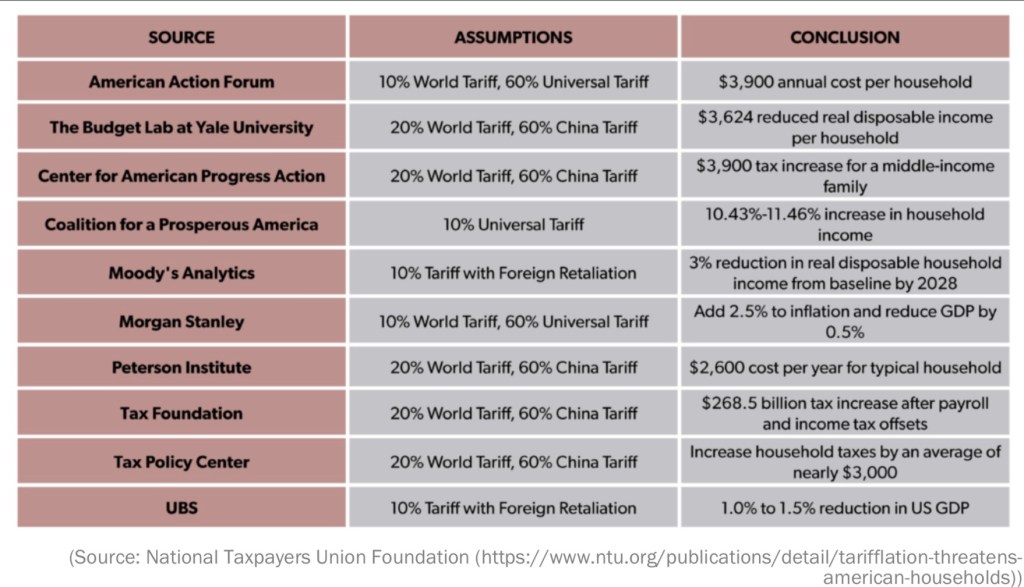
The table above is from Eric Boehm at Reason.com. It shows a variety of negative economic projections based on the likely imposition of tariffs by the incoming Trump Administration. Donald Trump’s protectionist agenda is motivated in large part by the notion that imports of foreign goods and services harm the U.S. economy. This misapprehension is common on both the populist left and the nationalist right, but it is also fueled by special interests averse to competition. Especially puzzling are those who extol the virtues of capitalism and free markets while claiming that free markets across borders are inimical to our nation’s economic interests.

Imports and Domestic Spending

Many assume that imports directly reduce GDP. In fact, on this point, some might be led astray by a superficial exposure to macroeconomics. As Noah Smith has noted, they might think back to the simple spending definition of GDP they learned as college freshmen:

GDP = C + I + G + (X – M),

where C is consumer spending on final goods and services, I is investment spending, G is government spending, X is foreign spending on U.S. exports, and M is U.S. spending on imports from abroad. So imports are subtracted! Doesn’t that mean imports directly reduce GDP?

The key here is to recognize that C, I, and G already include spending on imported goods. Therefore, imports must be subtracted from the spending totals to find the value spent on domestically-produced final goods and services. No, imports are not a direct, net subtraction from GDP.

Your Loathsome Foreign Car

Of course the domestic impact of imports goes deeper than this simple accounting framework. If someone decides to purchase an imported good instead of a close substitute produced domestically, what happens to GDP? If the decision has an immediate impact on production, then U.S. GDP declines. Otherwise, the domestic good is new inventory investment (part of I above), and there is no change. But if the import decision is repeated, the result is permanently lower U.S. GDP relative to the alternative, as producers won’t want to add to inventories indefinitely. The same is true if a domestic producer decides to purchase a component or raw material produced overseas rather than one produced at home.

The import decision causes a domestic producer to lose a sale along with the profit that sale would have earned. That puts pressure on the firm’s workers and wages as well. The firm still has the value of the unit in inventory, but if the import decision is repeated there will be more substantial follow-on effects on production, employment, spending, and saving.

Not So Fast

There is still more to the story, of course. By purchasing the foreign good,,which in the buyer’s estimation delivers greater value at that point in time, there is a gain in consumer surplus that is very real. To the buyer, that gain is perhaps equivalent to dollars in the bank. Their real wealth has increased relative to the surplus value of the foregone domestic purchase. This, too, will likely have follow-on effects in terms of spending and saving, but positive effects.

Therefore, to a first approximation, the immediate effects of an import purchase on total domestic welfare are ambiguous. Consumers of imports gain value; producers of import-competing goods lose value.

As to the loss of the domestic sale, competition is tough, but it greatly contributes to the efficiency of the free market system and to the well being of consumers. Let’s face it: ultimately, the whole point of economic activity is to enable consumption. Production has no other purpose. So producers must react to competition and strive to improve value for buyers along any margins they can. That, in turn, is unequivocally positive for potential buyers both here and abroad.

It’s also true that the purchase of foreign goods means that dollars must be sold in exchange for foreign currency. That weakens the dollar, but those “excess dollars” are generally used to purchase U.S. assets, including physical capital. That direct investment promotes economic growth.

Open Economy, Open Mind

No matter what you believe about the net benefits or costs of a single import transaction like the one described above, it is misleading to draw conclusions about the benefits of foreign trade based on a single transaction, or even a series of repeated transactions.

First, consumer sovereignty is based on freedom of choice, including the freedom to purchase from any seller, domestic or foreign. Consumers greatly benefit from that broad freedom. Add to that the benefit of producers who are free to purchase inputs from any source they believe to offer the greatest value (a benefit that ultimately flows through to consumers). These freedoms ultimately enhance productivity and well being.

Trade across borders leverages the same economic advantages as trade within borders. People tend to accept the latter as truth without giving it a thought, yet the former is often rejected reflexively. The question is inappropriately bound up in issues like patriotism and, over time, an excessive focus on high-visibility job losses in traditional industries.

Trade allows people and their countries to specialize in producing things at which they are comparatively efficient, i.e., in which they are lower-cost producers. This is at the very heart of mutually beneficial exchange: no party to a voluntary transaction expects to suffer a loss. And in trade, when an external, domestic party sustains a lost sale, for example, they have the opportunity to improve or reallocate their resources to endeavors to which they are better suited. So there are direct gains from trade and there are indirect gains via the discipline of competition, including the benefits of reallocating scarce resources from inefficient to efficient uses.

Tariff Gains

Now we shift gears to tariffs: interventions having benefits that are more concentrated than costs, and which tend to be more ephemeral:

— Domestic producers who compete with imports gain through the grant of additional market power, given the tax on foreign goods and services. These producers now have more pricing flexibility, and what is often more pertinent, survivability.

— Workers at domestic firms will benefit to the extent that their employers face reduced foreign competition. Some combination of employment, hours, and wages may rise.

— Some firms have mixed gains and losses, with more pricing power over final product but elevated costs due to the use of taxed foreign components.

Tariff Losses

Who pays when government succumbs to irrational protectionist pressure and attempts to restrict imports via tariffs?

— Domestic consumers suffer a loss of freedom and bear a large part of the burden of the tariff tax.

— Higher prices for imports lead to higher prices for competing domestic goods, causing consumers to experience a loss of purchasing power.

— Domestic businesses suffer a loss of control over input decisions. Those already utilizing foreign inputs (and their buyers downstream) bear some of the burden of the tariff tax. For example, tariffs could be quite damaging to the U.S. AI industry, a result that would run strongly contrary to Trump’s promise to promote American AI.

— The U.S. suffers a loss of foreign investment, which could engender higher interest rates, lower productivity growth, and lower real wages.

— As Tyler Cowen puts it in a review of this paper, “… lobbying, logrolling and political horse-trading were essential features of the shift toward higher US tariffs. A lot of the tariffs of the time [1870 -1909] depended on which party controlled Congress, rather than economic rationality.“

— Tariffs tend to reduce economic growth due to diminished productivity in tariff-protected industries, which also erodes real wages. Less productive firms capture a significant share of the benefits of tariffs, so that economic growth falls due to a compositional effect. Higher prices for imports and import-competing goods undermine the real gains of import-protected workers.

— Finally, tariffs invariably beget retaliatory tariffs by erstwhile friendly trading partners. Export industries and their employees take a direct hit. This retaliation damages the prospects of the most productive exporters, while weaker exporting firms might be forced to close shop unnecessarily.

One other note: the discussion of gains and losses above is essentially the same for policies that reward the use of American labor via tax breaks. This not only penalizes imports of final and intermediate foreign goods, it subsidizes high-cost domestic labor. Obviously, the upshot is a less competitive U.S. economy.

Tariff-Threat Policy

To be fair, Donald Trump has said he’d use the threat of tariffs strategically to achieve a variety of objectives, not all of which are directly related to trade. We can hope that many of those threats won’t be acted upon. On one hand, that’s more appealing than general tariffs, with potential foreign policy gains and less in the way of general damage to the economy. On the other hand, the discretionary application of tariffs could invite political favoritism and foster a corrupt rent-seeking environment.

Conclusion

Trade protectionism protects weak and strong producers alike. The weak should not be given artificial incentives to produce goods inefficiently. That’s simply a waste of resources. Protecting the strong is unnecessary and discourages the drive for efficiency as well as real value creation. It lends market power to already powerful firms, leading to higher prices and penalizing domestic consumers.

One last aside: tariffs cannot raise anywhere close to the revenue necessary to replace the income tax, an absurd claim made by Trump on the campaign trail.

Only free trade is consistent with the values of a free society. It enhances choice, makes markets more competitive, creates incentives for efficiency, and cultivates opportunities for economic growth, That would serve Trump and the nation much better than the fixation on tariffs.

White Racialism, Identity Politics, and Crippling DEI

09 Thursday Nov 2023

Posted by Nuetzel in DEI, Identity Politics

≈ 1 Comment

Tags

Anti-discrimination law, Christopher Rufo, Colorblind Society, Comparative advantage, DEI, Diversity, Equity, George Floyd, Hobbesian, Identity Politics, Inclusion, Jim Crow Laws, Protected Classes, Racial Preferences, Racialism, racism, rent seeking, Segregation, Slavery, Social Constructs, Structural Racism, Tribalism, Tyler Cowen, Victimhood, Victor Davis Hanson, White Racialism, Zero-Sum Thinking

I’ve taken an extended hiatus from blogging while moving to a different part of the country. I haven’t posted here in over 10 weeks, but a new post appears below. I’m still tying-up loose ends from the move, but I’ll be trying to get back to posting more regularly … trying!

~~~~~~~~~~~~~~~~~~~~~~~~~~~~~~~~~~~~~~~

Absurd ideas about race and identity politics come from extreme elements on both the Left and the Right. Some leftists insist that race has no natural basis — that it’s simply a “social construct”. On the Right, a “racialist” contingent is promoting the “celebration of whiteness” and embracing racial preferences for whites. Treated as alternative pathways, I’d take “social construct”. It’s nonsense, of course, but the beautiful irony is that it provides a basis for stripping away from our institutions the entire diversity, equity, and inclusion (DEI) straightjacket. It’s almost as if those promoting race as a social construct wish to build a “colorblind” society. On the other hand, I suppose some think they can have their DEI cake along with a side of free choice to identify as anything they want: black, white, or furry.

Who Are the Racists?

People of good faith don’t harbor or act on racist tendencies. The mere recognition of racial/ethnic/cultural differences is not evidence of racism and does not preclude the treatment of all with fairness and due respect. It’s possible to respect, value, or fall in love with someone outside one’s own racial, ethnic, or cultural group of origin, even while holding a general affinity for one’s own group, as nearly everyone does.

But a few real racists are sprinkled across all races, ethnicities, cultures, and the full political spectrum. The “popular” racist stereotype as white male has been kept alive by the lingering echos of slavery in America, which ended nearly 16 decades ago, and the long hangover that included Jim Crow laws and segregation. Today, however, “white society” or “whiteness” is hardly the sole domain of prejudice.

Is Racialism Different?

Now, a few whites are promoting the celebration of “white identity” as a counterbalance to identity politics among non-whites. Ostensibly, this “white racialism” might be similar to celebrations of identity often practiced by minorities, which are also forms of racialism. Should white racialism be viewed as less savory than racialism practiced by racial minorities?

For most Caucasians, “being white” does not have much salience relative to other affiliations defining identity. That’s why white racialism seems odd to me. Sure, when forced to check a box, whites will check “Caucasian”, but “white identity” seems overly broad. There are too many distinct cultures and subcultures that dominate self-identity, such as national ancestry, religion, and cultural membership.

The same could be said for many other racial categories, but minority status and historical events (e.g., American slavery) help explain why broad categories often form cohesive identity groups. And, as Christopher Rufo notes in his great discussion of the racialist viewpoint, broad categories tend to be the most closely associated with racialism:

“Yes, left-wing racialism is indeed now deeply embedded in America’s institutions, and the demographic balance of the country has shifted in recent decades. And yes, the basic racial classification system in the United States broadly delineates continental origin—Europe, Africa, Latin America, Asia—in a way that is not arbitrary or meaningless. Terms such as ‘white,’ ‘black,’ ‘Latino,’ and ‘Asian,’ while often obscuring important variations within such groupings, have become the lingua franca and are useful shorthand descriptors for many purposes.”

There are individuals from all groups or “classes”, including whites, who react critically to aggressive expressions of identity by members of other classes. Perhaps that’s excusable, depending on the degree of zealotry on either part. The line between pride in race/ancestry/culture and fractious racialism might be hard to discern in some cases, but the chief distinction is rooted in explicit, demeaning and/or envious comparisons to “out-groups”. This might be damaging enough, but from there it can be a very short step into outright racism.

A preoccupation with the historic disadvantages of one’s race can be disempowering to an individual and destructive in a social sense. I believe the white racialist phenomenon belongs in that category. The presumed “disadvantages” of whiteness are very contemporary, however, rooted in policies dating back only to the widespread adoption of racial preferences for non-white “protected classes” and DEI.

Preferences For All

Imagine the racialist policies now practiced widely in government, industry, and academia — particularly racial preferences on behalf of protected classes — but now applied on behalf of heretofore unprotected classes as well. For example, what if some proportion of jobs, admissions, or other coveted placements were set aside for whites? If whites represent 50% of the population, then 50% of hires or admissions would be reserved for whites.

Some might assume that this treatment is already implied by existing racial preferences, but that’s not the case. In the wake of George Floyd’s death, just 6% of new hires among S&P companies were white, according to Bloomberg News.

Nevertheless, such a white racialist turnabout would be a colossal mistake. Adding strict limits to the application of existing preferences might be a good thing, but white racial preferences would buttress the entire system of racial preferences as an institution and add more rigidity to the operation of labor markets. From an economic viewpoint, it would be just as pernicious as racial preferences generally.

Racial preferences of any kind freeze labor markets and impair the allocation of human resources to their most-valued uses. In fact, placing one individual into a position on any basis other than their qualifications implies that two individuals must be placed into positions in which they lack comparative advantage relative to each other. Little by little, that means lost output and upward price pressure. It is a mechanism that short circuits gains from trade, shriveling the benefits that the most and least talented confer on society at large. Extending preferences to whites would only serve to further institutionalize this damaging practice.

Adherence to numerical preferences is to pretend that people can be treated less as individuals and more like interchangeable parts… except with respect to their value as “class members”. Racial preferences are presumed to be a remedy for so-called structural racism, as opposed to racism by individuals. But they involve classification and favor the so-called “oppressed” at the expense of designated “oppressors”. The latter, almost without exception, had no role oppressive regimes of the past. Favoritism of this kind necessarily means reverse discrimination and fails to match individuals to roles in an optimal fashion.

Whether publicly or privately imposed, racial preferences often undermine those they are purported to help by placing individuals into positions for which they may not be competitive. This can sabotage an individual’s long-term success. It goes without saying that preferences build resentment among the “unprotected”, which goes to the impetus for “white racialism”. Indeed, preferences are not always popular with protected classes either. That’s because they interfere with merit-based decision-making and are perceived to stigmatize those presumed to benefit.

The Fixed Pie Is a Lie

Racialism reflects zero-sum thinking, a hallmark of DEI initiatives. Tyler Cowen quoted the abstract of a recent NBER working paper that found:

“… a more zero-sum mindset is strongly associated with more support for government redistribution, race- and gender-based affirmative action, and more restrictive immigration policies.”

Zero-sum thinking is fundamental to rent-seeking behavior, which is motivated by either malevolent greed or perceptions of victimhood. Victimhood and rent seeking is at the heart of calls for DEI, to say nothing of more radical proposals like reparation payments. White racialism attempts to get in on the action by positing that whites are oppressed under the current institutional dominance of DEI. But the misguided presumption that every identity group should have their own preferences or quotas broadens the emphasis on redressing perceived harms and redistributing rewards — zero-sum activities.

These zero-sum efforts waste energy and resources, harming our ability to produce things that enhance well being. Ultimately, they are actually negative-sum activities, and they also breed hatred.

Race is obviously determined by genetics, but I’d be happy to pretend it’s a mere social construct if that would help get us to a “colorblind” society.

Conclusion

There’s a huge irony in the racialism exercised by both traditional and “white racialist” DEI advocates: it neglects the most fundamental and just application of diversity: equality of opportunity. This principle incorporates the concept of diversity without sacrificing economic efficiency. We’ve largely abandoned it in favor of equality of outcomes via racial preferences, even at a time when society has become enlightened with respect to racial differences. In doing so, we’ve unintentionally chosen another form of explicit racial victimization.

To close, here’s a good summary of the dangers of racialism and identity politics offered by Victor Davis Hanson:

“Anytime one ethnic, racial, or religious group refuses to surrender its prime identity in exchange for a shared sense of self, other tribes for their own survival will do the same.

All then rebrand their superficial appearance as essential not incidental to whom they are.

And like nuclear proliferation that sees other nations go nuclear once a neighboring power gains the bomb, so too the tribalism of one group inevitably leads only to more tribalism of others. The result is endless Hobbesian strife.”

And that’s how white racialism fits right in with the pernicious politics of identity. When you can, vote for the elimination, or at least reform, of DEI policies and practices, not for a reinforcement of identity politics.

Government Failure as a Root Cause of Market Failure

10 Monday Jul 2023

Posted by Nuetzel in Government Failure, Market Failure

≈ Leave a comment

Tags

Capital Formation, central planning, Chevron Doctrine, Competitive Equilibrium, Corruption, crowding out, Declaration of Independence, Don Boudreaux, External Benefits, External Costs, Government Failure, Inflation, John Cochrane, Labor Supply, Market Failure, Michael Munger, monopoly power, Pareto Superiority, Peter Boettke, Price Controls, Protectionism, Redistribution, Regulatory Capture, rent seeking, Risk-Free Asset, Side Payments, Social Security, State Capacity, Tax Distortions, Thomas Jefferson, Treasury Debt, William R. Keech

We’re told again and again that government must take action to correct “market failures”. Economists are largely responsible for this widespread view. Our standard textbook treatments of external costs and benefits are constructed to demonstrate departures from the ideal of perfectly competitive market equilibria. This posits an absurdly unrealistic standard and diminishes the power and dramatic success of real-world markets in processing highly dispersed information, allocating resources based on voluntary behavior, and raising human living standards. It also takes for granted the underlying institutional foundations that lead to well-functioning markets and presumes that government possesses the knowledge and ability to rectify various departures from an ideal. Finally, “corrective” interventions are usually exposited in economics classes as if they are costless!

Failed Disgnoses

This brings into focus the worst presumption of all: that government solutions to social and economic problems never fail to achieve their intended aims. Of course that’s nonsense. If defined on an equivalent basis, government failure is vastly more endemic and destructive than market failure.

Related to this point, Don Boudreaux quotes from Peter Boettke’s Living Economics:

“According to ancient legend, a Roman emperor was asked to judge a singing contest between two participants. After hearing the first contestant, the emperor gave the prize to the second on the assumption that the second could be no worse than the first. Of course, this assumption could have been wrong; the second singer might have been worse. The theory of market failure committed the same mistake as the emperor. Demonstrating that the market economy failed to live up to the ideals of general competitive equilibrium was one thing, but to gleefully assert that public action could costlessly correct the failure was quite another matter. Unfortunately, much analytical work proceeded in such a manner. Many scholars burst the bubble of this romantic vision of the political sector during the 1960s. But it was [James] Buchanan and Gordon Tullock who deserve the credit for shifting scholarly focus.”

John Cochrane sums up the whole case succinctly in the “punchline” of a recent post:

“The case for free markets never was their perfection. The case for free markets always was centuries of experience with the failures of the only alternative, state control. Free markets are, as the saying goes, the worst system; except for all the others.”

Tracing Failures

We can view the relation between market failure and government failure in two ways. First, we can try to identify market failures and root causes. For example, external costs like pollution cause harm to innocent third parties. This failure might be solely attributable to transactions between private parties, but there are cases in which government engages as one of those parties, such as defense contracting. In other cases government effectively subsidizes toxic waste, like the eventual disposal of solar panels. Another kind of market failure occurs when firms wield monopoly power, but that is often abetted by costly regulations that deliver fatal blows to small competitors.

The second way to analyze the nexus between government and market failures is to first examine the taxonomy of government failure and identify the various damages inflicted upon the operation of private markets. That’s the course I’ll follow below, though by no means is the discussion here exhaustive.

Failures In and Out of Scope

An extensive treatment of government failure was offered eight years ago by William R. Keech and Michael Munger. To start, they point out what everyone knows: governments occasionally perpetrate monstrous acts like genocide and the instigation of war. That helps illustrate a basic dichotomy in government failures:

“… government may fail to do things it should do, or government may do things it should not do.’

Both parts of that statement have numerous dimensions. Failures at what government should do run the gamut from poor service at the DMV, to failure to enforce rights, to corrupt bureaucrats and politicians skimming off the public purse in the execution of their duties. These failures of government are all too common.

What government should and should not do, however, is usually a matter of political opinion. Thomas Jefferson’s axioms appear in a single sentence at the beginning of the Declaration of Independence; they are a tremendous guide to the first principles of a benevolent state. However, those axioms don’t go far in determining the range of specific legal protections and services that should and shouldn’t be provided by government.

Pareto Superiority

Keech and Munger engage in an analytical exercise in which the “should and shouldn’t” question is determined under the standard of Pareto superiority. A state of the world is Pareto superior if at least one person prefers it to the current state (and no one else is averse to it). Coincidentally, voluntary trades in private markets always exploit Pareto superior opportunities, absent legitimate external costs and benefits.

The set of Pareto superior states available to government can be expanded by allowing for side payments or compensation to those who would have preferred the current state. Still, those side payments are limited by the magnitude of the gains flowing to those who prefer the alternative (and if those gains can be redistributed monetarily).

Keech and Munger define government failure as the unexploited existence of Pareto superior states. Of course, by this definition, only a benevolent, omniscient, and omnipotent dictator could hope to avoid government failure. But this is no more unrealistic than the assumptions underlying perfectly competitive market equilibrium from which departure are deemed “market failures” that government should correct. Thus, Keech and Munger say:

“The concept of government failure has been trapped in the cocoon of the theory of perfect markets. … Government failure in the contemporary context means failing to resolve a classic market failure.”

But markets must operate within a setting defined by culture and institutions. The establishment of a social order under which individuals have enforceable rights must come prior to well-functioning markets, and that requires a certain level of state capacity. Keech and Munger are correct that market failure is often a manifestation of government failure in setting and/or enforcing these “rules of the game”.

“The real question is … how the rules of the game should be structured in terms of incentives, property rights, and constraints.”

The Regulatory State and Market Failures

Government can do too little in defining and enforcing rights, and that’s undoubtedly a cause of failure in markets in even the most advanced economies. At the same time there is an undeniable tendency for mission creep: governments often try to do too much. Overregulation in the U.S. and other developed nations creates a variety of market failures. This includes the waste inherent in compliance costs that far exceed benefits; welfare losses from price controls, licensing, and quotas; diversion of otherwise productive resources into rent seeking activity, anti-competitive effects from “regulatory capture”; Chevron-like distortions endemic to the administrative judicial process; unnecessary interference in almost any aspect of private business; and outright corruption and bribe-taking.

Central Planning and Market Failures

Another category of government attempting to “do too much” is the misallocation of resources that inevitably accompanies efforts to pick “winners and losers”. The massive subsidies flowing to investors in various technologies are often misdirected. Many of these expenditures end up as losses for taxpayers, and this is not the only form in which failed industrial planning takes place. A related evil occurs when steps are taken to penalize and destroy industries in political disfavor with thin economic justification.

Other clear examples of government “planning” failure are protectionist laws. These are a net drain on our wealth as a society, denying consumers of free choice and saddling the country with the necessity to produce restricted products at high cost relative to erstwhile trading partners.

There are, of course, failures lurking within many other large government spending programs in areas such as national defense, transportation, education, and agriculture. Many of these programs can be characterized as centrally planning. Not only are some of these expenditures ineffectual, but massive procurement spending seems to invite waste and graft. After all, it’s somebody else’s money.

Redistribution and Market Failures

One might regard redistribution programs as vehicles for the kinds of side payments described by Keech and Munger. Some might even say these are the side payments necessary to overcome resistance from those unable to thrive in a market economy. That reverses the historical sequence of events, however, since the dominant economic role of markets preceded the advent of massive redistribution schemes. Unfortunately, redistribution programs have been plagued by poor design, such as the actuarial nightmare inherent in Social Security and the destructive work incentives embedded in other parts of the social safety net. These are rightly viewed as government failures, and their distortionary effects spill variously into capital markets, labor markets and ultimately product markets.

Taxation and Market Failures

All these public initiatives under which government failures precipitate assorted market failures must be paid for by taxpayers. Therefore, we must also consider the additional effects of taxation on markets and market failures. The income tax system is rife with economic distortions. Not only does it inflict huge compliance costs, but it alters incentives in ways that inhibit capital formation and labor supply. That hampers the ability of input markets to efficiently meet the needs of producers, inhibiting the economy’s productive capacity. In turn, these effects spill into output market failures, with consequent losses in .social welfare. Distortionary taxes are a form of government failure that leads to broad market failures.

Deficits and Market Failure

More often than not, of course, tax revenue is inadequate to fund the entire government budget. Deficit spending and borrowing can make sense when public outlays truly produce long-term benefits. In fact, the mere existence of “risk-free” assets (Treasury debt) across the maturity spectrum might enhance social welfare if it enables improvements in portfolio diversification that outweigh the cost of the government’s interest obligations. (Treasury securities do bear interest-rate risk and, if unindexed, they bear inflation risk.)

Nevertheless, borrowing can reflect and magnify deleterious government efforts to “do too much”, ultimately leading to market failures. Government borrowing may “crowd out” private capital formation, harming economy-wide productivity. It might also inhibit the ability of households to borrow at affordable rates. Interest costs of the public debt may become explosive as they rise relative to GDP, limiting the ability of the public sector to perform tasks that it should *actually* do, with negative implications for market performance.

Inflation and Market Failure

Deficit spending promotes inflation as well. This is more readily enabled when government debt is monetized, but absent fiscal discipline, the escalation of goods prices is the only remaining force capable of controlling the real value of the debt. This is essentially the inflation tax.

Inflation is a destructive force. It distorts the meaning of prices, causes the market to misallocate resources due to uncertainty, and inflicts costs on those with fixed incomes or whose incomes cannot keep up with inflation. Sadly, the latter are usually in lower socioeconomic strata. These are symptoms of market failure prompted by government failure to control spending and maintain a stable medium of exchange.

Conclusion

Markets may fail, but when they do it’s very often rooted in one form of government failure or another. Sometimes it’s an inadequacy in the establishment or enforcement of property rights. It could be a case of overzealous regulation. Or government may encroach on, impede, or distort decisions regarding the provision of goods or services best left to the market. More broadly, redistribution and taxation, including the inflation tax, distort labor and capital markets. The variety of distortions created when government fails at what it should do, or does what it shouldn’t do, is truly daunting. Yet it’s difficult to find leaders willing to face up to all this. Statism has a powerful allure, and too many elites are in thrall to the technocratic scientism of government solutions to social problems and central planning in the allocation of resources.

Canadian Wildfires, Smoky Days Are Recurring Events

11 Sunday Jun 2023

Posted by Nuetzel in Forest Fires, Global Warming, Wildfires

≈ Leave a comment

Tags

Anthropomorphic Global Warming, Boreal Forests, Canadian Fires, Climate Change, Dark Days, David Marcus, Edward Struzik, Fire Suppression, Forest Management, Prescribed Burns, Québec Fires, rent seeking, Wildfires

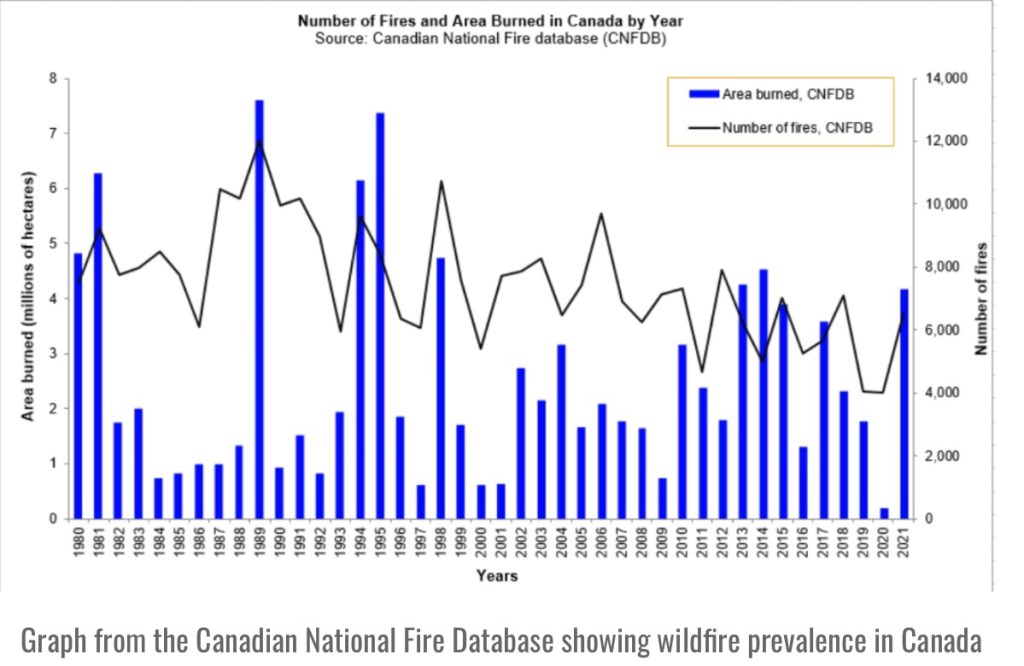
Smoke from this spring’s terrible forest fires in Canada has fouled the air in much of the country and blown into the northeastern U.S. and mid-Atlantic coastal states. The severity of the fires, if they continued at this pace over the rest of the fire season, would break Canadian records for number of fires and burned area.

Large wildfires with smoky conditions occur in these in regions from time-to-time, and it’s not unusual for fires to ignite in the late spring. The article shown above appeared in the New York Tribune on June 5, 1903. Other “dark day” episodes were recorded in New England in 1706, 1732, 1780, 1814, 1819, 1836, 1881, 1894, and 1903, and several times in the 20th century. I list early years specifically because they preceded by decades (even centuries) the era of supposed anthropomorphic global warming, now euphemistically known as “climate change”.

More recently, however, in the past 10 years, Quebec experienced relatively few wildfires. That left plenty of tinder in the boreal forests with highly flammable, sappy trees. In May, a spell of sunshine helped dry the brush in the Canadian forests. Then lightning and human carelessness sparked the fires, along with multiple instances of arson, some perpetrated by climate change activists.

On top of all that, poor forest management contributed to the conflagrations. So-called fire suppression techniques have done more harm than good over the years, as I’ve discussed on this blog in the past. David Marcus emphasizes the point:

“For years, Canadian parks officials have been warning that their country does not do enough to cull its forests and now we’re witnessing the catastrophic results.

It’s simple really. Edward Struzik, author of ‘Dark Days at Noon, The Future of Fire’ lays it out well.

‘We have been suppressing fires for so many decades in North America that we have forests that are older than they should be,’ he said. …

‘Prescribed burns are one of the best ways to mitigate the wildfire threat,’ he added.”

Nevertheless, the media are eager to blame climate change for any calamity. That’s one part simple naïveté on the part of young journalists, fresh off the turnip truck as it were, with little knowledge or inclination to understand the history and causes of underlying forest conditions. But many seasoned reporters are all too ready to support the climate change narrative as well. There’s also an element of calculated political misinformation in these claims, abetted by those seeking rents from government climate policies.

Wildfires are as old as time; without good forest management practices they are necessary for forest renewal. Agitation to sow climate panic based on wildfires is highly unscrupulous. There is no emergency except for the need to reform forest management, reduce the fuel load, and more generally, put an end to the waste of resources inherent in government climate change initiatives.

See this tweet! Hmmm.

Cassandras Feel An Urgent Need To Crush Your Lifestyle

12 Thursday Jan 2023

Posted by Nuetzel in Climate science, Environmental Fascism

≈ 1 Comment

Tags

Atmospheric Aerosols, Capacity Factors, Carbon Emissions, Carbon-Free Buildings, Chicken Little, Climate Alarmism, Coercion, Electric Vehicles, Elon Musk, Extreme Weather Events, Fossil fuels, Gas Stoves, Judith Curry, Land Use, Model Bias, Nuclear power, Paul Ehrlich, Renewable energy, rent seeking, Sea Levels, Settled Science, Solar Irradience, Solar Panels, Subsidies, Temperature Manipulation, Toyota Motors, Urban Heat Islands, Volcanic activity, Wind Turbines

Appeals to reason and logic are worthless in dealing with fanatics, so it’s too bad that matters of public policy are so often subject to fanaticism. Nothing is more vulnerable on this scale than climate policy. Why else would anyone continue to listen to prognosticators of such distinguished failure as Paul Ehrlich? Perhaps most infamously, his 1970s forecasts of catastrophe due to population growth were spectacularly off-base. He’s a man without any real understanding of human behavior and how markets deal efficiently and sustainably with scarcity. Here’s a little more detail on his many misfires. And yet people believe him! That’s blind faith.

The foolish acceptance of chicken-little assertions leads to coercive and dangerous policy prescriptions. These are both unnecessary and very costly in direct and hidden ways. But we hear a frantic chorus that we’d better hurry or… we’re all gonna die! Ironically, the fate of the human race hardly matters to the most radical of the alarmists, who are concerned only that the Earth itself be in exactly the same natural state that prevailed circa 1800. People? They don’t belong here! One just can’t take this special group of fools too seriously, except that they seem to have some influence on an even more dangerous group of idiots called policymakers.

Judith Curry, an esteemed but contrarian climate expert, writes of the “faux urgency” of climate action, and how the rush to implement supposed climate mitigations is a threat to our future:

“Rapid deployment of wind and solar power has invariably increased electricity costs and reduced reliability, particularly with increasing penetration into the grid. Allegations of human rights abuses in China’s Xinjiang region, where global solar voltaic supplies are concentrated, are generating political conflicts that threaten the solar power industry. Global supply chains of materials needed to produce solar and wind energy plus battery storage are spawning new regional conflicts, logistical problems, supply shortages and rising costs. The large amount of land use required for wind and solar farms plus transmission lines is causing local land use conflicts in many regions.”

Curry also addresses the fact that international climate authorities have “moved the goalposts” in response to the realization that the so-called “crisis” is not nearly as severe as we were told not too long ago. And she has little patience for delusions that authorities can reliably force adjustments in human behavior so as to to reduce weather disasters:

“Looking back into the past, including paleoclimatic data, there has been more extreme weather [than today] everywhere on the planet. Thinking that we can minimize severe weather through using atmospheric carbon dioxide as a control knob is a fairy tale.”

The lengths to which interventionists are willing to go should make consumer/taxpayers break out their pitchforks. It’s absurd to entertain mandates forcing vehicles powered by internal combustion engines (ICEs) off the road, and automakers know it. Recently, the head of Toyota Motors acknowledged his doubts that electric vehicles (EVs) can meet our transportation demands any time soon:

“People involved in the auto industry are largely a silent majority. That silent majority is wondering whether EVs are really OK to have as a single option. But they think it’s the trend so they can’t speak out loudly. Because the right answer is still unclear, we shouldn’t limit ourselves to just one option.”

In the same article, another Toyota executive says that neither the market nor the infrastructure is ready for a massive transition to EVs, a conclusion only a dimwit could doubt. Someone should call the Big 3 American car companies!

No one is a bigger cheerleader for EVs than Elon Musk. In the article about Toyota, he is quoted thusly:

“At this time, we actually need more oil and gas, not less. Realistically I think we need to use oil and gas in the short term, because otherwise civilization will crumble. One of the biggest challenges the world has ever faced is the transition to sustainable energy and to a sustainable economy. That will take some decades to complete.”

Of course, for the foreseeable future, EVs will be powered primarily by electricity generated from burning fossil fuels. So why the fuss? But as one wag said, that’s only until the government decides to shut down those power plants. After that, good luck with your EV!

Gas stoves are a new target of our energy overlords, but this can’t be about fuel efficiency, and it’s certainly not about the quality of food preparation. The claim by an environmental think tank called “Carbon-Free Buildings” is that gas stoves are responsible for dangerous indoor pollutants. Of course, the Left was quick to rally around this made-up problem, despite the fact that they all seem to use gas stoves and didn’t know anything about the issue until yesterday! And, they insist, racial minorities are hardest hit! Well, they might consider using exhaust fans, but the racialist rejoinder is that minorities aren’t adequately informed about the dangers and mitigants. Okay, start a safe-use info campaign, but keep government away from an embedded home technology that is arguably superior to the electric alternative in several respects.

Renewable energy mandates are a major area of assault. If we were to fully rely on today’s green energy technologies, we’d not just threaten our future, but our immediate health and welfare. Few people, including politicians, have any awareness of the low rates at which green technologies are actually utilized under real-world conditions.

“Worldwide average solar natural capacity factor (CF) reaches about ~11-13%. Best locations in California, Australia, South Africa, Sahara may have above 25%, but are rare. (see www.globalsolaratlas.info, setting direct normal solar irradiance)

Worldwide average wind natural capacity factors (CF) reach about ~21-24%. Best off-shore locations in Northern Europe may reach above 40%. Most of Asia and Africa have hardly any usable wind and the average CF would be below 15%, except for small areas on parts of the coasts of South Africa and Vietnam. (see www.globalwindatlas.info, setting mean power density)”

Those CFs are natural capacity factors (i.e., the wind doesn’t always blow or blow at “optimal” speeds, and the sun doesn’t always shine or shine at the best angle), The CFs don’t even account for “non-natural” shortfalls in actual utilization and other efficiency losses. It would be impossible for investors to make these technologies profitable without considerable assistance from taxpayers, but they couldn’t care less about whether their profits are driven by markets or government fiat. You see, they really aren’t capitalists. They are rent seekers playing a negative-sum game at the expense of the broader society.

There are severe environmental costs associated with current wind and solar technologies. Awful aesthetics and the huge inefficiencies of land use are bad enough. Then there are deadly consequences for wildlife. Producing inputs to these technologies requires resource-intensive and environmentally degrading mining activities. Finally, the costs of disposing of spent, toxic components of wind turbines and solar panels are conveniently ignored in most public discussions of renewables.

There is still more hypocritical frosting on the cake. Climate alarmists are largely opposed to nuclear power, a zero-carbon and very safe energy source. They also fight to prevent development of fossil fuel energy plant for impoverished peoples around the world, which would greatly aid in economic development efforts and in fostering better and safer living conditions. Apparently, they don’t care. Climate activists can only be counted upon to insist on wasteful and unreliable renewable energy facilities.

Before concluding, it’s good to review just a few facts about the “global climate”:

1) the warming we’ve seen in forecasts and in historical surface temperature data has been distorted by urban heat island effects, and weather instruments are too often situated in local environments rich in concrete and pavement.

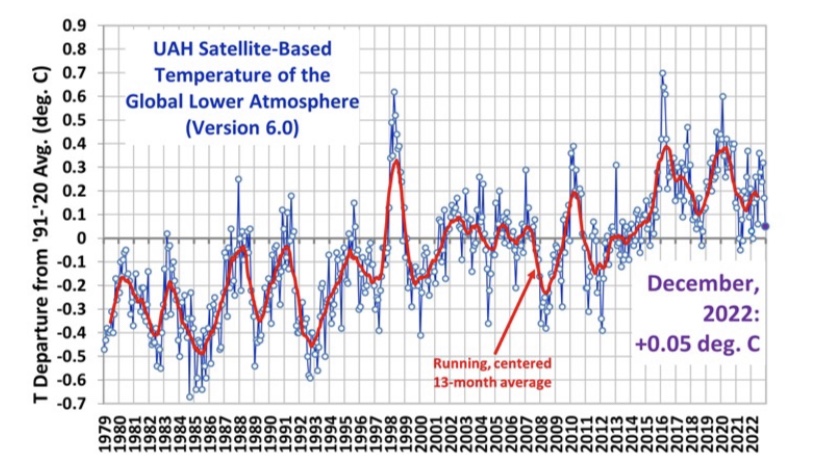
2) Satellite temperatures are only available for the past 43 years, and they have to be calibrated to surface measurements, so they are not independent measures. But the trend in satellite temperatures over the past seven years has been flat or negative at a time when global carbon emissions are at all-time highs.

3) There have been a series of dramatic adjustments to historical data that have “cooled the past” relative to more recent temperatures.

4) The climate models producing catastrophic long-term forecasts of temperatures have proven to be biased to the high side, having drastically over-predicted temperature trends over the past two- to three decades.

5) Sea levels have been rising for thousands of years, and we’ve seen an additional mini-rebound since the mini-ice age of a few hundred years ago. Furthermore, the rate of increase in sea levels has not accelerated in recent decades, contrary to the claims of climate alarmists.

6) Storms and violent weather have shown no increase in frequency or severity, yet models assure us that they must!

Despite these facts, climate change fanatics will only hear of climate disaster. We should be unwilling to accept the climatological nonsense now passing for “settled science”, itself a notion at odds with the philosophy of science. I’m sad to say that climate researchers are often blinded by the incentives created by publication bias and grant money from power-hungry government bureaucracies and partisan NGOs. They are so blinded, in fact, that research within the climate establishment now almost completely ignores the role of other climatological drivers such as the solar irradiance, volcanic activity, and the role and behavior of atmospheric aerosols. Yes, only the global carbon dial seems to matter!

No one is more sympathetic to “the kids” than me, and I’m sad that so much of the “fan base” for climate action is dominated by frightened members of our most youthful generations. It’s hard to blame them, however. Their fanaticism has been inculcated by a distinctly non-scientific community of educators and journalists who are willing to accept outrageous assertions based on “toy models” concocted on weak empirical grounds. That’s not settled science. It’s settled propaganda.

It’s a Big Government Mess

22 Tuesday Nov 2022

Posted by Nuetzel in Big Government, Uncategorized

≈ 1 Comment

Tags

Campaign Spending, Carbon Footprint, central planning, Climate Risk, Compliance Costs, Cronyism, Debt Monetization, dependency, Diversity, Do-Somethingism, External Costs, Fiscal Illusion, Limited government, Malinvestment, monopoly, Price Controls, Public goods, Redistribution, Regulatory Capture, rent seeking, Wetlands, Willingness To Pay

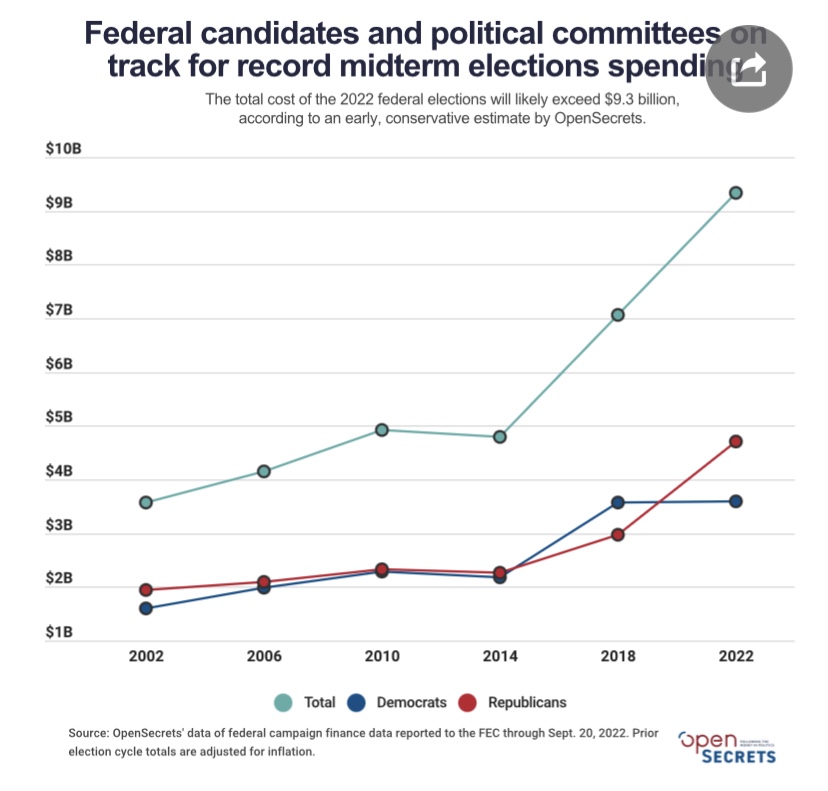
I’m really grateful to have the midterm elections behind us. Well, except for the runoff Senate race in Georgia, the cockeyed ranked-choice Senate race in Alaska, and a few stray House races that remain unsettled after almost two weeks. I’m tired of campaign ads, including the junk mail and pestering “unknown” callers — undoubtedly campaign reps or polling organizations.

It’s astonishing how much money is donated and spent by political campaigns. This year’s elections saw total campaign spending (all levels) hit $16.7 billion, a record for a mid-term. The recent growth in campaign spending for federal offices has been dramatic, as the chart below shows:

Do you think spending of a few hundred million dollars on a Senate campaign is crazy? Me too, though I don’t advocate for legal limits on campaign spending because, for better or worse, that issue is entangled with free speech rights. Campaigns are zero-sum events, but presumably a big donor thinks a success carries some asymmetric reward…. A success rate of better than 50% across several campaigns probably buys much more…. And donors can throw money at sure political bets that are probably worth a great deal…. Many donors spread their largess across both parties, perhaps as a form of “protection”. But it all seems so distasteful, and it’s surely a source of waste in the aggregate.

My reservations about profligate campaign spending include the fact that it is a symptom of big government. Donors obviously believe they are buying something that government, in one way or another, makes possible for them. The greater the scope of government activity, the more numerous are opportunities for rent seeking — private gains through manipulation of public actors. This is the playground of fascists!

There are people who believe that placing things in the hands of government is an obvious solution to the excesses of “greed”. However, politicians and government employees are every bit as self-interested and “greedy” as actors in the private sector. And they can do much more damage: government actors legally exercise coercive power, they are not subject in any way to external market discipline, and they often lack any form of accountability. They are not compelled to respect consumer sovereignty, and they make correspondingly little contribution to the nation’s productivity and welfare.

Actors in the private sector, on the other hand, face strong incentives to engage in optimizing behavior: they must please customers and strive to improve performance to stay ahead of their competition. That is, unless they are seduced by what power they might have to seek rents through public sector activism.

A people who grant a wide scope of government will always suffer consequences they should expect, but they often proceed in abject ignorance. So here is my rant, a brief rundown on some of the things naive statists should expect to get for their votes. Of course, this is a short list — it could be much longer:

  • Opportunities for graft as bureaucrats administer the spending of others’ money and manipulate economic activity via central planning.
  • A ballooning and increasingly complex tax code seemingly designed to benefit attorneys, the accounting profession, and certainly some taxpayers, but at the expense of most taxpayers.
  • Subsidies granted to producers and technologies that are often either unnecessary or uneconomic (and see here), leading to malinvestment of capital. This is often a consequence of the rent seeking and cronyism that goes hand-in-hand with government dominance and ham-handed central planning.
  • Redistribution of existing wealth, a zero- or even negative-sum activity from an economic perspective, is prioritized over growth.
  • Redistribution beyond a reasonable safety net for those unable to work and without resources is a prescription for unnecessary dependency, and it very often constitutes a surreptitious political buy-off.
  • Budgetary language under which “budget cuts” mean reductions in the growth of spending.
  • Large categories of spending, known in the U.S. as non-discretionary entitlements, that are essentially off limits to lawmakers within the normal budget appropriations process.
  • “Fiscal illusion” is exploited by politicians and statists to hide the cost of government expansion.
  • The strained refrain that too many private activities impose external costs is stretched to the point at which government authorities externalize internalities via coercive taxes, regulation, or legal actions.
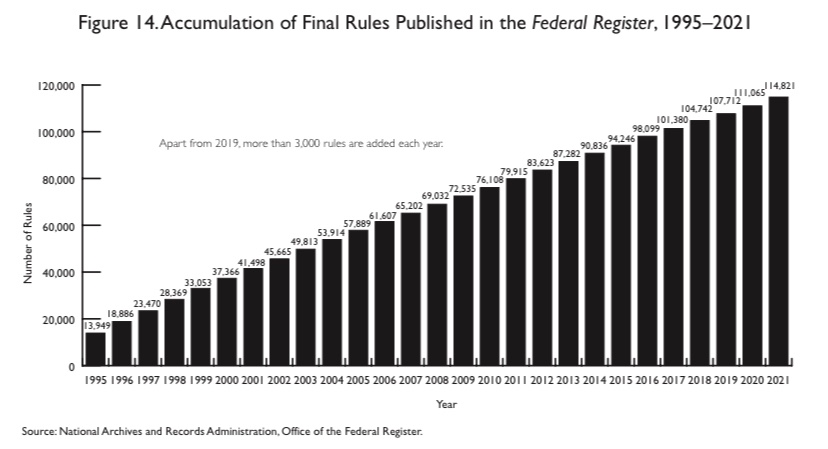
  • Massive growth in regulation (see chart at top) extending to puddles classified as wetlands (EPA), the ”disparate impacts” of private hiring practices (EEOC), carbon footprints of your company and its suppliers (EPA, Fed, SEC), outrageous energy efficiency standards (DOE), and a multiplicity of other intrusions.
  • Growth in the costs of regulatory compliance.
  • A nearly complete lack of responsiveness to market prices, leading to misallocation of resources — waste.
  • Lack of value metrics for government activities to gauge the public’s “willingness to pay”.
  • Monopoly encouraged by regulatory capture and legal / compliance cost barriers to competition. Again, cronyism.
  • Monopoly granted by other mechanisms such as import restrictions and licensure requirements. Again, cronyism.
  • Ruination of key industries as government control takes it’s grip.
  • Shortages induced by price controls.
  • Inflation and diminished buying power stoked by monetized deficits, which is a long tradition in financing excessive government.
  • Malinvestment of private capital created by monetary excess and surplus liquidity.
  • That malinvestment of private capital creates macroeconomic instability. The poorly deployed capital must be written off and/or reallocated to productive uses at great cost.
  • Funding for bizarre activities folded into larger budget appropriations, like holograms of dead comedians, hamster fighting experiments, and an IHOP for a DC neighborhood.
  • A gigantic public sector workforce in whose interest is a large and growing government sector, and who believe that government shutdowns are the end of the world.
  • Attempts to achieve central control of information available to the public, and the quashing of dissent, even in a world with advanced private information technology. See the story of Hunter Biden’s laptop. This extends to control of scientific narratives to ensure support for certain government programs.
  • Central funding brings central pursestrings and control. This phenomenon is evident today in local governance, education, and science. This is another way in which big government fosters dependency.
  • Mission creep as increasing areas of economic activity are redefined as “public” in nature.
  • Law and tax enforcement, security, and investigative agencies pressed into service to defend established government interests and to compromise opposition.

I’ve barely scratched the surface! Many of the items above occur under big government precisely because various factions of the public demand responses to perceived problems or “injustices”, despite the broader harms interventions may bring. The press is partly responsible for this tendency, being largely ignorant and lacking the patience for private solutions and market processes. And obviously, those kinds of demands are a reason government gets big to begin with. In the past, I’ve referred to these knee-jerk demands as “do somethingism”, and politicians are usually too eager to play along. The squeaky wheel gets the oil.

I mentioned cronyism several times in the list. The very existence of broad public administration and spending invites the clamoring of obsequious cronies. They come forward to offer their services, do large and small “favors”, make policy suggestions, contribute to lawmakers, and to offer handsomely remunerative post-government employment opportunities. Of course, certaIn private parties also recognize the potential opportunities for market dominance when regulators come calling. We have here a perversion of the healthy economic incentives normally faced by private actors, and these are dynamics that gives rise to a fascist state.

It’s true, of course, that there are areas in which government action is justified, if not necessary. These include pure public goods such as national defense, as well as public safety, law enforcement, and a legal system for prosecuting crimes and adjudicating disputes. So a certain level of state capacity is a good thing. Nevertheless, as the list suggests, even these traditional roles for government are ripe for unhealthy mission creep and ultimately abuse by cronies.

The overriding issue motivating my voting patterns is the belief in limited government. Both major political parties in the U.S. violate this criterion, or at least carve out exceptions when it suits them. I usually identify the Democrat Party with statism, and there is no question that democrats rely far too heavily on government solutions and intervention in private markets. The GOP, on the other hand, often fails to recognize the statism inherent in it’s own public boondoggles, cronyism, and legislated morality. In the end, the best guide for voting would be a political candidate’s adherence to the constitutional principles of limited government and individual liberty, and whether they seem to understand those principles. Unfortunately, that is often too difficult to discern.

The EPA’s Trip To the Constitutional Woodshed

07 Thursday Jul 2022

Posted by Nuetzel in Administrative State, Constitution, Supreme Court, Uncategorized

≈ 1 Comment

Tags

Administrative Law, Administrative Procedures Act, Administrative State, Affordable Care Act, Charles Lipson, Chevron Deference, Clarence Carson, Clean Air Act, Climate Alarmism, Constitutional Law, Environmental Protection Agency, EPA, Francis Menton, Franklin D. Roosevelt, FTC, Gabriel Kolko, Great Society, Humphrey’s Executor, ICC, Jarkesy v. SEC, Jonathan Tobin, Kevin O. Leske, Lyndon B. Johnson, Major Questiins Doctrine, National Labor Relations Board, Neil Gorsuch, New Deal, Philip Hamburger, rent seeking, SEC, Sheldon Richman, Supreme Court, The Manhattan Contrarian, West Virginia v. EPA, Woodrow Wilson

The Supreme Court’s regular docket is done for the year, but one of last week’s rulings is of great interest to those concerned about the constitutional threat posed by the administrative state. In West Virginia v. EPA, the Court held that the Clean Air Act of 1970 does not authorize the EPA to regulate carbon emissions in power generation. Well, that’s getting to be a very old statute and no one thought much about carbon dioxide emissions when it became law, so of course it doesn’t! However, this decision is crucial as a check on the ever-growing, extra-legal power of the administrative bureaucracy. I say “extra-legal” because regulatory agencies are increasingly taking it upon themselves to write rules that reach well beyond their legislative mandates. Only the legislature can make law under our system of government, or at least law that settles “major questions”, a doctrine that the Court has applied in this case.

Consequential Side Issues

While many critics of the West Virginia decision might find this hard to believe, it has nothing to do with the Court’s views about the prospects for climate change. That is not the Court’s job and it knows it, or at least most of the justices know it. Even if climate change poses a real threat of global catastrophe, and it does not, that is not the Court’s job. Its primary function is to preserve constitutional law, and that is what this decision is about. (For more on the folly of climate alarmism, see here, here, and here.)

Apart from its constitutional implications, growth in the number of regulatory rules and their complexity also imposes massive costs on the economy, robbing the private sector of productive opportunities, often with little or no demonstrable public benefit. The unbridled promulgation of rules does, however, benefit special interests. That includes bureaucrats, litigators, and private parties who derive side benefits from regulation, such as protection of monopoly status, competitive advantages, and expanded professional opportunities. Leveraging government and political privilege for private benefit is rent seeking at its very heart, and it’s also at the very heart of fascistic corporatism.

A Little History

Regulation has been a channel for rent seeking going back to the earliest days of the Republic and even before. But a Great Leap Forward in federal regulatory intervention came in the late 1880s with several Supreme Court decisions involving railroad rates, and then the establishment of the Interstate Commerce Commission. The railroads practically begged to be regulated. At the last link, Sheldon Richmsn quotes historian Gabriel Kolko:

“The first regulatory effort, the Interstate Commerce Commission, had been cooperative and fruitful; indeed, the railroads themselves had been the leading advocates of extended federal regulation after 1887.”

The railroads wanted stability, of course, and less competition, and that’s what they got, though in the end they didn’t do themselves any favors. Here’s historian Clarence Carson on the ultimate result:

“Since the railroads could not effectively compete in so many ways, such opportunity for improving their situation as existed would usually be to combine roads cover­ing the same general area so as to maintain some control over rates and get as much of the profitable business as possible within an area. This is what rail­road financiers tended to do. The result, as far as the public was concerned, was a nonintegrated rail system, reduced competition, poorer service, and higher rates.”

Later, Woodrow Wilson and Franklin D. Roosevelt had strong roles in advancing the regulatory state. Wilson was smitten with the scientism inherent in centralized decision making and administrative expertise. He was also loath to concede his vision of administrative planning to democratic ideals. Justice Neil Gorsuch, in his concurrence on the EPA decision, offers some rather disturbing quotes from Wilson:

“Woodrow Wilson famously argued that ‘popular sovereignty’ ‘embarrasse[d]’ the Nation because it made it harder to achieve ‘executive expertness.’ The Study of Administration, 2 Pol. Sci. Q. 197, 207 (1887) (Administration). In Wilson’s eyes, the mass of the people were ‘selfish, ignorant, timid, stubborn, or foolish.’ Id., at 208. He expressed even greater disdain for particular groups, defending ‘[t]he white men of the South’ for ‘rid[ding] themselves, by fair means or foul, of the intolerable burden of governments sustained by the votes of ignorant [African-Americans].’ 9 W. Wilson, History of the American People 58 (1918). He likewise denounced immigrants ‘from the south of Italy and men of the meaner sort out of Hungary and Poland,’ who possessed ‘neither skill nor energy nor any initiative of quick intelligence.’ 5 id., at 212. To Wilson, our Republic ‘tr[ied] to do too much by vote.’ Administration 214.”

FDR’s New Deal was responsible for a huge expansion in the administrative apparatus, as this partial list of federal agencies created under his leadership indicates. Many of these agencies were subsequently ruled unconstitutional, but quite a few live on today with greatly expanded scope and presumed powers.

The Great Society policies of Lyndon B. Johnson also created new agencies and programs, with additional burdens on the ability of the private economy to function properly. Of course, the complexity of the administrative state has increased many-fold with more recent actions such as the Clean Air Act and the Affordable Care Act.

Major Questions

The agencies, despite any expertise they might have in-house, cannot create major rules and mandates without fairly specific statutory authorization. That is a constitutional imperative. It’s not quite clear, however, what test might distinguish a “major question” requiring enabling legislation from lesser matters. There is certainly some room for interpretation. According to Kevin O. Leske:

“Under the [major questions] doctrine, a court will not defer to an agency’s interpretation of a statutory provision in circumstances where the case involves an issue of deep economic or political significance or where the interpretive question could effectuate an enormous and transformative expansion of the agency’s regulatory authority.”

Unfortunately, this judicial deference to agency rule-making and interpretation led to further erosion of the separation of powers and due process rights. Vague legislation, aggressive special interests and rent seekers, and judicial deference have allowed agencies excessive latitude to interpret and stretch their mandates, to enforce expansive regulatory actions, and to adjudicate disputes with regulated entities in proceedings internal to the agencies themselves.

At issue in EPA v. West Virginia were the agency’s steps to radically transform the energy mix used in power generation, with potentially dramatic, negative impacts on the public. The Court said that won’t fly unless Congress gives the EPA more specific instructions along those lines. Agency expertise, by itself, is not enough to override the legitimate democratic interests of the public in such consequential matters.

But what about executive actions of the sort increasingly taken by presidents over the years? Why are those legal? Article Two of the Constitution grants discretion to the president for enforcement of laws and managing the executive branch. Furthermore, pieces of legislation can specifically grant discretionary power to the executive branch in particular areas. Nevertheless, it might be possible for even executive orders issued by the president to “go too far” in interpreting congressional intent. That is within the purview of courts in case of legal challenges.

Unaccountable Agency Power

So called “administrative expertise” was given some degree of deference by the Supreme Court as early as the 1930s. In 1947, the Court decided the application of such expertise should often take precedence over pre-established rules. There was also a recognition that legislators often lacked the expertise to formulate certain regulatory guidelines. The expanding scope and complexity of regulations gave rise to increasing legal disputes, however. This strained the judicial system for at least two reasons: the sheer limits of its capacity and the lack of technical expertise needed to settle many disputes. This ultimately led to the adjudication of many disputes within the agencies themselves. Agency tribunals of subject matter experts were formed to meet these growing demands. This was said to facilitate “cheap justice”, not to mention more rapid decisions. The passage of the Administrative Procedures Act in 1947 was a recognition that administrative law was necessary and required certain standards, though they differ from normal judicial standards, such as rules of evidence. This left very little to brake aggressive and extra-legal rule-making and enforcement by the agencies.

Another disturbing aspect of the growth in administrative power has been the advent of agencies said to be “independent” from the other branches of government, as if to intimate their existence as a fourth branch. As Francis Menton (the Manhattan Contrarian) says, agencies:

“… can create rules for your conduct free from the Congress, and … can prosecute you free from the President. In 1935, in a case called Humphrey’s Executor, the Supreme Court upheld the part of the FTC Act that made the Commissioners immune from discharge by the President other than in very limited circumstances. Humphrey’s Executor has not been overruled to this day.

The FTC was only the beginning of an explosion of creation of such ‘independent’ agencies and otherwise un-separated powers in the federal government. The Federal Reserve was created about the same time (actually 1913), and things really took off during Roosevelt’s New Deal, with agencies like the FCC, SEC, and NLRB.”

Later, the Supreme Court adopted a two-part test to determine whether courts may defer to administrative expertise in interpreting legislative intent, rather than substituting their own judgement or insisting on a clearer legislative mandate. This was the principle of so-called Chevron deference, named for the case Chevron v. Natural Resources Defense Council, in which the Court ruled for the EPA’s definition of a “stationary source” of pollution as “plantwide”. The test for Chevron deference was whether an agency’s rule was a “reasonable” statutory interpretation and whether Congress had not directly addressed the point in question.

Rolling It Back

Philip Hamburger, in his book “Is Administrative Law Unlawful?”, addressed the struggle between administrative power and “regular law” back to the days of “royal prerogative”. The advent of constitutional law was designed to prevent anything resembling the latter.

“… administrative law has returned American government and society to precisely the sort of consolidated or absolute power that the US Constitution―and constitutions in general―were designed to prevent.”

But now we have some very promising developments. Again, in the West Virginia case, the EPA’s authority to regulate carbon emissions in power generation has been denied by the Court, pending any future legislation that would specifically enable that authority. There was no mention of Chevron in this decision whatsoever! That’s a big win for constitutional principle. In another recent case before the Fifth Circuit Court in New Orleans, Jarkesy v. SEC, an administrative law judge (ALJ) at the SEC had assessed damages and fines against Jarkesy, but he challenged the SEC in court, as Menton describes:

“Jarkesy claimed that he was deprived of his Seventh Amendment right to have his case decided by a jury, and also that the SEC had unconstitutionally exercised legislative powers when deciding to try his case before an ALJ without having been given any guiding principles by Congress on how to make that decision. The Fifth Circuit ruled for Jarkesy on both points. This decision has the potential to force some significant changes on how the SEC does business. However, Mr. Jarkesy still does have to continue to run a gantlet that will likely include a request by the government for en banc review by the Fifth Circuit, and then a request for review by the Supreme Court.”

Conclusion

Here is a nice summary of the constitutional issues from an earlier post by Menton:

“… (1) the combining of powers into agencies that would enact, and also enforce, and also adjudicate regulations (directly contrary to the Constitution’s separation of powers into three branches of government); (2) agencies enacting regulations with the force of law on their own say so (contrary to the Constitution’s requirement that all laws be passed by both houses of Congress and presented to the President for signature); and (3) many agencies claiming to be “independent” of the President (contrary to the Constitution’s vesting all ‘ executive power’ in the President).

This is echoed by Jonathan Tobin, who says:

“Government by fiat of intellectuals or scientific experts may or may not be good policy. But it is alien to the U.S. Constitution, and it has nothing to do with democracy.”

One other critical point made by Charles Lipson is that the Court’s West Virginia decision, while sending an unmistakeable message to federal agencies, should also raise awareness in Congress that it is not enough to legislate vague statutes and rely on bureaucrats to make all the decisions about implementation. Instead, “major questions” must be dealt with legislatively and with full accountability to voters. Congress must address these issues, if not up-front, then whenever they arise as disputes in the courts or otherwise. Certainly, the West Virginia decision should make individuals or entities subject to regulatory action less likely to allow major questions to be settled by ALJ rulings within the agencies themselves. The Supreme Court has expressed a willingness for such cases to be reviewed in normal courts of law. That is a very positive development for liberty.

A Fiscal Real-Bills Doctrine? No Such Thing As Painless Inflation Tax

14 Tuesday Jun 2022

Posted by Nuetzel in Fiscal policy, Inflation, Uncategorized

≈ Leave a comment

Tags

Biden Administration, Cronyism, Federal Debt, Fiscal Inflation, Fiscal policy, Friedrich Hayek, Hyperinflation, Inflation tax, Knowledge Problem, Modern Monetary Theory, Monetary policy, Money Printing, Nominal GDP Targeting, Pete Buttigieg, Real Bills Doctrine, Reichsbank, rent seeking, Ro Khanna

A remarkable proposal made recently by Representative Ro Khanna (D -CA) would have the Biden Administration impose price controls, which would be bad enough. Khanna also would like the federal government to cover the inflation losses incurred by Americans by having it directly purchase certain goods and services and resell them “cheap” to consumers. In fairness, Khanna says the government should attempt to take advantage of dips in prices for oil, food commodities, and perhaps other necessities, which of course would limit or reverse downward price changes. When asked about Khanna’s proposal, Pete Buttigieg, Joe Biden’s Transportation Secretary, replied that there were great ideas coming out of Congress and the Administration should consider them. Anyway, the idea is so bad that it deserves a more thorough examination.

Central Planners Have No Clothes

First, such a program would represent a massive expansion in the scope of government. It would also present ample opportunities for graft and cronyism, as federal dollars filter through the administrative layers necessary to manage the purchases and distribution of goods. Furthermore, price and quantity would then be shaded by a heavy political component, often taking precedence over real demand and cost considerations. And that’s beyond the crippling “knowledge problem” that plagues all efforts at central planning.

One of the most destructive aspects of allowing government to absorb a greater share of total spending is that government is not invested with the same budgetary discipline as private buyers. Take no comfort in the notion that the government might prove expert at timing these purchases to leverage price dips. Remember that government always spends “other people’s money”, whether it comes from tax proceeds, lenders, or the printing press (and hence future consumers, who have absolutely no agency in the matter). Hence, price incentives take on less urgency, while political incentives gain prominence. The loss of price sensitivity means that government expenditures are likely to inflate more readily than private expenditures. This is all the more critical at a time when inflation is becoming embedded in expectations and pricing decisions. Khanna thus proposes an inflation “solution” that puts less price-sensitive bureaucrats in charge of actual purchases. That’s a prescription for failure.

If anyone in Biden’s White House is seriously considering a program of this kind, and let’s hope they’re not, they should at least be aware that direct subsidies for the purchase of key goods would be far more efficient. It’s also possible to hedge the risk of future price increases on commodities markets, perhaps simply distributing hedging gains to consumers when they pay off. However, having the federal government participate as a major player in commodities options and futures is probably not on the table at this point … and I shudder to think of it, but it might be more efficient than Khanna’s vision.

A Fiscal Real Bills Doctrine

Khanna’s program would almost surely cause inflation to accelerate. Inflation itself a form of taxation imposed by profligate governments, though it’s an inefficient tax since it creates greater uncertainty. Higher prices deflate the real value of most government debt (borrowed from the public), assets fixed in nominal value, and incomes. Read on, but this program would have the government pay your inflation tax for you by inflating some more. Does this sound like a vicious circle?

Khanna’s concept of inflation-relief is a fiscal reimagining of a long-discredited monetary theory called the “Real Bills Doctrine”. According to this doctrine, rising prices and costs necessitate additional money creation so that businesses have the liquidity to pay the bills associated with ongoing productive efforts. The “real” part is a reference to the link between business expenses and actual production, despite the fact that those bills are expressed in nominal terms. The result of this policy is a cycle of ever-higher inflation, as ever-more money is printed. This was the policy utilized by the Reichsbank in Weimar Germany during its hyperinflation of 1922-23. It’s really quite astonishing that anyone ever thought such a policy was helpful!

In Khanna’s version of the doctrine, the government spends to relieve cost pressure faced by consumers, so the rationale has nothing to do with productive effort.

Financing and the Central Bank Response

It’s reasonable to ask how these outlays would be financed. In all likelihood, the U.S. Treasury would borrow the funds at interest rates now at 10-15 year highs, which have risen in part to compensate investors for higher inflation.

My bet is that Khanna imagines the Fed would simply “print” money (i.e., buy the new government debt floated by the Treasury to pay for the program). This is the prescription of so-called Modern Monetary Theory, whose adherents have either forgotten or have never learned that money growth and inflation is a costly and regressive form of taxation.

Most economists would say the response of the Federal Reserve to this fiscal stimulus would bear on whether it really ignites additional inflationary pressure. Of course, rather than borrowing, Congress could always vote to levy higher taxes on the public in order to pay the public’s inflation tax burden! But then what’s the point? Well, taxing at least has the virtue of not fueling still higher inflation, and the Fed would not have a role to play.

But if the government simply borrows instead, it adds to the already bloated supply of government debt held by the public. This borrowing is likely to put more upward pressure on interest rates, and the federal government’s mounting interest expense requires more financing. What then might the Fed do?

The Fed is an independent, quasi-government entity, so it would not have to accommodate the additional spending by printing money (buying the new Treasury debt). Either way, investors are increasingly skeptical that the growing debt burden will ever be reversed via future surpluses. The fiscal theory of the price level holds that something must reduce the real value of government debt (in order to satisfy the long-term fiscal budget constraint). That “something” is a higher price level. This position is not universally accepted, and some would contend that if the Fed simply set a nominal GDP growth target and stuck to it, accelerating inflation would not have to follow from Khanna’s policy. The same if the Fed could stick to a symmetric average inflation target, but they certainly haven’t been up to that task. Hoping the Fed would fully assert its independence in a fiscal hurricane is probably wishful thinking.

Conclusion

There are no choke points in the supply chain for bad ideas on the left wing of the Democratic Party, and they are dominating party centrists in terms of messaging. The answer, it seems, is always more government. High inflation is very costly, but the best policy is to rein it in, and that requires budgetary and monetary discipline. Attempts to make high inflation “painless” are misguided in the first instance because they short-circuit consumer price responses and substitution, which help restrain prices. Second, the presumption that an inflation tax can be “painless” is an invitation to fiscal debauchery. Third, expansive government brings out hoards of rent seekers instigating corruption and waste. Finally, mounting public debt is unlikely to be offset by future surpluses, and that is the ultimate admission of Modern Monetary Theory. A fiscal real bills doctrine would be an additional expression of this lunacy. To suggest otherwise is either sheer stupidity or an exercise in gaslighting. You can’t inflate away the pain of an inflation tax.

ESG Scoring: Political Tool Disguised as Investment Guide

30 Wednesday Mar 2022

Posted by Nuetzel in Capital Markets, Corporatism, Environmental Fascism, Social Justice

≈ 3 Comments

Tags

Access to Capital, Antitrust, Blackrock, Climate Action 100+, Corporatism, Diversity, Equity, ESG Fees, ESG Scores, Great Reset, Green Energy, Inclusion, John Cochrane, Mark Brnovich, Principal-Agent Problem, Renewable energy, Renewables, rent seeking, Shareholder Value, Social Justice, Stakeholder Capitalism, Sustainability, Too big to fail, Ukraine Invasion, Vladimir Putin, Woke Investors, Zero-Carbon

ESG scores are used to rate companies on “Environmental, Social, and Governance” criteria. The truth, however, is that ESGs are wholly subjective measures of company performance. There are many different ESG scores available, with no uniform standards for methodology, specific inputs, or weighting schemes. If you think quarterly earnings reports are manipulated, ESGs are an even more pliable tool for misleading investors. It is a market fad, and fund managers are using it as an excuse to charge higher fees to investors. But like any trending phenomenon, for a time, the focus on ESGs might feed-back positively to returns on favored companies. That won’t be sustainable, however, without legislative and regulatory cover, plus a little manipulative help from the ESG engineers and “Great Reset” propagandists.

It’s 100% Political, 0% Economic

ESGs are founded on prioritizing objectives that have little to do with shareholder value or any well-understood yardsticks of financial or operating performance. The demands on company resources for scoring highly on ESG are often nakedly political. This includes adoption of environmental goals such as fraudulent “zero carbon” impacts, the nebulous “sustainability” objective promoted by “green” activists, diversity, inclusion and equity initiatives, and support for activist groups such as Black Lives Matter and Antifa.

Concepts like “stakeholder value” are critical to the rationale for ESGs. “Stakeholders” can include employees, suppliers, and customers, as well as potential employees. suppliers, and customers. In other words, they can be just about anyone in the broader community, or more likely activists for “social change” whose interests have but the thinnest connection to the business’s productive activities. In essence, so-called stakeholder capitalism amounts to a ceding of control over corporate resources, and ultimately confiscation of wealth from equity owners.

Corporations have long engaged in various kinds of defensive actions, amounting to a modern-day trade in indulgences. No one will be upset about your gas-powered fleet if you buy enough carbon offsets, which just might neutralize the impact of the fleet on your ESG! On a more sinister level, ESG’s provide opportunities for cover against information that might be damaging to firms, such as the use of slave labor overseas. Flatter the right people, give to their causes, “partner” with them on pet initiatives, and your sins will be ignored and your ESG will climb! And ESGs are used in attempts to pacify leftist investors who see the corporation as a vessel for their own social objectives, quite apart from any mission it might have had as a productive enterprise.

Your ESG will shine if you do business that’s politically-favored, like renewable energy, despite its inefficiencies and significant environmental blemishes. But ESGs are not merely used to reward those anointed as virtuous by the Left. They are more forcefully used to punish firms in industries that are out of favor, or firms refusing to participate in buying off authoritarian crusaders. For example, you might be so berserk as to think fossil fuels and climate change represent imminent threats of catastrophe. Naturally, you’ll want to punish oil and gas producers. In fact, if you are in charge of ESG modeling, you might want to penalize almost any extraction industry, with certain exceptions: the massive extraction and disposal costs of renewables will pass without notice.

All these machinations occur despite the huge uncertainty surrounding flimsy, model-based predictions of warming and global catastrophe. Never mind that fossil fuels are still relied upon to provide for most of our energy needs and will be for some time to come, including base-load power generation when intermittency prevents renewables from meeting demand. The stability of the power grid depends upon the availability of carbon-based energy, which in fact is marvelously efficient. Yet the ESG crowd (not to mention the Biden Administration) seeks to drive up its cost, including the cost of capital, and these added costs fall most heavily on the poor.

ESG-guided efforts by activists to deny capital to certain segments of the energy sector may constitute antitrust violations. Some big players in the financial industry, who together manage trillions of dollars in investment funds, belong to an advocacy organization called Climate Action 100+. They coordinate on a mission to completely transform the energy industry via “green” investments and divestments of presumptively “dirty” concerns. These players and their clients have huge investments in green energy, and it is in their interest to provide cheap capital to those firms while denying capital to fossil fuel industries. As Arizona Attorney General Mark Brnovich writes at the link above, this is restraint of trade “hiding in plain sight”.

Manipulation

ESGs could be the mother of all principal-agent problems. Corporate CEOs, hired by ownership as stewards and managers of productive assets, are promoting these metrics and activities, which may not align with the interests of ownership. ESG’s are not standardized, and most users will have little insight into exactly how these “stakeholder” sausages are stuffed. In fact, much of the information used for ESGs is extremely ad hoc, not universally disclosed, and is often qualitative. The applicability of these scores to the universe of stocks, and their reliability in guiding investment decisions, is extremely questionable no matter what the investor’s objectives. And of course the models can be manipulated to produce scores that suit the preferences of money managers who have a stake in certain firms or industry segments, and who inflate their fees in exchange for ESG investment advice. And firms can certainly engage in deceptions that boost ESGs, as already discussed.

Like many cultural or consumer trends, investment trends can feed off themselves for a time. If there are enough “woke” investors, ESGs might well feed an unvirtuous cycle of stock purchases in which returns become positively correlated with wokeness. Such a divorce from business fundamentals will eventually take its toll on returns, especially when economic or other conditions present challenges, but that’s not the answer you’ll get from many stock pickers and investment pundits.

At the same time, there are ways in which the preoccupation with ESGs dovetails with the rents often sought in the political arena. Subsidies, for example, will be awarded to firms producing renewables. Politically favored firms are also likely to receive better regulatory treatment.

There are other ways in which firms engaging in wasteful activities can survive profitably, at least for a time. Monopoly power is one, and companies often develop a symbiosis with regulators that hampers smaller competitors. This is traditional rent-seeking corporatism in action, along with the “too-big-to-fail” regime. Sometimes sheer growth in demand for new technologies or networking potential helps to conceal waste. Hot opportunities can leave growing companies awash in cash, some of which will be burned in wasteful endeavors. ESG scoring offers them additional cover.

Cracks In the Edifice

John Cochrane notes a fundamental, long-term contradiction for those who invest based on ESGs: an influx of capital will tend to drive down returns in those firms and industries, while the returns on firms having low ESGs will be driven upward. Yet advocates claim you can invest for virtue and superior returns. That can’t outlast real market forces, especially as ESG efforts dilute any mission a firm might have as a productive enterprise.

Vladimir Putin’s brutal invasion of Ukraine has revealed other cracks in the ESG edifice. We now have parties arguing that defense stocks should be awarded ESG points! Also, that oil production by specific nations should be scored highly. There is also an awakening to the viability of nuclear power as an energy source. Then we have the problem of delivering on Biden’s promise to Europe of more liquified natural gas exports. That will be difficult given the way Biden has bludgeoned the industry, as well as the ESG conspiracy to deny it access to capital. Just watch the ESG hacks backpedal. Now, even the evangelists at Blackrock are wavering. To see the thread of supposed ESG consistency unravel would be enough to make you laugh if the entire conspiracy weren’t so grotesque.

Closing

The pretensions underlying “green” initiatives undertaken by large corporations are good mainly for virtue signaling, to collect public subsidies, and to earn better ESG scores. They are usually wasteful in a pure economic sense. The same is true of social justice and diversity initiatives, which can be perversely racist in their effects and undermine the rule of law.

Ultimately, we must recognize that the best contribution any producer can make to society is to create value for shareholders and customers by doing what it does well. The business world, however, has gone far astray in the direction of rank corporatism, and keep this in mind: any company supporting a sprawling HR department, pervasive diversity efforts, “sustainability” initiatives, and preoccupations with “stakeholder” outreach is distracted from its raison d’etre, its purpose as a business enterprise to produce something of value. It is probably captive to outside interests who have essentially commandeered management’s attention and shareholders’ resources.

When it comes to investing, I prefer absolute neutrality with respect to out-of-mission social goals. Sure, do no harm, but the focus should remain squarely on goals inherent in the creation of value for customers and shareholders.

Homeownership, Pensions, and the Wealth Distribution

13 Monday Dec 2021

Posted by Nuetzel in Markets, Wealth Distribution

≈ Leave a comment

Tags

Capitalism, Daniel Waldenström, Housing Assets, income inequality, Pension Assets, Popular Assets, Progressive Taxation, regulation, rent seeking, Social Security, Wealth Concentration, Wealth Inequality

My theme in “What’s To Like About Income Inequality?” was the existence of natural drivers of an unequal distribution of income, as where institutions reward merit and legal systems assign strong property rights. I also discussed trends in income and wealth inequality and how standard measures of inequality are distorted by income taxes and transfer payments, including differences in unrealized and realized capital gains. Furthermore, income mobility makes “snapshots” of inequality less compelling, as individuals are not “stuck” for all time at a point in the income distribution, but are typically moving across the distribution and usually upward as they age through their working years.

Wealth inequality is another matter, but a new paper by Daniel Waldenström entitled “Wealth and History: An Update” shows that wealth concentration, which he defines as the share of wealth held by the top 1%, declined markedly between 1920 and 1970 in Europe and the U.S. After 1970, however, the share remained flat in Europe and was flat in the U.S. as well if unfunded pensions and Social Security benefits are valued as wealth. However, the near-entirety of the earlier decline in U.S. wealth concentration occurred by about 1950.

So a great thinning in the fat right tail of the wealth distribution occurred during the middle years of the 20th century. Waldenström attributes this transition to growth of homeownership and pension assets. These are so-called “popular assets” because they are held more broadly than the legacy wealth of the 1800s and early twentieth century:

“… the structure of private wealth has changed over the twentieth century, from being dominated by elite fortunes in agriculture or businesses to consisting mainly of widely dispersed assets in housing and funded pensions.”

Waldenström concludes that the facts run contrary to claims that wealth inequality has worsened in Western, capitalist economies over the years:

“These new findings have implications for the historiography of Western wealth accumulation and wealth concentration. They cast doubt over the view that an unfettered capitalism, such as in pre-democratic and pre-taxation nineteenth-century Europe, generates extreme levels of capital accumulation. The new findings also question the pivotal role of wars, crises and progressive taxation as the sole important factors behind the wealth equalization of the twentieth century.

Waldenström considers the role of progressive taxation in equalizing wealth, but he acknowledges that taxes undermined wealth accumulation at all levels, so the effect was ambiguous. A point on which I’d take issue with Waldenström is the role of regulation, which he believes “curbed the growth of large fortunes”. That might be true in some cases, but this effect is also subject to ambiguity. Regulation is often welcomed by powerful market players as a way of consolidating market position and hindering new competition. The regulatory state has long been considered a primary channel for rent seeking, so the impact on the wealth distribution is likely to be mixed.

Market institutions, together with rising education levels, labor reforms, and gains in productivity enabled this broadening in the accumulation and distribution of wealth. Social Security certainly played a part as well, though we don’t know how private pensions might have evolved in its absence. Of course, Social Security has a terrible record as an “investment” of payroll taxes. Private control over the investment direction of those funds would have done far better, and still could, which would be a further boon to wealth for the lower 99%.

It is true that inequality in both income and wealth is to be expected under merit-based systems of rewards. However, Daniel Waldenström’s paper offers evidence that markets do not merely concentrate wealth at the expense of workers. Rather, they deliver gains to all participants, who are in turn free to accumulate wealth in the kinds of “popular assets” discussed by Waldenström.

← Older posts
Follow Sacred Cow Chips on WordPress.com

Recent Posts

  • Immigration and Merit As Fiscal Propositions
  • Tariff “Dividend” From An Indigent State
  • Almost Looks Like the Fed Has a 3% Inflation Target
  • Government Malpractice Breeds Health Care Havoc
  • A Tax On Imports Takes a Toll on Exports

Archives

  • December 2025
  • November 2025
  • October 2025
  • September 2025
  • August 2025
  • July 2025
  • June 2025
  • May 2025
  • April 2025
  • March 2025
  • February 2025
  • January 2025
  • December 2024
  • November 2024
  • October 2024
  • September 2024
  • August 2024
  • July 2024
  • June 2024
  • May 2024
  • April 2024
  • March 2024
  • February 2024
  • January 2024
  • December 2023
  • November 2023
  • August 2023
  • July 2023
  • June 2023
  • May 2023
  • April 2023
  • March 2023
  • February 2023
  • January 2023
  • December 2022
  • November 2022
  • October 2022
  • September 2022
  • August 2022
  • July 2022
  • June 2022
  • May 2022
  • April 2022
  • March 2022
  • February 2022
  • January 2022
  • December 2021
  • November 2021
  • October 2021
  • September 2021
  • August 2021
  • July 2021
  • June 2021
  • May 2021
  • April 2021
  • March 2021
  • February 2021
  • January 2021
  • December 2020
  • November 2020
  • October 2020
  • September 2020
  • August 2020
  • July 2020
  • June 2020
  • May 2020
  • April 2020
  • March 2020
  • February 2020
  • January 2020
  • December 2019
  • November 2019
  • October 2019
  • September 2019
  • August 2019
  • July 2019
  • June 2019
  • May 2019
  • April 2019
  • March 2019
  • February 2019
  • January 2019
  • December 2018
  • November 2018
  • October 2018
  • September 2018
  • August 2018
  • July 2018
  • June 2018
  • May 2018
  • April 2018
  • March 2018
  • February 2018
  • January 2018
  • December 2017
  • November 2017
  • October 2017
  • September 2017
  • August 2017
  • July 2017
  • June 2017
  • May 2017
  • April 2017
  • March 2017
  • February 2017
  • January 2017
  • December 2016
  • November 2016
  • October 2016
  • September 2016
  • August 2016
  • July 2016
  • June 2016
  • May 2016
  • April 2016
  • March 2016
  • February 2016
  • January 2016
  • December 2015
  • November 2015
  • October 2015
  • September 2015
  • August 2015
  • July 2015
  • June 2015
  • May 2015
  • April 2015
  • March 2015
  • February 2015
  • January 2015
  • December 2014
  • November 2014
  • October 2014
  • September 2014
  • August 2014
  • July 2014
  • June 2014
  • May 2014
  • April 2014
  • March 2014

Blogs I Follow

  • Passive Income Kickstart
  • OnlyFinance.net
  • TLC Cholesterol
  • Nintil
  • kendunning.net
  • DCWhispers.com
  • Hoong-Wai in the UK
  • Marginal REVOLUTION
  • Stlouis
  • Watts Up With That?
  • Aussie Nationalist Blog
  • American Elephants
  • The View from Alexandria
  • The Gymnasium
  • A Force for Good
  • Notes On Liberty
  • troymo
  • SUNDAY BLOG Stephanie Sievers
  • Miss Lou Acquiring Lore
  • Your Well Wisher Program
  • Objectivism In Depth
  • RobotEnomics
  • Orderstatistic
  • Paradigm Library
  • Scattered Showers and Quicksand

Blog at WordPress.com.

Passive Income Kickstart

OnlyFinance.net

TLC Cholesterol

Nintil

To estimate, compare, distinguish, discuss, and trace to its principal sources everything

kendunning.net

The Future is Ours to Create

DCWhispers.com

Hoong-Wai in the UK

A Commonwealth immigrant's perspective on the UK's public arena.

Marginal REVOLUTION

Small Steps Toward A Much Better World

Stlouis

Watts Up With That?

The world's most viewed site on global warming and climate change

Aussie Nationalist Blog

Commentary from a Paleoconservative and Nationalist perspective

American Elephants

Defending Life, Liberty and the Pursuit of Happiness

The View from Alexandria

In advanced civilizations the period loosely called Alexandrian is usually associated with flexible morals, perfunctory religion, populist standards and cosmopolitan tastes, feminism, exotic cults, and the rapid turnover of high and low fads---in short, a falling away (which is all that decadence means) from the strictness of traditional rules, embodied in character and inforced from within. -- Jacques Barzun

The Gymnasium

A place for reason, politics, economics, and faith steeped in the classical liberal tradition

A Force for Good

How economics, morality, and markets combine

Notes On Liberty

Spontaneous thoughts on a humble creed

troymo

SUNDAY BLOG Stephanie Sievers

Escaping the everyday life with photographs from my travels

Miss Lou Acquiring Lore

Gallery of Life...

Your Well Wisher Program

Attempt to solve commonly known problems…

Objectivism In Depth

Exploring Ayn Rand's revolutionary philosophy.

RobotEnomics

(A)n (I)ntelligent Future

Orderstatistic

Economics, chess and anything else on my mind.

Paradigm Library

OODA Looping

Scattered Showers and Quicksand

Musings on science, investing, finance, economics, politics, and probably fly fishing.

  • Subscribe Subscribed
    • Sacred Cow Chips
    • Join 128 other subscribers
    • Already have a WordPress.com account? Log in now.
    • Sacred Cow Chips
    • Subscribe Subscribed
    • Sign up
    • Log in
    • Report this content
    • View site in Reader
    • Manage subscriptions
    • Collapse this bar
 

Loading Comments...