• About

Sacred Cow Chips

Sacred Cow Chips

Author Archives: Nuetzel

Climate Change, Hurricanes and Noisy Statistics

22 Friday Sep 2017

Posted by Nuetzel in Global Warming

≈ Leave a comment

Tags

AGW, Atlantic Multi-Decadal Oscillation, Climate Change, Cool the Past, East Anglia University, El Nino, Fabius Maximus, global warming, Hurricane Harvey, Hurricane Irma, Hurricane Maria, Michael Mann, NOAA, Roger Pielke Sr, Roy Spencer, Ryan Maue, Sea Surface Temperatures, Signal-to-Noise, Statistical Noise, Storm Intensity, Watt's Up With That?
IMG_4919

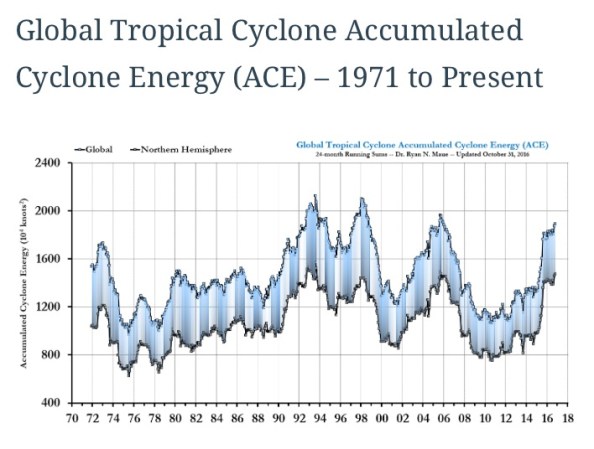
The nasty spate of hurricanes this year has been a catch-up of sorts following a decade of subdued activity. In fact, global hurricane activity has been flat to declining in frequency since 1970. Until the recent increase, hurricane activity had been trending down in terms of 24-month cumulative energy since the 1990s, as the chart above shows. The historical data on the number of U.S. landfalls extends back to 1900, and it has had a negative trend as well. Nevertheless, we hear from climate alarmists that Hurricanes Harvey and Irma, which ended a drought of record length in U.S hurricane landfalls, and now presumably Maria, were a consequence of anthropomorphic global warming (AGW), er… climate change.

The implication is that increases in the atmospheric concentration of CO2 led to these hurricanes or their high intensity. Apparently, the paucity of hurricane activity over the previous ten years can be waved off as a fluke. A further implication of the alarmist view is that the longer negative trends in hurricane frequency and energy can be ignored in the context of any relation to CO2 concentration. But how so? One confounding factor I’ve seen mentioned blames El Nino warming in the Pacific, and a consequent increase in Atlantic wind shear, for the long lull in activity after 2005. That has a ring of plausibility, but a closer look reveals that actual El Nino activity during those years was hardly impressive, with the exception of 2015-16.

More historical data can be seen in the charts on the tropical cyclone page on the Watts Up With That? blog. (The charts in question start about two-thirds of the way down the page.) Hurricane expert Ryan Maue compiled a number of these charts, including the one above. He authored an editorial in the Wall Street Journal this week bemoaning the climate-change hype surrounding Harvey and Irma (if the link doesn’t work, it is available at the WSJ’s Opinion page on Facebook, posted on 9/17). Maue believes that both the climate science community and the media share in the blame for that hype. But he also says the following:

“Although a clear scientific consensus has emerged over the past decade that climate change influences hurricanes in the long run, its effect upon any individual storm is unclear.“

Maue provides a link to this NOAA web site offering cautious support for the proposition that there is a link between global warming and hurricane intensity, though the data it cites ends about ten years ago, so it does not capture the recent lull. Also, some of the information it provides is based on modeled global temperatures and hurricane activity through 2100. As is well-known by now, or should be, long-term climate forecasts based on carbon forcings are notoriously inaccurate, and NOAA admits that the association between those predicted temperatures and future hurricanes is tenuous:

“It is premature to conclude that human activities–and particularly greenhouse gas emissions that cause global warming–have already had a detectable impact on Atlantic hurricane or global tropical cyclone activity.“

Perhaps the idea that there is consensus regarding the relationship between climate change and hurricanes is more of a stretch than Maue and NOAA let on. Here is a summary of 30 peer-reviewed studies showing no connection to either hurricane frequency or intensity. Most of these studies are more recent than the end of the data record cited by NOAA. And in fact, many of these studies find support for a negative link between global temperatures and hurricane activity.

One of the prominent alarmists in the climate research community is Penn State’s Michael Mann, who has famously claimed that hurricanes are more frequent now than at any time in the past 1,000 years. He based his conclusions on highly speculative hurricane “proxies” identified in layers of sediment. Mann’s claims and research technique have been called into questioned by other climate scientists, who have arrived at contrary results in their own research. Lest anyone forget, Mann was implicated in a  data manipulation fraud related to the East Anglia climate scandal. Though cleared by a group of tenured professors at his own university, there are a number of climate scientists who believe Mann violated scientific standards.

The claim that global warming will cause hurricanes to become increasingly intense relies on elevated sea surface temperatures. This year, temperatures in the Gulf of Mexico are elevated and are said to have had a role in strengthening Harvey as it approached the Gulf Coast. Texas, however, has experienced as many landfalls of major hurricanes with cooler Gulf waters as with warmer waters. And Irma strengthened in a part of the Atlantic without such warm temperatures. Instead, minimal wind shear was implicated as a factor contributing to Irma’s strength.

In general, Atlantic temperatures have been relatively warm since the late 1990s, a fact that most scientists would at least partially attribute to the “Atlantic multi-decadal oscillation“, a regular cycle in water temperatures that repeats with a period of multiple decades. Potentially adding to that temperature increase is a controversial change in NOAA’s calibration of sea surface temperatures, as an increasing share of those readings are taken from buoys rather than ship-board measurement. There is some suspicion that NOAA’s adjustments “cool the past” more than is justified, a suspicion that was heightened by allegations from one whistle-blowing NOAA scientist early this year. Then, there is the contention that the sea surface temperature makes little difference if it is matched by an increase in air temperature.

Overall, NOAA says the combination of frequency and intensity of tropical cyclones will increase by 2%-11% over the rest of this century. As Roy Spencer notes, that is not a terribly alarming figure given the risks people have always willingly accepted by living in coastal areas. In any case, the range is based on models of climate behavior that are of questionable reliability. And like past temperature predictions produced by carbon-forcing climate models, it is likely to be a gross overestimate. Here is Roger Pielke, Sr., who is quoted in this wide-ranging post on hurricanes and climate at the Fabius Maximus web site:

“Model projections of hurricane frequency and intensity are based on climate models. However, none have shown skill at predicting past (as hindcasts) variations in hurricane activity (or long term change in their behavior) over years, decades, and longer periods. Thus, their claim of how they will change in the future remains, at most, a hypothesis (i.e. speculation). When NOAA, IPCC and others communicate to the media and public, to be scientifically honest, they should mention this.”

Despite the spike in activity this year, strong hurricanes are intermittent and fairly rare. Establishing reliable statistical connections with other forces is difficult with emergent events like hurricanes. Moreover, the degree of error in measuring global or regional temperature itself is much larger than is generally acknowledged, and the global warming “signal” is very weak. As we say in the statistical analysis business, noisy data are compatible with diverse hypotheses. The relationship between hurricanes and climate change is a prime example.

“Freedom of Representation” Is a Better Name Than “Right To Work”

15 Friday Sep 2017

Posted by Nuetzel in Right to Work, Unions

≈ 1 Comment

Tags

Agency Fees, Compelled Riders, Competitive Enterprise Institute, David Boaz, David Henderson, Eric Greitens, Exclusive Representation, Free Riders, Gary Chartier, Holman Jenkins, Ivan Osorio, Joe Lehman, Mackinac Center for Public Policy, Missouri Right to Work, monopoly, Monopsony, National Labor Relations Board, Right to Work, Sheldon Richman, Taft-Hartley Act, Vinnie Vernuccio, Wagner Act

Missouri’s Right-to-Work (RtW) legislation, signed into law by Governor Eric Greitens in February of 2016, essentially states that no employee or prospective employee, with certain exceptions, can be required to join a union or to pay union dues or agency fees. But before the RtW law’s effective date on August 28th, well over 300,000 signatures were collected in opposition, which is believed to meet state requirements for a referendum on the issue. As a consequence, the law was put on hold, pending a vote in November.

A casual look at a variety of statistics by state “right-to-work” status shows an impressive advantage for RtW states, though that doesn’t imply causality. One can certainly think of reasons why the causality might be operative, and I find some of them plausible, but that’s not the line of argument I want to pursue here.

The Libertarian Divide

Libertarians are of divided opinion on the desirability of RtW laws. David Boaz wrote about this division back in 2012. On one side, it’s clearly an abrogation of an individual workers’ rights to require, as a condition of employment, entry into a third-party association against their will, or to coerce payment of dues or fees for collective bargaining and ongoing representation on a variety of job-related issues. Such a requirement would violate the constitutional protections on freedom of association, freedom of speech, and freedom of contract. Boaz quotes Vinnie Vernuccio and Joe Lehman of the Mackinac Center for Public Policy:

“Right to work does not change any aspect of collective bargaining other than preventing employees from getting fired for choosing not to join or remain in a union and pay union dues or agency fees, which may go toward political causes they don’t support. Collective bargaining still exists in right-to-work states, and workers are of course free to organize.“

This may overstate the consequences for workers who would rather not join a union. Non-union workers have so-called Beck rights, which allow them to opt out of “core membership” and  pay reduced dues covering only representation. An appropriate accounting for that portion of dues might not be straightforward, however, and it is still likely to represent an involuntary payment. Moreover, awareness of Beck rights is far from universal, and asserting them might not be straightforward.

Libertarians who disagree with the perspective expressed in the quote above emphasize the employers’ freedom of contract as though it takes primacy over worker autonomy in the shaping of voluntary and mutually beneficial employment relationships. The thinking is that an employer might actually prefer to host a union shop. There are presumed efficiencies of collective bargaining, standard and agreed-upon work rules, lower turnover, and perhaps even worker loyalty. Among this group of libertarians are Holman Jenkins, Sheldon Richman, and Gary Chartier:

“When a legislature interferes with voluntary employment contracts, it infringes people’s freedom to bargain with their own labor and possessions. Treating this kind of interference as acceptable means licensing arbitrary interventions into the market by politicians, who are ill-equipped to second-guess the decisions made by the real people making work agreements with one another.“

Labor Law

One could be forgiven for thinking that Chartier and the others view RtW as a form of government intervention in otherwise free labor markets. These critics acknowledge, however, that there is already intervention in labor relations via the Wagner Act (1935), which among other things prohibits any refusal “to bargain collectively with the representative of the employer’s employees.” Under the Act, the National Labor Relations Board (NLRB) is charged with:

“… overseeing the process by which employees decide whether to be represented by a labor organization and prosecuting violations. ... issue rules interpreting the labor legislation. This will generally be binding, unless a court deems it to have acted outside its authority. … prevent unfair labor practices, lead investigations, collect evidence, issue subpoenas, and require witnesses to give evidence.“

So, the NLRB is empowered to force employers, if it so chooses, to bargain collectively and even to rule on whether a vote by employees was “fair”. RtW laws are defended as a force to countervail against this federal power. The Wagner Act was later amended by the Taft-Hartley Act (1947) to curb union power and abuses. It created more balance in the relations between unions and employers and it offered some protection to non-union job seekers by prohibiting closed shops. It also allowed states to pass RtW laws to proscribe the forced payment of agency fees by non-union employees, if states so choose. Nevertheless, labor law continues to support monopoly union privileges and abusive tactics. Moreover, restrictions on unions’ use of dues and agency fees for political activities are difficult to enforce in the absence greater requirements for union financial transparency. The response from libertarian critics of RtW laws is that there are avenues for additional reform at the federal level without adding additional interventions (RtW) at the state level.

One of the clearest rebuttals to the above arguments against RtW laws comes from Ivan Osorio of the Competitive Enterprise Institute, who first quotes Chartier on prospective legislation in Indiana:

“‘If employers choose to conclude union-shop contracts with unions, what gives the Indiana legislature the right to interfere?‘”

Here is Osorio’s rejoinder:

“... there is no jurisdiction anywhere in the United States where there is no such interference at all. Simply replace “union shop” with “open shop,” and the one-sidedness of Chartier’s query … becomes clear. Why should the government forbid an employer from negotiating a voluntary membership agreement with a union?“

Exclusive Representation

Another side of the RtW debate is the contention that non-union workers receive the same benefits achieved via collective bargaining if they are employed by a firm having an otherwise unionized work force. Thus, the non-union workers are said to be “free riding” on the union’s efforts. This framing is highly misleading, however. Under the Wagner Act, a firm’s non-union workers are not entitled to pay for benefits negotiated by the union unless the union has opted for exclusive representation. In that case, those non-union workers are not so much free riders as “compelled riders“, who may be forced to accept certain terms, working conditions and particular representation in grievances against their wishes. The union’s exclusive power is thus flexed in two ways: as a monopoly seller of labor to the firm, and as a monopoly seller of agency services to the worker, extracting dues or agency fees in the process.

Balancing Rights

David Henderson’s perspective on the RtW issue is appealing, as he accounts for the tradeoff between emphasizing the rights of workers and employers:

“It’s true that [RtW] laws make it illegal for employers to do what some of them might want to do: namely hire only union workers, require everyone who works for them to join unions, or require everyone who works for them to pay dues to a union. But are there really likely to be many such employers? I don’t think so. …

Now, I don’t know that there are no such employers. Maybe there are some. If so, then it becomes a tradeoff. On the one hand, preserve the rights of many non-union workers, many union workers, and unionized employers but trample on the rights of those few unionized employers. On the other hand, trample on the rights of many union workers, non-union workers, and unionized employers but preserve the rights of those few unionized employers. I choose the first option because I think it tramples on way fewer people’s rights. And, remember, that if you say right-to-work is wrong and you get your way just on that issue, the federal government will continue to trample on many people’s rights. …

… the best solution is to abolish the law that gives government-enforced monopoly power to unions. Sheldon [Richman] and I agree on this. The issue here is whether we should just settle for saying that and pushing for that or do something else meanwhile.“

Union representation can protect workers from an imbalance of power between a large employer and individual workers. But it is not all sweetness and light for unionized workers, not to mention consumers who pay for the influence of unions on prices in general. While unions played a critical role in establishing and defending workers’ rights over the years, they have increasingly presented agency problems for their constituencies. They have also hastened declines in industries facing competitive pressures, which in turn have hastened the decline of union representation generally. (Public sector unions present a different set of problems involving conflicts of interest with taxpayers, but those are beyond the scope of this post.) In general, worker rights in the private sector are better served by allowing self-determination in the matter of union representation. To the extent that state RtW laws protect that autonomy, they are probably worthwhile at this point in the evolution of labor relations. However, if that is the primary effect, RtW is something of a misnomer.

Behold Our Riches! Quality, Prices, Income, and the Purchasing Power of Labor

12 Tuesday Sep 2017

Posted by Nuetzel in Human Welfare, Markets

≈ 1 Comment

Tags

Affordability, Consumer Surplus, Don Boudreaux, Human Progress, Income Statistics, John D. Rockefeller, Marian Tupy, Martin Feldstein, Measures of Economic Welfare, Middle Class Stagnation, Non-Wage Benefits, Quality Adjustment, Wage Stagnation

coffeemaker

A steady refrain among pundits is that the American middle class can’t get ahead. The standard of living of average Americans has stagnated over the past 30 years, according to this view. It’s bolstered by government measures of average wage growth relative to consumer prices. But Martin Feldstein describes the flaws in constructing these measures; he says they may have led to an understatement of real income growth of more than 2% per year! Here is a link to Feldstein’s piece in the Wall Street Journal: “We’re Richer Than We Realize“. (If the link doesn’t work, an ungated link can be found on the WSJ Facebook page, posted at 10:30 a.m. on Saturday, Sept. 9th.)

Here are some of Feldstein’s observations:

“If there is no increase in the cost of production, the government concludes that there has been no increase in quality. And if the manufacturer reports an increase in the cost of production, the government assumes that the value of the product to consumers has increased in the same proportion.

That’s a very narrow—and incorrect—way to measure quality change. In reality companies improve products in ways that don’t cost more to produce and may even cost less. That’s been true over the years for familiar products like television sets and audio speakers. The government therefore doesn’t really measure the value to consumers of the improved product, only the cost of the increased inputs. The same approach, based on measuring the cost of inputs rather than the value of output, is also used for services.

The official estimates of quality change are therefore mislabeled and misinterpreted. When it comes to quality change, what is called the growth of real output is really the growth of real inputs. The result is a major underestimation of the increase in real output and in the growth of real incomes that occurs through quality improvements.

The other source of underestimation of growth is the failure to capture the benefit of new goods and services. Here’s how the current procedure works: When a new product is developed and sold to the public, its market value enters into nominal gross domestic product. But there is no attempt to take into account the full value to consumers created by the new product per se.“

It goes well beyond that, however, as great swaths of consumer value are completely ignored by government statistics:

“A basic government rule of GDP measurement is to count only goods and services that are sold in the market. Services like Google and Facebook are therefore excluded from GDP even though they are of substantial value to households. The increasing importance of such free services implies a further understatement of real income growth.“

Some of these criticisms are unfair to the extent that income statistics correspond to what consumers can purchase in terms of market value. That is a fundamentally different concept than the total value consumers assign to goods and services (market value plus consumer surplus). Nevertheless, there are efforts to adjust for quality in these statistics, but they fall far short of their objective. Also, GDP and income statistics purport to be measures of economic welfare, though it’s well known that they fall short of that ideal. It might be more fair to say that that official income statistics are reliable in tracking short-term changes in well being, but not so much over long periods of time.

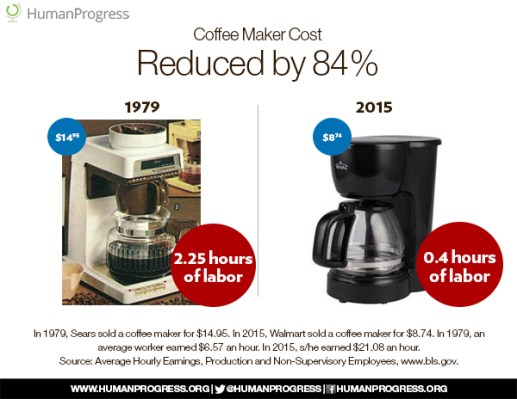
The graphic at the top of this post is taken from Marian L. Tupy’s “Cost of Living and Wage Stagnation in the United States, 1979-2015“, on the CATO Institute‘s web site:

“… many, perhaps most, big-ticket items used by a typical American family on a daily basis have decreased in price. Over at Human Progress, we have been comparing the prices of common household items as advertised in the 1979 Sears catalog and prices of common household items as sold by Walmart in 2015.

We have divided the 1979 nominal prices by 1979 average nominal hourly wages and 2015 nominal prices by 2015 average nominal hourly wages, to calculate the “time cost” of common household items in each year (i.e., the number of hours the average American would have to work to earn enough money to purchase various household items at the nominal prices). Thus, the ‘time cost’ of a 13 Cu. Ft. refrigerator fell by 52 percent in terms of the hours of work required at the average hourly nominal wage, etc.“

Tupy’s post also covers the huge increases in non-wage benefits enjoyed by many workers over the past several decades, which are not captured in average wage statistics.

It’s clear that standard measures of income growth are distorted by the failure to properly account for changes in the quality of goods and services at our disposal. The narrative of middle class stagnation is flawed in that respect. As Don Boudreaux has said, most ordinary Americans are richer today than John D. Rockefeller was a century ago. The availability and quality of goods and many services today, affordable to ordinary Americans, are vastly superior to what Rockefeller had then or could even imagine. And many of those advancements occurred since the 1970s.

An Immigration Reform Dream: What’s Trump’s Price?

08 Friday Sep 2017

Posted by Nuetzel in Executive Authority, Immigration

≈ Leave a comment

Tags

Border Wall, DACA, David Harsanyi, Deferred Action on Childhood Arrivals, Deportation, Dream Act, Executive Overreach, Executive Power, Ilya Somin, Immigration Enforcement, Immigration reform, Michael Ramsey, Path to Citizenship, Prosecutorial Discretion, The Federalist, The Originalism Blog, The Volokh Conspiracy, Zachary Price

Two major issues weigh on critics and supporters of President Trump’s rescission of DACA, President Obama’s 2012 executive order establishing the Deferred Action on Childhood Arrivals program. First is the treatment of individuals who entered the U.S. illegally prior to mid-2007 at less than 16 years of age (and who were 30 or younger in 2012). Under Trump’s new order, these individuals would be subject to deportation in March 2018 or later, depending on their remaining DACA eligibility and the status of any renewal application already filed by then.

As an isolated question, draconian treatment of so-called “Dreamers” (taken from the “Dream Act”, which never made it through Congress) is difficult to justify. These individuals did not arrive here by choice or through any fault of their own, and the vast majority are now productive members of society. The problem, however, is the usual argument against amnesty: it creates an incentive for would-be immigrants to circumvent the legal immigration process in the hope of later forgiveness. If children of illegals are subject to lenient treatment once in the U.S., it probably magnifies that incentive. While some take a hard line with respect to deporting today’s Dreamers, many critics of DACA are strongly sympathetic to their plight.

The second issue defines another basis for opposition to DACA: the questionable legality of Obama’s original order. Obama issued another executive order in 2014 that essentially expanded DACA. That later order, already rescinded by Trump in June, was likely to be overturned by the Supreme Court. This article quotes from the majority opinion of the U.S. Fifth Circuit Court of Appeals:

“The administration’s interpretation of the Immigration and Naturalization Act, [5th Circuit Judge] Smith wrote, would effectively vest the Secretary of Homeland Security with the power ‘to grant lawful presence and work authorization to any illegal alien in the United States—an untenable position in light of the INA’s intricate system of immigration classifications and employment eligibility.’ In other words, Smith wrote, ‘the INA flatly does not permit the reclassification of millions of illegal aliens as lawfully present and thereby make them newly eligible for a host of federal and state benefits, including work authorization.’“

The key here is the clause “making them newly eligible for a host of federal and state benefits” without proper legislative authorization. In other words, Obama exceeded his authority. The original DACA order suffers from the same defect as the extension, and it was likely to be challenged as well. However, Ilya Somin has defended DACA as a matter of “prosecutorial discretion”, which was Obama’s original rationale for not enforcing immigration law for Dreamers. (But there is suspicion that the likelihood of adding to Democrat voter rolls appealed to Obama.) Enforcement against the children of illegal immigrants, Somin contends, is simply bad policy of the sort routinely avoided by prosecutors. In 2013, Zachary Price addressed this defense of DACA, including the application of earlier statutes specifically allowing discretion in immigration enforcement (also see this post by Michael Ramsey):

“The immigration [DACA] policy, in contrast, provides a more definite and specific guarantee of non-enforcement to a broad category of undocumented immigrants who fall squarely within the scope of removal statutes. … It’s worth noting (as some folks have helpfully pointed out to me) that the Obama Administration has maintained vigorous enforcement with respect to other groups of undocumented immigrants. But DACA goes beyond simply turning a blind eye to their unlawful presence in the country. It effectively grants a form of lawful status not contemplated by the applicable statutes through an exercise of prosecutorial discretion.

It’s true that there is a history to the practice of deferred action. Although this form of relief originated in executive practice, it’s now mentioned in several statutes, so to some degree at least Congress may have ratified it. … Yet the practice (as I understand it) originated as a form of case-by-case humanitarian relief. While immigration officials have used it categorically a few times in the past (for instance, to grant relief to immigrant students affected by Hurricane Katrina), I’m not aware of it ever being used for as broad and significant a group of immigrants as in the DACA program. So I think it’s hard to claim that there’s been even an implicit ratification of the practice sufficient to support the DACA program.“

Legislative action — a new attempt at some kind of Dream Act — could resolve the dilemma faced by Dreamers and their defenders while avoiding the legal objections to unrestrained executive authority. It’s likely that Trump is willing to exchange a continuation of the DACA regime, or even complete amnesty for Dreamers, to achieve other priorities, such as funding for his ballyhooed border wall. One could accuse Trump of using the Dreamers as pawns — why else would he have agreed to a grace period of six months? And why did he say, subsequently, that he would “revisit DACA” if Congress failed to act? That might give him some leverage with those who oppose DACA on the legal grounds discussed above, but it might undermine his ability to cut a deal for the wall or any other priority with Democrats.

David Harsanyi writes in The Federalist that “Rescinding DACA Is the Right Thing To Do“:

“If there’s one thing that exemplified Obama’s administration, it was its embrace of executive unilateralism. No administration in memory was stopped more often by courts on this front—often by unanimous Supreme Court decisions. … The Constitution makes no allowance for the president to write law ‘if Congress doesn’t act.’“

Somin notes that rescinding DACA, and even passing a law in this case, will do nothing to prevent this and future presidents from exercising excessive authority. That’s certainly true, but rectifying a case in which that authority was exceeded, along with recognition of the constitutional limits on executive authority, is worthwhile.

Congress should pass legislation offering relief to the Dreamers. In a best case scenario, new legislation would provide them with a clear path to citizenship, and it would also reform existing immigration law to allow for greater flows of immigrants through the legal process. Those provisions might come at the cost of building a wall, as well as funds for tougher immigration enforcement. And Trump has made merit-based criteria for issuing green cards and accepting immigrants a priority. That’s fine as long as: 1) “merit” is defined partly by economic needs, such as low-skilled farm labor; and 2) there is some sort of navigable process for refugees.

While the prospect of allowing Dreamers to be used as political pawns might be repugnant, the end result could be worthwhile. And we shouldn’t forget that some of those Dreamers, as children, were probably used as pawns by the very parents who brought them here.


Tragic Harvey Flooding Was a Known Risk

31 Thursday Aug 2017

Posted by Nuetzel in Flood Insurance, Global Warming, Subsidies, Uncategorized

≈ Leave a comment

Tags

Climate Change, David Conrad, Federal Flood Insurance, Houston, Hurricane Frequency, Hurricane Harvey, Landfalling Hurricanes, Michael Grunwald, National Wildlife Federation, Roger Pielke Jr., Roy Spencer

Houston-flood-1935

The photo above is downtown Houston during the flood of 1935, which I lifted from a post on Roy Spencer’s blog. The rate of rainfall from Hurricane Harvey in Houston is not unprecedented, according to Spencer. The geographic breadth and duration of the heavy rainfall might be, but ready comparisons are difficult on that basis, even for the 100 years of recorded rainfall in East Texas. The tragic severity of the flood damage is probably unprecedented as well, though the full tally won’t be in for some time. The severity is a consequence of four factors: the breadth of the rainfall, its duration, the growth of the Houston metro area, and the unnecessary development of low-lying areas that can no longer provide effective drainage and absorption of rainfall due to impervious cover.

Harvey was (and is) a big storm, but an unusual aspect of Harvey was the way it stalled after making landfall:

“The exact same tropical system moving at, say, 15 mph might have produced the same total amount of rain, but it would have been spread over a wide area, maybe many states, with no flooding disaster. This is usually what happens with landfalling hurricanes. … Instead, Harvey stalled after it came ashore and so all of the rain has been concentrated in a relatively small portion of Texas around the Houston area. In both cases, the atmosphere produced the same amount of rain, but where the rain lands is very different.“

Spencer also notes that Harvey is in no way evidence of global warming, as many in the media have implied:

“Roger Pielke Jr. has pointed out that the U.S. has had only four Category 4 (or stronger) hurricane strikes since 1970, but in about the same number of years preceding 1970 there were 14 strikes. So we can’t say that we are experiencing more intense hurricanes in recent decades. … Going back even earlier, a Category 4 hurricane struck Galveston in 1900, killing between 6,000 and 12,000 people. That was the greatest natural disaster in U.S. history. … And don’t forget, we just went through an unprecedented length of time – almost 12 years – without a major hurricane (Cat 3 or stronger) making landfall in the U.S.“

As for the role of development in the severity of the flooding, Spencer says:

“Major floods are difficult to compare throughout history because the ways in which we alter the landscape. For example, as cities like Houston expand over the years, soil is covered up by roads, parking lots, and buildings, with water rapidly draining off rather than soaking into the soil. The population of Houston is now ten times what it was in the 1920s. The Houston metroplex area has expanded greatly and the water drainage is basically in the direction of downtown Houston.”

Short memories and inaccurate assessments of flood potential might have encouraged excessive building in low-lying areas in and around Houston. However, the profligate extension of federal flood insurance to properties in those areas played a large role. Here is Michael Grunwald:

“Nearly two decades before the storm’s historic assault on homes and businesses along the Gulf Coast of Texas this week, the National Wildlife Federation released a groundbreaking report about the United States government’s dysfunctional flood insurance program, demonstrating how it was making catastrophes worse by encouraging Americans to build and rebuild in flood-prone areas.“

Houston played a noteworthy role in the report quoted by Grunwald:

“‘Houston, we have a problem,’ declared the report’s author, David Conrad. The repetitive losses from even modest floods, he warned, were a harbinger of a costly and potentially deadly future. ‘We haven’t seen the worst of this yet,’ Conrad said.

Climate alarmists would be well-advised to read Spencer’s piece on Harvey. It offers  excellent historical and climatological context. It’s also interesting to read some of the venomous ad hominem sprayed in Spencer’s direction by alarmist trolls in the comments section. Spencer knows too well, however, that “floods aren’t just due to the weather“. Let’s hope that the Houston area won’t be encouraged to rebuild in low-lying areas by prospective subsidies from a federal flood insurance program in need of drastic reform.

Does Google Dominance Threaten Choice, Free Speech and Privacy?

29 Tuesday Aug 2017

Posted by Nuetzel in Censorship, Free Speech, monopoly

≈ 1 Comment

Tags

Aaron M. Renn, Alan Reynolds, Alex Tabarrok, Amazon, Anti-Competitive, Antitrust, Bing DuckDuckGo, Censorship, City Journal, Cloudflare, Digital Advertising, Edge Providers, Eric Schmidt, Free Speech, Free State Foundation, Google, ISPs, Julian Assange, Michael Horney, Net Neutrality, Regulatory Capture, rent seeking, Ryan Bourne, Scott Cleland, Scott Shackford, Tyler Cowen, Whole Foods

I’ve long been suspicious of the objectivity of Google search results. If you’re looking for information on a particular issue or candidate for public office, it doesn’t take long to realize that Google searches lean left of center. To some extent, the bias reflects the leftward skew of the news media in general. If you sample material available online from major news organizations on any topic with a political dimension, you’ll get more left than right, and you’ll get very little libertarian. So it’s not just Google. Bing reflects a similar bias. Of course, one learns to craft searches to get the other side of a story,  but I use Bing much more than Google, partly because I bridle instinctively at Google’s dominance as a search engine. I’ve also had DuckDuckGo bookmarked for a long time. Lately, my desire to avoid tracking of personal information and searches has made DuckDuckGo more appealing.

Google is not just a large company offering internet services and an operating system: it has the power to control speech and who gets to speak. It is a provider of information services and a collector of information with the power to exert geopolitical influence, and it does. This is brought into sharp relief by Julian Assange in his account of an interview he granted in 2011 to Google’s chairman Eric Schmidt and two of Schmidt’s advisors, and by Assange’s subsequent observations about the global activities of these individuals and Google. Assange gives the strong impression that Google is an arm of the deep state, or perhaps that it engages in a form of unaccountable statecraft, one meant to transcend traditional boundaries of sovereignty. Frankly, I found Assange’s narrative somewhat disturbing.

Monopolization

These concerns are heightened by Google’s market dominance. There is no doubt that Google has the power to control speech, surveil individuals with increasing sophistication, and accumulate troves of personal data. Much the same can be said of Facebook. Certainly users are drawn to the compelling value propositions offered by these firms. The FCC calls them internet “edge providers”, not the traditional meaning of “edge”, as between interconnected internet service providers (ISPs) with different customers. But Google and Facebook are really content providers and, in significant ways, hosting services.

According to Scott Cleland, Google, Facebook, and Amazon collect the bulk of all advertising revenue on the internet. The business is highly concentrated by traditional measures and becoming more concentrated as it grows. In the second quarter of 2017, Google and Facebook controlled 96% of digital advertising growth. They have ownership interests in many of the largest firms that could conceivably offer competition, and they have acquired outright a large number of potential competitors. Cleland asserts that the Department of Justice (DOJ) and the FTC essentially turned a blind eye to the many acquisitions of nascent competitors by these firms.

The competitive environment has also been influenced by other government actions over the past few years. In particular, the FCC’s net neutrality order in 2015 essentially granted subsidies to “edge providers”, preventing broadband ISPs (so-called “common carriers” under the ruling) from charging differential rates for the high volume of traffic they generate. In addition, the agency ruled that ISPs would be subject to additional privacy restrictions:

“Specifically, broadband Internet providers were prohibited from collecting and using information about a consumer’s browsing history, app usage, or geolocation data without permission—all of which edge providers such as Google or Facebook are free to collect under FTC policies.

As Michael Horney noted in an earlier Free State Foundation Perspectives release, these restrictions create barriers for ISPs to compete in digital advertising markets. With access to consumer information, companies can provide more targeted advertising, ads that are more likely to be relevant to the consumer and therefore more valuable to the advertiser. The opt-in requirement means that ISPs will have access to less information about customers than Google, Facebook, and other edge providers that fall under the FTC’s purview—meaning ISPs cannot serve advertisers as effectively as the edge providers with whom they compete.”

Furthermore, there are allegations that Google played a role in convincing Facebook to drop Bing searches on its platform, and that Google in turn quietly deemphasized its social media presence. There is no definitive evidence that Google and Facebook have colluded, but the record is curious.

Regulation and Antitrust

Should firms like Google, Facebook, and other large internet platforms be regulated or subjected to more stringent review of past and proposed acquisitions? These companies already have great influence on the public sector. The regulatory solution is often comfortable for the regulated firm, which submits to complex rules with which compliance is difficult for smaller competitors. Thus, the regulated firm wins a more secure market position and a less risky flow of profit. The firm also gains more public sector influence through its frequent dealings with regulatory authorities.

Ryan Bourne argues that “There Is No Justification for Regulating Online Giants as If They Were Public Utilities“. He notes that these firms are not natural monopolies, despite their market positions and the existence of strong network externalities. It is true that they generally operate in contested markets, despite the dominance of a just few firms. Furthermore, it would be difficult to argue that these companies over-charge for their services in any way suggestive of monopoly behavior. Most of their online services are free or very cheap to users.

But anti-competitive behavior can be subtle. There are numerous ways it can manifest against consumers, developers, advertisers, and even political philosophies and those who espouse them. In fact, the edge providers do manage to extract something of value: data, intelligence and control. As mentioned earlier, their many acquisitions suggest an attempt to snuff out potential competition. More stringent review of proposed combinations and their competitive impact is a course of action that Cleland and others advocate.  While I generally support a free market in corporate control, many of Google’s acquisitions were firms enjoying growth rates one could hardly attribute to mismanagement or any failure to maximize value. Those combinations expanded Google’s offerings, certainly, but they also took out potential competition. However, there is no bright line to indicate when combinations of this kind are not in the public interest.

Antitrust action is no stranger to Google: In June, the European Union fined the company $2.7 billion for allegedly steering online shoppers toward its own shopping platform. Google faces continuing scrutiny of its search results by the EU, and the EU has other investigations of anticompetitive behavior underway against both Google and Facebook.

It’s also worth noting that antitrust has significant downsides: it is costly and disruptive, not only for the firms involved, but for their customers and taxpayers. Alan Reynolds has a cautionary take on the prospect of antitrust action against Amazon. Antitrust is a big business in and of itself, offering tremendous rent-seeking benefits to a host of attorneys, economists, accountants and variety of other technical specialists. As Reynolds says:

“Politics aside, the question ‘Is Amazon getting too Big?’ should have nothing to do with antitrust, which is supposedly about preventing monopolies from charging high prices. Surely no sane person would dare accuse Amazon of monopoly or high prices.“

Meanwhile, the proposed Amazon-Whole Foods combination was approved by the FTC and the deal closed Monday.

Speech, Again

Ordinarily, my views on “speech control” would be aligned with those of Scott Shackford, who defends the right of private companies to restrict speech that occurs on their platforms. But Alex Tabbarok offers a thoughtful qualification in asking whether Google and Apple should have banned Gab:

“I have no problem with Twitter or Facebook policing their sites for content they find objectionable, such as pornography or hate speech, even though these are permitted under the First Amendment. A free market in news doesn’t mean that every newspaper must cover every story. A free market in news means free entry. But free entry is exactly what is now at stake. Gab was created, in part, to combat what was seen as Facebook’s bias against conservative news and views. If Gab or services like cannot be accessed via the big platforms that is a significant barrier to entry.

When Facebook and Twitter regulate what can be said on their platforms and Google and Apple regulate who can provide a platform, we have a big problem. It’s as if the NYTimes and the Washington Post were the only major newspapers and the government regulated who could own a printing press.

In a pure libertarian world, I’d be inclined to say that Google and Apple can also police whom they allow on their platforms. But we live in a world in which Google and Apple are bound up with and in some ways beholden to the government. I worry when a lot of news travels through a handful of choke points.“

This point is amplified by Aaron M. Renn in City Journal:

“The mobile-Internet business is built on spectrum licenses granted by the federal government. Given the monopoly power that Apple and Google possess in the mobile sphere as corporate gatekeepers, First Amendment freedoms face serious challenges in the current environment. Perhaps it is time that spectrum licenses to mobile-phone companies be conditioned on their recipients providing freedoms for customers to use the apps of their choice.“

That sort of condition requires ongoing monitoring and enforcement, but the intervention is unlikely to stop there. Once the platforms are treated as common property there will be additional pressure to treat their owners as public stewards, answerable to regulators on a variety of issues in exchange for a de facto grant of monopoly.

Tyler Cowen’s reaction to the issue of private, “voluntary censorship” online is a resounding “meh”. While he makes certain qualifications, he does not believe it’s a significant issue. His perspective is worth considering:

“It remains the case that the most significant voluntary censorship issues occur every day in mainstream non-internet society, including what gets on TV, which books are promoted by major publishers, who can rent out the best physical venues, and what gets taught at Harvard or for that matter in high school.“

Cowen recognizes the potential for censorship to become a serious problem, particularly with respect to so-called “chokepoint” services like Cloudflare:

“They can in essence kick you off the entire internet through a single human decision not to offer the right services. …so far all they have done is kick off one Nazi group. Still, I think we should reexamine the overall architecture of the internet with this kind of censorship power in mind as a potential problem. And note this: the main problem with those choke points probably has more to do with national security and the ease of wrecking social coordination, not censorship. Still, this whole issue should receive much more attention and I certainly would consider serious changes to the status quo.“

There are no easy answers.

Conclusions

The so-called edge providers pose certain threats to individuals, both as internet users and as free citizens: the potential for anti-competitive behavior, eventually manifesting in higher prices and restricted choice; tightening reins on speech and free expression; and compromised privacy. All three have been a reality to one extent or another. As a firm like Google attains the status of an arm of the state, or multiple states, it could provide a mechanism whereby those authorities could manipulate behavior and coerce their citizens, making the internet into a tool of tyranny rather than liberty. “Don’t be evil” is not much of a guarantee.

What can be done? The FCC’s has already voted to reverse its net neutrality order, and that is a big step; dismantling the one-sided rules surrounding the ISPs handling of consumer data would also help, freeing some powerful firms that might be able to compete for “edge” business. I am skeptical that regulation of edge providers is an effective or wise solution, as it would not achieve competitive outcomes and it would rely on the competence and motives of government officials to protect users from the aforementioned threats to their personal sovereignty. Antitrust action may be appropriate when anti-competitive actions can be proven, but it is a rent-seeking enterprise of its own, and it is often a questionable remedy to the ills caused by market concentration. We have a more intractable problem if access cannot be obtained for particular content otherwise protected by the First Amendment. Essentially, Cowen’s suggestion is to rethink the internet, which might be the best advice for now.

Ultimately, active consumer sovereignty is the best solution to the dominance of firms like Google and Facebook. There are other search engines and there are other online communities. Users must take steps to protect their privacy online. If they value their privacy, they should seek out and utilize competitive services that protect it. Finally, perhaps consumers should consider a recalibration of their economic and social practices. They may find surprising benefits from reducing their dependence on internet services, instead availing themselves of the variety of shopping and social experiences that still exist in the physical world around us. That’s the ultimate competition to the content offered by edge providers.

Identity-Inspired Hatred and Censorial Violence

21 Monday Aug 2017

Posted by Nuetzel in Identity Politics, racism

≈ Leave a comment

Tags

ACLU, Antifa, Black Lives Matter, Brendan O'Neill, Charlottesville, First Amendment, Free Speech, Hate Speech, Jeff Goldstein, KKK, Rob Dreher, Snopes, Social Justice Warriors, Unite the Right, White Nationalism, White Supremacy

I favor small government and individual liberty because I believe it confers benefits across the socioeconomic spectrum. But some would actually say that means I share responsibility for the appearance of a mob of white supremacists, Klansmen and Nazis in Charlottesville, VA. Not only that: I share responsibility for the very existence of those groups and any atrocities performed in their name! Even as I condemn them.

Here’s another strange thing: many of my old peacenik friends on the Left now believe that violence is an acceptable response to speech. Apparently not just abhorrent speech from white supremacists. They are willing to forgive, if not endorse, violence perpetrated in the name of “social justice”, whatever that concept’s currently fashionable expanse.

It’s also strange that these former champions of nonviolence now fail to distinguish between violence and speech they find offensive. It’s not just acceptable to confront racists. Whether or not it occurred this way in Charlottesville, it’s now acceptable to start a physical altercation with racists. And it’s worse than that: the “wrong” policy position on anything from immigration to public aid to the minimum wage may be characterized as violence (and racism), and that justifies violent opposition.

Many members of the so-called “Unite the Right” (UtR) coalition came to Charlottesville prepared for a fight. They engaged in racist hate speech (protected by the U.S. Constitution) and they were ready to provoke and threaten their enemies (not protected). Physical aggression can be prosecuted as assault, but racism itself cannot unless it motivates a crime. The young Ohio racist responsible for the death of the counter-protester is certain to be charged with a hate crime.

There are claims that the UtR racists arrived with better weapons for the occasion, including guns (open-carry is legal in VA), than the large crowd of counter-protestors. It’s a noteworthy blessing that not a single shot was fired.

Yes, we should all be eager to denounce the rhetoric of white supremacy, but the role of the leftist groups in the violence that took place in Charlottesville cannot be dismissed. The counter-protest coalition, which was organized over the weeks prior to the UtR demonstration, included Black Lives Matter (BLM) and Antifa, both groups responsible for a number of violent protests in recent memory (and see here). Snopes, the leftist “fact-checking” organization, claims that Antifa is not as violent as the so-called alt-right. If one confines “alt-right” to members of KKK, Neo-Nazi, skinhead, and white supremacist organizations, that might be right. Many members of these groups are undoubtedly dangerous even as individuals. The media, of course, defines alt-right much more broadly.

One can reasonably categorize Antifa and BLM as hate groups in their own right. For example, Antifa has advocated physical violence against Trump supporters, a group constituting almost half of the voting public. BLM marches have featured eliminationist rhetoric toward police: “Pigs in a blanket, fry ’em like bacon”, and “What do we want? Dead cops!” Furthermore, BLM supporters have not been shy about expressing racist views, and a few (aberrant?) BLM supporters have been charged in a number of recent police killings. Nevertheless, if not explicitly violent or threatening imminent violence, I support their right to speak freely.

Thankfully, white racist organizations today do not represent a significant number of Americans. For example, KKK membership ranged from 3 to 6 million during the first half of the 20th century, but today its numbers are estimated at less than 10,000. The other groups certainly make up some of the difference, but while the number of those organizations has grown recently, they tend to be smaller groups than in the past. In total and as a reflection of modern sentiments among caucasians, they are truly fringe, though you might not know it from media reports.

These groups are entitled to express their hateful views as long as it is speech, not violence or an threat of imminent violence. The leadership of the racists obtained a permit for their demonstration in Charlottesville only after the city was sued on their behalf by the ACLU, much to that organization’s credit. Again, like it or not, hate speech is protected by the U.S. Constitution, and that right must be defended. Nevertheless, the ACLU has been attacked for this principled stance. I think the ACLU would also agree that acceptance of violence in opposition to speech is more dangerous to freedom than the speech rights of the fringe racist population. It will not stop with opposition to racism. Instead, it will metastasize into violence in opposition to a broad range of rhetoric, including legitimate policy positions, and it already has.

Whatever you may think of the relative “merits” and demerits of the antagonists in Charlottesville, there is one fascinating similarity between them: both sides trade in victimhood and advocate statist solutions to the problems they perceive. Jeff Goldstein riffs on this point on Facebook:

“Antifa, BLM, CAIR, the New Black Panthers, La Raza, the Pussy Hatters, the KKK — these are all identity movements and all formed and animated by the kind of identity politics championed by the left… The alt-right is only ‘right wing’ in the continental sense. The American conservative is classically liberal, while the American progressive is Fabian socialist.

Don’t listen to labels; follow the assumptions made by each movement — the alt right, the prog left — and you’ll soon recognize that they are the same. This is tribalism, no more and no less. … You should reject this archaic collectivism from whatever group espouses it, because in the end it is simply anti-individualism dressed in mob attire to bolster cowardice and bigotry in numbers.“

Similar points are made by Brendan O’Neill:

Both [sides] are obsessed with race, SJWs demanding white shame, the alt-right responding with white pride. Both view everyday life and culture through a highly racialised filter. SJWs can’t even watch a movie without counting how many lines the black actor has in comparison with the white actor so that they can rush home and tumblr about the injustice of it all. Both have a seemingly boundless capacity for self-pity. Both are convinced they’re under siege, whether by patriarchy, transphobia and the Daily Mail (SJWs) or by pinkos and blacks (white nationalists). Both have a deep censorious strain. And both crave recognition of their victimhood and flattery of their feelings. This is really what they’re fighting over — not principles or visions but who should get the coveted title of the most hard-done-by identity. They’re auditioning for social pity.“

Finally, this piece, “The Curse of Identity Politics” by Rod Dreher, attributes the dysfunctions of white supremacy and violent social-justice advocacy to a failure of religious leaders and their followers to address inconvenient realities head-on. Some of his argument is persuasive, but a more interesting aspect of his essay relates to actions he believes inspire an awakening of racism and racist action. Here are a few of Dreher’s points:

“When the Left indulges in rhetoric that demonizes whites — especially white males — it summons the demons of white nationalism.

When the Left punishes white males who violate its own delicate speech taboos, while tolerating the same kind of rhetoric on its own side, it summons the demons of white nationalism.

When the Left attributes moral status, and moral goodness, to persons based on their race, their sex, their sexual orientation, or any such thing, it summons up the demons of white nationalism.

When the Left refuses to condemn the violent antifa protesters, and treats their behavior as no big deal, it summons the demons of white nationalism.“

These things summon not just racism and white nationalism. They also inflame a broader opposition to radical intervention from people of good faith. These people believe in the righteousness of neutral public policy with respect to race, faith, sexual preference, and other dimensions along which the Left demands both ex ante and ex post equality.

Deconstructing the Health Care Administrative State

14 Monday Aug 2017

Posted by Nuetzel in Health Care, Obamacare

≈ Leave a comment

Tags

ACA, Accountable Care Organizations, Affordable Care Act, Community Rating, Coverage Mandate, Donald Trump, Guaranteed Issue, Heartland Institute, Michael Tanner, Obamacare, Repeal and Replace, Robert Laszewski, Tim Huelskamp, Tom Price

A leftist friend chided me early this year for my foolish optimism about repeal and replacement of Obamacare. I have to give her credit. She said the GOP did not have a viable plan — I’m sure she meant that both as a matter of policy and politics. I pointed to the several “plans” that were extant at the time, and even some that I thought might soon be formalized as legislation. I wrote off her skepticism as a failure on her part to understand an approach to health care policy less statist than the Affordable Care Act (ACA). Like so many on the left, she probably has trouble conceiving of any plan not relying on centralized control. Apparently, quite a few Republicans share that blind spot. Nevertheless, I was certainly naive about the prospects of getting anything through Congress quickly.

But the battle is not lost, even now. It should be obvious to everyone, as Michael Tanner notes, that the health care debate is far from over. The individual insurance market is in bad shape, reeling from the unfavorable balance of risks created by community rating, mandated coverage and guaranteed issue. As Robert Laszewski notes, the attrition in the individual market is dominated by individuals not eligible for Obamacare subsidies. While legislation is a much longer shot than I imagined back in January, there remain a variety of ways in which Obamacare’s most deleterious provisions can be neutralized and replaced to create a more market-oriented environment. And though it’s too bad that it might come to this, as the situation continues to devolve, new legislation might gain viability.

Tanner mentions a variety of administrative decisions sitting squarely in the hands of the Trump Administration: insurance company subsidies? congressional exemption from Obamacare? promotion of open enrollment? enforcing the individual mandate? And there are many others. Tim Huelskamp provides a link to The Heartland Institute‘s “complete healthcare reform toolbox“. He says:

“During congressional testimony in March, my former House colleague and HHS Secretary Tom Price pointed out that the law offers him multiple opportunities to do just that: ‘Fourteen hundred and forty-two times … the secretary ‘shall’ or the secretary ‘may” make changes to the Affordable Care Act. The Price is right! Under Obamacare, he has tremendous power and latitude not only to dismantle the ACA but to replace it with health care options that enhance individual freedom.

Let Americans pick their doctors, choose a ‘skinny’ health insurance plan, or even purchase a plan from a company based in another state. The Trump administration can waive penalties on individuals and businesses who simply can’t afford Obama’s mandates.  HHS can give a green light to any state that wants to begin restoring choice and freedom for their citizens without federal bureaucrat interference.“

Another productive avenue is deregulation of health care providers themselves. One of the worst aspects of the ACA is its reliance on so-called Accountable Care Organizations (ACOs), which were intended to encourage greater cooperation and efficiency among providers. The reality is that the ACO rules imposed by HHS are leading to higher costs, greater financial risk and increased concentration in the provision of medical care. Patients, also, are often penalized by the monopolizing effects, and because they might not be able to continue seeing the doctor of their choice under the limits of the health plans available. Moreover, the ACA infringes upon the doctor-patient relationship by restricting the doctor’s authority and the patient’s choices about tests and treatments that can be provided. Many of these rules and restrictions can be undone by administrative action.

Finally, before we completely dismiss the possibility of a legislative solution, there is a new Republican health care bill to consider in the Senate. However, it is just as limited in its reforms, or more, than the bill that passed in the House and the one that failed in the Senate. It’s unlikely to go anywhere soon. There could be later opportunities to consider various pieces of reform legislation, especially if the Trump Administration makes good on its promises to roll back administrative rules put in place to implement the ACA. Sadly, for now we wait in vain for legislators and President Trump to overcome the intellectual failure at the root of the inaction on ending Obamacare. The lesson is that in human affairs, central planning doesn’t work!

The Comparative Human Advantage

10 Thursday Aug 2017

Posted by Nuetzel in Automation, Technology, Tradeoffs

≈ 1 Comment

Tags

Absolute Advantage, Automation, Comparative advantage, Elon Musk, Kardashev Scale, Minimum Wage, Opportunity cost, Scarcity, Specialization, Superabundance, Trade

There are so many talented individuals in this world, people who can do many things well. In fact, they can probably do everything better than most other people in an absolute sense. In other words, they can produce more of everything at a given cost than most others. Yet amazingly, they still find it advantageous to trade with others. How can that be?

It is due to the law of comparative advantage, one of the most important lessons in economics. It’s why we specialize and trade with others for almost all of ours needs and wants, even if we are capable of doing all things better than them. Here’s a simple numerical example… don’t bail out on me (!):

  • Let’s say that you can produce either 1,000 bushels of barley or 500 bushels of hops in a year, or any combination of the two in those proportions. Each extra bushel of hops you produce involves the sacrifice of two bushels of barley.
  • Suppose that I can produce only 500 bushels of barley and 400 bushels of hops in a year, or any combination in those proportions. It costs me only 1.25 bushels of barley to produce an extra bushel of hops.
  • You can produce more hops than I can, but hops are costlier for you at the margin: 2 bushels of barley to get an extra bushel of hops, more than the 1.25 bushels it costs me.
  • That means you can probably obtain a better combination (for you) of barley and hops by specializing in barley and trading some of it to me for hops. You don’t have to do everything yourself. It’s just not in your self-interest even if you have an absolute advantage over me in everything!

This is not a coincidental outcome. Exploiting opportunities for trade with those who face lower marginal costs effectively increases our real income. In production, we tend to specialize — to do what we do — because we have a comparative advantage. We specialize because our costs are lower at the margin in those activities. And that’s also what motivates trade with others. That’s why nations should trade with others. And, as I mentioned about one week ago here, that’s why we have less to fear from automation than many assume.

Certain tasks will be automated as increasingly productive “robots” (or their equivalents) justify the costs of the resources required to produce and deploy them. This process will be accelerated to the extent that government makes it appear as if robots have a comparative advantage over humans via minimum wage laws and other labor market regulations. As a general rule, employment will be less vulnerable to automation if wages are flexible. 

What if one day, as Elon Musk has asserted, robots can do everything better than us? Will humans have anywhere to work? Yes, if human labor is less costly at the margin. Once deployed, a robot in any application has other potential uses, and even a robot has just 24 hours in a day. Diverting a robot into another line of production involves the sacrifice of its original purpose. There will always be uses in which human labor is less costly at the margin, even with lower absolute productivity, than repurposing a robot or the resources needed to produce a new robot. That’s comparative advantage! That will be true for many of the familiar roles we have today, to say nothing of the unimagined new roles for humans that more advanced technology will bring.

Some have convinced themselves that a fully-automated economy will bring an end to scarcity itself. Were that to occur, there would be no tradeoffs except one kind: how you use your time (barring immortality). Superabundance would cause the prices of goods and services to fall to zero; real incomes would approach infinity. In fact, income as a concept would become meaningless. Of course, you will still be free to perform whatever “work” you enjoy, physical or mental, as long as you assign it a greater value than leisure at the margin.

Do I believe that superabundance is realistic? Not at all. To appreciate the contradictions inherent in the last paragraph, think only of the scarcity of talented human performers and their creativity. Perhaps people will actually enjoy watching other humans “perform” work. They always have! If the worker’s time has any other value (and it is scarce to them), what can they collect in return for their “performance”? Adulation and pure enjoyment of their “work”? Some other form of payment? Not everything can be free, even in an age of superabundance.

Scarcity will always exist to one extent or another as long as our wants are insatiable and our time is limited. As technology solves essential problems, we turn our attention to higher-order needs and desires, including various forms of risk reduction. These pursuits are likely to be increasingly resource intensive. For example, interplanetary or interstellar travel will be massively expensive, but they are viewed as desirable pursuits precisely because resources are, and will be, scarce. Discussions of the transition of civilizations across the Kardashev scale, from “Type 0” (today’s Earth) up to “Type III” civilizations, capable of harnessing the energy equivalent of the luminosity of its home galaxy, are fundamentally based on presumed efforts to overcome scarcity. Type III is a long way off, at best. The upshot of ongoing scarcity is that opportunity costs of lines of employment will remain positive for both robots and humans, and humans will often have a comparative advantage.

Ridley’s Case For Free Market Capitalism

05 Saturday Aug 2017

Posted by Nuetzel in Free markets

≈ Leave a comment

Tags

Capitalism, Corporatism, crony capitalism, Invisible Hand, Liberalism, Markets, Matt Ridley, monopoly, Profit Motive

Matt Ridley delivered an excellent lecture in July addressing a generally unappreciated distinction: markets and free enterprise vs. corporatism. Many don’t seem to know the difference. Ridley offers an insightful discussion of the very radical and liberating nature of free markets. The success of the free market system in alleviating poverty and increasing human well-being is glaringly obvious in historical perspective, but it’s become too easy for people to take market processes for granted. It’s also too easy to misinterpret outcomes in a complex society in which producers must navigate markets as well as a plethora of regulatory obstacles and incentives distorted by government.

I agree with almost everything Ridley has to say in this speech, but I think he does the language of economics no favors. I do not like his title: “The Case For Free Market Anti-Capitalism”. Free Markets are great, of course, and they are fundamental to the successful workings of a capitalistic system. Not a corporatist system, but capitalism! Ridley seems to think the latter is a dirty word. As if to anticipate objections like mine, Ridley says:

“‘Capitalism’ and ‘markets’ mean the same thing to most people. And that is very misleading. Commerce, enterprise and markets are – to me – the very opposite of corporatism and even of ‘capitalism’, if by that word you mean capital-intensive organisations with monopolistic ambitions.“

No, that is not what I mean by capitalism. Commerce, free enterprise, markets, capitalism and true liberalism all imply that you are free to make your own production and consumption decisions without interference by the state. Karl Marx coined the word “capitalism” as a derogation, but the word was co-opted long ago to describe a legitimate and highly successful form of social organization. I prefer to go on using “capitalism” as synonymous with free markets and liberalism, though the left is unlikely to abandon the oafish habit of equating liberalism with state domination.

Capital is man-made wealth, like machines and buildings. It can be used more intensively or less in production and commerce. But capitalism is underpinned by the concept of private property. You might own capital as a means of production, or you might operate an enterprise with very little capital, but the rewards of doing so belong to you. Saving those rewards by reinvesting in your business or investing in other assets allows you to accumulate capital. That’s a good way to build or expand a business that is successful in meeting the needs of its customers, and it’s a good way to provide for oneself later in life.

Capitalism does not imply monopolistic ambitions unless you incorrectly equate market success with monopoly power. Market success might mean that you are an innovator or just better at what you do than many of your competitors. It usually means that your customers are pleased. The effort to innovate or do your job well speaks to an ambition rooted in discovery, service and pride. In contrast, the businessperson with monopolistic ambitions is willing to achieve those ends by subverting normal market forces, including attempts to enlist the government in protecting their position. That’s known as corporatism, rent-seeking, and crony capitalism. It is not real capitalism, and Ridley should not confuse these terms. But he also says this:

“Free-market ideas are often the very opposite of business and corporate interests. “

Most fundamental to business interests is to earn a profit, and the profit motive is an essential feature of markets and the operation of the invisible hand that is so beneficial to society. Why Ridley would claim that business interests are inimical to free market ideals is baffling.

I hope and believe that Ridley is merely guilty of imprecision, and that he intended to convey that certain paths to profit are inconsistent with free market ideals. And in fact, he follows that last sentence with the following, which is quite right: capitalism is subverted by corporatism:

“We need to call out not just the worst examples of crony capitalism, but an awful lot of what passes for capitalism today — a creature of subsidy that lobbies governments for regulatory barriers to entry.“

And, of course, crony capitalism is not capitalism!

Now I’ll get off my soapbox and briefly return to the topic of an otherwise beautiful lecture by Ridley. He makes a number of fascinating points, including the following, which is one of the most unfortunate and paradoxical results in the history of economic and social thought:

“Somewhere along the line, we have let the market, that most egalitarian, liberal, disruptive, distributed and co-operative of phenomena, become known as a reactionary thing. It’s not. It is the most radical and liberating idea ever conceived: that people should be free to exchange goods and services with each other as they please, and thereby work for each other to improve each other’s lives.

In the first half of the 19th century this was well understood. To be a follower of Adam Smith was to be radical left-winger, against imperialism, militarism, slavery, autocracy, the established church, corruption and the patriarchy.

Political liberation and economic liberation went hand in hand. Small government was a progressive proposition. Insofar as there was a revolution during the Industrial Revolution, it was the weakening of the power of the aristocracy and the landed interests, and the liberation of the bulk of the people.“

Do read the whole thing!

← Older posts
Newer posts →
Follow Sacred Cow Chips on WordPress.com

Recent Posts

  • Grading Trump II, So Far
  • A Warsh Policy Scenario At the Federal Reserve
  • The Coexistence of Labor and AI-Augmented Capital
  • The Case Against Interest On Reserves
  • Immigration and Merit As Fiscal Propositions

Archives

  • March 2026
  • February 2026
  • January 2026
  • December 2025
  • November 2025
  • October 2025
  • September 2025
  • August 2025
  • July 2025
  • June 2025
  • May 2025
  • April 2025
  • March 2025
  • February 2025
  • January 2025
  • December 2024
  • November 2024
  • October 2024
  • September 2024
  • August 2024
  • July 2024
  • June 2024
  • May 2024
  • April 2024
  • March 2024
  • February 2024
  • January 2024
  • December 2023
  • November 2023
  • August 2023
  • July 2023
  • June 2023
  • May 2023
  • April 2023
  • March 2023
  • February 2023
  • January 2023
  • December 2022
  • November 2022
  • October 2022
  • September 2022
  • August 2022
  • July 2022
  • June 2022
  • May 2022
  • April 2022
  • March 2022
  • February 2022
  • January 2022
  • December 2021
  • November 2021
  • October 2021
  • September 2021
  • August 2021
  • July 2021
  • June 2021
  • May 2021
  • April 2021
  • March 2021
  • February 2021
  • January 2021
  • December 2020
  • November 2020
  • October 2020
  • September 2020
  • August 2020
  • July 2020
  • June 2020
  • May 2020
  • April 2020
  • March 2020
  • February 2020
  • January 2020
  • December 2019
  • November 2019
  • October 2019
  • September 2019
  • August 2019
  • July 2019
  • June 2019
  • May 2019
  • April 2019
  • March 2019
  • February 2019
  • January 2019
  • December 2018
  • November 2018
  • October 2018
  • September 2018
  • August 2018
  • July 2018
  • June 2018
  • May 2018
  • April 2018
  • March 2018
  • February 2018
  • January 2018
  • December 2017
  • November 2017
  • October 2017
  • September 2017
  • August 2017
  • July 2017
  • June 2017
  • May 2017
  • April 2017
  • March 2017
  • February 2017
  • January 2017
  • December 2016
  • November 2016
  • October 2016
  • September 2016
  • August 2016
  • July 2016
  • June 2016
  • May 2016
  • April 2016
  • March 2016
  • February 2016
  • January 2016
  • December 2015
  • November 2015
  • October 2015
  • September 2015
  • August 2015
  • July 2015
  • June 2015
  • May 2015
  • April 2015
  • March 2015
  • February 2015
  • January 2015
  • December 2014
  • November 2014
  • October 2014
  • September 2014
  • August 2014
  • July 2014
  • June 2014
  • May 2014
  • April 2014
  • March 2014

Blogs I Follow

  • Passive Income Kickstart
  • OnlyFinance.net
  • TLC Cholesterol
  • Nintil
  • kendunning.net
  • DCWhispers.com
  • Hoong-Wai in the UK
  • Marginal REVOLUTION
  • Stlouis
  • Watts Up With That?
  • American Elephants
  • The View from Alexandria
  • The Gymnasium
  • A Force for Good
  • Notes On Liberty
  • troymo
  • SUNDAY BLOG Stephanie Sievers
  • Miss Lou Acquiring Lore
  • Your Well Wisher Program
  • Objectivism In Depth
  • RobotEnomics
  • Orderstatistic
  • Paradigm Library
  • Scattered Showers and Quicksand
  • Jam Review

Blog at WordPress.com.

Passive Income Kickstart

OnlyFinance.net

TLC Cholesterol

Nintil

To estimate, compare, distinguish, discuss, and trace to its principal sources everything

kendunning.net

The Future is Ours to Create

DCWhispers.com

Hoong-Wai in the UK

A Commonwealth immigrant's perspective on the UK's public arena.

Marginal REVOLUTION

Small Steps Toward A Much Better World

Stlouis

Watts Up With That?

The world's most viewed site on global warming and climate change

American Elephants

Defending Life, Liberty and the Pursuit of Happiness

The View from Alexandria

In advanced civilizations the period loosely called Alexandrian is usually associated with flexible morals, perfunctory religion, populist standards and cosmopolitan tastes, feminism, exotic cults, and the rapid turnover of high and low fads---in short, a falling away (which is all that decadence means) from the strictness of traditional rules, embodied in character and inforced from within. -- Jacques Barzun

The Gymnasium

A place for reason, politics, economics, and faith steeped in the classical liberal tradition

A Force for Good

How economics, morality, and markets combine

Notes On Liberty

Spontaneous thoughts on a humble creed

troymo

SUNDAY BLOG Stephanie Sievers

Escaping the everyday life with photographs from my travels

Miss Lou Acquiring Lore

Gallery of Life...

Your Well Wisher Program

Attempt to solve commonly known problems…

Objectivism In Depth

Exploring Ayn Rand's revolutionary philosophy.

RobotEnomics

(A)n (I)ntelligent Future

Orderstatistic

Economics, chess and anything else on my mind.

Paradigm Library

OODA Looping

Scattered Showers and Quicksand

Musings on science, investing, finance, economics, politics, and probably fly fishing.

Jam Review

"If you get confused, listen to the music play."

  • Subscribe Subscribed
    • Sacred Cow Chips
    • Join 128 other subscribers
    • Already have a WordPress.com account? Log in now.
    • Sacred Cow Chips
    • Subscribe Subscribed
    • Sign up
    • Log in
    • Report this content
    • View site in Reader
    • Manage subscriptions
    • Collapse this bar
 

Loading Comments...