Brave Cops and Foolish Subversives

Tags

, , , , , , , , , , , , , , , , , ,

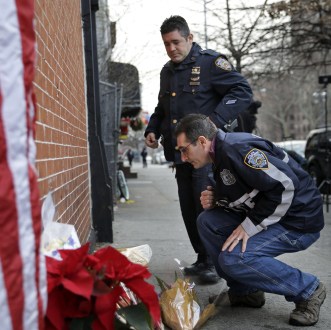
It’s difficult to put oneself in the shoes of a cop, but it seems clear that many partisans lack an appreciation for the intensity and danger of police work, which is fundamentally about protecting the public from threats to life and property. Confrontation is an unavoidable part of the job, whether it involves a domestic disturbance, drunk and disorderly conduct, property crime, or a shooting. Situations are adversarial and officers often face significant mortal risk. These are very brave people.

It would be impossible to do a cop’s job without legal authorization and occasional use force, but it can be very hard to judge when that’s necessary. A cop’s beat can feel like a war zone. There’s not much time to think. Things happen fast. Bad things happen really fast. Calm is restored in the best of circumstances, but arrests may be necessary, and sometimes a situation escalates or is already so fraught that it ends in tragedy. Sound procedures help police do their jobs better, but outcomes are capricious, and it is all too easy to make harsh judgements about split-second decisions in hindsight. Like any other accused, when a police matter ends badly, the cop is entitled to due process. Depending on circumstances and evidence, that means cops deserve a fair margin of error in the conduct of their duties.

To take a recent example, the police shooting of Rayshard Brooks in Atlanta occurred after Brooks wrestled with officers when they attempted to put him in handcuffs. Brooks broke free and snatched one of their tasers. As he ran, an officer pursued him at fairly close range. Brooks turned and fired the taser at the officer, shooting too high as it turned out. But the officer returned fire within an instant, three shots, striking Brooks in the back twice. Was that justified or reckless? The videos shown on the networks are in slow motion, but decisions like that can’t be made in slow-mo. The taser might have struck and disabled the officer, or in rare circumstances even killed him. And some tasers fire more than once; if one or both officers were disabled, their guns were potentially up for grabs. Either way, the use of his firearm seems to have been within Georgia law and Atlanta Police Department guidelines. No one should pretend there was time for careful deliberation. However, none of that dissuaded the Fulton County DA from filing immediate murder charges in a politically charged atmosphere. That’s hardly due process.

Of course there are bad cops and racist cops, but they comprise a distinct minority. Certain reforms might help to keep them from abusing their power, get them off the force, or convict them, depending on the nature of the offense. Qualified immunity gives excessive cover to bad cops and has protected far too many from prosecution. It’s regrettable that Senate Republicans have refused to consider modifications to qualified immunity, but perhaps they are holding it back as a negotiating ploy. Monitoring the conduct of officers is obviously important, and anonymous peer review within departments would be an excellent mechanism for identifying problem officers. Some reform proposals would certainly reduce the likelihood that police actions will be unjust, regardless of individual attitudes: ending no-knock raids and decriminalizing drugs would be major steps forward on that front.

The brutal murder of George Floyd has brought much more radical calls for changes in policing — even defunding or dismantling entire departments. These are based on widespread assertions that police are biased against blacks and that unjust police violence is directed at blacks. There is conflicting evidence on that point, however. Harvard Professor Roland Fryer concludes that while there is no evidence of racial bias in the use of lethal force by police, there is some evidence of bias in the use of non-lethal force. Other facts make the latter conclusion seem dubious, however. Consider the patterns of criminal activity described at the last link by Barry Latzer, CUNY Professor of Criminal Justice:

The latest police data collected by the FBI indicates that blacks comprised 58 percent of all murder arrests and 40 percent of those apprehended for all violent crimes. This disproportional involvement of African Americans in violent crime turns out to be the most significant factor of all in explaining the use of force against blacks by police.

It will be no surprise that violent criminals in the United States are commonly armed and dangerous. For assaults, for instance, 71 percent of arrested persons carried firearms. Among suspected murderers, 58 percent had guns, as did 42 percent of apprehended robbery suspects. This tally doesn’t include the knives or blunt instruments recovered from violent offenders, including over 48,000 cutting instruments possessed by those arrested for assault alone.”

Latzer cites a number of studies of lethal force by police. One of these studies found:

… after controlling for numerous factors, that blacks were 27.4 percent less likely than non-Hispanic whites to be fatally shot by police.”

Other researchers have noted:

… the absence of any correlation between the race of the officer and that of the victim. That is, after controlling for other factors, white police officers were no more likely than black officers to fatally shoot black civilians. In fact, the more black officers on a police force, the more African Americans were fatally shot.” 

Another finding by the same study:

[O]fficer race, sex, or experience did not predict the race of a person fatally shot beyond relationships explained by county demographics. On the other hand, race-specific violent crime strongly predicted the race of a civilian fatally shot by police, explaining over 40% of the variance in civilian race. These results bolster claims to take into account violent crime rates when examining fatal police shootings.”

The most tragic aspect of all this is that the vast majority of black crime victims are victimized by other blacks. Here are 2018 statistics for homicides. While blacks account for about 13.5% of the U.S. population, black offenders accounted for nearly 45% of homicides in 2018, and black-on-black homicide accounted for nearly 40% of all homicides.

Crime in the black community, and its economic costs, are inflicted almost exclusively on other blacks. If there was ever a need for good policing, this is it. The reasons for disproportionate crime and violence in the black community are complex. The notion that there is “systemic racism” at play here might be correct, but again, the evidence suggests it is not the fault of police. The welfare state plays a major role, as Walter Williams has long asserted. There are many more children living without fathers in the black community, a product of misdirected social policy that awards greater benefits to single-parents households. High rates of male incarceration obviously compound this problem. Blame can also be ascribed to a dysfunctional system of public education, and our nation’s continuing insistent on prosecuting the War on Drugs is highly destructive.

The campaign against police is promoted by a number of leftist organizations, the most prominent of which are Black Lives Matter and Antifa. Other well-meaning leftists do not question the rhetoric of police racism, and they also tend to fall for the illusion of collectivist virtue. Don’t accept this bullshit! It won’t help blacks as a class. We’ve known for some time that BLM is a Marxist organization, as is AntifaLawrence Person quotes BLM co-founder Patrice Cullors: “We are trained Marxists.”

According to Alexandra Phillips:

BLM happily self-identifies as a neo-Marxist movement with various far left objectives, including defunding the police (an evolution of the [Black] Panther position of public open-carry to control the police), to dismantling capitalism and the patriarchal system, disrupting the Western-prescribed nuclear family structure, seeking reparations from slavery to redistribute wealth and via various offshoot appeals, to raise money to bail black prisoners awaiting trial. The notion of seizing control of the apportionment of capital, dismantling the frameworks of society and neutralising and undermining law enforcement are not just Marxist, but anarchic.”

Identity politics provides a rich trove of grievance, guilt projection, and intimidation. But it won’t end there. They will use any and all means to subvert civil society in order to gain power, and there will be a high cost in terms of freedom, lives and human well being. These people are ruthless morons. One doesn’t have to look far to learn that the histories of Marxist revolution and attempts at governance are uniform in their failure and bloody mayhem.

Too many “nice people”, media, businesses, and other institutions are all too willing to accept BLM and Antifa propaganda unquestioningly, including their stupefying lies about disproportionate police violence against blacks. Yes, there are black victims of police brutality, and there are many white victims as well — criminal justice and police reform is not to be dismissed. Unfortunately, there is a large disproportion of violent crime committed by blacks against blacks. Many in the black community know all too well that good policing is desperately needed. Quite simply: no cops, no peace, no justice.

Zero Cost Stimulus: Risky Business

Tags

, , , , , ,

When the federal government intervenes to stimulate the economy, it generally means a big spending program or tax reduction and an increase in the federal deficit. This year we’ve witnessed the largest single-year fiscal policy effort in U.S. history, an effort to aid individuals whose jobs were lost and to stimulate the suddenly depressed economy. The coronavirus lockdowns in most states brought federal legislation enhancing unemployment compensation, one-time support payments to most adults, emergency business “loans” that are largely to be forgiven, and many other elements. The cost of these packages is expected to be about $2.4 trillion. And there will be more legislation this summer intended to stimulate hiring, including a probable infrastructure bill. President Trump still supports what the Administration calls a “hiring subsidy”, which is in fact a payroll tax holiday. As described, it would not explicitly target new hires, but would grant the holiday to all workers regardless of employment status. All these programs will ultimately be quite costly to taxpayers.

But what if there is a way to stimulate hiring without adding a dime to the federal deficit? (And I’m not talking about monetary policy, which inflicts costs of its own.) One inventive idea would create hiring incentives on a contingent basis, but with the beautiful feature that the program itself eliminates the contingency. Alex Tabarrok recently devoted a post to this idea, for which credit goes to Robertas Zubrickas. Here’s how it works, in Zubrickas’ words:

… we propose a policy that offers firms wage subsidies for new hires payable only if the total number of new hires made in the economy does not exceed a prespecified threshold. An example would be a promise to cover all new labor costs contingent on that less than, say, 100,000 new jobs are created in total. From a firm’s perspective two outcomes can occur from this policy. One outcome is when the number of new jobs is less than the threshold, in which case the firm has its additional labor costs covered while keeping all the additional revenue. The second outcome is when the threshold is met and no subsidies are paid.”

If enough firms hire in order to reap the subsidies, then aggregate hiring exceeds the threshold and no wage subsidies are paid, but the additional employment boosts demand sufficiently to justify the hiring. Fiscal stimulus without any budget impact! Incredible, right?

There are problems, of course. The simple program described would carry big risks for many businesses. Just because aggregate hiring exceeds the threshold doesn’t mean demand for your firm’s offerings will increase. To take an obvious example, can a rural employer count on an increase in demand? The program could be designed to hinge on different regional hiring thresholds, or different industry hiring thresholds, but that quickly gets complicated.

Moreover, firms will have an incentive to free ride on other businesses who hire up-front. The timing of cash flows would also be critical. Are the subsidies to be paid upon proof of hiring, with repayment later if the aggregate hiring threshold is reached? If not, I suspect many employers would rather scramble to hire workers upon the realization of any increase in demand as might occur, but unwilling to risk hiring given the possibility that the subsidy will be lost and that their own sales will remain weak. That might be especially true for small firms. And if the subsidy is paid up front, good luck getting it back on behalf of taxpayers! So there are substantial fiscal risks, whether or not the aggregate hiring threshold is met. But perhaps those risks could be minimized with some limited tests of such a program.

Finally, this sort of plan would be much less likely to succeed with repetition. Then again, a one-time contingent hiring subsidy might be well suited to the so-called “low-employment equilibrium” that many believe we face today. The contingent subsidy is certainly a market distortion, but one hopes it would be a temporary distortion.

Zubrickas’ contingent wage subsidies are fascinating. The pandemic and the social distancing imperative have increased the cost of doing business, and the infection risk perceived by consumers is a potential drag on demand. Wage subsidies would reduce hiring costs, but if enough firms hire, those costs would be restored while demand would be stronger. But additional sales might not materialize for your firm! Designing a program of this type so as to minimize the risks faced by individual firms and taxpayers is tough, but it is an idea worth exploring in more detail. In concept, it’s certainly preferable to fiscal programs that carry huge costs and usually end in permanently larger government.        


Coronavirus Framing #7: Second Wave Uncertainty

Tags

, , , , , , , , , , , , , , , , , , ,

We’re now said to be on the cusp of a “second wave” of coronavirus infections. It’s become a new focus of media attention in the past week or so. Increased infections have been reported across a number of states, especially in the south, but I’m not especially alarmed at this point for reasons explained below. Either way, the public policy response will certainly be different this time, at least in most areas. We’ve learned that a more targeted approach to managing coronavirus risk is far less costly, which means eschewing general lockdowns in favor of focusing resources on protecting the most vulnerable. That approach is supported by research weighing the costs and benefits of the alternatives (also see here and here).

The targeted approach I’ve advocated does not call for any less caution on the part of individuals. That means avoiding prolonged, close contact with others, especially indoors. I don’t mind wearing a mask when inside stores or public buildings, but I believe it should be voluntary. I do my best to stay out of close proximity to most others in public places anyway, masked or otherwise. This is voluntary social distancing. I also believe public health authorities should be more active in disseminating information on known correlates of coronavirus severity, such as Vitamin D deficiency, high LDL cholesterol, and the “reverse seasonal effect” caused by low humidity in air-conditioned spaces. I would also strongly agree that the effort to identify and mass produce vaccine candidates, known as Operation Warp Speed, should be ramped up considerably, with heavier funding and more than five vaccine candidates.

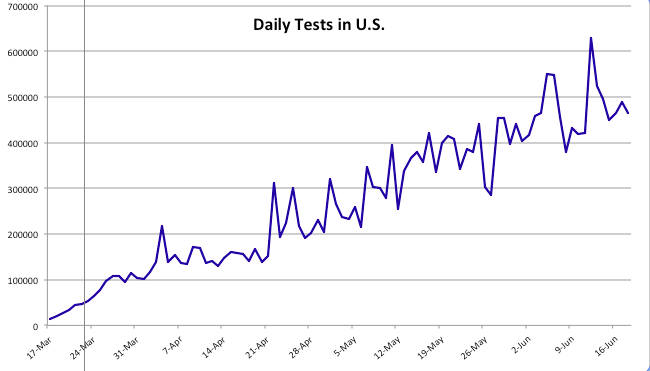
We’ve seen a continuing increase in coronavirus testing since my last “framing” post about a month ago. Testing has increased to a daily average of almost 500,000 over the past two weeks. At present we appear to have an excess supply of testing capacity in many areas, as Rich Lowry notes:

The problem with testing nationally is becoming less a shortfall of availability of the tests and more a shortfall of people showing up to get tested. An insider in the diagnostics industry says that laboratories are reporting that they are ‘sample starved’ — i.e., they aren’t getting enough specimens. He notes, ‘We have all seen stories about sample-collection sites in some regions not seeing that many patients.’

An HHS official says that in May there was the capacity to do twice as many tests as were actually performed, calling it a function of ‘allocation and efficiency, but more just demand.’ Says Giroir, ‘We really see areas in the country now that there’s more tests available than people who want to get tested or the need for testing.'”

Before turning to some charts, a word about the data in the charts I’ve been using throughout the pandemic. Some of the nationwide information was directly from the CDC or the Johns Hopkins dashboard. In other cases, I’ve reported state level data and some nationwide data published by The COVID Tracking Project (CTP) and the COVID Time Series (CTS) dashboard, which uses state data from CTP. I first noticed a few discrepancies in the national totals in April, which have become larger with growth in the counts of cases and deaths. Here is a key part of CTP’s explanation:

For many states, the CDC publishes higher testing numbers than the states themselves report, which raises questions about the structure and integrity of both state and federal data reporting. … Another point of contrast between the CDC’s new reporting and the official state data compiled by The COVID Tracking Project is that the CDC has not released historical, state-level testing data for the first three months of the outbreak.”

Thus, the CDC currently reports almost 120,000 U.S. deaths, while CTP reports about 112,000. Nevertheless, I will continue to report numbers from both sources for the sake of continuity, and I will try to remember to note the source in each case.

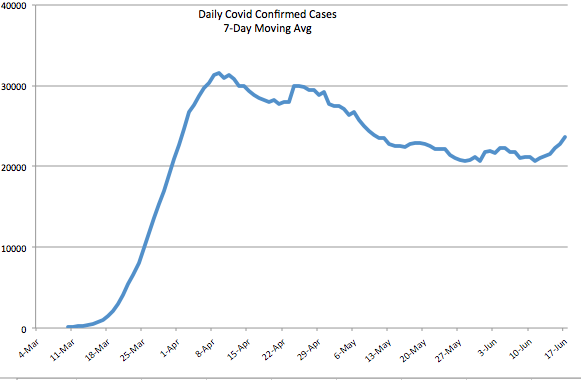
The first chart below shows the number of daily tests from CTP; the second chart shows the number of daily confirmed cases (CTP). Since mid-May, daily testing has increased by more than 50%, calculated on a moving average basis, and is now approaching half a million per day or more than 3 million per week. Pooled testing is coming, which will ultimately increase testing capacity several-fold. Daily confirmed cases have been hovered just above 20,000 since around Memorial Day, with a recent turn upward to around 24,000.

Early in the pandemic, I made the mistake of focusing too heavily on case numbers. Yes, I adjusted for population size and was aware that the initial shortage of tests was restraining diagnoses. Still, I did not foresee the great expansion in testing we’ve witnessed, the great transmissibility of the virus in some regions, nor the large number of asymptomatic cases that would ultimately be diagnosed.

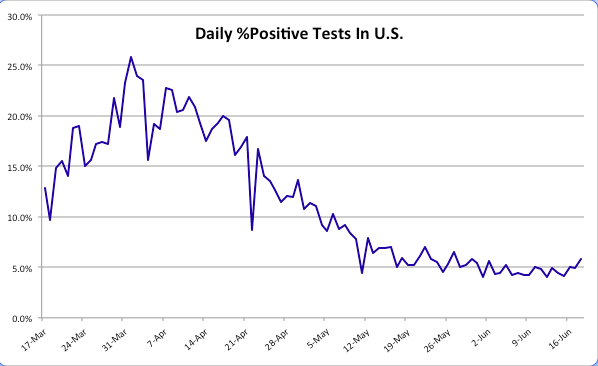
The daily percentage of positive tests (CTP), which is smoothed in the chart below using a seven-day moving average to eliminate within-week variability, has declined gradually since early April to about 4% before the uptick in the last few days. Still, that’s a drop of about 75% from the peak when tests were in very short supply. Those were days when even heavily symptomatic individuals were having trouble getting tested.

We’d hope to see a resumption in the decline of the positive percentage as testing continues to grow, but even with a relatively constant positivity rate, the number of daily confirmed cases must grow as testing expands. There may be several reasons the positivity rate has remained stubbornly near 5% over the past few weeks. One is the obvious reversal in social distancing as states have opened up. People became less fearful about the virus in general, and protesters jammed the streets after the George Floyd murder in Minneapolis. Another reason is that there are new areas of focus for testing that might be picking up cases. For example, hospitals in some states are now testing all admissions for COVID-19. This will tend to pick up more infections to the extent that individuals with co-morbidities are hospitalized at higher rates in general and are also more susceptible to the coronavirus. Finally, testing more broadly is likely to pick up a larger share of asymptomatic cases even as the “true rate” of infection declines.

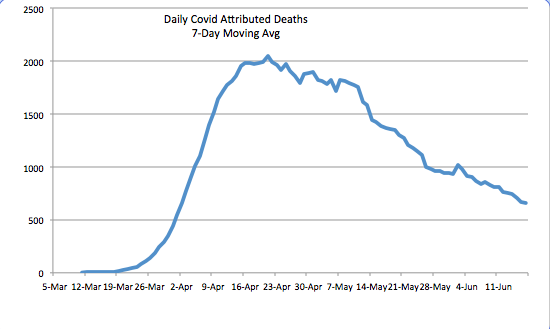
The daily death toll (CTP) attributed to coronavirus has continued to decline. See below. It is now running at about a third of the peak level it reached in mid-April. There are several reasons for the decline. One is the lower number of active cases, changes in which lead deaths by a few weeks. Awareness and testing capacity have undoubtedly led to earlier diagnosis of the most severe cases. There is also the strong possibility that the virus, having felled some of the most susceptible individuals, is now up against more hosts with effective immune responses. An ongoing degree of social distancing, more humid weather, and more direct sunlight have probably reduced initial viral loads from those experienced early-on, when the case load was escalating. Finally, treatment has improved in multiple ways, and there are now a few medications that have shown promise in shortening the duration and severity of infection.

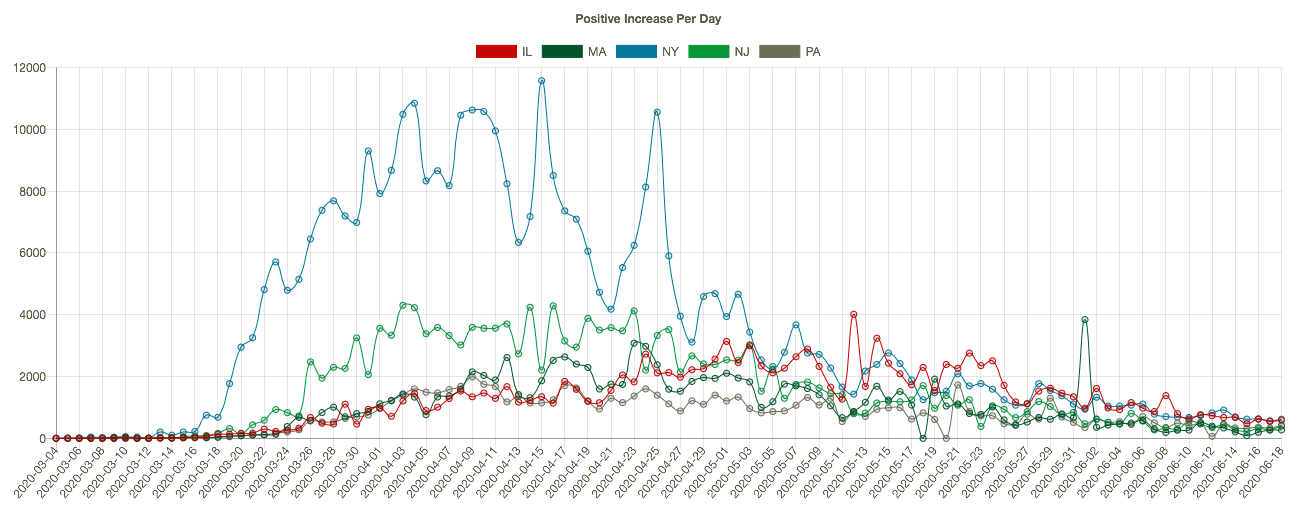
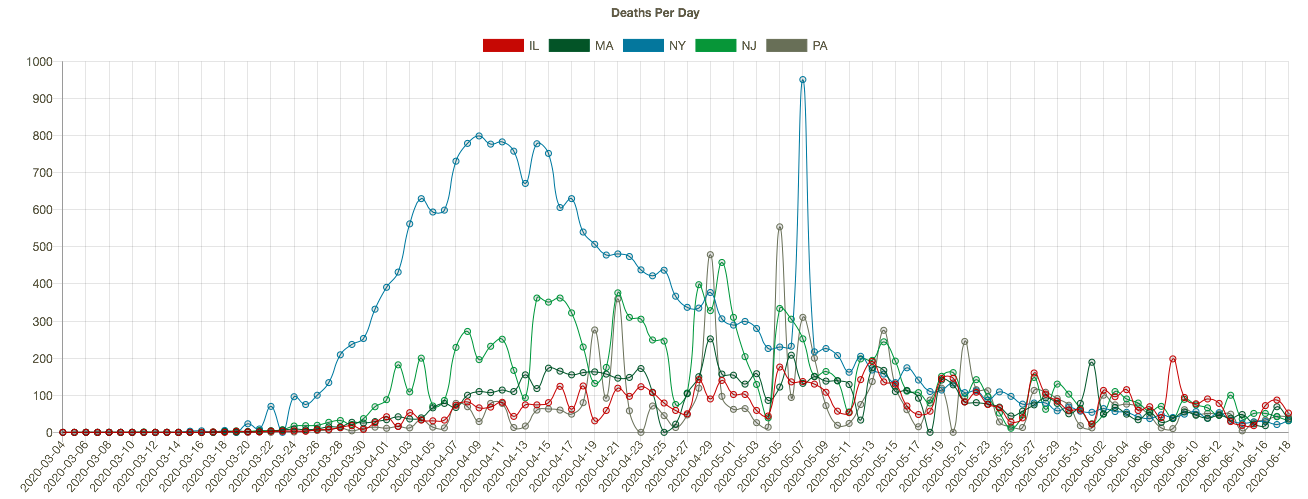
The course of the pandemic has varied greatly across countries and across regions of the U.S. The New York City area was especially hard hit along with several other large cities, as well as Louisiana. CTS shows that states with the highest cumulative number of coronavirus deaths (New York (blue line), New Jersey (green), Massachusetts, Illinois, and Pennsylvania in the charts below) have experienced downward trends in positive cases per day (the first chart below), leading daily deaths downward in May and early June (the second chart — NY’s downtrend began earlier). I apologize if the charts below are difficult to read, but they have resisted my efforts at resizing. Note: I’m mainly focused on trends here, and I have not shown these series on a per capita basis.

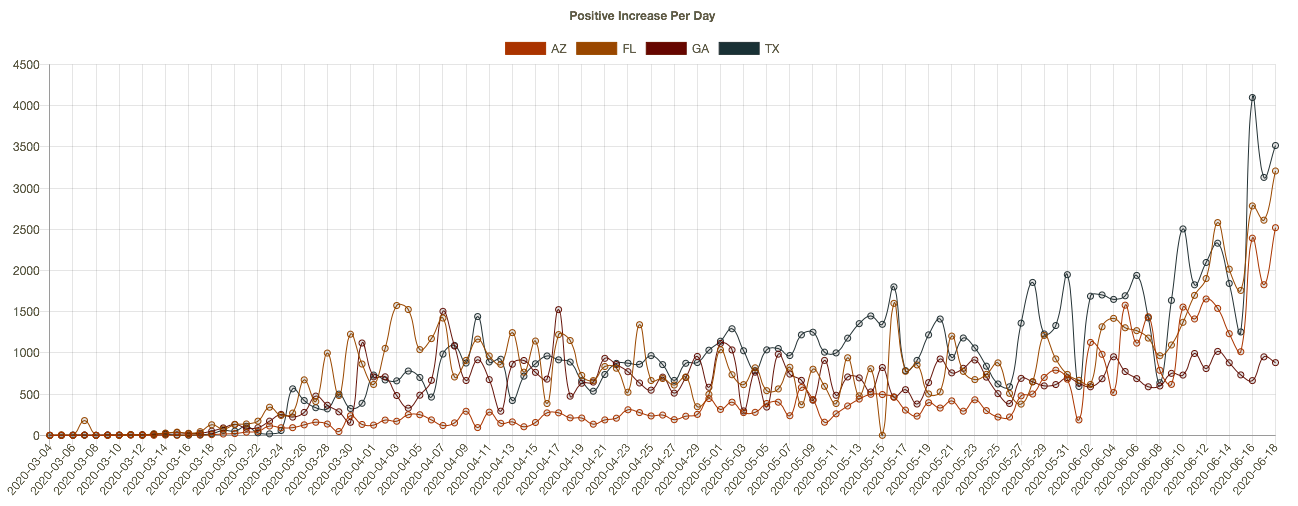
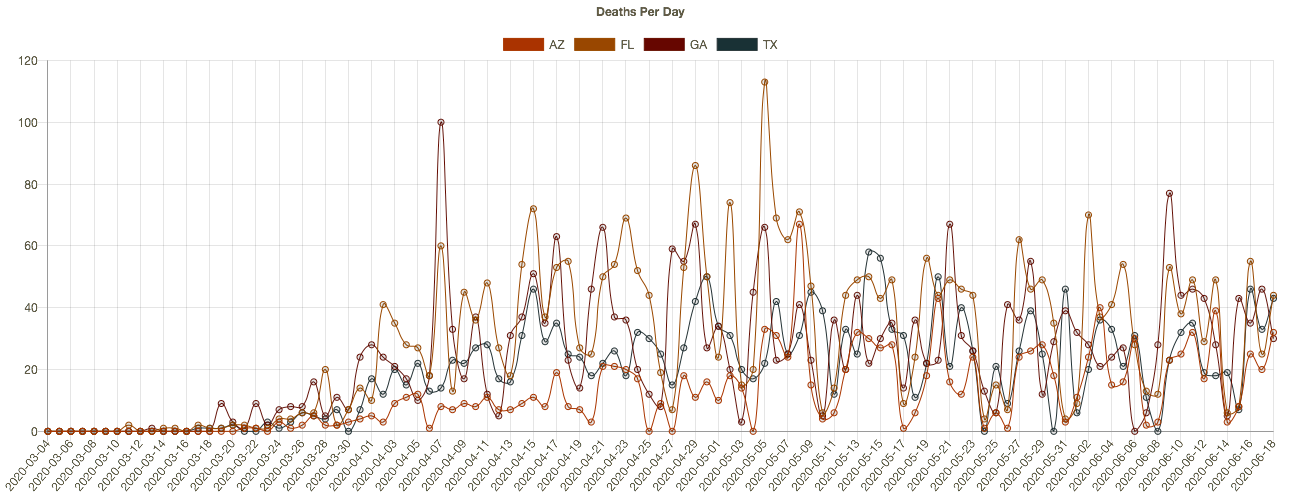
More recently, almost two dozen states have begun to see higher daily case diagnoses. Several of these had more favorable outcomes in the early months of the pandemic and were in more advanced stages of reopening. The charts below (CTS) show results for Arizona, Florida, Georgia, and Texas. The new “hot spots” in these states are mostly urban centers. It’s not clear that the reopenings are to blame, however. The protests after George Floyd’s murder may have contributed in cities like Houston, though no increase in New York is apparent as yet. The states in the chart are all in the south or southwest, so the increases have occurred despite sunny, warm conditions. It’s possible that hot weather has prompted more intensive use of air conditioning, which dries indoor environments and can promote the spread of the virus. These southern states have not yet experienced a corresponding increase in deaths, though that would occur with a lag. 

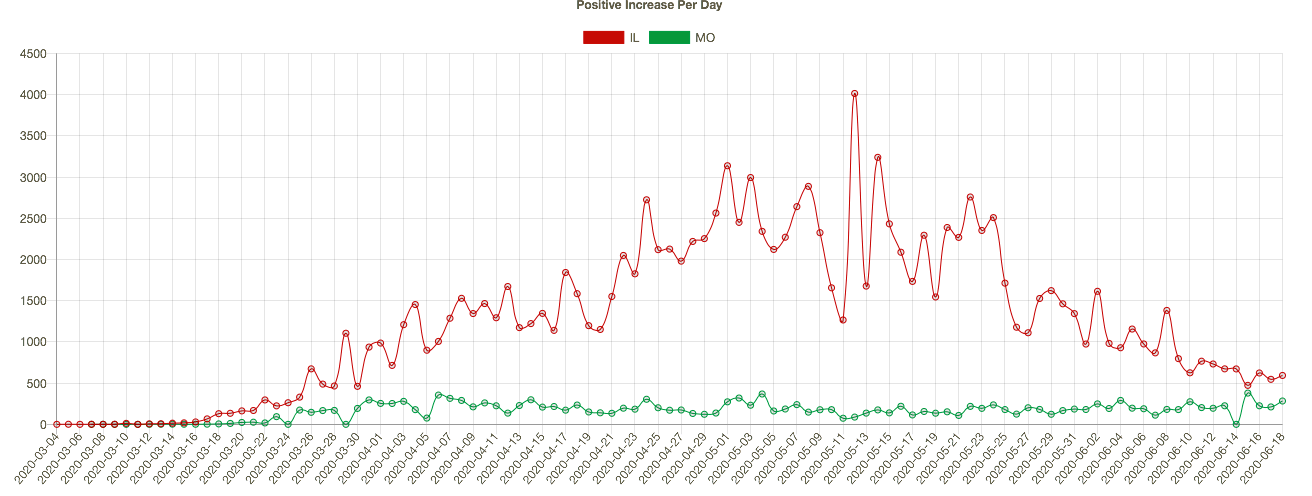
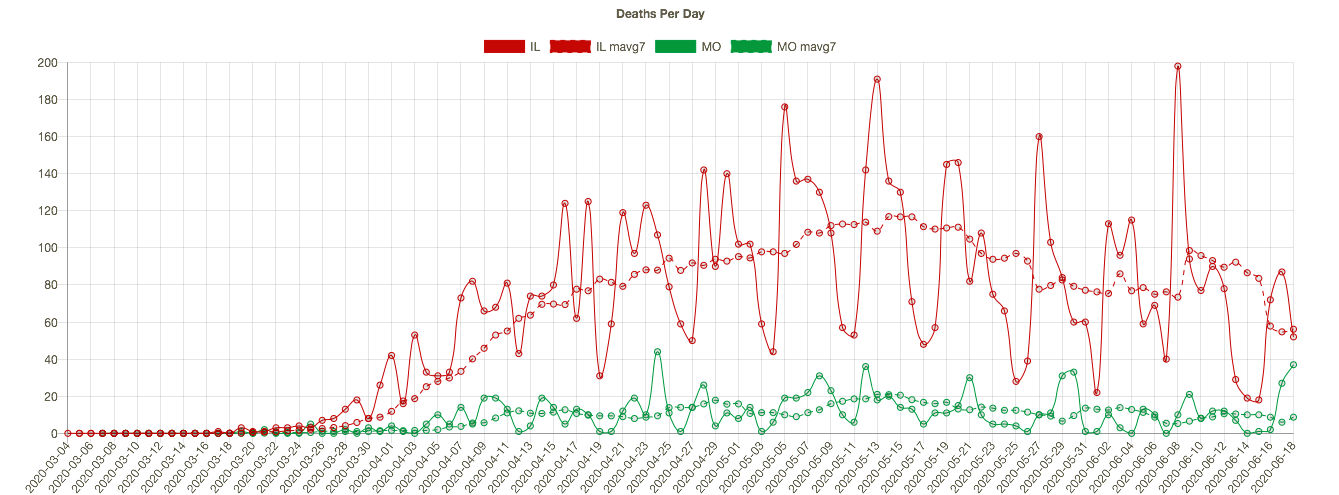
Missouri has seen an slow upward trend in its daily positive test count over the past four weeks, even though the state’s positive rate has trended down slowly since early May. I show MO’s confirmed cases per day below (in green) together with Illinois’ (because my hometown is on the border and the two states are a nice contrast). IL is much larger and has had a much higher case load, but the downward trend in new cases in IL is impressive. Coronavirus deaths per day are shown in the second chart below, with seven-day averages superimposed. Deaths have also trended down in both states, though MO has experienced a few bad days very recently, and MO’s case fatality rate is slightly higher than in IL.

We’ll know fairly soon whether we’re really headed for a second major wave. However, the case count, in and of itself, is not too informative. Testing has increased markedly, so we would expect to see more cases diagnosed. The percent of tests that are positive is a better indicator, and it has flattened at a still uncomfortable 5% for about a month, with a slight uptick in the past few days. Even more telling will be the future path of coronavirus deaths. My expectation is that more recent infections are likely to be less deadly, if only because of the lessons learned about protecting the care-bound elderly. I also believe we’re not too far from what I have called effective herd immunity

The pandemic has taken a heavy toll, especially among the aged. In fact, total deaths in the U.S. have now exceeded both the Hong Kong flu of the late 1960s and the Asian flu of the late 1950s. Unfortunately, risks will remain elevated for some time. However, any reasonable estimate of the life-years lost is considerably less than in those earlier pandemics due to the differing age profiles of the victims. In any case, the coronavirus pandemic has not been the kind of apocalyptic event that was originally feared and erroneously predicted by several prominent epidemiological models. It can be tackled effectively and at much lower cost by focusing resources on protecting vulnerable segments of the population. 

.

Diversity of Thought Matters

Tags

, , , , , , , , , , , , ,

Here’s an extraordinary letter written last week by a UC-Berkeley history professor to his colleagues. I link to a reprint on ZeroHedge because it was easier to read on my phone than the original source. The letter is anonymous, but it’s authenticity has been verified by well-known colleagues of the author outside the UC system, including Thomas Sowell of Stanford. In the first instance, it is a reaction to recent departmental and university communications, but the issues are much broader. The author, a self-described person of color, is embittered by the tyranny of groupthink that has characterized the reaction to George Floyd’s murder, the “soft bigotry of low expectations’ for blacks, and the virtual beatification of a man with a long and brutal rap sheet. The letter is an ominous warning that basic freedoms are at risk, not to mention intellectual integrity. Here are some salient points from the letter:

  • I could not find a single instance of substantial counter-argument or alternative narrative to explain the under-representation of black individuals in academia or their over-representation in the criminal justice system. The explanation provided in your documentation, to the near exclusion of all others, is univariate: the problems of the black community are caused by whites, or, when whites are not physically present, by the infiltration of white supremacy and white systemic racism into American brains, souls, and institutions.
  • The claim that the difficulties that the black community faces are entirely causally explained by exogenous factors in the form of white systemic racism, white supremacy, and other forms of white discrimination remains a problematic hypothesis that should be vigorously challenged by historians. Instead, it is being treated as an axiomatic and actionable truth without serious consideration of its profound flaws, or its worrying implication of total black impotence.
  • “… consider the proportion of black incarcerated Americans. This proportion is often used to characterize the criminal justice system as anti-black. However, if we use the precise same methodology, we would have to conclude that the criminal justice system is even more anti-male than it is anti-black. … Would we characterize criminal justice as a systemically misandrist conspiracy against innocent American men? I hope you see that this type of reasoning is flawed, and requires a significant suspension of our rational faculties. Black people are not incarcerated at higher rates than their involvement in violent crime would predict. This fact has been demonstrated multiple times across multiple jurisdictions in multiple countries.
  • I personally don’t dare speak out against the BLM narrative, and with this barrage of alleged unity being mass-produced by the administration, tenured professoriat, the UC administration, corporate America, and the media, the punishment for dissent is a clear danger at a time of widespread economic vulnerability. I am certain that if my name were attached to this email, I would lose my job and all future jobs, even though I believe in and can justify every word I type.
  • The vast majority of violence visited on the black community is committed by black people. There are virtually no marches for these invisible victims, no public silences, no heartfelt letters from the UC regents, deans, and departmental heads. The message is clear: Black lives only matter when whites take them. Black violence is expected and insoluble, while white violence requires explanation and demands solution. Please look into your hearts and see how monstrously bigoted this formulation truly is. … No discussion is permitted for nonblack victims of black violence, who proportionally outnumber black victims of nonblack violence.
  • “… our department appears to have been entirely captured by the interests of the Democratic National Convention, and the Democratic Party more broadly. To explain what I mean, consider what happens if you choose to donate to Black Lives Matter, an organization UCB History has explicitly promoted in its recent mailers. All donations to the official BLM website are immediately redirected to ActBlue Charities, an organization primarily concerned with bankrolling election campaigns for Democrat candidates. Donating to BLM today is to indirectly donate to Joe Biden’s 2020 campaign.
  • our university and department has made multiple statements celebrating and eulogizing George Floyd. Floyd was a multiple felon who once held a pregnant black woman at gunpoint. He broke into her home with a gang of men and pointed a gun at her pregnant stomach. He terrorized the women in his community. He sired and abandoned multiple children, playing no part in their support or upbringing, failing one of the most basic tests of decency for a human being. He was a drug-addict and sometime drug-dealer, a swindler who preyed upon his honest and hard-working neighbors. … And yet, the regents of UC and the historians of the UCB History department are celebrating this violent criminal, elevating his name to virtual sainthood. A man who hurt women. A man who hurt black women. With the full collaboration of the UCB history department, corporate America, most mainstream media outlets, and some of the wealthiest and most privileged opinion-shaping elites of the USA, he has become a culture hero, buried in a golden casket, his (recognized) family showered with gifts and praise. Americans are being socially pressured into kneeling for this violent, abusive misogynist. A generation of black men are being coerced into identifying with George Floyd, the absolute worst specimen of our race and species.”
  • My family have been personally victimized by men like Floyd. We are aware of the condescending depredations of the Democrat party against our race. The humiliating assumption that we are too stupid to do STEM, that we need special help and lower requirements to get ahead in life, is richly familiar to us. … The ever-present soft bigotry of low expectations and the permanent claim that the solutions to the plight of my people rest exclusively on the goodwill of whites rather than on our own hard work is psychologically devastating. No other group in America is systematically demoralized in this way by its alleged allies. A whole generation of black children are being taught that only by begging and weeping and screaming will they get handouts from guilt-ridden whites.

There is much more in the letter. Some will dismiss the letter based on the author’s decision to remain anonymous, but one can hardly find fault with that in today’s suffocating intellectual environment. There are many others who remain silent because they either fear the consequences, distain the questions, or wish to be polite. My only other reservation about the letter is the author’s failure to acknowledge George Floyd’s efforts to reform, which were obviously in vain. Those efforts and his murder should not elevate Floyd to an heroic status. Nevertheless, his victimhood qualifies him as a legitimate symbol of police brutality, if not racism.

While much of academia has been swallowed whole by vapid identitarianism and scientism over science and rational thought, the history professor has managed to survive in what might be the hottest bed of leftist extremism in the country at UC-Berkeley. I hope the professor has a long and influential career.

Hypocrisy and the False Presumption of Expertise

Between self-righteous insistence on lockdowns and wholeheartedly jumping into throngs of protestors in the streets, it’s as if the “woke” crowd is eager to flaunt its hypocrisy. However, a greater disgrace belongs to public health experts who have compromised and politicized their advice since the George Floyd murder in Minneapolis more than two weeks ago. Their apparent compulsion to virtue signal has overwhelmed their mindfulness as objective scientists.

Here is Tyler Cowen on the preposterous messaging from some of these experts. I’m fairly certain the quote in the first paragraph is from the esteemed Carl T. Bergstrom:

I am not looking to attack or make trouble for any individual person here, so no link or name, but this is from a leading figure in biology and also a regular commenter on epidemiology: ‘As a citizen, I wholeheartedly support the protests nonetheless.’

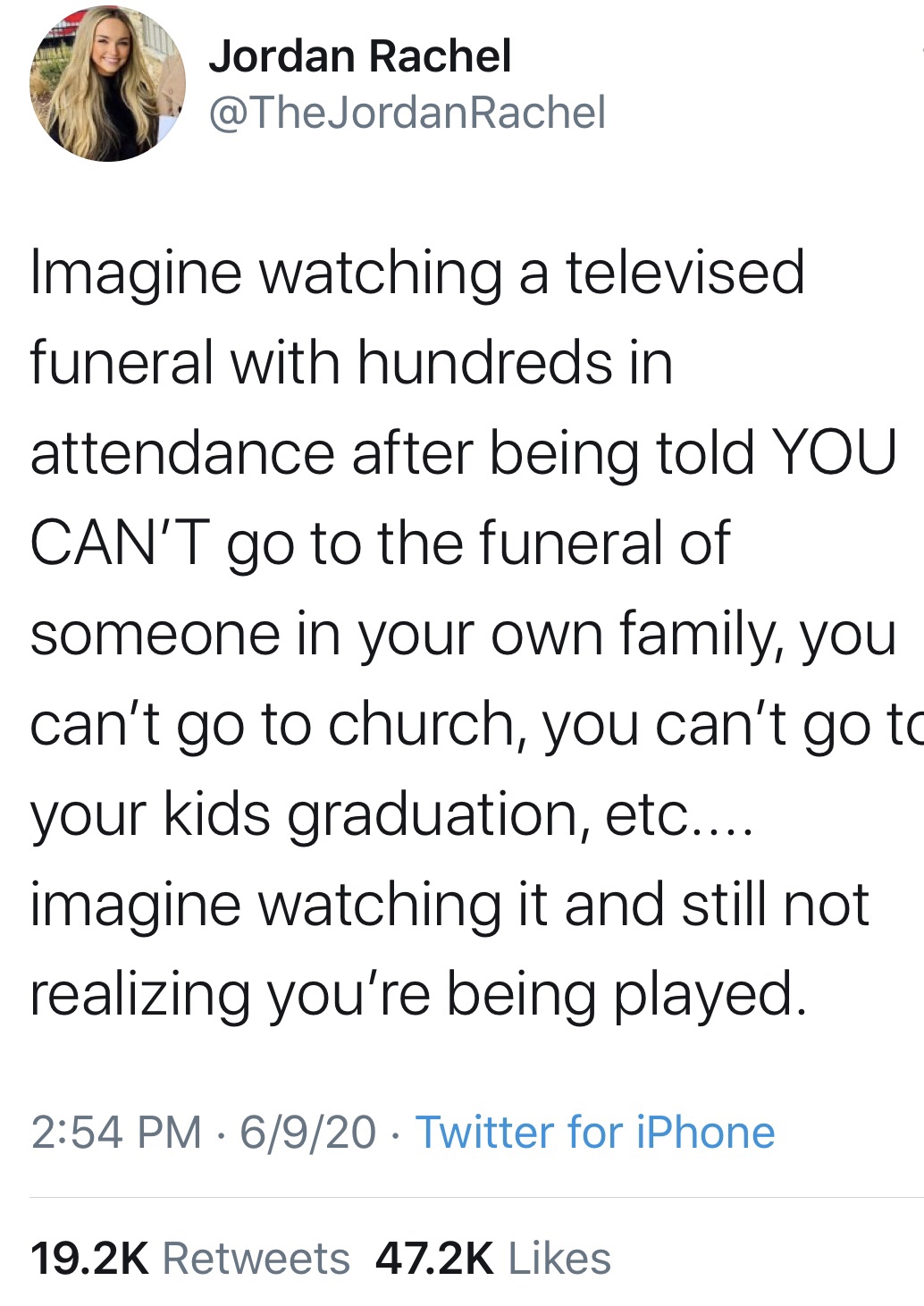
My worries run deep. Should the original lockdown recommendations have been asterisked with a ‘this is my lesser, non-citizen self speaking’ disclaimer? Should those who broke the earlier lockdowns, to save their jobs or visit their relatives, or go to their churches, or they wanted to see their dying grandma but couldn’t…have been able to cite their role as ‘citizens’ as good reason for opposing the recommendations of the ‘scientists’? Does the author have much scientific expertise in how likely these protests are to prove successful? Does typing the word ‘c-i-t-i-z-e-n’ relieve one of the burden of estimating how much public health credibility will be lost if/when we are told that another lockdown is needed to forestall a really quite possible second wave? Does the author have a deep understanding of the actual literature on the ‘science/citizen’ distinction, value freedom in science, the normative role of the advisor, and so on? Does the implicit portrait painted by that tweet imply a radically desiccated, and indeed segregated role of the notions of ‘scientist’ and ‘citizen’? Would you trust a scientist like that for advice? Should you? And shouldn’t he endorse the protests ‘2/3 heartedly’ or so, rather than ‘wholeheartedly’? Isn’t that the mood affiliation talking?

On May 20th, the same source called a Trump plan for rapid reopening (churches too, and much more) ‘extraordinarily dangerous’ — was that the scientist or the citizen talking? And were we told which at the time? Andreas’s comments at that above link are exactly on the mark, especially the point that the fragile consensus for the acceptability of lockdown will be difficult to recreate ever again. ….

We really very drastically need to raise the quality and credibility of the advice given here.”

David Bernstein identifies the same charlatanism in the claims of health experts (e.g, the likes of Jennifer Nuzzo of Johns Hopkins), who insist that protests have value that outweighs the cost of any coronavirus infections they might cause:

The public health folks who are comparing the negative Covid-related health effects of the rallies to the health effects of racism and police violence are committing a fundamental methodological error. On the one side, there is a real public health problem of coronavirus, and we know, based on what the experts have been telling us since March, that large public gatherings will likely kill a large but indeterminate number of people.

On the other side, racism harms people’s well-being, and state violence directly harms their health. However, and this is key, no one has any idea what overall effect the protests (and any attendant violence) will have on racism and state violence, even whether it will be positive or negative.

When public health experts express implicit or explicit belief that political rallies and protests will lead to desirable social and political outcomes, they are not engaging in science, they are not relying on public health research, they are relying on something akin to faith.”

These experts have not made any effort of “model” the effects of racism on public health, to say nothing of the presumed effectiveness of protests in mitigating those effects. They are engaged in political advocacy. In fact, however, I quite agree that certain reforms to the criminal justice system will have long-term benefits to society, but all prior advice from these experts suggests the protests will have severe health costs. Cowen links to virologist Trevor Bedford’s tweets offering a range of estimates for the ultimate number of coronavirus deaths that will result from the protests: 200-1,100.  While acknowledging the tragic consequences of racism, Bedford notes that most of these extra deaths will be “disproportionately among black individuals”.

Moreover, the crazier ideas holding sway with some protesters (e.g., ban police, reparation payments), and the crazy actions taken by radical elements (arson, looting, murder) might well result in racial backlash. Worse yet, dismantling police departments or even reduced police budgets could reverse declines in violent crime we’ve witnessed over the past 20 years, with most of the cost falling squarely on impoverished black communities.

Some rightly ask why people have been denied their right to grieve and bury their own loved ones while throngs are permitted to attend George Floyd’s funeral, along with the protests on crowded streets:

Is it any surprise that democrats now claim Trump rallies would be coronavirus hazards, even after supporting the protesters who flocked to the streets? The Trump rallies might well lead to more infections. If the rallies take place, I’d be glad to see them kept outdoors with socially-distanced attendees wearing masks. But anyone defending the marches and protests of the past two weeks while condemning future Trump rallies on the grounds of coronavirus risk is engaging in rank hypocrisy. But that’s just one example: it’s just as outrageous to agitate for lockdowns that inflict the greatest harm on the poor, and cost lives in myriad ways, while carping about economic injustice.


Trump Hates/Loves Lockdowns, Dumps on Swedes

Tags

, , , , , , , , , ,

President Trump was in a festive mood last Friday, pleased with the May employment report, as he should be. But in his Rose Garden word jam, he made some questionable and unnecessary claims about coronavirus policies in the U.S. and the Swedish experience. I credit Trump for pushing to end the lockdowns as it became clear that they were both unhealthy and unsustainable. However, he’s now way too eager to cover his earlier tracks. That is, he is now defensive about the precautions he advocated on the advice of his medical experts in March and early April.

In the Rose Garden, Trump said that lockdowns were necessary to stop the spread of the virus. But to assert that lockdowns “stopped” or even slowed the spread of the virus is speculation at best, and they had deadly effects of their own. Most of the social distancing was achieved through voluntary action, as I have argued previously. Lockdown advocacy lacked any semblance of geographic nuance, as if uniform application makes sense regardless of population density.

Trump went on to say that Sweden was in “bad shape” because it did not impose a lockdown during the pandemic. This is not a new position for the president, but the facts are anything but clear-cut. Again, there is mixed evidence on whether mandatory lockdowns have a real impact on the spread or mortality of the coronavirus (also see here). That’s not to say that social distancing doesn’t work, but much of the benefit comes from private decisions to mitigate risk via distancing. Of course, that also depends on whether people have good information to act on. And to be fair, Sweden did take certain measures such as banning gatherings of more than 50 people, closing schools, and limiting incoming travel.

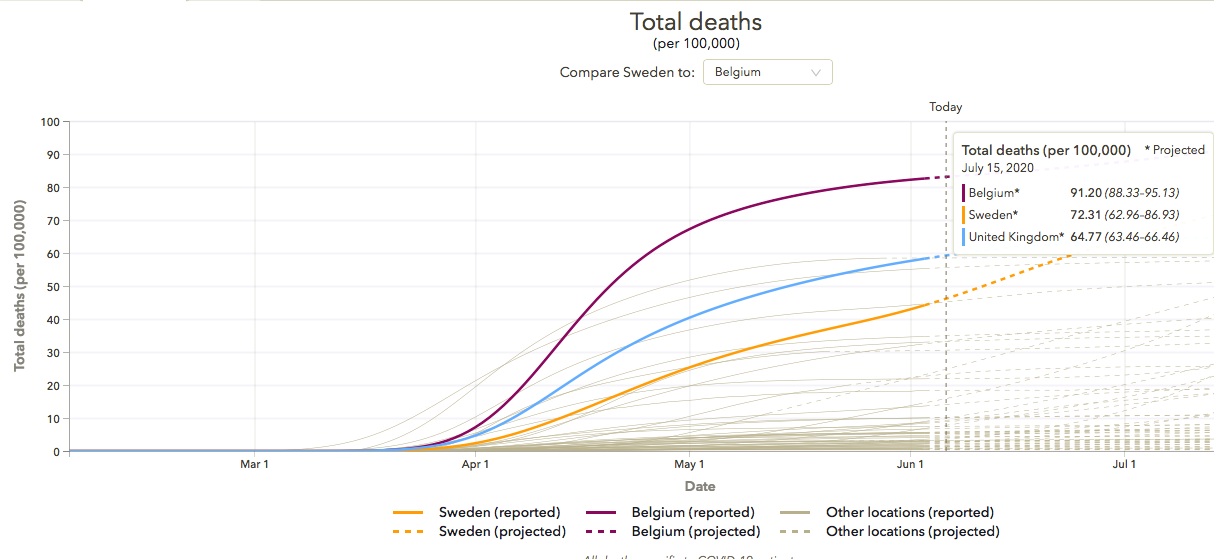
While the full tale has not been told, and Sweden’s death rate is high on a per capita basis, several other Western European countries that imposed lockdowns have had even higher death rates. The following chart is from the Institute for Health Metrics and Evaluation (IMHE). It is expressed in terms of coronavirus deaths per 100,000 of population. The orange line is Sweden, the purple line is Belgium, and the light blue line is the UK. Actuals are reported through June 4th. While Sweden’s death toll has a somewhat steeper gradient, the level remains well below both Belgium and the UK. It is also lower than the death rates for Italy and Spain, and it is about the same as France’s death rate. Yes, a number of other countries have lower death rates, including the U.S., but the evidence is hardly consistent with Trump’s characterization.

Sweden’s big mistake was not it’s decision to rely on voluntary social distancing, but in failing to adequately protect highly vulnerable populations. The country’s elderly skew older than most countries by several years. Residents of nursing homes have accounted for about half of Sweden’s coronavirus deaths, an international outlier. Inadequate preparedness in elder care has been a particular problem, including a lack of personal protective equipment for workers. There was also a poorly implemented volunteer program, intended to fill-out staffing needs, that appears to have aggravated transmission of the virus.

Sweden has also experienced a concentration of cases and deaths among its large immigrant population. It has the largest immigrant population among the Nordic countries, with large numbers of low income migrants from Syria, Iraq, Iran, Somalia and parts of Eastern Europe. Earlier in the pandemic, according to one estimate, 40% of coronavirus fatalities in Stockholm were in the Somali population. These immigrants tend to live in dense conditions, often in multigenerational households. Many residents with health problems tend to go untreated. Conditions like Vitamin D deficiency and high cholesterol, apparent risk factors for coronavirus severity, likely go untreated in these communities. In addition, language barriers and traditional trust relationships may diminish the effectiveness of communications from public health authorities. In fact, some say the style of Swedish public health messaging was too culturally idiosyncratic to be of much use to immigrants. And one more thing: immigrants are a disproportionately high 28% of nursing home staff in Sweden, implying an intimacy between two vulnerable populations that almost surely acts as a risk multiplier in both.

It might be too harsh to suggest that that Sweden could have prevented the outsized impact of the virus on immigrants. However, Sweden’s coronavirus testing has not been as intensive as other Nordic countries. More testing might have helped alleviate the spread of the virus in nursing homes and in immigrant communities. But the vulnerabilities of the immigrant population might be more a matter of inadequate health care than anything else, both on the demand and supply sides.

Contrary to Trump’s characterization, Sweden’s herd immunity strategy is not the reason for it’s relatively high death rate from the virus. Several countries that imposed lockdowns have had higher death rates. And Sweden’s death rate has been heavily concentrated among the aged in nursing homes and its large immigrant population. It’s possible that Sweden’s approach led to a cavalier attitude with respect identifying vulnerable groups and taking measures that could have protected them, including more intensive testing. Nevertheless, it’s inaccurate and unfair to scapegoat Sweden for not imposing a mandatory lockdown. The choice is not merely whether to impose lockdowns, but how to protect vulnerable populations at least cost. In that sense, general lockdowns are a poor choice.


Rioters Inflict Racial Injustice

Tags

, , , , , , , , , , , , , , , , ,

My fervent hope is that the reaction of horror to George Floyd’s murder is universal. However, my perspective on the violence that’s erupted over the week since is also one of disgust. The perpetrators are using Floyd’s death as an opportunity to unleash attacks that undermine civil society and often hurt people of color more than anyone.

The peaceful protests against police brutality and racism in cities across the country are earnest calls for reform, and they also represent fine tributes to all victims of racism. But a different dynamic takes hold when peaceful protesters are infiltrated by violent elements. Agitators use the cover of the protests and typically begin to dominate the scene as darkness falls, though sometimes it happens in broad daylight. The violence, arson, looting, and shooting are perpetrated by a combination of those whose political motivations go well beyond needed reforms to the justice system and other opportunists who are primarily interested in loot, or just a riotous a good time. There are also some otherwise non-violent protesters emboldened by the agitators to cheer on these acts of violence.

As others have said, the rioting does not serve to honor George Floyd in any way, and it does nothing to end racism or racial victimization. By cheering on these malefactors you lose any legitimate claim as an enemy of racism. The rioting, if anything, brings harm to the black community. Black lives are lost in the strife, such as the retired police captain in St. Louis who was shot Monday night defending his friend’s pawn shop. Blacks are also losing their livelihoods as a consequence of the destruction.

The left-wing, anarchist agitators are modern blackshirts masquerading as anti-fascists. Their interest, and delusion, is the violent overthrow of our government. They are largely white millennials, mostly male, and largely unemployed as a result of the ill-advised coronavirus lockdowns imposed in many states. Antifa has been prominent in these attacks, often running under Black Lives Matter flags, and the radical wing of BLM participates as well.

These pigs have been coddled by leftist state and local government officials in many cities, who send outmanned police forces to try to keep the damage in check while releasing those arrested the next day. President Trump was absolutely right on Monday to call out the national guard and raise the possibility of deploying military forces where state and local officials are incapable or unwilling to bring these situations under control.

And here’s the thing: all it takes is a few agitators, along with their enthusiastic but less ideological recruits, to destroy communities. There have been larger numbers in big cities, perhaps a few thousand hard-core shit disturbers. Slowly but surely, perhaps due to Trump’s prodding, state and local politicians are awakening and enabling law enforcement to effectively quell the unrest. The agitators, who are fairly well organized, are being infiltrated by moles who will undermine their operations and perhaps aid in prosecuting higher-level organizers and funders at the federal level. In the end, the force of anarchists is fairly small and the local support they manage to stir is fleeting.

While we recoil at the harm inflicted by the riots, another perspective is offered by the equity markets, which have been relatively unfazed through the turmoil. The values of firms in the security business have risen, but otherwise, as one investment strategist says:

‘Right now it’s limited enough that it’s not perceived as having a meaningful economic impact,’ said Willie Delwiche, investment strategist at Baird. ‘The risk to the market right now is excessive optimism,’ and headlines from protests could simply be dampening that optimism a bit, he added.”

The riots are destructive of lives and economic value, and while we mourn those caught up in these tragedies, the situation does not portend a total social collapse. The overall impact on the U.S. economy expected by markets is not of a magnitude suggesting great instability. This too shall pass, though not easily for the small businesses and employees being ruined by the double jolt of lockdowns and riots.

Besides the outright harm to the black community by the riots, there are other disturbing elements that must be confronted. I keep hearing “White silence = violence”. No, “white silence” is neither responsible for the actions of George Floyd’s killer nor the riots in the streets. What must one say to avoid personal responsibility for the aberrant behavior of Derrick Chauvin and the rioters? What I hear are ignorant excuses and accusations: the violence is inexcusable and it is no one’s fault but the participants, whatever their circumstances.

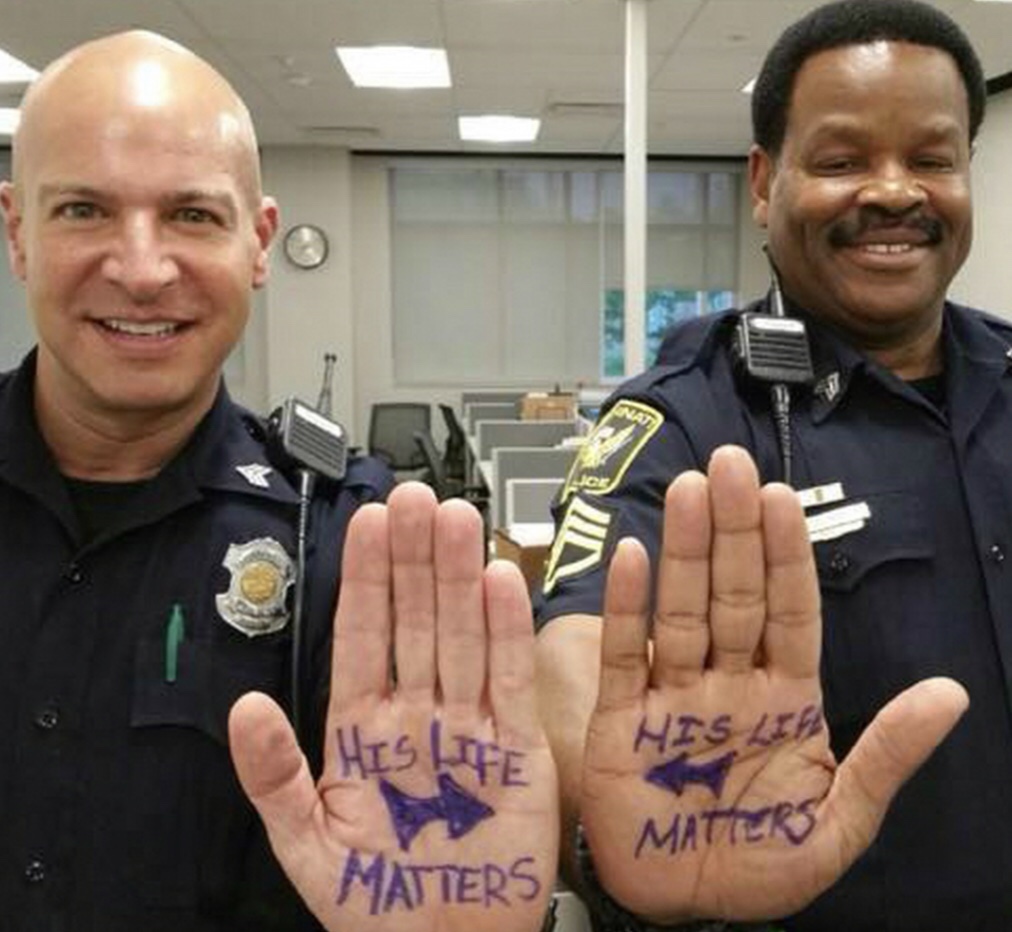
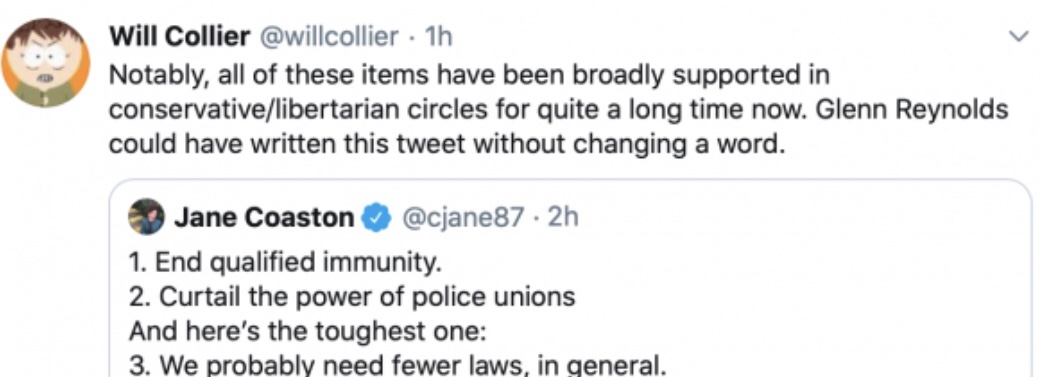
People of good faith oppose the brutality inflicted by bad cops and a system that tolerates them. It is surely time for some reforms, as the following suggests:

And there are still other promising criminal justice reforms to consider. We need to end the drug war, which is particularly harmful to minority communities.

I bemoan the poor circumstances and education that have burdened many of the disaffected protesters, and even the rioters. I advocate for policies that I believe promote improved education and family stability. I have advocated for a safety net. I have shared my distaste for the unnecessary COVID-19 lockdowns that forced so many of these individuals out of their jobs for several months. But from some quarters, the demands have no end. Not until I bow down on my hands and knees to apologize for the sins of generations past. Who cares if they weren’t my ancestors? I’m white! The next demand is reparation payments to today’s generations of blacks. Don’t complain that impoverished whites won’t share in the gains, though there are more than twice as many of them. They simply failed to capitalize on the opportunity afforded by their privilege. I’m sorry for the sarcasm….

Please mourn George Floyd’s horrible death and support the protests against the brutality that killed him, but do not pretend for a moment that the violence is in any way justified, or that it will create a healthier society. Don’t root for that shit. And don’t cast aspirations at your fellow men and women as if the color of their skin is responsible for the social ills you’ve taken up as a cause. It does nothing to further solutions.

Trump and Coronavirus

Tags

, , , , , , , , , , , , , , , , , , , , , , , , , , , , , , , , , , , , , , ,

It’s a bit early to fully evaluate President Trump’s performance in dealing with the coronavirus pandemic, but there are a number of criteria on which I might assign marks. I’ll address some of those below, but in so doing I’m reminded of Jerry Garcia’s quip that he was “shopping around for something no one will like.” That might be how this goes. Of course, many of the sub-topics are worthy of lengthier treatment. The focus here is on the pandemic and not more general aspects of his performance in office, though there is some unavoidable overlap.

General “Readiness”

Many have criticized the Trump Administration for not being “ready” for a pandemic. I assign no grade on that basis because absolutely no one was ready, at least not in the West, so there is no sound premise for judgement. I also view the very general charge that Trump did not provide “leadership” as code for either “I don’t like him”, or “he refused to impose more authoritarian measures”, like a full-scale nationwide lockdown. Such is the over-prescriptive instinct of the Left.

Equally misleading is the allegation that Trump had “disbanded” the White House pandemic response team, and I have addressed that here. First, while the NSC would play a coordinating role, pandemic response is supposed to be the CDC’s job, when it isn’t too busy with diseases of social injustice to get it done. Second, it was John Bolton who executed a reorganization at the NSC. There were two high profile departures from the team in question at the time, and one one was a resignation. Most of the team’s staff remained with the NSC with the same duties as before the reirganization.

Finally, there was the matter of a distracting impeachment on false charges. This effort lasted through the first three years of Trump’s administration, finally culminating in January 2020. Perhaps the Administration would have had more time to focus on what was happening in China without the histrionics from the opposition party. So whatever else I might say below, these factors weigh toward leniency in my appraisal of Trump’s handing of the virus.

Messaging: C

As usual, Trump’s messaging during the pandemic was often boorish and inarticulate. His appearances at coronavirus briefings were no exception, often cringeworthy and sometimes featuring misinterpretations of what his team of experts was saying. He was inconsistent in signaling optimism and pessimism, as were many others such as New York Governor Andrew Cuomo and New York City Mayor Bill De Blasio. It shifted from “the virus is about like the flu” in February to a more sober assessment by mid-March. This was, however, quite consistent with the messaging from Dr. Anthony Fauci over the same time frame, as well as the World Health Organization (WHO). Again, no one really knew what to expect, so it’s understandable. A great deal of that can be ascribed to “the fog of war”.

Delegation and Deference: B

Trump cannot be accused of ignoring expert advice through the episode. He was obviously on-board with Fauci, Dr. Deborah Birx, Dr. Robert Redfield, and other health care advisors on the “15 Days to Slow the Spread” guidelines issued on March 16. His messaging wavered during those 15 days, expressing a desire to fully reopen the nation by Easter, which Vice President Michael Pence later described as “aspirational”. Before the end of March, however, Trump went along with a 30-day extension of the guidelines. Finally, by mid-April, the White House released guidelines for “Opening Up America Again“, which was a collaboration between Trump’s health care experts and the economic team. Trump agreed that the timeline for reopening should be governed by “the data”. There is no question, however, that Trump was chomping at the bit for reopening at several stages of this process. I see value in that positioning, as it conveys an intent to reopen asap and that people should have confidence in progress toward that goal.  

International Travel Bans: A

If anyone wonders why the world was so thoroughly blindsided by the coronavirus, look no further than China’s failure to deliver a proper warning as 2019 drew to a close. Wuhan, China was ground zero; the virus spread to the rest of the world with travelers out of Wuhan and other Chinese cities. The White House announced severe restrictions on flights from China on January 31, including a two-week quarantine for returning U.S. citizens. In retrospect, it wasn’t a minute too soon, yet for that precaution, Trump was attacked as a racist by the Left. In early February, WHO actually said travel bans were unnecessary, among other missteps. Other bans were instituted on entry from Iran and Brazil, as well as entry from Europe in early March, as countries around the globe closed their borders. Trump’s actions on incoming travelers were prescient, so I’ll score this one for Trump. Some of these travel restrictions can and should be eased now, and certainly that is expected in coming months, so we’ll see how well that process is managed.

Deference to States: A-

As a federalist, I was pleased that Trump and his team left most of the specifics on closures and bans on public gatherings up to state and local governments. That allowed more targeted mitigation efforts as dictated by local conditions and, to some extent, public opinion. This is a classic case of “laboratory federalism” whereby the most effective policies can be identified, though as we’ve seen, there’s no guarantee less successful states will emulate them. I grade Trump well on this one.

On reopening, too, Trump has been a consistent advocate of allowing flexility where local conditions permit, though he wrongly claimed he had “total authority” over ending social distancing rules. It’s hard to square that remark with his general stand on the issue of autonomy except as a tactic to strong-arm certain governors on other points.   

CDC/FDA Snafus: D

I applaud the Administration for its emphasis on the salutary effects of deregulation, but Trump went along with some major pieces of “expert advice” that were not only poor from regulatory perspective, but an affront to federalism. One was a directive issued by the CDC to delay “all elective surgeries, non-essential medical, surgical, and dental procedures during the 2019 Novel Coronavirus (COVID-19) outbreak“. (See my post “Suspending Medical Care in the Name of Public Health“.)

This is exactly the kind of “one size fits all” regulatory policy that has proven so costly, sacrificing not just economic activity but lives and care for the sick, creating avoidable illnesses and complications. The idea was to assure that adequate health care resources were available to treat an onslaught of coronavirus patients, but that was unneeded in most jurisdictions. And while the contagion was in it’s early “exponential” phase at the time, a more nuanced approach could have been adopted to allow different geographic areas and facilities more discretion, especially for different kinds of patients, or perhaps something less than a complete suspension of care. In any case, the extensions into May were excessive. I must grade Trump poorly for allowing this to happen, despite what must have been extreme pressure to follow “expert advice” on the point and the others discussed earlier.

That’s not the only point on which I blame Trump for caving to the CDC. In a case of massive regulatory failure, the CDC and FDA put the U.S. well over a month behind on testing when the first signs of the virus appeared here. Not only did they prohibit private labs and universities from getting testing underway, insisting on exclusive use of the CDC’s own tests, they also distributed faulty tests in early February that took over a month to replace. The FDA also enforced barriers to imported N95-type masks during the pandemic. Trump tends to have a visceral understanding of the calcifying dangers of regulation, but he let the so-called “experts” call the shots here. Big mistake, and Trump shares the blame with these agencies.  

Health Resources: B-

Managing the emergency distribution of PPE and ventilators to states did not go as smoothly as might have been hoped. The shortage itself left FEMA with the unenviable task of allocating quantities that could never satisfy all demands. A few states were thought to have especially acute needs, but there was also an obligation to hold stockpiles against potential requests from other states. In fact, a situation of this kind creates an incentive for states to overstate their real needs, and there are indications that such was the case. Trump sparred with a few governors over these allocations. There is certainly blame to be shared, but I won’t grade Trump down for this.

Vaccines and Treatments: C+


The push to develop vaccines might not achieve success soon, if ever, but a huge effort is underway. Trump gets some of the credit for that, as well as the investment in capacity now to produce future vaccine candidates in large quantities. As for treatments, he was very excited about the promise of hydroxychloraquine, going so far as to take it himself with zinc, a combination for which no fully randomized trial results have been reported (the recent study appearing in the Lancet on HCQ taken by itself has been called into question). Trump also committed an unfortunate gaffe when the DHS announced the results of a study showing that sunlight kills coronavirus in a matter of minutes, as do bleach and other disinfectants. Trump mused that perhaps sunlight or some form of disinfectant could be used as a treatment for coronavirus patients. He might have been thinking about an old and controversial practice whereby blood is exposed to UV light and then returned to the body. Later, he said he used the term “disinfectant” sarcastically, but he probably meant to say “euphemistically” …. I’m not sure he knows the difference. In any case, his habit of speculating on such matters is often unhelpful, and he loses points for that.

Fiscal Policy: B

The several phases of the economic stimulus program were a collaboration between the Trump Administration and Congress. A reasonably good summary appears here. The major parts were the $2.3 trillion CARES Act in late March and a nearly $500 billion supplemental package in late April. These packages were unprecedented in size. Major provisions were direct cash payments and the Paycheck Protection Program (PPP), which provides loans and grants to small businesses. The execution of both was a bit clunky, especially PPP, which placed a burden on private banks to extend the loans but was sketchy in terms of qualifications. The extension of unemployment compensation left some workers with more benefits than they earned in their former jobs, which could be an impediment to reopening. There were a number of other reasonable measures in these packages and the two smaller bills that preceded them in March. A number of these measures were well-targeted and inventive, such as waiving early withdrawal penalties from IRA and 401(k) balances. The Trump Administration deserves credit for helping to shape these efforts as well as others taken independently by the executive branch. 

Trump’s proposal to suspend payroll taxes did not fly, at least not yet. The idea is to reduce the cost of hiring and increase the return to work, if only temporarily. This is not a particularly appealing idea because so much of the benefits would flow to those who haven’t lost their jobs. It could be improved if targeted at new hires and rehires, however.

Trump’s proposal to grant liability waivers to reopened private businesses is extremely contentious, but one I support. Lockdowns are being eased under the weight of often heavy public and private regulation of conduct. As John Cochrane says in “Get Ready for the Careful Economy“: 

One worry on regulation is that it will provide a recipe for a wave of lawsuits. That may have been a reason the Administration tried to hold back CDC guidance. A long, expensive, and impractical list of things you must do to reopen is catnip when someone gets sick and wants to blame a business. Show us the records that you wiped down the bathrooms every half hour. A legal system that can sue over talcum powder is not above this.”

Indeed, potential liability might represent a staggering cost to many businesses, one that might not be insurable. Accusations of negligence, true or false, can carry significant legal costs. Customers and employees, not just businesses, must accept some of the burden of risks of doing business. I give Trump good marks for this one, but we’ll see if it goes anywhere.

Some of the proposals for new stimulus legislation from democrats are much worse, including diversity initiatives, massive subsidies for “green” technologies, and bailouts for state and local government for unfunded pension liabilities. None of these has anything to do with the virus. The burden of pension shortfalls in some states should not fall on taxpayers nationwide, but on the states that incurred them. The Trump Administration and congressional Republicans should continue resisting these opportunistic proposals.

The Grade

Without assigning weights to the sub-topics covered above, I’d put the overall grade for Trump and his Administration’s handling of matters during the pandemic at about a B-, thus far. When it comes to politics, it’s often unfair to credit or blame one side for the promulgation of an overall set of policies. Nevertheless, I think it’s fair to say that Trump, could have done much better and could have done much worse. We will learn more with the passage of time, the continued evolution of the virus, the development of treatments or vaccines, and the course of the economy.


Suspending Medical Care In the Name of Public Health

Tags

, , , , , , , , , , , , , , , , , , , ,

Step back in time six months and ask any health care professional about the consequences of suspending delivery of most medical care for a period of months. Forget about the coronavirus for a moment and just think about that “hypothetical”. These experts would have answered, uniformly, that it would be cataclysmic: months of undiagnosed cardiac and stroke symptoms; no cancer screenings, putting patients months behind on the survival curve; deferred procedures of all kinds; run-of-the-mill infections gone untreated; palsy and other neurological symptoms anxiously discounted by victims at home; a hold on treatments for all sorts of other progressive diseases; and patients ordinarily requiring hospitalization sent home. And to start back up, new health problems must compete with all that deferred care. Do you dare tally the death and other worsened outcomes? Both are no doubt significant.

What you just read has been a reality for more than two months due to federal and state orders to halt non-emergency medical procedures in the U.S. The intent was to conserve hospital capacity for a potential rush of coronavirus patients and to prevent others from exposure to the virus. That might have made sense in hot spots like New York, but even there the provision of temporary capacity went almost completely unused. Otherwise, clearing hospitals of non-Covid patients, who could have been segregated, was largely unnecessary. The fears prompted by these orders impacted delivery of care in emergency facilities: people have assiduously avoided emergency room visits. Even most regular office visits were placed on hold. And as for the reboot, there are health care facilities that will not survive the financial blow, leaving communities without local sources of care.

A lack of access to health care is one source of human misery, but let’s ask our health care professional about another “hypothetical”: the public health consequences of an economic depression. She would no doubt predict that the stresses of joblessness and business ruin would be acute. It’s reasonable to think of mental health issues first. Indeed, in the past two months, suicide hotlines have seen calls spike by multiples of normal levels (also see here and here). But the stresses of economic disaster often manifest in failing physical health as well. Common associations include hypertension, heart disease, migraines, inflammatory responses, immune deficiency, and other kinds of organ failure.

The loss of economic output during a shutdown can never be recovered. Goods don’t magically reappear on the shelves by government mandate. Running the printing press in order to make government benefit payments cannot make us whole. The output loss will permanently reduce the standard of living, and it will reduce our future ability to deal with pandemics and other crises by eroding the resources available to invest in public health, safety, and disaster relief.

What would our representative health care professional say about the health effects of a mass quarantine, stretching over months? What are the odds that it might compound the effects of the suspension in care? Confinement and isolation add to stress. In an idle state of boredom and dejection, many are unmotivated and have difficulty getting enough exercise. There may be a tendency to eat and drink excessively. And misguided exhortations to “stay inside” certainly would never help anyone with a Vitamin D deficiency, which bears a striking association with the severity of coronavirus infections.

But to be fair, was all this worthwhile in the presence of the coronavirus pandemic? What did health care professionals and public health officials know at the outset, in early to mid-March? There was lots of alarming talk of exponential growth and virus doubling times. There were anecdotal stories of younger people felled by the virus. Health care professionals were no doubt influenced by the dire conditions under which colleagues who cared for virus victims were working.

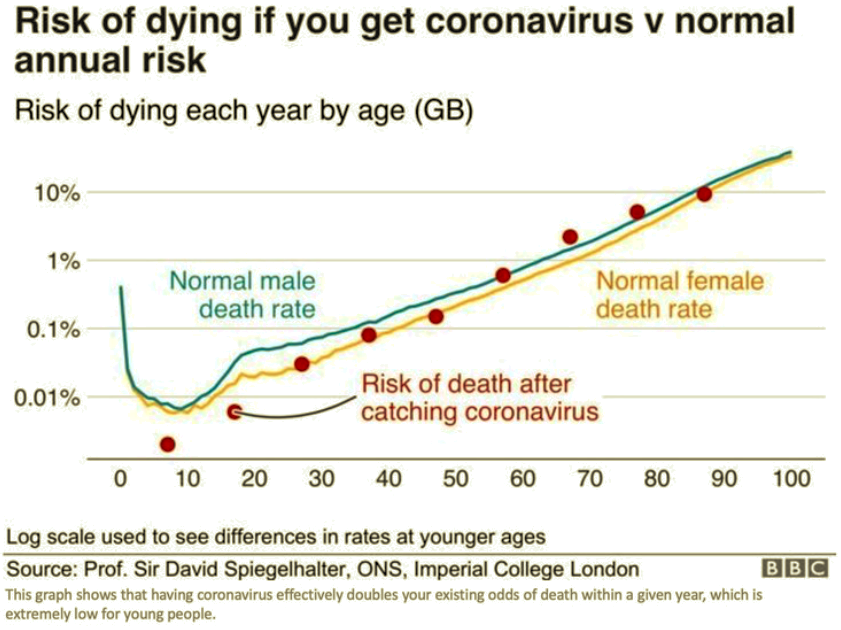
Nevertheless, a great deal was known in early March about the truly vulnerable segments of the population, even if you discount Chinese reporting. Mortality rates in South Korea and Italy were heavily skewed toward the aged and those with other risk factors. One can reasonably argue that health care professionals and policy experts should have known even then how best to mitigate the risks of the virus. That would have involved targeting high-risk segments of the population for quarantine, and treatment for the larger population in-line with the lower risks it actually faced. Vulnerable groups require protection, but death rates from coronavirus across the full age distribution closely mimic mortality from other causes, as the chart at the top of this chart shows.

The current global death toll is still quite small relative to major pandemics of the past (Spanish Flu, 1918-19: ~45 million; Asian Flu, 1957-58: 1.1 million; Hong Kong flu, 1969: 1 million; Covid-19 as of May 22: 333,000). But by mid-March, people were distressed by one particular epidemiological model (Neil Ferguson’s Imperial College Model, subsequently exposed as slipshod), predicting 2.2 million deaths in the U.S. (We are not yet at 100,000 deaths). Most people were willing to accept temporary non-prescription measures to “slow the spread“. But unreasonable fear and alarm, eagerly promoted by the media, drove the extension of lockdowns across the U.S. by up to two extra months in some states, and perhaps beyond.

The public health and policy establishment did not properly weigh the health care and economic costs of extended lockdowns against the real risks of the coronavirus. I believe many health care workers were goaded into supporting ongoing lockdowns in the same way as the public. They had to know that the suspension of medical care was a dire cost to pay, but they fell in line when the “experts” insisted that extensions of the lockdowns were worthwhile. Some knew better, and much of the public has learned better.

The Decline and Fall of a Virus

Tags

,

Asymptomatic cases of coronavirus have some important implications, both good and bad. Of course, it’s great that so many people are asymptomatic. It demonstrates an innate immunity or some other kind of acquired immunity to the virus. On the other hand, these individuals can still spread the virus while infected, and they are hard to identify.

Estimates of the share of asymptomatic cases vary tremendously, some reaching almost 90%. But being asymptomatic is a matter of degree: in some cases there might be no symptoms whatsoever, from initial infection to complete suppression. In others, the symptoms are mild and may not raise any alarm in one’s mind. That distinction implies that testing criteria should be broadened, especially as the cost of testing declines.

Here I show two simple examples of viral spread to demonstrate that some level of asymptomatic “pre-immunity” in the population reduces the threshold at which the impact of the virus reverses. Both examples involve a population of 100 people. In both cases, social interactions are such that an infected person infects an average of two others. That is, the initial reproduction rate (known as R0) is equal to two. In both examples, the process starts with one infected individual:

Example #1:

Everyone is susceptible, meaning that the virus will cause symptoms and illness in anyone who catches it. Condensing the timeline, let’s just say we go from the first infection to three infections; then #2 and #3 each infect two more, and we have a total of seven infections; then the extra four pass the virus along to another eight victims and we’re up to 15; and so on. This is the exponential growth that is characteristic of the early stage of an epidemic. But then other dynamics start to kick in: most of the infected people recover with adaptive immunity, though a few may die. By now, however, only 85 susceptible people remain in the population, so each infected person infects an average of less than two more. The reproduction rate R must fall from it’s initial value of R0 as the susceptible population shrinks. By the time 50 people are infected and 50 susceptible people remain, the value of R is halved. In this example, that’s where herd immunity is achieved: when 50% of the population has been infected.

For those who enjoy math, here is a useful relation:

Herd Immunity Threshold (HIT) = 1 – 1/R0.

The higher is R0, the initial reproduction rate, the more people must be infected to achieve herd immunity. The coronavirus is said to have an R0 somewhere in the mid-2s. If it’s 2.5, then 60% of the population must be infected to achieve herd immunity under the assumption of universal susceptibility. When 60% are infected, R is equal to one. More people will be infected beyond that time, but fewer and fewer. R continues to fall, and the contagion wanes.

While I’ve abstracted from the time dimension, the total number of people who will be infected depends on factors like the duration of an infection. It takes time for an infected individual to come into contact with new, susceptible hosts for the virus, and fewer hosts will be available as time passes. That means the virus will die out well before the full population has been infected.

Example #2:

Let’s say 40 of the 100 people are not susceptible to the virus, meaning they will experience few if any symptoms if they catch it. Those 40 are innately immune, or perhaps they retain some adaptive immunity from previous exposure to a non-novel coronavirus. Strictly speaking, the entire population can catch the virus and can transmit it to others, but only 60% the population is susceptible to illness. It’s still true that each infected person would infect two others at the start. However, only 1.2 of those newly infected people would get sick on average. I will call that value the effective R0, which is net of the immune cohort. By the time 17 people have been infected, and about 10 of them get sick, there are only 50 susceptible people remaining. The effective R is already down to one. Herd immunity is effectively achieved after less than 20 infections. The HIT is just 17% (rounded)! That means the number of symptomatic infections will begin declining beyond that point. In this case, again depending on the average duration of an infection, it’s likely that much less than half of the population is ultimately sickened by the virus.

To summarize thus far, what example #2 demonstrates is that the existence of prior immunity in some individuals reduces the effective HIT. We know that sub-groups have differing levels of prior immunity / susceptibility to the coronavirus. In fact, for the coronavirus, we know the non-susceptible share of the population is substantial, given the large number of individuals who have been exposed but were asymptomatic.

Other Impacts on Reproduction Rate

Other influences can inhibit the spread of a virus. Weather, for example (see the nice interactive tool in “Weather and Transmission Rates“). Social distancing, including avoidance of “super-spreader events“, reduces the average number of people anyone can come into contact with. Masks might reduce the spread to others as well. Quarantining infected individuals obviously eliminates contacts with other individuals. Quarantining susceptible individuals prevents them from being exposed. In all of these cases, R is reduced more drastically over time from it’s initial value R0. This reduces the effective HIT and the ultimate number of individuals infected. Those effects are incremental to the impact of a large, non-susceptible sub-group, as in example #2, And there are variations on the appeal to heterogeneity that are equally convincing, as described below.

New HIT Literature

So herd immunity is not as far out of reach as many believe. That question is now being addressed more intensively in the academic world. Herd immunity occurs in the context of a virus’s ability to spread from host to host, which is summarized by R. In my limited review, most of the articles addressing a lower HIT emphasize distancing or other practices that reduce R. However, herd immunity really means that given a set of social conditions, enough of the population has either an innate or an acquired immunity to cause the impact of a contagion to recede. Both the level of immunity and the social conditions can alter the effective HIT.

Jacob Sullum offers a nice summary of some of this work. One paper describing the impact of heterogeneity emphasizes the order in which individuals become infected. Here is Sullum’s description with a link to the paper:

A couple of new reports speculatively lower the possible herd immunity threshold for the coronavirus to just 10 to 20 percent of the population. This conjecture depends chiefly on assumptions about just how susceptible and connected members of the herd are. In their preprint, a team of European epidemiologists led by the Liverpool School of Tropical Medicine mathematical bioscientist Gabriela Gomes explains how this might work.

If highly susceptible herd members become infected and thus immune first, the preprint says, their subsequent interactions with the still-uninfected will not result in additional cases. Basically, the virus stymies itself by disproportionately removing those most useful to it from contributing to its future transmission. In addition, if herd members are very loosely connected and interact with one another rarely, the virus will have a much harder time jumping to its next victims. Sustained social distancing aimed at flattening the curve of coronavirus infections and cases mimics this effect.”

The sequential explanation is of obvious importance, But don’t it’s not the fundamental mechanism at play in example #2, which is strictly the heterogeneity of the population.

Nick Spyropoulas of the Alma Economics Group describes reductions in the herd immunity threshold in “Notes on the Dynamics of Subsequent Epidemic Waves“. It’s a very nice write-up, but it only emphasizes social distancing.

Judith Curry provides an excellent and well-referenced exposition of some herd immunity experiments. They are based on an even more extended approach to heterogeneity introducing: 1) variation in susceptibility across individuals; and 2) variation in the dispersion of transmission. The latter means, “… the extent to which infection happens through many spreaders or just a few“. She uses these mechanisms to modify a standard epidemiological model using prior estimates of variability to calibrate the model. Both experiments arrive at drastically lower HITs and total infections than her baseline experiment, which uses the standard model. The chart below shows her results with moderate heterogeneity. Her results with more extreme (though realistic) values of the heterogeneity metrics are even more remarkable. See the link above.

Check Against Real World

How does all this square with our experience to-date with the coronavirus? It’s difficult to tell with case counts, as the volume of testing keeps increasing and so many infected individuals are asymptomatic and remain undiagnosed. Estimates of R vary, but most states appear to have an R currently less than one. That means the virus is receding almost everywhere in the U.S. The same is true in much of the developed world, where the virus was most prevalent. Even Sweden, where achieving herd immunity is policy, diagnosed cases and deaths have been largely confined to vulnerable groups, and in total are less than many other (though not all) European countries.

Does that mean many areas in the U.S. and elsewhere have reached herd immunity? Locales that have had serological testing have thus far shown infection rates of anywhere from 2% to 10%, though New York City, where the outbreak was most severe, may have had more than 20% of its population infected as of a month ago. Different regions may have different HITs, so there is a chance that some areas, including NYC, are close to herd immunity.

Unfortunately, some of the reductions in R and in the effective HIT were won by social distancing, which will be reversed to some extent as the economy reopens. That’s the flip side of the “flat curve” we’ve managed to experience. The value of R may drift back toward or above one for a time. Diminished sunlight and humidity in the fall might have a similar effect. A second wave is not likely to be as bad as the first, however. That’s because: 1) we’ll now have more adaptive immunity in the population; 2) the most susceptible people are among those who already have acquired immunity or, more sadly, have died; 3) we’ll be better at coping with an outbreak in multiple ways; and 4) more speculatively, we’ll have identified the most effective treatments and, with less likelihood, a vaccine for those who want it.

Policy Lessons

In any outbreak, keeping R below one at least-cost is the objective. Given the alternatives, that rules out full-scale lockdowns because we know a large share of the population already has innate or acquired immunity. Forced shutdowns are unnecessarily costly relative to a targeted approach. But what form does that take?

Infected individuals must be quarantined until they recover, and their close contacts should be quarantined for up to a full incubation period. Large gatherings must be suspended temporarily. Testing capacity must be such that anyone with a fever or any symptom, mild or otherwise, can be tested. Regular testing of certain individuals like health care workers, teachers, and other first responders should take place. Simple screenings using infrared thermometers will be useful in high-traffic establishments. Precautions must be targeted at the most susceptible, and it’s pretty easy to identify them: the elderly and those with co-morbidities such as heart disease, diabetes, and lung conditions.

There are questions of civil liberties that must be addressed as well. Many high-risk individuals can live independently, so their freedoms must be weighed against their safety. Keeping this cohort quarantined is out of the question unless it’s voluntary. Regular testing should take place, and a subset of this group might already have the markers of immunity. Another question of civil liberties involves detailed contact tracing, which requires the establishment of an apparatus capable of great intrusion and abuse. I believe identification of close contacts should be an adequate precaution, though there may be degrees of tracing that I would find acceptable. Finally, a vaccine would be welcome, but it should not be mandatory