• About

Sacred Cow Chips

Sacred Cow Chips

Tag Archives: Alex Tabarrok

Joy-Politik: Taxing Unrealized Capital Gains

25 Wednesday Sep 2024

Posted by Nuetzel in Wealth Taxes

≈ 1 Comment

Tags

Alex Tabarrok, Billionaire Tax, Capital Flight, Jason Furman, Joe Biden, Kamala Harris, Michael Munger, Moore v. United States, Notional Equity Interest, Sam Altman, Tyler Cowen, ULTRA, Unrealized Capital Gains, Wealth Tax

Kamala Harris’ campaign platform lifts several tax provisions from Joe Biden’s ill-fated campaign. The most pernicious of these are lauded by observers on the Left for their “fairness”, but they dismiss some rather obvious economic damage these provisions would inflict. Here, I’ll cover Harris’ proposal to tax unrealized capital gains of the rich in two different ways:

  1. A minimum 25% “billionaire tax” on the “incomes” of taxpayers with net worth exceeding $100 million. This definition of income would include unrealized capital gains.
  2. A tax of 28% at the time of death on unrealized capital gains in excess of $5 million ($10 million for joint returns).

Why Bother?

To get a whiff of the complexity involved, take a look at the description on pp. 79 – 85 of this document, to which the Harris proposal seems to correspond. It’s not fully fleshed out, but it’s easy to imagine the lucrative opportunities this would create for tax attorneys and accountants, to say nothing of job openings at the IRS!

On the other hand, there’s little chance these proposals would be approved by Congress, no matter which party holds a majority. Harris knows that, or at least her advisors do. That taxation of unrealized gains is even part of the conversation in a presidential election year tells us how normalized the idea has become within the Democrat Party, which seems to have lost all regard for private property rights. These are classist proposals designed to garner the votes of the “tax-the-rich” crowd, who either aren’t aware or haven’t come to grips with the fact that the U.S. already has a very progressive income tax system. “The rich” already pay a disproportionately high share of taxes.

Taxable Income

These provisions would complicate and corrupt the income tax code by distorting the definition of income for tax purposes. The Internal Revenue Code has always been consistent in defining taxable income as realized income. One might use the expression “mark-to-market taxation” to characterize a tax on unrealized gains from tradable assets. It’s much more difficult to estimate unrealized gains on non-tradable or infrequently traded investments, for which there is no ready market value.

There is one type of income that some believe to be taxed as unrealized. A few weeks ago, in a post about Sam Altman’s infatuation with a wealth tax, I cited a recent Supreme Court decision that has been mistakenly interpreted as favoring income taxation of unrealized gains or a wealth tax. In fact, Moore v. United States involved the undistributed profits of a foreign pass-through entity (i.e., not a C corporation) for purposes of the mandatory repatriation tax. The foreign firm’s profits were realized, and its pass-through status meant that the U.S. owners had also, by definition, realized the profits. So this case did not set a precedent or create an exception to the rule that income taxation applies only to realized income.

Forced Sales

Tradable assets with easily recorded market values will often have unrealized gains in a given year. While tax payments might be spread over the current and future tax years, these taxes could necessitate asset sales to pay the taxes owed. If unrealized losses are treated symmetrically, they would require either future deductions or possibly credits for prior tax payments.

Estimates of unrealized gains on illiquid or private investments like closely-held business interests, artwork, or real estate are highly uncertain and subject to dispute. A large tax liability on such an asset could be especially burdensome. Cash must be raised, which might require a forced sale of other assets. And again, these valuations often come with great complexity and exorbitant administrative costs, not just for the IRS, but especially for taxpayers.

Economic Downsides

As I noted above, additional taxes on unrealized gains would create an obvious need for liquidity, if not immediately then at death. With or without careful planning, sales of assets by wealthy investors to pay the tax would undermine market values of equity (and other assets), producing a broader loss of wealth economy-wide.

Avoidance schemes would be heavily utilized. For example, a wealthy investor could borrow heavily against assets so as to offset unrealized gains with deductible debt-service costs.

Capital flight is likely to be intense if a Harris tax regime began to take shape in Congress. This might be the best avoidance scheme of all. The U.S. is likely to experience massive capital outflows. Furthermore, investment in new physical capital will decline, ultimately leading to lower productivity and real wages.

Entrepreneurial activity would also take a hit. In a critique of Jason Furman’s effort to justify Harris’ proposal, Tyler Cowen asks why we should be so eager to “whack” venture capital. He also quotes an email from Alex Tabarrok on the detrimental policy effects on rapidly growing start-ups:

“What’s really going on is that you are divorcing the entrepreneur from their capital at precisely the moment that the team is likely most productive. Separation of capital from entrepreneur could negatively impact the company’s growth or the entrepreneur’s ability to manage effectively. The entrepreneur could lose control, for example. If you wait until the entrepreneur realizes the gain that’s the time that the entrepreneur wants out and is ready to consume so it’s closer to taxing consumption and better timed in the entrepreneurial growth process.“

Or the entrepreneur might just decide that a startup would be more rewarding in a tax-friendly environment, perhaps somewhere overseas.

Interest Rates and Tax Receipts

Tabarrok notes in a separate post that much of the variation in stock prices is caused by changes in interest rates. Investors use market rates to determine discount rates at which a firm’s future cash flows can be valued. Thus, changes in rates engender changes in stock prices, capital gains, and capital losses.

A decline in interest rates can raise market valuations without any change in dividends. However, a long-term investor would see no change in pre-tax income or consumption, so the tax could force a series of premature sales. A change in a firm’s expected growth rate would also create an unrealized gain (or loss), but the tax would undermine U.S. equity values. Taxing an actual increase in the dividend is one thing, but taxing a change in expectations of future dividends is another. As Tabarrok puts it, “It’s taxing the chickens before the eggs have hatched.“

Dangerous Narrative, Dangerous Policy

A final objection to taxing unrealized capital gains is that it would cross the line into a form of wealth taxation. Assets come in many forms, but the only time realized values can be discerned are when they are traded. That goes for collectibles, homes, boats, and the full array of financial assets. A corollary is that a very large percentage of wealth is unrealized.

A tax on unrealized gains would be the proverbial camel’s nose under the tent and another incursion into the private realm. So often in the history of taxation we’ve seen narrow taxes expand into broad taxes. This is one more opportunity for the state to extend its dominance and control.

I’ve written in the past about the economic dangers of a wealth tax. First, every dollar of income used to purchase capital is already taxed once. In that sense, the cost basis of wealth would be double taxed under a wealth tax. Second, the supply of capital is highly elastic. This implies a high propensity for capital flight, shallowing of productive physical capital, and reduced productivity and real wages. Avoidance schemes would rapidly be put into play. Given these limitations, the revenue raising potential of a wealth tax is unlikely to live up to expectations. Finally, a wealth tax is unconstitutional, but that won’t stop the Left from pushing for one, especially if they first get a tax on unrealized gains. Even if they are unsuccessful now, the conversation tends to normalize the idea of a wealth tax among low-information voters, and that is a shame.

AntiSemitic Left Tests Limits of Free Speech

30 Tuesday Apr 2024

Posted by Nuetzel in anti-Semitism, Free Speech

≈ Leave a comment

Tags

Agitators, Alex Tabarrok, Codes of Conduct, Eugene Volokh, Fighting Wirds, First Amendment, Foundation for Individual Rights and Expression, Free Speech, Freedom of Assembly, Hamas, Instapundit, Intifada, Israel, Michael Munger, P.J. O'Rourke, Terrorism

The current protests on college campuses across the nation bring into focus differing opinions on the limits of free speech and assembly. Particular questions seem to defy resolution. Nevertheless, there is some misunderstanding regarding the settled breadth of the First Amendment.

The protestors have acted as if they have constitutional carte blanche to gather anywhere to say anything in opposition to Israel and its war against Hamas terrorists; a subset thinks this encompasses “occupation” of any space for any duration; a still smaller subset believes this includes a right to condemn Jews, all Jews.

I strongly doubt, however, that many of the protestors truly believe their constitutional protections extend to intimidation and bullying of Jewish students attempting to go about their business on campus (scroll to a few of the articles here), destruction of property, or the use of “fighting words”, or physical attacks on Jews or other “oppressors”.

It’s well known that the Constitution does not protect “fighting words”, including threats. Furthermore, Eugene Volokh explains that there is no constitutional right to “occupy” a college campus, either public or private.

Of course, private schools are not legally bound to respect free speech or assembly rights. They can regulate activity on their private campuses in any way they see fit. Some explicitly abide the same rights as public universities, which seems reasonable for any institution dedicated to the free spirit of inquiry.

Volokh, however, cites Supreme Court precedents in which a majority held that government can prohibit camping in certain parks, for example, and that public colleges and universities can impose restrictions on campus activities:

“There is no First Amendment right to camp out in any university, public or private. Indeed, there is no First Amendment right to camp out even in public parks (see Clark v. CCNV (1984)), and the government’s power to limit the use of property used for a public university is even greater than its power as to parks (Widmar v. Vincent (1981)):

“‘A university differs in significant respects for public forums such as streets or parks or even municipal theaters. A university’s mission is education, and decisions of this Court have never denied a university’s authority to impose reasonable regulations compatible with that mission upon the use of its campus and facilities. We have not held, for example, that a campus must make all of its facilities equally available to students and nonstudents alike, or that a university must grant free access to all of its grounds or buildings.’

“Likewise, if UC Berkeley had held a law student party in the law school building rather than at Dean Chemerinsky’s house, it could have stopped students from using the party as an occasion to orate to the audience (especially with their own sound amplification devices, which the student brought to Chemerinsky’s house). See Spears v. Arizona Bd. of Regents (D. Ariz. 2019)(upholding public university’s right to stop people from speaking with sound amplification at an on-campus book fair).“

Volokh also notes, however, that public universities cannot restrict mere “offensive” expression, which would include certain antisemitic statements or even swastikas (for example), as long as the expression falls short of “fighting words” or explicit threats. Do calls for the “extermination of Jews” qualify as fighting words? That deserves a resounding yes. It’s clearly hate speech, and it’s exactly the sort of expression that might be deemed so offensive to counterprotestors (for example) as to constitute an immediate threat to public order.

Does the meaning of “fighting words” include such chants as “From the river to the sea…”? Some say that depends on the speaker, but that can’t provide a sound basis of distinction. It is clearly associated with calls to eliminate the state of Israel. Some believe it also implies the genocide of Jews in Israel, and Jews can’t be blamed for finding it threatening. Okay, how about “Intifada”? I doubt all of the students involved in the current protests understand the genocidal implications of these words. The agitators understand them well enough.

This is a grey area in our understanding of the First Amendment. The “River to the Sea” chant, and Intifada, seem like fighting words to me, but they might not qualify as direct threats to anyone on campus. By comparison, the swastika is “just” a party emblem, whatever policies it stands for, and apparently the Court did not deem it a direct threat to anyone in Skokie, Illinois. The legal distinctions here feel inadequate. Still, we say the “mere” expression of offensive ideas or symbols is protected speech, provided that it does not directly threaten harm to any party.

Many libertarians, with whom I usually agree, urge tolerance of the protests and encampments, including at least cautious tolerance of the protests. The Foundation for Individual Rights and Expression (FIRE) has strenuously objected to the actions of police in Austin, Texas in dispersing demonstrators at the University of Texas. Alex Tabarrak has reposted a tweet or two apparently critical of the government’s response to protestors in Texas and at Emory University in Atlanta, though it should be noted that the economics professor who was taken down and handcuffed on video had actually hit a police officer. Michael Munger, in a variation of his “worst enemy test” of government power, says that giving campus authorities “the power to crush us, at their discretion” is probably a bad idea. But they have that power if they choose to exercise it, for better or worse. (By “us”, I don’t think Munger intended to take sides).

I’m highly skeptical of the motives and incentives of some of the “occupiers” of campus spaces, not to mention their status as students. More importantly, there is ample evidence that “fighting words” and threats against Jews have been used by many of the protesters. This violates the codes of conduct at many schools, and should not only be censured, but any student identified as guilty of this sort of hate speech should be expelled, not merely suspended. There should be severe consequences for professors choosing to participate in these protests as well.

This behavior should have long-term consequences, and that is happening at some schools. I saw the following quote from P.J. O’Rourke on Instapundit, which seems appropriate here:

“There’s only one basic human right, the right to do as you damn well please. And with it comes the only basic human duty, the duty to take the consequences.”

The kids are wearing masks for a reason, and it ain’t Covid! Now, the protestors’ demands include “amnesty” for their participation in the protests. That shouldn’t play well if you’re provably guilty of calling for the extermination of a race of people. But here’s the thing: certain institutions like Columbia University have allowed the aberrant behavior to go on with little challenge, showing that the real limits to free speech and assembly are whatever acquiescent campus administrators are willing to put up with.

Removing these encampments is more than justified on constitutional grounds at any school, public or private. The arrest of some of the more intransigent elements among the protesters may be well justified. Insulting hate speech is one thing, but eliminationist hate speech constitutes fighting words and should not be tolerated. Of course, forcibly removing the encampments is risky in terms of public safety because some of the protestors will physically challenge the police. Comparatively innocent (though naive) students might get caught up in a conflict with law enforcement, but ignorance is no defense. They should not be there. Those risks must be taken to end the “hate encampments”, which are a direct threat to the rights of others wishing only to go about their business.

Health Care & Education: Slow Productivity Growth + Subsidies = Jacked Prices

14 Sunday May 2023

Posted by Nuetzel in Education, Health Care, Priductivity

≈ Leave a comment

Tags

Abundance Agenda, Alex Tabarrok, Baumol's Disease, Beethoven’s String Quartet No. 14, CHIPS, competition, Consumer Sovereignty, Education Cost, Education Grants, Education Productivity, Employer-Paid Coversge, Eric Helland, Exchange subsidies, health care costs, Health Care Productivity, Industrial Concentration, Mark Perry, Medicaid, Medical Technology, Medicare, Obamacare, Peter Suderman, Relative Prices, Slow Productivity Growth, Student Loans, Subsidies, Tax Subsidies, third-party payments, Willian Baumol

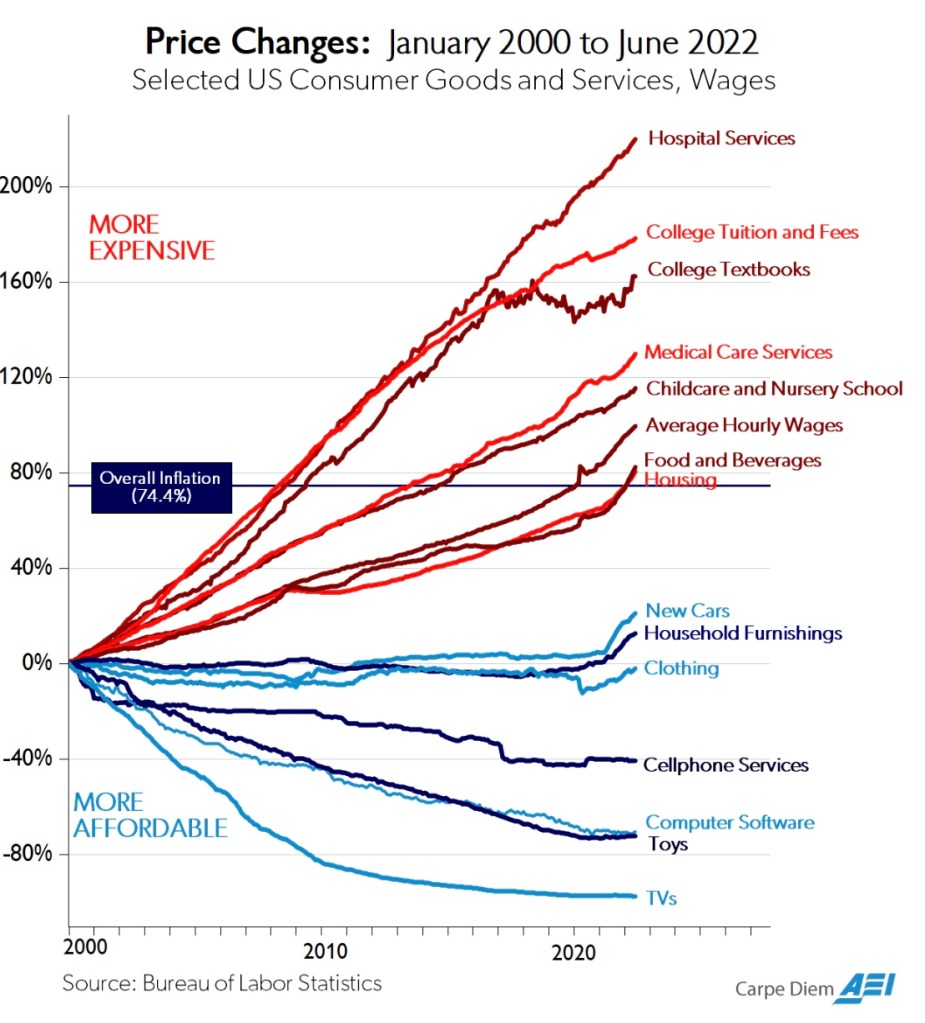
This post is about relative prices in two major sectors of the U.S. economy, both of which are hindered by slow productivity growth while being among the most heavily subsidized: education and health care. Historically, both sectors have experienced rather drastic relative price increases, as illustrated for the past 20 years in the chart from Mark Perry above.

Baumol’s Cost Disease

These facts are hardly coincidental, though it’s likely the relative costs education and health care would have risen even in the absence of subsidies. Over long periods of time, the forces primarily guiding relative price movements are differentials in productivity growth. The tendency of certain industries to suffer from slow growth in productivity is the key to something known among economists as Baumol’s Disease, after the late William Baumol, who first described the phenomenon’s impact on relative prices.

Standards of living improve when a sufficient number of industries enjoy productivity growth. That creates a broad diffusion of new demands across many industries, including those less amenable to productivity growth, such as health care and education. But slow productivity growth and rising demand in these industries are imbalances that push their relative prices upward.

Alex Tabarrok and Eric Helland noted a few years ago that it took four skilled musicians 44 minutes to play Beethoven’s String Quartet No. 14 in 1826 and also in 2010, but the inflation-adjusted cost was 23 times higher. Services involving a high intensity of skilled labor are more prone to Baumol’s Disease than manufactured goods. As well, services for which demand is highly responsive to income or sectors characterized by monopoly power may be more prone to Baumol’s disease.

Tabarrok wonders whether we should really consider manifestations of Baumol’s Disease a blessing, because they show the extent to which productivity and real incomes have grown across the broader economy. So, rather than blame low productivity growth in certain services for their increasing relative prices, we should really blame (or thank) the rapid productivity growth in other sectors.

The Productivity Slog

There are unavoidable limits to the productivity growth of skilled educators, physicians, and other skilled workers in health care. Again, in a growing economy, prices of things in relatively fixed supply or those registering slow productivity gains will tend to rise more rapidly.

Technology offers certain advantages in some fields of education, but it’s hard to find evidence of broad improvement in educational success in the U.S. at any level. In the health care sector, new drugs often improve outcomes, as do advances in technologies such as drug delivery systems, monitoring devices, imaging, and robotic surgery. However, these advances don’t necessarily translate into improved capacity of the health care system to handle patients except at higher costs.

There’s been some controversy over the proper measurement of productivity in the health care sector. Some suggest that traditional measures of health care productivity are so flawed in capturing quality improvements that the meaning of prices themselves is distorted. They conclude that adjusting for quality can actually yield declines in effective health care prices. I’d interject, however, that patients and payers might harbor doubts about that assertion.

Other investigators note that while real advances in health care productivity should reduce costs, the degree of success varies substantially across different types of innovations and care settings. In particular, innovations in process and protocols seem to be more effective in reducing health care expenditures than adding new technologies to existing protocols or business models. All too often, medical innovations are of the latter variety. Ultimately, innovations in health care haven’t allowed a broader population of patients to be treated at low cost.

Superior Goods

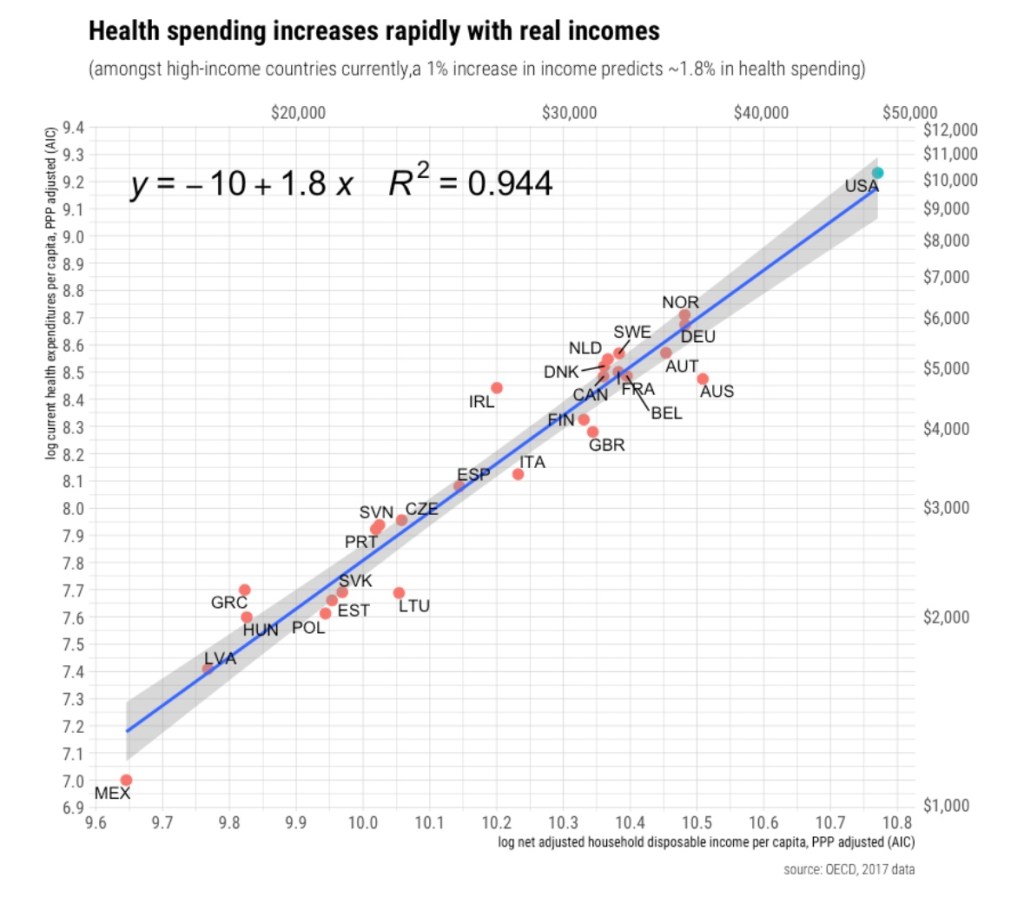
Therefore, it appears that increases in the relative prices of education and health care over time have arisen as a natural consequence of the interplay between disparities in productivity growth and rising demand. Indeed, this goes a long way toward explaining the high cost of health care in the U.S. compared to other developed nations, as standards of living in the U.S. are well above nearly all others. In that respect, the cost of health care in the U.S. is not necessarily alarming. People demand more health care and education as their incomes rise, but delivering more health care isn’t easy. To paraphrase Tabarrok, turning steelworkers into doctors, nurses and teachers is a costly proposition.

The Role of Subsidies

In the clamor for scarce educational and health care resources, natural tensions over access have spilled into the political sphere. In pursuit of distributing these resources more equitably, public policy has relied heavily on subsidies. It shouldn’t surprise anyone that subsiding a service resistant to productivity gains will magnify the Baumol effect on relative price. One point is beyond doubt: the amounts of these subsidies is breathtaking.

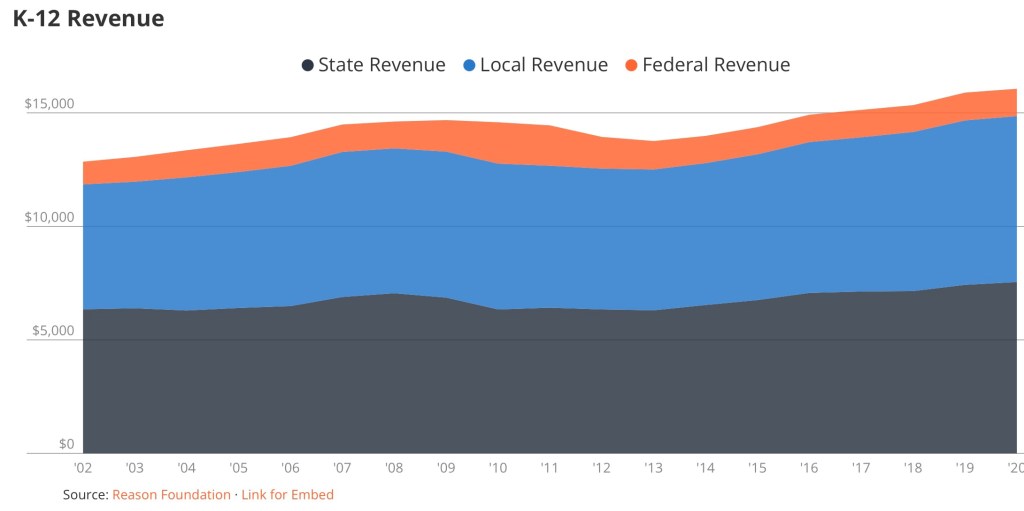
Education: Public K -12 schools are largely funded by local taxpayers. Taxpayer-parents of school-aged children pay part of this cost whether they send their children to public schools or not. If they don’t, they must pay the additional cost of private or home schooling. This severely distorts the link between payments and the value assigned by actual users of public schools. It also confers a huge degree of market power to public schools, thus insulating them economically from performance pressures.

Public K – 12 schools are also heavily subsidized by state governments and federal grants. The following chart shows the magnitude and growth of K – 12 revenue per student over the past couple of decades.

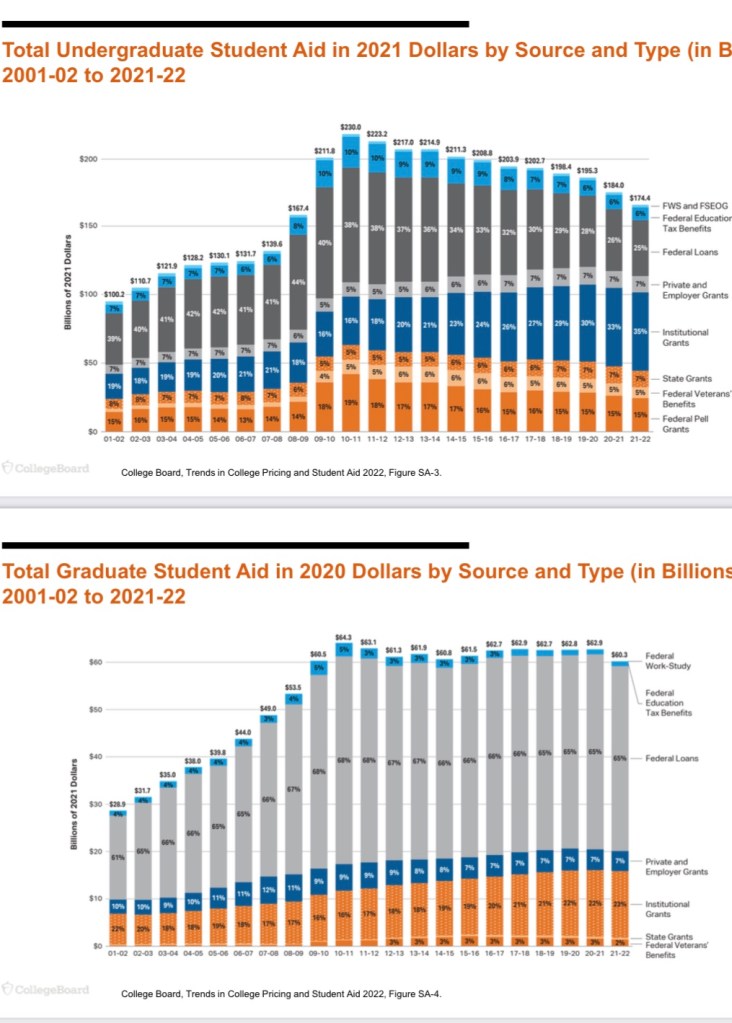
Subsidies for higher education take the form of student aid, including federal student loans, grants to institutions, as well as a variety of tax subsidies. Here’s a nice breakdown:

This represents a mix of buyer and seller subsidies. That suggests less upward pressure on price and more stimulus to output, but we still run up against the limits to productivity growth noted above. Moreover, other constraints limit the effectiveness of these subsidies, such as lower academic qualifications in a broader student population and the potential for rewards in the job market to diminish with a potential excess of graduates.

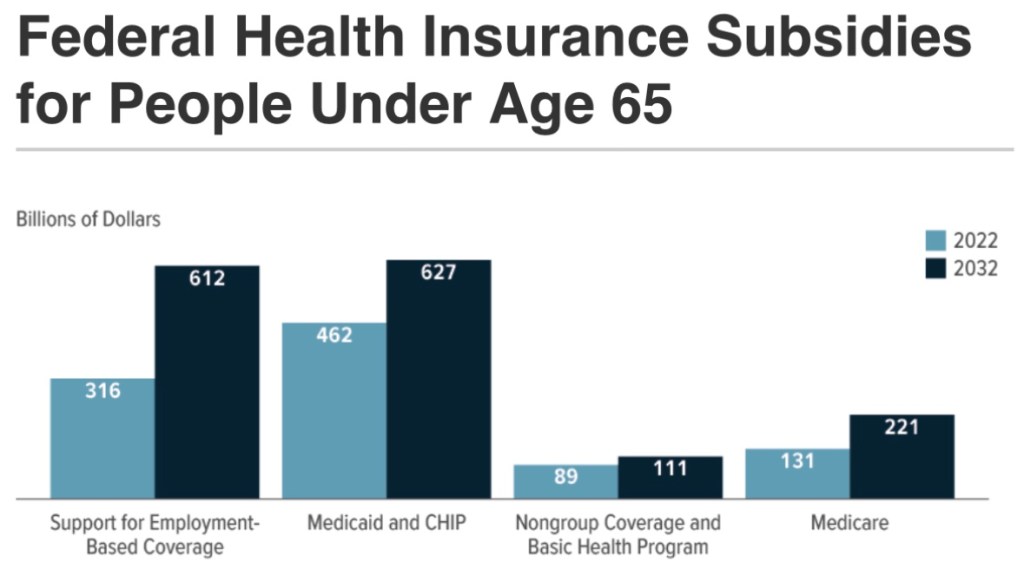
Health care: Subsidies here are massive and come in a variety of forms. They often directly provide or reduce the cost of health insurance coverage: Medicaid, the Children’s Health Insurance Program (CHIP), Obamacare exchange subsidies, Medicare savings programs, tax-subsidies on employer-paid health coverage, and medical expense tax deductions. Within limits, these subsidies reduce the marginal cost of care patients are asked to pay, thus contributing to over-utilization of various kinds of care.

The following are CBO projections from June 2022. They are intended here to give an idea of the magnitude of health care insurance subsidies:

Still Other Dysfunctions

There are certainly other drivers of high costs in the provision of health care and education beyond a Baumol effect magnified by subsidies. The third-party payment system has contributed to a loss of price discipline in health care. While consumers are often responsible for paying at least part of their health insurance premiums, the marginal cost of health care to consumers is often zero, so they have little incentive to manage their demands.

Another impediment to cost control is a regulatory environment in health care that has led to a sharply greater concentration of hospital services and the virtual disappearance of independent provider practices. Competition has been sorely lacking in education as well. Subsidies flowing to providers with market power tend to exacerbate behaviors that would be punished in competitive markets, and not just pricing.

Summary

Baumol’s Disease can explain a lot about the patterns of relative prices shown in the chart at the top of this post. That pattern is a negative side effect of general growth in productivity. Unfortunately, it also reflects a magnification engendered by the payment of subsidies to sectors with slow productivity growth. The intent of these subsidies is to distribute health care and education more equitably, but the impact on relative prices undermines these objectives. The approach forces society to exert wasted energy, like an idiotic dog chasing its tail.

Peter Suderman wrote an excellent piece in which he discussed health care and education subsidies in the context of the so-called “abundance agenda”. His emphasis is on the futility of this agenda for the middle class, for which quality education and affordable health care always seem just out of reach. The malign effects of “abundance” policies are reinforced by anti-competitive regulation and payment mechanisms, which subvert market price discipline and consumer sovereignty. We’d be far better served by policies that restore consumer responsibility, deregulate providers, and foster competition in the delivery of health care and education.

Hiring Discrimination In the U.S., Canada, and Western Europe

10 Monday Oct 2022

Posted by Nuetzel in Discrimination

≈ Leave a comment

Tags

Alex Tabarrok, Anti-Discrimination Laws, Ban the Box, Disparate impact, European Union, Hiring Discrimination, Protected Groups, Racial Proxies, Segregation, Slavery

Some people have the impression that the U.S. is uniquely bad in terms of racial, ethnic, gender, and other forms of discrimination. This misapprehension is almost as grossly in error as the belief held in some circles that the history of slavery is uniquely American, when in fact the practice has been so common historically, and throughout the world, as to be the rule rather than the exception.

This week, Alex Tabarrok shared some research I’d never seen on one kind of discriminatory behavior. In his post, “The US has Relatively Low Rates of Hiring Discrimination”, he cites the findings of a 2019 meta-study of “… 97 Field Experiments of Racial Discrimination in Hiring”. The research focused on several Western European countries, Canada, and the U.S. The experiments involved the use of “faux applicants” for actual job openings. Some studies used applications only and were randomized across different racial or ethnic cues for otherwise similar applicants. Other studies paired similar individuals of different racial or ethnic background for separate in-person interviews.

The authors found that hiring discrimination is fairly ubiquitous against non-white groups across employers in these countries. The authors were careful to note that the study did not address levels of hiring discrimination in countries outside the area of the study. They also disclaimed any implication about other forms of discrimination within the covered countries, such as bias in lending or housing.

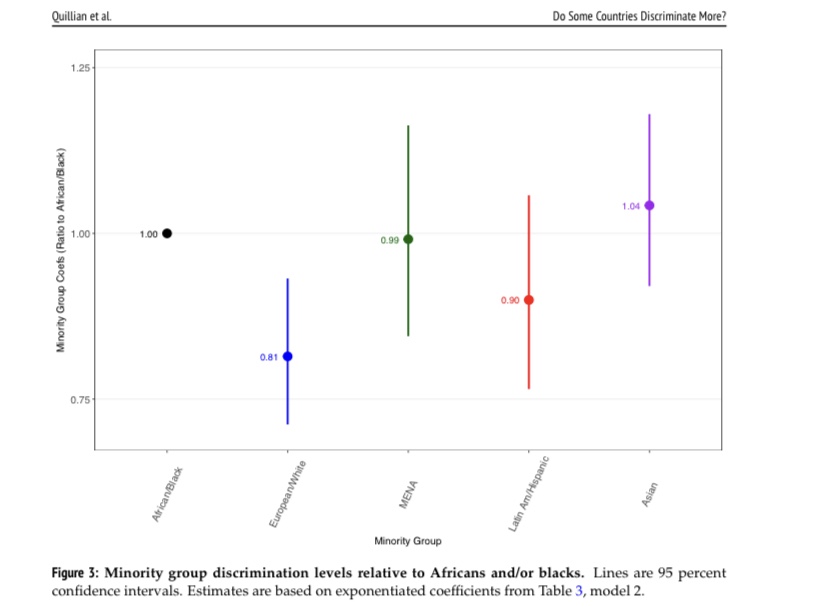
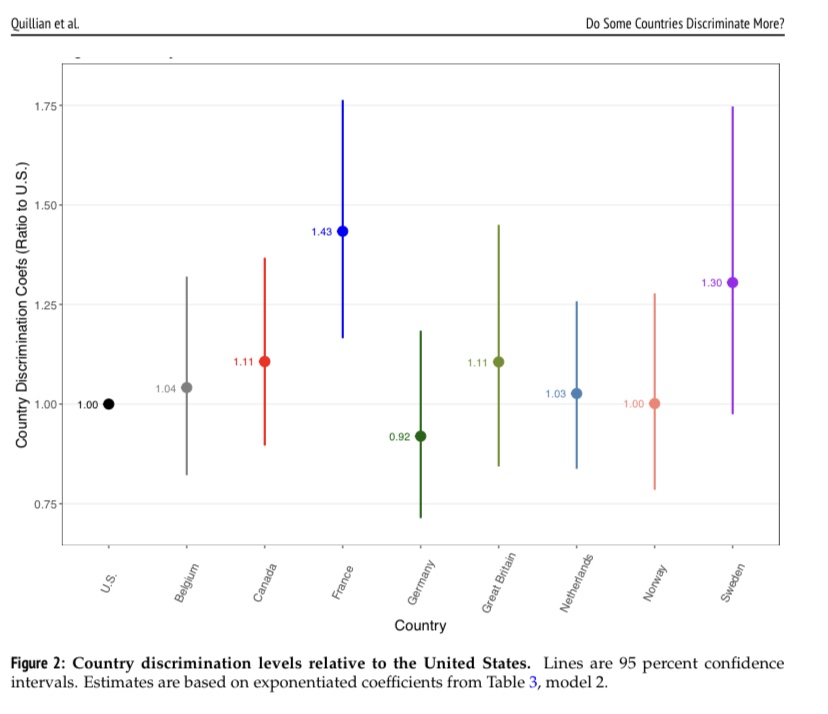
The study’s point estimates indicated “ubiquitous hiring discrimination”, though not all the estimates were statistically significant. My apologies if the chart below is difficult to read. If so, try zooming in, clicking on it, or following the link to the study above.

Some of the largest point estimates were highly imprecise due to less coverage by individual studies. The impacted groups and severity varied across countries. Blacks suffered significant discrimination in the U.S., Canada, France, and Great Britain. For Hispanics, the only coverage was in the U. S. and sparsely in Canada. The point estimates showed discrimination in both counties, but it was (barely) significant only in the U.S. For Middle Eastern and North African (MENA) applicants, discrimination was severe in France, the Netherlands, Belgium, and Sweden. Asian applicants faced discrimination in France, Norway, Canada, and Great Britain.

Across all countries, the group suffering the least hiring discrimination was white immigrants, followed by Latin Americans / Hispanics (but only two countries were covered). Asians seemed to suffer the most discrimination, though not significantly more than Blacks (and less in the U.S. than in France, Norway, Canada, and Great Britain). Blacks and MENA applicants suffered a bit less than Asians from hiring discrimination, but again, not significantly less.

Comparing countries, the authors used U.S. hiring discrimination as a baseline, assigning a value of one. France had the most severe hiring discrimination and at a high level of significance. Sweden was next highest, but it was not significantly higher than in the U.S. Belgium, Canada, the Netherlands and Great Britain had higher point estimates of overall discrimination than the U. S., though none of those differences were significant. Employers in Norway were about as discriminatory as the U.S., and German employers were less discriminatory, though not significantly.

The upshot is that as a group, U.S. employers are generally at the low end of the spectrum in terms of discriminatory hiring. Again, the intent of this research was not to single out the selected countries. Rather, these countries were chosen because relevant studies were available. In fact, Tabarrok makes the following comment, which the authors probably wouldn’t endorse and is admittedly speculative, but I suspect it’s right:

“I would bet that discrimination rates would be much higher in Japan, China and Korea not to mention Indonesia, Iraq, Nigeria or the Congo. Understanding why discrimination is lower in Western capitalist democracies would reorient the literature in a very useful way.”

So the U.S. is not on the high-side of this set of Western countries in terms of discriminatory hiring practices. While discrimination against blacks and Hispanics in the U.S. appears to be a continuing phenomenon, overall hiring discrimination in the U.S. is, at worst, comparable to many European countries.

To anticipate one kind of response to this emphasis, the U.S. is not alone in its institutional efforts to reduce discrimination. In fact, the study’s authors say:

“A fairly similar set of antidiscrimination laws were adopted in North America and many Western European countries from the 1960s to the 1990s. In 2000, the European Union passed a series of race directives that mandated a range of antidiscrimination measures to be adopted by all member states, putting their legislative frameworks on racial discrimination on highly similar footing.”

Despite these similarities, there are a few institutional details that might have some bearing on the results. For example, France bans the recording and “formal discussion” of race and ethnicity during the hiring process. (However, photos are often included in job applications in European countries.) Does this indicate that reporting mandates and prohibiting certain questions reduce hiring discrimination? That might be suggestive, but the evidence is not as clear cut as the authors seem to believe. They cite one piece of conflicting literature on that point. Moreover, it does not explain why Great Britain had a greater (and highly significant) point estimate of discrimination against Asians, or why Canada and Norway were roughly equivalent to France on this basis. Nor does it explain why Sweden and Belgium did not differ from France significantly in terms of discrimination against MENA applicants. Or why Canada was not significantly different from France in terms of hiring discrimination against Blacks. Overall, discrimination in Sweden was not significantly less than in France. Still, at least based on the three applicant groups covered by studies of France, that country had the highest overall level of discrimination. France also had the most significant departure from the U.S., where recording the race and ethnicity of job applicants is institutionalized.

Germany had the lowest overall point estimates of hiring discrimination in the study. According to the authors, employers in German-speaking countries tend to collect a fairly thorough set of background information on job applications. This detail can actually work against discrimination in hiring. Tabarrok notes that so-called “ban the box” policies, or laws that prohibit employers from asking about an applicant’s criminal record, are known to result in greater racial disparities in hiring. The same is true of policies that threaten sanctions against the use of objective job qualifications which might have disparate impacts on “protected” groups. That’s because generalized proxies based on race are often adopted by hiring managers, consciously or subconsciously.

Discrimination in hiring based on race and ethnicity might actually be reasonable when a job entails sensitive interactions requiring high levels of trust with members of a minority community. This statement acknowledges that we do not live in a perfect world in which racial and ethnic differences are irrelevant. Still, aside from exceptions of that kind, overt hiring discrimination based on race or ethnicity is a negative social outcome. The conundrum we face is whether it is more or less negative than efforts to coerce nondiscrimination on those bases across a broad range of behaviors, most of which are nondiscriminatory to begin with, and when interventions often have perverse discriminatory effects. Policymakers and observers in the U.S. should maintain perspective. Discriminatory behavior persists in the U.S., especially against Blacks, but some of this discrimination is likely caused by prohibitions on objective tests of relevant job skills. And as the research discussed above shows, employers here appear to be a bit less discriminatory than those in most other Western democracies.

Anatomy of a Scam on Taxpayers: Biden Plumps Up IDRs

29 Monday Aug 2022

Posted by Nuetzel in Federal Budget, rent seeking, Student Loans

≈ Leave a comment

Tags

Alex Tabarrok, Biden Student Loan Plan, IDRs, Income Driven Repayments, Legal Standing, Loan Repayment Assistance Programs, LRAPs, Matt Bruenig, Penn-Wharton Budget Model, Public Service Loan Forgiveness, Student Loan Forgiveness

In my last post I discussed the difficulty faced by potential challengers to President Biden’s student loan forgiveness program in establishing legal standing in court. I also mentioned an estimate of the cost of the plan to taxpayers of around $600 billion over ten years. That was from the Penn-Wharton Budget Model, but now the model’s estimate ranges to more than $1 trillion! The difference is a reassessment of the changes to increasingly popular income-driven repayment (IDR) plans and uncertainty around behavioral assumptions like plan uptake over the ten-year budget window. The changes to IDRs are separate from the $10,000 – $20,000 short-term loan forgiveness component of Biden’s plan, and they are a perfect basis for a legal scam on taxpayers.

IDRs are not new. Under these plans, a borrower pays 10% of their income toward the outstanding balance of their student loans for a period of 10 to 20 years, depending on the plan, after which any remaining balance is forgiven. This may or may not make sense for borrowers with high student loan payments relative to income. In fact, there are some who warn that IDRs are a ripoff. However, only income above 150% of the poverty line is subject to IDR payments. For some students borrowing heavily, IDRs can make tuition hikes irrelevant beyond a certain loan balance: just borrow it! Living expenses can be borrowed as well! These plans almost completely eliminate price sensitivity among consumers of college educations, and it may make sense for certain students to borrow as much as possible. It’s also a prescription for escalating tuition.

Law graduates who work in the public sector have long received favorable treatment via IDRs: they pay 10% of their discretionary income for only 10 years. The so-called Public Service Loan Forgiveness (PSLF) program is leveraged by law schools, which offer deals for students called Loan Repayment Assistance Programs (LRAP). For an explanation, I’ll defer to Matt Bruenig and his interesting post on the topic (with hat tip to Alex Tabarrok):

“The LRAP schemes work as follows:

  1. The school increases their tuition.
  2. The student takes out federal loans to cover the tuition increase.
  3. The school squirrels away the debt-financed tuition increase into an LRAP fund.
  4. The school disburses money from the LRAP fund to cover PSLF repayments.

Through this roundabout process, the law schools effectively use student debt to pay off student debt and make their schools free or nearly free, at least for these particular students.”

The school knows the student’s debt payments are limited by income. Tuition hikes can be paid with additional loans, and the LRAPs future obligations are limited by the student’s income after graduation. Not only is the tuition hike “free” to the student, but the school might be able to pocket a share of the new loan and invest the whole nut for returns in the interim. That’s the gist of Tabarrok’s simple example. Needless to say, IDRs and PSLF create some very bad incentives! Farewell to cost control!

Biden’s plan extends IDRs in ways that make them far more attractive to students, including undergraduates. Here are the changes, again from Bruenig:

“The IDR changes are four-fold:

  1. Increase the amount of income not subject to IDR from 150 percent of the federal poverty line to 225 percent of the federal poverty line.
  2. Eliminate any accrual of interest on IDR-enrolled loans.
  3. For undergraduate debt, reduce the IDR rate from 10 percent of income beyond the threshold in (1) to 5 percent of income beyond the threshold in (1).
  4. For IDR-enrolled debts with original loan balances below $12,000, reduce the repayment period from 20 years to 10 years.”

Smaller payments and zero interest! This is what led to Penn-Wharton’s revision in the high-side cost estimates of Biden’s student loan forgiveness plan:

“‘Depending on future details of the actual IDR program and concomitant behavioral changes, the IDR program could add another $450 billion or more,’ the analysis found. ‘Thereby raising total plan costs to over $1 trillion.’”

The incentives are for schools to offer LRAPs more broadly, and to abuse them. Rent-seeking vendors have lined up to design and manage these programs. Students and even parents are encouraged to borrow up to the maximum limits, which conceivably allows the loan proceeds to be used outside of the ostensible educational purpose of the loan, potentially for investment gains. See Tabarrok’s post for some links to creative schemes to which part of the loan proceeds might be put by borrowers.

This is a huge scam! It’s hard to square the Administration’s action with any effort to apply economic logic to program design. But that’s not really the point of the student loan forgiveness program. Instead, it’s designed to warm the hearts of Biden’s political base among students and young college graduates. And it will further enrich the heavily endowed universities that can be counted upon to inculcate students with leftist dogma. Apparently, the rest of us, who lack standing to formally challenge these schemes, can just suck it.

BLM’s Trail of Homicide

20 Tuesday Apr 2021

Posted by Nuetzel in law enforcement, Police Bias

≈ Leave a comment

Tags

Alex Tabarrok, Black Lives Matter, BLM, BLM Protests, Defund the Police, Freddie Gray, George Floyd, Lethal Force, Marxism, Police Homicides, Property Crime, Systemic Racism, Travis Campbell, Vox

Check out this Vox article on the impact of Black Lives Matter (BLM) protests on police homicides, other homicides, and property crime within the communities where protests occurred. It cites a study by Travis Campbell, a Ph.D. candidate in economics at UMass-Amherst with the following major findings for the period 2014-2019:

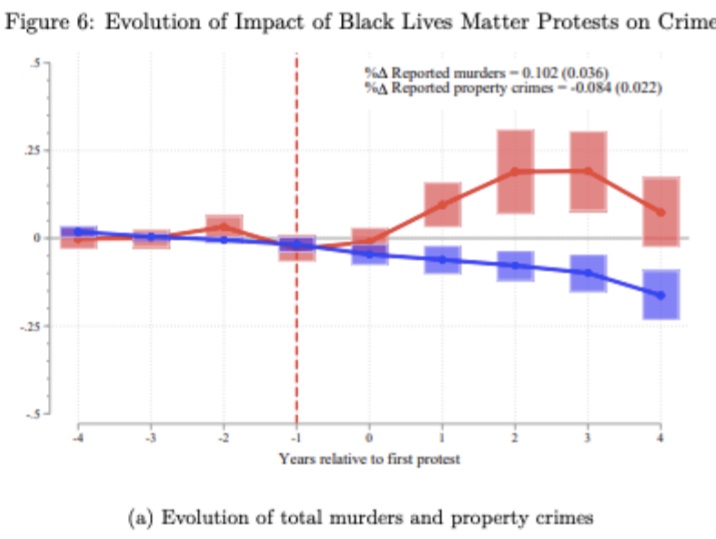
1) Police homicides in census areas where BLM protests took place were 10% – 15% less than if those deaths had followed the trend where BLM protests did not take place, after controlling for confounding factors like the local unemployment rate. That’s about 300 fewer uses of lethal force by police, or one less for every 4,000 BLM protestors. So far, so good, one might guess.

2) Other homicides increased by roughly 10% using the same basis of comparison, or somewhere between 1,000 and 6,000. This estimate is less precise for a number of reasons, and it was not the main focus of Campbell’s research. Still, using a value near the mid-point, say 3,000, yields one extra murder for every 400 BLM protestors! The effect seems to taper off after about four years.

3) Reported property crimes decreased by 8.4% in areas that had BLM protests, but the share of those crimes solved declined by 5.5%. Campbell interprets the latter as an indication of reduced policing intensity. Reports of crime might decline if confidence in the police declines post protest, but reduced effort by the police is also consistent with less reported property crime, less police engagement, and more homicide.

As Alex Tabarrok says:

“The explanation is consistent with what happened in Baltimore after the Freddie Gray protests and riots, namely arrests went down and murders went up.”

The research did not include data on the 2020 protests and riots following the death of George Floyd due to lags in reporting homicides and crime.

One of BLM’s primary objectives is to end “systemic racism” in policing, a problem that has no real empirical basis. Nevertheless, a reduction in deadly confrontations between police and blacks would seem to be a win (though the study doesn’t address the racial makeup of police homicides). But if that means less police engagement and a substantial increase in homicides in the community, the cost is obviously too high. Areas suffering from high homicide rates need more policing, not less. But yes, it must be good policing in partnership with citizens, and there are real reforms that could help.

BLM’s continued calls to “defund the police” are more about signaling lofty intent than about solving real problems. After all, that’s the perverse charm of the Marxism espoused by BLM, Antifa, and gentry leftists having class immunity to unintended (but predictable) consequences. You don’t really have to solve problems. You can just make them for others and take credit for trying!

COVID Now: Turning Points, Vaccines, and Mutations

20 Wednesday Jan 2021

Posted by Nuetzel in Coronavirus, Pandemic, Vaccinations

≈ Leave a comment

Tags

Alex Tabarrok, Case Fatality Rate, CDC, CLI, Convalescent Plasma, Covid-19, COVID-Like Illness, Date of Death, Herd Immunity, Herd Immunity Threshold, Infection Fatality Rate, Ivermectin, Johns Hopkins, Monoclonal Antibodies, Phil Kerpen, Provisional Deaths, South African Strain, UK Strain, Vaccinations, Youyang Gu

The pandemic outlook remains mixed, primarily due to the slow rollout of the vaccines and the appearance of new strains of the virus. Nationwide, cases and COVID deaths rose through December. Now, however, there are several good reasons for optimism.

The fall wave of the coronavirus receded in many states beginning in November, but the wave started a bit later in the eastern states, in the southern tier of states, and in California. It appears to have crested in many of those states in January, even after a post-holiday bump in new diagnoses. As of today, Johns Hopkins reports only two states with increasing trends of new cases over the past two weeks: NH and VA, while CT and WY were flat. States shaded darker green have had larger declines in new cases.

A more detailed look at WY shows something like a blip in January after the large decline that began in November. Trends in new cases have clearly improved across the nation, though somewhat later than hoped.

While the fall wave has taken many lives, we can take some solace in the continuing decline in the case fatality rate. (This is not the same as the infection mortality rate (IFR), which has also declined. The IFR is much lower, but more difficult to measure). The CFR fell by more than half from its level in the late summer. In other words, without that decline, deaths today would be running twice as high.

Some of the CFR’s decline was surely due to higher testing levels. However, better treatments are reducing the length of hospital stays for many patients, as well as ICU admittance and deaths relative to cases. Monoclonal antibodies and convalescent plasma have been effective for many patients, and now Ivermectin is showing great promise as a treatment, with a 75% reduction in mortality according to the meta-analysis at the link.

Reported or “announced” deaths remain high, but those reports are not an accurate guide to the level or trend in actual deaths as they occur. The CDC’s provisional death reports give the count of deaths by date of death (DOD), shown below. The most recent three to four weeks are very incomplete, but it appears that actual deaths by DOD may have peaked as early as mid-December, as I speculated they might last month. Another noteworthy point: by the totals we have thus far, actual deaths peaked at about 17,000 a week, or just over 2,400 a day. This is substantially less than the “announced” deaths of 4,000 or more a day we keep hearing. The key distinction is that those announced deaths were actually spread out over many prior weeks.

A useful leading indicator of actual deaths has been the percentage of ER patients presenting COVID-like illness (CLI). The purple dots in the next CDC chart show a pronounced decline in CLI over the past three weeks. This series has been subject to revisions, which makes it much less trustworthy. A less striking decline in late November subsequently disappeared. At the time, however, it seemed to foretell a decline in actual deaths by mid-December. That might actually have been the case. We shall see, but if so, it’s possible that better therapeutics are causing the apparent CLI-deaths linkage to break down.

A more recent concern is the appearance of several new virus strains around the world, particularly in the UK and South Africa. The UK strain has reached other countries and is now said to have made appearances in the U.S. The bad news is that these strains seem to be more highly transmissible. In fact, there are some predictions that they’ll account for 30% of new cases by the beginning of March. The South African strain is said to be fairly resistant to antibodies from prior infections. Thus, there is a strong possibility that these cases will be additive, and they might or might not speedily replace the established strains. The good news is that the new strains do not appear to be more lethal. The vaccines are expected to be effective against the UK strain. It’s not yet clear whether new versions of the vaccines will be required against the South African strain by next fall.

Vaccinations have been underway now for just over a month. I had hoped that by now they’d start to make a dent in the death counts, and maybe they have, but the truth is the rollout has been frustratingly slow. The first two weeks were awful, but as of today, the number of doses administered was over 14 million, or almost 46% of the doses that have been delivered. Believe it or not, that’s an huge improvement!

About 4.3% of the population had received at least one dose as of today, according to the CDC. I have no doubt that heavier reliance on the private sector will speed the “jab rate”, but rollouts in many states have been a study in ineptitude. Even worse, now a month after vaccinations began, the most vulnerable segment of the population, the elderly, has received far less than half of the doses in most states. The following table is from Phil Kerpen. Not all states are reporting vaccinations by age group, which might indicate a failure to prioritize those at the greatest risk.

It might not be fair to draw strong conclusions, but it appears WV, FL, IN, AK, and MS are performing well relative to other states in getting doses to those most at risk.

Even with the recent increase in volume, the U.S. is running far behind the usual pace of annual flu vaccinations. Each fall, those average about 50 million doses administered per month, according to Alex Tabarrok. He quotes Youyang Gu, an AI forecaster with a pretty good track record thus far, on the prospects for herd immunity and an end to the pandemic. However, he uses the term “herd immunity” as the ending share of post-infected plus vaccinated individuals in the population, which is different than the herd immunity threshold at which new cases begin to decline. Nevertheless, in Tabarrok’s words:

“… the United States will have reached herd immunity by July, with about half of the immunity coming from vaccinations and half from infections. Long before we reach herd immunity, however, the infection and death rates will fall. Gu is projecting that by March infections will be half what they are now and by May about one-tenth the current rate. The drop will catch people by surprise just like the increase. We are not good at exponentials. The economy will boom in Q2 as infections decline.”

That sounds good, but Tabarrok also quotes a CDC projection of another 100,000 deaths by February. That’s on top of the provisional death count of 340,000 thus far, which runs 3-4 weeks behind. If we have six weeks of provisionals to go before February, with actual deaths at their peak of about 17,000 per week, we’ll get to 100,000 more actual deaths by then. For what it’s worth, I think that’s pessimistic. The favorable turns already seen in cases and actual deaths, which I believe are likely to persist, should hold fatalities below that level, and the vaccinations we’ve seen thus far will help somewhat.

Let’s Do “First Doses First”

06 Wednesday Jan 2021

Posted by Nuetzel in Coronavirus, Vaccinations

≈ Leave a comment

Tags

Alex Tabarrok, Covid-19, FDA, First Doses First, Herd Immunity, Herd Immunity Threshold, Moderna, Operation Warp Speed, Pfizer, Phil Kerpen, Vaccines

Both the Pfizer and the Moderna COVID vaccines require two doses, with an effectiveness of about 95%. But a single dose may have an efficacy of about 80% that is likely to last over a number of weeks without a second dose. There are varying estimates of short-term efficacy, and but see here, here, and here. The chart above is for the Pfizer vaccine (red line) relative to a control group over days since the first dose, and the efficacy grows over time relative to the control before a presumed decay ever sets in.

Unfortunately, doses are in short supply, and getting doses administered has proven to be much more difficult than expected. “First Doses First” (FDF) is a name for a vaccination strategy focusing on delivering only first doses until a sufficient number of the highly vulnerable receive one. After that, second doses can be administered, perhaps within some maximum time internal such as 8 – 12 weeks. FDF doubles the number of individuals who can be vaccinated in the short-term with a given supply of vaccine. Today, Phil Kerpen posted this update on doses delivered and administered thus far:

Dosing has caught up a little, but it’s still lagging way behind deliveries.

As Alex Tabbarok points out, FDF is superior strategy because every two doses create an average of 1.6 immune individuals (2 x 0.8) instead of just 0.95 immune individuals. His example involves a population of 300 million, a required herd immunity level of two-thirds (higher than a herd immunity threshold), and an ability to administer 100 million doses per month. Under a FDF regime, you’ve reached Tabarrok’s “herd immunity” level in two months. (This is not to imply that vaccination is the only contributor to herd immunity… far from it!) Under the two-dose regime, you only get halfway there in that time. So FDF means fewer cases, fewer deaths, shorter suspensions of individual liberty, and a faster economic recovery.

An alternative that doubles the number of doses available is Moderna’s half-dose plan. Apparently, their tests indicate that half doses are just as effective as full doses, and they are said to be in discussions with the FDA and Operation Warp Speed to implement the half-dose plan. But the disadvantage of the half-dose plan relative to FDF is that the former does not help to overcome the slow speed with which doses are being administered.

Vaccine supplies are bound to increase dramatically in coming months, and the process of dosing will no doubt accelerate as well. However, for the next month or two, FDF is too sensible to ignore. While I am not a fan of all British COVID policies, their vaccination authorities have recommended an FDF approach as well as allowing different vaccines for first and second doses.

Allocating Vaccine Supplies: Lives or “Justice”?

29 Tuesday Dec 2020

Posted by Nuetzel in Pandemic, Public Health, Uncategorized, Vaccinations

≈ 1 Comment

Tags

Alex Tabarrok, CDC, Chicago, Co-Morbidities, Covid-19, Emma Woodhouse, Essential Workers, Historical Inequities, Infection Fatality Rate, Long-Term Care, Megan McArdle, Super-Spreaders, Transmission, Vaccinations, Vaccine Allocation, Vaccine Passports

There are currently two vaccines in limited distribution across the U.S. from Pfizer and Moderna, but the number and variety of different vaccines will grow as we move through the winter. For now, the vaccine is in short supply, but that’s even more a matter of administering doses in a timely way as it is the quantity on hand. There are competing theories about how best to allocate the available doses, which is the subject of this post. I won’t debate the merits of refusing to take a vaccine except to say that I support anyone’s right to refuse it without coercion by public authorities. I also note that certain forms of discrimination on that basis are not necessarily unreasonable.

The vaccines in play all seem to be highly effective (> 90%, which is incredible by existing standards). There have been a few reports of side effects — certainly not in large numbers — but it remains to be seen whether the vaccines will have any long-term side effects. I’m optimistic, but I won’t dismiss the possibility.

Despite competing doctrines about how the available supplies of vaccine should be allocated, there is widespread acceptance that health care workers should go first. I have some reservations about this because, like Emma Woodhouse, I believe staff and residents at long-term care facilities should have at least equal priority. Yet they do not in the City of Chicago and probably in other areas. I have to wonder whether unionized health care workers there are the beneficiaries of political favoritism.

Beyond that question, we have the following competing priorities: 1) the vulnerable in care homes and other elderly individuals (75+, while younger individuals with co-morbidities come later); 2) “essential” workers of all ages (from police to grocery store clerks — decidedly arbitrary); and 3) basically the same as #2 with priority given to groups who have suffered historical inequities.

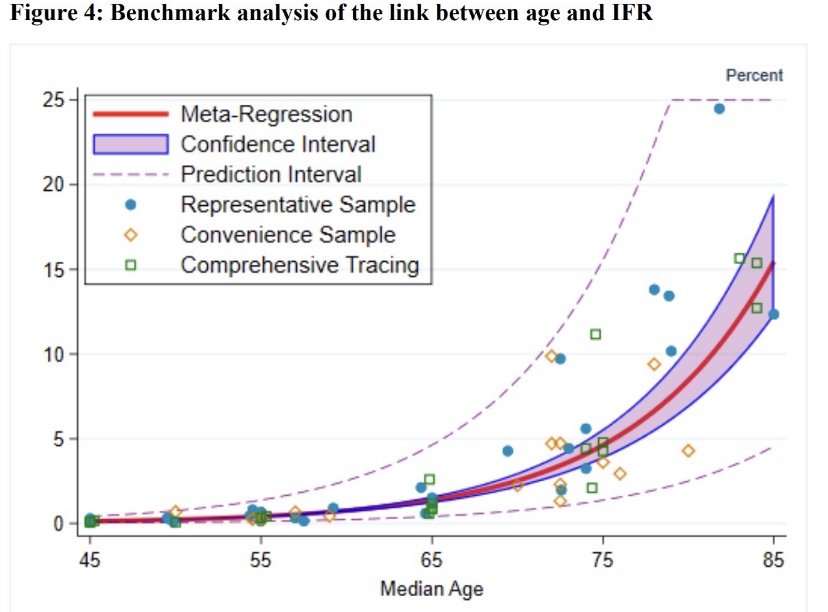
#1 is clearly the way to save the most lives, at least in the short-run. Over 40% of the deaths in the U.S. have been in elder-care settings, and COVID infection fatality rates mount exponentially with age:

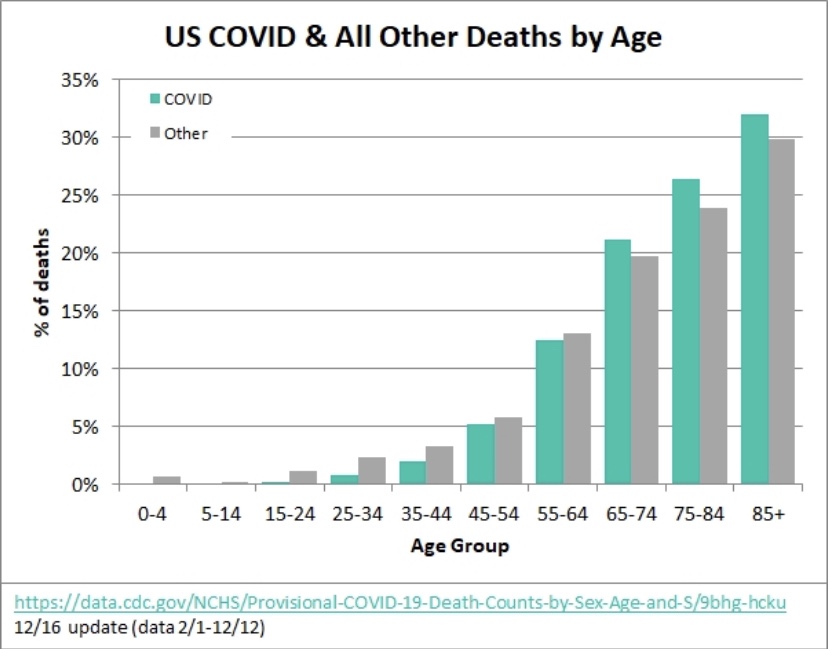
To derive the implications of #1 and #2, it’s more convenient to look at the share of deaths within each age cohort, since it incorporates the differences in infection rates and fatality rates across age groups (the number of “other” deaths is much larger than COVID deaths, of course, despite similar death shares):

The 75+ age group has accounted for about 58% of all COVID deaths in the U.S., and ages 25 – 64 accounted for about 20% (an approximate age range for essential workers). This implies that nearly three times as many lives can be saved by prioritizing the elderly, at least if deaths among so-called essential workers mimic deaths in the 25 – 64 age cohorts. However, the gap would be smaller and perhaps reversed in terms of life-years saved.

Furthermore, this is a short-run calculation. Over a longer time frame, if essential workers are responsible for more transmission across all ages than the elderly, then it might throw the advantage to prioritizing essential workers over the elderly, but it would take a number of transmission cycles for the differential to play out. Yes, essential workers are more likely to be “super-spreaders” than work-at-home, corporate employees, or even the unemployed, but identifying true super-spreaders would require considerable luck. Moreover, care homes generally house a substantial number of elderly individuals and staff in a confined environment, where spread is likely to be rampant. So the transmission argument for #2 over #1 is questionable.

The over-riding problem is that of available supply. Suppose enough vaccine is available for all elderly individuals within a particular time frame. That’s about 6.6% of the total U.S. population. The same supply would cover only about 13% of the younger age group identified above. Essential workers are a subset of that group, but the same supply would fall far short of vaccinating all of them; lives saved under #2 would then fall far short of the lives saved under #1. Quantities of the vaccine are likely to increase over the course of a few months, but limited supplies at the outset force us to focus the allocation decision on the short-term, making #1 the clear winner.

Now let’s talk about #3, minority populations, historical inequities, and the logic of allocating vaccine on that basis. Minority populations have suffered disproportionately from COVID, so this is really a matter of objective risk, not historical inequities… unless the idea is to treat vaccine allocations as a form of reparation. Don’t laugh — that might not be far from the intent, and it won’t count as a credit toward the next demand for “justice”.

For the sake of argument, let’s assume that minorities have 3x the fatality rate of whites from COVID (a little high). Roughly 40% of the U.S. population is non-white or Hispanic. That’s more than six times the size of the full 75+ population. If all of the available doses were delivered to essential workers in that group, it would cover less than half of them and save perhaps 30% of minority COVID deaths over a few months. In contrast, minorities might account for up to two-thirds of the deaths among the elderly. Therefore, vaccinating all of the elderly would save 58% of elderly COVID deaths and about 39% of minority deaths overall!

The COVID mortality risk to the average white individual in the elderly population is far greater than that faced by the average minority individual in the working age population. Therefore, no part of #3 is sensible from a purely mathematical perspective. Race/ethnicity overlaps significantly with various co-morbidities and the number of co-morbidities with which individuals are afflicted. Further analysis might reveal whether there is more to be gained by prioritizing by co-morbidities rather than race/ethnicity.

Megan McArdle has an interesting column on the CDC’s vaccination guidelines issued in November, which emphasized equity, like #3 above. But the CDC walked back that decision in December. The initial November decision was merely the latest of the the agency’s fumbles on COVID policy. In her column, McArdle notes that the public has understood that the priority was to save lives since the very start of the pandemic. Ideally, if objective measures show that identifiable characteristics are associated with greater vulnerability, then those should be considered in prioritizing individuals who desire vaccinations. This includes age, co-morbidities, race/ethnicity, and elements of occupational risk. But lesser associations with risk should not take precedence over greater associations with risk unless an advantage can be demonstrated in terms of lives saved, historical inequities or otherwise.

The priorities for the early rounds of vaccinations may differ by state or jurisdiction, but they are all heavily influenced by the CDC’s guidelines. Some states pay lip service to equity considerations (if they simply said race/ethnicity, they’d be forced to operationalize it), while others might actually prioritize doses by race/ethnicity to some degree. Once the initial phase of vaccinations is complete, there are likely to be more granular prioritizations based on different co-morbidities, for example, as well as race/ethnicity. Thankfully, the most severe risk gradient, advanced age, will have been addressed by then.

One last point: the Pfizer and Moderna vaccines both require two doses. Alex Tabarrok points out that first doses appear to be highly effective on their own. In his opinion, while supplies are short, the second dose should be delayed until all groups at substantially elevated risk can be vaccinated…. doubling the supply of initial doses! The idea has merit, but it is unlikely to receive much consideration in the U.S. except to the extent that supply chain problems make it unavoidable, and they might.

The FDA Can Put Virus Behind Us, Sans Vaccine

19 Wednesday Aug 2020

Posted by Nuetzel in Liberty, Pandemic, Vaccinations

≈ 1 Comment

Tags

Alex Tabarrok, Anti-Vaxers, Coronavirus, COVID Screening, Covid-19, E25Bio, Emergency Use Authorization, False Positive, Falze Negative, FDA, Harvard, Infectious vs Infected, John Cochrane, National Basketball Players Association, NBA, Paper Tests, Rapid Tests, Regulatory Failure, SalivaDirect, Self-Quarantine, Test Accuracy, Tracing, Transmission Chain, Vaccine Development, Vaccine Supply Chain, Wyss Institute for Biologically Inspired Engineering, Yale, Zach Lowe

Most of the news about COVID vaccine development is positive, but there are still huge doubts about 1) whether an effective vaccine(s) will ever be available; 2) when it will be available; 3) in what quantities (supply chains for vaccines present issues that most lay persons would never imagine) ; 4) the best approaches to allocation across young/healthy vs. old/vulnerable; 5) how long it will provide protection (the news is good on lasting immunity as well); and 6) whether people will actually take it. Given all these uncertainties, it’s worth considering an approach to stanching the coronavirus that won’t require a vaccine while still allowing a return to normalcy: cheap, rapid tests available to consumers on a daily basis in their homes or in businesses.

The full benefits of cheap, rapid tests can take people a while to wrap their heads around. In fact, there are skeptics who’s views on any and all testing are colored by suspicions that increased testing is some sort of conspiracy to spread fear and keep the economy hobbled. It’s true that increased testing drove much of the increase in COVID cases this summer, which caused the mainstream media to delight in spinning alarmist narratives. Fair enough, but that misses the point, which I’ll try to elucidate below. I credit a John Cochrane post for bringing this to my attention.

A successful vaccine breaks the so-called “transmission chain”, but so does frequent testing to identify infectious individuals on an ongoing basis so they can self-quarantine. As Alex Tabarrok has emphasized, we should worry about identifying infectious individuals, as opposed to infected individuals. They are not the same. Cheap, rapid, and easy-to-administer tests have already proven to be fairly accurate during the infectious stage. The idea is for individuals to self-test every day and stay home if they are positive. Or, employers can test workers every day and send them home if they are positive. Frequent testing also makes it simpler to trace the source of an infection and may reduce the importance of tracing.

To those who say this represents an affront to personal liberty, and I’m very touchy on that subject myself, recall that even now people are being screened in their workplaces using thermometers, questionnaires, or on the basis of any frogginess perceived by supervisors and co-workers. Those “tests” are far less accurate in identifying COVID-19 contagiousness than the kinds of cheap tests at issue here, and they are certainly no less intrusive. Then there are the many businesses facing restrictions on their operations: how “accurate” is it to keep everyone at home by locking down places of business? How intrusive is that? Those restrictions are indefensible, and especially with the advent and diffusion of cheap, rapid tests.

Of course, people might cheat and not report positives. Tests could be administered at workplaces to avoid that possibility, or at points of admission to businesses and facilities, but a few minutes of delay would be necessary. I would not support a centralized database of daily test results. If nothing else, relying on the good faith of individuals in reporting their results would be a giant leap forward in breaking the transmission chain now, rather than counting on the possibility of a successful virus in the indefinite future. And we might then avoid the whole pro-vax/anti-vax imbroglio that already foments, which raises major questions bearing on individual liberty.

Then there is the question of positive tests within multi-person households. Should the entire family or household self-quarantine? I say no, not if the others are negative, but then the others should test twice before going out, which dramatically reduces the probability of a false negative, and they should probably test more frequently, perhaps several times a day.

There are other important details to address: Who will pay for the tests? Will workers be paid to stay home if they test positive? How long will they be required to stay home? How will repeated tests be treated? I don’t want to get into detail on all of these points, but cheap, fast tests can help overcome many of these difficulties, and I believe many of the details can and should be worked out privately.

Unfortunately, the FDA has approved only two rapid tests, and they are not very rapid and not cheap enough. Only one had been approved up until last weekend because the FDA found the accuracy to be lacking … compared to PCR tests! But the FDA finally issued an Emergency Use Authorization for a saliva-based test (SalivaDirect) developed at Yale, partly funded by the NBA and the Players Association. The test still requires processing at a lab, so it’s really not convenient enough and not fast enough. Here is Zach Lowe on the cost:

“The cost per sample could be as low as about $4, though the cost to consumers will likely be higher than that — perhaps around $15 or $20 in some cases, according to expert sources.”

Not bad, but it’s much higher than more rapid, paper tests developed by Harvard’s Wyss Institute for Biologically Inspired Engineering and a company called E25Bio. Both of those are expected to cost about $1 per sample and can be completed anywhere. That’s a price that can work. And there are other promising candidates.

The benefits of tests that are rough, ready, and cheap will be huge. Such tests will also enable retesting, which helps to overcome the dilemmas of false positives and negatives. False negatives might be of greater concern to the FDA, but again, false negatives are less likely during the contagious stage of an infection, and the tests will be accurate enough that transmission risk will be drastically reduced.

The FDA needs to move beyond its stodgy insistence on achieving laboratory levels of accuracy. It’s unlikely that a single test source will be adequate to stanch the transmission chain, so the agency should rush to approve as many cheap, rapid tests as possible, with as many advisories and patient warnings regarding test results and follow-up instructions as it deems necessary. Remember, these tests are much better than thermometers!

← Older posts
Follow Sacred Cow Chips on WordPress.com

Recent Posts

  • Immigration and Merit As Fiscal Propositions
  • Tariff “Dividend” From An Indigent State
  • Almost Looks Like the Fed Has a 3% Inflation Target
  • Government Malpractice Breeds Health Care Havoc
  • A Tax On Imports Takes a Toll on Exports

Archives

  • December 2025
  • November 2025
  • October 2025
  • September 2025
  • August 2025
  • July 2025
  • June 2025
  • May 2025
  • April 2025
  • March 2025
  • February 2025
  • January 2025
  • December 2024
  • November 2024
  • October 2024
  • September 2024
  • August 2024
  • July 2024
  • June 2024
  • May 2024
  • April 2024
  • March 2024
  • February 2024
  • January 2024
  • December 2023
  • November 2023
  • August 2023
  • July 2023
  • June 2023
  • May 2023
  • April 2023
  • March 2023
  • February 2023
  • January 2023
  • December 2022
  • November 2022
  • October 2022
  • September 2022
  • August 2022
  • July 2022
  • June 2022
  • May 2022
  • April 2022
  • March 2022
  • February 2022
  • January 2022
  • December 2021
  • November 2021
  • October 2021
  • September 2021
  • August 2021
  • July 2021
  • June 2021
  • May 2021
  • April 2021
  • March 2021
  • February 2021
  • January 2021
  • December 2020
  • November 2020
  • October 2020
  • September 2020
  • August 2020
  • July 2020
  • June 2020
  • May 2020
  • April 2020
  • March 2020
  • February 2020
  • January 2020
  • December 2019
  • November 2019
  • October 2019
  • September 2019
  • August 2019
  • July 2019
  • June 2019
  • May 2019
  • April 2019
  • March 2019
  • February 2019
  • January 2019
  • December 2018
  • November 2018
  • October 2018
  • September 2018
  • August 2018
  • July 2018
  • June 2018
  • May 2018
  • April 2018
  • March 2018
  • February 2018
  • January 2018
  • December 2017
  • November 2017
  • October 2017
  • September 2017
  • August 2017
  • July 2017
  • June 2017
  • May 2017
  • April 2017
  • March 2017
  • February 2017
  • January 2017
  • December 2016
  • November 2016
  • October 2016
  • September 2016
  • August 2016
  • July 2016
  • June 2016
  • May 2016
  • April 2016
  • March 2016
  • February 2016
  • January 2016
  • December 2015
  • November 2015
  • October 2015
  • September 2015
  • August 2015
  • July 2015
  • June 2015
  • May 2015
  • April 2015
  • March 2015
  • February 2015
  • January 2015
  • December 2014
  • November 2014
  • October 2014
  • September 2014
  • August 2014
  • July 2014
  • June 2014
  • May 2014
  • April 2014
  • March 2014

Blogs I Follow

  • Passive Income Kickstart
  • OnlyFinance.net
  • TLC Cholesterol
  • Nintil
  • kendunning.net
  • DCWhispers.com
  • Hoong-Wai in the UK
  • Marginal REVOLUTION
  • Stlouis
  • Watts Up With That?
  • Aussie Nationalist Blog
  • American Elephants
  • The View from Alexandria
  • The Gymnasium
  • A Force for Good
  • Notes On Liberty
  • troymo
  • SUNDAY BLOG Stephanie Sievers
  • Miss Lou Acquiring Lore
  • Your Well Wisher Program
  • Objectivism In Depth
  • RobotEnomics
  • Orderstatistic
  • Paradigm Library
  • Scattered Showers and Quicksand

Blog at WordPress.com.

Passive Income Kickstart

OnlyFinance.net

TLC Cholesterol

Nintil

To estimate, compare, distinguish, discuss, and trace to its principal sources everything

kendunning.net

The Future is Ours to Create

DCWhispers.com

Hoong-Wai in the UK

A Commonwealth immigrant's perspective on the UK's public arena.

Marginal REVOLUTION

Small Steps Toward A Much Better World

Stlouis

Watts Up With That?

The world's most viewed site on global warming and climate change

Aussie Nationalist Blog

Commentary from a Paleoconservative and Nationalist perspective

American Elephants

Defending Life, Liberty and the Pursuit of Happiness

The View from Alexandria

In advanced civilizations the period loosely called Alexandrian is usually associated with flexible morals, perfunctory religion, populist standards and cosmopolitan tastes, feminism, exotic cults, and the rapid turnover of high and low fads---in short, a falling away (which is all that decadence means) from the strictness of traditional rules, embodied in character and inforced from within. -- Jacques Barzun

The Gymnasium

A place for reason, politics, economics, and faith steeped in the classical liberal tradition

A Force for Good

How economics, morality, and markets combine

Notes On Liberty

Spontaneous thoughts on a humble creed

troymo

SUNDAY BLOG Stephanie Sievers

Escaping the everyday life with photographs from my travels

Miss Lou Acquiring Lore

Gallery of Life...

Your Well Wisher Program

Attempt to solve commonly known problems…

Objectivism In Depth

Exploring Ayn Rand's revolutionary philosophy.

RobotEnomics

(A)n (I)ntelligent Future

Orderstatistic

Economics, chess and anything else on my mind.

Paradigm Library

OODA Looping

Scattered Showers and Quicksand

Musings on science, investing, finance, economics, politics, and probably fly fishing.

  • Subscribe Subscribed
    • Sacred Cow Chips
    • Join 128 other subscribers
    • Already have a WordPress.com account? Log in now.
    • Sacred Cow Chips
    • Subscribe Subscribed
    • Sign up
    • Log in
    • Report this content
    • View site in Reader
    • Manage subscriptions
    • Collapse this bar
 

Loading Comments...