• About

Sacred Cow Chips

Sacred Cow Chips

Tag Archives: Biden Administration

Debt Ceiling Stopgaps and a Weak Legal Challenge

07 Sunday May 2023

Posted by Nuetzel in Federal Budget, Public debt

≈ Leave a comment

Tags

Bank Liquidity, Biden Administration, Bing, Capital Gains Income, Chuck Schumer, Civil War, Debt Ceiling, Debt Limit Suspension, Default, Discharge Petition, Extraordinary Measures, Federal Deficits, Fourteenth Amendment, Google, Janet Yellen, Kevin McCarthy, Minting Coin, Modern Monetary Theary, Par Value, Perpetuities, Premium Bonds, Spending Restraint, statism
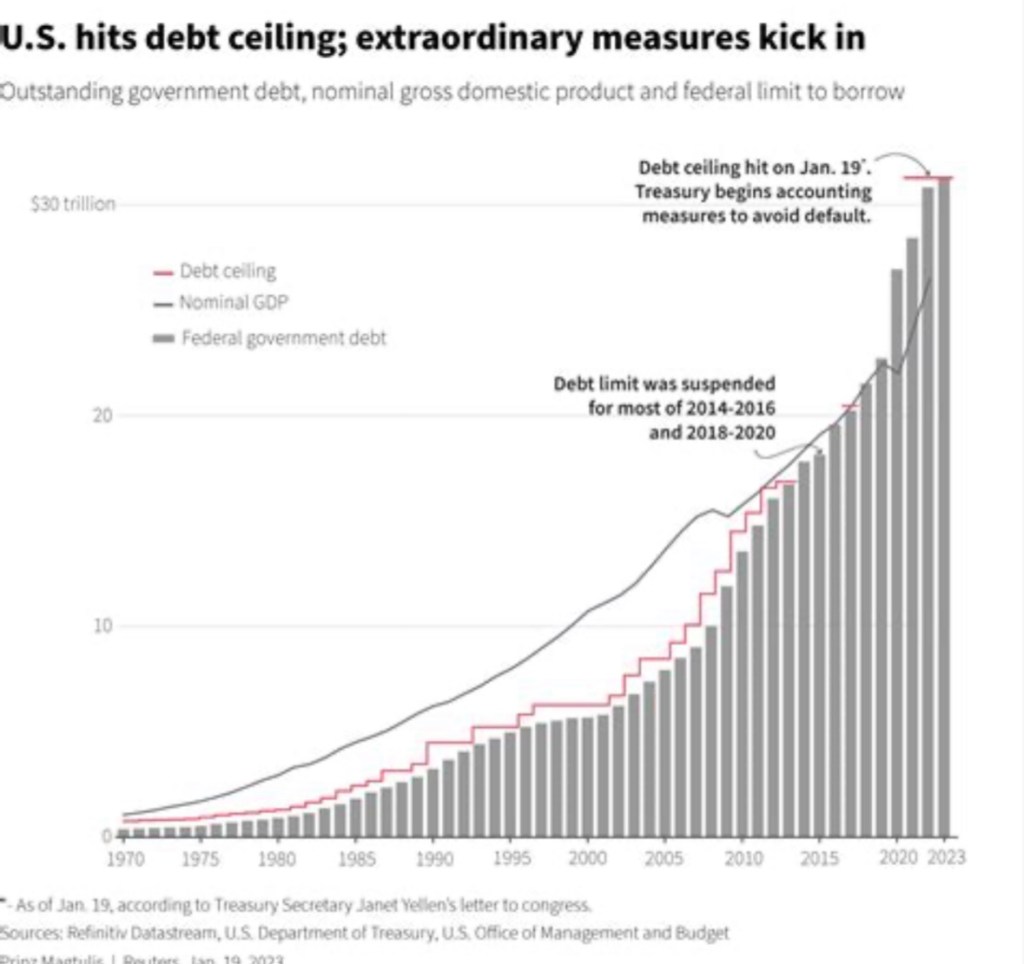
Long-awaited developments in the federal debt limit standoff shook loose in late April when Republicans passed a debt limit bill in the House of Representatives. Were it signed into law, the bill would extend the debt ceiling by about $1.5 trillion while incorporating elements of spending restraint. That approach is highly unpopular with democrats, but the zero-hour looms: Treasury Secretary Janet Yellen says the Treasury will run out of funds to pay all of the government’s obligations in early June. Soon we’ll have a better fix on President Biden’s response to the republicans, as he’s invited congressional leaders to the White House this Tuesday, May 8th to discuss the issue.

Biden wants a “clean” debt limit bill without changes impacting the budget path or existing appropriations. Senate Majority Leader Chuck Schumer would like to see a “clean” suspension of the debt limit. Republicans would like to use a debt limit extension to impose some spending restraint. They’ve focused only on the discretionary side of the budget, however, while much-needed reforms of mandatory programs like Social Security and Medicare were left aside. In fairness, both political parties have made massive contributions over the years to the burgeoning public debt, so not many are free of blame. But any time is a good time to try to enforce some fiscal discipline.

The Extraordinary Has Its Limits

Three months ago I wrote that the Treasury’s “extraordinary measures” to avoid breaching the debt limit would probably allow adequate time to break the impasse. In other words, accounting maneuvers allowed spending to continue without the sale of new debt. That bought some time, but perhaps not as much as hoped … tax filing season has revealed that revenue is coming in short of expectations, probably because weak asset markets have not generated anticipated levels of taxable capital gains income. In any case, very little progress was made over the past three months on settling the debt limit issue until the House passed the plan pushed by McCarthy. So we await the results of the pow-wow at the White House this week.

A Legislative Trick?

There’s been talk that House democrats will try to push through a “clean” debt limit bill of one sort or another by using a so-called discharge petition. They conveniently snuck this measure into an unrelated piece of legislation back in January. The upshot is that a bill meeting certain conditions must go to the floor for a vote if the discharge petition on the issue has at least 218 signatures. That means at least five republicans must join the democrats to force a vote and then join them again to pass a clean debt limit bill. That’s a long shot for democrats. Given the odds, will Biden deign to negotiate with House Speaker Kevin McCarthy? Even if he does, Biden will probably stall a while longer to extend the game of chicken. His hope would be for a few House republicans to lose their resolve for budget discipline in the face of looming default.

An Aside On Some Falsehoods

There’s a good measure of jingoistic BS surrounding the public debt. For example, you’ve probably heard from prominent voices in the debate that the U.S. has never defaulted on its debt and dad-gummit, it won’t start now! But the federal government has defaulted on its debt four times in the past! In three of those cases, the government reneged on commitments to convert bills or certificates into precious metals. The first default occurred during the Civil War, however, when the Union was unable to pay its war costs and subsequently went on a money printing binge. Unfortunately, we’re now engaged in a civil war of public versus private claims on resources, but the government can’t pay its bills without piling on debt. The statist forces now in control of the executive branch continue to insist that every American should demand more federal borrowing.

Here’s more BS in the form of linguistics that seemingly pervade all budget discussions these days: the House bill includes modest spending restraints, but mostly these are reductions in the growth of spending. Yet these are routinely described by democrats and the media as spending cuts. We could use another bill in the House demanding clear language that abides by the commonly accepted meaning of words. Fat chance!

The Trillion Dollar Coin

In my earlier debt limit post, I discussed two unconventional solutions to the Treasury’s financing dilemma. Both are conceived as short-term workarounds.

One is the minting of a $1 trillion platinum coin by the Treasury, which would deposit the coin at the Federal Reserve. The Fed would then sell back to the public (banks) existing Treasury bonds out of its massive holdings (> $8 trillion). The Treasury could then use the proceeds to pay the government’s bills. Thus, the Fed would do what the Treasury is prohibited from doing under the debt ceiling: selling debt.

When the debt ceiling is ultimately lifted, the “coin” process would be reversed (and the coin melted) without any impact on the money supply. As described, this is wholly different from earlier proposals to mint coins that would feed growth in the stock of money. Those were the brainchildren of so-called Modern Monetary Theorists and a few left-wing members of Congress.

There hasn’t been much discussion of “the coin” in recent months. In any case, the Fed would not be obligated to cooperate with the Treasury on this kind of workaround. The Fed has urged fiscal discipline, and it could simply refuse to take the coin if it felt that debt limit negotiations should be settled between Congress and the President.

Premium Bonds

The other workaround I discussed earlier is the sale by the Treasury of premium bonds or even perpetuities. This involves a little definitional trickery, as the debt limit is expressed in terms of the par value of debt. An example of premium bonds is given at the link above. High interest, low par bonds could be issued by the Treasury with the proceeds used to pay off older discounted bonds and pay the government’s bills. Perpetuities are an extreme case of premium bonds because they have zero par value and would not count against the debt limit at all. They simply pay interest forever with no return of principle. Paradoxically, perpetuities might also be less controversial because they would not involve payments to retire older debt.

Constitutional Challenge

The Biden Administration has pondered another way out of the jam, one that is perhaps more radical than either premium bonds or minting a big coin: challenge the debt ceiling on constitutional grounds. The idea is based on a clause in the Fourteenth Amendment stating that the: “validity of the public debt of the United States… shall not be questioned.” That’s an extremely vague provision. Presumably, as an amendment to the Constitution, this “rule” applies to the federal government itself, not to anyone dumping Treasury debt because its value is at risk. Any fair interpretation would dictate that the government should do nothing to undermine the value of outstanding public debt.

Let’s put aside the significant degree to which the real value of the public debt has been eroded historically by inflationary fiscal and monetary policy. That leaves us with the following questions:

  • Does a legislated debt limit (in and of itself) undermine the value of the public debt? Why would restraining the growth of debt or setting a limit on its quantity do such a thing?
  • Would a refusal to legislate an increase in the debt limit undermine or “question” the debt’s value? No, because belt-tightening is always a valid alternative to default. The Fourteenth Amendment is not a rationale for fiscal over-extension.
  • If we frame this as a question of default vs. fiscal restraint, only the former undermines the value of the debt.

From here, it looks like the blame for bringing the value of the public debt into question is squarely on the spendthrifts. Profligacy undermines the value of one’s commitments, so one can hardly blame those wishing to use the debt ceiling to promote fiscal responsibility. Any challenge to the debt ceiling based on the Fourteenth Amendment is likely to be guffawed out of court.

The Market’s Likely Rebuke

The market will probably react harshly if the debt ceiling impasse continues. That would bring higher yields on outstanding Treasury debt and a sharp worsening of the liquidity crisis for banks holding devalued Treasury debt. Naturally, Biden will attempt to blame the GOP for any bad outcome. His Treasury could attempt to buy more time by announcing the minting of a large coin or the sale of premium bonds, including perpetuities. Ultimately, neither of those moves would do much to stem the damage. The real problem is fiscal incontinence.

A Fiscal Real-Bills Doctrine? No Such Thing As Painless Inflation Tax

14 Tuesday Jun 2022

Posted by Nuetzel in Fiscal policy, Inflation, Uncategorized

≈ Leave a comment

Tags

Biden Administration, Cronyism, Federal Debt, Fiscal Inflation, Fiscal policy, Friedrich Hayek, Hyperinflation, Inflation tax, Knowledge Problem, Modern Monetary Theory, Monetary policy, Money Printing, Nominal GDP Targeting, Pete Buttigieg, Real Bills Doctrine, Reichsbank, rent seeking, Ro Khanna

A remarkable proposal made recently by Representative Ro Khanna (D -CA) would have the Biden Administration impose price controls, which would be bad enough. Khanna also would like the federal government to cover the inflation losses incurred by Americans by having it directly purchase certain goods and services and resell them “cheap” to consumers. In fairness, Khanna says the government should attempt to take advantage of dips in prices for oil, food commodities, and perhaps other necessities, which of course would limit or reverse downward price changes. When asked about Khanna’s proposal, Pete Buttigieg, Joe Biden’s Transportation Secretary, replied that there were great ideas coming out of Congress and the Administration should consider them. Anyway, the idea is so bad that it deserves a more thorough examination.

Central Planners Have No Clothes

First, such a program would represent a massive expansion in the scope of government. It would also present ample opportunities for graft and cronyism, as federal dollars filter through the administrative layers necessary to manage the purchases and distribution of goods. Furthermore, price and quantity would then be shaded by a heavy political component, often taking precedence over real demand and cost considerations. And that’s beyond the crippling “knowledge problem” that plagues all efforts at central planning.

One of the most destructive aspects of allowing government to absorb a greater share of total spending is that government is not invested with the same budgetary discipline as private buyers. Take no comfort in the notion that the government might prove expert at timing these purchases to leverage price dips. Remember that government always spends “other people’s money”, whether it comes from tax proceeds, lenders, or the printing press (and hence future consumers, who have absolutely no agency in the matter). Hence, price incentives take on less urgency, while political incentives gain prominence. The loss of price sensitivity means that government expenditures are likely to inflate more readily than private expenditures. This is all the more critical at a time when inflation is becoming embedded in expectations and pricing decisions. Khanna thus proposes an inflation “solution” that puts less price-sensitive bureaucrats in charge of actual purchases. That’s a prescription for failure.

If anyone in Biden’s White House is seriously considering a program of this kind, and let’s hope they’re not, they should at least be aware that direct subsidies for the purchase of key goods would be far more efficient. It’s also possible to hedge the risk of future price increases on commodities markets, perhaps simply distributing hedging gains to consumers when they pay off. However, having the federal government participate as a major player in commodities options and futures is probably not on the table at this point … and I shudder to think of it, but it might be more efficient than Khanna’s vision.

A Fiscal Real Bills Doctrine

Khanna’s program would almost surely cause inflation to accelerate. Inflation itself a form of taxation imposed by profligate governments, though it’s an inefficient tax since it creates greater uncertainty. Higher prices deflate the real value of most government debt (borrowed from the public), assets fixed in nominal value, and incomes. Read on, but this program would have the government pay your inflation tax for you by inflating some more. Does this sound like a vicious circle?

Khanna’s concept of inflation-relief is a fiscal reimagining of a long-discredited monetary theory called the “Real Bills Doctrine”. According to this doctrine, rising prices and costs necessitate additional money creation so that businesses have the liquidity to pay the bills associated with ongoing productive efforts. The “real” part is a reference to the link between business expenses and actual production, despite the fact that those bills are expressed in nominal terms. The result of this policy is a cycle of ever-higher inflation, as ever-more money is printed. This was the policy utilized by the Reichsbank in Weimar Germany during its hyperinflation of 1922-23. It’s really quite astonishing that anyone ever thought such a policy was helpful!

In Khanna’s version of the doctrine, the government spends to relieve cost pressure faced by consumers, so the rationale has nothing to do with productive effort.

Financing and the Central Bank Response

It’s reasonable to ask how these outlays would be financed. In all likelihood, the U.S. Treasury would borrow the funds at interest rates now at 10-15 year highs, which have risen in part to compensate investors for higher inflation.

My bet is that Khanna imagines the Fed would simply “print” money (i.e., buy the new government debt floated by the Treasury to pay for the program). This is the prescription of so-called Modern Monetary Theory, whose adherents have either forgotten or have never learned that money growth and inflation is a costly and regressive form of taxation.

Most economists would say the response of the Federal Reserve to this fiscal stimulus would bear on whether it really ignites additional inflationary pressure. Of course, rather than borrowing, Congress could always vote to levy higher taxes on the public in order to pay the public’s inflation tax burden! But then what’s the point? Well, taxing at least has the virtue of not fueling still higher inflation, and the Fed would not have a role to play.

But if the government simply borrows instead, it adds to the already bloated supply of government debt held by the public. This borrowing is likely to put more upward pressure on interest rates, and the federal government’s mounting interest expense requires more financing. What then might the Fed do?

The Fed is an independent, quasi-government entity, so it would not have to accommodate the additional spending by printing money (buying the new Treasury debt). Either way, investors are increasingly skeptical that the growing debt burden will ever be reversed via future surpluses. The fiscal theory of the price level holds that something must reduce the real value of government debt (in order to satisfy the long-term fiscal budget constraint). That “something” is a higher price level. This position is not universally accepted, and some would contend that if the Fed simply set a nominal GDP growth target and stuck to it, accelerating inflation would not have to follow from Khanna’s policy. The same if the Fed could stick to a symmetric average inflation target, but they certainly haven’t been up to that task. Hoping the Fed would fully assert its independence in a fiscal hurricane is probably wishful thinking.

Conclusion

There are no choke points in the supply chain for bad ideas on the left wing of the Democratic Party, and they are dominating party centrists in terms of messaging. The answer, it seems, is always more government. High inflation is very costly, but the best policy is to rein it in, and that requires budgetary and monetary discipline. Attempts to make high inflation “painless” are misguided in the first instance because they short-circuit consumer price responses and substitution, which help restrain prices. Second, the presumption that an inflation tax can be “painless” is an invitation to fiscal debauchery. Third, expansive government brings out hoards of rent seekers instigating corruption and waste. Finally, mounting public debt is unlikely to be offset by future surpluses, and that is the ultimate admission of Modern Monetary Theory. A fiscal real bills doctrine would be an additional expression of this lunacy. To suggest otherwise is either sheer stupidity or an exercise in gaslighting. You can’t inflate away the pain of an inflation tax.

Rejecting Fossil Fuels at Our Great Peril

18 Wednesday May 2022

Posted by Nuetzel in Central Planning, Energy, Risk, Technology

≈ 2 Comments

Tags

Bartley J. Madden, Biden Administration, Dan Ervin, Don Boudreaux, Electric Vehicles, Energy Mandates, Energy subsidies, EV Adoption, External Benefits, External Costs, Fossil fuels, Grid Stability, Intermittancy, Kevin Williamson, Markets, Power Outages, Price Controls, regressivity, Renewable energy, Russia Sanctions, SEC Carbon Mandate, Sustainability

The frantic rush to force transition to a zero-carbon future is unnecessary and destructive to both economic well-being and the global environment. I do not subscribe to the view that a zero-carbon goal is an eventual necessity, but even if we stipulate that it is, a rational transition would eschew the immediate abandonment of fossil fuels and adopt a gradual approach relying heavily on market signals rather than a mad dash via coercion.

I’ve written about exaggerated predictions of temperature trends and catastrophes on a number of occasions (and see here for a similar view from a surprising source). What might be less obvious is the waste inherent in forcing the abandonment of mature and economic technologies in favor of, as yet, under-developed and uneconomic technologies. These failures should be obvious when the grid fails, as it does increasingly. It is often better to leave the development and dispersion of new technologies to voluntary decision-making. In time, advances will make alternative, low- or zero-carbon energy sources cost effective and competitive to users. That will include efficient energy storage at scale, new nuclear technologies, geothermal techniques, and further improvements in the carbon efficiency of fossil fuels themselves. These should be chosen by private industry, not government planners.

Boneheads At the Helm

Production of fossil fuels has been severely hampered by the Biden Administration’s policies. The sanctions on Russian oil that only began to take hold in March have caused an additional surge in the price of oil. Primarily, however, we’ve witnessed an artificial market disruption instigated by Biden’s advisors on environmental policy. After all, neither Russian oil imports nor the more recent entreaties to rogue states as Iraq and Venezuela for oil would have been necessary if not for the Administration’s war on fossil fuels. Take a gander at this White House Executive Order issued in January 2021. It reads like a guidebook on how to kill an industry. In a column this weekend, Kevin Williamson quipped about “the Biden administration’s uncanny ability to get everything everywhere wrong all at once.” That was about policy responses to inflation, but it applies to energy in particular.

Scorning the Miracle

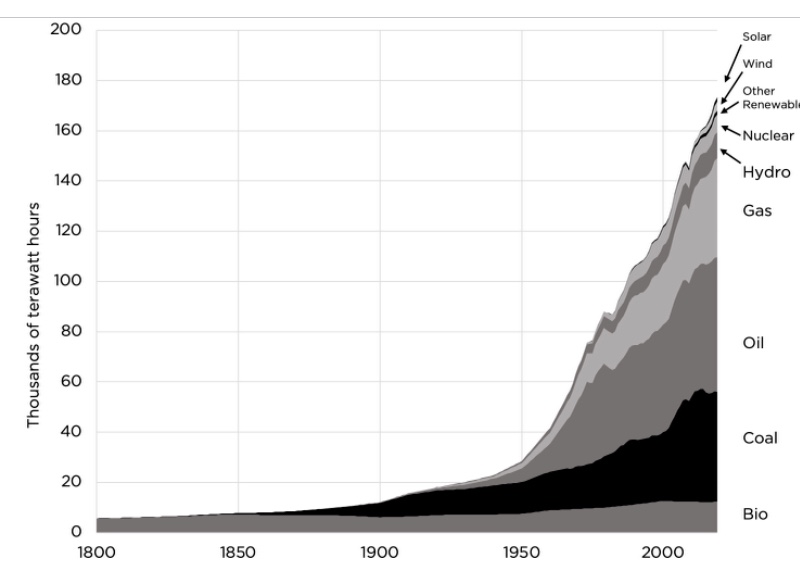
Fossil fuels are the source of cheap and reliable energy that have lifted humanity to an unprecedented level of prosperity. Fossil fuels have given a comfortable existence to billions of people, allowing them to rise out of poverty. This prosperity gives us the luxury of time to develop substitutes, not to mention much greater safety against the kind of weather extremes that have always been a fact of life. The world still gets 80% of its energy from fossil fuels. These fuels are truly a miracle, and we should not discard such valuable technologies prematurely. That forces huge long-term investments in inferior technologies that are likely to be superseded in the future by more economic refinements or even energy sources and methods now wholly unimagined. There are investors who will still wish to pursue those new technologies, perhaps with non pecuniary motives, and there are a few consumers who really want alternatives to fossil fuels.

Biden’s apparent hope that his aggressive climate agenda will be a great legacy of his presidency is at the root of his intransigence toward fossil fuels. His actions in this regard have had a profoundly negative psychological effect on the oil and gas industry. Steps such as cancellations of pipeline projects are immediately impactful in that regard, to say nothing of the supplies that would have ultimately flowed through those pipelines. These cancellations reinforce the message Biden’s been sending to the industry and its investors since his campaign: we mean to shut you down! Who wants to invest in new wells under those circumstances? Other actions have followed: no new federal oil and gas leases, methane restrictions, higher drilling fees on federal land, and a variety of climate change initiatives that bode ill for the industry, such as the SEC’s mandate on carbon disclosures and the Federal Reserve’s proposed role in policing climate impacts.

And now, Democrats are contemplating a move that would make gasoline even more scarce: price controls. As Don Boudreaux says in a recent letter to The Hill:

“Progressives incessantly threaten to tax and regulate carbon fuels into oblivion. These threats cannot but reduce investors’ willingness to fund each of the many steps – from exploration through refining to transporting gasoline to market – that are necessary to keep energy prices low. One reality reflected by today’s high prices at the pump is this hostility to carbon fuels generally and to petroleum especially. And gasoline price controls would only make matters worse by further reducing the attractiveness of investing in the petroleum industry: Why invest in bringing products to market if the prices at which you’re allowed to sell are dictated by grandstanding politicians?”

The kicker is that all these policies are futile in terms of their actual impact on global carbon concentrations, let alone their highly tenuous link to global temperatures. The policies are also severely regressive, inflicting disproportionate harm on the poor, who can least afford such an extravagant transition. Biden wants the country to sacrifice its standard of living in pursuit of these questionable goals, while major carbon-emitting nations like China and India essentially ignore the issue.

Half-Baked Substitution

Market intervention always has downsides to balance against the potential gains of “internalizing externalities”. In this case, the presumed negative externalities are imagined harms of catastrophic climate change from the use of fossil fuels; the presumed external benefits are the avoidance of carbon emissions and climate change via renewables and other “zero-carbon” technologies. With those harms and gains in question, it’s especially important to ask who loses. Taxpayers are certainly on that list. Users of energy produced with fossil fuels end up paying higher prices and are forced to conserve or submit to coerced conversion away from fossil fuels. Then there are the wider impediments to economic growth and, as noted above, the distributional consequences.

Users of immature or inferior energy alternatives might also end up as losers, and there are likely to be external costs associated with those technologies as well. It’s not widely appreciated that today’s so-called clean energy alternatives are plagued by their need to obtain certain minerals that are costly to extract in economic and environmental terms, not to mention highly carbon intensive. And when solar and wind facilities fail or reach the end of their useful lives, disposal creates another set of environmental hazards. In short, the loses imposed through forced internalization of highly uncertain externalities are all too real.

Unfortunately, the energy sources favored by the Administration fail to meet base-load power needs on windless and/or cloudy days. The intermittency of these key renewables means that other power sources, primarily fossil-fuel and nuclear capacity, must remain available to meet demand on an ongoing basis. That means the wind and solar cannot strictly replace fossil fuels and nuclear capacity unless we’re willing to tolerate severe outages. Growth in energy demand met by renewables must be matched by growth in backup capacity.

A call for “energy pragmatism” by Dan Ervin hinges on the use of coal to provide the “bridge to the energy future”, both because there remains a large amount of coal generating capacity and it can stabilize the grid given the intermittency of wind and solar. Ervin also bases his argument for coal on recent increases in the price of natural gas, though a reversal of the Biden EPA’s attacks on gas and coal, which Ervin acknowledges, would argue strongly in favor of natural gas as a pragmatic way forward.

Vehicle Mandates

The Administration has pushed mandates for electric vehicle (EV) production and sales, including subsidized charging stations. Of course, the power used by EVs is primarily generated by fossil fuels. Furthermore, rapid growth in EVs will put a tremendous additional strain on the electric grid, which renewables will not be able to relieve without additional backup capacity from fossil fuels and nuclear. This severely undermines the supposed environmental benefits of EVs.

Once again, mandates and subsidies are necessary because EV technology is not yet economic for most consumers. Those buyers don’t want to spend what’s necessary to purchase an EV, nor do they wish to suffer the inconveniences that re-charging often brings. This is a case in which policy is outrunning the ability of the underlying infrastructure required to support it. And while adoption of EVs is growing, it is still quite low (and see here).

Wising Up

Substitution into new inputs or technologies happens more rationally when prices accurately reflect true benefits and scarcities. The case for public subsidies and mandates in the push for a zero-carbon economy rests on model predictions of catastrophic global warming and a theoretical link between U.S. emissions and temperatures. Both links are weak and highly uncertain. What is certain is the efficiency of fossil fuels to power gains in human welfare.

This Bartley J. Madden quote sums up a philosophy of progress that is commendable for firms, and probably no less for public policymakers:

“Keep in mind that innovation is the key to sustainable progress that jointly delivers on financial performance and taking care of future generations through environmental improvements.”

Madden genuflects to the “sustainability” crowd, who otherwise don’t understand the importance of trusting markets to guide innovation. If we empower those who wish to crush private earnings from existing technologies, we concede the future to central planners, who are likely to choose poorly with respect to technology and timing. Let’s forego the coercive approach in favor of time, development, and voluntary adoption!

Projecting a Wobbly Stick

11 Friday Mar 2022

Posted by Nuetzel in Foreign Policy, National Security, War

≈ Leave a comment

Tags

Anthony Blinken, Biden Administration, Joe Biden, John Cochrane, NATO, Naval Blockade, No-Fly Zone, Nuclear Threat, Russia, Strategic Ambiguity, Trade Embargo, Ukraine, Vladimir Putin, WMDs, Xi Jinping

Why reveal your intentions when you don’t have to? That’s exactly what the Biden Administration did with respect to the question of a “no-fly zone” over Ukraine, and it might as well apply to all future incursions backed by wild threats from aggressor states possessing WMDs. This was another unforced error by Biden’s team and Secretary of State Anthony Blinken. John Cochrane writes that “strategic ambiguity” has real value in deterring an aggressor, but apparently our current leadership hasn’t thought that through. From Cochrane:

“Once again, the U.S. declares, publicly, ahead of time — ahead of the possible collapse of the Ukrainian government — what we will not do, and elevates it to a matter of principle.

Who else is listening? Well, Xi Jinping. And the Iranians. And the South Koreans, Japanese, Saudi Arabians, and more. …

We have just wrapped Taiwan up and delivered it to China.

Message to Iran: test one nuclear weapon. Invade Syria, Iraq, or whatever. The US will not respond. Message to others. Get nukes. Now.

This war isn’t just about Ukraine. It is about the kind of world we live in for the next generation.”

As Cochrane’s says, the U.S. and NATO calculated that supplying anti-tank and anti-aircraft weapons to Ukraine would not trigger Putin to make good on his larger threats. At the same time, the thinking is a no-fly zone is too chancy. It’s probably true, but there was no reason to say so. It could have and should have waited. It might have given Putin some pause, any instance of which could be of great value to the Ukrainians as they marshal their defense.

This kind of up-front pusillanimity more broadly undermines the credibility of other options we might wish to have against aggressors in the future, such as trade embargoes, naval blockades, or even conventional weapons. Nor do the particulars in this case limit the range of actions a future aggressor might make threats against. We’ve more or less revealed that whatever a future aggressor chooses to forbid, under the menace of some drastic reprisal, is off the table. Acquiescence is adopted as doctrine, and that is a huge blunder.

Chill-Out Advisory: Pandemic to Endemic Means Live Again

13 Sunday Feb 2022

Posted by Nuetzel in Pandemic, Public Health, Uncategorized

≈ Leave a comment

Tags

Acquired Immunity, Biden Administration, CDC, Child Risks, Covid-19, Covid-Like Symptoms, Covidestim.org, Delta Variant, EU Visits, HOLD2, Hope-Simpson Seasonal Pattern, Hospital Utilization, Hospitalizations, Incidental Infections, John Tierney, Lockdowns, Mask Efficacy, Natural Immunity, Omicron BA.1, Omicron BA.2, Omicron Variant, Our World In Data, Phil Kerpen, Staffed Beds, Teachers Unions, Tradeoffs, Transmissability, Vaccine Efficacy, Vaccine Risks, Virulence

We might be just be done with the coronavirus pandemic. That is, it appears to be transitioning to a more permanent endemic phase. What follows are a few details about the Omicron wave and its current status, an attempt to put the risks of Covid in perspective, and a few public policy lessons that are now gaining broad currency but should have been obvious long ago.

What’s The Status?

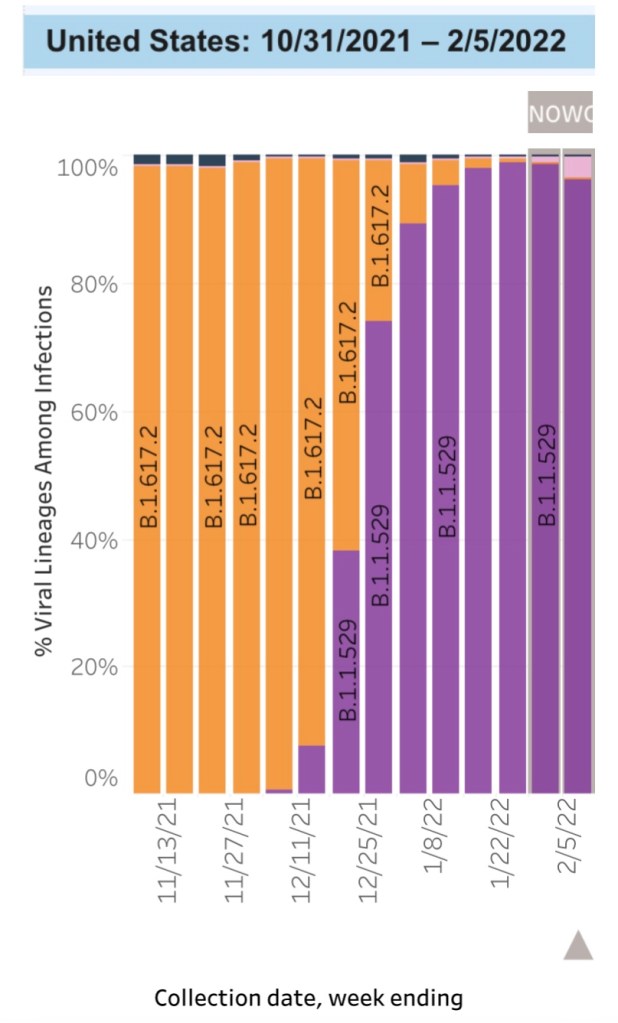
The Omicron variant became the dominant U.S. strain of the coronavirus in December. Omicron outcompeted Delta, which was very good news because Omicron is far less severe. The chart below (from the CDC Data Tracker site) shows Omicron’s rapid ascendance and displacement of the Delta variant. The orange bar segments represent the proportion of cases of the Delta strain, while the purple and pink segments are Omicron sub-variants known as BA.1 and BA.2, respectively. BA.2 is even more transmissible than BA.1 and is likely to become dominant over the next month or so. However, the BA.2 sub-variant appears to be far less virulent than Delta, like BA.1.

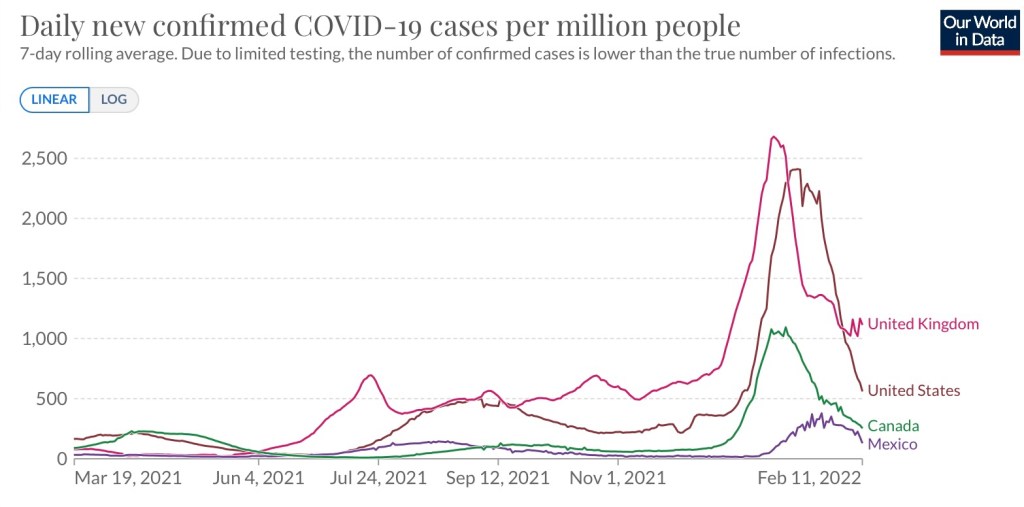
Despite a record number of infections over a period of a month or so, the Omicron wave is tapering just as rapidly as it ramped up, as the next chart demonstrates. In fact, covidestim.org shows that cases are now receding in all states, DC, and Puerto Rico. Here are new cases per million people from Our World in Data:

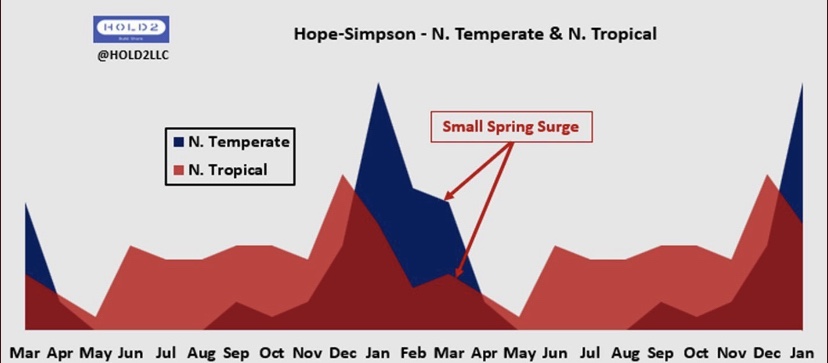
Whether BA.2 causes cases to plateau for a while, or even a secondary Omicron “wavelet”, is yet to be seen. That would be consistent with the normal Hope-Simpson seasonal pattern of viral prevalence in the northern hemisphere (hat tip: HOLD2):

Data problems make the Omicron wave difficult to assess, however. We don’t know the share of incidental infections for the U.S. as a whole, but more than half of hospitalized Covid patients in Massachusetts and Rhode Island are classified with incidental infections. The proportion in the UK is estimated to be rising and approaching 30% of total cases, with much higher percentages in many regions of England, as shown below.

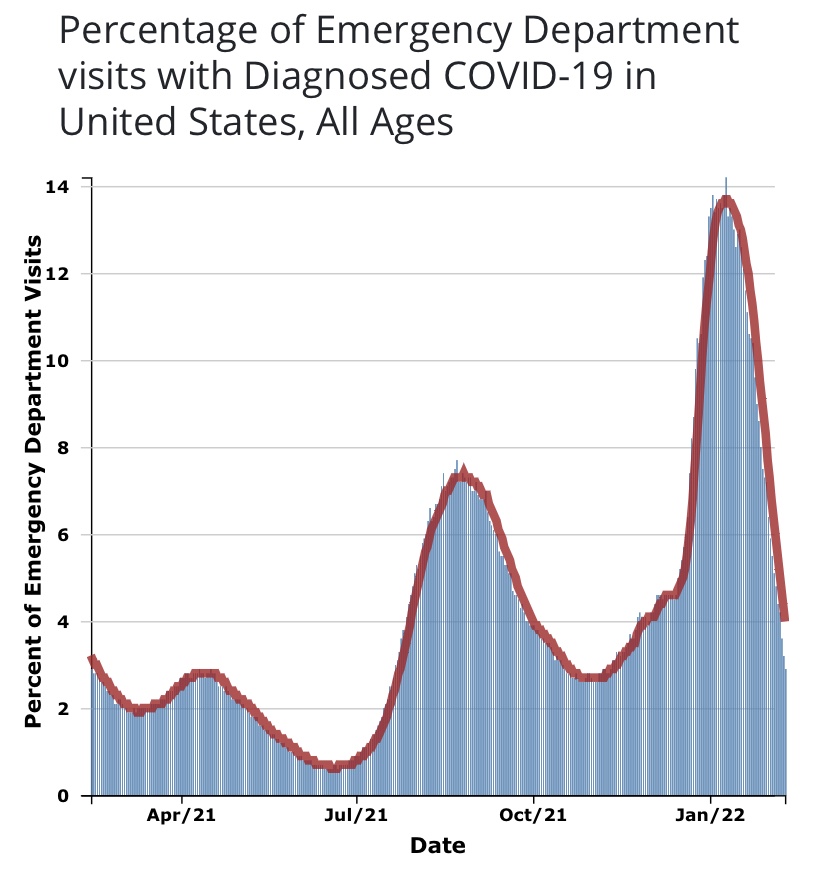
As I’ve emphasized in the past, case numbers should not be the primary gauge of the state of the pandemic, especially with a more highly contagious but relatively mild variant like Omicron. Hospitalizations are a better measure, but only if “incidental” infections are removed from the counts. That’s been acknowledged only recently by the public health establishment, and even the Biden Administration is emphasizing it as a matter of sheer political expediency. Another measure that might be more reliable for assessing the pandemic in the community as a whole is the number of emergency room patients presenting Covid-like symptoms. From the CDC Data Tracker:

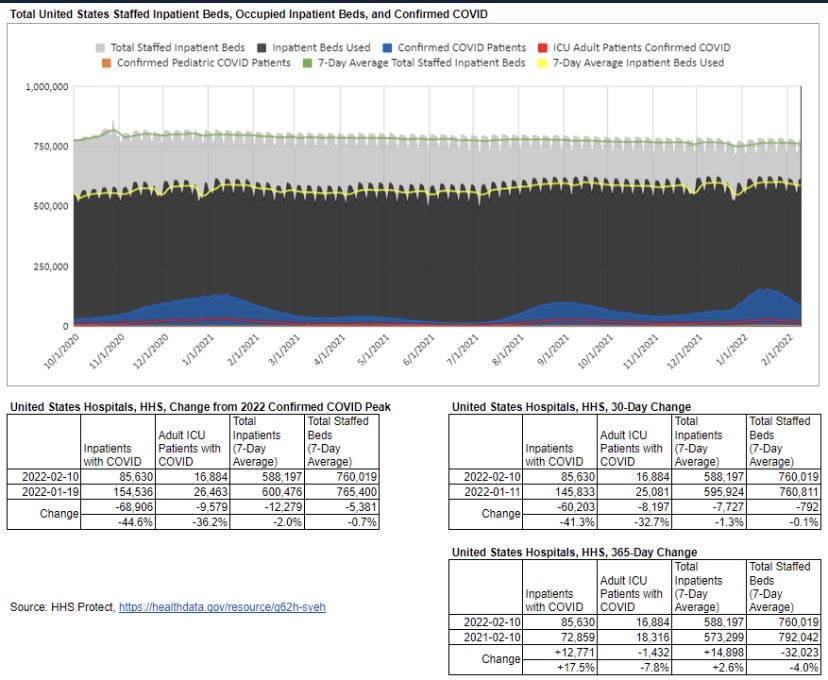
There is no doubt that incidental infections create complications in caring for patients with other ailments. That has a bearing on the utilization of hospital capacity. Generally, however, strains on hospital capacity during the pandemic have been greatly exaggerated. This is not to diminish the hard work and risks faced by health care workers, and there have been spot shortages of capacity in certain localities. However, in general, staffed beds have been more than adequate to meet needs. This chart, like a few others below, is courtesy of Phil Kerpen:

With the more highly transmissible variants we have now, it’s not at all surprising to see a high proportion of incidental cases among inpatients. Incidental infections are likely to inflate counts of Covid deaths as well, given the exceptional and odd way in which Covid deaths are being recorded. It will be some time until we see full U.S. data on cases and deaths net of incidental infections. Moreover, many of the Covid deaths in December and January were from lingering Delta infections, which might still be a factor in the February counts.

How Are Your Odds?

The mild or asymptomatic nature of most Omicron cases, the large proportion of incidental hospitalizations, and the knowledge that Omicron is not a deep respiratory threat should offer strong reassurance to healthy individuals that the variant does not pose a great risk. According to a recent CDC report, in a sample of almost 700,000 vaccinated individuals aged 65 or less without co-morbidities, there were no Covid fatalities or ICU admissions during the 10 months from December 2020 through October 2021. There was only one fatality in the sample of healthy individuals older than 65. There were just 36 fatalities across the full sample of over 1.2 million vaccinated individuals, so COVID’s fatality risk was only about 0.3%. Of those deaths, 28 were among those with four or more risk factors (including co-morbidities and > 65 years). And this was before the advent of Omicron!

I have a few doubts about the CDC’s sample selection and vagaries around certain definitions used. Nevertheless, the results are striking. However, the study did not address risks to unvaccinated adults. Another more limited CDC study found that vaccinated patients were still less likely than the unvaccinated to require critical care during the Omicron wave.

A separate CDC study found a 91% reduction in the likelihood of death for Omicron relative to Delta. A study from the UK (see summary here) found that Omicron cases were 59% less likely than Delta cases to require hospitalization and 69% less likely to result in death within 28 days of a positive test. Omicron was far less deadly among both the vaccinated and the unvaccinated, and the latter had a larger reduction in the likelihood of death. The study was stratified by age as well, with less severe outcomes for Omicron among older cohorts except in the case of death, for which there was no apparent age gradient.

Another unnecessarily contentious issue has been the risk to children during the pandemic. Based on the data, there should never have been much doubt that these risks are quite low. Apparently, however, it was advantageous for teachers’ unions to insist otherwise. Phil Kerpen soundly debunks that claim with the following chart:

Covid has been less deadly to children from infancy through 17 years than the pre-pandemic flu going back to 2012! Oh yes, but teachers FEAR transmission from the children! That claim is just as silly, since children are known to be inefficient transmitters of the virus (and see here).

Now that Omicron has relegated the Delta variant to the history books, the risks going forward seem much more manageable. Omicron is less severe, especially for the vaccinated. Levels of acquired (natural) immunity from earlier infections are now much higher against older strains, and Omicron infections seem to be protective against Delta.

In commentary about the first CDC study discussed above, John Tierney lends perspective to the odds of death from pre-Omicron Covid:

“Those are roughly the same odds that in the course of a year you will die in a fire, or that you’ll perish by falling down stairs. Going anywhere near automobiles is a bigger risk: you’re three times more likely during a given year to be killed while riding in a car, and also three times more likely to be a pedestrian casualty. The 150,000-to-1 odds of a Covid death are even longer than the odds over your lifetime of dying in an earthquake or being killed by lightning.”

Yet with all this research confirming the low odds of death induced by Omicron, why have we seen recent deaths at levels approaching previous waves? First, many of those deaths are carried over from Delta infections. That means deaths should begin to taper rapidly as February reports roll in. And remember that daily reports do not show deaths by date of death. Deaths usually occur weeks or even months before they are reported. That also means some of the deaths reported might be “harvested” from much earlier fatalities. Second, given the high levels of incidental Omicron infections, some of those deaths are misattributed to Covid, an issue that is not new by any means. Finally, while Omicron is relatively mild for most people, the high rate of transmission means that a high number of especially vulnerable individuals may be infected with severe outcomes. We have seen much more severe consequences for the unvaccinated, of course, and for those with co-morbidities.

Things We Should Have Known

I’ll try to keep this last section brief, but as an introduction I’ll just say that it’s almost as if we’ve been allowing the lunatics to run the asylum. To paraphrase one comment I saw recently, if you wonder why there is so much dissent, you ought to consider the fact the much of what our governments have done (along with many private organizations) was to prohibit things that were demonstrably safe (e.g., going outside, using swing sets, or attending schools) and to encourage things that were demonstrably harmful (e.g., deferring medical care, or masking small children).

The following facts are only now coming into focus among those who’ve been “following the politics” rather than “the science”, despite pretensions to the latter.

  • Specific public health initiatives often face steep economic, emotional, social, and countervailing health tradeoffs.
  • Lockdowns do NOT work.
  • Masks do NOT work (despite the CDC’s past and recent confusion on the matter).
  • Children are at very low-risk from Covid.
  • Children do NOT present high risks to teachers.
  • Natural immunity is more protective than vaccines.
  • Vaccines do NOT “stop the spread”.
  • Vaccine risks might outweigh benefits for certain groups and individuals.
  • Vaccines should NOT be relied upon at the expense of treatments.
  • Don’t reject treatments based on politics.
  • Vaccine mandates are unethical.

Grow Up and Chill Out!

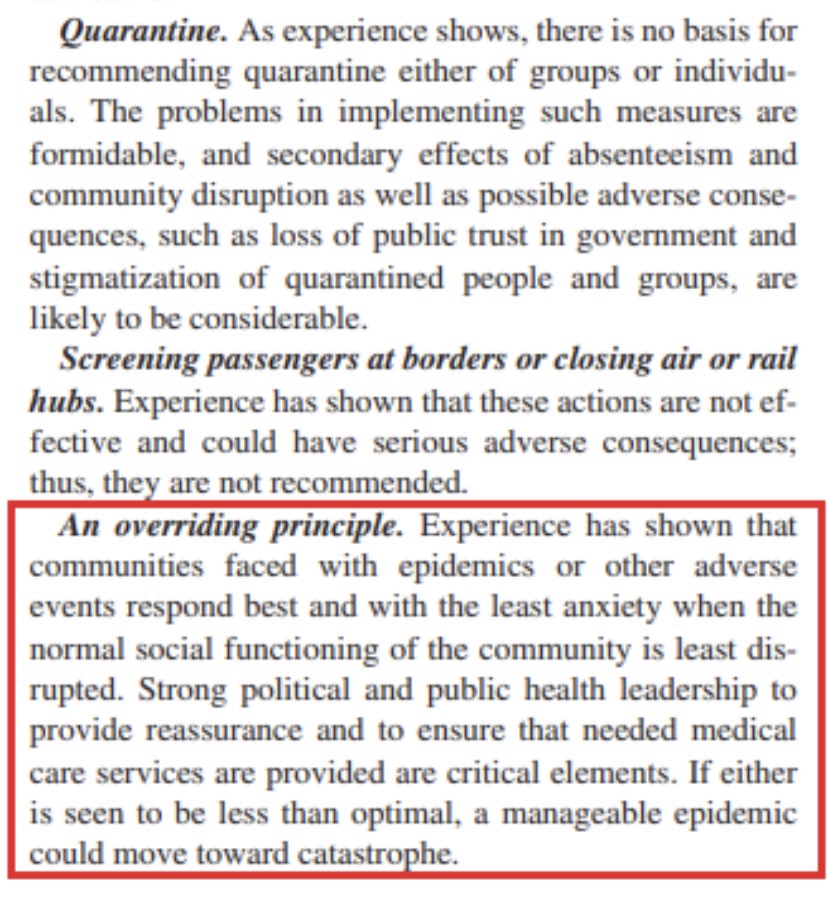
Life is full of risks, and nothing has changed to alter wisdom gained in earlier pandemics. For example, this pearl from a 2006 publication on disease mitigation measures should be heeded (hat tip: Phil Kerpen):

If there is one simple message everyone needs to hear, it is to stop allowing the virus bogeyman to rule your life. It will never go away completely, and it is likely to present risks that is are comparable to the flu going forward. In fact, it might well compete with the flu, which means we won’t be dealing with endemic Covid plus historical flu averages, but some smaller union of the two case loads.

So get out, go back to work, or go have some fun! Get back truckin’ on!

Inflation: The Leftist “Tax the Poor” Policy

23 Thursday Sep 2021

Posted by Nuetzel in Deficits, Inflation, Redistribution

≈ 2 Comments

Tags

Asymmetric Information, Bank of International Settlements, Biden Administration, budget deficits, Budget Reconcilation Bill, Claudio Bario, Confiscation, dependency, Federal Reserve, Fixed-Rate Debt, Inflation, infrastructure, Joe Biden, John Maynard Keynes, MMT, Moderm Monetary Theory, Money Illusion, Money Printing, Noah Smith, Patrick Horan, Redistribution, Regressive Tax, Scott Sumner, Social Infrastructure, Unexpected Inflation

Recent years have seen explosive growth in federal deficits along with growth rates in the money supply that would have made John Maynard Keynes blush. It’s no coincidence that a new school of thought has developed among certain “monetary economists”. But as someone trained in monetary economics, I wish I could make those quote marks larger. This new school of thought is known as Modern Monetary Theory (MMT), and it asserts that the money spigot is a perfectly legitimate means of financing government spending and, furthermore, that it is not necessarily inflationary. Here is how Scott Sumner and Patrick Horan describe MMT:

“A central idea of MMT is that a government that issues its own fiat currency can pay its bills in that same currency. These governments need not worry about budget deficits when contemplating additional spending. Thus because the US government has a monopoly on money creation, our federal government does not need to raise all its revenue through tax or bond finance. A government with its own currency cannot go bankrupt because it can always issue more currency to cover any budget deficit. … MMT advocates argue that this why the US government can afford expensive programs such as a jobs guarantee and universal healthcare.”

Spend and Print

Joe Biden’s $3.5 trillion “social infrastructure” package would be just a start, but that’s likely to be more like $5.5T once the budget gimmicks are stripped out. We can be somewhat hopeful, because that initiative looks increasingly likely to fail in Congress, at least this time around. But the tax side of that bill was already $2.6T short of the latter spending figure, and the tax provisions keep shrinking. Now, it’s looking more like a shortfall of $3.5T would require financing. Moderate Democrats may not support this crazy bill in the end, but Dems from deep blue states want to reinstate state and local tax deductibility, which would cut the tax component still more. Well who cares? Print the money, say the brave MMT advocates.

Sumner gets to the heart of the problem in this piece. Progressives, with false assurance from MMT, want loose monetary policy to make their expansive programs “affordable”. As he explains, if this happens while the economy is near its production potential, inflation is a sure thing. These lessons were learned long ago, but have been conveniently forgotten by the political class (or they simply prefer to ignore them), instead jumping onto the MMT bandwagon.

Inflation Is Taxation

No conscientious observer of government finance should ever forget that inflation is a form of taxation. Assets whose values are either fixed or subject to some inertia are devalued by inflation in terms of purchasing power, or in real terms, as economists put it. Strictly speaking, this is true when inflation is unexpected… if it is expected, then lenders and borrowers can negotiate terms that will compensate for these changes in real value. But when inflation is unexpected, the losses to lenders are offset by gains to borrowers. Of course the federal government is a gigantic borrower, so inflation can represent a confiscation of wealth from the public.

It’s not small potatoes. Currently, about $22T of U.S. Treasury debt is held by the public, and its average maturity is more than 5 years. If the Federal Reserve engineers an unexpected 1% jump in the rate of inflation, it shaves over $1T off the real value of that debt before it’s repaid, and it reduces the real interest cost of that debt as well. Of course, the holders of that debt will suffer an immediate loss if they are forced to sell prior to maturity for any reason, since new buyers will be demanding higher yields to compensate for higher inflation if it is expected to persist.

The Poor Losers

Inflation causes redistributions to take place, especially when it is unexpected inflation. We’ve already discussed lenders and borrowers, but similar considerations apply to anyone entering into fixed price contracts for goods or labor. Here’s what Claudio Bario of the Bank of International Settlements (BIS) has to say about these shifts:

“Inflation shifts income and wealth away from those who are least aware of it, or least able to protect against it. These segments of the population often coincide with lower-income groups, which explains why inflation has often been portrayed as a most regressive form of tax. The ‘inflation tax’ takes its toll through the erosion of the value of financial assets and contracts fixed in nominal terms.”

Inflation is a regressive tax! In this respect, economist Noah Smith echos Bario in a recent op-ed in which he discusses “money illusion”, or the confusion of real and nominal income:

“Workers … who are slow to perceive the rise in prices they pay for goods like cars and groceries, won’t realize this, and will be happy with their unusually large raises. But companies, whose accountants and managers certainly know the true inflation rate, will also be happy, because they know they’re not actually paying more for labor.

That information asymmetry between workers and employers may be exactly what keeps wages from rising faster than inflation. If workers take a year to realize how much prices have gone up, they may be satisfied with the raises they got during the time of high inflation — even if that inflation ultimately turns out to be transitory. By then, it might be too late to negotiate for a real, inflation-adjusted raise.”

Inflation taxes and redistributions become more acute at higher rates of inflation, but any unexpected escalation in the rate of inflation will take a toll on the poor. Bario elaborates on the mechanisms by which inflation inflicts budgetary pain on the those at the lower end of the socioeconomic spectrum.

“As regards wealth distribution, the financial assets that are most vulnerable to inflation are cash and bank accounts – the typical savings vehicles held by the poorest segments of the population. This is mostly because the poorest have access only to limited investment options to protect their savings. …

… wages and pensions – the main sources of income for a large majority of households and even more so for the poorest half of the population – are typically fixed in nominal terms and hence vulnerable to inflation. Indexation mechanisms, such as those adopted in many [advanced economies] in the 1970s, are no panacea: they may fail to keep pace as inflation accelerates; …”

In addition to the inflationary gains reaped by government, it’s clear that inflation gives rise to redistributions between private parties: generally from those with lower incomes and wealth to their employers, producers, financial institutions, and pension payers (businesses, state and local governments). An exception is some low income debtors might benefit if they owe long term obligations at fixed interest rates, but low income individuals are often constrained from obtaining this form of credit.

Causing, Then Exploiting, Inequality

Another especially galling aspect of the Left’s focus on money finance is how its consequences fly in the face of their concerns about income and wealth inequality. Inflation is typically manifested in rising equity prices: nominal stock values tend to escalate in an inflationary environment, protecting their owners from losses to the real value of their investments. Stocks are generally a good inflation hedge. Yet we know that stocks are disproportionately owned by those in the highest strata of the income and wealth distributions. Later, of course, the Left will seek to level the burgeoning inequality wrought by their own policies by “taxing the rich”! Apparently, for the Left, consistency is never considered a virtue. This is not unlike another trick, which is to blame “greedy corporations” for the inflation wrought by Leftist policies.

It’s a great irony that the Left, which purports to support the poor and working people, would propose a form of government finance that is so regressive in its effects. To be generous, perhaps it’s just another case of “progressives” unknowingly hurting the ones they love. The expansive programs they advocate will confer government benefits to many individuals in higher income brackets, not just the poor, but those government alms will help to compensate for higher inflation. But this too takes advantage of money illusion, because those benefits might well buy progressives the loyalty of beneficiaries unable to recognize the ongoing erosion in their standard of living, and who are unwilling to come to grips with their increasing dependency.

But Tut, Tut, They Say

Advocates of MMT, in combination with expansive government, also have a tendency to deny that inflation has ever been a consequence of such policies. As Sumner points out, they have forgotten historical episodes that run contrary to the theory, and most “popular” advocates of MMT fail to recognize the important role played by limits on the economy’s production potential. When money growth outruns the economy’s ability to produce real goods and services, the prices of goods will rise.

Infrastructure Or Infra-Stricture? The Democrats’ $3.5 Trillion Reconciliation Bill

16 Thursday Sep 2021

Posted by Nuetzel in Big Government, Central Planning, infrastructure, Uncategorized

≈ 3 Comments

Tags

Antonia Ocasio-Cortez, Bernie Sanders, Biden Administration, Budget Reconcilation Bill, Capital Gains, Civilian Climate Corps, Clean Energy, corporate income tax, dependency, Federal Reserve, Fossil fuels, Green Cards, infrastructure, Joe Manchin, Legal Permanent Residency, Paid Family Leave, Physical Investment, Productivity Growth, Social Infrastructure, Tax the Rich, Tragedy of the Commons, Universal Pre-School, Welfare State

The Socialist Party faithful once known as Democrats are pushing a $3.5 trillion piece of legislation they call an “infrastructure” bill. They hope to pass it via budget reconciliation rules with a simple majority in the Senate. The Dems came around to admitting that the bill is not about infrastructure in the sense in which we usually understand the term: physical installations like roads, bridges, sewer systems, power lines, canals, port facilities, and the like. These kinds of investments generally have a salutary impact on the nation’s productivity. Some “traditional” infrastructure, albeit with another hefty wallop of green subsidies, is covered in the $1.2 trillion “other” infrastructure bill already passed by the Senate but not the House. The reconciliation bill, however, addresses “social infrastructure”, which is to say it would authorize a massive expansion in the welfare state.

What Is Infrastructure?

Traditionally, public and private infrastructure are underlying assets that facilitate production or consumption in one way or another, consistent with the prefix “infra”, meaning below or within. For example, a new factory requires physical access by roads and/or rail, as well as sewer service, water, gas and/or electric supply. All of the underlying physical components that enable that factory to operate may be thought of as private infrastructure, which has largely private benefits. Therefore, it is often privately funded, though certainly not always.

Projects having many beneficiaries, such as highways, municipal sewers, water, gas and electrical trunk lines, canals, and ports may be classified as public infrastructure, though they can be provided and funded privately. Pure public infrastructure provides services that are non-rivalrous and non-excludable, but examples are sparse. Nevertheless, the greater the public nature of benefits, the greater the rationale for government involvement in their provision. In practice, a great deal of “public” infrastructure is funded by user fees. In fact, a failure to charge user fees for private benefits often leads to a tragedy of the commons, such as the overuse of free roads, imposing a heavier burden on taxpayers.

The use of the term “infrastructure” to describe forms of public support is not new, but the scope of government interventions to which the term is applied has mushroomed during the Biden Administration. Just about any spending program you can think of is likely to be labeled “infrastructure” by so-called progressives. The locution is borrowed somewhat questionably, seemingly motivated by the underlying structure of political incentives. More bluntly, it sounds good as a sales tactic!

$3.5 Trillion and Chains

Among other questionable items, the so-called budget reconciliation “infrastructure” bill allocates funds toward meeting:

“… the President’s climate change goals of 80% clean electricity and 50% economy-wide carbon emissions by 2030, while advancing environmental justice and American manufacturing. The framework would fund:
• Clean Energy Standard
• Clean Energy and Vehicle Tax Incentives
• Civilian Climate Corps
• Climate Smart Agriculture, Wildfire Prevention and Forestry
• Federal procurement of clean technologies
• Weatherization and Electrification of Buildings
• Clean Energy Accelerator
”

The resolution would also institute “methane reduction and polluter import fees”. Thus, we must be prepared for a complete reconfiguration of our energy sector toward a portfolio of immature and uneconomic technologies. This amounts to an economic straightjacket.

Next we have a series of generous programs and expansions that would encourage dependence on government:

“• Universal Pre-K for 3 and 4-year old children
• High quality and affordable Child Care
•
[free] Community College, HBCUs and MSIs, and Pell Grants
• Paid Family and Medical Leave
• Nutrition Assistance
• Affordable Housing
”

If anything, pre-school seems to have cognitive drawbacks for children. Several of these items, most obviously the family leave mandate, would entail significant regulatory and cost burdens on private businesses.

There are more generous provisions on the health care front, which are good for further increasing the federal government’s role in directing, regulating, and funding medical care:

“• new Dental, Vision, and Hearing benefit to Medicare
• Home and Community-Based Services expansion
• Extend the Affordable Care Act Expansion from the ARP
• Close the Medicaid “Coverage Gap” in the States that refused to expand
• Reduced patient spending on prescription drugs
”

Finally, we have a series of categories intended to “help workers and communities across the country recover from the COVID-19 pandemic and reverse trends of economic inequality.”

“• Housing Investments
• Innovation and R & D Upgrades
• American Manufacturing and Supply Chains Funding
• LPRs for Immigrants and Border Mangt. • Pro-Worker Incentives and Penalties
• Investment in Workers and Communities • Small Business Support

I might suggest that a recovery from the pandemic would be better served by getting the federal government out of everyone’s business. The list includes greater largess and more intrusions by the federal government. The fourth item above, grants of legal permanent residency (LPR) or green cards, would legalize up to 8 million immigrants, allowing them to qualify for a range of federal benefits. It would obviously legitimize otherwise illegal border crossings and prevent any possibility of eventual deportation.

Screwing the Pooch

How many of those measures really sound like infrastructure? This bill goes on for more than 10,000 pages, so the chance that lawmakers will have an opportunity to rationally assess all of its provisions is about nil! And the reconciliation bill doesn’t stop at $3.5T. There are a few budget gimmicks being leveraged that could add as much as $2T of non-infrastructure spending to the package. One cute trick is to add certain provisions affecting revenue or spending years from now in order to cut the bill’s stated price tag.

A number of the bill’s generous giveaways will have negative effects on productive incentives. It’s also clear that some items in the bill will supplement the far Left’s educational agenda, which is seeped in critical theory. And the bill will increase the dominance of the federal government over not only the private sector, but state and local sovereignty as well. This is another stage in the metastasis of the federal bureaucracy and the dependency fostered by the welfare state.

Taxing the Golden Goose

But here’s the really big rub: the whole mess has to be paid for. The flip side of our growing dependency on government is the huge obligation to fund it. Check this out:

“American ‘consumer units,’ as BLS calls them, spent a net total of $17,211.12 on taxes last year while spending only $16,839.89 on food, clothing, healthcare and entertainment combined,”

Democrats continue to dicker over the tax provisions of the bill, but the most recent iteration of their plan is to cover about $2.9 trillion of the cost via tax hikes. Naturally, the major emphasis is on penalizing corporations and “the rich”. The latest plan includes:

  • increasing the corporate income tax from 21% to 26.8%;
  • increasing the top tax rate on capital gains from 20% to 25%;
  • an increase in the tax rate for incomes greater than $400,000 ($450,000 if married filing jointly)
  • adding a 3% tax surcharge for those with adjusted gross incomes in excess of $5 million;
  • Higher taxes on tobacco and nicotine products;
  • halving the estate and gift tax exemption;
  • limiting deductions for executive compensation;
  • changes in rules for carried interest and crypto assets.

There are a few offsets, including the promise of tax reductions for individuals earning less than $200,000 and businesses earning less than $400,000. We’ll see about that. Those cuts would expire by 2027, which reduces their “cost” to the government, but it will be controversial when the time comes.

The Dem sell job includes the notion that corporate income belongs to the “rich”, but as I’ve noted before, the burden of the corporate income tax falls largely on corporate workers and consumers. Lower wages and higher prices are almost sure to follow. This would deepen the blade of the Democrats’ political hari-kari, but they pin their hopes on the power of alms. Once bestowed, however, those will be difficult if not impossible to revoke, and the Dems know this all too well.

The assault on the “rich” in the reconciliation bill is both ill-advised and unlikely to yield the levels of revenue projected by Democrats. Like it or not, the wealthy provide the capital for most productive investment. Taxing their returns and their wealth more heavily can only reduce incentive to do so. Those investors will seek out more tax-advantaged uses for their funds. That includes investments in non-productive but federally-subsidized alternatives. Capital gains can often be deferred, of course. These penalties also ensure that more resources will be consumed in compliance and tax-avoidance efforts. The solutions offered by armies of accountants and tax attorneys will tend to direct funds to uses that are suboptimal in terms of growth in economic capacity.

What isn’t funded by new taxes will be borrowed by the federal government or simply printed by the Federal Reserve. Thus, the federal government will not only compete with the private sector for additional resources, but the monetary authority will provide fuel for more inflation.

Fracturing Support?

Fortunately, a few moderate Democrats in both the House and the Senate are balking at the exorbitance of the reconciliation bill. Senator Joe Manchin of West Virginia has said he would like to see a package of no more than $1.5 trillion. That still represents a huge expansion of government, but at least Manchin has offered a whiff of sanity. Equally welcome are threats from radical Democrats like Senator Bernie Sanders and Rep. Antonia Ocasio-Cortez that a failure to pass the full reconciliation package will mean a loss of their support for the original $1.2 trillion infrastructure bill, much of which is wasteful. We should be so lucky! But that’s a lot of pork for politicians to walk away from.

Infra-Shackles

The so-called infrastructure investments in the reconciliation bill represent a range of constraints on economic growth and consumer well being. Increasing the government’s dominance is never a good prescription for productivity, whether due to regulatory and compliance costs, bureaucratization of decision-making, minimizing the role of price signals, pure waste through bad incentives and graft, and public vs. private competition for resources. The destructive tax incentives for funding the bill are an additional layer of constraints on growth. Let’s hope the moderate Democrats hold firm, or even better, that the tantrum-prone radical Democrats are forced to make good on their threats.

Vax Results, Biden Boosters, Delta, and the Mask Charade

19 Thursday Aug 2021

Posted by Nuetzel in Coronavirus, Public Health, Uncategorized, Vaccinations

≈ Leave a comment

Tags

Aerosols, Antibody Response, Biden Administration, Case Counts, City Journal, Covid-19, Delta Variant, Follow the Science, Hope-Simpson, Hospitalizations, Israeli Vaccinations, Jeffrey H. Anderson, Jeffrey Morris, Mask Mandates, Moderna, mRNA Vaccines, Pfizer, Randomized Control Trials, Reproduction Rates, The American Reveille, Transmissability, Vaccinations, Vaccine Efficacy

If this post has an overarching theme, it might be “just relax”! That goes especially for those inclined to prescribe behavioral rules for others. People can assess risks for themselves, though it helps when empirical information is presented without bias. With that brief diatribe, here are a few follow-ups on COVID vaccines, the Delta wave, and the ongoing “mask charade”.

Israeli Vax Protection

Here is Jeffrey Morris’ very good exposition as to why the Israeli reports of COVID vaccine inefficacy are false. First, he shows the kind of raw data we’ve been hearing about for weeks: almost 60% of the country’s severe cases are in vaccinated individuals. This is the origin of the claim that the vaccines don’t work. 

Next, Morris notes that 80% of the Israeli population 12 years and older are vaccinated (predominantly if not exclusively with the Pfizer vaccine). This causes a distortion that can be controlled by normalizing the case counts relative to the total populations of the vaccinated and unvaccinated subgroups. Doing so shows that the unvaccinated are 3.1 times more likely to have contracted a severe case than the vaccinated. Said a different way, this shows that the vaccines are 67.5% effective in preventing severe disease. But that’s not the full story!

Morris goes on to show case rates in different age strata. For those older than 50 (over 90% of whom are vaccinated and who have more co-morbidities), there are 23.6 times more severe cases among the unvaccinated than the vaccinated. That yields an efficacy rate of 85.2%. Vaccine efficacy is even better in the younger age group: 91.8%. 

These statistics pertain to the Delta variant. However, it’s true they are lower than the 95% efficacy rate achieved in the Pfizer trials. Is Pfizer’s efficacy beginning to fade? That’s possible, but this is just one set of results and declining efficacy has not been proven. Israel’s vaccination program got off to a fast start, so the vaccinated population has had more time for efficacy to decay than in most countries. And as I discussed in an earlier post, there are reasons to think that the vaccines are still highly protective after a minimum of seven months.

Biden Boosters

IIn the meantime, the Biden Administration has recommended that booster shots be delivered eight months after original vaccinations. There is empirical evidence that boosters of similar mRNA vaccine (Pfizer and Moderna) might not be a sound approach, both due to side effects and because additional doses might reduce the “breadth” of the antibody response. We’ll soon know whether the first two jabs are effective after eight months, and my bet is that will be the case.

Is Delta Cresting?

Meanwhile, the course of this summer’s Delta wave appears to be turning a corner. The surge in cases has a seasonal component, mimicking the summer 2020 wave as well as the typical Hope-Simpson pattern, in which large viral waves peak in mid-winter but more muted waves occur in low- to mid-latitudes during the summer months.

Therefore, we might expect to see a late-summer decline in new cases. There are now 21 states with COVID estimated reproduction rates less than one (this might change by the time you see the charts at the link). In other words, each new infected person transmits to an average of less than one other person, which shows that case growth may be near or beyond a peak. Another 16 states have reproduction rates approaching or very close to one. This is promising.

Maskholes

Finally, I’m frustrated as a resident of a county where certain government officials are bound and determined to impose a mask mandate, though they have been slowed by a court challenge. The “science” does NOT support such a measure: masks have not been shown to mitigate the spread of the virus, and they cannot stop penetration of aerosols in either direction. This recent article in City Journal by Jeffrey H. Anderson is perhaps the most thorough treatment I’ve seen on the effectiveness of masks. Anderson makes this remark about the scientific case made by mask proponents:

“Mask supporters often claim that we have no choice but to rely on observational studies instead of RCTs [randomized control trials], because RCTs cannot tell us whether masks work or not. But what they really mean is that they don’t like what the RCTs show.”

Oh, how well I remember the “follow-the-science” crowd insisting last year that only RCTs could be trusted when it came to evaluating certain COVID treatments. In any case, the observational studies on masks are quite mixed and by no means offer unequivocal support for masking. 

A further consideration is that masks can act to convert droplets to aerosols, which are highly efficient vehicles of transmission. The mask debate is even more absurd when it comes to school children, who are at almost zero risk of severe COVID infection (also see here), and for whom masks are highly prone to cause developmental complications.

Closing Thoughts

The vaccines are still effective. Data purporting to show otherwise fails to account for the most obvious of confounding influences: vaccination rates and age effects. In fact, the Biden Administration has made a rather arbitrary decision about the durability of vaccine effects by recommending booster shots after eight months. The highly transmissible Delta variant has struck quickly but the wave now shows signs of cresting, though that is no guarantee for the fall and winter season. However, Delta cases have been much less severe on average than earlier variants. Masks did nothing to protect us from those waves, and they won’t protect us now. I, for one, won’t wear one if I can avoid it.

The Futility and Falsehoods of Climate Heroics

01 Tuesday Jun 2021

Posted by Nuetzel in Climate science, Environmental Fascism, Global Warming, Uncategorized

≈ Leave a comment

Tags

Atmospheric Carbon, Biden Administration, Carbon forcing, Carbon Mitigation, Climate Change, Climate Sensitivity, ExxonMobil, Fossil fuels, global warming, Green Energy, Greenhouse Gas, IPPC, John Kerry, Judith Curry, Natural Gas, Netherlands Climate Act, Nic Lewis, Nuclear power, Putty-Clay Technology, Renewables, Ross McKitrick, Royal Dutch Shell, Social Cost of Carbon, William Nordhaus

The world’s gone far astray in attempts to battle climate change through forced reductions in carbon emissions. Last Wednesday, in an outrageously stupid ruling,a Dutch court ordered Royal Dutch Shell to reduce its emissions by 45% by 2030 relative to 2019 levels. It has nothing to do with Shell’s historical record on the environment. Rather, the Court said Shell’s existing climate action plans did not meet “the company’s own responsibility for achieving a CO2 reduction.” The decision will be appealed, but it appears that “industry agreements” under the Netherlands’ Climate Act of 2019 are in dispute.

Later that same day, a shareholder dissident group supporting corporate action on climate change won at least two ExxonMobil board seats. And then we have the story of John Kerry’s effort to stop major banks from lending to the fossil fuel industry. Together with the Biden Administration’s other actions on energy policy, we are witnessing the greatest attack on conventional power sources in history, and we’ll all pay dearly for it. 

The Central Planner’s Conceit

Technological advance is a great thing, and we’ve seen it in the development of safe nuclear power generation, but the environmental left has successfully placed roadblocks in the way of its deployment. Instead, they favor the mandated adoption of what amount to beta versions of technologies that might never be economic and create extreme environmental hazards of their own (see here, here, here, and here). To private adopters, green energy installations are often subsidized by the government, disguising their underlying inefficiencies. These premature beta versions are then embedded in our base of productive capital and often remain even as they are made obsolete by subsequent advances. The “putty-clay” nature of technology decisions should caution us against premature adoptions of this kind. This is just one of the many curses of central planning.

Not only have our leftist planners forced the deployment of inferior technologies: they are actively seeking to bring more viable alternatives to ruination. I mentioned nuclear power and even natural gas offer a path for reducing carbon emissions, yet climate alarmists wage war against it as much as other fossil fuels. We have Kerry’s plot to deny funding for the fossil fuel industry and even activist “woke” investors, attempting to override management expertise and divert internal resources to green energy. It’s not as if renewable energy sources are not already part of these energy firms’ development portfolios. Allocations of capital and staff to these projects are usually dependent upon a company’s professional and technical expertise, market forces, and (less propitiously) incentives decreed by the government. Yet, the activist investors are there to impose their will.

Placing Faith and Fate In Models

All these attempts to remake our energy complex and the economy are based on the presumed external costs associated with carbon emissions. Those costs, and the potential savings achievable through the mitigation efforts of government and private greenies around the globe, have been wildly exaggerated.

The first thing to understand about the climate “science” relied upon by the environmental left is that it is almost exclusively model-dependent. In other words, it is based on mathematical relationships specified by the researchers. Their projections depend on those specs, the selection of parameter values, and the scenarios to which they are subjected. The models are usually calibrated to be roughly consistent with outcomes over some historical time period, but as modelers in almost any field can attest, that is not hard to do. It’s still possible to produce extreme results out-of-sample. The point is that these models are generally not estimated statistically from a lengthy sample of historical data. Even when sound statistical methodologies are employed, the samples are blinkingly short on climatological timescales. That means they are highly sample-specific and likely to propagate large errors out-of-sample. But most of these are what might be called “toy models” specified by the researcher. And what are often billed as “findings” are merely projections based on scenarios that are themselves manufactured by imaginative climate “researchers” cum grant-seeking partisans. In fact, it’s much worse than that because even historical climate data is subject to manipulation, but that’s a topic for another day.

Key Assumptions

What follows are basic components of the climate apocalypse narrative as supported by “the science” of man-made or anthropomorphic global warming (AGW):

(A) The first kind of model output to consider is the increase in atmospheric carbon concentration over time, measured in parts per million (PPM). This is a function of many natural processes, including volcanism and other kinds of outgassing from oceans and decomposing biomass, as well absorption by carbon sinks like vegetation and various geological materials. But the primary focus is human carbon generating activity, which depends on the carbon-intensity of production technology. As Ross McKitrick shows (see chart below), projections from these kinds of models have demonstrated significant upside bias over the years. Whether that is because of slower than expected economic growth, unexpected technological efficiencies, an increase in the service-orientation of economic activity worldwide, or feedback from carbon-induced greening or other processes, most of the models have over-predicted atmospheric carbon PPM. Those errors tend to increase with the passage of time, of course.

(B) Most of the models promoted by climate alarmists are carbon forcing models, meaning that carbon emissions are the primary driver of global temperatures and other phenomena like storm strength and increases in sea level. With increases in carbon concentration predicted by the models in (A) above, the next stage of models predicts that temperatures must rise. But the models tend to run “hot.” This chart shows the mean of several prominent global temperature series contrasted with 1990 projections from the Intergovernmental Panel on Climate Change (IPCC).

The following is even more revealing, as it shows the dispersion of various model runs relative to three different global temperature series:

And here’s another, which is a more “stylized” view, showing ranges of predictions. The gaps show errors of fairly large magnitude relative to the mean trend of actual temperatures of 0.11 degrees Celsius per decade.

(C) Climate sensitivity to “radiative forcing” is a key assumption underlying all of the forecasts of AGW. A simple explanation is that a stronger greenhouse effect, and increases in the atmosphere’s carbon concentration, cause more solar energy to be “trapped” within our “greenhouse,” and less is radiated back into space. Climate sensitivity is usually measured in degrees Celsius relative to a doubling of atmospheric carbon. 

And how large is the climate’s sensitivity to a doubling of carbon PPM? The IPCC says it’s in a range of 1.5C to 4.5C. However, findings published by Nic Lewis and Judith Curry are close to the low end of that range, and are those found by the author of the paper described here. 

In separate efforts, Finnish and Japanese researchers have asserted that the primary cause of recent warming is an increase in low cloud cover, which the Japanese team attributes to increases in the Earth’s bombardment by cosmic rays due to a weakening magnetic field. The Finnish authors note that most of the models used by the climate establishment ignore cloud formation, an omission they believe leads to a massive overstatement (10x) of sensitivity to carbon forcings. Furthermore, they assert that carbon forcings are mainly attributable to ocean discharge as opposed to human activity.

(D) Estimates of the Social Cost of Carbon (SCC) per ton of emissions are used as a rationale for carbon abatement efforts. The SCC was pioneered by economist William Nordhaus in the 1990s, and today there are a number of prominent models that produce distributions of possible SCC values, which tend to have high dispersion and extremely long upper tails. Of course, the highest estimates are driven by the same assumptions about extreme climate sensitivities discussed above. The Biden Administration is using an SCC of $51 per ton. Some recommend the adoption of even higher values for regulatory purposes in order to achieve net-zero emissions at an early date, revealing the manipulative purposes to which the SCC concept is put. This is a raw attempt to usurp economic power, not any sort of exercise in optimization, as this admission from a “climate expert” shows. In the midst of a barrage of false climate propaganda (hurricanes! wildfires!), he tells 60 Minutes that an acceptable limit on warming of 1.5C is just a number they “chose” as a “tipping point.”

As a measurement exercise, more realistic climate sensitivities yield much lower SCCs. McKitrick presents a chart from Lewis-Curry comparing their estimates of the SCC at lower climate sensitivities to an average of earlier estimates used by IPCC:

High levels of the SCC are used as a rationale for high-cost carbon abatement efforts. If the SCC is overstated, however, then costly abatements represent waste. And there is no guarantee that spending an amount on abatements equal to the SCC will eliminate the presumed cost of a ton’s worth of anthropomorphic warming. Again, there are strong reasons to believe that the warming experienced over the past several decades has had multiple causes, and human carbon emissions might have played a relatively minor role. 

Crisis Is King

Some people just aren’t happy unless they have a crisis over which to harangue the rest of us. But try as they might, the vast resources dedicated to carbon reduction are largely wasted. I hesitate to say their effort is quixotic because they want more windmills and are completely lacking in gallantry. As McKitrick notes, it takes many years for abatement to have a meaningful impact on carbon concentrations, and since emissions mix globally, unilateral efforts are practically worthless. Worse yet, the resource costs of abatement and lost economic growth are unacceptable, especially when some of the most promising alternative sources of “clean” energy are dismissed by activists. So we forego economic growth, rush to adopt immature energy alternatives, and make very little progress toward the stated goals of the climate alarmists.

Joe Biden’s Fat Cooked-Goose Tax Plan

03 Saturday Apr 2021

Posted by Nuetzel in Fiscal policy, Taxes

≈ Leave a comment

Tags

Biden Administration, CARES Act, corporate taxes, Double Taxation, infrastructure, Justin Wolfers, Loopholes, OECD, Offshoring, Pandemic, Pass-Through Income, Phil Kerpen, Renewable Energy Credits, Research and DEvelopment, Statutory Rates, Tax Foundation

I recently wrote on this blog about the damaging impact of corporate taxes on workers, consumers, and U.S. competitiveness. Phil Kerpen tweeted the chart above showing the dramatic reduction in the distribution of corporate tax rates across the world from 1980 through 2020. Yes, yes, Joe Biden’s posture as a fair and sensible leader aside, most countries place great emphasis on their treatment of business income and their standing relative to trading partners.

Kerpen’s tweet was a response to this tweet by economist Justin Wolfers:

Apparently, Wolfers wishes to emphasize that Biden’s plan, which raises the statutory corporate rate from 21% to 28%, does not take the rate up to the level of the pre-Trump era. Fair enough, but compare Wolfers’ chart with Kerpen’s (from the Tax Foundation) and note that it would still put the U.S. in the upper part of the international distribution without even considering the increment from state corporate tax rates. Also note that the U.S. was near the top of the distribution in 1980, 2000, and 2010. In fact, the U.S. had the fourth highest corporate tax rate in the world in 2017, before Trump’s tax package took effect. Perhaps Biden’s proposed rate won’t be the fourth highest in the world, but it will certainly worsen incentives for domestic U.S. investment, the outlook for wage growth, and consumer prices.

And in the same thread, Wolfers said this:

That’s certainly true, but let’s talk about those “loopholes”. First, much of U.S. corporate income is “passed though” to the returns of individual owners, so corporate taxes understate the true rate of tax paid on corporate income. Let’s also remember that the corporate tax represents a double taxation of income, and as a matter of tax efficiency it would be beneficial to consolidate these taxes on individual returns.

Beyond those consideration, the repeal of any corporate tax deduction or credit would have its own set of pros and cons. As long as there is a separate tax on corporate income, there is an economic rationale for most so-called “loopholes”. Does Wolfers refer to research and development tax credits? Maybe he means deductions on certain forms of compensation, though it’s hard to rationalize treating any form of employee compensation as income taxable to the business. Then there are the massive tax subsidies extended for investments in renewable energy. Well, good for Wolfers if that last one is his gripe! The CARES Act of 2020 allowed publicly-traded companies to use losses in 2020( presumably induced by the pandemic) to offset income in prior years, rather than carrying them forward. Did Wolfers believe that to be inappropriate? I might object to that too, to the extent that the measure allows declining firms to use COVID to cloak inefficiencies. Does he mean the offshoring of income to avoid U.S. corporate taxes? Might that be related to relative tax rates?

In any case, Wolfers can’t possibly imagine that the U.S. is the only country allowing a variety of expenses to be deducted against corporate income, or credits against tax bills for various activities. So, a comparison of statutory tax rates is probably a good place to start in assessing the competitive thrust of tax policy. But effective tax rates can reveal much more about the full impact of tax policy. In 2011, a study showed that the U.S. had the second highest effective corporate tax rate in the world. Today, among developed countries, the OECD puts the U.S. roughly in the middle of the pack, close to Germany but higher than Canada, Mexico and Japan, and lower than the UK. This article from 2019 reaches the same conclusion, though the rankings and rates differ from the OECD’s calculations. So it’s not as if the U.S. is the only country to offer tax incentives, or “loopholes” in Wolfers’ preferred terminology.

The corporate tax hikes proposed by the Biden Administration are intended to fund the massive outlays in the so-called infrastucture bill, which of course has very little to do with real infrastructure. Both the tax and spending proposals are bad policy. So far, however, passage of the bill is not a given. Let’s hope all of the Republicans and at least one Democrat senator have the sense to vote it down, but I’m not optimistic. The best hope for resistance among Democrats is Joe Manchin of West Virginia, but even he has signaled his support. Biden’s appointment of Gayle Manchin to a key administration post couldn’t have hurt.

← Older posts
Follow Sacred Cow Chips on WordPress.com

Recent Posts

  • Immigration and Merit As Fiscal Propositions
  • Tariff “Dividend” From An Indigent State
  • Almost Looks Like the Fed Has a 3% Inflation Target
  • Government Malpractice Breeds Health Care Havoc
  • A Tax On Imports Takes a Toll on Exports

Archives

  • December 2025
  • November 2025
  • October 2025
  • September 2025
  • August 2025
  • July 2025
  • June 2025
  • May 2025
  • April 2025
  • March 2025
  • February 2025
  • January 2025
  • December 2024
  • November 2024
  • October 2024
  • September 2024
  • August 2024
  • July 2024
  • June 2024
  • May 2024
  • April 2024
  • March 2024
  • February 2024
  • January 2024
  • December 2023
  • November 2023
  • August 2023
  • July 2023
  • June 2023
  • May 2023
  • April 2023
  • March 2023
  • February 2023
  • January 2023
  • December 2022
  • November 2022
  • October 2022
  • September 2022
  • August 2022
  • July 2022
  • June 2022
  • May 2022
  • April 2022
  • March 2022
  • February 2022
  • January 2022
  • December 2021
  • November 2021
  • October 2021
  • September 2021
  • August 2021
  • July 2021
  • June 2021
  • May 2021
  • April 2021
  • March 2021
  • February 2021
  • January 2021
  • December 2020
  • November 2020
  • October 2020
  • September 2020
  • August 2020
  • July 2020
  • June 2020
  • May 2020
  • April 2020
  • March 2020
  • February 2020
  • January 2020
  • December 2019
  • November 2019
  • October 2019
  • September 2019
  • August 2019
  • July 2019
  • June 2019
  • May 2019
  • April 2019
  • March 2019
  • February 2019
  • January 2019
  • December 2018
  • November 2018
  • October 2018
  • September 2018
  • August 2018
  • July 2018
  • June 2018
  • May 2018
  • April 2018
  • March 2018
  • February 2018
  • January 2018
  • December 2017
  • November 2017
  • October 2017
  • September 2017
  • August 2017
  • July 2017
  • June 2017
  • May 2017
  • April 2017
  • March 2017
  • February 2017
  • January 2017
  • December 2016
  • November 2016
  • October 2016
  • September 2016
  • August 2016
  • July 2016
  • June 2016
  • May 2016
  • April 2016
  • March 2016
  • February 2016
  • January 2016
  • December 2015
  • November 2015
  • October 2015
  • September 2015
  • August 2015
  • July 2015
  • June 2015
  • May 2015
  • April 2015
  • March 2015
  • February 2015
  • January 2015
  • December 2014
  • November 2014
  • October 2014
  • September 2014
  • August 2014
  • July 2014
  • June 2014
  • May 2014
  • April 2014
  • March 2014

Blogs I Follow

  • Passive Income Kickstart
  • OnlyFinance.net
  • TLC Cholesterol
  • Nintil
  • kendunning.net
  • DCWhispers.com
  • Hoong-Wai in the UK
  • Marginal REVOLUTION
  • Stlouis
  • Watts Up With That?
  • Aussie Nationalist Blog
  • American Elephants
  • The View from Alexandria
  • The Gymnasium
  • A Force for Good
  • Notes On Liberty
  • troymo
  • SUNDAY BLOG Stephanie Sievers
  • Miss Lou Acquiring Lore
  • Your Well Wisher Program
  • Objectivism In Depth
  • RobotEnomics
  • Orderstatistic
  • Paradigm Library
  • Scattered Showers and Quicksand

Blog at WordPress.com.

Passive Income Kickstart

OnlyFinance.net

TLC Cholesterol

Nintil

To estimate, compare, distinguish, discuss, and trace to its principal sources everything

kendunning.net

The Future is Ours to Create

DCWhispers.com

Hoong-Wai in the UK

A Commonwealth immigrant's perspective on the UK's public arena.

Marginal REVOLUTION

Small Steps Toward A Much Better World

Stlouis

Watts Up With That?

The world's most viewed site on global warming and climate change

Aussie Nationalist Blog

Commentary from a Paleoconservative and Nationalist perspective

American Elephants

Defending Life, Liberty and the Pursuit of Happiness

The View from Alexandria

In advanced civilizations the period loosely called Alexandrian is usually associated with flexible morals, perfunctory religion, populist standards and cosmopolitan tastes, feminism, exotic cults, and the rapid turnover of high and low fads---in short, a falling away (which is all that decadence means) from the strictness of traditional rules, embodied in character and inforced from within. -- Jacques Barzun

The Gymnasium

A place for reason, politics, economics, and faith steeped in the classical liberal tradition

A Force for Good

How economics, morality, and markets combine

Notes On Liberty

Spontaneous thoughts on a humble creed

troymo

SUNDAY BLOG Stephanie Sievers

Escaping the everyday life with photographs from my travels

Miss Lou Acquiring Lore

Gallery of Life...

Your Well Wisher Program

Attempt to solve commonly known problems…

Objectivism In Depth

Exploring Ayn Rand's revolutionary philosophy.

RobotEnomics

(A)n (I)ntelligent Future

Orderstatistic

Economics, chess and anything else on my mind.

Paradigm Library

OODA Looping

Scattered Showers and Quicksand

Musings on science, investing, finance, economics, politics, and probably fly fishing.

  • Subscribe Subscribed
    • Sacred Cow Chips
    • Join 128 other subscribers
    • Already have a WordPress.com account? Log in now.
    • Sacred Cow Chips
    • Subscribe Subscribed
    • Sign up
    • Log in
    • Report this content
    • View site in Reader
    • Manage subscriptions
    • Collapse this bar
 

Loading Comments...