• About

Sacred Cow Chips

Sacred Cow Chips

Tag Archives: John Cochrane

ESG Scoring: Political Tool Disguised as Investment Guide

30 Wednesday Mar 2022

Posted by Nuetzel in Capital Markets, Corporatism, Environmental Fascism, Social Justice

≈ 3 Comments

Tags

Access to Capital, Antitrust, Blackrock, Climate Action 100+, Corporatism, Diversity, Equity, ESG Fees, ESG Scores, Great Reset, Green Energy, Inclusion, John Cochrane, Mark Brnovich, Principal-Agent Problem, Renewable energy, Renewables, rent seeking, Shareholder Value, Social Justice, Stakeholder Capitalism, Sustainability, Too big to fail, Ukraine Invasion, Vladimir Putin, Woke Investors, Zero-Carbon

ESG scores are used to rate companies on “Environmental, Social, and Governance” criteria. The truth, however, is that ESGs are wholly subjective measures of company performance. There are many different ESG scores available, with no uniform standards for methodology, specific inputs, or weighting schemes. If you think quarterly earnings reports are manipulated, ESGs are an even more pliable tool for misleading investors. It is a market fad, and fund managers are using it as an excuse to charge higher fees to investors. But like any trending phenomenon, for a time, the focus on ESGs might feed-back positively to returns on favored companies. That won’t be sustainable, however, without legislative and regulatory cover, plus a little manipulative help from the ESG engineers and “Great Reset” propagandists.

It’s 100% Political, 0% Economic

ESGs are founded on prioritizing objectives that have little to do with shareholder value or any well-understood yardsticks of financial or operating performance. The demands on company resources for scoring highly on ESG are often nakedly political. This includes adoption of environmental goals such as fraudulent “zero carbon” impacts, the nebulous “sustainability” objective promoted by “green” activists, diversity, inclusion and equity initiatives, and support for activist groups such as Black Lives Matter and Antifa.

Concepts like “stakeholder value” are critical to the rationale for ESGs. “Stakeholders” can include employees, suppliers, and customers, as well as potential employees. suppliers, and customers. In other words, they can be just about anyone in the broader community, or more likely activists for “social change” whose interests have but the thinnest connection to the business’s productive activities. In essence, so-called stakeholder capitalism amounts to a ceding of control over corporate resources, and ultimately confiscation of wealth from equity owners.

Corporations have long engaged in various kinds of defensive actions, amounting to a modern-day trade in indulgences. No one will be upset about your gas-powered fleet if you buy enough carbon offsets, which just might neutralize the impact of the fleet on your ESG! On a more sinister level, ESG’s provide opportunities for cover against information that might be damaging to firms, such as the use of slave labor overseas. Flatter the right people, give to their causes, “partner” with them on pet initiatives, and your sins will be ignored and your ESG will climb! And ESGs are used in attempts to pacify leftist investors who see the corporation as a vessel for their own social objectives, quite apart from any mission it might have had as a productive enterprise.

Your ESG will shine if you do business that’s politically-favored, like renewable energy, despite its inefficiencies and significant environmental blemishes. But ESGs are not merely used to reward those anointed as virtuous by the Left. They are more forcefully used to punish firms in industries that are out of favor, or firms refusing to participate in buying off authoritarian crusaders. For example, you might be so berserk as to think fossil fuels and climate change represent imminent threats of catastrophe. Naturally, you’ll want to punish oil and gas producers. In fact, if you are in charge of ESG modeling, you might want to penalize almost any extraction industry, with certain exceptions: the massive extraction and disposal costs of renewables will pass without notice.

All these machinations occur despite the huge uncertainty surrounding flimsy, model-based predictions of warming and global catastrophe. Never mind that fossil fuels are still relied upon to provide for most of our energy needs and will be for some time to come, including base-load power generation when intermittency prevents renewables from meeting demand. The stability of the power grid depends upon the availability of carbon-based energy, which in fact is marvelously efficient. Yet the ESG crowd (not to mention the Biden Administration) seeks to drive up its cost, including the cost of capital, and these added costs fall most heavily on the poor.

ESG-guided efforts by activists to deny capital to certain segments of the energy sector may constitute antitrust violations. Some big players in the financial industry, who together manage trillions of dollars in investment funds, belong to an advocacy organization called Climate Action 100+. They coordinate on a mission to completely transform the energy industry via “green” investments and divestments of presumptively “dirty” concerns. These players and their clients have huge investments in green energy, and it is in their interest to provide cheap capital to those firms while denying capital to fossil fuel industries. As Arizona Attorney General Mark Brnovich writes at the link above, this is restraint of trade “hiding in plain sight”.

Manipulation

ESGs could be the mother of all principal-agent problems. Corporate CEOs, hired by ownership as stewards and managers of productive assets, are promoting these metrics and activities, which may not align with the interests of ownership. ESG’s are not standardized, and most users will have little insight into exactly how these “stakeholder” sausages are stuffed. In fact, much of the information used for ESGs is extremely ad hoc, not universally disclosed, and is often qualitative. The applicability of these scores to the universe of stocks, and their reliability in guiding investment decisions, is extremely questionable no matter what the investor’s objectives. And of course the models can be manipulated to produce scores that suit the preferences of money managers who have a stake in certain firms or industry segments, and who inflate their fees in exchange for ESG investment advice. And firms can certainly engage in deceptions that boost ESGs, as already discussed.

Like many cultural or consumer trends, investment trends can feed off themselves for a time. If there are enough “woke” investors, ESGs might well feed an unvirtuous cycle of stock purchases in which returns become positively correlated with wokeness. Such a divorce from business fundamentals will eventually take its toll on returns, especially when economic or other conditions present challenges, but that’s not the answer you’ll get from many stock pickers and investment pundits.

At the same time, there are ways in which the preoccupation with ESGs dovetails with the rents often sought in the political arena. Subsidies, for example, will be awarded to firms producing renewables. Politically favored firms are also likely to receive better regulatory treatment.

There are other ways in which firms engaging in wasteful activities can survive profitably, at least for a time. Monopoly power is one, and companies often develop a symbiosis with regulators that hampers smaller competitors. This is traditional rent-seeking corporatism in action, along with the “too-big-to-fail” regime. Sometimes sheer growth in demand for new technologies or networking potential helps to conceal waste. Hot opportunities can leave growing companies awash in cash, some of which will be burned in wasteful endeavors. ESG scoring offers them additional cover.

Cracks In the Edifice

John Cochrane notes a fundamental, long-term contradiction for those who invest based on ESGs: an influx of capital will tend to drive down returns in those firms and industries, while the returns on firms having low ESGs will be driven upward. Yet advocates claim you can invest for virtue and superior returns. That can’t outlast real market forces, especially as ESG efforts dilute any mission a firm might have as a productive enterprise.

Vladimir Putin’s brutal invasion of Ukraine has revealed other cracks in the ESG edifice. We now have parties arguing that defense stocks should be awarded ESG points! Also, that oil production by specific nations should be scored highly. There is also an awakening to the viability of nuclear power as an energy source. Then we have the problem of delivering on Biden’s promise to Europe of more liquified natural gas exports. That will be difficult given the way Biden has bludgeoned the industry, as well as the ESG conspiracy to deny it access to capital. Just watch the ESG hacks backpedal. Now, even the evangelists at Blackrock are wavering. To see the thread of supposed ESG consistency unravel would be enough to make you laugh if the entire conspiracy weren’t so grotesque.

Closing

The pretensions underlying “green” initiatives undertaken by large corporations are good mainly for virtue signaling, to collect public subsidies, and to earn better ESG scores. They are usually wasteful in a pure economic sense. The same is true of social justice and diversity initiatives, which can be perversely racist in their effects and undermine the rule of law.

Ultimately, we must recognize that the best contribution any producer can make to society is to create value for shareholders and customers by doing what it does well. The business world, however, has gone far astray in the direction of rank corporatism, and keep this in mind: any company supporting a sprawling HR department, pervasive diversity efforts, “sustainability” initiatives, and preoccupations with “stakeholder” outreach is distracted from its raison d’etre, its purpose as a business enterprise to produce something of value. It is probably captive to outside interests who have essentially commandeered management’s attention and shareholders’ resources.

When it comes to investing, I prefer absolute neutrality with respect to out-of-mission social goals. Sure, do no harm, but the focus should remain squarely on goals inherent in the creation of value for customers and shareholders.


Projecting a Wobbly Stick

11 Friday Mar 2022

Posted by Nuetzel in Foreign Policy, National Security, War

≈ Leave a comment

Tags

Anthony Blinken, Biden Administration, Joe Biden, John Cochrane, NATO, Naval Blockade, No-Fly Zone, Nuclear Threat, Russia, Strategic Ambiguity, Trade Embargo, Ukraine, Vladimir Putin, WMDs, Xi Jinping

Why reveal your intentions when you don’t have to? That’s exactly what the Biden Administration did with respect to the question of a “no-fly zone” over Ukraine, and it might as well apply to all future incursions backed by wild threats from aggressor states possessing WMDs. This was another unforced error by Biden’s team and Secretary of State Anthony Blinken. John Cochrane writes that “strategic ambiguity” has real value in deterring an aggressor, but apparently our current leadership hasn’t thought that through. From Cochrane:

“Once again, the U.S. declares, publicly, ahead of time — ahead of the possible collapse of the Ukrainian government — what we will not do, and elevates it to a matter of principle.

Who else is listening? Well, Xi Jinping. And the Iranians. And the South Koreans, Japanese, Saudi Arabians, and more. …

We have just wrapped Taiwan up and delivered it to China.

Message to Iran: test one nuclear weapon. Invade Syria, Iraq, or whatever. The US will not respond. Message to others. Get nukes. Now.

This war isn’t just about Ukraine. It is about the kind of world we live in for the next generation.”

As Cochrane’s says, the U.S. and NATO calculated that supplying anti-tank and anti-aircraft weapons to Ukraine would not trigger Putin to make good on his larger threats. At the same time, the thinking is a no-fly zone is too chancy. It’s probably true, but there was no reason to say so. It could have and should have waited. It might have given Putin some pause, any instance of which could be of great value to the Ukrainians as they marshal their defense.

This kind of up-front pusillanimity more broadly undermines the credibility of other options we might wish to have against aggressors in the future, such as trade embargoes, naval blockades, or even conventional weapons. Nor do the particulars in this case limit the range of actions a future aggressor might make threats against. We’ve more or less revealed that whatever a future aggressor chooses to forbid, under the menace of some drastic reprisal, is off the table. Acquiescence is adopted as doctrine, and that is a huge blunder.

Fiscal Inflation Is Simple With This One Weird Trick

03 Thursday Feb 2022

Posted by Nuetzel in Fiscal policy, Inflation

≈ 2 Comments

Tags

Alexandria Ocasio-Cortez, Bernie Sanders, Build Back Better, Child Tax Credit, Congressional Budget Office, Deficits, Federal Reserve, Fiscal policy, Fiscal Theory of the Price Level, Helicopter Drop, Inflation tax, infrastructure, Joe Biden, John Cochrane, Median CPI, Modern Monetary Theory, Monetary policy, Pandemic Relief, Seigniorage, Stimulus Payments, Student Loans, Surpluses, Trimmed CPI, Universal Basic Income

I’ll get to the weird trick right off the bat. Then you can read on if you want. The trick really is perverse if you believe in principles of sound credit and financial stability. To levy a fiscal inflation tax, all the government need do is spend like a drunken sailor and undermine its own credibility as a trustworthy borrower. One way to do that: adopt the policy prescriptions of Modern Monetary Theory (MMT).

A Theory of Deadbeat Government

That’s right! Run budget deficits and convince investors the debt you float will never be repaid with future real surpluses. That doesn’t mean the government would literally default (though that is never outside the realm of possibility). However, given such a loss of faith, something else must give, because the real value government debt outstanding will exceed the real value of expected future surpluses from which to pay that debt. The debt might be in the form of interest-bearing government bonds or printed money: it’s all government debt. Ultimately, under these circumstances, there will be a revised expectation that the value of that debt (bonds and dollars) will be eroded by an inflation tax.

This is a sketch of “The Fiscal Theory of the Price Level” (FTPL). The link goes to a draft of a paper by John Cochrane, which he intends as an introduction and summary of the theory. He has been discussing and refining this theory for many years. In fairness to him, it’s a draft. There are a few passages that could be written more clearly, but on the whole, FTPL is a useful way of thinking about fiscal issues that may give rise to inflation.

Fiscal Helicopters

Cochrane discusses the old allegory about how an economy responds to dollar bills dropped from a helicopter — free money floating into everyone’s yard! The result is the classic “too much money chasing too few goods” problem, so dollar prices of goods must rise. We tend to think of the helicopter drop as a monetary policy experiment, but as Cochrane asserts, it is fiscal policy.

We have experienced something very much like the classic helicopter drop in the past two years. The federal government has effectively given money away in a variety of pandemic relief efforts. Our central bank, the Federal Reserve, has monetized much of the debt the Treasury issued as it “loaded the helicopter”.

In effect, this wasn’t an act of monetary policy at all, because the Fed does not have the authority to simply issue new government debt. The Fed can buy other assets (like government bonds) by issuing dollars (as bank reserves). That’s how it engineers increases in the money supply. It can also “lend” to the U.S. Treasury, crediting the Treasury’s checking account. Presto! Stimulus payments are in the mail!

This is classic monetary seigniorage, or in more familiar language, an inflation tax. Here is Cochrane description of the recent helicopter drop:

“The Fed and Treasury together sent people about $6 trillion, financed by new Treasury debt and new reserves. This cumulative expansion was about 30% of GDP ($21,481) or 38% of outstanding debt ($16,924). If people do not expect that any of that new debt will be repaid, it suggests a 38% price-level rise. If people expect Treasury debt to be repaid by surpluses but not reserves, then we still expect $2,506 / $16,924 = 15% cumulative inflation.”

FTPL, May I Introduce You To MMT

Another trend in thought seems to have dovetailed with the helicopter drop , and it may have influenced investor sentiment regarding the government’s ever-weakening commitment to future surpluses: that would be the growing interest in MMT. This “theory” says, sure, go ahead! Print the money government “must” spend. The state simply fesses-up, right off the bat, that it has no intention of running future surpluses.

To be clear, and perhaps more fair, economists who subscribe to MMT believe that deficits financed with money printing are acceptable when inflation and interest rates are very low. However, expecting stability under those circumstances requires a certain level of investor confidence in the government fisc. Read this for Cochrane’s view of MMT.

Statists like Bernie Sanders, Alexandria Ocasio-Cortez, and seemingly Joe Biden are delighted to adopt a more general application of MMT as intellectual cover for their grandiose plans to remake the economy, fix the climate, and expand the welfare state. But generalizing MMT is a dangerous flirtation with inflation denialism and invites economic disaster.

If This Goes On…

Amid this lunacy we have Joe Biden and his party hoping to find avenues for “Build Back Better”. Fortunately, it’s looking dead at this point. The bill considered in the fall would have amounted to an additional $2 trillion of “infrastructure” spending, mostly not for physical infrastructure. Moreover, according to the Congressional Budget Office, that bill’s cost would have far exceeded $2 trillion by the time all was said and done. There are ongoing hopes for separate passage of free community college, an extended child tax credit for all families, a higher cap for state and local income tax deductions, and a host of other social and climate initiatives. The latter, relegated to a separate bill, is said to carry a price tag of over $550 billion. In addition, the Left would still love to see complete forgiveness of all student debt and institute some form of universal basic income. Hey, just print the money, right? Warm up the chopper! But rest easy, cause all this appears less likely by the day.

Are there possible non-inflationary outcomes from ongoing helicopter drops that are contingent on behavior? What if people save the fresh cash because it’s viewed as a one-time windfall (i.e., not a permanent increase in income)? If you sit on such a windfall it will erode as prices rise, and the change in expectations about government finance won’t be too comforting on that score.

There are many aspects of FTPL worth pondering, such as whether bond investors would be very troubled by yawning deficits with MMT noisemakers in Congress IF the Fed refused to go along with it. That is, no money printing or debt monetization. The burgeoning supply of debt would weigh heavily on the market, forcing rates up. Government keeps spending and interest costs balloon. It is here where Cochrane and critics of FTPL have a sharp disagreement. Does this engender inflation in the absence of debt monetization? Cochrane says yes if investors have faith in the unfaithfulness of fiscal policymakers. Excessive debt is then every bit as inflationary as printing money.

Real Shocks and FTPL

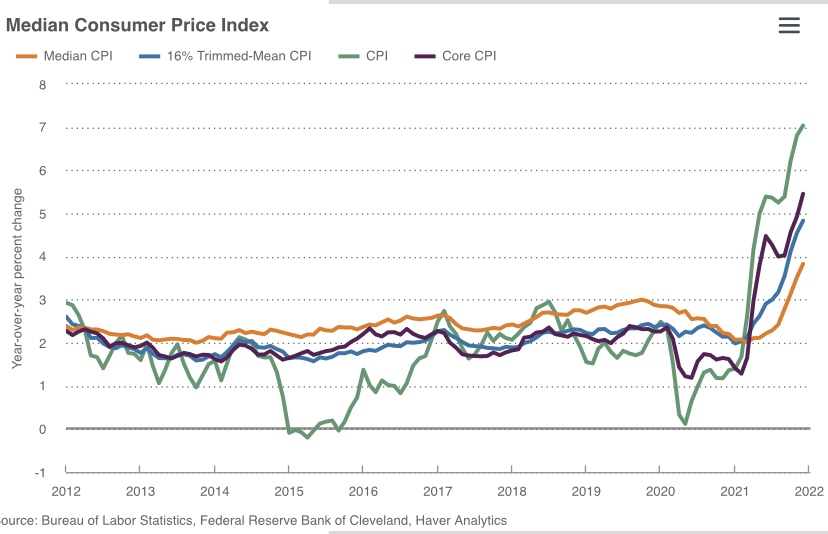
It’s natural to think supply disruptions are primarily responsible for the recent acceleration of inflation, rather than the helicopter drop. There’s no question about those price pressures in certain markets, much of it inflected by wayward policymakers, and some of those markets involve key inputs like energy and labor. Even the median component of the CPI has escalated sharply, though it has lagged broader measures a bit.

Broad price pressures cannot be sustained indefinitely without accommodating changes in the supply of money, which is the so-called “numeraire” in which all goods are priced. What does this have to do with FTPL or the government’s long-term budget constraint? The helicopter drop certainly led to additional money growth and spending, but again, FTPL would say that inflation follows from the expectation that government will not produce future surpluses needed for long-term budget balance. The creation of either new money or government debt, loaded the chopper as it were, is sufficient to accommodate broad price pressures over some duration.

Conclusion

Whether or not FTPL is a fully accurate description of fiscal and monetary phenomena, few would argue that a truly deadbeat government is a prescription for hyperinflation. That’s an extreme, but the motivation for FTPL is the potential abandonment of good and honest governing principles. Pledging an inflation tax is not exactly what anyone means by the full faith and credit of the U.S. government.

Rewarding Merit Is The Key To Growth

21 Monday Jun 2021

Posted by Nuetzel in economic growth, Meritocracy, Redistribution

≈ Leave a comment

Tags

Adrian Wooldridge, Autocracy, Clientelism, Friedrich Hayek, John Cochrane, Meritocracy, Nepotism, Pure Democracy, Racial Equity, Redistribution, Ruth Bader Ginsburg, Social Justice, Upward Mobility, W.E.B. Du Bois, Zero-Sum Games

Outward trappings of success, even at very modest levels, are seldom durable or predictive of future achievement if not backed by actual performance. That’s one reason why redistributionist policies are so unsuccessful at fostering upward mobility. They fail by focusing on outcomes rather than on addressing more fundamental causes, like skills, training, and well-functioning markets for low-skill labor. The same applies to programs that prescribe quotas on admissions, tuition aid, and hiring. The beneficiaries of these programs are often placed into situations in which they are unprepared. This makes them vulnerable to stigmatization and ultimately failure. And when poor performance is in any way ignored or forgiven, it has an impact on the psyche of the individual and their reputation, and it creates losses to the rest of society.

On the other hand, conditions and policies that lead to economic growth are likely to benefit the lower strata of society and minorities, to the extent that minorities are more concentrated in lower income quantities than non-minorities. We know incentives always matter, and incentives rely on the ability of individuals to act and succeed. Success implies gains to others who have occasion to avail themselves of the individual’s efforts. They are offering rewards for merit! Furthermore, those offers are always increasing in the value created, and thus, in levels of accomplishment. In that way, individuals always have opportunities to strive for growth.

But none of that works unless meritocracy holds sway. LittlBut none of that works unless meritocracy holds sway. Little wonder that meritocracy is so closely tied to a society’s prosperity, as documented in this article and a forthcoming book by Adrian Wooldridge. John Cochrane provides an excellent review and critique of Wooldridge’s thesis along with several lengthy quotes.

Wooldridge disputes the widely-accepted theory that democracy is a determinant of economic growth (also see here), noting that democracy can create economic pitfalls related to majoritarian excesses, whereas merit-based systems of rewards are common to almost all successful economies, including autocracies (Singapore, China) and democracies/republics (the U.S., Japan, Scandinavia), irrespective of the size of government. He offers examples of countries in which meritocratic systems are weak but nepotism or political “clientelism” are strong, with unfortunate results (Greece, Portugal, Italy). You certainly won’t get efficient outcomes when leaders prioritize family, friends, cronies, and political contributors for plum jobs and other rewards.

Of course, there is no pure meritocracy in the world. Rather, there are varying degrees of meritocracy across different societies. Traditionally, the U.S. economic system has relied on merit to a great extent; returns to merit are largely a matter of equal opportunity, though not entirely. Equally talented individuals do not always have access to the same opportunities. In fact, that is the major point of attack against the concept of meritocracy, but it does not imply that the benefits of meritocracy are a myth. There are many institutional dysfunctions that can and should be fixed to overcome the kinds of problems cited by critics, primarily public education, but the old expression “don’t throw the baby out with the bathwater” seems especially apt.

In fact, meritocracy promotes upward mobility. Here is Cochrane on the great paradox underlying the backlash against meritocracy:

“The US paternalistic/aristocratic elite is running away from meritocracy under the banner of ‘social justice’ and ‘racial equity.’ Yet meritocracy throughout history has been a great equalizer, a great leveler, the main way that excluded out-groups could get ahead.”

And on this point, Cochrane quotes Wooldridge:

“… Meritocracy is one of the great building blocks of modernity, along with democracy, capitalism and liberalism. … Is it really the case that meritocracy is a tool of White male privilege? W.E.B. Du Bois and Ruth Bader Ginsburg might have something different to say. Are lotteries or holistic assessments really better ways of distributing educational opportunities than standardized tests? Most of us would hesitate before flying with a pilot who had been chosen by lottery. Do we really want a society in which group identities trump individual abilities? “

To give the critics their due, however, a more refined version of their argument is that “meritocracy is a myth without inclusion”. Fair enough, but again, any shortfall in participation is not the fault of meritocracy per se, but of underlying conditions and policies fostering substandard education, family instability, high crime and incarceration rates, and high rates of unemployment among those with low skills.

An important strand of Wooldridge’s work is the implication that meritocracy is a redeeming feature of some autocratic regimes. Indeed, Wooldridge is not the least bit skeptical that autocratic rule is sustainable, just as long as merit drives rewards. This is a point on which Cochrane differs. An autocracy in which high echelons are populated by the meritorious will constantly grapple with temptations of the powerful to reward their pals. Lines of accountability must be all the stronger to prevent such decay. Furthermore, autocracy usually weds itself to meritocracy only in a conditional sense. For example, in China, one must support the party. These restraints undermine the benefits of meritocracy by offering less autonomy for individuals to leverage their talent.

“Pure” democracy has its own drawbacks, b“Pure” democracy has its own drawbacks, but at least leaders have autonomy while being accountable to a broader class. And as Cochrane says, the greatest dangers of democracy can be addressed under representative democracy along with other means of protecting minorities and individual rights.

The effort to banish meritocracy is madness and the product of a totalitarian mindset. To speak of the “illusion” or “myth” of meritocracy is to contend that talent, preparedness, sound decision-making, workmanship, precision, effort, and value-delivered represent trickery of some sort. Such is the viewpoint of those who take human well-being to be a zero-sum game. But it’s even worse than that. For example, placing lives in the hands of “randomly selected” pilots would invite catastrophe, and while that example is extreme, it clearly illustrates how non-meritocratic approaches are likely to produce negative sums! Putting resources into the hands of individuals with lesser qualifications is always a prescription for waste. Make no mistake: the road to serfdom is well-traveled and can be a very quick trip. Abandoning merit-based rewards would get us a fast start.

What’s To Like About Income Inequality?

22 Saturday May 2021

Posted by Nuetzel in Uncategorized

≈ 2 Comments

Tags

Capital Gains, David Splinter, Emmanuel Saez, Fiscal Income, Founders, Gerald Auten, Hoover Institution, Income Redistribution, Inequality, Inheritance, Joel Kotkin, John Cochrane, Joint Committee on Taxation, Omitted Income, Paul Graham, Progressive Taxes, Thomas Piketty, Transfer Oayments

What’s to like about inequality?

That depends on how it happened and on the conditions governing its future evolution. Inequality is a fact of life, and no social or economic system known to man can avoid or eliminate it. It’s “bad” in the sense that “not everybody gets a prize,” but inequality in a free market economic system arises out of the same positive dynamic that fosters achievement in any kind of competition. Even the logic underlying the view that inequality is “bad” is not consistent: we can be more equal if the rich all lose $1,000,000 and the poor all lose $1,000, but that won’t make anyone happy.

Unequal Rewards Are Natural

Many activities contribute to general prosperity and create unequal rewards as a by-product. A capitalist system rewards knowledge, effort, creativity, and risk-taking. Those who are very good at creating value earn commensurate rewards, and in turn, they often create rewarding opportunities for others who might participate in their enterprises. A system of just incentives and rewards also requires that property rights be secure, and that implies that wealth can be accumulated more readily by those earning the greatest rewards.

Equality can be decreed only by severely restricting the rewards to productive effort, and that requires a massive imbalance of power. The state, and those who direct its actions, always have a monopoly on legal coercion. In practice, the power to commandeer value created by others means that economic benefits will waft under the noses of apparatchiks. The raw power and economic benefits usurped under such an authoritarian regime cannot be competed away, and efficiency and value are seldom prioritized by state monopolists. The egalitarian pretense thus masks its own form of extreme inequality and decline. Inequality is unavoidable in a very real sense.

Measuring Trends in Inequality

Beyond those basic truths, the facts do not support the conventional wisdom that inequality has grown more extreme. A research paper by Gerald Auten and David Splinter corrects many of the shortcomings of commonly-cited sources on income inequality. Auten works for the U.S. Treasury, and Splinter is employed by the congressional Joint Committee on Taxation. They find that higher transfer payments and growing tax progressivity since the early 1960s kept the top after-tax income share stable.

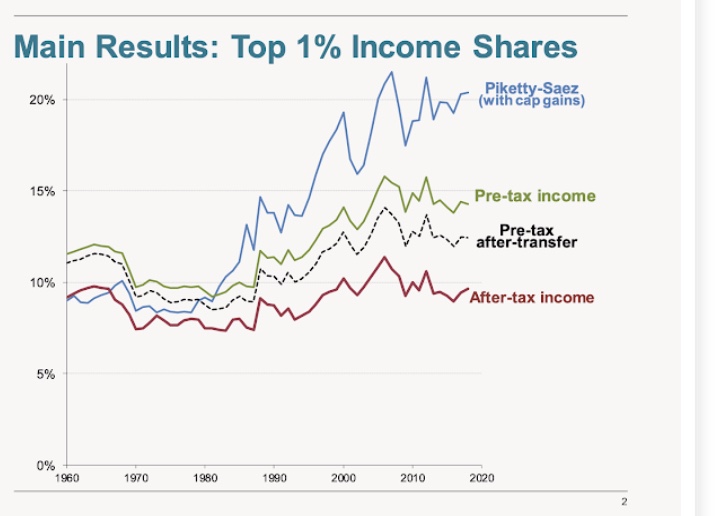
John Cochrane shares the details of a recent presentation made by Auten and Splinter (AS) at the Hoover Institution. A few interesting charts follow:

The blue “Piketty-Saez” (PS) line at the top uses an income measure from well-known research by Thomas Piketty and Emanuel Saez that contributed to the narrative of growing income inequality. The PS line is based on tax return information (fiscal income), but it embeds several distortions.

Realized capital gains are counted there, which misrepresents income shares because the realization of gains does not mark the point at which the true gains occur. Typically, the wealth exists before and after the gains are realized. Realized gains are often a function of changes in tax law and investor reaction to those changes. Moreover, neither realized nor unrealized gains represent income earned in production; instead, they capture changes in asset prices.

Income earned in production is about a third more than the income measure used by PS, even with the capital gains distortion. This omitted income and its allocation across earners is the subject of detailed analysis by AS. Their analysis is consistent in its focus on individual taxpayers, rather than households, which eliminates another upward bias in the PS line created by a secular decline in marriage rates. Then, AS consider the reallocation of income shares due to taxes and transfer payments. After all that, the income share of the top 1% shifts all the way down to the red line in the chart. The most recent observations put the share about where it was in the 1960s. 

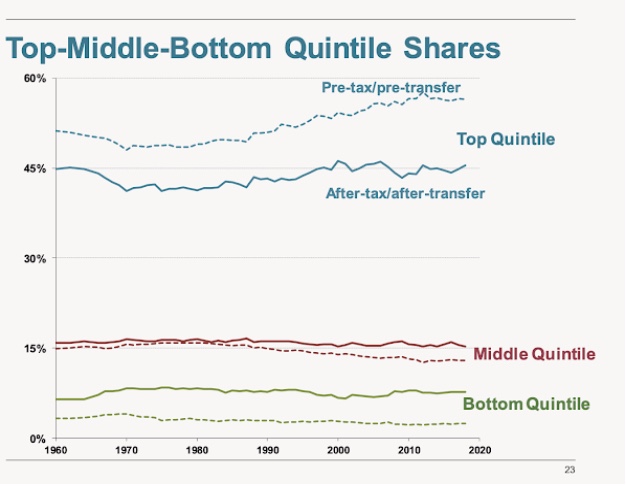
The next chart shows income shares for broader segments: the top, middle, and lowest 20% of the income distribution. Taxes and transfers cause massive changes in the calculated shares and their trends over time. Again, these shares remain about where they were in the 1960s, contradicting the popular narrative that high earners are gobbling up ever larger pieces of the pie.

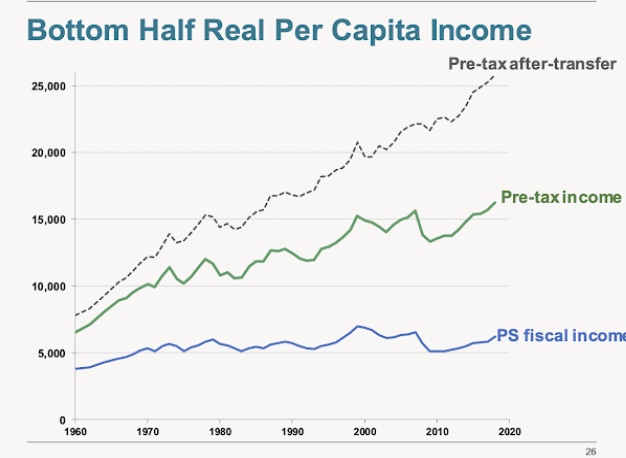
If income shares have remained about the same since the 1960s, that means high and low earners have made roughly equivalent income gains over that time. The next chart demonstrates that the bottom half of the income distribution has indeed seen significant growth in real incomes, despite the false impression created by PS and the common misperception of stagnant income growth among the working class. 

More Distributional Tidbits 

In a sense, all this is misleading because there is so much migration across the income distribution over time. Traditional calculations of income shares are “cross-sectional”, meaning they compare the same slices of the distribution at different points in time. But people near the low end in 1990 are not the same people near the bottom today. The same is true of those near the top and those in the middle. Income grows over time, and those lower in the distribution typically migrate upward as they age and acquire skills and work experience. Upward migration in income share is the general tendency, but there is some downward migration as well. Abandoning the cross-sectional view causes the typical story-line of rising income inequality to unravel.

There are many other interesting facts (and some great charts) in the AS paper and in Cochran’s post. One in particular shows that the average federal tax rate paid by the top 1% trended upward from the 1960s through the mid-1990s before flattening and trending slightly downward. This contradicts the assertion that high earners paid much higher taxes before the 1960s than today. In fact, the tax base broadened over that time, more than compensating for declines in marginal tax rates. 

Given the fact that more exacting measures of inequality haven’t changed much over the years, does that imply that redistributional policies have worked to keep the income distribution from worsening? That seems plausible on its face. If anything, taxes on high earners have increased, as have transfers to low earners and non-earners. Those changes appear to have offset other factors that would have led to greater inequality. However, the framing of the question is inappropriate. Maintaining a given income distribution is not a good thing if it inhibits economic growth. In fact, faster growth in production and greater well-being might well have led to a more unequal distribution of income. In other words, the whole question of offsetting inequality via redistribution is something of a chimera in the absence of a reliable counter-factual.

Wealth

Cochrane has a related post on the sources of wealth in America. Increasingly over the past few decades, wealth has been accumulated by self-made entrepreneurs, rather than through inheritance. That might come as a surprise to many on the left, to the extent that they care. Cochrane quotes Paul Graham on this point:

“In 1982 the most common source of wealth was inheritance. Of the 100 richest people, 60 inherited from an ancestor. There were 10 du Pont heirs alone. By 2020 the number of heirs had been cut in half, accounting for only 27 of the biggest 100 fortunes.

Why would the percentage of heirs decrease? Not because inheritance taxes increased. In fact, they decreased significantly during this period. The reason the percentage of heirs has decreased is not that fewer people are inheriting great fortunes, but that more people are making them.

How are people making these new fortunes? Roughly 3/4 by starting companies and 1/4 by investing. Of the 73 new fortunes in 2020, 56 derive from founders’ or early employees’ equity (52 founders, 2 early employees, and 2 wives of founders), and 17 from managing investment funds.”

The picture that emerges is one of great opportunity and dynamism. While the accumulation of massive fortunes might enrage the Left, these are the kinds of outcomes we should hope for, especially because the success of these new titans of industry is inextricably linked to tremendous value captured by their customers and lucrative opportunities for their employees. 

Here’s the best part of Cochrane’s post:

“We should not think about more or less inequality, we should think about the right amount of inequality, or productive vs. rent-seeking sources of inequality. Or, better, whether inequality is a symptom of health or sickness in the economy. Take Paul’s picture of the US economy at face value. What’s a better economy and society? One in which a few oligopolies … , deeply involved with government, run everything — think GM, Ford, IBM, AT&T, defense contractors — and it’s hard to start new innovative fast growing companies? Or the world in which the Bill Gates and Steve Jobs of the world can start new companies, deliver fabulous products and get insanely rich in the process? “

No doubt about it! However, today’s tremendously successful tech entrepreneurs also give us something to worry about. They have become oligarchs capable of suppressing competitive forces through sheer market power, influence, and even control over politicians and regulators. As I said at the top, whether inequality is benign depends upon the conditions governing its evolution. And today, we see the ominous development of a corporate-state tyranny, as decried by Joel Kotkin in this excellent post. Many of the daring tech entrepreneurs who benefitted from advantages endowed by our capitalist system have become autocrats who seek to plan our future with their own ideologies and self-interest in mind.

Conclusion

For too long we’ve heard the Left bemoan an increasingly “unfair” distribution of income. This includes propaganda intended to distort poverty levels in the U.S. The fine points of measuring shifts in the income distribution show that narrative to be false. Moreover, attempting to equalize the distribution of income, or even preventing changes that might occur as a natural consequence of innovation and growth, is not a valid policy objective if our goal is to maximize economic well-being.

The worst thing about inequality is that the poorest individuals are likely to be destitute and with no ability or means of supporting themselves. There is certainly such an underclass in the U.S., and our social safety net helps keep the poorest and least capable individuals above the poverty line after transfer payments. But too often our efforts to provide support interfere with incentives for those who are capable of productive work, which is both demeaning for them and a drain on everyone else. The best prescription for improving the well-being of all is economic growth, regardless of its impact on the distribution of income or wealth.

The FDA Can Put Virus Behind Us, Sans Vaccine

19 Wednesday Aug 2020

Posted by Nuetzel in Liberty, Pandemic, Vaccinations

≈ 1 Comment

Tags

Alex Tabarrok, Anti-Vaxers, Coronavirus, COVID Screening, Covid-19, E25Bio, Emergency Use Authorization, False Positive, Falze Negative, FDA, Harvard, Infectious vs Infected, John Cochrane, National Basketball Players Association, NBA, Paper Tests, Rapid Tests, Regulatory Failure, SalivaDirect, Self-Quarantine, Test Accuracy, Tracing, Transmission Chain, Vaccine Development, Vaccine Supply Chain, Wyss Institute for Biologically Inspired Engineering, Yale, Zach Lowe

Most of the news about COVID vaccine development is positive, but there are still huge doubts about 1) whether an effective vaccine(s) will ever be available; 2) when it will be available; 3) in what quantities (supply chains for vaccines present issues that most lay persons would never imagine) ; 4) the best approaches to allocation across young/healthy vs. old/vulnerable; 5) how long it will provide protection (the news is good on lasting immunity as well); and 6) whether people will actually take it. Given all these uncertainties, it’s worth considering an approach to stanching the coronavirus that won’t require a vaccine while still allowing a return to normalcy: cheap, rapid tests available to consumers on a daily basis in their homes or in businesses.

The full benefits of cheap, rapid tests can take people a while to wrap their heads around. In fact, there are skeptics who’s views on any and all testing are colored by suspicions that increased testing is some sort of conspiracy to spread fear and keep the economy hobbled. It’s true that increased testing drove much of the increase in COVID cases this summer, which caused the mainstream media to delight in spinning alarmist narratives. Fair enough, but that misses the point, which I’ll try to elucidate below. I credit a John Cochrane post for bringing this to my attention.

A successful vaccine breaks the so-called “transmission chain”, but so does frequent testing to identify infectious individuals on an ongoing basis so they can self-quarantine. As Alex Tabarrok has emphasized, we should worry about identifying infectious individuals, as opposed to infected individuals. They are not the same. Cheap, rapid, and easy-to-administer tests have already proven to be fairly accurate during the infectious stage. The idea is for individuals to self-test every day and stay home if they are positive. Or, employers can test workers every day and send them home if they are positive. Frequent testing also makes it simpler to trace the source of an infection and may reduce the importance of tracing.

To those who say this represents an affront to personal liberty, and I’m very touchy on that subject myself, recall that even now people are being screened in their workplaces using thermometers, questionnaires, or on the basis of any frogginess perceived by supervisors and co-workers. Those “tests” are far less accurate in identifying COVID-19 contagiousness than the kinds of cheap tests at issue here, and they are certainly no less intrusive. Then there are the many businesses facing restrictions on their operations: how “accurate” is it to keep everyone at home by locking down places of business? How intrusive is that? Those restrictions are indefensible, and especially with the advent and diffusion of cheap, rapid tests.

Of course, people might cheat and not report positives. Tests could be administered at workplaces to avoid that possibility, or at points of admission to businesses and facilities, but a few minutes of delay would be necessary. I would not support a centralized database of daily test results. If nothing else, relying on the good faith of individuals in reporting their results would be a giant leap forward in breaking the transmission chain now, rather than counting on the possibility of a successful virus in the indefinite future. And we might then avoid the whole pro-vax/anti-vax imbroglio that already foments, which raises major questions bearing on individual liberty.

Then there is the question of positive tests within multi-person households. Should the entire family or household self-quarantine? I say no, not if the others are negative, but then the others should test twice before going out, which dramatically reduces the probability of a false negative, and they should probably test more frequently, perhaps several times a day.

There are other important details to address: Who will pay for the tests? Will workers be paid to stay home if they test positive? How long will they be required to stay home? How will repeated tests be treated? I don’t want to get into detail on all of these points, but cheap, fast tests can help overcome many of these difficulties, and I believe many of the details can and should be worked out privately.

Unfortunately, the FDA has approved only two rapid tests, and they are not very rapid and not cheap enough. Only one had been approved up until last weekend because the FDA found the accuracy to be lacking … compared to PCR tests! But the FDA finally issued an Emergency Use Authorization for a saliva-based test (SalivaDirect) developed at Yale, partly funded by the NBA and the Players Association. The test still requires processing at a lab, so it’s really not convenient enough and not fast enough. Here is Zach Lowe on the cost:

“The cost per sample could be as low as about $4, though the cost to consumers will likely be higher than that — perhaps around $15 or $20 in some cases, according to expert sources.”

Not bad, but it’s much higher than more rapid, paper tests developed by Harvard’s Wyss Institute for Biologically Inspired Engineering and a company called E25Bio. Both of those are expected to cost about $1 per sample and can be completed anywhere. That’s a price that can work. And there are other promising candidates.

The benefits of tests that are rough, ready, and cheap will be huge. Such tests will also enable retesting, which helps to overcome the dilemmas of false positives and negatives. False negatives might be of greater concern to the FDA, but again, false negatives are less likely during the contagious stage of an infection, and the tests will be accurate enough that transmission risk will be drastically reduced.

The FDA needs to move beyond its stodgy insistence on achieving laboratory levels of accuracy. It’s unlikely that a single test source will be adequate to stanch the transmission chain, so the agency should rush to approve as many cheap, rapid tests as possible, with as many advisories and patient warnings regarding test results and follow-up instructions as it deems necessary. Remember, these tests are much better than thermometers!

Trump and Coronavirus

26 Tuesday May 2020

Posted by Nuetzel in Pandemic, Public Health, Risk Management, Stimulus, Trump Administration

≈ 1 Comment

Tags

Andrew Cuomo, Anthony Fauci, Bill De Blasio, CARES Act, CDC, Coronavirus, Deborah Birx, DHS, Disinfectant, Donald Trump, Elective Surgeries, FDA, Federalism, FEMA, Fiscal policy, Hydroxychloraquine, International Travel, Javits Center, John Bolton, John Cochrane, Laboratory Federalism, Lancet, Liability Waivers, Lockdowns, Michael Pence, Mike Pompeo, N95 Mask, NSC, Paycheck Protection Program, PPE, Robert Redfield, State Department, Testing, Unfunded Pensions, UV Light, Vaccines, Ventilators, WHO, Wuhan, Zinc

It’s a bit early to fully evaluate President Trump’s performance in dealing with the coronavirus pandemic, but there are a number of criteria on which I might assign marks. I’ll address some of those below, but in so doing I’m reminded of Jerry Garcia’s quip that he was “shopping around for something no one will like.” That might be how this goes. Of course, many of the sub-topics are worthy of lengthier treatment. The focus here is on the pandemic and not more general aspects of his performance in office, though there is some unavoidable overlap.

General “Readiness”

Many have criticized the Trump Administration for not being “ready” for a pandemic. I assign no grade on that basis because absolutely no one was ready, at least not in the West, so there is no sound premise for judgement. I also view the very general charge that Trump did not provide “leadership” as code for either “I don’t like him”, or “he refused to impose more authoritarian measures”, like a full-scale nationwide lockdown. Such is the over-prescriptive instinct of the Left.

Equally misleading is the allegation that Trump had “disbanded” the White House pandemic response team, and I have addressed that here. First, while the NSC would play a coordinating role, pandemic response is supposed to be the CDC’s job, when it isn’t too busy with diseases of social injustice to get it done. Second, it was John Bolton who executed a reorganization at the NSC. There were two high profile departures from the team in question at the time, and one one was a resignation. Most of the team’s staff remained with the NSC with the same duties as before the reirganization.

Finally, there was the matter of a distracting impeachment on false charges. This effort lasted through the first three years of Trump’s administration, finally culminating in January 2020. Perhaps the Administration would have had more time to focus on what was happening in China without the histrionics from the opposition party. So whatever else I might say below, these factors weigh toward leniency in my appraisal of Trump’s handing of the virus.

Messaging: C

As usual, Trump’s messaging during the pandemic was often boorish and inarticulate. His appearances at coronavirus briefings were no exception, often cringeworthy and sometimes featuring misinterpretations of what his team of experts was saying. He was inconsistent in signaling optimism and pessimism, as were many others such as New York Governor Andrew Cuomo and New York City Mayor Bill De Blasio. It shifted from “the virus is about like the flu” in February to a more sober assessment by mid-March. This was, however, quite consistent with the messaging from Dr. Anthony Fauci over the same time frame, as well as the World Health Organization (WHO). Again, no one really knew what to expect, so it’s understandable. A great deal of that can be ascribed to “the fog of war”.

Delegation and Deference: B

Trump cannot be accused of ignoring expert advice through the episode. He was obviously on-board with Fauci, Dr. Deborah Birx, Dr. Robert Redfield, and other health care advisors on the “15 Days to Slow the Spread” guidelines issued on March 16. His messaging wavered during those 15 days, expressing a desire to fully reopen the nation by Easter, which Vice President Michael Pence later described as “aspirational”. Before the end of March, however, Trump went along with a 30-day extension of the guidelines. Finally, by mid-April, the White House released guidelines for “Opening Up America Again“, which was a collaboration between Trump’s health care experts and the economic team. Trump agreed that the timeline for reopening should be governed by “the data”. There is no question, however, that Trump was chomping at the bit for reopening at several stages of this process. I see value in that positioning, as it conveys an intent to reopen asap and that people should have confidence in progress toward that goal.  

International Travel Bans: A

If anyone wonders why the world was so thoroughly blindsided by the coronavirus, look no further than China’s failure to deliver a proper warning as 2019 drew to a close. Wuhan, China was ground zero; the virus spread to the rest of the world with travelers out of Wuhan and other Chinese cities. The White House announced severe restrictions on flights from China on January 31, including a two-week quarantine for returning U.S. citizens. In retrospect, it wasn’t a minute too soon, yet for that precaution, Trump was attacked as a racist by the Left. In early February, WHO actually said travel bans were unnecessary, among other missteps. Other bans were instituted on entry from Iran and Brazil, as well as entry from Europe in early March, as countries around the globe closed their borders. Trump’s actions on incoming travelers were prescient, so I’ll score this one for Trump. Some of these travel restrictions can and should be eased now, and certainly that is expected in coming months, so we’ll see how well that process is managed.

Deference to States: A-

As a federalist, I was pleased that Trump and his team left most of the specifics on closures and bans on public gatherings up to state and local governments. That allowed more targeted mitigation efforts as dictated by local conditions and, to some extent, public opinion. This is a classic case of “laboratory federalism” whereby the most effective policies can be identified, though as we’ve seen, there’s no guarantee less successful states will emulate them. I grade Trump well on this one.

On reopening, too, Trump has been a consistent advocate of allowing flexility where local conditions permit, though he wrongly claimed he had “total authority” over ending social distancing rules. It’s hard to square that remark with his general stand on the issue of autonomy except as a tactic to strong-arm certain governors on other points.   

CDC/FDA Snafus: D

I applaud the Administration for its emphasis on the salutary effects of deregulation, but Trump went along with some major pieces of “expert advice” that were not only poor from regulatory perspective, but an affront to federalism. One was a directive issued by the CDC to delay “all elective surgeries, non-essential medical, surgical, and dental procedures during the 2019 Novel Coronavirus (COVID-19) outbreak“. (See my post “Suspending Medical Care in the Name of Public Health“.)

This is exactly the kind of “one size fits all” regulatory policy that has proven so costly, sacrificing not just economic activity but lives and care for the sick, creating avoidable illnesses and complications. The idea was to assure that adequate health care resources were available to treat an onslaught of coronavirus patients, but that was unneeded in most jurisdictions. And while the contagion was in it’s early “exponential” phase at the time, a more nuanced approach could have been adopted to allow different geographic areas and facilities more discretion, especially for different kinds of patients, or perhaps something less than a complete suspension of care. In any case, the extensions into May were excessive. I must grade Trump poorly for allowing this to happen, despite what must have been extreme pressure to follow “expert advice” on the point and the others discussed earlier.

That’s not the only point on which I blame Trump for caving to the CDC. In a case of massive regulatory failure, the CDC and FDA put the U.S. well over a month behind on testing when the first signs of the virus appeared here. Not only did they prohibit private labs and universities from getting testing underway, insisting on exclusive use of the CDC’s own tests, they also distributed faulty tests in early February that took over a month to replace. The FDA also enforced barriers to imported N95-type masks during the pandemic. Trump tends to have a visceral understanding of the calcifying dangers of regulation, but he let the so-called “experts” call the shots here. Big mistake, and Trump shares the blame with these agencies.  

Health Resources: B-

Managing the emergency distribution of PPE and ventilators to states did not go as smoothly as might have been hoped. The shortage itself left FEMA with the unenviable task of allocating quantities that could never satisfy all demands. A few states were thought to have especially acute needs, but there was also an obligation to hold stockpiles against potential requests from other states. In fact, a situation of this kind creates an incentive for states to overstate their real needs, and there are indications that such was the case. Trump sparred with a few governors over these allocations. There is certainly blame to be shared, but I won’t grade Trump down for this.

Vaccines and Treatments: C+


The push to develop vaccines might not achieve success soon, if ever, but a huge effort is underway. Trump gets some of the credit for that, as well as the investment in capacity now to produce future vaccine candidates in large quantities. As for treatments, he was very excited about the promise of hydroxychloraquine, going so far as to take it himself with zinc, a combination for which no fully randomized trial results have been reported (the recent study appearing in the Lancet on HCQ taken by itself has been called into question). Trump also committed an unfortunate gaffe when the DHS announced the results of a study showing that sunlight kills coronavirus in a matter of minutes, as do bleach and other disinfectants. Trump mused that perhaps sunlight or some form of disinfectant could be used as a treatment for coronavirus patients. He might have been thinking about an old and controversial practice whereby blood is exposed to UV light and then returned to the body. Later, he said he used the term “disinfectant” sarcastically, but he probably meant to say “euphemistically” …. I’m not sure he knows the difference. In any case, his habit of speculating on such matters is often unhelpful, and he loses points for that.

Fiscal Policy: B

The several phases of the economic stimulus program were a collaboration between the Trump Administration and Congress. A reasonably good summary appears here. The major parts were the $2.3 trillion CARES Act in late March and a nearly $500 billion supplemental package in late April. These packages were unprecedented in size. Major provisions were direct cash payments and the Paycheck Protection Program (PPP), which provides loans and grants to small businesses. The execution of both was a bit clunky, especially PPP, which placed a burden on private banks to extend the loans but was sketchy in terms of qualifications. The extension of unemployment compensation left some workers with more benefits than they earned in their former jobs, which could be an impediment to reopening. There were a number of other reasonable measures in these packages and the two smaller bills that preceded them in March. A number of these measures were well-targeted and inventive, such as waiving early withdrawal penalties from IRA and 401(k) balances. The Trump Administration deserves credit for helping to shape these efforts as well as others taken independently by the executive branch. 

Trump’s proposal to suspend payroll taxes did not fly, at least not yet. The idea is to reduce the cost of hiring and increase the return to work, if only temporarily. This is not a particularly appealing idea because so much of the benefits would flow to those who haven’t lost their jobs. It could be improved if targeted at new hires and rehires, however.

Trump’s proposal to grant liability waivers to reopened private businesses is extremely contentious, but one I support. Lockdowns are being eased under the weight of often heavy public and private regulation of conduct. As John Cochrane says in “Get Ready for the Careful Economy“: 

“One worry on regulation is that it will provide a recipe for a wave of lawsuits. That may have been a reason the Administration tried to hold back CDC guidance. A long, expensive, and impractical list of things you must do to reopen is catnip when someone gets sick and wants to blame a business. Show us the records that you wiped down the bathrooms every half hour. A legal system that can sue over talcum powder is not above this.”

Indeed, potential liability might represent a staggering cost to many businesses, one that might not be insurable. Accusations of negligence, true or false, can carry significant legal costs. Customers and employees, not just businesses, must accept some of the burden of risks of doing business. I give Trump good marks for this one, but we’ll see if it goes anywhere.

Some of the proposals for new stimulus legislation from democrats are much worse, including diversity initiatives, massive subsidies for “green” technologies, and bailouts for state and local government for unfunded pension liabilities. None of these has anything to do with the virus. The burden of pension shortfalls in some states should not fall on taxpayers nationwide, but on the states that incurred them. The Trump Administration and congressional Republicans should continue resisting these opportunistic proposals.

The Grade

Without assigning weights to the sub-topics covered above, I’d put the overall grade for Trump and his Administration’s handling of matters during the pandemic at about a B-, thus far. When it comes to politics, it’s often unfair to credit or blame one side for the promulgation of an overall set of policies. Nevertheless, I think it’s fair to say that Trump, could have done much better and could have done much worse. We will learn more with the passage of time, the continued evolution of the virus, the development of treatments or vaccines, and the course of the economy.


On the Meaning of Herd Immunity

09 Saturday May 2020

Posted by Nuetzel in Pandemic, Public Health, Risk

≈ 2 Comments

Tags

Antibody, Antigen, Carl T. Bergstrom, Christopher Moore, Covid-19, Herd Immunity, Heterogeneity, Household Infection, Immunity, Infection Mortality Risk, Initial Viral Load, John Cochrane, Lockdowns, Marc Lipsitch, Muge Cevik, Natalie Dean, Natural Immunity, Philippe Lemoine, R0, Santa Fe Institute, SARS-CoV-2, Social Distancing, Super-Spreaders, Zvi Mowshowitz

Immunity doesn’t mean you won’t catch the virus. It means you aren’t terribly susceptible to its effects if you do catch it. There is great variation in the population with respect to susceptibility. This simple point may help to sweep away confusion over the meaning of “herd immunity” and what share of the population must be infected to achieve it.

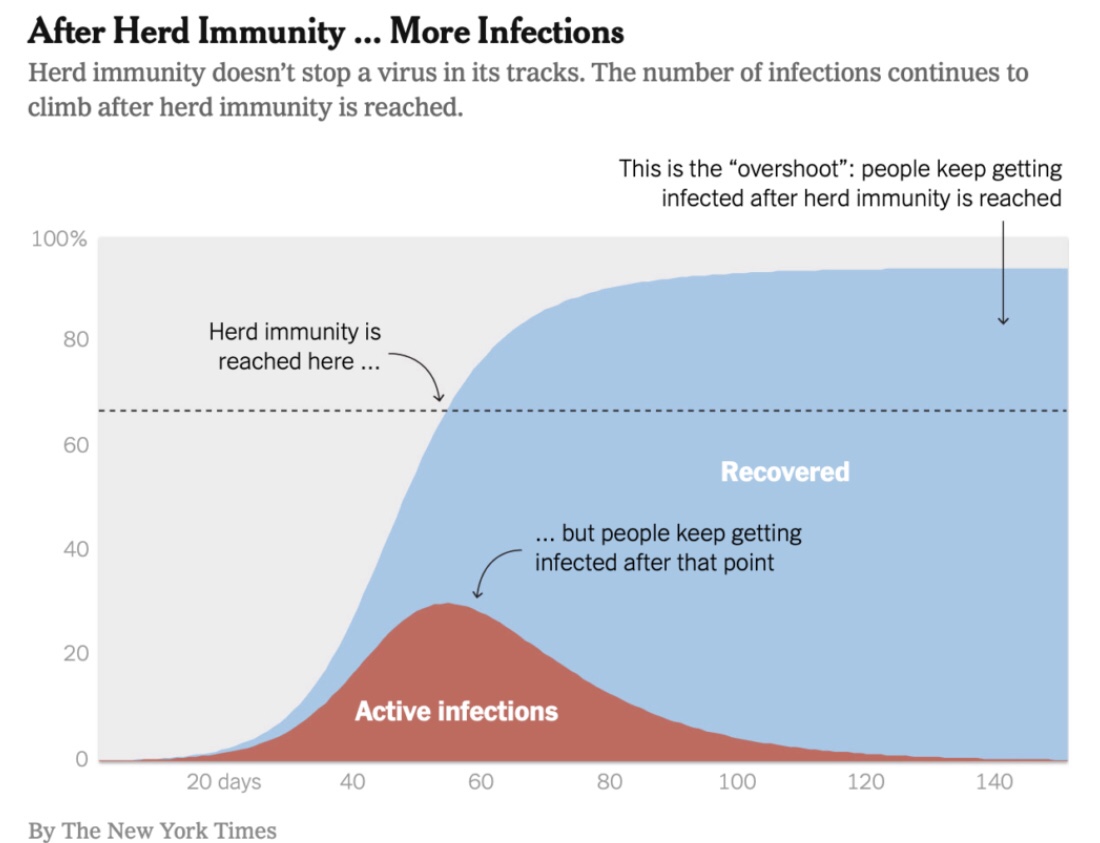
Philippe Lemoine discusses this point in his call for an “honest debate about herd immunity“. He reproduces the following chart, which appeared in this NY Times piece by Carl T. Bergstrom and Natalie Dean:

Herd immunity, as defined by Bergstrom and Dean, occurs when there are sufficiently few susceptible individuals remaining in the population to whom the actively-infected can pass the virus. The number of susceptible individuals shrinks over time as more individuals are infected. The chart indicates that new infections will continue after herd immunity is achieved, but the contagion recedes because fewer additional infections are possible.

We tend to think of the immune population as those having already been exposed to the virus, and who have recovered. Those individuals have antibodies specifically targeted at the antigens produced by the virus. But many others have a natural immunity. That is, their immune systems have a natural ability to adapt to the virus.

Heterogeneity

At any point in a pandemic, the uninfected population covers a spectrum of individuals ranging from the highly susceptible to the hardly and non-susceptible. Immunity, in that sense, is a matter of degree. The point is that the number of susceptible individuals doesn’t start at 100%, as most discussions of herd immunity imply, but something much smaller. If a relatively high share of the population has low susceptibility, the virus won’t have to infect such a large share of the population to achieve effective herd immunity.

The apparent differences in susceptibility across segments of the population may be the key to early herd immunity. We’ve known for a while that the elderly and those with pre-existing conditions are highly vulnerable. Otherwise, youth and good health are associated with low vulnerability.

Lemoine references a paper written by several epidemiologists showing that “variation in susceptibility” to Covid-19 “lowers the herd immunity threshold”:

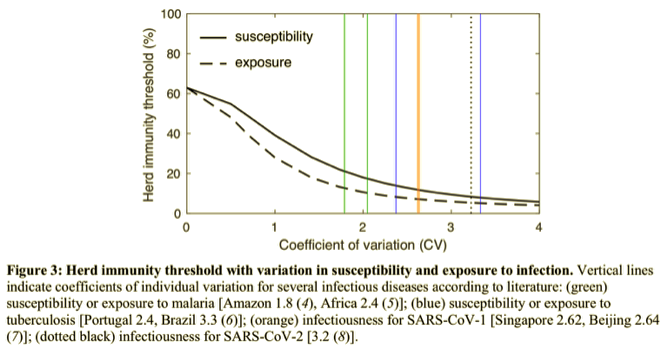
“Although estimates vary, it is currently believed that herd immunity to SARS-CoV-2 requires 60-70% of the population to be immune. Here we show that variation in susceptibility or exposure to infection can reduce these estimates. Achieving accurate estimates of heterogeneity for SARS-CoV-2 is therefore of paramount importance in controlling the COVID-19 pandemic.”

The chart below is from that paper. It shows a measure of this variation on the horizontal axis. The colored, vertical lines show estimates of historical variation in susceptibility to historical viral episodes. The dashed line shows the required exposure for herd immunity as a function of this measure of heterogeneity.

Their models show that under reasonable assumptions about heterogeneity, the reduction in the herd immunity threshold (in terms of the percent infected) may be dramatic, to perhaps less than 20%.

Then there are these tweets from Marc Lipsitch, who links to this study:

“As an illustration we show that if R0=2.5 in an age-structured community with mixing rates fitted to social activity studies, and also categorizing individuals into three categories: low active, average active and high active, and where preventive measures affect all mixing rates proportionally, then the disease-induced herd immunity level is hD=43% rather than hC=1−1/2.5=60%.”

Even the celebrated Dr. Bergstrom now admits, somewhat grudgingly, that hereogeniety reduces the herd immunity threshold, though he doesn’t think the difference is large enough to change the policy conversation. Lipsitch also is cautious about the implications.

Augmented Heterogeneity

Theoretically, social distancing reduces the herd immunity threshold. That’s because infected but “distanced” people are less likely to come into close contact with the susceptible. However, that holds only so long as distancing lasts. John Cochrane discusses this at length here. Social distancing compounds the mitigating effect of heterogeneity, reducing the infected share of the population required for herd immunity.

Another compounding effect on heterogeneity arises from the variability of initial viral load on infection (IVL), basically the amount of the virus transmitted to a new host. Zvi Mowshowitz discusses its potential importance and what it might imply about distancing, lockdowns, and the course of the pandemic. In any particular case, a weak IVL can turn into a severe infection and vice versa. In large numbers, however, IVL is likely to bear a positive relationship to severity. Mowshowitz explains that a low IVL can give one’s immune system a head start on the virus. Nursing home infections, taking place in enclosed, relatively cold and dry environments, are likely to involve heavy IVLs. In fact, so-called household infections tend to involve heavier IVLs than infections contracted outside of households. And, of course, you are very unlikely to catch Covid outdoors at all.

Further Discussion

How close are we to herd immunity? Perhaps much closer than we thought, but maybe not close enough to let down our guard. Almost 80% of the population is less than 60 years of age. However, according to this analysis, about 45% of the adult population (excluding nursing home residents) have any of six conditions indicating elevated risk of susceptibility to Covid-19 relative to young individuals with no co-morbidities. The absolute level of risk might not be “high” in many of those cases, but it is elevated. Again, children have extremely low susceptibility based on what we’ve seen so far.

This is supported by the transmission dynamics discussed in this Twitter thread by Dr. Muge Cevik. She concludes:

“In summary: While the infectious inoculum required for infection is unknown, these studies indicate that close & prolonged contact is required for #COVID19 transmission. The risk is highest in enclosed environments; household, long-term care facilities and public transport. …

Although limited, these studies so far indicate that susceptibility to infection increases with age (highest >60y) and growing evidence suggests children are less susceptible, are infrequently responsible for household transmission, are not the main drivers of this epidemic.”

Targeted isolation of the highly susceptible in nursing homes, as well as various forms of public “distancing aid” to the independent elderly or those with co-morbidities, is likely to achieve large reductions in the effective herd immunity ratio at low cost relative to general lockdowns.

The existence of so-called super-spreaders is another source of heterogeneity, and one that lends itself to targeting with limitations or cancellations of public events and large gatherings. What’s amazing about this is how the super-spreader phenomenon can lead to the combustion of large “hot spots” in infections even when the average reproduction rate of the virus is low (R0 < 1). This is nicely illustrated by Christopher Moore of the Santa Fe Institute. Super-spreading also implies, however, that while herd immunity signals a reduction in new infections and declines in the actively infected population, “hot spots” may continue to flare up in a seemingly random fashion. The consequences will depend on how susceptible individuals are protected, or on how they choose to mitigate risks themselves.

Conclusion

I’ve heard too many casual references to herd immunity requiring something like 70% of the population to be infected. It’s not that high. Many individuals already have a sort of natural immunity. Recognition of this heterogeneity has driven a shift in the emphasis of policy discussions to the idea of targeted lockdowns, rather than the kind of indiscriminate “dumb” lockdowns we’ve seen. The economic consequences of shifting from broad to targeted lockdowns would be massive. And why not? The health care system has loads of excess capacity, and Covid infection fatality risk (IFR) is turning out to be much lower than the early, naive estimates we were told to expect, which were based on confirmed case fatality rates (CFRs).

The Opportunity of Skewed Coronavirus Transmission

30 Monday Mar 2020

Posted by Nuetzel in economic growth, Pandemic

≈ 1 Comment

Tags

Contagion, Coronavirus, Covid-19, Fat-Tailed Distribution, Heart Disease, Herd Immunity, John Cochrane, President Trump, Prophylaxis, Public Park Closures, Reproduction Rate, Restart Economy, Right Skew, Shelter In Place, Stay-at-Home, Suicide, Super-Spreaders, The Federalist, Transmission Rate

People talk about the transmission rate or reproduction rate (R0) of Covid-19 as if it’s a single number that applies to the entire population. John Cochrane emphasizes the huge implications of this misperception for how best to prevent the spread of the virus, and at lower cost, and for how best to “restart” the economy.

First, however, lets dispense with the absolutist position that there can be no compromise on virus mitigation in favor of economic activity. I am not opposed to the “lockdown” we are now living, but it will have significant and unnecessary costs if it goes on too long: the lost output is a huge blow not only to our current lifestyles but to our ability to grow in the future, or even to afford better health care in the future. Beyond that, the lockdown has immediate negative impacts of its own on public health: economic stress leads to all kinds of terrible health outcomes like heart disease and even suicide. About the latter, the President is absolutely correct: if you need research to prove it, see here, here, here, and here, all respected journals (the links all courtesy of The Federalist.) Economic stress and isolation is quite likely to promote poor dietary habits, lethargy, and possibly family dysfunction as well. Don’t pretend there aren’t real tradeoffs between the economy, virus interventions, and public health. The trick is to improve those tradeoffs. A balance can and must be struck, and depending on policy actions, the tradeoff can be made better or worse.

Back to the virus reproduction rate: the R0 values we see quoted are estimates of the average number of other people infected by each infected person. A value of three means that each person infected with the virus passes it on to three others, on average. If R0 is greater than one, an epidemic grows. If R0 is less than one, a contagion recedes. It becomes a “non-epidemic” if R0 remains less than one. It does not have to be zero (and probably cannot be zero).

But not everyone is the same: my R0 is different from your R0 if only because we have different occupational exposure to others and different levels of social engagement. We also differ physiologically, which probably leads to differences in our “personal” R0 values. And an individual’s R0 will differ by time and place, depending on random circumstances like which way the wind is blowing. But here is where it gets interesting. Cochrane describes an extreme version of the skewed distribution shown at the top of this post:

“Suppose there are 100 people with a 0.5 reproduction rate, and 1 super-spreader with a 100 replication rate. The average reproduction rate is 1.5. Clearly, locking everyone down is wildly inefficient. It’s much more important to find the 1 super-spreader and lock him or her down, or change the business or behavior that’s causing the super-spreading.

This is exaggerated, but not far off the mark. I have not seen numbers on the distribution of reproduction rates across people, but it is a fair bet that it has an extremely fat tail. Most of us are washing our hands, social distancing, work in businesses that are shut down or are taking great steps to limit contact. And a few people and activities contribute to most of the spread.

This wide and fat-tailed dispersion is ignored in a lot of simulations I’ve seen. They take the average reproduction rate as the same for everyone. That’s a big mistake.

The danger: we waste a huge amount of time and money moving you and me from a 0.5 reproduction rate to an 0.4 reproduction rate. …  The opportunity: focus on the super-spreaders, and the super-spreading activities, and you bring down the reproduction rate at much lower cost. “

There are many ways to reduce R0. Cochrane gets a little more specific about this and the policy implications of the skewed R0 distribution across individuals:

“All we need is to get the transmission rate under one. Activities with possible but very low transmission rates, and high economic benefits should go on. Don’t separate to ‘essential’ and ‘non-essential.’ Separate into ‘high likelihood of transmission’ and ‘low likelihood of transmission.’

Why are we not using masks everywhere? Sure, they’re not perfect. Sure, an old hankerchief might only cut the chance of transmission by half. We’re not all surgeons. Cutting by half is enough to stop the virus. 

Conversely, why did they close the state parks? Really? Just how dangerous is it to drive the dog to a hiking trail and stay 6 feet away from other people? Parks, ski areas, golf courses, all sorts of businesses that surely can be run with a reproduction rate far less than one are just shut down. I met a realtor on our dog walk yesterday. They’re totally shut down. Just how hard is it to run a realty business with a 0.5 reproduction rate? One family in the house at a time, don’t touch anything, an hour between showings, stay 6 feet from the realtor… But instead the whole business is just shut down.”

The beginning of that last paragraph echoes a point I made in my last post about public park closures and the health benefits of getting outside generally.

Cochrane goes on to discuss several other policy options, including the potential benefits of simple kinds of testing and the overemphasis on false negatives and positives in policy discussions. Imperfect tests should not be discouraged by these concerns. If you’re worried about that, you shouldn’t use a thermometer either!

“Stay-at-home” or “shelter-in-place” orders will increasingly be tested by private parties if they remain in effect too long. That will be encouraged by the seemingly arbitrary distinctions some orders make between “essential” and “non-essential” activities. If workers or small businessmen judge themselves to be at low risk, they will take matters into their own hands to the extent they can. I believe that’s already happening where the specifics of “lockdown” orders have gone too far.  Workers at the low end of the income spectrum are especially hard hit by these orders. One can hardly blame them for trying to earn what they can if they believe, and their customers believe, their activities and interactions are of low risk.

Ultimately, the entire distribution of R0s will slide to the left. That will occur even at low levels of “herd immunity” and anything that offers at least weak prophylaxis. Broadly speaking, the latter includes maintaining distance, refusing admittance to venues with a fever, avoiding handshakes, wearing masks, and potentially chloroquine, which is already in widespread use by physicians treating coronavirus patients. Ultimately, a vaccine will slide the distribution far to the left, but the economy need not be held hostage until that time. To paraphrase Cochrane, we can get the transmission rate below one and keep it there without stopping the world permanently. There are many options, and now is the time for business and government to start planning for that.

Diversity and Despotism

14 Friday Feb 2020

Posted by Nuetzel in Affirmative Action, Diversity, Identity Politics

≈ Comments Off on Diversity and Despotism

Tags

Bias, Disparate impact, Diversity, Diversity Administrators, Emory University, Impartiality, Inclusion, Jerry Coyne, John Cochrane, Mark Bauerlein, Overt Discrimination, Political Test, Superficiality, University of California, University of Montana, Walter Williams, Wokeademia

Diversity is a fine thing, but who can define it precisely, and along what dimensions? It is essentially an amorphous concept, defined in ways that vary with context and often by political fiat. In my view, the best diversity outcome is always that which results from impartial decisions. That goes for hiring, firing, admission, and the like; in distributing rewards; in making loans; and in price or non-price rationing decisions. And by “impartiality” I mean those decisions should be made without respect to superficial qualities such as skin color, country of origin, sexual preference, religious faith, and political philosophy.

“Superficiality”, however, depends on the context of the decision at hand, or it might describe an outcome that is superficial to the decision criteria: an impartial selection of candidates for jobs that require great physical strength is likely to be skewed toward males. Likewise, an impartial selection of candidates for jobs that require strong English language skills is likely to favor those whose first language is English. And an impartial selection of a new physics professor should be the candidate having the strongest expertise in physics. The point is that impartiality can seldom guarantee outcomes that are consistent with the demands of diversity activists. In fact, to the extent that diversity objectives may emphasize qualities that are superficial to the decision at hand, they undermine impartiality.

Should research physicists devote their energies to dreaming up ways to promote diversity within their field? Electrical engineers? Will that help them advance the state of knowledge in their disciplines? As a member of an alumni board, I have personally witnessed the department of economics at a state university grapple with diversity reviews and/or mandates in hiring, class enrollment, and curriculum. Economics is actually a field that has strong things to say about the negative consequences of bias and discrimination, and the department should not have to jump through hoops proving it to “diversity administrators” who may well lack the qualifications necessary to assess that part of the curriculum. There is no question that devoting energy and resources to these bureaucratic pursuits is wasteful of faculty time as well as resources furnished by taxpayers. But that isn’t even the worst of it.

The amorphous nature of diversity confers power on its enforcers in business, government, and academia. We know that rank-ordering alternatives in pursuit of an objective may conflict with the selection that best satisfies the diversity fashion du jour. But today our society has devolved to the point at which corporate HR departments insist that individuals be browbeaten into “recognizing their bias” and evaluated on “promoting diversity”. Hiring and promotions at universities in fields as “diverse” as physics and language arts are dependent on a candidate’s ability to convince diversity administrators of their sincere and inventive strategies to promote diversity.

In a post titled “Wokeademia“, John Cochrane comments on these “diversity political tests”:

“It’s not about whether you are ‘diverse,’ meaning belonging to a racial, gender, or sexual-preference group the University wishes to hire. It is a statement, as it says, of your active participation in a political movement.”

He quotes Jerry Coyne on the “diversity equity and inclusion statement” required by the University of California:

“Why is it a political test? Politics are a reflection of how you believe society should be organized. Classical liberals aspire to treat every person as a unique individual, not as a representative of their gender or their ethnic group. The sample rubric dictates that in order to get a high diversity score, a candidate must have actively engaged in promoting different identity groups as part of their professional life…. Requiring candidates to believe that people should be treated differently according to their identity is indeed a political test…The idea of using a political test as a screen for job applicants should send a shiver down our collective spine….”

Cochrane sheds additional light on this phenomenon in a follow-up post:

“I started this series impressed by the obvious political and free speech ramifications. There is a much simpler economic explanation however. As the quotes from the UC system make clear, the central requirement of the diversity statements is to document past active participation in, and require future approval and participation in all the programs produced by the diversity staff.

Jerry Coyne may have nailed it: ‘By hiring large numbers of deans and administrators whose job is to promote initiatives like the above, colleges like Berkeley have guaranteed that this kind of process will only get more onerous and more invidious. After all, those people have to keep ratcheting up the process to keep their jobs going.'”

Here is one more follow-up from Cochrane on the spread of Wokeadamia in which he offers a sampling of academic job descriptions from schools around the country. The heavy emphasis on one’s track record in promoting diversity, and on one’s future plans to do so, may well eclipse a candidate’s actual qualifications for the job!

It’s fair to say the misplaced emphasis on diversity has reached crazy proportions. Mark Bauerlein, a professor of English at Emory University, reports on a recent episode at the University of Montana in which the school held an essay contest for Martin Luther King Day as part of its effort to respond to complaints of a lack of racial diversity on campus. The population of the state of Montana is just 0.4% African American, so it should come as no surprise that there are relatively few blacks on the campus of the state university. The nine-member prize selection committee had a non-white majority, but only six students entered the contest, all of whom were white. All four winners were white females. Not only were the selections condemned by activists, but the winners were threatened and the university effectively negated the whole contest.

Until such time as thought, feelings, personal preferences, and technical expertise are officially outlawed, people will make decisions that seem arbitrary to others. That’s often because others don’t understand the decision parameters and are in no position to judge its impartiality. But sometimes personal preferences will reflect bias against superficial characteristics. Economists have noted that such bias nearly always comes at a cost to the decision maker. For example, if the best job candidate is black, then the decision to hire a white is economically inferior and will harm the firm’s competitiveness. And of course there are laws prohibiting overt discrimination in many aspects of economic life. Beyond that, we can condemn such bias as might exist, but it is often impossible to discern except as an often errant appeal to statistical genera or “disparate impact”, and it cannot be prevented while maintaining a free society. Political tests, in particular, are not consistent with a free society and should themselves be prohibited.

← Older posts
Newer posts →
Follow Sacred Cow Chips on WordPress.com

Recent Posts

  • The Case Against Interest On Reserves
  • Immigration and Merit As Fiscal Propositions
  • Tariff “Dividend” From An Indigent State
  • Almost Looks Like the Fed Has a 3% Inflation Target
  • Government Malpractice Breeds Health Care Havoc

Archives

  • January 2026
  • December 2025
  • November 2025
  • October 2025
  • September 2025
  • August 2025
  • July 2025
  • June 2025
  • May 2025
  • April 2025
  • March 2025
  • February 2025
  • January 2025
  • December 2024
  • November 2024
  • October 2024
  • September 2024
  • August 2024
  • July 2024
  • June 2024
  • May 2024
  • April 2024
  • March 2024
  • February 2024
  • January 2024
  • December 2023
  • November 2023
  • August 2023
  • July 2023
  • June 2023
  • May 2023
  • April 2023
  • March 2023
  • February 2023
  • January 2023
  • December 2022
  • November 2022
  • October 2022
  • September 2022
  • August 2022
  • July 2022
  • June 2022
  • May 2022
  • April 2022
  • March 2022
  • February 2022
  • January 2022
  • December 2021
  • November 2021
  • October 2021
  • September 2021
  • August 2021
  • July 2021
  • June 2021
  • May 2021
  • April 2021
  • March 2021
  • February 2021
  • January 2021
  • December 2020
  • November 2020
  • October 2020
  • September 2020
  • August 2020
  • July 2020
  • June 2020
  • May 2020
  • April 2020
  • March 2020
  • February 2020
  • January 2020
  • December 2019
  • November 2019
  • October 2019
  • September 2019
  • August 2019
  • July 2019
  • June 2019
  • May 2019
  • April 2019
  • March 2019
  • February 2019
  • January 2019
  • December 2018
  • November 2018
  • October 2018
  • September 2018
  • August 2018
  • July 2018
  • June 2018
  • May 2018
  • April 2018
  • March 2018
  • February 2018
  • January 2018
  • December 2017
  • November 2017
  • October 2017
  • September 2017
  • August 2017
  • July 2017
  • June 2017
  • May 2017
  • April 2017
  • March 2017
  • February 2017
  • January 2017
  • December 2016
  • November 2016
  • October 2016
  • September 2016
  • August 2016
  • July 2016
  • June 2016
  • May 2016
  • April 2016
  • March 2016
  • February 2016
  • January 2016
  • December 2015
  • November 2015
  • October 2015
  • September 2015
  • August 2015
  • July 2015
  • June 2015
  • May 2015
  • April 2015
  • March 2015
  • February 2015
  • January 2015
  • December 2014
  • November 2014
  • October 2014
  • September 2014
  • August 2014
  • July 2014
  • June 2014
  • May 2014
  • April 2014
  • March 2014

Blogs I Follow

  • Passive Income Kickstart
  • OnlyFinance.net
  • TLC Cholesterol
  • Nintil
  • kendunning.net
  • DCWhispers.com
  • Hoong-Wai in the UK
  • Marginal REVOLUTION
  • Stlouis
  • Watts Up With That?
  • Aussie Nationalist Blog
  • American Elephants
  • The View from Alexandria
  • The Gymnasium
  • A Force for Good
  • Notes On Liberty
  • troymo
  • SUNDAY BLOG Stephanie Sievers
  • Miss Lou Acquiring Lore
  • Your Well Wisher Program
  • Objectivism In Depth
  • RobotEnomics
  • Orderstatistic
  • Paradigm Library
  • Scattered Showers and Quicksand

Blog at WordPress.com.

Passive Income Kickstart

OnlyFinance.net

TLC Cholesterol

Nintil

To estimate, compare, distinguish, discuss, and trace to its principal sources everything

kendunning.net

The Future is Ours to Create

DCWhispers.com

Hoong-Wai in the UK

A Commonwealth immigrant's perspective on the UK's public arena.

Marginal REVOLUTION

Small Steps Toward A Much Better World

Stlouis

Watts Up With That?

The world's most viewed site on global warming and climate change

Aussie Nationalist Blog

Commentary from a Paleoconservative and Nationalist perspective

American Elephants

Defending Life, Liberty and the Pursuit of Happiness

The View from Alexandria

In advanced civilizations the period loosely called Alexandrian is usually associated with flexible morals, perfunctory religion, populist standards and cosmopolitan tastes, feminism, exotic cults, and the rapid turnover of high and low fads---in short, a falling away (which is all that decadence means) from the strictness of traditional rules, embodied in character and inforced from within. -- Jacques Barzun

The Gymnasium

A place for reason, politics, economics, and faith steeped in the classical liberal tradition

A Force for Good

How economics, morality, and markets combine

Notes On Liberty

Spontaneous thoughts on a humble creed

troymo

SUNDAY BLOG Stephanie Sievers

Escaping the everyday life with photographs from my travels

Miss Lou Acquiring Lore

Gallery of Life...

Your Well Wisher Program

Attempt to solve commonly known problems…

Objectivism In Depth

Exploring Ayn Rand's revolutionary philosophy.

RobotEnomics

(A)n (I)ntelligent Future

Orderstatistic

Economics, chess and anything else on my mind.

Paradigm Library

OODA Looping

Scattered Showers and Quicksand

Musings on science, investing, finance, economics, politics, and probably fly fishing.

  • Subscribe Subscribed
    • Sacred Cow Chips
    • Join 128 other subscribers
    • Already have a WordPress.com account? Log in now.
    • Sacred Cow Chips
    • Subscribe Subscribed
    • Sign up
    • Log in
    • Report this content
    • View site in Reader
    • Manage subscriptions
    • Collapse this bar
 

Loading Comments...