Good God! What a remarkable display of ignorance we witnessed on Friday from three different Supreme Court justices. This trio dumped buckets-full of erroneous information about the current state of the COVID pandemic, all points that are easily falsifiable. The three are Sonia Satamayor, Stephen Breyer, and Elena Kagan. The flub-fest occurred during a proceeding on challenges to OSHA’s attempt to impose a nationwide vaccine mandate on private employers having more than 100 employees. I’m sorely tempted to say these jurists must know better, but perhaps they were simply parroting what they’ve heard from “reliable” media sources.
Here’s a list of the false assertions made by the three justices at the hearing, as compiled by Michael P. Sanger, along with my own brief comments:
100,000 children in critical care and on ventilators (Sotomayor) — Not even close!
Vaccine mandate would prevent 100% of US cases (Breyer) — Lol!
750 million people tested positive last Thursday (Breyer) — That’s more than twice the U.S. population… in one day! Haha! See here.
COVID deaths are at an all-time high (Sotomayor) — No, they are well under half of the all-time high, and many of those “announced” deaths are Delta deaths and deaths that occurred weeks to months ago.
It’s “beyond settled” that vaccines and masks are the best way to stop the spread (Kagan) — Say what?
COVID vaccines stop transmission (Kagan) — Is that why two fully vaccinated attorneys arguing the government’s case just tested positive?
Federal agencies can mandate vaccines using the police powers of the federal government (Sotomayor) — Incorrect, not at their fancy. Police powers with respect to health, safety and morals are generally reserved to the states by the Tenth Amendment. The Commerce Clause allows Congress to regulate these powers through federal agencies on “major questions”. Congress, however, has never acted on the question of vaccine mandates.
Hospitals are nearing capacity (Sotomayor) — Again, no! And see here.
Omicron is deadlier than Delta (Sotomayor) — Omicron may be more severe than the common cold in some cases, but all indications are that it has much lower severity than the Delta variant.
Hospitals are full of unvaccinated people (Breyer) — No, on two counts: 1) hospitals are not full, and 2) there are COVID hospitalizations among the vaccinated as well. Also see here.
I’ve covered most of these points on this blog at various times in the past, a few links to which are provided in the bullets above. As one wag said, it’s almost as if these justices read nothing but the New York Times, the paper that onceassured the world that Joseph Stalin was actually a pretty decent fellow. With tongue firmly in cheek, Ed Morrissey askedwhether Twitter would suspend Justice Sotomayor for spreading COVID misinformation.
There also followed a desperate attempt by left-wing journalists to convince themselves and their followers that Justice Neil Gorsuch had incorrectly claimed hundreds of thousands of people die from the flu every year. The actual Gorsuch quote in the transcript reads:
“Flu kills—I believe—hundreds, thousands of people every year.”
And that indeed is what can be heard clearly on the audio (short clip here). But in the fertile imaginations of the lefty commentariat, Gorsuch uttered an extra “of”. Gorsuch was clearly correcting himself mid-sentence. As noted by Phil Kerpen, the line of questioning had to do with the establishment of a limiting principle under which OSHA could conceivably have authority to impose a vaccine mandate. Naturally, Gorsuch intended to quote a number smaller than the count of COVID deaths.
Most of the justices appeared to lean against the OSHA mandate. We’ll probably get a ruling this week. However, the episode vividly illustrates the power of the leftist mainstream media and social media to manipulate beliefs, even beliefs held by individuals of formidable intellect. It also shows how fiercely people cling to falsehoods supporting their ideological mood affiliations.
In a gross failure of education or perhaps memory, politicians, policymakers, and certain academics seem blithely ignorant of things we’ve learned repeatedly. And of all the dumb ideas floated regarding our current bout with inflation, the notion of invoking price controls is near the top. But watch out, because the Biden Administration has already shifted from “inflation is transitory” to “it only hurts the rich” to “it’s fine because people just want to buy things”, and now “greedy businessmen are the culprits”. The latter falsehood is indeed the rationale for price controls put forward by a very confused economist at the University of Massachusetts-Amherst named Isabella Weber. (Seethis for an excerpt and a few immediate reactions.) She makes me grieve for my profession… even the frequently ditzy Paul Krugman called her out, though he softened his words after realizing he might have offended some of his partisan allies. Of course, the idea of price controls is just bad enough to gain favor with the lefty goofballs pulling Biden’s strings.
To understand the inflation process, it’s helpful to distinguish between two different dynamics:
1. When prices change we usually look for explanations in supply and demand conditions. We have supply constraints across a range of markets at the moment. There’s also a great deal to say about the ways in which government policy is hampering supplies of labor and energy, which are key inputs for just about everything. It’s fair to note here that, rather than price controls, we just might do better to ask government to get out of the way! In addition, however, consumer demand rebounded as the pandemic waned and waxed, and the federal government has been spending hand over fist, with generous distributions of cash with no strings attached. Thus, supply shortfalls and strong demand have combined to create price pressures across many markets.
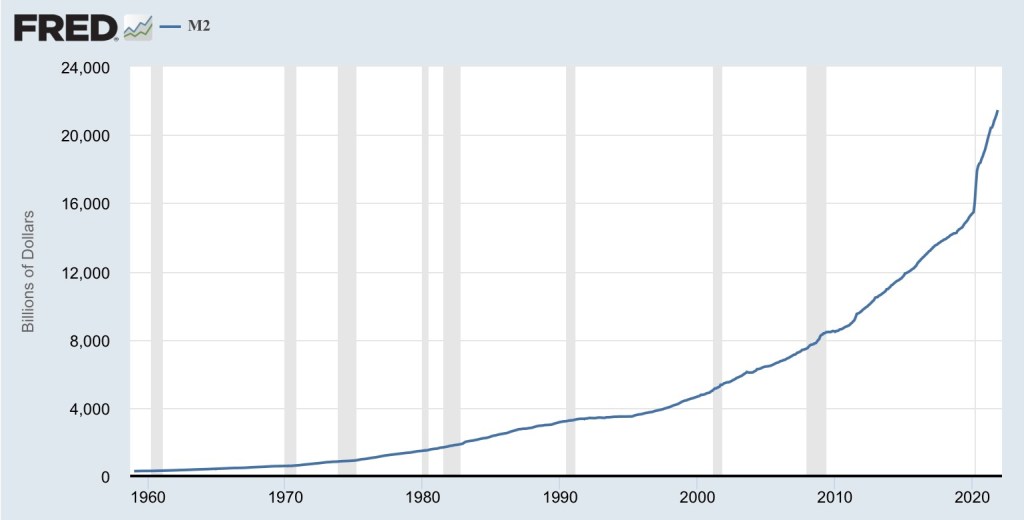
2. Economy-wide, all dollar prices cannot rise continuously without an excess supply of a monetary asset. The Federal Reserve has discussed tapering its bond purchases in 2022 and its intention to raise overnight interest rates starting in the spring. It’s about time! The U.S. money supply ballooned during 2020 and its growth remains at a gallop. This has enabled the inflation we are experiencing today, and only recently have the markets begun to react as if the Fed means business.
Weber, our would-be price controller, exhibits a marked ignorance with respect to both aspects of price pressure: how markets work in the first instance, and how monetary profligacy lies at the root of broader inflation. Instead, she insists that prices are rising today because industrialists have simply decided to extract more profit! Poof! It’s as simple as that! Well what was holding those greedy bastards back all this time?
Everyone competes for scarce resources, so prices are bid upward when supplies are short, inputs more costly, or demand is outpacing supply for other reasons. Sure, sellers may earn a greater margin on sales under these circumstances. But the higher price accomplishes two important social objectives: efficient rationing of available quantities, and greater incentives to bring additional supplies to market.
So consider the outcome when government takes the advice of a Weber: producers are prohibited from adjusting price in response to excess demand. Shortages develop. Consumers might want more, but that’s either impossible or it simply costs more. Yet producers are prohibited from pricing commensurate with that cost. Other adjustments soon follow, such as changes in discounts, seller credit arrangements, and product quality. Furthermore, absent price adjustment, transaction costs become much more significant. Other resources are consumed in the mere process of allocating available quantities: time spent in queues, administering quotas, lotteries or other schemes, costly barter, and ultimately unsatisfied needs and wants, not to mention lots of anger and frustration. Lest anyone think this process is “fair”, keep in mind that it’s natural for these allocations to take a character that is worse than arbitrary. “Important people” will always have an advantage under these circumstances.
Regulatory and financial burdens are imposed on those who play by the rules, but not everyone does. Black market mechanisms come into play, including opportunities for illegal side payments, rewards for underworld activity, along with a general degradation in the rule of law.
Price controls also impose rigidity in relative prices that can be very costly for society. “Freezing” the value of one good in terms of others distorts the signals upon which efficient resource allocation depends. Tastes, circumstances, and production technology change, and flexible relative prices enable a smoother transitions between these states. And even while demand and/or input scarcity might increase in all markets, these dynamics are never uniform. Over time, imbalances always become much larger in some markets than others. Frozen relative prices allow these imbalances to persist.
For example, the true value of good A at the imposition of price controls might be two units of good B. Over time, the true value of A might grow to four units of good B, but the government insists that A must be traded for no more than the original two units of B. Good B thus becomes overvalued on account of government intervention. The market for good A, which should attract disproportionate investment and jobs, will instead languish under a freeze of relative prices. Good B will continue to absorb resources under the artificial tradeoff imposed by price controls. Society must then sacrifice the gains otherwise afforded by market dynamism.
The history of price controls is dismal (also see here). They artificially suppress measured inflation and impose great efficiency costs on the public. Meanwhile, price controls fail to address the underlying monetary excess.
Price controls are destructive when applied economy-wide, but also when governments attempt to apply them to markets selectively. Posturing about “strategic” use of price controls reveals the naïveté of those who believe government planners can resolve market dislocations better than market participants themselves. Indeed, the planners would do better to discover, and undo, the damage caused by so many ongoing regulatory interventions.
So beware Joe Biden’s bluster about “greedy producers” in certain markets, whether they be in “Big Meat”, or “Big Oil”. Price interventions in these markets are sure to bring you less meat, less oil, and quite possibly less of everything else. The unintended consequences of such government interventions aren’t difficult to foresee unless one is blinded with the scientism of central planning.
That’s our Commander and Chief this week, posing in a mask on the beach in what is a phenomenal display of stupidity. More importantly, that kind of messaging contributes to the wholly unwarranted panic surrounding the Omicron variant of Covid-19. Panic, you say? Take a look at this admission from a New York health official. She says a recent alert on pediatric hospitalizations was driven by a desire to “motivate” parents to vaccinate their children. YetCovid has never posed a significant risk to children. And take a look at what this insane physician posted. It’s fair to say he’s “catastrophizing”, an all too common psychological coping mechanism for alarmists.
The Omicrommon Cold
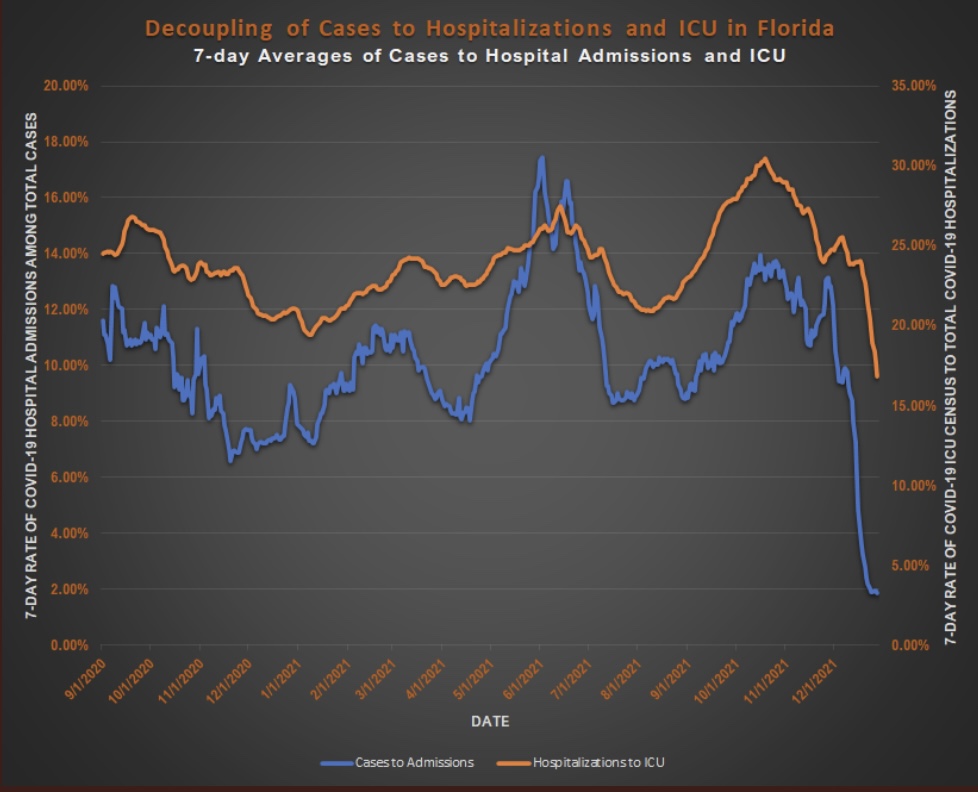
Given Omicron’s low apparent severity, it might be the variant that allows a return to normalcy. It’s perhaps the forefront of a more benign but endemic Covid, as it seems to be out-competing and displacing the far more dangerous Delta variant. In fact, Omicron infections are protective against Delta, probably for much longer than vaccines. The mild severity we’ve seen thus far is due in part to protection from vaccines and acquired immunity against breakthrough infections, but there’s more: there are plenty of non-breakthrough cases of Omicron, and most hospitalizations are among the unvaccinated. Yet we see this drastic decline in Florida’s ratio of ICU to hospital admissions (as well as a reduction in length of stay — not shown on chart). Similar patterns appear elsewhere. Omicron’s more rapid onset and course make it less likely that these patterns are caused by lags in the data.
Panic Begets Lockdowns
The frantic Omicron lunacy is driven partly by data on the number of new cases, which can be highly misleading as a guide to the real state of affairs. Testing is obviously necessary for diagnosis, but case totals as an emphasis of reporting have a way of feeding back to panic and destructive public policy: every wave brings surges in cases and the positivity rate prompting authoritarian measures with dubious benefits and significant harms (see here and here).
Flawed Case Data
In many respects, the data on Covid case totals have been flawed from the beginning, owing largely to regulators. At the outset in early 2020, there was a severe shortage in testing capacity due to the CDC’s delays in approving tests, as well as restrictions on testing by private labs. Many cases went undiagnosed, including a great many asymptomatic cases. The undercount of cases inflated the early case fatality rate (CFR). Subsequently, the FDA dithered in its reviews of low-cost, rapid, at-home tests. The latest revelation was the Administration’s decision in October to nix a large rollout of at-home tests. While the results of those tests are often unreported, they would have been helpful to individual decisions about seeking care and quarantining.
The PCR test finally distributed in March 2020 was often too sensitive, which the CDC has finally acknowledged, This is a flaw I’ve noted several times in the past. It led to false positives. Hospitals began testing all admitted patients, which was practical, and the hospitals were happy to do so given the financial rewards attendant to treating Covid patients under the CARES Act. However, it resulted in the counting of “incidental” Covid-positives: patients admitted with Covid, but not for Covid. That inflates apparent severity gleaned through measures like hospitalized cases, and it can distort counts of Covid fatalities and the CFR.
On balance, the bias caused by the test shortage at the start of the pandemic likely constrained total case counts, but the subsequent impact of testing practices is uncertain except for incidental hospitalized cases and the impact on counts of deaths.
Omicron Enlightenment
Omicron spreads rapidly, so the clamoring for tests by panicked consumers has resulted in another testing shortage, both for PCR tests and at-home tests at pharmacies. The shortage might not be relieved until the Omicron wave has crested, which could occur within a matter of a few weeks if the experience of South Africa and London are guides. In the meantime, another deleterious effect of the “case panic” is the crush of nervous individuals at emergency rooms presenting with relatively minor symptoms. Now more than ever, many of the cases identified at hospitals are incidental, particularly pediatric cases.
A thread by Monica Gandhi, and her recent article in the New York Times, makes the case that hospitalizations should be the primary focus of Covid reporting, rather than new cases. Quite apart from the inaccuracies of case counting and the mild symptoms experienced by most of those infected, Gandhi reasons that breakthrough infections so common with Omicron render case counts less relevant. That’s because high rates of vaccination (not to mention natural immunity from prior infections) reduce severity. Even Jennifer Rubin has taken this position, a complete reversal of her earlier case-count sanctimony.
Incidental Infections
Phil Kerpen’s reaction to Gandhi’s article was on point, however:
“Unless HHS Protect adds a primary [diagnosis] column, hospital census isn’t much more useful than cases.”
HHS Protect refers to the Health and Human Services public data hub. Without knowing whether Covid is the primary diagnosis at admission, we have no way of knowing whether the case is incidental. If Covid is the primary reason for admission, the infection is likely to be fairly severe. It is more useful to know both the number of patients hospitalized for Covid and tge number hospitalized for other conditions (incidentally with Covid). The distinction has been extremely important to those interpreting data from South Africa, where a high proportion of incidental admissions was a tip-off that Omicron is less severe than earlier variants.
The absence of such coding is similar to the confusion caused by the CDC’s decision early in pandemic to issue new guidance on the completion of death certificates when Covid is present or even suspected. A special exception was created at that time requiring all deaths involving primary or incidental Covid infections to be ruled as Covid deaths. This represented another terrible corruption of the data.
Summary
Earlier variants of Covid were extremely dangerous to the elderly, obese, and the immune-compromised. Yet public health authorities seemed to take every opportunity to mismanage the pandemic, including contradictory messaging and decisions that compromised the usefulness of data on the pandemic. But here we are with Omicron, which might well be the variant that spells the end of the deadly Covid waves, and the focus is still squarely on case counts, vaccine mandates, useless masking requirements, and President Brandon wearing a mask on the beach!
Case counts should certainly be available, as Gandhi goes to great lengths to emphasize. However, other metrics like hospitalizations are more reliable indicators of the current wave’s severity, especially if paired with information on primary diagnoses. Fortunately, there has been a very recent shift of interest to that kind of focus because the superior information content of reports from countries like South Africa and Denmark is too obvious. As Don Wolt marvels:
“Behold the sudden interest by the public health establishment in the “With/From” COVID distinction. While long an important & troubling issue for many who sought to understand the true impact of the virus, it was, until very recently, actively ignored by Fauci & crew.”
That change in emphasis would reduce the current sense of panic, partly by making it more difficult for the media to purvey scare stories and for authorities to justify draconian non-pharmaceutical interventions. It’s no exaggeration to say that anything that might keep the authoritarians at bay should be a public health priority.
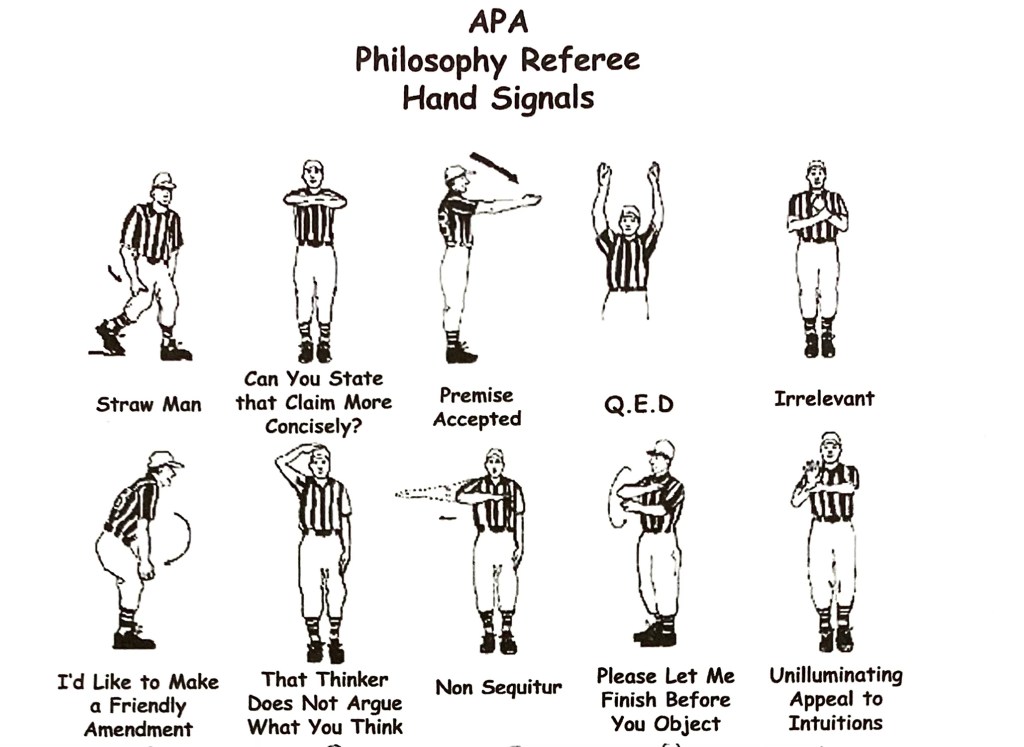
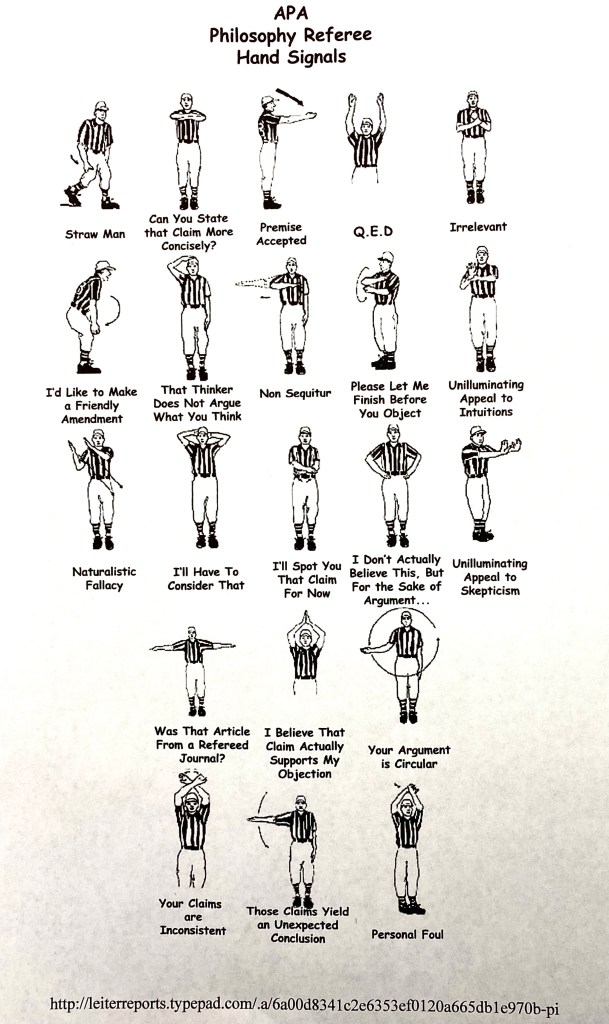
The Christmas holidays are upon us, with many joyful gatherings of family and friends, lots of tempting treats and libations, and of course, plenty of college football bowl games… all barring cancellation due to Covid psychosis. Just as discipline and good sportsmanship is maintained on the football field via sound officiating, it might be helpful to designate at least one friend or family member to serve as an impartial referee for the many political and philosophical discussions that are bound to crop up around the Yule log.
In the spirit of giving, I present you with an illustrated guide to officiating these deliberations. A complete set of hand signals for philosophy referees is shown below, with credit to the Leiter Reports blog. However, you better give your designated ref(s) a day or so to prepare. And remember to appoint a videographer for replay review!
A subset of my LinkedIn connections list “preferred pronouns” after their names, but I don’t think I’ve ever had any misapprehensions about their “gender identities”. Not one of them. Their “gendentities” are obvious based on the names and/or photos they’ve chosen to use on social media. In fact, the “default” pronoun designations in the English language work pretty well that way. So, apart from the fact that LinkedIn invites its users to list pronouns, why do these people bother? Would they introduce themselves that way in person? “Hi, nice to meet you, I’m Jane Smith, she / her.” Maybe on a name tag. Otherwise, unlikely.
Let’s face it: precious few of us have any doubt about our own biological sex. Do you have a penis and no vagina? Or vice versa? That settles it! But if you wish you didn’t have a penis, or wish you did, or you’re not sure… then you have a gender quandary and a pronoun problem. Still, those who decide to “take” one gender via transition will have chosen their pronouns. They typically make an effort to “present” that way as well.
There’s a tiny minority of individuals whose biological sex is ambiguous, and there are others who simply consider themselves “non-binary” or “genderqueer”. They represent three to four people out of every 1,000, ifa recent survey can be believed (and surveys like this can be terribly flawed). These people are actually included in the broad definition of transgender. But again, for biological or other reasons, they identify as neither male nor female. It would be natural for these individuals to prefer gender-neutral pronouns (for example, possibilities are they / them and zi / hir, rather than he / him or she / her). That’s understandable, but: 1) using the plural “they” as a singular pronoun can lead to awkward grammar, inviting the use of the plural verb form as a fix*; and 2) remembering different pronouns for different people is a complexity to which most of us are quite unaccustomed. This is a practical issue, and social encounters with non-binaries are fairly unusual for most of us.
If tolerating the use of “he” or “she” just won’t do for this tiny minority, even as a courtesy to the “unschooled”, then it must be very important to make one’s non-binary status clear to everyone. That suggests a different problem, and one of a psychological nature. The insistence on strict adherence to alternative pronouns reflects a narcissism common to most manifestations of identity politics. And no, there is no reliable research showing that use of non-gendered pronouns reduces non-binary suicides, as one advocacy group has claimed.
I speak as one who has been called by the wrong gendered pronoun! I’m a male and I’m confident I present that way. However, I’ve worked with many Chinese over the course of my career, and gendered pronouns aren’t used in Chinese. The distinctions between “he” and “she”, or “his” and “hers”, can be as foreign to them as the pronouns “zi” and “hir” are to me. I’ve heard myself referenced by Chinese colleagues as “she”. Did it offend me? Not at all, because I knew the speaker was not fluent in the English language.
It should be easy to tolerate members of a minority who get it wrong because we empathize with their language challenge. We don’t demand their absolute conformity, but they understand their minority status and might prefer to avoid the potential embarrassment of getting it wrong. Contrary-wise, if I’m in the minority, say at a gathering of Chinese, shall I press the issue by demanding that every member of the majority distinguish between me and my wife using the correct English pronouns? I think not. But non-binary activists are so offended by gendered pronouns, which have been in common use among English speakers for centuries, that they demand the majority change the language to accommodate them. That is unreasonable. It’s okay to let others know what you prefer, but you shouldn’t feel slighted by every miscue or be a complete prig about it!
Now, if you happen to be a plain-old binary individual, what’s your excuse for listing preferred pronouns on social media? It seems completely unnecessary, so why bother? Here are a few possibilities:
You have transitioned to your gender and list pronouns as a courtesy to anyone who knew you before your transition.
You are an HR functionary having a career imperative to signal your evenhandedness.
You are a plaintiffs attorney chasing genderqueer discrimination business.
You simply like the Chinese practice and want to adopt gender-neutral pronouns. Good luck at your high school reunion!
My guess is that pecuniary and career motives are less important to most pronoun-listers than simple political correctness. Either way, it’s a virtue signal. Of course, you might have non-binary friends or relatives and wish to demonstrate to the world your unerring respect for their preferences. That’s admirable loyalty, but it’s an unnecessary compulsion.
Pronoun lists seem designed to announce support for all things LGBTQ+. I also suspect that some believe it more firmly establishes their socially progressive bona fides, that the pronoun-lister is beyond reproach no matter the nasty capitalists for whom they might toil. Therefore, announcing one’s preference for default pronouns seems both unnecessary and pretentious.
I am fairly tolerant of the notion that gender identity can transcend biology in some individuals. However, that is a controversial metaphysical assertion that many do not accept. Certainly, a decision to reject one’s biological sex should not be made hastily. In particular, these decisions should not be encouraged in children except for cases in which biological sex is ambiguous and where medical procedures might be appropriate. Yet LGBTQ+ doctrine teaches that questioning one’s gender identity should be normalized, even among impressionable children. That is highly objectionable and even abusive. Persuading straights to engage in pronoun pretensions of the kind described above is part of the LGBTQ+ crusade to normalize gender dysphoria.
Beyond all that, changing the structure of the English language to accommodate LGBTQ+ advocates requires a change in language curriculum for young children. One might object on purely grammatical grounds, but it would also raise questions as to why dual sets of pronouns are necessary. To whom do these pronouns apply? That broaches the sensitive topic of gender fluidity that many parents and taxpayers do not wish to be taught as standard curriculum in elementary or even secondary schools. I’m inclined to agree with them.
My general attitude is “whatever floats your boat, but leave me out of it”. I submit that the use of non-gendered pronouns is not “owed” to anyone. It would be easier for the rarefied non-binaries to accept the same fluidity with respect pronouns that they profess with respect to their own gender identities.
* I have occasionally used plural pronouns (they, them, and their) with plural verb forms in reference to “one”, “someone”, or “you”), who might be either male or female. In those cases, the sentence is meant to apply to both genders, but I admit it’s sloppy writing.
My theme in “What’s To Like About Income Inequality?” was the existence of natural drivers of an unequal distribution of income, as where institutions reward merit and legal systems assign strong property rights. I also discussed trends in income and wealth inequality and how standard measures of inequality are distorted by income taxes and transfer payments, including differences in unrealized and realized capital gains. Furthermore, income mobility makes “snapshots” of inequality less compelling, as individuals are not “stuck” for all time at a point in the income distribution, but are typically moving across the distribution and usually upward as they age through their working years.
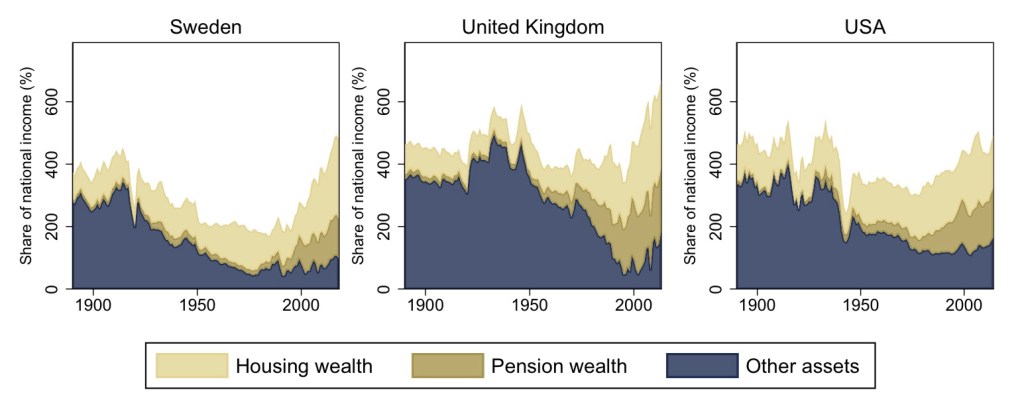
Wealth inequality is another matter, but a new paper by Daniel Waldenström entitled “Wealth and History: An Update” shows that wealth concentration, which he defines as the share of wealth held by the top 1%, declined markedly between 1920 and 1970 in Europe and the U.S. After 1970, however, the share remained flat in Europe and was flat in the U.S. as well if unfunded pensions and Social Security benefits are valued as wealth. However, the near-entirety of the earlier decline in U.S. wealth concentration occurred by about 1950.
So a great thinning in the fat right tail of the wealth distribution occurred during the middle years of the 20th century. Waldenström attributes this transition to growth of homeownership and pension assets. These are so-called “popular assets” because they are held more broadly than the legacy wealth of the 1800s and early twentieth century:
“… the structure of private wealth has changed over the twentieth century, from being dominated by elite fortunes in agriculture or businesses to consisting mainly of widely dispersed assets in housing and funded pensions.”
Waldenström concludes that the facts run contrary to claims that wealth inequality has worsened in Western, capitalist economies over the years:
“These new findings have implications for the historiography of Western wealth accumulation and wealth concentration. They cast doubt over the view that an unfettered capitalism, such as in pre-democratic and pre-taxation nineteenth-century Europe, generates extreme levels of capital accumulation. The new findings also question the pivotal role of wars, crises and progressive taxation as the sole important factors behind the wealth equalization of the twentieth century.
Waldenström considers the role of progressive taxation in equalizing wealth, but he acknowledges that taxes undermined wealth accumulation at all levels, so the effect was ambiguous. A point on which I’d take issue with Waldenström is the role of regulation, which he believes “curbed the growth of large fortunes”. That might be true in some cases, but this effect is also subject to ambiguity. Regulation is often welcomed by powerful market players as a way of consolidating market position and hindering new competition. The regulatory state has long been considered a primary channel for rent seeking, so the impact on the wealth distribution is likely to be mixed.
Market institutions, together with rising education levels, labor reforms, and gains in productivity enabled this broadening in the accumulation and distribution of wealth. Social Security certainly played a part as well, though we don’t know how private pensions might have evolved in its absence. Of course, Social Security has a terrible record as an “investment” of payroll taxes. Private control over the investment direction of those funds would have done far better, and still could, which would be a further boon to wealth for the lower 99%.
It is true that inequality in both income and wealth is to be expected under merit-based systems of rewards. However, Daniel Waldenström’s paper offers evidence that markets do not merely concentrate wealth at the expense of workers. Rather, they deliver gains to all participants, who are in turn free to accumulate wealth in the kinds of “popular assets” discussed by Waldenström.
The political motives behind the naming of the Covid Omicron variant might prove to be a huge irony. The Greek letter Xi was skipped by the World Health Organization (WHO), undoubtedly to avoid any symbolic association between Covid and the Chinese dictator Xi Jinping. After all, he’s probably determined to bury discussion of the leak at the Wuhan lab that was the probable cause of this whole mess. The WHO was happy to provide cover. The irony is that the Omicron variant might well bring on a more gentle phase of the pandemic if early indications can be trusted. But in that case, my guess is Chairman Xi wouldn’t have appreciated the twist even if WHO had called it the Xi variant.
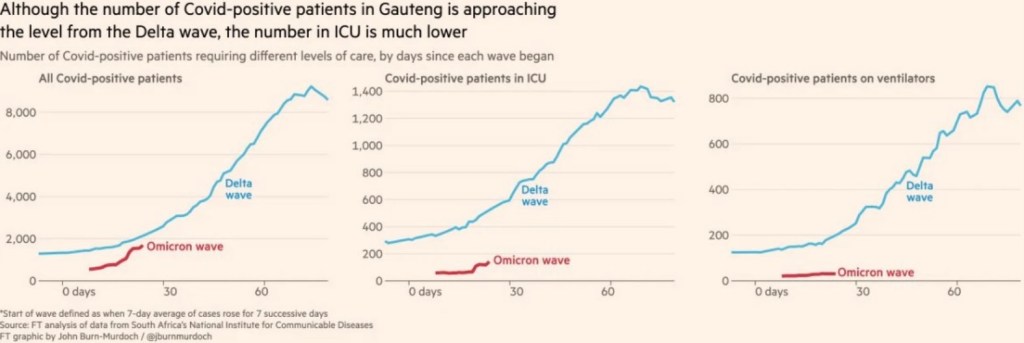
The Omicron variant was identified in the Gauteng Province of South Africa and announced by national health authorities on November 24th. The earliest known sample was taken on November 9th. The variant was subsequently diagnosed in a number of other countries, including the U.S. It has a large number of mutations, and initial reports indicated that the variant was spreading extremely fast, having suddenly outcompeted other variants to account for the majority of new cases in South Africa. It is apparently highly contagious. Moreover, Omicron has been diagnosed among the vaccinated as well as those having immunity from prior infections, which is usually more effective and durable than vaccination. Thus, it is said to have “immune escape” properties. Scary indeed!
However, Omicron seems to have been around much longer than suggested by its initial diagnosis in late November (and see this link for an extreme view). Cases in a number of countries show that it is already global; the lags involved in diagnosis as well as earlier contacts with spreaders suggest that Omicron’s origin could have been as early as late September. That means the spread has not been quite as fast as the first alarming reports suggested.
The reported symptoms of the Omicron variant have been quite mild, with fatigue being the most noteworthy. Omicron appears to have taken one mutation from the common cold, which, like Covid-19, is a type of coronavirus. And while there has been a surge in hospitalized cases in South Africa, most of these are said to be “incidental”. That is, these patients were admitted for other problems but happened to test positive for the Omicron variant. As we’ve seen throughout the pandemic, the data is not always reliable.
It’s too early to draw definite conclusions, and this variant might prove to be more dangerous with time. In fact, some say that South Africa’s experience might not be representative because of its young population and high natural immunity. It also happens to be early summer there, when higher vitamin D levels help to boost immunity. So, there is a great deal of uncertainty about Omicron (and see here). Nevertheless, I’ll risk a jinx by momentarily contemplating an outcome that’s not terribly far-fetched.
Viruses mutate in ways that help ensure their survival: they must not kill too many of their hosts, which means the usual progression is toward less lethal variants. They may become more contagious, and new variants must be contagious enough to outcompete their ancestors. Viral interference can sometimes prevent multiple viruses from having a broad coexistence. That’s the likely phenomenon we witnessed when the Covid pandemic coincided with the virtual disappearance of the flu and other respiratory viruses. More to the point, it’s the same phenomenon that occurred when the Spanish Flu was eventually outcompeted by less deadly variants.
So it’s possible that a mild Omicron will put the pandemic behind us. If it proves to be as contagious and as mild as it appears thus far, it would likely displace Delta and other variants as the first phase of a new, endemic malady. That might even cut into the severity of the current seasonal wave. The Ethical Skeptic tweets thusly:
“So was Omicron an ultra fast-mutating magic terminator variant? A gift from God, or aliens…? … Or natural virility/genetic profile derived from a previous variant conferring immunity …”
That would be a wonderful outcome, but Omicron’s arrival in the northern hemisphere just as winter gets underway contributes to the uncertainty. It’s severity during the northern winter could be far worse than what we’ve seen in South Africa. We can hope this variant isn’t one truly deserving of Chairman Xi’s name.
The weak methodology and accuracy of climate models is the subject of an entertaining Norman Rogers post. I want to share just a few passages along with a couple of qualifiers.
Rogers quotes Kevin Trenberth, former Head of Climate Analysis at the National Center for Atmospheric Research, with apparent approval. Oddly, Rogers does not explain that Trenberth is a strong proponent of the carbon-forcing models used by the UN’s Intergovernmental Panel on Climate Change (IPCC). He should have made that clear, but Trenberth actually did say the following:
“‘[None of the] models correspond even remotely to the current observed climate [of the Earth].’“
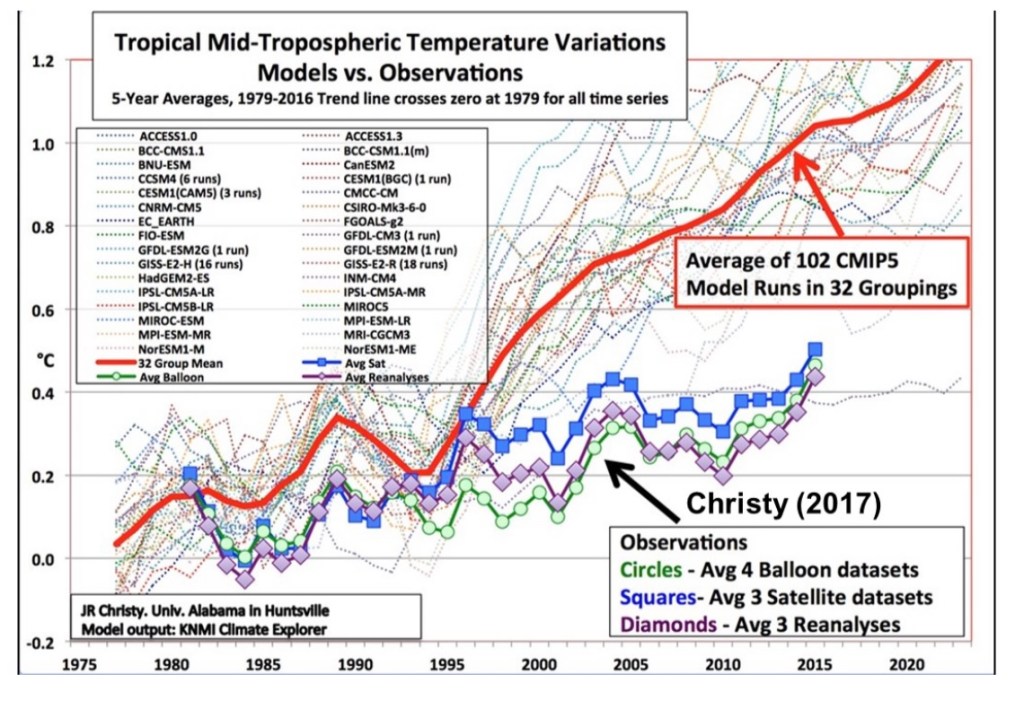
I’ll explain the context of this comment below, but it constitutes a telling admission of the poor foundations on which climate alarmism rests. The various models used by the IPCCc are all a little different and they are calibrated differently. I’ve noted elsewhere that their projections are consistently biased toward severe over-predictions of temperature trends. Rogers goes on from there:
“The models can’t properly model the Earth’s climate, but we are supposed to believe that, if carbon dioxide has a certain effect on the imaginary Earths of the many models it will have the same effect on the real earth.”
But how on earth can a modeler accept the poor track record of these models? It’s not as if the bias is difficult to detect! On this question, Rogers says:
“The climate models are an exemplary representation of confirmation bias, the psychological tendency to suspend one’s critical facilities in favor of welcoming what one expects or desires. Climate scientists can manipulate numerous adjustable parameters in the models that can be changed to tune a model to give a ‘good’ result.“
And why are calamitous projections desirable from the perspective of climate modelers? Follow the money and the status rewards of reinforcing the groupthink:
“Once money and status started flowing into climate science because of the disaster its denizens were predicting, there was no going back. Imagine that a climate scientist discovers gigantic flaws in the models and the associated science. Do not imagine that his discovery would be treated respectfully and evaluated on its merits. That would open the door to reversing everything that has been so wonderful for climate scientists. Who would continue to throw billions of dollars a year at climate scientists if there were no disasters to be prevented? “
Indeed, it has been a gravy train. Today, it is reinforced by green-preening politicians, the many billions of dollars committed by investors seeking a continuing flow of public subsidies for renewables, tempting opportunities for international redistribution (and graft), and a mainstream media addicted to peddling scare stories. The parties involved all rely on, and profit by, alarmist research findings.
Rogers’ use of the Trenberth quote above might suggest that Trenberth is a critic of the climate models used by the IPCC. However, the statement was in-line with Trenberth’s long-standing insistence that the IPCC models are exclusively for constructing “what-if” scenarios, not actual forecasting. Perhaps his meaning also reflected his admission that climate models are “low resolution” relative to weather forecasting models. Or maybe he was referencing longer-term outcomes that are scenario-dependent. Nevertheless, the quote is revealing to the extent that one would hope these models are well-calibrated to initial conditions. That is seldom the case, however.
As a modeler, I must comment on a point made by Rogers about the use of ensembles of models. That essentially means averaging the predictions of multiple models that differ in structure. Rogers denigrates the approach, and while it is agnostic with respect to theories of the underlying process generating the data, it certainly has its uses in forecasting. Averaging the predictions of two different models with statistically independent and unbiased predictions will generally produce more accurate forecasts than the individual models. Rogers may or may not be aware of this, but he has my sympathies in this case because the IPCC is averaging across a large number of models that are clearly biasedin the same direction! Rogers adds this interesting tidbit on the IPCC’s use of model ensembles:
“There is a political reason for using ensembles. In order to receive the benefits flowing from predicting a climate catastrophe, climate science must present a unified front. Dissenters have to be canceled and suppressed. If the IPCC were to select the best model, dozens of other modeling groups would be left out. They would, no doubt, form a dissenting group questioning the authority of those that gave the crown to one particular model.”
Rogers discusses one more aspect of the underpinnings of climate models, one that I’ve covered several times on this blog. That is the extent to which historical climate data is either completely lacking, plagued by discontinuities or coverage, or distorted by imperfections in measurement. The data used to calibrate climate models has been manipulated, adjusted, infilled, and estimated over lengthy periods by various parties to produce “official” and unofficial temperature series. While these efforts might seem valiant as exercises in understanding the past, they are fraught with uncertainty. Rogers provides a link to the realclimatescience blog, which details many of the data shortcomings as well as shenanigans perpetrated by researchers and agencies who have massaged, imputed, or outright created these historical data sets out of whole cloth. Rogers aptly notes:
“The purported climate catastrophe ahead is 100% junk science. If the unlikely climate catastrophe actually happens, it will be coincidental that it was predicted by climate scientists. Most of the supporting evidence is fabricated.”
Much of what is labeled market failure is a consequence of government failure, or rather, failure caused by misguided public intervention, not just in individual markets but in the economy more generally. Misguided efforts to correct perceived excesses in pricing are often the problem, but there are myriad cases of regulatory overreach, ham-handed application of taxes and subsidies for various enterprises, and widespread cronyism. But it is often convenient for politicians to appear as if they are doing something, which makes activism and active blame of private enterprise a tempting path. The Biden Administration’s energy crisis offers a case in point. First, a digression on the efficiency of free markets. Skip the next two sections to get straight to Biden’s mess.
Behold the Bounty
I always spent part of the first class session teaching Principles of Economics on some incredible things that happen each and every day. Most college freshmen seem to take them for granted: the endless variety of goods that arrive on shelves each day; the ongoing flow of services, many appearing like magic at the flick of a switch; the high degree of coincidence between specific wants and all these fresh supplies; the variety and flow of raw materials and skills that are brought to bear; the fantastic array of sophisticated equipment deployed to assist in these efforts; and the massive social coordination necessary to accomplish all this. How does it all happen? Who collects all the information on what is wanted, and by whom? On the feasibility of actually producing and distributing various things? What miracle computer processes the vast set of information guiding these decisions and actions? Does some superior intelligence within an agency plan all this stuff?
The answer is simple. The seemingly infinite set of knowledge is marshaled, and all these tasks are performed, by the greatest institution of social cooperation to ever emerge: decentralized, free markets! Buying decisions are guided by individual needs and wants. Production and selling decisions are guided by resource availability and technology. And all sides react to evolving prices. Preferences, resources, and technology are in a constant state of flux, but prices react, signaling producers and consumers to make individual adjustments that correct larger imbalances. It is tempting to describe the process as the evolving solution to a gigantic set of dynamic equations.
The Impossible Conceit
No human planner or government agency is capable of solving this problem as seamlessly and efficiently as markets, nor can they hope to achieve the surplus welfare that redound to buyers and sellers in markets. Central planners or intervening authorities cannot possess the knowledge and coordinating power of the market mechanism. That doesn’t mean markets are “perfect”, of course. Things like external costs and benefits, dominant sellers, and asymmetric information can cause market outcomes to deviate from the competitive “ideal”. Inequities can arise from some of these imperfections as well.
What can be much worse is the damage to market performance caused by government policy. Usually the intent is to “correct” imperfections, and the rationale might be defensible. The knowledge to do it very well is often lacking, however. Taxes, subsidies, regulations, tariffs, quotas, capital controls, and manipulation of interest rates (and monetary and credit aggregates) are very general categories of distortion caused by the public sector. Then there is competition for resources via government procurement, which is frequently graft-ridden or price-insensitive.
Many public interventions create advantages for large sellers, leading to greater market concentration. This might best serve the private political power of the wealthy or might convey advantages to investments that happen to be in vogue among the political class. These are the true roots of fascism, which leverages coercive state power for the benefit of private interests.
Energy Vampires
Now we have the curious case of the Biden Administration and it’s purposeful disruption of energy markets in an effort to incentivize a hurried transition from fossil fuels to renewable energy. As I described in a recent post on stagflation,
“… Biden took several steps to hamstring the domestic fossil fuel industry at a time when the economy was still recovering from the pandemic. This included revoking permits for the Keystone pipeline, a ban on drilling on federal lands and federally-controlled waters in the Gulf, shutting down production on some private lands on the pretext of enforcing the Endangered Species Act, and capping methane emissions by oil and gas producers. And all that was apparently just a start.
As Mark Theisen notes, when you promise to destroy a particular industry, as Joe Biden has, by taxing and regulating it to death, who wants to invest in or even maintain production facilities? Some leftists with apparent influence on the administration are threatening penalties against the industry up to and including prosecution for ‘crimes against humanity’!”
In addition to killing Keystone, there remains a strong possibility that Biden will shut down the Line 5 pipeline in Michigan, and there are other pipelines currently under federal review. Biden’s EPA also conducted a purge of science advisors considered “too friendly” to oil and gas industry. This was intertwined with a “review” of new methane rules, which harm smaller, independent oil and gas drillers disproportionately.
Joe Biden’s “Build Back Better” (BBB) legislation, as clumsy in policy as it is in name, introduces a number of “Green New Deal” provisions that would further disadvantage the production and use of fossil fuels. Hart Energy provides descriptions of various tax changes that appeared in the Treasury’s so-called “Greenbook”, a collection of revenue proposals, many of which appear in the BBB legislation that recently passed in the House. These include rollbacks of various deductions for drilling costs, depletion allowances, and recovery rules, as well as hikes in certain excise taxes as well as taxes on foreign oil income. And all this while granting generous subsidies to intermittent and otherwise uneconomic technologies that happen to be in political favor. This is a fine payoff for cronies having invested significantly in these rent seeking opportunities. While the bill still faces an uphill fight in the Senate, apparently Biden has executive orders, held in abeyance, that would inflict more pain on consumers and producers of fossil fuels.
Biden’s energy policies are obviously intended to reduce supplies of oil, gas, and other fossil fuels. Prices have responded, as Green notes:
“Gas is up an average of 57% this year, with corresponding increases of 44% for diesel and a whopping 60% for fuel oil.”
The upward price pressure is not limited to petroleum: electricity rates are jumping as well. Consumers and shippers have noticed. In fact, while Biden crows about wanting “the rich” to pay for BBB, his energy policies are steeply regressive in their impact, as energy absorbs a much larger share of budgets among the poor than the rich. This is politically suicidal, but Biden’s advisors have chosen a most cynical tact as the reality has dawned on them.
Abusive Victim Blaming
Who to blame? After the predictable results of cramping domestic production and attacking fossil fuel producers, the Biden team naturally blames them for rising prices! “Price gouging” is a charge made by political opportunists and those who lack an understanding of how markets allocate scarce resources. More severe scarcity means that prices must rise to ration available quantities and to incentivize those capable of bringing forth additional product under difficult circumstances. That is how a market is supposed to function, and it mitigates scarcity!
But here comes the mendacious and Bumbling Buster Biden. He wants antitrust authorities at the FTC to investigate oil pricing. Again from Stephen Green:
There’s nothing quite like a threat to market participants to prevent the price mechanism from performing its proper social function. But a failure to price rationally is a prescription for more severe shortages.
Biden has also ordered the Strategic Petroleum Reserve (SPR) to release 50 million barrels of oil, a move that replaces a total of 2.75 days of monthly consumption in the U.S. The SPR is supposed to be drawn upon only in the case of emergencies like natural disasters, so this draw-down is as irresponsible as it is impotent. In fact, OPEC is prepared to offset the SPR release with a production cut. Biden has resorted to begging OPEC to increase production, which is pathetic because the U.S. was a net exporter of oil not long ago … until Biden took charge.
Conclusion
Properly stated, the challenge mounted against markets as an institution is not that they fall short of “perfection”. It is that some other system would lead to superior results in terms of efficiency and/or equity. Central planning, including the kind exercised by the Biden Administration in it’s hurried and foolish effort to tear down and remake the energy economy, is not even a serious candidate on either count.
Granted, there is a long history of subsidies to the oil and gas sector. I cannot defend those, but the development of the technology (even fracking) largely preceded the fruits of the industry’s rent seeking. At this point, green fuels receive far more subsidies (despite some claims to the contrary). Furthermore, the primacy of fossil fuels was not achieved by tearing down competing technologies and infrastructure. In contrast, the current round of central planning requires destruction of entire sectors of the economy that could otherwise produce efficiently for the foreseeable future, if left unmolested.
The Biden Administration has adopted the radical green agenda. Their playbook calls for a severe tilting of price incentives in favor uneconomic, renewable energy sources, despite the economy’s heretofore sensible reliance on plentiful fossil fuels. It’s no surprise that Biden’s policy is unpopular across the economic spectrum. His natural inclination is to blame a competitive industry victimized by his policy. It’s a futile attempt to avoid accountability, as if he thinks doubling down on the fascism will help convince the electorate that oil and gas producers dreamt up this new, nefarious strategy of overcharging customers. People aren’t that dumb, but it’s typical for the elitist Left presume otherwise.
Bill Gates’ considerable philanthropic efforts through the Gates Foundation are well known. Much of the foundation’s activity has focused on disease control and nutrition around the globe. Education reform has also been a priority. Many of these projects are laudable, though I’m repulsed by a few (see here and here). During the coronavirus pandemic, Gates has spoken approvingly of Non-Pharmaceutical Interventions (lockdown measures), which are both coercive and ineffective (and see here). He has earned the enmity of anti-vaxers, of course, though I’m not anti-vax as long as the jabs are voluntary. The Gates Foundation funded the World Health Organization’s effort to provide guidance on digital vaccine passports, which is a de facto endorsement of discrimination based on vaccination status. His priorities for addressing climate change also raise some troubling issues, a few of which I address below.
Squeezing Policy from a Definition
Gates put a special Malthusian twist on a TED Talk he did back in 2010 using an equation for carbon dioxide emissions, which he’s reprised over the years. It gained a lot of notice in 2016 when a few sticklers noticed that his claim to have “discovered” the equation was false. The equation is:
CO2 = P x S x E x C,
where P = People, S = Services per person, E = Energy per service, and C = CO2 per energy unit.
This equation first appeared as the so-called Kaya Identity in a scientific review in 2002. Such an equation can be helpful in organizing one’s thoughts, but it has no operational implications in and of itself. At one level it is superficial: we could write a similar identity for almost anything, like the quantity of alcohol consumed in a year, which must equal the population times the ounces of alcohol per drink times the number of drinks per person. At a deeper level, it can be tempting to build theories around such equations, and there is no question that any theory about CO2 must at least preserve the identity.
There’s an obvious temptation to treat an equation like this as something that can be manipulated by policy, despite the possibility of behavioral links across components that might lead to unintended consequences. This is where Gates gets into trouble.
Reality Checks
As David Solway writes, Gates’ jumped to the conclusion that population drives carbon emissions, reinforcing a likely perspective that the human population is unsustainable. His benevolent solution? A healthier population won’t breed as fast, so he prescribes more vaccinations (voluntary?) and improved health care. For good measure, he added a third prong: better “reproductive health services”. Let’s see… what share of the 0.9 -1.4 billion reduction in world population Gates prescribed in 2016 would have come from terminated pregnancies?
In fact, healthier people might or might not want more children, but lower child mortality in the developing world would reduce certain economic incentives for high fertility. Another reliable association is between income and child bearing: an increase in “services per person” is likely to lead to smaller families, but that wasn’t given any emphasis by Gates. Income growth is simply not part of the narrative! Yet income growth does something else: it allows us to more easily afford the research and investments required for advanced technologies, including cleaner energy. These things take time, however.
Solway points to other weaknesses in Gates’ interpretation of the Kaya Identity. For example, efforts to slow population growth are not reliably associated with “services per person”, fuel efficiency, or carbon efficiency. In other words, carbon emissions may be powerfully influenced by factors other than population. China is a case in point.
Centralized industrial and social planning is generally ill-suited to advancing human well being. It’s especially suspect if the sole objective is to reduce carbon emissions. But Gates knows that lowering emissions without a corresponding drop in real income requires continuing technological advances and/or more efficient decisions about which technologies to deploy. He is a big advocate of developing cheap hydrogen power, which is far from a reality. He is also excited about carbon capture technologies, which are still in their infancy.
Renewables like wind and solar power play a large part in Gates’ vision. Those technologies cannot deliver a reliable flow of power, however, without either adequate backup capacity or a dramatic advance in battery technology. Gates over-promotes wind and solar, but I give him credit for acknowledging their intermittency. He attempts to come to grips with it by advocating nuclear backup, but it’s just not clear that he has integrated the incremental cost of the necessary backup capacity with other direct costs of these renewables… not to mention the considerable environmental costs imposed by wind and solar (see the “back-to-nature” photo at the top for a cogent illustration). Power storage at scale is still a long way off, and its cost will be significant as well.
We could deploy existing energy technologies to greater advantage with respect to carbon efficiency. We’ve already reduced CO2 emissions in the U.S. by substituting natural gas for less carbon-efficient fuels, but the Biden Administration would rather discourage its use. Gates deserves credit for recognizing the huge role that nuclear energy can play in providing zero-carbon power. Despite that, he still can’t quite bring himself to admit the boneheadedness of heavy reliance on intermittent renewables.
Bill’s “Green Premium”
Gates seems to have deemphasized the Kaya Identity more recently. Instead, his focus has shifted to the so-called “green premium”, or the incremental cost of using zero-carbon technology relative to a traditional source. Needless to say, the premium is large for truly zero-carbon sources, but Gates emphasizes the importance of using the green premium to guide development even in the here and now.
That’s fine, but it’s not clear that he gives adequate consideration to cases in which emissions, while not eliminated, can be reduced at a negative incremental cost via appropriate substitution. That describes the transition to natural gas from other fuels. This is something that markets can do without the assistance of ham-handed interventionists. Gates prefers nuclear power and says natural gas is “not a real bridge technology” to a zero carbon future. That’s short-sighted and reflects an absolutist mindset that ignores both the economic and political environment. The thinking is that if it’s not zero emissions, it’s not worth doing.
Gates emphasizes the need to sharply reduce the range of green premia on various technologies to achieve net-zero carbon emissions by 2050. But the goal of net-zero emissions 2050 is based on the highly unlikely proposition that global catastrophe awaits failing net-zero. In fact, the predicted consequences of doing nothing are based on drastic and outdated carbon growth scenarios and rudimentary carbon-forcing models that have proven to be severely biased to the upside in terms of predicting global temperature trends.
The idea that 2050 is some kind of “deadline” is a wholly arbitrary determination. Furthermore, the absolutism with which such goals are stated belies a failure to properly assess the true costs and benefits of carbon-based energy. If we so much as accept the notion that fossil fuels have external costs, we are then expected to accept that zero carbon emissions is optimal. This is not “science”; it is doctrine propped-up by bizarre and false scare stories. It involves massive efforts to manipulate opinion and coerce behavior based upon shoddy forecasts produced by committee. Even carbon capture technology is considered “problematic” because it implies that someone, somewhere, will use a process that emits CO2. That’s a ridiculous bogeyman, of course, and even Gates supports development of carbon capture.
Conclusion
I’ve never felt any real antipathy for Bill Gates as a person. He built a fortune, and I used his company’s software for most of my career. In some ways I still prefer it to macOS. I believe Gates is sincere in his efforts to help humanity even if his efforts are misdirected. He seems to reside on the less crazy end of the spectrum of climate alarmists. He’s putting a great deal of his private resources toward development of technologies that, if successful, might actually lead to less coercion by those attempting to transform private energy decisions. Nevertheless, there is menace in some of the solutions to which Gates clings. They require concerted action on the part of central authorities that would commandeer private resources and abrogate liberty. His assertion that the world is over-populated is both dubious and dangerous. You can offer free health care, but a conviction that the population must be thinned can lead to far more radical and monstrous initiatives.
The “green premium” promoted by Gates is an indirect measure of how far we must go to achieve parity in the pricing of carbon and non-carbon energy sources, as if parity should be an objective of public policy. That proposition is based on bad economics, fraudulent analyses of trends in carbon concentrations and climate trends, and a purposely incomplete menu of technological alternatives. Yes, the green premium highlights various technological challenges, but it is also a direct measure of how much intervention via taxes or subsidies are necessary to achieve parity. Is that a temptation to policymakers? Or does it represent a daunting political barrier? It’s pretty clear that the “median voter” does not view climate change as the only priority.
In advanced civilizations the period loosely called Alexandrian is usually associated with flexible morals, perfunctory religion, populist standards and cosmopolitan tastes, feminism, exotic cults, and the rapid turnover of high and low fads---in short, a falling away (which is all that decadence means) from the strictness of traditional rules, embodied in character and inforced from within. -- Jacques Barzun








 Sacred Cow Chips