• About

Sacred Cow Chips

Sacred Cow Chips

Category Archives: Uncategorized

Dobbs, Roe, and the Freakout Over Federalism

25 Wednesday May 2022

Posted by Nuetzel in Abortion, Federalism, Uncategorized

≈ Leave a comment

Tags

Abortion, Adoption, Akhil Amar, Artificial Womb, Bill of Rights, Birth Control, CDC, Classism, Court Leak, dependency, Disparate impact, Dobbs v. Jackson Women’s Health Organization, Due Process Clause, Emergency Contraception, Equal Protection Clause, Establishment Clause, Eugene Volokh, Eugenics, Federalism, Fetal Homicide Laws, Fetal Rights, Fetal Viability, First Amendment, Fourteenth Amendment, Great Society, Josh Blackman, Judicial Activism, Later-Term Abortion, Margaret Sanger, Morning After Pill, Personhood, Planned Parenthood v. Casey, Privacy Rights, Pro-Life, racism, Roe v. Wade, Ruth Bader Ginsburg, Samuel Alito, Supreme Court, War Drugs, World Health Organization

The leak of a Supreme Court draft opinion in Dobbs v. Jackson Women’s Health Organization has created uproars on several fronts. The opinion, written by Justice Samuel Alito, represented a 5-4 majority at the time of its writing, but it is a draft opinion, and the substance and the positions of other justices might change before a final decision is handed down by the Court by the end of June. The draft would essentially uphold a Mississippi law restricting abortions after the first 15 weeks of pregnancy. This would overturn the Roe v. Wade (1973) and Planned Parenthood v. Casey (1992) decisions. The former established that states could regulate abortion only beyond a certain stage of pregnancy (originally the first trimester), while the latter allowed states to regulate once a pregnancy reached the stage of fetal viability. While 24 weeks is often cited as the lower limit of viability, it is considered to be as early as 20 weeks by the World Health Organization, an estimate that could decline with future advances in prenatal and neonatal care (such as artificial wombs). In any case, viability would no longer be the standard if the draft opinion stands. Indeed, it would once again be up to states as to how they wish to regulate abortion.

Here is an update on where things stood on May 11th. Reportedly, the 5-4 majority still stood, and no other draft opinions existed in the case at that time. No news since.

Due Process and Privacy Rights

Was Roe v. Wade a good legal decision? Ruth Bader Ginsburg did not hold the opinion in high regard as a matter of the jurisprudence. Apparently, she felt that the Court should have simply struck down the restrictive Texas law in question without imposing a set of rules, which amounted to an aggressive infringement on the legislative function and the evolution of law, and case law, at the state level. Her words were:

“Doctrinal limbs too swiftly shaped, experience teaches, may prove unstable. The most prominent example in recent decades is Roe v. Wade.”

She also felt the Court should not have leaned on the Due Process Clause of Fourteenth Amendment, which prohibits the denial of “life, liberty or property, without due process of law”. And she believed that relying on due process and the privacy rights of a woman and her physician made Roe vulnerable to challenge. She was probably right.

Yale Law School professor Akhil Amar, who is pro-choice, also believes the Roe decision was misguided and calls its reliance on due process “textual gibberish”. The objection to substantive due process is based on the absence of any principle establishing which “rights” not found explicitly in the Bill of Rights are valid, and which are not.

Equal Protection

In fact, Amar defends Justice Alito’s draft opinion and believes, as Ginsberg did, that the Equal Protection Clause of the Fourteenth Amendment is a better defense of abortion rights. The contention is that unless a woman possesses the right to terminate a pregnancy, she is not on an equal footing with similarly situated men in terms of self-determination and life opportunities. Of course, none of this weighs the interests of the unborn child.

Establishment Clause

Josh Blackman has an interesting series of comments about whether the Establishment Clause of the First Amendment may be a valid defense of abortion rights. That seemingly preposterous claim relies on abortion as a right, in some cases, protected by the free exercise of religion. As Blackman sums up in his sixth point:

“… abortion rights groups should be careful what they wish for. If the Court recognizes a Free Exercise right to perform or receive an abortion, then conservatives can cook up even more aggressive religious liberty strategies. I’ll bring the bagels for the next meeting of the Temple of Automatic Weapons.”

Eugene Volokh makes several interesting points on attempts to use the Establishment Clause “to obtain exemptions from generally applicable laws”. A separate, misguided take at the Establishment Clause is that a law must be unconstitutional if it was based on religious beliefs. Volokh handily disposes of that contention here.

Judicially-Prescribed Rights vs. Constitutional Rights

Blackman has written that the Alito draft is a tour de force, addressing many constitutional principles and concerns expressed by other justices. In another post, Blackman explains a very basic rationale for a decision to overturn Roe. It is related to the objections expressed by Ginsberg and Amar, and to the many “lamentations” expressed in the Court’s abortion opinions over the years since Roe. Namely, that rule and establishment of new rights by court decision was not a mechanism intended by the framers of the Constitution, but self-government and federalist principles were:

“It is a mistake to argue that Dobbs extinguishes a right, without also acknowledging that the decision would restore another right. Overruling Roe would extinguish a judicially-created right to abortion, but it would restore a very different right: the right of the people to govern themselves.”

Personhood

Of course, none of these points are really germane to the crux of the pro-life argument to which I subscribe. However, both Roe and Casey acknowledge the state’s interest in protecting the fetus beyond some point in a pregnancy. The closer to term, the greater the interest. The implication is that a fetus gradually takes on degrees of “personhood” through the course of gestation, and that rights attach to that nascent individual at some point. Both Roe and Casey, by allowing states to regulate abortion beyond some point, offer recognition that the closer an abortion occurs to full term, the stronger the case that it may be prohibited.

The law in most European nations carries the same implication, and if anything leans more heavily in favor of fetal rights than Roe. Furthermore, there are 38 states with fetal homicide laws, which treat the fetus as a person in the case of a murder of a pregnant woman. In 29 of those states, the law applies at the earliest stages of pregnancy. This suggests that in most states, sentiments may weigh in favor of treating the fetus as a person imbued with constitutional rights.

In the end, this is not an exclusively religious argument, as the pro-abortion Left always suggests. For me, it’s purely an ethical one. At what point beyond conception are pro-abortion activists willing to concede that a human life is at stake? Apparently a heartbeat is not enough to convince them. Neither does the appearance of small fingers and toes. Nor the ability to feel pain. These are all things that happen before the child is “viable”. But even viability is not enough for some of the more radical abortion activists, who are proposing choice right up to the moment of birth. Incredibly, and despite the real limitations imposed on mid- or late-term abortions in many states (in line with Roe and Casey), some pro-choice advocates are now acting as if overturning these cases causes women to lose such an unfettered right!

Practical Matters

Anyone can obtain a variety of birth control alternatives without a prescription (and often for free). This includes emergency contraception, or the “morning after pill”. Granted, sometimes birth control measures fail, which places the prospective mother (and perhaps an involved or conscientious father) in a difficult position. Nevertheless, careful use of birth control would minimize the abortion problem and obviate much of the debate, but people are often too impulsive or careless about sex.

Late term abortions are a fairly small percentage of all abortions. The CDC reported that in 2018, 50,000 (~8%) abortions occurred after the first trimester (14+ weeks), and 6,200 (1%) took place at or beyond the point of theoretical viability (21+ weeks). This study found that of abortions at 20+ weeks, mothers tended to be younger (20 -24), discovered their pregnancies somewhat later, faced logistical and financial delays in arranging the abortion, or faced other challenging life circumstances. However, the researchers rebut a common rationale for late-term abortion when they say:

“… most women seeking later terminations are not doing so for reasons of fetal anomaly or life endangerment.”

Eugenics and Classism

Pregnancies among black women are terminated at a disproportionately high rate. That’s consistent with the original, eugenicistic and racist goals of Planned Parenthood founder Margaret Sanger. This is an outcome to top all disparate impacts. I have witnessed pro-abortion activists counter that these aborted lives would have been miserable, impoverished, and without opportunity — essentially not worth living — but these are value judgements of the most monstrous kind. I’ve also heard the pathetic argument that fiscal conservatives should be happy that abortions will reduce spending on aid programs. Of course, the plight of the would-be mother is also emphasized by pro-abortion advocates, but we should not be so eager to accept the tradeoff here: abortion gets the mother is off the hook, but a child’s life is at stake. No matter the odds of success, human beings are all endowed with potential and opportunity, and it’s not necessary to be economically secure to be happy or pursue dreams.

It’s easy to be pessimistic that public policy can ever mitigate the economic burden on impoverished women who bring unexpected or unwanted pregnancies to term, or to brighten the economic future of their children. After all, over the decades since the Great Society program was conceived, the welfare state has proven no better than a dependency treadmill. Family structure has been decimated by those programs and the destructive consequences of the failed (but ongoing) war on drugs. Likewise, public education is a disaster. However, there are also alternatives such as adoption, and there are many private individuals and organizations working to encourage prospective mothers and ease those burdens.

The Leak

The leak of the draft opinion in Dobbs is unfortunate as it compromises the ongoing integrity of the Court’s internal debates and proceedings. In addition to this institutional damage, the impropriety of staging protests outside the homes of justices and inside places of worship should be roundly condemned by people with respect for judicial integrity, privacy and free exercise. These protests are partly attempts to intimidate, and they have even been accompanied by threats of violence. The belligerent posture of these activists is unconscionable.

Long Live Federalism

Again, the Court’s final decision in Dobbs might not be the opinion in the leaked draft. However, if the Court does indeed overturn Roe, it would not outlaw abortion. Rather, it would allow voters in each state to have a voice in aligning the law with public sentiment. Some states will have more restrictive abortion laws than others, but even the Mississippi law at issue in Dobbs allows abortion up through week 15, almost two weeks longer than the original Roe limitation.

The country is still deeply divided on the issue of abortion. Fundamentally, a broader acceptance of the life-and-death reality of abortion would help bring more consensus on the issue. One theory I have is that many who oppose overturning Roe would simply rather not think about that reality. In their minds, Roe keeps abortion compartmentalized, safely walled off from conscience and sometimes even spiritual convictions. They rationalize Roe based on their inability to observe the person whose life is at stake, and they accept justifications that minimize the value of that life.

A single rule imposed by the Court has not and will not resolve these differences. Indeed, Roe and Casey were failed acts of judicial activism that should be reversed. While bad legislation is regrettable, it is always subject to review and challenge by the people. In a federalist system, a bad law is contained like a single experimental treatment in a large trial with multiple arms. However, in this case, unlike a trial with random selection of subjects, one treatment group may differ from others in important respects, and the objective is not to identify one single-best solution, but different solutions that work best for different groups. That is a closer approximation to real self-government than federal legislation and especially one-size-fits-all Court rule-making.

On Quitting Facebook, One Year Later

25 Friday Feb 2022

Posted by Nuetzel in Censorship, Social Media, Uncategorized

≈ Leave a comment

Tags

Censorship, CIA, CloutHub, Common Carrier, Content Moderation, Eugene Volokh, Facebook, Facebook Jail, Fact Checkers, FireEye, First Amendment, Frenemies, Friend Requests, Gab, GETTR, Hosting Function, Meta, MeWe, Parler, Public Square, Recommendation Function, Section 230 Immunity, Telecommunications Act of 1996, Telegram, Truth Social, Vivek Ramaswamy

I’m very happy to be off Facebook, or “Meta” as it now calls itself. The platform has become, effectively, a propaganda arm of governments, and one that appears to be engaging in unconstitutional censorship. More on that below.

One year ago my profile dropped off of FB entirely. I had decided to quit in January 2021 after about 15 years. I downloaded everything from my profile and wrote a blog post called “On Quitting Facebook”. It was my last entry there, so that’s really when I quit, but it took a month before they completely deactivated me.

You have to resist the temptation to go back during that interim month or it starts all over again — a new interim period, that is — when you finally decide to get out. I knew immediately that I loved being free of it, so that part was easy. My feelings haven’t changed a bit.

F-R-Double E

I no longer have to put up with the propaganda that FB prioritizes nor the “demoted post” phenomenon. None of my posts had actually been blocked outright, but I knew “Facebook jail” was happening to users with increasing frequency, as well as post blocking and “red flags” authorized by politically-motivated FB “fact checkers”.

Free of FB, I no longer have to put up with various “frenemies” I’d somehow collected. And quitting FB allowed me to reclaim precious time I’d been wasting on an obsession that one would think avoidable: scrolling through my news feed, sometimes more than once a day, to view an assortment of photos of meals, puppies, and peoples’ lovely feet propped-up in “relax mode”, plus huge dollops of left-wing political and economic BS, often delivered with snark. But of course the lefty BS is almost everywhere in media.

There was one other disturbing anomoly on FB that became more frequent for me: friend requests from exceptionally gruesome-looking characters. I think they were fake requests, but I had tight security on my profile, so the source and motive is anyone’s guess. The increasing frequency led me to wonder whether someone had information about me, which my security settings should not have allowed. That would have meant it was partly an “inside job” on FB, perhaps designed to intimidate me in one way or another. I have no idea, but I don’t miss those requests.

So there’s a lot to like about quitting FB! It certainly brought a few disappointments and challenges. Unfortunately, I did lose touch with some good people. In what follows I elaborate on certain legal ramifications of FB’s poor conduct in hosting users both privately and within what’s purported to serve as a “public square”; the social media frustrations I’ve experienced since quitting; and my impressions of a few other platforms.

Government Censorship?

FB is a private company, so the usual libertarian position is that it can run its platform any way it wants. It is therefore no business of the government’s whether FB moderates content, bans certain users, or takes editorial positions. However, FB benefits from immunity to prosecution under Section 230 of the Telecommunications Act of 1996, which was traditionally intended for common carriers like telephone companies. That means they can’t be held liable for anything a third party might say on their network. Say what you want on the phone, because liability-free carriers shouldn’t care. FB and other social media platforms receive this same protection. But should they?

While we can think of FB as a kind of modern public square, in some respects it looks more like a common carrier. By that I mean much of the communication that takes place on the platform is voluntary and between private contacts, or groups of “friends”. The voluntary nature of these connections is a key aspect of what Eugene Volokh calls the “hosting function”. No one is forced to look at what you post. Yet FB makes a habit of moderating the content of those posts and conversations and still receives immunity under Section 230.

In other respects, FB does resemble a public square. Content posted by one party can be shared by each contact with their own network of friends, and thus can “go viral”. But if FB moderates content, censors users, or takes political positions of its own via the “recommendation function” often exercised by social media platforms, then it is not acting purely as a public square. Indeed, in that case it is more like a publisher, which otherwise would not be immune from lawsuits.

The case against FB is even stronger than that, however. It has acted as a de facto agent of the government in several respects. A recent FOIA request has revealed a White House email showing:

“… Facebook, Merck, and the CDC Foundation, whose corporate partners includes Pfizer, have formed an alliance ‘to use social media and digital platforms to build confidence in and drive uptake of vaccines.’”

FB has also acted to delete user accounts at the behest of the U.S. and Israeli governments. And FB has partnered with a security firm called FireEye, which is funded by the CIA. There are other areas of “cooperation” between entities performing government-funded activities described at the last link.

The topic of social media giants censoring speech on behalf of the U.S. and other governments has been discussed by Vivek Ramiswamy, who notes the obvious breach of constitutional rights that it represents. It’s fine for a private firm to regulate speech on its own premises, but conducting censorship at the behest of government is equivalent to censorship by government and a flat out a violation of the First Amendment.

Moreover, FB has had the audacity to propose government “oversight” in its effort to moderate content. What, in the name of regulatory capture, could go wrong? I’d say the whole thing is Orwellian, but perhaps no more than what we’ve already seen. The best policy response, as Volokh suggests, might be to separate the hosting and conversation functions of social media from the recommendation function. The former can be treated as “common carrier” functions for the purpose of applying Section 230, with an obligation for non-discrimination and minimal content moderation, while the latter function would receive no immunity under Section 230.

My Post-FB Social Media Escapades

My blog lost a lot of readership when I quit FB. Last spring, however, I began a roughly five-month stint as a contributing blogger on a site that brought a jump in my readership. Unfortunately, it became clear, over time, that it was largely an audience unwilling to entertain more objective and sometimes technical considerations. I also became disillusioned after finding myself writing posts to debunk certain conspiratorial fantasies of other contributing bloggers on the site. I didn’t want to be associated with those writers, so I cut ties. My readership crashed again, but I’m not sure I lost many high-quality readers in that instance.

I joined various “free speech” social media platforms: first Parler (until it was taken down by Amazon, and I haven’t been back), and I’d been on MeWe, but then Gab, CloutHub, GETTR, and Telegram. MeWe, Gab, and CloutHub sponsor groups with shared interests, and I’ve made it a point to join Libertarian groups when I can find them. Those groups are not very active on CloutHub. GETTR feels a bit more like Twitter to me, and there are no group pages. Telegram is a secure messaging app with extra features. I just started a so-called “channel” there to which I can post my content. Users can view and subscribe to my channel if they wish, but I have to cross-post to other channels to find them. We’ll see how it goes, but there are a lot of people who LOVE Telegram!

A few friends from my FB days followed me to one or two of the “free speech” platforms, but only one of them seems to have maintained any presence there. Most of them became entirely inactive from what I can tell. I know some went back to FB, upon which so many people are dependent. Sometimes that’s for business reasons, which is both understandable and regrettable. Anyway, at least one of my former FB connections is still cross-posting some of my articles to FB, which is fine and I truly appreciate it.

Like FB, the alternative platforms I’ve tried are dominated by meme warriors. While a few trolls lurk there, MeWe, Gab, and CloutHub are very much echo chambers. But at least dissident voices have a place where they aren’t censored! In an ideal world we’d have diversity of thought and civility.

I’ve grown kind of numb to all the memes. I tend to scroll right past them in search of meatier fare. Memes tend to over-simplify complex issues and appeal to mood affiliations. They generally offer zero evidence in support of their messages. Even worse is their impact on attention span. It’s extremely difficult to get users to read anything longer than a meme blurb. In fact, there are people who notice the headlines on my posts and make immediate comments on that basis, as if I’m posting memes! But again, FB is very much a hall of memes, so I don’t mean to imply that there’s been any change for me in that respect … I just like to bitch about memes!

There are a few anti-semites on some of the “free-speech” sites, Gab in particular. In fact, Gab is thoroughly dominated by the religious right, so the anti-semitism is all the more striking. Excepting the Jew haters, whom I can block, I respect the religious right, and our interests are often aligned. However, a steady diet of posts with Christianity as an emphasis makes Gab less than ideal for me. Besides, every time I click on the Gab app it takes like 15 seconds to load on my phone!

I joined MeWe well before I quit FB. Nevertheless, I’ve had trouble getting traction there and I’m thinking of dropping out just to simplify my life. So far, CloutHub seems a little better in terms of generating visits to my blog.

It’s hard for a small-time blogger like me to get much notice on GETTR. There are some well-known conservative personalities there, so there are some decently informative posts. I have not been very active on Telegram, but that might change, as I said above.

I’ve been on LinkedIn for many years, but I’ve only recently decided to begin posting my articles there. I’ve lost a handful of connections as a result! That’s okay. As I like to say, eventually I’ll piss everyone off! I do get some views from LinkedIn, but users who might agree with my point of view are often too chickenshit to say so. That’s more understandable on a platform oriented toward career and professional contacts. However, I think the perception of social pressure is not very much different than the intimidation some people feel on FB.

I’ve considered joining the Truth Social platform, Donald Trump’s foray into social media. It’s billed as a “big tent”, but it will be another echo chamber, I’m sure. It’s also been a technical mess so far (not unique among new apps in that respect). I’m no Trump hater by any means, but any post that might be critical of him is almost certain to attract some hate on Truth Social (the link no is satire, btw). That’s not censorship per se, but TS might not be a great place for some of my posts.

No Going Back

Maybe the last section above was more self-assessment than anything else. As a personal decision, quitting FB was unequivocally positive for me. It hurt my blog readership, but I still hope to gain momentum on other platforms and to promote Sacred Cow Chips by placing links on other sites. In any case, I blog for myself as much as anyone else, just because I enjoy writing, thinking about issues, and occasionally doing a “deep dive” to research an issue.

The censorship occurring on the big social media platforms is simply unacceptable, and I wish more people would rise-up against it. I experienced some schadenfreude when I saw that Meta’s (Facebook’s) financials were a disappointment last quarter. The number of active users declined ever so slightly, but that was a first for FB. One can only hope it’s a trend in the making. And see this, though it might be a bit over-optimistic. Damn the censorship!

Every Gentleman Best Heed the Power of Hysterics To Censor

19 Saturday Feb 2022

Posted by Nuetzel in Censorship, Gender Differences, Uncategorized

≈ Leave a comment

Tags

Abortion, Antifa, BLM, Bullying, Center for the Study of Partisanship and Ideology, Civil Rights Law, Critical Race Theory, Dark Triad, Defense Priorities, Disparate impact, Equal Pay, Eric Landers, Family Leave Mandates, Feminization, First Amendment, Gender Conventions, Gender Studies, Georgetown Law School, Grievance Studies, Harrassment, Hate Speech, Human Resources, Ilya Shapiro, Joe Biden, Minimum Wage, Noah Carl, Racial Quotas, racism, Richard Hanania, Sexism, Virtuous Victimhood, Yale Halloween

Here are the gender conventions we’ve adopted in Western society on the rules of debate:

“We accept gender double standards, and tolerate more aggression towards men than we do towards women. We also tolerate more hyper-emotionalism from women than men.”

So says Richard Hanania in an essay called “Women’s Tears Win In the Marketplace of Ideas“. Hanania is the president of the Center for the Study of Partisanship and Ideology, and a research fellow at Defense Priorities. He offers some cogent examples of this disparate treatment, such as the Yale Halloween costume imbroglio and the “cancelling” of Ilya Shapiro at Georgetown Law School. To those we can add Eric Landers’ forced withdrawal as Joe Biden’s chief science advisor, and there are countless others. About this, Hanania says:

“What makes these cases difficult is that male versus male argumentation just has completely different rules, norms, and expectations than male versus female. … A man can’t just yell in another man’s face for 5 or 10 minutes about how he’s hurting his feelings. If a man does behave this way, bystanders are more likely to feel disgusted than join in or play the role of white knight. The man at the receiving end of the abuse is at some point going to have to escalate towards violence, or back down and say something about how this is beneath him. Depending on the situation, observers may assume violence is a distinct possibility, and get between the two sides.

None of these options are available when getting yelled at by a woman. You certainly can’t make an implicit threat of violence. Raising your voice will turn everyone against you, and even walking away can look heartless.”

I’ve witnessed a few pathetic crying jags in the workplace myself, as well as some volleys of verbal belligerence from females on social media that were pointedly anti-social. In my experience, most women can dish out barbs good-naturedly in jest and conduct themselves with dignity in debate. On the other hand, there are too many men who become hostile in debate, which most observers will find much less sympathetic if the counter-party is a woman. And there are a few men, here and there, who have trouble holding back tears in a fraught exchange, but we all know it’s not a good look.

To state the obvious, tears are a natural reaction to grief or real hurt. Anger is well-justified in response to criminal or personal wrongs. Nevertheless, it’s necessary to distinguish between these kinds of reactions and the ignoble tears or venom sometimes brought to controversial debates by neurotic partisans. As Hanania says of our disparate gender conventions, considerable censorship is instigated by an intransigent minority of women who manage to “… indulge their passions in ways that men cannot … .” Most men, anyway… and if they do, they’ve usually lost and know it.

These passionate displays are often tied to claims of individual or group victimhood. The objector could be anyone who feels an under-appreciated beef, but acting-out in order to signal “virtuous victimhood” in this way might indicate a deeper instability.

Again, as Hanania says, females have a definite advantage in the deployment of tears, confrontational rhetoric, and screams. Coincidentally, in a post to which Hanania links, Noah Carl marshals data on the extremely skewed representation of degrees awarded to women in Grievance Studies (e.g. Gender Studies and Critical Race Theory).

Too often, claims of victimhood are invoked in attempts to rebut any number of principled policy positions. For example, your views might be construed as offensive, racist, or sexist if you oppose such things as an increase in the minimum wage, racial quotas, disparate impact actions, equal pay rules, family leave mandates, and abortion. Expressing a strong and reasoned defense of many positions can foment imagined micro-aggressions or even harassment.

The real danger here is that honest debate is suppressed, and with it, very often, the truth. I acknowledge that people must be free to express or defend their views passionately, and with tears, screams, or otherwise, which the First Amendment guarantees. Our gender conventions in this matter should be revisited, however, if men and women are truly to be on equal footing.

Whether baring fangs or shedding tears, there are self-appointed arbiters of acceptable speech represented in almost all of our public and private institutions, ready to shut down debate on account of their feelings. They have more than a few sympathetic allies, male and female, at higher levels of their organizations. In the past, Hanania has discussed the over-representation of females in Human Resource departments. In these contexts, adjudication of disputes often relies on vague notions of what constitutes “hate speech” or “harassment” under Civil Rights Law. If you manage to provoke the tears of a colleague or underling, you’re probably behind the eight ball!

Hanania considers some alternative ground rules or “options” for debate:

  1. Expect everyone who participates in the marketplace of ideas to abide by male standards, meaning you accept some level of abrasiveness and hurt feelings as the price of entry.
  2. Expect everyone to abide by female standards, meaning we care less about truth and prioritize the emotional and mental well-being of participants in debates.”

Either of these options is better than the double standard we have now, and Hanania point to a number of egregious manifestations of our double standard. As he notes, #2 might be what’s meant by the “feminization of intellectual life”, but it fosters the arbitrary prohibition against discussion of any number of ideas that belong on the policy menu.

Option #1 would undoubtedly be condemned as “traditional male dominance” of public debate, but it would bar no one from participation, and obstacles perceived by females, or any sensitive soul, can be viewed as a matter of socialization. Both tearful and ferocious argumentation should be marginalized regardless of the antagonist’s gender.

Imperfect as they are, we have laws and/or social strictures against harassment, bullying, and other aggressive behavior thought to be largely associated with malcontented males. But as Hanania says:

“We haven’t even begun to think carefully about equivalent pathologies stemming from traits of the other sex.”

This problem obviously pales in comparison to the fascist tactics typical of the far Left. That includes the violent behavior of Antifa and BLM, unethical attempts blame conservatives for various, often fabricated deeds, and to threaten and punish them economically, even to the point of state-sponsored thievery and threats of harm to family members. Despite the more benign nature of the disparities discussed here, restoring gender equality to the terms of civil debate, without tears and hysterics, would be a great step forward.

Chill-Out Advisory: Pandemic to Endemic Means Live Again

13 Sunday Feb 2022

Posted by Nuetzel in Pandemic, Public Health, Uncategorized

≈ Leave a comment

Tags

Acquired Immunity, Biden Administration, CDC, Child Risks, Covid-19, Covid-Like Symptoms, Covidestim.org, Delta Variant, EU Visits, HOLD2, Hope-Simpson Seasonal Pattern, Hospital Utilization, Hospitalizations, Incidental Infections, John Tierney, Lockdowns, Mask Efficacy, Natural Immunity, Omicron BA.1, Omicron BA.2, Omicron Variant, Our World In Data, Phil Kerpen, Staffed Beds, Teachers Unions, Tradeoffs, Transmissability, Vaccine Efficacy, Vaccine Risks, Virulence

We might be just be done with the coronavirus pandemic. That is, it appears to be transitioning to a more permanent endemic phase. What follows are a few details about the Omicron wave and its current status, an attempt to put the risks of Covid in perspective, and a few public policy lessons that are now gaining broad currency but should have been obvious long ago.

What’s The Status?

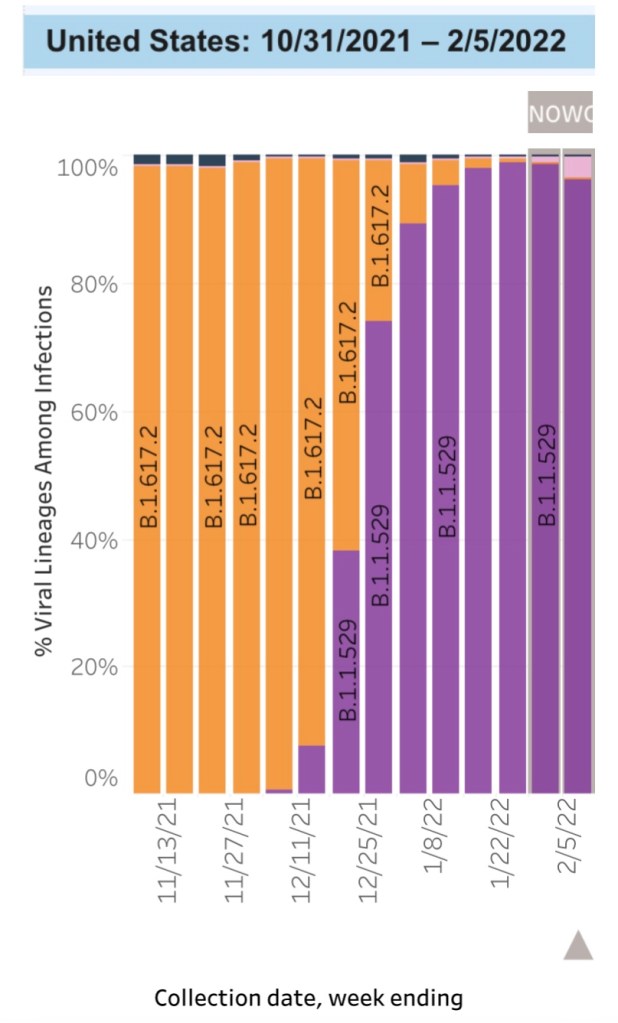
The Omicron variant became the dominant U.S. strain of the coronavirus in December. Omicron outcompeted Delta, which was very good news because Omicron is far less severe. The chart below (from the CDC Data Tracker site) shows Omicron’s rapid ascendance and displacement of the Delta variant. The orange bar segments represent the proportion of cases of the Delta strain, while the purple and pink segments are Omicron sub-variants known as BA.1 and BA.2, respectively. BA.2 is even more transmissible than BA.1 and is likely to become dominant over the next month or so. However, the BA.2 sub-variant appears to be far less virulent than Delta, like BA.1.

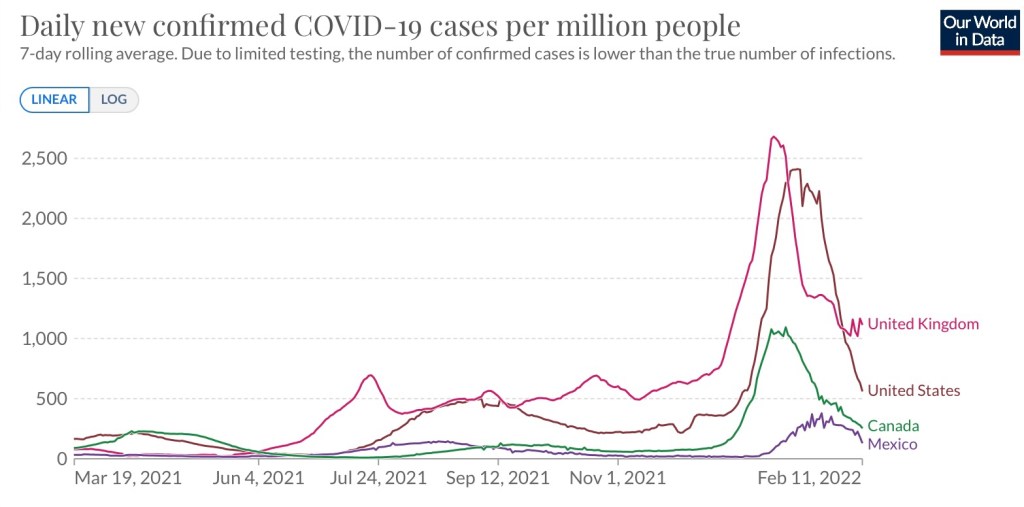
Despite a record number of infections over a period of a month or so, the Omicron wave is tapering just as rapidly as it ramped up, as the next chart demonstrates. In fact, covidestim.org shows that cases are now receding in all states, DC, and Puerto Rico. Here are new cases per million people from Our World in Data:

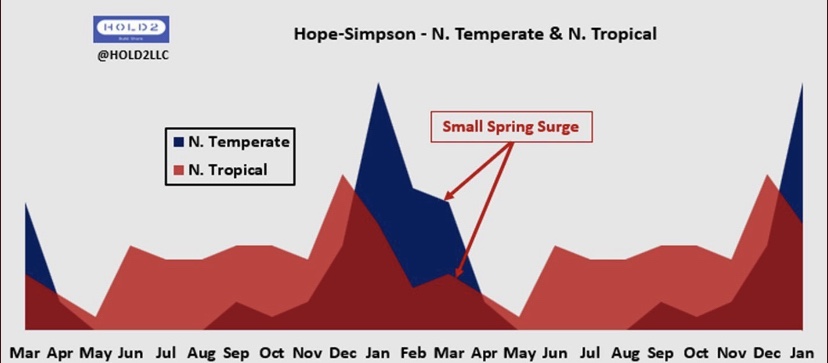
Whether BA.2 causes cases to plateau for a while, or even a secondary Omicron “wavelet”, is yet to be seen. That would be consistent with the normal Hope-Simpson seasonal pattern of viral prevalence in the northern hemisphere (hat tip: HOLD2):

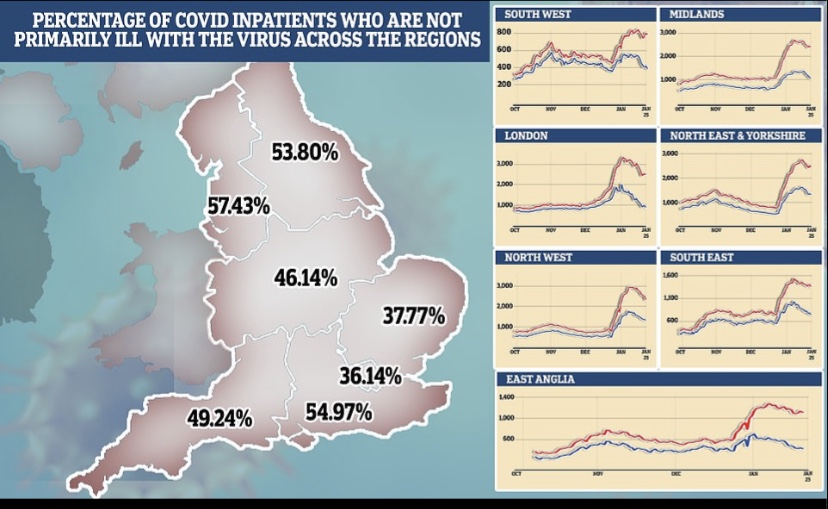
Data problems make the Omicron wave difficult to assess, however. We don’t know the share of incidental infections for the U.S. as a whole, but more than half of hospitalized Covid patients in Massachusetts and Rhode Island are classified with incidental infections. The proportion in the UK is estimated to be rising and approaching 30% of total cases, with much higher percentages in many regions of England, as shown below.

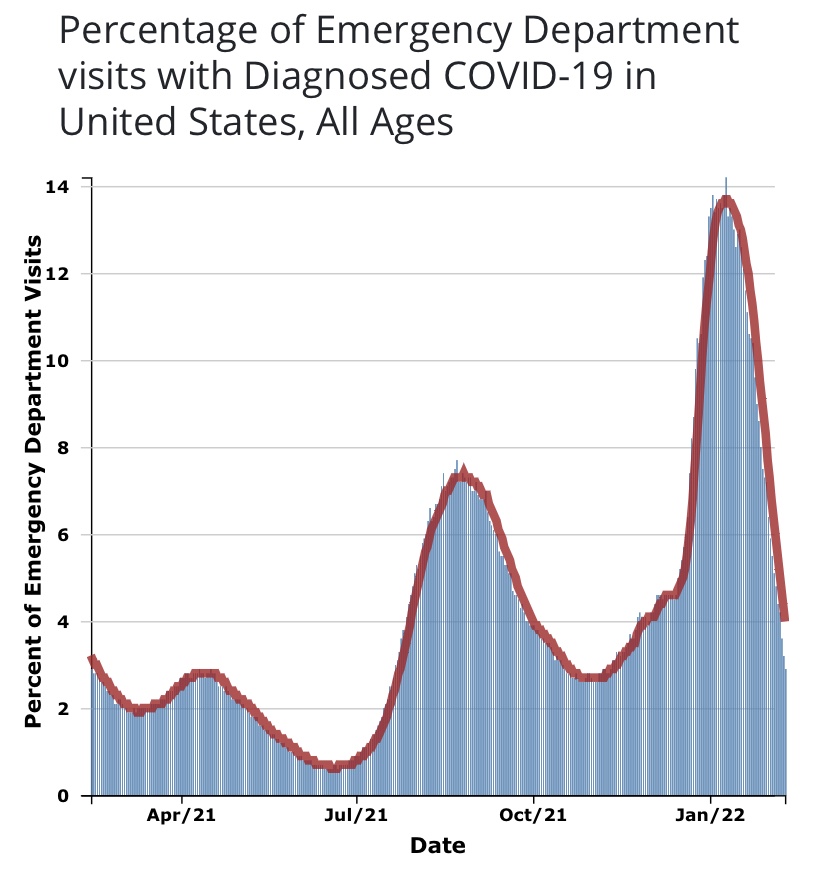
As I’ve emphasized in the past, case numbers should not be the primary gauge of the state of the pandemic, especially with a more highly contagious but relatively mild variant like Omicron. Hospitalizations are a better measure, but only if “incidental” infections are removed from the counts. That’s been acknowledged only recently by the public health establishment, and even the Biden Administration is emphasizing it as a matter of sheer political expediency. Another measure that might be more reliable for assessing the pandemic in the community as a whole is the number of emergency room patients presenting Covid-like symptoms. From the CDC Data Tracker:

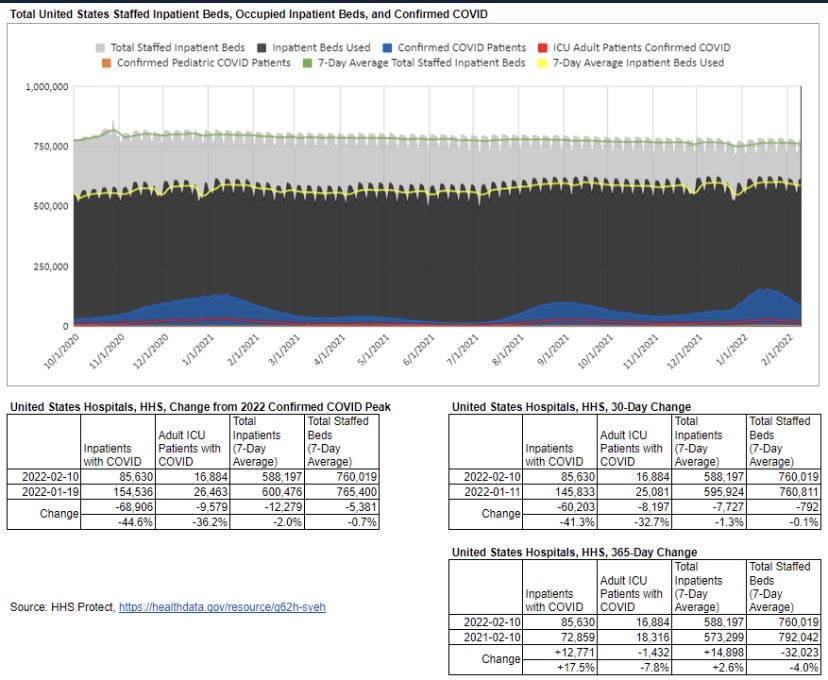
There is no doubt that incidental infections create complications in caring for patients with other ailments. That has a bearing on the utilization of hospital capacity. Generally, however, strains on hospital capacity during the pandemic have been greatly exaggerated. This is not to diminish the hard work and risks faced by health care workers, and there have been spot shortages of capacity in certain localities. However, in general, staffed beds have been more than adequate to meet needs. This chart, like a few others below, is courtesy of Phil Kerpen:

With the more highly transmissible variants we have now, it’s not at all surprising to see a high proportion of incidental cases among inpatients. Incidental infections are likely to inflate counts of Covid deaths as well, given the exceptional and odd way in which Covid deaths are being recorded. It will be some time until we see full U.S. data on cases and deaths net of incidental infections. Moreover, many of the Covid deaths in December and January were from lingering Delta infections, which might still be a factor in the February counts.

How Are Your Odds?

The mild or asymptomatic nature of most Omicron cases, the large proportion of incidental hospitalizations, and the knowledge that Omicron is not a deep respiratory threat should offer strong reassurance to healthy individuals that the variant does not pose a great risk. According to a recent CDC report, in a sample of almost 700,000 vaccinated individuals aged 65 or less without co-morbidities, there were no Covid fatalities or ICU admissions during the 10 months from December 2020 through October 2021. There was only one fatality in the sample of healthy individuals older than 65. There were just 36 fatalities across the full sample of over 1.2 million vaccinated individuals, so COVID’s fatality risk was only about 0.3%. Of those deaths, 28 were among those with four or more risk factors (including co-morbidities and > 65 years). And this was before the advent of Omicron!

I have a few doubts about the CDC’s sample selection and vagaries around certain definitions used. Nevertheless, the results are striking. However, the study did not address risks to unvaccinated adults. Another more limited CDC study found that vaccinated patients were still less likely than the unvaccinated to require critical care during the Omicron wave.

A separate CDC study found a 91% reduction in the likelihood of death for Omicron relative to Delta. A study from the UK (see summary here) found that Omicron cases were 59% less likely than Delta cases to require hospitalization and 69% less likely to result in death within 28 days of a positive test. Omicron was far less deadly among both the vaccinated and the unvaccinated, and the latter had a larger reduction in the likelihood of death. The study was stratified by age as well, with less severe outcomes for Omicron among older cohorts except in the case of death, for which there was no apparent age gradient.

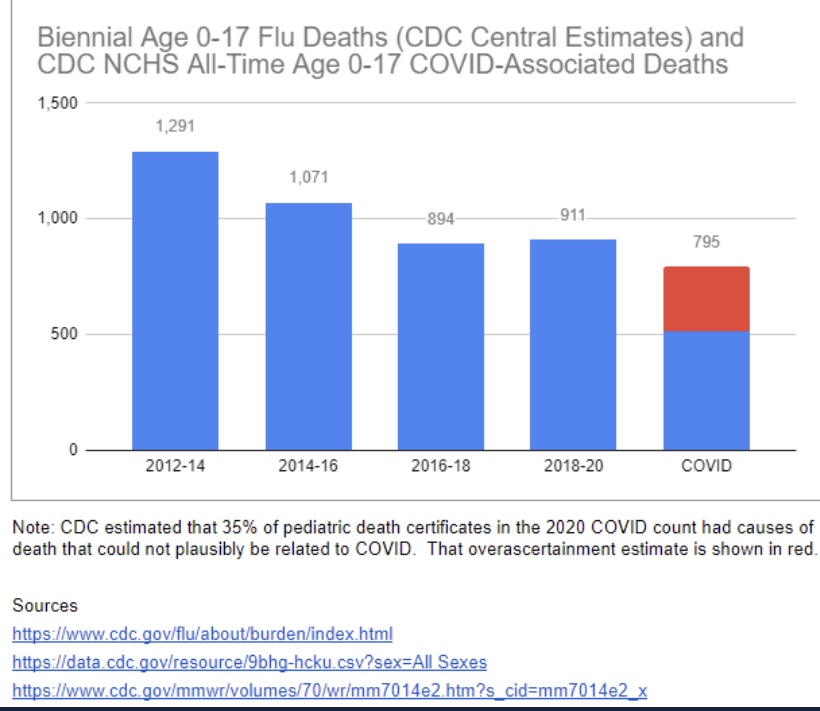
Another unnecessarily contentious issue has been the risk to children during the pandemic. Based on the data, there should never have been much doubt that these risks are quite low. Apparently, however, it was advantageous for teachers’ unions to insist otherwise. Phil Kerpen soundly debunks that claim with the following chart:

Covid has been less deadly to children from infancy through 17 years than the pre-pandemic flu going back to 2012! Oh yes, but teachers FEAR transmission from the children! That claim is just as silly, since children are known to be inefficient transmitters of the virus (and see here).

Now that Omicron has relegated the Delta variant to the history books, the risks going forward seem much more manageable. Omicron is less severe, especially for the vaccinated. Levels of acquired (natural) immunity from earlier infections are now much higher against older strains, and Omicron infections seem to be protective against Delta.

In commentary about the first CDC study discussed above, John Tierney lends perspective to the odds of death from pre-Omicron Covid:

“Those are roughly the same odds that in the course of a year you will die in a fire, or that you’ll perish by falling down stairs. Going anywhere near automobiles is a bigger risk: you’re three times more likely during a given year to be killed while riding in a car, and also three times more likely to be a pedestrian casualty. The 150,000-to-1 odds of a Covid death are even longer than the odds over your lifetime of dying in an earthquake or being killed by lightning.”

Yet with all this research confirming the low odds of death induced by Omicron, why have we seen recent deaths at levels approaching previous waves? First, many of those deaths are carried over from Delta infections. That means deaths should begin to taper rapidly as February reports roll in. And remember that daily reports do not show deaths by date of death. Deaths usually occur weeks or even months before they are reported. That also means some of the deaths reported might be “harvested” from much earlier fatalities. Second, given the high levels of incidental Omicron infections, some of those deaths are misattributed to Covid, an issue that is not new by any means. Finally, while Omicron is relatively mild for most people, the high rate of transmission means that a high number of especially vulnerable individuals may be infected with severe outcomes. We have seen much more severe consequences for the unvaccinated, of course, and for those with co-morbidities.

Things We Should Have Known

I’ll try to keep this last section brief, but as an introduction I’ll just say that it’s almost as if we’ve been allowing the lunatics to run the asylum. To paraphrase one comment I saw recently, if you wonder why there is so much dissent, you ought to consider the fact the much of what our governments have done (along with many private organizations) was to prohibit things that were demonstrably safe (e.g., going outside, using swing sets, or attending schools) and to encourage things that were demonstrably harmful (e.g., deferring medical care, or masking small children).

The following facts are only now coming into focus among those who’ve been “following the politics” rather than “the science”, despite pretensions to the latter.

  • Specific public health initiatives often face steep economic, emotional, social, and countervailing health tradeoffs.
  • Lockdowns do NOT work.
  • Masks do NOT work (despite the CDC’s past and recent confusion on the matter).
  • Children are at very low-risk from Covid.
  • Children do NOT present high risks to teachers.
  • Natural immunity is more protective than vaccines.
  • Vaccines do NOT “stop the spread”.
  • Vaccine risks might outweigh benefits for certain groups and individuals.
  • Vaccines should NOT be relied upon at the expense of treatments.
  • Don’t reject treatments based on politics.
  • Vaccine mandates are unethical.

Grow Up and Chill Out!

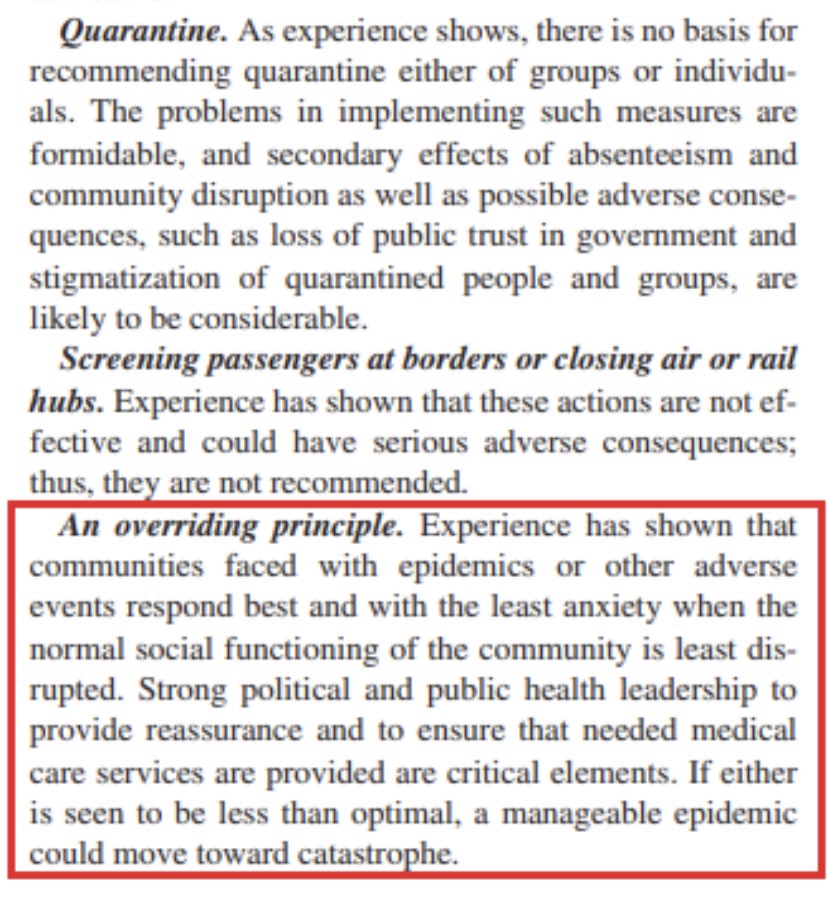
Life is full of risks, and nothing has changed to alter wisdom gained in earlier pandemics. For example, this pearl from a 2006 publication on disease mitigation measures should be heeded (hat tip: Phil Kerpen):

If there is one simple message everyone needs to hear, it is to stop allowing the virus bogeyman to rule your life. It will never go away completely, and it is likely to present risks that is are comparable to the flu going forward. In fact, it might well compete with the flu, which means we won’t be dealing with endemic Covid plus historical flu averages, but some smaller union of the two case loads.

So get out, go back to work, or go have some fun! Get back truckin’ on!

The Curious Case of Unnecessary Pronoun Lists

21 Tuesday Dec 2021

Posted by Nuetzel in Gender, Identity Politics, Political Correctness, Uncategorized

≈ Leave a comment

Tags

Binary Genders, Biological Sex, Default Pronouns, Gender Dysphoria, Gender Fluidity, Gender Neutrality, Gendered Pronouns, Genderqueer, Identity Politics, LGBTQ, LinkedIn, Non-Binary, Plural Pronouns, Preferred Pronouns, Transgender

A subset of my LinkedIn connections list “preferred pronouns” after their names, but I don’t think I’ve ever had any misapprehensions about their “gender identities”. Not one of them. Their “gendentities” are obvious based on the names and/or photos they’ve chosen to use on social media. In fact, the “default” pronoun designations in the English language work pretty well that way. So, apart from the fact that LinkedIn invites its users to list pronouns, why do these people bother? Would they introduce themselves that way in person? “Hi, nice to meet you, I’m Jane Smith, she / her.” Maybe on a name tag. Otherwise, unlikely.

Let’s face it: precious few of us have any doubt about our own biological sex. Do you have a penis and no vagina? Or vice versa? That settles it! But if you wish you didn’t have a penis, or wish you did, or you’re not sure… then you have a gender quandary and a pronoun problem. Still, those who decide to “take” one gender via transition will have chosen their pronouns. They typically make an effort to “present” that way as well.

There’s a tiny minority of individuals whose biological sex is ambiguous, and there are others who simply consider themselves “non-binary” or “genderqueer”. They represent three to four people out of every 1,000, if a recent survey can be believed (and surveys like this can be terribly flawed). These people are actually included in the broad definition of transgender. But again, for biological or other reasons, they identify as neither male nor female. It would be natural for these individuals to prefer gender-neutral pronouns (for example, possibilities are they / them and zi / hir, rather than he / him or she / her). That’s understandable, but: 1) using the plural “they” as a singular pronoun can lead to awkward grammar, inviting the use of the plural verb form as a fix*; and 2) remembering different pronouns for different people is a complexity to which most of us are quite unaccustomed. This is a practical issue, and social encounters with non-binaries are fairly unusual for most of us.

If tolerating the use of “he” or “she” just won’t do for this tiny minority, even as a courtesy to the “unschooled”, then it must be very important to make one’s non-binary status clear to everyone. That suggests a different problem, and one of a psychological nature. The insistence on strict adherence to alternative pronouns reflects a narcissism common to most manifestations of identity politics. And no, there is no reliable research showing that use of non-gendered pronouns reduces non-binary suicides, as one advocacy group has claimed.

I speak as one who has been called by the wrong gendered pronoun! I’m a male and I’m confident I present that way. However, I’ve worked with many Chinese over the course of my career, and gendered pronouns aren’t used in Chinese. The distinctions between “he” and “she”, or “his” and “hers”, can be as foreign to them as the pronouns “zi” and “hir” are to me. I’ve heard myself referenced by Chinese colleagues as “she”. Did it offend me? Not at all, because I knew the speaker was not fluent in the English language.

It should be easy to tolerate members of a minority who get it wrong because we empathize with their language challenge. We don’t demand their absolute conformity, but they understand their minority status and might prefer to avoid the potential embarrassment of getting it wrong. Contrary-wise, if I’m in the minority, say at a gathering of Chinese, shall I press the issue by demanding that every member of the majority distinguish between me and my wife using the correct English pronouns? I think not. But non-binary activists are so offended by gendered pronouns, which have been in common use among English speakers for centuries, that they demand the majority change the language to accommodate them. That is unreasonable. It’s okay to let others know what you prefer, but you shouldn’t feel slighted by every miscue or be a complete prig about it!

Now, if you happen to be a plain-old binary individual, what’s your excuse for listing preferred pronouns on social media? It seems completely unnecessary, so why bother? Here are a few possibilities:

  • You have transitioned to your gender and list pronouns as a courtesy to anyone who knew you before your transition.
  • You are an HR functionary having a career imperative to signal your evenhandedness.
  • You are a plaintiffs attorney chasing genderqueer discrimination business.
  • You simply like the Chinese practice and want to adopt gender-neutral pronouns. Good luck at your high school reunion!

My guess is that pecuniary and career motives are less important to most pronoun-listers than simple political correctness. Either way, it’s a virtue signal. Of course, you might have non-binary friends or relatives and wish to demonstrate to the world your unerring respect for their preferences. That’s admirable loyalty, but it’s an unnecessary compulsion.

Pronoun lists seem designed to announce support for all things LGBTQ+. I also suspect that some believe it more firmly establishes their socially progressive bona fides, that the pronoun-lister is beyond reproach no matter the nasty capitalists for whom they might toil. Therefore, announcing one’s preference for default pronouns seems both unnecessary and pretentious.

I am fairly tolerant of the notion that gender identity can transcend biology in some individuals. However, that is a controversial metaphysical assertion that many do not accept. Certainly, a decision to reject one’s biological sex should not be made hastily. In particular, these decisions should not be encouraged in children except for cases in which biological sex is ambiguous and where medical procedures might be appropriate. Yet LGBTQ+ doctrine teaches that questioning one’s gender identity should be normalized, even among impressionable children. That is highly objectionable and even abusive. Persuading straights to engage in pronoun pretensions of the kind described above is part of the LGBTQ+ crusade to normalize gender dysphoria.

Beyond all that, changing the structure of the English language to accommodate LGBTQ+ advocates requires a change in language curriculum for young children. One might object on purely grammatical grounds, but it would also raise questions as to why dual sets of pronouns are necessary. To whom do these pronouns apply? That broaches the sensitive topic of gender fluidity that many parents and taxpayers do not wish to be taught as standard curriculum in elementary or even secondary schools. I’m inclined to agree with them.

My general attitude is “whatever floats your boat, but leave me out of it”. I submit that the use of non-gendered pronouns is not “owed” to anyone. It would be easier for the rarefied non-binaries to accept the same fluidity with respect pronouns that they profess with respect to their own gender identities.

* I have occasionally used plural pronouns (they, them, and their) with plural verb forms in reference to “one”, “someone”, or “you”), who might be either male or female. In those cases, the sentence is meant to apply to both genders, but I admit it’s sloppy writing.

Scary New Variant or Omicrommon Cold?

08 Wednesday Dec 2021

Posted by Nuetzel in Coronavirus, Pandemic, Uncategorized

≈ Leave a comment

Tags

Coronavirus, Covid-19, Delta Variant, Ethical Skeptic, Gauteng Province, Immune Escape, Mutations, Omicron Variant, South Africa, Spanish Flu, Viral Interference, Vitamin D, World Health Organization, Xi Jinping, Xi Variant

The political motives behind the naming of the Covid Omicron variant might prove to be a huge irony. The Greek letter Xi was skipped by the World Health Organization (WHO), undoubtedly to avoid any symbolic association between Covid and the Chinese dictator Xi Jinping. After all, he’s probably determined to bury discussion of the leak at the Wuhan lab that was the probable cause of this whole mess. The WHO was happy to provide cover. The irony is that the Omicron variant might well bring on a more gentle phase of the pandemic if early indications can be trusted. But in that case, my guess is Chairman Xi wouldn’t have appreciated the twist even if WHO had called it the Xi variant.

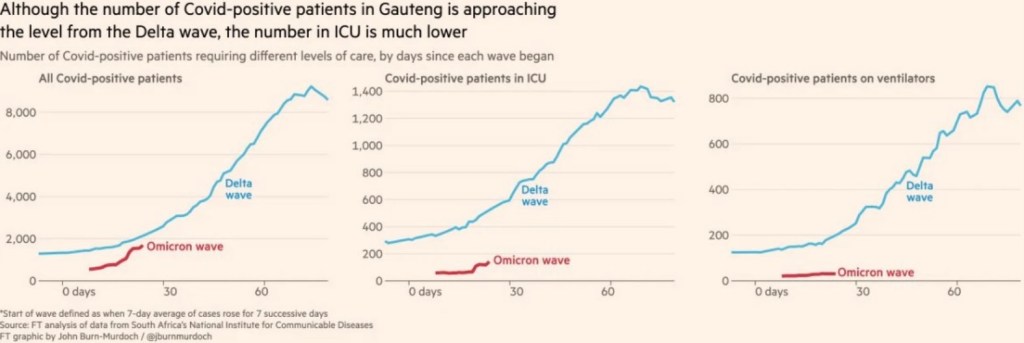
The Omicron variant was identified in the Gauteng Province of South Africa and announced by national health authorities on November 24th. The earliest known sample was taken on November 9th. The variant was subsequently diagnosed in a number of other countries, including the U.S. It has a large number of mutations, and initial reports indicated that the variant was spreading extremely fast, having suddenly outcompeted other variants to account for the majority of new cases in South Africa. It is apparently highly contagious. Moreover, Omicron has been diagnosed among the vaccinated as well as those having immunity from prior infections, which is usually more effective and durable than vaccination. Thus, it is said to have “immune escape” properties. Scary indeed!

However, Omicron seems to have been around much longer than suggested by its initial diagnosis in late November (and see this link for an extreme view). Cases in a number of countries show that it is already global; the lags involved in diagnosis as well as earlier contacts with spreaders suggest that Omicron’s origin could have been as early as late September. That means the spread has not been quite as fast as the first alarming reports suggested.

The reported symptoms of the Omicron variant have been quite mild, with fatigue being the most noteworthy. Omicron appears to have taken one mutation from the common cold, which, like Covid-19, is a type of coronavirus. And while there has been a surge in hospitalized cases in South Africa, most of these are said to be “incidental”. That is, these patients were admitted for other problems but happened to test positive for the Omicron variant. As we’ve seen throughout the pandemic, the data is not always reliable.

It’s too early to draw definite conclusions, and this variant might prove to be more dangerous with time. In fact, some say that South Africa’s experience might not be representative because of its young population and high natural immunity. It also happens to be early summer there, when higher vitamin D levels help to boost immunity. So, there is a great deal of uncertainty about Omicron (and see here). Nevertheless, I’ll risk a jinx by momentarily contemplating an outcome that’s not terribly far-fetched.

Viruses mutate in ways that help ensure their survival: they must not kill too many of their hosts, which means the usual progression is toward less lethal variants. They may become more contagious, and new variants must be contagious enough to outcompete their ancestors. Viral interference can sometimes prevent multiple viruses from having a broad coexistence. That’s the likely phenomenon we witnessed when the Covid pandemic coincided with the virtual disappearance of the flu and other respiratory viruses. More to the point, it’s the same phenomenon that occurred when the Spanish Flu was eventually outcompeted by less deadly variants.

So it’s possible that a mild Omicron will put the pandemic behind us. If it proves to be as contagious and as mild as it appears thus far, it would likely displace Delta and other variants as the first phase of a new, endemic malady. That might even cut into the severity of the current seasonal wave. The Ethical Skeptic tweets thusly:

“So was Omicron an ultra fast-mutating magic terminator variant? A gift from God, or aliens…? … Or natural virility/genetic profile derived from a previous variant conferring immunity …”

That would be a wonderful outcome, but Omicron’s arrival in the northern hemisphere just as winter gets underway contributes to the uncertainty. It’s severity during the northern winter could be far worse than what we’ve seen in South Africa. We can hope this variant isn’t one truly deserving of Chairman Xi’s name.

Climate Alarmism and Junk Science

02 Thursday Dec 2021

Posted by Nuetzel in Climate, Research Bias, Uncategorized

≈ 8 Comments

Tags

Carbon Forcing Models, Climate Alarmism, Green Subsidies, Intergovernmental Panel on Climate Change, IPCC, Kevin Trenberth, Model Bias, Model Ensembles, National Center for Atmospheric Research, Norman Rogers, Redistribution, rent seeking

The weak methodology and accuracy of climate models is the subject of an entertaining Norman Rogers post. I want to share just a few passages along with a couple of qualifiers.

Rogers quotes Kevin Trenberth, former Head of Climate Analysis at the National Center for Atmospheric Research, with apparent approval. Oddly, Rogers does not explain that Trenberth is a strong proponent of the carbon-forcing models used by the UN’s Intergovernmental Panel on Climate Change (IPCC). He should have made that clear, but Trenberth actually did say the following:

“‘[None of the] models correspond even remotely to the current observed climate [of the Earth].’“

I’ll explain the context of this comment below, but it constitutes a telling admission of the poor foundations on which climate alarmism rests. The various models used by the IPCCc are all a little different and they are calibrated differently. I’ve noted elsewhere that their projections are consistently biased toward severe over-predictions of temperature trends. Rogers goes on from there:

“The models can’t properly model the Earth’s climate, but we are supposed to believe that, if carbon dioxide has a certain effect on the imaginary Earths of the many models it will have the same effect on the real earth.”

But how on earth can a modeler accept the poor track record of these models? It’s not as if the bias is difficult to detect! On this question, Rogers says:

“The climate models are an exemplary representation of confirmation bias, the psychological tendency to suspend one’s critical facilities in favor of welcoming what one expects or desires. Climate scientists can manipulate numerous adjustable parameters in the models that can be changed to tune a model to give a ‘good’ result.“

And why are calamitous projections desirable from the perspective of climate modelers? Follow the money and the status rewards of reinforcing the groupthink:

“Once money and status started flowing into climate science because of the disaster its denizens were predicting, there was no going back. Imagine that a climate scientist discovers gigantic flaws in the models and the associated science. Do not imagine that his discovery would be treated respectfully and evaluated on its merits. That would open the door to reversing everything that has been so wonderful for climate scientists. Who would continue to throw billions of dollars a year at climate scientists if there were no disasters to be prevented? “

Indeed, it has been a gravy train. Today, it is reinforced by green-preening politicians, the many billions of dollars committed by investors seeking a continuing flow of public subsidies for renewables, tempting opportunities for international redistribution (and graft), and a mainstream media addicted to peddling scare stories. The parties involved all rely on, and profit by, alarmist research findings.

Rogers’ use of the Trenberth quote above might suggest that Trenberth is a critic of the climate models used by the IPCC. However, the statement was in-line with Trenberth’s long-standing insistence that the IPCC models are exclusively for constructing “what-if” scenarios, not actual forecasting. Perhaps his meaning also reflected his admission that climate models are “low resolution” relative to weather forecasting models. Or maybe he was referencing longer-term outcomes that are scenario-dependent. Nevertheless, the quote is revealing to the extent that one would hope these models are well-calibrated to initial conditions. That is seldom the case, however.

As a modeler, I must comment on a point made by Rogers about the use of ensembles of models. That essentially means averaging the predictions of multiple models that differ in structure. Rogers denigrates the approach, and while it is agnostic with respect to theories of the underlying process generating the data, it certainly has its uses in forecasting. Averaging the predictions of two different models with statistically independent and unbiased predictions will generally produce more accurate forecasts than the individual models. Rogers may or may not be aware of this, but he has my sympathies in this case because the IPCC is averaging across a large number of models that are clearly biased in the same direction! Rogers adds this interesting tidbit on the IPCC’s use of model ensembles:

“There is a political reason for using ensembles. In order to receive the benefits flowing from predicting a climate catastrophe, climate science must present a unified front. Dissenters have to be canceled and suppressed. If the IPCC were to select the best model, dozens of other modeling groups would be left out. They would, no doubt, form a dissenting group questioning the authority of those that gave the crown to one particular model.”

Rogers discusses one more aspect of the underpinnings of climate models, one that I’ve covered several times on this blog. That is the extent to which historical climate data is either completely lacking, plagued by discontinuities or coverage, or distorted by imperfections in measurement. The data used to calibrate climate models has been manipulated, adjusted, infilled, and estimated over lengthy periods by various parties to produce “official” and unofficial temperature series. While these efforts might seem valiant as exercises in understanding the past, they are fraught with uncertainty. Rogers provides a link to the realclimatescience blog, which details many of the data shortcomings as well as shenanigans perpetrated by researchers and agencies who have massaged, imputed, or outright created these historical data sets out of whole cloth. Rogers aptly notes:

“The purported climate catastrophe ahead is 100% junk science. If the unlikely climate catastrophe actually happens, it will be coincidental that it was predicted by climate scientists. Most of the supporting evidence is fabricated.”

Break the Market, Blame It, Then Break It Some More

28 Sunday Nov 2021

Posted by Nuetzel in Energy, Environmental Fascism, Free markets, Uncategorized

≈ 2 Comments

Tags

Antitrust, Asymmetric Information, Build Back Better, Capital Controls, central planning, Endangered Species Act, Energy Policy, Externalities, Fossil fuels, Fracking, FTC, Government Failure, Green New Deal, Greenbook, Hart Energy, Industrial Policy, Industry Concentration, Joe Biden, Keystone XL Pipeline, Knowledge Problem, Line 5 Pipeline, Mark Theisen, Market Failure, Monetary policy, OPEC, Price Gouging, Principles of Economics, Quotas, Regulatory Overreach, Stephen Green, Strategic Petroleum Reserve, Subsidies, Tariffs, Taxes, The Fatal Conceit

Much of what is labeled market failure is a consequence of government failure, or rather, failure caused by misguided public intervention, not just in individual markets but in the economy more generally. Misguided efforts to correct perceived excesses in pricing are often the problem, but there are myriad cases of regulatory overreach, ham-handed application of taxes and subsidies for various enterprises, and widespread cronyism. But it is often convenient for politicians to appear as if they are doing something, which makes activism and active blame of private enterprise a tempting path. The Biden Administration’s energy crisis offers a case in point. First, a digression on the efficiency of free markets. Skip the next two sections to get straight to Biden’s mess.

Behold the Bounty

I always spent part of the first class session teaching Principles of Economics on some incredible things that happen each and every day. Most college freshmen seem to take them for granted: the endless variety of goods that arrive on shelves each day; the ongoing flow of services, many appearing like magic at the flick of a switch; the high degree of coincidence between specific wants and all these fresh supplies; the variety and flow of raw materials and skills that are brought to bear; the fantastic array of sophisticated equipment deployed to assist in these efforts; and the massive social coordination necessary to accomplish all this. How does it all happen? Who collects all the information on what is wanted, and by whom? On the feasibility of actually producing and distributing various things? What miracle computer processes the vast set of information guiding these decisions and actions? Does some superior intelligence within an agency plan all this stuff?

The answer is simple. The seemingly infinite set of knowledge is marshaled, and all these tasks are performed, by the greatest institution of social cooperation to ever emerge: decentralized, free markets! Buying decisions are guided by individual needs and wants. Production and selling decisions are guided by resource availability and technology. And all sides react to evolving prices. Preferences, resources, and technology are in a constant state of flux, but prices react, signaling producers and consumers to make individual adjustments that correct larger imbalances. It is tempting to describe the process as the evolving solution to a gigantic set of dynamic equations.

The Impossible Conceit

No human planner or government agency is capable of solving this problem as seamlessly and efficiently as markets, nor can they hope to achieve the surplus welfare that redound to buyers and sellers in markets. Central planners or intervening authorities cannot possess the knowledge and coordinating power of the market mechanism. That doesn’t mean markets are “perfect”, of course. Things like external costs and benefits, dominant sellers, and asymmetric information can cause market outcomes to deviate from the competitive “ideal”. Inequities can arise from some of these imperfections as well.

What can be much worse is the damage to market performance caused by government policy. Usually the intent is to “correct” imperfections, and the rationale might be defensible. The knowledge to do it very well is often lacking, however. Taxes, subsidies, regulations, tariffs, quotas, capital controls, and manipulation of interest rates (and monetary and credit aggregates) are very general categories of distortion caused by the public sector. Then there is competition for resources via government procurement, which is frequently graft-ridden or price-insensitive.

Many public interventions create advantages for large sellers, leading to greater market concentration. This might best serve the private political power of the wealthy or might convey advantages to investments that happen to be in vogue among the political class. These are the true roots of fascism, which leverages coercive state power for the benefit of private interests.

Energy Vampires

Now we have the curious case of the Biden Administration and it’s purposeful disruption of energy markets in an effort to incentivize a hurried transition from fossil fuels to renewable energy. As I described in a recent post on stagflation,

“… Biden took several steps to hamstring the domestic fossil fuel industry at a time when the economy was still recovering from the pandemic. This included revoking permits for the Keystone pipeline, a ban on drilling on federal lands and federally-controlled waters in the Gulf, shutting down production on some private lands on the pretext of enforcing the Endangered Species Act, and capping methane emissions by oil and gas producers. And all that was apparently just a start.

As Mark Theisen notes, when you promise to destroy a particular industry, as Joe Biden has, by taxing and regulating it to death, who wants to invest in or even maintain production facilities? Some leftists with apparent influence on the administration are threatening penalties against the industry up to and including prosecution for ‘crimes against humanity’!”

In addition to killing Keystone, there remains a strong possibility that Biden will shut down the Line 5 pipeline in Michigan, and there are other pipelines currently under federal review. Biden’s EPA also conducted a purge of science advisors considered “too friendly” to oil and gas industry. This was intertwined with a “review” of new methane rules, which harm smaller, independent oil and gas drillers disproportionately.

Joe Biden’s “Build Back Better” (BBB) legislation, as clumsy in policy as it is in name, introduces a number of “Green New Deal” provisions that would further disadvantage the production and use of fossil fuels. Hart Energy provides descriptions of various tax changes that appeared in the Treasury’s so-called “Greenbook”, a collection of revenue proposals, many of which appear in the BBB legislation that recently passed in the House. These include rollbacks of various deductions for drilling costs, depletion allowances, and recovery rules, as well as hikes in certain excise taxes as well as taxes on foreign oil income. And all this while granting generous subsidies to intermittent and otherwise uneconomic technologies that happen to be in political favor. This is a fine payoff for cronies having invested significantly in these rent seeking opportunities. While the bill still faces an uphill fight in the Senate, apparently Biden has executive orders, held in abeyance, that would inflict more pain on consumers and producers of fossil fuels.

Biden’s energy policies are obviously intended to reduce supplies of oil, gas, and other fossil fuels. Prices have responded, as Green notes:

“Gas is up an average of 57% this year, with corresponding increases of 44% for diesel and a whopping 60% for fuel oil.”

The upward price pressure is not limited to petroleum: electricity rates are jumping as well. Consumers and shippers have noticed. In fact, while Biden crows about wanting “the rich” to pay for BBB, his energy policies are steeply regressive in their impact, as energy absorbs a much larger share of budgets among the poor than the rich. This is politically suicidal, but Biden’s advisors have chosen a most cynical tact as the reality has dawned on them.

Abusive Victim Blaming

Who to blame? After the predictable results of cramping domestic production and attacking fossil fuel producers, the Biden team naturally blames them for rising prices! “Price gouging” is a charge made by political opportunists and those who lack an understanding of how markets allocate scarce resources. More severe scarcity means that prices must rise to ration available quantities and to incentivize those capable of bringing forth additional product under difficult circumstances. That is how a market is supposed to function, and it mitigates scarcity!

But here comes the mendacious and Bumbling Buster Biden. He wants antitrust authorities at the FTC to investigate oil pricing. Again from Stephen Green:

“… the Biden Administration has decided to launch a vindictive legal campaign against oil producers in order to deflect blame for the results of Biden’s policies: Biden’s Solution to Rising Gas Prices Appears to Be Accusing Oil Companies of Price Gouging.”

There’s nothing quite like a threat to market participants to prevent the price mechanism from performing its proper social function. But a failure to price rationally is a prescription for more severe shortages.

Biden has also ordered the Strategic Petroleum Reserve (SPR) to release 50 million barrels of oil, a move that replaces a total of 2.75 days of monthly consumption in the U.S. The SPR is supposed to be drawn upon only in the case of emergencies like natural disasters, so this draw-down is as irresponsible as it is impotent. In fact, OPEC is prepared to offset the SPR release with a production cut. Biden has resorted to begging OPEC to increase production, which is pathetic because the U.S. was a net exporter of oil not long ago … until Biden took charge.

Conclusion

Properly stated, the challenge mounted against markets as an institution is not that they fall short of “perfection”. It is that some other system would lead to superior results in terms of efficiency and/or equity. Central planning, including the kind exercised by the Biden Administration in it’s hurried and foolish effort to tear down and remake the energy economy, is not even a serious candidate on either count.

Granted, there is a long history of subsidies to the oil and gas sector. I cannot defend those, but the development of the technology (even fracking) largely preceded the fruits of the industry’s rent seeking. At this point, green fuels receive far more subsidies (despite some claims to the contrary). Furthermore, the primacy of fossil fuels was not achieved by tearing down competing technologies and infrastructure. In contrast, the current round of central planning requires destruction of entire sectors of the economy that could otherwise produce efficiently for the foreseeable future, if left unmolested.

The Biden Administration has adopted the radical green agenda. Their playbook calls for a severe tilting of price incentives in favor uneconomic, renewable energy sources, despite the economy’s heretofore sensible reliance on plentiful fossil fuels. It’s no surprise that Biden’s policy is unpopular across the economic spectrum. His natural inclination is to blame a competitive industry victimized by his policy. It’s a futile attempt to avoid accountability, as if he thinks doubling down on the fascism will help convince the electorate that oil and gas producers dreamt up this new, nefarious strategy of overcharging customers. People aren’t that dumb, but it’s typical for the elitist Left presume otherwise.

Parents and Taxpayers Confront Rogue Educrats

14 Thursday Oct 2021

Posted by Nuetzel in Critical Race Theory, Education, Propaganda, Uncategorized

≈ Leave a comment

Tags

Critical Race Theory, Department of Education, Diversity, Equity, Freedom of Speech, Home Schooling, Ibram X. Kendi, Inclusion, Indoctrination, Merrick Garland, National School Boards Association, Nicole Solas, Norman Rockwell, Panorama Education, Propaganda, Psrental Sovereignty, School Choice, School Taxes, School Vouchers, Selina Zito, Social Infrastructure, Social Justice, STOP CRT Amendment

This Norman Rockwell painting is called “Freedom of Speech”. It depicts a Vermont dairy farmer speaking his mind at a school board meeting, and no, he is not a “domestic terrorist”! (A recent piece by Selina Zito reminded me of this painting.) Today, parents of schoolchildren have a very special reason to be upset: the teaching of critical race theory (CRT) as part of the regular curriculum. A better name for this vapid “theory” might be “critical race theology”, because it is no “theory” at all: it is a set of “woke” accusations leveled against “out groups” designated by leftists: whites, straights, men, and sometimes groups like Jews and Asians. Many people of color are just as dismayed as those among CRT’s targets because its wrongheaded and corrosive nature is so plain. CRT is itself straightforwardly racist.

Taxpayers have a place in this debate as well, at both the K-12 and public university levels. However, their role in funding the indoctrination taking place in public schools has been neglected in the story of the revolt against CRT.

The Parent Trap

Many parents have taken strong action in response to the CRT onslaught. Some have quietly removed their children from public schools, while others have chosen to register their objections with school officials, often at school board meetings. Also, there has been some success at the ballot box by dissident school board candidates. This is grass roots participatory democracy in action, local and vocal. Certainly parents have a greater stake in their childrens’ education than anyone (except the kids themselves). They have a right to know what’s being taught and to provide critical feedback to schools.

School officials, teachers unions, and CRT teacher-enthusiasts are not likely to be straightforward about whether CRT is actually taught, however. This link might help you see through the gaslighting to which we’ve all been subjected. This article discusses various political avenues for fighting CRT in the schools. And here’s a “tool kit” that might be helpful.

Garland’s Effrontery

To top it all off, recently we’ve witnessed an act of fascist authoritarianism by the U.S. Attorney General that, by all appearances, involves a conspiracy between the Biden Administration, top officials at the Department of Justice, and the National School Boards Association (NSBA). AG Merrick Garland’s memorandum of October 4 announced a “partnership among federal, state, local, tribal, and territorial law enforcement to address threats against school administrators, board members, teachers, and staff.“ He did not provide actual evidence of threats against school boards or personnel, however. Yet Garland is willing to treat interested parents as if they are domestic terrorists! His memorandum is a thinly veiled warning to anyone having the temerity to confront school authorities on issues like CRT, as well as school mask mandates (which are ineffective, unnecessary, and detrimental to learning, socialization, and the psychological well being of children). Furthermore, we now know of an obvious conflict of interest: Garland’s daughter is married to the cofounder of Panorama Education, which sells training materials for teachers of CRT.

While Garland’s attempt to undercut free speech might chill the willingness of some parents to speak out against CRT in the schools, many refuse to back down. The following is an excerpt from a letter to the NSBA written on behalf of 427,000 parent-members of 21 organizations:

“Our organizations unequivocally oppose violence and find it deeply troubling that you imply otherwise about concerned citizens who care deeply about their community’s children – and who are concerned by the direction that America’s schools have taken.

  • Citizens are angry that school boards and school officials around the country are restricting access to public meetings, limiting public comment, and in some cases conducting business via text messages in violation of state open meetings laws.
  • They are angry that schools are charging them thousands of dollars in public records requests to view curriculum and training materials that impact their children and that should be open to the public by default.
  • They are angry that pandemic-related learning losses have compounded the already-low reading, writing, and math proficiency rates in America’s schools.
  • They are angry that rather than focusing on declining student achievement, large numbers of districts have chosen to fund, often with hundreds of thousands of dollars in taxpayer money, “social justice” and “diversity, equity, and inclusion” programs with finite resources.”

Insularity At the Board

I’ll be surprised if Garland’s memorandum doesn’t inspire many parents to push harder against CRT in their local schools. However, getting in front of school boards is not always easy, thanks to restricted access for public comment. Here’s an example of the draconian reaction by school authorities in their effort to silence parents, from Orange County, CA. In my own local school district in Missouri, making a short comment at a board meeting first requires submission of a request detailing the subject or question you wish to address to the board. Not only can they simply ignore your request, but it also gives them an opportunity to “circle the wagons” in advance, as it were, even calling upon various “friends of the board” to attend en masse.

The leftists who support CRT fight dirty, as this article notes:

“Nicole Solas, a mother who has complained about her school board, has been harassed and even sued by the authorities. Go ahead, ‘arrest me,’ she said on Twitter. ‘They wanted to publicly humiliate me,’ she said. ‘They paid a PR firm to call me a racist in the national media. So they really wanted to ostracize me from my community.’”

The anger of parents toward this bankrupt philosophy in our schools, and its belligerent proponents, is well justified. Parents obviously have the biggest stake in this controversy. My kids are grown, but I’m angry too, in part because the once-fine education offered by our school district has digressed to brutish proselytization about victimhood, its supposed perpetrators, and the emphasis on the Left’s version of “social justice”. I’m also angry as a taxpayer. While the student population might shrink as decent families abandon the brainwashing camps in favor of private schools or home schooling, does anyone expect the tax bill to decline commensurately? At all? School taxes should be a ripe area for activism, because lots of people don’t want to pay for this shit!

Our Taxes, Our Schools?

Opponents of CRT won a victory of sorts this summer when the U.S. Department of Education amended a proposal that would have prioritized CRT initiatives in awarding grant money.

“The Department of Education withdrew ‘the requirement that grantees incorporate curriculum and instruction based on or similar to the 1619 Project or the works of Ibram X. Kendi.’”

Hooray for that. And in August, the U.S. Senate passed a “STOP CRT” amendment to the otherwise misbegotten $3.5 trillion “social infrastructure” bill. The amendment would ban the use of federal funds for teaching CRT in schools. Of course, that the federal government has any role in funding local schools, and in shaping their curricula, is itself regrettable.

At the state level, many Republican office-holders seem unaware of the use of state resources for CRT in schools, as this piece about Indiana demonstrates. Perhaps they’ve been cowed, and are reluctant to comment for fear of being called racists by CRT proponents. Registering strong displeasure with state legislators regarding the onslaught of CRT is something all within our opposition should be doing.

Local taxes still account for most school funding. There’s obviously no way to get around school district bond servicing. Most ballot initiatives on school taxes appear at the behest of the school districts themselves, and generally those go in only one direction: up! General funding may be subject to reduction via ballot initiative, but petitions are usually necessary, and apparently those have been few and far between. A more promising avenue for wresting control over school funding are school voucher programs, whereby school funds (either state or local dollars) follow the student rather than remaining under the control of monopoly school districts. School choice is expanding across a number of states, having been given a boost by the pandemic. CRT might prove to be an additional impetus in some states. But parents should be careful: some private schools are just as brazen as public schools when it comes to peddling CRT. And there is the danger that vouchers, one day, will bring unwelcome government curriculum mandates.

Joining Arms

The widespread adoption of critical theology in public schools (and universities) is not only a corruption of education: it is institutional roguery and a misappropriation of taxpayer funds for political indoctrination. This is aggravated by the unresponsiveness of many school boards, administrators, and teachers. Parents have good cause to be infuriated, and so do taxpayers. They are natural allies in this struggle to win back our educational institutions.

Infrastructure Or Infra-Stricture? The Democrats’ $3.5 Trillion Reconciliation Bill

16 Thursday Sep 2021

Posted by Nuetzel in Big Government, Central Planning, infrastructure, Uncategorized

≈ 3 Comments

Tags

Antonia Ocasio-Cortez, Bernie Sanders, Biden Administration, Budget Reconcilation Bill, Capital Gains, Civilian Climate Corps, Clean Energy, corporate income tax, dependency, Federal Reserve, Fossil fuels, Green Cards, infrastructure, Joe Manchin, Legal Permanent Residency, Paid Family Leave, Physical Investment, Productivity Growth, Social Infrastructure, Tax the Rich, Tragedy of the Commons, Universal Pre-School, Welfare State

The Socialist Party faithful once known as Democrats are pushing a $3.5 trillion piece of legislation they call an “infrastructure” bill. They hope to pass it via budget reconciliation rules with a simple majority in the Senate. The Dems came around to admitting that the bill is not about infrastructure in the sense in which we usually understand the term: physical installations like roads, bridges, sewer systems, power lines, canals, port facilities, and the like. These kinds of investments generally have a salutary impact on the nation’s productivity. Some “traditional” infrastructure, albeit with another hefty wallop of green subsidies, is covered in the $1.2 trillion “other” infrastructure bill already passed by the Senate but not the House. The reconciliation bill, however, addresses “social infrastructure”, which is to say it would authorize a massive expansion in the welfare state.

What Is Infrastructure?

Traditionally, public and private infrastructure are underlying assets that facilitate production or consumption in one way or another, consistent with the prefix “infra”, meaning below or within. For example, a new factory requires physical access by roads and/or rail, as well as sewer service, water, gas and/or electric supply. All of the underlying physical components that enable that factory to operate may be thought of as private infrastructure, which has largely private benefits. Therefore, it is often privately funded, though certainly not always.

Projects having many beneficiaries, such as highways, municipal sewers, water, gas and electrical trunk lines, canals, and ports may be classified as public infrastructure, though they can be provided and funded privately. Pure public infrastructure provides services that are non-rivalrous and non-excludable, but examples are sparse. Nevertheless, the greater the public nature of benefits, the greater the rationale for government involvement in their provision. In practice, a great deal of “public” infrastructure is funded by user fees. In fact, a failure to charge user fees for private benefits often leads to a tragedy of the commons, such as the overuse of free roads, imposing a heavier burden on taxpayers.

The use of the term “infrastructure” to describe forms of public support is not new, but the scope of government interventions to which the term is applied has mushroomed during the Biden Administration. Just about any spending program you can think of is likely to be labeled “infrastructure” by so-called progressives. The locution is borrowed somewhat questionably, seemingly motivated by the underlying structure of political incentives. More bluntly, it sounds good as a sales tactic!

$3.5 Trillion and Chains

Among other questionable items, the so-called budget reconciliation “infrastructure” bill allocates funds toward meeting:

“… the President’s climate change goals of 80% clean electricity and 50% economy-wide carbon emissions by 2030, while advancing environmental justice and American manufacturing. The framework would fund:
• Clean Energy Standard
• Clean Energy and Vehicle Tax Incentives
• Civilian Climate Corps
• Climate Smart Agriculture, Wildfire Prevention and Forestry
• Federal procurement of clean technologies
• Weatherization and Electrification of Buildings
• Clean Energy Accelerator
”

The resolution would also institute “methane reduction and polluter import fees”. Thus, we must be prepared for a complete reconfiguration of our energy sector toward a portfolio of immature and uneconomic technologies. This amounts to an economic straightjacket.

Next we have a series of generous programs and expansions that would encourage dependence on government:

“• Universal Pre-K for 3 and 4-year old children
• High quality and affordable Child Care
•
[free] Community College, HBCUs and MSIs, and Pell Grants
• Paid Family and Medical Leave
• Nutrition Assistance
• Affordable Housing
”

If anything, pre-school seems to have cognitive drawbacks for children. Several of these items, most obviously the family leave mandate, would entail significant regulatory and cost burdens on private businesses.

There are more generous provisions on the health care front, which are good for further increasing the federal government’s role in directing, regulating, and funding medical care:

“• new Dental, Vision, and Hearing benefit to Medicare
• Home and Community-Based Services expansion
• Extend the Affordable Care Act Expansion from the ARP
• Close the Medicaid “Coverage Gap” in the States that refused to expand
• Reduced patient spending on prescription drugs
”

Finally, we have a series of categories intended to “help workers and communities across the country recover from the COVID-19 pandemic and reverse trends of economic inequality.”

“• Housing Investments
• Innovation and R & D Upgrades
• American Manufacturing and Supply Chains Funding
• LPRs for Immigrants and Border Mangt. • Pro-Worker Incentives and Penalties
• Investment in Workers and Communities • Small Business Support

I might suggest that a recovery from the pandemic would be better served by getting the federal government out of everyone’s business. The list includes greater largess and more intrusions by the federal government. The fourth item above, grants of legal permanent residency (LPR) or green cards, would legalize up to 8 million immigrants, allowing them to qualify for a range of federal benefits. It would obviously legitimize otherwise illegal border crossings and prevent any possibility of eventual deportation.

Screwing the Pooch

How many of those measures really sound like infrastructure? This bill goes on for more than 10,000 pages, so the chance that lawmakers will have an opportunity to rationally assess all of its provisions is about nil! And the reconciliation bill doesn’t stop at $3.5T. There are a few budget gimmicks being leveraged that could add as much as $2T of non-infrastructure spending to the package. One cute trick is to add certain provisions affecting revenue or spending years from now in order to cut the bill’s stated price tag.

A number of the bill’s generous giveaways will have negative effects on productive incentives. It’s also clear that some items in the bill will supplement the far Left’s educational agenda, which is seeped in critical theory. And the bill will increase the dominance of the federal government over not only the private sector, but state and local sovereignty as well. This is another stage in the metastasis of the federal bureaucracy and the dependency fostered by the welfare state.

Taxing the Golden Goose

But here’s the really big rub: the whole mess has to be paid for. The flip side of our growing dependency on government is the huge obligation to fund it. Check this out:

“American ‘consumer units,’ as BLS calls them, spent a net total of $17,211.12 on taxes last year while spending only $16,839.89 on food, clothing, healthcare and entertainment combined,”

Democrats continue to dicker over the tax provisions of the bill, but the most recent iteration of their plan is to cover about $2.9 trillion of the cost via tax hikes. Naturally, the major emphasis is on penalizing corporations and “the rich”. The latest plan includes:

  • increasing the corporate income tax from 21% to 26.8%;
  • increasing the top tax rate on capital gains from 20% to 25%;
  • an increase in the tax rate for incomes greater than $400,000 ($450,000 if married filing jointly)
  • adding a 3% tax surcharge for those with adjusted gross incomes in excess of $5 million;
  • Higher taxes on tobacco and nicotine products;
  • halving the estate and gift tax exemption;
  • limiting deductions for executive compensation;
  • changes in rules for carried interest and crypto assets.

There are a few offsets, including the promise of tax reductions for individuals earning less than $200,000 and businesses earning less than $400,000. We’ll see about that. Those cuts would expire by 2027, which reduces their “cost” to the government, but it will be controversial when the time comes.

The Dem sell job includes the notion that corporate income belongs to the “rich”, but as I’ve noted before, the burden of the corporate income tax falls largely on corporate workers and consumers. Lower wages and higher prices are almost sure to follow. This would deepen the blade of the Democrats’ political hari-kari, but they pin their hopes on the power of alms. Once bestowed, however, those will be difficult if not impossible to revoke, and the Dems know this all too well.

The assault on the “rich” in the reconciliation bill is both ill-advised and unlikely to yield the levels of revenue projected by Democrats. Like it or not, the wealthy provide the capital for most productive investment. Taxing their returns and their wealth more heavily can only reduce incentive to do so. Those investors will seek out more tax-advantaged uses for their funds. That includes investments in non-productive but federally-subsidized alternatives. Capital gains can often be deferred, of course. These penalties also ensure that more resources will be consumed in compliance and tax-avoidance efforts. The solutions offered by armies of accountants and tax attorneys will tend to direct funds to uses that are suboptimal in terms of growth in economic capacity.

What isn’t funded by new taxes will be borrowed by the federal government or simply printed by the Federal Reserve. Thus, the federal government will not only compete with the private sector for additional resources, but the monetary authority will provide fuel for more inflation.

Fracturing Support?

Fortunately, a few moderate Democrats in both the House and the Senate are balking at the exorbitance of the reconciliation bill. Senator Joe Manchin of West Virginia has said he would like to see a package of no more than $1.5 trillion. That still represents a huge expansion of government, but at least Manchin has offered a whiff of sanity. Equally welcome are threats from radical Democrats like Senator Bernie Sanders and Rep. Antonia Ocasio-Cortez that a failure to pass the full reconciliation package will mean a loss of their support for the original $1.2 trillion infrastructure bill, much of which is wasteful. We should be so lucky! But that’s a lot of pork for politicians to walk away from.

Infra-Shackles

The so-called infrastructure investments in the reconciliation bill represent a range of constraints on economic growth and consumer well being. Increasing the government’s dominance is never a good prescription for productivity, whether due to regulatory and compliance costs, bureaucratization of decision-making, minimizing the role of price signals, pure waste through bad incentives and graft, and public vs. private competition for resources. The destructive tax incentives for funding the bill are an additional layer of constraints on growth. Let’s hope the moderate Democrats hold firm, or even better, that the tantrum-prone radical Democrats are forced to make good on their threats.

← Older posts
Newer posts →
Follow Sacred Cow Chips on WordPress.com

Recent Posts

  • The Case Against Interest On Reserves
  • Immigration and Merit As Fiscal Propositions
  • Tariff “Dividend” From An Indigent State
  • Almost Looks Like the Fed Has a 3% Inflation Target
  • Government Malpractice Breeds Health Care Havoc

Archives

  • January 2026
  • December 2025
  • November 2025
  • October 2025
  • September 2025
  • August 2025
  • July 2025
  • June 2025
  • May 2025
  • April 2025
  • March 2025
  • February 2025
  • January 2025
  • December 2024
  • November 2024
  • October 2024
  • September 2024
  • August 2024
  • July 2024
  • June 2024
  • May 2024
  • April 2024
  • March 2024
  • February 2024
  • January 2024
  • December 2023
  • November 2023
  • August 2023
  • July 2023
  • June 2023
  • May 2023
  • April 2023
  • March 2023
  • February 2023
  • January 2023
  • December 2022
  • November 2022
  • October 2022
  • September 2022
  • August 2022
  • July 2022
  • June 2022
  • May 2022
  • April 2022
  • March 2022
  • February 2022
  • January 2022
  • December 2021
  • November 2021
  • October 2021
  • September 2021
  • August 2021
  • July 2021
  • June 2021
  • May 2021
  • April 2021
  • March 2021
  • February 2021
  • January 2021
  • December 2020
  • November 2020
  • October 2020
  • September 2020
  • August 2020
  • July 2020
  • June 2020
  • May 2020
  • April 2020
  • March 2020
  • February 2020
  • January 2020
  • December 2019
  • November 2019
  • October 2019
  • September 2019
  • August 2019
  • July 2019
  • June 2019
  • May 2019
  • April 2019
  • March 2019
  • February 2019
  • January 2019
  • December 2018
  • November 2018
  • October 2018
  • September 2018
  • August 2018
  • July 2018
  • June 2018
  • May 2018
  • April 2018
  • March 2018
  • February 2018
  • January 2018
  • December 2017
  • November 2017
  • October 2017
  • September 2017
  • August 2017
  • July 2017
  • June 2017
  • May 2017
  • April 2017
  • March 2017
  • February 2017
  • January 2017
  • December 2016
  • November 2016
  • October 2016
  • September 2016
  • August 2016
  • July 2016
  • June 2016
  • May 2016
  • April 2016
  • March 2016
  • February 2016
  • January 2016
  • December 2015
  • November 2015
  • October 2015
  • September 2015
  • August 2015
  • July 2015
  • June 2015
  • May 2015
  • April 2015
  • March 2015
  • February 2015
  • January 2015
  • December 2014
  • November 2014
  • October 2014
  • September 2014
  • August 2014
  • July 2014
  • June 2014
  • May 2014
  • April 2014
  • March 2014

Blogs I Follow

  • Passive Income Kickstart
  • OnlyFinance.net
  • TLC Cholesterol
  • Nintil
  • kendunning.net
  • DCWhispers.com
  • Hoong-Wai in the UK
  • Marginal REVOLUTION
  • Stlouis
  • Watts Up With That?
  • Aussie Nationalist Blog
  • American Elephants
  • The View from Alexandria
  • The Gymnasium
  • A Force for Good
  • Notes On Liberty
  • troymo
  • SUNDAY BLOG Stephanie Sievers
  • Miss Lou Acquiring Lore
  • Your Well Wisher Program
  • Objectivism In Depth
  • RobotEnomics
  • Orderstatistic
  • Paradigm Library
  • Scattered Showers and Quicksand

Blog at WordPress.com.

Passive Income Kickstart

OnlyFinance.net

TLC Cholesterol

Nintil

To estimate, compare, distinguish, discuss, and trace to its principal sources everything

kendunning.net

The Future is Ours to Create

DCWhispers.com

Hoong-Wai in the UK

A Commonwealth immigrant's perspective on the UK's public arena.

Marginal REVOLUTION

Small Steps Toward A Much Better World

Stlouis

Watts Up With That?

The world's most viewed site on global warming and climate change

Aussie Nationalist Blog

Commentary from a Paleoconservative and Nationalist perspective

American Elephants

Defending Life, Liberty and the Pursuit of Happiness

The View from Alexandria

In advanced civilizations the period loosely called Alexandrian is usually associated with flexible morals, perfunctory religion, populist standards and cosmopolitan tastes, feminism, exotic cults, and the rapid turnover of high and low fads---in short, a falling away (which is all that decadence means) from the strictness of traditional rules, embodied in character and inforced from within. -- Jacques Barzun

The Gymnasium

A place for reason, politics, economics, and faith steeped in the classical liberal tradition

A Force for Good

How economics, morality, and markets combine

Notes On Liberty

Spontaneous thoughts on a humble creed

troymo

SUNDAY BLOG Stephanie Sievers

Escaping the everyday life with photographs from my travels

Miss Lou Acquiring Lore

Gallery of Life...

Your Well Wisher Program

Attempt to solve commonly known problems…

Objectivism In Depth

Exploring Ayn Rand's revolutionary philosophy.

RobotEnomics

(A)n (I)ntelligent Future

Orderstatistic

Economics, chess and anything else on my mind.

Paradigm Library

OODA Looping

Scattered Showers and Quicksand

Musings on science, investing, finance, economics, politics, and probably fly fishing.

  • Subscribe Subscribed
    • Sacred Cow Chips
    • Join 128 other subscribers
    • Already have a WordPress.com account? Log in now.
    • Sacred Cow Chips
    • Subscribe Subscribed
    • Sign up
    • Log in
    • Report this content
    • View site in Reader
    • Manage subscriptions
    • Collapse this bar
 

Loading Comments...