• About

Sacred Cow Chips

Sacred Cow Chips

Tag Archives: Friedrich Hayek

Tangled Up In Green Industrial Policy: Joe Biden’s Electrification

28 Thursday Mar 2024

Posted by Nuetzel in Government Failure, Industrial Policy, Liberty

≈ 1 Comment

Tags

Adam Smith, Administrative State, Arnold Kling, Battery Fires, Battery Replacement, Biden EPA Mandates, BYD, Carbon Credits, central planning, Charging Stations, Chevron Deference, Electric Stoves, Electric Vehicles, Electrification, Energiewende, EV Range, EV Rich-Man Subsidy, EV Tire Wear, Fossil fuels, Friedrich Hayek, Grid Capacity, Industrial Policy, Infrastructure Investment and Jobs Act, Joel Kotkin, John Mozena, Legislative Deference, Long Tailpipe, Ludwig von Mises, National Security, Net Zero, Offshore Wind, Rare Earth Minerals, Trade Intervention

Industrial policy allows government planners to select favored and disfavored industries or sectors. It thereby bypasses and distorts impersonal market signals that would otherwise direct scarce resources to the uses most valued by market participants. Instead, various forms of aid and penalties are imposed on different sectors in order to accomplish the planners’ objectives, This includes interventions in foreign trade and attempts to steer technological development. Industrial policy often comes under the guise of enhanced national security. Of course, it can also be used to reward cronies. And it has a poor record of accomplishing its objectives and avoiding unintended consequences.

The Sausage Factory

The executive and legislative branches of the U.S. government are loaded with economic interventionists, regardless of party affiliation. In an age of (Chevron) judicial deference to “experts” within the administrative state, it is not uncommon for legislative language to give abundant leeway to those who implement policy within the executive branch (though a couple of upcoming Supreme Court decisions might change that balance). Increasingly, bills are stuffed so full of provisions that lawmakers find it all but impossible to read them in full, let alone make an accurate assessment of their virtues, drawbacks, and internal contradictions.

Even worse is the fact that bills are, in great part, written by relatively youthful legislative staffers with little real world experience in industry, and who harbor the naive belief that whatever is wished, government can make it so. But their work also proceeds under guidance from lawmakers, administration officials, consultants, and lobbyists who have their own agendas and axes to grind. This is how industrial policy is promulgated in the U.S., and it is through this ugly prism that we must view environmental policy.

The Left dictates environmental and energy policy in several states, especially California, where energy costs have soared under renewable energy initiatives. California households now pay almost triple the rate per kilowatt-hour paid in Washington, and more than double what’s paid in Oregon. Something similar may happen in New York, which has highly ambitious goals for renewable energy even as the costs of the state’s offshore wind projects are out of control. These and other state-level “laboratories” are demonstrating that a renewable energy agenda can carry very high costs to the populace. The same is true of the painful experience in Germany with its much-heralded Energiewende.

Net Zero

The Left is also pulling the strings within the federal bureaucracy and the Biden Administration. The objective is an industrial policy to achieve “net zero” CO2 emissions, a practical impossibility for at least several decades (unless it’s faked, of course). Nevertheless, that policy calls for phasing out the use of fossil fuels. Under this agenda, mandates and subsidies are bestowed upon the use of renewable electric power sources, while restrictions and penalties are imposed on the production and use of fossil fuels. A subsequent post on the subject of power generation will address this prototypical failure of central planning.

Electrification

Here, I discuss another key objective of our industrial planners: electrify whatever is not electrified in order to advance the net zero agenda. Of course, for some time to come, more than half of electric power will be generated using fossil fuels (currently about 60%, with another 18% nuclear), so the policy is largely a sham on its face, but we’ll return to that point below. The EV tailpipe is very long, as they say.

Electrification means, among other things, the forced adoption of electronic vehicles (EVs). President Biden’s EPA has issued rules on auto emissions that are expected to require, by 2032, that 60% or more of cars and light trucks sold will be EVs. The USA Today article at the link offers this rich aside:

“…the original proposal — which was always technology-neutral in theory, meaning automakers could sell any cars and light-duty trucks they wanted as long as they hit the fleetwide reductions….”

Technology neutral? Hahaha! We aren’t forcing you to choose technologies as long as you meet our technological requirements!

EV Doldrums

Anyway, the EPA’s targets are completely impractical, partly because the value for drivers is lacking. Not coincidentally, the market for EVs seems to have chilled of late. Hertz has soured on heavy use of EVs in its fleet, and Ford has announced reductions in EV production. The new UAW agreements will make it difficult for some domestic producers to turn a profit on EVs. Fisker is just about broke. Apple has cancelled development of its EV, and several other automakers have reduced their production plans. Toyota was the first producer to raise the red flag on the breakneck transition to EVs in favor of a measured reliance on hybrids. Of course, there are other prominent voices cautioning against rapid attempts at electrification in general.

To be fair, some EVs are marvelous machines, but they and their supporting infrastructure are not yet well-suited to the mass market.

A Tangled Web

Here are some drawbacks of EVs that have yet to be adequately addressed:

  • They are expensive, even with the rich-man’s subsidy to buyers paid by the government and carbon credit subsidies granted to producers.
  • Costly battery replacement is an eventuality that looms over the wallets of EV owners.
  • EVs have limited range given the state of battery technology, especially when the weather is cold.
  • There presently exist far too few charging stations to make EVs workable for many people. In any case, charging away from home can be extremely time consuming and the charges vary widely.
  • The purchase and installation of EV chargers at home is a separate matter, and can cost $4,000 or more if an upgrade to the service panel is necessary. Installed costs commonly range from $1,175 to $3,300, depending on the type of charger and the region.
  • EVs are much heavier than vehicles powered by internal combustion engines. As a result, EV tire wear can be a surprising cost causer and pollutant.
  • Used EVs are not in demand, given all of the above, so resale value is questionable.
  • Battery fires in EVs are extremely difficult to extinguish, creating a new challenge for emergency responders.
  • Reliance on EVs for local emergency services would be dangerous without duplicative investment by local jurisdictions to offset the down-time required for charging.
  • For decades to come, the power grid will be unable to handle the load required for widespread adoption of EVs. A rapid conversion would be impossible without a great expansion in generating and transmission capacity, including transformer availability.
  • Domestically we lack the natural resources to produce the batteries required by EVs in a quantity that would satisfy the Administration’s goals. This forces dependence on China, our chief foreign adversary.
  • The mining of those resources is destructive to the environment. Much of it is done in China due to the country’s abundance of rare earth minerals, but wherever the mining occurs, it relies heavily on diesel power.
  • Joel Kotkin points out that China now hosts the world’s largest EV producer, BYD. Biden’s mandates might very well allow China to dominate the U.S. auto market, even as its own CO2 emissions are soaring,,
  • Producers of EVs earn carbon credits for each vehicle sold, which they can sell to other auto producers who fall short of their required mix of EVs in total production. Tesla, for example, earned revenue of $1.8 billion from carbon credit sales in 2022. But note again that these so-called zero-emission vehicles use electricity generated with an average of 60% fossil fuels. Thus, the scheme is largely a sham.

The push for EVs has been hampered by the botched rollout of (non-Tesla) charging stations under a huge Biden initiative in the Infrastructure Investment and Jobs Act. Progress has been bogged down by sheer complexity and expense, including the cost of bringing adequate power supplies to the chargers as well as the difficulty of meeting contracting requirements and operating standards. This is exemplary of the failures that usually await government efforts to engineer outcomes contrary to market forces.

Electric Everything?

Like EVs, electric stoves have drawbacks that limit their popularity, including price and the nature of the heat needed for quality food preparation. In addition to autos and stoves, wholesale electrification would require the replacement or costly reconfiguration of a huge stock of business and household capital that is now powered by fossil fuels, like gas furnaces, tractors, chain saws, and many other tools and appliances. This set of legacy investment choices was guided by market prices that reflect the scarcity and efficiency of the resources, yet government industrial planners propose to lay much of it to waste.

Central Planning: a False Conceit

John Mozena quotes Adam Smith on the social and economic hazards of rejecting the market mechanism and instead accepting governmental authority over the allocation of resources:

“All governments which thwart this natural course, which force things into another channel, or which endeavour to arrest the progress of society at a particular point, are unnatural, and to support themselves are obliged to be oppressive and tyrannical.”

And Arnold Kling gives emphasis to the disadvantages faced by even the most benevolent central planner:

“As Ludwig von Mises and Friedrich Hayek pointed out during the socialist calculation debate, central planners lack the information that is produced by markets. By over-riding market prices and substituting their own judgment, regulators incur the same loss of information.”

Advocates of EV industrial policy have failed to appreciate the large gaps between the technology they are determined to dictate and basic consumer requirements. These gaps are along such margins as range, charging time, tire and battery wear, and perhaps most importantly, affordability. The planners have failed to foresee the massive demands on the power grid of a forced replacement of the internal combustion auto stock with EVs. The planners elide the true nature of EV-driven emissions, which are never zero carbon but instead depend on the mix of power sources used to charge EV batteries. Finally, EV mandates show that the industrial planners are oblivious to other environmental burdens inherent in EVs, whatever their true carbon footprint might be.

Continue reading →
That Word “Liberal” … I Don’t Think That Means What You Think It Means

03 Wednesday Jan 2024

Posted by Nuetzel in Conservatism, Liberalism, Socialism

≈ Leave a comment

Tags

Adam Smith, Capitalism, Classical Liberal, Conservatism, Consumer Sovereignty, Corporatism, Free Markets, Freedom of Speech, Friedrich Hayek, Liberalism, Libertarianism, MAGA, monopoly, Monopsony, Nate Silver, Natural Rights, Non-Aggression Principle, Perfect Competition, Progressivism, Property Rights, Public goods, Religious Freedom, Right to Life, Scott Sumner, social engineering, Socialism, State Capacity, State Religion, statism, The Wealth of Nations

Leftism has taken on new dimensions amid its preoccupation with identity politics, victimhood, and “wokeness”. Traditional socialists are still among us, of course, but “wokeists” and “identitarians” have been on the progressive vanguard of late, rooting for the deranged human butchers of Hamas and the dismantling of liberal institutions. This didn’t happen overnight, of course, and traditional socialists are mostly fine with it.

An older story is the rebranding of leftism that took place in the U.S. during the first half of the 20th century, when the word “liberal” was co-opted by leftists. Before that, a liberal orientation was understood to be antithetical to the collectivist mindset long associated with the Left. Note also that liberalism retains its original meaning even today in much of Europe. Often we hear the term “classical liberal” to denote the “original” meaning of liberalism, but the modifier should be wholly unnecessary.

Liberalism Is Not “In-Betweenism”

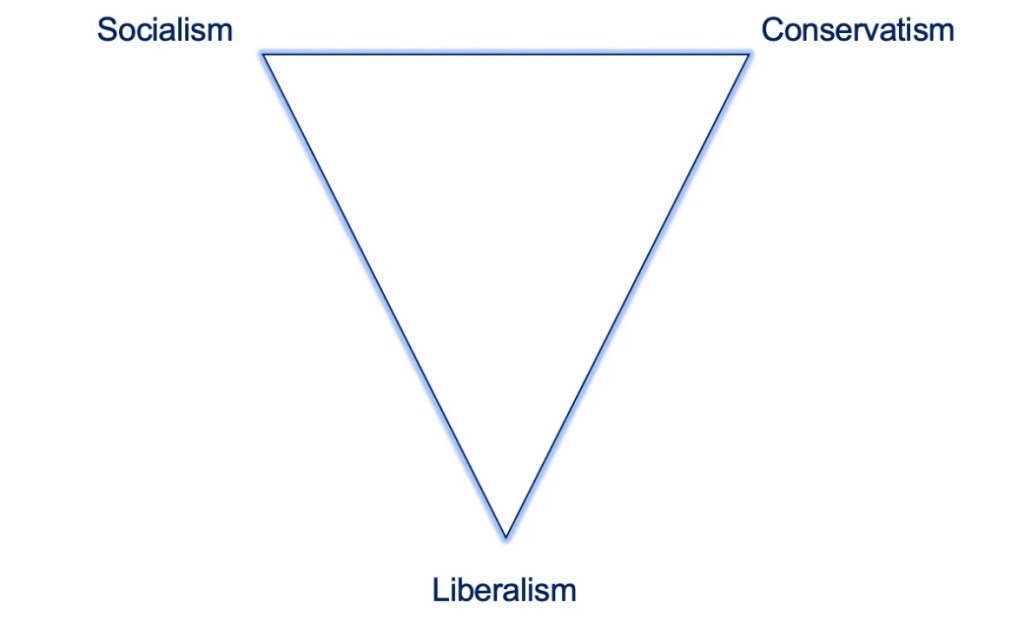
In this vein, Nate Silver presents a basic taxonomy of political orientation in a recent Substack post. It includes the diagram above, which distinguishes between socialism, conservatism, and liberalism. Silver draws on a classic essay written by Friedrich Hayek in 1945, “Why I am Not a Conservative”, in which Hayek discussed the meaning of the word “liberal” (and see here). Liberalism’s true emphasis is a tolerance for individual rights and freedoms, subject to varying articulations of the “nonaggression principle”. That is, “do as you like, but do no harm to others”.

We often see a linear representation distinguishing between so-called progressives on the left and conservatives on the right. Of course, a major hallmark of leftist thinking is extreme interventionism. Leftists or progressives are always keen to detect the slightest whiff of an externality or the slightest departure from the perfectly competitive market ideal. They seem eager to find a role for government in virtually every area of life. While it’s not a limiting case, we can substitute socialism or statism for progressivism on the far left, as Silver does, whereby the state takes primacy in economic and social affairs.

Conservatism, on the other hand, is a deep resistance to change, whether institutional, social, and sometimes economic. Conservatives too often demonstrate a willingness to use the coercive power of the state to prevent change. Hayek noted the willingness of both socialists and conservatives to invoke state power for their own ends.

Similarly, religious conservatives often demand state support beyond that afforded by the freedom to worship in the faith of one’s choice. They might strongly reject certain freedoms held to be fundamental by liberals. Meanwhile, socialists often view mere religious freedom as a threat to the power of the state, or at least they act like it (e.g. see here for an example).

Like conservatives, dedicated statists would doubtless resist change if it meant a loss of their own power. That is, they’d wish to preserve socialist institutions. On this point, witness the vitriol from the Left over what it perceives as threats to the public school monopoly. Witness also the fierce resistance among public employees to reducing the scale of the administrative state, and how advocates of entitlements fiercely resist decreases in the growth rate of those expenditures.

Silver, like Hayek, objects to the traditional, linear framework in which liberals are thought to occupy a range along a line between socialism and conservatism. He objects to that because real liberals value individual liberty as a natural human right, a viewpoint typically abhored by both socialists and conservatives. There is nothing “in between” about it! And of course, conservatives and progressives are equally guilty in their mistaken use of the word “liberal”.

Mapping Political Preferences

Liberty, statism, and conservatism are not exactly orthogonal political dimensions. Larger government almost always means less economic liberty. At a minimum, state dominance implies a social burden associated with public monopoly and monopsony power, as well as tax and welfare-state incentive problems. These features compromise or corrupt the exercise of basic rights. On the other hand, capitalism and its concomitant reliance on consumer sovereignty, individual initiative, free exchange and secure property rights is most in harmony with true liberalism.

For conservatives, resistance to change in support of a traditionally free market economy might offer something of a contradiction. In one sense, it corresponds to upholding market institutions. However, free markets allow new competitors and new technologies to undermine incumbents, who conservatives sometimes wish to defend through regulatory or protectionist measures. And conservatives are almost always too happy to join in the chorus of “price gouging” in response to the healthy operation of the free market in bringing forth supplies.

All that is to say that preferences involving liberty, statism, and traditionalism are not independent of one another. They cannot simply be mapped onto a three-dimensional space. At least the triangular representation gets liberalism out of the middle, but it’s difficult to visualize other ideological positions there. For example, “state religionism” could lie anywhere along the horizontal line at the top or even below it if certain basic liberties are preserved. Facism combines elements of socialism and a deformed version of capitalism that is properly called corporatism, but where would it fall within the triangle?

Big Government Liberalism?

Silver says he leans heavily toward a “big government” version of liberalism, but big government is hard to square with broad liberties. Granted, any well-functioning society must possess a certain level of “state capacity” to defend against private or public violations of individual rights, adjudicate disputes, and provide true public goods. It’s not clear whether Silver’s preferences lie within the bounds of those ambitions. Still, he deserves credit for his recognition that liberalism is wholly different from the progressive, socialist vision. It is the opposite.

The “New” Triangle

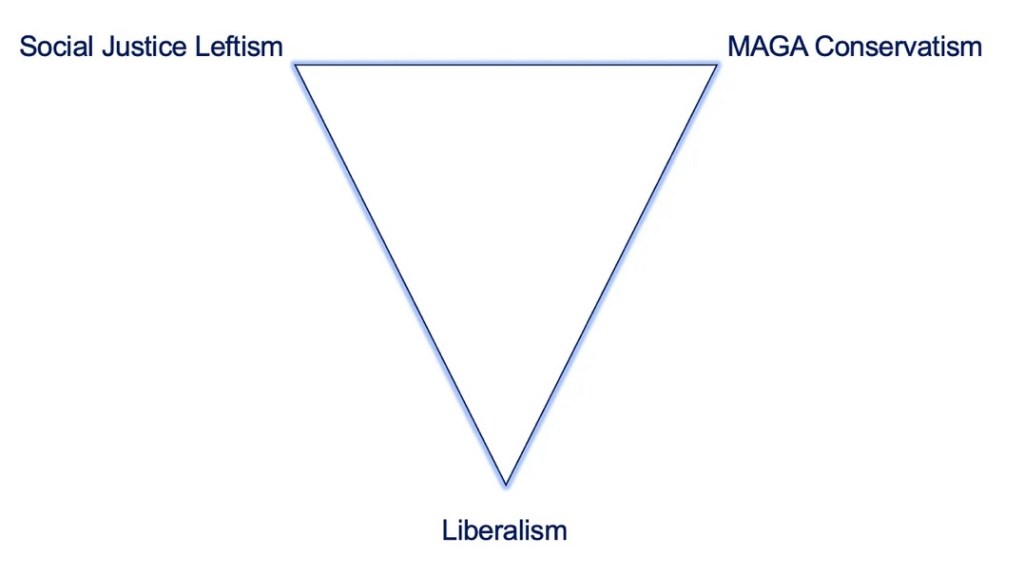
Silver attempts to gives the triangular framework a more contemporary spin by replacing conservatism with “MAGA Conservatism” and socialism with “Social Justice Leftism” (SJL), or “wokeism”. Here, I’m treating MAGA as a “brand”. Nothing below is intended to imply that America should not be a great nation.

The MAGA variant of conservatism emphasizes nationalism, though traditional conservatives have never been short on love of nation. For that matter, as a liberal American, it’s easier to forgive nationalist sentiments than it is the “Death to America” refrain we now hear from some SJLs.

The MAGA brand is also centered around a single individual, Donald Trump, whose rhetoric strikes many as nativistic. And Trump is a populist whose policy proposals are often nakedly political and counterproductive.

SJL shares with socialism an emphasis on various forms of redistribution and social engineering, but with a new focus on victimhood based on classes of identity. Of SJL, Silver says:

“Proponents of SJL usually dislike variations on the term ‘woke’, but the problem is that they dislike almost every other term as well. And we need some term for this ideology, because it encompasses quite a few distinctive features that differentiate it both from liberalism and from traditional, socialist-inflected leftism. In particular, SJL is much less concerned with the material condition of the working class, or with class in general. Instead, it is concerned with identity — especially identity categories involving race, gender and sexuality, but sometimes also many others as part of a sort of intersectional kaleidoscope.”

The gulf between liberals and SJLs couldn’t be wider on issues like free speech and “equity”, and equality of opportunity. MAGAns, on the other hand, have some views on individual rights and responsibility that are largely consistent with liberals, but reflexive populism often leads them to advocate policies protecting rents, corporate welfare, and protectionism.

Divided Liberalism

Liberalism emphasizes limited government, individual autonomy, and free exchange. However, there are issues upon which true liberals are of divided opinion. For example, one such area of controversy is the conflict between a woman’s right to choose and the fetal right to life. Many true liberals disagree over whether the rights of a fetus outweigh its mother’s right to choose, but most would concede that the balance shifts to the fetus at some point well short of birth (putting aside potential dangers to the mother’s life). Open borders is another area that can divide true liberals. On one side, the right to unrestricted mobility is thought to supersede any public interest in enforcing borders and limiting the flow of immigrants. On the other side, questions of national sovereignty, national security, as well as social and state capacity to absorb immigrants take primacy.

Don’t Call Lefties “Liberal”… They’re Not!

True liberalism (including most strains of libertarianism) recognizes various roles that a well-functioning state should play, but it also recognizes the primacy of the individual and individual rights as a social underpinning. As Hayek noted, true liberals are not resistant to change per se, unlike conservatives. But modern progressives demand changes of the worst kind: that the state should intervene to pursue their favored objectives, laying claim to an ever-greater share of private resources. This requires government coercion on a massive scale, the antithesis of liberalism. It’s time to recognize that “progressives” aren’t liberals in any sense of the word. For that matter, they don’t even stand for progress.

I’ll close with a quote from Adam Smith that I cribbed from Scott Sumner. Unfortunately, Sumner does not give the full reference, but I’ll take his word that Smith wrote this 20 years before the publication of The Wealth of Nations:

“Little else is requisite to carry a state to the highest degree of opulence from the lowest barbarism, but peace, easy taxes, and a tolerable administration of justice; all the rest being brought about by the natural course of things. All governments which thwart this natural course, which force things into another channel, or which endeavour to arrest the progress of society at a particular point, are unnatural, and to support themselves are obliged to be oppressive and tyrannical.”

Great Moments In Projection: Il Doofe Says His Opponents Are Anti-Democratic, Fascist

06 Tuesday Sep 2022

Posted by Nuetzel in Democracy, fascism, Uncategorized

≈ Leave a comment

Tags

Administrative State, Angelo M. Codaville, Babylon Bee, Benito Mussolini, Classical Liberal, Constitutional Republic, Corporatism, crony capitalism, Dan Klein, Democracy, fascism, FDR, Federalism, Friedrich Hayek, G.W.F. Hegel, Hitler, Il Duce, Joe Biden, Joseph Stalin, Majoritarianism, Nationalism, New Deal, Semi-Fascism, Sheldon Richman, Socialism

When partisans want to make sure they get their way, perhaps we shouldn’t be surprised to hear them claim their opponents are “anti-democratic”. Well, one-party rule is not democratic, just in case that’s unclear to leftists prattling about “hunting down” the opposition. We now have those forces hurling cries of “fascism” and “semi-fascism” at political adversaries for opposing their use of the state’s coercive power to get their way and to punish political enemies.

Restrained Democracy

The U.S. is not a democracy; it is a constitutional republic. The reason it’s not a democracy is that the nation’s founders were wary of the dangers of majoritarianism. There are many checks on unbridled majoritarianism built into our system of government, including the many protections and guarantees of individual rights in the Constitution, as well as federalism and three branches of government intended as coequals.

In a short essay on democracy, Dan Klein refers to a mythology that has developed around the presumed democratic ideal, quoting Friedrich Hayek on the “fantasy of consensus” that tends to afflict democratic absolutists. Broad consensus is possible on many issues, but it might have been an imperative within small bands of primitive humans, when survival of the band was of paramount concern. That’s not the case in modern societies, however. Classical liberals are often derided as “anti-democratic”, but like the founders, their distaste for pure democracy stems from a recognition of the potential for tyrannies of the majority. Klein notes that the liberal emphasis on individual rights is naturally at tension with democracy. Obviously, a majority might selfishly prefer actions that would be very much to the detriment of individuals in the minority, so certain safeguards are necessary.

However, the trepidation of classical liberals for democracy also has to do with the propensity for majorities to “governmentalize” affairs so as to codify their preferences. As Klein says, this often means regulation of many details of life and social interactions. These are encroachments to which classical liberals have a strong aversion. One might fairly say “small government” types like me are “anti-pure democracy”, and as the founders believed, democratic processes are desirable if governing power is distributed and restrained by constitutional principles and guarantees of individual rights.

Democracy has vulnerabilities beyond the danger posed by majoritarian dominance, however. Elections mean nothing if they can be manipulated, and they are easily corrupted at local levels by compromises to the administration of the election process. Indeed, today powerful national interests are seeking to influence voting for local election officials across the country, contributing substantial sums to progressive candidates. It’s therefore ironic to hear charges of racism and anti-democracy leveled at those who advocate measures to protect election integrity or institutions such as federalism.

And here we have the White House Press Secretary insisting that those in the “minority” on certain issues (dependent, of course, on how pollsters phrase the question) are “extremists”! To charge that someone or some policy is “anti-democratic” usually means you didn’t get your way or you’re otherwise motivated by political animus.

Fascism

Biden and others are throwing around the term fascism as well, though few of these partisans can define the term with any precision. Most who pretend to know its meaning imagine that fascism evokes some sort of conservative authoritarianism. Promoting that impression has been the purpose of many years of leftist efforts to redefine fascism to suit their political ends. Stalin actually promoted the view that anything to the right of the Communist Party was inherently fascist. But today, fascism is an accurate description of much of Western governance, dominated as it is by the administrative state.

I quote here from my post “The Fascist Roader” from 2016:

“A large government bureaucracy can coexist with heavily regulated, privately-owned businesses, who are rewarded by their administrative overlords for expending resources on compliance and participating in favored activities. The rewards can take the form of rich subsidies, status-enhancing revolving doors between industry and powerful government appointments, and steady profits afforded by monopoly power, as less monied and politically-adept competitors drop out of the competition for customers. We often call this “corporatism”, or “crony capitalism”, but it is classic fascism, as pioneered by Benito Mussolini’s government in Italy in the 1920s. Here is Sheldon Richman on the term’s derivation:

‘As an economic system, fascism is socialism with a capitalist veneer. The word derives from fasces, the Roman symbol of collectivism and power: a tied bundle of rods with a protruding ax.’”

Meanwhile, Hitler’s style of governing shared some of the characteristics of Mussolini’s fascism, but there were important differences: Hitler persecuted Jews, blaming them for all manner of social problems, and he ultimately had them slaughtered across much of Europe. Mussolini was often brutal with his political enemies. At the same time, he sought to unite an Italian people who were otherwise a fairly diverse lot, but once Mussolini was under Hitler’s thumb, Italian Jews were persecuted as well.

Angelo M. Codevilla provides an excellent account of Mussolini’s political career and the turns in his social philosophy over the years. He always considered himself a dedicated socialist, but the views he professed evolved as dictated by political expediency. So did his definition of fascism. As he took power in Italy with the aid of “street fighters”, fascism came to mean nationalism combined with rule by the administrative state and a corresponding preemption of legislative authority. And there were concerted efforts by Mussolini to control the media and censor critics. Sound familiar? Here’s a quote from Il Duce himself on this matter:

“Because the nature of peoples is variable, and it is easy to persuade them of things, but difficult to keep them thus persuaded. Hence one must make sure that, when they no longer believe, one may be able then to force them to believe.”

Here is Codevilla quoting Mussolini from 1919 on his philosophy of fascism:

“The fascist movement, he said, is ‘a group of people who join together for a time to accomplish certain ends.’ ‘It is about helping any proletarian groups who want to harmonize defense of their class with the national interest.’ ‘We are not, a priori, for class struggle or for class-cooperation. Either may be necessary for the nation according to circumstances.’”

This framing underlies another basic definition of fascism: a system whereby government coercion is used to extract private benefits, whether by class or individual. Codevilla states that Mussolini was focused on formal “representation of labor” in policy-making circles. Today, western labor unions seem to have an important, though indirect, influence on policy, and labor is of course the presumed beneficiary of many modern workplace regulations.

Modern corporatism is directly descended from Mussolini’s fascist state. The symbiosis that exists between large corporations and government has several dimensions, including regulatory capture, subsidies and taxes to direct flows of resources, high rates of government consumption, rich government contracts, and of course cronyism. This carries high social costs, as government dominance of economic affairs gives rise to a culture of rent seeking and diminished real productivity. Here is Codevilla’s brief description of the transition:

“Hegel, as well as the positivist and Progressive movements, had argued for the sovereignty of expert administrators. Fascist Italy was the first country in which the elected legislature gave up its essential powers to the executive, thus abandoning the principle, first enshrined in the Declaration of Independence and the U.S. Constitution, by which people are rightly governed only through laws made by elected representatives. By the outbreak of World War II, most Western countries’ legislatures—the U.S. Congress included—had granted the executive something like ‘full powers,’ each by its own path, thus establishing the modern administrative state.”

Mussolini saw Italian fascism as the forerunner to FDR’s New Deal and took great pride in that. On this point, he said:

“… the state is responsible for the people’s economic well-being, it no longer allows economic forces to run according to their own nature.”

The Babylon Bee’s take on Biden and fascism would have been more accurate had it alluded to Mussolini, but not nearly as funny! The following link (and photoshopped image) is obviously satire, but it has a whiff of eerie truth.

Biden Condemns Fascism in Speech While Also Debuting Attractive New Mustache

Conclusion

Biden’s slur that Republicans are “anti-democratic” is an obvious distortion, and it’s rather ironic at that. The nation’s support for democratic institutions has always been qualified for good reasons: strict majoritarianism tends to disenfranchise voters in the minority, and in fact it can pose real dangers to their lives and liberties. Our constitutional republic offers “relief valves”, such as “voting with your feet”, constitutional protections, and seeking recourse in court. Biden’s party, however, has a suspicious advantage via control of election supervision in many key urban areas of the country. This can be exploited in national elections to win more races as long as the rules on election administration are sufficiently lax. This is a true corruption of democracy, unlike the earnest efforts to improve election integrity now condemned by democrats.

Joe Biden hasn’t the faintest understanding of what fascism means. He uses the term mostly to suggest that Trump, and perhaps most Republicans, have authoritarian and racist sympathies. Meanwhile, he works to entrench the machinery and the breadth of our own fascist state, usurping legislative authority. He is buttressed by a treacherous security apparatus, “street fighters” under the guise of Antifa and BLM, and the private media acting as a propaganda arm of the administration. Joe Biden, you’re our fascist now.

A Fiscal Real-Bills Doctrine? No Such Thing As Painless Inflation Tax

14 Tuesday Jun 2022

Posted by Nuetzel in Fiscal policy, Inflation, Uncategorized

≈ Leave a comment

Tags

Biden Administration, Cronyism, Federal Debt, Fiscal Inflation, Fiscal policy, Friedrich Hayek, Hyperinflation, Inflation tax, Knowledge Problem, Modern Monetary Theory, Monetary policy, Money Printing, Nominal GDP Targeting, Pete Buttigieg, Real Bills Doctrine, Reichsbank, rent seeking, Ro Khanna

A remarkable proposal made recently by Representative Ro Khanna (D -CA) would have the Biden Administration impose price controls, which would be bad enough. Khanna also would like the federal government to cover the inflation losses incurred by Americans by having it directly purchase certain goods and services and resell them “cheap” to consumers. In fairness, Khanna says the government should attempt to take advantage of dips in prices for oil, food commodities, and perhaps other necessities, which of course would limit or reverse downward price changes. When asked about Khanna’s proposal, Pete Buttigieg, Joe Biden’s Transportation Secretary, replied that there were great ideas coming out of Congress and the Administration should consider them. Anyway, the idea is so bad that it deserves a more thorough examination.

Central Planners Have No Clothes

First, such a program would represent a massive expansion in the scope of government. It would also present ample opportunities for graft and cronyism, as federal dollars filter through the administrative layers necessary to manage the purchases and distribution of goods. Furthermore, price and quantity would then be shaded by a heavy political component, often taking precedence over real demand and cost considerations. And that’s beyond the crippling “knowledge problem” that plagues all efforts at central planning.

One of the most destructive aspects of allowing government to absorb a greater share of total spending is that government is not invested with the same budgetary discipline as private buyers. Take no comfort in the notion that the government might prove expert at timing these purchases to leverage price dips. Remember that government always spends “other people’s money”, whether it comes from tax proceeds, lenders, or the printing press (and hence future consumers, who have absolutely no agency in the matter). Hence, price incentives take on less urgency, while political incentives gain prominence. The loss of price sensitivity means that government expenditures are likely to inflate more readily than private expenditures. This is all the more critical at a time when inflation is becoming embedded in expectations and pricing decisions. Khanna thus proposes an inflation “solution” that puts less price-sensitive bureaucrats in charge of actual purchases. That’s a prescription for failure.

If anyone in Biden’s White House is seriously considering a program of this kind, and let’s hope they’re not, they should at least be aware that direct subsidies for the purchase of key goods would be far more efficient. It’s also possible to hedge the risk of future price increases on commodities markets, perhaps simply distributing hedging gains to consumers when they pay off. However, having the federal government participate as a major player in commodities options and futures is probably not on the table at this point … and I shudder to think of it, but it might be more efficient than Khanna’s vision.

A Fiscal Real Bills Doctrine

Khanna’s program would almost surely cause inflation to accelerate. Inflation itself a form of taxation imposed by profligate governments, though it’s an inefficient tax since it creates greater uncertainty. Higher prices deflate the real value of most government debt (borrowed from the public), assets fixed in nominal value, and incomes. Read on, but this program would have the government pay your inflation tax for you by inflating some more. Does this sound like a vicious circle?

Khanna’s concept of inflation-relief is a fiscal reimagining of a long-discredited monetary theory called the “Real Bills Doctrine”. According to this doctrine, rising prices and costs necessitate additional money creation so that businesses have the liquidity to pay the bills associated with ongoing productive efforts. The “real” part is a reference to the link between business expenses and actual production, despite the fact that those bills are expressed in nominal terms. The result of this policy is a cycle of ever-higher inflation, as ever-more money is printed. This was the policy utilized by the Reichsbank in Weimar Germany during its hyperinflation of 1922-23. It’s really quite astonishing that anyone ever thought such a policy was helpful!

In Khanna’s version of the doctrine, the government spends to relieve cost pressure faced by consumers, so the rationale has nothing to do with productive effort.

Financing and the Central Bank Response

It’s reasonable to ask how these outlays would be financed. In all likelihood, the U.S. Treasury would borrow the funds at interest rates now at 10-15 year highs, which have risen in part to compensate investors for higher inflation.

My bet is that Khanna imagines the Fed would simply “print” money (i.e., buy the new government debt floated by the Treasury to pay for the program). This is the prescription of so-called Modern Monetary Theory, whose adherents have either forgotten or have never learned that money growth and inflation is a costly and regressive form of taxation.

Most economists would say the response of the Federal Reserve to this fiscal stimulus would bear on whether it really ignites additional inflationary pressure. Of course, rather than borrowing, Congress could always vote to levy higher taxes on the public in order to pay the public’s inflation tax burden! But then what’s the point? Well, taxing at least has the virtue of not fueling still higher inflation, and the Fed would not have a role to play.

But if the government simply borrows instead, it adds to the already bloated supply of government debt held by the public. This borrowing is likely to put more upward pressure on interest rates, and the federal government’s mounting interest expense requires more financing. What then might the Fed do?

The Fed is an independent, quasi-government entity, so it would not have to accommodate the additional spending by printing money (buying the new Treasury debt). Either way, investors are increasingly skeptical that the growing debt burden will ever be reversed via future surpluses. The fiscal theory of the price level holds that something must reduce the real value of government debt (in order to satisfy the long-term fiscal budget constraint). That “something” is a higher price level. This position is not universally accepted, and some would contend that if the Fed simply set a nominal GDP growth target and stuck to it, accelerating inflation would not have to follow from Khanna’s policy. The same if the Fed could stick to a symmetric average inflation target, but they certainly haven’t been up to that task. Hoping the Fed would fully assert its independence in a fiscal hurricane is probably wishful thinking.

Conclusion

There are no choke points in the supply chain for bad ideas on the left wing of the Democratic Party, and they are dominating party centrists in terms of messaging. The answer, it seems, is always more government. High inflation is very costly, but the best policy is to rein it in, and that requires budgetary and monetary discipline. Attempts to make high inflation “painless” are misguided in the first instance because they short-circuit consumer price responses and substitution, which help restrain prices. Second, the presumption that an inflation tax can be “painless” is an invitation to fiscal debauchery. Third, expansive government brings out hoards of rent seekers instigating corruption and waste. Finally, mounting public debt is unlikely to be offset by future surpluses, and that is the ultimate admission of Modern Monetary Theory. A fiscal real bills doctrine would be an additional expression of this lunacy. To suggest otherwise is either sheer stupidity or an exercise in gaslighting. You can’t inflate away the pain of an inflation tax.

Rewarding Merit Is The Key To Growth

21 Monday Jun 2021

Posted by Nuetzel in economic growth, Meritocracy, Redistribution

≈ Leave a comment

Tags

Adrian Wooldridge, Autocracy, Clientelism, Friedrich Hayek, John Cochrane, Meritocracy, Nepotism, Pure Democracy, Racial Equity, Redistribution, Ruth Bader Ginsburg, Social Justice, Upward Mobility, W.E.B. Du Bois, Zero-Sum Games

Outward trappings of success, even at very modest levels, are seldom durable or predictive of future achievement if not backed by actual performance. That’s one reason why redistributionist policies are so unsuccessful at fostering upward mobility. They fail by focusing on outcomes rather than on addressing more fundamental causes, like skills, training, and well-functioning markets for low-skill labor. The same applies to programs that prescribe quotas on admissions, tuition aid, and hiring. The beneficiaries of these programs are often placed into situations in which they are unprepared. This makes them vulnerable to stigmatization and ultimately failure. And when poor performance is in any way ignored or forgiven, it has an impact on the psyche of the individual and their reputation, and it creates losses to the rest of society.

On the other hand, conditions and policies that lead to economic growth are likely to benefit the lower strata of society and minorities, to the extent that minorities are more concentrated in lower income quantities than non-minorities. We know incentives always matter, and incentives rely on the ability of individuals to act and succeed. Success implies gains to others who have occasion to avail themselves of the individual’s efforts. They are offering rewards for merit! Furthermore, those offers are always increasing in the value created, and thus, in levels of accomplishment. In that way, individuals always have opportunities to strive for growth.

But none of that works unless meritocracy holds sway. LittlBut none of that works unless meritocracy holds sway. Little wonder that meritocracy is so closely tied to a society’s prosperity, as documented in this article and a forthcoming book by Adrian Wooldridge. John Cochrane provides an excellent review and critique of Wooldridge’s thesis along with several lengthy quotes.

Wooldridge disputes the widely-accepted theory that democracy is a determinant of economic growth (also see here), noting that democracy can create economic pitfalls related to majoritarian excesses, whereas merit-based systems of rewards are common to almost all successful economies, including autocracies (Singapore, China) and democracies/republics (the U.S., Japan, Scandinavia), irrespective of the size of government. He offers examples of countries in which meritocratic systems are weak but nepotism or political “clientelism” are strong, with unfortunate results (Greece, Portugal, Italy). You certainly won’t get efficient outcomes when leaders prioritize family, friends, cronies, and political contributors for plum jobs and other rewards.

Of course, there is no pure meritocracy in the world. Rather, there are varying degrees of meritocracy across different societies. Traditionally, the U.S. economic system has relied on merit to a great extent; returns to merit are largely a matter of equal opportunity, though not entirely. Equally talented individuals do not always have access to the same opportunities. In fact, that is the major point of attack against the concept of meritocracy, but it does not imply that the benefits of meritocracy are a myth. There are many institutional dysfunctions that can and should be fixed to overcome the kinds of problems cited by critics, primarily public education, but the old expression “don’t throw the baby out with the bathwater” seems especially apt.

In fact, meritocracy promotes upward mobility. Here is Cochrane on the great paradox underlying the backlash against meritocracy:

“The US paternalistic/aristocratic elite is running away from meritocracy under the banner of ‘social justice’ and ‘racial equity.’ Yet meritocracy throughout history has been a great equalizer, a great leveler, the main way that excluded out-groups could get ahead.”

And on this point, Cochrane quotes Wooldridge:

“… Meritocracy is one of the great building blocks of modernity, along with democracy, capitalism and liberalism. … Is it really the case that meritocracy is a tool of White male privilege? W.E.B. Du Bois and Ruth Bader Ginsburg might have something different to say. Are lotteries or holistic assessments really better ways of distributing educational opportunities than standardized tests? Most of us would hesitate before flying with a pilot who had been chosen by lottery. Do we really want a society in which group identities trump individual abilities? “

To give the critics their due, however, a more refined version of their argument is that “meritocracy is a myth without inclusion”. Fair enough, but again, any shortfall in participation is not the fault of meritocracy per se, but of underlying conditions and policies fostering substandard education, family instability, high crime and incarceration rates, and high rates of unemployment among those with low skills.

An important strand of Wooldridge’s work is the implication that meritocracy is a redeeming feature of some autocratic regimes. Indeed, Wooldridge is not the least bit skeptical that autocratic rule is sustainable, just as long as merit drives rewards. This is a point on which Cochrane differs. An autocracy in which high echelons are populated by the meritorious will constantly grapple with temptations of the powerful to reward their pals. Lines of accountability must be all the stronger to prevent such decay. Furthermore, autocracy usually weds itself to meritocracy only in a conditional sense. For example, in China, one must support the party. These restraints undermine the benefits of meritocracy by offering less autonomy for individuals to leverage their talent.

“Pure” democracy has its own drawbacks, b“Pure” democracy has its own drawbacks, but at least leaders have autonomy while being accountable to a broader class. And as Cochrane says, the greatest dangers of democracy can be addressed under representative democracy along with other means of protecting minorities and individual rights.

The effort to banish meritocracy is madness and the product of a totalitarian mindset. To speak of the “illusion” or “myth” of meritocracy is to contend that talent, preparedness, sound decision-making, workmanship, precision, effort, and value-delivered represent trickery of some sort. Such is the viewpoint of those who take human well-being to be a zero-sum game. But it’s even worse than that. For example, placing lives in the hands of “randomly selected” pilots would invite catastrophe, and while that example is extreme, it clearly illustrates how non-meritocratic approaches are likely to produce negative sums! Putting resources into the hands of individuals with lesser qualifications is always a prescription for waste. Make no mistake: the road to serfdom is well-traveled and can be a very quick trip. Abandoning merit-based rewards would get us a fast start.

COVID Interventions: Costly, Deadly, and Ineffective

14 Monday Dec 2020

Posted by Nuetzel in Coronavirus, Liberty, Lockdowns, Public Health

≈ 1 Comment

Tags

AJ Kay, Andrew Cuomo, CDC, Contact Tracing, Covid-19, David Kay, Do-Somethingism, Eric Garcetti, Essential Businesses, Fairfax County Schools, Federalism, Friedrich Hayek, Human Rights Watch, J.D. Tucille, Justin Hart, Kelsey Munro, Knowledge Problem, Lemoine, Life Value, Nature, Non-Prescriptive Interventions, Philippe Lemoine, Public Health, Scott Sumner, Seth Flaxman, Stringency Index, University of Oxford, World Health Organization

What does it take to shake people out of their statist stupor? Evidently, the sweet “logic” of universal confinement is very appealing to the prescriptive mindset of busybodies everywhere, who anxiously wag their fingers at those whom they view as insufficiently frightened. As difficult as it is for these shrieking, authoritarian curs to fathom, measures like lockdowns, restrictions on business activity, school closures, and mandates on behavior have at best a limited impact on the spread of the coronavirus, and they are enormously costly in terms of economic well-being and many dimensions of public health. Yet the storm of propaganda to the contrary continues. Media outlets routinely run scare stories, dwelling on rising case numbers but ignoring them when they fall; they emphasize inflated measures of pandemic severity; certain researchers and so-called health experts can’t learn the lessons that are plain in the data; and too many public officials feel compelled to assert presumed but unconstitutional powers. At least the World Health Organization has managed to see things clearly, but many don’t want to listen.

I’ll be the first to say I thought the federalist approach to COVID policy was commendable: allow states and local governments to craft policies appropriate to local conditions and political preferences, rather than have the federal government dictate a one-size-fits-all policy. I haven’t wavered in that assessment, but let’s just say I expected more variety. What I failed to appreciate was the extent to which state and local leaders are captive to provincial busybodies, mavens of precautionary excess, and fraudulent claims to scientific wisdom.

Of course, it should be obvious that the “knowledge problem” articulated by Friedrich Hayek is just as dangerous at low-levels of government as it is in a central Leviathan. And it’s not just a knowledge problem, but a political problem: officials become panicked because they fear bad outcomes will spell doom for their careers. Politicians are particularly prone to the hazards of “do-somethingism”, especially if they have willing, status-seeking “experts” to back them up. But as Scott Sumner says:

“When issues strongly impact society, the science no longer ‘speaks for itself’.

Well, the science is not quite as clear as the “follow-the-science” crowd would have you believe. And unfortunately, public officials have little interest in sober assessments of the unintended effects of lockdown policy.

In my last post, I presented a simple framework for thinking about the benefits and costs of lockdown measures, or non-pharmaceutical interventions (NPIs). I also emphasized the knowledge problem: even if there is some point at which NPI stringencies are “optimized”, government does not possess the knowledge to find that point. It lacks detailed information on both the costs and benefits of NPIs, but individual actors know their own tolerance for risk, and they surely have some sense of the risks they pose to others in their normal course of affairs. While voluntary precautions might be imperfect, they accomplish much of what interventionists hope will be gained via coercion. But, in an effort to “sell” NPIs to constituents and assert their authority, officials vastly over-estimate benefits of NPIs and under-estimate the costs.

NPI Stringency and COVID Outcomes

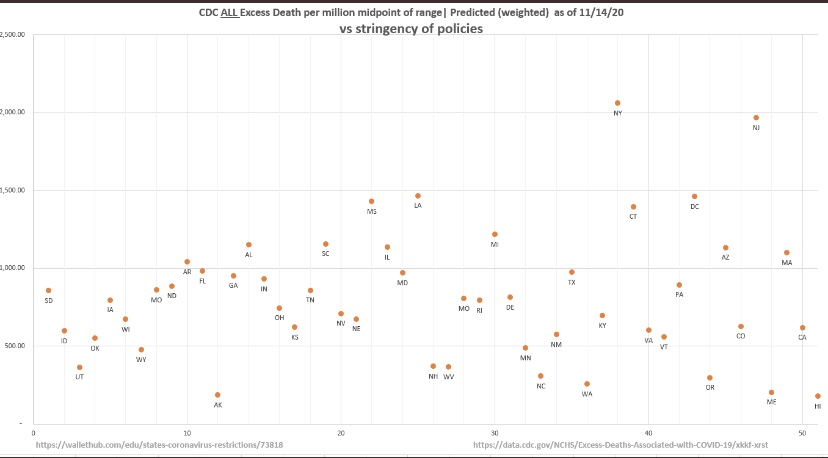
Let’s take a look at a measure of the strength of NPIs by state — the University of Oxford Stringency Index — and compare those to CDC all-cause excess deaths in each state. If it’s hard to read, try clicking on the image or turn your phone sideways. This plot covers outcomes through mid-November:

The chart doesn’t suggest any benefit to the imposition of greater restrictions, or more stringent NPIs. In fact, the truth is that people will do most of the work on their own based on perceptions of risk. That’s partly because government restrictions add little risk mitigation to what can be accomplished by voluntary social distancing and other precautions.

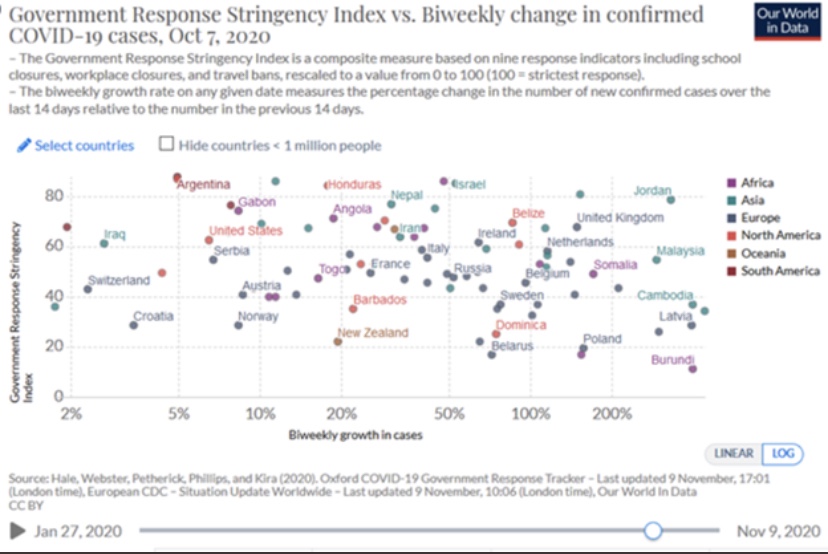
Here’s a similar chart with cross-country comparisons, though the data here ended in early October (I apologize for the fuzzy image):

But what about reverse causality? Maybe the imposition of stringency was a response to more severe contagions. Now that the virus has swept most of the U.S and Europe in three distinct waves, and given the variety and timing of NPIs that have been tried, it’s harder to make that argument. States like South Dakota have done fairly well with low stringency, while states like New Jersey with high stringency have fared poorly. The charts above provide multiple pair-wise examples and counter-examples of states or countries having faced hard waves with different results.

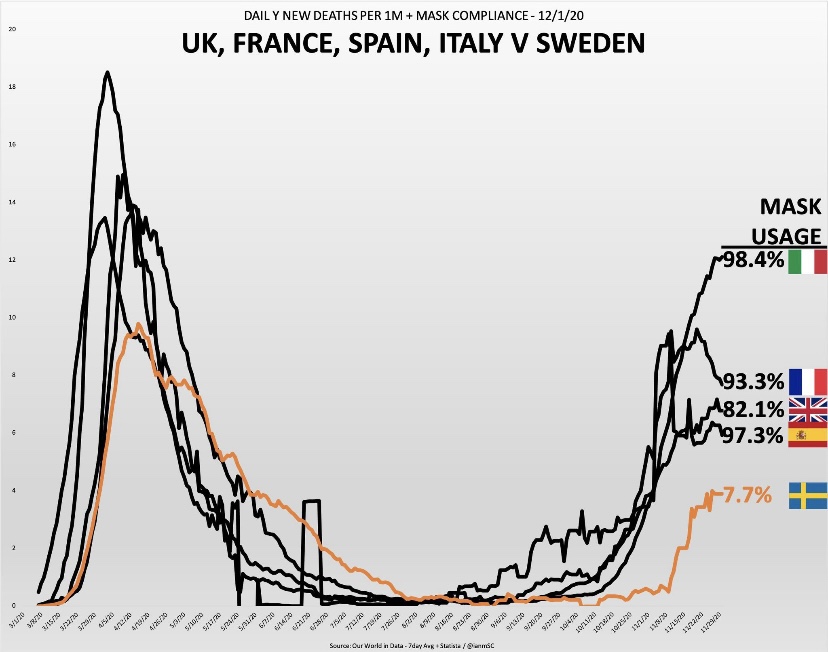
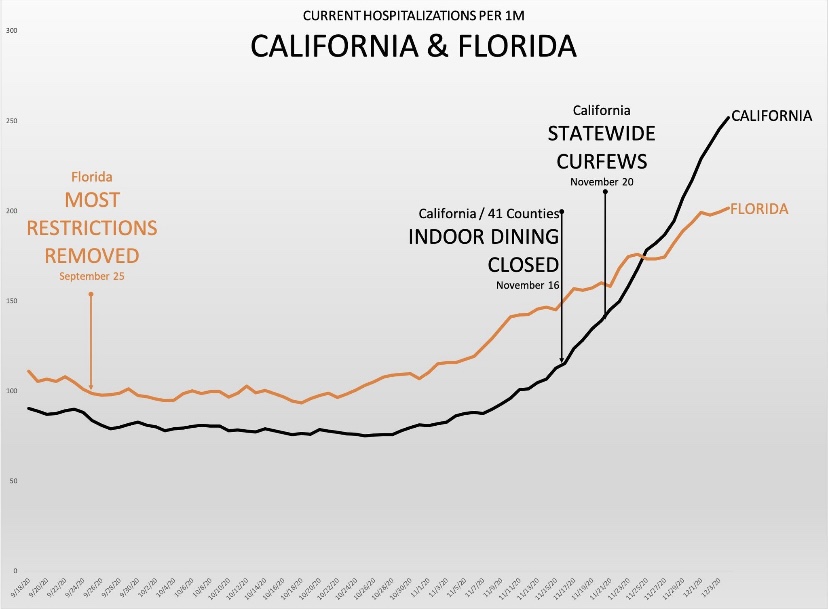
But let’s look at a few specific situations.

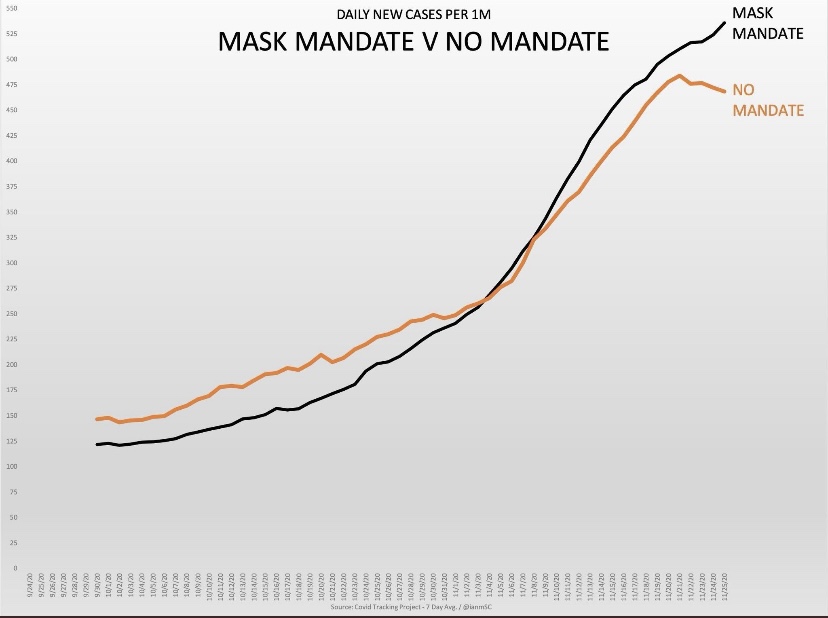
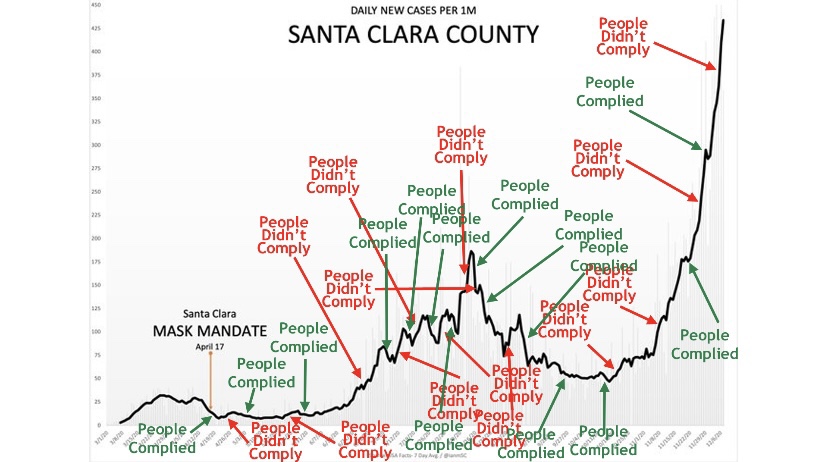
The countries shown above have converged somewhat over the past month: Sweden’s daily deaths have risen while the others have declined to greater or lesser degrees, but the implications for mask usage are unaltered.

And of course we have this gem, predicated on the mental gymnastics lockdown enthusiasts are fond of performing:

But seriously, it’s been a typical pattern: cases rise to a point at which officials muster the political will to impose restrictions, often well after the “exponential” phase of the wave or even the peak has passed. For the sake of argument, if we were to stipulate that lockdowns save lives, it would take time for these measures to mitigate new infections, time for some of the infected individuals to become symptomatic, and more time for diagnosis. For the lockdown arguments to be persuasive, the implementation of NPIs would have to precede the point at which the growth of cases begins to decline by a few weeks. That’s something we’ve seldom observed, but officials always seem to take credit for the inevitable decline in cases.

More informed lockdown proponents have been hanging their hats on this paper in Nature by Seth Flaxman, et al, published in July. As Philippe LeMoine has shown, however, Flaxman and his coauthors essentially assumed their result. After a fairly exhaustive analysis, Lemoine, a man who understands sophisticated mathematics, offers these damning comments:

“Their paper is a prime example of propaganda masquerading as science that weaponizes complicated mathematics to promote questionable policies. Complicated mathematics always impresses people because they don’t understand it and it makes the analysis look scientific, but often it’s used to launder totally implausible assumptions, which anyone could recognize as such if they were stated in plain language. I think it’s exactly what happened with Flaxman et al.’s paper, which has been used as a cudgel to defend lockdowns, even though it has no practical relevance whatsoever.”

The Economic Costs of Stringency

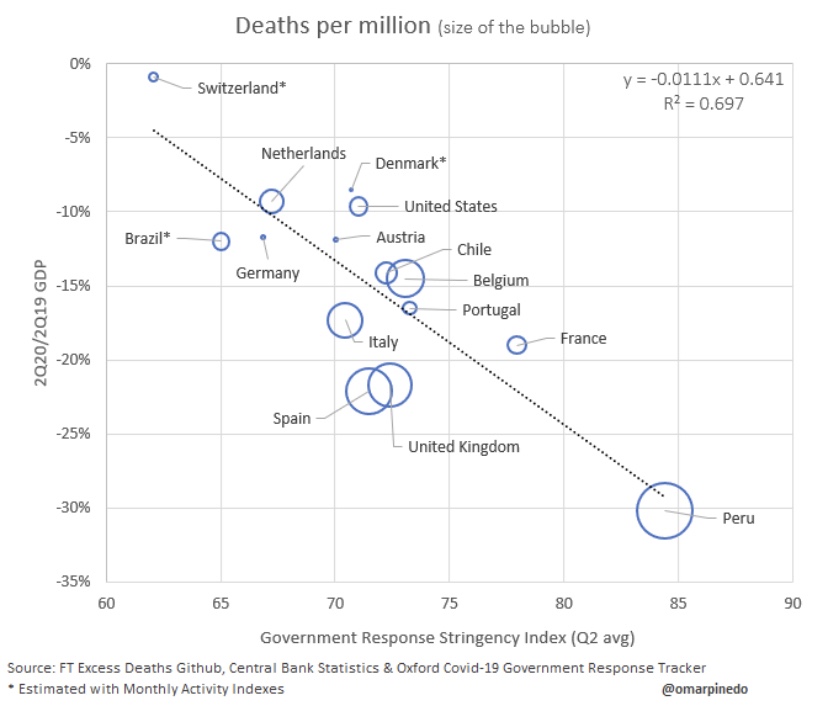
So the benefits of stringent lockdowns in terms of averting sickness and death from COVID are speculative at best. What about the costs of lockdowns? We can start with their negative impact on economic activity:

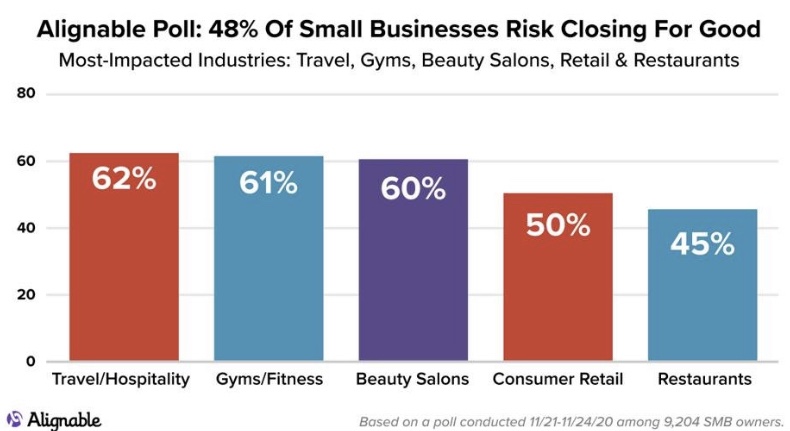
That’s a pretty bad reflection on NPI stringency. In the U.S, a 10% decline in GDP in 2020 amounts to about $2.1 trillion in lost goods and services. That’s just for starters. The many destroyed businesses and livelihoods carry an ongoing cost that could take years to fade, as this graphic on permanent business closures shows:

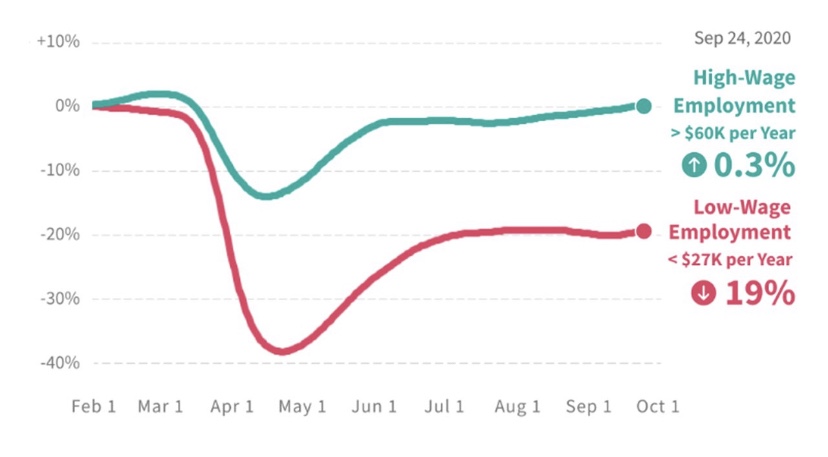
If you’re wondering about the distributional effects of lockdowns, here’s more bad news:

It’s possible to do many high-paying jobs from home. Not so for blue-collar workers. And distributional effects by size of enterprise are also heavily-skewed in favor of big companies. Within the retail industry, big-box stores are often designated as “essential”, while small shops and restaurants are not. The restaurant industry has been destroyed in many areas, inflicting a huge blow to owners and workers. This despite evidence from contact tracing showing that restaurants and bars account for a very small share of transmission. To add insult to injury, many restaurants invested heavily in safety measures and equipment to facilitate new, safer ways of doing business, only to be double-crossed by officials like Andrew Cuomo and Eric Garcetti, who later shut them down.

Public Health Costs of Stringency

Lives are lost due to lockdowns, but here’s a little exercise for the sake of argument: The life value implied by individual willingness-to-pay for risk reduction comes in at less than $4 million. Even if the supposed 300,000 COVID deaths had all been saved by lockdowns, that would have amounted to a value of $1.2 trillion, about half of the GDP loss indicated above. Of course, it would be outrageously generous to concede that lives saved by NPI’s have approached 300,000, so lockdowns fall far short at the very outset of any cost-benefit comparison, even if we value individual lives at far more than $4 million.

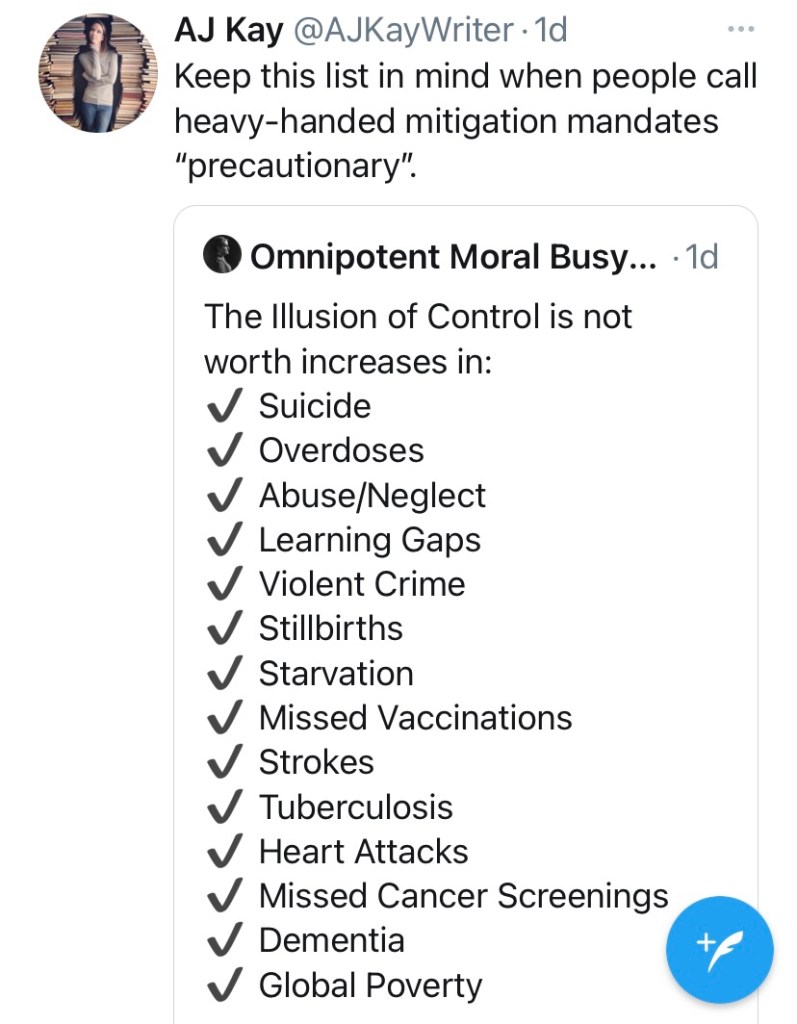
As AJ Kay says, the social and human costs go far beyond economic losses:

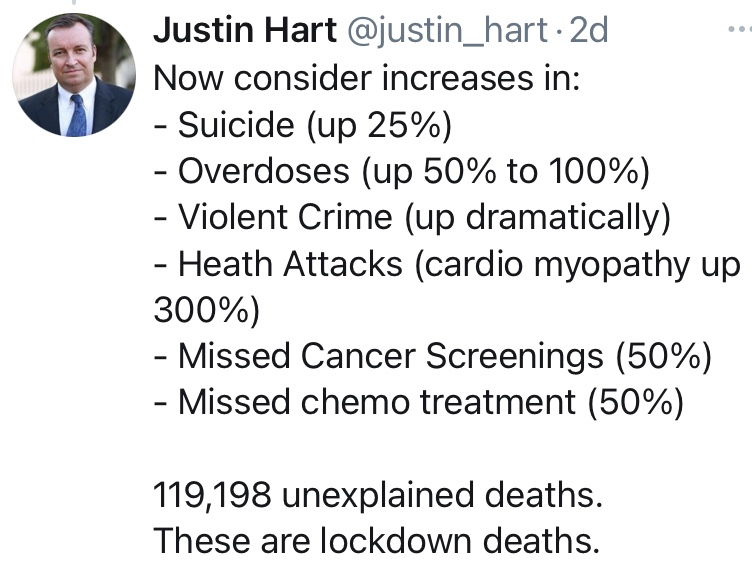
I cited specific examples of losses in many of these categories in an earlier post. But for the moment, instead of focusing on causes of death, take a look at this table provided by Justin Hart showing a measure of non-COVID excess deaths by age group in the far right-hand column:

The numbers here are derived by averaging deaths by age group over the previous five years and subtracting COVID deaths in each group. I believe Hart’s numbers go through November. Of greatest interest here is the fact that younger age groups, having far less risk of death from COVID than older age groups, have suffered large numbers of excess deaths NOT attributed to COVID. As Hart notes later in his thread:

These deaths are a tragic consequence of lockdowns.

Educational Costs of Stringency

Many schools have been closed to in-person instruction during the pandemic, leading to severe disruptions to the education f children. This report from the Fairfax County, VA School District is indicative, and it is extremely disheartening. The report includes the following table:

Note the deterioration for disabled students, English learners, and the economically disadvantaged. The surfeit of failing grades is especially damaging to groups already struggling in school relative to their peers, such as blacks and Hispanics. Not only has the disruption to in-person instruction been disastrous to many students and their futures; it has also yielded little benefit in mitigating the contagion. A recent study in The Lancet confirms once again that transmission is low in educational settings. Also see here and here for more evidence on that point.

Conclusion

It’s clear that the “follow-the-science” mantra as a rationale for stringent NPIs was always a fraud, as was the knee-jerk response from those who conflated lockdowns with “leadership”. Such was the wrongheaded and ultimately deadly pressure to “do something”. We can be thankful that pressure was resisted at the federal level by President Trump. The extraordinary damage inflicted by ongoing NPIs was quite foreseeable, but there is one more very ominous implication. I’ll allow J.D. Tucille to sum that up with some of the pointed quotes he provides:

“‘The first global pandemic of the digital age has accelerated the international adoption of surveillance and public security technologies, normalising new forms of widespread, overt state surveillance,’ warned Kelsey Munro and Danielle Cave of the Australian Strategic Policy Institute’s Cyber Policy Centre last month.

‘Numerous governments have used the COVID-pandemic to repress expression in violation of their obligations under human rights law,’ United Nations Special Rapporteur on Freedom of Expression David Kaye noted in July.

‘For authoritarian-minded leaders, the coronavirus crisis is offering a convenient pretext to silence critics and consolidate power,’ Human Rights Watch warned back in April.

There’s widespread agreement, then, that government officials around the world are exploiting the pandemic to expand their power and to suppress opposition. That’s the case not only among the usual suspects where authorities don’t pretend to take elections and civil liberties seriously, but also in countries that are traditionally considered ‘free.’ … It’s wildly optimistic to expect that newly acquired surveillance tools and enforcement powers will simply evaporate once COVID-19 is sent on its way. The post-pandemic new normal is almost certain to be more authoritarian than what went before.”

COVID Externalities: the Costs and Benefits of Intervention

13 Sunday Dec 2020

Posted by Nuetzel in Coronavirus, Public Health, Social Costs

≈ 1 Comment

Tags

Cost-Benefit Analysis, Covid-19, Externalities, Friedrich Hayek, Intervention, Knowledge Problem, Mutual Risks, Non-Pharmaceutical interventions, Public Health, Stringency Index, University of Oxford

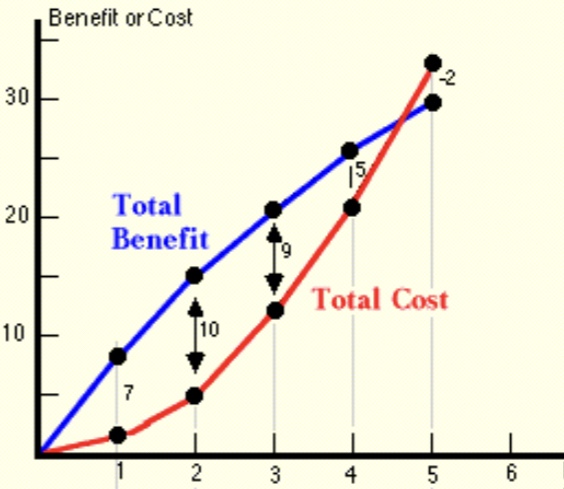
This post offers a simple representation of the argument against public non-pharmaceutical interventions (NPIs) to subdue the COVID-19 pandemic. The chart below features two lines, one representing the presumed life-saving benefits of lockdown measures or NPI stringency, and another representing the costs inflicted by those measures. The values on the axes here are not critical, though measures of stringency exist (e.g., the University of Oxford Stringency Index) and take values from zero to 100.

The benefits of lives saved due to NPI stringency are assigned a value on the vertical axis, as are the costs of lives lost due to deferred health care, isolation, and other stressors caused by stringency. In addition, there are the more straightforward losses caused by suspending economic activity, which should be included in costs.

One can think of the benefits curve as representing gains from forcing individuals, via lockdown measures, to internalize the external costs of risk inflicted on others. However, this curve captures only benefits incremental to those achieved through voluntary action. Thus, NPI benefits include only extra gains from coercing individuals to internalize risks, while losses from NPI stringency are captured by the cost curve.

My contention is that the benefits of stringency diminish and may in fact turn down at some point, and that costs always increase in the level of stringency. In the chart, for what it’s worth, the “optimal” level of stringency would be at a value of 2, where the difference between total benefits and total costs is maximized (and where the benefits of incremental stringency are equal to the marginal costs or losses). However, I am not convinced that the benefits of lockdown measures ever exceed costs, as they do in the chart above. That is, voluntary action may be sufficient. But if the benefits of NPIs do exceed costs, it’s likely to be only at low levels of stringency.

To the extent that people are aware of the pandemic and recognize risk, the external costs of possible infectiousness are already internalized to some degree. Moreover, there is mutual risk in most interactions, and all individuals face risks that are proportional to those to which they expose others: if your contacts are more varied and your interactions are more frequent and intimate, you face correspondingly higher risks yourself. After all, in a pandemic, an individual’s failure to exercise caution may lead to a very hard internalization of costs if an infection strikes them. This mutuality is an element absent from most situations involving externalities. And to the extent that you take voluntary precautions, you and your contacts both benefit. Nevertheless, I concede that there are individuals who face less risk themselves (the young or healthy) but who might behave recklessly, and they might not internalize all risk for which they are responsible. Yes, stringency may have benefits, but that does not mean it has net benefits.

Even if there is some meaningful point at which NPIs are “optimized”, government does not possess the knowledge required to find that point. It lacks detailed knowledge of both costs and benefits of NPIs. This is a manifestation of the “knowledge problem” articulated by Friedrich Hayek, which hampers all efforts at central planning. In contrast, individual actors know their own tolerance for risk, and they surely have some sense of the risks they create in their normal course of affairs. And again, there is a strong degree of proportionality and voluntary internalization of mutual risks.

While relying on voluntary action is economically inefficient relative to an ideal, full-information and perfectly altruistic solution, it is at least based on information that individuals possess: their own risk profile and risk preferences. In contrast, government does not possess information necessary to impose rules in an optimal way, and those rules are rife with unintended consequences and costs inflicted on individuals.

My next post will present empirical evidence of the weakness of lockdown measures in curbing the coronavirus as well as the high costs of those measures. The coronavirus is a serious infection, but it is not terribly deadly or damaging to the longer-term health of the vast majority of people. This, in and of itself, should be sufficient to demonstrate that the array of non-pharmaceutical interventions imposed in the U.S. and abroad were and are not worthwhile. People are capable of assessing risks for themselves. The externality argument, that NPIs are necessary because people do not adequately assess the risk they pose to others, relies on an authority’s ability to assess that risk, and they invariably go overboard on interventions for which they underestimate costs. COVID is not serious enough to justify a surrender of our constitutional rights, and like every concession to government authority, those rights will be difficult to recover.

Central Planning With AI Will Still Suck

23 Sunday Feb 2020

Posted by Nuetzel in Artificial Intelligence, Central Planning, Free markets

≈ Leave a comment

Tags

Artificial Intelligence, central planning, Common Law, Data Science, Digital Socialism, Friedrich Hayek, Jesús Fernández-Villaverde, Machine Learning, Marginal Revolution, Property Rights, Robert Lucas, Roman Law, Scientism, The Invisible Hand, The Knowledge Problem, The Lucas Critique, Tyler Cowen


Artificial intelligence (AI) or machine learning (ML) will never make central economic planning a successful reality. Jesús Fernández-Villaverde of the University of Pennsylvania has written a strong disavowal of AI’s promise in central planning, and on the general difficulty of using ML to design social and economic policies. His paper, “Simple Rules for a Complex World with Artificial Intelligence“, was linked last week by Tyler Cowen at Marginal Revolution. Note that the author isn’t saying “digital socialism” won’t be attempted. Judging by the attention it’s getting, and given the widespread acceptance of the scientism of central planning, there is no question that future efforts to collectivize will involve “data science” to one degree or another. But Fernández-Villaverde, who is otherwise an expert and proponent of ML in certain applications, is simply saying it won’t work as a curative for the failings of central economic planning — that the “simple rules” of the market will aways produce superior social outcomes.

The connection between central planning and socialism should be obvious. Central planning implies control over the use of resources, and therefore ownership by a central authority, whether or not certain rents are paid as a buy-off to the erstwhile owners of those resources. By “digital socialism”, Fernández-Villaverde means the use of ML to perform the complex tasks of central planning. The hope among its cheerleaders is that adaptive algorithms can discern the optimal allocation of resources within some “big data” representation of resource availability and demands, and that this is possible on an ongoing, dynamic basis.

Fernández-Villaverde makes the case against this fantasy on three fronts or barriers to the use of AI in policy applications: data requirements; the endogeneity of expectations and behavior; and the knowledge problem.

The Data Problem: ML requires large data sets to do anything. And impossibly large data sets are required for ML to perform the task of planning economic activity, even for a small portion of the economy. Today, those data sets do not exist except in certain lines of business. Can they exist more generally, capturing the details of all economic transactions? Can the data remain current? Only at great expense, and ML must be trained to recognize whether data should be discarded as it becomes stale over time due to shifting demographics, tastes, technologies, and other changes in the social and physical environment. 

Policy Change Often Makes the Past Irrelevant: Planning algorithms are subject to the so-called Lucas Critique, a well known principle in macroeconomics named after Nobel Prize winner Robert Lucas. The idea is that policy decisions based on observed behavior will change expectations, prompting responses that differ from the earlier observations under the former policy regime. A classic case involves the historical tradeoff between inflation and unemployment. Can this tradeoff be exploited by policy? That is, can unemployment be reduced by a policy that increases the rate of inflation (by printing money at a faster rate)? In this case, the Lucas Critique is that once agents expect a higher rate of inflation, they are unlikely to confuse higher prices with a more profitable business environment, so higher employment will not be sustained. If ML is used to “plan” certain outcomes desired by some authority, based on past relationships and transactions, the Lucas Critique implies that things are unlikely to go as planned.  

The Knowledge Problem: Not only are impossibly large data sets required for economic planning with ML, as noted above. To achieve the success of markets in satisfying unlimited wants given scarce resources, the required information is impossible to collect or even to know. This is what Friedrich Hayek called the “knowledge problem”. Just imagine the difficulty of arranging a data feed on the shifting preferences of many different individuals across a huge number of products,  services and they way preference orderings will change across the range of possible prices. The data must have immediacy, not simply a historical record. Add to this the required information on shifting supplies and opportunity costs of resources needed to produce those things. And the detailed technological relationships between production inputs and outputs, including time requirements, and the dynamics of investment in future productive capacity. And don’t forget to consider the variety of risks agents face, their degree of risk aversion, and the ways in which risks can be mitigated or hedged. Many of these things are simply unknowable to a central authority. The information is hopelessly dispersed. The task of collecting even the knowable pieces is massive beyond comprehension.

The market system, however, is able to process all of this information in real time, the knowable and the unknowable, in ways that balance preferences with the true scarcity of resources. No one actor or authority need know it all. It is the invisible hand. Among many other things, it ensures the deployment of ML only where it makes economic sense. Here is Fernández-Villaverde:

“The only reliable method we have found to aggregate those preferences, abilities, and efforts is the market because it aligns, through the price system, incentives with information revelation. The method is not perfect, and the outcomes that come from it are often unsatisfactory. Nevertheless, like democracy, all the other alternatives, including ‘digital socialism,’ are worse.”

Later, he says:

“… markets work when we implement simple rules, such as first possession, voluntary exchange, and pacta sunt servanda. This result is not a surprise. We did not come up with these simple rules thanks to an enlightened legislator (or nowadays, a blue-ribbon committee of academics ‘with a plan’). … The simple rules were the product of an evolutionary process. Roman law, the Common law, and Lex mercatoria were bodies of norms that appeared over centuries thanks to the decisions of thousands and thousands of agents.” 

These simple rules represent good private governance. Beyond reputational enforcement, the rules require only trust in the system of property rights and a private or public judicial authority. Successfully replacing private arrangements in favor of a central plan, however intricately calculated via ML, will remain a pipe dream. At best, it would suspend many economic relationships in amber, foregoing the rational adjustments private agents would make as conditions change. And ultimately, the relationships and activities that planning would sanction would be shaped by political whim. It’s a monstrous thing to contemplate — both fruitless and authoritarian.

Statism and Self-Harm

18 Tuesday Feb 2020

Posted by Nuetzel in Free markets, Government Failure, Uncategorized

≈ Leave a comment

Tags

Andre Schleifer, Autocracy, Chinese Interment Camps, Friedrich Hayek, Kazakh Muslims, New York Times, P.J. O'Rourke, Reason.com Nick Gillespie, Reeducation, rent seeking, statism, The Road To Serfdom, Tom Friedman, Uighur Muslims


Some have a tendency to think their problems can be solved only through the intervention of some powerful, external force. That higher power might be God, but at a more temporal level, government is often presumed to be a force to fix all things that need fixing. “There oughta be a law” is a gut reaction to things we find injurious or that offend; government has the resources, or the coercive power to get the resources, to undertake big, appealing projects; and of course government has the coercive power to “rearrange the deck chairs” in ways that might satisfy anyone’s sense of justice and fairness, so long as they get their way. Whenever people perceive some need they believe to be beyond their private capacity, or mere convenience, government action is the default option, and that’s partly because many think it’s the only option.

That’s the appeal of “democratic socialism”, to use a name that unintentionally emphasizes a very real danger of democracy: the tyranny of the majority. It’s a dismal way station along the road to serfdom, to borrow a phrase from Hayek.

Government, however, repeatedly demonstrates it’s sheer incompetence and its expedience as a vehicle for graft. And it’s not as if these failures go unrecognized. Everyone knows it! This is nowhere more true than when the state interferes with private markets or attempts to steer the economy’s direction at either an aggregate or industry level. But here we have a dark irony, as told by Nick Gillespie at Reason:

“Again and again—and in countries all over the world—declines in trust of government correlate strongly with calls for more government regulation in more parts of our lives. ‘Individuals in low-trust countries want more government intervention even though they know the government is corrupt,’ explain the authors of a 2010 Quarterly Journal of Economics paper. That’s certainly the case in the United States, where the size, scope, and spending of government has vastly increased over exactly the same period in which trust and confidence in the government has cratered. In 2018, I talked with one of the paper’s authors, Andrei Shleifer, a Harvard economist who grew up in the Soviet Union before coming to America. Why do citizens ask a government they don’t believe in to bring order? ‘They want regulation,’ he said. ‘They want a dictator who will bring back order.'”

Against all historical evidence and forebodings, the wish for a benevolent dictator! As if it’ll be different this time! Are we all statists? Certainly not me, but the Left is full of them. One prominent example is columnist Tom Friedman of the New York Times, who has expressed the sometimes fashionable view that “things get done” under dictatorships:

“One-party autocracy certainly has its drawbacks. But when it is led by a reasonably enlightened group of people, as China is today, it can also have great advantages. … That one party can just impose the politically difficult but critically important policies needed to move a society forward in the 21st century.”

Tell it to the interred Kazakh and Uighur Muslims undergoing “reeducation” in China. The Right has its share of statists as well, and it is typically expressed in desires for enforced social conservatism.

People seem to have a vague idea that everyone else must either be misbehaving or in misery. And despite the well-tested fallibility and lack of trust in government, people persist in believing that the public sector can conjure magic to solve their problems. But the state gets bigger and bigger while solving few problems and exacerbating others. In fact, as government grows, it makes rent seeking a more viable alternative to productive effort. Like the giant zero-sum game that it is, the expansion of government provides the very means to pick away at the wealth of others. When faced with these incentives, people most certainly will misbehave on small and large scales!

The truth is that individuals hold the most potent regulatory force in their own hands: the voluntary nature of trade. It protects against over-pricing, under-pricing, and inferior quality along many dimensions, but it demands discipline and a willingness to walk away. It also demands a willingness to put forth productive effort, rather than coveting the property of others, and taking from others via political action. To paraphrase P.J. O’Rourke, if you think things are expensive now, wait till they’re free!

Authoritarian Designs

31 Sunday Jan 2016

Posted by Nuetzel in Progressivism, racism, Uncategorized

≈ Leave a comment

Tags

Bernie Sanders, Child Quotas, CRISPR, Davis Bacon Act, Eugenics, Friedrich Hayek, John Stewart Mill, Jonah Goldberg, Kevin Drum, Minimum Wage, Mother Jones, Obamacare Effectiveness Research, Progressivism, racism, Scientism, Sterilization, Tyler Cowen

eugenics certificate

Why condemn today’s progressives for their movement’s early endorsement of eugenics? Kevin Drum at Mother Jones thinks this old association is now irrelevant. He furthermore believes that eugenics is not an important issue in the modern world. Drum’s remarks were prompted by Jonah Goldberg’s review of Illiberal Reformers, a book by Thomas Leonard on racism and eugenicism in the American economics profession in the late 19th century. Tyler Cowen begs to differ with Drum on both counts, but for reasons that might not have been obvious to Drum. Eugenics is not a bygone, and its association with progressivism is a reflection of the movement’s broader philosophy of individual subservience to the state and, I might add, the scientism that continues to run rampant among progressives.

Cowen cites John Stewart Mill, one of the great social thinkers of the 19th century, who was an advocate for individual liberty and a harsh critic of eugenics. Here is a great paragraph from Cowen:

“The claim is not that current Progressives are evil or racist, but rather they still don’t have nearly enough Mill in their thought, and not nearly enough emphasis on individual liberty. Their continuing choice of label seems to indicate they are not much bothered by that, or maybe not even fully aware of that. They probably admire Mill’s more practical reform progressivism quite strongly, or would if they gave it more thought, but they don’t seem to relate to the broader philosophy of individual liberty as it surfaced in the philosophy of Mill and others. That’s a big, big drawback and the longer history of Progressivism and eugenics is perhaps the simplest and most vivid way to illuminate the point. This is one reason why the commitment of the current Left to free speech just isn’t very strong.“

Eugenics is not confined to the distant past, as Cowen notes, citing more recent “progressive” sterilization programs in Sweden and Canada, as well as the potential use of DNA technologies like CRISPR in “designing” offspring. That’s eugenics. So is the child quota system practiced in China, sex-selective abortion, and the easy acceptance of aborting fetuses with congenital disorders. Arguably, Obamacare “effectiveness research” guidelines cut close to eugenicism by proscribing certain treatments to individuals based upon insufficient “average benefit”, which depends upon age, disability, and stage of illness. Obamacare authorizes that the guidelines may ultimately depend on gender, race and ethnicity. All of these examples illustrate the potential for eugenics to be practiced on a broader scale and in ways that could trample individual rights.

Jonah Goldberg also responded to Drum in “On Eugenics and White Privilege“. (You have to scroll way down at the link to find the section with that title.) Goldberg’s most interesting points relate to the racism inherent in the minimum wage and the Davis-Bacon Act, two sacred cows of progressivism with the same original intent as eugenics: to weed out “undesirables”, either from the population or from competing in labor markets. It speaks volumes that today’s progressives deny the ugly economic effects of these policies on low-skilled workers, yet their forebears were counting on those effects.

Scientism is a term invoked by Friedrich Hayek to describe the progressive fallacy that science and planning can be used by the state to optimize the course of human affairs. However, the state can never command all the information necessary to do so, particularly in light of the dynamism of information relating to scarcity and preferences; government has trouble enough carrying out plans that merely match the static preferences of certain authorities. Historically, such attempts at planning have created multiple layers of tragedy, as individual freedoms and material well-being were eroded. Someone should tell Bernie Sanders!

Eugenics fit nicely into the early progressive view, flattering its theorists with the notion that the human race could be made… well, more like them! Fortunately, eugenics earned its deservedly bad name, but it continues to exist in somewhat more subtle forms today, and it could take more horrific forms in the future.

Two earlier posts on Sacred Cow Chips dealt at least in part with eugenics: “Child Quotas: Family as a Grant of Privilege“, and “Would Heterosexuals Select For Gay Genes?“.


.

← Older posts
Follow Sacred Cow Chips on WordPress.com

Recent Posts

  • Immigration and Merit As Fiscal Propositions
  • Tariff “Dividend” From An Indigent State
  • Almost Looks Like the Fed Has a 3% Inflation Target
  • Government Malpractice Breeds Health Care Havoc
  • A Tax On Imports Takes a Toll on Exports

Archives

  • December 2025
  • November 2025
  • October 2025
  • September 2025
  • August 2025
  • July 2025
  • June 2025
  • May 2025
  • April 2025
  • March 2025
  • February 2025
  • January 2025
  • December 2024
  • November 2024
  • October 2024
  • September 2024
  • August 2024
  • July 2024
  • June 2024
  • May 2024
  • April 2024
  • March 2024
  • February 2024
  • January 2024
  • December 2023
  • November 2023
  • August 2023
  • July 2023
  • June 2023
  • May 2023
  • April 2023
  • March 2023
  • February 2023
  • January 2023
  • December 2022
  • November 2022
  • October 2022
  • September 2022
  • August 2022
  • July 2022
  • June 2022
  • May 2022
  • April 2022
  • March 2022
  • February 2022
  • January 2022
  • December 2021
  • November 2021
  • October 2021
  • September 2021
  • August 2021
  • July 2021
  • June 2021
  • May 2021
  • April 2021
  • March 2021
  • February 2021
  • January 2021
  • December 2020
  • November 2020
  • October 2020
  • September 2020
  • August 2020
  • July 2020
  • June 2020
  • May 2020
  • April 2020
  • March 2020
  • February 2020
  • January 2020
  • December 2019
  • November 2019
  • October 2019
  • September 2019
  • August 2019
  • July 2019
  • June 2019
  • May 2019
  • April 2019
  • March 2019
  • February 2019
  • January 2019
  • December 2018
  • November 2018
  • October 2018
  • September 2018
  • August 2018
  • July 2018
  • June 2018
  • May 2018
  • April 2018
  • March 2018
  • February 2018
  • January 2018
  • December 2017
  • November 2017
  • October 2017
  • September 2017
  • August 2017
  • July 2017
  • June 2017
  • May 2017
  • April 2017
  • March 2017
  • February 2017
  • January 2017
  • December 2016
  • November 2016
  • October 2016
  • September 2016
  • August 2016
  • July 2016
  • June 2016
  • May 2016
  • April 2016
  • March 2016
  • February 2016
  • January 2016
  • December 2015
  • November 2015
  • October 2015
  • September 2015
  • August 2015
  • July 2015
  • June 2015
  • May 2015
  • April 2015
  • March 2015
  • February 2015
  • January 2015
  • December 2014
  • November 2014
  • October 2014
  • September 2014
  • August 2014
  • July 2014
  • June 2014
  • May 2014
  • April 2014
  • March 2014

Blogs I Follow

  • Passive Income Kickstart
  • OnlyFinance.net
  • TLC Cholesterol
  • Nintil
  • kendunning.net
  • DCWhispers.com
  • Hoong-Wai in the UK
  • Marginal REVOLUTION
  • Stlouis
  • Watts Up With That?
  • Aussie Nationalist Blog
  • American Elephants
  • The View from Alexandria
  • The Gymnasium
  • A Force for Good
  • Notes On Liberty
  • troymo
  • SUNDAY BLOG Stephanie Sievers
  • Miss Lou Acquiring Lore
  • Your Well Wisher Program
  • Objectivism In Depth
  • RobotEnomics
  • Orderstatistic
  • Paradigm Library
  • Scattered Showers and Quicksand

Blog at WordPress.com.

Passive Income Kickstart

OnlyFinance.net

TLC Cholesterol

Nintil

To estimate, compare, distinguish, discuss, and trace to its principal sources everything

kendunning.net

The Future is Ours to Create

DCWhispers.com

Hoong-Wai in the UK

A Commonwealth immigrant's perspective on the UK's public arena.

Marginal REVOLUTION

Small Steps Toward A Much Better World

Stlouis

Watts Up With That?

The world's most viewed site on global warming and climate change

Aussie Nationalist Blog

Commentary from a Paleoconservative and Nationalist perspective

American Elephants

Defending Life, Liberty and the Pursuit of Happiness

The View from Alexandria

In advanced civilizations the period loosely called Alexandrian is usually associated with flexible morals, perfunctory religion, populist standards and cosmopolitan tastes, feminism, exotic cults, and the rapid turnover of high and low fads---in short, a falling away (which is all that decadence means) from the strictness of traditional rules, embodied in character and inforced from within. -- Jacques Barzun

The Gymnasium

A place for reason, politics, economics, and faith steeped in the classical liberal tradition

A Force for Good

How economics, morality, and markets combine

Notes On Liberty

Spontaneous thoughts on a humble creed

troymo

SUNDAY BLOG Stephanie Sievers

Escaping the everyday life with photographs from my travels

Miss Lou Acquiring Lore

Gallery of Life...

Your Well Wisher Program

Attempt to solve commonly known problems…

Objectivism In Depth

Exploring Ayn Rand's revolutionary philosophy.

RobotEnomics

(A)n (I)ntelligent Future

Orderstatistic

Economics, chess and anything else on my mind.

Paradigm Library

OODA Looping

Scattered Showers and Quicksand

Musings on science, investing, finance, economics, politics, and probably fly fishing.

  • Subscribe Subscribed
    • Sacred Cow Chips
    • Join 128 other subscribers
    • Already have a WordPress.com account? Log in now.
    • Sacred Cow Chips
    • Subscribe Subscribed
    • Sign up
    • Log in
    • Report this content
    • View site in Reader
    • Manage subscriptions
    • Collapse this bar
 

Loading Comments...