• About

Sacred Cow Chips

Sacred Cow Chips

Tag Archives: Herd Immunity

COVID Immunity, Herd By Herd

01 Tuesday Sep 2020

Posted by Nuetzel in Coronavirus, Herd Immunity

≈ Leave a comment

Tags

Antibodies, Coronavirus, Herd Immunity, Herd Immunity Threshold, Heterogeneity, Immunological Dark Matter, Infectives, Kyle Lamb, Miami, Seroprevalence, SIR Models, Stockholm New York City, Susceptibility, T-Cell Immunity, Transmissability, Yinon Weiss

Too many public health authorities remain in denial, but epidemiologists are increasingly convinced that heterogeneity implies a coronavirus herd immunity threshold (HIT) that is greatly reduced from traditional models and estimates. HIT is the share of the population that must be infected before the contagion begins to recede (and the transmission ratio R falls below one). Traditional models, based on three classes of individuals (Susceptibles, Infectives, and Recovered – SIR), predict a HIT of 60% or more. However, models that incorporate variation in susceptibility, transmissibility, and occupational or social behavior reduce the HIT substantially. Many of these more nuanced models show that the HIT could be in a range of just 15% to 25%. If that is the case, many regions are already there!

For background, I refer you to the first post I wrote about heterogeneity in late March, more detailed thoughts from early May, examples and more information on the literature later in May. I’ve referenced it repeatedly in other posts since then. And now, more than five months later, even the slow kids at the New York Times have noticed. The gist of it: if not everyone is equally susceptible, for example, a smaller share of the population needs to be “immunized via infection” to taper the spread of the virus.

Some supporting evidence appears in the charts below, courtesy of Kyle Lamb on Twitter. The first chart shows a seven-day average of C19 cases per million of population for ten states that reached an estimated 10% antibodies. These antibodies confer at least short-term immunity against C19. Most of these states saw cases/m climb at least through the day when the 10% level was reached, though Rhode Island appears to have been an exception.

The second chart shows the seven-day average of cases/m in the same states starting seven days after the 10% immunity level was reached. I’d prefer to see the days in the interim as well, but the changes in trend are still noteworthy. All of these states except Louisiana had a downturn in the seven-day average of new cases within a few weeks of breaching the 10% infection level (Louisiana had distinct and non-coincident outbreaks in different parts of the state). These striking similarities suggest that things turned as the infection level reached 15% or more, consistent with many of the epidemiological models incorporating heterogeneity.

Next, take a look at the states in which C19 surged most severely this summer. The new cases are not moving averages, so the charts are not quite comparable to those above. However, the peaks seem to occur prior to the breach of the 15% infection level.

Speculation about early herd immunity has been going on for several months with respect to various countries and even more “micro” settings such as cruise ships and military vessels, where populations are completely isolated. Early on, this “early” herd immunity was discussed under the aegis of “immunological dark matter”, but we know now that T-cell immunity has played an important role. In any case, anti-body expression (or seroprevalence) at around 20% has been linked to reversals in C19 cases and deaths in several countries. As Yinon Weiss notes, New York City and Stockholm were both C19 hotspots in the spring, both have seen deaths decline to low levels, and they have little in common in terms of public health policy. London as well. The one thing they share are similar levels of seroprevalence.

An important qualification is that herd immunity is not relevant at high levels of aggregation. That is, herd immunity won’t be achieved simultaneously in all regions. The New York City metro area might have reached its HIT in April, but Florida (or perhaps only Miami) might have reached a HIT in July. Many areas of the Midwest probably still aren’t there.

In the absence of a new mutation of C19, the final proof of herd immunity in many of the former hotspots will be in the fall and winter. We should expect at least a few cases in those areas, but if there are more intense contagions, they should be confined to areas that have not yet seen a level of seroprevalence near 15%.

COVID Seasonality and Latitudes

23 Sunday Aug 2020

Posted by Nuetzel in Pandemic

≈ 2 Comments

Tags

Air Conditioning, Antibodies, Antigenic Drift, Bimodal, Coronavirus, Covid-19, Ethical Skeptic, Heidi J Zapata, Herd Immunity, Herd Immunity Threshold, Humidity, Immune Response, Justin Hart, Latitude and Seasonality, Proofreading enzymes, Robert Edgar Hope-Simpson, SARS, SARS-CoV-2, Seasonality, Sunlight, T-Cell Immunity, Temperature, Tropical Latitudes, Viral Load, Viral Mutation, Vitamin D Deficiency

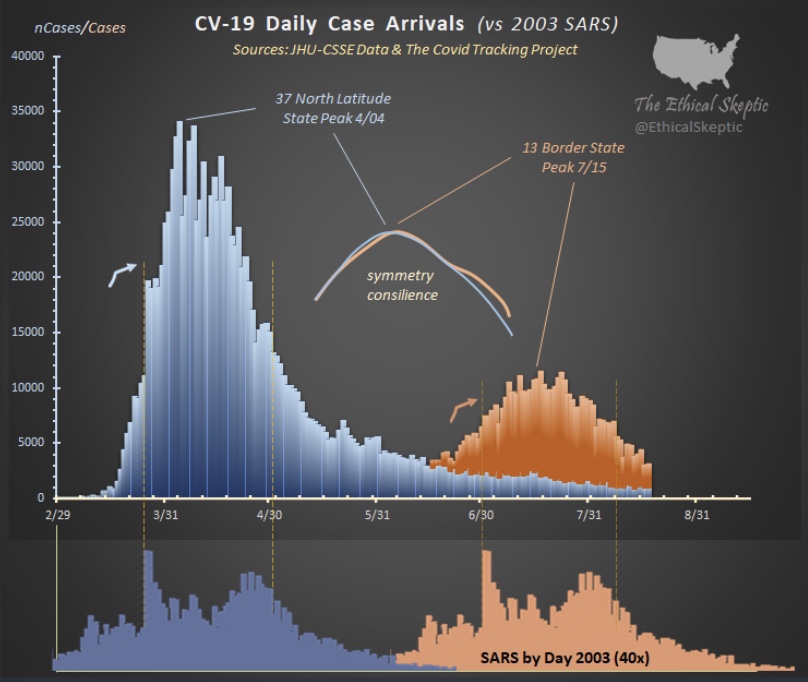
The coronavirus (C19), or SARS-CoV-2, has a strong seasonal component that appears to closely match that of earlier SARS viruses as well as seasonal influenza. This includes the two distinct caseloads we’ve experienced in the U.S. 1) in the late winter/early spring; and 2) the smaller bump we witnessed this summer in some southern states and tropics. 

COVID Seasonal Patterns and Latitude

The Ethical Skeptic on Twitter recently featured the chart below. It shows the new case count of C19 in the U.S. in the upper panel, and the 2003 SARS virus in the lower panel. Both viruses had an initial phase at higher latitudes and a summer rebound at lower latitudes.


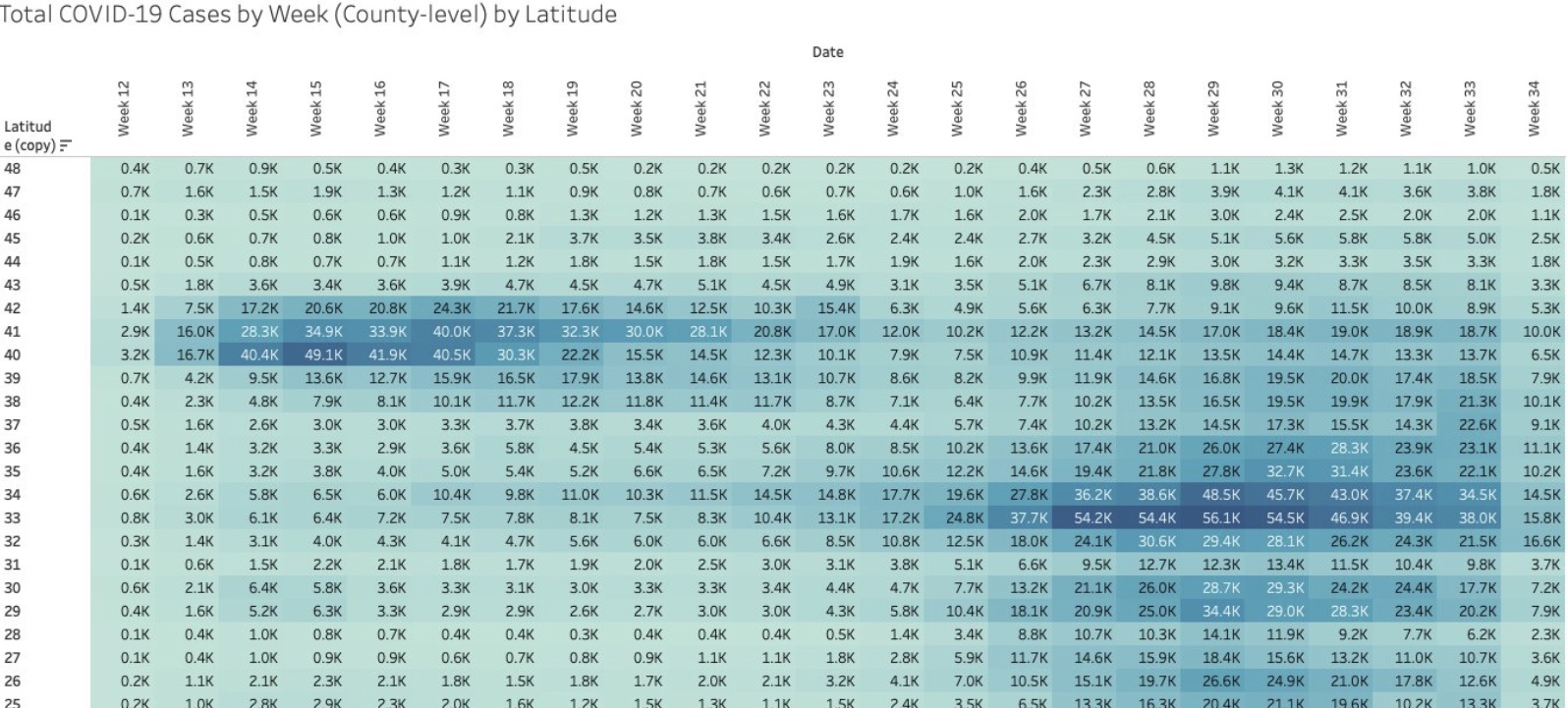
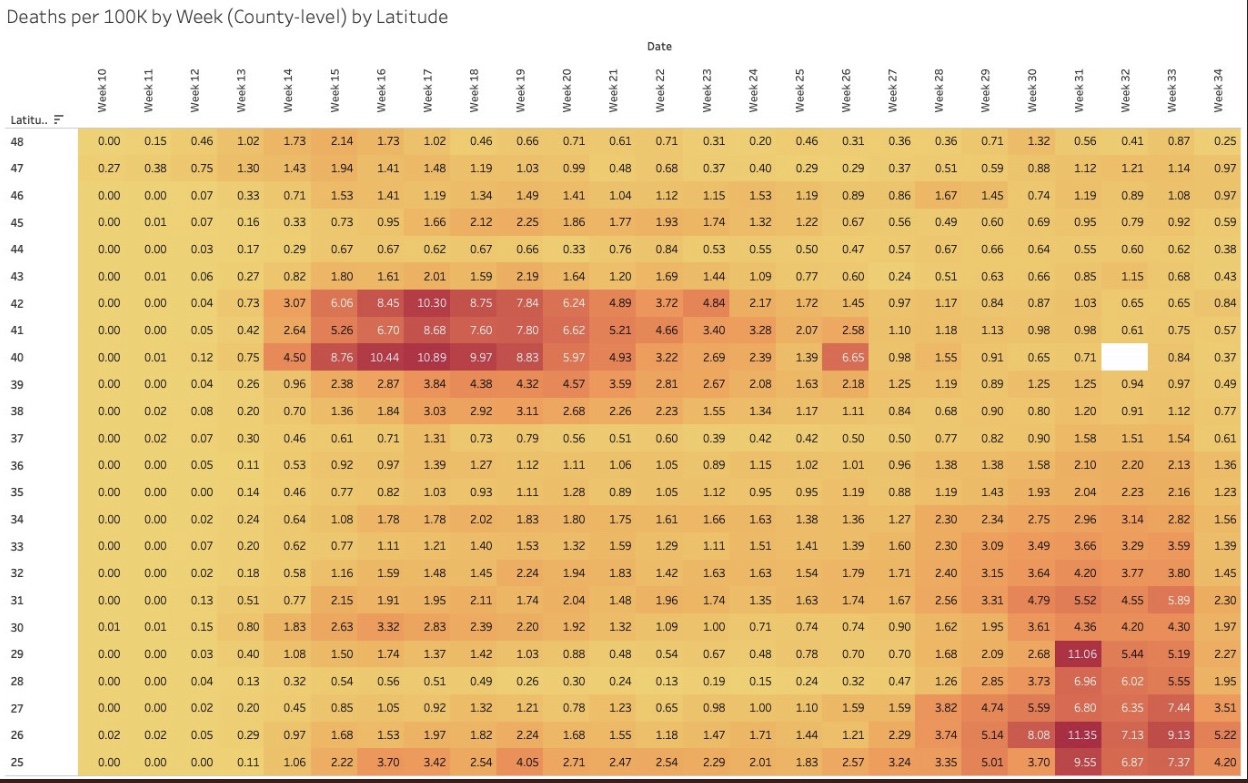
I particularly like the following visualizations from Justin Hart demonstrating the pandemic’s pattern at different latitudes (shown in the leftmost column). The first table shows total cases by week of 2020. The second shows deaths per 100,000 of population by week. Again, notice that lower latitudes have had a crest in the contagion this summer, while higher latitudes suffered the worst of their contagion in the spring. Based on deaths in the second table, the infections at lower latitudes have been less severe.

Viral Patterns in the South

Many expected the pandemic to abate this summer, including me, as it is well known that viruses don’t thrive in higher temperatures and humidity levels, and in more direct sunlight. So it is a puzzle that southern latitudes experienced a surge in the virus during the warmest months of the year. True, the cases were less severe on average, and sunlight and humidity likely played a role in that, along with the marked reduction in the age distribution of cases. However, the SARS pandemic of 2003 followed the same pattern, and the summer surge of C19 at southern latitudes was quite typical of viruses historically.

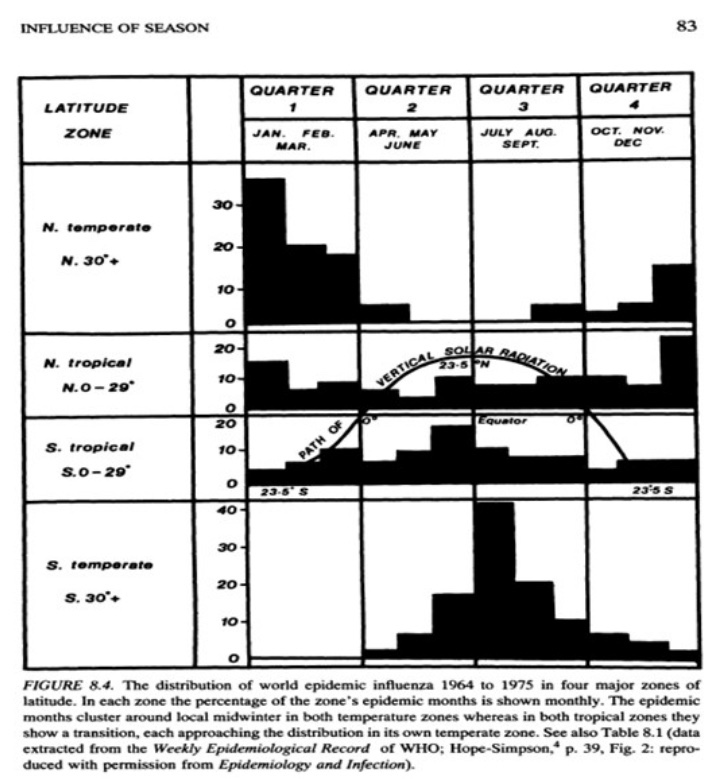
A classic study of the seasonality of viruses was published in 1981 by Robert Edgar Hope-Simpson. The next chart summarized his findings on influenza, seasonality, and latitude based on four groups of latitudes. Northern and southern latitudes above 30° are shown in the top and bottom panels, respectively. Both show wintertime contagions with few infections during the summer months. Tropical regions are different, however. The second and third panels of the chart show flu infections at latitudes less than 30°. Influenza seems to lurk at relatively low levels through most of the year in the tropics, but the respective patterns above and below the equator look almost like very muted versions of activity further to the north and south. However, some researchers describe the tropical pattern as bimodal, meaning that there are two peaks over the course of a year.   

So the “puzzle” of the summer surge at low latitudes appears to be more of an empirical regularity. But what gives rise to this pattern in the tropics, given that direct sunlight, temperature, and humidity subdue viral activity?

There are several possible explanations. One is that the summer rainy season in the tropics leads to less sunlight as well as changes in behavior: more time spent indoors and even less exposure to sunlight. In fact, today, in tropical areas where air conditioning is more widespread, it doesn’t have to be rainy to bring people indoors, just hot. Unfortunately, air conditioning dries the air and creates a more hospitable environment for viruses. Moreover, low latitudes are populated by a larger share of dark-skinned peoples, who generally are more deficient in vitamin D. That might magnify the virulence associated with the flight indoors brought on by hot and or rainy weather.   

Mutations and Seasonal Patterns

What makes the seasonal patterns noted above so reliable in the face of successful immune responses by recovered individuals? And shouldn’t herd immunity end these seasonal repetitions? The problem is the flu is highly prone to viral mutation, having segments of genes that are highly interchangeable (prompting so-called “antigenic drift“). That’s why flu vaccines are usually different each year: they are customized to prompt an immune response to the latest strains of the virus. Still, the power of these new viral strains are sufficient to propagate the kinds of annual flu cycles documented by Hope-Simpson.

With C19, we know there have been up to 100 mutations, mostly quite minor. Two major strains have been dominant. The first was more common in Southeast Asia near the beginning of the pandemic. It was less virulent and deadly than the strain that hit much of Europe and the U.S. Of course, in July the media misrepresented this strain as “new”, when in fact it had become the most dominant strain back in March and April.

What Lies Ahead

By now, it’s possible that the herd immunity threshold has been surpassed in many areas, which means that a surge this coming fall or winter would be limited to a smaller subset of still-susceptible individuals. The key question is whether C19 will be prone to mutations that pose new danger. If so, it’s possible that the fall and winter will bring an upsurge in cases in northern latitudes both among those still susceptible to existing strains, and to the larger population without immune defenses against new strains.

Fortunately, less dangerous variants are more more likely to be in the interest of the virus’ survival. And thus far, despite the number of minor mutations, it appears that C19 is relatively stable as viruses go. This article quotes Dr. Heidi J. Zapata, an infectious disease specialist and immunologist at Yale, who says that C19:

“… has shown to be a bit slow when it comes to accumulating mutations … Coronaviruses are interesting in that they carry a protein that ‘proofreads’ [their] genetic code, thus making mutations less likely compared to viruses that do not carry these proofreading proteins.”

The flu, however, does not have such a proofreading enzyme, so there is little to check its prodigious tendency to mutate. Ironically, C19’s greater reliability in producing faithful copies of itself should help ensure more durable immunity among those already having acquired defenses against C19.

This means that C19 might not have a strong seasonal resurgence in the fall and winter. Exceptions could include: 1) the remaining susceptible population, should they be exposed to a sufficient viral load; 2) regions that have not yet reached the herd immunity threshold; and 3) the advent of a dangerous new mutation, though existing T-cell immunity may effectively cross-react to defend against such a mutation in many individuals.


Some Cheery COVID Research Tidbits

16 Thursday Jul 2020

Posted by Nuetzel in Pandemic, Public Health, Uncategorized

≈ 1 Comment

Tags

ACE Inhibitors, Angiotensin Drugs, ARBs, bacillus Calmette-Guerin, BCG Vaccine, Blood Plasma, Cholesterol, Coronavirus, Covid-19, Derek Lowe, Gilead Sciences, Herd Immunity, Hydroxychloroquine, Immune Globulin, Instapundit, Lancet, Marginal Revolution, National Academies of Science Engineering and Medicine, Off-Label Drugs, Oxford, R0, Remdesivir, SARS-CoV-2, Severe Acute Respiratory Syndrome, Statins, T-Cell Immunity, Transmissability, Tricor, Tuberculosis, Viral Load

Here’s a short list of new or newish research developments, some related to the quest to find COVID treatments. Most of it is good news; some of it is very exciting!

Long-lasting T-cell immunity: this paper in Nature shows that prior exposure to coronaviruses like severe acute respiratory syndrome (SARS) and even the common cold prompt an immune reaction via so-called T-cells that have long memories and are reactive to certain proteins in COVID-19 (SARS-CoV-2). The T-cells were detected in both C19-infected and uninfected patients. This comes after discouraging reports that anti-body responses to C19 are short-lived, but T-cells are a different form of acquired immunity. Derek Lowe says the following:

“This makes one think, as many have been wondering, that T-cell driven immunity is perhaps the way to reconcile the apparent paradox between (1) antibody responses that seem to be dropping week by week in convalescent patients but (2) few (if any) reliable reports of actual re-infection. That would be good news indeed.”

The herd immunity threshold (HIT) is much lower than you think: I’ve written about the effect of heterogeneity on the HIT before, here and here. This new paper, by three Oxford zoologists, shows that the existence of a cohort having some form of prior immunity, innate or acquired, reduces the number of infections required to achieve the HIT. For example, if initial transmissibility (R0) is 2.5 and 40% of the population has prior immunity (both reasonable assumptions for many areas), the HIT is as low as 20%, according to the authors’ calculations. That’s when the contagion begins to recede, though the final infected share of the population would be higher. This might explain why new cases and deaths have already plunged in places like Italy, Sweden, and New York, and why protests in NYC did not lead to a new wave of infections, while those in the south appear to have done so.

Seasonal effects: viral loads might be decreasing. From the abstract:

“Severity of COVID-19 in Europe decreased significantly between March and May and the seasonality of COVID-19 is the most likely explanation. Mucosal barrier and mucociliary clearance can significantly decrease viral load and disease progression, and their inactivation by low relative humidity of indoor air might significantly contribute to severity of the disease.”

The BCG vaccine appears to be protective: this is the bacillus Calmette-Guérin tuberculosis vaccine administered in some countries, This finding is not based on clinical trials, so more work is needed.

Is there no margin in plasma? No subsidy? This is the only “bad news” item on my list. It’s widely agreed that blood plasma from recovered C19 patients can be incorporated into an immune globulin drug to inoculate people against the virus. It’s proven safe, but for various reasons no one seems interested. Not the government. Not private companies. Did Trump happen to mention it or something?

C19 doesn’t spread in schools: this German study demonstrates that there is little risk in reopening schools. One of the researchers says:

“Children act more as a brake on infection. Not every infection that reaches them is passed on…. This means that the degree of immunization in the group of study participants is well below 1 per cent and much lower then we expected. This suggests schools have not developed into hotspots.”

Also worth emphasis is that remote learning leaves much to be desired, as acknowledged by the National Academies of Science, Engineering and Medicine, which has recommended that schools reopen for younger children and those with special needs.

Can angiotensin drugs (ACE Inhibitors/ARBs) reduce mortality? This meta-analysis of nine studies finds that these drugs reduce C19 mortality among patients with hypertension. The drugs were also associated with a reduction in severity but not with statistical significance. These results run contrary to initial suspicions, because ACEI/ARB drugs actually “up-regulate” ACE-2 receptors, to which C19 binds. Researchers say the drugs might be working through some other protective channel. This is not a treatment per se, but this should be reassuring if you already take one of these medications.

Tricor appears to clear lung tissue of C19: this research focused on C19’s preference for an environment rich in cholesterol and other fatty acids:

“What they found is that the novel coronavirus prevents the routine burning of carbohydrates, which results in large amounts of fat accumulating inside lung cells – a condition the virus needs to reproduce.”

Tricor reduces those fats, and the researchers claim it is capable of clearing lung tissue of C19 in a matter of days. This was not a clinical trial, however, so more work is needed. Tricor is an FDA approved drug, so it is safe and could be administered “off label” immediately. Tricor is a fibrate; the news with respect to statins and C19 severity is pretty good too! These are not treatments per se, but this should be reassuring if you already take one of these medications.

Hydroxychloroquine works: despite months of carping from media and leftist know-it-all’s dismissing the mere possibility of HCQ as a potential C19 treatment, evidence is accumulating that it is effective in treating early-stage infections after all. The large study conducted by the Henry Ford Health System found that treatment with HCQ early after hospitalization, and with careful monitoring of heart function, cut the death rate in half relative to a control group. Here’s another: an Indian study found that four-plus maintenance doses of HCQ acted as a prophylactic against C19 infection among health care workers, reducing the odds of infection by more than half. An additional piece of evidence is provided by this analysis of a 14-day Swiss ban on the use of HCQ in late May and early June. The ban was associated with a huge leap in the C19 deaths after a lag of less than two weeks. Resumption of HCQ treatment brought C19 deaths down sharply after a similar lag.

Meanwhile, a study in Lancet purporting to show that HCQ was ineffective and posed significant risks to heart health was retracted based on the poor quality of the data.

Remdesivir also cuts death rate: by 62% in a smaller controlled study by the drug maker Gilead Sciences.

Pet ownership might confer some immunity: this one is a little off-beat, and perhaps the research is under-developed, but it is interesting nonetheless!

I owe Instapundit and Marginal Revolution hat tips for several of these items.

Trump Hates/Loves Lockdowns, Dumps on Swedes

07 Sunday Jun 2020

Posted by Nuetzel in Health Care, Pandemic

≈ Leave a comment

Tags

Cholesterol, Coronavirus, Donald Trump, Herd Immunity, Institute for Health Metrics and Evaluation, Lockdowns, Nordic, Rose Garden Briefing, Somali Immigration, Sweden, Vitamin D

President Trump was in a festive mood last Friday, pleased with the May employment report, as he should be. But in his Rose Garden word jam, he made some questionable and unnecessary claims about coronavirus policies in the U.S. and the Swedish experience. I credit Trump for pushing to end the lockdowns as it became clear that they were both unhealthy and unsustainable. However, he’s now way too eager to cover his earlier tracks. That is, he is now defensive about the precautions he advocated on the advice of his medical experts in March and early April.

In the Rose Garden, Trump said that lockdowns were necessary to stop the spread of the virus. But to assert that lockdowns “stopped” or even slowed the spread of the virus is speculation at best, and they had deadly effects of their own. Most of the social distancing was achieved through voluntary action, as I have argued previously. Lockdown advocacy lacked any semblance of geographic nuance, as if uniform application makes sense regardless of population density.

Trump went on to say that Sweden was in “bad shape” because it did not impose a lockdown during the pandemic. This is not a new position for the president, but the facts are anything but clear-cut. Again, there is mixed evidence on whether mandatory lockdowns have a real impact on the spread or mortality of the coronavirus (also see here). That’s not to say that social distancing doesn’t work, but much of the benefit comes from private decisions to mitigate risk via distancing. Of course, that also depends on whether people have good information to act on. And to be fair, Sweden did take certain measures such as banning gatherings of more than 50 people, closing schools, and limiting incoming travel.

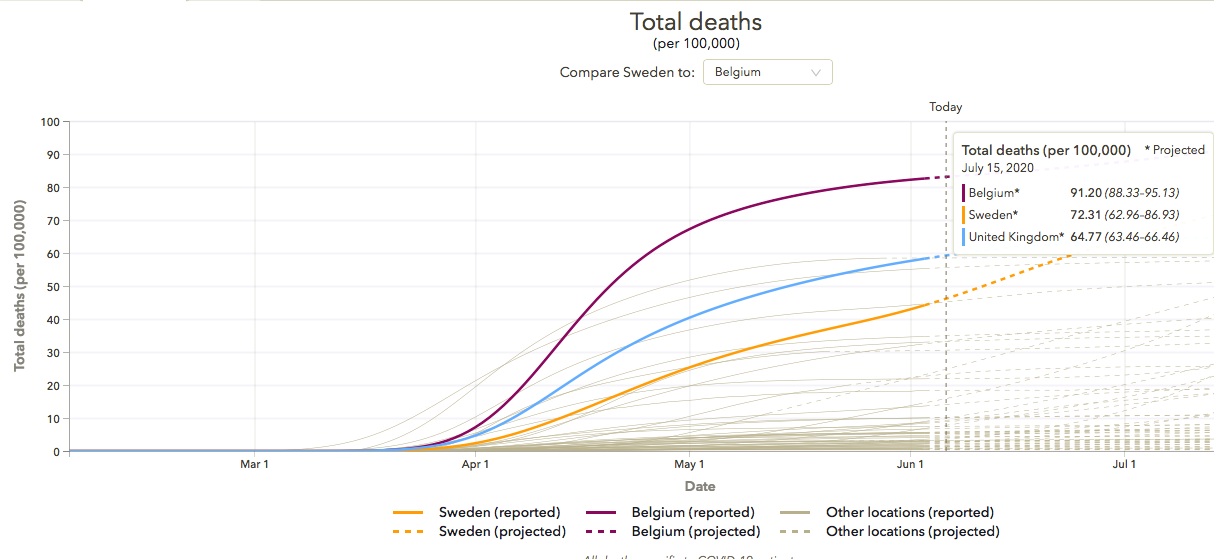
While the full tale has not been told, and Sweden’s death rate is high on a per capita basis, several other Western European countries that imposed lockdowns have had even higher death rates. The following chart is from the Institute for Health Metrics and Evaluation (IMHE). It is expressed in terms of coronavirus deaths per 100,000 of population. The orange line is Sweden, the purple line is Belgium, and the light blue line is the UK. Actuals are reported through June 4th. While Sweden’s death toll has a somewhat steeper gradient, the level remains well below both Belgium and the UK. It is also lower than the death rates for Italy and Spain, and it is about the same as France’s death rate. Yes, a number of other countries have lower death rates, including the U.S., but the evidence is hardly consistent with Trump’s characterization.

Sweden’s big mistake was not it’s decision to rely on voluntary social distancing, but in failing to adequately protect highly vulnerable populations. The country’s elderly skew older than most countries by several years. Residents of nursing homes have accounted for about half of Sweden’s coronavirus deaths, an international outlier. Inadequate preparedness in elder care has been a particular problem, including a lack of personal protective equipment for workers. There was also a poorly implemented volunteer program, intended to fill-out staffing needs, that appears to have aggravated transmission of the virus.

Sweden has also experienced a concentration of cases and deaths among its large immigrant population. It has the largest immigrant population among the Nordic countries, with large numbers of low income migrants from Syria, Iraq, Iran, Somalia and parts of Eastern Europe. Earlier in the pandemic, according to one estimate, 40% of coronavirus fatalities in Stockholm were in the Somali population. These immigrants tend to live in dense conditions, often in multigenerational households. Many residents with health problems tend to go untreated. Conditions like Vitamin D deficiency and high cholesterol, apparent risk factors for coronavirus severity, likely go untreated in these communities. In addition, language barriers and traditional trust relationships may diminish the effectiveness of communications from public health authorities. In fact, some say the style of Swedish public health messaging was too culturally idiosyncratic to be of much use to immigrants. And one more thing: immigrants are a disproportionately high 28% of nursing home staff in Sweden, implying an intimacy between two vulnerable populations that almost surely acts as a risk multiplier in both.

It might be too harsh to suggest that that Sweden could have prevented the outsized impact of the virus on immigrants. However, Sweden’s coronavirus testing has not been as intensive as other Nordic countries. More testing might have helped alleviate the spread of the virus in nursing homes and in immigrant communities. But the vulnerabilities of the immigrant population might be more a matter of inadequate health care than anything else, both on the demand and supply sides.

Contrary to Trump’s characterization, Sweden’s herd immunity strategy is not the reason for it’s relatively high death rate from the virus. Several countries that imposed lockdowns have had higher death rates. And Sweden’s death rate has been heavily concentrated among the aged in nursing homes and its large immigrant population. It’s possible that Sweden’s approach led to a cavalier attitude with respect identifying vulnerable groups and taking measures that could have protected them, including more intensive testing. Nevertheless, it’s inaccurate and unfair to scapegoat Sweden for not imposing a mandatory lockdown. The choice is not merely whether to impose lockdowns, but how to protect vulnerable populations at least cost. In that sense, general lockdowns are a poor choice.


On the Meaning of Herd Immunity

09 Saturday May 2020

Posted by Nuetzel in Pandemic, Public Health, Risk

≈ 2 Comments

Tags

Antibody, Antigen, Carl T. Bergstrom, Christopher Moore, Covid-19, Herd Immunity, Heterogeneity, Household Infection, Immunity, Infection Mortality Risk, Initial Viral Load, John Cochrane, Lockdowns, Marc Lipsitch, Muge Cevik, Natalie Dean, Natural Immunity, Philippe Lemoine, R0, Santa Fe Institute, SARS-CoV-2, Social Distancing, Super-Spreaders, Zvi Mowshowitz

Immunity doesn’t mean you won’t catch the virus. It means you aren’t terribly susceptible to its effects if you do catch it. There is great variation in the population with respect to susceptibility. This simple point may help to sweep away confusion over the meaning of “herd immunity” and what share of the population must be infected to achieve it.

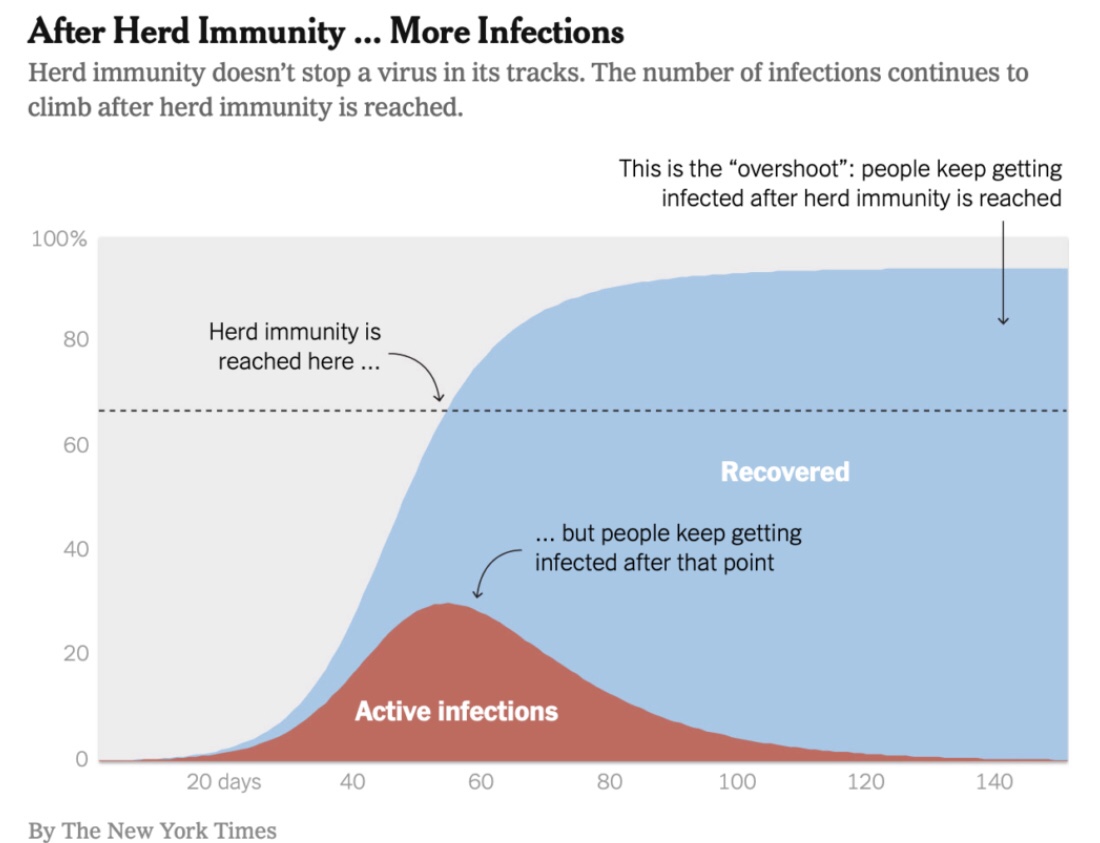
Philippe Lemoine discusses this point in his call for an “honest debate about herd immunity“. He reproduces the following chart, which appeared in this NY Times piece by Carl T. Bergstrom and Natalie Dean:

Herd immunity, as defined by Bergstrom and Dean, occurs when there are sufficiently few susceptible individuals remaining in the population to whom the actively-infected can pass the virus. The number of susceptible individuals shrinks over time as more individuals are infected. The chart indicates that new infections will continue after herd immunity is achieved, but the contagion recedes because fewer additional infections are possible.

We tend to think of the immune population as those having already been exposed to the virus, and who have recovered. Those individuals have antibodies specifically targeted at the antigens produced by the virus. But many others have a natural immunity. That is, their immune systems have a natural ability to adapt to the virus.

Heterogeneity

At any point in a pandemic, the uninfected population covers a spectrum of individuals ranging from the highly susceptible to the hardly and non-susceptible. Immunity, in that sense, is a matter of degree. The point is that the number of susceptible individuals doesn’t start at 100%, as most discussions of herd immunity imply, but something much smaller. If a relatively high share of the population has low susceptibility, the virus won’t have to infect such a large share of the population to achieve effective herd immunity.

The apparent differences in susceptibility across segments of the population may be the key to early herd immunity. We’ve known for a while that the elderly and those with pre-existing conditions are highly vulnerable. Otherwise, youth and good health are associated with low vulnerability.

Lemoine references a paper written by several epidemiologists showing that “variation in susceptibility” to Covid-19 “lowers the herd immunity threshold”:

“Although estimates vary, it is currently believed that herd immunity to SARS-CoV-2 requires 60-70% of the population to be immune. Here we show that variation in susceptibility or exposure to infection can reduce these estimates. Achieving accurate estimates of heterogeneity for SARS-CoV-2 is therefore of paramount importance in controlling the COVID-19 pandemic.”

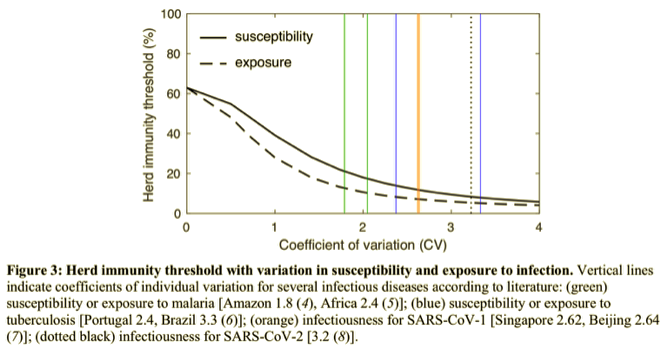
The chart below is from that paper. It shows a measure of this variation on the horizontal axis. The colored, vertical lines show estimates of historical variation in susceptibility to historical viral episodes. The dashed line shows the required exposure for herd immunity as a function of this measure of heterogeneity.

Their models show that under reasonable assumptions about heterogeneity, the reduction in the herd immunity threshold (in terms of the percent infected) may be dramatic, to perhaps less than 20%.

Then there are these tweets from Marc Lipsitch, who links to this study:

“As an illustration we show that if R0=2.5 in an age-structured community with mixing rates fitted to social activity studies, and also categorizing individuals into three categories: low active, average active and high active, and where preventive measures affect all mixing rates proportionally, then the disease-induced herd immunity level is hD=43% rather than hC=1−1/2.5=60%.”

Even the celebrated Dr. Bergstrom now admits, somewhat grudgingly, that hereogeniety reduces the herd immunity threshold, though he doesn’t think the difference is large enough to change the policy conversation. Lipsitch also is cautious about the implications.

Augmented Heterogeneity

Theoretically, social distancing reduces the herd immunity threshold. That’s because infected but “distanced” people are less likely to come into close contact with the susceptible. However, that holds only so long as distancing lasts. John Cochrane discusses this at length here. Social distancing compounds the mitigating effect of heterogeneity, reducing the infected share of the population required for herd immunity.

Another compounding effect on heterogeneity arises from the variability of initial viral load on infection (IVL), basically the amount of the virus transmitted to a new host. Zvi Mowshowitz discusses its potential importance and what it might imply about distancing, lockdowns, and the course of the pandemic. In any particular case, a weak IVL can turn into a severe infection and vice versa. In large numbers, however, IVL is likely to bear a positive relationship to severity. Mowshowitz explains that a low IVL can give one’s immune system a head start on the virus. Nursing home infections, taking place in enclosed, relatively cold and dry environments, are likely to involve heavy IVLs. In fact, so-called household infections tend to involve heavier IVLs than infections contracted outside of households. And, of course, you are very unlikely to catch Covid outdoors at all.

Further Discussion

How close are we to herd immunity? Perhaps much closer than we thought, but maybe not close enough to let down our guard. Almost 80% of the population is less than 60 years of age. However, according to this analysis, about 45% of the adult population (excluding nursing home residents) have any of six conditions indicating elevated risk of susceptibility to Covid-19 relative to young individuals with no co-morbidities. The absolute level of risk might not be “high” in many of those cases, but it is elevated. Again, children have extremely low susceptibility based on what we’ve seen so far.

This is supported by the transmission dynamics discussed in this Twitter thread by Dr. Muge Cevik. She concludes:

“In summary: While the infectious inoculum required for infection is unknown, these studies indicate that close & prolonged contact is required for #COVID19 transmission. The risk is highest in enclosed environments; household, long-term care facilities and public transport. …

Although limited, these studies so far indicate that susceptibility to infection increases with age (highest >60y) and growing evidence suggests children are less susceptible, are infrequently responsible for household transmission, are not the main drivers of this epidemic.”

Targeted isolation of the highly susceptible in nursing homes, as well as various forms of public “distancing aid” to the independent elderly or those with co-morbidities, is likely to achieve large reductions in the effective herd immunity ratio at low cost relative to general lockdowns.

The existence of so-called super-spreaders is another source of heterogeneity, and one that lends itself to targeting with limitations or cancellations of public events and large gatherings. What’s amazing about this is how the super-spreader phenomenon can lead to the combustion of large “hot spots” in infections even when the average reproduction rate of the virus is low (R0 < 1). This is nicely illustrated by Christopher Moore of the Santa Fe Institute. Super-spreading also implies, however, that while herd immunity signals a reduction in new infections and declines in the actively infected population, “hot spots” may continue to flare up in a seemingly random fashion. The consequences will depend on how susceptible individuals are protected, or on how they choose to mitigate risks themselves.

Conclusion

I’ve heard too many casual references to herd immunity requiring something like 70% of the population to be infected. It’s not that high. Many individuals already have a sort of natural immunity. Recognition of this heterogeneity has driven a shift in the emphasis of policy discussions to the idea of targeted lockdowns, rather than the kind of indiscriminate “dumb” lockdowns we’ve seen. The economic consequences of shifting from broad to targeted lockdowns would be massive. And why not? The health care system has loads of excess capacity, and Covid infection fatality risk (IFR) is turning out to be much lower than the early, naive estimates we were told to expect, which were based on confirmed case fatality rates (CFRs).

Spanish Flu: No Guide for Covid Lockdowns

25 Saturday Apr 2020

Posted by Nuetzel in Pandemic

≈ Leave a comment

Tags

Cost of Lost Output, Covid-19, Cytokine Storm, Economic Costs, Excess Mortality, Herd Immunity, Life-Years, Lockdown, Non-Prescription Measures, Novel Coronavirus, Pandemic, Quarantines, Reason.com, Serological Testing, Skilled Care, Social Distancing, South Korea, Spanish Flu, World War I

The coronavirus pandemic differs in a few important ways from the much deadlier Spanish flu pandemic of 1918-19. Estimates are that as much as 1/3rd of the world’s population was infected during that contagion, and the case fatality rate is estimated to have been 10-20%. The current pandemic, while very serious, will not approach that level of lethality.

Another important difference: the Spanish Flu was very deadly among young adults, whereas the Coronavirus is taking its greatest toll on the elderly and those with significant co-morbidities. Of course, the Spanish Flu infected a large number of soldiers and sailors, many returning from World War I in confined conditions aboard transport vessels. A major reason for its deadliness among young adults, however, is thought to be the “cytokine storm“, or severe inflammatory response, it induced in those with strong immune systems.

It’s difficult to make a perfect comparison between the pandemics, but the charts below roughly illustrate the contrast between the age distribution of case mortality for the Spanish Flu in 1918, shown in the first chart, and Covid-19 in the second. The first shows a measure of “excess mortality” for each age cohort as the vertical gap between the solid line (Spanish flu) and the dashed line (the average of the seven previous seasons for respiratory diseases). Excess mortality was especially high among those between the ages of 15 and 44.

The second chart is for South Korea, where the Covid-19 pandemic has “matured” and was reasonably well controlled. We don’t yet have a good measure of excess case mortality for Covid-19, but it’s clear that it is most deadly among the elderly population. Not to say that infected individuals in younger cohorts never suffer: they are a higher proportion of diagnosed cases, severe cases are of extended duration, and some of the infected might have to deal with lasting consequences.

One implication of these contrasting age distributions is that Covid-19 will inflict a loss of fewer “life years” per fatality. If the Spanish flu’s median victim was 25 years old, then perhaps about 49 life years were lost per fatality, based on life expectancies at that time. At today’s life expectancies, it might be more like 54 years. if Covid-19’s median victim is 70 years old, then perhaps 15 life-years are lost per fatality, or about 73% less. And that assumes the the median Covid victim is of average health, so the loss of life years is probably less. But what a grisly comparison! Any loss is tragic, but it is worth noting that the current pandemic will be far less severe in terms of fatalities, excess mortality (because the elderly always die at much higher rates), and in life-years lost.

Is that relevant to the policy discussion? It doesn’t mean we should throw all caution to the wind. Ideally, policy would save lives and conserve life-years. We’d always put children on the lifeboats first, after all! But in this case, younger cohorts are the least vulnerable.

The flu pandemic of 1918-19 is often held to support the logic of non-prescription public health measures such as school closures, bans on public gatherings, and quarantines. Does the difference in vulnerabilities noted above have any bearing on the “optimal” level of those measures in the present crisis? Some argue that while a so-called lockdown confers health benefits for a Spanish flu-type pandemic in which younger cohorts are highly vulnerable, that is not true of the coronavirus. The young are already on lifeboats having few leaks, as it were.

My view is that society should expend resources on protecting the most vulnerable, in this case the aged and those with significant co-morbidities. Health care workers and “first responders” should be on the list as well. If well-targeted and executed, a Covid-19 lockdown targeted at those groups can save lives, but it means supporting the aged and afflicted in a state of relative isolation, at least until effective treatments or a vaccine prove out. A lockdown might not change living conditions greatly for those confined to skilled care facilities, but much can be done to reduce exposure among those individuals, including a prohibition on staff working at multiple facilities.

Conversely, the benefits of a lockdown for younger cohorts at low risk of death are much less compelling for Covid-19 than might be suggested by the Spanish flu experience. In fact, it can be argued that a complete lockdown denies society of the lowest-hanging fruit of earlier herd immunity to Covid-19. Younger individuals who have more social and economic contacts can be exposed with relative safety, and thus self-immunized, as their true mortality rate (including undiagnosed cases in the denominator) is almost zero to begin with.

Then we have the economic costs of a lockdown. Idle producers are inherently costly due to lost output, but idle non-producers don’t impose that cost. For Covid-19, prohibiting the labor of healthy, working age adults has scant health benefits, and it carries the high economic costs of lost output. That cost is magnified by the mounting difficulty of bringing moribund activities back to life, many of which will be unsalvageable due to insolvency.

The lockdown question is not binary. There are ways to maintain at least modest levels of production in many industries while observing guidelines on safety and social distancing. In fact, producers are finding inventive ways of maximizing both production and safety. They should be relied upon to create these solutions. The excess mortality rates associated with this pandemic will continue to come into focus at lower levels with more widespread serological testing. That will reinforce the need for individual autonomy in weighing risks and benefits. Hazards are always out there: reckless or drunk drivers, innumerable occupational hazards, and the flu and other communicable diseases. Protect yourself in any way you see fit, but if you are healthy, please do so without agitating for public support from the rest of us, and without imposing arbitrary judgments on which activities carry acceptable risk for others.


Coronavirus “Framing” Update #4

13 Monday Apr 2020

Posted by Nuetzel in economic growth, Pandemic

≈ 2 Comments

Tags

Centre for Translational Data Science, Confirmed Cases, Coronavirus, Covid-19, Death Toll, Epidemiological Models, Herd Immunity, IMHE, Murray Model, Pandemic, Pending Tests, Test Demand, The University of Sydney

It’s beginning to look like we’ve turned a corner in mitigating the spread of the coronavirus. I hope I’m not speaking too soon.

It’s time to update some of the charts and thoughts about where the epidemic is trending in the U.S. Here’s the first of these “framing” posts I published on March 18th. The last update from about a week ago is here. The demand for tests seems to be tapering a little, and the percentage of tests that are positive has leveled and even dropped a bit. The number of confirmed cases continues to mount, but the daily increases are slowing, as is the growth rate of the cumulative count. Finally, the daily increase in the number of deaths is also slowing, and total deaths have risen more slowly than one prominent model predicted on the date at which I chose to “freeze” it for my own expositional purposes: April 2. The charts appear further below.

The epidemiological modelers have taken a real beating from many observers as their estimated virus growth curves have shifted downward. Their initial projections were way too high, and they have continued to overshoot in subsequent model revisions. In fairness, however, they didn’t have a lot to go on during the early stages of the pandemic, and conservatism was probably seen as a must. The variety and extent of mitigation measures was also an unknown, of course.

I build “event” models for a living, though the events I study are economic and are obviously much different kinds of risks than coronavirus infection. I seldom face situations in which so little historical data is available, so I can appreciate the modeling challenge presented by Covid-19: it was pretty close to an unwinnable situation. Nevertheless, until recently the projections were outrageously high. There comes a time when accurate, rather than conservative, projections are demanded. The confidence intervals produced by the modelers are really not worthy of the name. Partly on that basis, a very recent paper gave the model produced by the Institute for Health Metrics and Evaluation very poor marks (IMHE, which I called the Murray Model last week):

“In excess of 70% of US states had actual death rates falling outside the 95% prediction interval for that state…”

That’s nothing short of pathetic.

That brings me to the “framing” exercise I’ve been performing for nearly four weeks. It is not a modeling exercise. The “very good” and “pretty bad” scenarios I charted for the confirmed Covid-19 case count in the U.S. were not intended as confidence intervals except perhaps in spirit. The intent was to provide perspective on developments as they unfolded. Where to place those bounds? They were based on multiples of the Italian experience (pretty bad) and the South Korean experience (very good) as of March 18, normalized for U.S. population. Here’s the latest version of that chart, where Day 1 was March 4th:

The curve may be just starting to bend to the right. Let’s hope so. The daily growth rate of new cases has dropped below 5%. Below, it’s clear that the daily count of new confirmed cases plateaued in early April, and the last few days show an encouraging reduction.

I also think it’s telling that after a few weeks of “excess demand” for tests, demand seems to be falling. The chart below showed the sharp reduction in the “pending test” count about a week ago. It corresponded with the spike in daily tests, which have stabilized since then and may be trending down (lower panel).

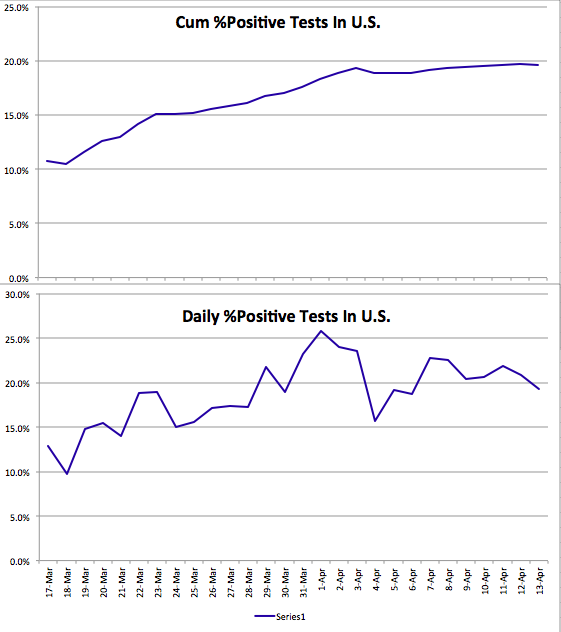
The next chart shows that the cumulative share of tests with a positive diagnosis has flattened. The lower panel hints at a taper in the daily share of positive tests, which would be welcome. However, I do not necessarily expect that percentage to decline too much if the number of tests continues to fall. In fact, more testing will almost certainly be required in order to “restart” the economy. Then, we should see a reduction in the percentage of positive tests if all goes well.

The last chart highlights the IMHE model discussed above. The chart extends from March through June, though the unlabeled date axis is not cooperating with me. The mean model prediction of U.S. cumulative deaths attributed to Covid-19 is shown in red. The upper and lower bounds of the confidence interval are the blue and green lines. Again, I “froze” this forecast as of April 2 to serve as another “framing” device. Actual deaths are traced by the black line, which goes through April 13th. It is trending below the mean forecast, and IMHE has reduced their mean forecast of the death toll by about a third since April 2nd (to 60,000). Actual deaths may well come in below that level.

I hope my optimism based on these nascent developments is not unwarranted. But they are consistent with state-by-state reports of more positive trends in the data. It is time to start planning for a return to more normal times, but with a new eye toward mitigating risk that will probably involve isolating vulnerable groups when appropriate, more work at home, widespread testing, and a few other significant changes in social and business practices. It remains to be seen how easily certain industries can return to previous levels, such as hospitality, or how soon crowds can return to sporting events, concerts, and theaters. That might have to await greater levels of “herd immunity”, an effective vaccine, and fast testing.

The Opportunity of Skewed Coronavirus Transmission

30 Monday Mar 2020

Posted by Nuetzel in economic growth, Pandemic

≈ 1 Comment

Tags

Contagion, Coronavirus, Covid-19, Fat-Tailed Distribution, Heart Disease, Herd Immunity, John Cochrane, President Trump, Prophylaxis, Public Park Closures, Reproduction Rate, Restart Economy, Right Skew, Shelter In Place, Stay-at-Home, Suicide, Super-Spreaders, The Federalist, Transmission Rate

People talk about the transmission rate or reproduction rate (R0) of Covid-19 as if it’s a single number that applies to the entire population. John Cochrane emphasizes the huge implications of this misperception for how best to prevent the spread of the virus, and at lower cost, and for how best to “restart” the economy.

First, however, lets dispense with the absolutist position that there can be no compromise on virus mitigation in favor of economic activity. I am not opposed to the “lockdown” we are now living, but it will have significant and unnecessary costs if it goes on too long: the lost output is a huge blow not only to our current lifestyles but to our ability to grow in the future, or even to afford better health care in the future. Beyond that, the lockdown has immediate negative impacts of its own on public health: economic stress leads to all kinds of terrible health outcomes like heart disease and even suicide. About the latter, the President is absolutely correct: if you need research to prove it, see here, here, here, and here, all respected journals (the links all courtesy of The Federalist.) Economic stress and isolation is quite likely to promote poor dietary habits, lethargy, and possibly family dysfunction as well. Don’t pretend there aren’t real tradeoffs between the economy, virus interventions, and public health. The trick is to improve those tradeoffs. A balance can and must be struck, and depending on policy actions, the tradeoff can be made better or worse.

Back to the virus reproduction rate: the R0 values we see quoted are estimates of the average number of other people infected by each infected person. A value of three means that each person infected with the virus passes it on to three others, on average. If R0 is greater than one, an epidemic grows. If R0 is less than one, a contagion recedes. It becomes a “non-epidemic” if R0 remains less than one. It does not have to be zero (and probably cannot be zero).

But not everyone is the same: my R0 is different from your R0 if only because we have different occupational exposure to others and different levels of social engagement. We also differ physiologically, which probably leads to differences in our “personal” R0 values. And an individual’s R0 will differ by time and place, depending on random circumstances like which way the wind is blowing. But here is where it gets interesting. Cochrane describes an extreme version of the skewed distribution shown at the top of this post:

“Suppose there are 100 people with a 0.5 reproduction rate, and 1 super-spreader with a 100 replication rate. The average reproduction rate is 1.5. Clearly, locking everyone down is wildly inefficient. It’s much more important to find the 1 super-spreader and lock him or her down, or change the business or behavior that’s causing the super-spreading.

This is exaggerated, but not far off the mark. I have not seen numbers on the distribution of reproduction rates across people, but it is a fair bet that it has an extremely fat tail. Most of us are washing our hands, social distancing, work in businesses that are shut down or are taking great steps to limit contact. And a few people and activities contribute to most of the spread.

This wide and fat-tailed dispersion is ignored in a lot of simulations I’ve seen. They take the average reproduction rate as the same for everyone. That’s a big mistake.

The danger: we waste a huge amount of time and money moving you and me from a 0.5 reproduction rate to an 0.4 reproduction rate. …  The opportunity: focus on the super-spreaders, and the super-spreading activities, and you bring down the reproduction rate at much lower cost. “

There are many ways to reduce R0. Cochrane gets a little more specific about this and the policy implications of the skewed R0 distribution across individuals:

“All we need is to get the transmission rate under one. Activities with possible but very low transmission rates, and high economic benefits should go on. Don’t separate to ‘essential’ and ‘non-essential.’ Separate into ‘high likelihood of transmission’ and ‘low likelihood of transmission.’

Why are we not using masks everywhere? Sure, they’re not perfect. Sure, an old hankerchief might only cut the chance of transmission by half. We’re not all surgeons. Cutting by half is enough to stop the virus. 

Conversely, why did they close the state parks? Really? Just how dangerous is it to drive the dog to a hiking trail and stay 6 feet away from other people? Parks, ski areas, golf courses, all sorts of businesses that surely can be run with a reproduction rate far less than one are just shut down. I met a realtor on our dog walk yesterday. They’re totally shut down. Just how hard is it to run a realty business with a 0.5 reproduction rate? One family in the house at a time, don’t touch anything, an hour between showings, stay 6 feet from the realtor… But instead the whole business is just shut down.”

The beginning of that last paragraph echoes a point I made in my last post about public park closures and the health benefits of getting outside generally.

Cochrane goes on to discuss several other policy options, including the potential benefits of simple kinds of testing and the overemphasis on false negatives and positives in policy discussions. Imperfect tests should not be discouraged by these concerns. If you’re worried about that, you shouldn’t use a thermometer either!

“Stay-at-home” or “shelter-in-place” orders will increasingly be tested by private parties if they remain in effect too long. That will be encouraged by the seemingly arbitrary distinctions some orders make between “essential” and “non-essential” activities. If workers or small businessmen judge themselves to be at low risk, they will take matters into their own hands to the extent they can. I believe that’s already happening where the specifics of “lockdown” orders have gone too far.  Workers at the low end of the income spectrum are especially hard hit by these orders. One can hardly blame them for trying to earn what they can if they believe, and their customers believe, their activities and interactions are of low risk.

Ultimately, the entire distribution of R0s will slide to the left. That will occur even at low levels of “herd immunity” and anything that offers at least weak prophylaxis. Broadly speaking, the latter includes maintaining distance, refusing admittance to venues with a fever, avoiding handshakes, wearing masks, and potentially chloroquine, which is already in widespread use by physicians treating coronavirus patients. Ultimately, a vaccine will slide the distribution far to the left, but the economy need not be held hostage until that time. To paraphrase Cochrane, we can get the transmission rate below one and keep it there without stopping the world permanently. There are many options, and now is the time for business and government to start planning for that.

Statists Might Like To Vaccinate Against Many Things

25 Monday Nov 2019

Posted by Nuetzel in Vaccinations

≈ Leave a comment

Tags

Anti-Vaxxers, Community Protection Threshold, Contagion, Contra-Indications, Externality, Federaalism, Herd Immunity, Immunization, Jeffrey Singer, Lancet, Measles, Mercury, Michigan Vaccine Law, Post Hoc Ergo Propter Hoc, Precautionary Principle, Price Discrimination, Private Governance, Vaccine Hesitancy, Vaccine Preservatives, Vaccine Resistors, Whooping Cough

The vaccine debate illustrates a widespread misunderstanding about the meaning of an “advanced society”. It does not mean that difficult social problems must be dealt with always and everywhere in a uniform way, as supporters of vaccine mandates seem to assume. Instead, it often means that society can respect differences in the preferences of individuals by allowing varied approaches to problem-solving across jurisdictions, as well as across public and private institutions. This latter notion of advancement respects individual freedom and facilitates experiential social learning. But is that varied approach wise in a world of communicable diseases?

One standard of “community” protection assumes that vaccines work with a high degree of certainty within groups of individuals, especially with a second booster. The share of the population vaccinated against most common childhood diseases is fairly high. In fact, these shares mostly exceed their respective “community protection thresholds” — the percentage required to prevent a particular disease from spreading. That means achieving so-called “herd immunity”. Of course, that will not be true across many local subgroups. Nevertheless, if one accepts this standard, a runaway contagion in the U.S. is an extremely remote possibility, affording some flexibility for respecting preferences for and against vaccination.

My Friend, the Vaccine Resistor

One of my best friends is a passionate vaccine resistor (VR). I won’t say he’s “vaccine hesitant” because that doesn’t come close to his position. I won’t call him an “anti-vaxxer” because he doesn’t mind if others avail themselves of vaccines (and besides, the term has taken on such derogatory connotation. He’s a fine fellow, very smart, lots of fun to be with, and we have plenty of mutual interests. We’ve argued about vaccinations before, and a few other medical and nutritional issues, but we mostly stay out of each others’ ways on these topics.

But I recently witnessed my pal get into a “debate” on social media with a mutual acquaintance and some of her connections. She happens to be a nurse. She’d posted a photo of an attractive young woman in a t-shirt imprinted, “Vaccines Cause Adults”. My buddy spoke up and said “Not for everyone!’, and he posted a link to an article that he felt supported his position. Of course, a number of barbed responses came his way. Okay, some of those were fair debate points, though barbed, but others were quite derisive, ad hominem attacks on him. He responded by posting links to more articles and research, which might not have been productive. It’s usually a waste of time to argue with people on social media. But to his great credit he maintained his equanimity. The episode made me feel a bit sad. People can be such assholes on social media. I was put off by the nurse’s refusal to moderate . That’s a typical pattern: posters allow their other friends to hurl terrible insults at anyone who disagrees, even when it’s an old friend. Mind you, I stayed on the sidelines in this case, except that I originally “liked” the nurse’s meme.

Later, I had a private exchange with my friend. I’m on board with vaccinations. I believe that widespread immunization contributes to public health, but I told him there are certain points on which I can sympathize with VRs. Without knowing the details, he encouraged me to write a blog post on the subject. I’m not sure he’ll like the results. However, as noted above, I’m willing to make a few concessions to my buddy’s side of the argument, and I wish we could identify a path that would settle the debate.

My Standpoint

This is one part my pal won’t like. Are VRs anti-science? First, VR’s come in several varieties. Some might resist only some vaccines and not others. But VRs do not disavow empiricism, as they claim their own set of empirical findings to support their position, however one might regard the research quality. 

I believe many VRs are misled by a serious post hoc ergo propter hoc fallacy: after this, therefore because of this. For example, for many observers, the purported link between autism and the measles, mumps and rubella vaccine was put to rest when the British medical journal Lancet retracted the original article supporting that claim as faulty. That doesn’t wash with more radical VRs, many of whom seem to have someone on the autism spectrum in their own families. They are understandably sensitive, but please forgive me: that suggests a need to find some external explanation, a source of blame not related to genetics.

Radical VRs are selective proponents of the precautionary principle: any risk of harm from a vaccine delivered in any amount is too great a risk. They seem reluctant to acknowledge the reality of a dose-response relationship, which bears on the risks of exposure to certain compounds often present in vaccine formulations. VRs will not acknowledge that vaccines present a manageable risk. And then there are the misleading references to disease incidence counts, as opposed to disease incidence rates, that are all too common (though my friend is almost certainly innocent on this count).

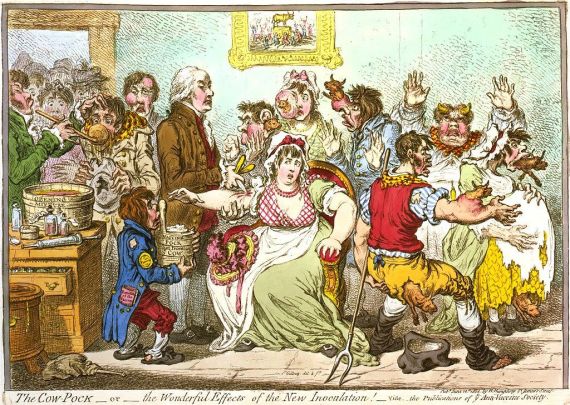
Vaccine resistance is not a new phenomenon, as the cartoon above from 1802 illustrates. Certain people will always find the idea of injecting germs into their systems deeply unsettling. Of course, that’s a very natural basis of resistance. A person’s body is their own property, after all. My default position is that an individual’s control over their own body is inviolable, and parents should always be the first authority over decisions about their children. The real issue, however, is the question of whether unvaccinated children inflict external costs on others.

Points of Contention

The major objections of VRs fall into several categories: 1) preservatives; 2) multiple viruses; 3) vulnerable infants; 4) contra-indications; 5) inefficacy; and 6) free choice. There may be others, but I’ll go with those.

Preservatives: Some vaccines still use a form of mercury, but a much more innocuous variant than the one VRs found so objectionable a few decades ago. Still, they object. And they object to many other compounds used in minute quantities as preservatives, such as formaldehyde, which occurs naturally in our bodies. I think the following test is helpful: if it were proposed that VRs take new versions of the vaccines that had zero preservatives, many would still refuse, especially if they were asked to pay the additional cost of providing them in that form. Thus, preservatives are revealed to be something of a side show.

Multiple Viruses: VRs object to the administration of vaccines that inoculate against several viruses in one dose or within a short window of time. This objection has some plausibility, since an injection of several different “bugs’ at once might place excessive stress on the body, even if the risk is still small. But again, would VRs volunteer to take single strain vaccines in a schedule over a lengthier period of time? Probably not.

Vulnerable Infants: VRs say it’s too risky to vaccinate infants in their first few months of life. This too is a plausible objection, and it would seem like a relatively easy concession to make in the interests of compromise … except, it won’t ever be good enough. Radical VRs will not agree to having their children vaccinated at any age.

Contra-Indications: There are undoubtedly genetic factors that pre-dispose certain individuals to an adverse reaction to certain vaccines. These might be rare, so an effort to compromise by requiring a thorough genetic profile before vaccination would be costly. I believe profiling is a reasonable demand for individuals to make, however, provided they pay the cost themselves.

Inefficacy: My friend posted an intriguing article about the drastic declines that occurred in the incidence of various diseases before the introduction of vaccines to prevent those diseases. This might not be the same link, but it makes the same argument. That doesn’t mean vaccines don’t work, of course. There is a vast literature that shows that they do. Bing it! And in cases such as smallpox, the use of “folk applications” of puss to a small scratch in the skin were in use long before the vaccine was available. Nevertheless, the VRs contend that the historical rates of disease incidence provide evidence against vaccinating. They also contend that diseases like measles are not serious enough to warrant precautions like vaccines. Measles can be deadly, though not as deadly as the flu.

Free Choice: This is the point on which I’m most sympathetic to VRs. Again, we own our own bodies and should have authority over our own minor children, yet communicable diseases seem to be a classic case of externality. Susceptible individuals may inflict a cost on others by refusing vaccination or segregation. Other people own their bodies too, and they have a right to avoid exposure. They too can isolate themselves or take precautions as they deem necessary. If both parties wish to participate in society, then both hold rights they allege to be threatened by the other. That complicates the task of reconciling these interests in private, voluntary ways, and yet they often are reconciled privately.

Solutions?

The debate today often revolves around mandatory vaccination, which would be an extreme measure relying on the coercive power of the state. The rationale is that even a vaccinated majority would be subject to an unnecessarily high risk of infection when in frequent contact with an unvaccinated minority. It’s difficult to endorse such broad intrusiveness when we’re dealing with a negative externality of such minute probability. And such a policy is not at all defensible without exceptions for individuals for whom a vaccine is contra-indicated.

Tolerating differences in vaccination rules across cities, school districts, or even states, may be a reasonable approach to settling the debate in the long run. These variations allow empirical evidence to accumulate on the efficacy of different vaccine regimes. It also allows individuals and families to “vote with their feet”, migrating to jurisdictions that best suit their preferences. These are the basic foundations of federalism, a principle of great usefulness in preserving freedoms while addressing regional differences of opinion on contentious issues.

Michigan has a policy allowing unvaccinated children to attend schools, but a waiver must be obtained requiring the child’s parents to attend a vaccine education program. The policy is credited with increasing vaccination rates. The problem is that VRs tend to view this requirement as an infringement on their rights. Advocates of the policy might argue that the situation should be viewed as an arms-length, voluntary exchange between two parties, in this case a family and a public entity. The vaccine education program is just the price one must pay in lieu of vaccination. The exchange is not arms length, however, as it would be if the school were a private entity. The VR parents who refuse the waiver are not rebated for taxes paid for local schools. In fact, like all taxes, the payment is coerced.

It’s not always necessary to appeal to some form of government action, even at local levels. For example, private schools may require vaccination among enrollees, and private businesses, especially health care providers, may require staff to be vaccinated. Life and health insurers may wish to price risk differently for the unvaccinated. VRs might object that they are subject to discrimination by institutions requiring immunization, or who price discriminate in favor of the immunized, but VRs are free to form competitive institutions, even on small scales or as mutual companies. To the extent that such private rules are unjustified, the institutions who discriminate are likely to learn or lose eventually. That’s the beauty of market solutions. In these ways, non-coercive private governance is far preferable to action by the state.

Dr. Jeffrey Singer is an advocate of immunization who opposes mandatory vaccine laws, as he explained a few years ago in “Vaccination and Free Will“. He suggested elsewhere, in “Seeking Balance In Vaccination Laws“, that schools, instead of requiring immunization, could mitigate the risk of a contagion by insisting that unvaccinated children be held out of school when a particular threat arises and remain out until it passed. That’s a reasonable idea, but I suspect many pro-vax parents would fear that it doesn’t go far enough in protecting against the introduction of a disease by an unvaccinated child.

Conclusion

Recent increases in the incidence of diseases such as measles, mumps and whooping cough are extremely troubling. Whether these outbreaks bear any relationship to patterns of vaccination in the population is certainly a valid question. To the extent that more families and individuals wish to be immunized, and that private institutions wish to take action to increase vaccination rates within their sphere of influence, I’m all for it. Vaccination laws are a different matter.

Political action at the local level might mean that school districts and other public entities will require vaccinations or vaccine education programs. Alternatives exist for those refusing to vaccinate, but broad mandatory vaccination is too coercive. Such measures carry significant costs, not least of which is a loss of liberty and normalization of losses of liberty. It’s not clear that a vaccination mandate at the national level, or even a state vaccination mandate, can offer benefits sufficient to justify those costs. Nudges are irritating and may be costly, but forcible intrusions are way out-of-bounds. Unfortunately, there are parties that simply can’t resist the temptations of behavioral control, and that’s worthy of resistance. Let’s continue to muddle through with an essentially federalist approach to vaccination policy. I regard that as a hallmark of an advanced society.


Newer posts →
Follow Sacred Cow Chips on WordPress.com

Recent Posts

  • The Case Against Interest On Reserves
  • Immigration and Merit As Fiscal Propositions
  • Tariff “Dividend” From An Indigent State
  • Almost Looks Like the Fed Has a 3% Inflation Target
  • Government Malpractice Breeds Health Care Havoc

Archives

  • January 2026
  • December 2025
  • November 2025
  • October 2025
  • September 2025
  • August 2025
  • July 2025
  • June 2025
  • May 2025
  • April 2025
  • March 2025
  • February 2025
  • January 2025
  • December 2024
  • November 2024
  • October 2024
  • September 2024
  • August 2024
  • July 2024
  • June 2024
  • May 2024
  • April 2024
  • March 2024
  • February 2024
  • January 2024
  • December 2023
  • November 2023
  • August 2023
  • July 2023
  • June 2023
  • May 2023
  • April 2023
  • March 2023
  • February 2023
  • January 2023
  • December 2022
  • November 2022
  • October 2022
  • September 2022
  • August 2022
  • July 2022
  • June 2022
  • May 2022
  • April 2022
  • March 2022
  • February 2022
  • January 2022
  • December 2021
  • November 2021
  • October 2021
  • September 2021
  • August 2021
  • July 2021
  • June 2021
  • May 2021
  • April 2021
  • March 2021
  • February 2021
  • January 2021
  • December 2020
  • November 2020
  • October 2020
  • September 2020
  • August 2020
  • July 2020
  • June 2020
  • May 2020
  • April 2020
  • March 2020
  • February 2020
  • January 2020
  • December 2019
  • November 2019
  • October 2019
  • September 2019
  • August 2019
  • July 2019
  • June 2019
  • May 2019
  • April 2019
  • March 2019
  • February 2019
  • January 2019
  • December 2018
  • November 2018
  • October 2018
  • September 2018
  • August 2018
  • July 2018
  • June 2018
  • May 2018
  • April 2018
  • March 2018
  • February 2018
  • January 2018
  • December 2017
  • November 2017
  • October 2017
  • September 2017
  • August 2017
  • July 2017
  • June 2017
  • May 2017
  • April 2017
  • March 2017
  • February 2017
  • January 2017
  • December 2016
  • November 2016
  • October 2016
  • September 2016
  • August 2016
  • July 2016
  • June 2016
  • May 2016
  • April 2016
  • March 2016
  • February 2016
  • January 2016
  • December 2015
  • November 2015
  • October 2015
  • September 2015
  • August 2015
  • July 2015
  • June 2015
  • May 2015
  • April 2015
  • March 2015
  • February 2015
  • January 2015
  • December 2014
  • November 2014
  • October 2014
  • September 2014
  • August 2014
  • July 2014
  • June 2014
  • May 2014
  • April 2014
  • March 2014

Blogs I Follow

  • Passive Income Kickstart
  • OnlyFinance.net
  • TLC Cholesterol
  • Nintil
  • kendunning.net
  • DCWhispers.com
  • Hoong-Wai in the UK
  • Marginal REVOLUTION
  • Stlouis
  • Watts Up With That?
  • Aussie Nationalist Blog
  • American Elephants
  • The View from Alexandria
  • The Gymnasium
  • A Force for Good
  • Notes On Liberty
  • troymo
  • SUNDAY BLOG Stephanie Sievers
  • Miss Lou Acquiring Lore
  • Your Well Wisher Program
  • Objectivism In Depth
  • RobotEnomics
  • Orderstatistic
  • Paradigm Library
  • Scattered Showers and Quicksand

Blog at WordPress.com.

Passive Income Kickstart

OnlyFinance.net

TLC Cholesterol

Nintil

To estimate, compare, distinguish, discuss, and trace to its principal sources everything

kendunning.net

The Future is Ours to Create

DCWhispers.com

Hoong-Wai in the UK

A Commonwealth immigrant's perspective on the UK's public arena.

Marginal REVOLUTION

Small Steps Toward A Much Better World

Stlouis

Watts Up With That?

The world's most viewed site on global warming and climate change

Aussie Nationalist Blog

Commentary from a Paleoconservative and Nationalist perspective

American Elephants

Defending Life, Liberty and the Pursuit of Happiness

The View from Alexandria

In advanced civilizations the period loosely called Alexandrian is usually associated with flexible morals, perfunctory religion, populist standards and cosmopolitan tastes, feminism, exotic cults, and the rapid turnover of high and low fads---in short, a falling away (which is all that decadence means) from the strictness of traditional rules, embodied in character and inforced from within. -- Jacques Barzun

The Gymnasium

A place for reason, politics, economics, and faith steeped in the classical liberal tradition

A Force for Good

How economics, morality, and markets combine

Notes On Liberty

Spontaneous thoughts on a humble creed

troymo

SUNDAY BLOG Stephanie Sievers

Escaping the everyday life with photographs from my travels

Miss Lou Acquiring Lore

Gallery of Life...

Your Well Wisher Program

Attempt to solve commonly known problems…

Objectivism In Depth

Exploring Ayn Rand's revolutionary philosophy.

RobotEnomics

(A)n (I)ntelligent Future

Orderstatistic

Economics, chess and anything else on my mind.

Paradigm Library

OODA Looping

Scattered Showers and Quicksand

Musings on science, investing, finance, economics, politics, and probably fly fishing.

  • Subscribe Subscribed
    • Sacred Cow Chips
    • Join 128 other subscribers
    • Already have a WordPress.com account? Log in now.
    • Sacred Cow Chips
    • Subscribe Subscribed
    • Sign up
    • Log in
    • Report this content
    • View site in Reader
    • Manage subscriptions
    • Collapse this bar
 

Loading Comments...