• About

Sacred Cow Chips

Sacred Cow Chips

Tag Archives: Coronavirus

Biden Brainstorm: Nationwide Lockdown, Mask Mandate

01 Sunday Nov 2020

Posted by Nuetzel in Liberty, Pandemic, Tyranny

≈ Leave a comment

Tags

Coronavirus, Covid-19, Donald Trump, Joe Biden, Lockdown Deaths, Mask Mandate, Nationwide Lockdown, Pete Buttigieg, Presidential Powers, Viral Load

Ah, so Mayor Pete Buttigieg of South Bend, Indiana, one of garbling Joe Biden’s campaign surrogates, says Biden will indeed consider a national lockdown if elected. Oh, fine. And Biden accused Trump of destroying the economy? These dumb-asses must think people have memory spans of about a second.

There are several gigantic problems with foggy Joe’s idea: first, it’s not within a president’s power to impose a nationwide lockdown, as the chorus of experts reminded us last spring when Trump mentioned it. Second, the evidence suggests that lockdowns don’t work to eliminate the virus; they delay its spread at best. Third, as we’ve witnessed, lockdowns themselves have enormous public health consequences, leading to a variety of severe maladies, despondency, and excess non-COVID deaths. That’s simply unacceptable. Finally, the economic damage imposed by lockdowns is horrific and often permanent. We’re talking about destroying the independent livelihoods of people. Permanently! Lockdowns are especially hard on those at the bottom of the economic ladder, who are disproportionately minorities. That’s so obvious, and yet very difficult for elites to gather in.

Here’s another one: today Biden said he would impose a “national mandate” on masks and social distancing on Day One of his presidency. Like lockdowns, evidence is accumulating that masks do not work to contain the virus, and in fact they might be counter-productive (also see here, here, here, and here). Biden’s people will probably also insist on a mandating a government-approved contact-tracing app on your cell phone. Not if I can help it! But don’t get me wrong… I wear a mask in public buildings as an act of voluntary cooperation and to be polite. I also hold out some hope that it will keep the viral load minimal should anything float my way, but whatever lands on the mask might stick with it … and me!

Measures like those Biden contemplates are major assaults on our liberty. And the thing is, if any of it comes to pass, the restrictions might never go away. We’ll be asked to do this every flu season, or perhaps permanently to protect each other from “germs”. This is an authoritarian move, one that we should all resist, even if you’re freaked out by the virus. The best way to resist right now is to vote for Donald Trump.

And please, don’t give me any bullshit about our “responsibility” to lock down, and how mandatory masks are necessary to protect the vulnerable. Is poverty now a “responsibility”? The most highly vulnerable can be protected without masks, and maybe better. Beyond that, people must be free to determine their own level of risk tolerance, just as they have for millennia with respect to a broad spectrum of serious risks, pathogens or otherwise. That’s a dimension of freedom about which no one should be so cavalier.

The Favored Cause of Death

19 Monday Oct 2020

Posted by Nuetzel in Coronavirus, Public Health

≈ 3 Comments

Tags

All-Cause Mortality, Andrew Bostom, Andrew Cuomo, Cause of Death, Centers for Disease Control, Clinical Events, Coronavirus, Death Certificate, False Positives, Florida House of Representatives, Hospice Deaths, Justin Hart, Lockdown Deaths, Non-COVID Deaths. Co-Morbidities, PCR Tests, Specificity, Testing

The CDC changed its guidelines on completion of death certificates on April 5th of this year, and only for COVID-19 (C19), just as infections and presumed C19 deaths were ramping up. The substance of the change was to broaden the definition under which death should be attributed to C19. This ran counter to CDC guidelines followed over the previous 17 years, and the change not only makes the C19 death counts suspect: it also makes comparisons of C19 deaths to other causes of death unreliable, since only C19 is subject to the new CDC guidance. That’s true for concurrent and historical comparisons. The distortions are especially bad relative to other respiratory diseases, but also relative to other conditions that are common in mortality data.

The change in the CDC guidelines was noted in a recent report prepared for the Florida House of Representatives. It was brought to my attention by a retweet by Justin Hart linked to this piece on Andrew Bostom’s site. Death certificates are divided into two parts: Part 1 provides four lines in which causes of death are listed in reverse clinical order of events leading to death. Thus, the first line is the final clinical condition precipitating death. Prior clinical events are to be listed below that. The example shown above indicates that an auto accident, listed on the fourth line, initiated the sequence of events. Part 2 of the certificate is available for physicians or examiners to list contributing factors that might have played a role in the death that were not part of the sequence of clinical events leading to death.

The CDC’s change in guidelines for C19, and C19 only, made the criteria for inclusion in Part 1 less specific, and it essentially eliminated the distinction between Parts 1 and 2. The following appears under “Vital Records Criteria”:

“A death certificate that lists COVID-19 disease or SARS-CoV-2 as a cause of death or a significant condition contributing to death.”

How much difference does this make? For one thing, it opens the door to C19-attributed deaths in cases of false-positive PCR tests. When large cohorts are subject to testing — for example, all patients admitted to hospitals — there will always be a significant number of false positives even when test specificity is as high as 98 – 99%.

The elimination of any distinction between Parts 1 and 2 causes other distortions. A review of the Florida report is illustrative. The House staff reviewed almost 14,000 certificates for C19-19 attributed deaths. Over 9% of those did not list C19 among the clinical conditions leading to death. Instead, in those cases, C19 was listed as a contributing factor. Under the CDC’s previous guidelines, those would not have been counted as C19 deaths. The Florida House report is conservative in concluding that the new CDC guidelines inflated C19 deaths by only those 9% of the records examined.

There are reasons to think that the exaggeration was much greater, however. First, the Florida House report noted that nearly 60% of the certificates contained information “recorded in a manner inconsistent with state and national guidance”. In addition, almost another 10% of the fatalities were among patients already in hospice! Do we really believe the deaths of all those patients whose diseases had reached such an advanced stage should be classified as C19 fatalities? And another 1-2% listed non-C19 conditions as the immediate and underlying causes.

Finally, more than 20% of the certificates listed C19 alone as a cause of death despite a range of other contributing conditions or co-morbidities. This in itself may have been prompted by the change in the CDC’s guidelines, as the normal standards often involve a “comorbidity” as the initial reason for hospitalization — in that case a clinical event ordinarily listed in Part 1. The high rate of errors and the fact that roughly two-thirds of the deaths reviewed occurred in the hospital, where patients are all tested and often multiple times, raises the specter that up to 20% more of the C19 deaths were either erroneous and/or misclassified due to false positives.

(An exception may have occurred in New York, where an order issued in March by Governor Andrew Cuomo to return C19-positive residents of nursing homes (including suspected C19 cases) back to those homes, The order was made before the change in CDC guidelines and wasn’t rescinded until later in April. There is reason to believe that some of the C19 deaths among nursing home residents in New York were undercounted.)

All told, in the Florida data we have potential misclassification of deaths of 9% + 9% + 2% + 20% = 40%, or inflation relative to actual C19 deaths of up to 40%/60% = 67%! I strongly doubt it’s that high, but I would not consider a range of 25% – 50% exaggeration to be unreasonable.

We know that reports of C19 deaths lag actual dates of death by anywhere from 1 to 8 weeks, sometimes even more. This is misleading when no effort is made to explain that difference, which I’ve never heard out of a single journalist. We also know that false positive tests inflate C19 deaths. The Florida report gives us a sense of how large that exaggeration might be. In addition, the Florida data show that the CDC guidelines inflate C19 deaths in other ways: as a mere contributing factor, it can now be listed as the cause of death, unlike the treatment of pneumonia as a contributing factor, for instance. The same kind of distortion occurs when patients contract C19 (or have a false positive test) while in hospice.

There is no doubt that C19 led to “excess deaths” relative to all-cause mortality. However, many of these fatalities are misclassified, and it’s likely that a large share were and are lockdown deaths as opposed to C19 deaths. That’s tragic. The CDC has done the country a massive disservice by creating “special rules” for attributing cause-of-death to C19. If reported C19 fatality rates reflected the same rules applied to other conditions, our approach to managing the pandemic surely would have inflicted far less damage to health and economic well being.

Fall Coronavirus Season

16 Friday Oct 2020

Posted by Nuetzel in Coronavirus, Pandemic, Uncategorized

≈ Leave a comment

Tags

Antigenic Drift, CARES Act, Coronavirus, Covid-19, Death Laundering, Europe, False Positives, Hospital Reimbursement, IFR, Immunity, Infection Fatality Rate, Kyle Lamb, Medicare, Seasonality, Second Wave, Twitter, Vitamin D, WHO

We’ve known for some times that COVID-19 (C19) follows seasonal patterns typical of the flu, though without the flu’s frequent antigenic drift. Now that we’re moving well into autumn, we’ve seen a surge in new C19 case counts in Europe and in a number of U.S. states, especially along the northern tier of the country.

The new case surge began in early to mid-September, depending on the state, and it’s been coincident with another surge in tests. From late July through early October, we had a near doubling in the number of tests per positive in the U.S. An increase in tests also accompanied the previous surge during the summer, which claimed far fewer lives than the initial wave in the early spring. In the summer, infections were much more prevalent among younger people than in the spring. Vitamin D levels were almost certainly higher during the summer months, our ability to treat the virus had also improved, and immunities imparted by prior infections left fewer susceptible individuals in the population. We have many of those advantages now, but D levels will fade as the fall progresses.

As for the new surge in cases, another qualification is that false positives are still a major testing problem; they inflate both case counts and C19-attributed deaths. In the absence of any improvement in test specificity, of which there is no evidence, the exaggeration caused by false positives grows larger as testing increases and positivity rates fall. So take all the numbers with that as a caveat.

How deadly will the virus be this fall? So far in Europe, the trends look very promising. Kyle Lamb provided the following charts from WHO on Twitter yesterday. (We should all be grateful that Twitter hasn’t censored Kyle yet, because he’s been a force in exposing alarmism in the mainstream media and among the public health establishment.) Take a look at these charts, and note particularly the lag between the first wave of infections and deaths, as well as the low counts of deaths now:

If the lag between diagnosis and death is similar now to the spring, Europe should have seen a strong upward trend in deaths by now, yet it’s hardly discernible in most of those countries. The fatality rates are low as well:

As Lamb notes, the IFRs in the last column look about like the flu, though again, the reporting of deaths and their causes are often subject to lags.

What about the U.S.? Nationwide, C19 cases and attributed death reports declined after July. See the chart below. More recently, reported deaths have stabilized at under 700 per day. Note again the relatively short lags between turns in cases and deaths in both the spring and summer waves.

Clearly, there has been no acceleration in C19 deaths corresponding to the recent trend in new cases. Northeastern states that had elevated death rates in the spring saw no resurgence in the summer; southern states that experienced a surge in the summer have now enjoyed taperings of both cases and deaths. But with each season, the virus seems to roll to regions that have been relatively unscathed to that point. Now, cases are surging in the upper Midwest and upper mountain states, though some of these states are lightly populated and their data are thin.

A few state charts are shown below, but trends in deaths are very difficult to tease out in some cases. First, here are new cases and reported deaths in Michigan, Wisconsin, and Minnesota. There is a clear uptrend in cases in these states along with a very slight rise in deaths, but reported deaths are very low.

Next are Idaho, Montana, North Dakota, and South Dakota. A slight uptrend in cases began as early as August. Idaho and Montana have had few deaths, so they are not plotted in the second chart. The Dakotas have had days with higher reported deaths, and while the data are thin and volatile, the visual impression is definitely of an uptrend in deaths.

The following states are somewhat more central in latitude: Colorado, Illinois, and Ohio. There is a slight upward trend in new cases, but not deaths. Illinois is experiencing its own second wave in cases.

Out of curiosity, I also plotted Massachusetts, Pennsylvania, and New Jersey, all of which suffered in the first wave during the spring. They are now experiencing uptrends in cases, especially Massachusetts, but deaths have been restrained thus far.

The upshot is that states having little previous exposure to the virus are seeing an uptrend in deaths this fall. The same does not seem to be happening in states with significant prior exposure, at least not yet.

There are major questions about the reasons for the lingering death counts in the U.S.. But consider the following: first, the infection fatality rate (IFR) keeps falling, despite the stubborn level of daily reported deaths. Second, deaths reported have increasingly been pulled forward from deaths that actually occurred in the more distant past. This sort of “laundering” lends the appearance of greater persistence in deaths than is real. Third, again, false positives exaggerate not just cases, but also C19 deaths. Hospitals test everyone admitted, and patients who test positive for C19 are reimbursed at higher rates under the CARES Act; Medicare reimburses at a higher rates for C19 patients as well.

We’re definitely seeing a seasonal upswing in C19 infections in the US., now going on five weeks. In Europe, the surge in cases began slightly earlier. However, in both Europe and the U.S., these new cases have not yet been associated with a meaningful surge in deaths. The exceptions in the U.S. are the low-density upper mountain states, which have had little prior exposure to the virus. The lag between cases and deaths in the spring and summer was just two to three weeks, and while it’s too early to draw conclusions, the absence of a surge in deaths thus far bodes well for the IFR going forward. If we’re so fortunate, we can thank a combination of factors: a younger set of infecteds, earlier detection, better treatment and therapeutics, lower viral loads, and a subset of individuals who have already gained immunity.

Lockdowns Subvert Public Health and Life Itself

15 Thursday Oct 2020

Posted by Nuetzel in Coronavirus, Lockdowns, Public Health, Uncategorized

≈ 1 Comment

Tags

Bill of Rights, CDC, City Journal, Coronavirus, Covid-19, David Miles, Deaths of Despair, dependency, Dr. David Nabarro, Excess Deaths, Flatten the Curve, Great Barrington Declaration, John Tierney, Lockdown Deaths, Lockdowns, Ninth Amendment, Oxfam International, Pandemic, Quality Adjusted Life Years, School Closures, Suicide, The Ethical Skeptic, The Lancet, WHO, World Health Organization

Acceptance of risk is a necessary part of a good life, and extreme efforts to avoid it are your own business. Government has no power to guarantee absolute safety, nor should we presume to have such a right. Ongoing COVID lockdowns are an implicit assertion of exactly that kind of government power, despite the impotence of those efforts, and they constitute a rejection of more fundamental rights.

Lockdowns have had destructive effects on health and economic well being while conferring little if any benefit in mitigating harm from the virus. The lockdowns were originally sold as a way to “flatten the curve”, that is, to avoid a spike in cases and an overburdened health care system. However, this arguably well-qualified rationale later expanded in scope to encompass the mitigation of smaller and much less deadly outbreaks among younger cohorts, and then to the very idea of extinguishing the virus altogether. It’s become painfully obvious that such measures are not capable of achieving those goals.

In the U.S., the ongoing lockdowns have been a cause célèbre largely on the interventionist Left, and they have been prolonged mainly by Democrats at various levels of government. In a way, this is not unlike many other policies championed by the Left, often ostensibly designed to help members of the underclasses: instead, those policies often destroy or wrongly obviate incentives and promote dependency on the state. In this case, the plunge into dependency is a reality the Left would very much like to ignore, or to blame on someone else. You know who.

The lockdowns have been largely unsuccessful in mitigating the spread of the virus. At the same time, they have been used as a pretext to deny constitutional rights such as the free practice of religion, assembly, and a broad range of unenumerated rights under the “penumbra” of the Bill of Rights and the Ninth Amendment. What’s more, the severity of the economic blow caused by lockdowns has been borne disproportionately by the working poor and the small businesses who employ so many of them.

Lockdowns are deadly. It’s not clear that they’ve saved any lives, but they have massively disrupted the operation of the health care system with major consequences for those with chronic and undiagnosed conditions. The lockdowns have also led to spikes in mental health issues, alcoholism, drug abuse, and deaths of despair. A recent study found that over 26% of the excess deaths during the pandemic were non-COVID deaths. Those deaths were avoidable or accelerated, whereas the lockdowns have failed to meaningfully curtail COVID deaths. Don’t tell me about reduced traffic fatalities: that reduction is relatively small relative to the increase in non-COVID excess deaths (see below).

What proof do we have that lockdowns cause excess deaths? See this study in The Lancet on cancer deaths due to lockdown-induced delays in diagnoses. See this study on UK school closures. See this Oxfam International report on lockdown-induced starvation. Other reports from the UK suggests that lockdown deaths are widespread, having taken nearly 2,800 per week early in the pandemic, and many other deaths yet to occur have been made inevitable by lockdowns. Doctors in the U.S. have warned that lockdowns are a “mass casualty incident”, and a German government study warned of the same.

The Ethical Skeptic (TES) on Twitter has been tracking a measure of lockdown deaths for some time now. The following graphic provides a breakdown of excess non-COVID deaths since the start of the pandemic. The total “pie” shows almost 320,000 excess deaths through September 26th (avoiding less complete counts in recent weeks), as reported by the CDC. COVID accounted for 202,000 of those deaths, based on state-level reporting. Of the remaining 117,000 excess deaths, TES uses CDC data to allocate roughly 85,000 to various causes, the largest (more than half) being “Suicide, Addiction, Abandonment, and Abuse”. Other large categories include Cardio/Diabetes, Stroke, premature Alzheimers/Dementia death, and Cancer Access. Nearly 32,000 excess deaths remain as a “backlog”, not yet reported with a cause by states.

Also of interest in the graphic are estimates of life-years lost. The vast bulk of COVID victims are elderly, of course, which means that any estimate of lost years per victim must be relatively low. On the other hand, most non-COVID, lockdown-related deaths are among younger victims, with correspondingly greater life-years lost. TES’s aggregate estimate is that lockdown-related excess deaths involve double the life-years lost of COVID deaths. Of course, that is an estimate, but even granting some latitude for error, the reality is horrifying!

John Tierney in City Journal cites several recent studies concluding that lockdowns have been largely ineffective in Europe and in the U.S. While Tierney doesn’t rule out the possibility that lockdowns have produced some benefits, they have carried excessive costs and risks to public health going forward, such as lingering issues for those having deferred important health care decisions as well as disruption in future economic prospects. Ultimately, lockdowns don’t accomplish anything:

“While the economic and social costs have been enormous, it’s not clear that the lockdowns have brought significant health benefits beyond what was achieved by people’s voluntary social distancing and other actions.”

Tierney also discusses the costs and benefits of lockdowns in terms of life years: quality-adjusted life-years (QALY), which is a widely-used measure for evaluating of the use of health care resources:

“By the QALY measure, the lockdowns must be the most costly—and cost-ineffective—medical intervention in history because most of the beneficiaries are so near the end of life. Covid-19 disproportionately affects people over 65, who have accounted for nearly 80 percent of the deaths in the United States. The vast majority suffered from other ailments, and more than 40 percent of the victims were living in nursing homes, where the median life expectancy after admission is just five months. In Britain, a study led by the Imperial College economist David Miles concluded that even if you gave the lockdown full credit for averting the most unrealistic worst-case scenario (the projection of 500,000 British deaths, more than ten times the current toll), it would still flunk even the most lenient QALY cost-benefit test.”

We can now count the World Health Organization among the detractors of lockdowns. According to WHO’s Dr. David Nabarro:

“Lockdowns just have one consequence that you must never ever belittle, and that is making poor people an awful lot poorer…. Look what’s happened to smallholder farmers all over the world. … Look what’s happening to poverty levels. It seems that we may well have a doubling of world poverty by next year. We may well have at least a doubling of child malnutrition.”

In another condemnation of the public health consequences of lockdowns, number of distinguished epidemiologists have signed off on a statement known as The Great Barrington Declaration. The declaration advocates a focused approach of protecting the most vulnerable from the virus, while allowing those at low risk to proceed with their lives in whatever way they deem acceptable. Those at low risk of severe disease can acquire immunity, which ultimately inures to the benefit of the most vulnerable. With few, brief, and local exceptions, this is how we have always dealt with pandemics in the past. That’s real life!

Joe’s “Boom”: Mendacity or Memory Loss?

06 Tuesday Oct 2020

Posted by Nuetzel in economic growth, Executive Authority

≈ Leave a comment

Tags

Barack Obama, Coronavirus, Donald Trump, economic growth, Economic Stimulus of 2009, Issues & Insights, Job Growth, Joe Biden, Lockdowns, Non-Pharmaceutical interventions, Pandemic, Presidential Debate, Public Health, Shovel-Ready Projects

Joe Biden has claimed that he and Barack Obama had left Donald Trump with a “booming” economy to start his term in office. Of course, if he had anything to do with economic performance during the Obama Administration, it may have been his oversight of the mismanaged and ineffective “shovel-ready” stimulus program of 2009, For his sake, one might hope (and suspect) his oversight was nominal. In any case, his characterization of the Obama economy is not really accurate, as this editorial at Issues and Insights demonstrates. I could argue with a few of their points, but the thrust of it is correct. The economy weakened in 2015 and 2016, and expectations were for continued slow growth or possibly a recession in 2017 or after. At that point, many economists thought the aging expansion might be on its last legs. But economic growth exceeded expectations after Trump took office. As for job growth, economists predicted relatively sluggish growth in 2017-2019, but actual job growth exceeded those projections by more than three times.

Finally, Biden’s assertion that “Trump caused the recession” was laughable, especially when the punchline is his willingness to “shut down the economy“! He insists “I would listen to the scientists”, presumably the same knuckleheads who don’t understand the public health tradeoffs between the pandemic itself and lockdown risks (and who don’t understand the Constitution). Biden might not understand that the President lacks constitutional powers to demand a nationwide shutdown. Trump was quite sensibly persuaded to leave non-pharmaceutical interventions in the hands of the private sector as well as state and local governments, with guidance from federal health authorities. That some state and local leaders instituted draconian policies, which were largely ineffective and often damaging. was and is a terrible misfortune. The more sensible approach is to  protect the most vulnerable and allow others to gauge their own risks, as we always have in earlier pandemics.

Virus Visuals and Non-Pharmaceutical Interventions

19 Saturday Sep 2020

Posted by Nuetzel in Government Failure, Pandemic

≈ Leave a comment

Tags

Bill Blain. Donald Luskin, Coronavirus, Covid-19, Death Laundering, False Positives, Federalism, Flatten the Curve, Jacob Sullum, Kyle Lamb, National Bureau of Economic Research, Non-Pharmaceutical interventions, NPIs, Oxford Stringency Index, The Ethical Skeptic

There are a bunch of nice graphs below summarizing the course of the coronavirus (C19) pandemic in different countries, as well as their policy responses. The charts are courtesy of Kyle Lamb, who has been an unlikely (in my mind…) but forceful voice regarding the pandemic over the past few months. I’m sorry if the resolution in some of the charts is poor, but I hope you can click on them for a better view.

The data reported in the charts goes through September 12. The first few charts below are “mirror charts”: they show newly diagnosed C19 cases by day on top, right-side up; on the bottom of each chart are C19-attributed deaths, but the vertical axis is inverted to create the “mirror effect”. The scales on the bottom are heavily stretched compared to the top (deaths are much smaller than cases), and the scales for different countries aren’t comparable. The patterns are informative nevertheless, and I’ll provide per capita deaths separately.

Let’s start with the U.S., where the early part of the pandemic in the spring was quite deadly, while the second, geographically distinct “wave” of the pandemic was less deadly. It looks bad, but the high number of deaths in the spring was partly a consequence of mismanagement by a few prominent government officials in the Northeast, most glaringly Governor Andrew Cuomo of New York. The full pattern for the U.S. combines different waves in different regions. The overall outcome to-date is 622 deaths per million of population.

Then we have charts for (deaths/mil in parens): the UK (628), Italy (591), Spain (653), France (467), Germany (114), the Netherlands (364), and Switzerland (240), which all have had second waves in cases, of but hardly any noticeable second wave in deaths, at least not yet:

And finally, we have Sweden (576), which had many deaths during the first wave, but very few now. Overall, to-date, Sweden has faired better than the U.S., Spain, the UK, and Italy — not to mention Belgium (870), for which I don’t have mirror charts.

There are several points to make about the charts:

First, the so-called second wave this summer has not been as deadly as the virus was in the spring. The U.S. is not an exception in that regard, though it did have more C19 deaths than the other countries. The count of U.S. deaths in the summer was partly due to C19 false positives under a much heavier testing regime, as well as “death laundering” by public health authorities that looks suspiciously like a politicization of the attribution process: C19 deaths over the summer have been well in excess of what would be expected from C19 hospitalizations and ICU admissions. It’s also evident that deaths are being reallocated to C19 from other natural causes, as this chart from The Ethical Skeptic shows (compare the bright line for 2020 to the (very) dim but tightly clustered baselines from prior years):

Second, most of the charts for Europe (not Sweden) show a late summer escalation in cases, though cases in Spain and Germany appear to have crested already. If an uptrend in deaths is to follow, it should become noticeable soon. Thus far, the wave certainly looks less threatening. 

Finally, it’s noteworthy that Sweden’s early experience, which was plagued by mismanagement of the virus’ threat to the nursing home population, later transitioned to a dramatic fading of cases and deaths. There has been no late summer wave in Sweden as we’ve seen elsewhere. This despite Sweden’s far less stringent non-pharmaceutical interventions (NPIs). Sweden’s deaths per million of population are now less than in the US, the UK, Italy, Spain, and Belgium, and most of those differences are growing.

All of the other countries discussed above have had far more stringent lockdown policies than Sweden, and at far greater economic cost. The following charts show some cross-country comparisons of an Oxford University index of NPI stringency over time. It combines a number of different dimensions of NPIs, such as mask mandates, restrictions on public gatherings, and school closures. The first chart below shows the U.S. and the UK contrasted with Sweden. The other countries discussed above are shown in separate charts that follow. 

In the U.S., there has been tremendous variation across states in terms of stringency due to the federalist approach required by the U.S. Constitution, but overall, the Oxford measure for the U.S. has been broadly similar to the UK over time, with the largest departures from one another at the start of the pandemic.   


The stringency of NPIs over the full pandemic depends on their day-by-day strength as well as their duration at various levels. One could measure stringency indices and deaths at various points in time and produce all kinds of conflicting results as to the efficacy of NPIs. On the whole, however, these charts suggest that stringent NPIs hold no particular advantage except perhaps as a way to temporarily avoid overwhelming the health care system. Even the original “flatten the curve” argument acknowledged that the virus could not be avoided indefinitely at a reasonable cost via NPIs, especially in an otherwise free society.

Note that most of these countries eased their NPIs after the initial wave in the spring, but several remained far more stringent than Sweden’s policies. That did not prevent the second wave of cases, though again, those were far less deadly.

As Jacob Sullum writes, and what is increasingly clear to honest observers: lockdowns tend to be ineffective and even destructive over lengthy periods.

A working paper from the National Bureau of Economic Research finds that four different “stylized facts” about the growth in C19 deaths are consistent across countries and states having different policy responses to the virus. The authors say:

“… failing to account for these four stylized facts may result in overstating the importance of policy mandated [non-pharmaceutical interventions] for shaping the progression of this deadly pandemic.“

Here’s Bill Blain’s discussion of the inefficacy of lockdowns. And here is Donald Luskin’s summary of his firm’s research that appeared in the WSJ, which likewise casts extreme doubt on the wisdom of stringent NPIs.

The virus is far from gone, but this summer’s wave has been much more docile in both Europe and the U.S. There are reasons to think that subsequent waves will be dampened in many areas via the cumulative immunity gained from exposure thus far, not to mention improvements in treatment and knowledge regarding prophylaxis such as Vitamin D supplements. Government authorities and their public health advisors should dispense with the pretense that stringent NPIs can mitigate the impact of the virus at a reasonable cost. These measures are constitutionally flawed, impinge on basic freedoms, and look increasingly like government failure. Risk mitigation should be practiced by those who are either vulnerable or fearful, but for most people, particularly children and people of working age, those risks no longer appear to be much worse than a bad year for influenza.  

Trump’s Payroll Tax Ploy

15 Tuesday Sep 2020

Posted by Nuetzel in Fiscal policy, Taxes

≈ Leave a comment

Tags

and Wells Fargo, Coronavirus, Coyote Blog, CVS, Donald Trump, economic stimulus, Election Politics, Employer’s Share, FICA, Hiring Incentives, Home Depot, JP Morgan Chase, payroll taxes, Permanent Income, Social Security, Steve Mnuchin, Tax Deferral, UPS, Warren Meyer

President Trump’s memorandum to Treasury Secretary Steve Mnuchin on payroll tax deferral is bad economic policy, but it might ultimately prove useful as a political weapon. The memo, released in August, instructed the Treasury to allow employers to suspend withholding of the employee’s share of FICA taxes (6.2%) until the end of the year, but it does not forgive the taxes. Only Congress (with the President’s signature) can eliminate the tax obligation. There are several reasons I don’t like it:

  1. Assuming the tax obligation is forgiven, it would provide some relief to those who are already employed (and earning less than $4,000 every two weeks), but not to the unemployed. Thus, as relief from coronavirus-induced job losses, this doesn’t cut it.
  2. It does not reduce the cost of hiring, as would a permanent reduction in the employer’s share, so it does not improve hiring incentives.
  3. The deferral creates uncertainty: will the tax bill be forgiven? If not, will the employee be on the hook? Or the employer? What if an employee leaves the company having received a deferral?
  4. The measure will not be an effective stimulus to spending. It is not an addition to workers’ permanent income since it is a temporary “holiday”. Income perceived as temporary adds little to consumer spending. And it doesn’t constitute a temporary tax break unless employers participate (see below), and even then only if Trump is re-elected and if Congress agrees to forgive the tax.
  5. Trump suggested that the tax will be forgiven if he is re-elected. It’s a rather unsavory proposition: create an immediate tax benefit paired with a matching future obligation with forgiveness contingent upon re-election!
  6. Long-term funding of Social Security is already problematic. Adding a payroll tax holiday on top of that, assuming the taxes are forgiven, only aggravates the situation. Yes, I can imagine various “long-game” reform proposals that might attempt to leverage such a break, but I consider that highly unlikely.

It’s no surprise that a number of large employers are not participating in the tax deferral. such as CVS, JP Morgan Chase, UPS, Home Depot, and Wells Fargo.

Small employers have an even bigger problem to the extent that they lack sophisticated accounting systems to handle such deferrals. Here’s Warren Meyers’ take on the payroll tax suspension:

“We have 400 employees today, but since we are a summer seasonal business we will have fewer than 100 in January. If there is a catch-up repayment in January (meaning Congress chooses not to forgive the taxes altogether), most of my employees who would need to repay the tax will be gone. Do you think the government is just going to say, ‘oh well, I guess we lost that money’? Hah! You don’t know how the government works with tax liens. My guess is that for every employee no longer on the payroll for whom back employment taxes need to be collected, the government is going to say our company is responsible for those payments instead. We could be out hundreds of thousands of extra dollars. President Biden will just say, ‘well I guess you should not have participated in a Trump program.’

So this is the vise we are in: Either we participate in the program, and risk paying a fortune in extra taxes at some future date, or we don’t participate, and have every employee screaming at us for deducting payroll taxes when President Trump told them they did not have to pay it anymore. And what happens if Congress does come along later and forgive the taxes, what kind of jerk am I for not allowing my employees to benefit from the tax break?

A payroll tax rollback was considered for the Republican stimulus packages that failed in Congress this summer, but that provision was said to be “negotiable”. In any case, nothing passed. Surely Trump’s economic advisors know that the economics of the payroll tax memo are lousy, even if Trump doesn’t get it.

I can’t decide whether the whole thing is Machiavellian or just a goof. Perhaps Trump is so eager to be seen as a tax cutter that he is willing to gloss over the distinction between a tax cut and a deferral. If the taxes owed are not forgiven, it won’t be on his watch. And Trump might believe he can weaponize the payroll tax deferral against obstinate Democrats in Congress as well as Joe Biden. Maybe he can.

False Positives, False Cases, False Deaths

14 Monday Sep 2020

Posted by Nuetzel in Coronavirus, Pandemic

≈ Leave a comment

Tags

Andrew N. Cohen, Antibodies, Bruce Kessel, Coronavirus, COVID Deaths, Covid-19, False Negatives, False Positives, Infectious vs Infected, Michael G. Milgroom, NFL, PCR Tests, Positivity Rate, Rapid Tests, Seroprevalence, T-Cells, University of Arizona

The tremendous increase in testing for COVID-19 (C19) this summer was associated with an increase in cases. Most of these tests were so-called PCR tests with samples collected via deep nasal swabs. More testing did not fully explain the increased case load, but false positives (FPs) still accounted for a substantial share. That’s especially true in light of the decline in positivity rates, which reflected a decline in the actual prevalence of active infections. FPs also account for a substantial share of the deaths attributed to COVID, which are obviously cases of false attribution. If a test for C19 is positive, it will be listed on the death certificate.  

COVID Case Inflation

The exaggeration of confirmed cases due to FPs is more substantial as the prevalence of active infection declines. That’s because the share of true positives in the tested population declines, while the share of false positives must rise due to the greater share of uninfected individuals in the population.

Now, as the contagion is waning in former hot spots, there is a danger that FPs create the impression of persistence in the case counts. That’s costly not just for those incorrectly diagnosed, but also in terms of medical resources, for communities subject to excessive public intervention, such as inappropriate lockdowns, and in terms of the fear promoted by these inaccuracies.

FPs are extremely disruptive when testing is relied upon in critical situations such as health care staffing, or even among sports teams. For example, at the University of Arizona, out of 25 positive tests on September 3, only 10 were confirmed as positives in later tests. The NFL has also had its share of false positives. 

Lax Testing Standards

There is evidence that testing standards under CDC guidance are so broad that a large number of inactive, non-infectious cases are being flagged as positives (see the chart above for the intuition, as well as the graphic at the bottom of this post). The tests sometimes amount to a coin flip when it comes to evaluating positives; some of the positives might even come from non-novel coronaviruses such as the common cold! This paper by Andrew N. Cohen, Bruce Kessel, & Michael G. Milgroom – CKM) questions the guidance of public health authorities on testing more generally. From the abstract (my emphasis):

“Unlike previous epidemics, in addressing COVID-19 nearly all international health organizations and national health ministries have treated a single positive result from a PCR-based test as confirmation of infection, even in asymptomatic persons without any history of exposure. …  positive results in asymptomatic individuals that haven’t been confirmed by a second test should be considered suspect.”

False Positive Math

When I wrote about “The Scourge of False Positives” in July. I noted that a test specificity of 95% implies that 5% of uninfected individuals will falsely test positive. Unfortunately, that still produces a huge number of FPs when testing is broad. That’s NOT a good reason to avoid broad testing; it just means that positive tests should be confirmed by another test. (In this case, two tests with the same specificity reduce a 5% false positive rate to 0.25%. That’s why fast, cheap tests are necessary for confirmation.

Again, exaggerated case counts due to FP’s become more severe as a contagion wanes. That’s because FPs become an increasingly large share of positive test results and overstate the persistence of the virus. If active infections fall to 1% of 750,000 daily tests, or 7,500 true cases, the 5% specificity implies 37,125 FPs: true positives would be only 17% of positive cases. Much worse than a coin flip! And again, which cases are infectious?

How Bad Are FPs, Really?

This recent research, also authored by CKM, explains the reasons why FPs are usually an issue in the real world, despite the tests’ reportedly perfect reactivity to anything other than the virus’ genetic fragments. CKM find that the median FP rate in their sample of “tests of tests” was 2.3%. That means 23 out of every 1,000 uninfected people tested will test positive.

If that seems small to you, suppose the true prevalence of active infection in a population is 4%. If 1,000,000 people are tested and there are no false negatives (unlikely), then 40,000 infected people will be identified by the test. However, another 22,000 uninfected people will also test positive ((1,000,000 – 40,000 infected) x 0.023). That means the number of positive tests will be inflated by 55%. They’ll all receive some form of treatment or ordered into quarantine. Expanded Testing and FPs This summer, the volume of daily tests increased from about 150,000 a day in early April to more than 750,000 a day in July. That’s a 400% increase, but the true prevalence of active infection in the expanded test population during the summer was almost certainly lower than in the spring. Suppose active infections fell from 10% of the test population in the spring to 5% in the summer. That means the daily number of “true positives” would have risen from 15,000 to 35,000 in the expanded test population (and again I assume no false negatives for simplicity). The number of FPs, however, would have risen from 3,105 to 16,445. Therefore, FPs would have accounted for 40% of the increase in “confirmed” cases between spring and summer.

False COVID Deaths

FPs are also inflating COVID death counts. PCR tests are routinely given at hospital admission for any cause, and even after sudden death, especially as the availability of tests increased late in the spring. This subset of the tested population will certainly have its share of FPs. If such a patient dies, regardless of underlying cause, it might well be attributed to COVID-19 as it will still appear on the death certificate. The same has occurred in the case of traffic fatalities, suicides, and other sudden deaths.

Antibody Tests

The FP problem also plagues tests of seroprevalence, which determine whether an individual has had the virus or is cross-protected against the virus by antibodies acquired via non-novel coronavirus infections. The consequences of these antibody FPs can be serious as well, because it means a positive test might not ensure immunity. As the exposed share of the population increases, however, the FP share of antibody tests is diminished.

Conclusion

As long as testing is required, dealing with FPs (and false negatives, of course) requires repeated testing, as CKM state unequivocally. And the tests must be fast to be of any use. The current testing regime must be overhauled to prevent false positives from costly impositions on the lives of uninfected patients, consuming unnecessary medical resources, making unrealistic assessments of cases and deaths, and unnecessary suspensions of normal human social activity and liberty.

COVID Immunity, Herd By Herd

01 Tuesday Sep 2020

Posted by Nuetzel in Coronavirus, Herd Immunity

≈ Leave a comment

Tags

Antibodies, Coronavirus, Herd Immunity, Herd Immunity Threshold, Heterogeneity, Immunological Dark Matter, Infectives, Kyle Lamb, Miami, Seroprevalence, SIR Models, Stockholm New York City, Susceptibility, T-Cell Immunity, Transmissability, Yinon Weiss

Too many public health authorities remain in denial, but epidemiologists are increasingly convinced that heterogeneity implies a coronavirus herd immunity threshold (HIT) that is greatly reduced from traditional models and estimates. HIT is the share of the population that must be infected before the contagion begins to recede (and the transmission ratio R falls below one). Traditional models, based on three classes of individuals (Susceptibles, Infectives, and Recovered – SIR), predict a HIT of 60% or more. However, models that incorporate variation in susceptibility, transmissibility, and occupational or social behavior reduce the HIT substantially. Many of these more nuanced models show that the HIT could be in a range of just 15% to 25%. If that is the case, many regions are already there!

For background, I refer you to the first post I wrote about heterogeneity in late March, more detailed thoughts from early May, examples and more information on the literature later in May. I’ve referenced it repeatedly in other posts since then. And now, more than five months later, even the slow kids at the New York Times have noticed. The gist of it: if not everyone is equally susceptible, for example, a smaller share of the population needs to be “immunized via infection” to taper the spread of the virus.

Some supporting evidence appears in the charts below, courtesy of Kyle Lamb on Twitter. The first chart shows a seven-day average of C19 cases per million of population for ten states that reached an estimated 10% antibodies. These antibodies confer at least short-term immunity against C19. Most of these states saw cases/m climb at least through the day when the 10% level was reached, though Rhode Island appears to have been an exception.

The second chart shows the seven-day average of cases/m in the same states starting seven days after the 10% immunity level was reached. I’d prefer to see the days in the interim as well, but the changes in trend are still noteworthy. All of these states except Louisiana had a downturn in the seven-day average of new cases within a few weeks of breaching the 10% infection level (Louisiana had distinct and non-coincident outbreaks in different parts of the state). These striking similarities suggest that things turned as the infection level reached 15% or more, consistent with many of the epidemiological models incorporating heterogeneity.

Next, take a look at the states in which C19 surged most severely this summer. The new cases are not moving averages, so the charts are not quite comparable to those above. However, the peaks seem to occur prior to the breach of the 15% infection level.

Speculation about early herd immunity has been going on for several months with respect to various countries and even more “micro” settings such as cruise ships and military vessels, where populations are completely isolated. Early on, this “early” herd immunity was discussed under the aegis of “immunological dark matter”, but we know now that T-cell immunity has played an important role. In any case, anti-body expression (or seroprevalence) at around 20% has been linked to reversals in C19 cases and deaths in several countries. As Yinon Weiss notes, New York City and Stockholm were both C19 hotspots in the spring, both have seen deaths decline to low levels, and they have little in common in terms of public health policy. London as well. The one thing they share are similar levels of seroprevalence.

An important qualification is that herd immunity is not relevant at high levels of aggregation. That is, herd immunity won’t be achieved simultaneously in all regions. The New York City metro area might have reached its HIT in April, but Florida (or perhaps only Miami) might have reached a HIT in July. Many areas of the Midwest probably still aren’t there.

In the absence of a new mutation of C19, the final proof of herd immunity in many of the former hotspots will be in the fall and winter. We should expect at least a few cases in those areas, but if there are more intense contagions, they should be confined to areas that have not yet seen a level of seroprevalence near 15%.

Teachers Face Low-to-Moderate COVID Risk

29 Saturday Aug 2020

Posted by Nuetzel in Education, Pandemic, School Choice, Uncategorized

≈ Leave a comment

Tags

Coronavirus, Covid-19, Digital Divide, Gymnasium Teachers, Occupational Risk, Online Learning, School Choice, School Closures, School Reform, Sweden, Teachers Unions

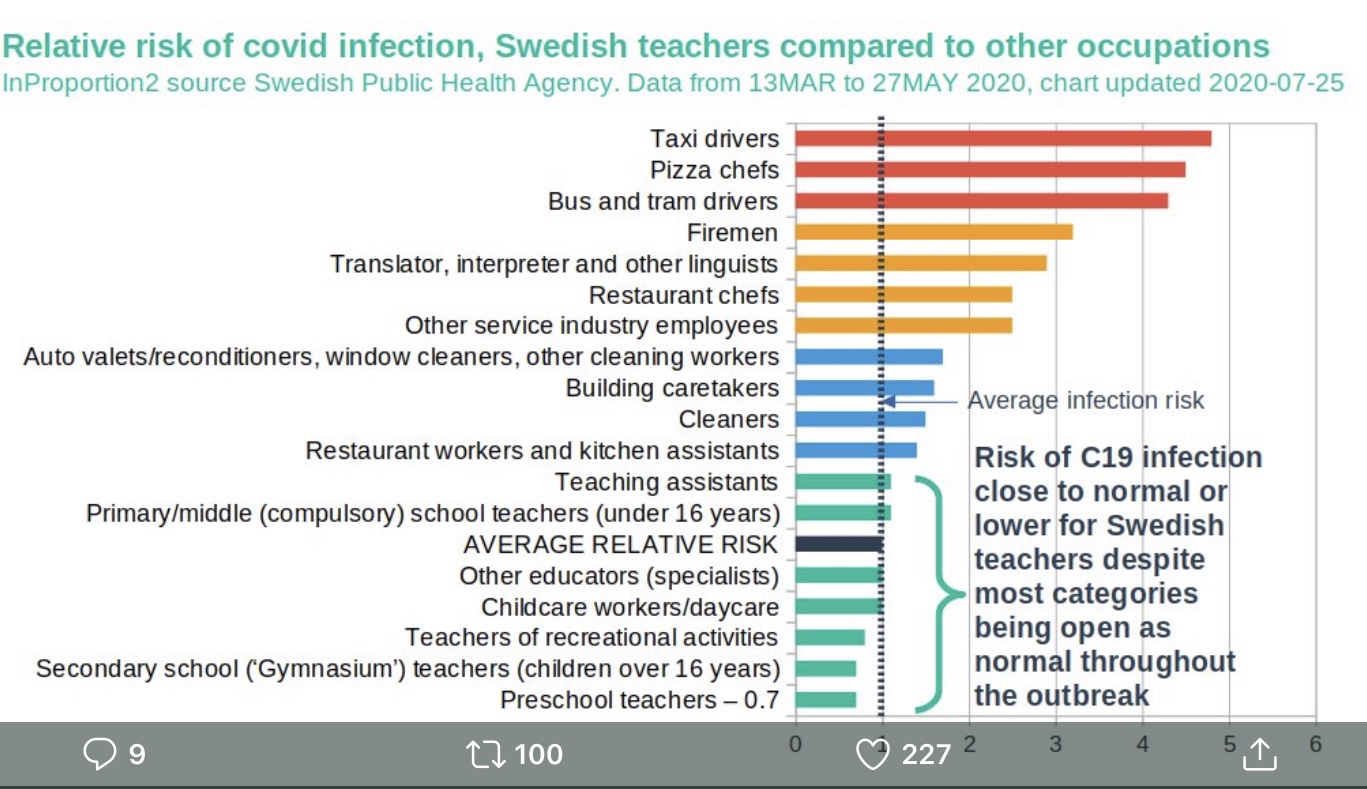
A quick follow-up to my recent post “COVID Hysteria and School Reform“: the graphic above is from an occupational risk study recently conducted by Swedish health authorities. The horizontal axis is obscured by the lower banner from Twitter (my fault), but the average risk of infection across all occupations was slightly less than 1%, and the highest-risk occupations were in the 4 – 5% range. Keep in mind, the data was collected while the virus was still raging in Sweden, while schools remained open. The virus hasn’t completely vanished in Sweden since then, but it has largely abated.

The study found that teachers had roughly average or below average risk, especially for pre-school and upper secondary (so-called “gymnasium”) teachers. The results demonstrate the lack of merit to claims by teachers unions that their members are somehow at greater risk of contracting coronavirus than other “essential” workers. We already know that children have extremely low susceptibility to COVID-19 and that they do not readily transmit the virus.

The health benefits of closing schools or taking them on-line do not compensate for the loss of educational effectiveness and detrimental health effects of preventing children from attending schools. The digital divide between children from disadvantaged households and their peers is likely to grow more severe if online learning is their only option. They should have choices, including functioning public schools.

To the last point, however, read this link for the sort of thing one teachers union supports. If the members are okay with that insanity then they shouldn’t be teaching your kids.

← Older posts
Newer posts →
Follow Sacred Cow Chips on WordPress.com

Recent Posts

  • Immigration and Merit As Fiscal Propositions
  • Tariff “Dividend” From An Indigent State
  • Almost Looks Like the Fed Has a 3% Inflation Target
  • Government Malpractice Breeds Health Care Havoc
  • A Tax On Imports Takes a Toll on Exports

Archives

  • December 2025
  • November 2025
  • October 2025
  • September 2025
  • August 2025
  • July 2025
  • June 2025
  • May 2025
  • April 2025
  • March 2025
  • February 2025
  • January 2025
  • December 2024
  • November 2024
  • October 2024
  • September 2024
  • August 2024
  • July 2024
  • June 2024
  • May 2024
  • April 2024
  • March 2024
  • February 2024
  • January 2024
  • December 2023
  • November 2023
  • August 2023
  • July 2023
  • June 2023
  • May 2023
  • April 2023
  • March 2023
  • February 2023
  • January 2023
  • December 2022
  • November 2022
  • October 2022
  • September 2022
  • August 2022
  • July 2022
  • June 2022
  • May 2022
  • April 2022
  • March 2022
  • February 2022
  • January 2022
  • December 2021
  • November 2021
  • October 2021
  • September 2021
  • August 2021
  • July 2021
  • June 2021
  • May 2021
  • April 2021
  • March 2021
  • February 2021
  • January 2021
  • December 2020
  • November 2020
  • October 2020
  • September 2020
  • August 2020
  • July 2020
  • June 2020
  • May 2020
  • April 2020
  • March 2020
  • February 2020
  • January 2020
  • December 2019
  • November 2019
  • October 2019
  • September 2019
  • August 2019
  • July 2019
  • June 2019
  • May 2019
  • April 2019
  • March 2019
  • February 2019
  • January 2019
  • December 2018
  • November 2018
  • October 2018
  • September 2018
  • August 2018
  • July 2018
  • June 2018
  • May 2018
  • April 2018
  • March 2018
  • February 2018
  • January 2018
  • December 2017
  • November 2017
  • October 2017
  • September 2017
  • August 2017
  • July 2017
  • June 2017
  • May 2017
  • April 2017
  • March 2017
  • February 2017
  • January 2017
  • December 2016
  • November 2016
  • October 2016
  • September 2016
  • August 2016
  • July 2016
  • June 2016
  • May 2016
  • April 2016
  • March 2016
  • February 2016
  • January 2016
  • December 2015
  • November 2015
  • October 2015
  • September 2015
  • August 2015
  • July 2015
  • June 2015
  • May 2015
  • April 2015
  • March 2015
  • February 2015
  • January 2015
  • December 2014
  • November 2014
  • October 2014
  • September 2014
  • August 2014
  • July 2014
  • June 2014
  • May 2014
  • April 2014
  • March 2014

Blogs I Follow

  • Passive Income Kickstart
  • OnlyFinance.net
  • TLC Cholesterol
  • Nintil
  • kendunning.net
  • DCWhispers.com
  • Hoong-Wai in the UK
  • Marginal REVOLUTION
  • Stlouis
  • Watts Up With That?
  • Aussie Nationalist Blog
  • American Elephants
  • The View from Alexandria
  • The Gymnasium
  • A Force for Good
  • Notes On Liberty
  • troymo
  • SUNDAY BLOG Stephanie Sievers
  • Miss Lou Acquiring Lore
  • Your Well Wisher Program
  • Objectivism In Depth
  • RobotEnomics
  • Orderstatistic
  • Paradigm Library
  • Scattered Showers and Quicksand

Blog at WordPress.com.

Passive Income Kickstart

OnlyFinance.net

TLC Cholesterol

Nintil

To estimate, compare, distinguish, discuss, and trace to its principal sources everything

kendunning.net

The Future is Ours to Create

DCWhispers.com

Hoong-Wai in the UK

A Commonwealth immigrant's perspective on the UK's public arena.

Marginal REVOLUTION

Small Steps Toward A Much Better World

Stlouis

Watts Up With That?

The world's most viewed site on global warming and climate change

Aussie Nationalist Blog

Commentary from a Paleoconservative and Nationalist perspective

American Elephants

Defending Life, Liberty and the Pursuit of Happiness

The View from Alexandria

In advanced civilizations the period loosely called Alexandrian is usually associated with flexible morals, perfunctory religion, populist standards and cosmopolitan tastes, feminism, exotic cults, and the rapid turnover of high and low fads---in short, a falling away (which is all that decadence means) from the strictness of traditional rules, embodied in character and inforced from within. -- Jacques Barzun

The Gymnasium

A place for reason, politics, economics, and faith steeped in the classical liberal tradition

A Force for Good

How economics, morality, and markets combine

Notes On Liberty

Spontaneous thoughts on a humble creed

troymo

SUNDAY BLOG Stephanie Sievers

Escaping the everyday life with photographs from my travels

Miss Lou Acquiring Lore

Gallery of Life...

Your Well Wisher Program

Attempt to solve commonly known problems…

Objectivism In Depth

Exploring Ayn Rand's revolutionary philosophy.

RobotEnomics

(A)n (I)ntelligent Future

Orderstatistic

Economics, chess and anything else on my mind.

Paradigm Library

OODA Looping

Scattered Showers and Quicksand

Musings on science, investing, finance, economics, politics, and probably fly fishing.

  • Subscribe Subscribed
    • Sacred Cow Chips
    • Join 128 other subscribers
    • Already have a WordPress.com account? Log in now.
    • Sacred Cow Chips
    • Subscribe Subscribed
    • Sign up
    • Log in
    • Report this content
    • View site in Reader
    • Manage subscriptions
    • Collapse this bar
 

Loading Comments...