• About

Sacred Cow Chips

Sacred Cow Chips

Tag Archives: Lockdowns

Sweden’s Pandemic Policy: Arguably Best Practice

14 Monday Nov 2022

Posted by Nuetzel in Health Care, Pandemic

≈ Leave a comment

Tags

Anders Tegnell, Closures, Coronavirus, Covid-19, Deaths of Despair, European Economic Area, Excess Deaths, Joakim Book, Johan Giesecke, Latitude, Lockdowns, Non-Pharmaceutical interventions, Nordic, NPIs, Our World In Data, Oxford Stringency Index, Pandemic, Quarantines, Sweden, Vitamin D

When Covid-19 began its awful worldwide spread in early 2020, the Swedes made an early decision that ultimately proved to be as protective of human life as anything chosen from the policy menu elsewhere. Sweden decided to focus on approaches for which there was evidence of efficacy in containing respiratory pandemics, not mere assertions by public health authorities (or anyone else) that stringent non-pharmaceutical interventions (NPIs) were necessary or superior.

The Swedish Rationale

The following appeared in an article in Stuff in late April, 2020,

“Professor Johan Giesecke, who first recruited [Sweden’s State epidemiologist Anders] Tegnell during his own time as state epidemiologist, used a rare interview last week to argue that the Swedish people would respond better to more sensible measures. He blasted the sort of lockdowns imposed in Britain and Australia and warned a second wave would be inevitable once the measures are eased. ‘… when you start looking around at the measures being taken by different countries, you find very few of them have a shred of evidence-base,’ he said.

Giesecke, who has served as the first Chief Scientist of the European Centre for Disease Control and has been advising the Swedish Government during the pandemic, told the UnHerd website there was “almost no science” behind border closures and school closures and social distancing and said he looked forward to reviewing the course of the disease in a year’s time.”

Giesecke was of the opinion that there would ultimately be little difference in Covid mortality across countries with different pandemic policies. Therefore, the least disruptive approach was to be preferred. That meant allowing people to go about their business, disseminating information to the public regarding symptoms and hygiene, and attempting to protect the most vulnerable segments of the population. Giesecke said:

“I don’t think you can stop it. It’s spreading. It will roll over Europe no matter what you do.”

He was right. Sweden had a large number of early Covid deaths primarily due to its large elderly population as well as its difficulty in crafting effective health messages for foreign-speaking immigrants residing in crowded enclaves. Nevertheless, two years later, Sweden has posted extremely good results in terms of excess deaths during the pandemic.

Excess Deaths

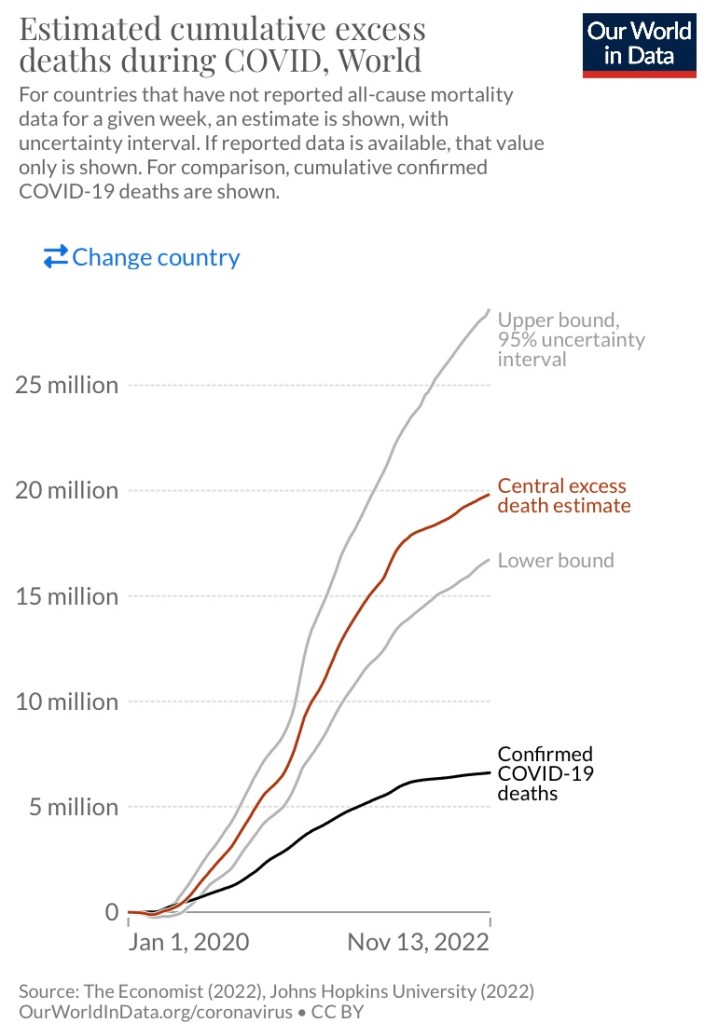
Excess deaths, or deaths relative to projections based on historical averages, are a better metric than Covid deaths (per million) for cross-country or jurisdictional comparisons. Among other reasons, the latter are subject to significant variations in methods of determining cause of death. Moreover, there was a huge disparity between excess deaths and Covid deaths during the pandemic, and the gap is still growing:
Excess deaths varied widely across countries, as illustrated by the left-hand side of the following chart:
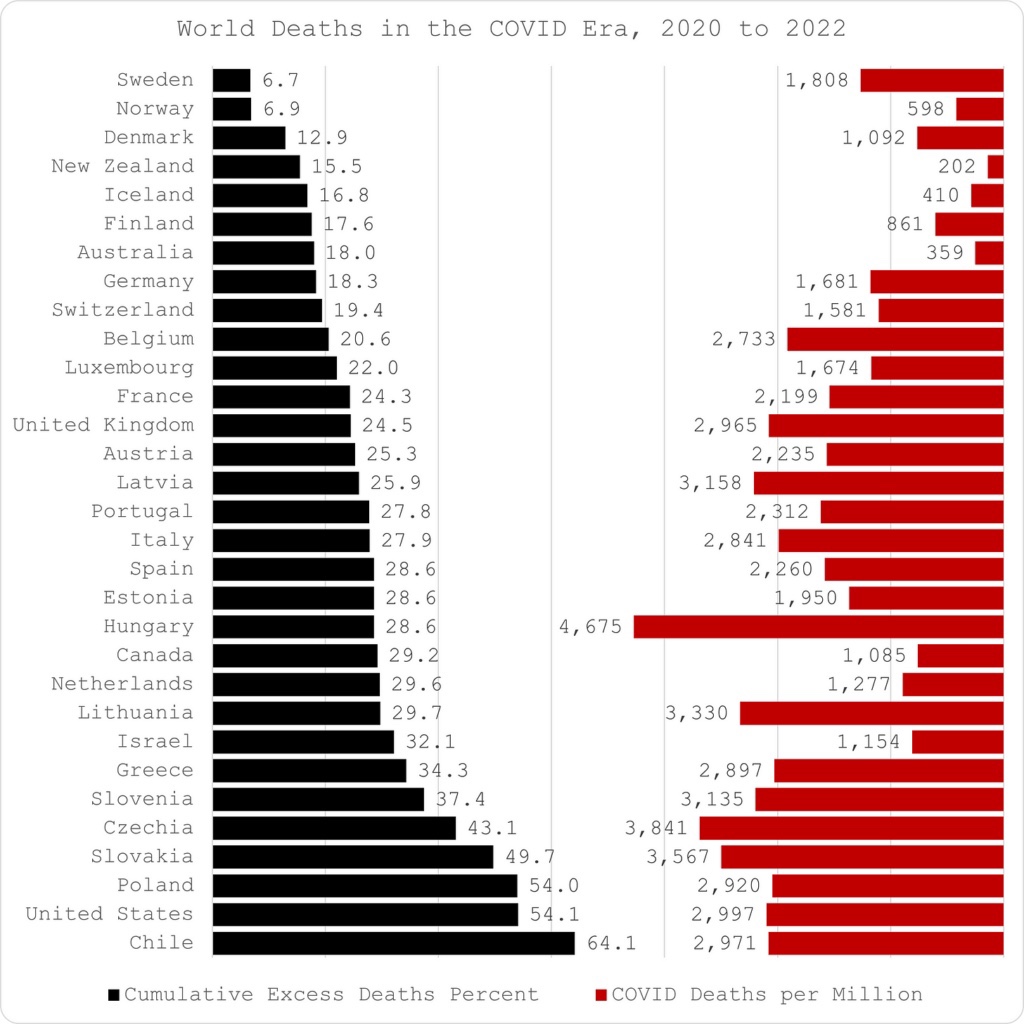
Interestingly, most of the lowest excess death percentages were in Nordic countries, but especially Sweden and Norway. That might be surprising in terms of high Nordic latitudes, which may have created something of a disadvantage in terms of sun exposure and potentially low vitamin D levels. Norway enacted more stringent public policies during the pandemic than Sweden. Globally, however, lockdown measures showed no systematic advantage in terms of excess deaths. Notably, the U.S. did quite poorly in terms of excess deaths at 8X the Swedish rate,

Covid Deaths

The right-hand side of the chart above shows that Sweden experienced a significant number of Covid deaths per million residents. The figure still compares reasonably well internationally, despite the country’s fairly advanced age demographics. Most Covid deaths occurred in the elderly and especially in care settings. Like other places, that is where the bulk of Sweden’s Covid deaths occurred. Note that U.S. Covid deaths per million were more than 50% higher than in Sweden.

NPIs Are Often Deadly

Perhaps a more important reason to emphasize excess deaths over Covid deaths is that public policy itself had disastrous consequences in many countries. In particular, strict NPIs like lockdowns, including school and business closures, can undermine public health in significant ways. That includes the inevitably poor consequences of deferred health care, the more rapid spread of Covid within home environments, the physical and psychological stress from loss of livelihood, and the toll of isolation, including increased use of alcohol and drugs, less exercise, and binge eating. Isolation is particularly hard on the elderly and led to an increase in “deaths of despair” during the pandemic. These were the kinds of maladjustments caused by lockdowns that led to greater excess deaths. Sweden avoided much of that by eschewing stringent NPIs, and Iceland is sometimes cited as a similar case.

Oxford Stringency Index

I should note here, and this is a digression, that the most commonly used summary measure of policy “stringency” is not especially trustworthy. That measure is an index produced by Oxford University that is available on the Our World In Data web site. Joakim Book documented troubling issues with this index in late 2020, after changes in the index’s weightings dramatically altered its levels for Nordic countries. As Book said at that time:

“Until sometime recently, Sweden, which most media coverage couldn’t get enough of reporting, was the least stringent of all the Nordics. Life was freer, pandemic restrictions were less invasive, and policy responses less strong; this aligned with Nordic people’s experience on the ground.”

Again, Sweden relied on voluntary action to limit the spread of the virus, including encouragement of hygiene, social distancing, and avoiding public transportation when possible. Book was careful to note that “Sweden did not ‘do nothing’”, but it’s policies were less stringent than its Nordic neighbors in several ways. While Sweden had the same restrictions on arrivals from outside the European Economic Area as the rest of the EU, it did not impose quarantines, testing requirements, or other restrictions on travelers or on internal movements. Sweden’s school closures were short-lived, and its masking policies were liberal. The late-2020 changes in the Oxford Stringency Index, Book said, simply did not “pass the most rudimentary sniff test”.

Economic Stability

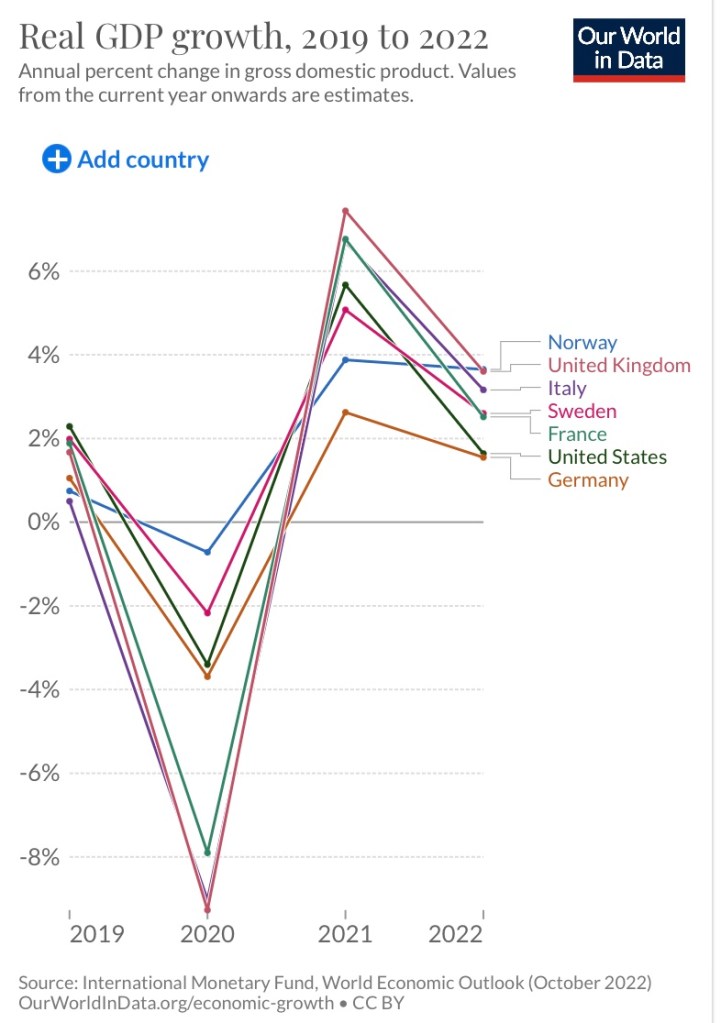
Sweden’s economy performed relatively well during the pandemic. The growth path of real GDP was smoother than most countries that succumbed to the excessive precautions of lockdowns. However, Norway’s economy appears to have been the most stable of those shown on the chart, at least in terms of real output, though it did suffer a spike in unemployment.
The Bottom Line

The big lesson is that Sweden’s “light touch” during the pandemic proved to be at least as effective, if not more so, than comparatively stringent policies imposed elsewhere. Covid deaths were sure to occur, but widespread non-Covid excess deaths were unanticipated by many countries practicing stringent intervention. That lack of foresight is best understood as a consequence of blind panic among public health “experts” and other policymakers, who too often are rewarded for misguided demonstrations that they have “done something”. Those actions failed to stop the spread in any systematic sense, but they managed to do great damage to other aspects of public health. Furthermore, they undermined economic well being and the cause of freedom. Johan Giesecke was right to be skeptical of those claiming they could contain the virus through NPIs, though he never anticipated the full extent to which aggressive interventions would prove deadly.


Interventionists Love You and Demand You Change, or Else

19 Friday Aug 2022

Posted by Nuetzel in Central Planning, Industrial Policy, Uncategorized

≈ Leave a comment

Tags

CHIPS Act, David McGrogan, Dierdre McCloskey, Don Boudreaux, Industrial Planning, Inflation Reduction Act, Jason Brennan, Joseph Stiglitz, Lionel Trilling, Lockdowns, Pandemic, Paul Krugman, Scientism, Solyndra

Statistics and measurement might not be critical to the exercise of the authoritarian impulse, but they have served to enable the technocratic tyranny idealized by contemporary statists. Certain influential thinkers have claimed our ability to compile statistics helps give rise to the bureaucratized state. I ran across a great post that led with that topic: “The Brutalization of Compassion” by David McGrogan. The mere ability to compile relevant statistics on a population and its well being (income, jobs, wages, inequality, mortality, suicide, etc… ) can motivate action by authorities to “improve” matters. The purpose might be to get ahead of rival states, or the action might be rationalized as compassion. But watch out! McGrogan quotes a bit of cautionary wisdom from Lionel Trilling:

“‘When once we have made our fellow men the objects of our enlightened interest,’ he put it, something within us causes us to then ‘go on and make them the objects of our pity, then of our wisdom, ultimately of our coercion.’”

Ultimately, to pursue their vision, interventionists must impose controls on behaviors. In practice, that means any variance or attempted variance must be penalized. Here’s McGrogan’s description of the steps in this process:

“The conceptualisation of the population as a field of action, and the measurement of statistical phenomenon within it – the taking of an ‘enlightened interest’ in it – gives rise to both ‘pity,’ or compassion, and the application of ‘wisdom’ to resolve its problems. What is left, of course, is coercion, and we do not need to look far to identify it in the many means by which the modern state subjects the population to a kind of Tocquevillian ‘soft despotism,’ constantly manipulating, cajoling and maneuvering it this way and that for its own good, whether through compulsory state education or ‘sin taxes’ or anything in between.”

Follow the Scientism

I can’t neglect to mention another important condition: the hubris among apparatchiks who imagine the state can improve upon private institutions to achieve social betterment. They will always fail in attempts to replace the action of the private markets and the price mechanism to process information relating to scarcities and preferences. Absent that facility, human planners cannot guide flows of resources to their most valued uses. In fact, they nearly always botch it!

Government provision of public goods is one concession worth making, but the state capacity needed to fulfill this legitimate function is subject to severe mission creep: we frequently see efforts to characterize goods and service as “public” despite benefits that are almost wholly private (e.g. education). Likewise, we often hear exaggerated claims of “harms” requiring state intervention (e.g. carbon emissions). These situations often hinge purely on politics. Even when legitimate external benefits or costs can be identified, there is a pretension that they can be accurately measured and corrected via subsidies or taxes. This is far-fetched. At best, it’s possible to vouch for the directional appropriateness of some interventions, but the magnitude of corrective measures is variable and essentially unknowable. Too often we see government failure via over-subsidization of politically favored activities and over-penalization of politically disfavored activities.

One of the most egregious errors of intervention is the over-application of the precautionary principle: if risks are associated with an activity, then it must be curtailed. This often relies on measurements of highly uncertain causes and effects, and it involves aggregation subject to its own biases.

Just as questionable is the ability of “experts” to model natural or behavioral processes such that outcomes can be “predicted” over horizons extending many decades forward. That interventionists tend to ignore the uncertainties of these predictions is the most blatant and damaging conceit of all, not least because the public and the media usually have limited knowledge with which to assess the phenomenon in question.

Public Health Tyranny

The Covid pandemic presented a compelling excuse for precautionists in government and even private institutions to impose radical controls under a set of claims they called “the science”. These claims were often false and really antithetical to the principles of scientific inquiry, which calls for continually questioning hypotheses, even when they represent “consensus”. Yet a series of questionable scientific claims were used to justify abridgment of basic freedoms for the general population, most of whom faced little risk from the virus. This included lockdowns of schools and churches, business closures, cancellation of public events (except of course for protests and riots by Leftists), deferred medical care, vaccine mandates, and mask mandates. The damage these measures inflicted was fierce, and in the end we know that it was almost entirely unnecessary. Still, the public health establishment seems all too willing to ignore the facts in its readiness to repeat the whole range of mistakes at the slightest uptick in what’s now an endemic infection.

Standard Issue Cronyism

In the wake of the pandemic, we’ve witnessed a surge in calls for government to enhance the security of our nation’s supply chains. Too large a share of the critical goods required by domestic industries are produced overseas, which has made supply disruptions, and the threat of future disruptions, especially acute. Right on cue, advocates of industrial policy and planning have arranged for the federal government to provide $85 billion to domestic producers of semiconductors under the so-called CHIPS Act. But semiconductor producers are in no need of government incentives to “re-shore” production:

“… there has been even more chipmaking investment dedicated to the U.S. market, even as federal subsidies have languished. Construction is now underway at four major U.S. facilities and will continue with or without subsidies—something even Intel reluctantly acknowledged when it delayed the groundbreaking ceremony on its much‐ballyhooed Ohio facility to protest congressional inaction. This is because, as numerous experts have explained over the last year, there are real economic and geopolitical reasons to invest in additional U.S. semiconductor production—no federal subsidies needed.”

Moreover, the global shortage of computer chips appears to be ending. The subsidies will unnecessarily enrich industrialists and their shareholders, provide a source of graft to bureaucrats and various middle men, and likely over-allocate resources to domestic production of chips. Industrial planning of this kind has a long history of failure, and this time won’t be different.

Climate Fascists

We also see repeated over-application of the precautionary principle and rising dominance of industrial policy in climate and energy policy. Enormous sacrifices are imposed on consumers for the sake of minuscule changes in global carbon emissions and the “expected” long-term path of future “global” temperatures. The interventions taken in pursuit of these objectives are draconian, limiting choices and raising the cost of virtually everything produced and consumed. They distort the direction of physical investment, disfavoring reliable sources of base load capacity needed for growth, and also disfavoring the safest and most reliable zero-carbon alternative: nuclear power. The renewable energy sources foolishly pushed by the state and the ESG establishment are environmentally costly in their own right, and they don’t work when natural conditions are unfavorable. As one wag says about the climate provisions of the ironically named Inflation Reduction Act, “Gonna be a lot more Solyndras coming”.

And talk about sloppy! Our “trusted representatives” in Congress could hardly be bothered to pretend they’d done their homework. They neglected to provide any quantitative carbon and temperature impacts of the legislation. This must be a case of true honesty, because they really have no idea!

Delusions of Central Planning

One great weakness (among many) of arguments for state industrial planning is the assumption that government agents are somehow more competent, efficient, and “pure of heart” than agents in the private sector. Nothing could be more laughable. On this point, some of the most incisive commentary I’ve seen is provided by the masterful Don Boudreaux, first quoting Georgetown philosopher Jason Brennan before adding his own entertaining thoughts:

The typical way the left argues for the state is to describe what economists in the 1850s thought markets would be like under monopoly or monopsony, and then compare that to a state run by angels. Both halves of the argument are bad, and yet philosophy treats this as if it were rigorous and sophisticated.

“Far too many policy proposals are nothing more than prayers to the state-god. ‘We entreat you, Oh Powerful and Sacred One, to relieve our people of this or that misery, blemish, and market imperfection! We beseech you to bestow upon us – your faithful servants – cosmic justice, safety from new pathogens, unkind thoughts, and microaggressions, and protection from each and every burden of reality that we can imagine being cured by an omniscient, benevolent, and omnipotent deity! If we obey – and sacrifice to you without complaint our treasure and our freedoms – you will provide!’

I do not exaggerate. Pick at random any proposed government intervention offered by the likes of Progressives or national conservatives, and you’ll discover that the workability of this proposed intervention, when evaluated honestly, rests on nothing more solid than the above absurd faith that the state is – or, when in the right hands, will be – a secular god.”

On the idealization of government’s ability to “plan the economy” rationally, here is more from Boudreaux, first quoting the great Deirdre McCloskey:

Deep in left-wing thought about the economy, and in a good deal of right-wing thought, too, is the premise, as Isaiah Berlin once put it with a sneer, that government can accomplish whatever it rationally proposes to do. As has been often observed about leftists even as sweet as John Rawls, the left has no theory of the behavior of the government. It assumes that the government is a perfect expression of the will of The People.

“And nothing is more unscientific – indeed, more mystical – than is this still-commonplace practice of most Progressives, and also of very many conservatives, to analyze the economy and society, and to offer policy recommendations, using such a juvenile ‘understanding’ of the state. Yet such an ‘understanding’ of the state permeates the work even of some Nobel laureates in economics – laureates such as Paul Krugman and Joseph Stiglitz. This ‘understanding’ of the state is inseparable also from the work of pundits too many to count…

That these professors and pundits think of themselves as scientific – and are widely regarded as being especially intelligent, thoughtful, and scientific – testifies to the strength of the cult of democratically rubber-stamped coercion.”

Conclusion

Humans have proven to be incredible documentarians. The advent of measurement techniques and increasingly sophisticated methods of accounting for various phenomena has enabled better ways of understanding our world and our well being. Unfortunately, a by-product was the birth of scientism, the belief that men in authority are capable not only of measuring, but of fine-tuning, the present and future details of society and social interaction. Those pretensions are terribly mistaken. However, the actions of Congress and the Biden Administration prove that it’s adherents will never be persuaded, despite repeated demonstrations of the futility of central planning. Their words of compassion are no comfort — they must coerce the ones they “love”.

Chill-Out Advisory: Pandemic to Endemic Means Live Again

13 Sunday Feb 2022

Posted by Nuetzel in Pandemic, Public Health, Uncategorized

≈ Leave a comment

Tags

Acquired Immunity, Biden Administration, CDC, Child Risks, Covid-19, Covid-Like Symptoms, Covidestim.org, Delta Variant, EU Visits, HOLD2, Hope-Simpson Seasonal Pattern, Hospital Utilization, Hospitalizations, Incidental Infections, John Tierney, Lockdowns, Mask Efficacy, Natural Immunity, Omicron BA.1, Omicron BA.2, Omicron Variant, Our World In Data, Phil Kerpen, Staffed Beds, Teachers Unions, Tradeoffs, Transmissability, Vaccine Efficacy, Vaccine Risks, Virulence

We might be just be done with the coronavirus pandemic. That is, it appears to be transitioning to a more permanent endemic phase. What follows are a few details about the Omicron wave and its current status, an attempt to put the risks of Covid in perspective, and a few public policy lessons that are now gaining broad currency but should have been obvious long ago.

What’s The Status?

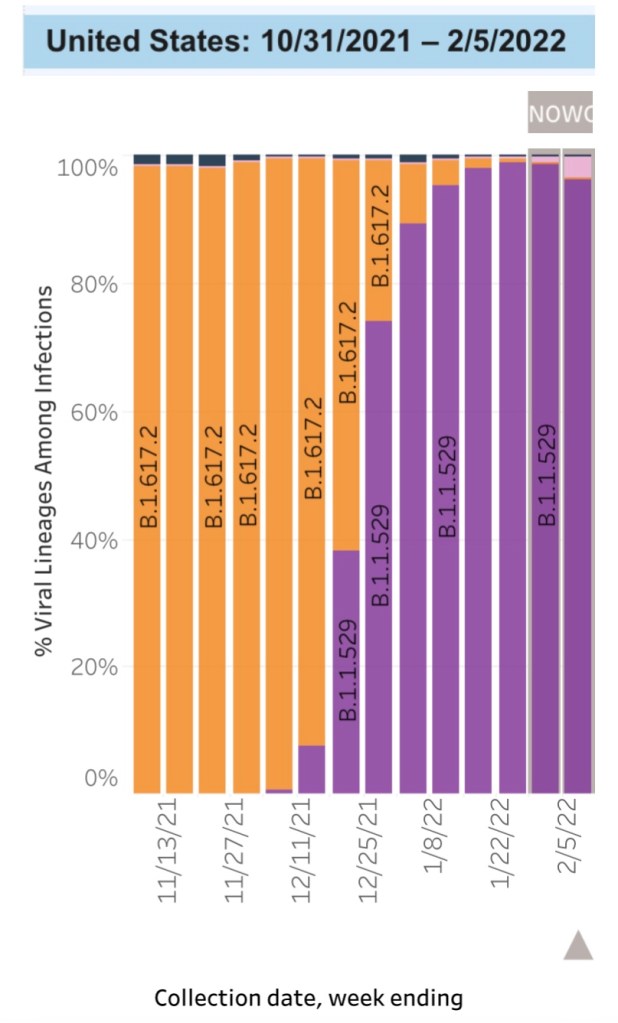
The Omicron variant became the dominant U.S. strain of the coronavirus in December. Omicron outcompeted Delta, which was very good news because Omicron is far less severe. The chart below (from the CDC Data Tracker site) shows Omicron’s rapid ascendance and displacement of the Delta variant. The orange bar segments represent the proportion of cases of the Delta strain, while the purple and pink segments are Omicron sub-variants known as BA.1 and BA.2, respectively. BA.2 is even more transmissible than BA.1 and is likely to become dominant over the next month or so. However, the BA.2 sub-variant appears to be far less virulent than Delta, like BA.1.

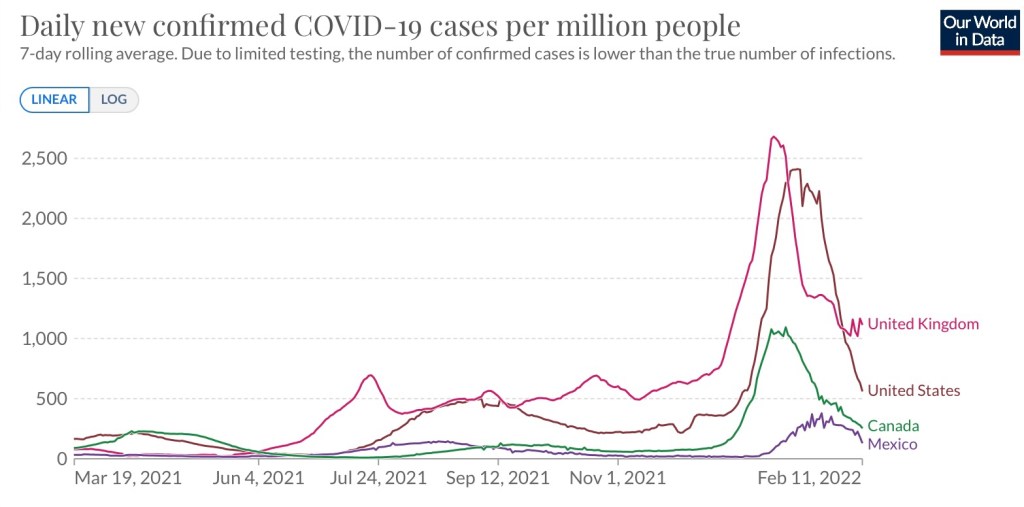
Despite a record number of infections over a period of a month or so, the Omicron wave is tapering just as rapidly as it ramped up, as the next chart demonstrates. In fact, covidestim.org shows that cases are now receding in all states, DC, and Puerto Rico. Here are new cases per million people from Our World in Data:

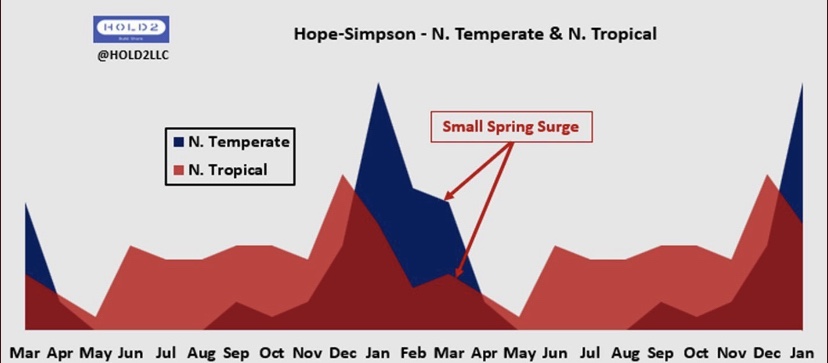
Whether BA.2 causes cases to plateau for a while, or even a secondary Omicron “wavelet”, is yet to be seen. That would be consistent with the normal Hope-Simpson seasonal pattern of viral prevalence in the northern hemisphere (hat tip: HOLD2):

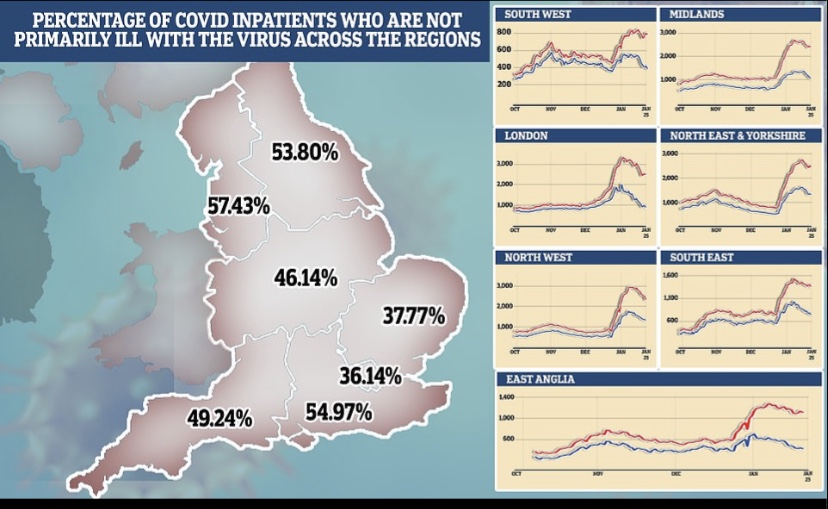
Data problems make the Omicron wave difficult to assess, however. We don’t know the share of incidental infections for the U.S. as a whole, but more than half of hospitalized Covid patients in Massachusetts and Rhode Island are classified with incidental infections. The proportion in the UK is estimated to be rising and approaching 30% of total cases, with much higher percentages in many regions of England, as shown below.

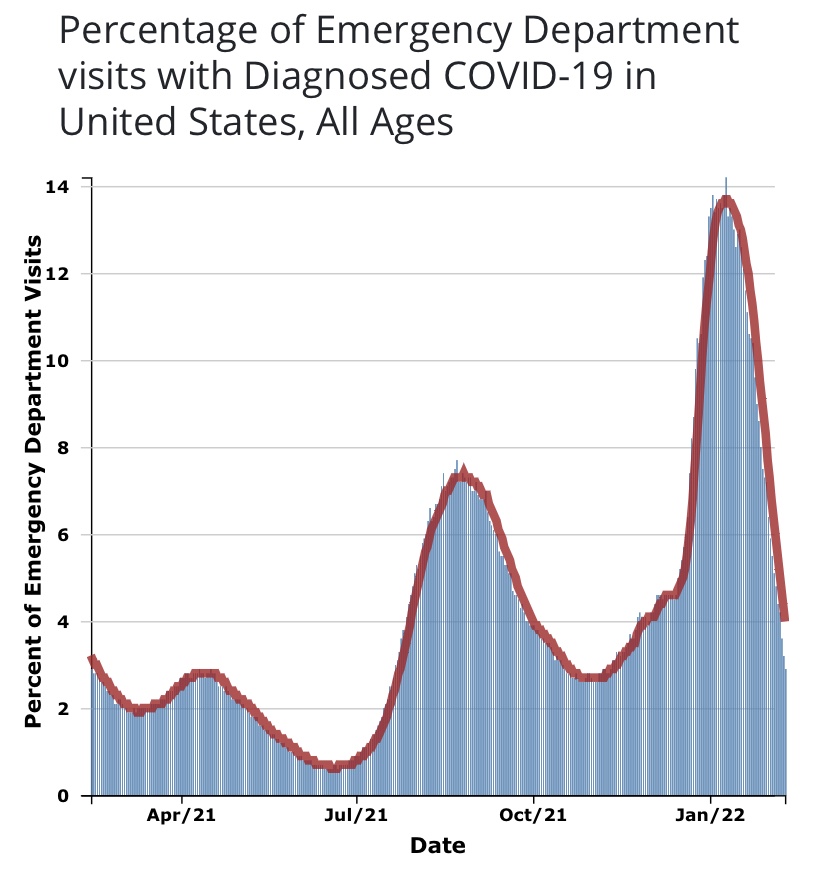
As I’ve emphasized in the past, case numbers should not be the primary gauge of the state of the pandemic, especially with a more highly contagious but relatively mild variant like Omicron. Hospitalizations are a better measure, but only if “incidental” infections are removed from the counts. That’s been acknowledged only recently by the public health establishment, and even the Biden Administration is emphasizing it as a matter of sheer political expediency. Another measure that might be more reliable for assessing the pandemic in the community as a whole is the number of emergency room patients presenting Covid-like symptoms. From the CDC Data Tracker:

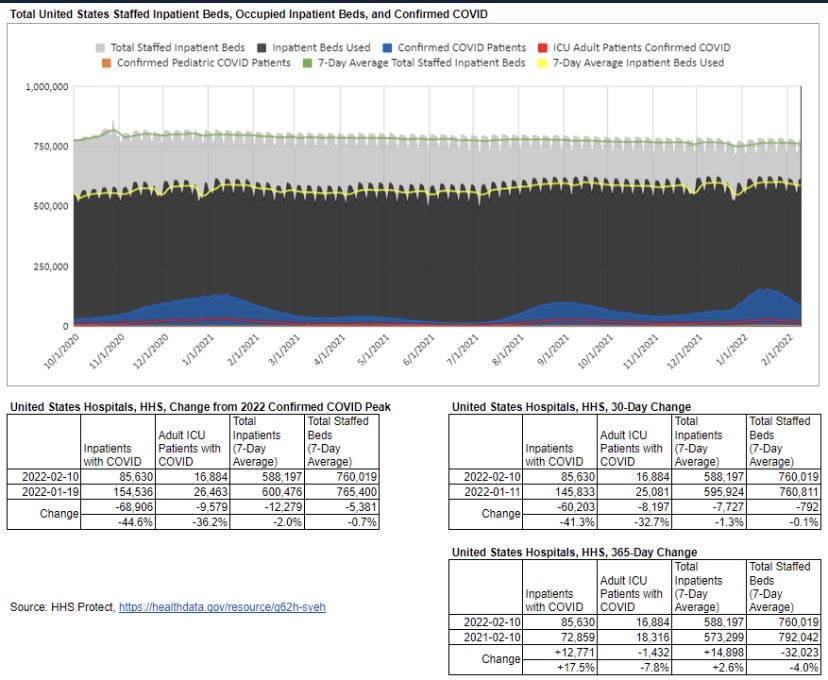
There is no doubt that incidental infections create complications in caring for patients with other ailments. That has a bearing on the utilization of hospital capacity. Generally, however, strains on hospital capacity during the pandemic have been greatly exaggerated. This is not to diminish the hard work and risks faced by health care workers, and there have been spot shortages of capacity in certain localities. However, in general, staffed beds have been more than adequate to meet needs. This chart, like a few others below, is courtesy of Phil Kerpen:

With the more highly transmissible variants we have now, it’s not at all surprising to see a high proportion of incidental cases among inpatients. Incidental infections are likely to inflate counts of Covid deaths as well, given the exceptional and odd way in which Covid deaths are being recorded. It will be some time until we see full U.S. data on cases and deaths net of incidental infections. Moreover, many of the Covid deaths in December and January were from lingering Delta infections, which might still be a factor in the February counts.

How Are Your Odds?

The mild or asymptomatic nature of most Omicron cases, the large proportion of incidental hospitalizations, and the knowledge that Omicron is not a deep respiratory threat should offer strong reassurance to healthy individuals that the variant does not pose a great risk. According to a recent CDC report, in a sample of almost 700,000 vaccinated individuals aged 65 or less without co-morbidities, there were no Covid fatalities or ICU admissions during the 10 months from December 2020 through October 2021. There was only one fatality in the sample of healthy individuals older than 65. There were just 36 fatalities across the full sample of over 1.2 million vaccinated individuals, so COVID’s fatality risk was only about 0.3%. Of those deaths, 28 were among those with four or more risk factors (including co-morbidities and > 65 years). And this was before the advent of Omicron!

I have a few doubts about the CDC’s sample selection and vagaries around certain definitions used. Nevertheless, the results are striking. However, the study did not address risks to unvaccinated adults. Another more limited CDC study found that vaccinated patients were still less likely than the unvaccinated to require critical care during the Omicron wave.

A separate CDC study found a 91% reduction in the likelihood of death for Omicron relative to Delta. A study from the UK (see summary here) found that Omicron cases were 59% less likely than Delta cases to require hospitalization and 69% less likely to result in death within 28 days of a positive test. Omicron was far less deadly among both the vaccinated and the unvaccinated, and the latter had a larger reduction in the likelihood of death. The study was stratified by age as well, with less severe outcomes for Omicron among older cohorts except in the case of death, for which there was no apparent age gradient.

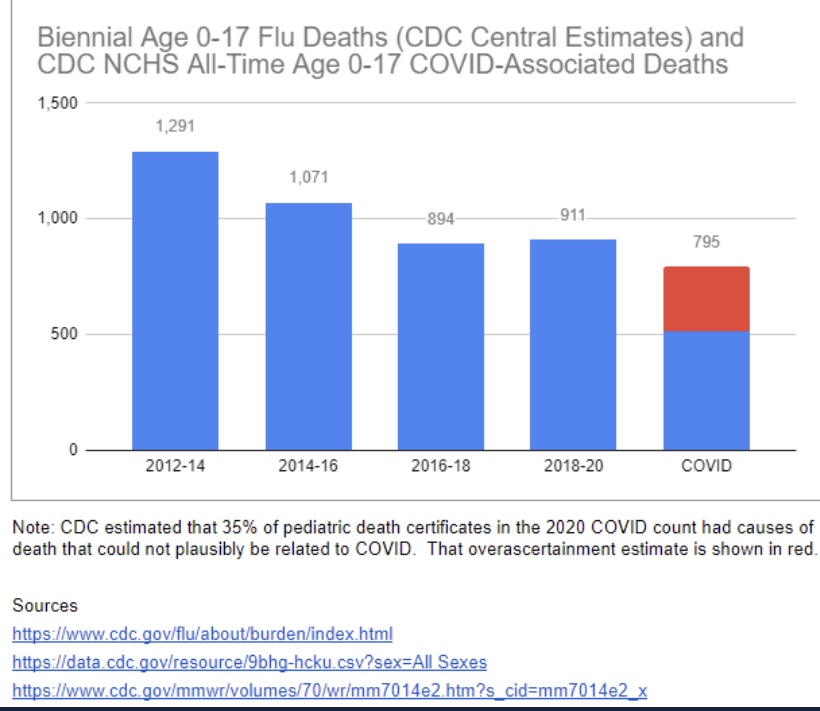
Another unnecessarily contentious issue has been the risk to children during the pandemic. Based on the data, there should never have been much doubt that these risks are quite low. Apparently, however, it was advantageous for teachers’ unions to insist otherwise. Phil Kerpen soundly debunks that claim with the following chart:

Covid has been less deadly to children from infancy through 17 years than the pre-pandemic flu going back to 2012! Oh yes, but teachers FEAR transmission from the children! That claim is just as silly, since children are known to be inefficient transmitters of the virus (and see here).

Now that Omicron has relegated the Delta variant to the history books, the risks going forward seem much more manageable. Omicron is less severe, especially for the vaccinated. Levels of acquired (natural) immunity from earlier infections are now much higher against older strains, and Omicron infections seem to be protective against Delta.

In commentary about the first CDC study discussed above, John Tierney lends perspective to the odds of death from pre-Omicron Covid:

“Those are roughly the same odds that in the course of a year you will die in a fire, or that you’ll perish by falling down stairs. Going anywhere near automobiles is a bigger risk: you’re three times more likely during a given year to be killed while riding in a car, and also three times more likely to be a pedestrian casualty. The 150,000-to-1 odds of a Covid death are even longer than the odds over your lifetime of dying in an earthquake or being killed by lightning.”

Yet with all this research confirming the low odds of death induced by Omicron, why have we seen recent deaths at levels approaching previous waves? First, many of those deaths are carried over from Delta infections. That means deaths should begin to taper rapidly as February reports roll in. And remember that daily reports do not show deaths by date of death. Deaths usually occur weeks or even months before they are reported. That also means some of the deaths reported might be “harvested” from much earlier fatalities. Second, given the high levels of incidental Omicron infections, some of those deaths are misattributed to Covid, an issue that is not new by any means. Finally, while Omicron is relatively mild for most people, the high rate of transmission means that a high number of especially vulnerable individuals may be infected with severe outcomes. We have seen much more severe consequences for the unvaccinated, of course, and for those with co-morbidities.

Things We Should Have Known

I’ll try to keep this last section brief, but as an introduction I’ll just say that it’s almost as if we’ve been allowing the lunatics to run the asylum. To paraphrase one comment I saw recently, if you wonder why there is so much dissent, you ought to consider the fact the much of what our governments have done (along with many private organizations) was to prohibit things that were demonstrably safe (e.g., going outside, using swing sets, or attending schools) and to encourage things that were demonstrably harmful (e.g., deferring medical care, or masking small children).

The following facts are only now coming into focus among those who’ve been “following the politics” rather than “the science”, despite pretensions to the latter.

  • Specific public health initiatives often face steep economic, emotional, social, and countervailing health tradeoffs.
  • Lockdowns do NOT work.
  • Masks do NOT work (despite the CDC’s past and recent confusion on the matter).
  • Children are at very low-risk from Covid.
  • Children do NOT present high risks to teachers.
  • Natural immunity is more protective than vaccines.
  • Vaccines do NOT “stop the spread”.
  • Vaccine risks might outweigh benefits for certain groups and individuals.
  • Vaccines should NOT be relied upon at the expense of treatments.
  • Don’t reject treatments based on politics.
  • Vaccine mandates are unethical.

Grow Up and Chill Out!

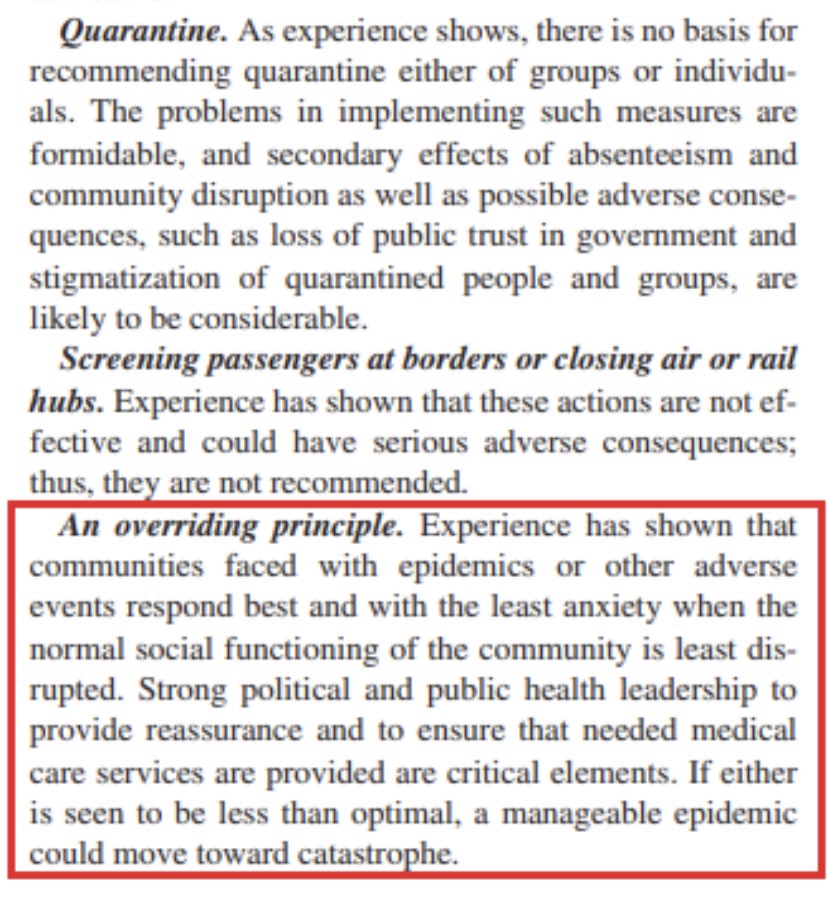
Life is full of risks, and nothing has changed to alter wisdom gained in earlier pandemics. For example, this pearl from a 2006 publication on disease mitigation measures should be heeded (hat tip: Phil Kerpen):

If there is one simple message everyone needs to hear, it is to stop allowing the virus bogeyman to rule your life. It will never go away completely, and it is likely to present risks that is are comparable to the flu going forward. In fact, it might well compete with the flu, which means we won’t be dealing with endemic Covid plus historical flu averages, but some smaller union of the two case loads.

So get out, go back to work, or go have some fun! Get back truckin’ on!

Bill Gates, Wayward Climate Nerd

17 Wednesday Nov 2021

Posted by Nuetzel in Climate, Energy

≈ Leave a comment

Tags

Abortion, Anti-Vaxers, Battery Technology, Bill Gates, Carbon Capture, Carbon Concentration, Carbon Efficiency, Carbon Emissions, CO2, David Solway, Fossil fuels, Gates Foundation, Green Premium, Health and Fertility, Hydrogen Power, Industrial Policy, Kaya Identity, Lockdowns, Median Voter, Natural Gas, Net Zero Carbon, Non-Pharmaceutical interventions, Nuclear power, Power Storage, Renewable energy, Reproductive Health Services, Solar Power, TED Talks, Thomas Malthus, Vaccine Passports, Wind Power, World Health Organization

Bill Gates’ considerable philanthropic efforts through the Gates Foundation are well known. Much of the foundation’s activity has focused on disease control and nutrition around the globe. Education reform has also been a priority. Many of these projects are laudable, though I’m repulsed by a few (see here and here). During the coronavirus pandemic, Gates has spoken approvingly of Non-Pharmaceutical Interventions (lockdown measures), which are both coercive and ineffective (and see here). He has earned the enmity of anti-vaxers, of course, though I’m not anti-vax as long as the jabs are voluntary. The Gates Foundation funded the World Health Organization’s effort to provide guidance on digital vaccine passports, which is a de facto endorsement of discrimination based on vaccination status. His priorities for addressing climate change also raise some troubling issues, a few of which I address below.

Squeezing Policy from a Definition

Gates put a special Malthusian twist on a TED Talk he did back in 2010 using an equation for carbon dioxide emissions, which he’s reprised over the years. It gained a lot of notice in 2016 when a few sticklers noticed that his claim to have “discovered” the equation was false. The equation is:

CO2 = P x S x E x C,

where P = People, S = Services per person, E = Energy per service, and C = CO2 per energy unit.

This equation first appeared as the so-called Kaya Identity in a scientific review in 2002. Such an equation can be helpful in organizing one’s thoughts, but it has no operational implications in and of itself. At one level it is superficial: we could write a similar identity for almost anything, like the quantity of alcohol consumed in a year, which must equal the population times the ounces of alcohol per drink times the number of drinks per person. At a deeper level, it can be tempting to build theories around such equations, and there is no question that any theory about CO2 must at least preserve the identity.

There’s an obvious temptation to treat an equation like this as something that can be manipulated by policy, despite the possibility of behavioral links across components that might lead to unintended consequences. This is where Gates gets into trouble.

Reality Checks

As David Solway writes, Gates’ jumped to the conclusion that population drives carbon emissions, reinforcing a likely perspective that the human population is unsustainable. His benevolent solution? A healthier population won’t breed as fast, so he prescribes more vaccinations (voluntary?) and improved health care. For good measure, he added a third prong: better “reproductive health services”. Let’s see… what share of the 0.9 -1.4 billion reduction in world population Gates prescribed in 2016 would have come from terminated pregnancies?

In fact, healthier people might or might not want more children, but lower child mortality in the developing world would reduce certain economic incentives for high fertility. Another reliable association is between income and child bearing: an increase in “services per person” is likely to lead to smaller families, but that wasn’t given any emphasis by Gates. Income growth is simply not part of the narrative! Yet income growth does something else: it allows us to more easily afford the research and investments required for advanced technologies, including cleaner energy. These things take time, however.

Solway points to other weaknesses in Gates’ interpretation of the Kaya Identity. For example, efforts to slow population growth are not reliably associated with “services per person”, fuel efficiency, or carbon efficiency. In other words, carbon emissions may be powerfully influenced by factors other than population. China is a case in point.

Centralized industrial and social planning is generally ill-suited to advancing human well being. It’s especially suspect if the sole objective is to reduce carbon emissions. But Gates knows that lowering emissions without a corresponding drop in real income requires continuing technological advances and/or more efficient decisions about which technologies to deploy. He is a big advocate of developing cheap hydrogen power, which is far from a reality. He is also excited about carbon capture technologies, which are still in their infancy.

Renewables like wind and solar power play a large part in Gates’ vision. Those technologies cannot deliver a reliable flow of power, however, without either adequate backup capacity or a dramatic advance in battery technology. Gates over-promotes wind and solar, but I give him credit for acknowledging their intermittency. He attempts to come to grips with it by advocating nuclear backup, but it’s just not clear that he has integrated the incremental cost of the necessary backup capacity with other direct costs of these renewables… not to mention the considerable environmental costs imposed by wind and solar (see the “back-to-nature” photo at the top for a cogent illustration). Power storage at scale is still a long way off, and its cost will be significant as well.

We could deploy existing energy technologies to greater advantage with respect to carbon efficiency. We’ve already reduced CO2 emissions in the U.S. by substituting natural gas for less carbon-efficient fuels, but the Biden Administration would rather discourage its use. Gates deserves credit for recognizing the huge role that nuclear energy can play in providing zero-carbon power. Despite that, he still can’t quite bring himself to admit the boneheadedness of heavy reliance on intermittent renewables.

Bill’s “Green Premium”

Gates seems to have deemphasized the Kaya Identity more recently. Instead, his focus has shifted to the so-called “green premium”, or the incremental cost of using zero-carbon technology relative to a traditional source. Needless to say, the premium is large for truly zero-carbon sources, but Gates emphasizes the importance of using the green premium to guide development even in the here and now.

That’s fine, but it’s not clear that he gives adequate consideration to cases in which emissions, while not eliminated, can be reduced at a negative incremental cost via appropriate substitution. That describes the transition to natural gas from other fuels. This is something that markets can do without the assistance of ham-handed interventionists. Gates prefers nuclear power and says natural gas is “not a real bridge technology” to a zero carbon future. That’s short-sighted and reflects an absolutist mindset that ignores both the economic and political environment. The thinking is that if it’s not zero emissions, it’s not worth doing.

Gates emphasizes the need to sharply reduce the range of green premia on various technologies to achieve net-zero carbon emissions by 2050. But the goal of net-zero emissions 2050 is based on the highly unlikely proposition that global catastrophe awaits failing net-zero. In fact, the predicted consequences of doing nothing are based on drastic and outdated carbon growth scenarios and rudimentary carbon-forcing models that have proven to be severely biased to the upside in terms of predicting global temperature trends.

The idea that 2050 is some kind of “deadline” is a wholly arbitrary determination. Furthermore, the absolutism with which such goals are stated belies a failure to properly assess the true costs and benefits of carbon-based energy. If we so much as accept the notion that fossil fuels have external costs, we are then expected to accept that zero carbon emissions is optimal. This is not “science”; it is doctrine propped-up by bizarre and false scare stories. It involves massive efforts to manipulate opinion and coerce behavior based upon shoddy forecasts produced by committee. Even carbon capture technology is considered “problematic” because it implies that someone, somewhere, will use a process that emits CO2. That’s a ridiculous bogeyman, of course, and even Gates supports development of carbon capture.

Conclusion

I’ve never felt any real antipathy for Bill Gates as a person. He built a fortune, and I used his company’s software for most of my career. In some ways I still prefer it to macOS. I believe Gates is sincere in his efforts to help humanity even if his efforts are misdirected. He seems to reside on the less crazy end of the spectrum of climate alarmists. He’s putting a great deal of his private resources toward development of technologies that, if successful, might actually lead to less coercion by those attempting to transform private energy decisions. Nevertheless, there is menace in some of the solutions to which Gates clings. They require concerted action on the part of central authorities that would commandeer private resources and abrogate liberty. His assertion that the world is over-populated is both dubious and dangerous. You can offer free health care, but a conviction that the population must be thinned can lead to far more radical and monstrous initiatives.

The “green premium” promoted by Gates is an indirect measure of how far we must go to achieve parity in the pricing of carbon and non-carbon energy sources, as if parity should be an objective of public policy. That proposition is based on bad economics, fraudulent analyses of trends in carbon concentrations and climate trends, and a purposely incomplete menu of technological alternatives. Yes, the green premium highlights various technological challenges, but it is also a direct measure of how much intervention via taxes or subsidies are necessary to achieve parity. Is that a temptation to policymakers? Or does it represent a daunting political barrier? It’s pretty clear that the “median voter” does not view climate change as the only priority.

Herd Immunity To Public Health Bullshitters and To COVID

16 Monday Aug 2021

Posted by Nuetzel in Coronavirus, Herd Immunity, Uncategorized

≈ Leave a comment

Tags

Acquired Immunity, Aerosols, AstraZeneca, Border Control, Breakthrough Infections, Case Counts, Covid-19, Delta Variant, Endemicity, Herd Immunity, Hospitalizations, Immunity, Lockdowns, Mask Mandates, Oxford University, Paul Hunter, PCR Tests, School Closings, ScienceAlert, Sir Andrew Pollard, T-Cell Immunity, Transmissability, University of East Anglia, Vaccinations, Vaccine Hesitancy

My last post had a simple message about the meaning of immunity: you won’t get very sick or die from an infection to which you are immune, including COVID-19. Like any other airborne virus, that does NOT mean you won’t get it lodged in your eyeballs, sinuses, throat, or lungs. If you do, you are likely to test positive, though your immunity means the “case” is likely to be inconsequential.

As noted in that last post, we’ve seen increasing COVID case counts with the so-called Delta variant, which is more highly transmissible than earlier variants. (This has been abetted by an uncontrolled southern border as well.) However, as we’d expect with a higher level of immunity in the population, the average severity of these cases is low relative to last year’s COVID waves. But then I saw this article in ScienceAlert quoting Sir Andrew Pollard, a scientist affiliated AstraZeneca and the University of Oxford. He says with Delta, herd immunity “is not a possibility” — everyone will get it.

Maybe everyone will, but that doesn’t mean everyone will get sick. His statement raises an obvious question about the meaning of herd immunity. If our working definition of the term is that the virus simply disappears, then Pollard is correct: we know that COVID is endemic. But the only virus that we’ve ever completely eradicated is polio. Would Pollard say we’ve failed to achieve herd immunity against all other viruses? I doubt it. Endemicity and herd immunity are not mutually exclusive. The key to herd immunity is whether a virus does or does not remain a threat to the health of the population generally.

Active COVID infections will be relatively short-lived in individuals with “immunity”. Moreover, viral loads tend to be lower in immune individuals who happen to get infected. Therefore, the “infected immune” have less time and less virus with which to infect others. That creates resistance to further contagion and contributes to what we know as herd immunity. While immune individuals can “catch” the virus, they won’t get sick. Likewise, a large proportion of the herd can be immune and still catch the virus without getting sick. That is herd immunity.

One open and controversial question is whether uninfected individuals will require frequent revaccination to maintain their immunity. A further qualification has to do with asymptomatic breakthrough infections. Those individuals won’t see any reason to quarantine, and they may unwittingly transmit the virus.

I also acknowledge that the concept of herd immunity is often discussed strictly in terms of transmission, or rather its failure. The more contagious a new virus, like the Delta variant, the more difficult it is to achieve herd immunity. Models predicting low herd immunity thresholds due to heterogeneity in the population are predicated on a given level of transmissibility. Those thresholds would be correspondingly higher given greater transmissibility.

A prominent scientist quoted in this article is Paul Hunter of the University of East Anglia. After backing-up Pollard’s dubious take on herd immunity, Hunter drops this bit of real wisdom:

“We need to move away from reporting infections to actually reporting the number of people who are ill. Otherwise we are going to be frightening ourselves with very high numbers that don’t translate into disease burden.”

Here, here! Ultimately, immunity has to do with the ability of our immune systems to fight infections. Vaccinations, acquired immunity from infections, and pre-existing immunity all reduce the severity of later infections. They are associated with reductions in transmission, but those immune responses are more basic to herd immunity than transmissability alone. Herd immunity does not mean that severe cases will never occur. In fact, more muted seasonal waves will come and go, inflicting illness on a limited number of vulnerables, but most people can live their lives normally while viral reproduction is contained. Herd immunity!

Sadly, we’re getting accustomed to hearing misstatements and bad information from public health officials on everything from mask mandates, lockdowns, and school closings to hospital capacity and vaccine hesitancy. Dr. Pollard’s latest musing is not unique in that respect. It’s almost as if these “experts” have become victims of their own flawed risk assessments insofar as their waning appeal to “the herd” is concerned. Professor Hunter’s follow-up is refreshing, however. Public health agencies should quit reporting case counts and instead report only patients who present serious symptoms, COVID ER visits, or hospitalizations.

CDC Wags Finger; Diners Should Wag One Back

09 Tuesday Mar 2021

Posted by Nuetzel in Coronavirus, Public Health

≈ Leave a comment

Tags

Biden Administration, Causality, CDC, COVID Relief Bill, Covid-19, Dining Restrictions, Hope-Simpson, Karl Dierenbach, Lockdowns, Mask Mandates, Masks, Non-Pharmaceutical interventions, NPIs, Seasonality, Spurious Correlation, Vaccinations, Zero COVID

The CDC’s new study on dining out and mask mandates is a sham. On its face, the effects reported are small. And while it’s true most of the reported effects are statistically significant, the CDC acknowledges a number of factors that might well have confounded the results. This study should remind us of the infinite number of spurious and “significant” correlations in the world. Here, the timing of the mandates (or their removal) relative to purported effects and seasonal waves is highly suspicious, and as always, attributing causality on the basis of correlation is problematic.

On one hand, the CDC’s results are contrary to plentiful evidence that mandates are ineffective; on the other hand, the results are contrary to earlier CDC “guidance” that masks and limits on indoor dining are “highly effective”. Nevertheless, the latest report has massive propaganda value to the CDC. The media lapped up the story and provided cover for Democrats eager to pass the COVID (C19) relief package. Likewise, the Biden Administration is apparently committed to the narrative of an ongoing crisis as cover for continued attempts to shame political opponents in states that have elected to “reopen” or remain open.

Right off the bat, the study’s authors assert that the primary mode of transmission of C19 is from respiratory droplets. This is false. We know that aerosols are the main culprit in transmission, against which cloth masks are largely ineffective.

Be that as it may, let’s first consider the findings on dining. There was no statistically significant effect on the growth rate of cases or deaths up to 40 days after restrictions were lifted, according to the report. In fact, case growth declined slightly. There was, however, a small but statistically significant increase after 40 days. The fact that deaths seemed to “respond” faster and with greater magnitude than cases makes no sense and suggests that the results might be spurious.

The CDC offers possible explanations the long delay in the purported impact, such as the time required by restaurants to resume operations and early caution on the part of diners. These are speculative, of course. More pertinent is the fact that the data did not distinguish between indoor and outdoor dining, nor did it account for other differences in regulation such as rules on physical distancing, intra-county variation in local government mandates, and compliance levels.

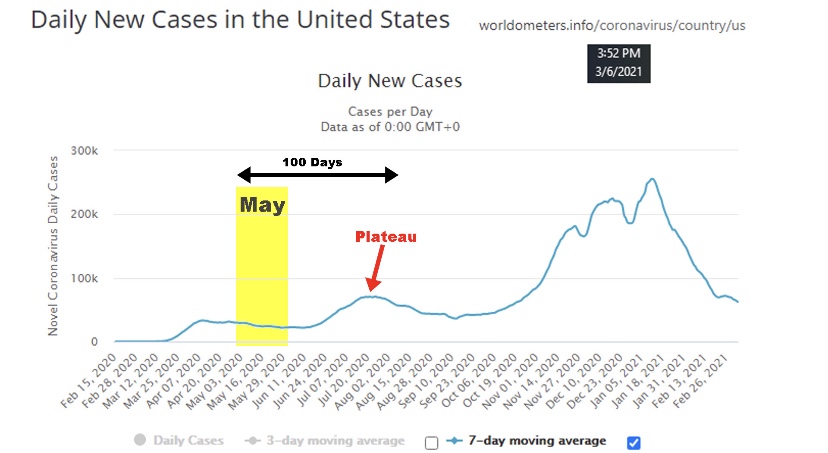
Finally, the measurement of effects covered 100 days after the policy change, but this window spans different stages of the pandemic. There were three waves of infections during 2020, which correspond to the classic Hope-Simpson pattern of virus seasonality. One was near year-end, but as each of the first two waves tapered (April-May, August-September), it should be no surprise that many restrictions were lifted. Within two months, however, new waves had begun. Karl Dierenbach notes that most of the reopenings occurred in May. Here’s how he explains the pattern:

“The map on the left shows counties where there was no on-premises dining (pink) in restaurants as of the beginning of May (4/30). … The map on the right shows that by the end of May, almost the entire country moved to allow some on-premises dining (green).”

“In the 100 days after May 1, cases nationwide fell slightly, then began to rise, and then plateaued.”

“And what did the CDC find happened after restaurants were allowed (changing mostly in May) to have on-premises dining? … Surprise! The CDC found that cases fell slightly, then began to rise, and then plateaued.”

The summer “mini-wave” is typical of mid- and tropical-latitude seasonality. Thus, the CDC’s findings with respect to dining restrictions are likely an artifact of the strong seasonality of the virus, rather than having anything to do with the lifting of restrictions between waves.

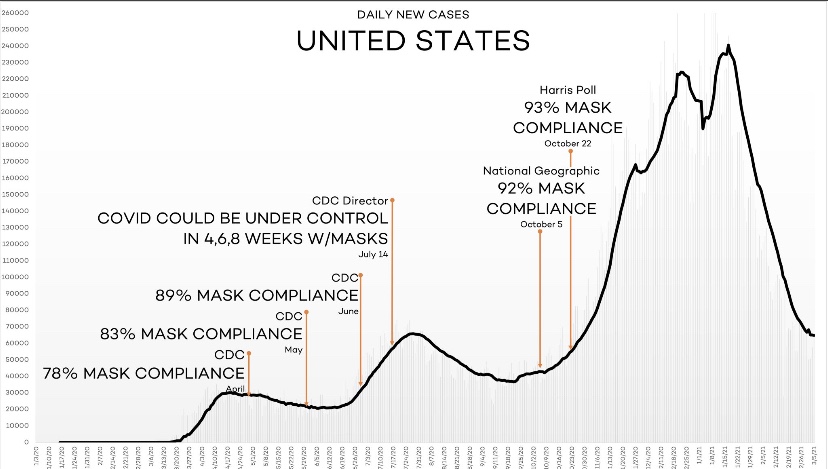
What about the imposition of mask mandates? The CDC’s findings show a much faster response in this case, with statistically significant changes in growth during the first 20 days. Another indicator of spurious correlation is that the growth response of deaths did not lag that of cases, but in fact deaths have reliably lagged cases by over 18 days during the pandemic. Again, the CDC’s caveats apply equally to its findings on masks. A large share of individuals adopted mask use voluntarily before mandates were imposed, so it’s not even clear that the mandates contributed much to the practice.

It’s a stretch to believe that mask mandates would have had an immediate, incremental effect on the growth of cases and deaths, given probable lags in compliance, exposure, and onset of symptoms. Moreover, a number of mask mandates in 2020 were imposed near the very peak of the seasonal waves. Little wonder that the growth rates of cases and deaths declined shortly thereafter.

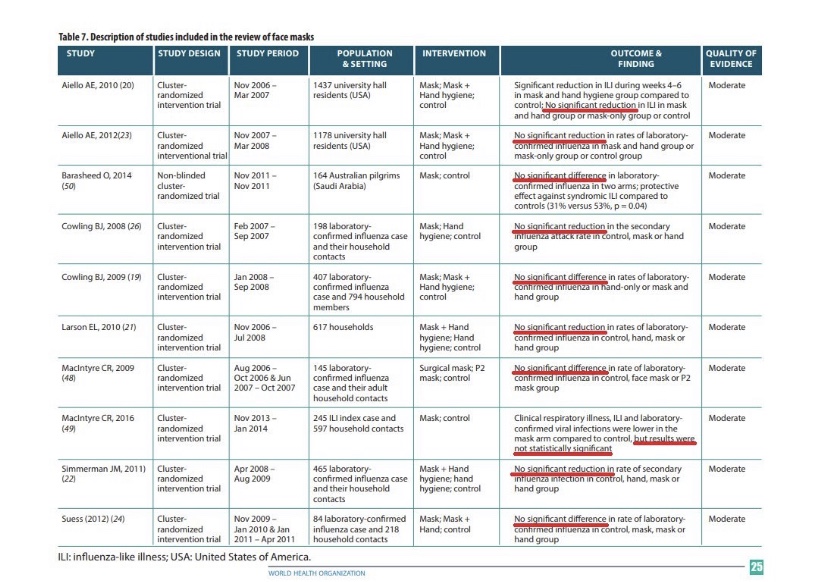
We’ve known for a long time that masks do little to stop the spread of viral particles. They become airborne as aerosols which easily penetrate the kind of cloth masks worn by most members of the public, to say nothing of making contact with their eyes. The table below contains citations to research over the past 10 years uniformly rejecting the hypothesis of a significant protective effect against influenza from masks. There is no reason to believe that they would be more effective in preventing C19 infections.

The CDC’s report on dining restrictions and mask mandates is a weak analysis. They wish to emphasize their faith in non-pharmaceutical interventions (NPIs) to minimize risks. They do so at a time when the vaccinated share of the most vulnerable population, the elderly, has climbed above 50% and is increasing steadily. Thus, risks are falling dramatically, so it’s past time to weigh the costs and benefits of NPIs more realistically. The timing of the report also seemed suspicious, coming as it did in the heat of the battle over the $1.9 trillion COVID relief bill, which subsequently passed.

It’s also a good time to note that zero risk, including “Zero COVID”, is not a realistic or worthwhile goal under any reasonable comparison of costs and benefits. Furthermore, NPIs have proven weak generally (also see here); claims to the contrary should always make us wary.

Hooray For Florida!

22 Monday Feb 2021

Posted by Nuetzel in Coronavirus, Public Health

≈ 2 Comments

Tags

Andrew Cuomo, Biden Administration, California, Coronavirus, Covid-19, Deaths, Florida, Hospitalizations, Infections, Lockdowns, NBC News, New York, Ron DeSantis, Stephen King, Vaccinations

It’s been said that many of the so-called “heroes” of the COVID pandemic who’ve been celebrated by the media are actually villains, and perhaps Governor Andrew Cuomo of New York should top the list. He saw to it that retirement homes were seeded with infected patients by ordering them returned their care homes rather than admitted to hospitals. Deaths in these facilities mounted, and they mounted faster than Cuomo’s administration was willing to admit. But the media and even Democrat state legislators have begun to take note, which is practically a miracle!

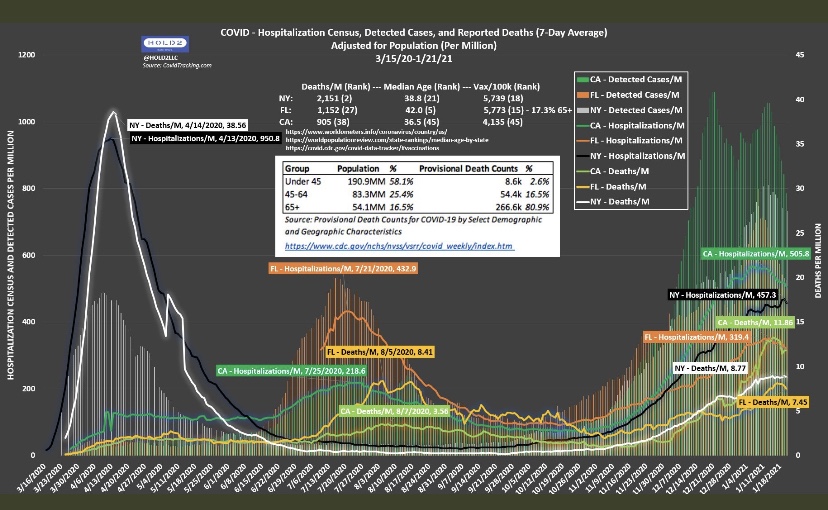
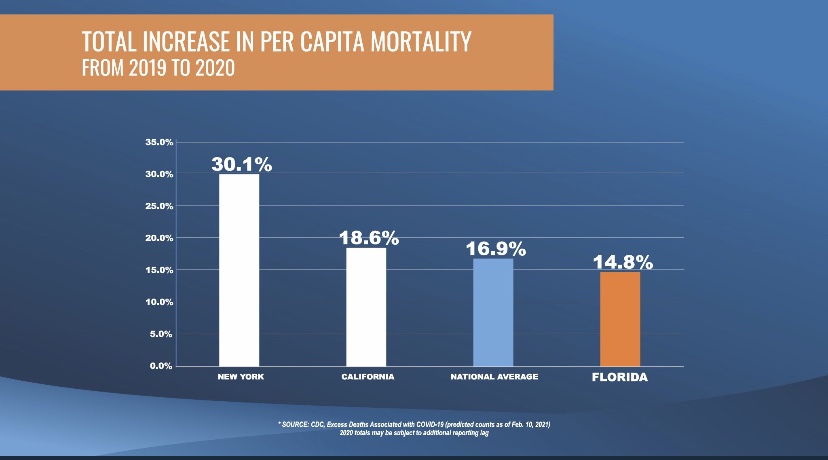
It seems equally true that some vilified by the media for their COVID response are actually heroes. Governor Ron DeSantis of Florida might deserve top honors here. Having spent the last month in Florida, I can attest that the business and social environment here is quite open compared to my home state (despite the presence of a few freaked out northerners who can’t quite fathom how stupid they look wearing masks on the beach). Florida’s infections, hospitalizations, and deaths have been lower than in California, New York, and many other states where lockdown measures have been stringent. (The first chart below is just a little busy…)

As I’ve written for much of the past year, COVID is far more dangerous to the elderly than anyone else, particularly those with co-morbidities. It’s also true that blacks (and some other minorities) are more vulnerable than whites, but if we want to save more black lives, we’re still better off prioritizing the elderly than racial groups. DeSantis understands this, and Florida is among the leaders in vaccinating the elderly population. (States don’t report this data on a uniform basis):

This approach to saving lives is obvious, yet critics at outlets like NBC News insist that DeSantis must be pandering to the senior population in Florida. Well, one wouldn’t want to be responsive to voters who happen to face high mortality risks, right? Others such as horror writer Stephen King have jumped onboard to offer their bumbling public health expertise as well.

There were many experts and the usual collection of numbskulls on social media who were wrong about Florida. DeSantis handled the pandemic as it should have been handled elsewhere. But the propaganda to the contrary goes unabated. For example, this article is pathetic. Can these people be serious? Or are they really that stupid? This goes for the Biden Administration as well, which had entertained the notion of imposing federal travel restrictions on Florida!

The political attacks on Florida and its governor reveal the extent to which opponents wish to ignore the evidence in plain sight. The data on COVID outcomes put the lie to the narrative of a public health emergency requiring massive restrictions on personal liberty. We know those policies are powerless to control the course of the contagion. The pandemic, however, was the key to convincing the public to accept a more authoritarian role for government. It’s a blessing that not everyone bought in, and that there are places like Florida where you can still go about your business in approximate normalcy.

Revisiting Excess Mortality

31 Sunday Jan 2021

Posted by Nuetzel in Coronavirus, Pandemic

≈ Leave a comment

Tags

All-Cause Mortality, Anthony Fauci, Ben Martin, Covid-19, Excess Deaths, Joe Biden, Lockdowns, Non-Pharmaceutical interventions, Pandemic

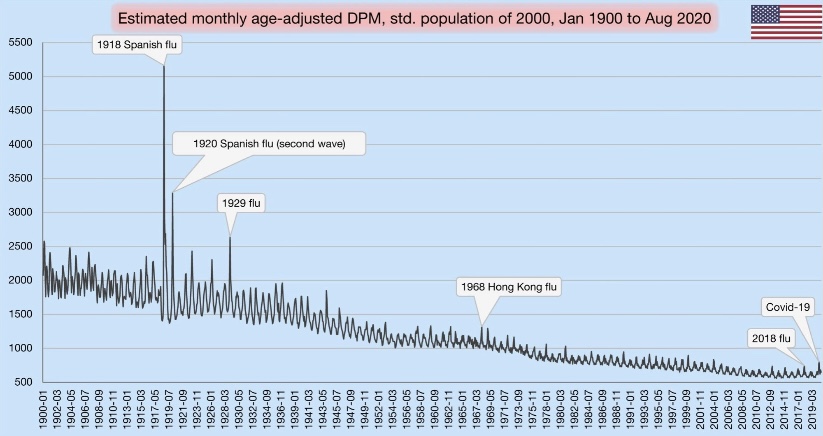
In early December I said that 2020 all-cause mortality in the U.S. would likely be comparable to figures from about 15 years ago. Now, Ben Martin confirms it with the chart below. Over time, declines in U.S. mortality have resulted from progress against disease and fewer violent deaths. COVID led to a jump in 2020, though some of last year’s deaths were attributable to policy responses, as opposed to COVID itself.

Here’s an even longer view of the trend from my post in December (for which 2020 is very incomplete):

As Martin notes sarcastically:

“Surprising, since the US is undergoing a ‘century pandemic‘ – In reality it is an event that’s unique in the last ‘15 years’”

The next chart shows 2020 mortality by month of year relative to the average of the past five years. Clearly, excess deaths have occurred compared to that baseline.

Using the range of deaths by month over the past 20 years (the blue-shaded band in the next chart), the 2020 figures don’t look quite as anomalous.

Finally, Martin shows total excess deaths in 2020 relative to several different baselines. The more recent (and shorter) the baseline time frame, the larger the excess deaths in 2020. Compared to the five-year average, 364,000 excess deaths occurred in 2020. Relative to the past 20 years, however, 150,000 excess deaths occurred last year. While those deaths are tragic, the pandemic looks more benign than when we confine our baseline to the immediate past.

Moreover, a large share of these excess deaths can be attributed to non-COVID causes of death that represent excesses relative to prior years, including drug overdoses, suicide, heart disease, dementia, and other causes. As many as 100,000 of these deaths are directly attributable lockdowns. That means true excess deaths caused by COVID infections were on the order of 50,000 relative to a 20-year baseline.

As infections subside from the fall wave, and as vaccinations continue to ramp up, some policy makers are awakening to the destructive impacts of non-pharmaceutical interventions (lockdown measures). The charts above show that this pandemic was never serious enough to justify those measures, and it’s not clear they can ever be justified in a free society. Yet some officials, including President Biden and Anthony Fauci, still labor under the misapprehension that masks mandates, stay-at-home orders, and restaurant closures can be effective or cost-efficient mitigation strategies.

Spate of Research Shows COVID Lockdowns Fail

27 Sunday Dec 2020

Posted by Nuetzel in Lockdowns, Public Health

≈ 4 Comments

Tags

@boriquagato, AIER, Covid-19, el gato malo, Hypothesis Testing, Ivor Cummins, Lockdowns, Model Calibration, Mortality, Non-Pharmaceutical interventions, Transmissability

For clarity, start with this charming interpretive one-act on public health policy in 2020. You might find it a little sardonic, but that’s the point. It was one of the more entertaining tweets of the day, from @boriquagato.

A growing body of research shows that stringent non-pharmaceutical interventions (NPIs) — “lockdowns” is an often-used shorthand — are not effective in stemming the transmission and spread of COVID-19. A compendium of articles and preprints on the topic was just published by the American Institute for Economic Research (AEIR): “Lockdowns Do Not Control the Coronavirus: The Evidence”. The list was compiled originally by Ivor Cummins, and he has added a few more articles and other relevant materials to the list. The links span research on lockdowns across the globe. It covers transmission, mortality, and other health outcomes, as well as the economic effects of lockdowns. AIER states the following:

“Perhaps this is a shocking revelation, given that universal social and economic controls are becoming the new orthodoxy. In a saner world, the burden of proof really should belong to the lockdowners, since it is they who overthrew 100 years of public-health wisdom and replaced it with an untested, top-down imposition on freedom and human rights. They never accepted that burden. They took it as axiomatic that a virus could be intimidated and frightened by credentials, edicts, speeches, and masked gendarmes.

The pro-lockdown evidence is shockingly thin, and based largely on comparing real-world outcomes against dire computer-generated forecasts derived from empirically untested models, and then merely positing that stringencies and “nonpharmaceutical interventions” account for the difference between the fictionalized vs. the real outcome. The anti-lockdown studies, on the other hand, are evidence-based, robust, and thorough, grappling with the data we have (with all its flaws) and looking at the results in light of controls on the population.”

We are constantly told that public intervention constitutes “leadership”, as if our well being depends upon behavioral control by the state. Unfortunately, it’s all too typical of research on phenomena deemed ripe for intervention that computer models are employed to “prove” the case. A common practice is to calibrate such models so that the outputs mimic certain historical outcomes. Unfortunately, a wide range of model specifications can be compatible with an historical record. This practice is also a far cry from empirically testing well-defined hypotheses against alternatives. And it is a practice that usually does poorly when the model is tested outside the period to which it is calibrated. Yet that is the kind of evidence that proponents of intervention are fond of using to support their policy prescriptions.

In this case, it’s even worse, with some of the alleged positive effects of NPI’s wholly made-up, with no empirical support whatsoever! So-called public health experts have misled themselves, and the public, with this kind of fake evidence, when they aren’t too busy talking out of both sides of their mouths.

On COVID, NPIs, and “Human” Data Points

24 Tuesday Nov 2020

Posted by Nuetzel in Lockdowns, Pandemic, Public Health

≈ 1 Comment

Tags

Alzheimer's, Anthony Fauci, Asymptomatic Carriers, Cancer, CDC, Centers for Disease Control, Covid-19, Dementia, Domestic Abuse, Education, HIV, Human Costs, Journal of the American Medical Association, Lancet, Lockdowns, Malaria, Malignant Neoplasms, Mandates, Masks, Public Health, Robert Redfield, SAAAD, SARS-CoV-2, Starvation, Suicide, The Ethical Skeptic, Tuberculoosis, Tyler Cowen, United Nations, Vitamin D

The other day a friend told me “your data points always seem to miss the people points.” He imagines a failure on my part to appreciate the human cost of the coronavirus. Evidently, he feels that I treat data on cases, hospitalizations, and deaths as mere accounting issues, all while emphasizing the negative aspects of government interventions.

This fellow reads my posts very selectively, hampered in part by his own mood affiliation. Indeed, he seems to lack an appreciation for the nuance and zeitgeist of my body of blogging on the topic… my oeuvre! This despite his past comments on the very things he claims I haven’t mentioned. His responses usually rely on anecdotes relayed to him by nurses or doctors he knows. Anecdotes can be important, of course. But I know nurses and doctors too, and they are not of the same mind as his nurses and doctors. Anecdotes! We’re talking about the determination of optimal policy here, and you know what Dr. Fauci says about relying on anecdotes!

Incremental Costs and Benefits

My friend must first understand that my views are based on an economic argument, one emphasizing the benefits and costs of particular actions, including human costs. COVID is dangerous, but primarily to the elderly, and no approach to managing the virus is free. Here are two rather disparate choices:

  1. Mandated minimization of economic and social interactions throughout society over some time interval in the hope of reducing the spread of the virus;
  2. Laissez faire for the general population while minimizing dangers to high-risk individuals, subject to free choice for mentally competent, high-risk individuals.

To be clear, #2 entails all voluntary actions taken by individuals to mitigate risks. Therefore, #1 implies a set of incremental binding restrictions on behavior beyond those voluntary actions. However, I also include in #1 the behavioral effects of scare mongering by public officials, who regularly issue pronouncements having no empirical basis.

The first option above entails so-called non-pharmaceutical interventions (NPIs) by government. These are the elements of so-called lockdowns, such as quarantines and other restrictions on mobility, business and consumer activity, social activities, health care activities, school closures, and mask mandates. NPIs carry costs that are increasing in the severity of constraints they impose on society.

And before I proceed, remember this: tallying all fatal COVID cases is really irrelevant to the policy exercise. Nothing we do, or could have done, would save all those lives. We should compare what lives can be saved from COVID via lockdowns, if any, with the cost of those lockdowns in terms of human life and human misery, including economic costs.

Economic Losses

NPIs involve a loss of economic output that can never be recovered… it is gone forever, and a loss is likely to continue for some time to come. That sounds so very anodyne, despite the tremendous magnitude of the loss involved. But let’s stay with it for just a second. The loss of U.S. output in 2020 due to COVID has been estimated at $2.5 trillion. As Don Boudreaux and Tyler Cowen have noted, what we normally spend on safety and precautionary measures (willingness-to-pay), together with the probabilities of losses, implies that we value our lives at less than $4 million on average. Let’s say the COVID death toll reaches 300,000 by year-end (that’s incremental in this case— but it might be a bit high). That equates to a total loss of $1.2 trillion in life-value if we ignore distinctions in life-years lost. Now ask this: if our $2.5 trillion output loss could have saved every one of those 300,000 lives, would it have been worth it? Not even close, and the truth is that the sacrifice will not have saved even a small fraction of those lives. I grant, however, that the economic losses are partly attributable to voluntary decisions, but goaded to a great extent by the alarmist commentary of public health officials.

The full depth of losses is far worse than the dollars and cents comparison above might sound. Output losses are always matched by (and, in value, are exactly the same as) income losses. That involves lost jobs, lost hours, failed businesses, and destroyed careers. Ah, now we’re getting a bit more “human”, aren’t we! It’s nothing short of callous to discount these costs. Unfortunately, the burden falls disproportionately on low-income workers. Our elites can mostly stay home and do their jobs remotely, and earn handsome incomes. The working poor spend their time in line at food banks.

Yes, government checks can help those with a loss of income compete with elites for the available supply of goods, but of course that doesn’t replace the lost supply of goods! Government aid of this kind is a palliative measure; it doesn’t offset the real losses during a suspension of economic activity.

Decimated Public Health

The strain of the losses has been massive in the U.S. and nearly everywhere in the world. People are struggling financially, making do with less on the table, depleting their savings, and seeking forbearance on debts. The emotional strains are no less real. Anxiety is rampant, drug overdoses have increased, calls to suicide hotlines have exploded, and the permanence of the economic losses may add to suicide rates for some time to come. Dr. Robert Redfield of the CDC says more teenagers will commit suicide this year than will die from COVID (also see here). There’s also been a terrifying escalation in domestic abuse during the pandemic, including domestic homicide. The despair caused by economic losses is all too real and should be viewed as a multiplier on the total cost of severe NPIs.

More on human costs: a health care disaster has befallen locked-down populations, including avoidance of care on account of panic fomented by so-called public health experts, the media, and government. Some of the consequences are listed here. But to name just a few, we have huge numbers of delayed cancer diagnoses, which sharply decrease survival time; mass avoidance of emergency room visits, including undiagnosed heart attacks and strokes; and unacceptable delays in cardiac treatments. Moreover, lockdowns worldwide have severely damaged efforts to deal with scourges like HIV, tuberculosis, and malaria.

The CDC reports that excess mortality among 25-44 year-olds this year was up more than 26%, and the vast bulk of these were non-COVID deaths. A Lancet study indicates that a measles outbreak is likely in 2021 due to skipped vaccinations caused by lockdowns. The WHO estimates that 130,000,000 people are starving worldwide due to lockdowns. That is roughly the population of the U.S. east coast. Again, the callousness with which people willfully ignore these repercussions is stunning, selfish and inhumane, or just stupid.

Excess Deaths

Can we quantify all this? Yes we can, as a matter of fact. I’ve offered estimates in the past, and I already mentioned that excess deaths, COVID and non-COVID, are reported on the CDC’s web site. The Ethical Skeptic (TES) does a good job of summarizing these statistics, though the last full set of estimates was from October 31. Here is the graphic from the TES Twitter feed:

Note particularly the huge number of excess deaths attributable to SAAAD (Suicide, Addiction Abandonment, Abuse and Despair): over 50,000! The estimate of life-years lost due to non-COVID excess deaths is almost double that of COVID deaths because of the difference in the age distributions of those deaths.

Here are a few supporting charts on selected categories of excess deaths, though they are a week behind the counts from above. The first is all non-COVID, natural-cause excess deaths (the vertical gap between the two lines), followed by excess deaths from Alzheimer’s and dementia, other respiratory diseases, and malignant neoplasms (cancer):

The clearest visual gap in these charts is the excess Alzheimer’s and dementia deaths. Note the increase corresponding to the start of the pandemic, when these patients were suddenly shut off from loved ones and the company of other patients. I also believe some of these deaths were (and are) due to overwhelmed staff at care homes struck by COVID, but even discounting this category of excess deaths leaves us with a huge number of non-COVD deaths that could have been avoided without lockdowns. This represents a human cost over and above those tied to the economic losses discussed earlier.

Degraded Education and Health

Lockdowns have also been destructive to the education of children. The United Nations has estimated that 24 million children may drop out of school permanently as a result of lockdowns and school closures. This a burden that falls disproportionately on impoverished children. This article in the Journal of the American Medical Association Network notes the destructive impact of primary school closures on educational attainment. Its conclusions should make advocates of school closures reconsider their position, but it won’t:

“… missed instruction during 2020 could be associated with an estimated 5.53 million years of life lost. This loss in life expectancy was likely to be greater than would have been observed if leaving primary schools open had led to an expansion of the first wave of the pandemic.“

Lockdown Inefficacy

Lockdowns just don’t work. There was never any scientific evidence that they did. For one thing, they are difficult to enforce and compliance is not a given. Of course, Sweden offers a prime example that draconian lockdowns are unnecessary, and deaths remain low there. This Lancet study, published in July, found no association between lockdowns and country mortality, though early border closures were associated with lower COVID caseloads. A French research paper concludes that public decisions had no impact on COVID mortality across 188 countries, U.S. states, and Chinese states. A paper by a group of Irish physicians and scientists stated the following:

“Lockdown has not previously been employed as a strategy in pandemic management, in fact it was ruled out in 2019 WHO and Irish pandemic guidelines, and as expected, it has proven a poor mitigator of morbidity and mortality.”

One of the chief arguments in favor of lockdowns is the fear that asymptomatic individuals circulating in the community (and there are many) would spread the virus. However, there is no evidence that they do. In part, that’s because the window during which an individual with the virus is infectious is narrow, but tests may detect tiny fragments of the virus over a much longer span of time. And there is even some evidence that lockdown measures may increase the spread of the virus!

Lockdown decisions are invariably arbitrary in their impact as well. The crackdown on gyms is one noteworthy example, but gyms are safe. Restaurants don’t turn up in many contact traces either, and yet restaurants have been repeatedly implicated as danger zones. And think of the many small retailers shut down by government, while giant competitors like Wal-Mart continue to operate with little restriction. This is manifest corporatism!

Then there is the matter of mask mandates. As readers of this blog know, I think masks probably help reduce transmission from droplets issued by a carrier, that is, at close range. However, this recent Danish study in the Annals of Internal Medicine found that cloth masks are ineffective in protecting the wearer. They do not stop aerosols, which seem to be the primary source of transmission. They might reduce viral loads, at least if worn properly and either cleaned often or replaced. Those are big “ifs”.

To the extent that masks offer any protection, I’m happy to wear them within indoor public accommodations, at least for the time being. To the extent that people are “scared”, I’m happy to observe the courtesy of wearing a mask, but not outside in uncrowded conditions. To the extent that masks are required under private “house rules”, of course I comply. Public mask mandates outside of government buildings are over the line, however. The evidence that those mandates work is too tenuous and our liberties are too precious too allow that kind of coercion. And private facilities should be subject to private rules only.

QED

So my poor friend is quite correct that COVID is especially deadly to certain cohorts and challenging for the health care community. But he must come to grips with a few realities:

  • The virus won’t be defeated with NPIs; they don’t work!
  • NPIs inflict massive harm to human well-being.
  • Lockdowns or NPIs are little or no gain, high-pain propositions.

The rejection of NPI’s, or lockdowns, is based on compelling “human” data points. As Don Boudreaux says:

“The lockdowns and other restrictions on economic and social activities are astronomically costly – in a direct economic sense, in an emotional and spiritual sense, and in a ‘what-the-hell-do-these-arbitrary-diktats-portend-for-our-freedom?’ sense.” 

This doctor has a message for the those denizens of social media with an honest wish to dispense helpful public health advice:

“Americans have admitted that they will meet for Thanksgiving. Scolding and shaming them for wanting this is unlikely to slow the spread of SARS-CoV-2, though it may earn you likes and retweets. Starting with compassion, and thinking of ways they can meet, but as safely as possible, is the task of real public health. Now is the time to save public health from social media.”

And take some Vitamin D!

← Older posts
Follow Sacred Cow Chips on WordPress.com

Recent Posts

  • Immigration and Merit As Fiscal Propositions
  • Tariff “Dividend” From An Indigent State
  • Almost Looks Like the Fed Has a 3% Inflation Target
  • Government Malpractice Breeds Health Care Havoc
  • A Tax On Imports Takes a Toll on Exports

Archives

  • December 2025
  • November 2025
  • October 2025
  • September 2025
  • August 2025
  • July 2025
  • June 2025
  • May 2025
  • April 2025
  • March 2025
  • February 2025
  • January 2025
  • December 2024
  • November 2024
  • October 2024
  • September 2024
  • August 2024
  • July 2024
  • June 2024
  • May 2024
  • April 2024
  • March 2024
  • February 2024
  • January 2024
  • December 2023
  • November 2023
  • August 2023
  • July 2023
  • June 2023
  • May 2023
  • April 2023
  • March 2023
  • February 2023
  • January 2023
  • December 2022
  • November 2022
  • October 2022
  • September 2022
  • August 2022
  • July 2022
  • June 2022
  • May 2022
  • April 2022
  • March 2022
  • February 2022
  • January 2022
  • December 2021
  • November 2021
  • October 2021
  • September 2021
  • August 2021
  • July 2021
  • June 2021
  • May 2021
  • April 2021
  • March 2021
  • February 2021
  • January 2021
  • December 2020
  • November 2020
  • October 2020
  • September 2020
  • August 2020
  • July 2020
  • June 2020
  • May 2020
  • April 2020
  • March 2020
  • February 2020
  • January 2020
  • December 2019
  • November 2019
  • October 2019
  • September 2019
  • August 2019
  • July 2019
  • June 2019
  • May 2019
  • April 2019
  • March 2019
  • February 2019
  • January 2019
  • December 2018
  • November 2018
  • October 2018
  • September 2018
  • August 2018
  • July 2018
  • June 2018
  • May 2018
  • April 2018
  • March 2018
  • February 2018
  • January 2018
  • December 2017
  • November 2017
  • October 2017
  • September 2017
  • August 2017
  • July 2017
  • June 2017
  • May 2017
  • April 2017
  • March 2017
  • February 2017
  • January 2017
  • December 2016
  • November 2016
  • October 2016
  • September 2016
  • August 2016
  • July 2016
  • June 2016
  • May 2016
  • April 2016
  • March 2016
  • February 2016
  • January 2016
  • December 2015
  • November 2015
  • October 2015
  • September 2015
  • August 2015
  • July 2015
  • June 2015
  • May 2015
  • April 2015
  • March 2015
  • February 2015
  • January 2015
  • December 2014
  • November 2014
  • October 2014
  • September 2014
  • August 2014
  • July 2014
  • June 2014
  • May 2014
  • April 2014
  • March 2014

Blogs I Follow

  • Passive Income Kickstart
  • OnlyFinance.net
  • TLC Cholesterol
  • Nintil
  • kendunning.net
  • DCWhispers.com
  • Hoong-Wai in the UK
  • Marginal REVOLUTION
  • Stlouis
  • Watts Up With That?
  • Aussie Nationalist Blog
  • American Elephants
  • The View from Alexandria
  • The Gymnasium
  • A Force for Good
  • Notes On Liberty
  • troymo
  • SUNDAY BLOG Stephanie Sievers
  • Miss Lou Acquiring Lore
  • Your Well Wisher Program
  • Objectivism In Depth
  • RobotEnomics
  • Orderstatistic
  • Paradigm Library
  • Scattered Showers and Quicksand

Blog at WordPress.com.

Passive Income Kickstart

OnlyFinance.net

TLC Cholesterol

Nintil

To estimate, compare, distinguish, discuss, and trace to its principal sources everything

kendunning.net

The Future is Ours to Create

DCWhispers.com

Hoong-Wai in the UK

A Commonwealth immigrant's perspective on the UK's public arena.

Marginal REVOLUTION

Small Steps Toward A Much Better World

Stlouis

Watts Up With That?

The world's most viewed site on global warming and climate change

Aussie Nationalist Blog

Commentary from a Paleoconservative and Nationalist perspective

American Elephants

Defending Life, Liberty and the Pursuit of Happiness

The View from Alexandria

In advanced civilizations the period loosely called Alexandrian is usually associated with flexible morals, perfunctory religion, populist standards and cosmopolitan tastes, feminism, exotic cults, and the rapid turnover of high and low fads---in short, a falling away (which is all that decadence means) from the strictness of traditional rules, embodied in character and inforced from within. -- Jacques Barzun

The Gymnasium

A place for reason, politics, economics, and faith steeped in the classical liberal tradition

A Force for Good

How economics, morality, and markets combine

Notes On Liberty

Spontaneous thoughts on a humble creed

troymo

SUNDAY BLOG Stephanie Sievers

Escaping the everyday life with photographs from my travels

Miss Lou Acquiring Lore

Gallery of Life...

Your Well Wisher Program

Attempt to solve commonly known problems…

Objectivism In Depth

Exploring Ayn Rand's revolutionary philosophy.

RobotEnomics

(A)n (I)ntelligent Future

Orderstatistic

Economics, chess and anything else on my mind.

Paradigm Library

OODA Looping

Scattered Showers and Quicksand

Musings on science, investing, finance, economics, politics, and probably fly fishing.

  • Subscribe Subscribed
    • Sacred Cow Chips
    • Join 128 other subscribers
    • Already have a WordPress.com account? Log in now.
    • Sacred Cow Chips
    • Subscribe Subscribed
    • Sign up
    • Log in
    • Report this content
    • View site in Reader
    • Manage subscriptions
    • Collapse this bar
 

Loading Comments...