• About

Sacred Cow Chips

Sacred Cow Chips

Tag Archives: Monetary policy

Almost Looks Like the Fed Has a 3% Inflation Target

16 Sunday Nov 2025

Posted by Nuetzel in Inflation, Monetary Policy

≈ Leave a comment

Tags

ADP Employment Report, Core PCE Deflator, Covid Restrictions, David Beckworth, Donald Trump, Dual Mandate, Employment Mandate, FAIT, Federal Funds Target, Flexible Average Inflation Targeting, Inflation Bias, Inflation Target, Jerome Powell, Mark Sobel, Monetary policy, Policy Asymmetry, Price Stability, Quantitative Tightening, Robert Brusca, Scott Sumner, Tariffs
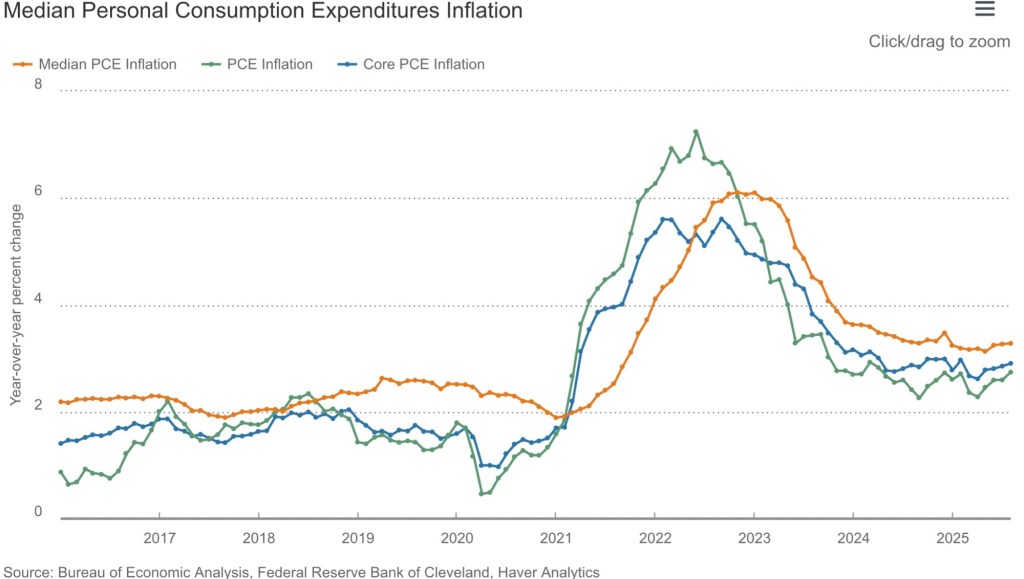
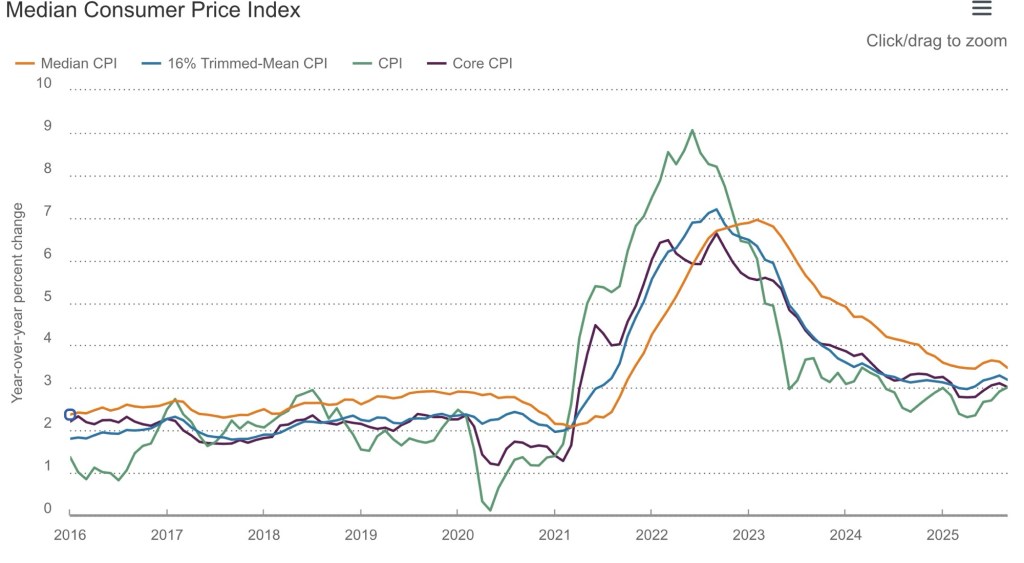
Inflation leveled off below 3% in 2024 and has drifted around the 3% level in 2025. The rate of increase in the core PCE (Personal Consumption Deflator) is the inflation measure of most interest to the Federal Reserve as a policy reference, but advances in the core CPI (Consumer Price Index) have settled at about the same level. The core inflation rates exclude food and energy prices due to the volatility of those components, but even with food and energy, inflation in the PCE and the CPI have been running near 3%.
It’s a 2% Target… Or Is It?

The Fed continues to maintain that its “official” inflation target is 2% for the core PCE. However, the central bank is now easing policy despite inflation running a full percentage point faster than the target. The rationale turns on the Fed’s dual mandate to maintain both “price stability” and full employment, goals that are not always compatible.

Currently, the labor market is showing signs of weakness, so the Fed has elected to ease policy by guiding the federal funds rate downward, and by putting a stop to run-off in its balance sheet holdings of securities. The latter ends a brief period of so-called quantitative tightening.

Just a couple of months ago, the central bank announced a new emphasis on targeting 2% inflation in the long run, with notable differences from the “flexible average inflation targeting” (FAIT) that it claimed to have adopted in 2020. In some respects, the Fed appeared to be giving more primacy to the “2%” definition of price stability than to the full employment mandate. Yet the “new approach” still allows plenty of wiggle room and might not differ much from the approach followed prior to FAIT.

No FAITful Error

Here’s how David Beckworth characterizes the way FAIT ultimately played out. He says that in practice the Fed took:

“… an asymmetric approach to the dual mandate: It would implement makeup policy on misses below the inflation target, and it would respond to shortfalls from maximum employment. These asymmetries, while well- intended, created an inflationary bias that caused FAIT to fail the ‘stress test’ of the 2021–22 inflation surge. This failure caused the Fed to effectively abandon FAIT in early 2022 and become a single-mandate central bank focused on price stability.“

Scott Sumner says the Fed never really really practiced FAIT to begin with. It should have been a symmetric policy, but it wasn’t. During 2021-22, the Fed did not attempt to correct for rising inflation. Instead, it focused on the recessionary effects of Covid and the impingements of Covid-era restrictions on employment.

Clearly, Covid was a shock that monetary policy was ill-suited to address without reinforcing inflation. Furthermore, the pandemic inflation was thought by the Fed to be transitory, but easing policy was a critical error. Stimulating demand via monetary accommodation gave inflation more permanence than the Fed apparently expected.

Lost In the Tea Leaves Again

While a strong commitment to price stability is welcome, it’s not clear that is what’s guiding the Fed’s decisions at the moment. Again, the Fed’s preferred inflation gauge has flattened out at around 3%. However, with uncertainty about tariffs and tariff pass throughs in 2026, the weak dollar, and unrelenting Treasury borrowing, easier monetary conditions could well set the stage for persistent inflation above 3%, despite the official 2% target. That might help explain the failure of longer-term interest rates to decline in the wake of the Fed’s latest quarter-point cut in the federal funds target in October.

Suspicious Minds

Speculation that the Fed is allowing its true inflation target to creep upward is hardly new. Back in June, former New York Fed economist Robert Brusca noted the following:

“A Cleveland Fed survey already has the business community thinking that the REAL target for inflation is 2.5%.”

More recently, Mark Sobel of the Official Monetary and Fiscal Institutions Forum stated that the real target, for now, is probably 3%:

“But could the Fed stealthily and unintentionally end up near 3%? Even apart from above-target inflation in recent years, short- and longer-term structural forces are at play that could usher in slightly higher inflation, notwithstanding Fed speeches on the sanctity of the 2% inflation target.“

Chewing On Data

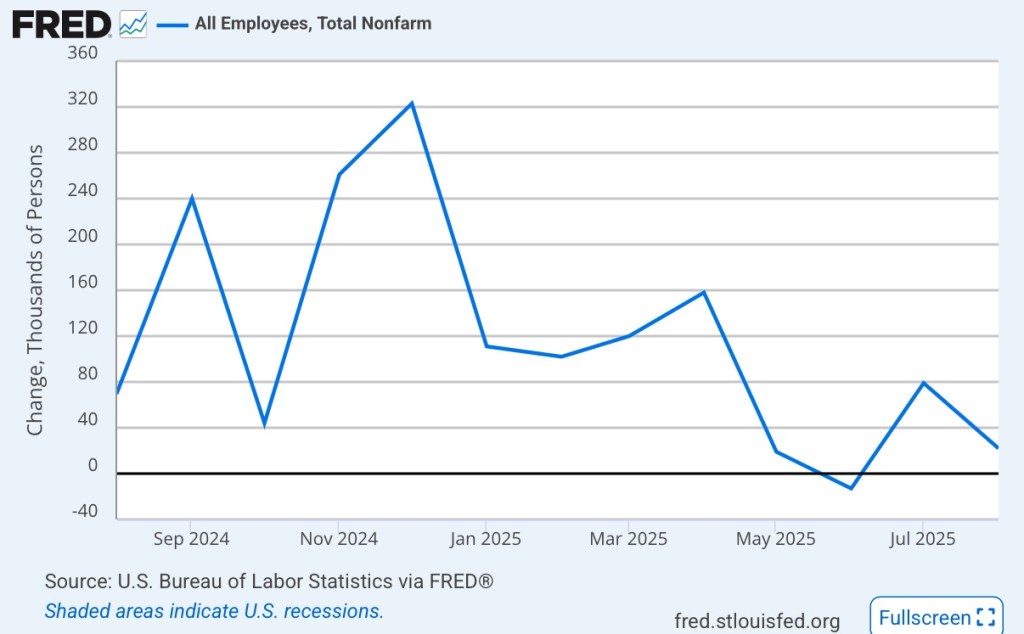
It’s pretty clear that the Fed has become a skittish about the pace of the real economy, lending more weight to the full employment part of its dual mandate. Employment growth slowed over the past year, partly due to government employee buy-outs and separations of illegal immigrants from their employers. The last official employment report was in early September, however, so the nonfarm payroll data is two months out-of-date:
Private payroll growth from ADP over the past two months has not looked especially encouraging:
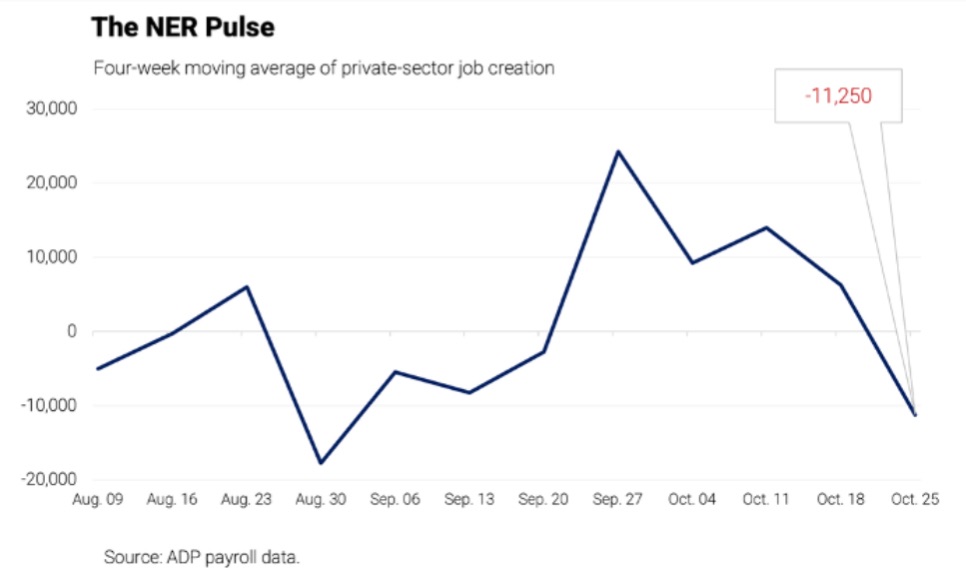
Tariffs and weakened profit margins have likely had a contractionary effect, and the six-week government shutdown just ended will shave 0.5% or more off fourth quarter GDP growth. Furthermore, while money (M2) growth has accelerated over the past year, it remains fairly restrained.
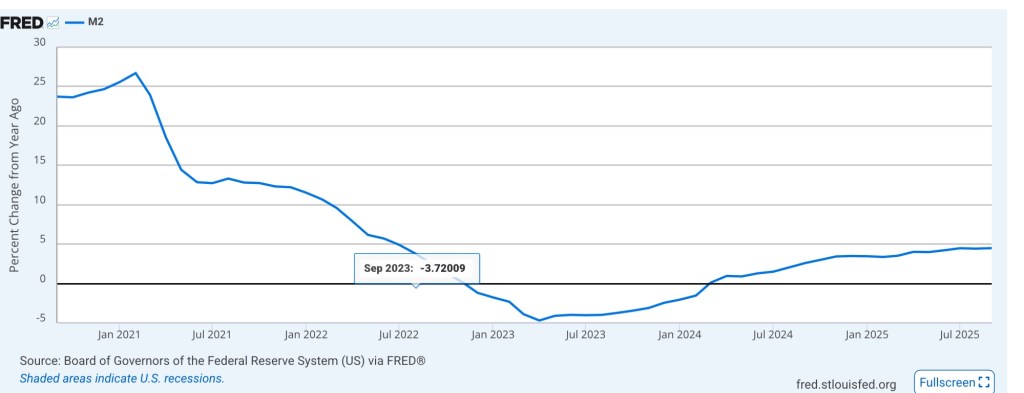
And the monetary base has been pretty flat for most of 2025:
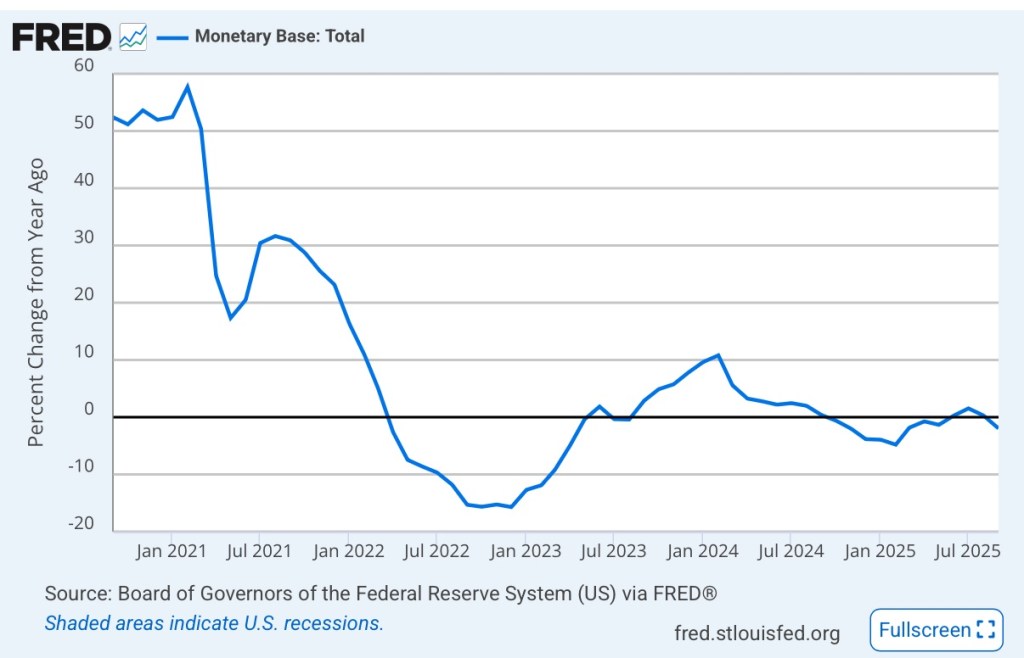
We’ll see where these aggregates go from here. The extended “restraint” might now be of some concern to the Fed, given recent doubts about employment and economic growth. Still, in October, Fed Chairman Jerome Powell said that another quarter-point cut in the federal funds rate target in December was not a foregone conclusion. That statement seems to have worried equity investors while offering little solace to bond investors.

Aborted Landing

If (and as long as) the Fed gives primacy or greater weight in its policy deliberations to employment than inflation, it might as well have adopted an inflation target of 3% or more. The additional erosion in purchasing power wrought by that leniency is bad enough, but the effect of monetary policy on the real side of the economy is more poorly understood than its effect on nominal variables. The Fed’s shift in priorities is both unreliable on the real side and dangerous in terms of price stability. These concerns are even more salient given the upcoming appointment (in May) of a new Fed Chairman by President Trump, who seems eager for easy money.


Macro Policy As a Hindrance To Growth

03 Monday Mar 2025

Posted by Nuetzel in Growth, Stimulus

≈ 1 Comment

Tags

Bankruptcy, Ben Landau-Taylor, Business Failures, Business Reorganization, Christine Liu, Creative Destruction, Fiscal policy, Industrial Policy, Joseph Schumpeter, Loan Guarantees, Monetary policy, Protectionism, Selective Taxes, Subsidies, Trade Barriers, Zombie Firms

Creative destruction takes place when inefficient producers are outcompeted by other firms, especially those brandishing new technologies. The concept, originally developed by Joseph Schumpeter in the 1940s, came to be accepted as a hallmark of market dynamics and capitalism. Successful market entrants rise to compete and eventually cripple incumbent producers who’ve grown stale in their offerings, inputs, or methods.

Creative destruction encourages long-term economic growth in several ways. First, it allows unproductive firms to fail, freeing resources to be absorbed by firms having solid growth opportunities. Second, creative destruction enables the diffusion of new technologies. Third, it motivates incumbents to improve their game, adapting to new realities in the marketplace. This is a continuous process. There are always firms that fail to keep pace with their competitors, whether old-line producers or failing risk-takers, but this is especially the case during periods of economic weakness.

Harmful Policy Menu

Attempting to prevent creative destruction via public policy is counter-productive, anti-competitive, and it impedes economic growth. Yet we constantly expend well-meaning energies to short circuit the process by attempting to promote uneconomic technologies, shield established firms from competition, and resuscitate dying firms. These efforts include industrial policies, barriers to foreign trade, excessive regulation of new technologies, selective taxation, certain bankruptcy reorganizations, and outright bailouts.

Creative destruction is a sign of flourishing competition, but it is subverted by industrial policies that subsidize politically-favored firms that otherwise would be uncompetitive. These policies create artificial advantages that waste public resources on what are often just bad ideas (see here and here).

Likewise, protectionism breeds weakness while shielding domestic producers from competition. And selective taxes, such as those on online sales, create an uneven playing field, blunting competitive forces.

Policies that encourage the survival of “zombie firms” also thwart creative destruction. These are companies with chronic losses that manage to hang on, sometimes for many years, with refinanced debt. Companies and their lenders can expend a great deal of internal effort forestalling bankruptcy. However, it’s not uncommon for zombie firms to languish for years but ultimately fail even after bankruptcy reorganizations, especially when the sole focus is on financial restructuring rather than business operations.

Government sometimes steps in to prolong the survival of struggling firms via subsidies, loan guarantees, and protracted efforts to keep interest rates low. Bailouts of various kinds have become all too common. Bailout activity creates perverse incentives with respect to risk. It also wastes resources by propping up inefficient operators, trapping resources in uses that return less to society than their opportunity costs.

Macro Maleficence

Ben Landau-Taylor makes a provocative but sensible claim in an article entitled “Industrial Greatness Requires Economic Depressions”. It’s about an unfortunate side effect of government policies intended to stabilize the economy: business failures occur with greater frequency during economic contractions, and that’s when policymakers are most apt to render aid via expansionary fiscal and monetary actions. No one likes economic downturns and unemployment, so “stimulative” policy is easy to sell politically, despite its all-too-typical failures in terms of timing and efficacy (see here and here). One intent is to support firms whose travails are revealed by a weak economy, including those relying on obsolete technologies. It might buy them survival time, but on the public dime. Ultimately, by forestalling creative destruction, these policies undermine economic growth.

Landau-Taylor emphasizes that creative destruction is not costless. Business failures and job losses are painful. And creative destruction brought on by dramatic advances can actually cause recessions or even depressions. Is that a rationale for delaying the inevitable failure of weak incumbents and impeding the broad adoption of new technologies? Our long-term well-being might dictate that we allow such transitions to take place by shunting aside interventionist temptations.

As a rationale for intervention, it’s sometimes said that we can’t regain the output lost during contractions. An appropriate riposte is that government efforts to counter recessionary forces are almost always futile. Furthermore, the lost output might be a pittance relative to the growth and permanent gains made possible by allowing creative destruction to run its course, liberating resources for better opportunities and growth.

On this point, Landau-Taylor says:

“If we want our descendants in 2125 to surpass our living standards the way we surpass our ancestors from 1925, then we will have to permit economic transformations at the scale that our ancestors did, including bankruptcies, job losses, and the cascading depressions that result. The individual pain of depressions does not have to be quite so severe as it once was. Because we are richer, we can and do spend vastly more on welfare, but this should be directed at individuals rather than at megacorporations. But there will always be some pain.“

Conclusion

Too often public policy creates obstacles to natural and healthy market processes, including creative destruction. This prevents the economy from reaching its true growth potential. Subsidies, bailouts, protectionism, and arguably macroeconomic stimulus, too often give safe harbor to struggling producers who manage to retain control over resources having more valued uses, including firms relying on obsolete and impractical technologies. Recessions typically expose firms with the weakest market prospects, but countercyclical fiscal and monetary policy may give them cover, forestalling their inevitable decline. Thus, we risk throwing good resources after bad, foregoing opportunities for growth and a more prosperous future.

JoyPolitik: Greed, Gouging, and Gullability

18 Wednesday Sep 2024

Posted by Nuetzel in Inflation, Price Controls

≈ 1 Comment

Tags

Antitrust, Greed, Ham Sandwich Nation, Hoarding, Inflation, Interventionism, Kamala Harris, Mark-Ups, Market Concentration, Markets, Michael Munger, Monetary policy, Predatory Pricing, Price Fixing, Price Gouging, Price Rationing, Shortages, Supply Shocks

Economic ignorance and campaign politics seem to go hand-in-hand, especially when it comes to the rhetoric of avowed interventionists. They love “easy” answers. If they get their way, negative but predictable consequences are always “unintended” and/or someone else’s fault. Unfortunately, too many journalists and voters like “easy” answers, and they repeatedly fall for the ploy.

This post highlights one of many bad ideas coming out of the Kamala Harris campaign. I probably won’t have time to cover all of her bad ideas before the election. There are just too many! I hope to highlight a few from the Trump campaign as well. Unfortunately, the two candidates have more than one bad idea in common.

Price Gouging

Here I’ll focus on Harris’ destructive proposal for a federal ban on “price gouging”. Unfortunately, she has yet to define precisely what she means by that term. On its face, she’d apparently support legislation authorizing the DOJ to go after grocers, gas stations, or other sellers in visible industries charging prices deemed excessive by the federal bureaucracy. This is a form of price control and well in keeping with the interventionist mindset.

As Michael Munger has said, when you charge “too much” you are “gouging”; when you charge “too little” you are “predatory”; and when you charge the same price as competitors you’ve engaged in a price fixing conspiracy. The fact that Harris’ proposal is deliberately vague is an even more dangerous invitation to arbitrary caprice by federal enforcers. It might be hard to price a ham sandwich without breaking such a law.

The great advantage of the price system is its impersonal coordination of the actions of disparate agents, creating incentives for both buyers and sellers to direct resources toward their most valued uses. Price controls of any kind short circuit that coordination, inevitably leading to shortages (or surpluses), misallocations, and diminished well being.

Inflation As Aggregate Macro Gouging

Aside from vote buying, Harris has broader objectives than the usual “anti-gouging” sentiment that accompanies negative supply shocks. She’s faced mounting pressure to address prices that have soared during the Biden Administration. The inflation during and after the COVID pandemic was induced by supply shortfalls first and then a spending/money-printing binge by the federal government. The pandemic induced shortages in some key areas, but the Treasury and the Fed together engineered a gigantic cash dump to accommodate that shock. This stimulated demand and turned temporary dislocations into permanently higher prices.

There were howls from the Left that greed in the private sector was to blame, despite plentiful evidence to the contrary. Blaming “price gouging” for inflated prices dovetails with Harris’ proclivity to inveigh against “corporate greed”. It’s typical leftist blather intended to appeal to anyone harboring suspicions of private property and the profit motive.

The profit motive is a compelling force for social good, motivating the performance of large corporations and small businesses alike. Diatribes against “greed” coming from the likes of a career politician with no private sector experience are not only unconvincing. They reveal childlike misapprehensions regarding economic phenomena.

More substantively, some have noted that mark-ups rose during and after the pandemic, but these markups are explained by normal cyclical fluctuations and the growing dominance of services in the spending mix. High margins are difficult to sustain without persistently high levels of demand. The Fed’s shift toward monetary restraint has dissipated much of that excessive demand pressure, but certainly not enough to bring prices back to pre-pandemic levels, which would require a severe economic contraction.

Claims that concentration among sellers has risen in some markets are also cited as evidence that greedy, price-gouging corporations are fueling inflation. If that is a real concern, then we might expect Harris to lean more heavily on antitrust policy. She should be circumspect in that regard: antitrust enforcement is too often used for terrible reasons (and also see here). In any case, rising market concentration does not necessarily imply a reduction in competitive pressures. Indeed, it might reflect the successful efforts of a strong competitor to please customers, delivering better value via quality and price. Moreover, mergers and acquisitions often result in stronger challenges to dominant players, energizing innovation, improved quality, and price competition.

If Harris is serious about minimizing inflation she should advocate for fiscal and monetary restraint. We’ve heard nothing of that from her campaign, however. No credible plans other than vaguely-defined price controls and promises to tax and spend our way to a joyful “opportunity economy”.

Disaster Supply Gouging

There is already a federal law against hoarding “scarce items” in times of war or national crisis and reselling at more than the (undefined) “prevailing market price”. There are also laws in 34 states with varying “anti-gouging” provisions, mostly applicable during emergencies only. These laws are counterproductive as they tend to “gouge” the flow of supplies.

In the aftermath of terrible storms or earthquakes, there are almost always shortages of critical goods like food, water, and fuel, not to mention specialized manpower, machinery, and materials needed for cleanup and restoration. As I pointed out some time ago, retailers often fail to adjust their prices under these circumstances, even as shelves are rapidly emptied. They are sometimes prohibited from repricing aggressively. If not, they are conflicted by the predictable hoarding that empties shelves, the higher costs of replenishing inventory, and the knowledge that price rationing creates undeservedly bad public relations. So retailers typically act with restraint to avoid any hint of “gouging” during crises.

Disasters often disrupt production and create physical barriers that hinder the very movement of goods. When prices are flexible and can respond to scarcity on the ground, suppliers can be very creative in finding ways to deliver badly needed supplies, despite the high costs those are likely to entail. Private sellers can do all this more nimbly and with greater efficiency than government, but they need price incentives to cover the costs and various risks. Price controls prevent that from happening, prolonging shortages at the worst possible time.

The chief complaint of those who oppose this natural corrective mechanism is that higher prices are “unfair”. And it is true that some cannot afford to pay higher prices induced by severe scarcity. The answer here is that government can write checks or even distribute cash, much as the government did nationwide during the pandemic. That’s about the only thing at which the state excels. Then people can afford to pay prices that reflect true levels of scarcity. If done selectively and confined to a regional level, the broader inflationary consequences are easily neutralized.

Instead, the knee-jerk reaction is to short-circuit the price mechanism and insist that available supplies be rationed equally. That might be a fine way for retailers to respond in the short run. Share the misery and prevent hoarding. But supplies will run low. When the shelves are empty, the price is infinite! That’s why sellers must have flexibility, not prohibitions.

Blame Game

Harris is engaged in a facile blame game at both the macro and micro level. She claims that inflation could be controlled if only corporations weren’t so greedy. Forget that they must cover their own rising costs, including the costs of compensating risk-averse investors. For that matter, she probably hasn’t gathered that a return to capital is a legitimate cost. Like many others, Harris seems ignorant of the elevated costs of bringing goods to market following either unpredictable disasters or during a general inflation. She also lacks any understanding of the benefits of relying on unfettered markets to bridge short-term gaps in supply. But none of this is surprising. She follows in a long tradition of ignorant interventionism. Let’s hope we have enough voters who aren’t that gullible.

“Hard Landing” Is Often Cost of Fixing Inflationary Policy Mistakes

05 Wednesday Oct 2022

Posted by Nuetzel in Inflation, Monetary Policy

≈ Leave a comment

Tags

Ample Reserves, Budget Deficit, Core CPI, Demand-Side Inflation, Energy Policy, Expected Inflation, Hard Landing, Inflation, Inflation Targeting, Inverted Yield Curve, Jeremy Siegel, John Cochrane, M2, Median CPI, Median PCE, Monetary Base, Monetary policy, PCE Deflator, Price Signals, Recession, Scott Sumner, Soft Landing, Supply-Side Inflation, Trimmed CPI

The debate over the Federal Reserve’s policy stance has undergone an interesting but understandable shift, though I disagree with the “new” sentiment. For the better part of this year, the consensus was that the Fed waited too long and was too dovish about tightening monetary policy, and I agree. Inflation ran at rates far in excess of the Fed’s target, but the necessary correction was delayed and weak at the start. This violated the necessary symmetry of a legitimate inflation-targeting regime under which the Fed claims to operate, and it fostered demand-side pressure on prices while risking embedded expectations of higher prices. The Fed was said to be “behind the curve”.

Punch Bowl Resentment

The past few weeks have seen equity markets tank amid rising interest rates and growing fears of recession. This brought forth a chorus of panicked analysts. Bloomberg has a pretty good take on the shift. Hopes from some economists for a “soft landing” notwithstanding, no one should have imagined that tighter monetary policy would be without risk of an economic downturn. At least the Fed has committed to a more aggressive policy with respect to price stability, which is one of its key mandates. To be clear, however, it would be better if we could always avoid “hard landings”, but the best way to do that is to minimize over-stimulation by following stable policy rules.

Price Trends

Some of the new criticism of the Fed’s tightening is related to a perceived change in inflation signals, and there is obvious logic to that point of view. But have prices really peaked or started to reverse? Economist Jeremy Siegel thinks signs point to lower inflation and believes the Fed is being too aggressive. He cites a series of recent inflation indicators that have been lower in the past month. Certainly a number of commodity prices are generally lower than in the spring, but commodity indices remain well above their year-ago levels and there are new worries about the direction of oil prices, given OPEC’s decision this week to cut production.

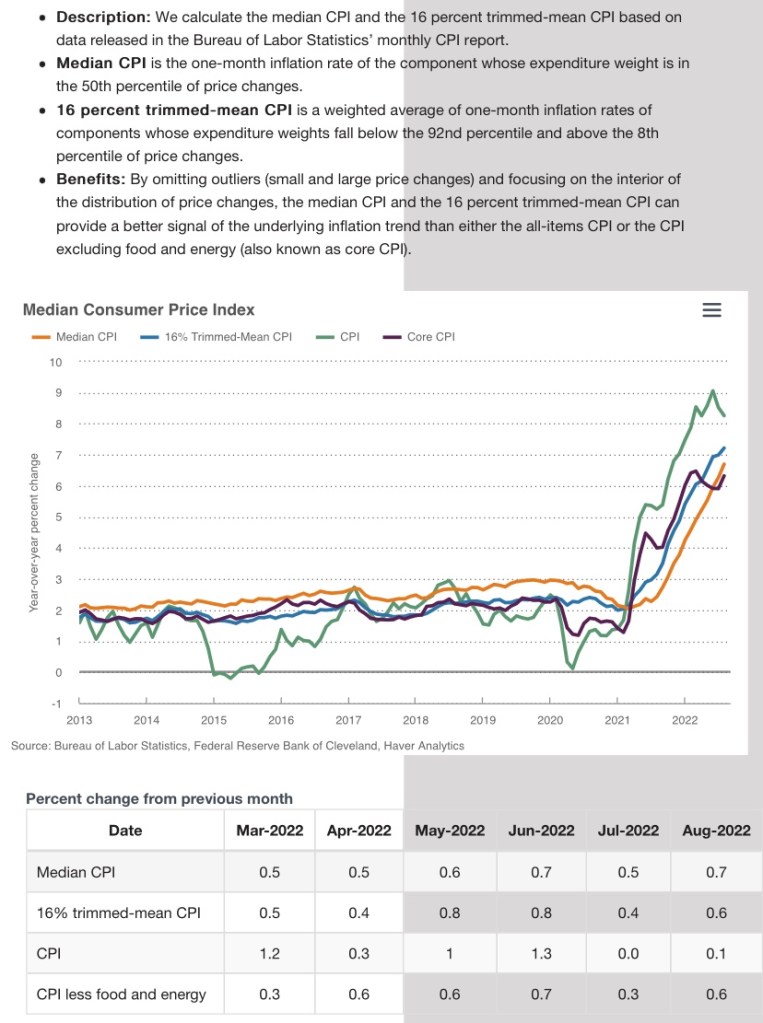
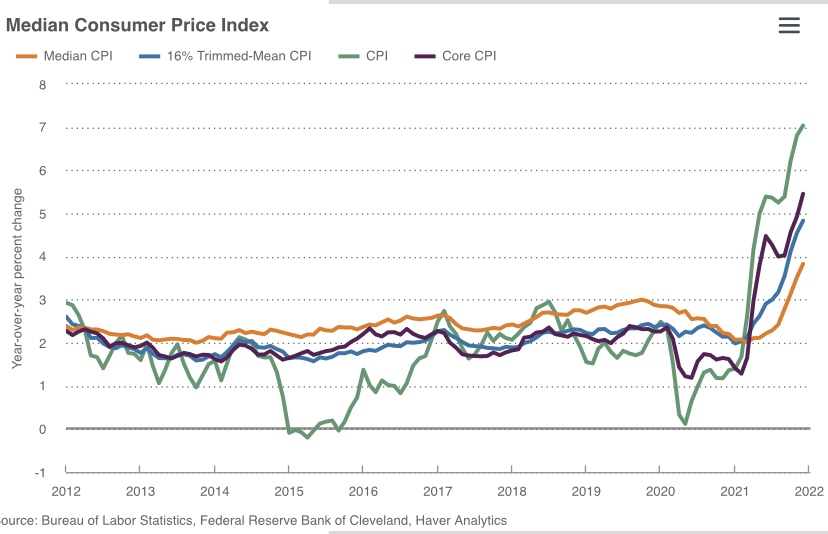
Central trends in consumer prices show that there is a threat of inflation that may be fairly resistant to economic weakness and Fed actions, as the following chart demonstrates:

Overall CPI growth stopped accelerating after June, and it wasn’t just moderation in oil prices that held it back (and that moderation might soon reverse). Growth of the Core CPI, which excludes food and energy prices, stopped accelerating a bit earlier, but growth in the CPI and the Core CPI are still running above 8% and 6%, respectively. More worrisome is the continued upward trend in more central measures of CPI growth. Growth in the median component of the CPI continues to accelerate, as has the so-called “Trimmed CPI”, which excludes the most extreme sets of high and low growth components. The response of those central measures lagged behind the overall CPI, but it means there is still inflationary momentum in the economy. There is a substantial risk that expectations of a more permanent inflation are becoming embedded in expectations, and therefore in price and wage setting, including long-term contracts.

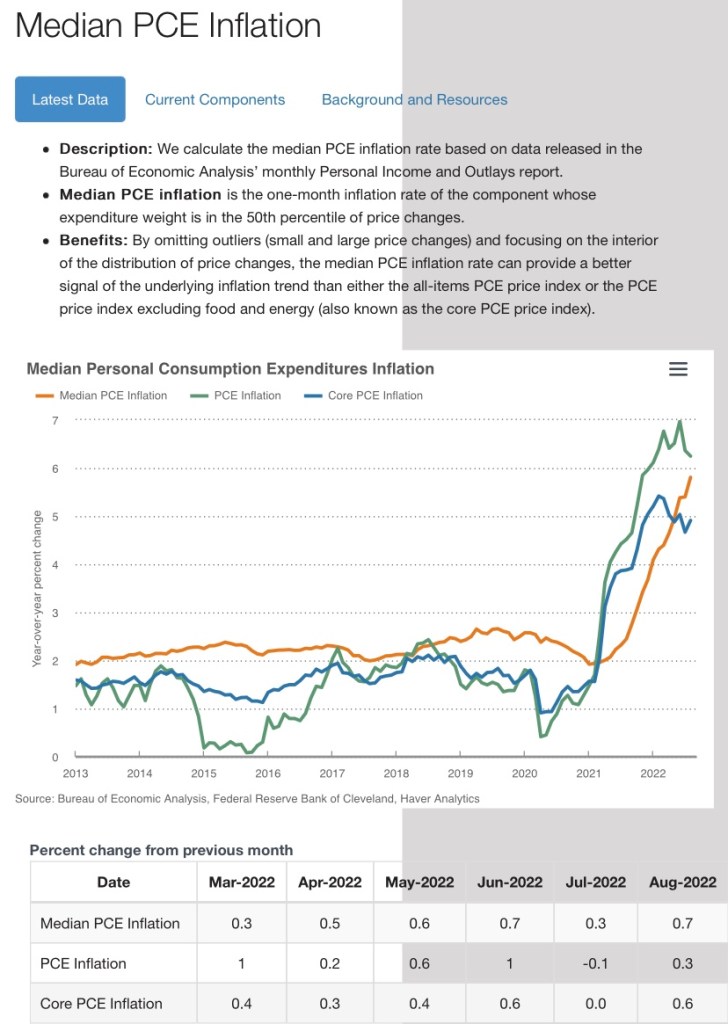
The Fed pays more attention to a measure of prices called the Personal Consumption Expenditures (PCE) deflator. Unlike the CPI, the PCE deflator accounts for changes in the composition of a typical “basket” of goods and services. In particular, the Fed focuses most closely on the Core PCE deflator, which excludes food and energy prices. Inflation in the PCE deflator is lower than the CPI, in large part because consumers actively substitute away from products with larger price increases. However, the recent story is similar for these two indices:

Both overall PCE inflation and Core PCE inflation stopped accelerating a few months ago, but growth in the median PCE component has continued to increase. This central measure of inflation still has upward momentum. Again, this raises the prospect that inflationary forces remain strong, and that higher and more widespread expected inflation might make the trend more difficult for the Fed to rein in.

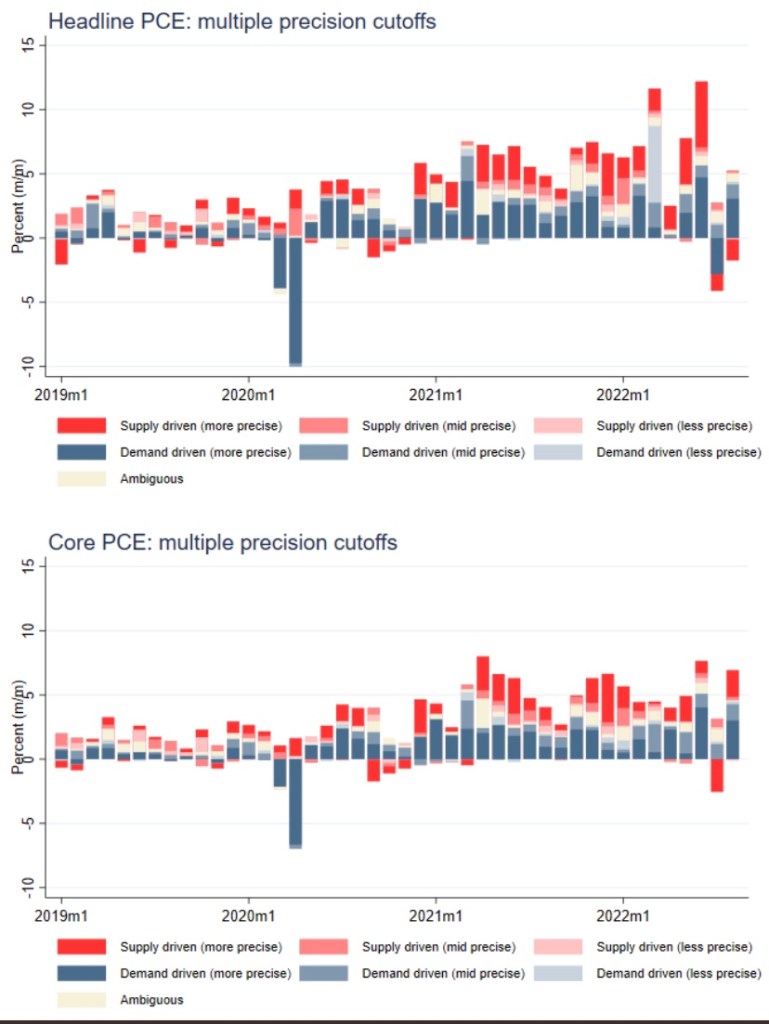
That leaves the Fed little choice if it hopes to bring inflation back down to its target level. It’s really a only a choice of whether to do it faster or slower. One big qualification is that the Fed can’t do much about supply shortfalls, which have been a source of price pressure since the start of the rebound from the pandemic. However, demand pressures have been present since the acceleration in price growth began in earnest in early 2021. At this point, it appears that they are driving the larger part of inflation.

The following chart shows share decompositions for growth in both the “headline” PCE deflator and the Core PCE deflator. Actual inflation rates are NOT shown in these charts. Focus only on the bolder colored bars. (The lighter bars represent estimates having less precision.) Red represents “supply-side” factors contributing to changes in the PCE deflator, while blue summarizes “demand-side” factors. This division is based on a number of assumptions (methodological source at the link), but there is no question that demand has contributed strongly to price pressures. At least that gives a sense about how much of the inflation can be addressed by actions the Fed might take.

I mentioned the role of expectations in laying the groundwork for more permanent inflation. Expected inflation not only becomes embedded in pricing decisions: it also leads to accelerated buying. So expectations of inflation become a self-fulfilling prophesy that manifests on both the supply side and the demand-side. Firms are planning to raise prices in 2023 because input prices are expected to continue rising. In terms of the charts above, however, I suspect this phenomenon is likely to appear in the “ambiguous” category, as it’s not clear that the counting method can discern the impacts of expectations.

What’s a Central Bank To Do?

Has the Fed become too hawkish as inflation accelerated this year while proving to be more persistent than expected? One way to look at that question is to ask whether real interest rates are still conducive to excessive rate-sensitive demand. With PCE inflation running at 6 – 7% and Treasury yields below 4%, real returns are still negative. That’s hardly seems like a prescription for taming inflation, or “hawkish”. Rate increases, however, are not the most reliable guide to the tenor of monetary policy. As both John Cochrane and Scott Sumner point out, interest rate increases are NOT always accompanied by slower money growth or slowing inflation!

However, Cochrane has demonstrated elsewhere that it’s possible the Fed was on the right track with its earlier dovish response, and that price pressures might abate without aggressive action. I’m skeptical to say the least, and continuing fiscal profligacy won’t help in that regard.

The Policy Instrument That Matters

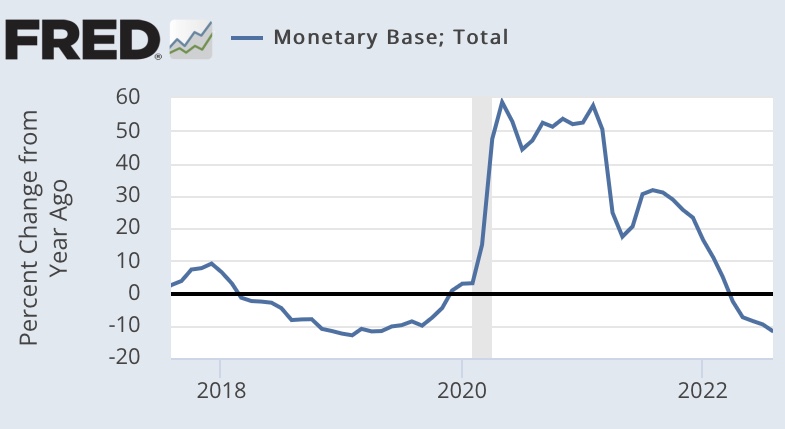
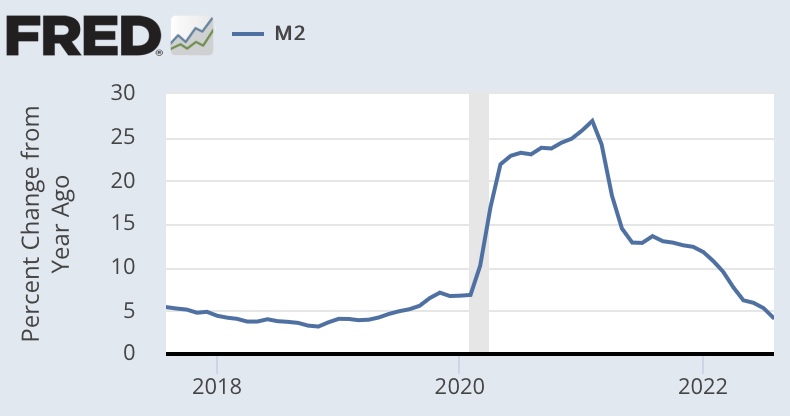
Ultimately, the best indicator that policy has tightened is the dramatic slowdown (and declines) in the growth of the monetary aggregates. The three charts below show five years of year-over-year growth in two monetary measures: the monetary base (bank reserves plus currency in circulation), and M2 (checking, saving, money market accounts plus currency).

Growth of these aggregates slowed sharply in 2021 after the Fed’s aggressive moves to ease liquidity during the first year of the pandemic. The monetary base and M2 growth have slowed much more in 2022 as the realization took hold that inflation was not transitory, as had been hoped. Changes in the growth of the money stock takes time to influence economic activity and inflation, but perhaps the effects have already begun, or probably will in earnest during the first half of 2023.

The Protuberant Balance Sheet

Since June, the Fed has also taken steps to reduce the size of its bloated balance sheet. In other words, it is allowing its large holdings of U.S. Treasuries and Agency Mortgage-Backed Securities to shrink. These securities were acquired during rounds of so-called quantitative easing (QE), which were a major contributor to the money growth in 2020 that left us where we are today. The securities holdings were about $8.5 trillion in May and now stand at roughly $8.2 trillion. Allowing the portfolio to run-off reduces bank reserves and liquidity. The process was accelerated in September, but there is increasing tension among analysts that this quantitative tightening will cause disruptions in financial markets and ultimately the real economy, There is no question that reducing the size of the balance sheet is contractionary, but that is another necessary step toward reducing the rate of inflation.

The Federal Spigot

The federal government is not making the Fed’s job any easier. The energy shortages now afflicting markets are largely the fault of misguided federal policy restricting supplies, with an assist from Russian aggression. Importantly, however, heavy borrowing by the U.S. Treasury continues with no end in sight. This puts even more pressure on financial markets, especially when such ongoing profligacy leaves little question that the debt won’t ever be repaid out of future budget surpluses. The only way the government’s long-term budget constraint can be preserved is if the real value of that debt is bid downward. That’s where the so-called inflation tax comes in, and however implicit, it is indeed a tax on the public.

Don’t Dismiss the Real Costs of Inflation

Inflation is a costly process, especially when it erodes real wages. It takes its greatest toll on the poor. It penalizes holders of nominal assets, like cash, savings accounts, and non-indexed debt. It creates a high degree of uncertainty in interpreting price signals, which ordinarily carry information to which resource flows respond. That means it confounds the efficient allocation of resources, costing all of us in our roles as consumers and producers. The longer it continues, the more it erodes our economy’s ability to enhance well being, not to mention the instability it creates in the political environment.

Imminent Recession?

So far there are only limited signs of a recession. Granted, real GDP declined in both the first and second quarters of this year, but many reject that standard as overly broad for calling a recession. Moreover, consumer spending held up fairly well. Employment statistics have remained solid, though we’ll get an update on those this Friday. Nevertheless, payroll gains have held up and the unemployment rate edged up to a still-low 3.7% in August.

Those are backward-looking signs, however. The financial markets have been signaling recession via the inverted yield curve, which is a pretty reliable guide. The weak stock market has taken a bite out of wealth, which is likely to mean weaker demand for goods. In addition to energy-supply shocks, the strong dollar makes many internationally-traded commodities very costly overseas, which places the global economy at risk. Moreover, consumers have run-down their savings to some extent, corporate earnings estimates have been trimmed, and the housing market has weakened considerably with higher mortgage rates. Another recent sign of weakness was a soft report on manufacturing growth in September.

Deliver the Medicine

The Fed must remain on course. At least it has pretensions of regaining credibility for its inflation targeting regime, and ultimately it must act in a symmetric way when inflation overshoots its target, and it has. It’s not clear how far the Fed will have to go to squeeze demand-side inflation down to a modest level. It should also be noted that as long as supply-side pressures remain, it might be impossible for the Fed to engineer a reduction of inflation to as low as its 2% target. Therefore, it must always bear supply factors in mind to avoid over-contraction.

As to raising the short-term interest rates the Fed controls, we can hope we’re well beyond the halfway point. Reductions in the Fed’s balance sheet will continue in an effort to tighten liquidity and to provide more long-term flexibility in conducting operations, and until bank reserves threaten to fall below the Fed’s so-called “ample reserves” criterion, which is intended to give banks the wherewithal to absorb small shocks. Signs that inflationary pressures are abating is a minimum requirement for laying off the brakes. Clear signs of recession would also lead to more gradual moves or possibly a reversal. But again, demand-side inflation is not likely to ease very much without at least a mild recession.

A Fiscal Real-Bills Doctrine? No Such Thing As Painless Inflation Tax

14 Tuesday Jun 2022

Posted by Nuetzel in Fiscal policy, Inflation, Uncategorized

≈ Leave a comment

Tags

Biden Administration, Cronyism, Federal Debt, Fiscal Inflation, Fiscal policy, Friedrich Hayek, Hyperinflation, Inflation tax, Knowledge Problem, Modern Monetary Theory, Monetary policy, Money Printing, Nominal GDP Targeting, Pete Buttigieg, Real Bills Doctrine, Reichsbank, rent seeking, Ro Khanna

A remarkable proposal made recently by Representative Ro Khanna (D -CA) would have the Biden Administration impose price controls, which would be bad enough. Khanna also would like the federal government to cover the inflation losses incurred by Americans by having it directly purchase certain goods and services and resell them “cheap” to consumers. In fairness, Khanna says the government should attempt to take advantage of dips in prices for oil, food commodities, and perhaps other necessities, which of course would limit or reverse downward price changes. When asked about Khanna’s proposal, Pete Buttigieg, Joe Biden’s Transportation Secretary, replied that there were great ideas coming out of Congress and the Administration should consider them. Anyway, the idea is so bad that it deserves a more thorough examination.

Central Planners Have No Clothes

First, such a program would represent a massive expansion in the scope of government. It would also present ample opportunities for graft and cronyism, as federal dollars filter through the administrative layers necessary to manage the purchases and distribution of goods. Furthermore, price and quantity would then be shaded by a heavy political component, often taking precedence over real demand and cost considerations. And that’s beyond the crippling “knowledge problem” that plagues all efforts at central planning.

One of the most destructive aspects of allowing government to absorb a greater share of total spending is that government is not invested with the same budgetary discipline as private buyers. Take no comfort in the notion that the government might prove expert at timing these purchases to leverage price dips. Remember that government always spends “other people’s money”, whether it comes from tax proceeds, lenders, or the printing press (and hence future consumers, who have absolutely no agency in the matter). Hence, price incentives take on less urgency, while political incentives gain prominence. The loss of price sensitivity means that government expenditures are likely to inflate more readily than private expenditures. This is all the more critical at a time when inflation is becoming embedded in expectations and pricing decisions. Khanna thus proposes an inflation “solution” that puts less price-sensitive bureaucrats in charge of actual purchases. That’s a prescription for failure.

If anyone in Biden’s White House is seriously considering a program of this kind, and let’s hope they’re not, they should at least be aware that direct subsidies for the purchase of key goods would be far more efficient. It’s also possible to hedge the risk of future price increases on commodities markets, perhaps simply distributing hedging gains to consumers when they pay off. However, having the federal government participate as a major player in commodities options and futures is probably not on the table at this point … and I shudder to think of it, but it might be more efficient than Khanna’s vision.

A Fiscal Real Bills Doctrine

Khanna’s program would almost surely cause inflation to accelerate. Inflation itself a form of taxation imposed by profligate governments, though it’s an inefficient tax since it creates greater uncertainty. Higher prices deflate the real value of most government debt (borrowed from the public), assets fixed in nominal value, and incomes. Read on, but this program would have the government pay your inflation tax for you by inflating some more. Does this sound like a vicious circle?

Khanna’s concept of inflation-relief is a fiscal reimagining of a long-discredited monetary theory called the “Real Bills Doctrine”. According to this doctrine, rising prices and costs necessitate additional money creation so that businesses have the liquidity to pay the bills associated with ongoing productive efforts. The “real” part is a reference to the link between business expenses and actual production, despite the fact that those bills are expressed in nominal terms. The result of this policy is a cycle of ever-higher inflation, as ever-more money is printed. This was the policy utilized by the Reichsbank in Weimar Germany during its hyperinflation of 1922-23. It’s really quite astonishing that anyone ever thought such a policy was helpful!

In Khanna’s version of the doctrine, the government spends to relieve cost pressure faced by consumers, so the rationale has nothing to do with productive effort.

Financing and the Central Bank Response

It’s reasonable to ask how these outlays would be financed. In all likelihood, the U.S. Treasury would borrow the funds at interest rates now at 10-15 year highs, which have risen in part to compensate investors for higher inflation.

My bet is that Khanna imagines the Fed would simply “print” money (i.e., buy the new government debt floated by the Treasury to pay for the program). This is the prescription of so-called Modern Monetary Theory, whose adherents have either forgotten or have never learned that money growth and inflation is a costly and regressive form of taxation.

Most economists would say the response of the Federal Reserve to this fiscal stimulus would bear on whether it really ignites additional inflationary pressure. Of course, rather than borrowing, Congress could always vote to levy higher taxes on the public in order to pay the public’s inflation tax burden! But then what’s the point? Well, taxing at least has the virtue of not fueling still higher inflation, and the Fed would not have a role to play.

But if the government simply borrows instead, it adds to the already bloated supply of government debt held by the public. This borrowing is likely to put more upward pressure on interest rates, and the federal government’s mounting interest expense requires more financing. What then might the Fed do?

The Fed is an independent, quasi-government entity, so it would not have to accommodate the additional spending by printing money (buying the new Treasury debt). Either way, investors are increasingly skeptical that the growing debt burden will ever be reversed via future surpluses. The fiscal theory of the price level holds that something must reduce the real value of government debt (in order to satisfy the long-term fiscal budget constraint). That “something” is a higher price level. This position is not universally accepted, and some would contend that if the Fed simply set a nominal GDP growth target and stuck to it, accelerating inflation would not have to follow from Khanna’s policy. The same if the Fed could stick to a symmetric average inflation target, but they certainly haven’t been up to that task. Hoping the Fed would fully assert its independence in a fiscal hurricane is probably wishful thinking.

Conclusion

There are no choke points in the supply chain for bad ideas on the left wing of the Democratic Party, and they are dominating party centrists in terms of messaging. The answer, it seems, is always more government. High inflation is very costly, but the best policy is to rein it in, and that requires budgetary and monetary discipline. Attempts to make high inflation “painless” are misguided in the first instance because they short-circuit consumer price responses and substitution, which help restrain prices. Second, the presumption that an inflation tax can be “painless” is an invitation to fiscal debauchery. Third, expansive government brings out hoards of rent seekers instigating corruption and waste. Finally, mounting public debt is unlikely to be offset by future surpluses, and that is the ultimate admission of Modern Monetary Theory. A fiscal real bills doctrine would be an additional expression of this lunacy. To suggest otherwise is either sheer stupidity or an exercise in gaslighting. You can’t inflate away the pain of an inflation tax.

The Fed’s Balance Sheet: What’s the Big Deal?

08 Sunday May 2022

Posted by Nuetzel in Government Failure, Inflation, Monetary Policy

≈ Leave a comment

Tags

Allocation of Capital, Bank Reserves, crowding out, Debt Monetization, Fed Balance Sheet, Federal Funds, Federal Reserve, Fiscal Inflation, Inflation tax, Interest Rate Targeting, MBS, Monetary policy, Mortgage Backed Securities, QE, Quantitative Easing, Scarcity, Tapering

The Federal Reserve just announced tighter monetary policy in an attempt to reduce inflationary pressures. First, it raised its target range for the federal funds rate (on overnight loans between banks) by 0.5%. The new range is 0.75% – 1%. Second, on June 1, the Fed will begin taking steps to reduce the size of its $9 trillion portfolio of securities. These holdings were acquired during periods of so-called quantitative easing (QE) beginning in 2008, including dramatic expansions in 2020-21. A shorthand reference for this portfolio is simply the Fed’s “balance sheet”. It includes government debt the Fed has purchased as well as privately-issued mortgage-backed securities (MBS).

What Is This Balance Sheet You Speak Of?

Talk of the Fed’s balance sheet seems to mystify lots of people. During the 2008 financial crisis, the Fed began to inject liquidity into the economy by purchasing large amounts of assets to be held on its balance sheet. This was QE. It’s scope was unprecedented and a departure from the Fed’s pre-crisis reliance on interest rate targeting. QE had the effect of increasing bank reserves, which raised the possibility of excessive money supply growth. That’s when the Fed began to pay interest to banks on reserves, so they might be content to simply hold some of the reserves over and above what they are required to hold, rather than using all of that excess to support new loans and deposits (and thus money growth). However, that interest won’t stop banks from lending excess reserves if better opportunities present themselves.

The Fed has talked about reducing, “normalizing”, or “tapering” its balance sheet for some time, but it only recently stopped adding to it. With inflation raging and monetary policy widely viewed as too “dovish”, analysts expected the Fed to stop reinvesting proceeds from maturing securities, which amounts to about $95 billion per month. That would shrink or “taper” the balance sheet at a rate of about $1.1 trillion per year. Last week the Fed decided to cap the “runoff” at $47.5 billion per month for the first three months, deferring the $95 billion pace until September. Monetary policy “hawks” were disappointed by this announcement.

Monetizing Government

So, one might ask, what’s the big deal? Why must the Fed taper its securities holdings? Well, first, the rate of inflation is far above the Fed’s target range, and it’s far above the “average Joe’s” comfort range. Inflation imposes significant costs on the economy and acts as a regressive form of taxation, harming the poor disproportionately. To the extent that the Fed’s huge balance sheet (and the corresponding bank reserves) are supporting incremental money growth and fueling inflation, the balance sheet must be reduced.

In that connection, the Fed’s investment in government debt represents monetized federal debt. That means the Fed is essentially printing money to meet the Treasury’s financing needs. Together with profligate spending by the federal government, nothing could do more to convince investors that government debt will never be repaid via future budget surpluses. This dereliction of the government’s “full faith and credit”, and the open-armed acceptance of the inflation tax as a financing mechanism (à la Modern Monetary Theory), is the key driver of fiscal inflation. Reducing the balance sheet would represent de-monetization, which might help to restore faith in the Fed’s ability to push back against fiscal recklessness.

Buyer of First Resort

Perhaps just as critically, the Fed’s heavy investment in government debt and MBS represents an ongoing distortion to the pricing of financial assets and the allocation of capital. Some call this interference in the “price discovery process”. That’s because the Fed has represented a market-altering presence, a willing and inelastic buyer of government debt and MBS. Given that presence, it’s difficult for buyers and sellers to discern the true values of alternative uses of capital, or to care.

QE was, among other things, a welcome institutional development for the U.S. Treasury and for those who fancy that fresh money printing is an ever-valid form of government payment for scarce resources. The Fed’s involvement also means that other potential buyers of Treasury debt need not worry about interest rate risk, making public debt relatively more attractive than private debt. This is a dimension of the “crowding out” phenomenon, whereby the allocation of capital and flows of real resources between public and private uses are distorted.

The Fed’s presence as a buyer of MBS depresses mortgage rates and makes mortgage lending less risky for lenders and investors. As a result, it encourages an over-investment in housing and escalating home prices. This too distorts the allocation of capital and real resources, at the margin, toward housing and away from uses with greater underlying value.

Conclusion

The magnitude of the Fed’s balance sheet is an ongoing testament to an increasingly dominant role of central authorities in the economy. In this case, the Fed has served as a conduit for the inflation tax. In addition, it has unwittingly facilitated crowding out of private capital investment. The Fed’s purchases of MBS have distorted the incentives (and demand) for residential investment. These are subtle effects that the average citizen might not notice, just as one might not notice the early symptoms of a debilitating disease. The long-term consequences of the Fed’s QE activities, including the inflation tax and distorted allocations of capital, are all too typical of failures of government intervention and attempts at central planning. But don’t expect anyone at the Fed to admit it.

Fiscal Inflation Is Simple With This One Weird Trick

03 Thursday Feb 2022

Posted by Nuetzel in Fiscal policy, Inflation

≈ 2 Comments

Tags

Alexandria Ocasio-Cortez, Bernie Sanders, Build Back Better, Child Tax Credit, Congressional Budget Office, Deficits, Federal Reserve, Fiscal policy, Fiscal Theory of the Price Level, Helicopter Drop, Inflation tax, infrastructure, Joe Biden, John Cochrane, Median CPI, Modern Monetary Theory, Monetary policy, Pandemic Relief, Seigniorage, Stimulus Payments, Student Loans, Surpluses, Trimmed CPI, Universal Basic Income

I’ll get to the weird trick right off the bat. Then you can read on if you want. The trick really is perverse if you believe in principles of sound credit and financial stability. To levy a fiscal inflation tax, all the government need do is spend like a drunken sailor and undermine its own credibility as a trustworthy borrower. One way to do that: adopt the policy prescriptions of Modern Monetary Theory (MMT).

A Theory of Deadbeat Government

That’s right! Run budget deficits and convince investors the debt you float will never be repaid with future real surpluses. That doesn’t mean the government would literally default (though that is never outside the realm of possibility). However, given such a loss of faith, something else must give, because the real value government debt outstanding will exceed the real value of expected future surpluses from which to pay that debt. The debt might be in the form of interest-bearing government bonds or printed money: it’s all government debt. Ultimately, under these circumstances, there will be a revised expectation that the value of that debt (bonds and dollars) will be eroded by an inflation tax.

This is a sketch of “The Fiscal Theory of the Price Level” (FTPL). The link goes to a draft of a paper by John Cochrane, which he intends as an introduction and summary of the theory. He has been discussing and refining this theory for many years. In fairness to him, it’s a draft. There are a few passages that could be written more clearly, but on the whole, FTPL is a useful way of thinking about fiscal issues that may give rise to inflation.

Fiscal Helicopters

Cochrane discusses the old allegory about how an economy responds to dollar bills dropped from a helicopter — free money floating into everyone’s yard! The result is the classic “too much money chasing too few goods” problem, so dollar prices of goods must rise. We tend to think of the helicopter drop as a monetary policy experiment, but as Cochrane asserts, it is fiscal policy.

We have experienced something very much like the classic helicopter drop in the past two years. The federal government has effectively given money away in a variety of pandemic relief efforts. Our central bank, the Federal Reserve, has monetized much of the debt the Treasury issued as it “loaded the helicopter”.

In effect, this wasn’t an act of monetary policy at all, because the Fed does not have the authority to simply issue new government debt. The Fed can buy other assets (like government bonds) by issuing dollars (as bank reserves). That’s how it engineers increases in the money supply. It can also “lend” to the U.S. Treasury, crediting the Treasury’s checking account. Presto! Stimulus payments are in the mail!

This is classic monetary seigniorage, or in more familiar language, an inflation tax. Here is Cochrane description of the recent helicopter drop:

“The Fed and Treasury together sent people about $6 trillion, financed by new Treasury debt and new reserves. This cumulative expansion was about 30% of GDP ($21,481) or 38% of outstanding debt ($16,924). If people do not expect that any of that new debt will be repaid, it suggests a 38% price-level rise. If people expect Treasury debt to be repaid by surpluses but not reserves, then we still expect $2,506 / $16,924 = 15% cumulative inflation.”

FTPL, May I Introduce You To MMT

Another trend in thought seems to have dovetailed with the helicopter drop , and it may have influenced investor sentiment regarding the government’s ever-weakening commitment to future surpluses: that would be the growing interest in MMT. This “theory” says, sure, go ahead! Print the money government “must” spend. The state simply fesses-up, right off the bat, that it has no intention of running future surpluses.

To be clear, and perhaps more fair, economists who subscribe to MMT believe that deficits financed with money printing are acceptable when inflation and interest rates are very low. However, expecting stability under those circumstances requires a certain level of investor confidence in the government fisc. Read this for Cochrane’s view of MMT.

Statists like Bernie Sanders, Alexandria Ocasio-Cortez, and seemingly Joe Biden are delighted to adopt a more general application of MMT as intellectual cover for their grandiose plans to remake the economy, fix the climate, and expand the welfare state. But generalizing MMT is a dangerous flirtation with inflation denialism and invites economic disaster.

If This Goes On…

Amid this lunacy we have Joe Biden and his party hoping to find avenues for “Build Back Better”. Fortunately, it’s looking dead at this point. The bill considered in the fall would have amounted to an additional $2 trillion of “infrastructure” spending, mostly not for physical infrastructure. Moreover, according to the Congressional Budget Office, that bill’s cost would have far exceeded $2 trillion by the time all was said and done. There are ongoing hopes for separate passage of free community college, an extended child tax credit for all families, a higher cap for state and local income tax deductions, and a host of other social and climate initiatives. The latter, relegated to a separate bill, is said to carry a price tag of over $550 billion. In addition, the Left would still love to see complete forgiveness of all student debt and institute some form of universal basic income. Hey, just print the money, right? Warm up the chopper! But rest easy, cause all this appears less likely by the day.

Are there possible non-inflationary outcomes from ongoing helicopter drops that are contingent on behavior? What if people save the fresh cash because it’s viewed as a one-time windfall (i.e., not a permanent increase in income)? If you sit on such a windfall it will erode as prices rise, and the change in expectations about government finance won’t be too comforting on that score.

There are many aspects of FTPL worth pondering, such as whether bond investors would be very troubled by yawning deficits with MMT noisemakers in Congress IF the Fed refused to go along with it. That is, no money printing or debt monetization. The burgeoning supply of debt would weigh heavily on the market, forcing rates up. Government keeps spending and interest costs balloon. It is here where Cochrane and critics of FTPL have a sharp disagreement. Does this engender inflation in the absence of debt monetization? Cochrane says yes if investors have faith in the unfaithfulness of fiscal policymakers. Excessive debt is then every bit as inflationary as printing money.

Real Shocks and FTPL

It’s natural to think supply disruptions are primarily responsible for the recent acceleration of inflation, rather than the helicopter drop. There’s no question about those price pressures in certain markets, much of it inflected by wayward policymakers, and some of those markets involve key inputs like energy and labor. Even the median component of the CPI has escalated sharply, though it has lagged broader measures a bit.

Broad price pressures cannot be sustained indefinitely without accommodating changes in the supply of money, which is the so-called “numeraire” in which all goods are priced. What does this have to do with FTPL or the government’s long-term budget constraint? The helicopter drop certainly led to additional money growth and spending, but again, FTPL would say that inflation follows from the expectation that government will not produce future surpluses needed for long-term budget balance. The creation of either new money or government debt, loaded the chopper as it were, is sufficient to accommodate broad price pressures over some duration.

Conclusion

Whether or not FTPL is a fully accurate description of fiscal and monetary phenomena, few would argue that a truly deadbeat government is a prescription for hyperinflation. That’s an extreme, but the motivation for FTPL is the potential abandonment of good and honest governing principles. Pledging an inflation tax is not exactly what anyone means by the full faith and credit of the U.S. government.

Break the Market, Blame It, Then Break It Some More

28 Sunday Nov 2021

Posted by Nuetzel in Energy, Environmental Fascism, Free markets, Uncategorized

≈ 2 Comments

Tags

Antitrust, Asymmetric Information, Build Back Better, Capital Controls, central planning, Endangered Species Act, Energy Policy, Externalities, Fossil fuels, Fracking, FTC, Government Failure, Green New Deal, Greenbook, Hart Energy, Industrial Policy, Industry Concentration, Joe Biden, Keystone XL Pipeline, Knowledge Problem, Line 5 Pipeline, Mark Theisen, Market Failure, Monetary policy, OPEC, Price Gouging, Principles of Economics, Quotas, Regulatory Overreach, Stephen Green, Strategic Petroleum Reserve, Subsidies, Tariffs, Taxes, The Fatal Conceit

Much of what is labeled market failure is a consequence of government failure, or rather, failure caused by misguided public intervention, not just in individual markets but in the economy more generally. Misguided efforts to correct perceived excesses in pricing are often the problem, but there are myriad cases of regulatory overreach, ham-handed application of taxes and subsidies for various enterprises, and widespread cronyism. But it is often convenient for politicians to appear as if they are doing something, which makes activism and active blame of private enterprise a tempting path. The Biden Administration’s energy crisis offers a case in point. First, a digression on the efficiency of free markets. Skip the next two sections to get straight to Biden’s mess.

Behold the Bounty

I always spent part of the first class session teaching Principles of Economics on some incredible things that happen each and every day. Most college freshmen seem to take them for granted: the endless variety of goods that arrive on shelves each day; the ongoing flow of services, many appearing like magic at the flick of a switch; the high degree of coincidence between specific wants and all these fresh supplies; the variety and flow of raw materials and skills that are brought to bear; the fantastic array of sophisticated equipment deployed to assist in these efforts; and the massive social coordination necessary to accomplish all this. How does it all happen? Who collects all the information on what is wanted, and by whom? On the feasibility of actually producing and distributing various things? What miracle computer processes the vast set of information guiding these decisions and actions? Does some superior intelligence within an agency plan all this stuff?

The answer is simple. The seemingly infinite set of knowledge is marshaled, and all these tasks are performed, by the greatest institution of social cooperation to ever emerge: decentralized, free markets! Buying decisions are guided by individual needs and wants. Production and selling decisions are guided by resource availability and technology. And all sides react to evolving prices. Preferences, resources, and technology are in a constant state of flux, but prices react, signaling producers and consumers to make individual adjustments that correct larger imbalances. It is tempting to describe the process as the evolving solution to a gigantic set of dynamic equations.

The Impossible Conceit

No human planner or government agency is capable of solving this problem as seamlessly and efficiently as markets, nor can they hope to achieve the surplus welfare that redound to buyers and sellers in markets. Central planners or intervening authorities cannot possess the knowledge and coordinating power of the market mechanism. That doesn’t mean markets are “perfect”, of course. Things like external costs and benefits, dominant sellers, and asymmetric information can cause market outcomes to deviate from the competitive “ideal”. Inequities can arise from some of these imperfections as well.

What can be much worse is the damage to market performance caused by government policy. Usually the intent is to “correct” imperfections, and the rationale might be defensible. The knowledge to do it very well is often lacking, however. Taxes, subsidies, regulations, tariffs, quotas, capital controls, and manipulation of interest rates (and monetary and credit aggregates) are very general categories of distortion caused by the public sector. Then there is competition for resources via government procurement, which is frequently graft-ridden or price-insensitive.

Many public interventions create advantages for large sellers, leading to greater market concentration. This might best serve the private political power of the wealthy or might convey advantages to investments that happen to be in vogue among the political class. These are the true roots of fascism, which leverages coercive state power for the benefit of private interests.

Energy Vampires

Now we have the curious case of the Biden Administration and it’s purposeful disruption of energy markets in an effort to incentivize a hurried transition from fossil fuels to renewable energy. As I described in a recent post on stagflation,

“… Biden took several steps to hamstring the domestic fossil fuel industry at a time when the economy was still recovering from the pandemic. This included revoking permits for the Keystone pipeline, a ban on drilling on federal lands and federally-controlled waters in the Gulf, shutting down production on some private lands on the pretext of enforcing the Endangered Species Act, and capping methane emissions by oil and gas producers. And all that was apparently just a start.

As Mark Theisen notes, when you promise to destroy a particular industry, as Joe Biden has, by taxing and regulating it to death, who wants to invest in or even maintain production facilities? Some leftists with apparent influence on the administration are threatening penalties against the industry up to and including prosecution for ‘crimes against humanity’!”

In addition to killing Keystone, there remains a strong possibility that Biden will shut down the Line 5 pipeline in Michigan, and there are other pipelines currently under federal review. Biden’s EPA also conducted a purge of science advisors considered “too friendly” to oil and gas industry. This was intertwined with a “review” of new methane rules, which harm smaller, independent oil and gas drillers disproportionately.

Joe Biden’s “Build Back Better” (BBB) legislation, as clumsy in policy as it is in name, introduces a number of “Green New Deal” provisions that would further disadvantage the production and use of fossil fuels. Hart Energy provides descriptions of various tax changes that appeared in the Treasury’s so-called “Greenbook”, a collection of revenue proposals, many of which appear in the BBB legislation that recently passed in the House. These include rollbacks of various deductions for drilling costs, depletion allowances, and recovery rules, as well as hikes in certain excise taxes as well as taxes on foreign oil income. And all this while granting generous subsidies to intermittent and otherwise uneconomic technologies that happen to be in political favor. This is a fine payoff for cronies having invested significantly in these rent seeking opportunities. While the bill still faces an uphill fight in the Senate, apparently Biden has executive orders, held in abeyance, that would inflict more pain on consumers and producers of fossil fuels.

Biden’s energy policies are obviously intended to reduce supplies of oil, gas, and other fossil fuels. Prices have responded, as Green notes:

“Gas is up an average of 57% this year, with corresponding increases of 44% for diesel and a whopping 60% for fuel oil.”

The upward price pressure is not limited to petroleum: electricity rates are jumping as well. Consumers and shippers have noticed. In fact, while Biden crows about wanting “the rich” to pay for BBB, his energy policies are steeply regressive in their impact, as energy absorbs a much larger share of budgets among the poor than the rich. This is politically suicidal, but Biden’s advisors have chosen a most cynical tact as the reality has dawned on them.

Abusive Victim Blaming

Who to blame? After the predictable results of cramping domestic production and attacking fossil fuel producers, the Biden team naturally blames them for rising prices! “Price gouging” is a charge made by political opportunists and those who lack an understanding of how markets allocate scarce resources. More severe scarcity means that prices must rise to ration available quantities and to incentivize those capable of bringing forth additional product under difficult circumstances. That is how a market is supposed to function, and it mitigates scarcity!

But here comes the mendacious and Bumbling Buster Biden. He wants antitrust authorities at the FTC to investigate oil pricing. Again from Stephen Green:

“… the Biden Administration has decided to launch a vindictive legal campaign against oil producers in order to deflect blame for the results of Biden’s policies: Biden’s Solution to Rising Gas Prices Appears to Be Accusing Oil Companies of Price Gouging.”

There’s nothing quite like a threat to market participants to prevent the price mechanism from performing its proper social function. But a failure to price rationally is a prescription for more severe shortages.

Biden has also ordered the Strategic Petroleum Reserve (SPR) to release 50 million barrels of oil, a move that replaces a total of 2.75 days of monthly consumption in the U.S. The SPR is supposed to be drawn upon only in the case of emergencies like natural disasters, so this draw-down is as irresponsible as it is impotent. In fact, OPEC is prepared to offset the SPR release with a production cut. Biden has resorted to begging OPEC to increase production, which is pathetic because the U.S. was a net exporter of oil not long ago … until Biden took charge.

Conclusion

Properly stated, the challenge mounted against markets as an institution is not that they fall short of “perfection”. It is that some other system would lead to superior results in terms of efficiency and/or equity. Central planning, including the kind exercised by the Biden Administration in it’s hurried and foolish effort to tear down and remake the energy economy, is not even a serious candidate on either count.

Granted, there is a long history of subsidies to the oil and gas sector. I cannot defend those, but the development of the technology (even fracking) largely preceded the fruits of the industry’s rent seeking. At this point, green fuels receive far more subsidies (despite some claims to the contrary). Furthermore, the primacy of fossil fuels was not achieved by tearing down competing technologies and infrastructure. In contrast, the current round of central planning requires destruction of entire sectors of the economy that could otherwise produce efficiently for the foreseeable future, if left unmolested.

The Biden Administration has adopted the radical green agenda. Their playbook calls for a severe tilting of price incentives in favor uneconomic, renewable energy sources, despite the economy’s heretofore sensible reliance on plentiful fossil fuels. It’s no surprise that Biden’s policy is unpopular across the economic spectrum. His natural inclination is to blame a competitive industry victimized by his policy. It’s a futile attempt to avoid accountability, as if he thinks doubling down on the fascism will help convince the electorate that oil and gas producers dreamt up this new, nefarious strategy of overcharging customers. People aren’t that dumb, but it’s typical for the elitist Left presume otherwise.

Inflation Doomsayers and Downplayers

25 Friday Jun 2021

Posted by Nuetzel in Inflation, Monetary Policy

≈ 2 Comments

Tags

Consumer Price Index, Core CPI, Cryptocurrencies, Deficits, Energy Policy, Federal Reserve, Financial Velocity, Fisher Effect, Helicopter Money, Housing Costs, Import Prices, Inflation, Inflation Premium, Irving Fisher, M1, Median CPI, Monetary policy, Monetization, Shrinkflation, Trading Volume, Trimmed CPI, Velocity of Money

There’s a big disconnect between recent news about escalating inflation and market expectations of inflation. In fact, there’s a big disconnect between market expectations and what we’re hearing from some conservative economists. The latter are predicting more inflation based on the recent spurt in prices and the expansionary policy of the Federal Reserve. Can these disparate views be reconciled?

Market Predictions

Market interest rates are considered pretty good predictors of inflation, at least relative to surveys and macroeconomic models. That’s because a fixed interest return is eroded by inflation, and fixed income investors will bid up interest rates to incorporate a premium to compensate for perceptions of increased inflation risk. This is known as the Fisher Effect, after the economist Irving Fisher. In fact, investors should bid rates up more than one-for-one with expected inflation, because the inflation premium will be taxed. A higher return must compensate for both higher expected inflation and taxes on the increased inflation premium.

After rising by about 1.2% from last summer through mid-March, interest rates on Treasury notes have declined slightly. The earlier run-up anticipated a strengthening economy, but if the increase was due to higher expected inflation, we could say it represented an added premium of about 1%, and that’s roughly in-line with changes in some other market-based gauges of expected inflation (ignoring pandemic lows).

Recent Inflation News

Meanwhile, measured inflation certainly has increased in 2021. I say “measured” because 1) “true” price changes are measured imperfectly, and 2) there is a difference between real inflation, which is a continuing process, and month-to-month changes in prices. Here, we’re really talking about the latter and hoping it doesn’t turn into a bad case of the former!

The green line in the chart below is the percent change in the consumer price index (CPI) from a year earlier. After declining during the pandemic, it rebounded sharply this year to almost 5% in May. The purple line is the increase in the CPI excluding food and energy prices, otherwise known as the “core” CPI. The jumps shown in the chart are well in excess of the market’s assessment of inflation trends.  

Both versions of the CPI have jumped in the past few months, but it turns out that durable goods like washing machines, TVs, and (probably) Pelotons have jumped the most sharply. Most of the weakness in prices during the pandemic was in non-durable goods, which stands to reason because so many activities away from home were curtailed. Also noteworthy about these price movements: when measured over a span of two years, prices excluding food and energy have risen at an annualized rate of only 2.6%. 

There are two other lines in the chart above that demonstrate much less alarming changes in prices: the orange line is so-called “median” inflation, which is the price change in the median component of the CPI. That is, half of all price components included in the CPI rose faster and half rose slower than the median. It has barely accelerated this year and stood at only about 2.1% higher in May than a year earlier. The blue line is the so-called “trimmed” CPI, or the average price change of the middle 84% of all CPI components. While it has accelerated in 2021, the year-over-year increase was only 2.6% in May. 

Thus, the breadth of the jump in prices was limited. The Federal Reserve and a lot of market participants insist that the uptick is narrow and temporary — a transitional phenomenon related to the sluggish recovery of supplies in the post-pandemic environment.

But again, the accuracy of price measures is always in question. For example, the housing cost component of the CPI was up only 2.2% in May from a year ago, but it is calibrated to actual survey data only twice a year, the survey is a weak data source, and we know home prices and rents have risen aggressively. Quality and quantity adjustments are always in question as well. An old approach for businesses dealing with rising costs is to reduce package size, which has been called “shrinkflation”. It seems to be back in vogue.

Inflation Drivers

It’s not yet clear how much wage pressure is occurring now. The economy-wide average hourly earnings data has been distorted over the past 15 months by the changing mix of employment, first shifting toward greater concentration in high-wage (work-at-home) occupations and now shifting back toward lower-wage jobs as the economy reopens. But we know many employers are facing a labor shortage, due in large part to extended unemployment benefits and other pandemic-related aid, so this puts upward pressure on wages. In 2021, minimum wage rates are undergoing substantial increases in 17 states, and a number of large employers such as Amazon have increased their minimum pay rates. That creates competitive pressure for smaller employers to boost pay as well.

The fundamental cause of an “honest-to-goodness” inflation is “too much money chasing too few goods”. The Federal Reserve has certainly given us enough to worry about in that regard. The basic money stock (M1) increased by four-fold in the late winter and early spring of 2020, just as the pandemic was spreading. Today, it is almost five times greater than in early 2020, so growth in the money stock remains quite fast even as the recovery proceeds. No wonder: the U.S. Treasury is issuing about $1 trillion of new debt every four-to-six weeks, and the Fed is essentially monetizing these deficits by purchasing a huge chunk of that debt.

That’s a lot of “helicopter” money… new money! But are there too few goods for it to chase? Or is it really chasing anything? Is it just sitting idle? First, GDP is likely to exceed its pre-pandemic level in the second quarter, despite the fact that private payrolls are still down by about 7 million employees. Of course, that doesn’t eliminate the ostensible imbalance between money and goods, and one might expect a veritable explosion in price inflation under these circumstances.

So far that seems unlikely. The so-called velocity of money (its rate of turnover) has plunged since the start of the pandemic, with no discernible rebound through the first quarter of 2021. That means a lot of the cash is not being used in transactions for real goods, but financial transaction volume has been quite strong in 2020-21. Daily stock trading volume was up by more than 50% in 2020 from 2019, and in the first quarter of 2021 it stood another 34% higher than the 2020 average (though volume tapered in April). This is to say nothing of the increased frenzy in cryptocurrency trading. So, while some money is turning over, the expansion of the money stock remains daunting and pressure might well spill-over into goods prices.

Caution Is a Virtue

So long as the Fed keeps printing money, and assuring investors that it will keep printing money, the equity markets are likely to remain strong. There are mixed signals coming from Fed officials, but the over-riding message is that the recent uptick in prices is largely temporary and limited in scope. That is, they assert that certain prices are being squeezed temporarily by rebounding demand for goods while suppliers play catch-up. 

Market expectations of inflation seem to agree with that view, but I have strong trepidations. There are cash reserves held in the private sector to support more aggressive spending. Large companies, consumers, and banks are still holding significant amounts of cash. The Biden Administration is doing its best to spend hand-over-fist. This administration’s energy policy is causing fuel bills to escalate. Home prices and rents are strong. The dollar is down somewhat from pre-pandemic levels, which increases import prices. Finally, the Fed is reluctant to reverse the huge increase in the money supply it engineered during the pandemic. If the recent surge in prices continues, and if higher inflation embeds itself into expectations, it will be all the more difficult for the Fed to correct. 

The market and the Fed might be correct in predicting that the spike in measured inflation is temporary. The recent data show that these worrisome price trends have not been broad. Just the same, I don’t want to hold fixed income investments right now: if higher expectations of inflation cause market interest rates to rise, the value of those assets will fall. Stock values should generally keep pace with inflation barring stronger signals of tightening by the Fed. Unfortunately, however, many would suffer in an inflationary environment as wages, fixed assets, and benefits are devalued by rising prices.

The Federal Reserve and Coronatative Easing

09 Monday Mar 2020

Posted by Nuetzel in Monetary Policy, Pandemic

≈ Leave a comment

Tags

Caronavirus, Covid-19, Donald Trump, Externality, Federal Reserve, Fiscal Actions, Flight to Safety, Glenn Reynolds, Influenza, Liquidity, Michael Fumento, Monetary policy, Network Effects, Nonpharmaceutical Intervention, Paid Leave, Pandemic, Payroll Tax, Quarantines, Scott Sumner, Solvency, Wage Assistance

Laughs erupted all around when the Federal Reserve reduced its overnight lending rate by 50 basis points last week: LIKE THAT’LL CURE THE CORANAVIRUS! HAHAHA! It’s easy to see why it seemed funny to people, even those who think the threat posed by Covid-19 is overblown. But it should seem less silly with each passing day. That’s not to say I think we’re headed for disaster. My own views are aligned with this piece by Michael Fumento: it will run its course before too long, and “viruses hate warm weather“. Nevertheless, the virus is already having a variety of economic effects that made the Fed’s action prudent.

Of course, the Fed did not cut its rate to cure the virus. The rate move was intended to deal with some of the economic effects of a pandemic. The spread of the virus has been concentrated in a few countries thus far: China, Iran, Italy, and South Korea. Fairly rapid growth is expected in the number of cases in the U.S. and the rest of the world over the next few weeks, especially now with the long-awaited distribution of test kits. But already in the U.S., we see shortages of supplies hitting certain industries, as shipments from overseas have petered. And now efforts to control the spread of the virus will involve more telecommuting, cancellation of public events, less travel, less dining out, fewer shopping trips, missed work, hospitalizations, and possibly widespread quarantines.

The upshot is at least a temporary slowdown in economic activity and concomitant difficulties for many private businesses. We’ve been in the midst of a “flight to safety”, as investors incorporate these expectations into stock prices and interest rates. Firms in certain industries will need cash to pay bills during a period of moribund demand, and consumers will need cash during possible layoffs. All of this suggests a need for liquidity, but even worse, it raises the specter of a solvency crisis.

The Fed’s power can attempt to fill the shortfall in liquidity, but insolvency is a different story. That, unfortunately, might mean either business failures or bailouts. Large firms and some small ones might have solid business continuation plans to help get them through a crisis, at least one of short to moderate duration, but many businesses are at risk. President Trump is proposing certain fiscal and regulatory actions, such as a reduction in the payroll tax, wage payment assistance, and some form of mandatory paid leave for certain workers. Measures might be crafted so as to target particular industries hit hard by the virus.

I do not object to these pre-emptive measures, even as an ardent proponent of small government, because the virus is an externality abetted by multiplicative network effects, something that government has a legitimate role in addressing. There are probably other economic policy actions worth considering. Some have suggested a review of laws restricting access to retirement funds to supplement inadequate amounts of precautionary savings.

Last week’s Fed’s rate move can be viewed as pre-emptive in the sense that it was intended to assure adequate liquidity to the financial sector and payment system to facilitate adjustment to drastic changes in risk appetites. It might also provide some relief to goods suppliers who find themselves short of cash, but their ability to benefit depends on their relationships to lenders, and lenders will be extremely cautious about extending additional credit as long as conditions appear to be deteriorating.

In an even stronger sense, the Fed’s action last week was purely reactive. Scott Sumner first raised an important point about ten days before the rate cut: if the Fed fails to reduce its overnight lending target, it represents a de facto tightening of U.S. monetary policy, which would be a colossal mistake in a high-risk economic and social environment:

“When there’s a disruption to manufacturing supply chains, that tends to reduce business investment, puts downward pressure on demand for credit. That will tend to reduce equilibrium interest rates. In addition, with the coronavirus, there’s also a lot of uncertainty in the global economy. And when there’s uncertainty, there’s sort of a rush for safe assets, people buy treasury bonds, that puts downward pressure on interest rates. So you have this downward pressure on global interest rates. Now while this is occurring, if the Fed holds constant its policy rate, it targets the, say fed funds rate at a little over 1.5 percent. While the equilibrium rates are falling, then essentially the Fed will be making monetary policy tighter.

… what I’m saying is, if the Fed actually wants to maintain a stable monetary policy, they may have to move their policy interest rate up and down with market conditions to keep the effective stance of monetary policy stable. So again, it’s not trying to solve the supply side problem, it’s trying to prevent it from spilling over and also impacting aggregate demand.”

The Fed must react appropriately to market rates to maintain the tenor of its policy, as it does not have the ability to control market rates. Its powers are limited, but it does have a responsibility to provide liquidity and to avoid instability in conducting monetary policy. Fiscal actions, on the other hand, might prove crucial to restoring economic confidence, but ultimately controlling the spread of the virus must be addressed at local levels and within individual institutions. While I am strongly averse to intrusions on individual liberty and I desperately hope it won’t be necessary, extraordinary measures like whole-city quarantines might ultimately be required. In that context, this post on the effectiveness of “non-pharmaceutical interventions” such as school closures, bans on public gatherings, and quarantines during the flu pandemic of 1918-19 is fascinating.


← Older posts
Follow Sacred Cow Chips on WordPress.com

Recent Posts

  • Immigration and Merit As Fiscal Propositions
  • Tariff “Dividend” From An Indigent State
  • Almost Looks Like the Fed Has a 3% Inflation Target
  • Government Malpractice Breeds Health Care Havoc
  • A Tax On Imports Takes a Toll on Exports

Archives

  • December 2025
  • November 2025
  • October 2025
  • September 2025
  • August 2025
  • July 2025
  • June 2025
  • May 2025
  • April 2025
  • March 2025
  • February 2025
  • January 2025
  • December 2024
  • November 2024
  • October 2024
  • September 2024
  • August 2024
  • July 2024
  • June 2024
  • May 2024
  • April 2024
  • March 2024
  • February 2024
  • January 2024
  • December 2023
  • November 2023
  • August 2023
  • July 2023
  • June 2023
  • May 2023
  • April 2023
  • March 2023
  • February 2023
  • January 2023
  • December 2022
  • November 2022
  • October 2022
  • September 2022
  • August 2022
  • July 2022
  • June 2022
  • May 2022
  • April 2022
  • March 2022
  • February 2022
  • January 2022
  • December 2021
  • November 2021
  • October 2021
  • September 2021
  • August 2021
  • July 2021
  • June 2021
  • May 2021
  • April 2021
  • March 2021
  • February 2021
  • January 2021
  • December 2020
  • November 2020
  • October 2020
  • September 2020
  • August 2020
  • July 2020
  • June 2020
  • May 2020
  • April 2020
  • March 2020
  • February 2020
  • January 2020
  • December 2019
  • November 2019
  • October 2019
  • September 2019
  • August 2019
  • July 2019
  • June 2019
  • May 2019
  • April 2019
  • March 2019
  • February 2019
  • January 2019
  • December 2018
  • November 2018
  • October 2018
  • September 2018
  • August 2018
  • July 2018
  • June 2018
  • May 2018
  • April 2018
  • March 2018
  • February 2018
  • January 2018
  • December 2017
  • November 2017
  • October 2017
  • September 2017
  • August 2017
  • July 2017
  • June 2017
  • May 2017
  • April 2017
  • March 2017
  • February 2017
  • January 2017
  • December 2016
  • November 2016
  • October 2016
  • September 2016
  • August 2016
  • July 2016
  • June 2016
  • May 2016
  • April 2016
  • March 2016
  • February 2016
  • January 2016
  • December 2015
  • November 2015
  • October 2015
  • September 2015
  • August 2015
  • July 2015
  • June 2015
  • May 2015
  • April 2015
  • March 2015
  • February 2015
  • January 2015
  • December 2014
  • November 2014
  • October 2014
  • September 2014
  • August 2014
  • July 2014
  • June 2014
  • May 2014
  • April 2014
  • March 2014

Blogs I Follow

  • Passive Income Kickstart
  • OnlyFinance.net
  • TLC Cholesterol
  • Nintil
  • kendunning.net
  • DCWhispers.com
  • Hoong-Wai in the UK
  • Marginal REVOLUTION
  • Stlouis
  • Watts Up With That?
  • Aussie Nationalist Blog
  • American Elephants
  • The View from Alexandria
  • The Gymnasium
  • A Force for Good
  • Notes On Liberty
  • troymo
  • SUNDAY BLOG Stephanie Sievers
  • Miss Lou Acquiring Lore
  • Your Well Wisher Program
  • Objectivism In Depth
  • RobotEnomics
  • Orderstatistic
  • Paradigm Library
  • Scattered Showers and Quicksand

Blog at WordPress.com.

Passive Income Kickstart

OnlyFinance.net

TLC Cholesterol

Nintil

To estimate, compare, distinguish, discuss, and trace to its principal sources everything

kendunning.net

The Future is Ours to Create

DCWhispers.com

Hoong-Wai in the UK

A Commonwealth immigrant's perspective on the UK's public arena.

Marginal REVOLUTION

Small Steps Toward A Much Better World

Stlouis

Watts Up With That?

The world's most viewed site on global warming and climate change

Aussie Nationalist Blog

Commentary from a Paleoconservative and Nationalist perspective

American Elephants

Defending Life, Liberty and the Pursuit of Happiness

The View from Alexandria

In advanced civilizations the period loosely called Alexandrian is usually associated with flexible morals, perfunctory religion, populist standards and cosmopolitan tastes, feminism, exotic cults, and the rapid turnover of high and low fads---in short, a falling away (which is all that decadence means) from the strictness of traditional rules, embodied in character and inforced from within. -- Jacques Barzun

The Gymnasium

A place for reason, politics, economics, and faith steeped in the classical liberal tradition

A Force for Good

How economics, morality, and markets combine

Notes On Liberty

Spontaneous thoughts on a humble creed

troymo

SUNDAY BLOG Stephanie Sievers

Escaping the everyday life with photographs from my travels

Miss Lou Acquiring Lore

Gallery of Life...

Your Well Wisher Program

Attempt to solve commonly known problems…

Objectivism In Depth

Exploring Ayn Rand's revolutionary philosophy.

RobotEnomics

(A)n (I)ntelligent Future

Orderstatistic

Economics, chess and anything else on my mind.

Paradigm Library

OODA Looping

Scattered Showers and Quicksand

Musings on science, investing, finance, economics, politics, and probably fly fishing.

  • Subscribe Subscribed
    • Sacred Cow Chips
    • Join 128 other subscribers
    • Already have a WordPress.com account? Log in now.
    • Sacred Cow Chips
    • Subscribe Subscribed
    • Sign up
    • Log in
    • Report this content
    • View site in Reader
    • Manage subscriptions
    • Collapse this bar
 

Loading Comments...