• About

Sacred Cow Chips

Sacred Cow Chips

Category Archives: Pandemic

Harbingers of COVID Fade, But Not the Pretense for Hysteria

17 Thursday Dec 2020

Posted by Nuetzel in Coronavirus, Pandemic, Vaccinations

≈ Leave a comment

Tags

@Humble_Analysis (PLC), CLI, COVID Vaccines, Covid-19, COVID-Like Illness, Date of Death, False Positives, Herd Immunity, ILI, Influenza-Like Illness, Justin Hart, PCR Tests, Reported Deaths

My pre-Thanksgiving optimism about a crest in the fall wave of the coronavirus has been borne out for the Midwest and Mountain states in the U.S. These regions were the epicenter of the fall wave through October and most of November, but new cases in those states have continued to decline. Cases in a number of other states began to climb in November, however, contributing to a continuing rise in total new cases nationally. Some of these states are still in the throes of this wave, with the virus impacting subsets of the population that were relatively unscathed up till now.

My disclaimer: COVID is obviously a nasty virus. I don’t want to get it. However, on the whole, it is not a cataclysm on the order of many pandemics of the past. In fact, excess deaths this year will add just over 10% to projections of total deaths based on a five-year average. That level puts us in line with average annual deaths of about twenty years ago. And many of those excess deaths have been caused by our overreaction to the pandemic, not by the virus itself. As my endocrinologist has said, this is the greatest overreaction in all medical history. Unfortunately, a fading pandemic does not mean we can expect an end to the undue panic, or pretense for panic, on the part of interventionists.

This post will focus largely on trends in newly diagnosed COVID cases. I have been highly critical of our testing regime and COVID case counts because the most prominent diagnostic test (PCR) falsely identifies a large number of uninfected individuals as COVID-positive. However, case numbers are widely tracked and it’s fairly easy to find information across geographies for comparison. Deflate all the numbers by 30% if you want, or by any other factor, but please indulge me because I think the trends are meaningful, even if the absolute level of cases is inflated.

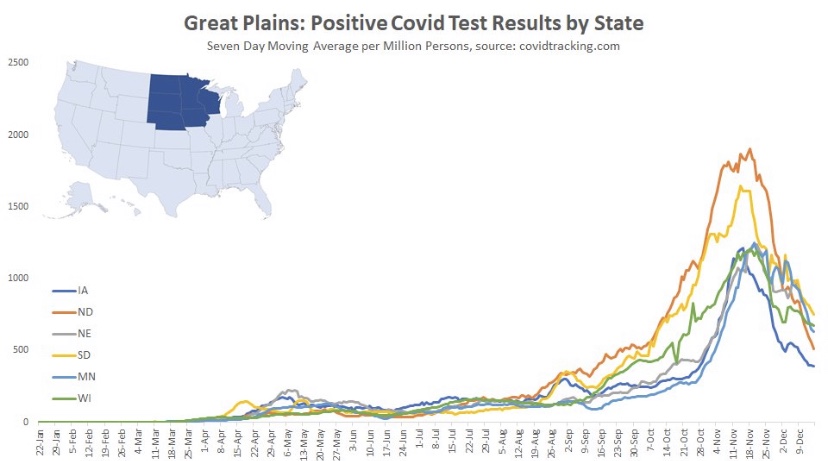
I’ll start with the good news and work my way down to states in which cases are still climbing (all of the following charts are from @Humble_Analysis (PLC)). The first chart is for the Great Plains, where cases peaked a little before Thanksgiving and have continued to fall since then. That peak came about six weeks after it began in earnest and cases have faded over the last four weeks.
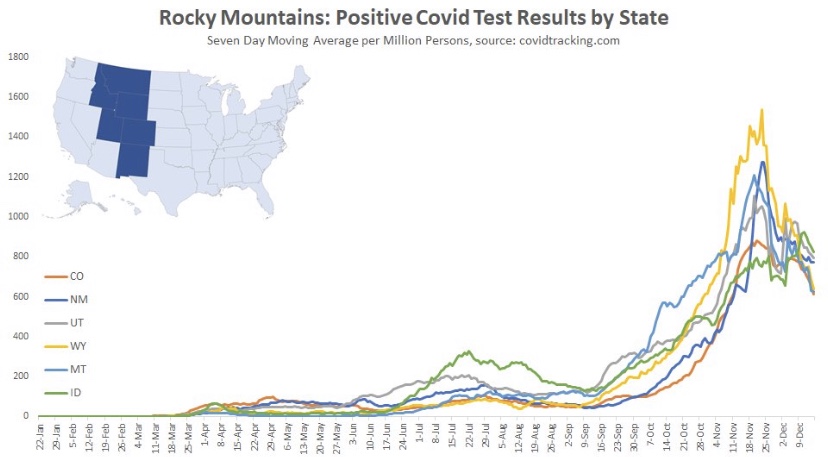
Next we have the Mountain states, where again, cases peaked around Thanksgiving, though Idaho saw a rebound after the holiday. You’ll see below that a number of states had a distinct drop in new cases during the week of Thanksgiving. There was somewhat of a pause in testing during that week, so the subsequent rebounds are largely due to a “catch-up” at testing sites, rather than some kind of Thanksgiving-induced spike in infections.

Back to the Mountain region, the peak came an average of about six or seven weeks into the wave, but the duration of the wave appears to have been longer in Montana and Wyoming.
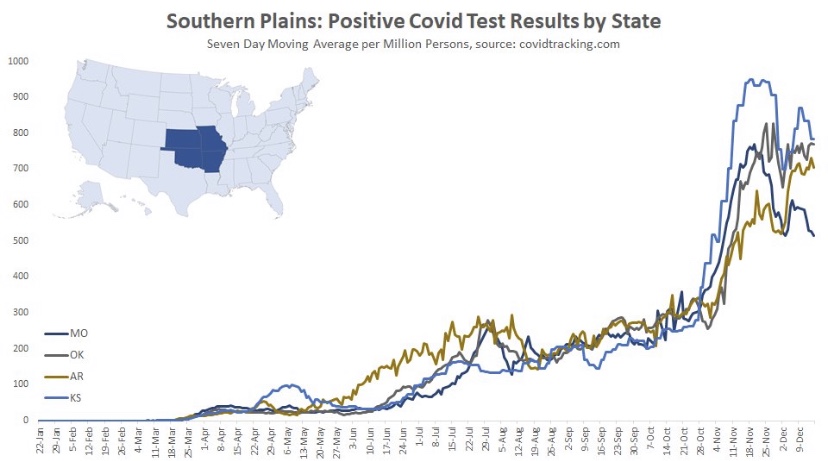
Here are the Southern Plain states, where cases plateaued around Thanksgiving (though cases in Missouri have clearly declined from their peak). In this region, case counts accelerated in October after a slow climb over the summer.
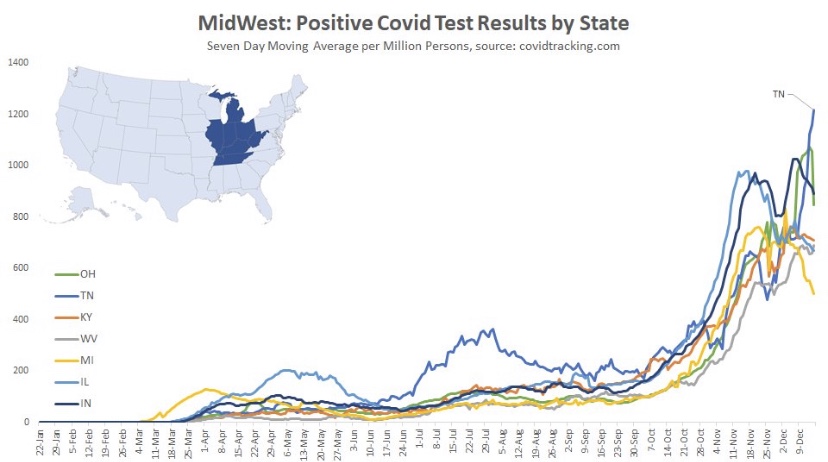
The situation is somewhat similar in the Midwest. where cases have generally plateaued. There were some post-Thanksgiving rebounds in several states, especially Tennessee. The wave began a little later in this region, in mid- to late October, and it is now seven to eight weeks into the wave, on average.
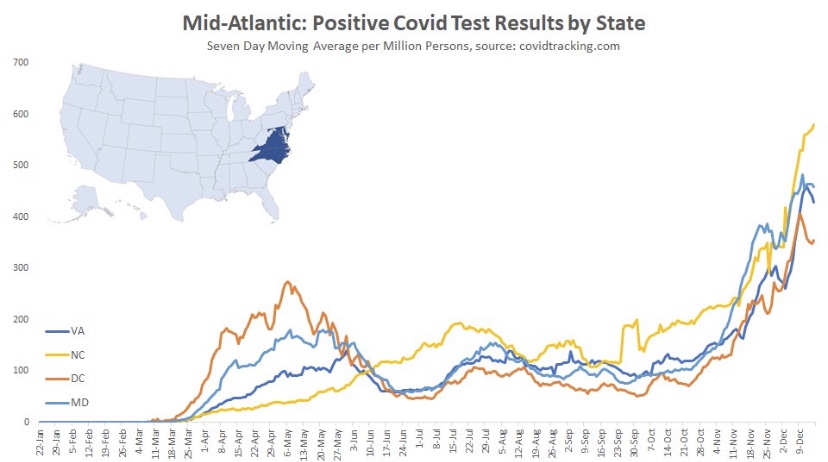
Here are the Mid-Atlantic states, which may be showing signs of a peak, though North Carolina has had the greatest caseload and is still climbing. These states are about seven weeks into the wave, on average.
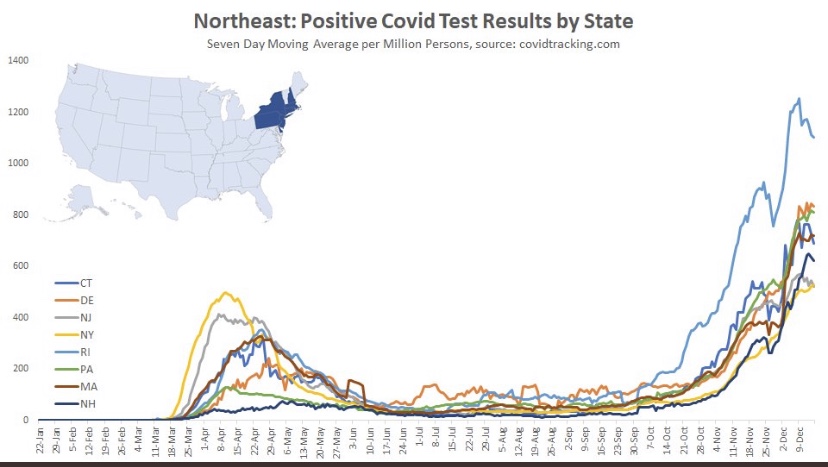
The Northeast also shows signs of a possible peak and is about seven weeks into the wave, except for Rhode Island, which saw an earlier onset and the most severe wave among these states.
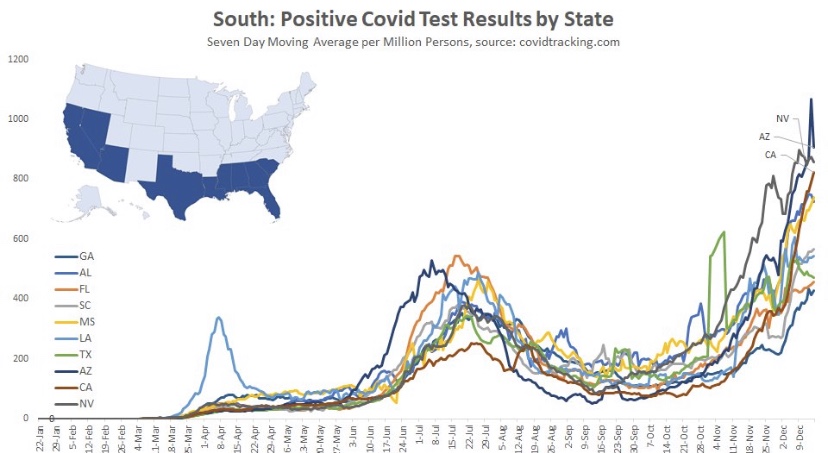
And finally we have the South, which is defined quite broadly in PLC’s construction. It’s a mixed bag, with a few states showing signs of a peak after about seven weeks. However, cases are still climbing in several states, notably California and Florida, among a few others.
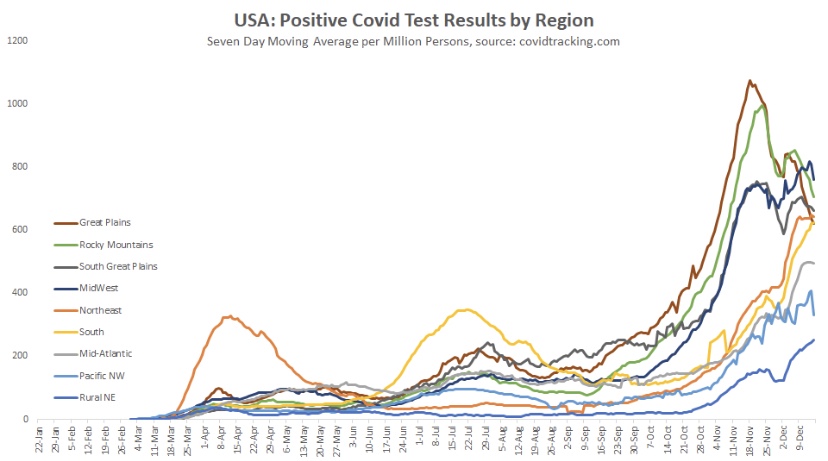
Oregon and Washington were skipped, but they appear as the Pacific NW in the following chart, along with aggregations for all the other regions. Maine is Part of the “Rural NE”, which was also skipped. The fall wave can be grouped roughly into two sets of regions: those in which waves began in late September or early October, and those where waves began in early to mid-November. The first group has moved beyond a peak or at least has plateaued. The latter group may be reaching peaks now or one hopes very soon. It seems to take about seven weeks to reach the peak of these regional waves, so a late December peak for the latter group would be consistent.
Justin Hart has a take on the duration of these waves, but he does so in terms of the share of emergency room (ER) visits in which symptoms of COVID-like illness (CLI) are presented. CLI tends to precede case counts slightly. Hart puts the duration of these waves at eight to ten weeks, but that’s a judgement call, and I might put it a bit longer using caseloads as a guide. Still, this color-coded chart from Hart is interesting.
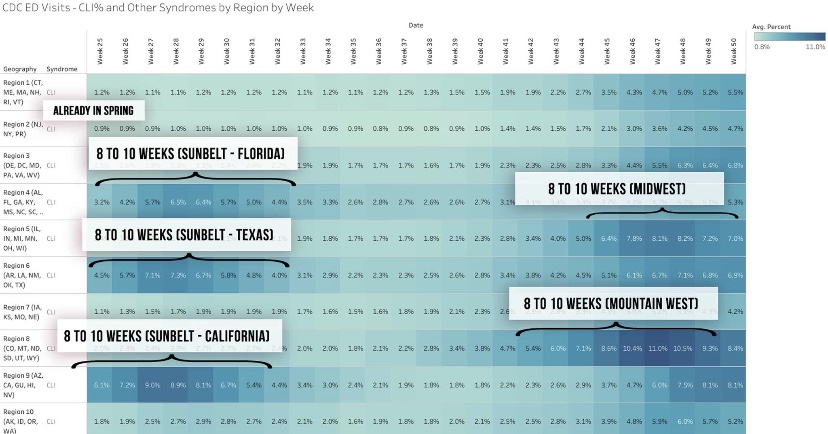
If this sort of cyclical duration holds up, it’s consistent with the view that cases in many of the still “hot” states should be peaking this month.

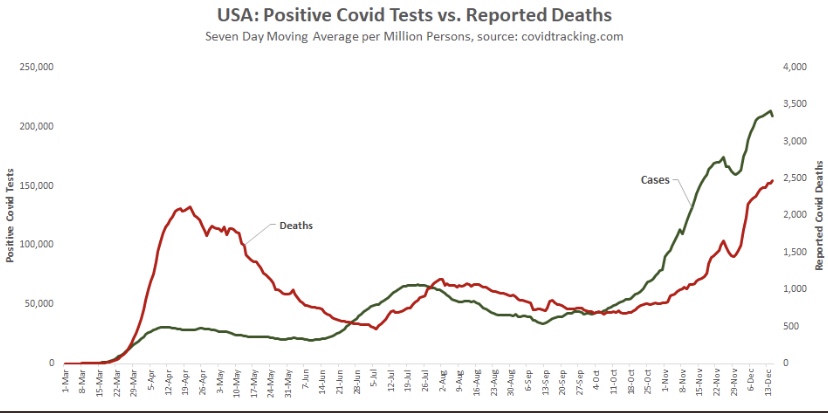
Aggregate cases for the U.S. appear below. The growth rate of new cases has slowed, and the peak is likely to occur soon. However, because it combines all of the regional waves, the duration of the wave nationwide will appear to be greater than for the individual regions. COVID-attributed deaths are also plotted, but they are reported deaths, not by date of death (DOD) or actual deaths, as I sometimes call them. Deaths by DOD are available only with a lag. As always, some of the reported deaths shown below occurred weeks before their reported date. Actual deaths were still rising as of late November, and are likely still rising. However, another indicator suggests they should be close to a peak.
A leading indicator of actual deaths I’ve discussed in the past now shows a more definitive improvement than it did just after Thanksgiving, as the next chart shows. This is the CLI share discussed above. An even better predictor of COVID deaths by actual DOD is the sum of CLI and the share of ER patients presenting symptoms of influenza-like illness (ILI), but ILI has been fairly low and stable, so it isn’t contributing much to changes in trend at the moment. There has been about a three-week lead between movements in CLI+ILI and COVID deaths by DOD.

(The reason the sum, CLI+ILI, has been a better predictor than CLI alone is because for some individuals, there are similarities in the symptoms of COVID and the flu.)
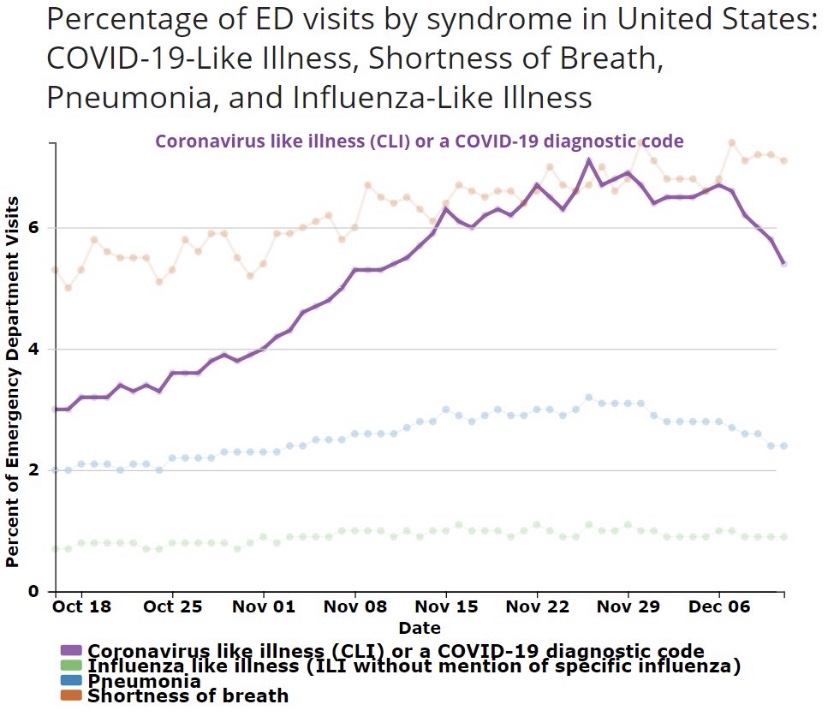
The chart shows that CLI peaked right around the Thanksgiving holiday (and so did CLI+ILI), but it remained on something of a plateau through the first week of December before declining. Some of the last few days on this chart are subject to revision, but the recent trend is encouraging. Allowing for a three-week lead, this indicates that peak deaths by DOD should occur around mid-December, but we won’t know exactly until early to mid-January. To be conservative, we might say the latter half of December will mark the peak in actual deaths.

The regional COVID waves this summer and fall seem to have run their course within 10 – 12 weeks. Several former hot spots have seen cases drop since Thanksgiving after surges of six to seven weeks. However, there are several other regions with populous states where the fall wave is still close to “mid-cycle”, as it were, showing signs of possible peaks after roughly seven weeks of rising cases. The national CLI share peaked around Thanksgiving, but it did not give up much ground until early December. That suggests that actual deaths (as opposed to reported deaths), at least in some regions, will peak around the time of the winter solstice. Let’s hope it’s sooner.

Successive waves within a region seem to reach particular subsets of the population with relatively few reinfections. The 10 – 12 week cycle discussed above is sufficient to achieve an effective herd immunity within these subsets. But once again, a large share of the vulnerable, and a large share of COVID deaths, are still concentrated in the elderly, high-risk population and in care homes. The vaccine(s) currently being administered to residents of those homes are likely to hasten the decline in COVID deaths beginning sometime in January, perhaps as early as mid-month. By then, however, we should already see a decline underway as this wave of the virus finally burns itself out. As vaccines reach a larger share of the population through the winter and spring, the likelihood of additional severe waves of the virus will diminish.

Lest there be any misunderstanding, the reasons for the contagion’s fade to come have mostly to do with reaching the effective herd immunity threshold within afflicted subsets of the population (sub-herds). Social distancing certainly plays a role as well. Nearly all of that is voluntary, though it has been encouraged by panicked pronouncement by certain public officials and the media. Direct interventions or lockdown measures are in general counter-productive, however, and they create a death toll of their own. Unfortunately, the fading pandemic might not rein-in the curtailment of basic liberties we’ve witnessed this year.

Post-Script: Let’s hope the side effects of the vaccines are not particularly severe in the elderly. That’s a little uncertain, because that sub-population was not tested in very high numbers.
A Good Historical Backdrop for the Pandemic

07 Monday Dec 2020

Posted by Nuetzel in Pandemic, Public Health

≈ 2 Comments

Tags

Age-Adjusted Deaths, All-Cause Mortality, Covid-19, Dry Tinder Effect, Flu Season, Lockdown Death, Pandemic, Patrick Moore

In this short post I’m trying to do my part to put our pandemic experience in perspective. Lord knows, I was on the low side in my U.S. case-load “guesstimate” last March, as well as the number of deaths induced by COVID. (A number of others, using highly sophisticated models, erred more severely in the opposite direction.) I also failed to anticipate the strength of the later seasonal waves we’ve experienced — I was excessively optimistic as the first wave ebbed. But now, as the fall wave is showing some signs of topping out, what can we say about the pandemic in historical perspective? I came across an interesting chart that sheds some light on the question.

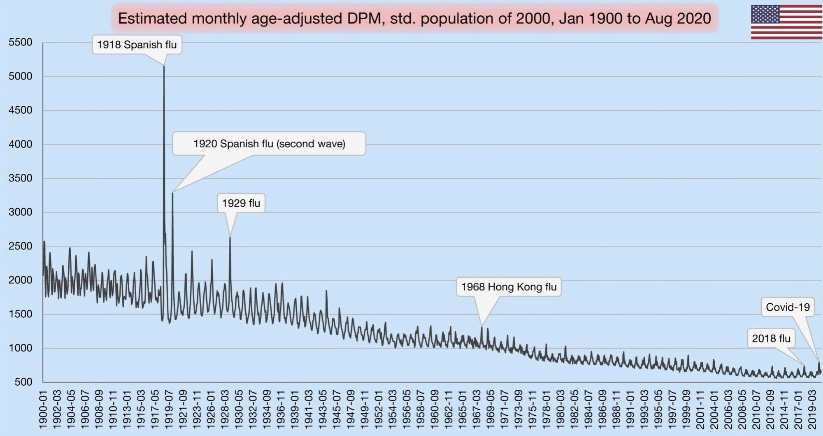
In terms of all-cause mortality, we’ve clearly seen a bump upward this year. Take a look at the chart below. It shows deaths per million (DPM) of population (from all causes). Try clicking on it if it’s hard to read, or turn your phone sideways. See the little blip on the lower right? That’s our pandemic year through August. The blip made 2020, at least through August, look something like a normal year of the early 2000s.

The visible spike early in 2020 was the spring wave, which was concentrated on the east coast. Of course, the fall wave will yield another spike, probably a bit higher than the first. Nevertheless, against the historical backdrop, this chart shows that the magnitude of our current public health crisis is relatively minor.

If you scan to the left from 2020, you can see that DPM this year would have appeared normal around 2005. Remember how bad it was back in aught-five…. all the death? Yeah, me neither. That’s perspective.

The chart also reflects several mild flu seasons over the past few years. Because the flu, like COVID-19, tends to hit the elderly and infirm the hardest, the “soft” DPM numbers over the past few years support the theory that the population included a fair amount of so-called “dry tinder” for COVID as we entered the year.

One other note on the chart: the DPMs are “age-adjusted”, meaning that age groups are weighted for comparisons across countries with differing age distributions (not what we’re doing here). In this case, the DPM values are weighted based on the population in the year 2000.

It’s amazing how so many have bought into the narrative that the current pandemic is historically bad. Yes, our DPMs are high relative to the last decade, but a significant number of those deaths were caused not by COVID, but by our own overreaction to the virus. That’s something else I failed to anticipate in the spring. It’s something we can put behind us now, however, if only we’re willing to put our experience in perspective. Unfortunately, many public officials, along with their public health advisors, continue to promote the deluded view that the virus can only be stopped by stopping our lives, our educations, our earnings, our health, and our sanity.

On COVID, NPIs, and “Human” Data Points

24 Tuesday Nov 2020

Posted by Nuetzel in Lockdowns, Pandemic, Public Health

≈ 1 Comment

Tags

Alzheimer's, Anthony Fauci, Asymptomatic Carriers, Cancer, CDC, Centers for Disease Control, Covid-19, Dementia, Domestic Abuse, Education, HIV, Human Costs, Journal of the American Medical Association, Lancet, Lockdowns, Malaria, Malignant Neoplasms, Mandates, Masks, Public Health, Robert Redfield, SAAAD, SARS-CoV-2, Starvation, Suicide, The Ethical Skeptic, Tuberculoosis, Tyler Cowen, United Nations, Vitamin D

The other day a friend told me “your data points always seem to miss the people points.” He imagines a failure on my part to appreciate the human cost of the coronavirus. Evidently, he feels that I treat data on cases, hospitalizations, and deaths as mere accounting issues, all while emphasizing the negative aspects of government interventions.

This fellow reads my posts very selectively, hampered in part by his own mood affiliation. Indeed, he seems to lack an appreciation for the nuance and zeitgeist of my body of blogging on the topic… my oeuvre! This despite his past comments on the very things he claims I haven’t mentioned. His responses usually rely on anecdotes relayed to him by nurses or doctors he knows. Anecdotes can be important, of course. But I know nurses and doctors too, and they are not of the same mind as his nurses and doctors. Anecdotes! We’re talking about the determination of optimal policy here, and you know what Dr. Fauci says about relying on anecdotes!

Incremental Costs and Benefits

My friend must first understand that my views are based on an economic argument, one emphasizing the benefits and costs of particular actions, including human costs. COVID is dangerous, but primarily to the elderly, and no approach to managing the virus is free. Here are two rather disparate choices:

  1. Mandated minimization of economic and social interactions throughout society over some time interval in the hope of reducing the spread of the virus;
  2. Laissez faire for the general population while minimizing dangers to high-risk individuals, subject to free choice for mentally competent, high-risk individuals.

To be clear, #2 entails all voluntary actions taken by individuals to mitigate risks. Therefore, #1 implies a set of incremental binding restrictions on behavior beyond those voluntary actions. However, I also include in #1 the behavioral effects of scare mongering by public officials, who regularly issue pronouncements having no empirical basis.

The first option above entails so-called non-pharmaceutical interventions (NPIs) by government. These are the elements of so-called lockdowns, such as quarantines and other restrictions on mobility, business and consumer activity, social activities, health care activities, school closures, and mask mandates. NPIs carry costs that are increasing in the severity of constraints they impose on society.

And before I proceed, remember this: tallying all fatal COVID cases is really irrelevant to the policy exercise. Nothing we do, or could have done, would save all those lives. We should compare what lives can be saved from COVID via lockdowns, if any, with the cost of those lockdowns in terms of human life and human misery, including economic costs.

Economic Losses

NPIs involve a loss of economic output that can never be recovered… it is gone forever, and a loss is likely to continue for some time to come. That sounds so very anodyne, despite the tremendous magnitude of the loss involved. But let’s stay with it for just a second. The loss of U.S. output in 2020 due to COVID has been estimated at $2.5 trillion. As Don Boudreaux and Tyler Cowen have noted, what we normally spend on safety and precautionary measures (willingness-to-pay), together with the probabilities of losses, implies that we value our lives at less than $4 million on average. Let’s say the COVID death toll reaches 300,000 by year-end (that’s incremental in this case— but it might be a bit high). That equates to a total loss of $1.2 trillion in life-value if we ignore distinctions in life-years lost. Now ask this: if our $2.5 trillion output loss could have saved every one of those 300,000 lives, would it have been worth it? Not even close, and the truth is that the sacrifice will not have saved even a small fraction of those lives. I grant, however, that the economic losses are partly attributable to voluntary decisions, but goaded to a great extent by the alarmist commentary of public health officials.

The full depth of losses is far worse than the dollars and cents comparison above might sound. Output losses are always matched by (and, in value, are exactly the same as) income losses. That involves lost jobs, lost hours, failed businesses, and destroyed careers. Ah, now we’re getting a bit more “human”, aren’t we! It’s nothing short of callous to discount these costs. Unfortunately, the burden falls disproportionately on low-income workers. Our elites can mostly stay home and do their jobs remotely, and earn handsome incomes. The working poor spend their time in line at food banks.

Yes, government checks can help those with a loss of income compete with elites for the available supply of goods, but of course that doesn’t replace the lost supply of goods! Government aid of this kind is a palliative measure; it doesn’t offset the real losses during a suspension of economic activity.

Decimated Public Health

The strain of the losses has been massive in the U.S. and nearly everywhere in the world. People are struggling financially, making do with less on the table, depleting their savings, and seeking forbearance on debts. The emotional strains are no less real. Anxiety is rampant, drug overdoses have increased, calls to suicide hotlines have exploded, and the permanence of the economic losses may add to suicide rates for some time to come. Dr. Robert Redfield of the CDC says more teenagers will commit suicide this year than will die from COVID (also see here). There’s also been a terrifying escalation in domestic abuse during the pandemic, including domestic homicide. The despair caused by economic losses is all too real and should be viewed as a multiplier on the total cost of severe NPIs.

More on human costs: a health care disaster has befallen locked-down populations, including avoidance of care on account of panic fomented by so-called public health experts, the media, and government. Some of the consequences are listed here. But to name just a few, we have huge numbers of delayed cancer diagnoses, which sharply decrease survival time; mass avoidance of emergency room visits, including undiagnosed heart attacks and strokes; and unacceptable delays in cardiac treatments. Moreover, lockdowns worldwide have severely damaged efforts to deal with scourges like HIV, tuberculosis, and malaria.

The CDC reports that excess mortality among 25-44 year-olds this year was up more than 26%, and the vast bulk of these were non-COVID deaths. A Lancet study indicates that a measles outbreak is likely in 2021 due to skipped vaccinations caused by lockdowns. The WHO estimates that 130,000,000 people are starving worldwide due to lockdowns. That is roughly the population of the U.S. east coast. Again, the callousness with which people willfully ignore these repercussions is stunning, selfish and inhumane, or just stupid.

Excess Deaths

Can we quantify all this? Yes we can, as a matter of fact. I’ve offered estimates in the past, and I already mentioned that excess deaths, COVID and non-COVID, are reported on the CDC’s web site. The Ethical Skeptic (TES) does a good job of summarizing these statistics, though the last full set of estimates was from October 31. Here is the graphic from the TES Twitter feed:

Note particularly the huge number of excess deaths attributable to SAAAD (Suicide, Addiction Abandonment, Abuse and Despair): over 50,000! The estimate of life-years lost due to non-COVID excess deaths is almost double that of COVID deaths because of the difference in the age distributions of those deaths.

Here are a few supporting charts on selected categories of excess deaths, though they are a week behind the counts from above. The first is all non-COVID, natural-cause excess deaths (the vertical gap between the two lines), followed by excess deaths from Alzheimer’s and dementia, other respiratory diseases, and malignant neoplasms (cancer):

The clearest visual gap in these charts is the excess Alzheimer’s and dementia deaths. Note the increase corresponding to the start of the pandemic, when these patients were suddenly shut off from loved ones and the company of other patients. I also believe some of these deaths were (and are) due to overwhelmed staff at care homes struck by COVID, but even discounting this category of excess deaths leaves us with a huge number of non-COVD deaths that could have been avoided without lockdowns. This represents a human cost over and above those tied to the economic losses discussed earlier.

Degraded Education and Health

Lockdowns have also been destructive to the education of children. The United Nations has estimated that 24 million children may drop out of school permanently as a result of lockdowns and school closures. This a burden that falls disproportionately on impoverished children. This article in the Journal of the American Medical Association Network notes the destructive impact of primary school closures on educational attainment. Its conclusions should make advocates of school closures reconsider their position, but it won’t:

“… missed instruction during 2020 could be associated with an estimated 5.53 million years of life lost. This loss in life expectancy was likely to be greater than would have been observed if leaving primary schools open had led to an expansion of the first wave of the pandemic.“

Lockdown Inefficacy

Lockdowns just don’t work. There was never any scientific evidence that they did. For one thing, they are difficult to enforce and compliance is not a given. Of course, Sweden offers a prime example that draconian lockdowns are unnecessary, and deaths remain low there. This Lancet study, published in July, found no association between lockdowns and country mortality, though early border closures were associated with lower COVID caseloads. A French research paper concludes that public decisions had no impact on COVID mortality across 188 countries, U.S. states, and Chinese states. A paper by a group of Irish physicians and scientists stated the following:

“Lockdown has not previously been employed as a strategy in pandemic management, in fact it was ruled out in 2019 WHO and Irish pandemic guidelines, and as expected, it has proven a poor mitigator of morbidity and mortality.”

One of the chief arguments in favor of lockdowns is the fear that asymptomatic individuals circulating in the community (and there are many) would spread the virus. However, there is no evidence that they do. In part, that’s because the window during which an individual with the virus is infectious is narrow, but tests may detect tiny fragments of the virus over a much longer span of time. And there is even some evidence that lockdown measures may increase the spread of the virus!

Lockdown decisions are invariably arbitrary in their impact as well. The crackdown on gyms is one noteworthy example, but gyms are safe. Restaurants don’t turn up in many contact traces either, and yet restaurants have been repeatedly implicated as danger zones. And think of the many small retailers shut down by government, while giant competitors like Wal-Mart continue to operate with little restriction. This is manifest corporatism!

Then there is the matter of mask mandates. As readers of this blog know, I think masks probably help reduce transmission from droplets issued by a carrier, that is, at close range. However, this recent Danish study in the Annals of Internal Medicine found that cloth masks are ineffective in protecting the wearer. They do not stop aerosols, which seem to be the primary source of transmission. They might reduce viral loads, at least if worn properly and either cleaned often or replaced. Those are big “ifs”.

To the extent that masks offer any protection, I’m happy to wear them within indoor public accommodations, at least for the time being. To the extent that people are “scared”, I’m happy to observe the courtesy of wearing a mask, but not outside in uncrowded conditions. To the extent that masks are required under private “house rules”, of course I comply. Public mask mandates outside of government buildings are over the line, however. The evidence that those mandates work is too tenuous and our liberties are too precious too allow that kind of coercion. And private facilities should be subject to private rules only.

QED

So my poor friend is quite correct that COVID is especially deadly to certain cohorts and challenging for the health care community. But he must come to grips with a few realities:

  • The virus won’t be defeated with NPIs; they don’t work!
  • NPIs inflict massive harm to human well-being.
  • Lockdowns or NPIs are little or no gain, high-pain propositions.

The rejection of NPI’s, or lockdowns, is based on compelling “human” data points. As Don Boudreaux says:

“The lockdowns and other restrictions on economic and social activities are astronomically costly – in a direct economic sense, in an emotional and spiritual sense, and in a ‘what-the-hell-do-these-arbitrary-diktats-portend-for-our-freedom?’ sense.” 

This doctor has a message for the those denizens of social media with an honest wish to dispense helpful public health advice:

“Americans have admitted that they will meet for Thanksgiving. Scolding and shaming them for wanting this is unlikely to slow the spread of SARS-CoV-2, though it may earn you likes and retweets. Starting with compassion, and thinking of ways they can meet, but as safely as possible, is the task of real public health. Now is the time to save public health from social media.”

And take some Vitamin D!

November Pandemic Perspective

18 Wednesday Nov 2020

Posted by Nuetzel in Coronavirus, Pandemic, Uncategorized

≈ Leave a comment

Tags

@tlowdon, Actual Date of Death, COVID, COVID Testing, COVID-Like Illness, Don Wolt, Excess Deaths, False Positives, Hospitalizations, ILI, Influenza-Like Illness, PCR Tests, Reported Deaths

I hope readers share my compulsion to see updated COVID numbers. It’s become a regular feature on this blog and will probably remain one until infections subside, vaccine or otherwise. Or maybe when people get used to the idea of living normally again in the presence of an endemic pathogen, as they have with many other pathogens and myriad risks of greater proportions, and as they should. That might require more court challenges, political changes, and plain old civil disobedience.

So here, then, is an update on the U.S. COVID numbers released over the past few days. The charts below are attributable to Don Wolt (@tlowdon on Twitter).

First, reported deaths began to creep up again in the latter half of October and have escalated in November. They’ve now reached the highs of the mid-summer wave in the south, but this time the outbreak is concentrated in the midwest and especially the upper midwest.

Reported deaths are the basis of claims that we are seeing 1,500 people dying every day, which is an obvious exaggeration. There have been recent days when reported deaths exceeded that level, but the weekly average of reported deaths is now between 1,100 and 1,200 a day.

It’s important to understand that deaths reported in a given week actually occurred earlier, sometimes eight or more weeks before the week in which they are reported. Most occur within three weeks of reporting, but sometimes the numbers added from four-plus weeks earlier are significant.

The following chart reproduces weekly reported deaths from above using blue bars, ending with the week of November 14th. Deaths by actual date-of-death (DOD) are shown by the orange bars. The most recent three-plus weeks always show less than complete counts of deaths by DOD. But going back to mid-October, actual weekly deaths were running below reported deaths. If the pattern were to follow the upswings of the first two waves of infections, then actual weekly deaths would exceed reported deaths by perhaps the end of October. However, it’s doubtful that will occur, in part because we’ve made substantial progress since the spring and summer in treating the disease.

To reinforce the last point, it’s helpful to view deaths relative to COVID case counts. Deaths by DOD are plotted below by the orange line using the scale on the right-hand vertical axis. New positive tests are represented by the solid blue line, using the left-hand axis, along with COVID hospitalizations. There is no question that the relationship between cases, hospitalizations, and deaths has weakened over time. My suspicions were aroused somewhat by the noticeable compression of the right axis for deaths relative to the two charts above, but on reviewing the actual patterns (peak relative to troughs) in those charts, I’m satisfied that the relationships have indeed “decoupled”, as Wolt puts it.

Cases are going through the roof, but there is strong evidence that a large share of these cases are false positives. COVID hospitalizations are up as well, but their apparent co-movement with new cases appears to be dampening with successive waves of the virus. That’s at least partly a consequence of the low number of tests early in the pandemic.

So where is this going? The next chart again shows COVID deaths by DOD using orange bars. Wolt has concluded, and I have reported here, that the single-best short-term predictor of COVID deaths by DOD is the percentage of emergency room visits at which patients presented symptoms of either COVID-like illness (CLI) or influenza-like illness (ILI). The sum of these percentages, CLI + ILI, is shown below by the dark blue line, but the values are shifted forward by three weeks to better align with deaths. This suggests that actual COVID deaths by DOD will be somewhere around 7,000 a week by the end of November, or about 1,000 a day. Beyond that time, the path will depend on a number of factors, including the weather, prevalence and immunity levels, and changes in mobility.

I am highly skeptical that lockdowns have any independent effect in knocking down the virus, though interventionists will try to take credit if the wave happens to subside soon for any other reason. They won’t take credit for the grim lockdown deaths reaped by their policies.

Despite the bleak prospect of 1,000 or more COVID-attributed deaths a day by the end of November, the way in which these deaths are counted is suspect. Early in the pandemic, the CDC significantly altered guidelines for the completion of death certificates for COVID such that deaths are often improperly attributed to the virus. Some COVID deaths stem from false-positive PCR tests, and again, almost since the beginning of the pandemic, hospitals were given a financial incentive to classify inpatients as COVID-infected.

It’s also important to remember that while any true COVID fatality is premature, they are generally not even close to the prematurity of lockdown deaths. That’s a simple consequence of the age profile of COVID deaths, which indicate relatively few life-years lost, and the preponderance of co-morbidities among COVID fatalities.

Again, COVId deaths are bad enough, but we are seeing an unacceptable and ongoing level of lockdown deaths. This is now to the point where they may account for almost all of the continuing excess deaths, even with the fall COVID wave. It’s probable that public health would be better served with reduced emphasis on COVID-mitigation for the general population and more intense focus on protecting the vulnerable, including the distribution of vaccines.

COVID and Hospital Capacity

15 Sunday Nov 2020

Posted by Nuetzel in Health Care, Pandemic

≈ 1 Comment

Tags

Bed Capacity, Capacity Management, CDC, Covid-19, HealthData.gov, Herd Immunity, Hospital Utilization, ICU Capacity, ICU Utilization, Influenza, Justin Hart, Lockdown Illnesses, Missouri, PCR Tests, Prevalence, Seasonality, St. Louis MO, Staffed Beds, Staffed Utilization, Statista

The fall wave of the coronavirus has brought with it an increase in COVID hospitalizations. It’s a serious situation for the infected and for those who care for them. But while hospital utilization is rising and is reaching tight conditions in some areas, claims that it is already a widespread national problem are without merit.

National and State Hospital Utilization

The table below shows national and state statistics comparing beds used during November 1-9 to the three-year average from 2017 – 19, from Justin Hart. There are some real flaws in the comparison: one is that full-year averages are not readily comparable to particular times of the year, with or without COVID. Nevertheless, the comparison does serve to show that current overall bed usage is not “crazy high” in most states, as it were. The increase in utilization shown in the table is highest in IA, MT, NV, PA, VT, and WI, and there are a few other states with sizable increases.

Another limitation is that the utilization rates in the far right column do not appear to be calculated on the basis of “staffed” beds, but total beds. The U.S. bed utilization rate would be 74% in terms of staffed beds.

Average historical hospital occupancy rates from Statista look like this:

Again, these don’t seem to be calculated on the basis of staffed beds, but current occupancies are probably higher now based on either staffed beds or total beds.

As of November 11th, a table available at HealthData.gov indicates that staffed bed utilization in the U.S. is at nearly 74%, with ICU utilization also at 74%. As the table above shows, states vary tremendously in their hospital bed utilization, a point to which I’ll return below.

COVID patients were using just over 9% of of all staffed beds and just over 19% of ICU beds as of November 11th. One caveat on the reported COVID shares you’ll see for dates going forward: the CDC changed its guidelines on counting COVID hospitalizations as of November 12th. It is now a COVID patient’s entire hospital stay, rather than only when a patient is in isolation with COVID. That might be a better metric if we can trust the accuracy of COVID tests (and I don’t), but either way, the change will cause a jump in the COVID share of occupied beds.

Interpreting Hospital Utilization

Many issues impinge on the interpretation of hospital utilization rates:

First, cases and utilization rates are increasing, which is worrisome, but the question is whether they have already reached crisis levels or will very soon. The data doesn’t suggest that is the case in the aggregate, but there certainly there are hospitals bumping up against capacity constraints in some parts of the country.

Second, occupancies are increasing due to COVID patients as well as patients suffering from lockdown-related problems such as self-harm, psychiatric problems, drug abuse, and conditions worsened by earlier deferrals of care. We can expect more of that in coming weeks.

Third, lockdowns create other hospital capacity issues related to staffing. Health care workers with school-aged children face the daunting task of caring for their kids and maintaining hours on jobs for which they are critically needed.

Fourth, there are capacity issues related to PPE and medical equipment that are not addressed by the statistics above. Different uses must compete for these resources within any hospital, so the share of COVID admissions has a strong bearing on how the care of other kinds of patients must be managed.

Fifth, some of the alarm is purely case-driven: all admissions are tested for COVID, and non-COVID admissions often become COVID admissions after false-positive PCR tests, or simply due to the presence of mild COVID with a more serious condition or injury. However, severe COVID cases have an outsized impact on utilization of staff because their care is relatively labor-intensive.

Sixth, there are reports that the average length of COVID patient stays has decreased markedly since the spring (it is hard to find nationwide figures), but it is also increasingly difficult to find facilities for post-acute care required for some patients on discharge. Nevertheless, if improved treatment reduces average length of stay, it helps hospitals deal with the surge.

Finally, thus far, the influenza season has been remarkably light, as the following chart from the CDC shows. It is still early in the season, but the near-complete absence of flu patients is helping hospitals manage their resources.

St. Louis Hotspot

The St. Louis metro area has been proclaimed a COVID “hotspot” by the local media and government officials, which certainly doesn’t make St. Louis unique in terms of conditions or alarmism. I’m curious about the data there, however, since it’s my hometown. Here is hospital occupancy on the Missouri side of the St. Louis region:

It seems this chart is based on total beds, not staffed beds, However, one of the interesting aspects of this chart is the variation in capacity over time, with several significant jumps in the series. This has to do with data coverage and some variation in daily reporting. Almost all of these data dashboards are relatively new, so their coverage has been increasing, but generally in fits and starts. Reporting is spotty on a day-to-day basis, so there are jagged patterns. And of course, capacity can vary from day-to-day and week-to-week — there is some flexibility in the number of beds that can be made available.

The share of St. Louis area beds in use was 61% as of November 11th (preliminary). COVID patients accounted for 12% of hospital beds. ICU utilization in the St. Louis region was a preliminary 67% as of Nov. 11, with COVID patients using 29% of ICU capacity (which is quite high). Again, these figures probably aren’t calculated on the basis of “staffed” beds, so actual hospital-bed and ICU-bed utilization rates could be several percentage points higher. More importantly, it does not appear that utilization in the St. Louis area has trended up over the past month.

At the moment, the St. Louis region appears to have more spare hospital capacity than the nation, but COVID patients are using a larger share of all beds and ICU beds in St. Louis than nationwide. So this is a mixed bag. And again, capacity is not spread evenly across hospitals, and it’s clear that hospitals are under pressure to manage capacity more actively. In fact, hospitals only have so many options as the share of COVID admissions increases: divert or discharge COVID and non-COVID patients, defer elective procedures, discharge COVID and non-COVID patients earlier, allow beds to be more thinly staffed and/or add temporary beds wherever possible.

Closing Thoughts

Anyone with severe symptoms of COVID-19 probably should be hospitalized. The beds must be available, or else at-home care will become more commonplace, as it was for non-COVID maladies earlier in the pandemic. A continued escalation in severe COVID cases would require more drastic steps to make hospital resources available. That said, we do not yet have a widespread capacity crisis, although that’s small consolation to areas now under stress. And a few of the states with the highest utilization rates now have been rather stable in terms of hospitalizations — they already had high average utilization rates, which is potentially dangerous.

COVID is a seasonal disease, and it’s no surprise that it’s raging now in areas that did not experience large outbreaks in the spring and summer. And those areas that had earlier outbreaks have not had a serious surge this fall, at least not yet. My expectation and hope is that the midwestern and northern states now seeing high case counts will soon reach a level of prevalence at which new infections will begin to subside. And we’re likely to see a far lower infection fatality rate than experienced in the Northeast last spring.

Predicted November COVID Deaths

08 Sunday Nov 2020

Posted by Nuetzel in Pandemic, Public Health

≈ 2 Comments

Tags

@tlowdon, Antibodies, CDC, COVID Deaths, Covid Tracking Project, COVID-Like Illness, ER Patient Symptoms, FiveThirtyEight, Flu Season, Herd Immunity, Humidity, Influenza-Type Illness, Iowa State, MIT, Predictive Models, Provisional Deaths, Seroprevalence, UCLA, University of Texas, Vitamin D

Reported COVID deaths do not reflect deaths that actually occurred in the reporting day or week, as I’ve noted several times. Here is a nice chart from @tlowdon on Twitter showing the difference between reported deaths and actual deaths for corresponding weeks. The blue bars are weekly deaths reported by the COVID Tracking Project. The solid orange bars are the CDC’s “provisional” deaths by actual week of death, which is less than complete for recent weeks because of lags in reporting. Still, it’s easy to see that reported deaths have overstated actual deaths each week since late August.

I should note that the orange bars represent deaths that involved COVID-19, though a COVID infection might not have actually killed them. This CDC report, updated on November 4th, shows the importance of co-morbidities, which in many cases are the actual cause of death according to pre-COVID, CDC guidance on death certificates.

Leading Indicators

Researchers have studied several measures in an effort to find leading indicators of COVID deaths. The list includes new cases diagnosed (PCR positivity) and the percentage of emergency room visits presenting symptoms of COVID-like illness (%CLI). These indicators are usually evaluated after shifting them in time by a few weeks in order to observe correlations with COVID deaths a few weeks later. Interestingly, @tlowdon reports that the best single predictor of actual COVID deaths over the course of a few weeks is the sum of the %CLI and the percentage of ER patients presenting symptoms of influenza-like illness (%ILI). Perhaps adding %ILI to %CLI strengthens the correlation because the symptoms of the flu and COVID are often mistaken for one another.

The chart below reproduces the orange bars from above representing deaths at actual dates of death. Also plotted are the %Positivity from COVID tests (shifted forward 2 weeks), %CLI (3 weeks), the %ILI (3 weeks), and the sum of %CLI and %ILI (3 weeks, the solid blue line). My guess is that %ILI contributes to the correlation with deaths mainly because %ILI’s early peak (which occurred in March) led the peak in deaths in April. Otherwise, there is very little variation in %ILI. That might change with the current onset of the flu season, but as I noted in my last post, the flu has been very subdued since last winter.

What About November?

So where does that leave us? The chart above ends with our leading indicator, CLI + ILI, brought forward from the first half of October. What’s happened to CLI + ILI since then? And what does that tell us to expect in November? The chart below is from the CDC’s web site. The red line is %CLI and the yellow line is %ILI. The sum of the two isn’t shown. However, there is no denying the upward trend in CLI, though the slope of CLI + ILI would be more moderate.

As of 10/31, CLI + ILI has increased by almost 40% since it’s low in early October. If the previous relationship holds up, that implies an increase of almost 40% in actual weekly COVID deaths from about 4,000 per week to about 5,500 per week by November 21 (a little less than 800 per day).

FiveThirtyEight has a compilation of 13 different forecast models with projections of deaths by the end of November. The estimate of 5,500 per week by November 21, or perhaps slightly less per week over the full month of November, would put total COVID deaths at the top of the range of the MIT, UCLA, Iowa State, and University of Texas models, but below or near the low end of ranges for eight other models. However, those models are based on reported deaths, so the comparison is not strictly valid. Reported deaths are still likely to exceed actual deaths by the end of November, and the actual death prediction would be squarely in the range of multiple reported death predictions. That reinforces the expectation an upward trend in actual deaths.

Third Wave States

States in the upper Midwest and upper Mountain regions have had the largest increases in cases per capita over the past few weeks. Using state abbreviations, the top ten are ND, SD, WI, IA, MT, NE, WY, UT, IL, and MN, with ID at #11 (according to the CDC’s COVID Data Tracker). One factor that might mediate the increase in cases, and ultimately deaths, is the possibility of early herd immunity: in the earlier COVID waves, the increase in infections abated once seroprevalence (the share of the population with antibodies from exposure) reached a level of 15% to 25%.

Unfortunately, estimates of seroprevalence by state are very imprecise. Thus far, reliable samples have been limited to states and metro areas that had heavy infections in the first and second waves. One rule of thumb, however, is that seroprevalence is probably less than 10x the cumulative share of a population having tested positive. To be very conservative, let’s assume a seroprevalence of four times cumulative cases. On that basis, half the states in the “top ten” listed above would already have seroprevalence above 15%. Those states are ND, SD, WI, IA, and NE. The others are mostly in a range of 12% to 15%, with MI coming in the lowest at about 9%.

This gives some cause for optimism that the wave in these states and others will abate fairly soon, but there are a number of uncertainties: first, the estimates of seroprevalence above, while conservative, are very imprecise, as noted above; second, the point at which herd immunity might cause the increase in new cases to begin declining is real guesswork (though we might have confirmation in a few states before long); third, we are now well into the fall season, with lower temperatures, lower humidity, less direct sunlight, and diminishing vitamin D levels. We do not have experience with COVID at this time of year, so we don’t know whether the patterns observed earlier in the year will be repeated. If so, new cases might begin to abate in some areas in November, but that probably wouldn’t be reflected in deaths until sometime in December. And if the flu comes back with a corresponding increase in CLI + ILI, then we’d expect further increases in actual deaths attributed to COVID. That is only a possibility given the weakness in flu numbers in 2020, however.

Closing Thoughts

I was excessively optimistic about the course of the pandemic in the U.S. in the spring. While this post has been moderately pessimistic, I believe there are reasons to expect fewer deaths than previous relationships would predict. We are far better at treating COVID now, and the vulnerable are taking precautions that have reduced their incidence of infections relative to younger and healthier cohorts. So if anything, I think the forecasts above will err on the high side.

COVID Trends and Flu Cases

05 Thursday Nov 2020

Posted by Nuetzel in Pandemic

≈ 1 Comment

Tags

Casedemic, Coronavirus, Covid Tracking Project, Covid-19, Flu Season, Herd Immunity, Infection Fatality Rate, Influenza, Johns Hopkins University, Justin Hart, Lockdowns, Provisional Deaths, Rational Ground

Writing about COVID as a respite from election madness is very cold comfort, but here goes….

COVID deaths in the U.S. still haven’t shown the kind of upward trend this fall that many had feared. It could happen, but it hasn’t yet. In the chart above, new cases are shown in brown (along with the rolling seven-day average), while deaths (on the right axis) are shown in blue. It’s been over six weeks since new case counts began to rise, but deaths have risen for about two weeks, and it’s been gradual relative to the first two waves. Either the average lag between diagnosis and death is much longer than earlier in the year, or the current “casedemic” is much less deadly, or perhaps both. It could change. And granted, this is national data; states in the midwest have had the strongest trends in cases, especially the upper midwest, as well as stronger trends in hospitalizations and deaths. Most of those areas had milder experiences with the virus in the spring and summer.

Lagged Reporting

What’s tricky about this is that both case reports and death reports in the chart above are significantly lagged. A COVID test might not take place until several days after infection (if at all), and sometimes not until hospitalization or death. Then the test result might not be known for several days. However, the greater availability of tests and faster turnaround time have almost certainly shortened that lag.

Deaths are reported with an even a greater delay, though you wouldn’t know it from listening to the media or some of the organizations that track these statistics, such as Johns Hopkins University and the COVID Tracking Project. Thus far, they only tell you what’s reported on a given day. This article from Rational Ground does a good job of explaining the issue and the distortion it causes in discerning trends.

Deaths by actual date-of-death

I’ve reported on the issue of lagged COVID deaths myself. The following graph from Justin Hart is a clear presentation of the reporting delays.

Reported deaths for the most recent week (10/24) are shown in dark blue, and those deaths were spread over a number of prior weeks. Actual deaths in a given week are represented by a “stack” of deaths reported later, in subsequent weeks. One word of caution: actual deaths in the most recent weeks are “provisional”, and more will be added in subsequent reporting weeks. Hence the steep drop off for the 10/17 and 10/24 reporting weeks.

Going back three or four weeks, it’s clear that actual deaths continued to decline into October. Unfortunately, that doesn’t tell us much about the recent trend or whether actual deaths have started to rise given the increase in new cases. I have seen a new weekly update with the deaths by actual date of death, but it is not “stacked” by reporting week. However, it does show a slight increase in the week of 10/10, the first weekly increase since the end of June. So perhaps we’ll see an uptick more in-line with the earlier lags between diagnosis and death, but that’s far from certain.

Another important point is that the number of deaths each week, and each day, are not as high as reported by the media and the popular tracking sites. How often have you heard “more than 1,000 people a day are dying”. That’s high even for weekly averages of reported deaths. As of three weeks ago, actual daily deaths were running at about 560. That’s still very high, but based on seroprevalence estimates (the actual number of infections from the presence of antibodies), the infection fatality keeps dropping toward levels that are comparable to the flu at ages less than 65.

Where is the flu?

Speaking of the flu, this chart from the World Health Organization is revealing: the flu appears to have virtually disappeared in 2020:

It’s still very early in the northern flu season, but the case count was very light this summer in the Southern Hemisphere. There are several possible explanations. One favored by the “lockdown crowd” is that mitigation efforts, including masks and social distancing, have curtailed the flu bug. Not just curtailed … quashed! If that’s true, it’s more than a little odd because the same measures have been so unsuccessful in curtailing COVID, which is transmitted the same way! Also, these measures vary widely around the globe, which weakens the explanation.

There are other, more likely explanations: perhaps the flu is being undercounted because COVID is being overcounted. False positive COVID tests might override the reporting of a few flu cases, but not all diagnoses are made via testing. Other respiratory diseases can be mistaken for the flu and vice versus, and they are now more likely to be diagnosed as COVID absent a test — and as the joke goes, the flu is now illegal! And another partial explanation: it is rare to be infected with two viruses at once. Thus, COVID is said to be “crowding out” the flu.

Waiting for data

There is other good news about transmission, treatment, and immunity, but I’ll devote another post to that, and I’ll wait for more data. For now, the “third wave” appears to be geographically distinct from the first two, as was the second wave from the first. This suggests a sort of herd immunity in areas that were hit more severely in earlier waves. But the best news is that COVID deaths, thus far this fall, are not showing much if any upward movement, and estimates of infection fatality rates continue to fall.

Biden Brainstorm: Nationwide Lockdown, Mask Mandate

01 Sunday Nov 2020

Posted by Nuetzel in Liberty, Pandemic, Tyranny

≈ Leave a comment

Tags

Coronavirus, Covid-19, Donald Trump, Joe Biden, Lockdown Deaths, Mask Mandate, Nationwide Lockdown, Pete Buttigieg, Presidential Powers, Viral Load

Ah, so Mayor Pete Buttigieg of South Bend, Indiana, one of garbling Joe Biden’s campaign surrogates, says Biden will indeed consider a national lockdown if elected. Oh, fine. And Biden accused Trump of destroying the economy? These dumb-asses must think people have memory spans of about a second.

There are several gigantic problems with foggy Joe’s idea: first, it’s not within a president’s power to impose a nationwide lockdown, as the chorus of experts reminded us last spring when Trump mentioned it. Second, the evidence suggests that lockdowns don’t work to eliminate the virus; they delay its spread at best. Third, as we’ve witnessed, lockdowns themselves have enormous public health consequences, leading to a variety of severe maladies, despondency, and excess non-COVID deaths. That’s simply unacceptable. Finally, the economic damage imposed by lockdowns is horrific and often permanent. We’re talking about destroying the independent livelihoods of people. Permanently! Lockdowns are especially hard on those at the bottom of the economic ladder, who are disproportionately minorities. That’s so obvious, and yet very difficult for elites to gather in.

Here’s another one: today Biden said he would impose a “national mandate” on masks and social distancing on Day One of his presidency. Like lockdowns, evidence is accumulating that masks do not work to contain the virus, and in fact they might be counter-productive (also see here, here, here, and here). Biden’s people will probably also insist on a mandating a government-approved contact-tracing app on your cell phone. Not if I can help it! But don’t get me wrong… I wear a mask in public buildings as an act of voluntary cooperation and to be polite. I also hold out some hope that it will keep the viral load minimal should anything float my way, but whatever lands on the mask might stick with it … and me!

Measures like those Biden contemplates are major assaults on our liberty. And the thing is, if any of it comes to pass, the restrictions might never go away. We’ll be asked to do this every flu season, or perhaps permanently to protect each other from “germs”. This is an authoritarian move, one that we should all resist, even if you’re freaked out by the virus. The best way to resist right now is to vote for Donald Trump.

And please, don’t give me any bullshit about our “responsibility” to lock down, and how mandatory masks are necessary to protect the vulnerable. Is poverty now a “responsibility”? The most highly vulnerable can be protected without masks, and maybe better. Beyond that, people must be free to determine their own level of risk tolerance, just as they have for millennia with respect to a broad spectrum of serious risks, pathogens or otherwise. That’s a dimension of freedom about which no one should be so cavalier.

Fall Coronavirus Season

16 Friday Oct 2020

Posted by Nuetzel in Coronavirus, Pandemic, Uncategorized

≈ Leave a comment

Tags

Antigenic Drift, CARES Act, Coronavirus, Covid-19, Death Laundering, Europe, False Positives, Hospital Reimbursement, IFR, Immunity, Infection Fatality Rate, Kyle Lamb, Medicare, Seasonality, Second Wave, Twitter, Vitamin D, WHO

We’ve known for some times that COVID-19 (C19) follows seasonal patterns typical of the flu, though without the flu’s frequent antigenic drift. Now that we’re moving well into autumn, we’ve seen a surge in new C19 case counts in Europe and in a number of U.S. states, especially along the northern tier of the country.

The new case surge began in early to mid-September, depending on the state, and it’s been coincident with another surge in tests. From late July through early October, we had a near doubling in the number of tests per positive in the U.S. An increase in tests also accompanied the previous surge during the summer, which claimed far fewer lives than the initial wave in the early spring. In the summer, infections were much more prevalent among younger people than in the spring. Vitamin D levels were almost certainly higher during the summer months, our ability to treat the virus had also improved, and immunities imparted by prior infections left fewer susceptible individuals in the population. We have many of those advantages now, but D levels will fade as the fall progresses.

As for the new surge in cases, another qualification is that false positives are still a major testing problem; they inflate both case counts and C19-attributed deaths. In the absence of any improvement in test specificity, of which there is no evidence, the exaggeration caused by false positives grows larger as testing increases and positivity rates fall. So take all the numbers with that as a caveat.

How deadly will the virus be this fall? So far in Europe, the trends look very promising. Kyle Lamb provided the following charts from WHO on Twitter yesterday. (We should all be grateful that Twitter hasn’t censored Kyle yet, because he’s been a force in exposing alarmism in the mainstream media and among the public health establishment.) Take a look at these charts, and note particularly the lag between the first wave of infections and deaths, as well as the low counts of deaths now:

If the lag between diagnosis and death is similar now to the spring, Europe should have seen a strong upward trend in deaths by now, yet it’s hardly discernible in most of those countries. The fatality rates are low as well:

As Lamb notes, the IFRs in the last column look about like the flu, though again, the reporting of deaths and their causes are often subject to lags.

What about the U.S.? Nationwide, C19 cases and attributed death reports declined after July. See the chart below. More recently, reported deaths have stabilized at under 700 per day. Note again the relatively short lags between turns in cases and deaths in both the spring and summer waves.

Clearly, there has been no acceleration in C19 deaths corresponding to the recent trend in new cases. Northeastern states that had elevated death rates in the spring saw no resurgence in the summer; southern states that experienced a surge in the summer have now enjoyed taperings of both cases and deaths. But with each season, the virus seems to roll to regions that have been relatively unscathed to that point. Now, cases are surging in the upper Midwest and upper mountain states, though some of these states are lightly populated and their data are thin.

A few state charts are shown below, but trends in deaths are very difficult to tease out in some cases. First, here are new cases and reported deaths in Michigan, Wisconsin, and Minnesota. There is a clear uptrend in cases in these states along with a very slight rise in deaths, but reported deaths are very low.

Next are Idaho, Montana, North Dakota, and South Dakota. A slight uptrend in cases began as early as August. Idaho and Montana have had few deaths, so they are not plotted in the second chart. The Dakotas have had days with higher reported deaths, and while the data are thin and volatile, the visual impression is definitely of an uptrend in deaths.

The following states are somewhat more central in latitude: Colorado, Illinois, and Ohio. There is a slight upward trend in new cases, but not deaths. Illinois is experiencing its own second wave in cases.

Out of curiosity, I also plotted Massachusetts, Pennsylvania, and New Jersey, all of which suffered in the first wave during the spring. They are now experiencing uptrends in cases, especially Massachusetts, but deaths have been restrained thus far.

The upshot is that states having little previous exposure to the virus are seeing an uptrend in deaths this fall. The same does not seem to be happening in states with significant prior exposure, at least not yet.

There are major questions about the reasons for the lingering death counts in the U.S.. But consider the following: first, the infection fatality rate (IFR) keeps falling, despite the stubborn level of daily reported deaths. Second, deaths reported have increasingly been pulled forward from deaths that actually occurred in the more distant past. This sort of “laundering” lends the appearance of greater persistence in deaths than is real. Third, again, false positives exaggerate not just cases, but also C19 deaths. Hospitals test everyone admitted, and patients who test positive for C19 are reimbursed at higher rates under the CARES Act; Medicare reimburses at a higher rates for C19 patients as well.

We’re definitely seeing a seasonal upswing in C19 infections in the US., now going on five weeks. In Europe, the surge in cases began slightly earlier. However, in both Europe and the U.S., these new cases have not yet been associated with a meaningful surge in deaths. The exceptions in the U.S. are the low-density upper mountain states, which have had little prior exposure to the virus. The lag between cases and deaths in the spring and summer was just two to three weeks, and while it’s too early to draw conclusions, the absence of a surge in deaths thus far bodes well for the IFR going forward. If we’re so fortunate, we can thank a combination of factors: a younger set of infecteds, earlier detection, better treatment and therapeutics, lower viral loads, and a subset of individuals who have already gained immunity.

COVID, Trump, and Tyrants

11 Sunday Oct 2020

Posted by Nuetzel in Pandemic, Public Health, Trump Administration

≈ Leave a comment

Tags

15 Days to Slow the Spread, Andrew Cuomo, Asian Flu 1557-58, CCP, Centers for Disease Controls, Covid-19, Donald Trump, Dr. Anthony Fauci, Dr. Deborah Birx, Dr. Robert Redfield, Federalism, Mike Pence, Opening Up America Again, Pandemic, SARS Virus, Seasonality, World Health Organization

I’ve said this before, but it bears repeating: allegations of the White House’s “poor leadership” and preparedness for COVID-19 (C19) are a matter of selective memory. At the link above, I “graded” Trump’s pandemic job performance through May. Among other things, I said:

“Many have criticized the Trump Administration for not being ‘ready’ for a pandemic. I assign no grade on that basis because absolutely no one was ready, at least not in the West, so there is no sound premise for judgement. I also view the very general charge that Trump did not provide “leadership” as code for either ‘I don’t like him’, or ‘he refused to impose more authoritarian measures’, like a full-scale nationwide lockdown. Such is the over-prescriptive instinct of the Left.”

The President of the United States does not have the constitutional authority to impose a national lockdown, though Trump himself seemed confused at times as to whether he had that power. However, on this basis at least, the ad nauseam denigration of his “leadership” is vapid. At this point, the course of the pandemic in the U.S. is less severe than in several other industrialized countries who didn’t even have Andrew Cuomo around to exacerbate the toll, and it’s still not as deadly in per capita terms as the Asian Flu of 1957-58.

Who exactly was “ready” for C19? Perhaps critics are thinking of South Korea, or parts of South Asia. Those countries might have been “ready” to the extent that they had significant prior exposure to SARS viruses. There was already some degree of immunological protection. Those countries also were exposed to an earlier genetic variant of C19 that was much less severe than the strain that hit most of the western world. These are hardly reasons to blame Trump for a lack of “readiness”.

A related charge I hear all the time is that Trump “ignored the advice of medical experts“, or that he “ignored the science“. Presumably, those “experts” include the darling of the Prescriptive Class, Dr. Anthony Fauci. On February 28, Dr Fauci said:

“Right now, at this moment, there’s no need to change anything you’re doing on a day by day basis.“

All-righty then! So this was the advice Trump “should” have followed. Oh, wait… he did! And Fauci, on March 9, said there was no reason for young, healthy people to avoid cruise ships.

Likewise, Dr. Robert Redfield, Director of the Centers for Disease Control, said the following on February 27:

“The risk to the American public is low. We have an aggressive containment strategy that really has worked up to this time, 15 cases in the United States. Until the last case that we just had in Sacramento we hadn’t had a new case in two weeks.”

Then there is the World Health Organization, which downplayed the virus in January and February, and giving a convincing impression that it servied as a mouthpiece for the CCP.

In fact, the American people were badly harmed by wrongheaded decisions made by the “experts” at the CDC in January and February, when the agency insisted that testing could not proceed until a test of their own design was ready. Then, the first version it approved was discovered to be flawed! This set the testing effort back by well over a month, a delay that proved critical. It’s no exaggeration to say this bureaucratic overreach denied the whole country, and Trump, the information needed to properly assess the spread of the virus.

But let’s think about actual policy once it became clear that the virus was getting to be a serious matter in parts of the U.S. Here’s another excerpt from my post in May:

“Trump cannot be accused of ignoring expert advice through the episode. He was obviously on-board with Fauci, Dr. Deborah Birx, Dr. Robert Redfield, and other health care advisors on the ‘15 Days to Slow the Spread‘ guidelines issued on March 16. His messaging wavered during those 15 days, expressing a desire to fully reopen the nation by Easter, which Vice President Michael Pence later described as “aspirational”. Before the end of March, however, Trump went along with a 30-day extension of the guidelines. Finally, by mid-April, the White House released guidelines for ‘Opening Up America Again‘, which was a collaboration between Trump’s health care experts and the economic team. Trump agreed that the timeline for reopening should be governed by ‘the data’.” 

We should give Trump credit for shutting down flights into the U.S. from China, where the virus originated, late in January. That was an undeniably prescient move. Let’s also not forget that the original intent of the “15 Days” was to prevent hospitals and other medical resources from being overwhelmed. Today, the data show a strong seasonal tendency to the spread of the virus, but medical resources are not close to being overwhelmed, our ability to treat the virus has vastly improved, and its consequences are much less deadly than in the spring. That’s good progress, whatever the President’s detractors may say.

More than anything else, what Trump’s COVID critics fail to understand is that the executive leader of a republic is not possessed of monarchical powers. And in the U.S., the Constitution provides an additional layer of sovereignty for member states of the Union, a manifestation of the federalist principals without which the Union would not have been possible. The 15-day guidelines produced by the White House, and the guidelines for reopening, were consistent with this framework. The states have adapted their own policies to actual conditions and, if their leaders haven’t worn out their goodwill among voters, internal political realities. Those adaptations were often bad from my perspective, or even tyrannical, but sometimes good. That is exactly how our federalist system was designed to work.

← Older posts
Newer posts →
Follow Sacred Cow Chips on WordPress.com

Recent Posts

  • The Case Against Interest On Reserves
  • Immigration and Merit As Fiscal Propositions
  • Tariff “Dividend” From An Indigent State
  • Almost Looks Like the Fed Has a 3% Inflation Target
  • Government Malpractice Breeds Health Care Havoc

Archives

  • January 2026
  • December 2025
  • November 2025
  • October 2025
  • September 2025
  • August 2025
  • July 2025
  • June 2025
  • May 2025
  • April 2025
  • March 2025
  • February 2025
  • January 2025
  • December 2024
  • November 2024
  • October 2024
  • September 2024
  • August 2024
  • July 2024
  • June 2024
  • May 2024
  • April 2024
  • March 2024
  • February 2024
  • January 2024
  • December 2023
  • November 2023
  • August 2023
  • July 2023
  • June 2023
  • May 2023
  • April 2023
  • March 2023
  • February 2023
  • January 2023
  • December 2022
  • November 2022
  • October 2022
  • September 2022
  • August 2022
  • July 2022
  • June 2022
  • May 2022
  • April 2022
  • March 2022
  • February 2022
  • January 2022
  • December 2021
  • November 2021
  • October 2021
  • September 2021
  • August 2021
  • July 2021
  • June 2021
  • May 2021
  • April 2021
  • March 2021
  • February 2021
  • January 2021
  • December 2020
  • November 2020
  • October 2020
  • September 2020
  • August 2020
  • July 2020
  • June 2020
  • May 2020
  • April 2020
  • March 2020
  • February 2020
  • January 2020
  • December 2019
  • November 2019
  • October 2019
  • September 2019
  • August 2019
  • July 2019
  • June 2019
  • May 2019
  • April 2019
  • March 2019
  • February 2019
  • January 2019
  • December 2018
  • November 2018
  • October 2018
  • September 2018
  • August 2018
  • July 2018
  • June 2018
  • May 2018
  • April 2018
  • March 2018
  • February 2018
  • January 2018
  • December 2017
  • November 2017
  • October 2017
  • September 2017
  • August 2017
  • July 2017
  • June 2017
  • May 2017
  • April 2017
  • March 2017
  • February 2017
  • January 2017
  • December 2016
  • November 2016
  • October 2016
  • September 2016
  • August 2016
  • July 2016
  • June 2016
  • May 2016
  • April 2016
  • March 2016
  • February 2016
  • January 2016
  • December 2015
  • November 2015
  • October 2015
  • September 2015
  • August 2015
  • July 2015
  • June 2015
  • May 2015
  • April 2015
  • March 2015
  • February 2015
  • January 2015
  • December 2014
  • November 2014
  • October 2014
  • September 2014
  • August 2014
  • July 2014
  • June 2014
  • May 2014
  • April 2014
  • March 2014

Blogs I Follow

  • Passive Income Kickstart
  • OnlyFinance.net
  • TLC Cholesterol
  • Nintil
  • kendunning.net
  • DCWhispers.com
  • Hoong-Wai in the UK
  • Marginal REVOLUTION
  • Stlouis
  • Watts Up With That?
  • Aussie Nationalist Blog
  • American Elephants
  • The View from Alexandria
  • The Gymnasium
  • A Force for Good
  • Notes On Liberty
  • troymo
  • SUNDAY BLOG Stephanie Sievers
  • Miss Lou Acquiring Lore
  • Your Well Wisher Program
  • Objectivism In Depth
  • RobotEnomics
  • Orderstatistic
  • Paradigm Library
  • Scattered Showers and Quicksand

Blog at WordPress.com.

Passive Income Kickstart

OnlyFinance.net

TLC Cholesterol

Nintil

To estimate, compare, distinguish, discuss, and trace to its principal sources everything

kendunning.net

The Future is Ours to Create

DCWhispers.com

Hoong-Wai in the UK

A Commonwealth immigrant's perspective on the UK's public arena.

Marginal REVOLUTION

Small Steps Toward A Much Better World

Stlouis

Watts Up With That?

The world's most viewed site on global warming and climate change

Aussie Nationalist Blog

Commentary from a Paleoconservative and Nationalist perspective

American Elephants

Defending Life, Liberty and the Pursuit of Happiness

The View from Alexandria

In advanced civilizations the period loosely called Alexandrian is usually associated with flexible morals, perfunctory religion, populist standards and cosmopolitan tastes, feminism, exotic cults, and the rapid turnover of high and low fads---in short, a falling away (which is all that decadence means) from the strictness of traditional rules, embodied in character and inforced from within. -- Jacques Barzun

The Gymnasium

A place for reason, politics, economics, and faith steeped in the classical liberal tradition

A Force for Good

How economics, morality, and markets combine

Notes On Liberty

Spontaneous thoughts on a humble creed

troymo

SUNDAY BLOG Stephanie Sievers

Escaping the everyday life with photographs from my travels

Miss Lou Acquiring Lore

Gallery of Life...

Your Well Wisher Program

Attempt to solve commonly known problems…

Objectivism In Depth

Exploring Ayn Rand's revolutionary philosophy.

RobotEnomics

(A)n (I)ntelligent Future

Orderstatistic

Economics, chess and anything else on my mind.

Paradigm Library

OODA Looping

Scattered Showers and Quicksand

Musings on science, investing, finance, economics, politics, and probably fly fishing.

  • Subscribe Subscribed
    • Sacred Cow Chips
    • Join 128 other subscribers
    • Already have a WordPress.com account? Log in now.
    • Sacred Cow Chips
    • Subscribe Subscribed
    • Sign up
    • Log in
    • Report this content
    • View site in Reader
    • Manage subscriptions
    • Collapse this bar
 

Loading Comments...