• About

Sacred Cow Chips

Sacred Cow Chips

Category Archives: Public Health

The Favored Cause of Death

19 Monday Oct 2020

Posted by Nuetzel in Coronavirus, Public Health

≈ 3 Comments

Tags

All-Cause Mortality, Andrew Bostom, Andrew Cuomo, Cause of Death, Centers for Disease Control, Clinical Events, Coronavirus, Death Certificate, False Positives, Florida House of Representatives, Hospice Deaths, Justin Hart, Lockdown Deaths, Non-COVID Deaths. Co-Morbidities, PCR Tests, Specificity, Testing

The CDC changed its guidelines on completion of death certificates on April 5th of this year, and only for COVID-19 (C19), just as infections and presumed C19 deaths were ramping up. The substance of the change was to broaden the definition under which death should be attributed to C19. This ran counter to CDC guidelines followed over the previous 17 years, and the change not only makes the C19 death counts suspect: it also makes comparisons of C19 deaths to other causes of death unreliable, since only C19 is subject to the new CDC guidance. That’s true for concurrent and historical comparisons. The distortions are especially bad relative to other respiratory diseases, but also relative to other conditions that are common in mortality data.

The change in the CDC guidelines was noted in a recent report prepared for the Florida House of Representatives. It was brought to my attention by a retweet by Justin Hart linked to this piece on Andrew Bostom’s site. Death certificates are divided into two parts: Part 1 provides four lines in which causes of death are listed in reverse clinical order of events leading to death. Thus, the first line is the final clinical condition precipitating death. Prior clinical events are to be listed below that. The example shown above indicates that an auto accident, listed on the fourth line, initiated the sequence of events. Part 2 of the certificate is available for physicians or examiners to list contributing factors that might have played a role in the death that were not part of the sequence of clinical events leading to death.

The CDC’s change in guidelines for C19, and C19 only, made the criteria for inclusion in Part 1 less specific, and it essentially eliminated the distinction between Parts 1 and 2. The following appears under “Vital Records Criteria”:

“A death certificate that lists COVID-19 disease or SARS-CoV-2 as a cause of death or a significant condition contributing to death.”

How much difference does this make? For one thing, it opens the door to C19-attributed deaths in cases of false-positive PCR tests. When large cohorts are subject to testing — for example, all patients admitted to hospitals — there will always be a significant number of false positives even when test specificity is as high as 98 – 99%.

The elimination of any distinction between Parts 1 and 2 causes other distortions. A review of the Florida report is illustrative. The House staff reviewed almost 14,000 certificates for C19-19 attributed deaths. Over 9% of those did not list C19 among the clinical conditions leading to death. Instead, in those cases, C19 was listed as a contributing factor. Under the CDC’s previous guidelines, those would not have been counted as C19 deaths. The Florida House report is conservative in concluding that the new CDC guidelines inflated C19 deaths by only those 9% of the records examined.

There are reasons to think that the exaggeration was much greater, however. First, the Florida House report noted that nearly 60% of the certificates contained information “recorded in a manner inconsistent with state and national guidance”. In addition, almost another 10% of the fatalities were among patients already in hospice! Do we really believe the deaths of all those patients whose diseases had reached such an advanced stage should be classified as C19 fatalities? And another 1-2% listed non-C19 conditions as the immediate and underlying causes.

Finally, more than 20% of the certificates listed C19 alone as a cause of death despite a range of other contributing conditions or co-morbidities. This in itself may have been prompted by the change in the CDC’s guidelines, as the normal standards often involve a “comorbidity” as the initial reason for hospitalization — in that case a clinical event ordinarily listed in Part 1. The high rate of errors and the fact that roughly two-thirds of the deaths reviewed occurred in the hospital, where patients are all tested and often multiple times, raises the specter that up to 20% more of the C19 deaths were either erroneous and/or misclassified due to false positives.

(An exception may have occurred in New York, where an order issued in March by Governor Andrew Cuomo to return C19-positive residents of nursing homes (including suspected C19 cases) back to those homes, The order was made before the change in CDC guidelines and wasn’t rescinded until later in April. There is reason to believe that some of the C19 deaths among nursing home residents in New York were undercounted.)

All told, in the Florida data we have potential misclassification of deaths of 9% + 9% + 2% + 20% = 40%, or inflation relative to actual C19 deaths of up to 40%/60% = 67%! I strongly doubt it’s that high, but I would not consider a range of 25% – 50% exaggeration to be unreasonable.

We know that reports of C19 deaths lag actual dates of death by anywhere from 1 to 8 weeks, sometimes even more. This is misleading when no effort is made to explain that difference, which I’ve never heard out of a single journalist. We also know that false positive tests inflate C19 deaths. The Florida report gives us a sense of how large that exaggeration might be. In addition, the Florida data show that the CDC guidelines inflate C19 deaths in other ways: as a mere contributing factor, it can now be listed as the cause of death, unlike the treatment of pneumonia as a contributing factor, for instance. The same kind of distortion occurs when patients contract C19 (or have a false positive test) while in hospice.

There is no doubt that C19 led to “excess deaths” relative to all-cause mortality. However, many of these fatalities are misclassified, and it’s likely that a large share were and are lockdown deaths as opposed to C19 deaths. That’s tragic. The CDC has done the country a massive disservice by creating “special rules” for attributing cause-of-death to C19. If reported C19 fatality rates reflected the same rules applied to other conditions, our approach to managing the pandemic surely would have inflicted far less damage to health and economic well being.

Lockdowns Subvert Public Health and Life Itself

15 Thursday Oct 2020

Posted by Nuetzel in Coronavirus, Lockdowns, Public Health, Uncategorized

≈ 1 Comment

Tags

Bill of Rights, CDC, City Journal, Coronavirus, Covid-19, David Miles, Deaths of Despair, dependency, Dr. David Nabarro, Excess Deaths, Flatten the Curve, Great Barrington Declaration, John Tierney, Lockdown Deaths, Lockdowns, Ninth Amendment, Oxfam International, Pandemic, Quality Adjusted Life Years, School Closures, Suicide, The Ethical Skeptic, The Lancet, WHO, World Health Organization

Acceptance of risk is a necessary part of a good life, and extreme efforts to avoid it are your own business. Government has no power to guarantee absolute safety, nor should we presume to have such a right. Ongoing COVID lockdowns are an implicit assertion of exactly that kind of government power, despite the impotence of those efforts, and they constitute a rejection of more fundamental rights.

Lockdowns have had destructive effects on health and economic well being while conferring little if any benefit in mitigating harm from the virus. The lockdowns were originally sold as a way to “flatten the curve”, that is, to avoid a spike in cases and an overburdened health care system. However, this arguably well-qualified rationale later expanded in scope to encompass the mitigation of smaller and much less deadly outbreaks among younger cohorts, and then to the very idea of extinguishing the virus altogether. It’s become painfully obvious that such measures are not capable of achieving those goals.

In the U.S., the ongoing lockdowns have been a cause célèbre largely on the interventionist Left, and they have been prolonged mainly by Democrats at various levels of government. In a way, this is not unlike many other policies championed by the Left, often ostensibly designed to help members of the underclasses: instead, those policies often destroy or wrongly obviate incentives and promote dependency on the state. In this case, the plunge into dependency is a reality the Left would very much like to ignore, or to blame on someone else. You know who.

The lockdowns have been largely unsuccessful in mitigating the spread of the virus. At the same time, they have been used as a pretext to deny constitutional rights such as the free practice of religion, assembly, and a broad range of unenumerated rights under the “penumbra” of the Bill of Rights and the Ninth Amendment. What’s more, the severity of the economic blow caused by lockdowns has been borne disproportionately by the working poor and the small businesses who employ so many of them.

Lockdowns are deadly. It’s not clear that they’ve saved any lives, but they have massively disrupted the operation of the health care system with major consequences for those with chronic and undiagnosed conditions. The lockdowns have also led to spikes in mental health issues, alcoholism, drug abuse, and deaths of despair. A recent study found that over 26% of the excess deaths during the pandemic were non-COVID deaths. Those deaths were avoidable or accelerated, whereas the lockdowns have failed to meaningfully curtail COVID deaths. Don’t tell me about reduced traffic fatalities: that reduction is relatively small relative to the increase in non-COVID excess deaths (see below).

What proof do we have that lockdowns cause excess deaths? See this study in The Lancet on cancer deaths due to lockdown-induced delays in diagnoses. See this study on UK school closures. See this Oxfam International report on lockdown-induced starvation. Other reports from the UK suggests that lockdown deaths are widespread, having taken nearly 2,800 per week early in the pandemic, and many other deaths yet to occur have been made inevitable by lockdowns. Doctors in the U.S. have warned that lockdowns are a “mass casualty incident”, and a German government study warned of the same.

The Ethical Skeptic (TES) on Twitter has been tracking a measure of lockdown deaths for some time now. The following graphic provides a breakdown of excess non-COVID deaths since the start of the pandemic. The total “pie” shows almost 320,000 excess deaths through September 26th (avoiding less complete counts in recent weeks), as reported by the CDC. COVID accounted for 202,000 of those deaths, based on state-level reporting. Of the remaining 117,000 excess deaths, TES uses CDC data to allocate roughly 85,000 to various causes, the largest (more than half) being “Suicide, Addiction, Abandonment, and Abuse”. Other large categories include Cardio/Diabetes, Stroke, premature Alzheimers/Dementia death, and Cancer Access. Nearly 32,000 excess deaths remain as a “backlog”, not yet reported with a cause by states.

Also of interest in the graphic are estimates of life-years lost. The vast bulk of COVID victims are elderly, of course, which means that any estimate of lost years per victim must be relatively low. On the other hand, most non-COVID, lockdown-related deaths are among younger victims, with correspondingly greater life-years lost. TES’s aggregate estimate is that lockdown-related excess deaths involve double the life-years lost of COVID deaths. Of course, that is an estimate, but even granting some latitude for error, the reality is horrifying!

John Tierney in City Journal cites several recent studies concluding that lockdowns have been largely ineffective in Europe and in the U.S. While Tierney doesn’t rule out the possibility that lockdowns have produced some benefits, they have carried excessive costs and risks to public health going forward, such as lingering issues for those having deferred important health care decisions as well as disruption in future economic prospects. Ultimately, lockdowns don’t accomplish anything:

“While the economic and social costs have been enormous, it’s not clear that the lockdowns have brought significant health benefits beyond what was achieved by people’s voluntary social distancing and other actions.”

Tierney also discusses the costs and benefits of lockdowns in terms of life years: quality-adjusted life-years (QALY), which is a widely-used measure for evaluating of the use of health care resources:

“By the QALY measure, the lockdowns must be the most costly—and cost-ineffective—medical intervention in history because most of the beneficiaries are so near the end of life. Covid-19 disproportionately affects people over 65, who have accounted for nearly 80 percent of the deaths in the United States. The vast majority suffered from other ailments, and more than 40 percent of the victims were living in nursing homes, where the median life expectancy after admission is just five months. In Britain, a study led by the Imperial College economist David Miles concluded that even if you gave the lockdown full credit for averting the most unrealistic worst-case scenario (the projection of 500,000 British deaths, more than ten times the current toll), it would still flunk even the most lenient QALY cost-benefit test.”

We can now count the World Health Organization among the detractors of lockdowns. According to WHO’s Dr. David Nabarro:

“Lockdowns just have one consequence that you must never ever belittle, and that is making poor people an awful lot poorer…. Look what’s happened to smallholder farmers all over the world. … Look what’s happening to poverty levels. It seems that we may well have a doubling of world poverty by next year. We may well have at least a doubling of child malnutrition.”

In another condemnation of the public health consequences of lockdowns, number of distinguished epidemiologists have signed off on a statement known as The Great Barrington Declaration. The declaration advocates a focused approach of protecting the most vulnerable from the virus, while allowing those at low risk to proceed with their lives in whatever way they deem acceptable. Those at low risk of severe disease can acquire immunity, which ultimately inures to the benefit of the most vulnerable. With few, brief, and local exceptions, this is how we have always dealt with pandemics in the past. That’s real life!

COVID, Trump, and Tyrants

11 Sunday Oct 2020

Posted by Nuetzel in Pandemic, Public Health, Trump Administration

≈ Leave a comment

Tags

15 Days to Slow the Spread, Andrew Cuomo, Asian Flu 1557-58, CCP, Centers for Disease Controls, Covid-19, Donald Trump, Dr. Anthony Fauci, Dr. Deborah Birx, Dr. Robert Redfield, Federalism, Mike Pence, Opening Up America Again, Pandemic, SARS Virus, Seasonality, World Health Organization

I’ve said this before, but it bears repeating: allegations of the White House’s “poor leadership” and preparedness for COVID-19 (C19) are a matter of selective memory. At the link above, I “graded” Trump’s pandemic job performance through May. Among other things, I said:

“Many have criticized the Trump Administration for not being ‘ready’ for a pandemic. I assign no grade on that basis because absolutely no one was ready, at least not in the West, so there is no sound premise for judgement. I also view the very general charge that Trump did not provide “leadership” as code for either ‘I don’t like him’, or ‘he refused to impose more authoritarian measures’, like a full-scale nationwide lockdown. Such is the over-prescriptive instinct of the Left.”

The President of the United States does not have the constitutional authority to impose a national lockdown, though Trump himself seemed confused at times as to whether he had that power. However, on this basis at least, the ad nauseam denigration of his “leadership” is vapid. At this point, the course of the pandemic in the U.S. is less severe than in several other industrialized countries who didn’t even have Andrew Cuomo around to exacerbate the toll, and it’s still not as deadly in per capita terms as the Asian Flu of 1957-58.

Who exactly was “ready” for C19? Perhaps critics are thinking of South Korea, or parts of South Asia. Those countries might have been “ready” to the extent that they had significant prior exposure to SARS viruses. There was already some degree of immunological protection. Those countries also were exposed to an earlier genetic variant of C19 that was much less severe than the strain that hit most of the western world. These are hardly reasons to blame Trump for a lack of “readiness”.

A related charge I hear all the time is that Trump “ignored the advice of medical experts“, or that he “ignored the science“. Presumably, those “experts” include the darling of the Prescriptive Class, Dr. Anthony Fauci. On February 28, Dr Fauci said:

“Right now, at this moment, there’s no need to change anything you’re doing on a day by day basis.“

All-righty then! So this was the advice Trump “should” have followed. Oh, wait… he did! And Fauci, on March 9, said there was no reason for young, healthy people to avoid cruise ships.

Likewise, Dr. Robert Redfield, Director of the Centers for Disease Control, said the following on February 27:

“The risk to the American public is low. We have an aggressive containment strategy that really has worked up to this time, 15 cases in the United States. Until the last case that we just had in Sacramento we hadn’t had a new case in two weeks.”

Then there is the World Health Organization, which downplayed the virus in January and February, and giving a convincing impression that it servied as a mouthpiece for the CCP.

In fact, the American people were badly harmed by wrongheaded decisions made by the “experts” at the CDC in January and February, when the agency insisted that testing could not proceed until a test of their own design was ready. Then, the first version it approved was discovered to be flawed! This set the testing effort back by well over a month, a delay that proved critical. It’s no exaggeration to say this bureaucratic overreach denied the whole country, and Trump, the information needed to properly assess the spread of the virus.

But let’s think about actual policy once it became clear that the virus was getting to be a serious matter in parts of the U.S. Here’s another excerpt from my post in May:

“Trump cannot be accused of ignoring expert advice through the episode. He was obviously on-board with Fauci, Dr. Deborah Birx, Dr. Robert Redfield, and other health care advisors on the ‘15 Days to Slow the Spread‘ guidelines issued on March 16. His messaging wavered during those 15 days, expressing a desire to fully reopen the nation by Easter, which Vice President Michael Pence later described as “aspirational”. Before the end of March, however, Trump went along with a 30-day extension of the guidelines. Finally, by mid-April, the White House released guidelines for ‘Opening Up America Again‘, which was a collaboration between Trump’s health care experts and the economic team. Trump agreed that the timeline for reopening should be governed by ‘the data’.” 

We should give Trump credit for shutting down flights into the U.S. from China, where the virus originated, late in January. That was an undeniably prescient move. Let’s also not forget that the original intent of the “15 Days” was to prevent hospitals and other medical resources from being overwhelmed. Today, the data show a strong seasonal tendency to the spread of the virus, but medical resources are not close to being overwhelmed, our ability to treat the virus has vastly improved, and its consequences are much less deadly than in the spring. That’s good progress, whatever the President’s detractors may say.

More than anything else, what Trump’s COVID critics fail to understand is that the executive leader of a republic is not possessed of monarchical powers. And in the U.S., the Constitution provides an additional layer of sovereignty for member states of the Union, a manifestation of the federalist principals without which the Union would not have been possible. The 15-day guidelines produced by the White House, and the guidelines for reopening, were consistent with this framework. The states have adapted their own policies to actual conditions and, if their leaders haven’t worn out their goodwill among voters, internal political realities. Those adaptations were often bad from my perspective, or even tyrannical, but sometimes good. That is exactly how our federalist system was designed to work.

Joe’s Moronic Outdoor Mask Mandate

15 Saturday Aug 2020

Posted by Nuetzel in Pandemic, Public Health

≈ 1 Comment

Tags

Absolute Humidity, Aerosol Transmission, Covid-19, Dr. Anthony Fauci, Droplet Transmission, Federalism, Indoor Transmission, Joe Biden, Kansas Department of Health and Environment, Kansas Policy Institute, KDHE, Mask Mandate, Outdoor Transmission, Randomized Control Trial, The Sentinel, UV Rays

Do you wear a mask whenever you step outside? In your yard? At the beach? In the park? On an empty sidewalk? Then congratulations! You are a colossal imbecile, like all the others in the mandatory mask crowd. Now, Joe Biden, in an attempt to prove either dementia or a full-fledged alliance with irredeemably lefty Karens, is demanding a three-month nationwide mandate for masks to be worn by everyone … OUTDOORS!

Really, what kind of moron believes there is any real danger of contracting coronavirus outside short of close and prolonged exposure to an infected individual? We know outdoor transmission is extremely rare. Nearly 100% of cases are contracted indoors, almost always in tight, poorly ventilated spaces.

It’s not hard to fathom why outdoor environments are of such low risk. Outdoors, air is of such enormous volume that virus particles are quickly diluted, dramatically reducing any viral load one might encounter. Air circulation is much better outdoors as well, driven by differences in temperatures across lateral and vertical space. Any breeze effectively disperses the particles. And those small loads drifting through open air won’t survive long: the ultraviolet waves in direct sunlight tend to kill it very quickly. Humidity is also associated with more rapid deactivation of the virus. Air tends to be more humid outdoors whenever forced air heating or air conditioning are used without sufficient humidification.

Cloth masks, in any case, may be effective against transmission by droplets expelled from coughs or sneezes, but they are of questionable value against transmission by aerosols from exhaled air. Outside, if you are distanced, you really have only aerosols to worry about. Under those circumstances, cloth masks are more for show than anything else.

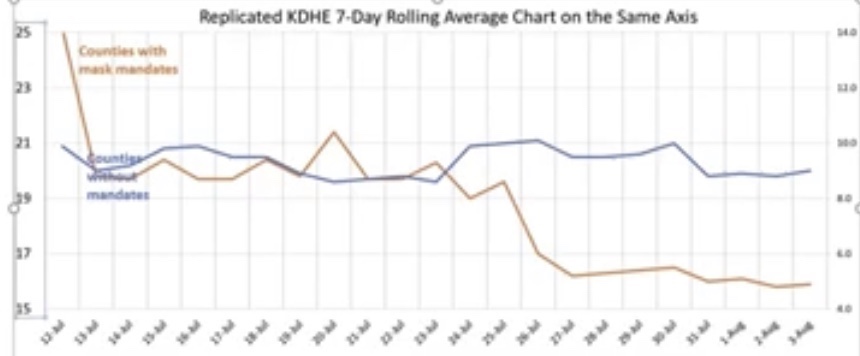
And on what pretext do officials, or your nitwitted neighbors, get the idea that mandatory masks OUTSIDE is in the interest of public health? I mean, besides buying-in to a ridiculous nanny-state narrative promoted by the media? Well, there is also some crap “research” to consider. Here is a good example: a study on masks from the Kansas Department of Health and Environment (KDHE). Take a look at what these guys tried to pull off…  Here’s what KDHE hoped would serve as “proof” of the dramatic efficacy of masks:

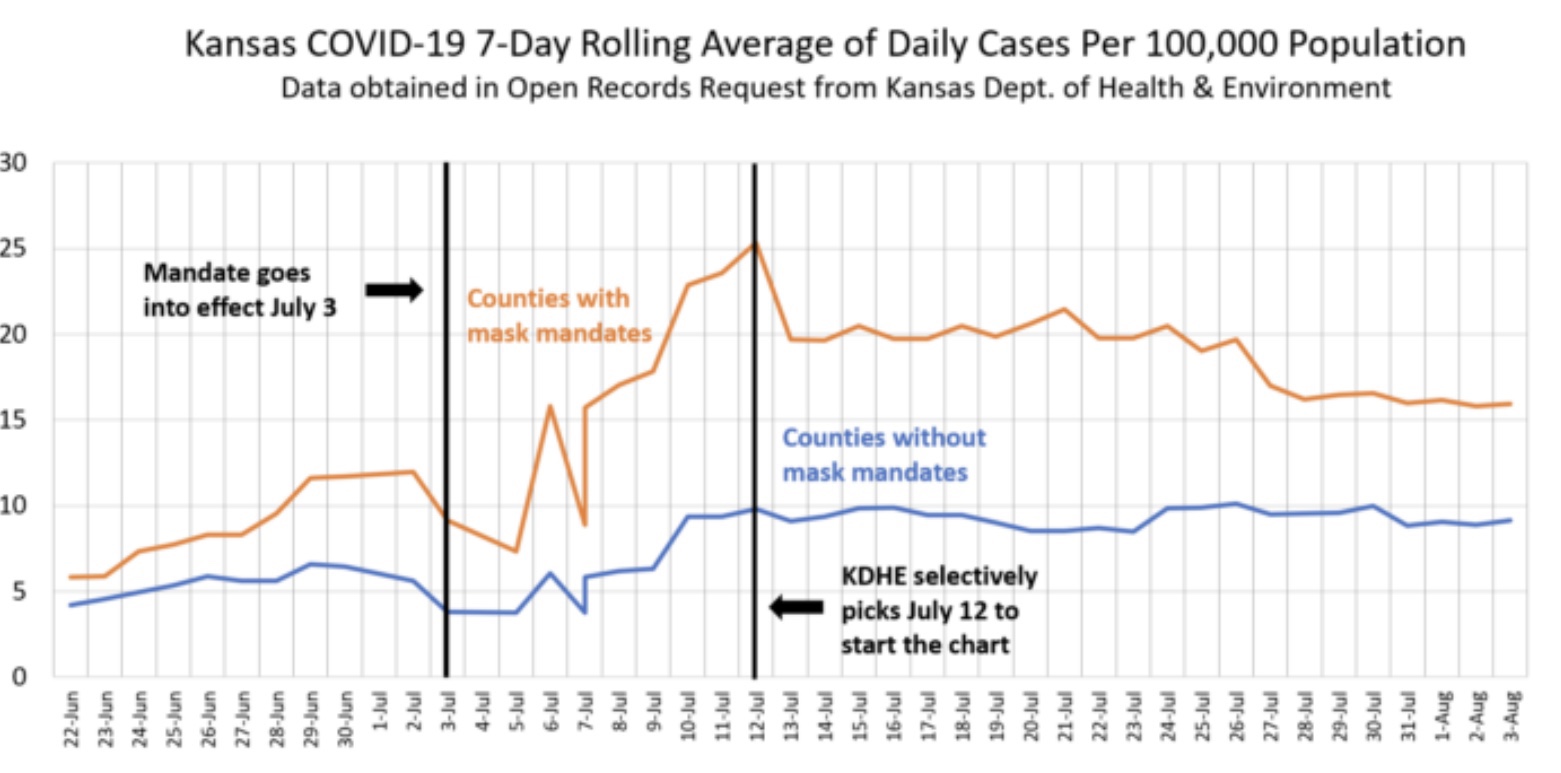
Wow! Notice two things in this chart: 1) the two lines are plotted with respect to different vertical axes; and 2) the chart begins on July 12th. Now take a look at a longer history in which the lines are plotted against the same axis.

It certainly doesn’t appear that the mandate beginning on July 3 had a favorable impact on new cases. What KDHE did here was incredibly dishonest, and I applaud the Kansas Policy Institute and it’s publication The Sentinel (linked above) for calling out KDHE for their dishonest piece of crap.

Other studies have exaggerated the general efficacy of masks as well. It’s also noteworthy that Europe’s medical establishment is unimpressed with masks. And after all, to my knowledge there have been no randomized control trials supporting the efficacy of masks — the only acceptable form of test according to Anthony Fauci! Now, none of that means masks don’t reduce COVID transmission. I happily wear a mask when I enter public buildings. What’s at issue here is whether masks should be required outdoors. Furthermore, I dispute the notion that a nationwide mask mandate is needed, because not all localities are at equal risk. I’m an advocate of the federalist principle that the best state and local solutions are crafted at the state and local levels. And at a personal level, I say ignore the intrusive bastards. Get outside in the fresh air, and forget the mask if you have some space.

COVID at Midsummer

04 Tuesday Aug 2020

Posted by Nuetzel in Pandemic, Public Health

≈ 2 Comments

Tags

Arizona, California, CDC, Coronavirus, COVID Time Series, Covid Tracking Project, Covid-19, Fatality Rate, Florida, Hospitalizations, Illinois, Kyle Lamb, Missouri, New Cases, New York, Provisional Deaths, Regional Variation, South Carolina, Tennessee, Texas

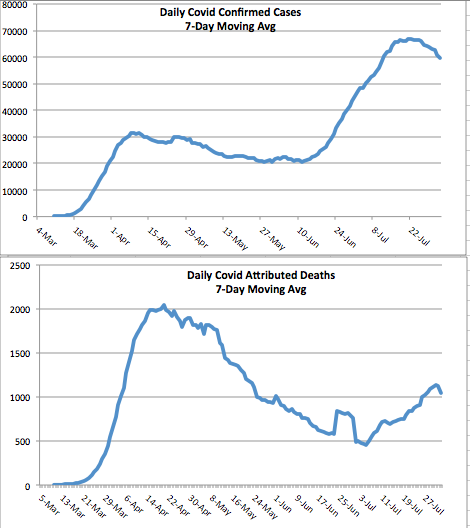
It’s been several weeks since I last posted on the state of the coronavirus pandemic (also see here). The charts below show seven-day moving averages of new confirmed cases and reported C19 deaths from the COVID Tracking Project as of August 3. Daily new cases began to flatten about three weeks ago and then turned down (it can take a few days for such changes to show up in a moving average). Daily C19-attributed deaths began climbing again in early July, lagging new cases by a few weeks, and they slowed just a bit over the past several days. Obviously, both are good news if those changes are maintained. The other thing to note is that deaths have remained far below their levels of April and early May.

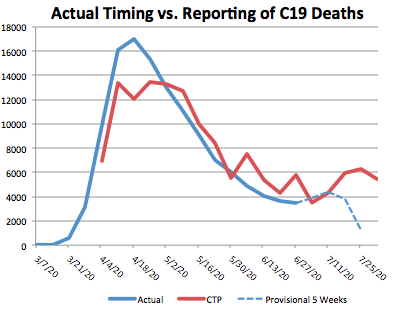
The daily death count is that reported on each date, not when the deaths actually occurred. Each day’s report consists of deaths that were spread across several previous weeks or even a month or more. That makes the slight downturn in deaths more tenuous from a data perspective. There are sometimes large numbers of deaths from preceding weeks reported together on a single day, so reporting can be ragged and the final pattern of actual deaths is not known for some time. More on that below.

States

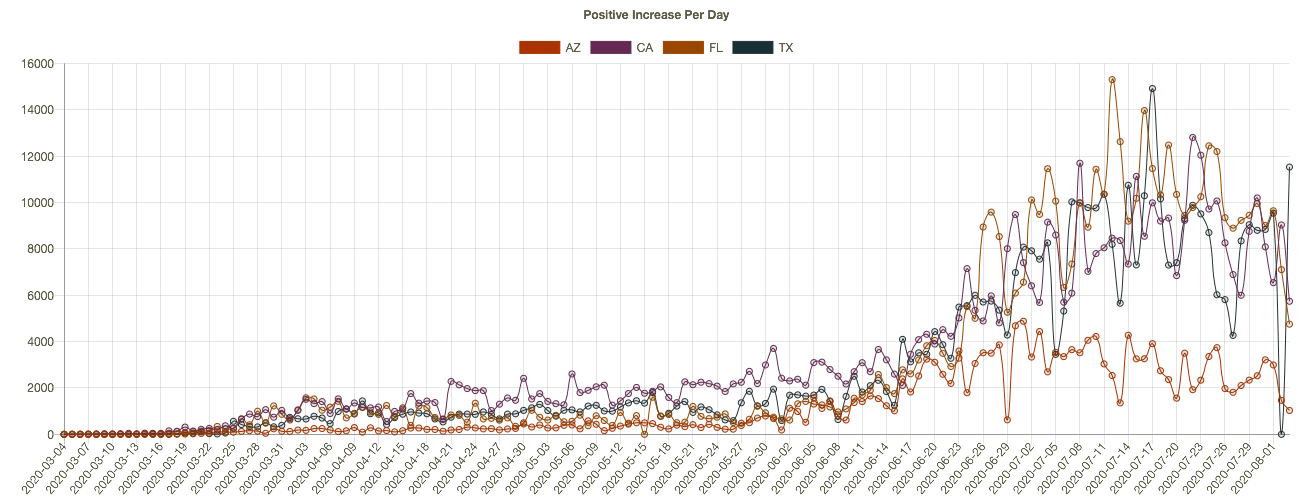
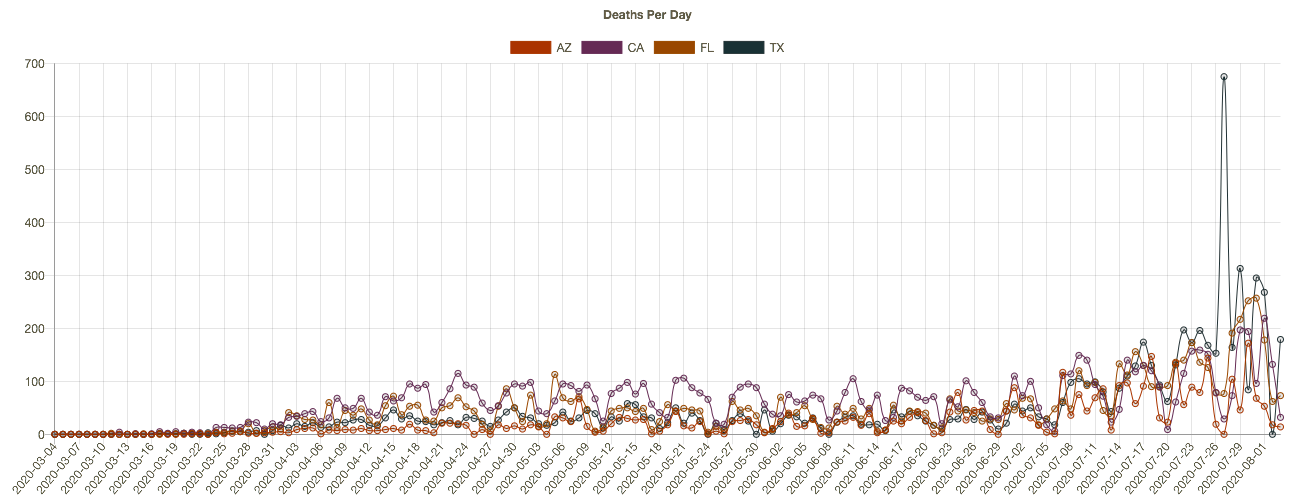
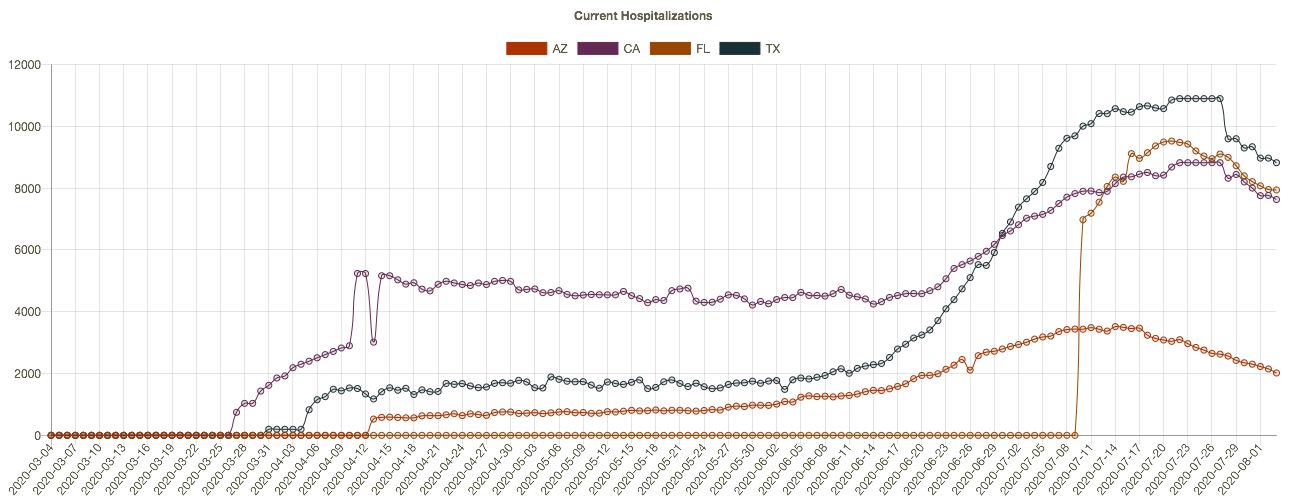
The increase in cases and deaths during late June and July was concentrated in four states: Arizona, California, Florida, and Texas. Here’s how those states look now in terms of cases and deaths, from the interactive COVID Time Series site:


New cases began to flatten or drop in these states two to three weeks ago, driving the change in the national data. Daily deaths have not turned convincingly, but again, these are reported deaths, which actually occurred over previous weeks. One more chart that is suggestive: current hospitalizations in these four states. The recent declines should bode well for the trend in reported deaths, but it remains to be seen. 

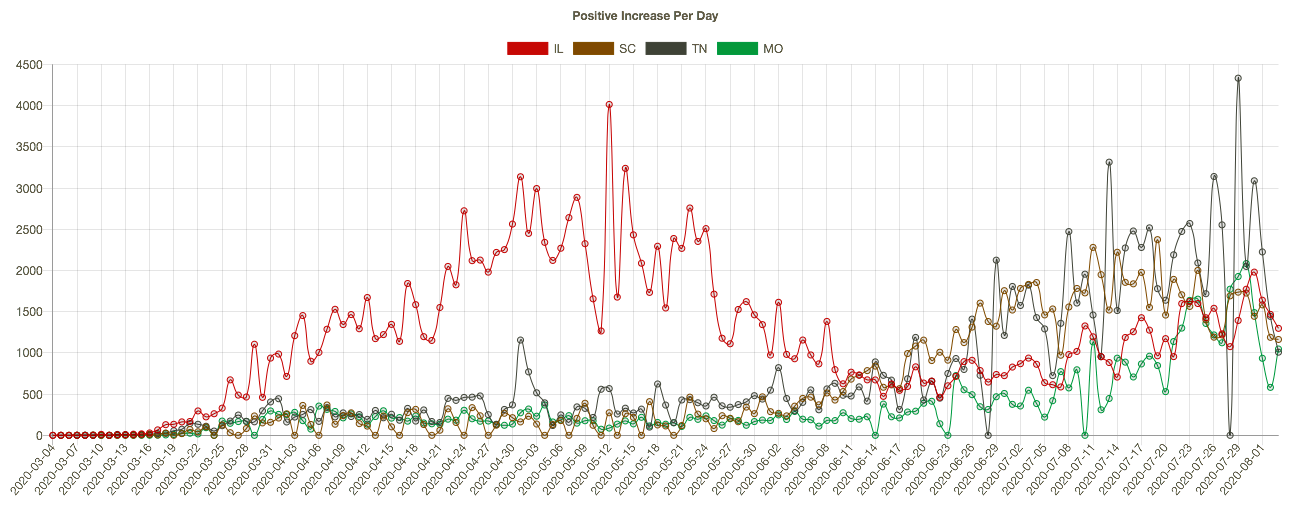
Meanwhile, other parts of the country have seen an uptrend in cases and deaths, such as Illinois, Missouri, South Carolina, and Tennessee. Here are new cases in those states:

It’s worth emphasizing that the elevated level of new cases this summer has not been associated with the rates of fatality experienced in the Northeast during the spring. There are many reasons: better patient care, new treatments, more direct summer sunlight, higher humidity, and tighter controls in nursing homes.

More On the Timing of Deaths

Back to the discrepancies in the timing of reported deaths and actual deaths. This is important because the reported totals each day and each week can be highly misleading, even to the point of frightening the public and policy makers, with consequent psychological and economic impacts.

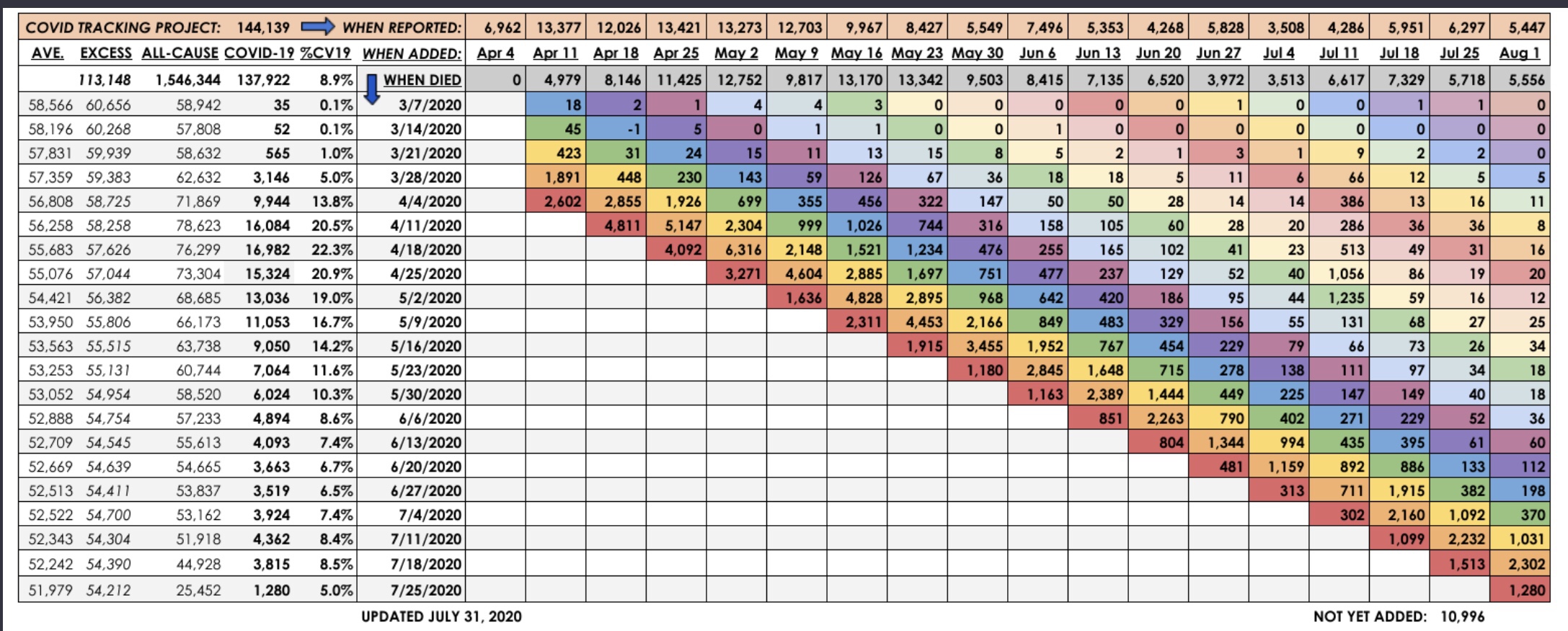
The latest summary of provisional vs. reported deaths is shown below, courtesy of Kyle Lamb, who posts updates on his Twitter feed. This report ends with the last complete week ending August 1. It’s a little hard to read, but you might get a better look if you click on it or turn your phone sideways. Some of the key series are also graphed below. 

The table shows the actual timing of deaths in the fourth column, with dates alongside. The pattern differs from the statistics reported by the Covid Tracking Project (CTP) in the top row (shaded orange), and from the totals of actual deaths by reporting day in the third row (shaded gray). The reporting dates are always later than the dates of death. This can be seen in the chart below. The most obvious illustration is how many of the deaths from around the peak in mid-April were reported in May. In March and April, the daily reports were short of the ultimate actual death counts because so few deaths with associated dates were known by then.


The right-hand end of the red line shows that many deaths reported by CTP have not yet been placed at an actual date of death by the CDC.  At this point, the actual date of death has not been placed for over 10,000 deaths! Again, those will be spread over earlier weeks.

The blue line is dashed over the last four weeks because those counts are most “highly” provisional. Small changes in the actual counts are likely for dates even before that, but the last four weeks are subject to fairly substantial upward revisions. Eventually, the right end of the blue line will more closely approximate the totals shown in red.

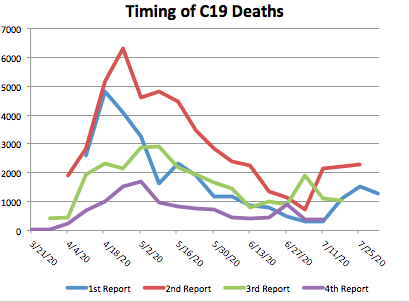
To get an indication of trends in the actual timing of deaths, I plotted the weekly actual deaths reported for the last four reporting weeks going back in time. In the table, those are the four lowest, color-coded diagonals. In the graph below, which should include the qualifier “by recency of report week”, actual deaths in the most recent report week are represented by the blue line, the prior weekly report is red, followed by green (three weeks prior), and purple (four weeks prior… sorry, the colors are not consistent with those in the table). The lines extend farther to the right for more recent report weeks.

The increase in actual deaths occurring in July has declined or flattened in each of the four most recent report weeks. Only the second-to-last week increased as of the August 1st report. On the whole, those changes seem favorable, but we shall see.

Closing

It’s getting trite to say, but the next few weeks will be interesting. The increase in deaths in July was a sad development, but at least the extent of it appears to have been limited. Even with a somewhat higher death count, the fatality rate continued to decline. Let’s hope any further waves of infections are even less deadly.

COVID Politics and Collateral Damage

26 Sunday Jul 2020

Posted by Nuetzel in Pandemic, Public Health

≈ 2 Comments

Tags

American Journal of Epidemiology, Andrew Cuomo, Anthony Fauci, Banality of Evil, CDC, City Journal, CMS, Donald Trump, Elective Surgery, Epidemiological Models, FDA, Gavin Newsom, Gretchen Whitmer, Harvey Risch, Hydroxychloraquin, Import Controls, Joel Zinberg, Lockdowns, Newsweek, NIH, Phil Murphy, Politico, PPE, Price Gouging, Prophylaxis, Quarantines, Steve Sisolak, The Lancet, Tom Wolf, Yale School of Public Health

Policymakers, public health experts, and the media responded to the coronavirus in ways that have often undermined public health and magnified the deadly consequences of the pandemic. Below I offer several examples of perverse politics and policy prescriptions, and a few really bad decisions by certain elected officials. Some of the collateral damage was intentional and motivated by an intent to inflict political damage on Donald Trump, and people of good faith should find that grotesque no matter their views on Trump’s presidency.

Politicized Treatment

The smug dismissal of hydroxychloraquine as Trumpian foolishness was a crime against humanity. We now know HCQ works as an early treatment and as a prophylactic against infection. It’s has been partly credited with stanching “hot spots” in India as well as contributing strongly to control of the contagion in Switzerland and in a number of other countries. According to epidemiologist Harvey Risch of the Yale School of Public Health, HCQ could save 75,000 to 100,000 lives if the drug is widely used. This is from Dr. Risch’s OpEd in Newsweek:

“On May 27, I published an article in the American Journal of Epidemiology (AJE) entitled, ‘Early Outpatient Treatment of Symptomatic, High-Risk COVID-19 Patients that Should be Ramped-Up Immediately as Key to the Pandemic Crisis.’ That article, published in the world’s leading epidemiology journal, analyzed five studies, demonstrating clear-cut and significant benefits to treated patients, plus other very large studies that showed the medication safety. …

Since [then], seven more studies have demonstrated similar benefit. In a lengthy follow-up letter, also published by AJE, I discuss these seven studies and renew my call for the immediate early use of hydroxychloroquine in high-risk patients.”

Risch is careful to couch his statements in forward-looking terms, but this also implies that tens of thousands of lives could have been saved, or patients might have recovered more readily and without lasting harm, had use of the drug not been restricted. The FDA revoked its Emergency Use Authorization for HCQ on June 15th, alleging that it is not safe and has little if any benefit. An important rationale cited in the FDA’s memo was an NIH study of late-stage C19 patients that found no benefit and potential risks to HCQ, but this is of questionable relevance because the benefit appears to be in early-stage treatment or prophylaxis. Poor research design also goes for this study and this study, while this study shared in some shortcomings (e.g., and no use of and/or controls for zinc) and a lack of statistical power. Left-wing outlets like Politico seemed almost gleeful, and blissfully ignorant, in calling those studies “nails in the coffin” for HCQ. Now, I ask: putting the outcomes of the research aside, was it really appropriate to root against a potential treatment for a serious disease, especially back in March and April when there were few treatment options, but even now?

Then we have the state governors who restricted the use of HCQ for treating C19, such as Gretchen Whitmer (MI) and Steve Sisolak (NV). Andrew Cuomo (NY) decided that HCQ could be dispensed only for hospital use, exactly the wrong approach for early stage treatment. And all of this resistance was a reaction to Donald Trump’s optimism about the promise of HCQ. Yes, there was alarm that lupus patients would be left without adequate supplies, but the medication is a very cheap, easy to produce drug, so that was never a real danger. Too much of the media and politicians have been complicit in denying a viable treatment to many thousands of C19 victims. If you were one of the snarky idiots putting it down on social media, you are either complicit or simply a poster child for banal evil.

Seeding the Nursing Homes

The governors of several states issued executive orders to force nursing homes to accept C19 patients, which was against CMS guidance issued in mid-March. The governors were Andrew Cuomo (NY), Gretchen Whitmer (MI), Gavin Newsom (CA), Tom Wolf (PA), and Phil Murphy (PA). This was a case of stupidity more than anything else. These institutions are home to the segment of the population most vulnerable to the virus, and they have accounted for about 40% of all C19 deaths. Nursing homes were ill-prepared to handle these patients, and the governors foolishly and callously ordered them to house patients who required a greater level of care and who represented an extreme hazard to other residents and staff.

Party & Protest On

Then of course we had the mayor of New York City, Bill De Blasio, who urged New Yorkers to get out on the town in early March. That was matched in its stupidity by the array of politicians and health experts who decided, having spent months proselytizing the need to “stay home”, that it was in their best interests to endorse participation in street protests that were often too crowded to maintain effective social distance. That’s not a condemnation of those who sought to protest peacefully against police brutality, but it was not a good or consistent recommendation in the domain of public health. Thankfully, the protests were outside!

Testing, Our Way Or the Highway

The FDA and CDC were guilty of regulatory overreach in preventing early testing for C19, and were responsible for many lives lost early in the pandemic. By the time the approved CDC tests revealed that the virus was ramping up drastically in March, the country was already behind in getting a handle on the spread of the virus, quarantining the infected, and tracing their contacts. There is no question that this cost lives.

Masks… Maybe, But Our Way Or the Highway

U.S. public health authorities were guilty of confused messaging on the efficacy of masks early in the pandemic. As Joel Zinberg notes in City Journal, Anthony Fauci admitted that his own minimization of the effectiveness of masks was motivated by a desire to prevent a shortage of PPE for health care workers:

“In discouraging mask use, Fauci—for decades, the nation’s foremost expert on viral infectious diseases—was not acting as a neutral interpreter of settled science but as a policymaker, concerned with maximizing the utility of the limited supply of a critical item. An economist could have told him that there was no need to misinform the public. Letting market mechanisms work and relaxing counterproductive regulations would ease shortages. Masks for health-care workers would be available if we were willing to pay higher prices; those higher prices, in turn, would elicit more mask production.”

Indeed, regulators made acquisition of adequate supplies of PPE more difficult than necessary via compliance requirements, “price gouging” rules, and import controls.

Bans on Elective Surgery

Another series of unnecessary deaths was caused by various bans on elective surgeries across the U.S. (also see here), and we’re now in danger of repeating that mistake. These bans were thought to be helpful in preserving hospital capacity, but hospitals were significantly underutilized for much of the pandemic. Add to that the fright inspired by official reaction to C19, which keeps emergency rooms empty, and you have a universe of diverse public health problems to grapple with. As I said on this blog a couple of months ago:

“… months of undiagnosed cardiac and stroke symptoms; no cancer screenings, putting patients months behind on the survival curve; deferred procedures of all kinds; run-of-the-mill infections gone untreated; palsy and other neurological symptoms anxiously discounted by victims at home; a hold on treatments for all sorts of other progressive diseases; and patients ordinarily requiring hospitalization sent home. And to start back up, new health problems must compete with all that deferred care. Do you dare tally the death and other worsened outcomes? Both are no doubt significant.”

Lockdowns

The lockdowns were unnecessary and ineffectual in their ability to control the spread of the virus. A study of 50 countries published by The Lancet last week found the following:

“Increasing COVID-19 caseloads were associated with countries with higher obesity … median population age … and longer time to border closures from the first reported case…. Increased mortality per million was significantly associated with higher obesity prevalence … and per capita gross domestic product (GDP) …. Reduced income dispersion reduced mortality … and the number of critical cases …. Rapid border closures, full lockdowns, and wide-spread testing were not associated with COVID-19 mortality per million people.”

That should have been obvious for a virus that holds little danger for prime working-age cohorts who are most impacted by economic lockdowns.

Like the moratoria on elective surgeries, lockdowns did more harm than good. Livelihoods disappeared, business were ruined, savings were destroyed, dreams were shattered, isolation set in, and it continues today. These kinds of problems are strongly associated with health troubles, family dysfunction, drug and alcohol abuse, and even suicide. It’s ironic that those charged with advising on matters pertaining to public health should focus exclusively on a single risk, recommending solutions that carry great risk themselves without a second thought. After all, the protocol in reviewing new treatments sets the first hurdle as patient safety, but apparently that didn’t apply in the case of shutdowns.

Even as efforts were made to reopen, faulty epidemiological models were used to predict calamitous outcomes. While case counts have risen in many states in the U.S. in June and July, deaths remain far below model predictions and far below deaths recorded during the spring in the northeast.

One last note: I almost titled this post “Attack of the Killer Morons”, but as a concession to what is surely a vain hope, I decided not to alienate certain readers right from the start.


Some Cheery COVID Research Tidbits

16 Thursday Jul 2020

Posted by Nuetzel in Pandemic, Public Health, Uncategorized

≈ 1 Comment

Tags

ACE Inhibitors, Angiotensin Drugs, ARBs, bacillus Calmette-Guerin, BCG Vaccine, Blood Plasma, Cholesterol, Coronavirus, Covid-19, Derek Lowe, Gilead Sciences, Herd Immunity, Hydroxychloroquine, Immune Globulin, Instapundit, Lancet, Marginal Revolution, National Academies of Science Engineering and Medicine, Off-Label Drugs, Oxford, R0, Remdesivir, SARS-CoV-2, Severe Acute Respiratory Syndrome, Statins, T-Cell Immunity, Transmissability, Tricor, Tuberculosis, Viral Load

Here’s a short list of new or newish research developments, some related to the quest to find COVID treatments. Most of it is good news; some of it is very exciting!

Long-lasting T-cell immunity: this paper in Nature shows that prior exposure to coronaviruses like severe acute respiratory syndrome (SARS) and even the common cold prompt an immune reaction via so-called T-cells that have long memories and are reactive to certain proteins in COVID-19 (SARS-CoV-2). The T-cells were detected in both C19-infected and uninfected patients. This comes after discouraging reports that anti-body responses to C19 are short-lived, but T-cells are a different form of acquired immunity. Derek Lowe says the following:

“This makes one think, as many have been wondering, that T-cell driven immunity is perhaps the way to reconcile the apparent paradox between (1) antibody responses that seem to be dropping week by week in convalescent patients but (2) few (if any) reliable reports of actual re-infection. That would be good news indeed.”

The herd immunity threshold (HIT) is much lower than you think: I’ve written about the effect of heterogeneity on the HIT before, here and here. This new paper, by three Oxford zoologists, shows that the existence of a cohort having some form of prior immunity, innate or acquired, reduces the number of infections required to achieve the HIT. For example, if initial transmissibility (R0) is 2.5 and 40% of the population has prior immunity (both reasonable assumptions for many areas), the HIT is as low as 20%, according to the authors’ calculations. That’s when the contagion begins to recede, though the final infected share of the population would be higher. This might explain why new cases and deaths have already plunged in places like Italy, Sweden, and New York, and why protests in NYC did not lead to a new wave of infections, while those in the south appear to have done so.

Seasonal effects: viral loads might be decreasing. From the abstract:

“Severity of COVID-19 in Europe decreased significantly between March and May and the seasonality of COVID-19 is the most likely explanation. Mucosal barrier and mucociliary clearance can significantly decrease viral load and disease progression, and their inactivation by low relative humidity of indoor air might significantly contribute to severity of the disease.”

The BCG vaccine appears to be protective: this is the bacillus Calmette-Guérin tuberculosis vaccine administered in some countries, This finding is not based on clinical trials, so more work is needed.

Is there no margin in plasma? No subsidy? This is the only “bad news” item on my list. It’s widely agreed that blood plasma from recovered C19 patients can be incorporated into an immune globulin drug to inoculate people against the virus. It’s proven safe, but for various reasons no one seems interested. Not the government. Not private companies. Did Trump happen to mention it or something?

C19 doesn’t spread in schools: this German study demonstrates that there is little risk in reopening schools. One of the researchers says:

“Children act more as a brake on infection. Not every infection that reaches them is passed on…. This means that the degree of immunization in the group of study participants is well below 1 per cent and much lower then we expected. This suggests schools have not developed into hotspots.”

Also worth emphasis is that remote learning leaves much to be desired, as acknowledged by the National Academies of Science, Engineering and Medicine, which has recommended that schools reopen for younger children and those with special needs.

Can angiotensin drugs (ACE Inhibitors/ARBs) reduce mortality? This meta-analysis of nine studies finds that these drugs reduce C19 mortality among patients with hypertension. The drugs were also associated with a reduction in severity but not with statistical significance. These results run contrary to initial suspicions, because ACEI/ARB drugs actually “up-regulate” ACE-2 receptors, to which C19 binds. Researchers say the drugs might be working through some other protective channel. This is not a treatment per se, but this should be reassuring if you already take one of these medications.

Tricor appears to clear lung tissue of C19: this research focused on C19’s preference for an environment rich in cholesterol and other fatty acids:

“What they found is that the novel coronavirus prevents the routine burning of carbohydrates, which results in large amounts of fat accumulating inside lung cells – a condition the virus needs to reproduce.”

Tricor reduces those fats, and the researchers claim it is capable of clearing lung tissue of C19 in a matter of days. This was not a clinical trial, however, so more work is needed. Tricor is an FDA approved drug, so it is safe and could be administered “off label” immediately. Tricor is a fibrate; the news with respect to statins and C19 severity is pretty good too! These are not treatments per se, but this should be reassuring if you already take one of these medications.

Hydroxychloroquine works: despite months of carping from media and leftist know-it-all’s dismissing the mere possibility of HCQ as a potential C19 treatment, evidence is accumulating that it is effective in treating early-stage infections after all. The large study conducted by the Henry Ford Health System found that treatment with HCQ early after hospitalization, and with careful monitoring of heart function, cut the death rate in half relative to a control group. Here’s another: an Indian study found that four-plus maintenance doses of HCQ acted as a prophylactic against C19 infection among health care workers, reducing the odds of infection by more than half. An additional piece of evidence is provided by this analysis of a 14-day Swiss ban on the use of HCQ in late May and early June. The ban was associated with a huge leap in the C19 deaths after a lag of less than two weeks. Resumption of HCQ treatment brought C19 deaths down sharply after a similar lag.

Meanwhile, a study in Lancet purporting to show that HCQ was ineffective and posed significant risks to heart health was retracted based on the poor quality of the data.

Remdesivir also cuts death rate: by 62% in a smaller controlled study by the drug maker Gilead Sciences.

Pet ownership might confer some immunity: this one is a little off-beat, and perhaps the research is under-developed, but it is interesting nonetheless!

I owe Instapundit and Marginal Revolution hat tips for several of these items.

Cases Climb, Most Patients Faring Better

30 Tuesday Jun 2020

Posted by Nuetzel in Pandemic, Public Health

≈ 1 Comment

Tags

Air Conditioning, Bloomberg, Cases vs. Deaths, Confirmed Cases, COVID Time Series, Covid-19, George Floyd, Immunity, Increased Testing, Nate Silver, Pandemic, Protest Effect, Social Distancing, Viral Transmission, Vitamin D Deficiency

There’s been much speculation about whether recent increases in confirmed cases of COVID-19 (first chart above) will lead to a dramatic increase in fatalities (second chart). More generally, there is curiosity or perhaps hope as to whether the virus is not as dangerous to these new patients as it was early in the pandemic. I have discussed this point in several posts, most recently here. Based on the national data (above), we’re at the point at which an upturn in deaths might be expected. Based on the experience of many individual states, however, deaths should have trended upward by now, but they haven’t done so. Cases are generally less severe and are resolving more quickly.

Of course, more testing produces more cases (though there has been a mild uptick in test positivity over the past two weeks), but that doesn’t really explain the entire increase in cases over the past few weeks. In particular, why are so many new cases in the south? After all, there is evidence that the virus doesn’t survive well in warm, humid climates with more direct sunlight.

As I have mentioned several times, heavy use of air-conditioning in the south may have contributed to the increase. Nate Silver speculates that this is the case. The weather warmed up in late May and especially June, and many southerners retreated indoors where the air is cool, dry, and the virus thrives. Managers of public buildings should avoid blasting the AC, and you might do well to heed the same advice if you live with others in a busy household. In fact, nearly all transmission is likely occurring indoors, as has been the case throughout the pandemic. At the same time, however, with the early reopening of many southern states, younger people flocked to gyms, bars and other venues, largely abandoning any pretense of social distancing. So it’s possible that these effects have combined to produce the spike in new cases.

Some contend that the protests following George Floyd’s murder precipitated the jump in confirmed cases. Perhaps they played a role, but I’m somewhat skeptical. Yes, these could have become so-called super-spreader events; there are certain cities in which the jump in cases lagged the protests by a few weeks, such as Austin, Houston, and Miami, and where some cases were confirmed to be among those who protested. But if the protests contributed much to the jump, why hasn’t New York City seen a corresponding increase? Not only that, but the protests were outside, and the protests dissuaded many others from going out at all!

The trend in coronavirus fatalities remains more favorable, despite the increase in daily confirmed cases. One exception is New Jersey, which decided to reclassify 1,800 deaths as “probable” COVID deaths about six days ago. You can see the spike caused by that decision in the second chart above. Reclassifications like that arouse my suspicion, especially when federal hospital reimbursements are tied to COVID cases, and in view of this description from Bloomberg (my emphasis):

“… those whose negative test results were considered unreliable; who were linked to known outbreaks and showed symptoms; or whose death certificates strongly suggested a coronavirus link.”

Deaths necessarily lag new cases by anywhere from a few days to several weeks, depending on the stage at the time of diagnosis and delays in test results. The lag between diagnosis and death seems to center on about 12 – 14 days. Thus far, there doesn’t appear to be an upward shift in the trend of fatal cases, but the big updraft in cases nationally only started about two weeks ago. More on that below.

Importantly, a larger share of new cases is now among a younger age cohort, for whom the virus is much less threatening. The most vulnerable people are probably taking more precautions than early in the pandemic, and shocking as might seem, there is probably some buildup in immunity in the surviving nursing home population at this point. We are also better at treatment, and there is generally plenty of hospital capacity. And to the extent that the surge in new cases is concentrated in the south, fewer patients are likely to have Vitamin D deficiencies, which is increasingly mentioned as a contributor to the severity of coronavirus infections.

I decided to make some casual comparisons of new cases versus COVID deaths on a state-by-state basis, but I got a little carried away. Using the COVID Time Series web site, I started by checking some of the southern states with recent large increases in case counts. I ended up looking at 15 states in the south and west, and I added Missouri and Minnesota as well. I passed over a few others because their trends were basically flat. The 17 states all had upward trends in new cases over the past one to two months, or they had an increase in new cases more recently. However, only four of those states experienced any discernible increase in daily deaths over the corresponding time frames. These are Arizona, Arkansas, Tennessee, and Texas, and their increases are so modest they might be statistical noise.

Again, deaths tend to lag new cases by a couple of weeks, so the timing of the increase in case counts matters. Five of the states were trending upward beginning in May or even earlier, and 13 of the states saw an acceleration or a shift to an upward trend in new cases after Memorial Day, in late May or June. Of those 13, the changes in trend occurred between one and five weeks ago. Six states, including Texas, had a shift within the past two weeks. It’s probably too early to draw conclusions for those six states, but in general there is little to suggest that fatal cases will soar like they did early in the pandemic. Case fatality rates are likely to remain at much lower levels.

We’ll know much more within a week or two. It’s very encouraging that the upward trend in new cases hasn’t resulted in more deaths thus far, especially at the state level, as many states have had case counts drift upward for over a month. If it’s going to occur, it should be well underway within a week or so. Much also depends on whether new cases continue to climb in July, in which case we’ll be waiting in trepidation for whether more deaths transpire.

Trump and Coronavirus

26 Tuesday May 2020

Posted by Nuetzel in Pandemic, Public Health, Risk Management, Stimulus, Trump Administration

≈ 1 Comment

Tags

Andrew Cuomo, Anthony Fauci, Bill De Blasio, CARES Act, CDC, Coronavirus, Deborah Birx, DHS, Disinfectant, Donald Trump, Elective Surgeries, FDA, Federalism, FEMA, Fiscal policy, Hydroxychloraquine, International Travel, Javits Center, John Bolton, John Cochrane, Laboratory Federalism, Lancet, Liability Waivers, Lockdowns, Michael Pence, Mike Pompeo, N95 Mask, NSC, Paycheck Protection Program, PPE, Robert Redfield, State Department, Testing, Unfunded Pensions, UV Light, Vaccines, Ventilators, WHO, Wuhan, Zinc

It’s a bit early to fully evaluate President Trump’s performance in dealing with the coronavirus pandemic, but there are a number of criteria on which I might assign marks. I’ll address some of those below, but in so doing I’m reminded of Jerry Garcia’s quip that he was “shopping around for something no one will like.” That might be how this goes. Of course, many of the sub-topics are worthy of lengthier treatment. The focus here is on the pandemic and not more general aspects of his performance in office, though there is some unavoidable overlap.

General “Readiness”

Many have criticized the Trump Administration for not being “ready” for a pandemic. I assign no grade on that basis because absolutely no one was ready, at least not in the West, so there is no sound premise for judgement. I also view the very general charge that Trump did not provide “leadership” as code for either “I don’t like him”, or “he refused to impose more authoritarian measures”, like a full-scale nationwide lockdown. Such is the over-prescriptive instinct of the Left.

Equally misleading is the allegation that Trump had “disbanded” the White House pandemic response team, and I have addressed that here. First, while the NSC would play a coordinating role, pandemic response is supposed to be the CDC’s job, when it isn’t too busy with diseases of social injustice to get it done. Second, it was John Bolton who executed a reorganization at the NSC. There were two high profile departures from the team in question at the time, and one one was a resignation. Most of the team’s staff remained with the NSC with the same duties as before the reirganization.

Finally, there was the matter of a distracting impeachment on false charges. This effort lasted through the first three years of Trump’s administration, finally culminating in January 2020. Perhaps the Administration would have had more time to focus on what was happening in China without the histrionics from the opposition party. So whatever else I might say below, these factors weigh toward leniency in my appraisal of Trump’s handing of the virus.

Messaging: C

As usual, Trump’s messaging during the pandemic was often boorish and inarticulate. His appearances at coronavirus briefings were no exception, often cringeworthy and sometimes featuring misinterpretations of what his team of experts was saying. He was inconsistent in signaling optimism and pessimism, as were many others such as New York Governor Andrew Cuomo and New York City Mayor Bill De Blasio. It shifted from “the virus is about like the flu” in February to a more sober assessment by mid-March. This was, however, quite consistent with the messaging from Dr. Anthony Fauci over the same time frame, as well as the World Health Organization (WHO). Again, no one really knew what to expect, so it’s understandable. A great deal of that can be ascribed to “the fog of war”.

Delegation and Deference: B

Trump cannot be accused of ignoring expert advice through the episode. He was obviously on-board with Fauci, Dr. Deborah Birx, Dr. Robert Redfield, and other health care advisors on the “15 Days to Slow the Spread” guidelines issued on March 16. His messaging wavered during those 15 days, expressing a desire to fully reopen the nation by Easter, which Vice President Michael Pence later described as “aspirational”. Before the end of March, however, Trump went along with a 30-day extension of the guidelines. Finally, by mid-April, the White House released guidelines for “Opening Up America Again“, which was a collaboration between Trump’s health care experts and the economic team. Trump agreed that the timeline for reopening should be governed by “the data”. There is no question, however, that Trump was chomping at the bit for reopening at several stages of this process. I see value in that positioning, as it conveys an intent to reopen asap and that people should have confidence in progress toward that goal.  

International Travel Bans: A

If anyone wonders why the world was so thoroughly blindsided by the coronavirus, look no further than China’s failure to deliver a proper warning as 2019 drew to a close. Wuhan, China was ground zero; the virus spread to the rest of the world with travelers out of Wuhan and other Chinese cities. The White House announced severe restrictions on flights from China on January 31, including a two-week quarantine for returning U.S. citizens. In retrospect, it wasn’t a minute too soon, yet for that precaution, Trump was attacked as a racist by the Left. In early February, WHO actually said travel bans were unnecessary, among other missteps. Other bans were instituted on entry from Iran and Brazil, as well as entry from Europe in early March, as countries around the globe closed their borders. Trump’s actions on incoming travelers were prescient, so I’ll score this one for Trump. Some of these travel restrictions can and should be eased now, and certainly that is expected in coming months, so we’ll see how well that process is managed.

Deference to States: A-

As a federalist, I was pleased that Trump and his team left most of the specifics on closures and bans on public gatherings up to state and local governments. That allowed more targeted mitigation efforts as dictated by local conditions and, to some extent, public opinion. This is a classic case of “laboratory federalism” whereby the most effective policies can be identified, though as we’ve seen, there’s no guarantee less successful states will emulate them. I grade Trump well on this one.

On reopening, too, Trump has been a consistent advocate of allowing flexility where local conditions permit, though he wrongly claimed he had “total authority” over ending social distancing rules. It’s hard to square that remark with his general stand on the issue of autonomy except as a tactic to strong-arm certain governors on other points.   

CDC/FDA Snafus: D

I applaud the Administration for its emphasis on the salutary effects of deregulation, but Trump went along with some major pieces of “expert advice” that were not only poor from regulatory perspective, but an affront to federalism. One was a directive issued by the CDC to delay “all elective surgeries, non-essential medical, surgical, and dental procedures during the 2019 Novel Coronavirus (COVID-19) outbreak“. (See my post “Suspending Medical Care in the Name of Public Health“.)

This is exactly the kind of “one size fits all” regulatory policy that has proven so costly, sacrificing not just economic activity but lives and care for the sick, creating avoidable illnesses and complications. The idea was to assure that adequate health care resources were available to treat an onslaught of coronavirus patients, but that was unneeded in most jurisdictions. And while the contagion was in it’s early “exponential” phase at the time, a more nuanced approach could have been adopted to allow different geographic areas and facilities more discretion, especially for different kinds of patients, or perhaps something less than a complete suspension of care. In any case, the extensions into May were excessive. I must grade Trump poorly for allowing this to happen, despite what must have been extreme pressure to follow “expert advice” on the point and the others discussed earlier.

That’s not the only point on which I blame Trump for caving to the CDC. In a case of massive regulatory failure, the CDC and FDA put the U.S. well over a month behind on testing when the first signs of the virus appeared here. Not only did they prohibit private labs and universities from getting testing underway, insisting on exclusive use of the CDC’s own tests, they also distributed faulty tests in early February that took over a month to replace. The FDA also enforced barriers to imported N95-type masks during the pandemic. Trump tends to have a visceral understanding of the calcifying dangers of regulation, but he let the so-called “experts” call the shots here. Big mistake, and Trump shares the blame with these agencies.  

Health Resources: B-

Managing the emergency distribution of PPE and ventilators to states did not go as smoothly as might have been hoped. The shortage itself left FEMA with the unenviable task of allocating quantities that could never satisfy all demands. A few states were thought to have especially acute needs, but there was also an obligation to hold stockpiles against potential requests from other states. In fact, a situation of this kind creates an incentive for states to overstate their real needs, and there are indications that such was the case. Trump sparred with a few governors over these allocations. There is certainly blame to be shared, but I won’t grade Trump down for this.

Vaccines and Treatments: C+


The push to develop vaccines might not achieve success soon, if ever, but a huge effort is underway. Trump gets some of the credit for that, as well as the investment in capacity now to produce future vaccine candidates in large quantities. As for treatments, he was very excited about the promise of hydroxychloraquine, going so far as to take it himself with zinc, a combination for which no fully randomized trial results have been reported (the recent study appearing in the Lancet on HCQ taken by itself has been called into question). Trump also committed an unfortunate gaffe when the DHS announced the results of a study showing that sunlight kills coronavirus in a matter of minutes, as do bleach and other disinfectants. Trump mused that perhaps sunlight or some form of disinfectant could be used as a treatment for coronavirus patients. He might have been thinking about an old and controversial practice whereby blood is exposed to UV light and then returned to the body. Later, he said he used the term “disinfectant” sarcastically, but he probably meant to say “euphemistically” …. I’m not sure he knows the difference. In any case, his habit of speculating on such matters is often unhelpful, and he loses points for that.

Fiscal Policy: B

The several phases of the economic stimulus program were a collaboration between the Trump Administration and Congress. A reasonably good summary appears here. The major parts were the $2.3 trillion CARES Act in late March and a nearly $500 billion supplemental package in late April. These packages were unprecedented in size. Major provisions were direct cash payments and the Paycheck Protection Program (PPP), which provides loans and grants to small businesses. The execution of both was a bit clunky, especially PPP, which placed a burden on private banks to extend the loans but was sketchy in terms of qualifications. The extension of unemployment compensation left some workers with more benefits than they earned in their former jobs, which could be an impediment to reopening. There were a number of other reasonable measures in these packages and the two smaller bills that preceded them in March. A number of these measures were well-targeted and inventive, such as waiving early withdrawal penalties from IRA and 401(k) balances. The Trump Administration deserves credit for helping to shape these efforts as well as others taken independently by the executive branch. 

Trump’s proposal to suspend payroll taxes did not fly, at least not yet. The idea is to reduce the cost of hiring and increase the return to work, if only temporarily. This is not a particularly appealing idea because so much of the benefits would flow to those who haven’t lost their jobs. It could be improved if targeted at new hires and rehires, however.

Trump’s proposal to grant liability waivers to reopened private businesses is extremely contentious, but one I support. Lockdowns are being eased under the weight of often heavy public and private regulation of conduct. As John Cochrane says in “Get Ready for the Careful Economy“: 

“One worry on regulation is that it will provide a recipe for a wave of lawsuits. That may have been a reason the Administration tried to hold back CDC guidance. A long, expensive, and impractical list of things you must do to reopen is catnip when someone gets sick and wants to blame a business. Show us the records that you wiped down the bathrooms every half hour. A legal system that can sue over talcum powder is not above this.”

Indeed, potential liability might represent a staggering cost to many businesses, one that might not be insurable. Accusations of negligence, true or false, can carry significant legal costs. Customers and employees, not just businesses, must accept some of the burden of risks of doing business. I give Trump good marks for this one, but we’ll see if it goes anywhere.

Some of the proposals for new stimulus legislation from democrats are much worse, including diversity initiatives, massive subsidies for “green” technologies, and bailouts for state and local government for unfunded pension liabilities. None of these has anything to do with the virus. The burden of pension shortfalls in some states should not fall on taxpayers nationwide, but on the states that incurred them. The Trump Administration and congressional Republicans should continue resisting these opportunistic proposals.

The Grade

Without assigning weights to the sub-topics covered above, I’d put the overall grade for Trump and his Administration’s handling of matters during the pandemic at about a B-, thus far. When it comes to politics, it’s often unfair to credit or blame one side for the promulgation of an overall set of policies. Nevertheless, I think it’s fair to say that Trump, could have done much better and could have done much worse. We will learn more with the passage of time, the continued evolution of the virus, the development of treatments or vaccines, and the course of the economy.


On the Meaning of Herd Immunity

09 Saturday May 2020

Posted by Nuetzel in Pandemic, Public Health, Risk

≈ 2 Comments

Tags

Antibody, Antigen, Carl T. Bergstrom, Christopher Moore, Covid-19, Herd Immunity, Heterogeneity, Household Infection, Immunity, Infection Mortality Risk, Initial Viral Load, John Cochrane, Lockdowns, Marc Lipsitch, Muge Cevik, Natalie Dean, Natural Immunity, Philippe Lemoine, R0, Santa Fe Institute, SARS-CoV-2, Social Distancing, Super-Spreaders, Zvi Mowshowitz

Immunity doesn’t mean you won’t catch the virus. It means you aren’t terribly susceptible to its effects if you do catch it. There is great variation in the population with respect to susceptibility. This simple point may help to sweep away confusion over the meaning of “herd immunity” and what share of the population must be infected to achieve it.

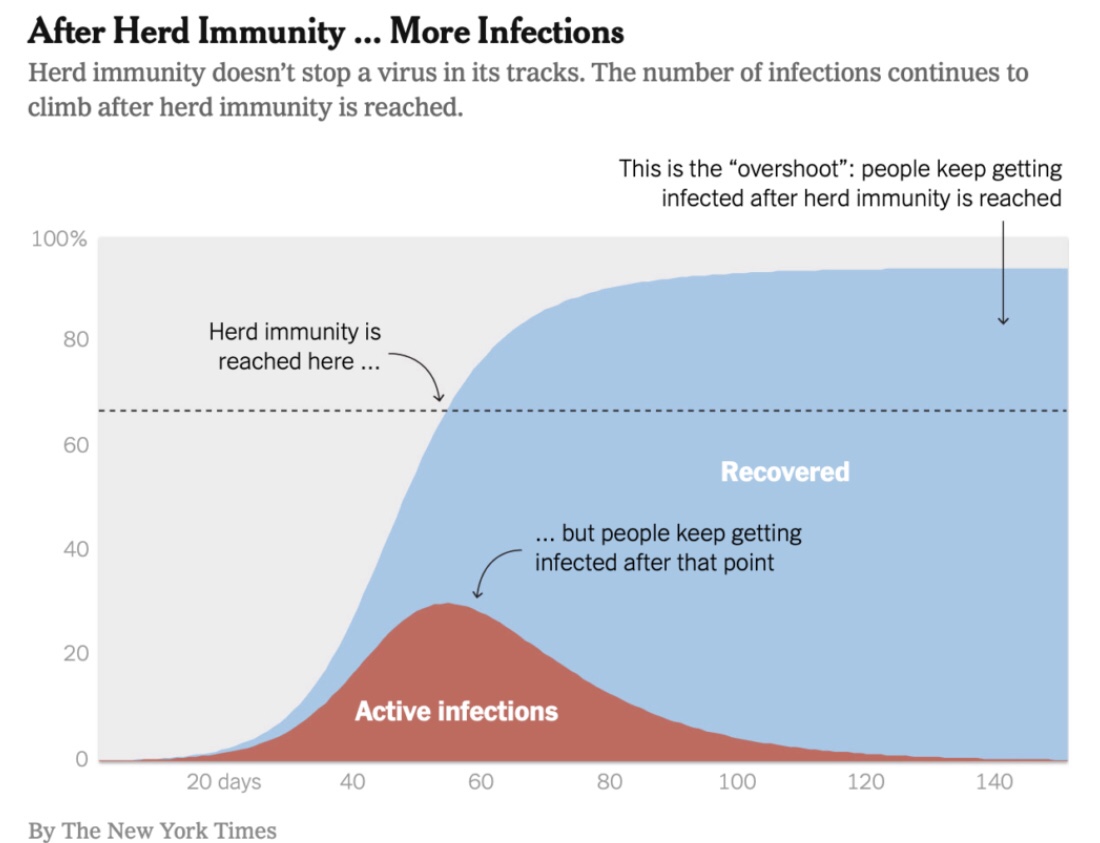
Philippe Lemoine discusses this point in his call for an “honest debate about herd immunity“. He reproduces the following chart, which appeared in this NY Times piece by Carl T. Bergstrom and Natalie Dean:

Herd immunity, as defined by Bergstrom and Dean, occurs when there are sufficiently few susceptible individuals remaining in the population to whom the actively-infected can pass the virus. The number of susceptible individuals shrinks over time as more individuals are infected. The chart indicates that new infections will continue after herd immunity is achieved, but the contagion recedes because fewer additional infections are possible.

We tend to think of the immune population as those having already been exposed to the virus, and who have recovered. Those individuals have antibodies specifically targeted at the antigens produced by the virus. But many others have a natural immunity. That is, their immune systems have a natural ability to adapt to the virus.

Heterogeneity

At any point in a pandemic, the uninfected population covers a spectrum of individuals ranging from the highly susceptible to the hardly and non-susceptible. Immunity, in that sense, is a matter of degree. The point is that the number of susceptible individuals doesn’t start at 100%, as most discussions of herd immunity imply, but something much smaller. If a relatively high share of the population has low susceptibility, the virus won’t have to infect such a large share of the population to achieve effective herd immunity.

The apparent differences in susceptibility across segments of the population may be the key to early herd immunity. We’ve known for a while that the elderly and those with pre-existing conditions are highly vulnerable. Otherwise, youth and good health are associated with low vulnerability.

Lemoine references a paper written by several epidemiologists showing that “variation in susceptibility” to Covid-19 “lowers the herd immunity threshold”:

“Although estimates vary, it is currently believed that herd immunity to SARS-CoV-2 requires 60-70% of the population to be immune. Here we show that variation in susceptibility or exposure to infection can reduce these estimates. Achieving accurate estimates of heterogeneity for SARS-CoV-2 is therefore of paramount importance in controlling the COVID-19 pandemic.”

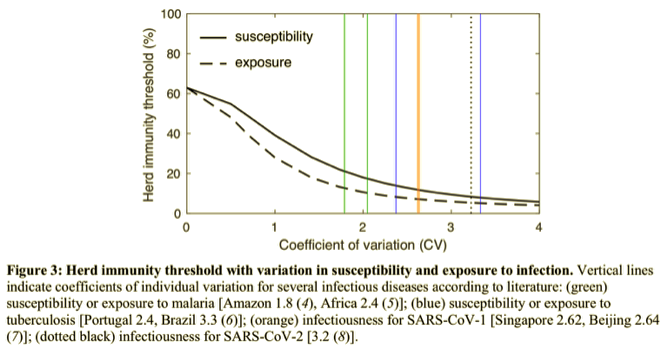
The chart below is from that paper. It shows a measure of this variation on the horizontal axis. The colored, vertical lines show estimates of historical variation in susceptibility to historical viral episodes. The dashed line shows the required exposure for herd immunity as a function of this measure of heterogeneity.

Their models show that under reasonable assumptions about heterogeneity, the reduction in the herd immunity threshold (in terms of the percent infected) may be dramatic, to perhaps less than 20%.

Then there are these tweets from Marc Lipsitch, who links to this study:

“As an illustration we show that if R0=2.5 in an age-structured community with mixing rates fitted to social activity studies, and also categorizing individuals into three categories: low active, average active and high active, and where preventive measures affect all mixing rates proportionally, then the disease-induced herd immunity level is hD=43% rather than hC=1−1/2.5=60%.”

Even the celebrated Dr. Bergstrom now admits, somewhat grudgingly, that hereogeniety reduces the herd immunity threshold, though he doesn’t think the difference is large enough to change the policy conversation. Lipsitch also is cautious about the implications.

Augmented Heterogeneity

Theoretically, social distancing reduces the herd immunity threshold. That’s because infected but “distanced” people are less likely to come into close contact with the susceptible. However, that holds only so long as distancing lasts. John Cochrane discusses this at length here. Social distancing compounds the mitigating effect of heterogeneity, reducing the infected share of the population required for herd immunity.

Another compounding effect on heterogeneity arises from the variability of initial viral load on infection (IVL), basically the amount of the virus transmitted to a new host. Zvi Mowshowitz discusses its potential importance and what it might imply about distancing, lockdowns, and the course of the pandemic. In any particular case, a weak IVL can turn into a severe infection and vice versa. In large numbers, however, IVL is likely to bear a positive relationship to severity. Mowshowitz explains that a low IVL can give one’s immune system a head start on the virus. Nursing home infections, taking place in enclosed, relatively cold and dry environments, are likely to involve heavy IVLs. In fact, so-called household infections tend to involve heavier IVLs than infections contracted outside of households. And, of course, you are very unlikely to catch Covid outdoors at all.

Further Discussion

How close are we to herd immunity? Perhaps much closer than we thought, but maybe not close enough to let down our guard. Almost 80% of the population is less than 60 years of age. However, according to this analysis, about 45% of the adult population (excluding nursing home residents) have any of six conditions indicating elevated risk of susceptibility to Covid-19 relative to young individuals with no co-morbidities. The absolute level of risk might not be “high” in many of those cases, but it is elevated. Again, children have extremely low susceptibility based on what we’ve seen so far.

This is supported by the transmission dynamics discussed in this Twitter thread by Dr. Muge Cevik. She concludes:

“In summary: While the infectious inoculum required for infection is unknown, these studies indicate that close & prolonged contact is required for #COVID19 transmission. The risk is highest in enclosed environments; household, long-term care facilities and public transport. …

Although limited, these studies so far indicate that susceptibility to infection increases with age (highest >60y) and growing evidence suggests children are less susceptible, are infrequently responsible for household transmission, are not the main drivers of this epidemic.”

Targeted isolation of the highly susceptible in nursing homes, as well as various forms of public “distancing aid” to the independent elderly or those with co-morbidities, is likely to achieve large reductions in the effective herd immunity ratio at low cost relative to general lockdowns.

The existence of so-called super-spreaders is another source of heterogeneity, and one that lends itself to targeting with limitations or cancellations of public events and large gatherings. What’s amazing about this is how the super-spreader phenomenon can lead to the combustion of large “hot spots” in infections even when the average reproduction rate of the virus is low (R0 < 1). This is nicely illustrated by Christopher Moore of the Santa Fe Institute. Super-spreading also implies, however, that while herd immunity signals a reduction in new infections and declines in the actively infected population, “hot spots” may continue to flare up in a seemingly random fashion. The consequences will depend on how susceptible individuals are protected, or on how they choose to mitigate risks themselves.

Conclusion

I’ve heard too many casual references to herd immunity requiring something like 70% of the population to be infected. It’s not that high. Many individuals already have a sort of natural immunity. Recognition of this heterogeneity has driven a shift in the emphasis of policy discussions to the idea of targeted lockdowns, rather than the kind of indiscriminate “dumb” lockdowns we’ve seen. The economic consequences of shifting from broad to targeted lockdowns would be massive. And why not? The health care system has loads of excess capacity, and Covid infection fatality risk (IFR) is turning out to be much lower than the early, naive estimates we were told to expect, which were based on confirmed case fatality rates (CFRs).

← Older posts
Newer posts →
Follow Sacred Cow Chips on WordPress.com

Recent Posts

  • A Warsh Policy Scenario At the Federal Reserve
  • The Coexistence of Labor and AI-Augmented Capital
  • The Case Against Interest On Reserves
  • Immigration and Merit As Fiscal Propositions
  • Tariff “Dividend” From An Indigent State

Archives

  • February 2026
  • January 2026
  • December 2025
  • November 2025
  • October 2025
  • September 2025
  • August 2025
  • July 2025
  • June 2025
  • May 2025
  • April 2025
  • March 2025
  • February 2025
  • January 2025
  • December 2024
  • November 2024
  • October 2024
  • September 2024
  • August 2024
  • July 2024
  • June 2024
  • May 2024
  • April 2024
  • March 2024
  • February 2024
  • January 2024
  • December 2023
  • November 2023
  • August 2023
  • July 2023
  • June 2023
  • May 2023
  • April 2023
  • March 2023
  • February 2023
  • January 2023
  • December 2022
  • November 2022
  • October 2022
  • September 2022
  • August 2022
  • July 2022
  • June 2022
  • May 2022
  • April 2022
  • March 2022
  • February 2022
  • January 2022
  • December 2021
  • November 2021
  • October 2021
  • September 2021
  • August 2021
  • July 2021
  • June 2021
  • May 2021
  • April 2021
  • March 2021
  • February 2021
  • January 2021
  • December 2020
  • November 2020
  • October 2020
  • September 2020
  • August 2020
  • July 2020
  • June 2020
  • May 2020
  • April 2020
  • March 2020
  • February 2020
  • January 2020
  • December 2019
  • November 2019
  • October 2019
  • September 2019
  • August 2019
  • July 2019
  • June 2019
  • May 2019
  • April 2019
  • March 2019
  • February 2019
  • January 2019
  • December 2018
  • November 2018
  • October 2018
  • September 2018
  • August 2018
  • July 2018
  • June 2018
  • May 2018
  • April 2018
  • March 2018
  • February 2018
  • January 2018
  • December 2017
  • November 2017
  • October 2017
  • September 2017
  • August 2017
  • July 2017
  • June 2017
  • May 2017
  • April 2017
  • March 2017
  • February 2017
  • January 2017
  • December 2016
  • November 2016
  • October 2016
  • September 2016
  • August 2016
  • July 2016
  • June 2016
  • May 2016
  • April 2016
  • March 2016
  • February 2016
  • January 2016
  • December 2015
  • November 2015
  • October 2015
  • September 2015
  • August 2015
  • July 2015
  • June 2015
  • May 2015
  • April 2015
  • March 2015
  • February 2015
  • January 2015
  • December 2014
  • November 2014
  • October 2014
  • September 2014
  • August 2014
  • July 2014
  • June 2014
  • May 2014
  • April 2014
  • March 2014

Blogs I Follow

  • Passive Income Kickstart
  • OnlyFinance.net
  • TLC Cholesterol
  • Nintil
  • kendunning.net
  • DCWhispers.com
  • Hoong-Wai in the UK
  • Marginal REVOLUTION
  • Stlouis
  • Watts Up With That?
  • Aussie Nationalist Blog
  • American Elephants
  • The View from Alexandria
  • The Gymnasium
  • A Force for Good
  • Notes On Liberty
  • troymo
  • SUNDAY BLOG Stephanie Sievers
  • Miss Lou Acquiring Lore
  • Your Well Wisher Program
  • Objectivism In Depth
  • RobotEnomics
  • Orderstatistic
  • Paradigm Library
  • Scattered Showers and Quicksand

Blog at WordPress.com.

Passive Income Kickstart

OnlyFinance.net

TLC Cholesterol

Nintil

To estimate, compare, distinguish, discuss, and trace to its principal sources everything

kendunning.net

The Future is Ours to Create

DCWhispers.com

Hoong-Wai in the UK

A Commonwealth immigrant's perspective on the UK's public arena.

Marginal REVOLUTION

Small Steps Toward A Much Better World

Stlouis

Watts Up With That?

The world's most viewed site on global warming and climate change

Aussie Nationalist Blog

Commentary from a Paleoconservative and Nationalist perspective

American Elephants

Defending Life, Liberty and the Pursuit of Happiness

The View from Alexandria

In advanced civilizations the period loosely called Alexandrian is usually associated with flexible morals, perfunctory religion, populist standards and cosmopolitan tastes, feminism, exotic cults, and the rapid turnover of high and low fads---in short, a falling away (which is all that decadence means) from the strictness of traditional rules, embodied in character and inforced from within. -- Jacques Barzun

The Gymnasium

A place for reason, politics, economics, and faith steeped in the classical liberal tradition

A Force for Good

How economics, morality, and markets combine

Notes On Liberty

Spontaneous thoughts on a humble creed

troymo

SUNDAY BLOG Stephanie Sievers

Escaping the everyday life with photographs from my travels

Miss Lou Acquiring Lore

Gallery of Life...

Your Well Wisher Program

Attempt to solve commonly known problems…

Objectivism In Depth

Exploring Ayn Rand's revolutionary philosophy.

RobotEnomics

(A)n (I)ntelligent Future

Orderstatistic

Economics, chess and anything else on my mind.

Paradigm Library

OODA Looping

Scattered Showers and Quicksand

Musings on science, investing, finance, economics, politics, and probably fly fishing.

  • Subscribe Subscribed
    • Sacred Cow Chips
    • Join 128 other subscribers
    • Already have a WordPress.com account? Log in now.
    • Sacred Cow Chips
    • Subscribe Subscribed
    • Sign up
    • Log in
    • Report this content
    • View site in Reader
    • Manage subscriptions
    • Collapse this bar
 

Loading Comments...