• About

Sacred Cow Chips

Sacred Cow Chips

Author Archives: Nuetzel

Union Control, Shuttered Schools, COVID Risk

07 Monday Sep 2020

Posted by Nuetzel in Coronavirus, Education, Unions

≈ Leave a comment

Tags

Christos Makridis, Corey DeAngelis, Covid-19, K-12 education, Public Employee Unions, Public Schools, Right to Work, School Closures, Teachers Unions, Tyler Cowen, Virtual Classrooms

Public schools are closed in favor of virtual classrooms in some areas. Elsewhere, however, schools have physically reopened to the children of willing parents. It should be no surprise that the varying strength of teachers’ unions has a lot to do with these decisions. One cannot claim that the pattern of closures is a response to varying levels of COVID risk, as there is no geographic association between the closures and COVID cases or deaths. The shame of it is that closures compromise learning and also have destructive effects on local labor markets and the ability of parents to earn incomes.

That unions play this role, often decisively, is shown in a new paper entitled “Are School Reopening Decisions Related to Union Influence?“, by Corey DeAngelis and Christos Makridis (HT: Tyler Cowen). The authors examine the fall reopening decisions of 835 school districts and find that “… districts in locations with stronger teachers’ unions are less likely to reopen in person…“. The authors test four different measures of union strength with similar findings. They also rule out potential confounding influences like voting patterns.

Shall we defend the unions for protecting their members from excessive risk? Well, another important finding reported by the authors won’t surprise anyone having the least familiarity with data on C19 risks:

“We also do not find evidence to suggest that measures of COVID-19 risk are correlated with school reopening decisions.”

Few children catch the virus and children are not effective at transmitting C19 to their peers, teachers, and parents. Furthermore, schools closed to in-person learning are not located in areas at elevated risk relative to those remaining open.

The role of teachers’ unions in school reopening decisions is a textbook case of the inadvisability of unionized public employees. Most obviously, it is in their interests to encourage greater funding and taxes. This is but one of many dimensions of the political agendas that teachers’ unions may advance, and to which member dues are put. These are not always representative of members’ views, which is especially problematic in states without right-to-work laws.

The very nature of public service means that the work of public employees (or its absence) has profound external influences on the community at large. The unions are not shy about using this power as leverage in negotiations. Thus, teachers’ unions often act as adversaries not only to taxpayers, but to parents, children, and the business community.

Do public school administrators and elected school board members belong on the list of union adversaries as well? Perhaps: the unions have bullied school districts and have made them less attractive as educational institutions in a cost-benefit sense. In the present case, the unions have successfully lobbied for ongoing payments of income and benefits to their members despite the degraded effectiveness of on-line instruction for many K-12 students. Meanwhile, many parents are learning to exercise choice in the matter by abandoning public schools in favor of private alternatives.

Not News: Infections and Long-Term Complications

06 Sunday Sep 2020

Posted by Nuetzel in Coronavirus, Health Care

≈ Leave a comment

Tags

Antibodies, Autoimmune Disease, Bacterial Infection, Celiac Disease, Chronic Fatigue Syndrome, Endocrinology, Fibromyalgia, Graves', Graves’ Disease, Guillain-Barré Syndrome, Influenza, Islet Cells, Multiple Sclerosis, Myocarditis, Rheumatoid Conditions, Sjogren’s Syndrome, Type I Diabetis, Viral Unfection

At 15 years of age I was diagnosed as a Type I diabetic — 49 years ago. I had a genetic predisposition, but I’ve been told by several endocrinologists over the years that an “event” likely triggered the antibody response for which I was predisposed. The event was, in all probability, a viral or bacterial infection. The autoimmune response to that infection attacked the islet cells in my pancreas and destroyed my body’s ability to produce insulin. I’ve been dependent on external delivery of insulin ever since. Life goes on.

I relate this information to emphasize that it is not “novel” for a virus to trigger long-term “complications”. Recently, certain media factions have been shrieking about the long-term complications that might be triggered by the coronavirus (C19) even in those with otherwise light symptoms. Those are unfortunate, but again, this aspect of viral and bacterial infection is not uncommon.

We know, for example, that bacterial and viral infections often trigger autoimmune diseases like diabetes. Other examples are chronic fatigue syndrome, fibromyalgia, rheumatoid conditions, celiac disease, Graves’ disease, Guillain-Barré syndrome, Sjogren’s Syndrome, multiple sclerosis, and many others.

One condition that’s been cited as an especially dangerous complication of C19 is myocarditis, or inflammation of the heart muscle. This has been invoked as a reason to cancel sports competitions, for example. (See here for a denial of one rather hyperbolic claim regarding this condition.) Myocarditis has a long history as a side effect of influenza. Most people recover with no long-term complications, and others manage to live with it and remain productive. While C19 is “novel”, infection-induced myocarditis is not.

If you catch a virus or a bacterial infection, you might experience other complications with varying severity. Get used to the idea. It’s an unfortunate fact of life.

COVID Immunity, Herd By Herd

01 Tuesday Sep 2020

Posted by Nuetzel in Coronavirus, Herd Immunity

≈ Leave a comment

Tags

Antibodies, Coronavirus, Herd Immunity, Herd Immunity Threshold, Heterogeneity, Immunological Dark Matter, Infectives, Kyle Lamb, Miami, Seroprevalence, SIR Models, Stockholm New York City, Susceptibility, T-Cell Immunity, Transmissability, Yinon Weiss

Too many public health authorities remain in denial, but epidemiologists are increasingly convinced that heterogeneity implies a coronavirus herd immunity threshold (HIT) that is greatly reduced from traditional models and estimates. HIT is the share of the population that must be infected before the contagion begins to recede (and the transmission ratio R falls below one). Traditional models, based on three classes of individuals (Susceptibles, Infectives, and Recovered – SIR), predict a HIT of 60% or more. However, models that incorporate variation in susceptibility, transmissibility, and occupational or social behavior reduce the HIT substantially. Many of these more nuanced models show that the HIT could be in a range of just 15% to 25%. If that is the case, many regions are already there!

For background, I refer you to the first post I wrote about heterogeneity in late March, more detailed thoughts from early May, examples and more information on the literature later in May. I’ve referenced it repeatedly in other posts since then. And now, more than five months later, even the slow kids at the New York Times have noticed. The gist of it: if not everyone is equally susceptible, for example, a smaller share of the population needs to be “immunized via infection” to taper the spread of the virus.

Some supporting evidence appears in the charts below, courtesy of Kyle Lamb on Twitter. The first chart shows a seven-day average of C19 cases per million of population for ten states that reached an estimated 10% antibodies. These antibodies confer at least short-term immunity against C19. Most of these states saw cases/m climb at least through the day when the 10% level was reached, though Rhode Island appears to have been an exception.

The second chart shows the seven-day average of cases/m in the same states starting seven days after the 10% immunity level was reached. I’d prefer to see the days in the interim as well, but the changes in trend are still noteworthy. All of these states except Louisiana had a downturn in the seven-day average of new cases within a few weeks of breaching the 10% infection level (Louisiana had distinct and non-coincident outbreaks in different parts of the state). These striking similarities suggest that things turned as the infection level reached 15% or more, consistent with many of the epidemiological models incorporating heterogeneity.

Next, take a look at the states in which C19 surged most severely this summer. The new cases are not moving averages, so the charts are not quite comparable to those above. However, the peaks seem to occur prior to the breach of the 15% infection level.

Speculation about early herd immunity has been going on for several months with respect to various countries and even more “micro” settings such as cruise ships and military vessels, where populations are completely isolated. Early on, this “early” herd immunity was discussed under the aegis of “immunological dark matter”, but we know now that T-cell immunity has played an important role. In any case, anti-body expression (or seroprevalence) at around 20% has been linked to reversals in C19 cases and deaths in several countries. As Yinon Weiss notes, New York City and Stockholm were both C19 hotspots in the spring, both have seen deaths decline to low levels, and they have little in common in terms of public health policy. London as well. The one thing they share are similar levels of seroprevalence.

An important qualification is that herd immunity is not relevant at high levels of aggregation. That is, herd immunity won’t be achieved simultaneously in all regions. The New York City metro area might have reached its HIT in April, but Florida (or perhaps only Miami) might have reached a HIT in July. Many areas of the Midwest probably still aren’t there.

In the absence of a new mutation of C19, the final proof of herd immunity in many of the former hotspots will be in the fall and winter. We should expect at least a few cases in those areas, but if there are more intense contagions, they should be confined to areas that have not yet seen a level of seroprevalence near 15%.

Teachers Face Low-to-Moderate COVID Risk

29 Saturday Aug 2020

Posted by Nuetzel in Education, Pandemic, School Choice, Uncategorized

≈ Leave a comment

Tags

Coronavirus, Covid-19, Digital Divide, Gymnasium Teachers, Occupational Risk, Online Learning, School Choice, School Closures, School Reform, Sweden, Teachers Unions

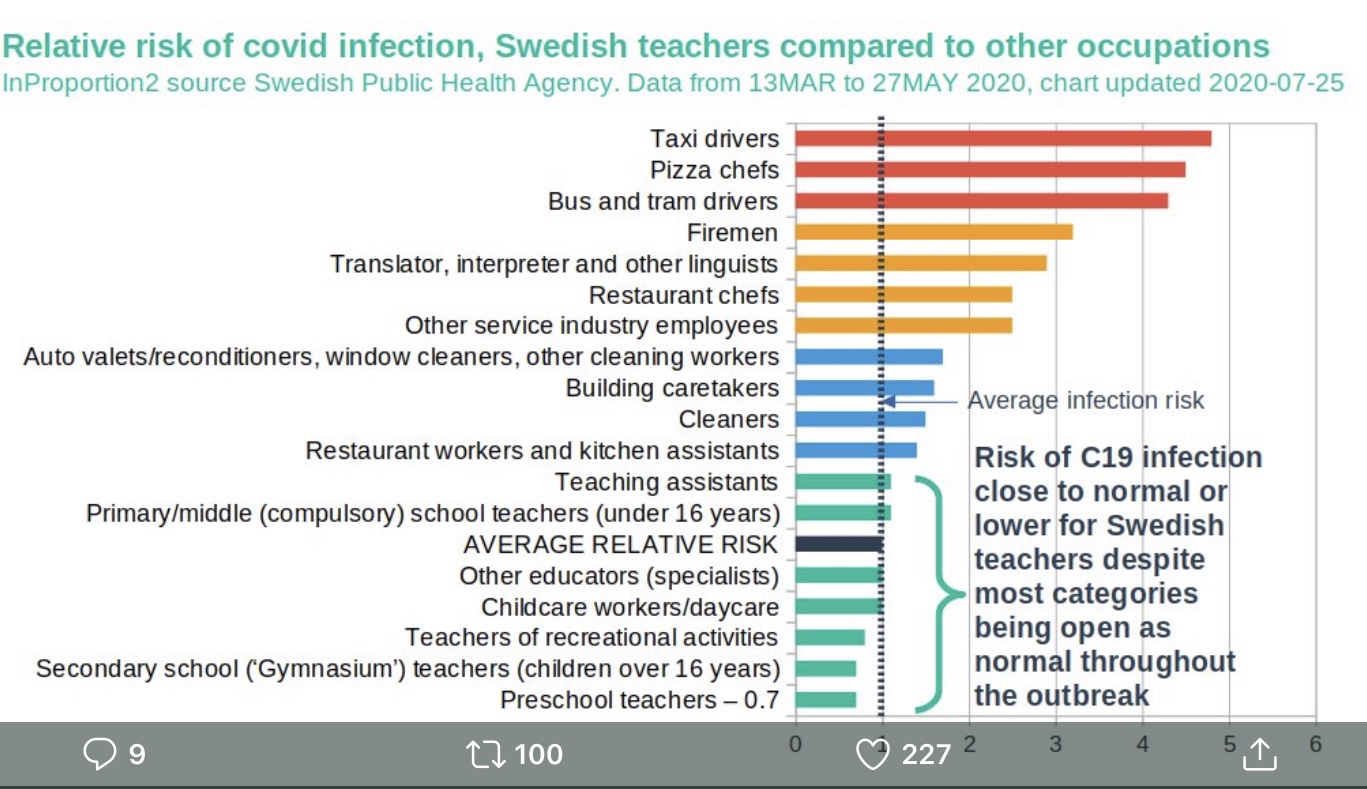
A quick follow-up to my recent post “COVID Hysteria and School Reform“: the graphic above is from an occupational risk study recently conducted by Swedish health authorities. The horizontal axis is obscured by the lower banner from Twitter (my fault), but the average risk of infection across all occupations was slightly less than 1%, and the highest-risk occupations were in the 4 – 5% range. Keep in mind, the data was collected while the virus was still raging in Sweden, while schools remained open. The virus hasn’t completely vanished in Sweden since then, but it has largely abated.

The study found that teachers had roughly average or below average risk, especially for pre-school and upper secondary (so-called “gymnasium”) teachers. The results demonstrate the lack of merit to claims by teachers unions that their members are somehow at greater risk of contracting coronavirus than other “essential” workers. We already know that children have extremely low susceptibility to COVID-19 and that they do not readily transmit the virus.

The health benefits of closing schools or taking them on-line do not compensate for the loss of educational effectiveness and detrimental health effects of preventing children from attending schools. The digital divide between children from disadvantaged households and their peers is likely to grow more severe if online learning is their only option. They should have choices, including functioning public schools.

To the last point, however, read this link for the sort of thing one teachers union supports. If the members are okay with that insanity then they shouldn’t be teaching your kids.

COVID Hysteria and School Reform

24 Monday Aug 2020

Posted by Nuetzel in Education, Pandemic, School Choice

≈ 1 Comment

Tags

Andrew Cuomo, Coronavirus, Donald Trump, Dr. Anthony Fauci, Glenn Reynolds, K-12 education, National Public Radio, NPR, Teachers Unions

Many haven’t quite gathered it in, but our public education system is an ongoing disaster for many low-income and minority students and families. The pandemic, however, is creating a major upheaval in K-12 education that might well benefit those students in the end. But before I get into that, a quick word about National Public Radio (NPR): it doesn’t make its political leanings a secret, which is why it should not be supported by taxpayers. Yes, like many other mainstream media outlets, NPR serves as a political front organization for Democrats (and worse).

Last week, NPR did a segment on “learning pods”, which I’d describe as private adaptations to the failure of many public schools (and teachers’ unions) to do their job during the pandemic. Glenn Reynolds passed along an interpretation of that NPR segment from a friend on Facebook, which I quote in its entirety below (bold emphasis mine). It was either this segment or else NPR has taken it down … but that link more or less matches the description. The post is somewhat satiric, but it captures much of what was actually said:

“Hilarious NPR, last week’s edition. They had an hour-long segment on learning pods. Participants: Host (white woman), Black Woman Activist, Asian Woman Parent, School-System Man.

Slightly editorialized (but true!) recollections below.

Host: In wealthy areas, parents get together and organize learning pods. What do we make of it?

School-System Man: Inequitable! Inappropriate! Bad! We do not support it!

Asian Woman Parent: Equity requires that we form these pods to educate our own children! Otherwise, only the rich can get education! Rich bad!

Host: Rich bad.

School-System Man: Rich horrible! They withdraw kids from public schools during the pandemic, so schools have less money!

Asian Woman Parent: We have no choice. You are not teaching.

Host: But what are you doing for the equity?

Asian Woman Parent: Why are the parents supposed to be doing something for the equity? That’s why we pay taxes, so professionals do something!

School-System Man: We cannot fix equity if you are clandestinely educating your own children, but not everyone else’s children!

Asian Woman Parent: The proper solution would have been to end the pandemic. But Trump did not end the pandemic. So, we must do learning pods. As soon as the pandemic is over, we’ll get back to normal, and everyone will catch up.

Everyone [with great relief]: Trump bad. Bad.

Black Woman Activist: No, wait a minute. This sounds as though in a regular school year, black children get good education. And they are getting terrible education! Unacceptable!

Host: Bad Trump!

Black Woman Activist: Foggeraboutit! It’s not Trump! It’s always been terrible! Black children are dumped into horrible public schools, where nobody is teaching them! So, my organization is now helping organize these learning pods for minority kids everywhere.

School-System Man [cautiously]: This is only helping Trump…

Black Woman Activist: Forget Trump! Don’t tell me black kids get no education because things are not normal now. When things were normal, their education was just as bad!

School-System Man: Whut??? How dare you! Our public schools are the best thing that ever happened to black children.

Asian Woman Parent: I’ll second that. Public schools in my neighborhood are just svelte.

Black Woman Activist: That’s the point! You live in a rich suburb, and your kids get a great public school! Black kids don’t!

Asian Woman Parent: If Trump managed the pandemic properly, we would not be having this conversation.

Host: Bad Trump!

Everyone: Bad Trump!

The end.”

Ah yes, so we’re back to blaming Donald Trump for following the advice of his medical experts, most prominently Dr. Anthony Fauci. And, while we’re at it, let’s blame Mr. Trump for following federalist principles by deferring to state and local governments to deal flexibly with the varying regional conditions of the pandemic, rather than ruling by federal executive edict. Of course, some of those state and local officials botched it, such as Andrew Cuomo. That’s tragic, but had Trump followed a more prescriptive tack, the howling from the Left would have been even more deafening.

We know that children are at little risk from the coronavirus. Nor do they seem to transmit the virus like older individuals, but teachers unions are adamant that the risks their members face at school would far exceed those shouldered by other “essential” workers. And the unions, not shy about partisanship even while representing public employees, want nothing more than to see Trump lose the election. So the unions and the schools districts they seem to control hold parents hostage. They collect their tax revenue and salaries while delivering virtual service at lower standards than usual, or no service at all. (Of course, public schools in some parts of the country are in session.) 

The teachers’ unions and public schools might get their comeuppance. The situation represents a tremendous opportunity for private schools, home schooling, and innovative schooling paradigms. Many private schools are holding classes in-person, more parents are homeschooling, and alternative arrangements like learning pods have formed, many of which are quite cost-effective.

Pressure is building to allow education dollars to follow individual students, not simply to flow to specific government schools. You can buy a decent K-12 education for $12,000 a year or so, and it’s likely to be a better education than you’ll get in many public schools. (One of the panelists on the NPR segment smugly called this an “insidious temptation”). At long last, parents would be allowed real choice in educating their children, and at long last schools would be incentivized to compete for those students. That might be one of the best things to come out of the pandemic.

COVID Seasonality and Latitudes

23 Sunday Aug 2020

Posted by Nuetzel in Pandemic

≈ 2 Comments

Tags

Air Conditioning, Antibodies, Antigenic Drift, Bimodal, Coronavirus, Covid-19, Ethical Skeptic, Heidi J Zapata, Herd Immunity, Herd Immunity Threshold, Humidity, Immune Response, Justin Hart, Latitude and Seasonality, Proofreading enzymes, Robert Edgar Hope-Simpson, SARS, SARS-CoV-2, Seasonality, Sunlight, T-Cell Immunity, Temperature, Tropical Latitudes, Viral Load, Viral Mutation, Vitamin D Deficiency

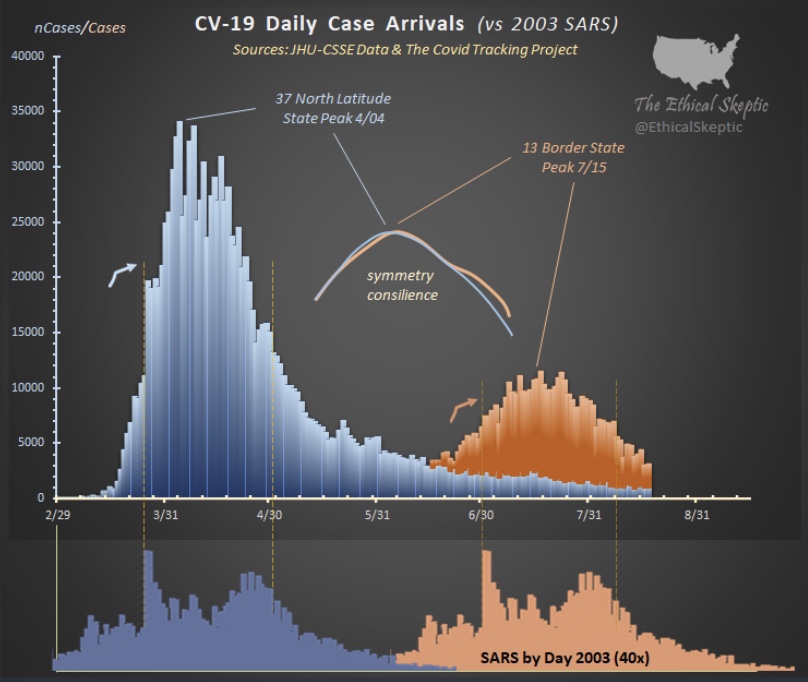
The coronavirus (C19), or SARS-CoV-2, has a strong seasonal component that appears to closely match that of earlier SARS viruses as well as seasonal influenza. This includes the two distinct caseloads we’ve experienced in the U.S. 1) in the late winter/early spring; and 2) the smaller bump we witnessed this summer in some southern states and tropics. 

COVID Seasonal Patterns and Latitude

The Ethical Skeptic on Twitter recently featured the chart below. It shows the new case count of C19 in the U.S. in the upper panel, and the 2003 SARS virus in the lower panel. Both viruses had an initial phase at higher latitudes and a summer rebound at lower latitudes.


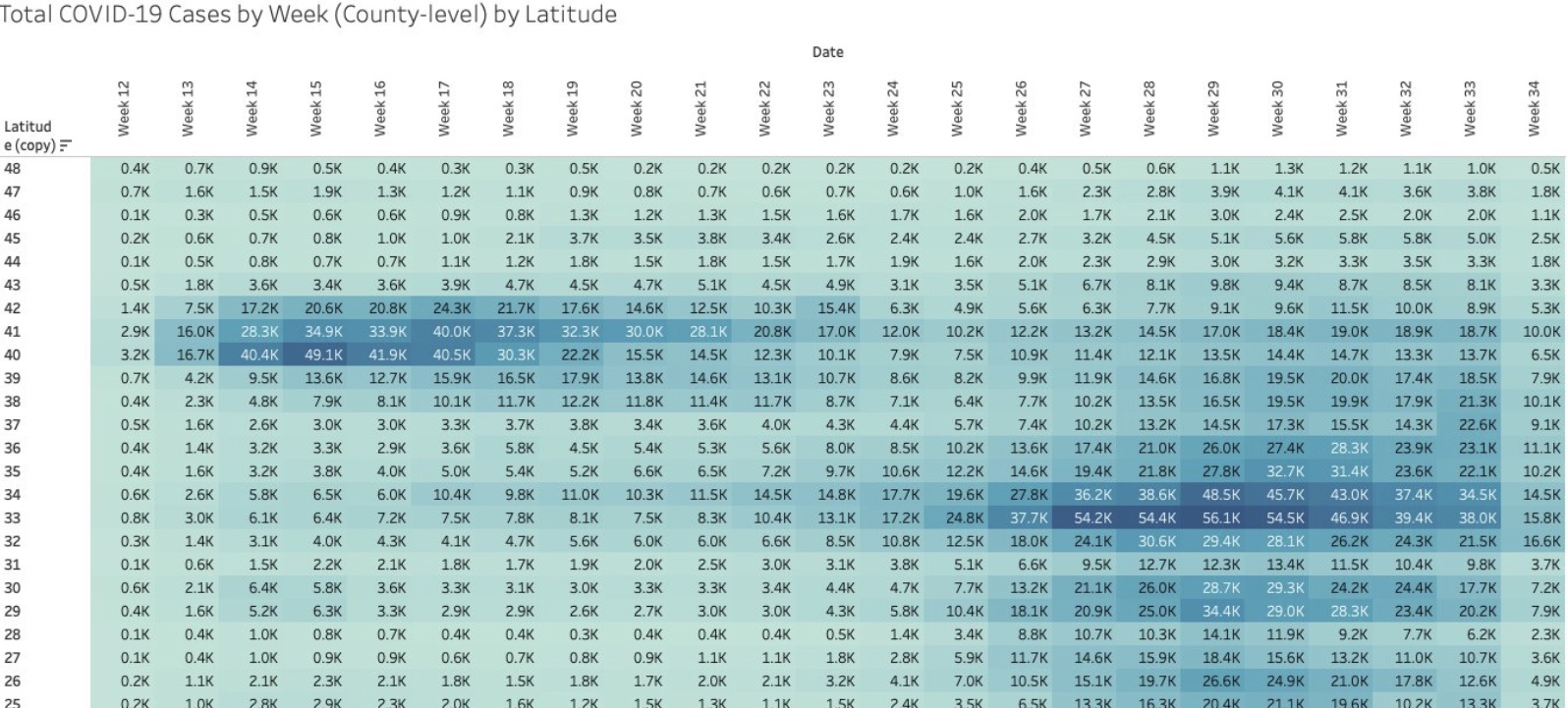
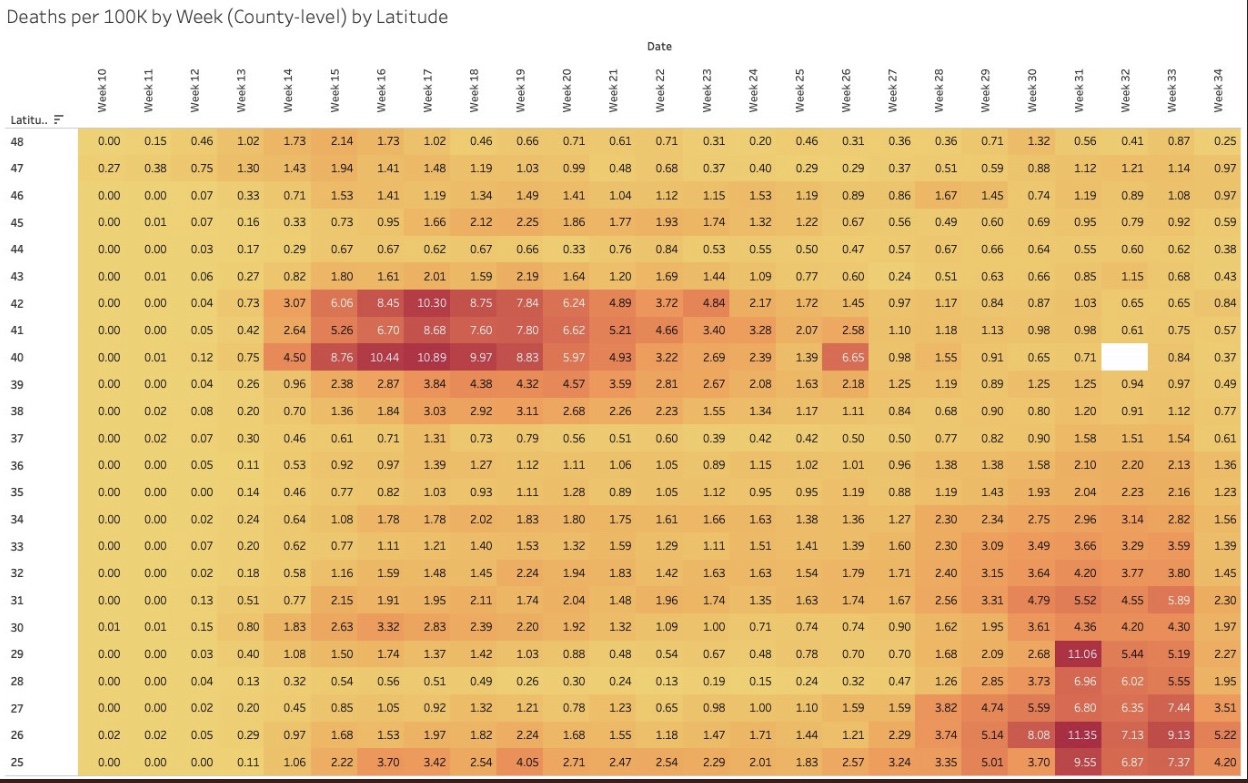
I particularly like the following visualizations from Justin Hart demonstrating the pandemic’s pattern at different latitudes (shown in the leftmost column). The first table shows total cases by week of 2020. The second shows deaths per 100,000 of population by week. Again, notice that lower latitudes have had a crest in the contagion this summer, while higher latitudes suffered the worst of their contagion in the spring. Based on deaths in the second table, the infections at lower latitudes have been less severe.

Viral Patterns in the South

Many expected the pandemic to abate this summer, including me, as it is well known that viruses don’t thrive in higher temperatures and humidity levels, and in more direct sunlight. So it is a puzzle that southern latitudes experienced a surge in the virus during the warmest months of the year. True, the cases were less severe on average, and sunlight and humidity likely played a role in that, along with the marked reduction in the age distribution of cases. However, the SARS pandemic of 2003 followed the same pattern, and the summer surge of C19 at southern latitudes was quite typical of viruses historically.

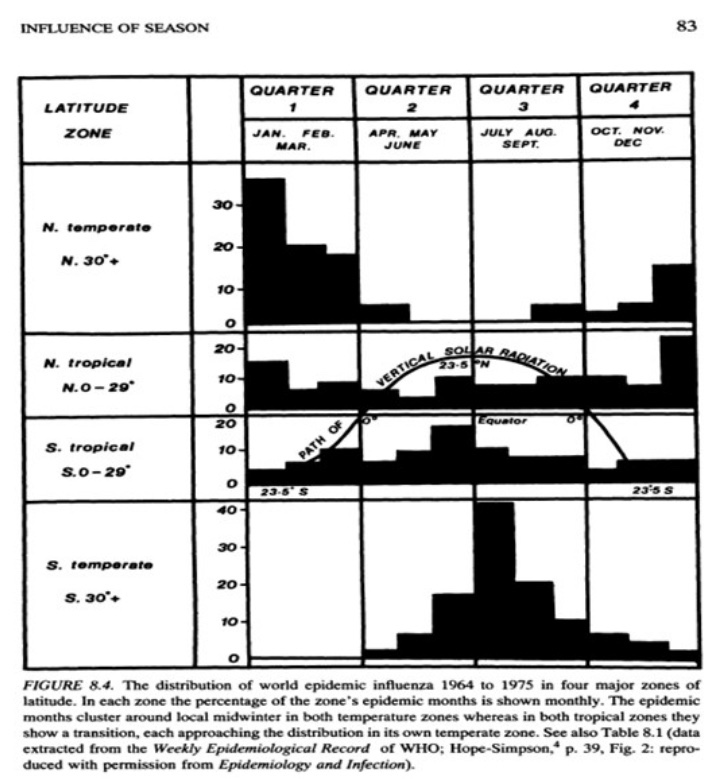
A classic study of the seasonality of viruses was published in 1981 by Robert Edgar Hope-Simpson. The next chart summarized his findings on influenza, seasonality, and latitude based on four groups of latitudes. Northern and southern latitudes above 30° are shown in the top and bottom panels, respectively. Both show wintertime contagions with few infections during the summer months. Tropical regions are different, however. The second and third panels of the chart show flu infections at latitudes less than 30°. Influenza seems to lurk at relatively low levels through most of the year in the tropics, but the respective patterns above and below the equator look almost like very muted versions of activity further to the north and south. However, some researchers describe the tropical pattern as bimodal, meaning that there are two peaks over the course of a year.   

So the “puzzle” of the summer surge at low latitudes appears to be more of an empirical regularity. But what gives rise to this pattern in the tropics, given that direct sunlight, temperature, and humidity subdue viral activity?

There are several possible explanations. One is that the summer rainy season in the tropics leads to less sunlight as well as changes in behavior: more time spent indoors and even less exposure to sunlight. In fact, today, in tropical areas where air conditioning is more widespread, it doesn’t have to be rainy to bring people indoors, just hot. Unfortunately, air conditioning dries the air and creates a more hospitable environment for viruses. Moreover, low latitudes are populated by a larger share of dark-skinned peoples, who generally are more deficient in vitamin D. That might magnify the virulence associated with the flight indoors brought on by hot and or rainy weather.   

Mutations and Seasonal Patterns

What makes the seasonal patterns noted above so reliable in the face of successful immune responses by recovered individuals? And shouldn’t herd immunity end these seasonal repetitions? The problem is the flu is highly prone to viral mutation, having segments of genes that are highly interchangeable (prompting so-called “antigenic drift“). That’s why flu vaccines are usually different each year: they are customized to prompt an immune response to the latest strains of the virus. Still, the power of these new viral strains are sufficient to propagate the kinds of annual flu cycles documented by Hope-Simpson.

With C19, we know there have been up to 100 mutations, mostly quite minor. Two major strains have been dominant. The first was more common in Southeast Asia near the beginning of the pandemic. It was less virulent and deadly than the strain that hit much of Europe and the U.S. Of course, in July the media misrepresented this strain as “new”, when in fact it had become the most dominant strain back in March and April.

What Lies Ahead

By now, it’s possible that the herd immunity threshold has been surpassed in many areas, which means that a surge this coming fall or winter would be limited to a smaller subset of still-susceptible individuals. The key question is whether C19 will be prone to mutations that pose new danger. If so, it’s possible that the fall and winter will bring an upsurge in cases in northern latitudes both among those still susceptible to existing strains, and to the larger population without immune defenses against new strains.

Fortunately, less dangerous variants are more more likely to be in the interest of the virus’ survival. And thus far, despite the number of minor mutations, it appears that C19 is relatively stable as viruses go. This article quotes Dr. Heidi J. Zapata, an infectious disease specialist and immunologist at Yale, who says that C19:

“… has shown to be a bit slow when it comes to accumulating mutations … Coronaviruses are interesting in that they carry a protein that ‘proofreads’ [their] genetic code, thus making mutations less likely compared to viruses that do not carry these proofreading proteins.”

The flu, however, does not have such a proofreading enzyme, so there is little to check its prodigious tendency to mutate. Ironically, C19’s greater reliability in producing faithful copies of itself should help ensure more durable immunity among those already having acquired defenses against C19.

This means that C19 might not have a strong seasonal resurgence in the fall and winter. Exceptions could include: 1) the remaining susceptible population, should they be exposed to a sufficient viral load; 2) regions that have not yet reached the herd immunity threshold; and 3) the advent of a dangerous new mutation, though existing T-cell immunity may effectively cross-react to defend against such a mutation in many individuals.


The FDA Can Put Virus Behind Us, Sans Vaccine

19 Wednesday Aug 2020

Posted by Nuetzel in Liberty, Pandemic, Vaccinations

≈ 1 Comment

Tags

Alex Tabarrok, Anti-Vaxers, Coronavirus, COVID Screening, Covid-19, E25Bio, Emergency Use Authorization, False Positive, Falze Negative, FDA, Harvard, Infectious vs Infected, John Cochrane, National Basketball Players Association, NBA, Paper Tests, Rapid Tests, Regulatory Failure, SalivaDirect, Self-Quarantine, Test Accuracy, Tracing, Transmission Chain, Vaccine Development, Vaccine Supply Chain, Wyss Institute for Biologically Inspired Engineering, Yale, Zach Lowe

Most of the news about COVID vaccine development is positive, but there are still huge doubts about 1) whether an effective vaccine(s) will ever be available; 2) when it will be available; 3) in what quantities (supply chains for vaccines present issues that most lay persons would never imagine) ; 4) the best approaches to allocation across young/healthy vs. old/vulnerable; 5) how long it will provide protection (the news is good on lasting immunity as well); and 6) whether people will actually take it. Given all these uncertainties, it’s worth considering an approach to stanching the coronavirus that won’t require a vaccine while still allowing a return to normalcy: cheap, rapid tests available to consumers on a daily basis in their homes or in businesses.

The full benefits of cheap, rapid tests can take people a while to wrap their heads around. In fact, there are skeptics who’s views on any and all testing are colored by suspicions that increased testing is some sort of conspiracy to spread fear and keep the economy hobbled. It’s true that increased testing drove much of the increase in COVID cases this summer, which caused the mainstream media to delight in spinning alarmist narratives. Fair enough, but that misses the point, which I’ll try to elucidate below. I credit a John Cochrane post for bringing this to my attention.

A successful vaccine breaks the so-called “transmission chain”, but so does frequent testing to identify infectious individuals on an ongoing basis so they can self-quarantine. As Alex Tabarrok has emphasized, we should worry about identifying infectious individuals, as opposed to infected individuals. They are not the same. Cheap, rapid, and easy-to-administer tests have already proven to be fairly accurate during the infectious stage. The idea is for individuals to self-test every day and stay home if they are positive. Or, employers can test workers every day and send them home if they are positive. Frequent testing also makes it simpler to trace the source of an infection and may reduce the importance of tracing.

To those who say this represents an affront to personal liberty, and I’m very touchy on that subject myself, recall that even now people are being screened in their workplaces using thermometers, questionnaires, or on the basis of any frogginess perceived by supervisors and co-workers. Those “tests” are far less accurate in identifying COVID-19 contagiousness than the kinds of cheap tests at issue here, and they are certainly no less intrusive. Then there are the many businesses facing restrictions on their operations: how “accurate” is it to keep everyone at home by locking down places of business? How intrusive is that? Those restrictions are indefensible, and especially with the advent and diffusion of cheap, rapid tests.

Of course, people might cheat and not report positives. Tests could be administered at workplaces to avoid that possibility, or at points of admission to businesses and facilities, but a few minutes of delay would be necessary. I would not support a centralized database of daily test results. If nothing else, relying on the good faith of individuals in reporting their results would be a giant leap forward in breaking the transmission chain now, rather than counting on the possibility of a successful virus in the indefinite future. And we might then avoid the whole pro-vax/anti-vax imbroglio that already foments, which raises major questions bearing on individual liberty.

Then there is the question of positive tests within multi-person households. Should the entire family or household self-quarantine? I say no, not if the others are negative, but then the others should test twice before going out, which dramatically reduces the probability of a false negative, and they should probably test more frequently, perhaps several times a day.

There are other important details to address: Who will pay for the tests? Will workers be paid to stay home if they test positive? How long will they be required to stay home? How will repeated tests be treated? I don’t want to get into detail on all of these points, but cheap, fast tests can help overcome many of these difficulties, and I believe many of the details can and should be worked out privately.

Unfortunately, the FDA has approved only two rapid tests, and they are not very rapid and not cheap enough. Only one had been approved up until last weekend because the FDA found the accuracy to be lacking … compared to PCR tests! But the FDA finally issued an Emergency Use Authorization for a saliva-based test (SalivaDirect) developed at Yale, partly funded by the NBA and the Players Association. The test still requires processing at a lab, so it’s really not convenient enough and not fast enough. Here is Zach Lowe on the cost:

“The cost per sample could be as low as about $4, though the cost to consumers will likely be higher than that — perhaps around $15 or $20 in some cases, according to expert sources.”

Not bad, but it’s much higher than more rapid, paper tests developed by Harvard’s Wyss Institute for Biologically Inspired Engineering and a company called E25Bio. Both of those are expected to cost about $1 per sample and can be completed anywhere. That’s a price that can work. And there are other promising candidates.

The benefits of tests that are rough, ready, and cheap will be huge. Such tests will also enable retesting, which helps to overcome the dilemmas of false positives and negatives. False negatives might be of greater concern to the FDA, but again, false negatives are less likely during the contagious stage of an infection, and the tests will be accurate enough that transmission risk will be drastically reduced.

The FDA needs to move beyond its stodgy insistence on achieving laboratory levels of accuracy. It’s unlikely that a single test source will be adequate to stanch the transmission chain, so the agency should rush to approve as many cheap, rapid tests as possible, with as many advisories and patient warnings regarding test results and follow-up instructions as it deems necessary. Remember, these tests are much better than thermometers!

Evidence of Fading COVID Summer Surge

16 Sunday Aug 2020

Posted by Nuetzel in Pandemic

≈ Leave a comment

Tags

CDC, CLI, Covid Tracking Project, Covid-19, COVID-Like Illness, Date of Death, FEMA, FEMA Regions, Herd Immunity Threshold, Hospitalizations, Kyle Lamb, PCR Test, Percent Positive, Provisional Deaths

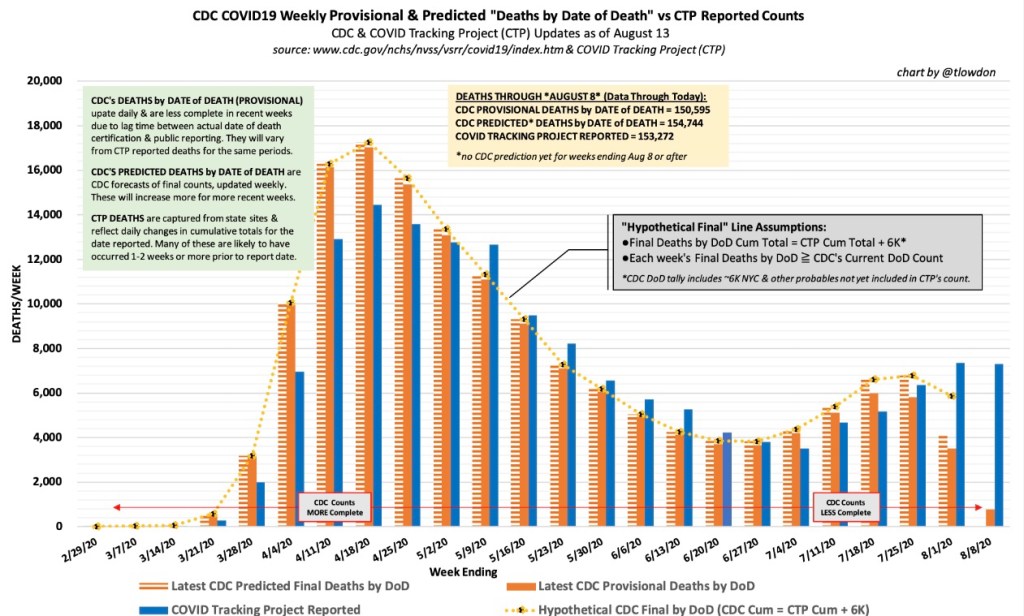
Lately I’ve talked a lot about reported deaths each week versus deaths by actual date of death (DOD). Much of that information came from Kyle Lamb’s Twitter account, and he’s the source of the charts below as well. The first one provides a convenient summary of the data reported through last week. The blue bars are reported deaths each week from the COVID Tracking Project (CTP), which are an aggregation of deaths that actually occurred over previous weeks. Again, the blue bars do NOT represent deaths that occurred in the reporting week. The solid orange bars are “provisional” actual deaths by DOD. “Provisional” means that recent weeks are not complete, though most deaths by DOD are captured within three to four weeks. The CDC also produces a “forecast” of final death counts by DOD, shown by the hatched orange bars.   

Note that the recent surge in deaths has been much smaller than the one in the spring, which was driven by deaths in the northeast. The CDC “expects” actual deaths by DOD to have declined starting after the week of July 23rd. However, CTP was still reporting deaths of over 1,000 per day last week. The actual timing of those deaths in prior weeks, and the ultimate extent of the summer surge in COVID deaths, remains to be seen.

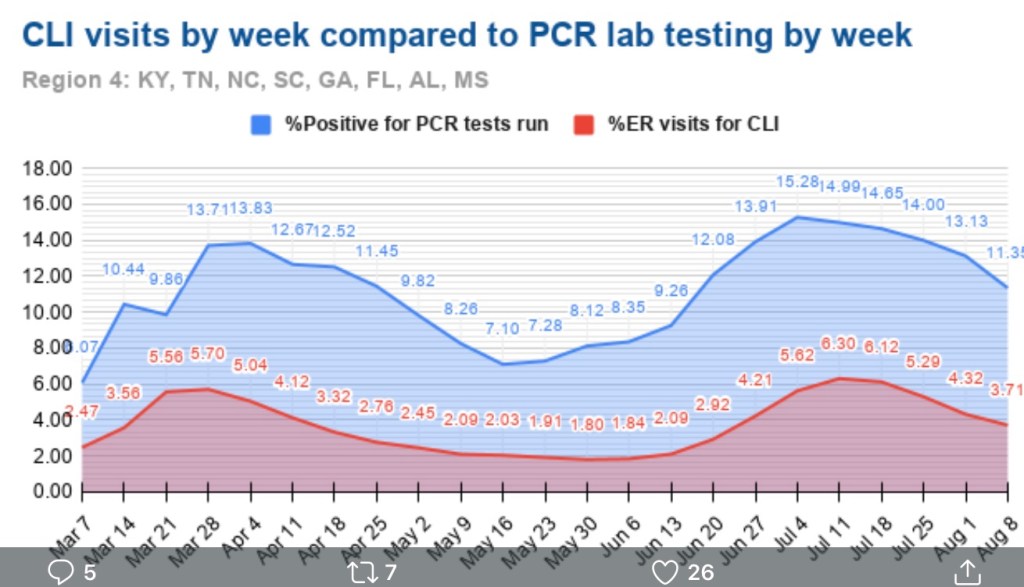
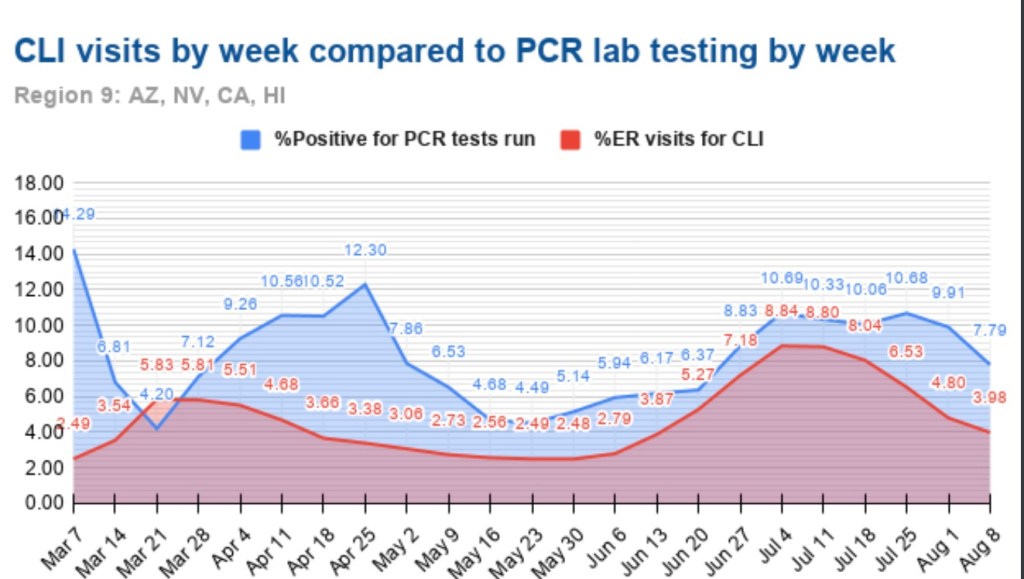
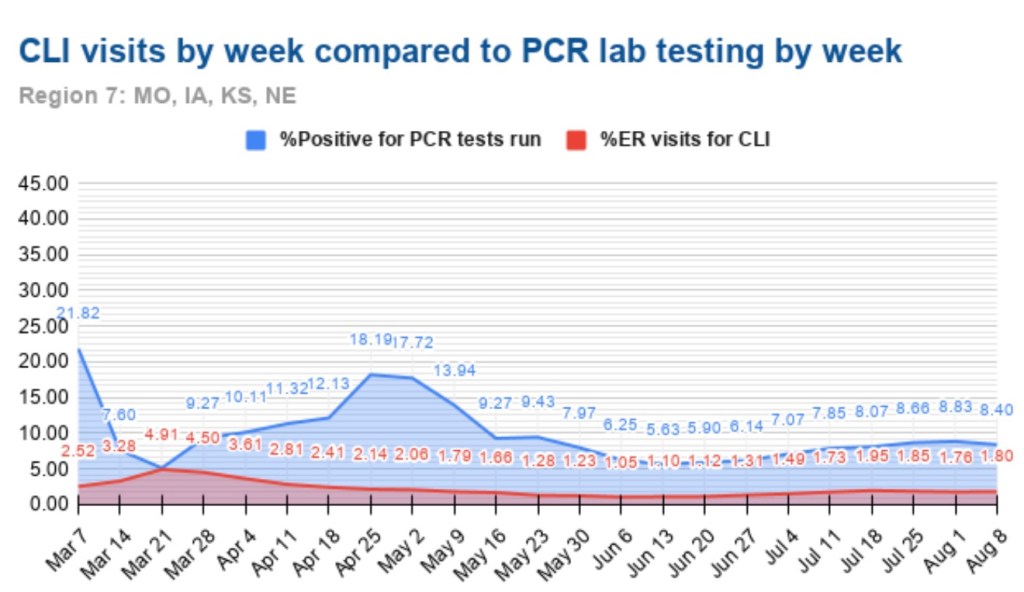
Certain leading indicators of deaths are signaling declines in actual deaths in August. Two of those indicators are 1) the positivity rate on standard PCR tests for infections; and 2) the share of emergency room visits made for symptoms of “COVID Like Illness” (CLI). The charts below show those indicators for FEMA regions that had the largest uptrends in cases in June and July. Florida is part of Region 4, shown in the next chart:

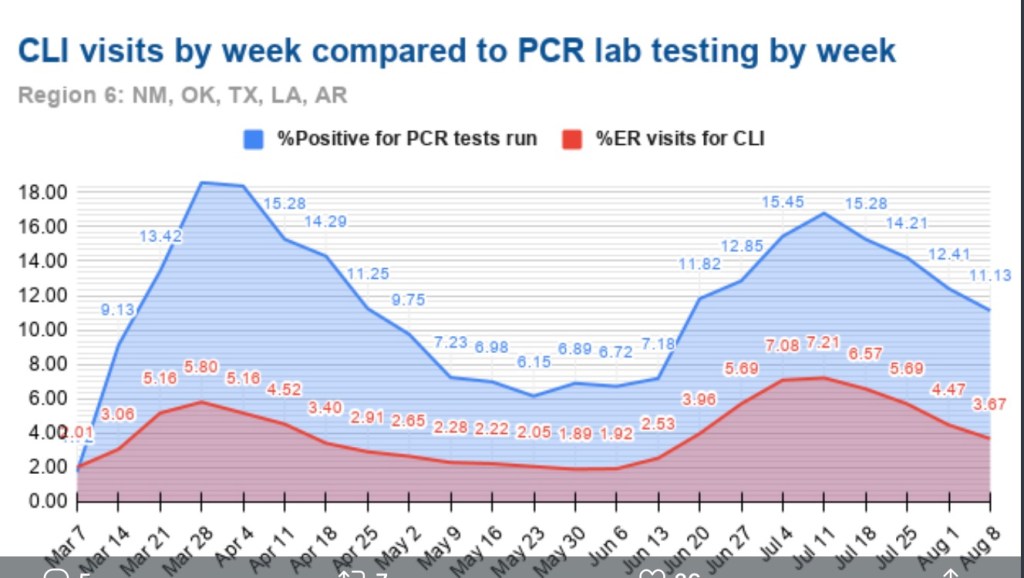
Here is the Region 6, which includes Texas:

Finally, Region 8 includes Arizona and California:

Out of personal interest, I’m also throwing in Region 7 with a few midwestern states, where cases have risen but not to the levels reached in Regions 4, 6, and 8:

With the exception of the last chart, the clear pattern is a peak or plateau in the positivity rate in late June through late July, followed by declines in subsequent weeks. The share or ER visits for CLI was not quite coincident with the positivity rate, but close. The decline in the CLI share is evident in Regions 4, 6 and 8. Again, these three regions include states that drove the nationwide increase in cases this summer (AZ, CA, FL, and TX), and the surge appears to have maxed out.     

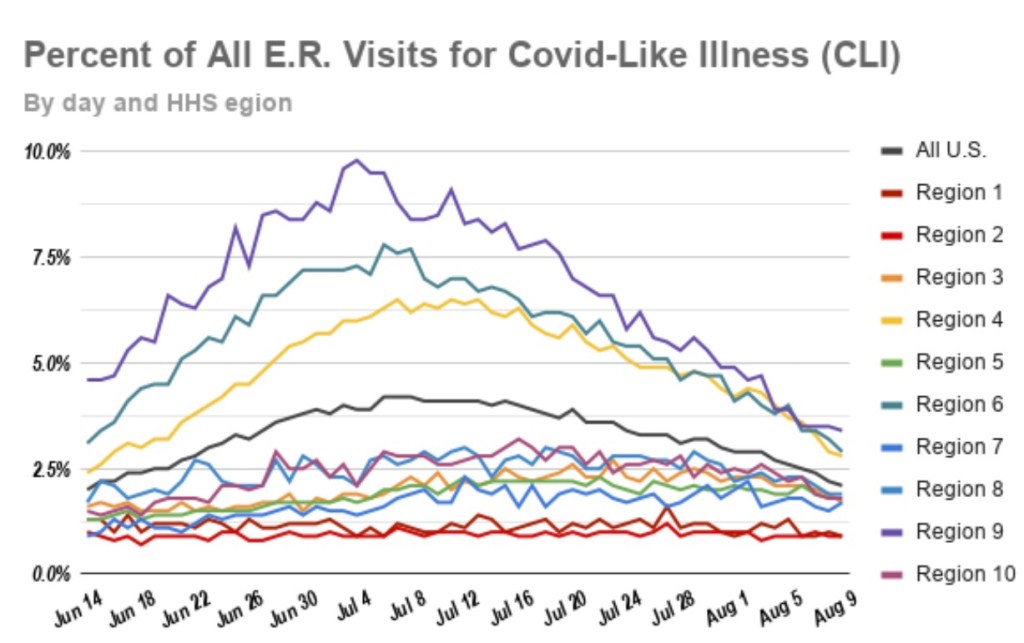
Here is a chart showing the share of CLI visits to ERs for all ten FEMA region from mid-June through last week. Clearly, this measure is improving across the U.S.

Nationwide, the CLI percentage at ERs has decreased by about 47% over the past four weeks, and the positivity rate has decreased by about 28% in that time. In addition to these favorable trends, COVID hospitalizations have decreased by about 40% over the past three weeks. All of these trends bode well for a downturn in COVID-attributed deaths.

The summertime surge in the virus was not nearly as ravaging as in the spring, and it appears to be fading. We’ll await developments in the fall, but we’ve come a long way in terms of protecting the vulnerable, treating the infected, approaching herd immunity thresholds (which means reduced rates of transmission to susceptible individuals), and the real possibility that we can put the pandemic behind us. 

Joe’s Moronic Outdoor Mask Mandate

15 Saturday Aug 2020

Posted by Nuetzel in Pandemic, Public Health

≈ 1 Comment

Tags

Absolute Humidity, Aerosol Transmission, Covid-19, Dr. Anthony Fauci, Droplet Transmission, Federalism, Indoor Transmission, Joe Biden, Kansas Department of Health and Environment, Kansas Policy Institute, KDHE, Mask Mandate, Outdoor Transmission, Randomized Control Trial, The Sentinel, UV Rays

Do you wear a mask whenever you step outside? In your yard? At the beach? In the park? On an empty sidewalk? Then congratulations! You are a colossal imbecile, like all the others in the mandatory mask crowd. Now, Joe Biden, in an attempt to prove either dementia or a full-fledged alliance with irredeemably lefty Karens, is demanding a three-month nationwide mandate for masks to be worn by everyone … OUTDOORS!

Really, what kind of moron believes there is any real danger of contracting coronavirus outside short of close and prolonged exposure to an infected individual? We know outdoor transmission is extremely rare. Nearly 100% of cases are contracted indoors, almost always in tight, poorly ventilated spaces.

It’s not hard to fathom why outdoor environments are of such low risk. Outdoors, air is of such enormous volume that virus particles are quickly diluted, dramatically reducing any viral load one might encounter. Air circulation is much better outdoors as well, driven by differences in temperatures across lateral and vertical space. Any breeze effectively disperses the particles. And those small loads drifting through open air won’t survive long: the ultraviolet waves in direct sunlight tend to kill it very quickly. Humidity is also associated with more rapid deactivation of the virus. Air tends to be more humid outdoors whenever forced air heating or air conditioning are used without sufficient humidification.

Cloth masks, in any case, may be effective against transmission by droplets expelled from coughs or sneezes, but they are of questionable value against transmission by aerosols from exhaled air. Outside, if you are distanced, you really have only aerosols to worry about. Under those circumstances, cloth masks are more for show than anything else.

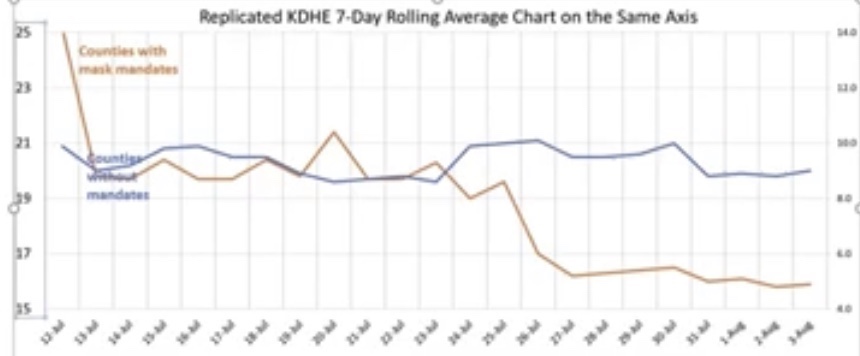
And on what pretext do officials, or your nitwitted neighbors, get the idea that mandatory masks OUTSIDE is in the interest of public health? I mean, besides buying-in to a ridiculous nanny-state narrative promoted by the media? Well, there is also some crap “research” to consider. Here is a good example: a study on masks from the Kansas Department of Health and Environment (KDHE). Take a look at what these guys tried to pull off…  Here’s what KDHE hoped would serve as “proof” of the dramatic efficacy of masks:

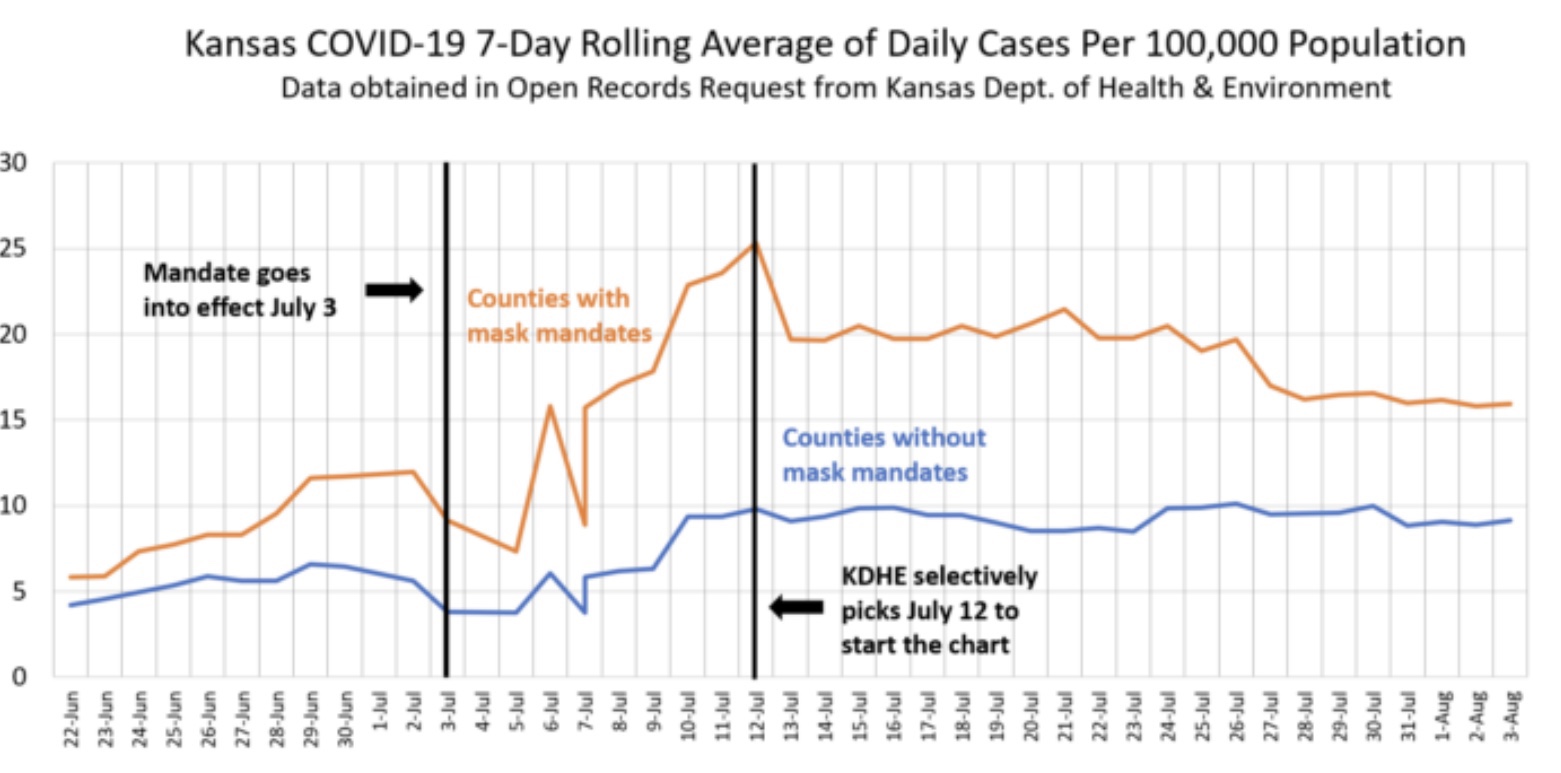
Wow! Notice two things in this chart: 1) the two lines are plotted with respect to different vertical axes; and 2) the chart begins on July 12th. Now take a look at a longer history in which the lines are plotted against the same axis.

It certainly doesn’t appear that the mandate beginning on July 3 had a favorable impact on new cases. What KDHE did here was incredibly dishonest, and I applaud the Kansas Policy Institute and it’s publication The Sentinel (linked above) for calling out KDHE for their dishonest piece of crap.

Other studies have exaggerated the general efficacy of masks as well. It’s also noteworthy that Europe’s medical establishment is unimpressed with masks. And after all, to my knowledge there have been no randomized control trials supporting the efficacy of masks — the only acceptable form of test according to Anthony Fauci! Now, none of that means masks don’t reduce COVID transmission. I happily wear a mask when I enter public buildings. What’s at issue here is whether masks should be required outdoors. Furthermore, I dispute the notion that a nationwide mask mandate is needed, because not all localities are at equal risk. I’m an advocate of the federalist principle that the best state and local solutions are crafted at the state and local levels. And at a personal level, I say ignore the intrusive bastards. Get outside in the fresh air, and forget the mask if you have some space.

Election Snafus, Fraud: Invite and They Will Come

12 Wednesday Aug 2020

Posted by Nuetzel in Democracy, Pandemic, Voter Fraud

≈ 2 Comments

Tags

19th Amendment, Absentee Ballots, Amy Klobuchar, Atlantic County NJ, Ballot Harvesting, CalTech, CBS, Charles Stewart III, Eric Boehm, European Union, Fraud Risk, J Christian Adams, Logan Churchwell, Mail-In Voting, Mark Harris, Massachusetts Institute of Technology, New York Times, PILF, Postal Voting, Public Interest Legal Foundation, Reason.com, Ron Wyden

There is understandable controversy over the prospect of more mail-in voting, but it’s reasonable to believe that some additional mail-in or postal voting may be necessary in light of the pandemic. Social distancing reduces the volume of activity that polling places can handle in a single day, and administrative decisions about the voting process can’t be deferred until late October in order to observe the state of the pandemic and make last-minute changes. Most states already permit voters to request a mail-in ballot for a variety of reasons: travel, illness, or other exigencies are usually sufficient, if a reason is even required. In the context of the pandemic, such a request should certainly be granted to those most concerned about contracting the coronavirus. So the option to vote by mail seems reasonable, at least in the abstract, as long as those who prefer to cast their ballots in person can do so.

“Universal” mail-in voting is another story, but the term first requires some qualification. I construe “universal” in this case to mean voting by citizens of the United States, a right protected and reserved to citizens by the 19th Amendment to the Constitution. That also means voters must be registered and must comply with state requirements for identification, if any, before receiving a ballot. In other words, under current state laws, a voter might be required to appear before an election authority to obtain a ballot for return by mail. The proponents of universal postal mail, however, seem to think states should simply mail ballots to the addresses of all registered voters. Many proponents go further, suggesting that all individuals of voting age should be mailed ballots.

The first major problem with a large expansion of postal voting is administrative complexity. It would represent a significant challenge for many jurisdictions to arrange in short order. It’s bound to create major delays in counting and reporting results, and it is likely to create doubt as to the reliability of the official election results. Here are some administrative issues and examples worth considering:

This recent experiment by CBS revealed delays in the official receipt of mailed ballots, a problem that will be more acute given plans in some jurisdictions to send ballots to postal voters only a week prior to the November election. The study also revealed some mis-sorting and misplacement of returned ballots. It concluded that a percentage of voters is likely to be “disenfranchised” by mail-in voting.

In early August, primary balloting by mail in Atlantic County, NJ was said to be especially problematic. Signatures on ballots were difficult to match to DMV records signed on “screen”; there was an extra step in delivering ballots to a central post office location and then on to election officials, causing delays; the voter registration system was plagued by technical glitches related to heavy demand for updated records; and there was insufficient time between sending ballots to voters and the deadline.

New York City’s primary election in June was similarly afflicted with a high rate of invalid mailed ballots. “The city BOE received 403,103 mail-in ballots for the June 23 Democratic presidential primary. … But the certified results released Wednesday revealed that only 318,995 mail-in ballots were counted. … That means 84,108 ballots were not counted or invalidated — 21 percent of the total. … One out of four mail-in ballots were disqualified for arriving late, lacking a postmark or failing to include a voter’s signature, or other defects. The Post reported Tuesday that roughly 30,000 mail-in ballots were invalidated in Brooklyn alone. … The high invalidation rate provides more proof that election officials and the Postal Service were woefully underprepared to handle and process the avalanche of mail-in ballots that voters were encouraged to fill out to avoid having to go to the polls during the coronavirus pandemic, critics said.”

From the New York Times, “In the last presidential election, 35.5 million voters requested absentee ballots, but only 27.9 million absentee votes were counted, according to a study [NYT link is bad] by Charles Stewart III, a political scientist at the Massachusetts Institute of Technology. He calculated that 3.9 million ballots requested by voters never reached them; that another 2.9 million ballots received by voters did not make it back to election officials; and that election officials rejected 800,000 ballots. That suggests an overall failure rate of as much as 21 percent.”

The problem of rejected mail-in ballots is all too common throughout the country. For example, redistricting can cause mail-in voters to cast their votes in the wrong precinct at a higher rate; people move frequently, especially low-income voters, so updating voter rolls is a tremendous challenge; and voters often fail to follow instructions carefully, and there is no one at hand to offer assistance.

Again, these are just the administrative problems. The upshot is that mail-in voting is likely to introduce uncertainties and delays in determining election outcomes, and is likely to result in numerous legal challenges as well.

This piece by Eric Boehm in Reason is skeptical of our ability to vote by mail without major complications of that kind. Boehm then turns to the question of mail-in ballots and fraud, however, quoting a variety of experts who claim that election fraud is a miniscule problem and that fraud has not had a partisan bias in the past. But partisan bias is not really the critical issue… fraud is, party by party, district by district, and state by state.

Despite Boehm’s protestations and widespread denial in the news media, election fraud is a “thing”. More importantly, the risk of election fraud is a thing. It’s instructive that two U.S. Senators (Ron Wyden (OR) and Amy Klobuchar (MN)) have introduced legislation that not only would authorize more widespread voting by mail, but “ballot harvesting” as well. The latter is the practice of visiting homes and “offering” to collect residents’ postal ballots for delivery to collection points. It has been a flagrant form of vote fraud in the past.

So what is our experience with fraud? Here is a “sampling” of 1,290 cases of election fraud, many of which involved absentee ballots and ballot harvesting. Detail on most of these cases can be found here.

The following testimonial reinforces the ease with which fraud can be perpetrated via mail-in voting:”I know because I did it“:

“Last year, a political operative working for North Carolina Republican congressional candidate Mark Harris was charged with fraud for directing a group of people to fill out as many as one thousand absentee ballot requests on behalf of voters — most of whom were unaware the ballots were being requested. … These people then collected the ballots and filled them out themselves. … 

Also in 2019, a Democratic city clerk in Southfield, Michigan, was arrested and charged with six felonies for falsifying absentee ballot records to say that 193 of the ballots in one election were missing signatures or a return date, when in fact they had both. The correct records were found in the trash can in her office.

… J. Christian Adams of the Public Interest Legal Foundation (PILF) says if states aren’t careful, they’ll be issuing ‘an open invitation to fraud. … There are two big problems with vote by mail,’ Adams told InsideSources. ‘Number one … people voting the ballot for other people through undue influence. … The second one — the voter rolls are a mess.’ … Adams’ organization has sued several states and counties for refusing to maintain accurate voter rolls, allowing the names of thousands of dead voters, felons and non-citizens to remain in the system.”

Fraud risk always exists even if detected and proven levels of fraud are low, and the level of risk scales with the extent to which ballots are cast by mail. The sudden, massive expansion in mail-in voting now contemplated by some would create unprecedented opportunities for fraud.

Consider the 28 million mail-in ballots that went missing between 2012 and 2018, roughly 20% of mail-in ballots issued during those years. According to Logan Churchwell of PILF:

“So what do people that really focus on the election process do about that? They go into ballot harvesting. If there’s so many ballots out there in the wind unaccounted for by election officials, surely some manpower could be dedicated to go bring them in. And that’s another part of the system where you have weaknesses and risk.”

It takes only a small percentage of the vote to swing many elections, so ballot harvesting, enabled by more widespread voting-by-mail, is a serious threat to the integrity of the democratic process. The last link cites a few reports that should give mail voting proponents some pause:

“There’s little doubt that as the number of mail-in ballots increases, so does fraud. A 2012 report in The New York Times noted that voter fraud involving mail-in ballots ‘is vastly more prevalent than the in-person voting fraud that has attracted far more attention, election administrators say. In Florida, absentee-ballot scandals seem to arrive like clockwork around election time.’ According to a Wall Street Journal report on voter exploitation in Hispanic communities in Texas, mail-in ballots have ‘spawned a mini-industry of consultants who get out the absentee vote, sometimes using questionable techniques.’ Poor, elderly, and minority communities are most likely to be preyed upon by so-called ballot ‘brokers.’

Concerns about fraud in mail-in ballots were serious enough that a 2008 report produced by the CalTech/MIT Voting Technology Project recommended that states ‘restrict or abolish on-demand absentee voting in favor of in-person early voting.'”

It’s no coincidence that most countries in the European Union restrict mail-in voting to those who are unable to vote in-person, such as those working or studying abroad, as well as the sick and elderly. There are exceptions, of course, but many of these developed countries reject the notion that mail-in voting is worth the risks.

It’s reasonable to expect many cautious voters to request ballots for return by mail. But at a minimum, any large-scale transition to postal voting should be done with care for the security and integrity of the voting process. It is not an exercise to be done in haste, as proponents now demand. The result of such a drastic change would be significant delays, legal challenges, and reduced confidence in the outcome of elections. And there will almost certainly be fraud. As in almost all things, a voluntary option subject to jurisdictional risk controls is far preferable to either mandatory or “universal” postal voting.

← Older posts
Newer posts →
Follow Sacred Cow Chips on WordPress.com

Recent Posts

  • Grading Trump II, So Far
  • A Warsh Policy Scenario At the Federal Reserve
  • The Coexistence of Labor and AI-Augmented Capital
  • The Case Against Interest On Reserves
  • Immigration and Merit As Fiscal Propositions

Archives

  • March 2026
  • February 2026
  • January 2026
  • December 2025
  • November 2025
  • October 2025
  • September 2025
  • August 2025
  • July 2025
  • June 2025
  • May 2025
  • April 2025
  • March 2025
  • February 2025
  • January 2025
  • December 2024
  • November 2024
  • October 2024
  • September 2024
  • August 2024
  • July 2024
  • June 2024
  • May 2024
  • April 2024
  • March 2024
  • February 2024
  • January 2024
  • December 2023
  • November 2023
  • August 2023
  • July 2023
  • June 2023
  • May 2023
  • April 2023
  • March 2023
  • February 2023
  • January 2023
  • December 2022
  • November 2022
  • October 2022
  • September 2022
  • August 2022
  • July 2022
  • June 2022
  • May 2022
  • April 2022
  • March 2022
  • February 2022
  • January 2022
  • December 2021
  • November 2021
  • October 2021
  • September 2021
  • August 2021
  • July 2021
  • June 2021
  • May 2021
  • April 2021
  • March 2021
  • February 2021
  • January 2021
  • December 2020
  • November 2020
  • October 2020
  • September 2020
  • August 2020
  • July 2020
  • June 2020
  • May 2020
  • April 2020
  • March 2020
  • February 2020
  • January 2020
  • December 2019
  • November 2019
  • October 2019
  • September 2019
  • August 2019
  • July 2019
  • June 2019
  • May 2019
  • April 2019
  • March 2019
  • February 2019
  • January 2019
  • December 2018
  • November 2018
  • October 2018
  • September 2018
  • August 2018
  • July 2018
  • June 2018
  • May 2018
  • April 2018
  • March 2018
  • February 2018
  • January 2018
  • December 2017
  • November 2017
  • October 2017
  • September 2017
  • August 2017
  • July 2017
  • June 2017
  • May 2017
  • April 2017
  • March 2017
  • February 2017
  • January 2017
  • December 2016
  • November 2016
  • October 2016
  • September 2016
  • August 2016
  • July 2016
  • June 2016
  • May 2016
  • April 2016
  • March 2016
  • February 2016
  • January 2016
  • December 2015
  • November 2015
  • October 2015
  • September 2015
  • August 2015
  • July 2015
  • June 2015
  • May 2015
  • April 2015
  • March 2015
  • February 2015
  • January 2015
  • December 2014
  • November 2014
  • October 2014
  • September 2014
  • August 2014
  • July 2014
  • June 2014
  • May 2014
  • April 2014
  • March 2014

Blogs I Follow

  • Passive Income Kickstart
  • OnlyFinance.net
  • TLC Cholesterol
  • Nintil
  • kendunning.net
  • DCWhispers.com
  • Hoong-Wai in the UK
  • Marginal REVOLUTION
  • Stlouis
  • Watts Up With That?
  • American Elephants
  • The View from Alexandria
  • The Gymnasium
  • A Force for Good
  • Notes On Liberty
  • troymo
  • SUNDAY BLOG Stephanie Sievers
  • Miss Lou Acquiring Lore
  • Your Well Wisher Program
  • Objectivism In Depth
  • RobotEnomics
  • Orderstatistic
  • Paradigm Library
  • Scattered Showers and Quicksand
  • Jam Review

Blog at WordPress.com.

Passive Income Kickstart

OnlyFinance.net

TLC Cholesterol

Nintil

To estimate, compare, distinguish, discuss, and trace to its principal sources everything

kendunning.net

The Future is Ours to Create

DCWhispers.com

Hoong-Wai in the UK

A Commonwealth immigrant's perspective on the UK's public arena.

Marginal REVOLUTION

Small Steps Toward A Much Better World

Stlouis

Watts Up With That?

The world's most viewed site on global warming and climate change

American Elephants

Defending Life, Liberty and the Pursuit of Happiness

The View from Alexandria

In advanced civilizations the period loosely called Alexandrian is usually associated with flexible morals, perfunctory religion, populist standards and cosmopolitan tastes, feminism, exotic cults, and the rapid turnover of high and low fads---in short, a falling away (which is all that decadence means) from the strictness of traditional rules, embodied in character and inforced from within. -- Jacques Barzun

The Gymnasium

A place for reason, politics, economics, and faith steeped in the classical liberal tradition

A Force for Good

How economics, morality, and markets combine

Notes On Liberty

Spontaneous thoughts on a humble creed

troymo

SUNDAY BLOG Stephanie Sievers

Escaping the everyday life with photographs from my travels

Miss Lou Acquiring Lore

Gallery of Life...

Your Well Wisher Program

Attempt to solve commonly known problems…

Objectivism In Depth

Exploring Ayn Rand's revolutionary philosophy.

RobotEnomics

(A)n (I)ntelligent Future

Orderstatistic

Economics, chess and anything else on my mind.

Paradigm Library

OODA Looping

Scattered Showers and Quicksand

Musings on science, investing, finance, economics, politics, and probably fly fishing.

Jam Review

"If you get confused, listen to the music play."

  • Subscribe Subscribed
    • Sacred Cow Chips
    • Join 128 other subscribers
    • Already have a WordPress.com account? Log in now.
    • Sacred Cow Chips
    • Subscribe Subscribed
    • Sign up
    • Log in
    • Report this content
    • View site in Reader
    • Manage subscriptions
    • Collapse this bar
 

Loading Comments...