• About

Sacred Cow Chips

Sacred Cow Chips

Tag Archives: Covid-19

The FDA Can Put Virus Behind Us, Sans Vaccine

19 Wednesday Aug 2020

Posted by Nuetzel in Liberty, Pandemic, Vaccinations

≈ 1 Comment

Tags

Alex Tabarrok, Anti-Vaxers, Coronavirus, COVID Screening, Covid-19, E25Bio, Emergency Use Authorization, False Positive, Falze Negative, FDA, Harvard, Infectious vs Infected, John Cochrane, National Basketball Players Association, NBA, Paper Tests, Rapid Tests, Regulatory Failure, SalivaDirect, Self-Quarantine, Test Accuracy, Tracing, Transmission Chain, Vaccine Development, Vaccine Supply Chain, Wyss Institute for Biologically Inspired Engineering, Yale, Zach Lowe

Most of the news about COVID vaccine development is positive, but there are still huge doubts about 1) whether an effective vaccine(s) will ever be available; 2) when it will be available; 3) in what quantities (supply chains for vaccines present issues that most lay persons would never imagine) ; 4) the best approaches to allocation across young/healthy vs. old/vulnerable; 5) how long it will provide protection (the news is good on lasting immunity as well); and 6) whether people will actually take it. Given all these uncertainties, it’s worth considering an approach to stanching the coronavirus that won’t require a vaccine while still allowing a return to normalcy: cheap, rapid tests available to consumers on a daily basis in their homes or in businesses.

The full benefits of cheap, rapid tests can take people a while to wrap their heads around. In fact, there are skeptics who’s views on any and all testing are colored by suspicions that increased testing is some sort of conspiracy to spread fear and keep the economy hobbled. It’s true that increased testing drove much of the increase in COVID cases this summer, which caused the mainstream media to delight in spinning alarmist narratives. Fair enough, but that misses the point, which I’ll try to elucidate below. I credit a John Cochrane post for bringing this to my attention.

A successful vaccine breaks the so-called “transmission chain”, but so does frequent testing to identify infectious individuals on an ongoing basis so they can self-quarantine. As Alex Tabarrok has emphasized, we should worry about identifying infectious individuals, as opposed to infected individuals. They are not the same. Cheap, rapid, and easy-to-administer tests have already proven to be fairly accurate during the infectious stage. The idea is for individuals to self-test every day and stay home if they are positive. Or, employers can test workers every day and send them home if they are positive. Frequent testing also makes it simpler to trace the source of an infection and may reduce the importance of tracing.

To those who say this represents an affront to personal liberty, and I’m very touchy on that subject myself, recall that even now people are being screened in their workplaces using thermometers, questionnaires, or on the basis of any frogginess perceived by supervisors and co-workers. Those “tests” are far less accurate in identifying COVID-19 contagiousness than the kinds of cheap tests at issue here, and they are certainly no less intrusive. Then there are the many businesses facing restrictions on their operations: how “accurate” is it to keep everyone at home by locking down places of business? How intrusive is that? Those restrictions are indefensible, and especially with the advent and diffusion of cheap, rapid tests.

Of course, people might cheat and not report positives. Tests could be administered at workplaces to avoid that possibility, or at points of admission to businesses and facilities, but a few minutes of delay would be necessary. I would not support a centralized database of daily test results. If nothing else, relying on the good faith of individuals in reporting their results would be a giant leap forward in breaking the transmission chain now, rather than counting on the possibility of a successful virus in the indefinite future. And we might then avoid the whole pro-vax/anti-vax imbroglio that already foments, which raises major questions bearing on individual liberty.

Then there is the question of positive tests within multi-person households. Should the entire family or household self-quarantine? I say no, not if the others are negative, but then the others should test twice before going out, which dramatically reduces the probability of a false negative, and they should probably test more frequently, perhaps several times a day.

There are other important details to address: Who will pay for the tests? Will workers be paid to stay home if they test positive? How long will they be required to stay home? How will repeated tests be treated? I don’t want to get into detail on all of these points, but cheap, fast tests can help overcome many of these difficulties, and I believe many of the details can and should be worked out privately.

Unfortunately, the FDA has approved only two rapid tests, and they are not very rapid and not cheap enough. Only one had been approved up until last weekend because the FDA found the accuracy to be lacking … compared to PCR tests! But the FDA finally issued an Emergency Use Authorization for a saliva-based test (SalivaDirect) developed at Yale, partly funded by the NBA and the Players Association. The test still requires processing at a lab, so it’s really not convenient enough and not fast enough. Here is Zach Lowe on the cost:

“The cost per sample could be as low as about $4, though the cost to consumers will likely be higher than that — perhaps around $15 or $20 in some cases, according to expert sources.”

Not bad, but it’s much higher than more rapid, paper tests developed by Harvard’s Wyss Institute for Biologically Inspired Engineering and a company called E25Bio. Both of those are expected to cost about $1 per sample and can be completed anywhere. That’s a price that can work. And there are other promising candidates.

The benefits of tests that are rough, ready, and cheap will be huge. Such tests will also enable retesting, which helps to overcome the dilemmas of false positives and negatives. False negatives might be of greater concern to the FDA, but again, false negatives are less likely during the contagious stage of an infection, and the tests will be accurate enough that transmission risk will be drastically reduced.

The FDA needs to move beyond its stodgy insistence on achieving laboratory levels of accuracy. It’s unlikely that a single test source will be adequate to stanch the transmission chain, so the agency should rush to approve as many cheap, rapid tests as possible, with as many advisories and patient warnings regarding test results and follow-up instructions as it deems necessary. Remember, these tests are much better than thermometers!
Evidence of Fading COVID Summer Surge

16 Sunday Aug 2020

Posted by Nuetzel in Pandemic

≈ Leave a comment

Tags

CDC, CLI, Covid Tracking Project, Covid-19, COVID-Like Illness, Date of Death, FEMA, FEMA Regions, Herd Immunity Threshold, Hospitalizations, Kyle Lamb, PCR Test, Percent Positive, Provisional Deaths

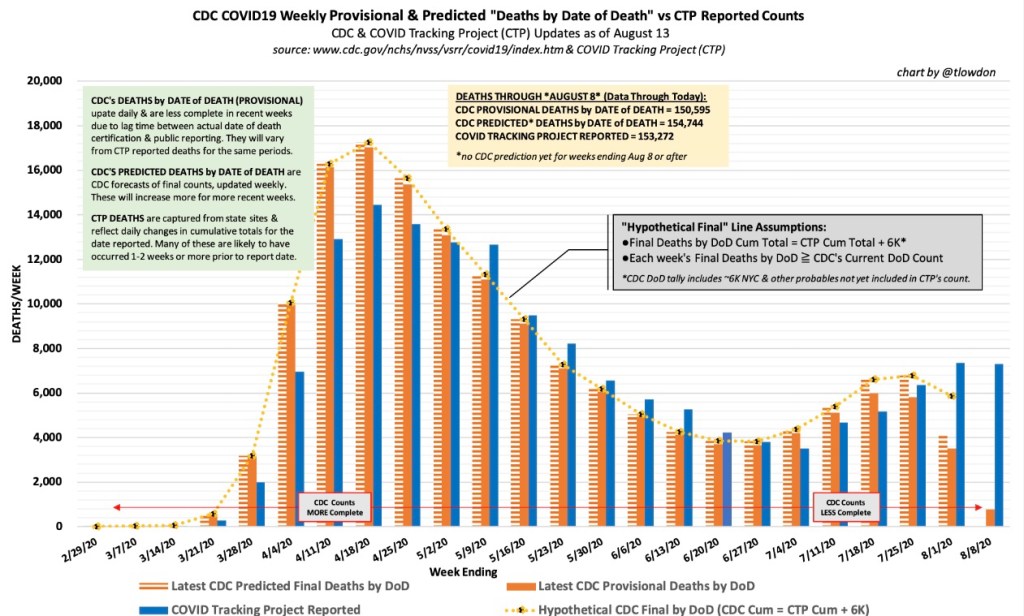
Lately I’ve talked a lot about reported deaths each week versus deaths by actual date of death (DOD). Much of that information came from Kyle Lamb’s Twitter account, and he’s the source of the charts below as well. The first one provides a convenient summary of the data reported through last week. The blue bars are reported deaths each week from the COVID Tracking Project (CTP), which are an aggregation of deaths that actually occurred over previous weeks. Again, the blue bars do NOT represent deaths that occurred in the reporting week. The solid orange bars are “provisional” actual deaths by DOD. “Provisional” means that recent weeks are not complete, though most deaths by DOD are captured within three to four weeks. The CDC also produces a “forecast” of final death counts by DOD, shown by the hatched orange bars.   

Note that the recent surge in deaths has been much smaller than the one in the spring, which was driven by deaths in the northeast. The CDC “expects” actual deaths by DOD to have declined starting after the week of July 23rd. However, CTP was still reporting deaths of over 1,000 per day last week. The actual timing of those deaths in prior weeks, and the ultimate extent of the summer surge in COVID deaths, remains to be seen.

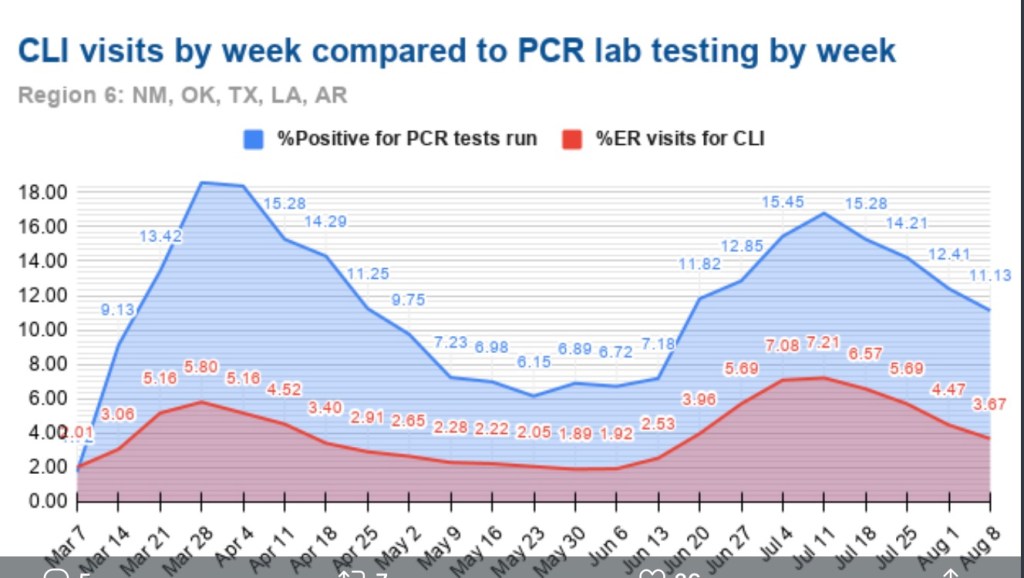
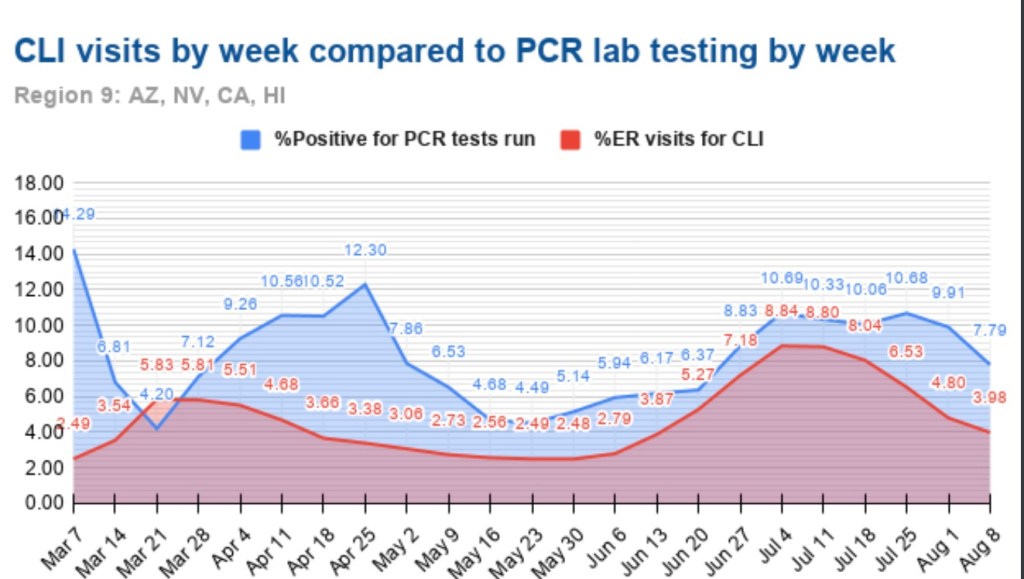
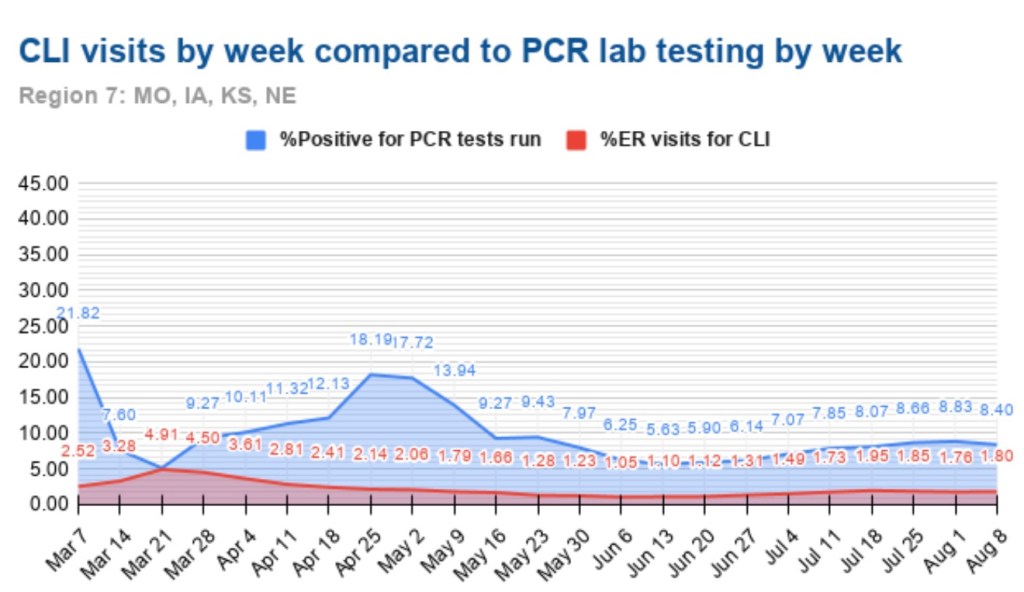
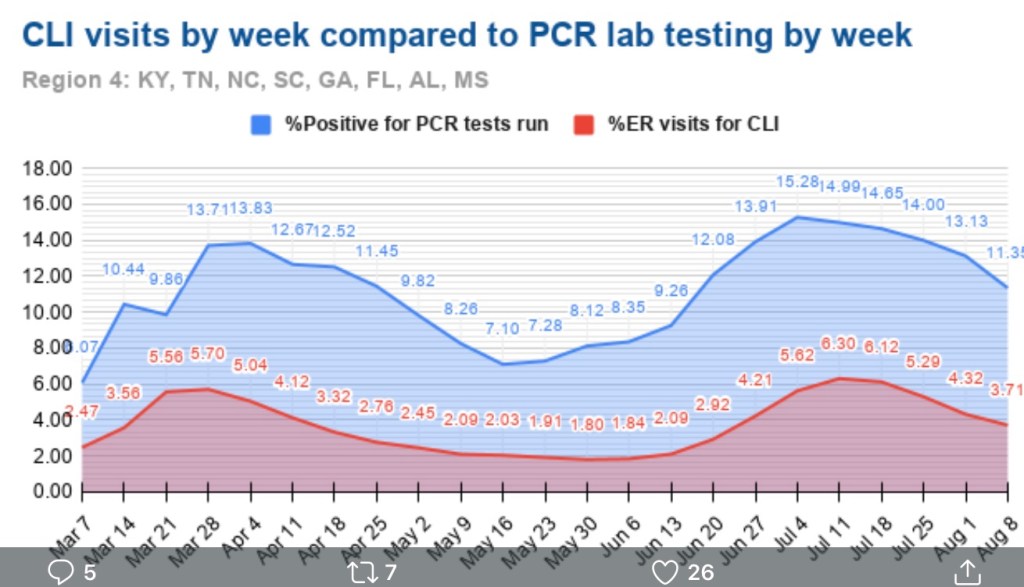
Certain leading indicators of deaths are signaling declines in actual deaths in August. Two of those indicators are 1) the positivity rate on standard PCR tests for infections; and 2) the share of emergency room visits made for symptoms of “COVID Like Illness” (CLI). The charts below show those indicators for FEMA regions that had the largest uptrends in cases in June and July. Florida is part of Region 4, shown in the next chart:

Here is the Region 6, which includes Texas:

Finally, Region 8 includes Arizona and California:

Out of personal interest, I’m also throwing in Region 7 with a few midwestern states, where cases have risen but not to the levels reached in Regions 4, 6, and 8:

With the exception of the last chart, the clear pattern is a peak or plateau in the positivity rate in late June through late July, followed by declines in subsequent weeks. The share or ER visits for CLI was not quite coincident with the positivity rate, but close. The decline in the CLI share is evident in Regions 4, 6 and 8. Again, these three regions include states that drove the nationwide increase in cases this summer (AZ, CA, FL, and TX), and the surge appears to have maxed out.     

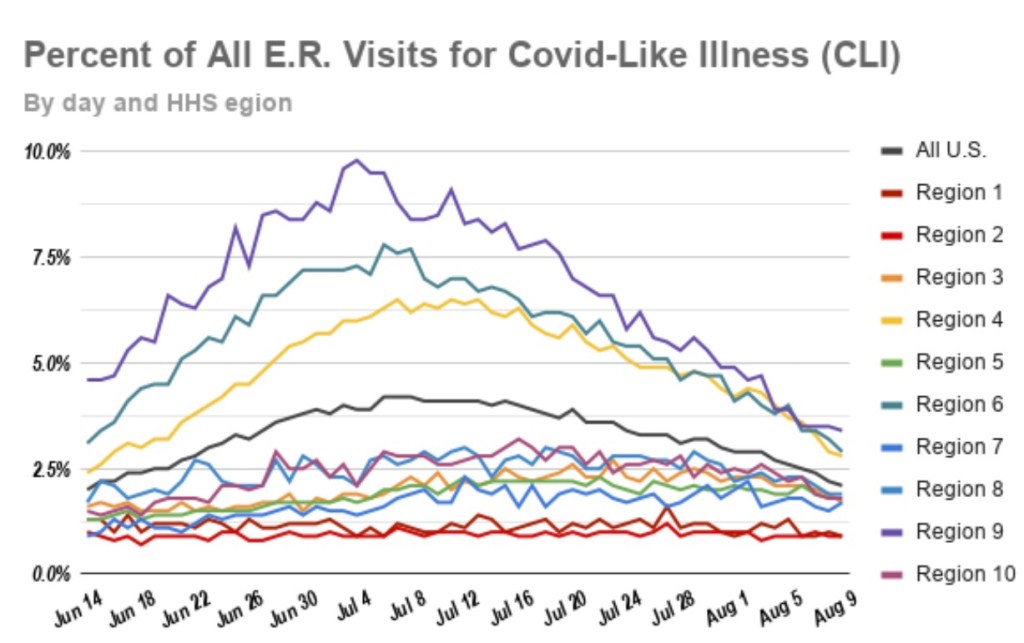
Here is a chart showing the share of CLI visits to ERs for all ten FEMA region from mid-June through last week. Clearly, this measure is improving across the U.S.

Nationwide, the CLI percentage at ERs has decreased by about 47% over the past four weeks, and the positivity rate has decreased by about 28% in that time. In addition to these favorable trends, COVID hospitalizations have decreased by about 40% over the past three weeks. All of these trends bode well for a downturn in COVID-attributed deaths.

The summertime surge in the virus was not nearly as ravaging as in the spring, and it appears to be fading. We’ll await developments in the fall, but we’ve come a long way in terms of protecting the vulnerable, treating the infected, approaching herd immunity thresholds (which means reduced rates of transmission to susceptible individuals), and the real possibility that we can put the pandemic behind us. 

Joe’s Moronic Outdoor Mask Mandate

15 Saturday Aug 2020

Posted by Nuetzel in Pandemic, Public Health

≈ 1 Comment

Tags

Absolute Humidity, Aerosol Transmission, Covid-19, Dr. Anthony Fauci, Droplet Transmission, Federalism, Indoor Transmission, Joe Biden, Kansas Department of Health and Environment, Kansas Policy Institute, KDHE, Mask Mandate, Outdoor Transmission, Randomized Control Trial, The Sentinel, UV Rays

Do you wear a mask whenever you step outside? In your yard? At the beach? In the park? On an empty sidewalk? Then congratulations! You are a colossal imbecile, like all the others in the mandatory mask crowd. Now, Joe Biden, in an attempt to prove either dementia or a full-fledged alliance with irredeemably lefty Karens, is demanding a three-month nationwide mandate for masks to be worn by everyone … OUTDOORS!

Really, what kind of moron believes there is any real danger of contracting coronavirus outside short of close and prolonged exposure to an infected individual? We know outdoor transmission is extremely rare. Nearly 100% of cases are contracted indoors, almost always in tight, poorly ventilated spaces.

It’s not hard to fathom why outdoor environments are of such low risk. Outdoors, air is of such enormous volume that virus particles are quickly diluted, dramatically reducing any viral load one might encounter. Air circulation is much better outdoors as well, driven by differences in temperatures across lateral and vertical space. Any breeze effectively disperses the particles. And those small loads drifting through open air won’t survive long: the ultraviolet waves in direct sunlight tend to kill it very quickly. Humidity is also associated with more rapid deactivation of the virus. Air tends to be more humid outdoors whenever forced air heating or air conditioning are used without sufficient humidification.

Cloth masks, in any case, may be effective against transmission by droplets expelled from coughs or sneezes, but they are of questionable value against transmission by aerosols from exhaled air. Outside, if you are distanced, you really have only aerosols to worry about. Under those circumstances, cloth masks are more for show than anything else.

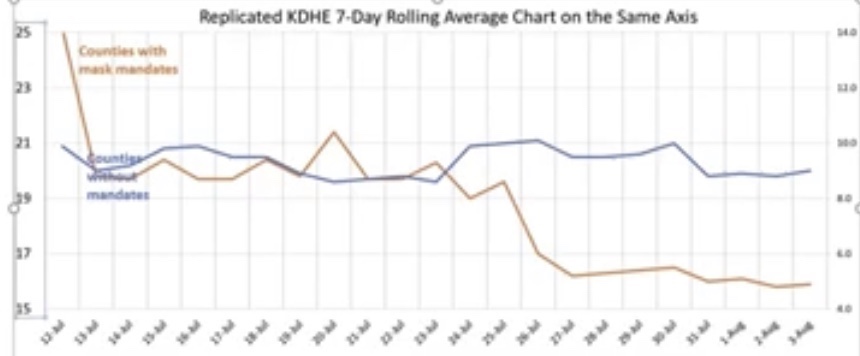
And on what pretext do officials, or your nitwitted neighbors, get the idea that mandatory masks OUTSIDE is in the interest of public health? I mean, besides buying-in to a ridiculous nanny-state narrative promoted by the media? Well, there is also some crap “research” to consider. Here is a good example: a study on masks from the Kansas Department of Health and Environment (KDHE). Take a look at what these guys tried to pull off…  Here’s what KDHE hoped would serve as “proof” of the dramatic efficacy of masks:

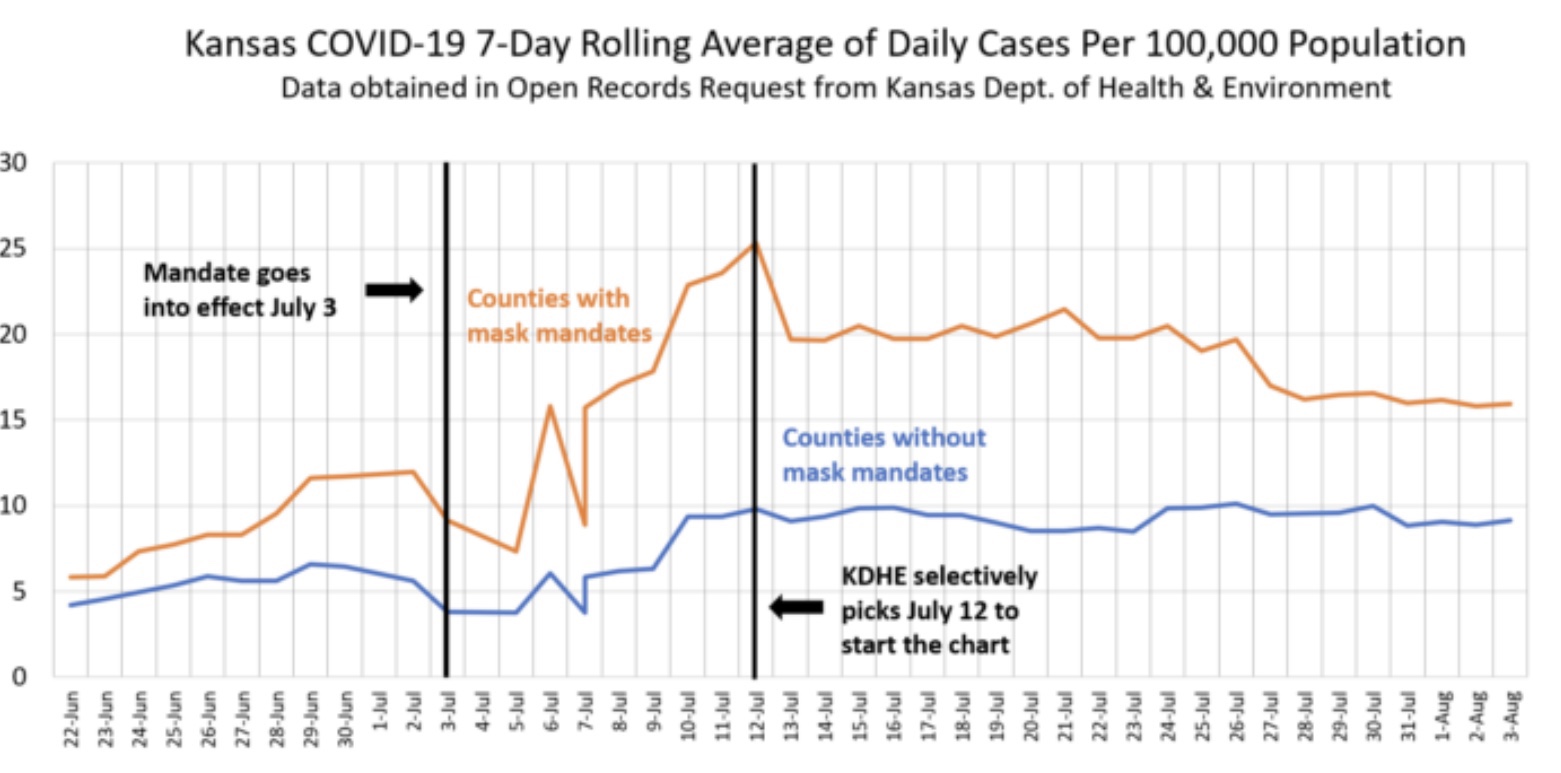
Wow! Notice two things in this chart: 1) the two lines are plotted with respect to different vertical axes; and 2) the chart begins on July 12th. Now take a look at a longer history in which the lines are plotted against the same axis.

It certainly doesn’t appear that the mandate beginning on July 3 had a favorable impact on new cases. What KDHE did here was incredibly dishonest, and I applaud the Kansas Policy Institute and it’s publication The Sentinel (linked above) for calling out KDHE for their dishonest piece of crap.

Other studies have exaggerated the general efficacy of masks as well. It’s also noteworthy that Europe’s medical establishment is unimpressed with masks. And after all, to my knowledge there have been no randomized control trials supporting the efficacy of masks — the only acceptable form of test according to Anthony Fauci! Now, none of that means masks don’t reduce COVID transmission. I happily wear a mask when I enter public buildings. What’s at issue here is whether masks should be required outdoors. Furthermore, I dispute the notion that a nationwide mask mandate is needed, because not all localities are at equal risk. I’m an advocate of the federalist principle that the best state and local solutions are crafted at the state and local levels. And at a personal level, I say ignore the intrusive bastards. Get outside in the fresh air, and forget the mask if you have some space.

COVID at Midsummer

04 Tuesday Aug 2020

Posted by Nuetzel in Pandemic, Public Health

≈ 2 Comments

Tags

Arizona, California, CDC, Coronavirus, COVID Time Series, Covid Tracking Project, Covid-19, Fatality Rate, Florida, Hospitalizations, Illinois, Kyle Lamb, Missouri, New Cases, New York, Provisional Deaths, Regional Variation, South Carolina, Tennessee, Texas

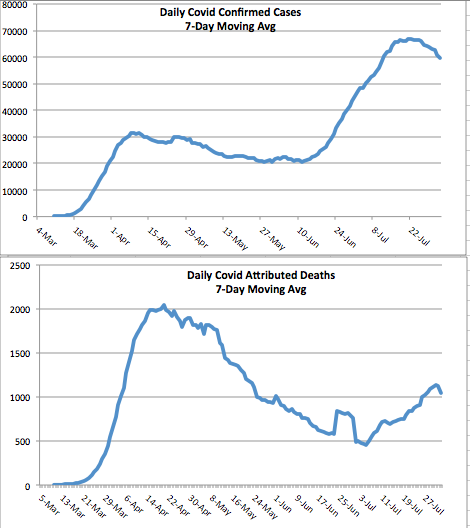
It’s been several weeks since I last posted on the state of the coronavirus pandemic (also see here). The charts below show seven-day moving averages of new confirmed cases and reported C19 deaths from the COVID Tracking Project as of August 3. Daily new cases began to flatten about three weeks ago and then turned down (it can take a few days for such changes to show up in a moving average). Daily C19-attributed deaths began climbing again in early July, lagging new cases by a few weeks, and they slowed just a bit over the past several days. Obviously, both are good news if those changes are maintained. The other thing to note is that deaths have remained far below their levels of April and early May.

The daily death count is that reported on each date, not when the deaths actually occurred. Each day’s report consists of deaths that were spread across several previous weeks or even a month or more. That makes the slight downturn in deaths more tenuous from a data perspective. There are sometimes large numbers of deaths from preceding weeks reported together on a single day, so reporting can be ragged and the final pattern of actual deaths is not known for some time. More on that below.

States

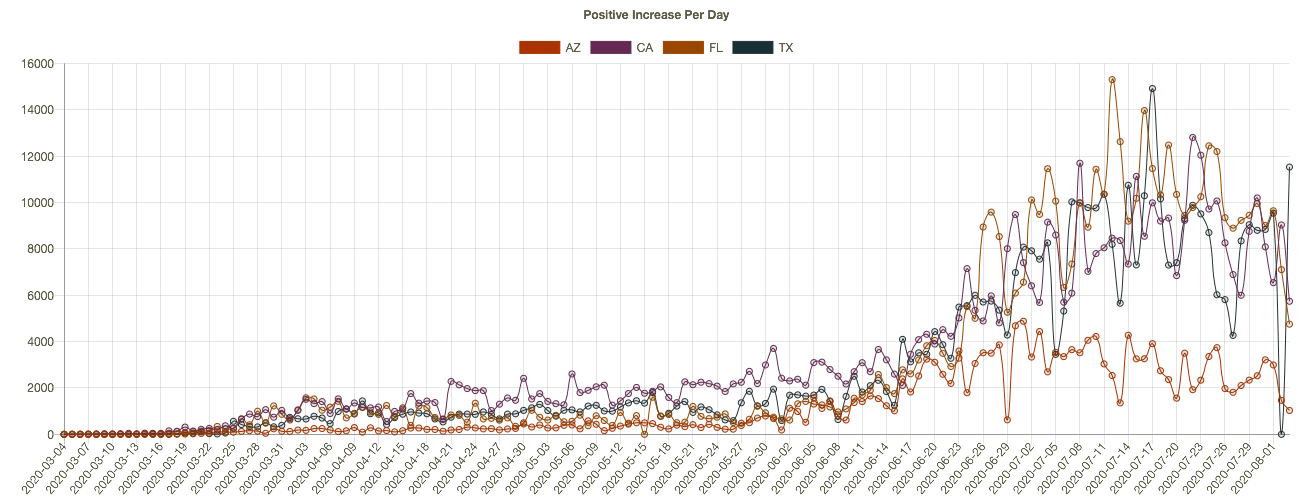
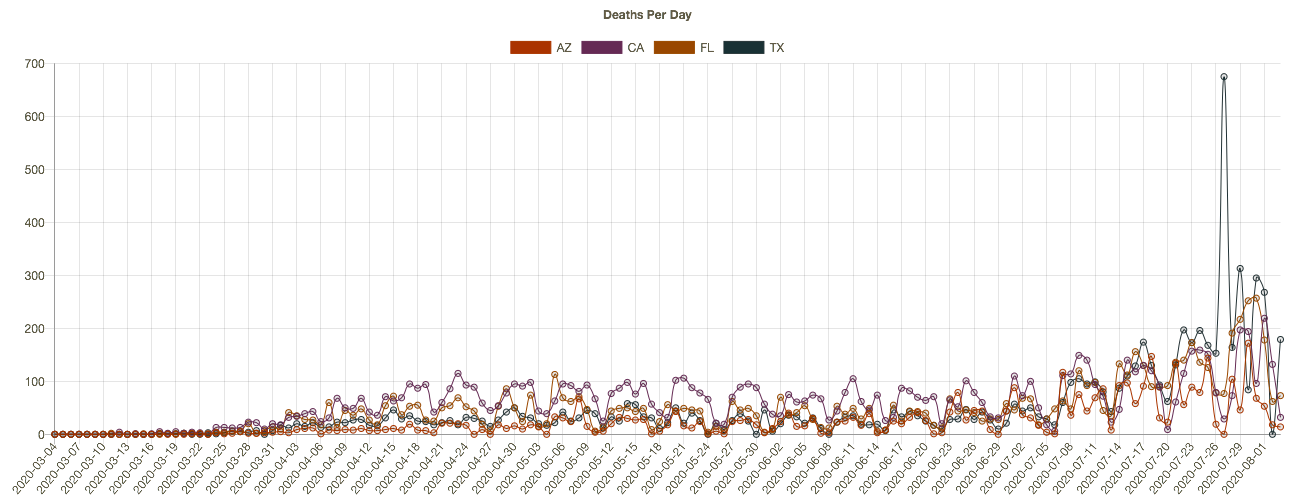
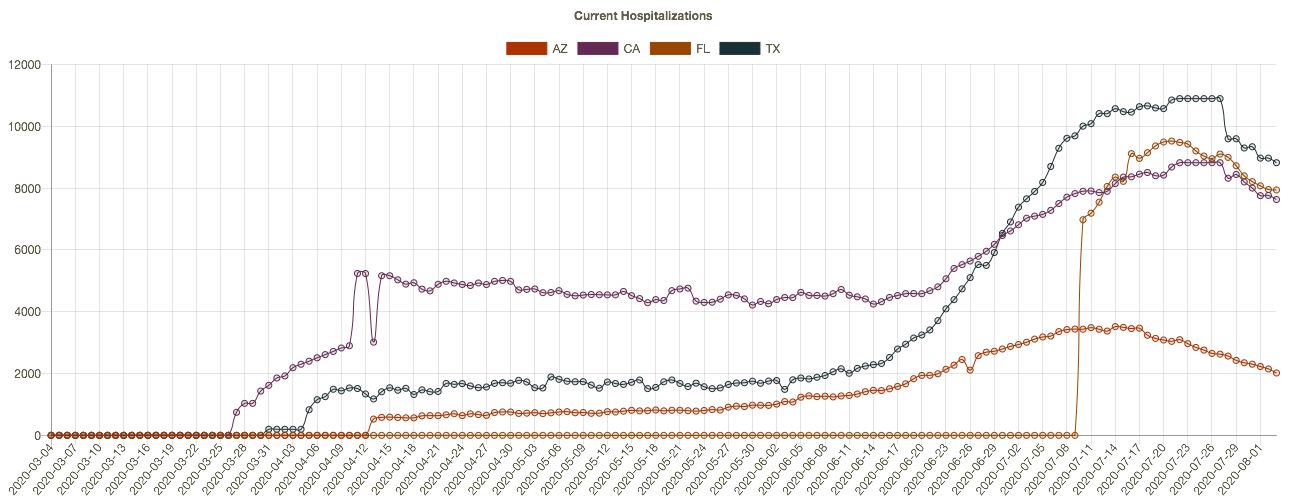
The increase in cases and deaths during late June and July was concentrated in four states: Arizona, California, Florida, and Texas. Here’s how those states look now in terms of cases and deaths, from the interactive COVID Time Series site:


New cases began to flatten or drop in these states two to three weeks ago, driving the change in the national data. Daily deaths have not turned convincingly, but again, these are reported deaths, which actually occurred over previous weeks. One more chart that is suggestive: current hospitalizations in these four states. The recent declines should bode well for the trend in reported deaths, but it remains to be seen. 

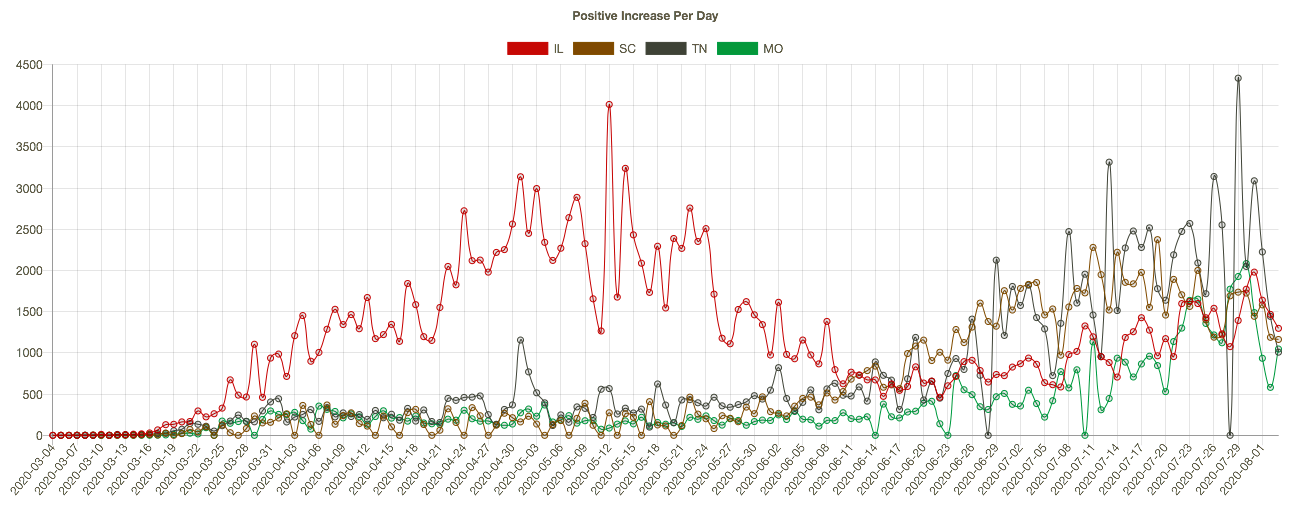
Meanwhile, other parts of the country have seen an uptrend in cases and deaths, such as Illinois, Missouri, South Carolina, and Tennessee. Here are new cases in those states:

It’s worth emphasizing that the elevated level of new cases this summer has not been associated with the rates of fatality experienced in the Northeast during the spring. There are many reasons: better patient care, new treatments, more direct summer sunlight, higher humidity, and tighter controls in nursing homes.

More On the Timing of Deaths

Back to the discrepancies in the timing of reported deaths and actual deaths. This is important because the reported totals each day and each week can be highly misleading, even to the point of frightening the public and policy makers, with consequent psychological and economic impacts.

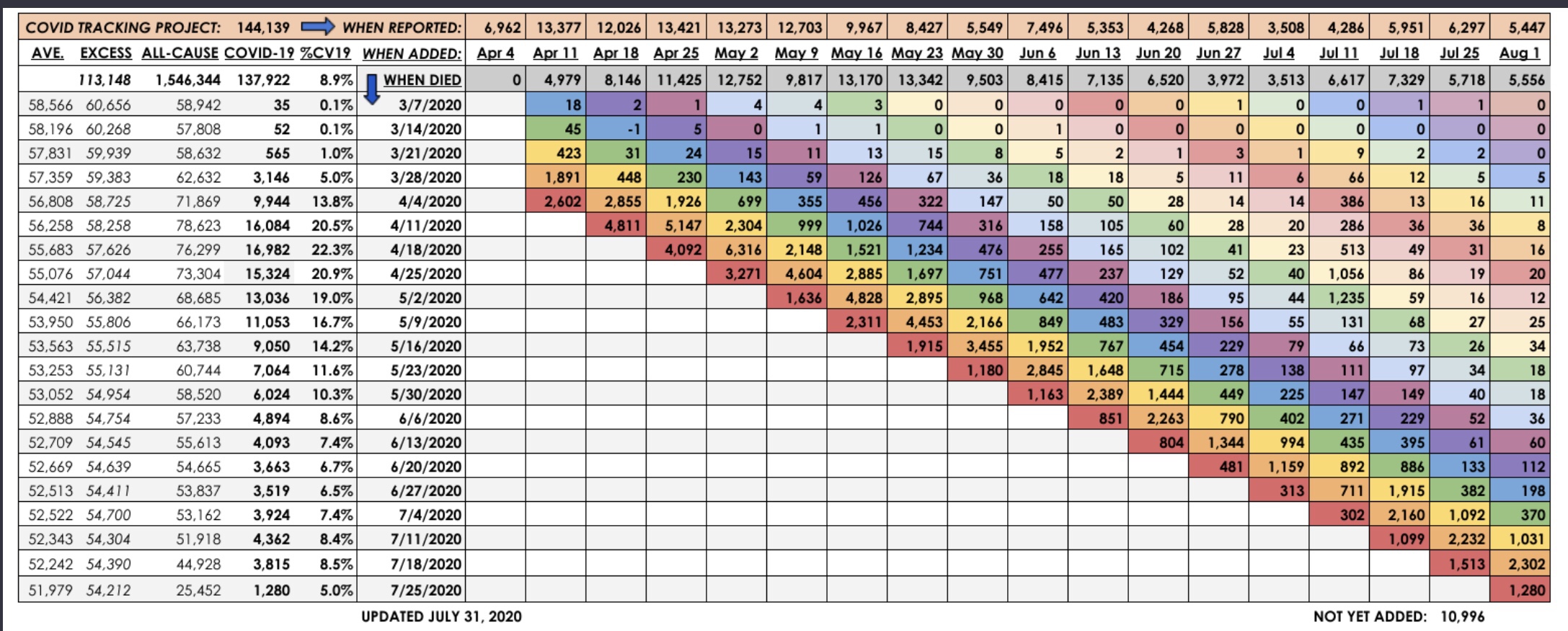
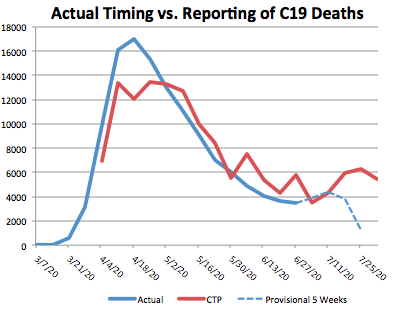
The latest summary of provisional vs. reported deaths is shown below, courtesy of Kyle Lamb, who posts updates on his Twitter feed. This report ends with the last complete week ending August 1. It’s a little hard to read, but you might get a better look if you click on it or turn your phone sideways. Some of the key series are also graphed below. 

The table shows the actual timing of deaths in the fourth column, with dates alongside. The pattern differs from the statistics reported by the Covid Tracking Project (CTP) in the top row (shaded orange), and from the totals of actual deaths by reporting day in the third row (shaded gray). The reporting dates are always later than the dates of death. This can be seen in the chart below. The most obvious illustration is how many of the deaths from around the peak in mid-April were reported in May. In March and April, the daily reports were short of the ultimate actual death counts because so few deaths with associated dates were known by then.


The right-hand end of the red line shows that many deaths reported by CTP have not yet been placed at an actual date of death by the CDC.  At this point, the actual date of death has not been placed for over 10,000 deaths! Again, those will be spread over earlier weeks.

The blue line is dashed over the last four weeks because those counts are most “highly” provisional. Small changes in the actual counts are likely for dates even before that, but the last four weeks are subject to fairly substantial upward revisions. Eventually, the right end of the blue line will more closely approximate the totals shown in red.

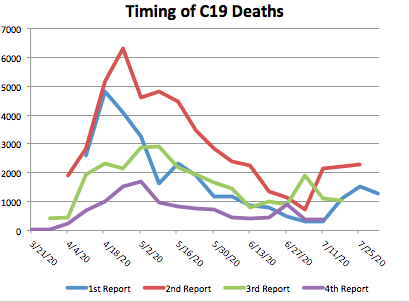
To get an indication of trends in the actual timing of deaths, I plotted the weekly actual deaths reported for the last four reporting weeks going back in time. In the table, those are the four lowest, color-coded diagonals. In the graph below, which should include the qualifier “by recency of report week”, actual deaths in the most recent report week are represented by the blue line, the prior weekly report is red, followed by green (three weeks prior), and purple (four weeks prior… sorry, the colors are not consistent with those in the table). The lines extend farther to the right for more recent report weeks.

The increase in actual deaths occurring in July has declined or flattened in each of the four most recent report weeks. Only the second-to-last week increased as of the August 1st report. On the whole, those changes seem favorable, but we shall see.

Closing

It’s getting trite to say, but the next few weeks will be interesting. The increase in deaths in July was a sad development, but at least the extent of it appears to have been limited. Even with a somewhat higher death count, the fatality rate continued to decline. Let’s hope any further waves of infections are even less deadly.

Risk Realism, COVID Hysteria

29 Wednesday Jul 2020

Posted by Nuetzel in Uncategorized

≈ 1 Comment

Tags

All-Cause Mortality, American Academy of Pediatrics, American Association of Sciences, Asian Flu, Covid-19, David Zaruk, Engineering and Medicine, Hydroxychloraquine, Infection Fatality Rate, Mollie Hemingway, Precautionary Principle, Spanish Flu, The Risk Monger, Tyler Cowen, Wired

Perhaps life in a prosperous society has sapped our ability and willingness to face risks. This tendency undermines that very prosperity, however. If we ever needed an illustration, the hysteria surrounding COVID-19 surely provides it. Do we really know how to exist in a world with risk anymore? During this episode, the media, public officials, and much of the public have completely lost their bearings with respect to the evaluation of risk, acting as if they are entitled to a zero-risk existence. Of course, COVID-19 is highly transmissible and dangerous for certain segments of the population, but it is rather benign for most people.

Perspective On C19 Risks

Just for starters, the table at the top of this post (admittedly not particularly well organized) shows calculations of odds from the CDC. These odds might well overstate the risks of both C19 and the flu, as they probably don’t account well for the huge number of asymptomatic cases of both viruses.

Another glimpse of reality is offered by a recent Swiss study showing the C19 infection mortality rate (IFR) by age, shown below. You can find a number of other charts on-line that show the same pattern: If you’re less than 50 years old, your risk of death from C19 is quite slim. Even those 50-64 years of age don’t face a substantial mortality risk, though it’s obviously higher for individuals having co-morbidities. These IFRs are lower than all-cause mortality for younger cohorts, but higher for older cohorts.

And here are a few other facts to put the risks of C19 in perspective:

  • The current pandemic is relatively benign: thus far, the U.S. has suffered a total of about 145,000 deaths, or 440 per million of population;
  • the Asian Flu of 1957-58 took 116,000, according to the CDC, or 674 per million;
  • the Spanish Flu of 1917-18 took 675,000 U.S lives, or 6,553 per million.

It should be obvious that these risks, while new and elevated for some, are not of such outrageous magnitude that they can’t be managed without bringing life to a grinding halt. That’s especially true when so-called safety measures entail substantial health risks of their own, as I have emphasized elsewhere (and here).

The Schools

Nothing illustrates our inability to assess risks better than the debate over reopening schools. This article in Wired is well-balanced on the safety issue. It emphasizes that there is little risk to teachers, students, or their families from opening schools if reasonable safety measures are taken.

Children of pre-school and elementary school age do not contract the virus readily, do not transmit the virus readily, and do not readily succumb to its effects. This German study on elementary schools demonstrates the safety of reopening. It is similar to the experience of other EU countries that have reopened schools. This article reinforces that point, but it emphasizes measures to limit any flare-ups that might arise. And while it singles out Israel as an example of poor execution, it fails to offer any evidence on the severity of infections.

Furthermore, we should not overlook the destructive effects of denying in-classroom learning to children. They simply don’t learn as well on-line, especially students who struggle. There are also the devastating social-psychological effects of the isolation experienced by many elementary school children during extended school closures. This is of a piece with the significant risks of lockdowns to well being. Perhaps not well known is that schooling is positively correlated with life expectancy: this study found that a one-year reduction in years of schooling is associated with a reduction in life expectancy of 0.6 years!

It’s true that children older than 10 might pose somewhat greater risks for C19 contagion, but those risks are manageable via hygiene, distancing, and other mitigations including hydroxychloraquine or other prophylaxes against infection for teachers who desire it. Capacity limitations might well require a temporary mix of online and in-school learning, but at least part-time attendance at brick-and-mortar schools should remain the centerpiece.

As Tyler Cowen points out, teenagers are less likely to remain isolated from others during school closures, so their behavior might be more difficult to manage. It’s quite possible they could be more heavily exposed outside of school, hanging out with friends, than in the classroom. This illustrates how our readiness to demure from absolute risk often ignores the pertinent question of relative risk.

Judging by reactions on social media, people are so frightened out of their wits that they cannot put these manageable risks in perspective. But here is a statement from the American Academy of Pediatrics. And here is a statement from the American Association of Sciences, Engineering and Medicine. They speak for themselves.

Excessive Precautionary Putzery

Our reaction to C19 amounts to a misapplication of the precautionary principle (PP), which states, quite reasonably, that precautionary measures must be invoked when faced with a risk that is not well understood. Risk must be managed! But what are those precautions and on what basis should benefits we forego via mitigation be balanced against quantifiable risks. That was one theme of my post “Precaution Forbids Your Rewards” several years back. Ralph B. Alexander discusses the PP, noting that the construct is vulnerable to political manipulation. It is, unfortunately, a wonderful devise for opportunistic interest groups and interventionist politicians. See something you don’t like? Identify a risk you can use to frighten the public. Use any anecdotal evidence you can scrape together. Start a movement and put a stop to it!

That really doesn’t help us deal with risk in a productive way. Do we understand that well being generally is enhanced by our willingness to incur and manage risks? As David Zaruk, aka, the Risk Monger, says, “our reliance of the precautionary principle has ruined our ability to manage risk.”:

“Two decades of the precautionary principle as the key policy tool for managing uncertainties has neutered risk management capacities by offering, as the only approach, the systematic removal of any exposure to any hazard. As the risk-averse precautionary mindset cements itself, more and more of us have become passive docilians waiting to be nannied. We no longer trust and are no longer trusted with risk-benefit choices as we are channelled down over-engineered preventative paths. While it is important to reduce exposure to risks, our excessively-protective risk managers have, in their zeal, removed our capacity to manage risks ourselves. Precaution over information, safety over autonomy, dictation over accountability.”

To quote Mollie Hemingway, in the case of the coronavirus, Americans are “reacting like a bunch of hysterics“.


Some Cheery COVID Research Tidbits

16 Thursday Jul 2020

Posted by Nuetzel in Pandemic, Public Health, Uncategorized

≈ 1 Comment

Tags

ACE Inhibitors, Angiotensin Drugs, ARBs, bacillus Calmette-Guerin, BCG Vaccine, Blood Plasma, Cholesterol, Coronavirus, Covid-19, Derek Lowe, Gilead Sciences, Herd Immunity, Hydroxychloroquine, Immune Globulin, Instapundit, Lancet, Marginal Revolution, National Academies of Science Engineering and Medicine, Off-Label Drugs, Oxford, R0, Remdesivir, SARS-CoV-2, Severe Acute Respiratory Syndrome, Statins, T-Cell Immunity, Transmissability, Tricor, Tuberculosis, Viral Load

Here’s a short list of new or newish research developments, some related to the quest to find COVID treatments. Most of it is good news; some of it is very exciting!

Long-lasting T-cell immunity: this paper in Nature shows that prior exposure to coronaviruses like severe acute respiratory syndrome (SARS) and even the common cold prompt an immune reaction via so-called T-cells that have long memories and are reactive to certain proteins in COVID-19 (SARS-CoV-2). The T-cells were detected in both C19-infected and uninfected patients. This comes after discouraging reports that anti-body responses to C19 are short-lived, but T-cells are a different form of acquired immunity. Derek Lowe says the following:

“This makes one think, as many have been wondering, that T-cell driven immunity is perhaps the way to reconcile the apparent paradox between (1) antibody responses that seem to be dropping week by week in convalescent patients but (2) few (if any) reliable reports of actual re-infection. That would be good news indeed.”

The herd immunity threshold (HIT) is much lower than you think: I’ve written about the effect of heterogeneity on the HIT before, here and here. This new paper, by three Oxford zoologists, shows that the existence of a cohort having some form of prior immunity, innate or acquired, reduces the number of infections required to achieve the HIT. For example, if initial transmissibility (R0) is 2.5 and 40% of the population has prior immunity (both reasonable assumptions for many areas), the HIT is as low as 20%, according to the authors’ calculations. That’s when the contagion begins to recede, though the final infected share of the population would be higher. This might explain why new cases and deaths have already plunged in places like Italy, Sweden, and New York, and why protests in NYC did not lead to a new wave of infections, while those in the south appear to have done so.

Seasonal effects: viral loads might be decreasing. From the abstract:

“Severity of COVID-19 in Europe decreased significantly between March and May and the seasonality of COVID-19 is the most likely explanation. Mucosal barrier and mucociliary clearance can significantly decrease viral load and disease progression, and their inactivation by low relative humidity of indoor air might significantly contribute to severity of the disease.”

The BCG vaccine appears to be protective: this is the bacillus Calmette-Guérin tuberculosis vaccine administered in some countries, This finding is not based on clinical trials, so more work is needed.

Is there no margin in plasma? No subsidy? This is the only “bad news” item on my list. It’s widely agreed that blood plasma from recovered C19 patients can be incorporated into an immune globulin drug to inoculate people against the virus. It’s proven safe, but for various reasons no one seems interested. Not the government. Not private companies. Did Trump happen to mention it or something?

C19 doesn’t spread in schools: this German study demonstrates that there is little risk in reopening schools. One of the researchers says:

“Children act more as a brake on infection. Not every infection that reaches them is passed on…. This means that the degree of immunization in the group of study participants is well below 1 per cent and much lower then we expected. This suggests schools have not developed into hotspots.”

Also worth emphasis is that remote learning leaves much to be desired, as acknowledged by the National Academies of Science, Engineering and Medicine, which has recommended that schools reopen for younger children and those with special needs.

Can angiotensin drugs (ACE Inhibitors/ARBs) reduce mortality? This meta-analysis of nine studies finds that these drugs reduce C19 mortality among patients with hypertension. The drugs were also associated with a reduction in severity but not with statistical significance. These results run contrary to initial suspicions, because ACEI/ARB drugs actually “up-regulate” ACE-2 receptors, to which C19 binds. Researchers say the drugs might be working through some other protective channel. This is not a treatment per se, but this should be reassuring if you already take one of these medications.

Tricor appears to clear lung tissue of C19: this research focused on C19’s preference for an environment rich in cholesterol and other fatty acids:

“What they found is that the novel coronavirus prevents the routine burning of carbohydrates, which results in large amounts of fat accumulating inside lung cells – a condition the virus needs to reproduce.”

Tricor reduces those fats, and the researchers claim it is capable of clearing lung tissue of C19 in a matter of days. This was not a clinical trial, however, so more work is needed. Tricor is an FDA approved drug, so it is safe and could be administered “off label” immediately. Tricor is a fibrate; the news with respect to statins and C19 severity is pretty good too! These are not treatments per se, but this should be reassuring if you already take one of these medications.

Hydroxychloroquine works: despite months of carping from media and leftist know-it-all’s dismissing the mere possibility of HCQ as a potential C19 treatment, evidence is accumulating that it is effective in treating early-stage infections after all. The large study conducted by the Henry Ford Health System found that treatment with HCQ early after hospitalization, and with careful monitoring of heart function, cut the death rate in half relative to a control group. Here’s another: an Indian study found that four-plus maintenance doses of HCQ acted as a prophylactic against C19 infection among health care workers, reducing the odds of infection by more than half. An additional piece of evidence is provided by this analysis of a 14-day Swiss ban on the use of HCQ in late May and early June. The ban was associated with a huge leap in the C19 deaths after a lag of less than two weeks. Resumption of HCQ treatment brought C19 deaths down sharply after a similar lag.

Meanwhile, a study in Lancet purporting to show that HCQ was ineffective and posed significant risks to heart health was retracted based on the poor quality of the data.

Remdesivir also cuts death rate: by 62% in a smaller controlled study by the drug maker Gilead Sciences.

Pet ownership might confer some immunity: this one is a little off-beat, and perhaps the research is under-developed, but it is interesting nonetheless!

I owe Instapundit and Marginal Revolution hat tips for several of these items.

Unfortunate COVID Follies

08 Wednesday Jul 2020

Posted by Nuetzel in Government Failure, Pandemic

≈ Leave a comment

Tags

Arsenic and Old Lace, BAME, Black Asian and Minority Ethnics, BLM, CDC, Coronavirus, Covid-19, Dr. Einstein, Flattening the Curve, Hydroxychloraquine, Jonathan Brewster, Lockdowns, Masks, Operation Warp Speed, Vitamin D Deficiency, World Health Organization

This post is devoted to a few coronavirus policies and positions that trouble me. 

Counting Deaths: People have the general impression that counting COVID-19 cases and deaths is straightforward. The facts are more reminiscent of the following exchange in the film Arsenic and Old Lace, when Jonathan Brewster angrily insists he has offed more souls than his sweet little aunties have poisoned with elderberry wine:

Dr. Einstein: You cannot count the one in South Bend. He died of pneumonia!
Jonathan Brewster: He wouldn’t have died of pneumonia if I hadn’t shot him! 

Here, Dr. Einstein wears the shoes of public health authorities who claim that C19 deaths are undercounted. But lives counted as lost from C19, in many cases, are individuals who also had the flu, pneumonia, stroke, kidney failure, and a variety of other co-morbidities. Yes, other causes of death might be induced by the coronavirus, but like Johnny’s victim in South Bend, many would not have died from C19 if they hadn’t had a prior health event. In addition, otherwise unexplained deaths are often attributed to C19 with little justification.

In fact, the C19 death toll has been distorted by a perverse federal hospital reimbursement policy that rewards hospitals for COVID patients. Death certificates seem to list C19 as the cause for almost anyone who dies in or out of a hospital during the pandemic, whether they’ve been tested or not. In fact, deaths have been attributed to C19 despite negative test results when officials decided, for one reason or another, that the test must have been unreliable!

Lockdowns: almost all of the “curve flattening” in late March and April was accomplished by voluntary action, which I’ve covered before here. The lockdowns imposed by state and local governments were highly arbitrary and tragic for many workers and business owners who could have continued to operate as safely as many so-called “essential” businesses. Lockdowns in certain areas were also blatant violations of religious rights. There is little to no evidence that lockdowns themselves led to any actual abatement of the virus. And of course, people are fed up! 

The Beach: Right now I’m at a wonderful beach condo in Florida for a week. There are other people on the beach, mostly families and a few groups of friends, but there is plenty of open space. You will not catch the coronavirus on a beach like this. And there is almost zero chance you’ll catch it on any beach. In fact, the chance you’ll catch it anywhere outside is minuscule unless you’re jammed so tightly among hundreds of protesters that you can’t even turn around. Yet government officials have closed beaches in many parts of the country while allowing the protests to go on. Oh sure, they think people will CROWD onto beaches as if they’re at a BLM protest… except they’re not. Ah, then it must be banned! That takes a special kind of dumbass.     

Waiting for Results: How could we have spent trillions of dollars as a nation on economic stimulus, much of it skimmed off by grifters, but we can’t seem to get sufficient resources to make calls to those awaiting test results? This is a case of misplaced priorities. Even now, people are waiting more than a week for their results, and many are wandering around in the community without knowing their status. Wouldn’t you think we’d get that done? We can conduct well over a half million tests a day, but can’t we find a few bucks to deliver results via phone, email, or text within 24 hours of processing results. This is truly absurd. 

Vaccine Candidates: A similar point can be made about vaccine development: We are spending $5 billion on Operation Warp Speed to build capacity in advance for five promising vaccine candidates. These will be identified over the next few months, and it looks as if all five will come from established pharmaceutical majors. There are many more vaccine candidates, however, some being developed by smaller players using inventive new techniques. The OWS expenditure looks pretty meager when you compare it to the trillions in funds the federal government is spending on economic stimulus, especially when finding an effective vaccine would obviate much of the stimulus. 

Treatment: Hydroxycloroquine has been found to lower the death rate from COVID-19 in a large controlled trial. Congratulations, morons, for trashing HCQ as a potential treatment, solely because Trump mentioned it. Way to go, dumbasses, for banning the use of a potential treatment that could have saved many thousands of lives. 

Air Conditioning: I’m shocked that public health experts haven’t been more vocal about the potentially dangerous effects of running air conditioners at high levels in public buildings. The virus is known to thrive in cool, dry environments, which is exactly what AC creates, yet this seems to have been almost completely ignored.   

Vitamin D: Likewise, I think public health experts have been far too reticent about the connection between Vitamin D deficiencies and the severity of C19 (also see here and here). The accumulating evidence about this association offers an explanation for the disturbingly high severity of cases among Black, Asian and Minority Ethnics (BAME), not to mention a possible role in C19 deaths among the generally D-deficient nursing home population. For the love of God, get the word out to the community that Vitamin D supplements might help, and they won’t hurt, and otherwise, tell people to get some sun!

Masks: I’m not in favor of strict mask mandates, but I have trouble understanding the aversion to masks among certain friends. Of course, there’s been way too much mixed messaging on the benefits of masks, and it didn’t all come from politicians! Scientists, the CDC, and the World Health Organization seemingly did everything possible to squander their credibility on this and other issues. However, a consensus now seems to have developed that masks protect others from the wearer and seem to protect the wearer from others as well. It should be obvious that masks offer a middle ground on which the economy can be restarted while mitigating the risks of further contagion. But even if you don’t believe masks protect the wearer, but only protect others from an infected wearer, donning a mask inside buildings, and when social distancing is impossible, still qualifies as a mannerly thing to do.  


Cases Climb, Most Patients Faring Better

30 Tuesday Jun 2020

Posted by Nuetzel in Pandemic, Public Health

≈ 1 Comment

Tags

Air Conditioning, Bloomberg, Cases vs. Deaths, Confirmed Cases, COVID Time Series, Covid-19, George Floyd, Immunity, Increased Testing, Nate Silver, Pandemic, Protest Effect, Social Distancing, Viral Transmission, Vitamin D Deficiency

There’s been much speculation about whether recent increases in confirmed cases of COVID-19 (first chart above) will lead to a dramatic increase in fatalities (second chart). More generally, there is curiosity or perhaps hope as to whether the virus is not as dangerous to these new patients as it was early in the pandemic. I have discussed this point in several posts, most recently here. Based on the national data (above), we’re at the point at which an upturn in deaths might be expected. Based on the experience of many individual states, however, deaths should have trended upward by now, but they haven’t done so. Cases are generally less severe and are resolving more quickly.

Of course, more testing produces more cases (though there has been a mild uptick in test positivity over the past two weeks), but that doesn’t really explain the entire increase in cases over the past few weeks. In particular, why are so many new cases in the south? After all, there is evidence that the virus doesn’t survive well in warm, humid climates with more direct sunlight.

As I have mentioned several times, heavy use of air-conditioning in the south may have contributed to the increase. Nate Silver speculates that this is the case. The weather warmed up in late May and especially June, and many southerners retreated indoors where the air is cool, dry, and the virus thrives. Managers of public buildings should avoid blasting the AC, and you might do well to heed the same advice if you live with others in a busy household. In fact, nearly all transmission is likely occurring indoors, as has been the case throughout the pandemic. At the same time, however, with the early reopening of many southern states, younger people flocked to gyms, bars and other venues, largely abandoning any pretense of social distancing. So it’s possible that these effects have combined to produce the spike in new cases.

Some contend that the protests following George Floyd’s murder precipitated the jump in confirmed cases. Perhaps they played a role, but I’m somewhat skeptical. Yes, these could have become so-called super-spreader events; there are certain cities in which the jump in cases lagged the protests by a few weeks, such as Austin, Houston, and Miami, and where some cases were confirmed to be among those who protested. But if the protests contributed much to the jump, why hasn’t New York City seen a corresponding increase? Not only that, but the protests were outside, and the protests dissuaded many others from going out at all!

The trend in coronavirus fatalities remains more favorable, despite the increase in daily confirmed cases. One exception is New Jersey, which decided to reclassify 1,800 deaths as “probable” COVID deaths about six days ago. You can see the spike caused by that decision in the second chart above. Reclassifications like that arouse my suspicion, especially when federal hospital reimbursements are tied to COVID cases, and in view of this description from Bloomberg (my emphasis):

“… those whose negative test results were considered unreliable; who were linked to known outbreaks and showed symptoms; or whose death certificates strongly suggested a coronavirus link.”

Deaths necessarily lag new cases by anywhere from a few days to several weeks, depending on the stage at the time of diagnosis and delays in test results. The lag between diagnosis and death seems to center on about 12 – 14 days. Thus far, there doesn’t appear to be an upward shift in the trend of fatal cases, but the big updraft in cases nationally only started about two weeks ago. More on that below.

Importantly, a larger share of new cases is now among a younger age cohort, for whom the virus is much less threatening. The most vulnerable people are probably taking more precautions than early in the pandemic, and shocking as might seem, there is probably some buildup in immunity in the surviving nursing home population at this point. We are also better at treatment, and there is generally plenty of hospital capacity. And to the extent that the surge in new cases is concentrated in the south, fewer patients are likely to have Vitamin D deficiencies, which is increasingly mentioned as a contributor to the severity of coronavirus infections.

I decided to make some casual comparisons of new cases versus COVID deaths on a state-by-state basis, but I got a little carried away. Using the COVID Time Series web site, I started by checking some of the southern states with recent large increases in case counts. I ended up looking at 15 states in the south and west, and I added Missouri and Minnesota as well. I passed over a few others because their trends were basically flat. The 17 states all had upward trends in new cases over the past one to two months, or they had an increase in new cases more recently. However, only four of those states experienced any discernible increase in daily deaths over the corresponding time frames. These are Arizona, Arkansas, Tennessee, and Texas, and their increases are so modest they might be statistical noise.

Again, deaths tend to lag new cases by a couple of weeks, so the timing of the increase in case counts matters. Five of the states were trending upward beginning in May or even earlier, and 13 of the states saw an acceleration or a shift to an upward trend in new cases after Memorial Day, in late May or June. Of those 13, the changes in trend occurred between one and five weeks ago. Six states, including Texas, had a shift within the past two weeks. It’s probably too early to draw conclusions for those six states, but in general there is little to suggest that fatal cases will soar like they did early in the pandemic. Case fatality rates are likely to remain at much lower levels.

We’ll know much more within a week or two. It’s very encouraging that the upward trend in new cases hasn’t resulted in more deaths thus far, especially at the state level, as many states have had case counts drift upward for over a month. If it’s going to occur, it should be well underway within a week or so. Much also depends on whether new cases continue to climb in July, in which case we’ll be waiting in trepidation for whether more deaths transpire.

Rioters Inflict Racial Injustice

02 Tuesday Jun 2020

Posted by Nuetzel in Free Speech, racism, Terrorism

≈ Leave a comment

Tags

Antifa, Black Lives Matter, Coronavirus, Covid-19, Criminal Justice Reform, Derrick Chauvin, Donald Trump, Equity Markets, George Floyd, Glenn Reynolds, Jane Coaston, National Guard, Police Unions, Qualified Immunity, racism, War on Drugs, Will Collier, Willie Delwiche

My fervent hope is that the reaction of horror to George Floyd’s murder is universal. However, my perspective on the violence that’s erupted over the week since is also one of disgust. The perpetrators are using Floyd’s death as an opportunity to unleash attacks that undermine civil society and often hurt people of color more than anyone.

The peaceful protests against police brutality and racism in cities across the country are earnest calls for reform, and they also represent fine tributes to all victims of racism. But a different dynamic takes hold when peaceful protesters are infiltrated by violent elements. Agitators use the cover of the protests and typically begin to dominate the scene as darkness falls, though sometimes it happens in broad daylight. The violence, arson, looting, and shooting are perpetrated by a combination of those whose political motivations go well beyond needed reforms to the justice system and other opportunists who are primarily interested in loot, or just a riotous a good time. There are also some otherwise non-violent protesters emboldened by the agitators to cheer on these acts of violence.

As others have said, the rioting does not serve to honor George Floyd in any way, and it does nothing to end racism or racial victimization. By cheering on these malefactors you lose any legitimate claim as an enemy of racism. The rioting, if anything, brings harm to the black community. Black lives are lost in the strife, such as the retired police captain in St. Louis who was shot Monday night defending his friend’s pawn shop. Blacks are also losing their livelihoods as a consequence of the destruction.

The left-wing, anarchist agitators are modern blackshirts masquerading as anti-fascists. Their interest, and delusion, is the violent overthrow of our government. They are largely white millennials, mostly male, and largely unemployed as a result of the ill-advised coronavirus lockdowns imposed in many states. Antifa has been prominent in these attacks, often running under Black Lives Matter flags, and the radical wing of BLM participates as well.

These pigs have been coddled by leftist state and local government officials in many cities, who send outmanned police forces to try to keep the damage in check while releasing those arrested the next day. President Trump was absolutely right on Monday to call out the national guard and raise the possibility of deploying military forces where state and local officials are incapable or unwilling to bring these situations under control.

And here’s the thing: all it takes is a few agitators, along with their enthusiastic but less ideological recruits, to destroy communities. There have been larger numbers in big cities, perhaps a few thousand hard-core shit disturbers. Slowly but surely, perhaps due to Trump’s prodding, state and local politicians are awakening and enabling law enforcement to effectively quell the unrest. The agitators, who are fairly well organized, are being infiltrated by moles who will undermine their operations and perhaps aid in prosecuting higher-level organizers and funders at the federal level. In the end, the force of anarchists is fairly small and the local support they manage to stir is fleeting.

While we recoil at the harm inflicted by the riots, another perspective is offered by the equity markets, which have been relatively unfazed through the turmoil. The values of firms in the security business have risen, but otherwise, as one investment strategist says:

“‘Right now it’s limited enough that it’s not perceived as having a meaningful economic impact,’ said Willie Delwiche, investment strategist at Baird. ‘The risk to the market right now is excessive optimism,’ and headlines from protests could simply be dampening that optimism a bit, he added.”

The riots are destructive of lives and economic value, and while we mourn those caught up in these tragedies, the situation does not portend a total social collapse. The overall impact on the U.S. economy expected by markets is not of a magnitude suggesting great instability. This too shall pass, though not easily for the small businesses and employees being ruined by the double jolt of lockdowns and riots.

Besides the outright harm to the black community by the riots, there are other disturbing elements that must be confronted. I keep hearing “White silence = violence”. No, “white silence” is neither responsible for the actions of George Floyd’s killer nor the riots in the streets. What must one say to avoid personal responsibility for the aberrant behavior of Derrick Chauvin and the rioters? What I hear are ignorant excuses and accusations: the violence is inexcusable and it is no one’s fault but the participants, whatever their circumstances.

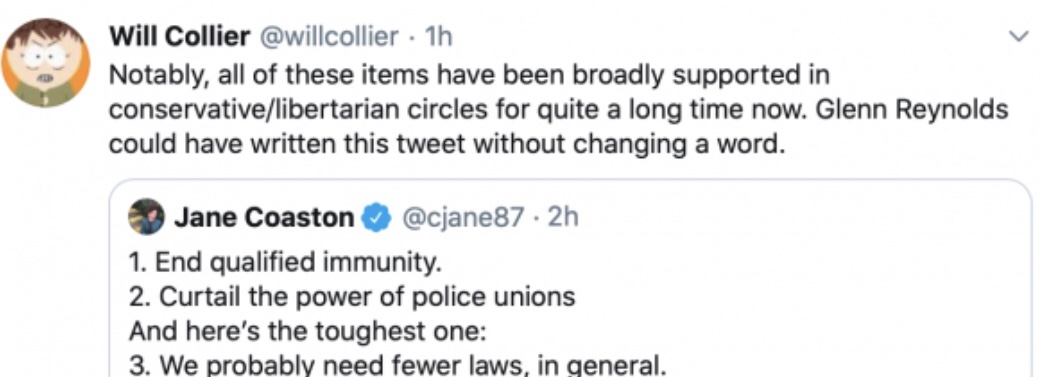
People of good faith oppose the brutality inflicted by bad cops and a system that tolerates them. It is surely time for some reforms, as the following suggests:

And there are still other promising criminal justice reforms to consider. We need to end the drug war, which is particularly harmful to minority communities.

I bemoan the poor circumstances and education that have burdened many of the disaffected protesters, and even the rioters. I advocate for policies that I believe promote improved education and family stability. I have advocated for a safety net. I have shared my distaste for the unnecessary COVID-19 lockdowns that forced so many of these individuals out of their jobs for several months. But from some quarters, the demands have no end. Not until I bow down on my hands and knees to apologize for the sins of generations past. Who cares if they weren’t my ancestors? I’m white! The next demand is reparation payments to today’s generations of blacks. Don’t complain that impoverished whites won’t share in the gains, though there are more than twice as many of them. They simply failed to capitalize on the opportunity afforded by their privilege. I’m sorry for the sarcasm….

Please mourn George Floyd’s horrible death and support the protests against the brutality that killed him, but do not pretend for a moment that the violence is in any way justified, or that it will create a healthier society. Don’t root for that shit. And don’t cast aspirations at your fellow men and women as if the color of their skin is responsible for the social ills you’ve taken up as a cause. It does nothing to further solutions.

Suspending Medical Care In the Name of Public Health

23 Saturday May 2020

Posted by Nuetzel in Health Care, Pandemic

≈ 3 Comments

Tags

Asian Flu, Comorbidities, Coronavirus, Covid-19, Get Outside, Hong Kong Flu, Imperial College Model, Italy, Lockdowns, Mortality by Age, Mortality Rates, Neil Ferguson, New York, Organ Failure, Pandemic, Public Health, Slow the Spread, South Korea, Spanish Flu, Suicide Hotlines, Vitamin D Deficiency

Step back in time six months and ask any health care professional about the consequences of suspending delivery of most medical care for a period of months. Forget about the coronavirus for a moment and just think about that “hypothetical”. These experts would have answered, uniformly, that it would be cataclysmic: months of undiagnosed cardiac and stroke symptoms; no cancer screenings, putting patients months behind on the survival curve; deferred procedures of all kinds; run-of-the-mill infections gone untreated; palsy and other neurological symptoms anxiously discounted by victims at home; a hold on treatments for all sorts of other progressive diseases; and patients ordinarily requiring hospitalization sent home. And to start back up, new health problems must compete with all that deferred care. Do you dare tally the death and other worsened outcomes? Both are no doubt significant.

What you just read has been a reality for more than two months due to federal and state orders to halt non-emergency medical procedures in the U.S. The intent was to conserve hospital capacity for a potential rush of coronavirus patients and to prevent others from exposure to the virus. That might have made sense in hot spots like New York, but even there the provision of temporary capacity went almost completely unused. Otherwise, clearing hospitals of non-Covid patients, who could have been segregated, was largely unnecessary. The fears prompted by these orders impacted delivery of care in emergency facilities: people have assiduously avoided emergency room visits. Even most regular office visits were placed on hold. And as for the reboot, there are health care facilities that will not survive the financial blow, leaving communities without local sources of care.

A lack of access to health care is one source of human misery, but let’s ask our health care professional about another “hypothetical”: the public health consequences of an economic depression. She would no doubt predict that the stresses of joblessness and business ruin would be acute. It’s reasonable to think of mental health issues first. Indeed, in the past two months, suicide hotlines have seen calls spike by multiples of normal levels (also see here and here). But the stresses of economic disaster often manifest in failing physical health as well. Common associations include hypertension, heart disease, migraines, inflammatory responses, immune deficiency, and other kinds of organ failure.

The loss of economic output during a shutdown can never be recovered. Goods don’t magically reappear on the shelves by government mandate. Running the printing press in order to make government benefit payments cannot make us whole. The output loss will permanently reduce the standard of living, and it will reduce our future ability to deal with pandemics and other crises by eroding the resources available to invest in public health, safety, and disaster relief.

What would our representative health care professional say about the health effects of a mass quarantine, stretching over months? What are the odds that it might compound the effects of the suspension in care? Confinement and isolation add to stress. In an idle state of boredom and dejection, many are unmotivated and have difficulty getting enough exercise. There may be a tendency to eat and drink excessively. And misguided exhortations to “stay inside” certainly would never help anyone with a Vitamin D deficiency, which bears a striking association with the severity of coronavirus infections.

But to be fair, was all this worthwhile in the presence of the coronavirus pandemic? What did health care professionals and public health officials know at the outset, in early to mid-March? There was lots of alarming talk of exponential growth and virus doubling times. There were anecdotal stories of younger people felled by the virus. Health care professionals were no doubt influenced by the dire conditions under which colleagues who cared for virus victims were working.

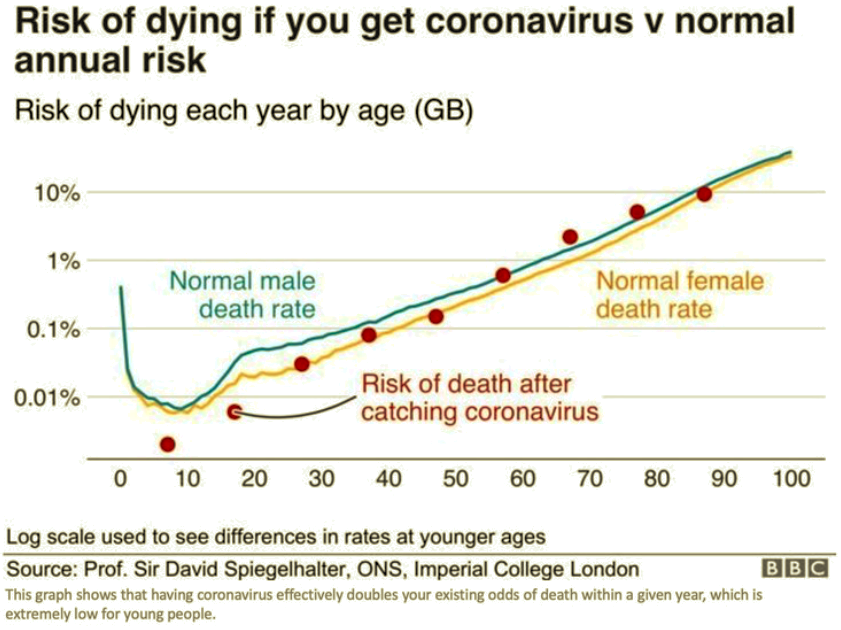
Nevertheless, a great deal was known in early March about the truly vulnerable segments of the population, even if you discount Chinese reporting. Mortality rates in South Korea and Italy were heavily skewed toward the aged and those with other risk factors. One can reasonably argue that health care professionals and policy experts should have known even then how best to mitigate the risks of the virus. That would have involved targeting high-risk segments of the population for quarantine, and treatment for the larger population in-line with the lower risks it actually faced. Vulnerable groups require protection, but death rates from coronavirus across the full age distribution closely mimic mortality from other causes, as the chart at the top of this chart shows.

The current global death toll is still quite small relative to major pandemics of the past (Spanish Flu, 1918-19: ~45 million; Asian Flu, 1957-58: 1.1 million; Hong Kong flu, 1969: 1 million; Covid-19 as of May 22: 333,000). But by mid-March, people were distressed by one particular epidemiological model (Neil Ferguson’s Imperial College Model, subsequently exposed as slipshod), predicting 2.2 million deaths in the U.S. (We are not yet at 100,000 deaths). Most people were willing to accept temporary non-prescription measures to “slow the spread“. But unreasonable fear and alarm, eagerly promoted by the media, drove the extension of lockdowns across the U.S. by up to two extra months in some states, and perhaps beyond.

The public health and policy establishment did not properly weigh the health care and economic costs of extended lockdowns against the real risks of the coronavirus. I believe many health care workers were goaded into supporting ongoing lockdowns in the same way as the public. They had to know that the suspension of medical care was a dire cost to pay, but they fell in line when the “experts” insisted that extensions of the lockdowns were worthwhile. Some knew better, and much of the public has learned better.

← Older posts
Newer posts →
Follow Sacred Cow Chips on WordPress.com

Recent Posts

  • Data Center Power Price Confusion
  • The Rise of the GOP “Common Good” Socialists
  • Trial Lawyers Reveal Preference For Less Safety
  • Funding Private Social Security Accounts
  • Chinese State, CCP, Cronies Exploit Wage Earners

Archives

  • September 2026
  • August 2026
  • July 2026
  • June 2026
  • May 2026
  • April 2026
  • March 2026
  • February 2026
  • January 2026
  • December 2025
  • November 2025
  • October 2025
  • September 2025
  • August 2025
  • July 2025
  • June 2025
  • May 2025
  • April 2025
  • March 2025
  • February 2025
  • January 2025
  • December 2024
  • November 2024
  • October 2024
  • September 2024
  • August 2024
  • July 2024
  • June 2024
  • May 2024
  • April 2024
  • March 2024
  • February 2024
  • January 2024
  • December 2023
  • November 2023
  • August 2023
  • July 2023
  • June 2023
  • May 2023
  • April 2023
  • March 2023
  • February 2023
  • January 2023
  • December 2022
  • November 2022
  • October 2022
  • September 2022
  • August 2022
  • July 2022
  • June 2022
  • May 2022
  • April 2022
  • March 2022
  • February 2022
  • January 2022
  • December 2021
  • November 2021
  • October 2021
  • September 2021
  • August 2021
  • July 2021
  • June 2021
  • May 2021
  • April 2021
  • March 2021
  • February 2021
  • January 2021
  • December 2020
  • November 2020
  • October 2020
  • September 2020
  • August 2020
  • July 2020
  • June 2020
  • May 2020
  • April 2020
  • March 2020
  • February 2020
  • January 2020
  • December 2019
  • November 2019
  • October 2019
  • September 2019
  • August 2019
  • July 2019
  • June 2019
  • May 2019
  • April 2019
  • March 2019
  • February 2019
  • January 2019
  • December 2018
  • November 2018
  • October 2018
  • September 2018
  • August 2018
  • July 2018
  • June 2018
  • May 2018
  • April 2018
  • March 2018
  • February 2018
  • January 2018
  • December 2017
  • November 2017
  • October 2017
  • September 2017
  • August 2017
  • July 2017
  • June 2017
  • May 2017
  • April 2017
  • March 2017
  • February 2017
  • January 2017
  • December 2016
  • November 2016
  • October 2016
  • September 2016
  • August 2016
  • July 2016
  • June 2016
  • May 2016
  • April 2016
  • March 2016
  • February 2016
  • January 2016
  • December 2015
  • November 2015
  • October 2015
  • September 2015
  • August 2015
  • July 2015
  • June 2015
  • May 2015
  • April 2015
  • March 2015
  • February 2015
  • January 2015
  • December 2014
  • November 2014
  • October 2014
  • September 2014
  • August 2014
  • July 2014
  • June 2014
  • May 2014
  • April 2014
  • March 2014

Blogs I Follow

  • Passive Income Kickstart
  • OnlyFinance.net
  • TLC Cholesterol
  • Nintil
  • kendunning.net
  • DCWhispers.com
  • Hoong-Wai in the UK
  • Marginal REVOLUTION
  • Stlouis
  • Watts Up With That?
  • American Elephants
  • The View from Alexandria
  • The Gymnasium
  • A Force for Good
  • Notes On Liberty
  • troymo
  • SUNDAY BLOG Stephanie Sievers
  • Miss Lou Acquiring Lore
  • Your Well Wisher Program
  • Objectivism In Depth
  • RobotEnomics
  • Orderstatistic
  • Paradigm Library
  • Scattered Showers and Quicksand
  • Jam Review

Blog at WordPress.com.

Passive Income Kickstart

OnlyFinance.net

TLC Cholesterol

Nintil

To estimate, compare, distinguish, discuss, and trace to its principal sources everything

kendunning.net

The Future is Ours to Create

DCWhispers.com

Hoong-Wai in the UK

A Commonwealth immigrant's perspective on the UK's public arena.

Marginal REVOLUTION

Small Steps Toward A Much Better World

Stlouis

Watts Up With That?

The world's most viewed site on global warming and climate change

American Elephants

Defending Life, Liberty and the Pursuit of Happiness

The View from Alexandria

In advanced civilizations the period loosely called Alexandrian is usually associated with flexible morals, perfunctory religion, populist standards and cosmopolitan tastes, feminism, exotic cults, and the rapid turnover of high and low fads---in short, a falling away (which is all that decadence means) from the strictness of traditional rules, embodied in character and inforced from within. -- Jacques Barzun

The Gymnasium

A place for reason, politics, economics, and faith steeped in the classical liberal tradition

A Force for Good

How economics, morality, and markets combine

Notes On Liberty

Spontaneous thoughts on a humble creed

troymo

SUNDAY BLOG Stephanie Sievers

Escaping the everyday life with photographs from my travels

Miss Lou Acquiring Lore

Gallery of Life...

Your Well Wisher Program

Attempt to solve commonly known problems…

Objectivism In Depth

Exploring Ayn Rand's revolutionary philosophy.

RobotEnomics

(A)n (I)ntelligent Future

Orderstatistic

Economics, chess and anything else on my mind.

Paradigm Library

OODA Looping

Scattered Showers and Quicksand

Musings on science, investing, finance, economics, politics, and probably fly fishing.

Jam Review

"If you get confused, listen to the music play."

  • Subscribe Subscribed
    Sacred Cow Chips
    Join 128 other subscribers

    Have a WordPress.com account? Log in now.

  • Sacred Cow Chips
    View site in Reader
    Manage subscriptionsSign upLog in
    Report this content
    Collapse this bar
Loading Comments...